Showing posts sorted by relevance for query ALL SAINTS DAY. Sort by date Show all posts

Sunday, November 09, 2025

Joyful Day of the Dead commemorations rally US Latino communities despite immigration raid fears

MINNEAPOLIS (AP) — These crucial religious, family and community celebrations for most Mexicans and many other Latin Americans have taken on special significance this year in U.S. Latino communities, as the Trump administration escalates immigration enforcement raids, including in Minnesota.


Giovanna Dell'orto
November 3, 2025

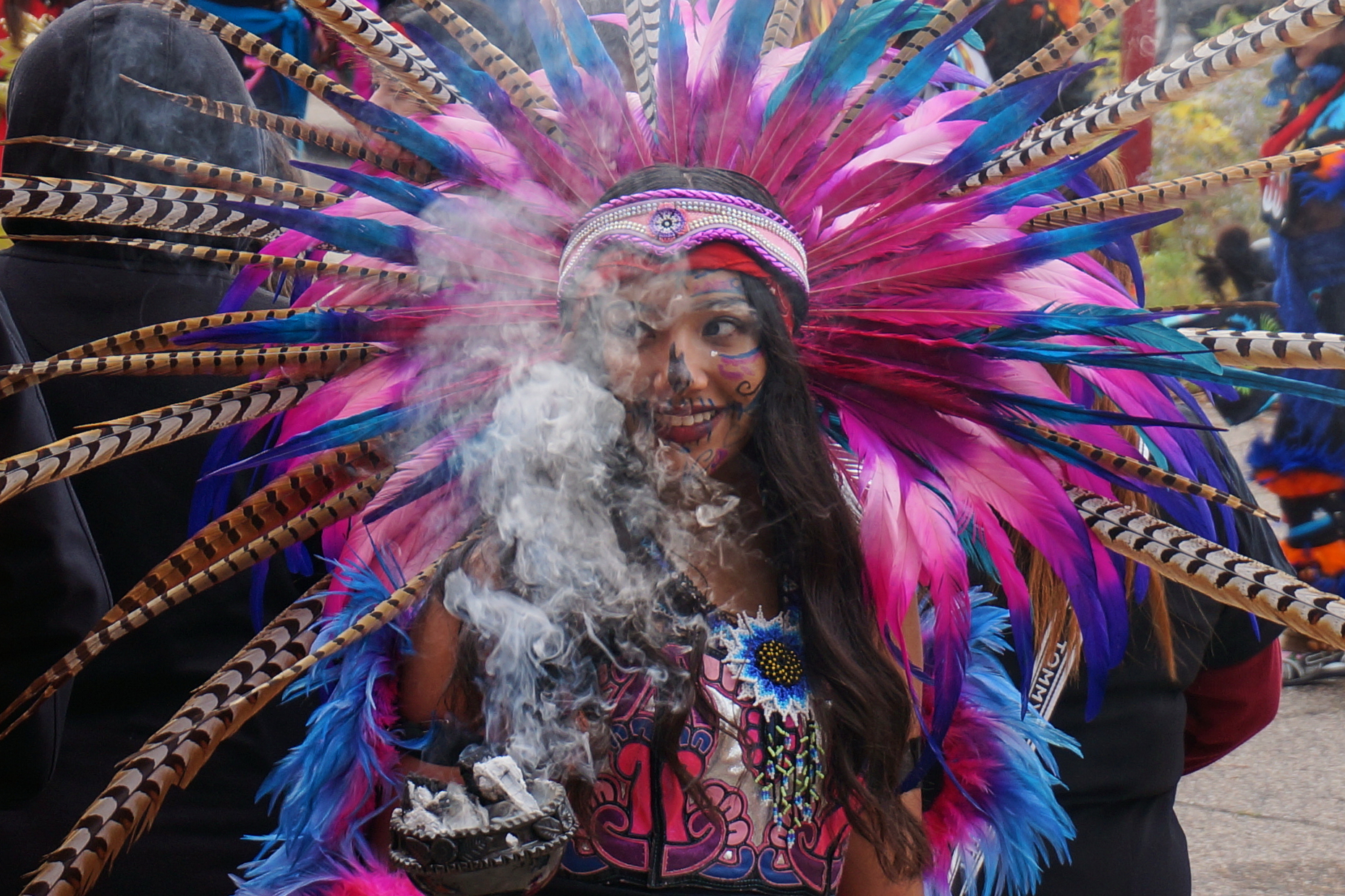
MINNEAPOLIS (AP) — More than 100 people followed Aztec dancers through an arch of paper flowers into El Colegio High School on Saturday morning to visit altars that students had created to commemorate Día de Muertos or Day of the Dead.

“It’s … a way of greeting our ancestors into our homes, back into our lives, even if they’re like not here physically, but spiritually,” said Daniela Rosales, a senior at the small, bilingual school in Minneapolis. “It’s a way of just having the community come all together and knowing that in some way they might feel safe.”

These crucial religious, family and community celebrations for most Mexicans and many other Latin Americans have taken on special significance this year in U.S. Latino communities, as the Trump administration escalates immigration enforcement raids, including in Minnesota.

While some organizers worried that fears of deportation would cast a pall on public celebrations, participants turned out in droves in cities big and small, saying the rituals brought a much-needed sense of resilience and community pride.

“We decided we can’t cave,” said Justin Ek, one of the founders of the Day of the Dead festival in Mankato, a city in the Minnesota farmland. “Our cultural celebrations are what we need to fill our souls for what’s to come.”

The Indigenous Latino artist’s family started a small commemoration in the parking lot of their painting business in 2018. This year, some 12,000 people joined the daylong celebration that included live music and several dozen papier-mâché sculptures of Catrinas (elaborately dressed skeletons) and fantasy creatures called alebrijes. Most activities were funded by community donations.

Grieving, but with happiness: The spiritual side of Day of the Dead

Ek’s father came to the U.S. from Mexico as a preteen, and in the struggle to make a living and eventually build a family, many connections with his homeland and relatives there disappeared, Ek said.

Day of the Dead festivities became a way to grieve that and rekindle some ties, he added, in addition to commemorating more recent family deaths.

“It’s our way to honor what we lost,” Ek said.

The holiday’s balance of joyful remembrance and a renewed sense of presence distinguishes it from both the outright party atmosphere of Halloween and the somber memorials of the Christian holy days of All Saints on Nov. 1 and All Souls’ Day on Nov. 2.

In fact, Day of the Dead evolved over centuries from Indigenous practices across the Americas, and only settled on these fall dates after Catholicism was introduced, said Cary Cordova, a University of Texas professor.

Different regions mark it with unique details, but the crucial element is paying homage to the dead with “ofrendas,” festive offerings of food, drinks, music and pastimes favorite by the dead. Their souls, many believe, return for a visit, guided by the candles and marigold flowers that mark the path to the ofrendas.

Whether in his Mexican childhood or today in Mankato, Luis Alberto Orozco said the key is to commemorate by “having fun as they would be” — with the departed’s favorite snacks and songs.

“It’s remembering people who passed on positively because they would want us to remember them happy … and making ourselves feel they’re with us,” Orozco said.

Joyful and prideful commemorations defy fears of immigration enforcement

As the emcee of this year’s celebration, Orozco reflected on tense conversations in recent months about whether the event in Mankato might draw immigration enforcement raids, especially as rumors spread on social media.

“We decided we were not going to be afraid. It was important for us to keep our faith,” he said. “Once I got to the event and saw all the people smile, all the fears went away.”

The recent crackdown on illegal immigration in Chicago has generated controversy and stirred fears across that city.

Lisa Noce, some of whose ancestors immigrated from Mexico to Chicago’s Pilsen neighborhood where she grew up, worried people would stay away from a Day of the Dead installation she helped create by the National Museum of Mexican Art there. But a big crowd came.

“I’m very thankful that it turned out that way,” she said, adding that she also sets up a smaller ofrenda in her kitchen with candy, Barbie dolls, and smiling photos of deceased family members.

‘Ofrendas’ range from family shrines to political statements

For more than a century, Day of the Dead artistic representations have also moved from the family to the public sphere.

Starting in Mexico and later through the Chicano rights movement in the United States, ofrendas have also become a form of protest covering often marginalized victims, said Luis Fitch, a Minneapolis artist who has created Day of the Dead images for retail giant Target and the U.S. Postal Service.

In Los Angeles, site of some of the strongest enforcement actions, a group advocating for detained migrants planned for Sunday a prayer with Buddhist, Jewish and Protestant Christian rituals as well as altars commemorating those who died in detention, said the Rev. Jennifer Gutierrez, one of the organizers.

“There’s pretty high anxiety,” said Gutierrez, a United Methodist minister. “But also an atmosphere of coming together to help each other.”

Back at El Colegio High School, the half dozen altars with flickering candles, decorated candy skulls and a profusion of paper flowers commemorated local and global losses.

There were pictures of the children killed at a school Mass just 3 miles (5 kilometers) away, but also those who died crossing the U.S-Mexican border as well as victims of the terror attacks on 9/11, the war in Gaza and violence against Indigenous women.

“We try to keep our sources of spiritual strength always nourished,” said Susana De Leon, one of the traditional Aztec dancers who got the commemoration started at El Colegio.“When the community sees us dancing, they feel strengthened. They feel the love.”


Halloween and a declining Christian tradition coexist on All Saints' Day in Spain

MADRID (AP) — The sobriety of the Catholic tradition, by which on All Saints' Day graves are cleaned and flowers are brought to cemeteries to spend time with deceased loved ones, has given way in recent years to sweets, fake blood, and spider webs from one of the most iconic holidays in the United States.


Alicia Leon and Teresa Medrano
November 3, 2025

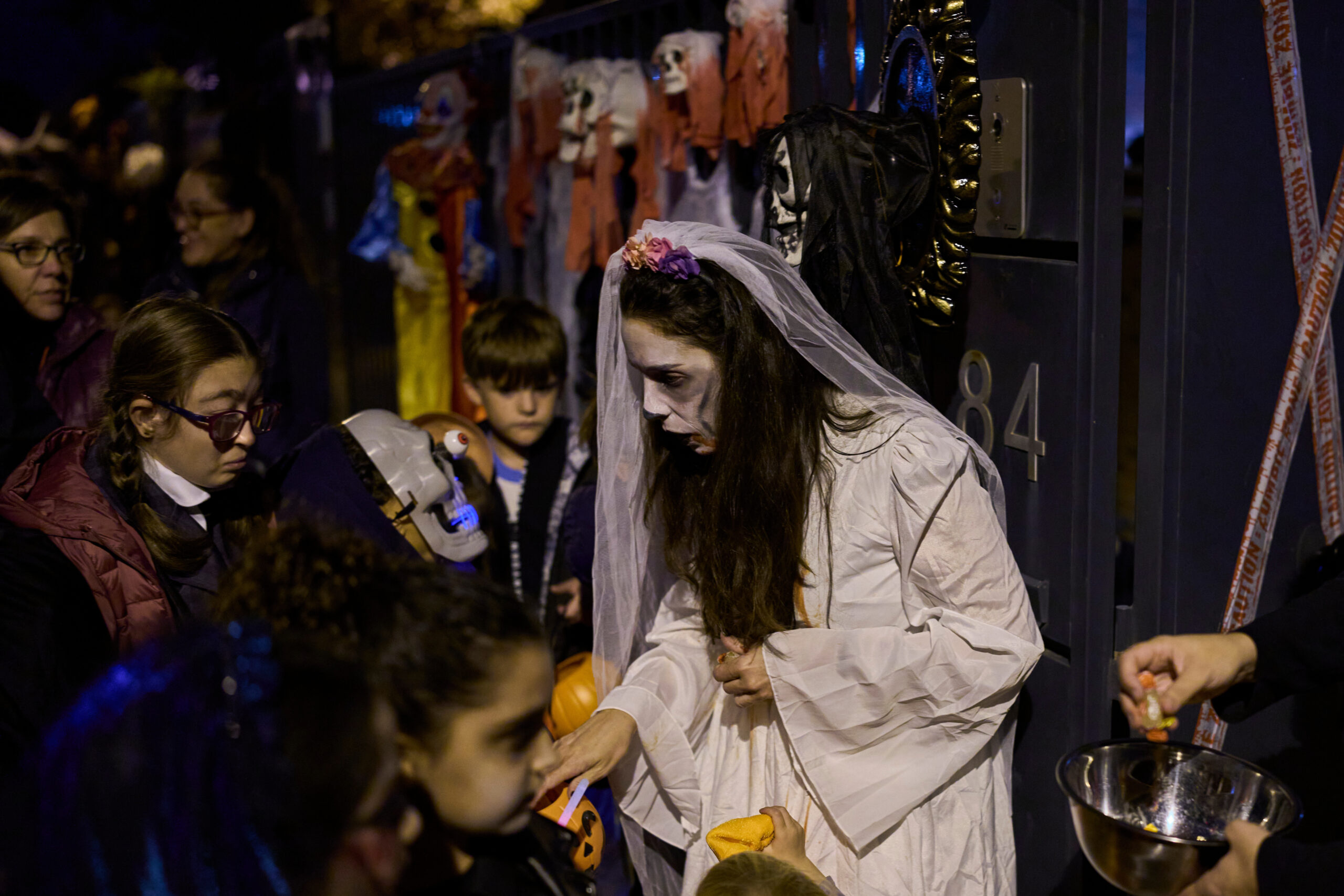
MADRID (AP) — Skeletons, ghosts, and monsters of all kinds took to the streets of many cities in Spain at nightfall to celebrate Halloween. The next morning, an older generation flocked to the country’s cemeteries to remember their dead.

The sobriety of the Catholic tradition, by which on All Saints’ Day graves are cleaned and flowers are brought to cemeteries to spend time with deceased loved ones, has given way in recent years to sweets, fake blood, and spider webs from one of the most iconic holidays in the United States.

As in many other parts of the world, instead of their own ancestral traditions, younger people have embraced the more commercial side of a celebration that originated from the pagan festival of Samhain, which honored the end of summer and the harvest. And it does not appear that they will follow in the footsteps of their elders.

The cultural change did not happen overnight, but is a consequence of the secularization of societies, explained José Bobadilla, a sociologist specialized in culture and religious diversity.

“Obviously, the process of a new, more Americanized culture has had an influence not only in Europe,” said Bobadilla, who noted that the current celebration, which is spreading throughout the world, “downplays the idea that it is a time to remember those who are no longer with us.”

The Almudena cemetery in Madrid, the largest in Spain with some five million people buried there, began receiving its first visitors early in the morning.

At the main entrance, several flower stalls waited with bouquets ready for those who left the arrangement of the graves to the last minute.

“We always come on (Nov) 1st,” said Alicia Sánchez, a 69-year-old retiree who lamented the loss of tradition due to a lack of interest among younger people.

“I don’t like Halloween because it’s not our holiday. But everyone has their traditions, and that should be respected,” she said.

Paz Sánchez visited her husband’s grave with his son, as they do on many other days. This time, however, they were surprised to see so few people despite it being the busiest day of the year.

“Maybe they don’t feel like getting up early to come to the cemetery,” said Sánchez, 87.

A few hours earlier, as in the last decade, Paracuellos de Jarama, a town about 30 kilometers (18.6 miles) northeast of Madrid, dressed up for Halloween.

It started with just a few neighbors, but now dozens of houses are decorated with pumpkins and ghosts, there is a haunted passageway, and hundreds of people roam the streets trick-or-treating.

Miguel Izquierdo transformed his family home into a pirate ship with recycled wood for the hull and an old sheet as a sail. The lights, music, and 30 kilos (66 pounds) of candy, which ran out in less than two hours, made it one of the most popular.

After three years, they continue to participate “because of how much fun the children have,” said Izquierdo, 42, who runs an audiovisual production company. “We like it because it’s a party, because it’s a costume party, and because there’s candy.”

“I don’t dislike the party, but I think it’s not part of our traditions,” said Antonia Martín, 68, who celebrated Halloween – without costume – for the first time for her grandchildren.


Associated Press religion coverage receives support through the AP’s collaboration with The Conversation US, with funding from Lilly Endowment Inc. The AP is solely responsible for this content.

Thursday, November 02, 2023

Opinion
This All Souls’ Day, experience moments of connection with those who have gone before us

This is an intentional act of cultivating relationship with our ancestors.

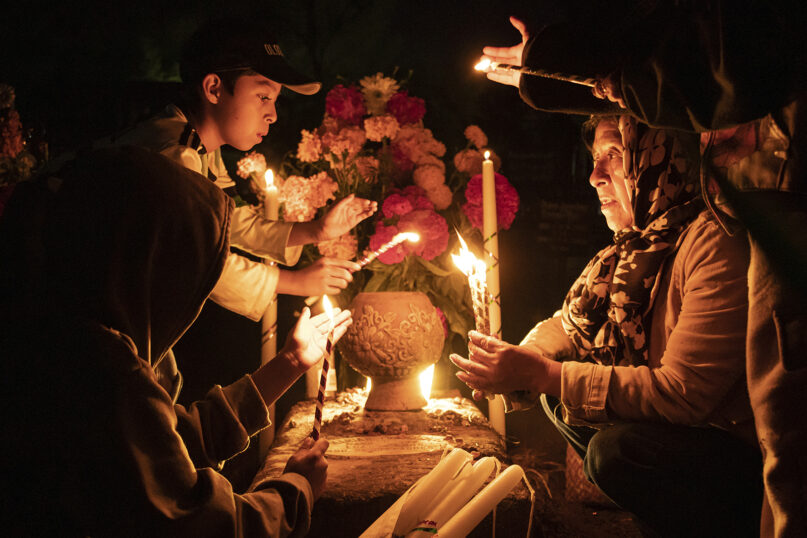
People hold candles over a tomb decorated with flowers at a cemetery in Atzompa, Mexico, Oct. 31, 2023. In a tradition that coincides with All Saints’ Day on Nov. 1 and All Souls’ Day on Nov. 2, families decorate graves with flowers and candles and spend the night in the cemetery, eating and drinking as they keep company with their dearly departed.
(AP Photo/Maria Alferez)

(RNS) — In Celtic tradition there are many moments considered to be a “thin time,” which means that heaven and earth feel closer and we might experience moments of connection to those who have gone before us in ways that we don’t usually.

These moments include the daily portals of dawn and dusk as the world moves from dark to light and back to dark again. They also include the eight threshold moments of the year, which are the solstices, the equinoxes and the cross-quarter days that fall between the solstices and equinoxes. Of these eight, Samhain, which falls on Nov. 1, is considered to be the thinnest time, when the ancestors and spirits walk among us. The door between the spiritual and the physical is even further open than at other times.

Samhain is the start of the dark half of the year. It is the season of rest, incubation and mystery. It is the season of dreamtime and the perfect time of year to open your heart to connect with those who journeyed before you. Winter invites us to gather inside, grow still with the landscape and listen for the voices we may not hear during other times of the year. These may be the sounds of our own inner wisdom or the voices of those who came before us.

Listen for the messages of the ancestors in those days especially — they will speak their wisdom through raven and stone, tree and rain, dreams and synchronicities. This is the language through which we receive these gifts and only need to open ourselves to them.

The Celtic feast of Samhain coincides with the Christian celebration of All Saints’ Day on Nov. 1 and All Souls’ Day on Nov. 2, which begin a whole month in honor of those who have died. We tend to neglect our ancestral heritage in our Western culture, but in other cultures, remembering the ancestors is an intuitive and essential way of beginning anything new. We don’t recognize the tremendous wisdom we can draw on from those who have traveled the journey before us and whose DNA we carry in every fiber of our bodies.

Ritual has a way of bridging the gap between the visible and invisible worlds and between the conscious and unconscious knowing. We can open ourselves to communication from our grandmothers and grandfathers. What we work on consciously through ritual and prayer has an impact in the world of the ancestors. Ritual is the intentional cultivation of relationship, but communication happens in spontaneous ways as well.

In Christian ritual and liturgy, there is the celebration on the Feasts of All Saints and All Souls. Some churches keep a Book of the Dead, in which the names of loved ones who died are written and kept near the altar so they may be remembered at Masses throughout November.

November is the month of the dead, and churches often have special Masses of remembrance throughout the month as well as setting up a special ancestral altar somewhere in the church space where members can bring photos, flowers and other offerings. Many churches also have votive candles available all year, which people can light either as a prayer for themselves or another or in remembrance of a loved one.

In medieval Europe, there were many practices for All Souls’ Day, including creating altars, celebrating requiem Masses, lighting candles and bonfires, visiting graves, ringing bells and making soul cakes, which were small, round, spiced loaves to commemorate the dead that were given out to people who came door to door.

Ad Choices Icon

We communicate with ancestors much in the way we would communicate with angels and saints — through dreams, visions, synchronicity, nature, ritual and imagination. We call upon them through prayer, we honor them through ritual offerings, and we ask them for guidance.

Henri Nouwen offers us this wisdom: As we grow older we have more and more people to remember, people who have died before us. It is very important to remember those who have loved us and those we have loved. Remembering them means letting their spirits inspire us in our daily lives. They can become part of our spiritual communities and gently help us as we make decisions on our journeys. Parents, spouses, children and friends can become true spiritual companions after they have died. Sometimes they can become even more intimate to us after death than when they were with us in life. Remembering the dead is choosing their ongoing companionship.

I especially love that final sentence: “Remembering the dead is choosing their ongoing companionship.” This is an intentional act of cultivating relationship.

The first fundamental blessing we can offer gratitude for is the gift of life itself. No matter what kind of family we came from, no matter how much suffering was caused, there is the fundamental impulse toward life that we can celebrate. We can give thanks for being here, being fully alive and even having the privilege of taking time to do this healing work: to explore spiritual practices and to ponder what makes our lives meaningful. Many of our ancestors never had that luxury.

Many worked very long hours for little reward and were never able to pause and ask themselves how their own generational connection could bring more wisdom to their lives.

I like to remember as well that in the midst of my ancestors’ struggles there was at least some resilience and courage developed that I have inherited. This is the second fundamental blessing we can offer gratitude for. I may never know what they went through exactly, but I can sometimes feel their sturdiness and how they endured. They too lived through times of war and plague and economic struggle.

Sometimes when I go outside at night and can see the brilliance of the stars, I remember that my ancestors also had moments of wonder and awe standing with their faces upturned toward the vast expanse of the universe. I remember that they too had moments of delight, of joy, of dancing, no matter how hard their lives were.

(Christine Valters Paintner is the author of “The Love of Thousands: How Angels, Saints, and Ancestors Walk With Us Toward Holiness” (Sorin Books), from which this column is adapted with permission. She is the online abbess for Abbey of the Arts, a virtual monastery offering classes and resources on contemplative practice and creative expression. The views expressed in this commentary do not necessarily reflect those of Religion News Service.)


Saturday, July 30, 2022

MORMONISM IS A CULT

A real Joseph Smith photo — or not? Why do Mormons care so much?

The polarized response to the photo reveals less about Joseph Smith than it does about us.

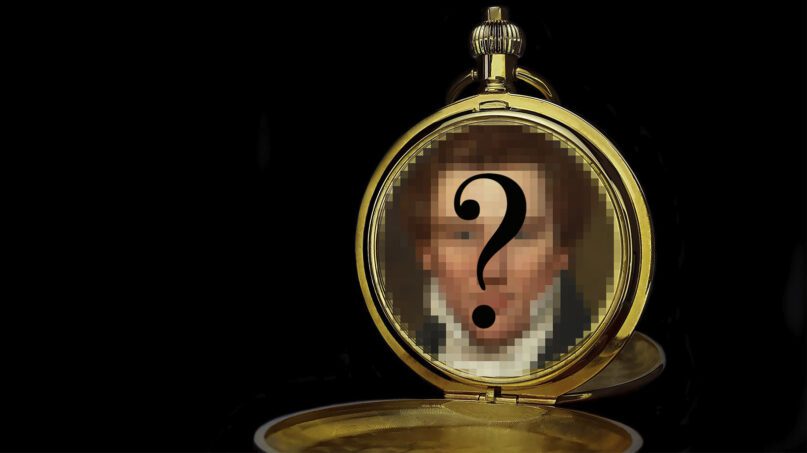
Opinions abound about a newly released image of Joseph Smith Jr. If the claim is accurate, it is the only known photograph of the prophet. RNS photo illustration

(RNS) — On July 21, Mormons were rocked by news that a great-great-grandson of Joseph Smith had discovered a daguerreotype he believes to be the only known photograph of the prophet.

Almost immediately, the Mormon social media world exploded.

Everyone, it seems, has an opinion about this. Even before they had read the John Whitmer Historical Association Journal article that lays out the considerable evidence supporting the claim, every rando on the internet was suddenly an expert on death masks, facial recognition software and the conventions of 19th-century portraiture.

People are saying he’s either too old or not old enough. He’s either too weathered and craggy or he’s been unforgivably yassified.

And the usual: He’s either a charlatan who was out to have sex with your daughters and steal all your money, OOOOOOOOOR he’s an angelic paragon of everything that is good.

See! The photo proves it. It’s all right there.


Over the last week I’ve been fascinated by the response — and the vehemence of that response — from various quarters of the Mormon world.

Occasionally, legitimate questions are raised about the evidence for authenticity, like this excellent post at Ardis Parshall’s Keepapitchinin blog, urging caution about hasty conclusions.

But for the most part, Mormon social media has not been filled with people using the best tools available to analyze and evaluate historical evidence, but people defaulting to their previously held views of Joseph Smith.

Sometimes, those are reaffirmations of faith — assertions that whether or not the photo is genuine, Joseph Smith was a bona fide prophet and servant of God.

And at the other end of the spectrum, some people utilized the photo to underscore how Smith was a schemer and a pervert.

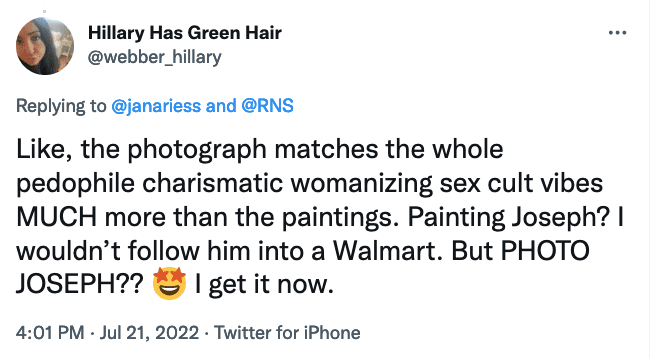
Among the people who appear to have budged in their prior assessments of Joseph Smith — people who actually changed their minds about him in some way because of the new image — are those who found the man in the photo, somewhat to their horror, more attractive than they expected.

Two of my favorite tweets were in this vein.


Meanwhile, there has been a growing Team Hyrum contingent. These people seem to agree the photo in question is probably a genuine daguerreotype made in Nauvoo in the 1840s and that it passed through the Smith family inside a locket for nearly 180 years. But they think the man in the image is Joseph’s brother Hyrum, who was killed by his side in 1844 and whose facial features appear similar, if their death masks are any indication.

All in all, the polarized response to the photo reveals less about Joseph Smith than it does about us.

Joseph Smith is a deeply divisive figure, and the same basic camps that existed in his own day to either revile or revere the man are alive and well in our own. He’s either a con artist or he’s a sainted martyr. A villain or a hero.

And in that sense, even if the daguerreotype is proved beyond a shadow of a doubt to be none other than Joseph Smith, it may make little difference one way or the other in how he is viewed. That’s because everyone who cares enough to have an opinion has already made up their mind.

AND HE STOLE THEIR HOLY UNDERWEAR FROM THE MASONIC INITIATION CEREMONY 

Mormonism and Freemasonry - Wikipedia

JOSEPH SMITH TABLE RAPPER AND SPIRITUALIST


Mormonism's Encounter with Spiritualism

Davis Bitton
Journal of Mormon History
Vol. 1 (1974), pp. 39-50 (12 pages)
Published By: University of Illinois Press
Journal of Mormon History 


Utah’s Pioneer Day celebrates Mormons’ trek west – but there’s a lot more to the
history of Latter-day Saints and migration

The Utah holiday is a reflection of The Church of Jesus Christ of Latter-day Saints’ slowly changing identity, a historian of Mormonism and migration writes.


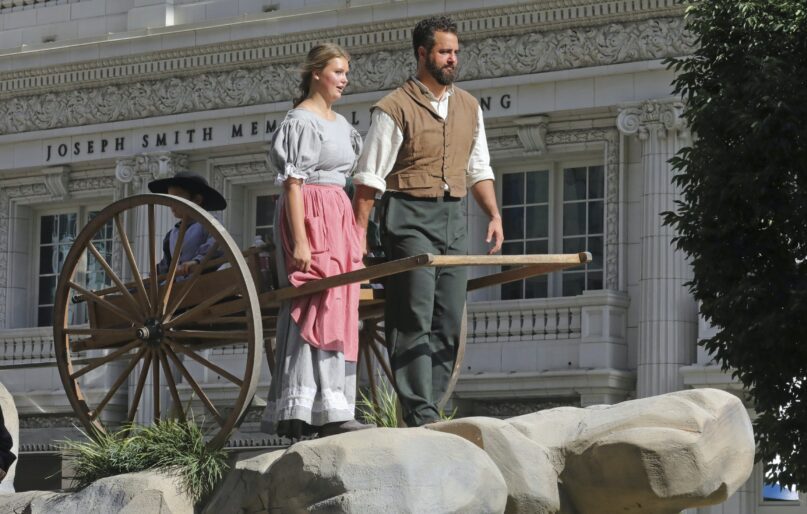
A couple rides on a float with a handcart during the parade for Pioneer Day, an annual Utah holiday, on July 24, 2019, in Salt Lake City. (AP Photo/Rick Bowmer)
July 22, 2022

By Jeffrey Turner

(The Conversation) — Each July 24, the state of Utah celebrates “Pioneer Day.” There are parades, rodeos, fireworks, a marathon, hikes and historical outfits, plus lots of red, white and blue – similar to the Fourth of July and other patriotic events in America.

Pioneer Day, however, commemorates something unique: the day Mormon migrants arrived in the Salt Lake Valley. The label “Mormon” refers to any church rooted in the teachings of founder Joseph Smith, although the largest of these, The Church of Jesus Christ of Latter-day Saints, has rejected the name in recent years.

The first Latter-day Saints to reach Utah had fled Illinois, more than 1,000 miles away. On July 24, 1847, after months on the trail, church president Brigham Young caught sight of the valley and proclaimed, “This is the right place.”

For Latter-day Saints, the holiday involves church activities like talks, dances, potlucks and sometimes reenacting pioneers’ experiences by walking along the “Mormon Trail” with handcarts. In Salt Lake City, there is a large parade called “Days of ‘47” with floats reflecting an annual theme related to pioneers.

As a historian who studies Mormon migration and immigration, I see the pageantry of Pioneer Day as a reflection of the church’s long, complicated relationships with race, nationalism and identity. Each year’s commemorations emphasize stories of hardship and heroism. However, they remember just one story of migration out of many in the diverse history of the church and the region.

Church on the move


Smith founded the LDS church in upstate New York in 1830. Ever since, its history has been one of movement.


Smith claimed to have received revelations and visions indicating that Latter-day Saints should gather to prepare for Jesus Christ’s Second Coming. The church taught that God would gather his people in a place called Zion – a word found in the Bible, often used to refer to Jerusalem or Israel – before Jesus’ return. By converting people to the LDS church and encouraging them 
to migrate together, 19th-century Latter-day Saints believed that they were building Zion.

KICKED OUT OF TOWN FOR POLYGAMY

In the faith’s first few decades, the LDS church changed headquarters several times, gathering in New York, then Ohio, then Missouri, then Illinois. Each time, their arrival prompted conflict with local communities that did not trust the new church – discrimination that sometimes broke into violence. After Smith, the founder, was killed by a local mob in 1844, Young led a large faction of Mormons on the long, difficult journey to Utah.

Western years

When Latter-day Saints arrived by the Salt Lake in 1847, the area was Mexican territory. The United States gained control of the territory the next year as part of the Treaty of Guadalupe Hidalgo, which ended the Mexican-American War and ceded Western lands to the United States.

It would be another half-century before Utah became a U.S. state, however. The territory was technically under U.S. control, but for the time being, Latter-day Saints celebrated their autonomy. As part of the effort to gather church members together, Young established a micro-loan system that financed converts’ migrations to Utah from both inside and outside the U.S.

Many did not trust the U.S. government, given the church’s previous experiences of discrimination. Nor did many Americans trust the LDS church, partially because of the practice of polygamy – which church leaders formally disavowed around the turn of the 20th century.

Some Americans in the 19th century considered Mormon immigrants to be racially nonwhite, although the vast majority were coming from Europe. Anti-immigrant sentiment was rising at the time, and critics sometimes conflated their fears about Mormon, Chinese and Muslim immigrants.

The U.S. federal government tried to stop Mormon immigration in a number of ways, such as forbidding people who supported polygamy from entering the country in 1891. Even so, hundreds of Latter-day Saints immigrated each year.
Overshadowed stories

Migration stories are a source of pride and identity for many Utahans, and Pioneer Day celebrations have a long history. Within two years of the first Latter-day Saints’ arrival in 1847, they started celebrating the anniversary with cannon salutes, music, bell ringing and speeches.

Later celebrations included reenactments. For the 50th anniversary in 1897, some celebrants reenacted part of the trek along the Mormon Trail and watched a procession of wagons and horse-drawn floats, a tradition that gradually formalized into the Days of ’47 parade.


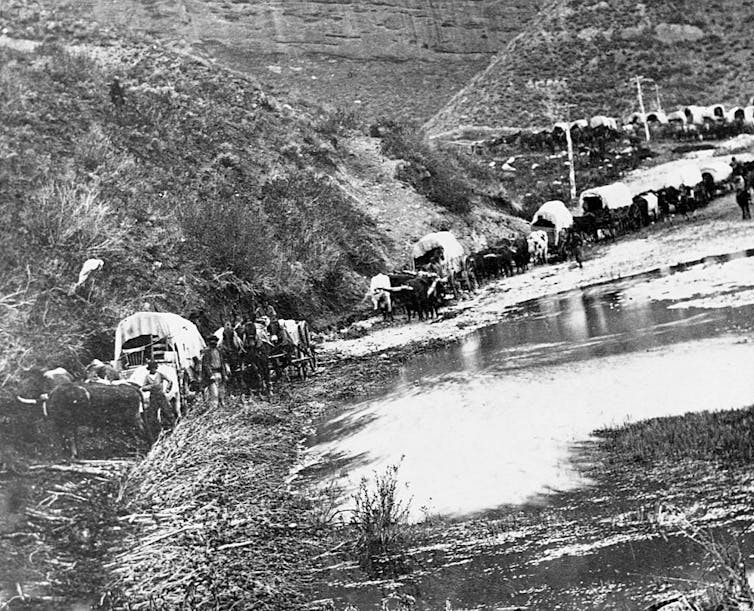
A covered wagon caravan of Mormon emigrants trying to cross a river in 1879.

Corbis Historical via Getty Images

To some, Pioneer Day symbolizes exclusion and forgetting – especially the church’s impact on Native Americans. In a 2019 op-ed, documentary filmmaker Angelo Baca and historian Erika Bsumek wrote that Pioneer Day “represents a key moment in the history of the colonization of the American West,” which caused “Utes, Paiutes, Shoshone, Goshute and Navajos” to lose “their homes, lands, and even, in some cases, their families.”

Pioneer Day is also the anniversary of the arrival of Black people, both enslaved and free, whose experiences have often been overlooked in Utah history.

However, monuments and written records have helped spark discussion about how to remember their legacy during the holiday.

As Latter-day Saint membership has grown more globally diverse, Pioneer Day celebrations have included more diverse pioneer narratives from the faith’s history. In recent years, church programs have also emphasized stories of how “pioneers” are building up the faith all around the world, not only in Utah.

As Utah and the church continue to become more diverse, Pioneer Day participants will continue to recover histories of migration, displacement and courage that shape their identity in the present through their remembrances of the past.

(Jeffrey Turner, Ph.D. Candidate in U.S. History, University of Utah. The views expressed in this commentary do not necessarily reflect those of Religion News Service.)

Tuesday, November 01, 2022

Here's what the Day of the Dead means, and why it endures

Albinson Linares, Noticias Telemundo - 


MEXICO CITY — José García López was sweating profusely as he stirred a cauldron of boiling oil in which dozens of potatoes were swimming, though his mind, he said, was on something else.

“When I’m done I’m going to buy the paper and candles that I need; I can’t let my grandparents down,” he said Friday afternoon, referring to the decorations he's going to make to honor his deceased relatives, as he spoke on the sidewalk of the Panteón Francés de la Piedad, an old cemetery in Mexico City.

García López is a street vendor who, like millions of Mexicans inside and outside the country, was getting ready to celebrate Día de los Muertos, or the Day of the Dead, a holiday in which Indigenous and Catholic traditions blend to honor loved ones who have died.

"I like that Mexicans do not forget our dead. In that way we are different," he said. "We live here, while relatives remember us."

The idea is magical and powerful: celebrating the dead for a few days while their souls return to Earth to share with the living. Nov. 1 honors deceased children and Nov. 2 focuses on adults.


The© Claudio Cruz

"In Mexico, Nov. 1 and 2 are very special days because they celebrate All Saints’ Day and All Souls’ Day, respectively," said Diana Martínez, an academic at the Institute of Anthropological Research at the National Autonomous University of Mexico, or UNAM.

Día de los Muertos is celebrated not just across Mexico, but also in U.S. cities such as Los Angeles and New York, where large offerings, parades and cultural events are held. Countries like Spain, the Philippines, Brazil and Guatemala, among others, also have traditions to celebrate their deceased.

Both public places and homes are filled with altars or offerings to commemorate loved ones with their favorite things, and decorations include cempasúchil flowers (marigolds), paper cut-outs, candles, salt, water, chocolate, sugar skulls, pan de muerto (bread of the dead) and the favorite foods and liquor of the deceased.

"It is a purely Catholic tradition that the Spaniards bring to Mexico and merges with the entire worldview or form of Mesoamerican thought. It is a festival that gives us belonging and unites us," Martínez said.

Popular beliefs vary depending on the Mexican region. Apart from Nov. 1 and 2, Oct. 28 is celebrated for those who died tragically or accidentally, and Oct. 30 is dedicated to those who died without being baptized and are in limbo.

From the 11th century to 'Coco' and 'Spectre'

The festivity dates back to the 11th century, when the abbot of Cluny created a special day to honor believers who died when Christianity was still considered a sect and persecutions and executions were frequent. By the 13th century, the Roman Catholic Church established Nov. 1 as All Saints’ Day.

In Spain, "the kingdoms of León, Aragón and Castile prepared sweets and breads similar to relics, which are the remains or bones of saints," Martínez said.

This ritual was combined with ancient festivals related to the end of the rainy season, harvest and drought. "It is that duality of abundance and scarcity, of life and death," she said.

Since before Spaniards and Christianity came to Latin America, Indigenous groups such as the Nahuas established rites and festivals that celebrated the deceased, as is the case of Miccailhuitontli, the Aztec Festival of the Little Dead.


The 23rd Annual Dia De Los Muertos at the Hollywood Forever Cemetery on Oct. 29, 2022, in Hollywood, Calif. (Emma McIntyre / Getty Images)© Emma McIntyre

The ancient Mexicans considered death a transition, not the end of existence but the beginning of the journey to Mictlan, the place of eternal rest in Aztec mythology.

Following the Mexican Revolution and the first years of independence, what it meant to be Mexican was re-evaluated, Martínez said, and that promoted a series of traditions such as the Day of the Dead. In the 1930s, President Lázaro Cárdenas promoted the celebration, trying to distance it a little from the Catholic Church and emphasizing its Indigenous, pre-Hispanic roots.

In 2008, UNESCO declared Día de los Muertos an Intangible Cultural Heritage of Humanity, and in recent years it has transcended borders, becoming a cultural phenomenon enhanced by movies such as Pixar's "Coco," which grossed more than $800 million worldwide.

The Day of the Dead was prominent in the memorable opening scene of the 2015 James Bond movie "Spectre," in which actor Daniel Craig seduces a catrina — the female skeleton — while running, jumping, shooting and exploding a building in the Historic Center of Mexico City during the Día de los Muertos parade.

It's a case in which reality imitates fiction because that parade had never been done, but now it's celebrated every year; in 2021 over 400,000 people participated.

"There are people who say that this is pure cultural marketing, but they don't understand that culture is culture because it changes, adapts and transforms," said Enrique Rodríguez Balam, a researcher at UNAM'S Peninsular Center for Humanities and Social Sciences in Mérida, Yucatán. "For me it is a triumph that this parade is popular and brings together thousands of people."

Altars, dancing, even cleaning bones

From Oct. 28, offerings begin to be made at altars, both public and private, and of all sizes. Although there are variations, there seems to be a consensus among experts about the shape of the altars: They are three steps or levels that, from bottom to top, represent the underworld, the earthly plane and the upper stage.

"Although it began with the saints and the faithful departed, now it has become popular to put movie stars, grandparents, saints and even pets," Martínez said. "In general, the offerings contain salt, water, copal (tree resin), candles, flowers, papel picado (paper cut-outs), skulls, photographs of loved ones and the deceased’s favorite dishes. Depending on the region there are changes. For example, in the Huasteca arches with flowers and fruits are placed that invite the dead to enter to the earthly world."

According to the National Institute of Indigenous Peoples, each element has a specific meaning.

Water is a symbol of life and is included so that the souls recover after their long journey. Since ancient times, salt has been an element of purification because, among other things, it helps prevent bodies from becoming corrupted.


The Day of the Dead parade on Oct. 30, 2022, in Brooklyn, N.Y. 
(Stephanie Keith / Getty Images)

The candles are light and guide the souls so they can return to their old places: The number of candles on the altar will depend on the souls that the family wants to receive. If the candles are placed in the shape of a cross, they represent the cardinal points so that souls can find their way home.

Copal or incense is used to cleanse places of evil spirits. In general, flowers adorn the room of the soul; marigolds are stripped in some places to make paths of petals and guide the deceased to the offering.

The izcuintle dog helps the souls to cross the powerful river before entering Mictlan. Bread is a Christian element that symbolizes "the Body of Christ," according to the Institute. Portraits of loved ones are the physical representation of those who are no longer on Earth, and their favorite dishes are also part of the celebration.

Some practices include making altars on tombstones. In some towns in Mexico there are dances with masks; it's believed that the souls of the dead temporarily take over the bodies of the living. In some towns in Guatemala, the celebrations lead to parties where people end up singing in cemeteries among the dead.

Few celebrations are as peculiar as those that take place in the Pomuch cemetery, in the Mexican state of Campeche, where the Cleaning of the Holy Remains takes place. In that town, the remains of loved ones rest in boxes at the cemetery and, every year, people gather to clean their relatives' bones.

'A beautiful tradition'

Mexican culture's fascination with and respect for death has been a recurring motif in the country’s literary tradition. Important writers such as José Revueltas, Carlos Fuentes, Octavio Paz and Juan Rulfo have reflected on this in their works.

"What is a fact is that the Mexican's obsession with mixing death with a celebration of rituals and daily life is something very much ours," Rodríguez Balam said, "and that is what draws attention in other parts of the world."


Raúl Flores, 57, is a gravedigger at the Panteón Francés de la Piedad cemetery. He lives among the bowels of the Earth where everything changes, even the notion of time — he measures time by how long it takes to dig pits.

“In this job we deal with so many things, and, in the end, death is something very, very common, right? It’s just one more step that all people, rich and poor, have to go through,” he said.

He's worked at the cemetery from a very young age and has witnessed many Día de los Muertos celebrations.

"It is a beautiful tradition, because people remember their grandparents, their parents, their brothers," he said. "It is not sad. Rather many times they look happy when they make the altars. People think that cemeteries are scary, but no. They are the quietest places."