Showing posts sorted by relevance for query SOPHIA. Sort by date Show all posts

Saturday, July 30, 2022

Russia’s invasion of Ukraine threatens a cultural heritage the two countries share, including Saint Sophia Cathedral

Saint Sophia Cathedral was built under the reign of Grand Prince Yaroslav, whose father, Volodymyr, converted the region to Christianity.
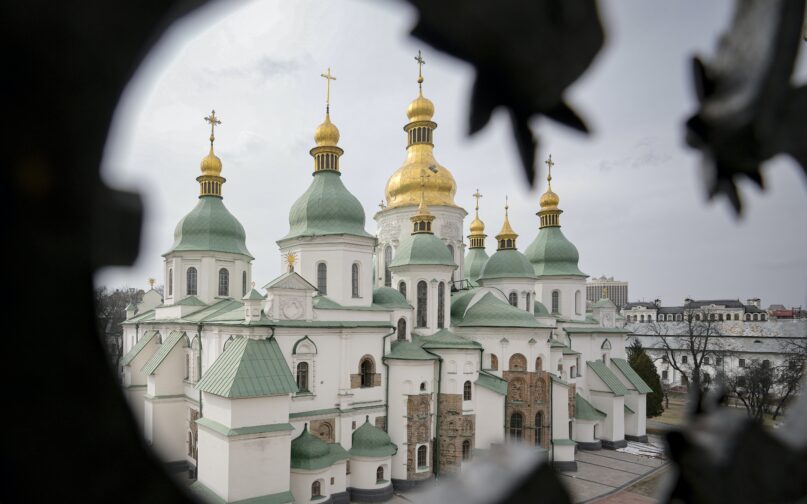
The Saint Sophia Cathedral as seen from a surrounding wall tower in Kyiv, Ukraine, on March 26, 2022. (AP Photo/Vadim Ghirda)

(The Conversation) — More than 160 Ukrainian cultural sites have been damaged or destroyed since Russia invaded the country in February 2022, according to UNESCO.

The Ukrainian government claims the number of damaged sites is far higher. Russia denies these charges.

Ukrainian officials accuse Russia of deliberately targeting cultural sites, half of which are churches, monasteries, prayer houses, synagogues and mosques. Such a targeting would be a violation of international law.

As a scholar who has spent over 30 years studying Russian and Ukrainian religion and culture, I’m deeply concerned about the cultural destruction of this war, which has already claimed thousands of lives and has turned over 12 million Ukrainians into refugees.

An important monument under threat is Saint Sophia Cathedral in Kyiv. Built in the 11th century, the church is one of Ukraine’s seven World Heritage sites recognized by the United Nations. It represents the common Orthodox Christian faith that many Russians and Ukrainians share.

Saint Sophia and the Byzantine model

Saint Sophia Cathedral was built under the reign of Grand Prince Yaroslav the Wise, whose father, Volodymyr – also known as Vladimir – had adopted Orthodox Christianity in 988.

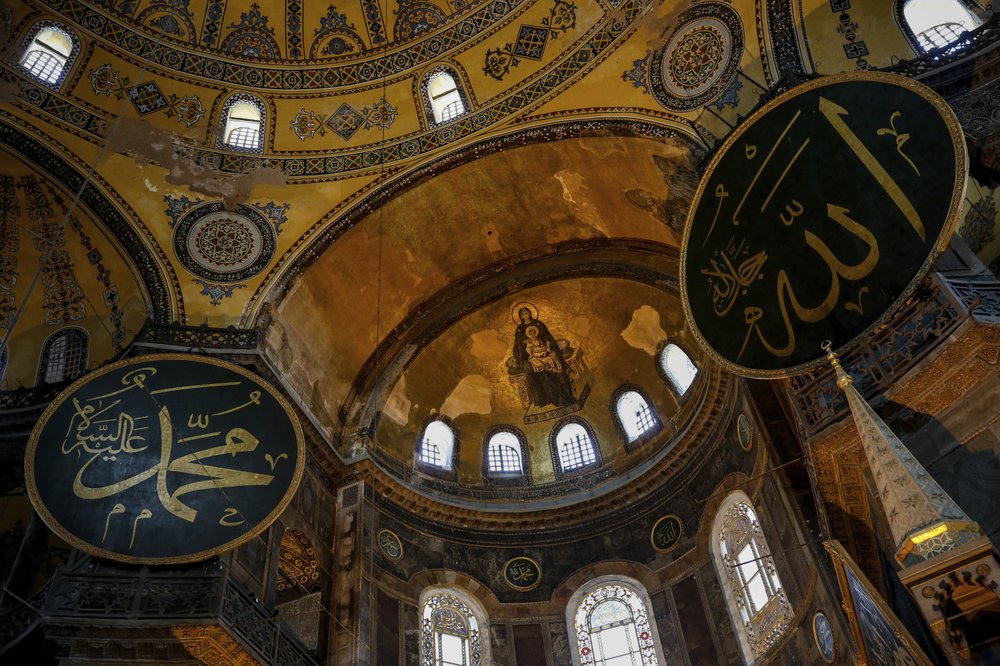
According to a legend in the early 12th-century “Primary Chronicle,” Volodymyr chose Orthodoxy for the beauty of its worship services. The envoys he sent to Constantinople, the capital of the Byzantine Empire, visited the famous Church of Holy Wisdom, the Hagia SophiaBuilt by Emperor Justinian in the sixth century, the Hagia Sophia is devoted to the Divine Wisdom, who is personified as a woman in the biblical “Book of Proverbs.” Convinced by his envoys’ favorable report, Volodymyr decided to be baptized and to convert his subjects.

After Volodymyr’s death, Yaroslav invited Byzantine architects and artists to build an impressive cathedral for Kyiv just like the Hagia Sophia in Constantinople. Yaroslav, who had fought a civil war to succeed his father, deliberately imitated the Byzantine capital to buttress his legitimacy. His new cathedral, Saint Sophia, even took its name from the imperial church in Constantinople.

Christian symbolism in the Cathedral

With 13 cupolas and a central dome that rises 29 meters (about 95 feet) into the air, Saint Sophia is an imposing structure that served as a testament to the power and piety of its ruler. Elaborate mosaics decorate the sanctuary and dome. Portraits of Yaroslav and his family are prominently displayed in the cathedral’s princely gallery, where the ruler attended services.
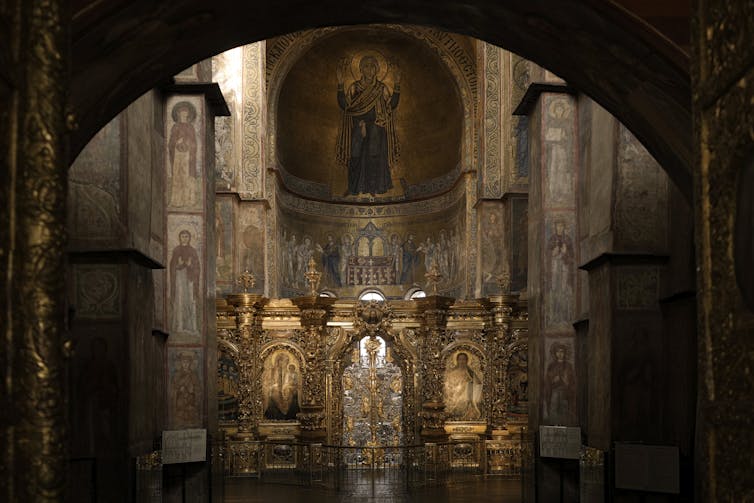
Mosaics adorning the inner walls of Saint Sophia Cathedral in Kyiv.

A view of the interior of Saint Sophia Cathedral.
AP Photo/Vadim Ghirda

mosaic of the Virgin Mary, the Mother of God, stands in the apse above the altar. Raising her hands in prayer, Mary is framed by a Greek inscription from Psalm 46: “God is in the midst of Her; She shall not be moved.”

The imagery and language are borrowed from Byzantium. Just as she was seen as a powerful divine protector of Constantinople, so now Mary protects Kyiv. The tall central dome is adorned with a mosaic of an all-powerful image of Christ, known as “Christ Pantokrator,” who gazes down from his throne at his worshipers.

The art historian Elena Boeck calls Saint Sophia “the most ambitious Orthodox Church built in the 11th century.”

Decline and restoration

Saint Sophia Cathedral was consecrated in 1049 and completed around 1062. As the power and importance of Kyiv declined, the church suffered from external attacks and internal neglect.

In 1169, the northern prince Andrei Bogolubskii of Vladimir sacked Kyiv – an event that the leader of the Orthodox Church of Ukraine, Metropolitan Epifaniy, has compared to the current Russian invasionMongol attacks in 12401416 and 1482 further damaged the cathedral.

Restoration work in the 17th century in the baroque style radically changed the cathedral’s outward appearance. The outer walls were plastered and whitewashed. The church was bombed during the Russian civil war in 1918. Under Soviet rule, the Communists plundered its treasury and secularized the building, which became a museum. In the 1940s, the church again suffered under German occupation.

Saint Sophia Cathedral stands as a monument to the East Slavic cultural heritage that Russians and Ukrainians share. Its extraordinary Byzantine mosaics and frescoes have survived nearly a millennium.

Today, as during the Second World War, Ukraine has been invaded by a foreign army that threatens this heritage. Although Russia has assured the United Nations that its armed forces are taking “necessary precautions” to prevent damage to World Heritage sites, such as Saint Sophia, war is destructive and unpredictable. Whether Saint Sophia Cathedral remains undamaged during this latest invasion remains an open question.

(J. Eugene Clay, Associate Professor of Religious Studies, School of Historical, Philosophical and Religious Studies, Arizona State University. The views expressed in this commentary do not necessarily reflect those of Religion News Service.)

Thursday, May 16, 2024


Sophia the AI robot gives commencement speech at New York college. Some grads weren't so pleased
.
Jonathan Limehouse, USA TODAY
Updated Thu, May 16, 2024 

Commencement speeches are typically given by celebrities, government officials, tenured professors or other notable individuals, but D'Youville University in Buffalo, New York did not hand the microphone to a human being during its spring ceremony over the weekend.

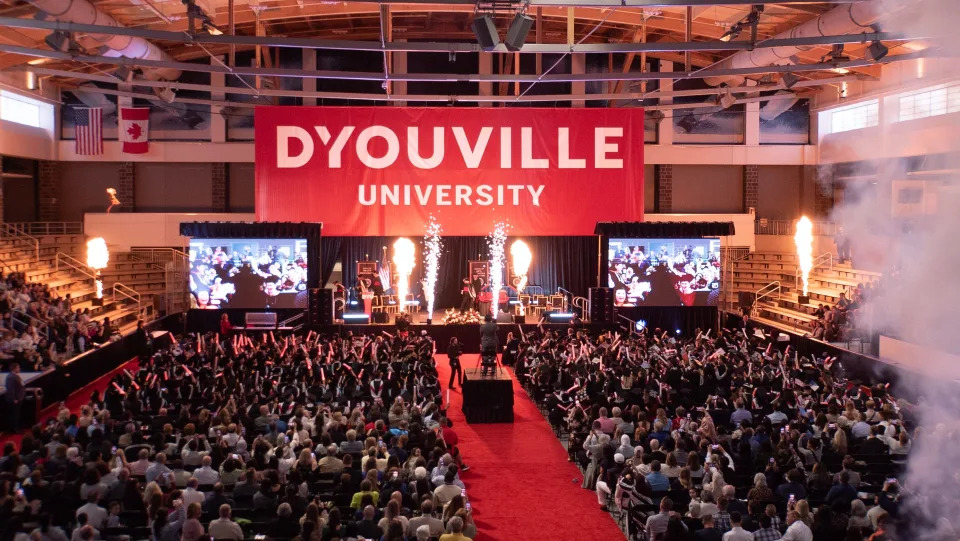
The private university opted to have an artificially intelligent robot named Sophia speak on Saturday to the over 2,000 people in attendance, including graduates, faculty members and families.

Before Sophia addressed graduates, D'Youville shared a Facebook post on April 25 saying the school is "embracing technology" by allowing the robot, who's appeared on "The Tonight Show Starring Jimmy Fallon," to be its commencement speaker.

"Sophia is expected to provide the 'last lecture' about the students' accomplishments through the year with an interview-style discussion with John Rizk, D’Youville University Student Government Association president, and candidate in the accelerated Doctor of Pharmacy (PharmD) degree program," the Facebook post said.

The speaker wasn't well-received by everyone, however, with some students creating a petition to replace the robot with a human.

"A major role of higher education is to be an incubator for innovation, and to prepare students for both the opportunities and challenges of the future," D'Youville University President Lorrie Clemo is quoted in the social media post.

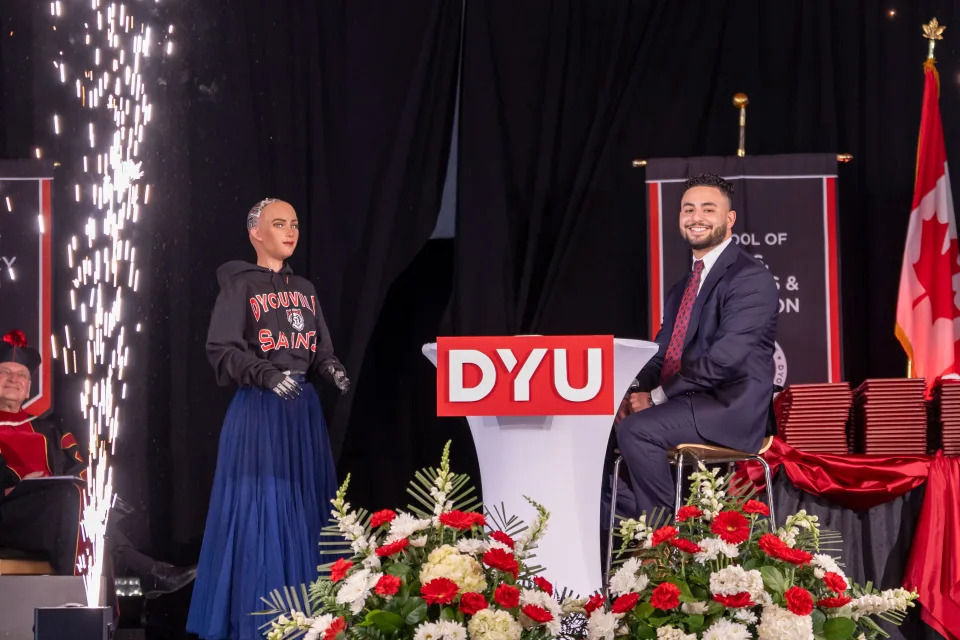
Sophia the humanoid robot and John Rizk, D’Youville University Student Government Association president, at the private institution's spring commencement ceremony on May 11, 2024.

What did Sophia say during D'Youville University's commencement ceremony?

As Sophia made her way to the stage, cold sparkler machines went off, shooting mini fireworks in the air. Rizk then asked the robot a series of questions, including how she "came to be."

"Thank you for having me, it is a pleasure to be here in Buffalo at D'Youville University," Sophia said. "I am Sophia, a humanoid robot developed by Hanson Robotics. I was designed to interact with humans and engage in conversations by learning and adapting through artificial intelligence algorithms... Overall I'm here to explore the possibilities of human-robot interaction, contribute to research in artificial intelligence and robots and hopefully assist humanity in various ways in the future."


Sophia the humanoid robot speaking during D’Youville University's spring commencement ceremony on May 11, 2024.

Due to Sophia not being able to offer life advice, which "comes from lived human experience," Rizk asked the robot if it could speak on the general insights shared in commencement speeches.

“Although every commencement address is different, there are clear themes used by all speakers as you embark on this new chapter of your lives,” Sophia said. “I offer you the following inspirational advice that is common at all graduation ceremonies: Embrace lifelong learning, be adaptable, pursue your passions, take risks, foster meaningful connections, make a positive impact, and believe in yourself.”

Embracing failure is the most common piece of advice given to graduates during commencement speeches, according to Sophia.

“Failure is often seen as an essential part of the human learning process and personal growth,” the robot said.

Why did D'Youville University pick Sophia as its commencement speaker?

Benjamin “BG” Grant, D'Youville University's vice president for student affairs, told USA TODAY that the school chose Sophia because each year it "identifies a developmental theme regarding a timely social topic so that (it) can offer educational and humanitarian programming throughout the year."

This past year, the college identified artificial intelligence as its theme, according to Grant. To further the year-long conversation, the school collaborated with its student government association to come up with a commencement speaker who represented the theme, he added.

"We thought it would be fascinating to have AI speak for itself and felt there was no better representative than Sophia who has delivered addresses at over 65 countries and the United Nations," according to Grant.

Due to the school's commencement speaker always being aligned with an "annual developmental theme," Grant said he does not anticipate Sophia serving as the university's commencement speaker again. The theme for next year has not been announced, but the university official added that "it will be just as powerful as years past."
D'Youville University graduates create Change.org petition to replace Sophia

Some graduating students at D'Youville University created a petition to replace Sophia as their commencement speaker. As of Thursday, the petition had over 2,500 signatures.

"Many students feel disrespected by this decision made by the University," the Change.org page says. "They feel that the commencement speaker is not a proper reflection of their education and experiences they had at D'Youville University... As students, we pride ourselves on the human connection that we are able to create through participation in our programs. We are real people who learn how to provide for real people."


D’Youville University's spring commencement ceremony on May 11, 2024.

Opposed to a humanoid robot, the students said their commencement speaker should "represent how there is importance in human connection."

"As the class of 2024 reaches their commencement, we are reminded of the virtual graduations we attended at the end of our high school careers," the petition said. "The connection to A.I. in this scenario feels similarly impersonal... We have learned in the last 4 years how important human connection is to our well-being and our professions as a whole. Above all else, students deserve to have the commencement they want."

The students also argue that having Sophia as their speaker "creates a gimmick effect" that takes away from the ceremony and only draws publicity to the school.
D'Youville University also offered a 'traditional-style commencement ceremony'

Grant said the university did not "force any graduating student or faculty member" to participate in the commencement ceremony if they felt uncomfortable.

"I don’t believe there has been a single presentation of AI that hasn’t included varying viewpoints and opinions on the topic – some positive, some negative, and some unsure," according to Grant. "This is true for any disruptive technology throughout our history, so we anticipated some pushback on the idea."

For those who did not want to be a part of the event, the school arranged and offered a "traditional-style commencement ceremony," which was to be led by its chief mission officer, Grant said.

"Over the two-week period that registration for this traditional-style ceremony was open, each person who registered had conversations with various members of our campus surrounding AI, and ultimately, everybody chose to attend our ceremony featuring Sophia," according to Grant. "To that end, we are thrilled that we were able to celebrate all of our students in a fun and exciting fashion that also helped continue the global conversation surrounding AI."

This article originally appeared on USA TODAY: AI robot named Sophia gives D'Youville University commencement speech

Students Show Up to Graduation, Find Commencement Speaker Is an AI Robot

Frank Landymore
Thu, May 16, 2024 at 3:01 PM MDT·2 min read
15


Platitudes Galore

You'd hope that universities would celebrate their students' graduation with a memorable ceremony. But for the graduating class at D'Youville University last weekend, their commencement was arguably one to forget.

With Daft Punk's "Robot Rock" blasting the auditorium, the institution brought a humanoid AI-powered robot on stage to address the over 2,000 bright-eyed youths in attendance.

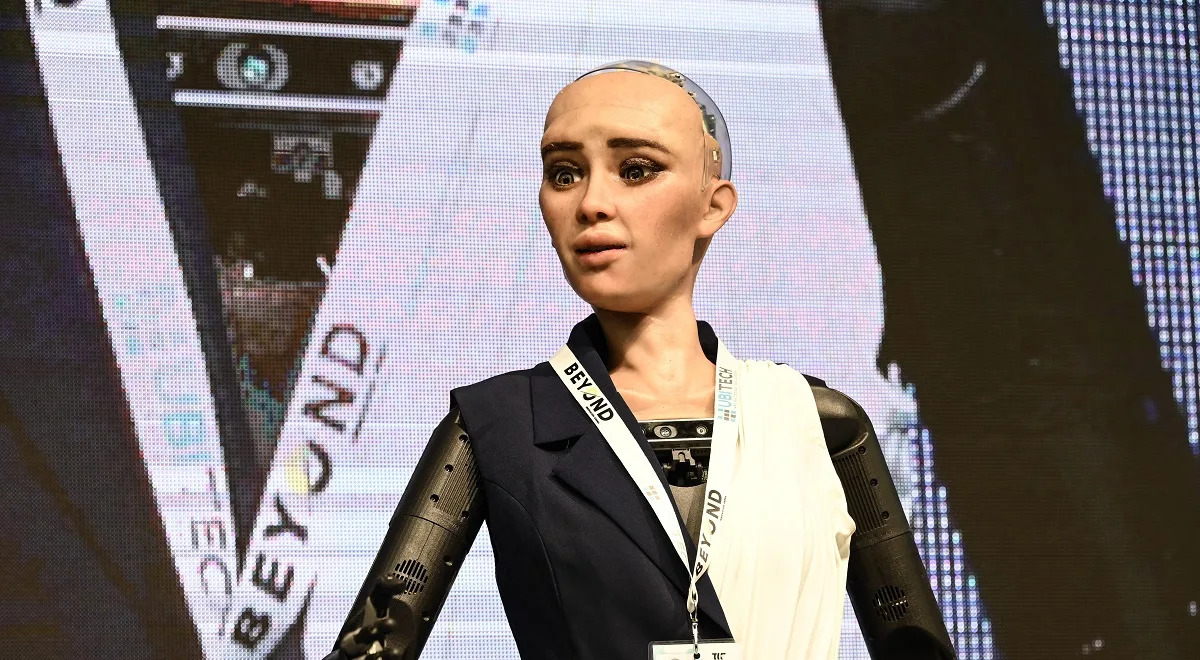
The corny choice of walk-up song was perhaps the sole endearing element of its appearance. Dressed in a D'Youville hoodie and with its brain exposed, Sophia, as the robot's called, spun-off generic advice in dry, synthetically-inflected tones. It did not give a scripted speech, but answered questions from the emcee. The whole charade drew "mixed reactions" from the crowd, The New York Times reports — with many students feeling downright insulted.

"Congratulations to all the graduating students," Sophia intoned, at one point brandishing a creepy, full-toothed grin.
Inhuman Touch

The university contends that it had very serious and lofty intentions in its hiring of a robot speaker — and didn't just cheap out on trying to get someone famous.

"We wanted to showcase how important technology is, and the potential for technology to really enrich the human experience," Lorrie Clemo, president of D'Youville, told the NYT.

Many students didn't feel that way. When the university announced Sophia would be the speaker, more than 2,500 signed a petition saying the decision "disrespected" the students, demanding a human take the stage.

The impersonal nature of the robot speaker, the petition argues, is an unwanted reminder of the virtual high school graduations they were forced to have during the COVID-19 pandemic.

"This is shameful to the 2020 graduates receiving their diplomas, as they feel they are having another important ceremony taken away," the petition reads.
Industry Mouthpiece

But if showcasing AI technology was the goal, the stunt was inadvertently a sobering success. The robot's unscripted responses perfectly encapsulate what generative AI largely does (and is very good at): coldly repackaging stuff that humans have already said.

"I offer you the following inspirational advice that is common at all graduation ceremonies: Embrace lifelong learning, be adaptable, pursue your passions, take risks, foster meaningful connections, make a positive impact, and believe in yourself," Sophia said, after being asked to share tidbits from other commencement speeches.

Feeling inspired yet? The robot, built by Hong Kong-based firm Hanson Robotics, was also given several opportunities to plug the AI industry. If students already felt "disrespected" ahead of the commencement ceremony, we doubt they've been won over by Sophia waxing mechanical about the wonders of AI.

More on robots: Boston Dynamics Shows Off Robodog With Fur

Thursday, July 30, 2020

Hagia Sophia: Ataturk and the rich Americans who changed icon's fate

Even 86 year later, debate still swirls around the decision taken in 1934, and has echoes in Erdogan's decision to revert it to a mosque

People fly the Turkish flag outside the Hagia Sophia in Istanbul on 15 July (AFP)

As expected, Turkey’s Council of State earlier this month repealed the 1934 cabinet decision that turned the Hagia Sophia into a museum.

In doing so, it overturned a decision by the founding fathers of the republic, including Mustafa Kemal Ataturk; Ismet Inonu, a Turkish general and statesman who served as the second president of Turkey from 1938 to 1950; and Celal Bayar, third president of Turkey who served from 1950-60.

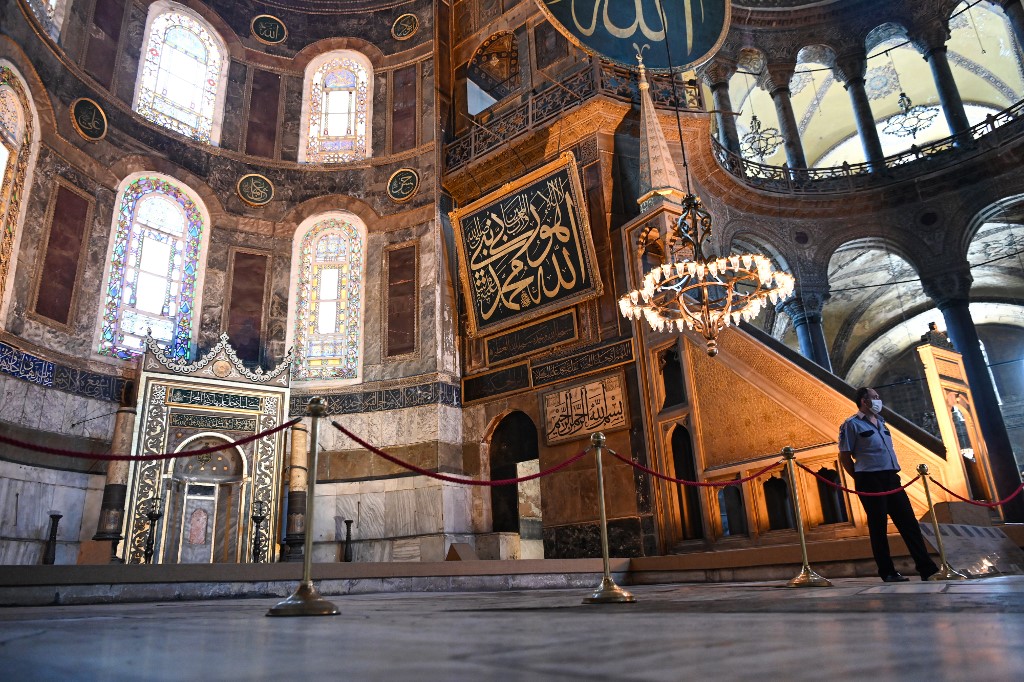
In an hour, President Recep Tayyip Erdogan signed a decree, and the Hagia Sophia was transferred to the Islamic affairs directorate and opened to prayers, more than eight decades later. On Friday, the first Jumma prayers will be held there in 86 years.


It was a great achievement for Whittemore to convince rich Americans to save Byzantine artefacts in Istanbul

But how did the Hagia Sophia become a museum in the first place? On 12 June 1929, eight rich and famous Americans met at the Tokatliyan Hotel on Istanbul’s Istiklal Street. The Byzantine Institute of America, which changed the Hagia Sophia’s destiny, was established during a dinner that night. The real mastermind was Thomas Whittemore, a socialite and academic with a passion for Byzantine art.

Whittemore had a social network ranging from American riches to Russian princes, including painter Henri Matisse and literary critic Gertrude Stein. Whittemore was known for his oversize scarfs and his love for hats. He was religious, gay and vegetarian.

The world was progressing towards the Great Depression, and it was a great achievement for Whittemore to convince rich Americans to save Byzantine artefacts in Istanbul. The greater achievement, two years later, was to get permission from Ankara to uncover the plastered Byzantine mosaics at the Hagia Sophia.

The Turkish cabinet issued a decision on 7 June 1931 for the work, signed by Ataturk and Inonu. According to the Byzantine Institute’s archives, Joseph Grew, then the US ambassador to Ankara, played a central role in obtaining the authorisation. Grew and Ataturk knew each other well; in now-famous footage, they jointly addressed the American public in 1927 to present the "new Turkey".

It was also a time when former enemies, such as Greece’s former prime minister, Eleftherios Venizelos, were getting closer to Turkey. Ankara and Athens signed a peace and cooperation deal in 1930 after Venizelos paid a visit to Turkey. He later nominated Ataturk for the Nobel Peace Prize. Turkey was looking to join the League of Nations in an attempt to balance its foreign relations against rising fascism.
Secretive decision

Ankara's permission to uncover the mosaics was welcomed in the West with fanfare, but Turkish people were clueless. The decision was taken in such secrecy that Turkish newspapers only learned of it two months later, thanks to a New York Times report.

Was Erdogan right to declare the Hagia Sophia a mosque?
Read More »

The same day, Turkish newspapers ran reports of two American airmen flying from New York to Istanbul, and of a letter sent by Ataturk to the US president. There were remarks by relevant local officials underlining that the work on the mosaics wouldn’t change the features of the mosque.

That first year, Whittemore and his staff uncovered the mosaics in the halls. But the mosque was still open for prayers, and next was the real issue: how would they uncover the mosaics with icons inside the mosque?

Coincidentally, Ataturk invited Whittemore to a historical congress in Ankara. He was welcomed by Ataturk’s adopted daughter, Zehra, who later died after studying in Britain by committing suicide or “falling from a train” while en route to France.

Ataturk met Whittemore in a publicised meeting, where he listened to the American scholar about the Byzantine mosaics and took his advice to send Zehra to Britain for English language education. But the picture of Ataturk with Whittemore wasn’t enough to subdue the public.

Gossip about the excavation was rampant, triggering another public attempt by politician Halil Ethem, a co-founder of the Byzantine Institute, to calm the masses. Appearing with Whittemore at the Hagia Sophia, Ethem said that nothing was harmed in the mosque and that the icons had not originally been banned in Islam.
Bombshell lands

The first official document to start the conversion of the Hagia Sophia into a museum was a letter dated 25 August 1934, written by then-Education Minister Abidin Ozmen to the prime minister's office.

“Upon the great verbal order I received, I hereby present one copy of the order that requires planning to put Hagia Sophia mosque into a museum,” Ozmen wrote. The prime ministry immediately created a commission and drafted a to-do list within two days.

Ozmen revealed the details of the oral order after his retirement in 1949, while he was paying a visit to the Hagia Sophia museum’s general manager, Muzaffer Ramazanoglu: “It was said in an academic way, chiefly by Ataturk, that instead of keeping it as something [that] only belongs to one religion and class, that turning Hagia Sophia into a museum that is open to visitors from all nations and religions would be suitable.”
The Hagia Sophia in Istanbul is pictured on 2 July (AFP)

The news of the conversion decision landed like a bombshell. Everyone was surprised. The manager of museums mentioned in the news reports didn’t even know what was happening.

The sudden decision was even criticised by pro-Ataturk Cumhuriyet daily newspaper in a front-page article: “We have to confess that we are continuing to get astonished as we read the newspapers, which report that Hagia Sophia will be organised as a museum. We constantly ask ourselves this question: what museum? Hagia Sophia itself is the most beautiful museum, and even alone is a better historical monument. We cannot comprehend the conversion of this monument into a museum.”
A message to the West

The cabinet decision followed. On 24 November 1934, the cabinet decreed that turning the Hagia Sophia into a museum would make all of the eastern world happy, giving another educational institute to humanity.

There have been many theories on what motivations led to the conversion. Some said it was a message to the US, and in general to the West, that the new regime in Turkey was secular and peaceful. Others claimed it was a gesture to the Balkan Pact, signed that year with Greece, Yugoslavia and Romania.

The public and newspapers weren't able to raise their voices, and the state, without questioning anything, used all its resources to make it happen

Whittemore, meanwhile, continued his work until the end of the 1940s, uncovering the mesmerising mosaics at the Chora Church in Istanbul after completing his task at the Hagia Sophia. He died in Washington in 1950 on his way to the State Department to meet Allan Dulles, the first civilian CIA director. Some claimed that Whittemore was also an intelligence source. He was holding an album of Hagia Sophia mosaics when he passed away.

Whatever the reason, the decision to turn a building essential to Istanbul’s religious and social life, which had served as a mosque for more than four centuries, without any outside input came as a surprise, and caused trauma among the religious segments of society.

That’s why it has long been an exciting dream for religious conservatives to reopen the Hagia Sophia as a mosque.

Just because the leader of the country deemed it appropriate, Istanbul’s largest mosque was turned into a museum overnight. The public and newspapers weren’t able to raise their voices, and the state, without questioning anything, used all its resources to make it happen.
Debate continues

Even 86 year later, debate still swirls around the decision taken in 1934. And however tragic it may be, Turkey’s decision-making mechanisms still work with 1934 technology, as evidenced by the latest move to again change the status of the Hagia Sophia.

The president had not taken a single step on the Hagia Sophia for two decades, responding to requests by saying people should first fill the mosque next door, and denouncing calls to turn the Hagia Sophia into a mosque as provocation.

Then, he suddenly he gave a green light to the conversion. The Council of State, whose chief justice was appointed to the position after voting to cancel Istanbul’s local elections last year, and which has rejected similar requests three times since 2005, unanimously repealed the previous cabinet decision and turned the Hagia Sophia into a mosque.

Some believe the goal was to distract from Turkey’s economic problems or to stop electoral bleeding; others say it aimed to send a message abroad.

With this decision-making mechanism reminiscent of the 1930s, and amid the applause of the same people who are grateful to lift the curse of Mehmed II cited in the Hagia Sophia’s endowment charter, a university belonging to a 40-year-old conservative foundation has been closed; people have been put in prison by political orders; and elected mayors have lost office.

Turkey in 1934, when the Hagia Sophia’s status was changed, and Turkey in 2020 look very alike.

The views expressed in this article belong to the author and do not necessarily reflect the editorial policy of Middle East Eye.


Yildiray Ogur

Yildiray Ogur is a columnist for Karar, a Turkish daily newspaper. He previously worked as an editor and columnist for various newspapers and TV channels.

Monday, August 04, 2025


Plan, prepare, conquer: predicting mountain accident risks with deep learning and pre-climb data


Researchers develop a robust framework using deep learning and contextual data to accurately predict mountaineering accident risks in advance


Sophia University

Predicting Mountaineering Accident Risks Using Deep Learning and Contextual Data 

image: 

To address the high number of mountaineering accidents in Japan, researchers developed a deep learning model that uses contextual information such as time of day, environmental conditions, and climbers’ details to accurately predict the risk of four major categories of climbing accidents. This holds immense potential to significantly improve mountain safety measures in Japan and worldwide.

view more 

Credit: Dr. Yusuke Fukazawa from Sophia University, Japan


Japan is famous for its beautiful mountain landscapes as well as for the challenges it offers to avid mountaineers. However, these mountains can get so treacherous that Japan actually records one of the highest numbers of mountain accidents globally. In fact, Japan had 3,126 mountain accidents in 2023, the highest annual total since 1961.


In particular, Nagano Prefecture, which has many mountains popular among climbers, is one of the regions with a high number of mountaineering accidents due to its rugged terrain and severe weather conditions.


Therefore, there is a dire need to accurately predict mountaineering accidents and estimate the risks in advance. This could help climbers and rescue teams prepare better while reducing the likelihood of future accidents.


While traditional machine learning has proven effective in predicting traffic accidents and natural disasters, its application to mountain accident prediction is limited by several factors: small datasets, the complex nature of accidents, and missing variables of environmental conditions and demographics.


To address this issue, Associate Professor Yusuke Fukazawa, together with graduate student Taeko Sato—both affiliated with the Graduate Program in Applied Data Sciences at Sophia University, Japan—developed a predictive model to assess mountaineering accident risks during the expedition planning stage. “Mountain accidents fall into four major categories: falls from height, ground-level falls, fatigue, and disorientation. However, these do not occur under uniform conditions; rather, they are closely related to factors such as time of day, terrain, weather conditions, and climber demographics,” explains Dr. Fukazawa.


Accordingly, they trained BERT, a deep learning model, with such contextual data to enable it to classify accident risks into the four key categories using climb-related information at the time of planning. The dataset consisted of 2,596 mountaineering accidents that occurred between 2014 and 2023 in the Nagano Prefecture. Furthermore, the researchers used SHAP analysis, an explainable AI technique, to visualize the relationships between the input features and predicted risks for each of the four accident categories. The results of this entire endeavor were published online in the International Journal of Data Science and Analytics on June 16, 2025.


The dataset had a stable number of annual accidents, with a notable decline only in 2020 due to the COVID-19 pandemic. However, there were distinct seasonal, temporal, and demographic patterns observed. For instance, more accidents were recorded during summer months, on weekends, and in the afternoon. Similarly, ground-level falls mainly occurred among women, whereas higher incidents of falls from height and disorientation were observed in men. Falls from height accounted for the greatest number of accidents, followed by ground-level falls, fatigue, and disorientation.


The BERT model accurately identified and predicted the four accident categories with over 60% accuracy achieved for two types: fall from height and disorientation. The SHAP analysis further aided in interpreting the model’s prediction to successfully classify the key predictors contributing to each category’s risk. Time of day, mountain location, weather conditions, and demographic factors were found to be critical predictors for all four categories. For example, “morning” and “Hotaka” were identified as strong predictors of falls from height, while “noon” and “Yatsugatake range” were for ground-level falls. Fatigue was linked to elderly climbers and the afternoon period, and disorientation was associated with conditions like snow and fog, as well as solo hiking. This matched with the patterns observed in the input dataset, which confirmed the robustness of the model.


Our high-accuracy, multi-class predictive model provides climbers a better understanding of the specific risks associated with their planned actions and conditions, enabling safer decision-making and preparation. By tailoring risk assessments to each climber’s unique situation, our model offers personalized safety recommendations, a more practical and effective form of mountaineering support instead of the traditional, one-size-fits-all warnings,” says Dr. Fukazawa. “We also believe that our research can be used for developing mobile applications and web-based services that offer planning and safety solutions at people’s fingertips. This way we hope to improve risk management not only for mountaineering but also for other outdoor activities and encourage more people to step outside and safely enjoy nature.”


Interestingly, these results highlight the power of deep learning and explainable AI in making risk assessments more reliable. In fact, this approach has the potential to extend beyond mountaineering, with potential applications in other domains where AI-driven decision support can aid in risk prediction and safety planning.


About Sophia University

Established as a private Jesuit affiliated university in 1913, Sophia University is one of the most prestigious universities located in the heart of Tokyo, Japan.  Imparting education through 29 departments in 9 faculties and 25 majors in 10 graduate schools, Sophia hosts more than 13,000 students from around the world.


Conceived with the spirit of “For Others, With Others,” Sophia University truly values internationality and neighborliness, and believes in education and research that go beyond national, linguistic, and academic boundaries. Sophia emphasizes on the need for multidisciplinary and fusion research to find solutions for the most pressing global issues like climate change, poverty, conflict, and violence. Over the course of the last century, Sophia has made dedicated efforts to hone future-ready graduates who can contribute their talents and learnings for the benefit of others, and pave the way for a sustainable future while “Bringing the World Together.”


Website: https://www.sophia.ac.jp/eng/


About Dr. Yusuke Fukazawa from Sophia University

Yusuke Fukazawa is an Associate Professor at the Department of Graduate Degree Program of Applied Data Sciences at Sophia University, Japan. His research focuses on machine learning, supervised learning, and predictive modeling and analytics. He completed his PhD from the Department of Precision Mechanical Engineering, The University of Tokyo. Prior to joining Sophia University, Dr. Fukazawa was a Senior Manager at NTT Docomo, Inc., and a visiting researcher at the University of Tokyo. He has 93 published articles and 274 industrial patents to his name, with 10 awards bestowed upon him for his research and student mentorship.


About Sophia University

Established as a private Jesuit affiliated university in 1913, Sophia University is one of the most prestigious universities located in the heart of Tokyo, Japan.  Imparting education through 29 departments in 9 faculties and 25 majors in 10 graduate schools, Sophia hosts more than 13,000 students from around the world.

Conceived with the spirit of “For Others, With Others,” Sophia University truly values internationality and neighborliness, and believes in education and research that go beyond national, linguistic, and academic boundaries. Sophia emphasizes on the need for multidisciplinary and fusion research to find solutions for the most pressing global issues like climate change, poverty, conflict, and violence. Over the course of the last century, Sophia has made dedicated efforts to hone future-ready graduates who can contribute their talents and learnings for the benefit of others, and pave the way for a sustainable future while “Bringing the World Together.”

Website: https://www.sophia.ac.jp/eng/


About Dr. Yusuke Fukazawa from Sophia University

Yusuke Fukazawa is an Associate Professor at the Department of Graduate Degree Program of Applied Data Sciences at Sophia University, Japan. His research focuses on machine learning, supervised learning, and predictive modeling and analytics. He completed his PhD from the Department of Precision Mechanical Engineering, The University of Tokyo. Prior to joining Sophia University, Dr. Fukazawa was a Senior Manager at NTT Docomo, Inc., and a visiting researcher at the University of Tokyo. He has 93 published articles and 274 industrial patents to his name, with 10 awards bestowed upon him for his research and student mentorship.

Thursday, July 02, 2020

Court considers status of Istanbul’s iconic Hagia Sophia
yesterday


1 of 6 
https://apnews.com/bf9f86b63e8bba72544007da4863e066
An aerial view of the Byzantine-era Hagia Sophia, one of Istanbul's main tourist attractions in the historic Sultanahmet district of Istanbul, Saturday, April 25, 2020. The 6th-century building is now at the center of a heated debate between conservative groups who want it to be reconverted into a mosque and those who believe the World Heritage site should remain a museum. (AP Photo)


ANKARA, Turkey (AP) — A state attorney on Thursday recommended that Turkey’s highest administrative court reject a request that Istanbul’s iconic Hagia Sophia, which now serves as museum, be turned back into a mosque, state-run media reported.

The 6th-century structure was the Byzantine Empire’s main cathedral before it was changed into an imperial mosque following the Ottoman conquest of Istanbul. Mustafa Kemal Ataturk, the founder of the modern Turkish republic, then turned into a museum that attracts millions of tourists each year.

Nationalist and religious groups have long been pressing for the landmark, which they regard as an Muslim Ottoman legacy, to be converted back into a mosque. Others believe the UNESCO World Heritage site should remain a museum, as a symbol of Christian and Muslim solidarity.

On Thursday, Turkey’s Council of State, began considering a request by a group that wants Hagia Sophia to revert back into a mosque.

The lawyer of the group argued that the building was the personal property of Ottoman Sultan Mehmet II, who conquered Istanbul, and pressed for the annulment of a 1934 Council of Ministers’ decision that turned it into a museum, the Anadolu Agency reported.

A state attorney, meanwhile, argued that the 1934 decision was legal, Anadolu reported. He recommended the request be rejected, arguing that a decision on restoring the structure’s Islamic heritage was up to the government, the agency said.

A decision is expected within two weeks.

Greece as well as the Istanbul-based Ecumenical Patriarch Bartholomew I, considered the spiritual leader of the world’s Orthodox Christians, have urged Turkey to keep Hagia Sophia as a museum. Bartholomew warned this week that its conversion into a mosque “will turn millions of Christians across the world against Islam.”

U.S. State Secretary Mike Pompeo waded into the debate Wednesday, urging Turkey to keep Hagia Sophia as a museum “to serve humanity as a much-needed bridge between those of differing faith traditions and cultures.” His comments sparked a rebuke from Turkey’s Foreign Ministry, which said Hagia Sophia was a domestic issue of Turkish national sovereignty.

Built under Byzantine Emperor Justinian, Hagia Sophia was the main seat of the Eastern Orthodox church for centuries, where emperors were crowned amidst ornate marble and mosaic decorations.

Four minarets were added to the terracotta-hued structure with cascading domes and the building was turned into an imperial mosque following the 1453 Ottoman conquest of Constantinople — the city that is now Istanbul.

The building opened its doors as a museum in 1935, a year after the Council of Ministers’


Pompeo urges Turkey not to convert Hagia Sophia into mosque  
Issued on: 01/07/2020 -


The United States has urged Turkey not to change the status of the Hagia Sophia, a church turned mosque turned museum Ozan KOSE AFP

Washington (AFP)

US Secretary of State Mike Pompeo on Wednesday urged Turkish President Recep Tayyip Erdogan not to convert the Hagia Sophia into a mosque and said Istanbul's celebrated former cathedral should remain open to all.

Erdogan, whose roots are in political Islam, has mused about turning Hagia Sophia back into a mosque, triggering tension with neighboring Greece.

Pompeo issued a statement on the eve of an expected Turkish court decision on whether Hagia Sophia was rightfully turned into a museum.

"We urge the government of Turkey to continue to maintain the Hagia Sophia as a museum, as an exemplar of its commitment to respect the faith traditions and diverse history that contributed to the Republic of Turkey, and to ensure it remains accessible to all," Pompeo said.

"The United States views a change in the status of the Hagia Sophia as diminishing the legacy of this remarkable building and its unsurpassed ability -- so rare in the modern world -- to serve humanity as a much-needed bridge between those of differing faith traditions and cultures," he said in a statement.

Pompeo -- an evangelical Protestant who often speaks about the rights of religious minorities -- said that the United States hoped to maintain dialogue with Turkey over the preservation of religious and cultural sites.

Muslim clerics in May recited prayers inside the landmark to celebrate the anniversary of the Ottomans' 1453 conquest of the city, then known as Constantinople.

The stunning edifice was first built as a church in the sixth century under the Byzantine Empire as the centerpiece of Constantinople.

After the Ottoman conquest, it was converted into a mosque before being turned into a museum during the rule of Mustafa Kemal Ataturk, the secularizing founder of modern Turkey, in the 1930s.

Erdogan mused last year about turning the museum into a mosque.

The remarks have drawn wide concern in Greece, whose Orthodox Church maintains its ecumenical patriarchate in Istanbul.

Turkey is a NATO ally of the United States but the two nations have seen friction in recent years, including over Ankara's incursions into Syria and its purchase of weapons from Russia.

© 2020 AFP


Tuesday, September 05, 2023


Does a “surprise” factor in gift-giving affect beneficiaries’ gratitude? Scientists answer


Researchers from Japan find that not expecting a gift or counterfactually imagining not receiving a gift does not really improve a beneficiary’s level of gratitude on receiving a gift


Peer-Reviewed Publication

SOPHIA UNIVERSITY

Effect of Simulating the Absence of Benefits on Beneficiaries’ Gratitude 

IMAGE: A NEW STUDY FROM SOPHIA UNIVERSITY, JAPAN, DEMONSTRATES THAT WHEN AN ABSENCE OF BENEFITS OR GIFTS IS SIMULATED FOR BENEFICIARIES EITHER BEFORE OR AFTER THEY RECEIVE THE BENEFITS, THERE IS NO INCREASE IN THEIR GRATITUDE. THIS ADDS TO THE LITERATURE ON UNDERSTANDING THE DIFFERENT DETERMINANTS OF THE EMOTION OF GRATITUDE. view more 

CREDIT: AKITOMO YAMAMOTO OF SOPHIA UNIVERSITY


Gratitude is a strong emotion, usually felt by a person who benefits from an intentional good deed of another person. Receiving gifts or benefits can instill a feeling of gratitude in people who receive them, i.e., beneficiaries, encouraging them to be more prosocial, while also helping to create a bond with their benefactors. This has led several researchers to examine the determinants of gratitude. Interestingly, beneficiaries often have preconceived beliefs about receiving a benefit. For instance, they may have no prior expectations of receiving a 'surprise' gift or could counterfactually imagine the absence of those benefits, despite receiving them. Although several studies have investigated the connection between expectations or counterfactual thinking and gratitude, there is insufficient information on whether imagining the absence of benefits increases beneficiaries’ gratitude upon receiving them.

In both studies Dr. Yamamoto and his co-author Masataka Higuchi, also from Sophia University, provided participants with manipulated vignettes to read as part of the simulations. While some participants received vignettes with absence simulations (absence simulation group), others received vignettes without absence simulations (control group). All participants were social psychology students at a Japanese university.

To this end, a study published in Japanese Psychological Research on 07 July 2023 investigated whether simulating the absence of benefits increases beneficiaries’ gratitude, via two psychological experiments. "Study 1 examined the effect of prior expectation of not receiving benefits, and Study 2 examined the effect of posterior counterfactual thinking regarding the benefits, with the hypothesis that simulating the absence of benefits increases gratitude in both studies," explains lead author Dr. Akitomo Yamamoto, a Postdoctoral Fellow at the Faculty of Human Sciences, Sophia University. "These studies are part of a continuous investigation into whether gratitude, which is an emotional response to others' benevolence, can be influenced by factors unrelated to the nature of the benevolence itself,” he continues.

In the first study, participants were presented with a scenario where a beneficiary (the participants themselves) may receive a gift from a benefactor. The absence simulation group is then informed that the benefactor did not prepare a gift—ergo setting no prior expectation of receiving a benefit. In contrast, the control group was informed that the benefactor did seem to prepare a certain gift. In the final vignette, both groups were told that the beneficiary receives the gift. Subsequently, the participants were asked to rate their gratitude on a nine-point unipolar scale (0-8).

In the second study, the participants read a vignette where a beneficiary (the participants themselves) received a certain benefit from a benefactor. The absence simulation group was then asked to imagine not receiving the benefit and the control group was asked to again imagine the benefit-receiving event. Both groups were asked to note down the consequences of their respective simulations and rate their gratitude.

Interestingly, the research team found that in both studies, simulating the absence of benefits did not significantly increase the participants’ gratitude as compared to the respective control groups. This negates the researchers’ original hypothesis and instead suggests that simulating the absence of benefits does not increase the beneficiaries’ feeling of gratitude.

These findings can help enhance our understanding of gratitude and how beneficiaries’ beliefs may or may not control this emotion. They could also have implications for the practice of gift-giving. "Our findings suggest that infusing your gifts with genuine thoughtfulness for the recipient, rather than focusing on peripheral elements like making it a surprise, is essential to make the recipient feel grateful," concludes Dr. Yamamoto.


Reference

Title of original paper】The Effect of Simulating the Absence of Benefits on Gratitude: Prior Expectations and Posterior Counterfactual Thinking

【Journal】Japanese Psychological Research

DOI】10.1111/jpr.12463

【Authors】Akitomo Yamamoto, Masataka Higuchi

【Affiliations】Sophia University


About Sophia University

Established as a private Jesuit affiliated university in 1913, Sophia University is one of the most prestigious universities located in the heart of Tokyo, Japan. Imparting education through 29 departments in 9 faculties and 25 majors in 10 graduate schools, Sophia hosts more than 13,000 students from around the world.

Conceived with the spirit of “For Others, With Others,” Sophia University truly values internationality and neighborliness, and believes in education and research that go beyond national, linguistic, and academic boundaries. Sophia emphasizes on the need for multidisciplinary and fusion research to find solutions for the most pressing global issues like climate change, poverty, conflict, and violence. Over the course of the last century, Sophia has made dedicated efforts to hone future-ready graduates who can contribute their talents and learnings for the benefit of others, and pave the way for a sustainable future while “Bringing the World Together.”

Website: https://www.sophia.ac.jp/eng/


About Dr. Akitomo Yamamoto from Sophia University

Dr. Akitomo Yamamoto is a Postdoctoral Fellow at Sophia University’s Faculty of Human Sciences, Department of Psychology. He has over 8 years of research experience, and has published 10 scientific articles in the field of social psychology. His academic interests include social emotion, gratitude, and indebtedness. Dr. Yamamoto received his PhD from Sophia University’s Graduate School of Human Sciences. Apart from his position at Sophia University, Dr. Yamamoto is also employed as a part-time lecturer at Bunkyo University and Toyo University.


Funding information

N/A