Sitting on a time bomb
Knowledge and concern about the climate crisis has grown exponentially in the past 25 years. But not among ultra-conservative and fascist political forces such as Donald Trump’s MAGA (Make America Great Again) movement in the United States, Alternative for Germany (AfD) and Reform UK in Britain.
In his infamous United Nations speech a year ago, Trump denounced global heating as the “biggest scam in world history.” Since his re-election, Trump has withdrawn the US from the Paris Accords, closed offices and programs dealing with climate change, terminated dozens of experts working on global heating and, crucially, withdrawn billions of dollars aimed at mitigating the effects of climate change.
But here is the irony: the US has been the site of hundreds of climate disasters. Among the best-known are Hurricanes Katrina and Sandy and the wildfires that hit Malibu and Paradise in California.
Hurricane Katrina and Sandy
Hurricane Katrina, in August 2005, was one of the most destructive natural disasters in US history. In New Orleans, the disaster significantly worsened when levees and floodwalls failed, allowing water to flood about 80% of the city. The human consequences were enormous.
More than 1800 people died, while hundreds of thousands were displaced from their homes. Many people could not evacuate before the storm and the disaster exposed major inequalities in income, housing, transport and emergency assistance access. Katrina caused about $108 billion in damages and made hundreds of thousands of homes uninhabitable.
Hurricane Sandy affected the Caribbean and eastern US in October 2012. As it approached the northeast, the storm became extremely large and interacted with other weather systems. New Jersey and New York experienced the most serious impacts.
One of Sandy’s greatest dangers was its enormous storm surge. Seawater flooded coastal communities and large parts of New York City, including streets, road tunnels and subway tunnels. Airports were flooded, transport networks were disrupted and about 8.5 million people lost electricity. At least 650,000 homes were damaged or destroyed. Sandy caused 147 direct deaths across the Atlantic basin, including 72 in the mid-Atlantic and northeast.
The storm demonstrated the vulnerability of densely populated coastal areas. Damage was particularly serious as Sandy affected some of the country’s most economically important urban areas.
Paradise wildfire
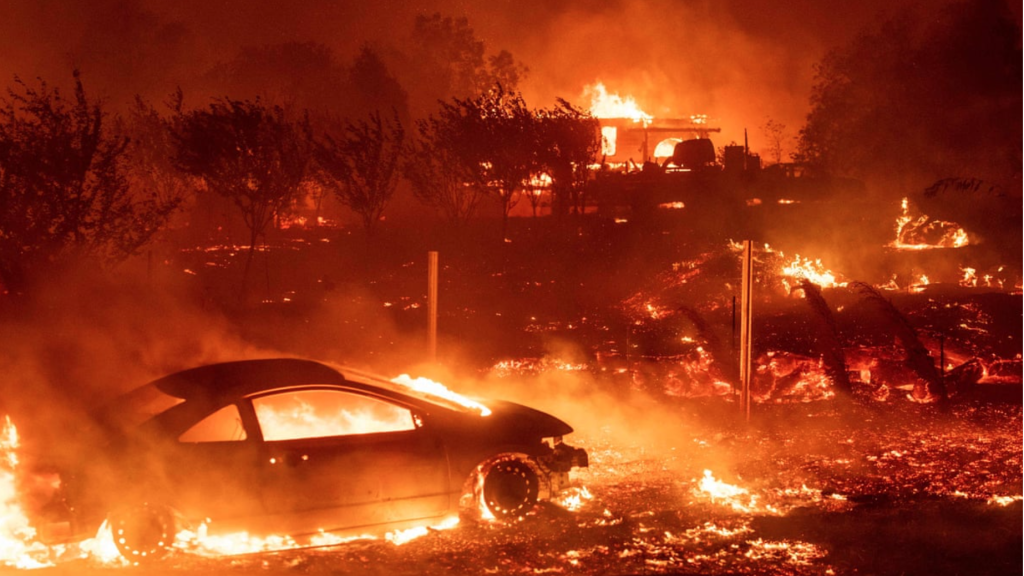
The Paradise wildfire, officially called the Camp Fire, began in northern California on November 8, 2018. Extremely dry vegetation, low humidity and powerful winds allowed the fire to spread at extraordinary speed through Butte County.
The town of Paradise, which had a population of about 26,000, was directly in its path. Residents were ordered to evacuate, but the fire’s speed caused severe congestion on the limited roads leading out of town. Paradise was devastated.
The Camp Fire ultimately destroyed more than 18,000 structures and killed at least 85 people, making it California’s deadliest and most destructive wildfire. Entire neighbourhoods were reduced to ashes and thousands of residents lost their homes and possessions
The disaster highlighted the vulnerability of communities located near forests and other fire-prone vegetation. California’s dry climate creates wildfire risks, but hotter conditions and prolonged drought can dry vegetation further, contributing to severe fires spreading rapidly.
The Camp Fire also raised questions about electricity infrastructure, evacuation planning and building in high-risk areas. Paradise has since become an important example of the challenges involved in rebuilding communities after wildfire disasters.
Malibu wildfire
Southern California experienced a major disaster at the same time as the Camp Fire: the Woolsey Fire. Beginning on November 8, 2018, the fire spread through Los Angeles and Ventura counties before reaching Malibu and the Pacific coast.
The Malibu fire received huge publicity because it affected the property of celebrities such as Miley Cyrus, Gerard Butler, Kim Kardashian and Robin Thicke. Kardashian and partner Kanye West employed a private firefighting company to hold off flames while they fled to another property in LA.
Strong winds and extremely dry vegetation helped drive flames rapidly through the Santa Monica Mountains. About 295,000 people were ordered to evacuate as communities came under threat.
The Woolsey Fire burned about 96,949 acres and destroyed more than 1600 structures. Three people were killed, and many homes in and around Malibu were destroyed or damaged. The fire burned large areas of natural habitat and parkland.
The disasters demonstrated that wildfires are not only an environmental problem but a major social and economic threat. Expanding development in fire-prone landscapes means more people and properties are exposed when fires occur.
Root cause
The increasingly destructive heatwaves, droughts, floods, hurricanes and wildfires in the US are not just “natural phenomena” nor simply the result of global heating. They are the result of an interaction of both, combined with the reckless actions of US capitalism.
Hurricanes are natural phenomena, as are drought, fire and extreme rainfall. But the social catastrophe that follows them is neither wholly natural nor politically neutral. It arises from the interaction between a warming climate and a society organised around private accumulation, fossil-fuel consumption, speculative property development and profound inequalities of wealth and power.
Global heating is changing the physical conditions under which US society operates. At the same time, capitalists continue to construct houses, infrastructure and entire communities in places increasingly exposed to fire, flooding, extreme heat and rising seas.
Profits from development are appropriated privately, while substantial portions of the risks are eventually transferred to the public through firefighting costs, disaster relief, infrastructure reconstruction, subsidised insurance and emergency intervention. What appears after as an unforeseeable natural catastrophe can therefore be understood as the predictable outcome of particular relations between capital, land and the state.
Global heating and extreme weather
Across North America, record high temperatures are increasingly common relative to record lows. The Intergovernmental Panel on Climate Change (IPCC) concluded that climate change is already contributing to more frequent and intense extreme events across the continent and projects further intensification of heatwaves, extreme storms and wildfire activity.
The relationship with rainfall is somewhat more complicated but equally important. A warmer atmosphere can contain more water vapour, creating the possibility of heavier rain. This does not mean everywhere becomes wetter. Indeed, parts of western and southwestern US are experiencing increased aridity. Climate change can intensify apparently opposite extremes: heavier downpours in some circumstances, more severe drying in others.
Nor does climate change “cause” every hurricane in the simplistic sense sometimes implied in popular discussion. Tropical cyclones existed before industrial capitalism. But warmer oceans, increased atmospheric moisture and rising sea levels alter the environment in which hurricanes occur. Consequently, a storm striking a coastline whose sea level has already risen can produce greater flooding than an otherwise equivalent storm would have in an earlier climatic period.
A Marxist analysis need not exaggerate or simplify the science. Indeed, it benefits from doing precisely the opposite. The point is not that every US disaster can be individually blamed upon global heating. It is that capital accumulation has altered the background climatic system upon which human civilisation depends, changing the probabilities and potential severity of numerous hazards.
Fossil capitalism and climate change
The common terminology of “human-induced climate change” is scientifically correct but socially incomplete. Humanity in the abstract did not industrialise the world through collective democratic decision-making. Fossil-fuel dependence developed within particular systems of production and relations of power.
The industrial capitalism of the 19th century was coal-powered. Oil became central to the automobile, aviation, petrochemical and military economies of the 20th century. Natural gas became another pillar of industrial production, electricity generation and domestic consumption.
Enormous corporations accumulated capital through extracting, processing, transporting and selling these fuels. States constructed roads, airports, suburban infrastructure and military systems around abundant fossil energy.
The climate crisis is therefore inseparable from fossil capitalism: an economic system in which capital accumulation became historically intertwined with fossil energy.
This does not mean ordinary consumers have no environmental impact. US citizens drive cars, heat houses and purchase carbon-intensive commodities. But consumer behaviour occurs within infrastructures inherited from previous rounds of investment.
A worker who must commute 30 miles because affordable housing is distant from employment does not exercise the same power over the climate system as a corporation deciding whether to invest billions in new fossil-fuel production. To treat both as individual “carbon footprints” dissolves radically unequal economic power into an imaginary community of equally responsible consumers.
Capitalism also creates a structural obstacle to adequate climate action. Individual firms must compete, generate returns and protect accumulated investment. Fossil-fuel reserves, refineries, pipelines, power stations and associated infrastructure represent enormous quantities of capital. Rapid decarbonisation threatens to strand some of those assets.
The transition required by climate science consequently confronts powerful owners for whom continued fossil-fuel exploitation is not an ideological abstraction but the basis of profit. The climate crisis reveals a contradiction between the requirements of indefinite capital accumulation and the ecological conditions required for stable human societies.
Wildfires: Where climate and property meet
Wildfire demonstrates this contradiction with unusual clarity. Fire is an ancient ecological process. Many North American ecosystems evolved with periodic burning. Indigenous peoples deliberately used fire to manage landscapes long before European colonisation. It would therefore be absurd to claim that global heating invented wildfire.
What climate change alters is fire weather. Rising temperatures increase evaporative demand, dry vegetation and soils, and can extend periods during which landscapes are combustible. But climate is only one side of the equation. The other is development.
US metropolitan growth has increasingly pushed housing into the wildland-urban interface: landscapes where houses and infrastructure encounter forests, grasslands, chaparral and other combustible vegetation.
This expansion is driven partly by population growth, but also by the political economy of land. Developers purchase peripheral land, obtain planning permission, subdivide it and transform it into a commodity whose value may increase enormously once houses can be constructed upon it. Ecological risk is converted into a property market.
This process generates a remarkable contradiction. The qualities that make such locations commercially attractive — the forest, hillside, canyon, mountain view, privacy or apparently untouched landscape — may be precisely those that increase exposure to wildfire. Nature is simultaneously marketed as an amenity and encountered as a hazard.
Climate change intensifies the contradiction. A development model constructed around historical expectations of fire frequency now operates in a climatic regime in which extreme fire weather is becoming more dangerous in many US western regions. The physical landscape changes, but the imperative to realise value from land continues.
Mike Davis and the political economy of Malibu
Few US intellectuals understood this relationship more than the late historian and urban theorist Mike Davis. In Ecology of Fear, Davis deals with the interlinked issues of wildfires and urban expansion.
Long before the present succession of climate, Davis argued Southern California’s spectacular disasters revealed the political economy concealed beneath the language of natural calamity. His work provides an exceptionally useful starting point for understanding the US today. Climate change has made Davis’s analysis not obsolete but more urgent.1
In his celebrated and deliberately provocative chapter, “The Case for Letting Malibu Burn,” in Ecology of Fear Davis attacked the conventional representation of Southern Californian wildfire as an unpredictable natural tragedy. He documented the long history of fire in the Santa Monica Mountains and emphasised that Malibu’s susceptibility to burning was hardly a secret.
Yet expensive residential development repeatedly expanded into this hazardous landscape. Fire destroyed property; public resources were mobilised; houses were rebuilt; development continued.
Davis interpreted this not primarily as individual foolishness but as political economy. Wealthy communities possessed the economic and political capacity to demand extraordinary protection for private property. Firefighting resources, infrastructure, insurance arrangements and disaster assistance helped make settlement possible in places where the underlying ecological risks remained severe.
Davis saw affluent settlements in the hills partly as landscapes of social separation — places whose exclusivity offered distance from the working-class and racially diverse metropolis below. He argued that development in hazardous areas was sustained through various forms of public subsidy and protection.
His argument is sometimes caricatured as saying that wealthy people’s houses should simply be allowed to burn. That misses its political purpose. “Letting Malibu burn” was a provocation intended to expose the irrationality of a system that repeatedly socialised the costs of protecting highly valuable private property built within a known fire ecology.
Who benefits? Who carries the risk?
Developers receive profits when land is converted into housing. Landowners receive increased property values. Financial institutions receive mortgage interest. Affluent purchasers obtain desirable homes.
Yet when catastrophe arrives, firefighters, municipal authorities, state agencies and federal disaster programs intervene. Roads must be maintained for evacuation, utilities repaired, emergency shelters opened and ruined infrastructure reconstructed. Private accumulation thereby generates public obligations.
Davis contrasted this lavish protection of valuable hillside property with the hazards experienced by working-class inhabitants of Central LA. Poorer residents might inhabit overcrowded or inadequately maintained buildings where mundane structural fires posed persistent dangers. Their disasters lacked the spectacular imagery of flames sweeping across Malibu hillsides and frequently attracted fewer resources and less political attention.
This is the class geography of disaster.
From wildfires to urban conflagration
Davis’s warning has acquired still greater significance as settlements penetrate combustible landscapes. He anticipated the possibility of a “post-suburban fire regime”: a situation in which development and changing environmental conditions produced catastrophes exceeding the familiar category of wildland fire.
This concept helps explain why the wildland-urban interface matters so greatly. Once flames or embers enter dense settlements, houses themselves become fuel. Wooden structures, fences, garages, cars, vegetation and other combustible materials can transmit fire through neighbourhoods. What begins as wildfire can become urban conflagration.
Climate change and suburbanisation therefore interact rather than operating as separate causes. Climate change can produce hotter and drier conditions favourable to extreme fire. Property development places more structures within reach of those fires. Infrastructure introduces additional ignition sources. Once communities ignite, the built environment can amplify destruction.
The result is a chain of causation connecting the global atmosphere to the mortgage market.
The class politics of adaptation
Disaster is also profoundly unequal after it occurs.
A wealthy household may possess comprehensive insurance, savings, several vehicles and alternative accommodation. Its members may have flexible employment allowing them to evacuate early.
A poor household may have none of these advantages. Renters may lose possessions without possessing adequate insurance. Low-paid workers may lose wages when businesses close. Homeless people and outdoor workers are exceptionally exposed to extreme heat and smoke.
Even evacuation assumes resources. Instructions to “leave immediately” mean something different to a household with two cars, credit cards and relatives elsewhere than to somebody without a vehicle or enough money for a hotel.
Climate inequality therefore cannot be measured solely by those whose house physically encounters the hazard. Class determines the capacity to anticipate, escape, absorb and recover from catastrophe.
The same principle operates with heat. Air conditioning can transform lethal outside temperatures into an inconvenience, but only for those who can afford it. A construction worker, farm labourer or delivery worker encounters heat as an occupational hazard precisely because their labour must continue under conditions from which wealthier people can retreat.
Capitalist society distributes environmental vulnerability through the labour market and housing market long before the hurricane arrives or the temperature record is broken.
Trumpism and climate denial
Trump’s politics represents an unusually aggressive defence of the fossil-fuel economy. Trump has repeatedly attacked climate policies, promoted increased oil and gas exploitation and portrayed environmental regulation as an obstacle to prosperity. In September, for example, he attacked Britain’s net-zero policies while urging greater exploitation of North Sea oil and gas.
This is not merely rhetorical climate scepticism. It has been translated into state policy. In February, Trump’s Environmental Protection Agency (EPA) rescinded the 2009 Greenhouse Gas Endangerment Finding and eliminated the federal greenhouse gas emissions standards for highway vehicles that depended upon it. The administration described this as the largest deregulatory action in US history.
The administration’s argument should be represented accurately. It maintains that the Clean Air Act does not provide the EPA with the statutory authority claimed for these regulations and argues the regulations impose enormous economic costs without materially affecting global climate change.
A Marxist interpretation, however, asks whose conception of “cost” dominates such calculations.
Environmental regulation imposes visible costs upon particular corporations and consumers today. Climate damage produces costs distributed across society and across decades: destroyed homes, higher insurance premiums, failed crops, damaged infrastructure, firefighting expenditures, heat mortality and disaster reconstruction.
Deregulation therefore appears to “save” money by shifting costs from capital onto society, workers, governments and future generations.
The Trump administration’s relaxation of vehicle-efficiency requirements illustrates this conflict. Government estimates associated with the weaker standards indicate lower initial vehicle costs but substantially greater fuel consumption and carbon emissions between now and 2050.
Trumpism consequently does more than deny or minimise climate science. It translates the immediate interests of fossil-fuel production and carbon-intensive accumulation into a populist political language: cheap petrol, consumer freedom, energy dominance and opposition to supposedly elitist environmental regulation.
Its success among sections of the working class cannot simply be dismissed as stupidity. Decades of neoliberal restructuring have made many workers suspicious of policies whose costs they are expected to bear. A badly designed transition can close a refinery, raise household energy costs or eliminate industrial employment while leaving corporate wealth untouched.
The left cannot answer right-wing climate politics simply by demanding sacrifice from ordinary people.
Climate politics and green capitalism
A Marxist climate program must instead confront ownership and class power.
Market mechanisms alone are inadequate when investment decisions controlling energy, transport and housing remain dominated by private profit. Carbon pricing may alter incentives, but a sufficiently rapid transformation requires huge planning and investment: renewable electricity, transmission networks, public transport, building insulation, resilient infrastructure and the managed retreat of development from locations that cannot reasonably be defended.
Such policies immediately raise distributive questions. Who pays? Who owns the new energy infrastructure? What happens to fossil fuel workers? Who decides where housing is constructed? Should developers profit from hazardous land and subsequently transfer disaster costs to the public?
A socialist response insists that decarbonisation cannot be achieved by making poorer households absorb the costs while leaving concentrated wealth intact. Workers leaving fossil industries require guaranteed employment, retraining, pensions and regional investment.
Public transport and energy-efficient housing need to provide material improvements rather than moral instruction. Adaptation needs to prioritise vulnerable communities rather than simply defending the most expensive property.
This is the substance behind the idea of a just transition. Without redistribution, climate policy can become another form of austerity. With redistribution and democratic planning, decarbonisation can become part of a wider transformation of everyday life.
Disaster capitalism and nature
Karl Marx described capital as possessing an extraordinary drive towards expansion. Competition forces firms to accumulate, innovate and enlarge production. Historically, this produced enormous rises in productive capacity.
But capital treats nature as a free input or waste repository. The atmosphere became, in effect, a free dumping ground for carbon generated by industry. The bill for that historical externalisation is now arriving.
The irony is that capitalism creates new commodities from the crisis it helped produce: private firefighting, air filtration, climate-controlled buildings, insurance products, carbon markets, disaster reconstruction and new adaptation technologies.
Those with sufficient money can purchase more protection while those without experience climate change directly. A society may become simultaneously richer in commodities and less secure ecologically.
Davis’s importance lies in understanding this process spatially. Capital does not merely exploit nature; it reorganises landscapes. It determines where factories, roads and suburbs appear, which neighbourhoods receive investment and which populations inhabit hazardous environments. Environmental catastrophe has a geography produced through previous rounds of accumulation.
Paying for the climate crisis
The rising incidence and intensity of extreme weather in the US cannot be understood through meteorology alone. Anthropogenic global heating is altering the climatic background, increasing extreme heat and heavy rainfall and contributing to more dangerous fire weather in substantial parts of North America.
But climate hazards become social disasters through decisions about land, housing, infrastructure and investment. This is where Marxist analysis adds something essential.
The central question is not whether climate change exists. It is who produced the emissions, who profits from the economic system that generated them, who is exposed to the consequences and who will be required to pay for adaptation and reconstruction.
Wildfires make these contradictions dramatically visible. Fossil-fuel combustion contributes to a hotter and, in many western US regions, more fire-prone climate. Property capital simultaneously extends development into combustible landscapes.
Private actors realise profits from development while public institutions assume substantial responsibility for protecting and rebuilding endangered communities. The wealthy generally possess greater resources to escape and recover, while workers and poorer communities absorb disproportionate social consequences.
Trumpism offers one response to this crisis: defend fossil capital, weaken environmental regulation, expand extraction and present continuing carbon-intensive capitalism as economic freedom. It has political power partly because liberal climate politics has too often failed to demonstrate how decarbonisation can improve rather than diminish working-class living standards.
Davis offered a radically different way of seeing the problem. His genius was to look at a burning hillside and see not merely flames and vegetation but class relations, property values, state power and urban history. The landscape itself contained a history of political choices.
His analysis has become more relevant as the climate warms. What he described in Malibu can increasingly be recognised elsewhere: private development advancing into hazardous territory, enormous resources mobilised after predictable catastrophe, and reconstruction preparing the conditions for another cycle.
The phrase “natural disaster” consequently conceals the most important question. Nature supplies the hurricane, drought, heat or fire, but society determines what stands in its path.
What society for a warming planet?
The climate crisis is therefore ultimately a struggle over what kind of society will inhabit a warming planet.
One possibility is an increasingly fortified capitalism in which wealthy communities purchase protection, insurance retreats from unprofitable territories, public money repeatedly rescues private property and the poor are left increasingly exposed to heat, flood and fire.
Another would treat energy, housing, transport and adaptation as matters of democratic planning rather than opportunities for accumulation.
Global heating has transformed that choice from an abstract ideological dispute into a material necessity. Fires, floods and heatwaves are warnings not merely about atmospheric chemistry but about a social order whose pursuit of endless accumulation is colliding with ecological limits.
Davis’s radical insight was that catastrophe exposes the normally hidden organisation of society. In the age of global heating, the US is receiving that lesson with increasing frequency: the climate may produce the hazard, but capitalism determines much of the vulnerability — and class determines who will most likely pay the price.
Phil Hearse is a veteran revolutionary socialist, a member of Britain’s National Education Union and a supporter of Anti*Capitalist Resistance
- 1
Much of this article is based on Mike Davis’s writing, including “ Who Will Build the Ark?” (published at New Left Review), “ El Diablo in the Wine Country” (published in London Review of Books) and Ecology of Fear (an excerpt of which can be read here).
His writing on other topics includes The Monster at Our Door (2003), which predicted a mass epidemic that eventually occurred as COVID (this has been updated as The Monster Enters); Planet of Slums (2006); and Prisoners of the American Dream (1998).
See a complete list of his book at Verso’s Mike Davis page.