Thursday, September 10, 2026

GENDER APARTHEID

Plight Of Afghans Going ‘From Bad To Worse’


A family collects water from a river in a village in Kunar province, Afghanistan.
 Photo Credit: UNICEF/Muzamel Azizi

UN Human Rights Chief Volker Türk says life in Afghanistan has worsened since the Taliban returned in 2021, with poverty rising and daily rights abuses while global attention fades.

Restrictions hit education, work, movement, and public life; the UN cites arrests over dress, beards, and music, plus media crackdowns, punishment of former opponents and minorities, and at least 449 corporal punishments in the first half of the year.

Women face what Türk called “gender apartheid,” including more than two million barred from secondary and higher education and exclusion from UN premises; more than 400,000 Afghans have been forcibly returned as humanitarian need remains huge and aid shrinks.


Since the Taliban returned to power in 2021, the plight of Afghans has only deteriorated, with millions impoverished while authorities violate basic human rights daily.

“Today, the plight of many in Afghanistan is going from bad to worse,” stressed the UN Human Rights Chief Volker Türk.

“Yet, it seems the world has forgotten and abandoned the people of Afghanistan to a plight deepening by the day,” he told journalists in Geneva. “The silence is deafening.”

Scaling up the oppression

Mr. Türk deplored the ongoing restrictions cutting severely into education, employment, freedom of movement, and access to public life.

Notably, both women and men are being arrested by the Taliban’s Office for the Propagation of Virtue and Prevention of Vice, primarily for alleged violations of strict dress codes, beard length, and the playing of, or listening to, music.

Human rights violations against former adversaries of the Taliban during the long war that followed the allied invasion of 2001 in response to the 9/11 attacks on the US and restrictions against religious minorities – including Shi’a and Ismaili communities – continue to be documented.

Censorship of the media, temporary closures of media outlets and arrests of journalists also continue.

At least 449 men and women were subjected to corporal punishment by the de facto authorities in the first half of the year, according to the UN.

‘Gender apartheid’

Women, in particular, are facing the brunt of the Taliban rule.

Since 2021, over two million Afghan girls and women have been denied access to secondary and higher education.

Fresh decrees issued by the de facto authorities this year also make it more difficult for a woman to separate from a spouse and implicitly authorise child marriage and violence against women and children.

Women are also being excluded from politics. Mr. Türk condemned the “absolute absence of women in any public decision-making fora.”

A year ago, Taliban leaders restricted Afghan women – including UN staff, contractors and visitors – from entering the United Nations’ own premises across the country.

“Such restrictions imposed on women and girls – which amount to gender apartheid – have no place in any society,” the OHCHR chief underscored.
Forced return

At the same time, Afghans who had fled to neighbouring countries are facing growing hostility from their hosts abroad while forced returns continue.

According to the UN refugee agency (UNHCR) more than 400,000 Afghans have been forcibly returned, mainly from Iran and Pakistan, but also from Türkiye, Tajikistan, and EU Member States.

“Many are forced to enter a country where they have never even stepped foot, and where they will face deep poverty, and inadequate food, clean water, and access to healthcare, education and employment,” Mr. Türk said.


He pointed to the estimated 21.9 million people, or about 45 per cent of the population, who require humanitarian aid, while foreign aid inflows are “[trickling] dry”.

“I implore all States to reconsider their actions, and to put the lives of the suffering population first,” he stressed.


HIP CAPITALI$M

'A scam': Glastonbury fans furious over music festival's historically high ticket prices for 2027

'A scam': Glastonbury fans furious over music festival's historically high ticket prices for 2027 - Pictured: Glasto 2025
Copyright AP Photo

By David Mouriquand
Published on

Many music fans are criticising the 2027 festival price hike as “not fair” and "a scam". Would you pay around €480 for Glasto?

After a fallow year in 2026, the UK's Glastonbury Festival has confirmed that tickets for next year's edition will go on sale next month.

Having previously argued that Worthy Farm's finest is overrated, a nightmare to get tickets for and ultimately has everything to envy some of mainland Europe's finest music festivals, here's another push factor that confirms our stance: ticket pricing.

Tickets for the 2027 edition, which will take place from 23 to 27 June, will cost £408 including a £5 booking fee per ticket.

That's approx. €480 in total – an increase of nearly £30 (€34) from 2025 and, according to reports from BBC News, part of a steady rise since 2010, when tickets cost £286 (€330).

Granted, this price hike pattern can be seen across the industry - and especially in post-Brexit UK. But Glasto was already the UK's most expensive music festival, and next year's prices are the highest they've ever been.

Fans aren't happy and understably so, considering the cost-of-living crisis, the fact that the 2027 edition's headliners have yet to be announced (even if rumours suggest The Rolling Stones, Fontaines D.C. and Stevie Wonder could be in mix), and that Glasto often resumes itself to: Booking difficulties + mud + awful facilities + bottlenecked stages + overinflated prices for food and drinks + vibes ruined by crowds which are far less friendly compared to certain European audiences.

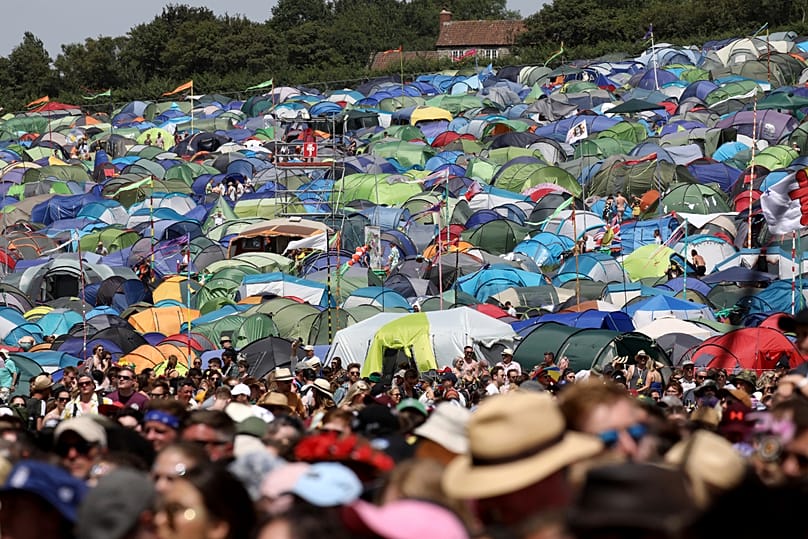
Revellers surrounding the Pyramid Stage at the Glastonbury Festival - 2019
Revellers surrounding the Pyramid Stage at the Glastonbury Festival - 2019 AP Photo

Unpopular opinion for many, but complaints are mounting - with some calling the 2027 price tag "unreasonable", "insane" and "a scam", while many feel like they're being priced out.

One fan wrote: “The last time I went was 2009. It was £165. It felt affordable, worth every penny. With inflation, sure, it should be £300 now. I get it, it’s a charity event. But £400?? That doesn’t feel right or fair.”

Someone else shared: "In 2000 it was £87. That’s an extra £321 in 27 years. The money went up but the music went down. Even accounting for inflation, that should be about £160 today. You pay more money to listen to shit music. How is this fair?"

Another wrote: "Everything in the UK is getting more expensive & lower quality How are people accepting this? Nothing in this country makes sense anymore."

Check out more reactions below:

Some fans have defended the price hike, sharing how it is actually a “bargain” compared to current concert prices.

“It’s £80-£100 for a big venue gig now. I think £408 is fair for five days of massive acts,” one person wrote on X. Another agreed: “£400 for a glasto ticket still seems like a good deal if you look at my concert spend this year."

“£400 for the whole 5 days and the acts you can see and everything else that’s in the fields is an absolute bargain,” another added.

Richer festival goers at Glastonbury Music Festival 2015
Richer festival goers at Glastonbury Music Festival 2015 AP Photo

In 2023, Glasto head Emily Eavis acknowledged it was a "challenging time" for festival organisers. "We have tried very hard to minimise the increase in price on the ticket but we're facing enormous rises in the costs of running this vast show, whilst still recovering from the huge financial impact of two years without a festival because of Covid."

Fair points, but considering four-day passes to this year's Rock en Seine cost €235, Belgium’s Rock Werchter (arguably mainland Europe’s answer to Glastonbury) set music lovers back €315, and one of our favourite EU festivals, the Netherlands’ Best Kept Secret, only cost €299 (including campsite access), we know which tickets we’ll be looking to book next year.

Roman revelation: Biggest ancient monumental wall mosaic unveiled after 2,000 years

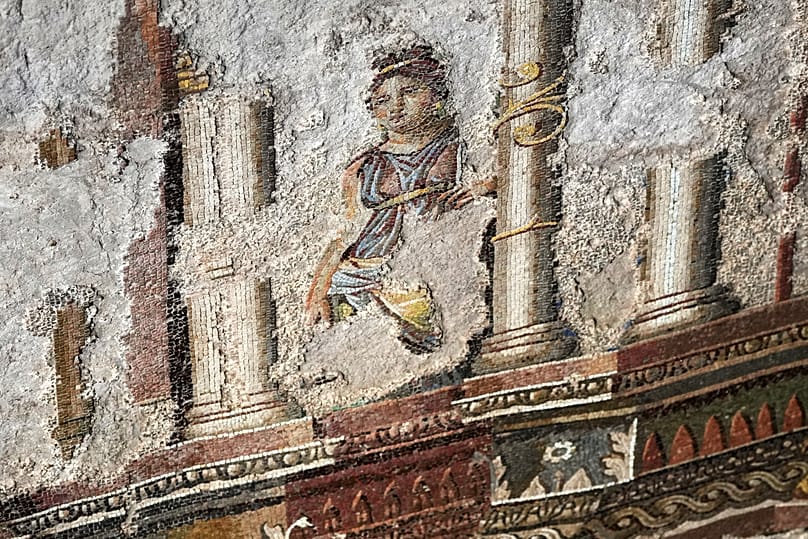
A restored 15-metre section of the ancient mosaic from the "La Città Dipinta" site, discovered in the late 1990s
Copyright AP Photo

By Ilaria Cicinelli & Tokunbo Salako
Published on

Trajan’s Baths in Oppian Hill will host a new museum where visitors to Rome can admire the Great Mosaic and the Painted City, two massive ancient artworks buried near the Colosseum that are estimated to date from the 1st century.

In a city filled with ancient treasures and relics, some are calling it the Italian capital's biggest and best kept secret. Now, the public can finally see what's thought to be the largest ever fresco and mosaic complex of ancient Rome.

Authorities have unveiled a first century A.D. depiction of a maritime city in what became the largest bath complex in the world - the Trajan Baths, the site of a new museum inaugurated on Wednesday.

The “Painted City” fresco and “Great Mosaic” were discovered in an underground gallery during excavations in the 1990s of the Baths of Trajan on the Oppian Hill near the Colosseum.

After being hidden underground for centuries, its blues and terracotta colors are still clear but faded.

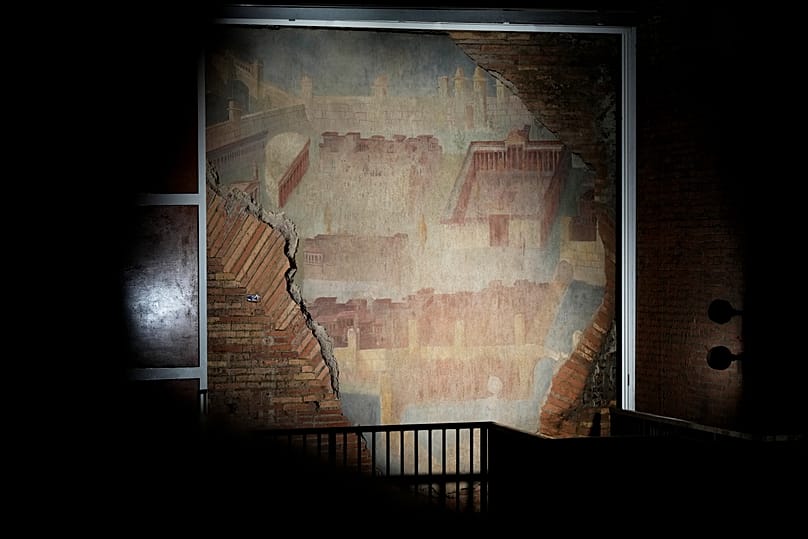
The fresco
The fresco AP Photo

Massive monuments

Speaking at the unveiling ceremony Rome's mayor, Roberto Gualtieri, said: “They are truly unique in the world, both from the point of view of artistic beauty and the historic and documental importance.”

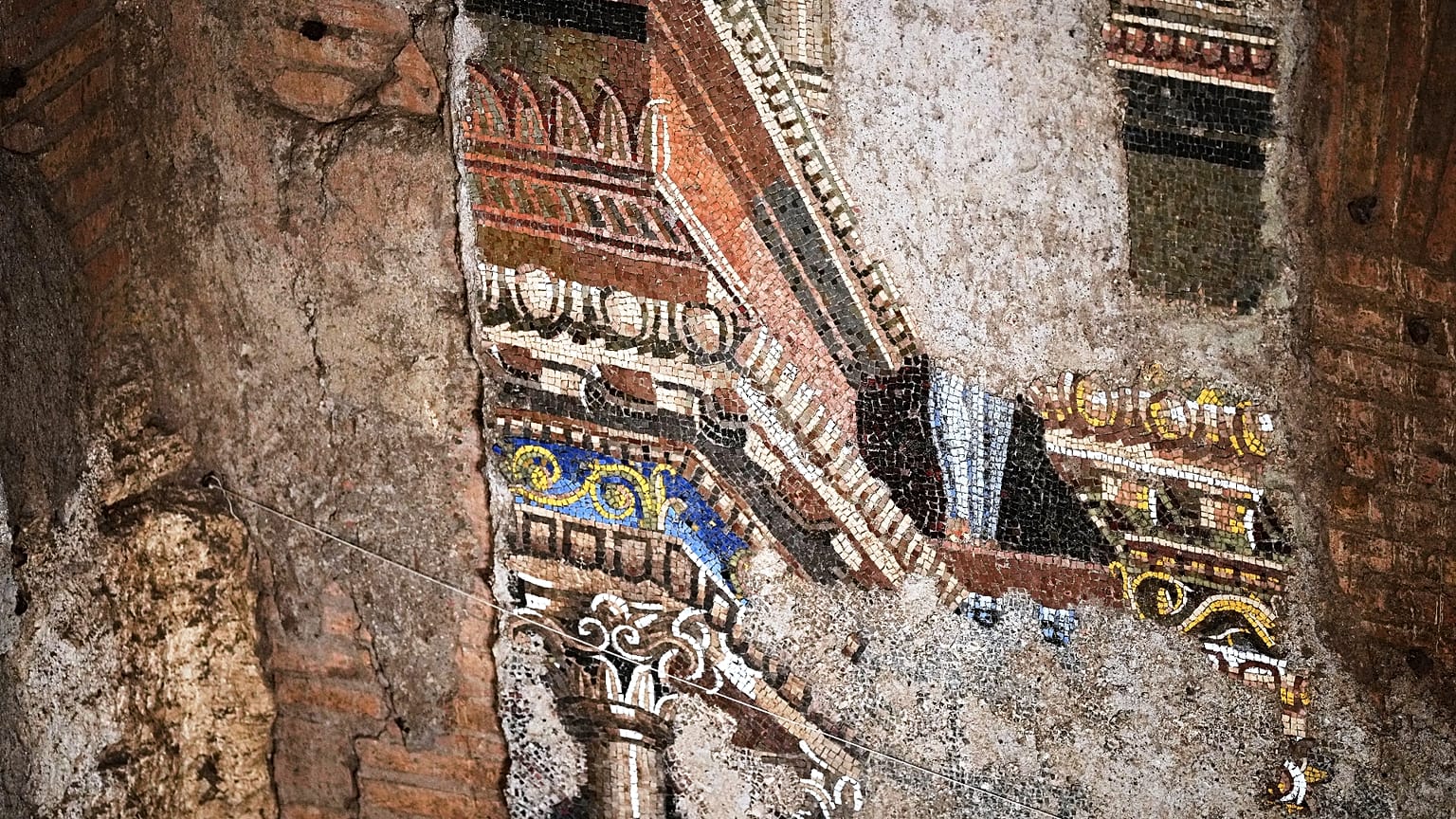
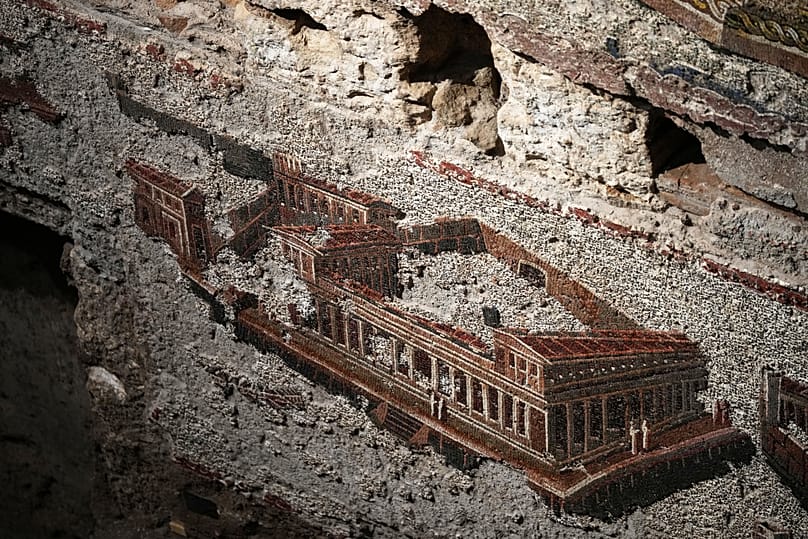
The mosaic, for its part, measures some 15 meters high and features intricately decorated columns and architectural elements and figures over four different levels. The top levels are up-close images with people that are almost like theatrical scenes, while at the bottom are views of the port city’s layout from above.

A section of the mosaic
A section of the mosaic AP Photo
A section of the restored 15-metre ancient wall mosaic from "The Painted City" site found in the late 1990s
A section of the restored 15-metre ancient wall mosaic from "The Painted City" site found in the late 1990s AP Photo/Andrew Medichini

The Baths of Trajan, which were dedicated by Emperor Trajan in 109 A.D., extended over six hectares and were at the time the largest bath complex in the world. They incorporated an earlier baths complex, the Domus Aurea, and were designed on a different trajectory to take better advantage of the water temperatures to optimize the thermal experience for users.

The Painted City and the Great Mosaic

Trajan's Baths were designed by Apollodorus of Damascus at the request of Emperor Trajan. Inaugurated on 22 June AD 109, they covered around 60,000 square metres and included bathing facilities, porticoes and spaces for physical and cultural activities and leisure time. The construction also incorporated older structures, including part of the Domus Aurea, which make it possible to trace the complex archaeological stratification.

The Painted City is a ten-square-metre fresco belonging to a building that predates Trajan's Baths, dating from the first century AD, depicting a city seen from above.

In the monumental wall mosaic "The Muse and the Philosopher", located in a large hall overlooking a nymphaeum, a Roman harbour is depicted in detail. It is not known whether it is real or imaginary, although some scholars have suggested it could be the final resting place of emperor Claudius.

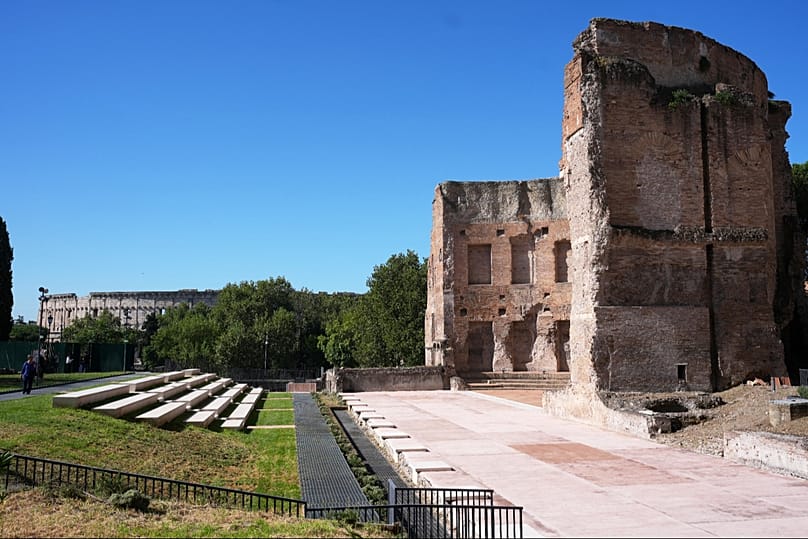
The Baths of Trajan in front of the Colosseum sits above the underground foundations where the restored "Painted City" fresco and Great Mosaic were found in the 1990s.
The Baths of Trajan in front of the Colosseum sits above the underground foundations where the restored "Painted City" fresco and Great Mosaic were found in the 1990s. AP Photo/Andrew Medichini

Already partially visible after restoration, the exposed section allows visitors to admire "the philosopher and other figures of extraordinary artistic quality", as Gualtieri put it.

However, finds made beneath the decoration have made it possible to reconstruct an original space that was much taller, with walls that must have risen to around 12 metres.

During the restoration, panoramic rest areas and new pedestrian routes were also created within the complex, along with a new tiered seating system designed to host concerts, conferences and events.

Restricted visits to preserve the artistic heritage

To assess the impact of visitor numbers on the conservation of the works, the first visits will be organised on an experimental basis for small groups at weekends only, with free guided tours by reservation, starting on 12 and 13 September.

From 2 October the site will be open to visitors from Friday to Sunday. There will be six time slots a day, with a maximum of 15 people at a time.

CCS

Delay tactic or genuine solution? Carbon capture under fire again as EU invests in ‘unproven’ technology

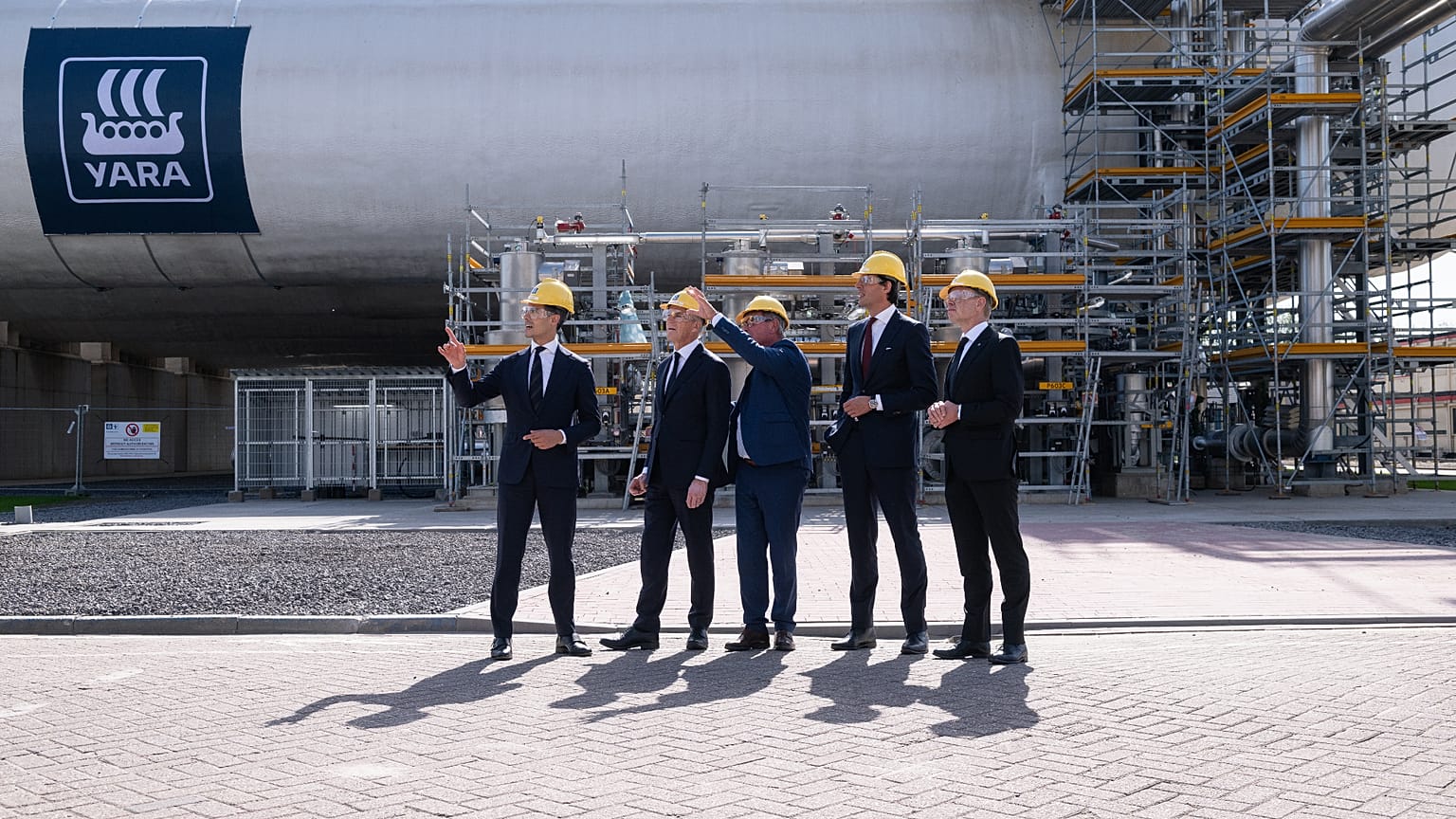
Wopke Hoekstra, European Commissioner for Climate, Net Zero and Clean Growth, second right, visits Yara Sluiskil, 7 September 2026
Copyright European Union, 2026, licensed under CC BY 4.0


By Ruth Wright with AFP
Published on

Carbon capture and storage has been found to be “technically uncertain and very high cost”.

CO2 emitted by a fertiliser factory in the Netherlands will be stored underneath the seabed in Norway, in what the owners are calling the “largest commercial carbon capture and storage (CCS) project in Europe”.

At an opening ceremony this week, the ammonia and fertiliser plant announced that it will capture 800,000 tonnes of CO2 a year then liquefy it to be sent by ship to Norway.

Having funded the project, the European Commission was keen to promote its investment – with the Commissioner for Climate, Net Zero and Clean Growth attending the inauguration alongside the Prime Ministers of both countries.

While the Commission says the Sluiskil plant, run by Norwegian chemical company Yara, is a “strategic investment”, opponents say it is “risking billions in taxpayers’ money to fund a dangerous distraction that delays climate action”.

As one of the most divisive topics in climate action, we look into the facts about carbon capture and how the EU came to be funding this experimental technology.

What is carbon capture and storage?

Carbon capture and storage (CCS) refers to technologies designed to prevent CO2 from entering the atmosphere in the first place and/or to remove it after it has been emitted.

As is done at the Sluiskil plant, most projects use a liquid to chemically remove the CO2 emitted from the production process, where it is then compressed into a liquid-like state and transported typically through a pipeline to a storage site. At that point, it’s either stored deep underground or is transformed into things like building materials or synthetic fuel. In the case of the latter, this technology is referred to as CCUS, where the ‘U’ stands for utilisation.

As of February 2026, there were 75 operational CCS projects around the world, according to climate change publication Carbon Brief. Almost all of them are at fossil-fuel extraction and processing sites, according to the IEA’s database. Together, these projects capture 62.5 million tonnes of CO2 (MtCO2) each year. This is equivalent to 0.2 per cent of total global emissions in 2025.

While Yara’s chief executive, Svein Tore Holsether, said in a statement, “The carbon capture facility in Sluiskil proves that large-scale industrial decarbonisation is possible today”, the cumulative emissions saved are a very, very tiny drop in the ocean.

US non-profit the Institute for Energy Economics and Financial Analysis (IEEFA) has conducted in-depth research into CCS. Their Energy Finance Analyst, Andrew Reid, says: “Despite the political and financial support that has been pointed to CCS over the past three to four years, it remains technically uncertain, very high cost, and reliant upon huge subsidies to move from feasibility to construction and operation.”

CCS: To help the fossil fuel industry to extract and sell more oil and gas

To understand its uses, it’s important to understand where carbon technology originates from. According to Carbon Brief, it “was originally rolled out at US and Canadian oil wells in the early 1970s as a way to achieve “enhanced oil recovery”. This involves injecting captured CO2 into depleted wells – a process that stores the gas, but also helps to extract more oil.” This is by far the most significant use for carbon capture worldwide, with three-quarters of it used for this purpose.

This means that “the majority of CO2 that is both captured and used today helps the fossil-fuel industry to extract and sell more oil and gas,” according to Carbon Brief.

How did the EU end up funding carbon capture and storage?

One of the arguments against CCS, which campaigners have been making for years, is that it is a way for polluters to keep polluting, rather than emitting less of the gases which are heating up the planet at alarming rates.

“All capture and storage projects suffer from the same problem: they distract attention and resources from cutting emissions at source and give polluting industries like fertiliser production a pass to keep on polluting,” says Rachel Kennerley, Senior International Carbon Capture Campaigner at the Center for International Environmental Law (CIEL).

Belén Balanyá, researcher and campaigner at Corporate Europe Observatory (CEO), has been tracking the lobbying efforts of the fossil fuel industry for 25 years. She has recently focussed on lobbying by the CCS industry. The outcomes of annual COP climate talks are known to be influenced by lobbyists representing industry. Balanyá found that around 500 CCS lobbyists were at COP29 in 2024. A year earlier, at COP28, CCS proponents (largely tied to fossil fuel industries) scored a significant win with the endorsement of “abatement and removal technologies” in the agreement.

Referring to fossil fuel industries, Balanyá says, “You look at what’s on the agenda and it’s always escape hatches to stay in business,” she tells Euronews Green. “It’s where they move when they’ve been forced to – when there’s more knowledge and more acceptance about climate change and their role and that they have to decarbonise.”

CCS being endorsed in a COP agreement may have contributed to its legitimacy in political circles within the EU. The CCUS Forum (now the Industrial Carbon Management (ICM) Forum), set up by the European Commission in 2021, is an annual event with working groups that feed directly into EU policymaking. CEO found that every group has been co-chaired by the fossil fuel industry or associated organisations.

A newly released report from the UN Environment Programme (UNEP) details the risks of overshooting 1.5°C of warming and how we can limit them. It assessed what it called Carbon Dioxide Removal and found that many issues remain with the technology, such as whether it can scale sustainably (due to costs, land and energy use), whether it would actually keep CO2 out of the atmosphere permanently and who’s responsible for regulation and leaks.

CCS: Good or bad?

Wherever commentators stand on CCS, there is some agreement that for some industries, the technology can be useful. Yara’s project targets emissions from ammonia production which “provides a relatively concentrated CO2 stream, making this one of the more straightforward industrial applications of carbon capture rather than an example of the very hardest emissions to abate,” according to Domien Vangenechten, Programme Lead in Clean Economy at E3G.

“The lesson should therefore not be that Europe needs CCS everywhere, but that we should pragmatically deploy it where it can cut substantial emissions today.”


From corals to saiga: Inside the recovery of threatened wildlife

Copyright Euronews
By Toby Gregory & Ruxshona Raxmatullayeva
Published on

From heat-resilient corals in the Gulf of Oman to saiga antelopes on the Ustyurt Plateau, scientists and conservationists are using research, technology and hands-on protection to safeguard threatened wildlife.

Studying the ocean of the future

On the UAE’s east coast, scientists at the Sharjah Marine Science Research Centre are studying marine ecosystems and recreating conditions that could become more common in the oceans of the future.

Some of the centre’s tanks simulate warmer, more acidic waters with lower oxygen levels. Professor Stephen Widdicombe, the centre’s director, says they offer an insight into how marine life could respond as ocean conditions change.

“The oceans are incredibly important, they represent 90% of the habitable space for life on this planet,” Widdicombe said. But he warned, they face pressures ranging from climate change and pollution to other human activities.

One area of research focuses on sea turtles. Every turtle has a unique pattern of scales on its face, much like a human fingerprint. Marine biologist Dr Jon Lapeyra photographs turtles along roughly one kilometre of coastline each week and uses artificial intelligence to help recognise individual animals.

“AI for us, and for this project in particular, has been a game changer,” Lapeyra said.

When the same turtle reappears, researchers can build a record of where it spends time and how it moves. Over six months, 95% of the turtles Lapeyra personally photographed were juveniles, which he described as an encouraging sign for the population.

Coral reefs are another focus. Corals in the Gulf of Oman already experience temperatures that would put many reefs elsewhere under severe stress, making them valuable for research into how reefs may respond to warmer oceans.

“The studies we do on coral reefs here can, of course, tell us something about future scenarios in other places of the world,” said Professor Henrik Stahl, the centre’s head of research and innovation.

Researchers are also working on restoration. Small coral fragments are placed on nursery tables anchored to the seabed, where they can grow into larger colonies under suitable conditions. Protecting threatened species often depends on understanding not only the animals themselves, but the habitats and resources they need to survive.

Protecting wildlife across vast landscapes

On Uzbekistan’s Ustyurt Plateau, the more than 600,000-hectare Saygachiy Complex Landscape Sanctuary protects part of the range of the saiga, a migratory antelope found across Central Asia.

“When we first arrived, we would see only two or three saiga antelopes,” said chief inspector Ortiqbek Saydullayev. “Today, we have managed to establish a resident population.”

Maintaining suitable conditions requires work throughout the year. Staff provide grain and other fodder when snow covers vegetation in winter, while water is pumped to watering points during the dry summer months. Saydullayev says 83 wells are spread across the sanctuary.

Saiga can also travel across national borders in search of food and milder weather. Their movements mean conservation depends not only on conditions within the sanctuary but also on the landscapes through which they migrate.

When protected habitats lose water

Further west, in Karakalpakstan, the Sudochye lake system shows another challenge facing protected wildlife.

Once connected to the Aral Sea, Sudochye became an independent lake system as the sea retreated and remains an important stopover for migratory birds.

“Water levels in the lakes have been declining year after year,” said Aymuradov Tokhtamurad, chief specialist at the Sudochye-Akpetki State Wildlife Sanctuary. “As inflows decrease, salinity increases. This affects wildlife and can force animals to leave the area.”

The changes can be seen along the shoreline, where vegetation remains green in areas still reached by water while reeds and plants further away have dried.

Sanctuary officials say Sudochye is the only nesting site for flamingos in Uzbekistan. If water levels continue to fall, they warn, the lakes could eventually stop functioning as a breeding site anced become primarily a passage point during migration.

Protected status can reduce some pressures, but it cannot replace the water on which an ecosystem depends.

Tracking recovery in the mountains

In southern Uzbekistan’s Kugitang mountains, Surkhan State Nature Reserve protects the markhor, a wild goat known for its corkscrew-shaped horns, and the Bukhara urial, a wild sheep.

The reserve was established in 1986 after populations of both species had fallen sharply. Wildlife censuses are now conducted twice a year.

“In November 2025, we counted nine hundred and eighty-one markhor and one hundred and thirty-seven Bukhara urial,” said deputy director Muhiddin Mamatqulov.

Researchers supplement those counts with 32 camera traps operating across the reserve. Senior researcher Umidjon Murtazayev says the devices record wildlife around the clock and help scientists study rare species, their behaviour, population dynamics and migration.

Technology has not replaced fieldwork. Ranger Bobur Eshoniyev says teams often remain in the mountains into the evening, when many animals become more active.

Reserve officials say the markhor population is growing, although threats including poaching, livestock pressure and fragmented habitat remain.

Across these projects, conservation increasingly combines long-term fieldwork with technologies ranging from artificial intelligence to remote cameras. The next test is whether recovering populations can continue to grow while the habitats they depend on face changing environmental pressures.


Spain endures 61 days of heatwave and records its hottest summer on record

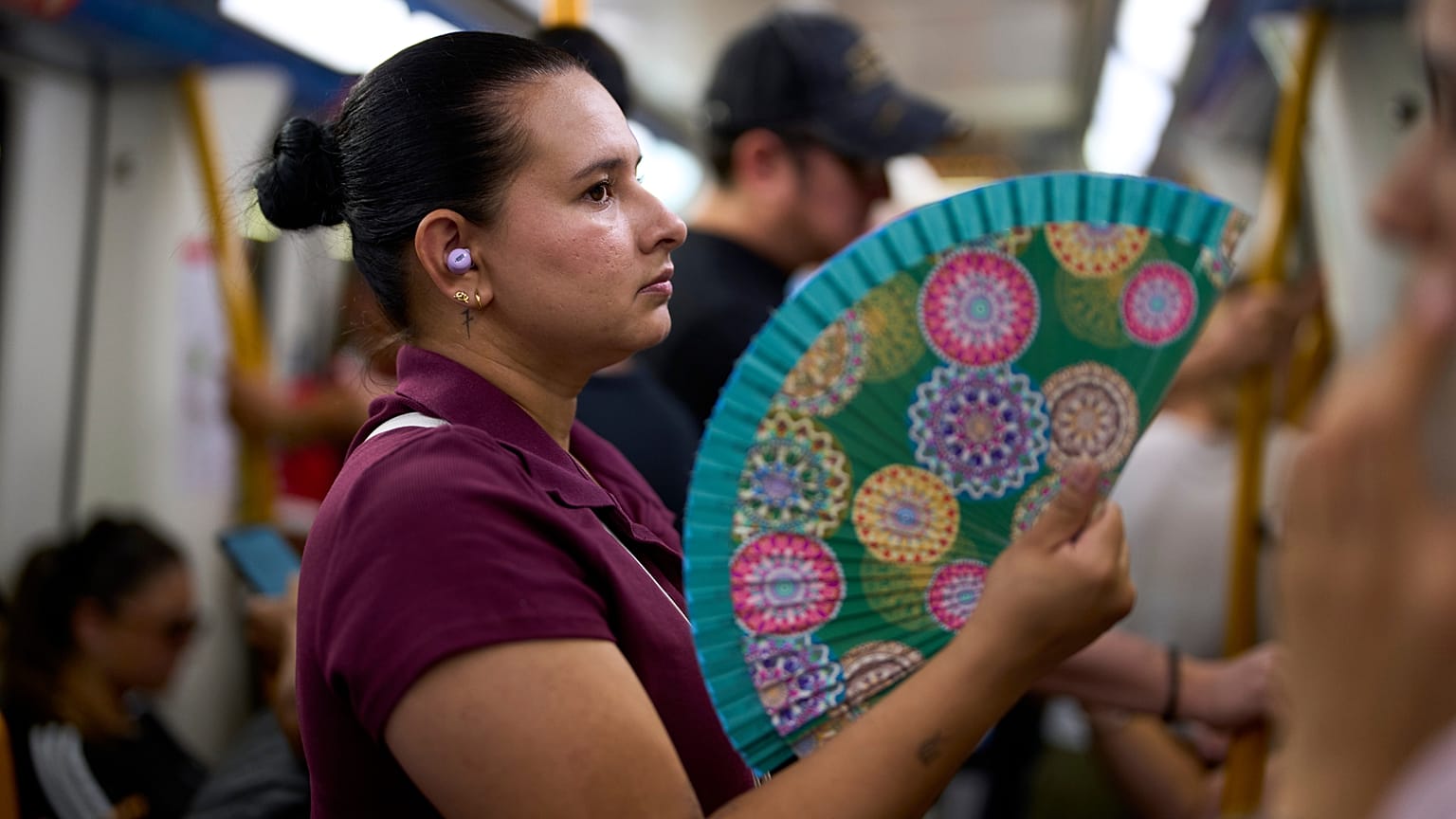
A woman uses a fan on the Madrid metro on 18 August 2026
Copyright Manu Fernández / AP

By Javier Iniguez De Onzono
Updated

Spain's weather agency has confirmed that Spaniards have already endured 61 days of heatwave conditions so far this year, more than in any other year.

Spain has surpassed the scorching summer of 2022, with a total of 61 heatwave days endured this year, compared with 41 previously, according to the State Meteorological Agency (Aemet).

The summer of 2026 has also recorded an average temperature of 24.5°C, making it the hottest since records began in 1961 and surpassing last year, 2025, by 0.3°C, and 2.4°C above the long-term average.

Aemet recalls that the 10 hottest summers on record have all occurred in the 21st century, and seven of the eight warmest have taken place since 2015. The agency also warns that the meteorological summer keeps getting longer.

"At the end of May, temperatures typical of July were recorded across large areas of the country. And then, in September, already in the meteorological autumn, there was another heatwave which, provisionally, ran from the 2nd to the 7th, lasting six days and affecting 16 provinces."

September heat, rainfall and wildfires: Spain outlook

Only in four other years has a month of September (1987, 1988, 2006 and 2016) seen such extreme heatwaves, more typical of the height of summer.

The heavy winter rains have meant that Spanish reservoirs have remained in very good condition after the summer season, with an average level of 62.58 per cent despite tourist pressure, and above half of their capacity in basins that are usually under stress, such as the Júcar, Segura, Andalusian Mediterranean and Catalan catchments.

Even so, this has not spared the country from suffering, as in the rest of Europe, large-scale fires that have exposed the lack of forest fire prevention and of sufficient personnel with good working conditions, in regions such as Madrid, Aragón or Castilla y León.