Showing posts sorted by relevance for query HIP CAPITALI$M. Sort by date Show all posts

Monday, August 21, 2023

HIP HOP CAPITALI$M
How hip-hop spurred the growth in Black businesses and financial empowerment

REVOLT COMMODIFIED

Ronda Lee
Sun, August 20, 2023

The 50th anniversary of hip-hop coincides with the national Black business month in August, and the former has been a driver of growth and empowerment for the latter, according to leaders in the music genre’s industry.

Hip-hop is an industry with an economic impact of $16 billion and has launched Black-owned businesses in music, film, fashion, and advertising for creatives that curated the culture.

Rappers have turned into entrepreneurs, spurring growth for other Black-owned businesses, building generational wealth, and investing in the communities that nurtured them.

"Hip-hop went from being a fad to commercialized and monetized in technology, fashion, sports and business," Detavio Samuels, CEO of REVOLT, told Yahoo Finance. "In the beginning, we weren’t owners, just brand ambassadors, not accumulating wealth from a genre and culture that we created. We’ve gone from making others rich to wealth accumulators."
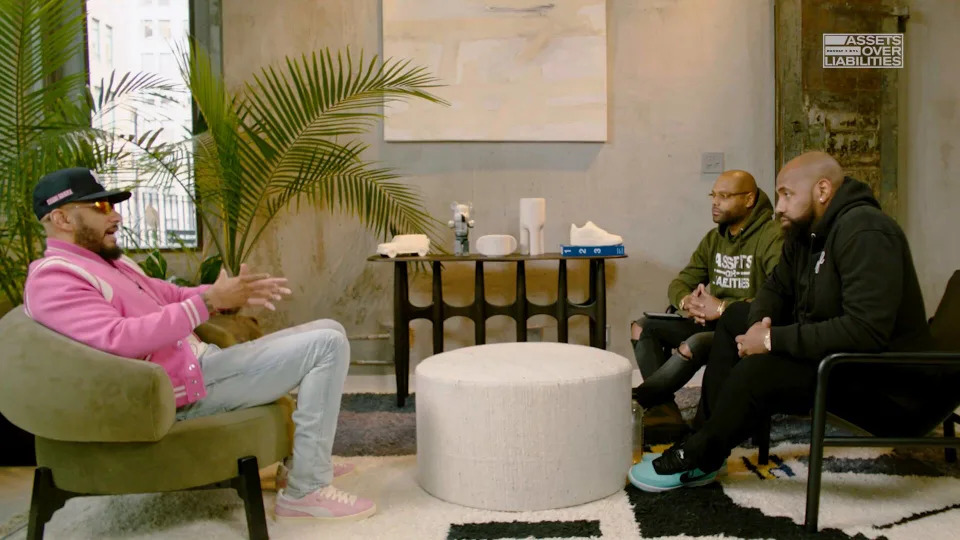

Rashad Bilal and Troy Millings of Earn Your Leisure, host REVOLT's Assets Over Liabilities, with the premiere episode featuring entrepreneur, producer, and artist Swizz Beatz.

Overall, there are around 3 million Black-owned businesses in America now, generating about $206 billion in annual revenue with 36% of those led by Black women. But the road to these successes was far from easy.

The history of Black businesses in the US is rife with violence and racism.

In what was known as the Red Summers of 1917-1919, many Black-owned businesses in Washington, D.C., Chicago, St. Louis, Houston, Tulsa, and Omaha were decimated during mob violence and racial terrorism.

In the decades that followed, many Black-owned businesses closed due to racially biased eminent domain proceedings, with the government taking land in Black business districts like Bruce’s Beach in Los Angeles and Beale Street in Memphis.

Hip-hop itself was its own economic battleground. When the genre was born, recording studios — more often owned by white executives — controlled the process from radio air time, marketing, ownership interests, and rights.

But they did not control the culture, which spawned more and more businesses.

For instance, Dapper Dan and 5001 FLAVORS were favorite designers for hip-hop artists that disrupted the fashion industry. Some of 5001 FLAVORS clients include Salt-n-Pepa, Heavy D, Sean P. Diddy Combs, Dr. Dre, DMX, Tupac, The Notorious BIG, Jay-Z, Beyonce, and Blue Ivy.

"Hip-hop allowed Black creatives and artists to create brands that wouldn’t have existed without hip-hop and allowed us to engage in collective economics, supporting other Black businesses," Sharene Wood, president and CEO of 5001 FLAVORS and Harlem Haberdashery, told Yahoo Finance. "Hip-hop opened the door to a lot of Black brands, like 5001 FLAVORS."
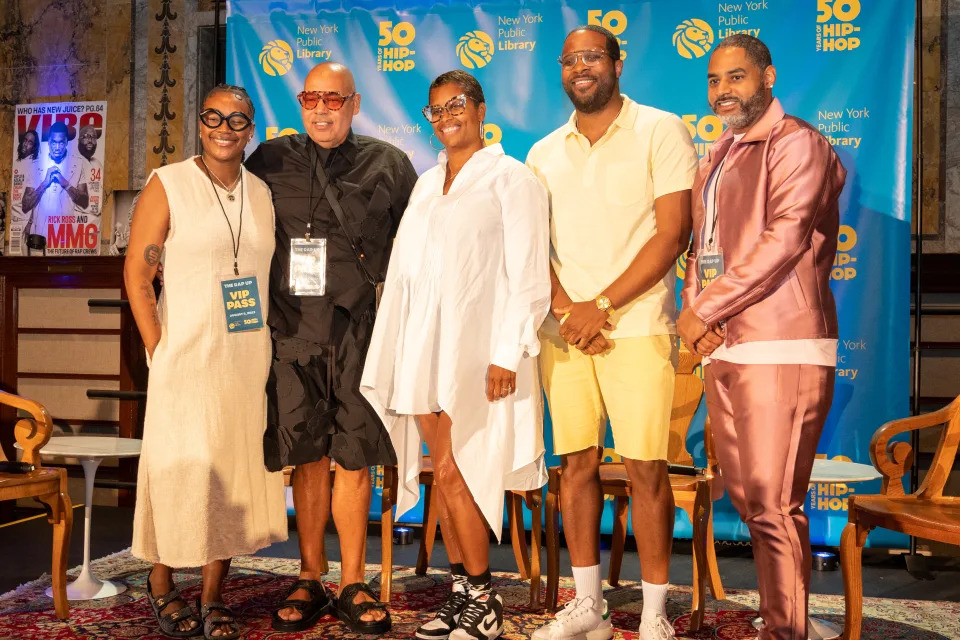

August 5, 2023. Ashlee Muhammad, Guy Wood Sr., Sharene Wood, Kells Barnett, and Guy Wood Jr. are featured at New York Public Library's "The Rap-Up" celebrating 50 years of hip-hop featuring Harlem Haberdashery and 5001 FLAVORS.

What started with $600 in Wood’s college dorm room has expanded 30 years later into a family business with a retail store (Harlem Haberdashery), a bespoke spirits line (HH Bespoke Spirits), and a 501(c)(3) that gives back to the community that raised them — #TakeCareofHarlem.

Designs by 5001 FLAVORS are archived at the Smithsonian, Grammy museum, and the Rock-n-Roll Hall of Fame museum honoring hip-hop.

"People wanted to build their own economy, and Biggie said it best: 'Never thought hip-hop would take us this far,'" Wood said. "Hip-hop creatives and the businesses that sprung from them didn’t have corporate grooming or business degrees when we started, but now Queen Latifah, LL COOL J, and Diddy are multi-hyphenates — rappers, actors, and entrepreneurs."

Sean "Diddy" Combs went from rapper-producer to CEO of Bad Boy Entertainment, owning a fashion line, and founder and chairman of REVOLT. This year is Bad Boy Entertainment’s 35th anniversary and the 10th anniversary of REVOLT.

REVOLT originally started as music video television in response to MTV’s embrace of reality television over music videos. However, when none of the genres outside of hip-hop showed up for the platform, REVOLT decided to embrace hip-hop culture as the storytelling agent.

"The narrative others tell about hip-hop is sex, love, drugs, and materialism," Samuels said. "REVOLT isn’t a media company, but an engine for transformative change for Black people to build generational wealth with culturally relevant information to turn financial whispers into shouts as to how Black billionaires have done it."

This resonates with the Black community. A Pew Research study found that 58% of Black adults say supporting Black businesses, or "buying Black" is an effective strategy for moving Black people toward equality in the United States.

"Social justice and empowerment has always been part of the DNA of hip-hop culture," Samuels said.

Financial empowerment


In another effort to empower the Black community and businesses, REVOLT partnered with Rashad Bilal and Troy Millings, founders of the viral platform Earn Your Leisure (EYL) that turned into a TV network on financial literacy, to host Assets Over Liabilities, a television series that bridges the gap between the world of finance and the hip-hop community, making financial literacy a focal point.

This season’s premiere episode is a sit-down with producer Swizz Beatz discussing his investment in Black artwork, selling his company Verzuz for $28 million, and his investment strategy for building generational wealth.

"Partnering with REVOLT to integrate hip-hop into the conversation removes stigmas and increases accessibility to financial literacy," Rashad Bilal and Troy Millings, co-hosts and co-founders of Earn Your Leisure, said. "We're empowering the community to break down financial walls and master their money with knowledge."

REVOLT is using its platform to highlight Black businesses and marketplace disruptors like Assets over Liabilities and Bet on Black.

Hip-hop’s influence on Black businesses and the idea of collective economics is rooted in empowering Black communities.

"Collective economics is not just about money, it’s a social responsibility to invest in the community because you can’t just consume from the community, you need to nurture it in order for business to thrive," Wood said. "Companies like the Fearless Fund exist because we’ve been historically underrepresented, underfunded, and systematically shut out of opportunities."

Ronda is a personal finance senior reporter for Yahoo Finance and attorney with experience in law, insurance, education, and government. Follow her on Twitter @writesronda


Sunday, October 16, 2022

HIP CAPITALI$M; YOGA FOR YAHOOS
Dubai's 'Yogi with a Lamborghini' on bridging the gap between money and spirituality 

By Laura Buckwell • Updated: 16/10/2022 - 11:24

Copyright euronews - Credit: Dubai

Master Sri Akarshana, better known as the Yogi with a Lamborghini, is an entrepreneur turned educational motivator who has reached 35 million people through his social media channels and live performances.


Master Sri Akarshana on Twitter

Born Eric Ho in the UK, the Dubai resident credits his father for helping him develop his entrepreneurial skills.

“My dad was an entrepreneur, so he had multiple restaurants, so I grew up learning about taking bank loans, then setting up a business and cash flow,” he told Euronews.


Master Sri Akarshana and his parents

He became a millionaire at the tender age of 25 years old after getting into steel and rubber recycling.

“One of the first deals we struck was for around $15 million. So, yeah, it just happened. We just took a chance and it worked out,” he said.

But despite his early success, Master Sri became disillusioned with money and “got a little bit lost chasing material [things], supercars, watches, houses, yachts.”

At a crossroads, a meeting with a Himalayan yogi from India changed his life and gave him what he describes as an ‘awakening’.

The Newcastle-born businessman underwent yoga training in the Himalayan mountains, eventually taking on the title of Master Sri Akarshana.

Grandmaster Akshar with Sri Akarshana

While yoga’s roots can be traced back thousands of years, Master Sri Akarshana decided to give the discipline a modern twist.

The viral name Yogi with a Lamborghini, therefore, was born of a desire to bridge the gap in society between those who are goal driven and those who are more spiritually inclined.

Yogi with a LamborghiniMaster Sri Akarshana

Master Sri explained, “It's not about one or the other. It's saying that, hey, we need to learn presence of mind and breath work and things like that and happiness fulfilment. But at the same time, we live in a material world, so money does matter.

“So to get that point across… I'm going to buy a Lamborghini and I'm going to continue to practise yoga and spirituality, because all the people who are chasing materials would see the Lamborghini and say, ‘hey, this is for me, I want to learn something’, and then all of the spiritual people would come on this channel saying, ‘Why is he driving a Lamborghini?’”

Now, Master Sri wants to bring the transformative power of yoga to more people, so he is opening a yoga centre in Dubai.

“It’s going to be the biggest yoga centre in Dubai, because Dubai likes everything to be the biggest, so we decided to do the same thing.... It's around 8,500 square foot unit, so we're going to be bringing a lot of people along this journey, building the community here, helping with health and wellbeing and mental health as well” he said.

However, this project is intertwined with his latest foray into the world of blockchain and digital art.


Master Sri launched three NFT collections with Super Creators this year, a market which has grown enormously since 2020, and has linked the collection with his yoga business.

“Aside from just selling let's say pixelated artwork that a lot of people are doing, ours has a real utility to it, where everybody who holds the NFT will be able to get free access to the yoga centre and all the training” he said.

Tuesday, October 24, 2023

HIP CAPITALI$M

Hipgnosis board unable to find better offer in $440m song sale

Daniel O'Boyle
Tue, 24 October 2023 


The board of the Hipgnosis Songs Fund says it has been unable to find a better offer for the collection of hits it agreed to sell to a sister fund for $440 million (£359 million), as a crucial vote on its future approaches.

The fund known for buying up the rights to pop stars’ work last month revealed plans to offload songs by artists such as Nelly, Rick James and Shakira to another fund, owned by Blackstone and managed by a team led by Hipgnosis founder Merck Mercuriadis.

The Hipgnosis fund said it sold the songs to return cash to shareholders because its share price didn’t reflect the value of its portfolio. But the deal drew criticism from some shareholders, who raised questions over the price and the connections between the two funds.

That prompted the fund’s board to shop the songs around, contacting 17 different parties in search of a better offer. But today it said it has not received a binding offer, as possible bidders said they “could not justify paying a higher price” than the original deal.

Shareholders will vote on the deal on Thursday, alongside a vote on continuation of the fund itself. Relations with shareholders weren’t helped when Hipgnosis revealed earlier this month that it would have to pull its dividend, because a lower-than-expected windfall from a recent US Copyright Royalties Board decision on streaming royalties meant it couldn’t hand the money back to shareholders without breaching agreements with its lenders.

In an attempt to fight off a revolt, the fund launched a strategic review last week, which will look at a range of options including kicking out Mercuriadis.

Shares lost as much as 3.5% today to 72.8p. That values the fund at £878 million, or less than half of the most recent assessed value of its portfolio.


BLACKSTONE-BACKED $440M ACQUISITION OFFER FOR HIPGNOSIS SONGS FUND ASSETS SEES OFF RIVAL INTEREST

Taylor Swift's Me! is one of four songs on her Lover album co-written by Joel Little, whose catalog is part of the portfolio being bid on by Blackstone-backed Hipgnosis Songs Capital


OCTOBER 24, 2023
BY TIM INGHAM

Last month, MBW broke the news that there was some interesting goings-on at Hipgnosis.

As reported, Blackstone-backed Hipgnosis Songs Capital (HSC) launched a bid to acquire 29 catalogs from UK-listed Hipgnosis Songs Fund (HSF) for USD $440 million.

These 29 catalogs include shares in hits performed by Taylor Swift and Lorde (Joel Little) as well as by Justin Bieber (Poo Bear), plus shares in the songwriting catalogs of stars such as Shakira, Rick James and Barry Manilow.

The $440 million offer price represented a multiple of 18.3x historical Net Publisher Share (NPS) of the catalogs, and a rise of +26% vs. the price paid by HSF for their original acquisition.


Sat in the middle of this activity was Hipgnosis Song Management (HSM), the investment adviser to both HSC and HSF.

HSM’s CEO – Merck Mercuriadis – explained at the time that he had “consulted with many of [HSF’s] largest shareholders” ahead of the $440 million acquisition bid.

Mercuriadis further explained that the primary benefit of a successful acquisition from an HSF shareholder’s perspective was that it would “release cash enabling [HSF] to reduce debt and ‘buy back’ shares in the market”, which would then potentially lead to a market ‘re-rating’ of HSF’s share price.

(As those of you following this story will know, HSF’s share price is currently trading at around half the size of the value placed on it by independent valuer, Citrin Cooperman. Blackstone’s $440 million bid for the 29 catalogs represents a 17.5% discount on this portfolio’s price as per this independent valuation.)

However, there was a big caveat to HSC’s bid to acquire these rights: To ensure that HSC’s offer was competitive, HSF entered into an independent ‘go shop’ period, in which it solicited bids from other parties to – effectively – see if that $440 million offer could be beaten.

It couldn’t.


In a note to shareholders today (October 24) , HSF’s board said that “following substantive engagement with a number of parties”, it did not receive a “Superior Offer” as part of the ‘go shop’ process.

HSF’s board said in a shareholder update that it had “received feedback through the process [from] a number of the parties assessed that they could not justify paying a higher price” than the $440 million offer from HSC.

(HSC had a ‘matching right’ if a superior bid was made, meaning that it could have raised its own bid offer to gazump any rival approaches at a higher price.)

In total, HSF’s board says it was in contact with 17 parties at the beginning of the ‘go shop’ process. Eight parties then signed NDAs, before one – non-binding – offer was made.

And that was the end of that.


This is another interesting chapter in the story of Hipgnosis Songs Fund, which has been a point of fixation for the financial pages of UK newspapers in the past two weeks. (HSF trades on the London Stock Exchange.)

On Thursday (October 26), HSF will hold shareholder votes on two crucial topics:Whether or not to accept Blackstone/HSC’s $440 million offer for the 29 catalogs;
Whether or not HSF should continue in its current form – a decision that will be reached via a ‘continuation vote’ amongst shareholders

Regardless of the way the votes move on these two issues, Merck Mercuriadis (via HSM) holds an ongoing “call option” to acquire the assets of Hipgnosis Songs Fund should HSF terminate the contract of HSM as its investment adviser.

As MBW reported last week, a “call option” is an agreement that sees a potential buyer (in this case HSM) able to acquire assets at a previously-specified price from a potential seller (in this case HSF).Music Business Worldwide


Thursday, September 29, 2022

HIP CAPITALI$M
South Asian Americans Are Coming Out Of The Weed Closet

Alisha Sahay - Yesterday - HuffPost 

Is weed stigma in the South Asian community finally shifting? 
(Photo: Illustration: Benjamin Currie/HuffPost; Photo: Getty Images)


When Emel, 34, consumed cannabis for the first time, it wasn’t at a house party with a cloud of smoke drifting up and onward, or any other clichéd scene that programs like D.A.R.E. used to warn her about — nor was it this great act of rebellion or dissent by an angsty American teen.

It was 2009, and Emel, who omitted her last name to avoid drug-use stigma at her job, was at a backyard barbecue hosted by a college friend’s family, whose Mexican heritage meant that their East Los Angeles home swelled with mariachi music and the chatter of aunties and uncles. The homemade brownies were perched alongside the rest of the food on the table, she recalls, readily available for the adults. Emel felt safe enough at the party to know that she’d be taken care of in case something happened — so she tried some.

“The thing I remember most is how peppery the brownie tasted,” she says. “It took an hour for the high to really hit. It was really subtle. It wasn’t scary or anything like that — it was really pleasant. It was in that moment that I was, like, ‘Oh, this isn’t that bad.’”

But it wasn’t just the taste of the brownie that had surprised her. “Nothing else happened. The earth didn’t open up and swallow me in hell because I had an edible.”

Emel grew up in Pakistan, then immigrated with her family to Los Angeles in 2003 when she was 15. Her traditional parents’ moral compass included reductive binaries that made ethics almost too simple: Don’t smoke, don’t drink and don’t dress provocatively. To do any of these things would make you “bad.” “I don’t think I’m a bad person — I think I’m a really good person,” she says. “But that battle will always be in the back of my mind because that’s how stigma boils it down.”

Many cultures condemn cannabis, but there’s something uniquely bitter about the battle that’s been waged against the substance by the South Asian community. As misguided as this is, many (especially older) members cling to their “model minority” status, and consuming weed is, well, not model minority behavior.

This judgment of cannabis use manifests in harmful rhetoric that’s internalized by people like Emel who consume with caution and intention. It’s not uncommon for brown people to hide their cannabis usage from the watchful and discerning eye of the cultural community they live in, which sometimes views users of the plant as “lazy stoners,” even though the myth has been thoroughly debunked.

Yet it was always “log kya kahenge” — “what will people think” in Hindi — a catchphrase that our parents have thought out loud when we veered away from what they deem the safest and most honorable behavior.


Nidhi Lucky Handa decided to make cannabis more accessible for her Indian community in the U.S. by launching Leune, which is now sold in several states and offers various forms of cannabis, including edibles and pre-rolled joints. (Photo: Tara Pixley for HuffPost)

“I think South Asians are one of the most community-based groups, which is a positive thing,” says Nidhi Lucky Handa, founder of the California-based cannabis company Leune. “But the exact opposite is true as well. The community is very concerned with what people think.”

A child of immigrant parents from India, Handa grew up in the suburbs of Boston. Though her parents were open to having conversations about traditionally taboo topics, like cannabis, Handa couldn’t say the same about her larger, conservative brown community. “When there was a function or birthday party, I was very aware that, even amongst my Indian peers, I would never talk about cannabis. It was an assumption that, at best, they might also smoke weed, but then it would get back to their parents and then put me in some sort of category of being a bad influence.”

Handa founded Leune in California — more than 3,000 miles away from this community in Boston — with the kind of IDGAF attitude that would make her younger self proud. The stigma she grew up with lurked in the background at times; she acknowledges that the physical distance served as armor against the whispers of the community she had grown up in. Away from home, she was able to focus on navigating the industry’s complex supply chains and ebb-and-flowing legalization. Not to mention, as a BIWOC founder in the industry, she had to face the additional laborious hurdle of having to dismantle its predominantly male and white landscape.

Though it’s easy for South Asians to deem the plant and its users as “bad influences,” the community’s stigma around the plant feels inherently contradictory. For one, it’s the South Asian cultures’ reverence for Earth and its natural elements that have led some brown people to see cannabis not as an offender but rather as another terrestrial inhabitant. “The way that my parents were, they were very interested in preventative medicine, homeopathy, ayurveda. So, from where I was sitting, cannabis was a plant first,” Handa says.


Nidhi Lucky Handa at her Hollywood office on Sept. 20. She sees cannabis as part of the tradition of honoring a tradition of medicine that relies on nature. 
(Photo: Tara Pixley for HuffPost)© Provided by HuffPost


Pari Patel, a 25-year-old who’s studying medical cannabis science and cultivating her own homegrown cannabis farm, agrees. “Having a green thumb is in my blood. I grew up with the farms in India owned by generations of farmers,” the New Yorker says. “I’m a Patel, after all, so that’s our known trait back in the motherland.”

Patel’s exposure to cannabis, however, wasn’t born solely out of curiosity. “I actually learned about [cannabis] in religious school, in a story about how the lordship used ‘bhang,’” she says, referring to the low-potent paste made from the leaves of the cannabis plant that dates to as early as 1,000 BCE. On Hindu religious holidays that celebrate Lord Shiva, like the spring festival Holi, bhang is traditionally used in food and drink: cold and milky “thandai,” thick and creamy “lassi” and ghee-ful sweets, among other sugary and savory concoctions.

Cannabis has also been recognized in both ayurvedic and Unani systems of ancient medicine as a treatment for endemic diseases like malaria, among other ailments. “The Atharva Veda” — one of four sacred pieces of Indian literature — calls bhang (which English translations posit as hemp) one of the five “kingdoms” of plants that “free us from distress,” and varying legends across India tell tales of Lord Shiva’s consumption of bhang (this is why it’s present at religious festivals that honor him). It’s this very mythological and religious significance that has allowed bhang to escape India’s otherwise strict cannabis criminalization.

If cannabis has been interwoven in the fabric of South Asian existence, where exactly did the stigma around it come from? In the U.S. and many other Western nations, the answer may not be so elusive: politics. “It’s a much more linear thing to understand in the U.S. This is a plant that has been used as a weapon, to fuel the industrial complex and to further structural racism,” Handa says. “This country is founded on this great ability to bring people together over their mutual hate for immigrant groups.”

In fact, Indian immigrants — along with Mexican immigrants and Black people — were in the crossfire of an ensuing century-long political smear campaign against cannabis beginning in the early 1900s. California’s cannabis prohibition in 1913 was accompanied by public health official Henry J. Finger’s contempt of the “Hindoos” — who were in reality predominantly Punjabi Sikh people — “a very undesirable lot” for “initiating our whites into this habit.”


The “war on drugs,” which labeled cannabis as a “gateway drug,” coincided with the influx of South Asian immigration following the 1965 Immigration and Nationality Act. In 1985, the Reagan administration successfully pressured the Rajiv Gandhi-led India, a nation looking to strengthen its relations with the U.S. and tap into American technology, to outlaw cannabis vis-a-vis the Narcotic Drugs and Psychotropic Substances Act, codifying cannabis hostility into law on both sides of the Atlantic Ocean.

Despite all this context about how weed stigma persists for South Asian Americans, some have a hard time acknowledging that very stigma could be, at least partially, a part of their assimilation process. Within our diaspora, there’s a tendency to accept ideologies, no matter how stigmatized, as impenetrable truths when they’re coming from authority figures within political, legal and social structures. For first- and second-generation brown people in the diaspora, adjusting to certain so-called truths was a matter of survival.

Cannabis was a symbol of calamity, especially as South Asians massively immigrated against the backdrop of the war on drugs; witnessed the resulting mass, disproportionate incarceration of Black people; and navigated a post-9/11 world that already stigmatized brown people. Being “good” and keeping our heads down were perceived to be the safest options.

Emel, who was raised in a Pakistani Muslim family, agrees. “It never made sense to me that a man could marry outside his religion in Islam but a woman can’t,” she says. “There are certain ideas and structures that are ingrained within us, and we accept them without question.”

Increasingly, however, brown people are challenging these predisposed, unjust structures. Patel says that, though her family disapproves of her using cannabis, she’s no longer willing to hide her cannabis use on social media and in real life. “A lot of people who have judged me have now come around and are users themselves.”


Nidhi Lucky Handa says people in her community are now even asking if they can invest in her cannabis business. 
(Photo: Tara Pixley for HuffPost)

Handa has noted a welcome shift in her community’s attitudes since launching Leune. “It was a ‘don’t talk about what she’s doing’ thing for a while,” she says. “Now I’ll get a random call, text or email asking, ‘Are you raising money? Can I invest?’”

Challenging stigmas also manifests in education. It’s important to note that cannabis can be addictive, especially for those who start as teens. But it’s crucial to recognize that cannabis can be a source of both physical and mental healing when used with informed guidance and intention.

Emel, Handa and Patel all credit weed for helping them through anxiety and other mental health struggles — a benefit that’s beginning to be backed by research. And, despite being demonized as an gateway drug, cannabis has actually shown potential as an exit drug in preventing opioid, tobacco and alcohol misuse. Medical marijuana has also been used to alleviate chronic pain and seizures in children.

Feelings around the plant are contradictory and complicated, and breaking down these barriers can be taxing. But for many South Asians, it’s worth the struggle.

“At the end of the day, [cannabis] is something that helps me be a better and healthier version of myself,” Emel says. “That is more valuable to me than preventing myself from doing something that’s ‘unsavory’ and suffering from it — preventing myself from being the whole person I can be.”

Related video: U.S. Set to Produce 27 Million Pounds
of Legal Cannabis by 2030   Duration 1:05   View on Watch


Monday, June 07, 2021

HIP CAPITALI$M

HIPGNOSIS SONGS FUND NOW OWNS A MUSIC CATALOG WORTH OVER $2.2 BILLION

(Henry Diltz / Warner Records)


Hipgnosis acquired 50% of the Neil Young song catalog in its last FY, in a deal worth around $150 million


Hipgnosis is the owner of a catalog that has been independently valued at USD $2.21 billion, the UK-listed company revealed today (June 7) in a financial update.

That catalog, valued as of the end of March 2021, contained 64,555 songs across 138 catalogs, according to a preliminary annual financial filing.

The $2.21 billion valuation, said Hipgnosis, reflected a multiple of 17.96x historical annual net publisher share income.

The valuation is over $200 million larger than the approximate $2 billion Hipgnosis cumulatively spent on the catalog following the firm’s IPO on the London Stock Exchange in 2018.

That ≈$2 billion cumulative expenditure, said Hipgnosis today, represents an average/blended acquisition multiple of 15.32x.

In the 12 months to end of March 2021, said Hipgnosis, it acquired 84 catalogs for $1.06 billion – an average per-deal price of $12.6 million.

These acquisitions included music catalogs from the likes of Neil Young, Lindsey Buckingham, Chrissie Hynde, Shakira, Walter Afanasieff, Steve Winwood and Grammy Award-winning producer, Andrew Watt.

Calling 2020/2021 a “remarkable year”, Hipgnosis founder and CEO, Merck Mercuriadis said today: “[Whilst] we never would have wished for a pandemic, it has accelerated the consumption of classic songs through streaming and demonstrated exactly what an excellent uncorrelated asset class proven songs are. The pandemic looks set to now lead us into inflation and again we are extremely well placed with Songs as an asset class for our shareholders to be beneficiaries.”

“THE PANDEMIC LOOKS SET TO NOW LEAD US INTO INFLATION AND AGAIN WE ARE EXTREMELY WELL PLACED WITH SONGS AS AN ASSET CLASS FOR OUR SHAREHOLDERS TO BE BENEFICIARIES.”

MERCK MERCURIADIS, HIPGNOSIS SONGS FUND

He added: “Our goals when we listed three years ago were to: (1) Establish Songs as an asset class; (2) Use the leverage of our fund and the great songs in our catalog to be a catalyst to change where the songwriter sits in the economic equation for the benefit of the songwriting community and our shareholders; (3) To replace the broken traditional publishing model with Song Management and add value.

“Having given our shareholders a 41% total return since inception, grown our NAV by more than 11% across this fiscal year, having advocated for songwriters at the highest level including the DCMS hearings taking place in Parliament and having increased our sync income from 9% to 15%, I’m delighted to say we are well on our way to Hipgnosis achieving all.”

Having rooted through Hipgnosis’ new preliminary update, below MBW presents three key takeaways from the music company’s latest numbers…


1) HIPGNOSIS HAS TRANSFORMED INTO A DEEPER CATALOG COMPANY IN THE PAST YEAR

One of the most interesting parts of Hipgnosis’ new results covers the make-up of the company’s portfolio of 64,555 songs (or, more accurately, its portfolio of songs and/or portions of songs).

The 84 catalogs acquired by Hipgnosis in the year to end of March 2021 – which also included deals for catalogs/income streams related to Blondie, Barry Manilow, Rick James, and Jimmy Iovine – changed the mix of its portfolio significantly.

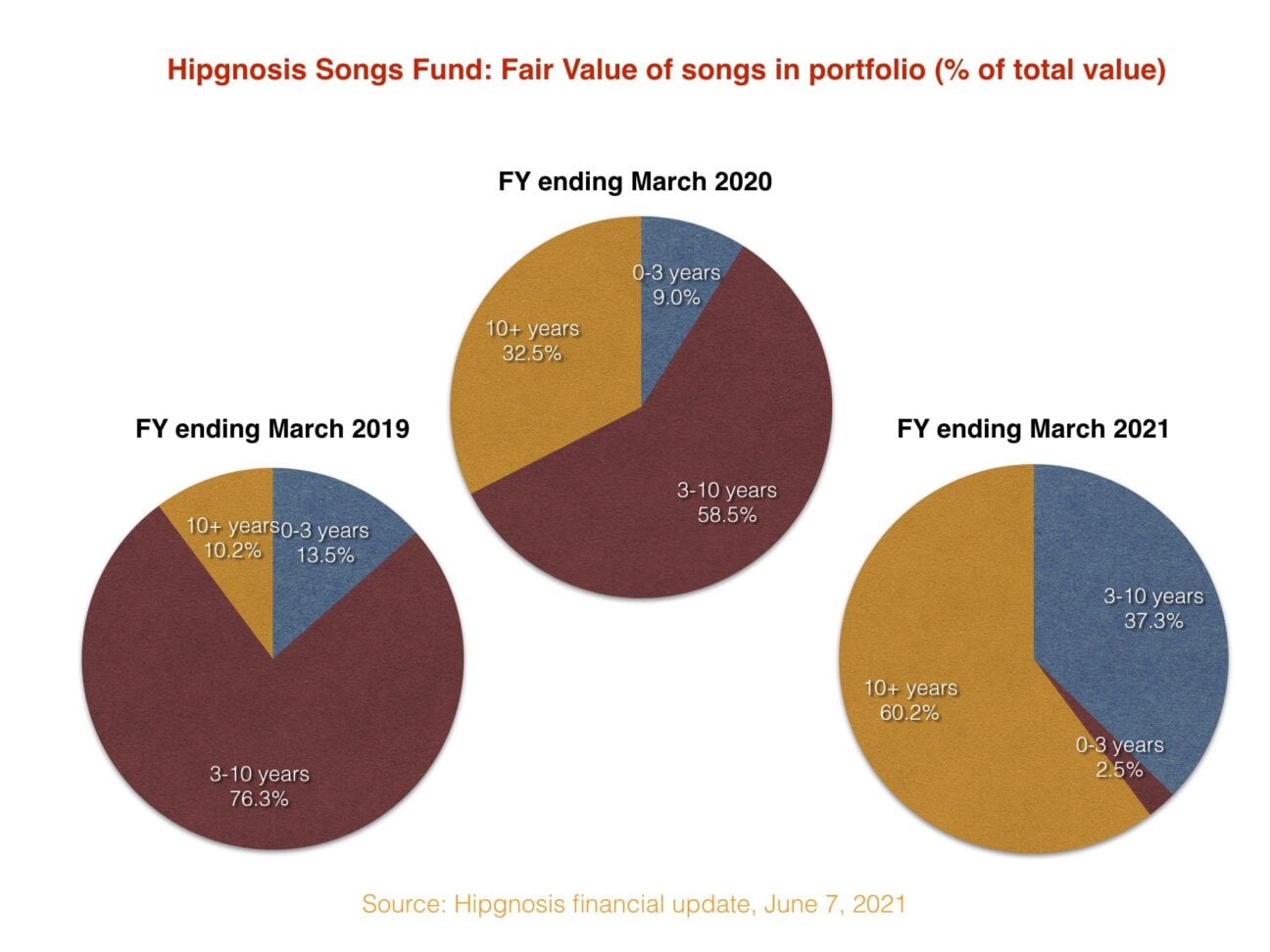
As you can see below, some 60.2% of Hipgnosis’ song portfolio, in terms of fair value, is now at least a decade old.

At the end of March 2020, this figure came in at just 32.5%, and at the end of March 2019, 10-years-plus aged catalog represented just 10.2% of the firm’s total fair value.

Obviously as time ticks on, acquired catalogs are getting older, but there’s been a clear acquisitive swing at Hipgnosis to more evergreen/classic catalogs in the past 15 months.

That said, major contemporary music deals are still getting done by Hipgnosis, with the likes of Andrew Watt and Joel Little (Taylor Swift, Lorde). Hipgnosis acquired 178 songs from Little earlier this month.


2) HIPGNOSIS SAW ITS NET REVENUE GROW 66% IN FY 2020/2021 – BUT PANDEMIC-HIT PERFORMANCE RIGHTS WERE A PAIN POINT

Hipgnosis Songs Fund‘s net revenue increased by 66% in the year ended March 31, 2021, to $138.4 million.

That number was up on the prior year’s net revenue figure of $83.3 million. It included both new revenue from acquisitions, and $22.7 million of “Right To Income” which Hipgnosis says “in effect reduces the net purchase price [of acquisitions], to the benefit of the company”.

Hipgnosis also posted a healthy EBITDA in FY 2021 of $106.7 million.

That was up 49.8% on the $71.2 million EBITDA the company posted in the prior year period.

The $106.7 million EBITDA in FY 2021 represented a 77.1% margin on Hipgnosis’ net revenue in the period ($138.4m).


Hipgnosis has started recognizing two separate calculations for its portfolio: one for its entire catalog, and one for “steady state catalogs”, from which it says “we would not expect decay from peak earnings”.

Streaming income increased 18.4% across the whole Hipgnosis portfolio in the six months to end of March 2021 versus the prior six months, said the company. And its “steady state” catalog grew by 24.3% on the same six month vs six month basis in the second half of the FY.

However, Hipgnosis added: “[Performance] income – which is predominantly received from shops, bars and restaurants as well as live music – has fallen across the music industry in 2020 as a result of COVID-19 lockdowns globally, with PRS recently stating [UK] performance revenues fell by 19.7% in 2020.

“As a result of these industry wide trends, performance income in our catalogs’ royalty earnings income decreased by 25.8% in the second half of the year from the previous six month period across all catalogs, and 21.3% on our ‘steady state’ catalogs where we would not expect decay from peak earnings.”

Hipgnosis said it expected a “further modest fall” in performance revenues in the first half of the current financial year (to end of September 2021), but that it expects “performance income will quickly return to and exceed pre-COVID-19 levels as lockdowns are being lifted in our largest revenue generating markets”.

On 26 March 2021, Hipgnosis drew down USD $90 million under its Revolving Credit Facility, resulting in total gross indebtedness of $577 million and net indebtedness of $438 million.


3) HIPGNOSIS SAYS ITS COPYRIGHT MANAGEMENT PLATFORM IS INCREASING SOME CATALOGS’ REVENUES BY AS MUCH AS 40%

Hipgnosis’ preliminary results filing reads: “We have launched a platform that matches all data points to identify issues that can stop or delay payments. It provides a 3D picture of the data across 200 outside partners who collect revenue on the Company’s behalf. The platform is expected to shorten payment times and increase accuracy as we identify data breaks in real time.

“Our initial trial catalogs have identified 62% of Songs had data issues and we estimate a significant revenue uplift, projected to be as much as 40%, which will be realised by correcting the mistakes in registrations inherited from previous owners. These issues existed before our ownership, therefore every issue fixed is pure revenue upside for the Company.”

“SYNC REVENUES HAVE EXCEEDED ALL EXPECTATIONS AND, DESPITE FILM AND TV PRODUCTION BEING SHUT DOWN FOR MUCH OF THE LAST 16 MONTHS, REVENUES HAVE INCREASED.”

MERCK MERCURIADIS, HIPGNOSIS

In addition, Hipgnosis is buoyant about its ‘Song Management’ team, led by Ted Cockle and Amy Thomson.

Said Merck Mercuriadis: “Our new Song Management team, led by Ted Cockle and Amy Thomson, has made a strong impact, growing revenue and enhancing the legacies of our great Songs, which will make a positive economic impact to the Company in periods to come. Sync revenues have exceeded all expectations and, despite film and TV production being shut down for much of the last 16 months, revenues have increased. This has highlighted not only that we have bought well but also how undervalued our iconic songs have been by traditional publishers and the massive opportunity this affords Hipgnosis.”

Speaking of sync, Hipgnosis’ results revealed that it has now hired former BMG Global Head Of Sync, Patrick Joest, in Europe.Music


Tuesday, March 28, 2023

HIP CAPITALI$M

SNDL to purchase four Dutch Love cannabis stores in $7.8M deal

Calgary-based pot retailer SNDL Inc. says it is buying four Dutch Love cannabis stores from Lightbox Enterprises Ltd.

SNDL says it is paying $7.8 million for three stores in B.C., one in Ontario and the right to use some of Dutch Love's intellectual property.

Around $1.5 million of the price will be paid in cash, $3 million will come in the form of cancelled debt owed by Lightbox to SNDL and $3.3 million will be paid in common shares of SNDL.

The stores SNDL will acquire generated a combined annual revenue of $11.5 million in 2022, with an average gross margin of 36.5 per cent.

The deal is anticipated to close by the end of May, and is the result of a sale and investment solicitation process undertaken by Lightbox as part of its proceedings under the Companies' Creditors Arrangement Act. 


The expected close will be concurrent with the proposed restructuring of Nova Cannabis Inc. and SNDL. 

This report by The Canadian Press was first published March 28, 2023.


Shoppers Drug Mart moves away from

medical cannabis, will send patients to

Avicanna

Shoppers Drug Mart Inc. is moving away from its medical cannabis distribution business and preparing to transfer patients to a platform run by biopharmaceutical company Avicanna Inc.

The pharmacy chain owned by Loblaw Companies Ltd. announced the shift Tuesday, but did not say what prompted the change or how much money Toronto-based Avicanna is paying for Shoppers to refer patients to its MyMedi.ca platform.

“We are grateful for the trust placed in us by our medical cannabis patients over the past few years, and are confident we’ve found the right partner in Avicanna to continue to support them,” said Jeff Leger, Shoppers' president, in a statement.

His company will start to send customers to Avicanna's platform in early May, with all of the patients set to be off-loaded from Shoppers' medical pot service by the end of July. Customers will be able to place orders on Shoppers' website through the transition period.

Avicanna said it will offer a similar range of products including various formats, brands and "competitive pricing." Like Shoppers, its online medical portal will strive to educate customers around harm reduction and provide specialty services for distinct patient groups like veterans.


Shoppers first launched its medical cannabis business in Ontario in January 2019, months after recreational pot was legalized in Canada (medical pot was legalized in Canada in 2001) at a time when many predicted the weed sector would be booming in the coming years.

The sector has instead struggled with profitability and as high numbers of recreational cannabis shops cluster in several cities, many retailers and licensed producers have had to drop their prices to stay competitive.

However, Shoppers said it racked up tens of thousands of patients in its four years of existence, providing them with access to cannabis from more than 30 brands including Aphria Inc., Hexo Corp.'s Redecan and the Green Organic Dutchman.

Shoppers' medical cannabis patients were required to obtain a prescription from a licensed health care provider such as a doctor to begin ordering pot from the company, which shipped orders to their homes.

But the company was unhappy with how medical pot regulations limited its model. Shoppers claimed Tuesday that medical cannabis remains the only medication that is not dispensed in pharmacies.

“As we move away from medical cannabis distribution, we remain firm in our belief that this medication should be dispensed in pharmacies like all others and will continue our advocacy to that end," said Leger.

Avicanna's statement did not outline its feelings on the matters, but its chief executive said it was "motivated" to "put our full efforts toward advancing medical cannabis and its incorporation into the standard of care.”

“We are thankful to be selected as the partner for this transition and look forward to introducing MyMedi.ca, supporting patients and providing them with continuity of care,” said Avicanna chief executive Aras Azadian in a statement.

This report by The Canadian Press was first published March 28, 2023.


Tuesday, March 05, 2024

HIP CAPITALI$M
Hipgnosis sees value of portfolio cut after new due diligence work

Rupert Hargreaves
Mon, 4 March 2024 

The board appointed the third-party advisor following disagreements between the company and its investment advisor Hipgnosis Song Management Limited, over the value of its assets.

The Hipgnosis Songs Fund has today reported an updated net asset value following the preliminary valuation report prepared by Shot Tower Capital.

The investment trust’s stock price is down over 10 per cent on the news.

Shot Tower was appointed by the company as part of its strategic review of the value of its portfolio of music streaming rights.

The board appointed the third-party advisor following disagreements between the company and its investment advisor Hipgnosis Song Management Limited, over the value of its assets.

Shot Tower has performed a detailed review of the company’s portfolio, using a “variety of factors and assumptions,” about royalty streams, rights and cash revenue generated from the value of assets.

Following the detailed analysis, the advisor has returned a “preliminary valuation report,” which pegged the fair value of the company’s portfolio at between $1.8bn (£1.4bn) and $2.1bn (£1.7bn) and $1.7bn (£1.3bn) and $2bn (£1.6bn) after “deducting contingent catalogue bonuses of $59.9m (£47.3). “

The Shot Tower valuation compared to the 30 September 2023 valuation of $2.6bn (£2.1bn).

Hipgnosis said: “The Shot Tower valuation midpoint of $1.9bn (£1.5bn) therefore reflects a multiple of 15.9x net royalty income prior to deducting contingent catalogue bonuses and a reduction in valuation of 26.3% to the valuation as at 30 September 2023.”

Adjusted solely for the Shot Tower Valuation, the company’s operative net asset value would be approximately $1.17 (92p) per share, compared to the last reported net asset value of $1.7392 (137p) per share at the end of September.

Robert Naylor, Chairman of Hipgnosis Songs Fund, said: “The newly constituted board is making good progress with the due diligence work that will underpin its strategic review. We are disclosing the valuation at this time given its material difference to valuations previously disclosed. The board will provide further detail on this when the due diligence is complete. The board remains focused on identifying all options to deliver shareholder value.”

Tuesday, August 05, 2025

NOT SO HIP CAPITALI$M

Gen Z shift, high costs force UK nightclubs to reinvent

London (AFP) – Is the party over? UK nightclubs are famed around the world, but Covid and inflation have hit the sector hard, forcing businesses to reinvent themselves to attract new generations to the dance floor.


Issued on: 05/08/2025 -

A man walks past the boarded up entrance to the closed-down PRYZM club in Kingston, west London © JUSTIN TALLIS / AFP

Pryzm Kingston is a well-known club in southwest London popular with students, where artists like Billie Eilish, Rod Stewart, and Stormzy have performed.

But the converted cinema closed its doors for renovation last month, with its owners saying it was time to "look to the future and reimagine this venue for the next generation of partygoers."

It will be transformed into a smaller club and a dance bar -- "creating venues that reflect what people are looking for now," they added.

Many other British clubs are also trying to re-adjust after around a third of them, about 400 venues, have shut down since 2020, according to the Night Time Industries Association (NTIA).

"Whilst nightclubs were in gentle decline prior to Covid, the pandemic profoundly accelerated things," Tony Rigg, a music industry consultant, told AFP, noting that the cost-of-living crisis had sent bills and rents soaring.

As the first pints of the evening were poured in central London, 26-year-old account manager Conor Nugent told AFP he only goes clubbing for "special occasions," after asking himself "if it's really worth it."

Like 68 percent of 18-to-30-year-olds, the Londoner has cut back on nights out for financial reasons and prefers to save up for concerts and events.

Rigg pointed out that Covid-19 caused a "cultural shift" among Gen Z — those born between 1997 and 2012 — who generally drink less alcohol and largely miss out on the "rite of passage of going out, experiencing clubs and learning some social behaviours."
Lure of Paris, Berlin

Rekom UK, the company behind iconic clubs like Pryzm and Atik, filed for bankruptcy in 2024, shutting down 17 venues across the country, citing multiple pressures.


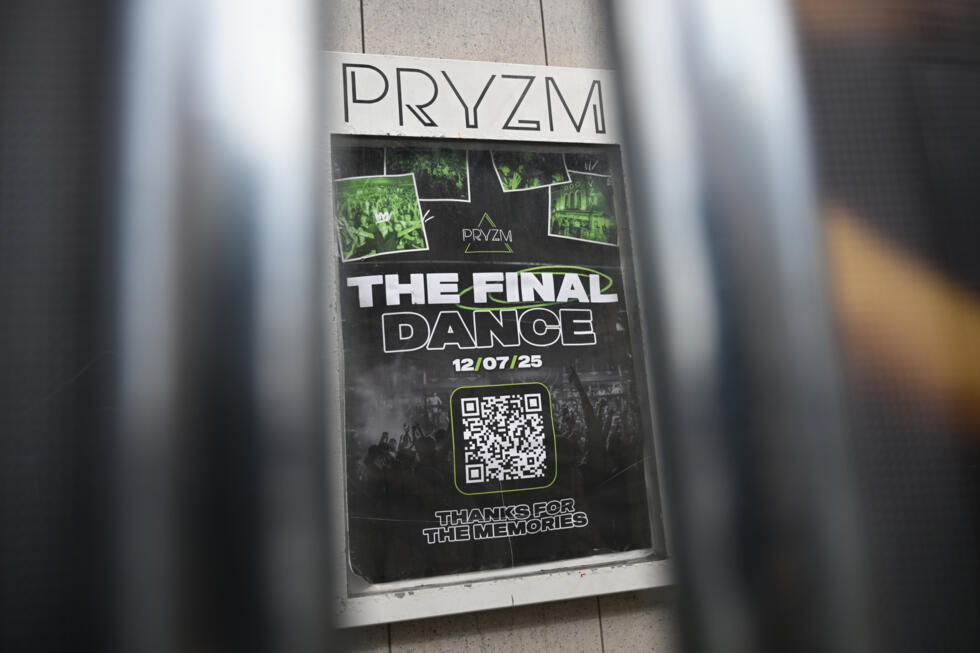
A sign advertises the final night at the closed-down PRYZM Kingston club in Kingston, west of London, on July 31, 2025 © JUSTIN TALLIS / AFP


About 20 others, including Kingston, were acquired by Neos Hospitality, which decided to convert some into dance bars or host alcohol-free events.

"The sector has to evolve otherwise it will become obsolete," Rigg acknowledged.

To stop hemorrhaging party-seekers lured by Berlin or Paris, London Mayor Sadiq Khan launched an independent working group called the "Nightlife Taskforce," which is set to publish a report later this year.

"One of the reasons why people love London is our nightlife, our culture," Khan told AFP.

"When I speak to mayors in Paris, in New York and Tokyo, I'm jealous of the powers they have" especially on licensing issues, he said, adding he was looking at other cities like Paris "with envy" as it enjoys a nighttime boom.

He was granted approval in March to overrule certain local authorities who had forced pubs, restaurants, concert halls, and nightclubs to close early.
UK nightclubs are trying to reinvent themselves after some 400 venues have closed their doors since 2020 © OLI SCARFF / AFP/File

The government has also announced plans to change regulations to support nightlife venues in certain areas.

"Sadly, in the UK, we struggle with reputational issues and a narrative that makes (clubbing) more of a counterculture element rather than a real economic and cultural driver," NTIA head Michael Kill, who advocates for greater recognition of electronic music and club culture, told AFP.

The night-time sector contributes a vital £153 billion ($203 billion) a year to the UK economy, employing around two million people, according to NTIA.

And with London still enjoying a long, well-established reputation, all is not lost.

The capital remains an "exciting" city, 25-year-old Carys Bromley who recently moved to London from the island of Guernsey, told AFP.

"There's a lot of parties, clubs, and a big nightlife. The places stay open longer, it's busier, a bit more wild," she said.

© 2025 AFP