It’s possible that I shall make an ass of myself. But in that case one can always get out of it with a little dialectic. I have, of course, so worded my proposition as to be right either way (K.Marx, Letter to F.Engels on the Indian Mutiny)
Wednesday, September 16, 2026
Aged microplastics can reshape how pharmaceuticals break down during wastewater treatment
Surface radicals on weathered plastic particles accelerate carbamazepine degradation in UV-based treatment systems, but may also increase the formation of some more toxic intermediate products
Shenyang Agricultural University Collaborative Journals
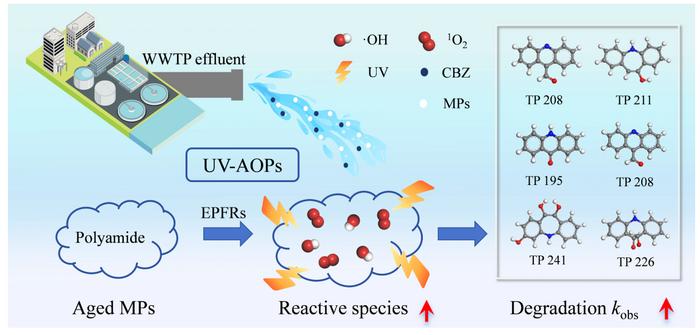
Microplastics in wastewater may do more than simply carry pollutants. A new study shows that aged microplastics can actively alter the chemical reactions used to remove pharmaceutical contaminants during advanced wastewater treatment, accelerating pollutant degradation while also changing the abundance of potentially harmful transformation products.
Researchers investigated how aged polyamide microplastics affect the breakdown of carbamazepine, a widely used pharmaceutical frequently detected in surface water, wastewater, and even drinking water. The team examined three ultraviolet-based advanced oxidation processes, known as UV/PMS, UV/H₂O₂, and UV/Cl, which use ultraviolet light and oxidants to generate highly reactive chemical species that destroy organic contaminants.
“Our results show that aged microplastics should not always be regarded as passive particles during wastewater treatment,” said corresponding author Xiaohui Wang of Beijing University of Chemical Technology. “Their aged surfaces can participate in chemical reactions, increase the production of reactive species, and ultimately influence both pollutant removal and the products formed during treatment.”
The researchers found that aging caused environmentally persistent free radicals, or EPFRs, to develop on the surface of polyamide microplastics. These surface radicals promoted electron transfer and enhanced the formation of reactive species, particularly hydroxyl radicals and singlet oxygen.
As a result, aged microplastics increased the observed degradation rate constant of carbamazepine by 1.2 to 1.8 times across the three treatment systems. The largest relative enhancement occurred in the UV/Cl system, where the degradation rate constant increased by about 1.8 times.
However, faster disappearance of the original pharmaceutical does not necessarily mean lower environmental risk.
Using mass spectrometry, the researchers identified numerous transformation products and found that aged microplastics increased the abundance of several intermediates. The fundamental degradation pathways remained broadly similar, involving reactions such as hydroxylation, oxidation, ring condensation, and ring cleavage, but the distribution of the resulting products changed.
Toxicity modeling further indicated that some transformation products were more toxic to aquatic organisms than the original carbamazepine molecule. In particular, TP 194 showed substantially higher acute and chronic toxicity, while several other intermediates were classified as harmful or toxic. Structural analysis suggested that removal of the amide group, hydroxyl substitution, and formation of unsaturated rings could contribute to increased toxicity.
The study also showed that wastewater chemistry matters. Nitrate promoted carbamazepine degradation in all three systems, while bicarbonate and humic acid generally inhibited it. The influence of chloride depended on its concentration and the oxidation system being used.
The findings highlight the need to consider microplastics as chemically active components of wastewater treatment environments, rather than inert contaminants. They also suggest that evaluating treatment efficiency solely by measuring the disappearance of a parent pollutant may overlook changes in transformation-product toxicity.
The authors note that the experiments were conducted under controlled laboratory conditions and used only polyamide microplastics. Future studies will need to test a broader range of plastics and verify these effects in complex, environmentally realistic waters.
===
Journal reference: Wang Y, Zhou X, Xu Z, Liu H, Wang X, et al. 2026. Oxidant-dependent carbamazepine transformation: how aged microplastics modulate degradation pathways in UV-AOPs. New Contaminants 2: e024 doi: 10.48130/newcontam-0026-0021
Oxidant-dependent carbamazepine transformation: how aged microplastics modulate degradation pathways in UV-AOPs
Article Publication Date
9-Sep-2026
Iron-modified nanotubes help accelerate the breakdown of toxic nitrobenzene in wastewater
A solar-inspired system combining heat, electrochemistry and photocatalysis removed more than 92% of nitrobenzene within two hours while limiting harmful intermediate products
Shenyang Agricultural University Collaborative Journals
Credit: Bin Bian, Jiayue Hu, Xinrui Ma, Pengkai Wang, Zhan Shen, Pascal E. Saikaly & Ling Liu
Nitrobenzene is a persistent industrial pollutant that can be difficult to eliminate from wastewater. Now, researchers have developed an integrated treatment system that combines thermal, electrochemical and photocatalytic processes to break down the pollutant more rapidly and drive it further toward mineralization.
The system removed 92.1% of nitrobenzene within two hours and achieved a calculated mineralization efficiency of 62.4%, substantially outperforming simpler electrochemical configurations tested in the study.
“Instead of relying on a single treatment mechanism, our approach brings together several forms of energy to accelerate pollutant degradation while promoting a more direct oxidation pathway,” said Jiayue Hu, a corresponding author of the study. “The results show how engineering both the electrode surface and the reaction environment can improve the treatment of persistent organic contaminants.”
Nitrobenzene is used in industrial chemical production and can enter agricultural, municipal and pharmaceutical wastewater. Its chemical stability makes it resistant to conventional oxidation. Some treatment approaches first convert nitrobenzene into aniline or require additional chemical reagents, which can increase costs or generate secondary pollution concerns.
The researchers explored a solar thermal electrochemical photocatalytic, or STEP, strategy, which combines photo, thermal and electrochemical effects. At the center of the system is an electrode made from titanium dioxide nanotube arrays modified with iron, known as Fe-TNT.
Titanium dioxide is widely used as a photocatalyst, but its relatively wide bandgap limits its ability to utilize light efficiently. The team's theoretical calculations suggest that local iron coordination introduces new electronic states that make charge transfer and nitrobenzene activation more favorable. The calculations also indicated stronger interactions between nitrobenzene molecules and the modified surface.
The researchers compared three operating modes. After two hours, the conventional solar-electrochemical configuration removed only 7.5% of nitrobenzene. Adding thermal assistance increased removal to 52.5%. When the Fe-TNT photocatalytic electrode was incorporated into the complete STEP configuration, removal reached 92.1%, while calculated nitrogen-based mineralization reached 62.4%.
Importantly, the combined treatment also appeared to change how nitrobenzene was broken down. Conventional electrochemical and thermal-electrochemical processes produced intermediates including phenol and para-benzoquinone. Under STEP conditions, these intermediates were not detected by the study's HPLC analysis, while maleic acid became the dominant detected product. The findings indicate a more direct pathway from nitrobenzene to maleic acid, followed by further oxidation toward smaller molecules and eventual mineralization.
This streamlined pathway could help reduce the accumulation of potentially harmful intermediates during treatment.
The researchers emphasize that the work remains at the laboratory stage. The experiments used an external solar heater and a UV lamp to separately reproduce the energy inputs represented in the STEP concept, rather than full-spectrum sunlight. Future studies under simulated or natural solar irradiation, together with long-term electrode stability, iron leaching and energy-efficiency tests, will be important for assessing practical applications.
===
Journal reference: Bian B, Hu J, Ma X, Wang P, Shen Z, et al. 2026. Enhanced nitrobenzene mineralization in a STEP system. Energy & Environment Nexus 2: e024 doi: 10.48130/een-0026-0018
About Energy & Environment Nexus: Energy & Environment Nexus (e-ISSN 3070-0582) is an open-access journal publishing high-quality research on the interplay between energy systems and environmental sustainability, including renewable energy, carbon mitigation, and green technologies.
A September 16 summit hosted by the National Center to Reframe Aging — the leader of the movement to transform how we think and talk about aging — brought together thought leaders, federal representatives, and professionals across multiple sectors who are reshaping the narrative around aging to improve health and well-being across the lifespan.
Several panels shared the successful outcomes from partnerships across the aging services network and state multisector plans on aging, while presenters also identified a roadmap for reaching new sectors. These include health care, where communication shapes how people understand aging, health, capacity, and care, and can influence decisions and outcomes; technology and agetech, where the people designing products and services make choices about who they are for and what they communicate about people at different ages; and financial services, which can help people plan for opportunity, work, contribution, and well-being across longer lives.
National Center Executive Director Patricia M. “Trish” D'Antonio, BSPharm, MS, MBA, BCGP, said that people are finding better ways to communicate, organizations are using reframing as a strategy, and a more complete story of aging is becoming part of the institutions that shape our lives.
“What we are doing is working. Reframing aging is a communication strategy that organizations in many sectors can apply to improve understanding and advance better outcomes for all of us as we age. And when one sector uses that strategy well, it creates examples, language, and momentum that another sector can adopt,” D’Antonio said. “They may come with a communication challenge: reaching a broader audience, improving a service, explaining an initiative, or showing the value of a program or product. That is our opportunity.”
Rani Snyder, MPA, the president of The John A. Hartford Foundation, delivered the summit’s keynote and announced two new awards. Presented by the National Center to Reframe Aging and sponsored by The John A. Hartford Foundation, the Reframing Aging Journalism and Culture Impact Awards will recognize excellence in reporting and storytelling that shape how aging is understood. The awards honor journalists, editors, storytellers, and organizations advancing accurate, productive narratives that counter stereotypes and reflect meaningful lives as we age.
“These awards will showcase journalism and organizational initiatives that demonstrate the power of accurate, productive communication about aging,” said Rani E. Snyder, president of The John A. Hartford Foundation. “Elevating successful approaches inspires others to adopt reframing aging principles and contribute to stronger policies, programs and communities for all of us as we age.”
Nominations for the awards will open in mid-2027.
###
The National Center to Reframe Aging leads the movement to transform how we think and talk about aging. As the architect of proven communication strategies, the National Center equips organizations and individuals with actionable resources to advance initiatives that benefit us all as we age. Led by the Gerontological Society of America, the National Center acts on behalf of and amplifies efforts of the Leaders of Aging Organizations collective. Support for the National Center comes from The John A. Hartford Foundation and The SCAN Foundation.
The Gerontological Society of America (GSA), founded in 1945, is the oldest and largest interdisciplinary organization focused on aging. It serves more than 6,000 members in over 60 countries. GSA’s vision, meaningful lives as we age, is supported by its mission to foster excellence, innovation, and collaboration to advance aging research, education, practice, and policy. GSA is home to the National Academy on an Aging Society (a nonpartisan public policy institute) and the National Center to Reframe Aging.
Four Host Nations gift SFU's Burnaby campus Indigenous place names
“Our language carries our history, our knowledge and our connection to these lands. Seeing these names reflected across Simon Fraser University’s Burnaby campus is an important recognition of the enduring presence of its Host Nations.”
These words from Chief Wayne Sparrow of the Musqueam Indian Band speak to the significance of the four Host Nations gifting Indigenous place names for the campus and four more culturally significant locations on Burnaby Mountain – believed to be the most extensive collaboration with Host Nations – during a naming ceremony today.
Working in partnership with the kʷikʷəƛ̓əm (Kwikwetlem), səlilwətaɬ (Tsleil-Waututh), Sḵwx̱wú7mesh Úxwumixw (Squamish) and xʷməθkʷəy̓əm (Musqueam) Nations and Indigenous members of the university community, SFU is grateful to receive and uphold Indigenous names in the two languages spoken by the Host Nations: hən̓q̓əmin̓əm̓ and Sḵwx̱wú7mesh.
“These names are gifts that carry meaning and responsibility, and we hope they encourage students, faculty, staff and visitors to learn more about the lands they are on and the Nations who have cared for them since time immemorial,” says Sparrow. “We appreciate SFU’s commitment to working in relationship with the Host Nations and to ensuring our languages and histories have a lasting and visible place on campus.”
xʷtatəl̕ləm ʔə ƛ̓ səltaɬ sme:nt / Xwta7ltáw̓txw tl’a Lheḵw’lhúḵw’aytn are the new names for SFU Burnaby campus, meaning “learning place” and “learning house” on Burnaby Mountain in each language, respectively.
“The name Xwta7ltáw̓txw tl’a Lheḵw’lhúḵw’aytn (learning house of Burnaby Mountain) carries both our sníchim (language) and our connection to this land, so that every person who steps onto this campus understands whose territory they stand on,” says Sxwíxwtn Wilson Williams, chairperson, Sḵwx̱wú7mesh Úxwumixw (Squamish Nation). “This gift reflects our relationship with SFU and the decades of shared commitment to education, and this ceremony marks an important step in a partnership we know will only grow stronger into the future.”
"It has been a journey of many years to arrive here, and I am grateful and honoured that today, we are celebrating the gifts of names from the four Host Nations upon which xʷtatəl̕ləm ʔə ƛ̓ səltaɬ sme:nt (hən̓q̓əmin̓əm̓) / Xwta7ltáw̓txw tl’a Lheḵw’lhúḵw’aytn (Sḵwx̱wú7mesh), Burnaby campus, sits," says SFU President Joy Johnson.
"Over the course of our conversations with Host Nations and the Indigenous community at SFU, I learned so much about the two languages traditionally spoken by our Host Nations, and SFU's responsibility to continue recognizing their languages, histories and ongoing presence on these lands. Thank you to everyone who contributed to this work and I look forward to hearing these names spoken all across our campus moving forward."
All five locations were identified as significant to Indigenous faculty, staff, students and the community. The place-naming project was led by an Indigenous naming committee, called the SFU Indigenous Naming Family.
"I am deeply honoured by the ongoing partnership between our Nation and Simon Fraser University to bestow hən̓q̓əmin̓əm̓ names across SFU’s Burnaby campus. In hən̓q̓əmin̓əm̓, Burnaby Mountain is known as səltaɬ and is of immense cultural significance to our Nation. Embedding our language and culture here strengthens the presence of səlilwətaɬ across our traditional territory while also sharing valuable knowledge with SFU students, staff, and visitors,” says Chief Justin George, səlilwətaɬ (Tsleil-Waututh Nation).
“My sincere gratitude goes to Gabriel George Sr., Director of our Language, Culture, and Protocol (LCP) Department, Michelle Goerge, LCP Deputy Director, and their dedicated team for working alongside SFU leadership to bring these names forward. As we approach the National Day for Truth and Reconciliation, this important work demonstrates SFU’s meaningful commitment to walking a better path forward alongside the four Host Nations."
At the opening of SFU’s Burnaby campus in 1965, the Host Nations were not engaged or consulted, and their history and connection was not recognized. Today, the university seeks to redress that history and unlock the Indigenous connections and histories across its three campuses and establish an enduring connection between Host Nations and settlers and newcomers by reminding the community of the history where they are situated.
“To my knowledge, I haven’t seen a naming process involving four nations before. This is precedent setting. SFU receiving the gifts of these Indigenous names for key locations on campus ensures Indigenous presence and language are woven into the fabric of the university,” says Chris (Syeta’x̱tn) Lewis, Indigenous Executive Lead at SFU. “They demonstrate that Indigenous people and ways of being belong at SFU. It’s important to understand that names are earned and not given lightly. This is a testament to the relational work the university has done with the Host Nations over the last decade or so.”
This Indigenous naming project supports SFU’s commitment to advance Truth and Reconciliation, a priority under the university’s What’s Next strategic plan, and a meaningful action in partnership with Indigenous peoples to create safe, welcoming places for Indigenous students, staff and faculty to learn, teach and work.
With the Burnaby campus naming work complete, it is our goal to continue this work on our other campuses: Surrey and Vancouver.
To learn more about this initiative, including a video on the significance of this partnership with the four Host Nations and pronunciation guides, visit SFU’s Indigenous Naming website.
New Indigenous names bestowed at SFU
hən̓q̓əmin̓əm̓
xʷtatəl̕ləm ʔə ƛ̓ səltaɬ sme:nt SFU Burnaby Campus Translation: Learning place of Burnaby Mountain
sƛ̓exənew̓txʷ First Peoples’ Gathering House Translation: Feast/local gathering house
q̓pəθətew̓txʷ Indigenous Student Centre Translation: Gather house or room
xʷəlməxʷaʔɬ tatəl̕ew̓txʷ Indigenous Curriculum Resource Centre Translation: Place of learning of the Indigenous Peoples
spən̓əm Indigenous Garden Translation: The garden and what is planted in it
Sḵwx̱wú7mesh
Xwta7ltáw̓txw tl’a Lheḵw’lhúḵw’aytn SFU Burnaby Campus Translation: Learning house of Burnaby Mountain
Tl’e7enḵáw̓txw First Peoples’ Gathering House Translation: Ceremony house
Ḵxwúsemay̓aḵin Indigenous Student Centre Translation: A purposeful gathering room
Xwtél̓ay Indigenous Curriculum Resource Centre Translation: Place of discovery
SFU is a leading research university, advancing an inclusive and sustainable future. Over the past 60 years, SFU has been recognized among the top universities worldwide in providing a world-class education and working with communities and partners to develop and share knowledge for deeper understanding and meaningful impact. Committed to excellence in everything we do, SFU fosters innovation to address global challenges and continues to build a welcoming, inclusive community where everyone feels a sense of belonging. With campuses in British Columbia’s three largest cities—Burnaby, Surrey and Vancouver—SFU has ten faculties that deliver 368 undergraduate degree programs and 149 graduate degree programs for more than 37,000 students each year. The university has a thriving network of more than 200,000 alumni across the globe.
Henry VIII’s dissolution enforcer stashed Catholic manuscript – its lost pages have just been rediscovered
Dr Katie Walter and Dr James Wade in The Keep archive, Brighton, with the fragment of Nicholas Love’s early 15th-century Mirror of the Blessed Life of Jesus Christ.
Sir John Gage, a key figure in Henry VIII’s dissolution of the monasteries, saved a dangerous Catholic book from likely destruction, a new study suggests. The identification of six lost pages of a medieval bestseller – illicitly prized by Catholics in the Reformation – as belonging to Gage, exposes the split loyalties of one of Tudor England’s great survivors.
Fans of Hilary Mantel’s Wolf Hall trilogy will recall John Gage appearing as a religious conservative and yet dependable enforcer for Henry VIII, as Constable of the Tower and Privy Counsellor. But new research suggests a bold act of subterfuge by Gage, in which he shielded a treasured Catholic text from the very destruction the king ordered him to enforce.
Archival sleuthing by researchers from the Universities of Sussex and Cambridge has reunited six fragile pages in The Keep archive, Brighton (UK) with a manuscript held 3,500 miles away at Yale University in the US: Nicholas Love’s early 15th-century Mirror of the Blessed Life of Jesus Christ.
Dr Katie Walter from the University of Sussex; and Dr James Wade, fromGirton College, Cambridge overcame a cataloguing puzzle which had frustrated scholars for nearly a century, leaving the fragment ‘hiding in plain sight’. Their study is published today in the journal Notes and Queries.
A trail of clues left by various archivists and scholars eventually led Wade and Walter to a digitised manuscript known as ‘Takamiya MS 20’ held by the Beinecke Library at Yale University. Scrolling through it, they found the gap where The Keep pages belonged – just before a controversial passage on the importance of oral confession to a priest – and matched the scribe’s handwriting, and the content of the missing passage to prove the connection. On the final page of the Yale manuscript, among a list of names of likely owners, including those of two religious women, is the signature of John Gage.
Dr Katie Walter says: “The fact two possible owners before Gage were religious women suggests the manuscript might have been in a monastic house before it came into his possession. The dissolution of the monasteries led to the destruction of many books but others were taken and then circulated through informal networks. Considering Gage’s active role in the dissolution, it’s very possible he acquired the book during this chaos.”
Dr James Wade says: “One possibility is that John Gage went to a monastic library and brought it home. Another is that someone else smuggled it out, and it briefly circulated from hand to hand until Gage acquired it. The key thing is – he kept it safe when he was meant to destroy books precisely like this one.”
Love’s precious / deadly words
Nicholas Love’s Mirror of the Blessed Life of Jesus Christ wentfrom being an approved,orthodox bestseller in the early 15th century to a ‘risk to life’ book in the English Reformation a century later.
Love completed his English translation and adaptation of an earlier Latin text around 1409, at a moment of intense anxiety about the rise and spread of heretical beliefs. The Lollards, a proto-Protestant religious movement, were boldly arguing people should have access to the Bible in English and challenging the role of the Pope and of priests. In 1401, an act was passed to suppress heresy, condemning seditious heretics, including the Lollards, to punishments that could include death by burning.
“In the early 15th century, having bible translations in English could get you killed,” Katie Walter says. “Nicholas Love’s translation offered a safe alternative. It was considered orthodox and circulated with the seal of approval of Archbishop Arundel, the outspoken opponent of the Lollards.”
In the Reformation, however, some of Love’s words became toxic. Most problematically, he appended a treatise arguing for the real presence of the blood and body of Jesus in the sacrament. He also included passages about oral confession to a priest as well as other orthodox Catholic sacraments – all of which became hotly debated in Henry VIII’s reign and in the tumultuous years of Reformation and counter-Reformation which followed.
James Wade says: “65 copies of Love’s text survive today. That’s a lot for a 15th-century manuscript but so many could have been destroyed in the Reformation. It shows how popular it was, but it also shows how a work that became suspicious and dangerous for some could also be valued and preserved by others.”
Who was John Gage (1479 – 1556)?
When the dissolution of the monasteries began in 1536, Sir John Gage was gaining influence at Henry VIII’s court. He was already vice-chamberlain of the royal household and was on the right side of Henry’s rising star: Thomas Cromwell.
Having already proven himself an effective administrator, Gage was tasked with organising the dissolution in Surrey, Kent, and Sussex. This involved taking stock of everything owned by monastic houses and working out how to dispose of those assets for the Crown.
As part of this role, Gage legitimately acquired items including the Battle Abbey sword, a treasure made for the Abbot in the early 15th century. Gage’s house,Firle Place, was even built with stones removed from the nearby Lewes Priory following its surrender to the Crown in 1537.
“Gage had a very long career in a highly turbulent court,” says James Wade. “He survived when many other very shrewd people did not. And he made a fortune in the process. But he's also this incredibly conflicted man, because he remained a Catholic throughout the Reformation. He’s got all this power and bureaucratic savvy combined with a risky conviction in his faith. Somehow he manages to reconcile these two things, and survive.”
Katie Walter says: “We often associate this period with book burning and destruction, so this manuscript’s story goes a bit against that grain. It reminds us that people were also rescuing, valuing and caring for books.”
William Caxton brought out a print edition of Nicholas Love's Mirror in 1486 and it stayed in print until publication abruptly halted at the start of the Reformation, after which point Catholics played an important role in safeguarding its contents for the future. “By keeping this book on his shelf, John Gage and his family were part of a much bigger secret effort to preserve Catholic literature and knowledge”, Katie Walter says.
James Wade says: “It makes us think about the integrity that underlies subterfuge. There was a lot at stake for John Gage to perform tasks at court, but then secretly preserve the very thing that he's meant to destroy.”
The researchers hope their findings will open up new opportunities to trace John Gage’s perilous steps through the dissolution and Reformation.
Notes to editors
A brief chronology
John’s Gage’s copy of Nicholas Love’s Mirror stays in the Gage family in Sussex until the 20th century. At some point between Gage’s acquisition and the manuscript’s re-binding in the nineteenth century, 6 pages, now known as ‘The Keep fragment’, become detached. In 1929, the family deposits 46 boxes of documents on loan with the Sussex Archaeological Society. One of these boxes contains the fragment but it is omitted from the box’s contents list. In 1982, the box is transferred to the East Sussex Record Office before moving to its current location in The Keep in 2013.
Meanwhile, in 1976, a collector in Tokyo, Japan, Professor Toshiyuki Takamiya, purchases the manuscript at a Christie’s sale of properties belonging to John Gage’s descendant, Viscount Gage of Firle. Then in 2017, it is transferred to the Beinecke Library at Yale University, where it remains.
Mirror of the Blessed Life of Jesus Christ: A missing fragment from Takamiya MS 20 in the holdings of The Keep
Article Publication Date
17-Sep-2026
Portrait (unattributed) of Sir John Gage.
First page of The Keep fragment of Nicholas Love’s early 15th-century Mirror of the Blessed Life of Jesus Christ. It shows the beginning of Chapter 34, on the Raising of Lazarus.
Pages 8-9 of The Keep fragment of Nicholas Love’s early 15th-century Mirror of the Blessed Life of Jesus Christ, from Chapter 34, on the Raising of Lazarus. Image shows the manuscript's thread binding.
Credit
Courtesy of The Trustees of the Firle Estate Settlement and the University of Sussex