Saturday, September 26, 2026


The radical ecology of Rosa Luxemburg



Rosa Luxemburg radical ecology

The following is a review by Paul Le Blanc of Rosa Luxemburg’s Herbarium: Radical Ecology and the Global Plantation, edited by Claudia Horn. New York: OR Books, 2026. 256 pages. $30 US/ £23 UK. This review is simultaneously published on LINKS and Communis.

Rosa Luxemburg’s Herbarium: Radical Ecology and the Global Plantation is a handsomely crafted and inspiring volume to be savored and shared, thanks to the uniquely exquisite sensibilities of Rosa Luxemburg and the splendid labors of the book’s editor, Claudia Horn. Richly illustrated by Luxemburg herself — with beautiful reproductions from among the many hundreds of samples in the 17 notebooks that contain Luxemburg’s drawings of vegetation and the pressed plants themselves, enhanced with numerous marginal notes by her in German — the book also provides well-chosen slices from correspondence with some of her closest friends, along with insightful and informative commentary from the editor. Revealed to us are little known dimensions of Luxemburg the outstanding thinker and revolutionary, but also the generously gifted human being.

Qualities of thought and revolutionary practice

Luxemburg wanted to replace the established order with a genuinely democratic and socialist future. The old order in Germany had taken the form of voracious capitalism integrated with a reactionary elite of land-based aristocrats. Much has changed in the world since, and yet Luxemburg’s perspectives have never stopped resonating in countries throughout the world to the present moment.

For her revolutionary commitments, she was denounced as “bloody Rosa”. Many (including moderate socialists) agreed with the highly esteemed centrist-liberal/conservative sociologist Max Weber. He was fiercely critical of the Spartacus League, which Luxemburg led with her comrade Karl Liebknecht in 1919. Several days before they were brutally killed in the so-called “Spartacist uprising,” Weber said that “Liebknecht belongs in a lunatic asylum, and Rosa Luxemburg in a zoo.” While he had not advocated their murder, it seems not to have shocked him. “Liebknecht was undoubtedly an honest man,” Weber commented, once the deed was done. “He called on the street to fight — the street killed him.” Much the same could have been said of Luxemburg. Of course, they were not killed by “the street,” but by a right-wing paramilitary, the Freikorps, commanded by officers from Germany’s reactionary elite, with tacit support from more moderate “law and order” elements.1

The personal qualities of “bloody Rosa” — who spent years in prison for her beliefs — do not correspond, though, to Weber’s anti-revolutionary caricature. Horn cites the testimony of one of the many prison staff members who befriended her (in this case a non-commissioned officer, Arthur Gertel, who was tasked with accompanying her on walks that she was permitted to take):

She was an intellectual genius yet full of kindness and compassion for all beings, human or animal… And yet the newspapers called her “Bloody Rosa.” The sharpness and refusal to make fundamental compromises that characterized Rosa Luxemburg’s political speeches and writings undoubtedly stemmed from her outrage at all injustice.2

It is the crescendo of injustice and horrific violence — inherent in capitalism, imperialism and global war — that would finally bring an end to Luxemburg’s life in 1919. That is not the focus of this volume. What Horn presents to us, however, transcends the violence in a way that refuses to push aside Luxemburg’s determined struggle to replace it with something better. As she emphasizes, “Luxemburg’s expansive sensitivity to human and non-human suffering drove her unswerving, unfailing, and uncompromising commitment to the cause of world revolution.”3

Enlightenment, Romanticism and the natural world

The great intellectual-cultural streams of the Enlightenment and Romanticism blend in this remarkable woman, with — at the very same time — rock-hard yet supple Marxist convictions that had become inseparable from a passionate yet very conscious connection to the natural world. Her strong bond with blue-feathered titmice is especially evident. She would feed them between the bars of her prison window and copy their bird song. In a letter to Mathilde Jacob, Luxemburg boasted that she could imitate them so well “that they all immediately come running,” adding: “In spite of the snow and frost and loneliness, we believe — the titmice and I — in the coming of spring!” In another letter to Sophie Liebknecht, she confessed that “sometimes, it seems to me that I am not really a human being at all, but rather a bird or a beast in human form.” In yet another letter, she proudly confided to Luise Kautsky:

The great titmice are in loyal attendance in front of my window; they already know my voice exactly; and it seems they like it when I sing. Recently I sang the Countess’s aria from Figaro, about six of them were perched there on a bush in front of the window and listened without moving all the way to the end; it was a very funny sight to see.4

Little wonder that she fantasized: “on my grave, as in my life, there will be no pompous phrases. Only two syllables will be allowed to appear on my gravestone: ‘Tsvee-tsvee’” (her transliteration of the titmouse call that she had mastered). While expressing the fervent hope that her death would come in the struggle for the socialist cause, she confessed “my innermost self belongs more to my titmice than to the ‘comrades’.”5

In fact, her expansive temperament embraced the whole of the natural world. “Inwardly,” she wrote, “I feel so much more at home in a plot of garden … and still more in the meadows when the grass is humming with bees, than at one of our party congresses.” As this little volume reveals, Luxemburg shared the passionate engagement of the bees and other creatures with the flourishing and sometimes struggling plants of all kinds — which delighted and fascinated her. Yet she insisted that nature was not, for her, “a restful refuge,” noting that “in nature too, at every step, I find so much that is cruel that I suffer very much.”6 The point was to be vibrantly aware, conscious of, and in tune with the wondrous reality of life — deeply in touch with herself and the vast and complex world around her.

In more than one way, this informed her political understanding and orientation. Luxemburg tirelessly analyzed the causes and impacts of the catastrophic horrors of World War I, with the conviction that “by its nature, socialism cannot be imposed” — that the key to reaching it could only be found through “uninhibited, effervescing life,” which meant that “experience alone is capable of making corrections and opening up new paths.” While the failure of the international socialist movement to stay true to its principles in resisting the global imperialist war brought a devastating “misfortune for humanity,” she insisted, “socialism will be lost only if the international proletariat refuses to learn from it.”7 Revolutionary consciousness and insurgency cannot be manufactured from the top-down. It must flow from actual experience as a collective process.

Capitalism and metabolic rift

Even more than was the case with the cataclysms of global war in 1914-18 and 1939-45, all human and non-human life on our planet is threatened by unfolding and intensifying ecological disasters. Just as imperialism and the global wars it generated were not simply the fruit of mistaken policy decisions — according to Luxemburg’s penetrating analyses — so is the environmental crisis not the outcome of policies that can simply be reversed. Both flow inexorably from the accumulation process at the heart of the capitalist economic order in which we live. Horn notes the same point when she writes, “profit seeking capitalist behavior causes various kinds of economic imbalance.”8

This imparts a special urgency to aspects of Luxemburg’s application of ecological sensibilities to her development of Marxist analysis. It is related to the notion of “metabolic rift,” recently highlighted in significant studies by such “eco-Marxists” as John Bellamy Foster and Ian Angus.9 Foster and Angus, following Marx — as Horn puts it — use the metaphor of “metabolism” to describe “the complex, interdependent process linking human society to nature.” According to Horn, “all economies transform — metabolize — physical materials such as wood, water, and soil into goods for use or exchange.” But “if producers do not exploit those natural resources in a sustainable way, both the resources and the economic system they support may be exhausted.” 

Drawing from Luxemburg’s classic The Accumulation of Capital (1913), Horn presents the view that “capitalism was not a closed system but rather operated within and depended upon a wider, non-capitalist ‘milieu’.” In fact, “capital accumulation had required the continuous absorption and transformation of resources — both human labor power and natural materials like wood or minerals — that originated outside capitalist societies.” Capitalism existed “not as a stable equilibrium but as a ceaseless, violent churn.” This was stressed in Luxemburg’s theory of imperialism as a perpetual invasion and exploitation of non-capitalist portions of our planet. 

In Luxemburg’s words, “capitalism feeds on the ruins of such organizations, and, although this non-capitalist milieu is indispensable for accumulation, the latter proceeds, at the cost of this medium, by eating it up.” Horn draws out this point: “Eating up the conditions for its survival, ‘capitalism prepares its own downfall under ever more violent contortions and convulsions.’” Nonetheless, as Horn observes later, “the capitalist system continues to displace the real costs of production, such as environmental destruction, outside the realm of capital accumulation, to be borne off-books by exploited people, non-human animals, and future generations.”10

Horn strongly suggests that Luxemburg’s particular analysis of imperialism suffered from its own flaws, to which she gives serious attention, but insists on the relevance of much of what she had to say about the capital accumulation process:

If history has not borne out Luxemburg’s argument that capitalism depends upon both exploiting and incorporating the non-capitalist world, such that it must inevitably exhaust itself, still, the enduring relevance of her analysis lies in its global scope; its sensitivity to the physical predicates of economic growth; its focus on the boundaries that capital constantly transgresses, polices, and redraws; and its attentiveness to the broad coalitions these trespasses and depredations could bring together in resistance.

The qualities of this remarkable book certainly do justice to the multifaceted person who was Luxemburg, but they also speak to us on a variety of levels about the meaning of life and about what must be done in the present moment.


A divided island, a divided left: Iceland after the EU referendum


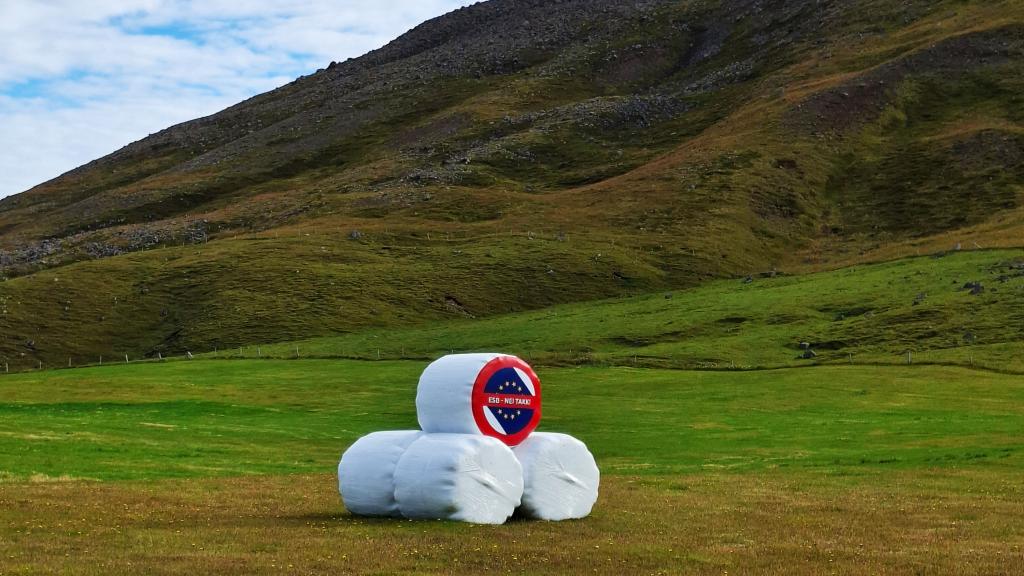
Iceland No EU referendum

First published at Rosa-Luxemburg-Stiftung Brussels Office.

On 29 August 2026, Icelanders voted on whether to resume accession negotiations with the European Union. The result was close but clear: 52.8 percent voted No and 47.2 percent Yes, with a turnout of 82.6 percent. Yet the campaign revealed a country — and a political left — sharply divided on much more than Europe.

The question on the ballot was narrower than much of the debate suggested. Icelanders were not deciding whether to join the EU, but whether to re-open negotiations that began after the financial crisis in 2009 and were suspended in 2013. Even a Yes vote would therefore have marked the beginning of another political process, not accession itself. Any eventual agreement would still have required a further political debate and approval in another referendum.

Yet the campaign became a referendum on much more: sovereignty, the Króna (Iceland´s currency), fisheries, agriculture, prices, inflation, interest rates, political trust, and Iceland’s place in Europe. It exposed a divided country: Reykjavík against much of rural Iceland, university-educated voters against those with shorter formal education, and, most interestingly, a left that had no common answer.

For the left, this makes the result more complicated than either disappointment or celebration. A No vote can reflect democratic scepticism towards the EU, market liberalisation, and distant institutions. But it can also leave unchallenged concentrations of economic power at home. The central question — the one the referendum did not ask — is therefore not simply “Brussels or Reykjavík?”. It is: where does power sit, who controls it, and who benefits from it?

Sovereignty — a sensitive issue

To understand the emotional force of sovereignty in Iceland, one must go further back than 2009. Iceland is a young republic, but its history is inseparable from the struggle to recover political and economic power, first from Norway, then from Denmark. For centuries, political authority in Iceland was exercised from abroad, severely restricting trade, and economic and social mobility. Home rule came only in 1904, and Iceland became a sovereign state in 1918, but remained in personal union with the Danish king. The republic was finally established in 1944.

That history matters. A political culture built around recovering control from Copenhagen will not casually transfer authority to Brussels. In that sense, a No vote is not irrational or simply nationalistic. Independence is part of modern Iceland’s political identity; also reflected in the name of the historically dominant Independence Party (Sjálfstæðisflokkurinn).

But independence has never meant isolation. The financial collapse of 2008 demonstrated the limits of economic self-sufficiency. Iceland’s oversized, newly privatised, banking system imploded, the Króna plunged, and the country turned to the International Monetary Fund and bilateral creditors — particularly among the Nordic states — for assistance. Iceland followed a recovery path that differed from that imposed on several southern EU countries, but the idea that Iceland simply rescued itself is a myth. The IMF-supported programme included capital controls, currency depreciation, debt restructuring, and the protection of important parts of the welfare state, while limiting the socialisation of private banking losses. Recovery combined domestic political choices with international assistance, access to markets, and cooperation.

Closer to the EU — and back again

It was in this context that Iceland applied for EU membership in 2009, under the country’s first majority left-leaning government led by the Social Democratic Alliance (Samfylkingin), in coalition with the Left-Green Movement (Vinstri græn). The coalition itself was divided: the Social Democrats favoured accession, while the Left-Greens remained sceptical. The application was no mere technocratic response to the financial crisis either. Rather, it emerged from a debate within the Icelandic left over whether greater European integration or greater national autonomy offered the better route out of the crisis for rebuilding economic stability.

Negotiations began in 2010. By the time they were put on hold in 2013, 27 negotiating chapters had been opened and 11 provisionally closed. A new centre-right government suspended the process, however, and in 2015 Iceland notified the EU that it should no longer be regarded as a candidate country.

Iceland nevertheless never really left “Europe”. It remains part of the European Economic Area (EEA), the European Free Trade Association (EFTA), and Schengen. Through the EEA, Iceland participates in the European single market and implements substantial amounts of EU legislation, while remaining outside formal EU decision-making. Agriculture and fisheries, however — both important sectors for Iceland — are excluded from the EEA’s core single-market arrangements.

The road to the 2026 referendum

The paradox of the European question in Icelandic politics was intensified by its more recent return. There was no parliamentary majority committed to EU membership, nor did the three parties of the governing coalition share a common position on it: The Liberal Reform Party (Viðreisn) is pro-European, while the People’s Party (Flokkur fólksins) is opposed, and the Social Democrats took a more nuanced position. Nevertheless, the coalition promised a referendum on resuming negotiations no later than 2027.

In 2026, that timetable was brought forward. Inflation was persistently high (~5.6 percent in August), and the Central Bank of Iceland had raised its key interest rate to 8 percent. Household purchasing power, housing costs, and the price of imported goods kept questions about Iceland’s economic model on the political agenda.

The geopolitical environment had also changed significantly. The Trump administration’s threats towards Greenland (including confusing it with Iceland), and a remark by the new US ambassador joking that Iceland could become the 52nd US state, raised uncomfortable questions about the reliability of Iceland’s traditional security relationships. The search for greater economic stability increasingly became connected to a broader question: in an increasingly uncertain world, which political alliances could a small state rely on?

A divided left

The referendum exposed an unusually complicated political map. As the table shows, Icelandic Euroscepticism cannot simply be mapped onto left and right, nor did party leadership always correspond with party voters.

In addition to the differences within the governing coalition, which spans the political centre, three parties represented in parliament opposed the referendum. No party to the left of SDA is currently represented in parliament, although these parties together received just under 10% of the vote in the 2024 elections. Their absence from parliament does not mean that they were absent from the wider debate. The Left-Green Movement, moreover, had provided the prime minister from 2017 until 2024, with Katrin Jakobsdóttir retaining the premiership even after the party lost ground in the 2021 election. After a second term in government, however, the party’s support collapsed: it lost its parliamentary representation altogether in 2024 and is currently undergoing a process of political and organisational renewal.

The 2024 election result further complicates the picture. The SDA narrowly emerged as the largest party, but its success coincided with the parliamentary disappearance of all parties to its left. The last election therefore produced an apparent success for the centre-left, while at the same time leaving the broader Icelandic left considerably weaker and less plural in parliament. Table 1 List of parties in Iceland, their broad orientation, last election results, position in the negotiation talks, as well as the level of support from possible party voters regarding the referendum (according to last Gallup poll before the referendum).

PartyBroad OrientationResult in last election Nov. 2024 (in %)​Position in 2026Yes in Final Gallup (in %)

Samfylkingin

(Social Democratic Alliance)

Social-democratic / centre-left20.75Strong Yes94

Viðreisn

(Liberal Reform Party)

Liberal, market-liberal, pro-European15.82Strong Yes95

Miðflokkurinn

(Centre Party)

National-conservative / populist right12.10Strong No6

Framsóknarflokkurinn

(Progressive Party)

Agrarian / centrist / regionalist7.80Predominantly No14

Flokkur fólksins

(People’s Party)

Welfare-populist / conservative/ centre13.78Sceptical and internally divided55

Sjálfstæðisflokkurinn

(Independence Party)

Liberal-conservative / centre-right19.36No13
Parties without representation in parliament

Píratar

(Pirate Party)

Progressive / civil-libertarian/ direct democracy3.02Open to negotiations; stressed democratic choiceNot separately reported

Sósíalistaflokkur Íslands

(Socialist Party of Iceland)

Socialist3.96NoNot separately reported

Vinstri græn

(Left Green Movement)

Left-green2.34Against membership, but accepted a public decision on negotiations66

The most revealing division was within the left. The Social Democratic Alliance made the clearest centre-left case for Yes: negotiate first, then judge the actual terms on offer. From this perspective, European integration could provide economic stability and political influence. There was also a democratic argument: Iceland already participates extensively in the European economic order but has no formal role in setting the rules it must follow. In this view, EU membership was not a simple surrender of Icelandic sovereignty, but a recovery of economic decision-making power.

By contrast, the Socialist Party offered the most explicit radical-left argument for No. Its critique sees the EU as fundamentally structured around markets, competition, and capital, while also raising concerns around militarisation, food sovereignty and the space available for independent socialist economic and labour politics. The EU’s democratic deficit, and its broader geopolitical alignment, and its policy towards Gaza, were further sources of mistrust.

The most striking internal division emerged within VG. The formal Left-Green position remained that Iceland’s interests were better served outside the EU, yet the party is divided, not only between party policy and voters, but also between generations of the party leadership. Its newly elected chair, Rósa Björk Brynjólfsdóttir, and vice-chair, Bjarki Hjörleifsson supported reopening negotiations to establish what kind of agreement might be available. This approach found substantial support among the party’s supporters. In Gallup’s final pre-referendum poll, around two thirds of potential Left-Green voters intended to vote Yes.

Several prominent former leaders took the opposite position, including former chair Svandís Svavarsdóttir, founding leader Steingrímur J. Sigfússon, and former prime minister Katrín Jakobsdóttir, with the latter intervening particularly forcefully in the final days of the campaign. Katrín had supported opening negotiations in 2009 but later concluded that this process had demonstrated how little room Iceland had on critical issues such as fisheries and agriculture. She also criticised the EU’s democratic deficit, decision-making process and its treatment of member states during the financial crisis. She therefore rejected the idea that reopening negotiations was simply a neutral exercise to “see what Iceland could get” (reflected in the slogan of the Yes campaign “Já til að sjá”, “Yes, to see”).

The result was an unusual reversal: much of the old Left-Green leadership defended traditional Euroscepticism — rooted in a tradition of national sovereignty, environmental control, peace politics and distrust of centralised European power — while its new leadership and a clear majority of its potential voters were willing to reopen the European question.

Finally, the Pirate Party, which rejects a conventional left-right classification, approached the issue less through a fixed position on integration than through the lens of democracy and transparency.

One country, several political geographies and cleavages

Nationally, the result of the referendum was relatively close. Geographically, it was not. Reykjavík voted Yes, while around six in ten voters outside the capital voted No. However, it would be a mistake to reduce rural opposition to backward-looking nationalism. Rural Iceland has substantial reasons to be cautious. Fisheries and agriculture matter much more outside Reykjavík, and decisions about access to fish, farm support, and resource management can determine whether a village has jobs, and whether younger residents remain.

There is also a long history of decisions being made in Reykjavík about places hundreds of kilometres away. Replacing one distant centre with another, even more distant, one is not an especially attractive proposition for these communities.

This distinction between national sovereignty and local power is crucial, and exposes a central contradiction. Iceland may exercise sovereign control over its fisheries in international law, but individual fishing communities often have very little influence over whether quotas, boats and jobs remain there. Fishing quotas have become increasingly concentrated over decades, with research documenting significant consolidation at a company and vessel level.

This is where the rhetoric of sovereignty becomes complicated. Brussels can be presented as the great threat to Icelandic control over resources, while the concentration of control within Iceland can receive considerably less attention. The core issue is not whether Iceland should surrender control over fisheries — it is whether national control is the same thing as democratic control. Clearly it is not.

Agriculture and the politics of protection

The same tension exists in agriculture. There are strong reasons to support Icelandic farming: food security, difficult production conditions, rural employment, cultural landscapes and the maintenance of settlements outside the capital. Iceland also provides substantial agricultural support, much of it through price support, border measures, and production-linked payments. Yet protection has not solved the underlying problems. Many farms struggle to remain viable, farm numbers have declined, and succession is increasingly difficult.

This produces an uncomfortable contradiction. Consumers pay high prices partly because domestic agriculture is protected, while many farmers still struggle financially. The question is therefore not simply whether Icelandic agriculture should be protected, but whether the existing system distributes its benefits effectively between farmers, consumers, and rural communities.

Nor is EU agricultural policy simply a matter of Brussels imposing farm payments or market rules. The EU’s rural-development framework includes programmes such as LEADER, through which local groups develop and manage their own strategies and budgets. Iceland’s existing system provides regional and rural support of its own, but the possibility that European integration might change the tools available to rural communities received little attention during the referendum. The debate instead frequently presented a binary choice: protect Icelandic agriculture from Brussels or expose it to Brussels.

The unexpected question of age

Perhaps the most striking development concerned young voters. Gallup’s final survey, conducted from 24 to 27 August, found that 60 percent of voters aged 18–29 intended to vote No. Even more strikingly, this appears to have been a very late shift: in June, 63 percent of voters in that age group had intended to vote Yes. For comparison, among 30–39-year-olds the result was almost even, while older age groups leaned slightly towards Yes. University graduates were also substantially more favourable towards negotiations than people with compulsory or secondary education.

We do not yet understand why this dramatic shift occurred among younger voters, but the result complicates the familiar assumption that younger voters are necessarily the most cosmopolitan or pro-European bloc one might expect after experiences like the Brexit referendum.

Sovereignty for whom? The debate Iceland did not have

What was perhaps most revealing is what was not discussed during the campaign. Many of the longer-term social, economic, and regional challenges facing Iceland remained largely untouched. At the same time, the No side was effective in mobilising fears and resentments around Brussels, sovereignty, fisheries, and agriculture, presenting the vote as a choice between Icelandic independence and European control. This framing considerably narrowed the debate.

The central weakness was that the campaign talked extensively about sovereignty but relatively little about the distribution of power inside Iceland. Fisheries provide the clearest example. Icelanders were asked whether they wanted to protect control over fisheries from Brussels, but much less about how that control is already exercised in Iceland; by whom, for whose benefit, and with what consequences for communities. The same applies to agriculture, regional development, housing and financial policy. The larger question not asked is not whether sovereignty should move from Reykjavík to Brussels, but whether Icelanders have sufficient democratic control over the economic decisions that already shape their lives.

Outlook: The question is closed — the problems are not

The immediate result is clear: at least for now, Iceland will not resume EU accession negotiations. But very little else has been resolved. Iceland remains inside the EEA and Schengen, deeply dependent on European trade and labour mobility, outside EU political decision-making, outside the Common Agricultural and Fisheries Policies, and outside the euro. The EU remains Iceland’s largest trading partner, accounting for more than half its goods trade in 2025.

The No vote is understandable in historical terms. Iceland became a republic only in 1944, after centuries in which important political and economic decisions were made elsewhere. Sovereignty therefore carries a particularly powerful historical meaning, closely linked to national political identity.

But history can become ideology when independence is treated as an answer rather than as a means. Iceland’s recent history illustrates this contradiction. When a financial model built around large, highly deregulated banking sector collapsed in 2008, the country needed international assistance, making the mantra “we are better off alone” increasingly difficult to sustain. Yet Iceland’s recovery was also shaped by domestic choices that differed from approaches taken elsewhere, including capital controls, restructuring, and protection of the welfare state.

The lesson is not that Iceland should join the EU, nor that it should remain outside it — neither of these choices address the deeper challenges around the distribution of economic and political power in Iceland. The referendum answered a narrow question printed on the ballot paper. It did not resolve the larger disagreement within the Icelandic left between social-democratic Europeanism, left-green sovereignty and socialist Euroscepticism, nor did it resolve who governs the country’s resources, institutions, and economic decisions, and in whose interests. Those questions are not going away.

Iranian War Update: Trumpety’s Running On Empty


by | Sep 24, 2026 

The Donald pulled no punches at the UN today. It was all hell and brimstone on the Iranian War file.

Once again, and perhaps for the 15th time, he promised to “annihilate” a nation that arose originally upwards of 2,700 years ago:

I have a big decision to make. Will a deal be made with Iran that lets them rebuild and create a far greater country than it ever was before — maybe one of the greatest in the Middle East, or even the world? Or do I annihilate the Islamic Republic, and do it quickly, never giving them a chance to kill and destroy people and countries again? Do I drive them into hell, with no chance of survival and no hope of future greatness for generations?”

Here’s the thing, however. Our loud-mouth school-yard Bully Boy, who still has the temperament of a 13-year old, is apparently not watching the gauges on his dashboard. After all, they show clear as a bell that the US military’s weapons stockpiles and the nation’s work-a-day fuel tanks of diesel oil are plunging toward empty. Rapidly.

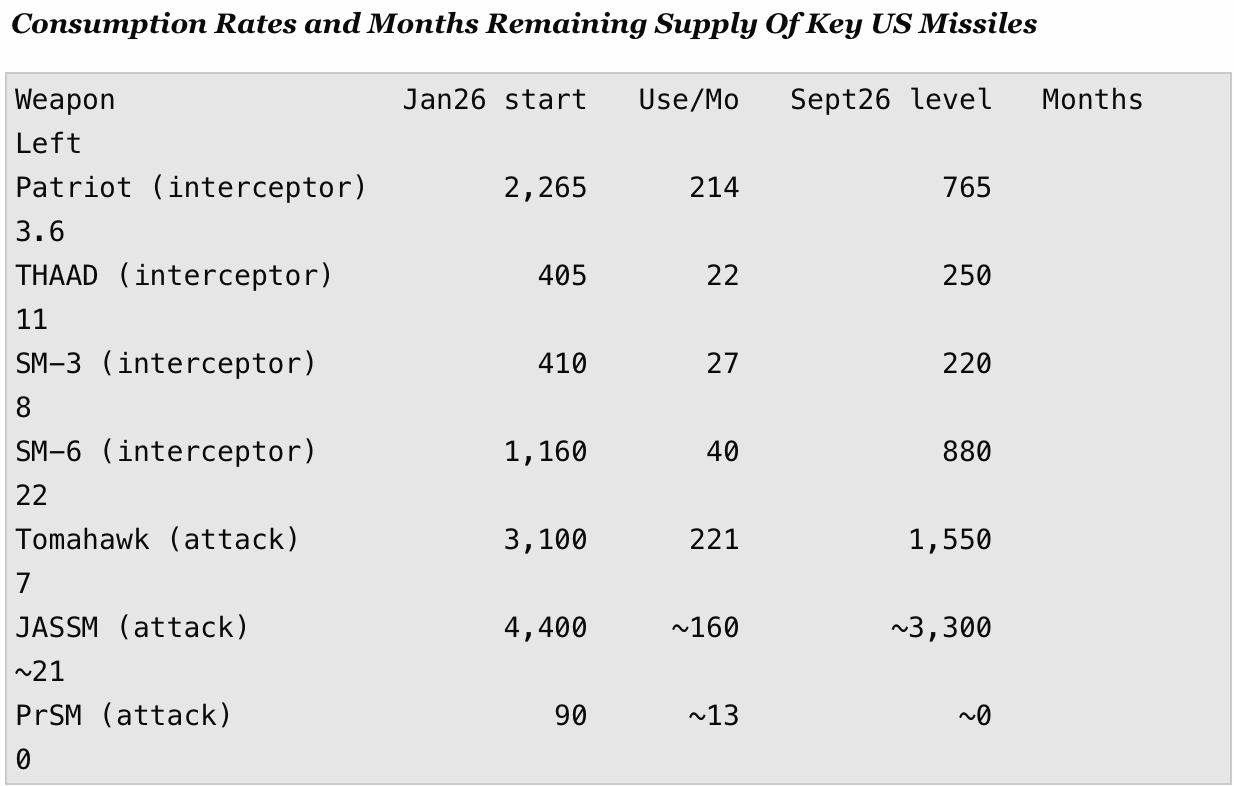
As for the former, it’s no secret that He-Man Hegseth and the Donald have burned the Pentagon’s supply of crucial interceptor missiles and attack weapons at red hot rates. Thus, based on public information, if the burn rates of the first seven months of the Donald’s disastrous war on Iran continue at current levels, to say nothing of escalate into the promised hell on earth, America’s entire stockpile of crucial attack and interceptor missiles will be depleted within a matter of months.

For instance, since Washington began its Forever Wars in the middle east in the 1990s, the go-to attack weapon designed to substitute for boots on the ground, surface warships in harm’s way and even traditional fixed wing and rotary attack aircraft has been the Tomahawk Cruise Missile. The latter is often launched from submarines hiding in the ocean deeps far way from battlefield targets and the reach of enemy counter-measures.

Yet 50% of the entire US stockpile of Tomahawk missiles has been consumed during the first 7 months of the war, bringing, presumably, hell up close and personal to the Iranian regime. In fact, the average consumption rate of 221 tomahawk missiles per month has been so heated that there is only 7 months of US stocks left at that rate.

And that’s before the Donald goes into the threatened “annihilation” mode— to say nothing of stocks needed for the Far East, Europe and other theaters of Uncle Sam’s misbegotten Global Empire.

Indeed, the approaching bottom of the weapons tank cannot be gainsaid. Since the war opened on February 28 Washington has self-evidently – per the table above – expended a large share of the magazines that make American long-range strike and missile defense so formidable.

Open-source midpoints put the prewar Patriot stock near 2,265 interceptors and the Tomahawk pile near 3,100. Seven months later the implied remainders are about 765 Patriots and 1,550 Tomahawks, down 66% and 50%, respectively. At the war-to-date average, therefore, what’s left is just 3.6 months of Patriots and the aforementioned 7.o months of Tomahawks before those two accounts hit zero.

THAAD and SM-3 last a bit longer on the same arithmetic—roughly 11 and 8 months – because the monthly burn is smaller, not because the stocks are actually at healthy levels. PrSM, which is Washington’s ground attack missile against air defenses, ships and bases is already effectively gone.

Likewise, JASSM, which is a stealth air-launched attack missile versus bunkers and airfields, looks to have materially more stocks remaining. But the early-war (March/April) clip of 1,000-plus rounds in 39 days is a warning, not a comfort. That is, if the Donald goes full frontal after the election, as he now told the world he intends, there truly wouldn’t be anything left in most of these key missile categories.

In short, while there are still enough rounds to keep fighting this war at a conserved rate, there arenot remotely enough rounds to keep fighting it the way the first month was fought. Yet the only route to military “annihilation” of the Iranian nation, in fact, would be to re-embrace the first months’ rate, and then double or triple it from there.

On the other hand, what the first seven months of war/pause/strike/truce/strike again have bought about in total is not mysterious. Ships and aircraft used Tomahawks and JASSMs to hit air defenses, missile plants, naval targets, and command nodes aplenty. Patriots, THAAD, SM-3, and SM-6 were fired at prodigious rates in order to keep Iranian ballistic missiles and drones off American bases, Israeli cities, and Gulf infrastructure.

The Congressional Budget Office, in fact, put the Defense Department’s cash cost through August 1 at about $38 billion, of which munitions replacement was the largest single piece: $13.1 billion for interceptors and $7.3 billion for land-attack cruise missiles.

So the accounting bill grossed-up to mid-September is undoubtedly $50 billion and counting. Yet after all this firepower expended, the Iranian military capacities—which have been clearly wounded – have not been disabled nearly extensively enough to bring the regime to its knees.

Indeed, by mid-spring, U.S. intelligence assessments still credited Tehran with on the order of 70 percent of its prewar missile stockpile and most of its mobile launchers, and with recovered access to a large share of underground storage and launch sites.

Likewise, oil still moves through the Strait only under heavy US naval escort. The regime is under inflation measured in the hundreds of percent, a smashed navy in official American telling, and a leadership that has been attrited via Israeli style assassination of enemy leaders targeted for death.

Yet the IRGC is also still firing. A September engagement over Jordan that consumed 60 to 70 Patriots and more than a dozen THAAD rounds against an Iranian salvo of about 20 ballistic missiles is the opposite of a spent adversary.

Indeed, one-way drones that cost tens of thousands of dollars still force the firing of US interceptors that cost millions each. That hideously adverse exchange rate is why the US interceptor column in any honest table declines faster than Iranian political will.

The deeper problem is structural. Precision magazines are built for short, intense campaigns against a target set that can be finished on a “one and done” basis. But Iran is a large country with dispersed launchers, a deep bench of short- and medium-range missiles, an incredibly resilient missile and drone production system buried in deep mountain redoubts, a population that has already absorbed years of sanctions, and a theory of victory that does not require air superiority.

You can burn a third of the Tomahawk stock and half to two-thirds of the combined interceptor family and still not get it done. That is, have –

  • an occupation force in control of the countryside.
  • a government-in-waiting that can hold Tehran.
  • a leak-proof blockade that seals Iran off from the outside world in an airtight manner.

The February–April surge showed what the high-end weapons can do in 39 days. But it wasn’t dispositive. It generated nothing that even remotely resembled capitulation in Tehran – even as Bibi’s opening day assassination of the Ayatollah generated an outpouring of national patriotism that had the very opposite effect.

By the same token, the recent months after the ceasefire show that Iran still has the capacity to regenerate its unique forms of fighting capacity. So more Tomahawks in month eight and month nine would hit more buildings. They would not, on the evidence to date, collapse the system that keeps on firing.

Running the remaining Patriots for another quarter at the seven-month average, or the remaining Tomahawks for another two quarters, would therefore most likely purchase a continuation of the current military stalemate at a higher residual risk.

At the end of the day, surrender is a political act. Nothing in the public record of this war suggests the Islamic Republic’s threshold for that act lies just a few hundred more cruise missiles away. The Donald’s own framing at the United Nations about annihilation this time and for sure was actually an admission that seven months of the most expensive munitions in the American arsenal did not close the file.

So emptying what is left of those same weapons’ accounts is not a new theory of the war. It is the White House’s existing seat-of-the-pants theory with a far thinner magazine.

As it happen, of course, the ultimate cost of the Donald’s proffered choice of a deal or annihilation after the election sits outside Iran. That’s because Patriot and THAAD are not Iran-only weapons.

They are the upper tier of American and allied ballistic-missile defense in the Pacific, on the Korean Peninsula, in Europe, and around the homeland architecture that was already thin before February. CSIS’s warning after the July drawdown was not that CENTCOM would run out tomorrow. It was that diminished stockpiles force riskier intercept doctrines and leave far less for any contingency that may arise in a second theater.

In this context, a recent CBO analysis of the “rebuild clock” for these interceptor stockpiles is at least five years even if production rates rise appreciably. THAAD deliveries were already frozen into 2027. Tomahawk output in recent peacetime years was on the order of 90 to 200 rounds per year against a wartime clip above 200 per month. Raytheon and Lockheed, of course, can be ordered to surge production. But metal does not appear in a vertical-launch cell on a press release.

A China contingency has been central to the planning case for these weapons for a decade. Pacific war games consume Tomahawks, JASSMs, SM-6s and Patriots at voracious rates in a matter of days, not quarters. North Korea is a missile problem that lives on the same THAAD and Patriot accounts.

The planned Europe air-defense rebuild after Ukraine already leaned heavily on the Patriot production line. Likewise, every interceptor fired at a Shahed or a medium-range ballistic missile over the Gulf is an interceptor that is not in Guam, Poland, or a CONUS battery.

The United States can still fly, steam, and drop cheaper munitions. What it cannot do, once the specialty magazines are gone, is recreate the combination of long-range conventional strike and high-end missile defense that is supposed to make opponents tremble in their boots.

There is also a narrower operational point. Global inventory is not the same as usable rounds on station. Ships cannot yet reload Tomahawks at sea. A theater can “go Winchester” (use the last weapon in the magazine) while crates still sit on shipping docks in the United States.

That is how a seven-month national average of 221 Tomahawks a month can coexist with local shortages after the first month. Stretching the remaining 1,550 rounds across another two quarters of “average” use assumes the Navy will keep feeding the same theater at the same pace.

But the first time a carrier strike group has to leave station to rearm, the average becomes fiction and the exposure becomes immediate. That is to say, the first thousand Tomahawks and the first thousand-plus Patriots bought suppression, defense of bases, and a demonstration. The next five hundred of each, at this stage of the war, buy more of the same against an opponent that has already shown it can eat that punishment and keep a missile force in the field.

In short, the thoroughly depleted missile inventories in the table above cannot buy a surrender document from Tehran. The Iranian regime has already proven that in spades.

They only thing they can buy, in fact, is a thinner American position against every other missile power that can read a production schedule. The rational use of the months-left column is therefore conservation and a political off-ramp from an utterly unnecessary and pointless war, not a sprint to an empty missile tank under the Donald’s juvenile war cry of “annihilation”.

Moreover, an empty missile tank would only be the half of it. The fact is, middle distillate inventories have fallen so far and so rapidly that only an immediate end to the war and complete re-opening of the SOH can likely prevent an even worse calamity.

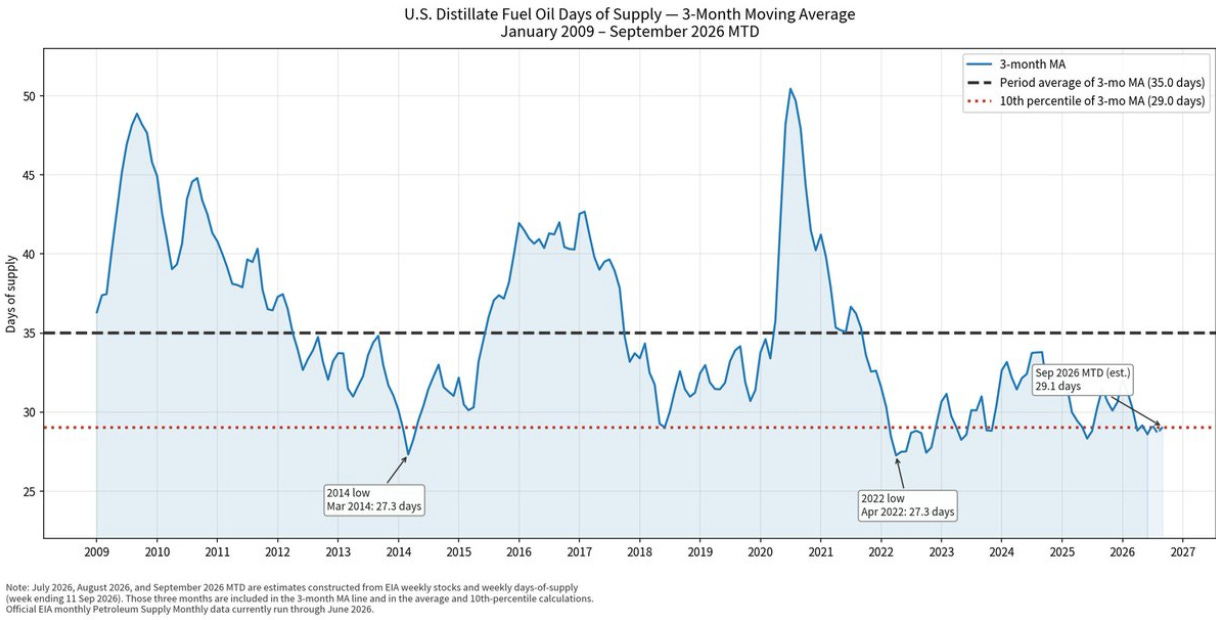
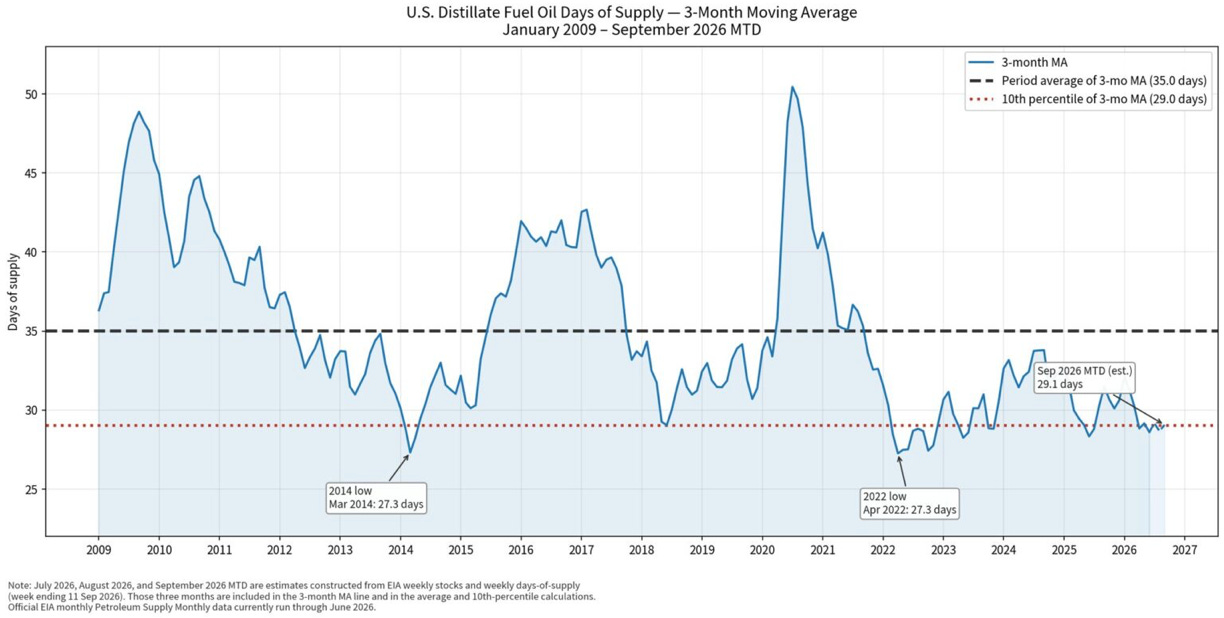
To wit, the life blood of the US economy today is diesel fuel because that’s what every farm tractor, work truck and semi-truck hauler in the US economy now operates on. And as shown in the graph below, we are already down to the 10th percentile of days cover for current daily consumption rates.

In short, the U.S. middle distillate sector is now sitting on the ragged edge. EIA’s latest weekly print, for the week ending 11 September 2026, put commercial distillate stocks at 107.9 million barrels (mb).

Four-week average product supplied was 3.60 million barrels a day, which is only 29.9 days of cover. That is not a surplus number. It is a late-summer tank that looks full only if you ignore how fast the fuel is leaving.

Moreover, most of that 107.9 mb is not spare product, anyway. Pipeline fill is about 25 mb, refinery working tanks another 22–26 mb, and terminal heels and minimum operating stock another 30–40 mb. Call the immobilized stock 80–90 mb.

So what you can actually draw-down without draining the pipes is a thin layer on top of that. In fact, using the 2022 break point of 25.9 days, or about 93 mb at today’s run rate, the usable surplus is barely 15 million barrels.

That is four days of demand, which is not a strategic reserve by any stretch of the imagination. A hiccup in the world market would blow that away in a heartbeat.

One Gulf Coast outage, a sudden export pull into Europe or Latin America, or a cold winter week that lifts heating-oil and diesel use together would take down the usable 15 mb in a matter of days and hours.

Then you would not be debating days of cover. You would be in the 2022 tape that took prices sky high under the hapless Joe Biden: That is to say, at 93 mb and 26 days, price would be doing the rationing and the sight would not be pretty.

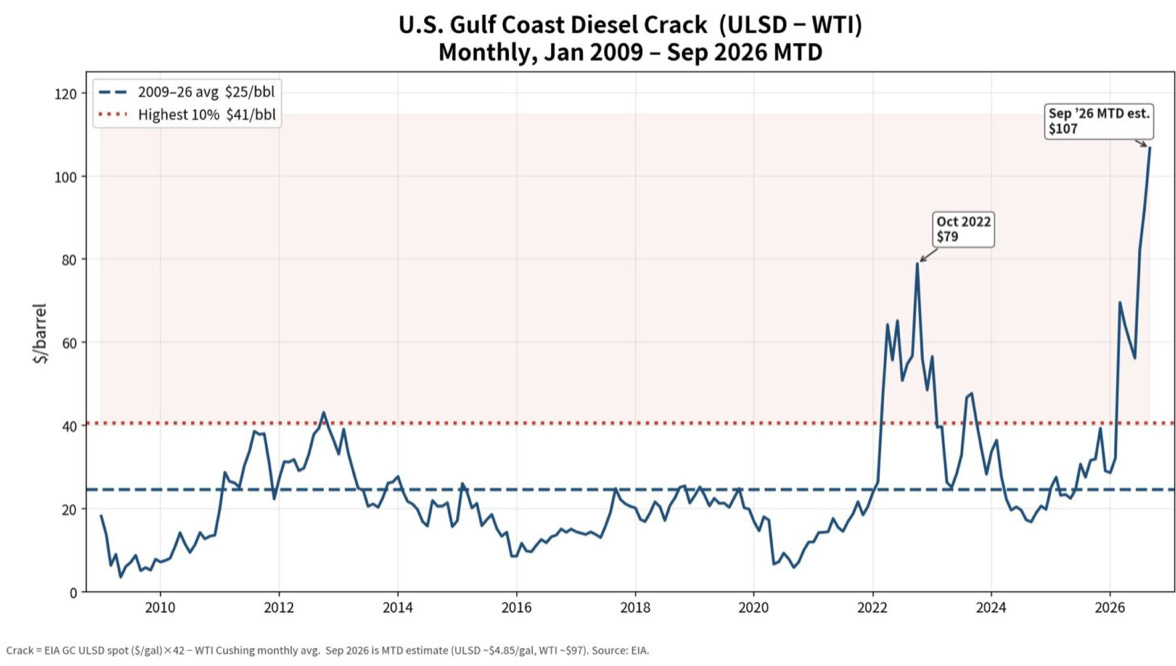
For want of doubt, here is the refinery crack spread for US middle distillates. The current level of $107 per barrel is already off the charts of history. It stands at more than 4X the average of $25 per barrel since 2009 and 2.6X the cut-off line for the highest 10% of monthly averages at $41 per barrel over the last 17 years.

As the man said, let that sink in!

The crack spread sits on top of the benchmark crude oil prices such as WTI or Brent. But what really counts for the overall economy is not the crude price going into the refineries but the post-crack spread product price – which measures the true level of scarcity or surplus in product markets – going out the refinery gate.

In truth, this is the real gauge on the middle distillate or diesel tanks in the domestic US economy. The indicator arrow is actually hugging the bottom and threatening to break-on-through.

As it happens, there is no precedent for the current discombobulation in the petroleum product markets. If we reach back 50 years, there have been only two other brief periods which stood anything close to the thin days of cover shown above.

So yes, POTUS, prolong the war until election day and then attempt the annihilation strategy shortly thereafter. But the military assault won’t work, and Mr. Market will then ravenously take the hindmost.

On a per gallon basis, diesel could go to $10 or even $20 per barrel, sending the US economy into the drink like, perhaps, NEVER BEFORE.

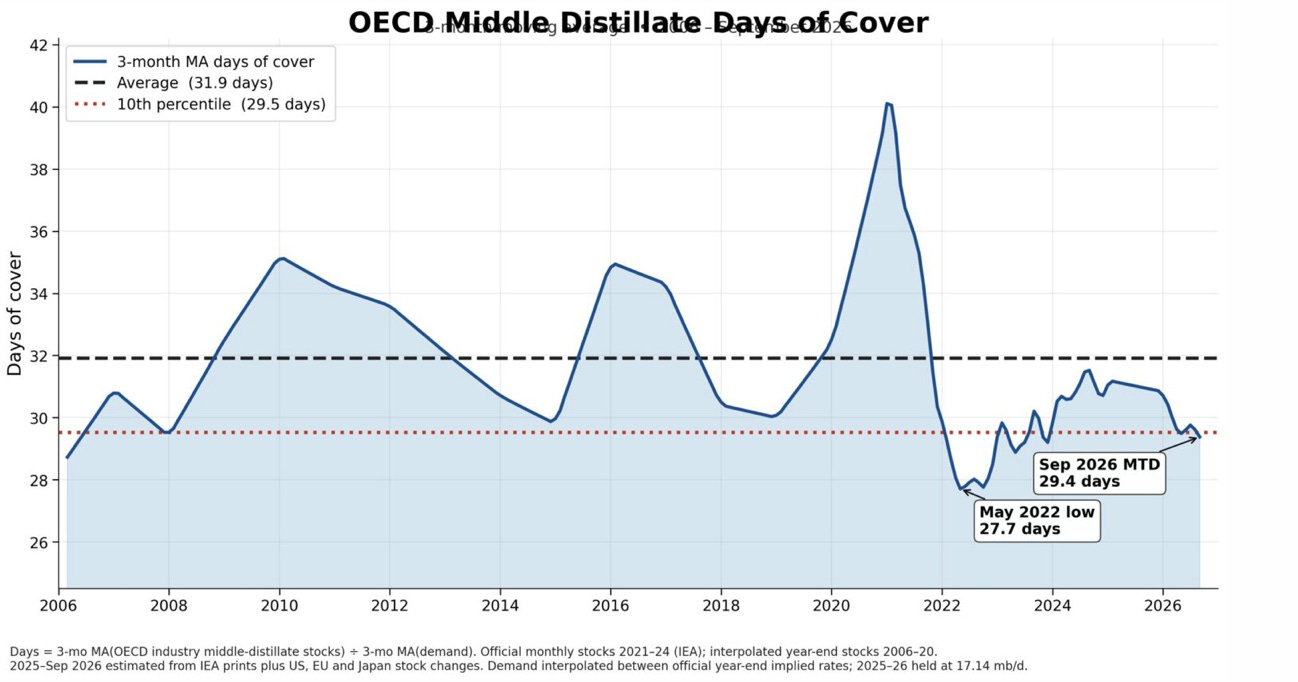
And there wouldn’t be any respite in the world market, either. Middle distillate inventories are scraping the bottom of the barrel on a worldwide basis, too.

The critics, of course, say the bombastic fool who showed up at the UN today is wholly innumerate and appropriately so. After all, with two empty tanks who in their right mind would shout “flank speed ahead”!

David Stockman was a two-term Congressman from Michigan. He was also the Director of the Office of Management and Budget under President Ronald Reagan. After leaving the White House, Stockman had a 20-year career on Wall Street. He’s the author of three books, The Triumph of Politics: Why the Reagan Revolution Failed, The Great Deformation: The Corruption of Capitalism in America, TRUMPED! A Nation on the Brink of Ruin… And How to Bring It Back, and the recently released Great Money Bubble: Protect Yourself From The Coming Inflation Storm. He also is founder of David Stockman’s Contra Corner and David Stockman’s Bubble Finance Trader.