It’s possible that I shall make an ass of myself. But in that case one can always get out of it with a little dialectic. I have, of course, so worded my proposition as to be right either way (K.Marx, Letter to F.Engels on the Indian Mutiny)
Tuesday, October 06, 2026
Trump Administration Sued Over ‘Callous Giveaway to Big Oil and Big Auto’
One environmental advocate said the Trump administration’s rollback of fuel efficiency standards “will mean wasted gas, more air pollution, and higher costs for Americans who are already struggling with high fuel prices.”
Traffic backs up on Interstate 405 during the morning commute at sunrise on January 15, 2026, in Los Angeles, California. (Photo by Kevin Carter/Getty Images)
A coalition of environmental groups filed a lawsuit Friday seeking to block the Trump administration’s rollback of fuel efficiency standards, which they called a “giveaway” to the oil and auto industries.
Earlier this week, the US Department of Transportationfinalized a rule weakening Corporate Average Fuel Economy (CAFE) standards, which require automakers to increase the fuel efficiency of their vehicles each year.
The Biden administrationrequired annual fuel-efficiency improvements aimed at bringing the average for new vehicles to 50.4 miles per gallon by 2031. Under the Trump administration’s new rule, the 2031 requirement would fall below the 35.4 mpg already achieved by the 2024 fleet, according to the National Highway Traffic Safety Administration’s (NHTSA) own analysis.
NHTSA estimated that as a result of the rule change, Americans will consume roughly 122 billion more gallons of gas by 2050 than they would have under the old standards, increasing average lifetime fuel costs by more than $1,600 per vehicle—more than the roughly $1,300 the administration has claimed they’ll save on average in upfront vehicle costs.
It is also projected to add about 1 billion additional metric tons of CO2 emissions by 2050 compared with retaining the previous standards—equivalent to more than six months’ worth of emissions from the entire US transportation sector.
“Oil companies will profit from less efficient cars, but drivers will take a hit to their wallets and our kids will breathe dirtier air,” said David Pettit, an attorney at the Center for Biological Diversity’s (CBD) Climate Law Institute. “We’ll all pay the price for more tailpipe pollutants spewing everywhere from playgrounds to wild places. We’re asking the courts to put a stop to this callous giveaway to Big Oil and Big Auto.”
CBD was joined by the Conservation Law Foundation, Environmental Defense Fund, Public Citizen, and Sierra Club, which filed a petition on Friday to ask an appeals court to review the rule change. They argue that the rollback is illegal because federal law requires NHTSA to set fuel-economy standards at the “maximum feasible” level manufacturers can achieve.
“The Trump administration’s rollback will mean wasted gas, more air pollution, and higher costs for Americans who are already struggling with high fuel prices,” said Andy Su, senior transportation attorney at Environmental Defense Fund. “We’re going to court to oppose this dangerous U-turn away from decades of successful work to make our cars more efficient and less expensive to drive.”
‘It Has to Stop’: Community Members Condemn ICE Arrests at Bus Stops After GOP Blocks Bill to Protect Kids
“It doesn’t have to be this way. ICE doesn’t have to traumatize children, tear families apart, and treat people like this,” said one Austin, Texas official.
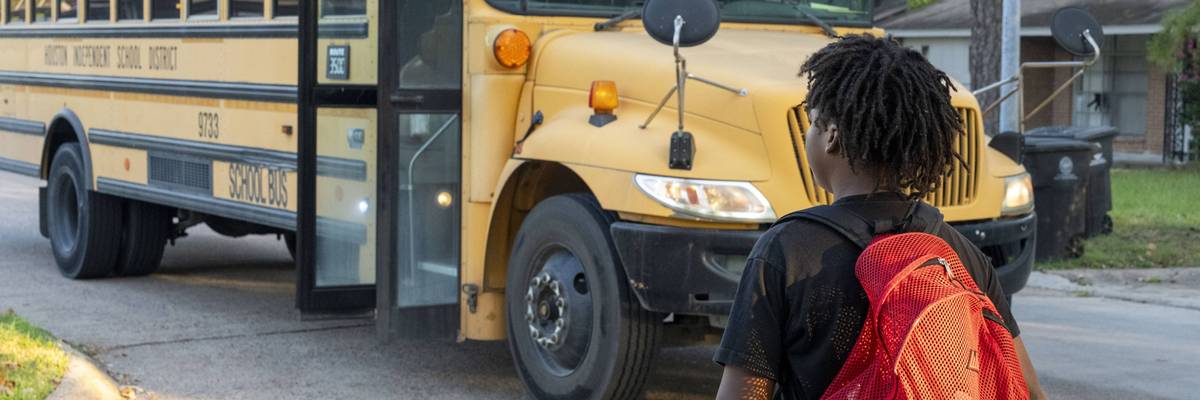
A North Forest High School student walks to a school bus in Houston on August 26, 2025. (Photo by Kirk Sides/Houston Chronicle via Getty Images)
Since Republicans in the US Senate this week blocked a bill to make school bus stops off-limits for US Immigration and Customs Enforcement, community members in Pennsylvania and Austin, Texas have expressed outrage by arrests made in front of children—in at least one reported case, leaving a child abandoned as officers detained his mother.
“It doesn’t have to be this way. ICE doesn’t have to traumatize children, tear families apart, and treat people like this,” said José “Chito” Vela III, the mayor pro tempore of Austin, on social media late Thursday.
Vela made the comments as he posted a video that he said shows the aftermath of an ICE arrest at a school bus stop, with officers driving away with the mother of a 9-year-old boy who was left with other community members.
“They fucking took her,” said one woman angrily as the child sat on the ground crying. “What the fuck are they going to do with the child now? ... Y’all have no fucking shame.”
Vela posted the video a day after Sen. Chris Murphy (D-Conn.) introduced a bill aimed at stopping ICE and other Department of Homeland Security (DHS) agencies from conducting enforcement operations at school bus stops.
In August, Murphy and many of his constituents were outraged when ICE arrested parents at school bus stops in Danbury, Connecticut—detaining them after their children boarded buses, leaving them without anyone to pick them up after school let out and giving the family no time to ensure their children would be cared for.
Murphy said on the Senate floor Wednesday that the bus stop arrests were part of an operation in which 118 people were detained in Connecticut. Federal data has shown that a majority of people being arrested by ICE, which is carrying out President Donald Trump’s mass deportation agenda, have no criminal convictions.
“For parents in this body, you know how anxious that first day of school is, how kids are just brimming with nervous anxiety about that first day, and you know what that feels like to watch your kid walk onto that school bus,” said Murphy. “Well, what do you think it does to those kids on that first and second day of school to see ICE officers at the school bus stop? Imagine that 6-year-old who boarded the school bus, and when he got back from school that day and got off, his parent wasn’t there. A 6-year-old feeling like he had been abandoned. In this case, he may or may not have seen the arrest because it happened almost immediately after he got on.”
The senator added that ICE has “blatantly lied” about its practice of carrying out arrests at school bus stops.
“When they were presented with these stories from Danbury, DHS doubled down and said any claim that ICE targeted parents at a school bus stop is false,” he said. “Then just days afterwards, we had the video evidence. This often happens—ICE says something didn’t happen, and then we have the video proving that it did.”
Also on Wednesday, about 75 community members gathered at the corner of Tremont Avenue and East Fornance Street in Norristown, Pennsylvania, where ICE reportedly detained three people in front of a group of children who were waiting for the school bus.
They called on Democratic Gov. Josh Shapiro and local officials to pass legislation to bar law enforcement from cooperating with ICE.
“When enforcement happens in places where families live their everyday lives, at bus stops, on streets, near schools, or in neighborhoods, the effects can reach beyond the person who is detained,” Jorge Liborio, 16, told WHYY. “It can affect children, parents, coworkers, friends, and entire communities.”
Jay Lee, an advocacy and civic engagement manager at the Woori Center, which provides resources for the area’s large immigrant population, said that “attendance is falling” in local schools. Immigrants make up about 18% of Norristown’s population.
Chalkbeat reported this week that nearly two years after Trump rescinded a policy that barred immigration enforcement in sensitive areas like schools and hospitals, school attendance dropped below 40% at one Indianapolis school when ICE was conducting operations in the city.
Two federal lawsuits challenging Trump’s termination of the sensitive locations policy are ongoing.
On Wednesday, Murphy denounced Republicans for blocking his bill, pointing to Sen. Jim Banks’ (R-Ind.) claim that it would create “sanctuary bus stops”—safe havens for immigrants who commit crimes.
“If we prohibit ICE from operating at school bus stops, you know what will happen?” said Banks. “All the illegals in the country will just hide out at bus stops, knowing that ICE isn’t allowed to touch them! Bus stops will become the most unsafe places in the country.”
Murphy called Banks’ objection “bizarre” and “dishonest.”
“I did not anticipate that one of the arguments against this bill would be that it would lead to the development of ‘sanctuary bus stops,’” said the senator. “But what do we imagine here? People are going to live at bus stops? We’re going to have encampments around bus stops of people who are here without documentation? I just think it’s an example of how this whole debate has gone way off the rails. It is just fundamentally detached from the reality.”
In Austin, Vela said that “families pay the price” when ICE “chooses to use these tactics.”
“This is evil. This is wrong. And it has to stop,” said Vela. “We must demand accountability. We must demand better. Our children deserve better.”
‘Historic Victory’: Judge Blocks Trump’s Big Bend Border Construction—For Now
“This fight is far from over,” said one campaigner. “We won’t rest until Big Bend’s environmental protections are fully restored and the illegal waiver that allowed so much destruction is gone for good.”
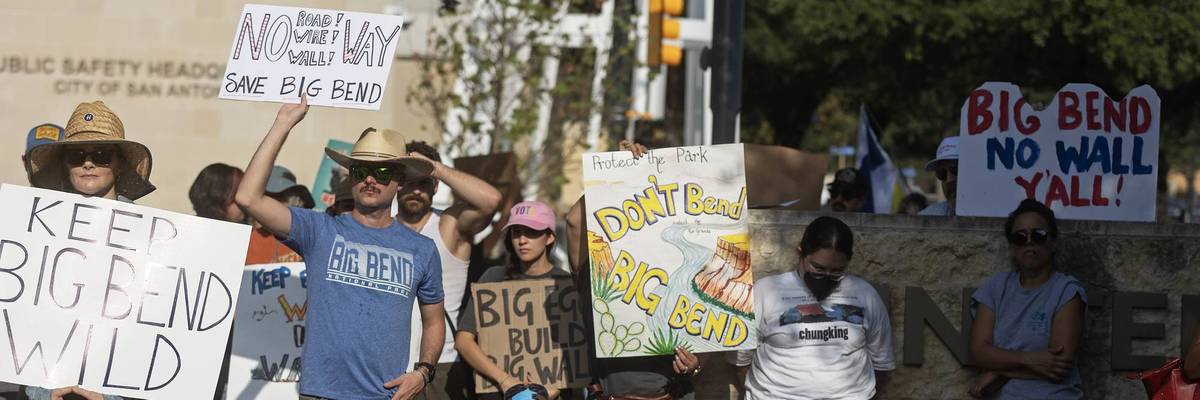
People gather in San Antonio, Texas on August 28, 2026 to oppose the Trump administration’s border barrier construction in the Big Bend region. (Photo by Alma E. Hernandez/San Antonio Express-News via Getty Images)
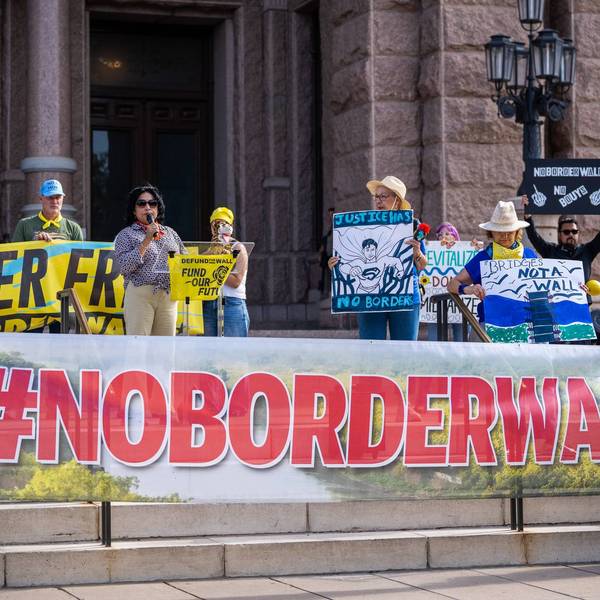
A federal judge in El Paso on Friday temporarily blocked the Trump administration from continuing construction of border barriers, roads, and other infrastructure across the Big Bend region, a win for environmentalists, landowners, and other Texans from across the political spectrum who are united in their opposition to the project.
US District Judge Kathleen Cardone—who was appointed by former President George W. Bush—granted a preliminary injunction sought by the Center for Biological Diversity (CBD) and other plaintiffs.
“The court finds that plaintiffs are likely to succeed on the merits of at least one of the claims in [their] suit, that there is a likelihood that they will suffer serious, irreparable harm without an injunction, and that the balance of the equities and the public interest weigh in their favor,” Cardone wrote in her two-page decision.
Cardone’s order immediately prohibits the Department of Homeland Security and its agencies from building “border barrier or related infrastructure” or engaging in “any construction or ground-disturbing activities” in the Big Bend Sector until they comply with applicable laws. It also stays the effect of three Trump administration waivers that had allowed officials to bypass numerous federal protections.
“This is a historic victory for Big Bend and everyone who loves this wild corner of Texas,” said Laiken Jordahl, CBD’s national public lands advocate. “No administration has the right to destroy a crown-jewel national park for political theater.”
“With a federal court ordering the bulldozers to stop, Big Bend gets to breathe,” Jordahl added. “But this fight is far from over. We won’t rest until Big Bend’s environmental protections are fully restored and the illegal waiver that allowed so much destruction is gone for good.”
Clara Bensen, director of communications for No Big Bend Wall and a board member of Conserve Big Bend, also welcomed the ruling.
“For months we’ve watched the federal government send bulldozers into a national park that belongs to all of us. Today a federal judge told them to stop,” she said in a statement.
“Since we learned the Trump administration planned to seize public and private land and destroy the Big Bend region as we know it, this community has come together across the political aisle to fight back,” Bensen added. “The government tried to ignore the law to build unnecessary border infrastructure, and the court made clear it can’t. This is a victory, but we are not letting our guard down.”
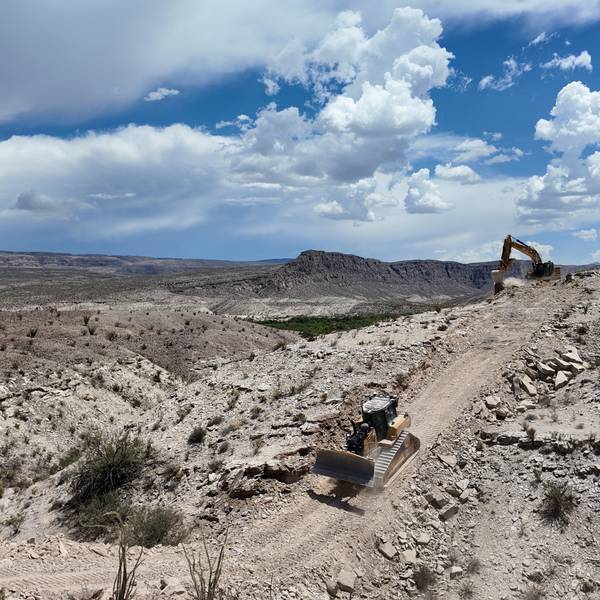
The ruling comes after contractors began bulldozing roads and building other infrastructure in and around Big Bend National Park in August, including near Santa Elena Canyon and Mariscal Mountain. US Customs and Border Protection (CBP) temporarily halted construction on August 17, but that pause expired earlier this week.
The Trump administration has argued that the project—which initially included plans for a 30-foot-high reinforced steel wall—is necessary to achieve what it calls “operational control” of the border. Plaintiffs in the case challenged the administration’s determination under Section 102 of the Illegal Immigration Reform and Immigrant Responsibility Act of 1996 that the region is an area of “high illegal entry,” noting that the government’s claim is contradicted by its own statistics.
The Big Bend Sector is among the least-trafficked portions of the southern border, accounting for roughly a quarter of the international boundary’s length, but no more than 3% of annual migrant apprehensions. The sector recorded just 1.3% of total border apprehensions in 2025, according to CBP data.
Plaintiffs in the case argued that the administration unlawfully used extraordinary powers to waive environmental and other laws, including the Endangered Species Act, National Park Service Organic Act, and National Wild and Scenic Rivers Act. Indigenous groups alleged violations of the Native American Graves Protection and Repatriation Act and the Archaeological and Historic Preservation Act.
At Friday’s hearing, Rio Grande river guide and landowner Danny William Miller described the prospect of a barrier cutting across his property and blocking access to the river as “a bullet to the head,” according to The Big Bend Sentinel.
Miller testified that once the landscape is altered, it cannot simply be restored. His guide work, he said, would become “a tour of the military-industrial complex, rather than a tour of the wilderness.”
Another local resident, Bill Guerra-Addington, told the court, “They’re taking the river away from us, and it’s devastating.”
Friday’s injunction is temporary. The underlying lawsuit will continue, and the broader legal battle over Trump’s Big Bend border project—and the administration’s legally dubious waivers—remains unresolved. On Wednesday, US District Judge Orlando Garcia, an appointee of former President Bill Clinton, rejected a request from an Indigenous group and business owners for a temporary restraining order in one of several separate cases seeking to halt work on the project.
Still, National Parks Conservation Association president and CEO Tiernan Sittenfeld called Cardone’s order “a victory for Big Bend and for all of America’s national parks.”
“While national park advocates are grateful for this halt to border construction in Big Bend, the devastating toll it has already taken on this national park must be studied and remediated,” she said. “The administration must repair the damage it has done to the beautiful, fragile desert ecosystems that make Big Bend National Park one of America’s most iconic places.”
“The administration’s border plan at Big Bend has faced strong bipartisan opposition from local landowners, experienced local borderland sheriffs, and conservationists alike,” Sittenfeld added. “Big Bend is no place for border barriers. It’s time for the administration to come to the table with the border communities that know Big Bend best, repair the damage from this ill-conceived project, and find new solutions.”
Palestinian Researcher Dismantles Israel’s List of So-Called ‘Terrorist’ Journalists Slain in Gaza
Researcher Muhammad Shehada reviewed all 170 names on the IDF’s list of supposed militants posing as journalists and found it to be “the most sloppy shameless fraud possible.”
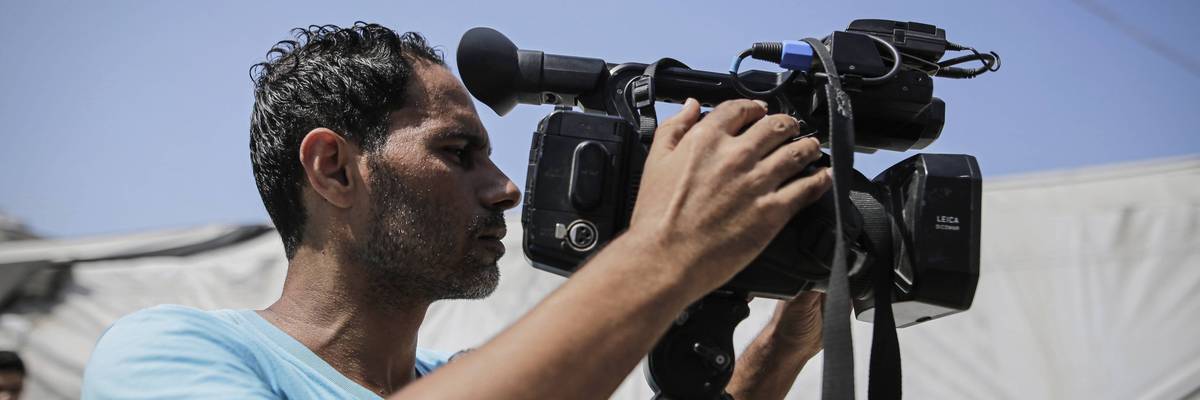
Palestinian journalists work with cameras, laptops and limited equipment from makeshift press areas as they continue reporting from Gaza City on International Day of Solidarity with Palestinian Journalists, in Gaza City, Palestine, on September 26, 2026. (Photo by Saeed M. M. T. Jaras/Anadolu via Getty Images)
Seeking to discredit reports of its unprecedented killing of journalists in Gaza, the Israel Defense Forces last week published a list of 170 slain Palestinians it claimed were not legitimate media workers but members of “terrorist groups.”
Palestinian political analyst Muhammad Shehada, a visiting fellow at the European Council on Foreign Relations, reviewed every single entry on the list. He called it “the most sloppy shameless fraud possible.”
Israeli officials and Western supporters have trumpeted the IDF’s list as a counter to findings by groups like International Federation of Journalists, which has described Israel’s nearly-three-year-old-war in Gaza as “the deadliest period in the history of journalism” and cataloged at least 240 journalists and media workers killed.
Reporters Without Borders (RSF) has found dozens of cases in which it concluded journalists were targeted deliberately because of their reporting and filed multiple complaints with the International Criminal Court (ICC) alleging war crimes against the press.
The database, which the IDF refers to as the “Press Files,” says “that claim does not tell the full story” and states that “individuals presented as innocent journalists were, in fact, militants in the military wings of Hamas, Palestinian Islamic Jihad (PIJ) and other terrorist organizations.”
The IDF claims the list was the product of an “in-depth investigation” consisting of open-source information, documents recovered by Israeli forces in Gaza, interrogations of alleged Palestinian militants, and intelligence gathered during military operations.
But as Shehada explained in a thread posted to social media on Sunday, “In the overwhelming majority of those listed, the IDF presents ZERO credible evidence. In most of them, their pages are literally blank.”
In 59 cases, Shehada found that the IDF did not provide any evidence for its claim that a journalist was a member of Hamas or PIJ other than that the claim was “based on multiple intelligence sources.”
Shehada said this amounted to essentially saying “trust me, bro,” which is especially insufficient given thenumerousinstances in which the IDF has been found to have misled the public about its responsibility for certain attacks, like the killing of 5-year-old Hind Rajab in 2024.
In another 42 cases, Shehada found, the IDF provided only decontextualized “snippets” of files, which were “undated and unspecified.” Without more information, Shehada said, this is “not... evidence of anything.”
“Those snippets could be taken from random files; they could be outdated or fabricated,” Shehada said, pointing to previous cases in which purported Hamas intelligence circulated by Israeli sources was later revealed to be misleadingly presented as fabricated.
Shehada pointed to specific cases in which Israel’s allegations against specific journalists have been undermined by the underlying evidence.
Israel claimed that Al Jazeera reporter Ismail al-Ghoul, whom the IDF killed in July 2024, was an operative with Hamas’ elite Nukhba wing and released a supposed Hamas personnel document as proof.
But as Reporters Without Borders has previously explained, the document says al-Ghoul, born in 1997, received a military rank in 2007, when he was 10, while elsewhere saying he joined in 2014. It also identifies him as an engineer, contradicting the IDF’s description of him as a Nukhba fighter. Israeli troops also detained al-Ghoul at al-Shifa hospital months before he was killed but released him after 12 hours.
The case of Anas al-Sharif, another Al Jazeera journalist killed in 2025, is similar. As Shehada documented for +972 magazine last year, al-Sharif was seriously injured in 2017, listed in a military context in 2019, but described as “suspended” and “unassigned” by 2023—while another document nevertheless portrays him as an elite Nukhba fighter. He was also reportedly detained and released by Israeli forces during the 2024 al-Shifa raid.
In other cases, the IDF’s evidence outright debunks the military’s own claims. For instance, Israel labeled photojournalist Hassan Aslih—killed by an airstrike at Nasser Hospital in Khan Yunis in May 2025—as a “military operative.” But the 2019 Hamas document provided as evidence for this lists him as a “photographer” involved with “media services.”
While the document, if authentic, does establish a relationship between Aslih and Hamas’ Qassam Brigades at least six years before his death, this does not make him a legitimate target under international humanitarian law, which distinguishes between those who have a “continuous combat function” and those who provide political or other indirect forms of support, like media coverage.
Shehada found at least seven cases in which the only evidence provided by the IDF was photos of slain journalists holding guns. In another 12 cases, the IDF provided undated photos of journalists allegedly taking part in Hamas or PIJ military activities.
Shehada noted that many prominent Israeli journalists also have past military service, such as Axios correspondent Barak Ravid, who was an IDF reservist until 2023. “Does that make him a ‘legitimate target’? or a non-civilian forever?” Shehada asked.
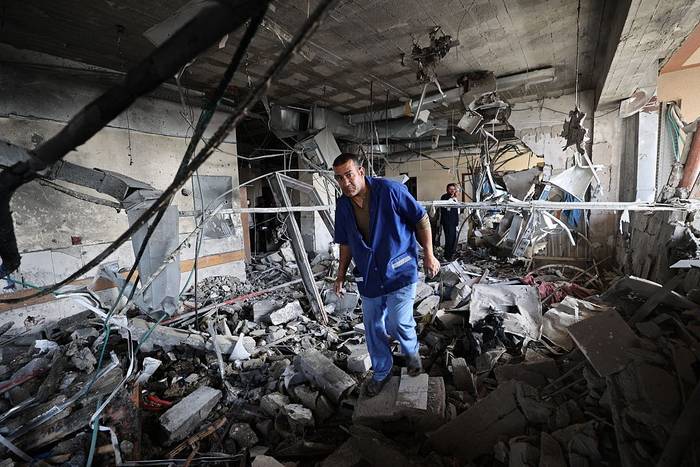
Palestinian hospital staff inspect the destruction inside Nasser hospital in Khan Yunis in the southern Gaza Strip, following an Israeli strike early on May 13, 2025 in which Palestinian journalist Hassan Aslih was killed along with several others. (Photo by Eyad Baba/AFP)
The distinction between past military affiliation and active combatant status has been a repeated source of dispute for press freedom groups that have attempted to tally the number of journalists killed.
Last month, the Committee to Protect Journalists (CPJ) completed a sweeping review of 229 deaths after Hamas and PIJ published obituaries identifying some people listed as journalists as members of armed groups.
CPJ ultimately removed 22 people from its list, including some it found had participated in combat—but retained others despite militant obituaries, gun photos, or past organizational ties when the evidence did not establish active combatant status.
The “Press Files” database contains 49 cases in which the main piece of evidence is one of these obituaries. Among them are people who CPJ examined and concluded were not active combatants, such as photojournalist Amr Abu Odeh—a 26-year-old freelance photographer for the Anadolu Agency and Reuters—whom the IDF database labels a Hamas “squad commander.”
CPJ examined photos of Odeh wearing a military uniform, which came from a 2021 military training course with Gaza’s Ministry of the Interior. The group noted that “No armed factions in Gaza have claimed Abu Odeh as being affiliated with them, and the IDF has not alleged he was involved in combat.”
“In multiple cases, despite obituaries by Hamas/PIJ, the Committee to Protect Journalists investigated thoroughly and concluded those journalists were NOT engaged in any militant activity during the genocide,” Shehada wrote. “They may have in the past. That doesn’t make them combatants forever.”
He added that the flimsiness of the IDF’s evidence was more striking given the sophistication of the intelligence unit it uses to “dig up dirt” on journalists to provide post hoc justification for their killings, which has been referred to internally as the “Legitimization Cell,” which was revealed in a +972 investigation.
“If that’s all they can provide as ”evidence“ (e.g. blank pages, random snippets, outdated docs) despite having formidable resources,” Shehada wrote, “then it’s a vindication of Gaza’s journalists!”
NAKBA 2.0
What is ‘Herod’s Pool’, and why is Israel developing it in the West Bank?
Al Jazeera Staff Mon, October 5, 2026
Key takeaways
Israeli authorities are developing an outdoor pool in the occupied West Bank, diverting water from a Palestinian village to create "Herod's Pool" in an effort to strengthen Israel's hold on historical sites.See more
Israel says that work has begun on a development project around an outdoor pool in the occupied West Bank filled after settlers illegally diverted water from a Palestinian village over the summer.
Instead of restoring the water to the village of Fasayil, near Jericho, Israeli authorities are working to formalise what has now been termed "Herod's Pool", named after an ancient Jewish king.
On Sunday, Israeli Finance Minister Bezalel Smotrich, a far-right settler, announced that "development and preservation" of Herod's Pool had commenced, connecting it to a larger project to "strengthen [Israel's] hold" on and preserve historical sites.
"The Settlement Revolution continues!" he declared in a social media post that carried an image of workers and wheelbarrows near the site.
The announcement follows Smotrich's June pledge of more than three million shekels (almost $1m) to develop the site, even though the pool sits on privately-owned Palestinian land belonging to a farmer.
The illegal diversion of water to the pool is part of Israel's monopolisation of water resources in the occupied West Bank's fertile Jordan Valley.
It also marks the latest Israeli seizure of Palestinian land in the name of archaeological heritage.
Here's what we know about the Herod's Pool project. What is 'Herod's Pool'?
Herod's Pool is the name Israeli settlers have given an ancient reservoir that lies in the Palestinian village of Fasayil. It is named after Herod the Great, a Jewish king from the first century BC.
The reservoir sits next to a natural spring.
Although settlers claim it once belonged to King Herod, archaeologists have not established when the pool was built. Alon Arad, executive director of Emek Shaveh, an Israeli NGO that defends cultural heritage rights and monitors the political use of archaeology, told the Reuters news agency that the pool's origins are unclear.
"We see in many cases the use of archaeology … to create this feeling that the West Bank is exclusively Jewish," he said.
Israeli politicians and settlers have also sought greater Israeli control over "Solomon's Pools", three ancient reservoirs in Bethlehem governorate, which have been used by Palestinians for generations.
Palestinians say the targeting of their water sources is part of a comprehensive plan to seize the resources of the occupied West Bank and force them off their land.
Israelis at a spring near the Palestinian village of Fasayil in the occupied West Bank on August 9, 2026. Residents say Israeli settlers diverted water from the spring, causing crops to die [Mohamad Torokman/Reuters]
Who owns the pool?
The reservoir sits on land belonging to Palestinian farmer Saad Nemer and his family. Nemer says that his grandfather purchased the property more than a century ago. Israeli-issued documentation and older title records reviewed by Reuters support the family's ownership claim.
Nemer said that settlers had been repeatedly redirecting water from his farm to swim in the pool. He explained that settlers had stolen his irrigation pipeline for the task, and over time the theft had left his farmland scorched and his greenhouses empty.
Nemer also said that settlers had threatened him and beat one of his employees.
The Israeli military body that administers the occupied West Bank, COGAT, has acknowledged that the water was diverted "without authorisation" and said it would investigate, even as Smotrich and other Israeli politicians celebrate the pool.
Nemer told The New York Times that he had been informed by COGAT that his water would be restored, but said it returned for only one day before being cut off again. He is now fearful of approaching the reservoir to reconnect his pipeline due to settler violence.
Saad Nemer visits his arid farm in the Palestinian village of Fasayil in the Israeli-occupied West Bank, August 9, 2026 [Mohamad Torokman/Reuters]
How have Israeli settlers invoked Herod?
While there is no proven link to Herod, the name features prominently in Israeli heritage projects across the occupied West Bank, which Israel refers to as "Judea and Samaria" in an attempt to separate it from its Palestinian population.
Critics, including archaeological rights groups, say such projects are increasingly being used to extend Israeli control over Palestinian land and heritage sites.
There is Herodium, a sprawling hilltop structure south of Jerusalem, said to be the ruins of a fortress the king erected. It has been under Israeli control for decades and operates as a national park, despite Palestinian protests that it is part of their heritage.
In Sebastia – ancient Samaria – Israel has dedicated large amounts of funding since 2023 to excavate the city's archaeological park and develop it as an Israeli "national park", usurping Palestinians who have long showcased the archaeological ruins as part of their history.
Israeli Minister of Heritage Amichai Eliyahu, who himself lives in an illegal West Bank settlement, has said it would be "first and foremost a Jewish heritage site". His office cited excavation of "the magnificent Roman city built by King Herod" when describing the archaeological periods the project intends to expose.
The Ibrahimi Mosque in Hebron – where Israel has repeatedly restricted Muslim access – stands on land considered to be Prophet Abraham's burial place by Muslims and Jews. Part of it is believed to have been built during the Herodian era.
In 2017, UNESCO recognised Hebron's Old City as a Palestinian heritage site, and warned that it was endangered by Israeli settler encroachments.
Ahead of UNESCO's decision, prominent Hebron settler Yishai Fleisher – who has served as an adviser to Israeli National Security Minister Itamar Ben-Gvir – objected to the designation on the grounds that it was "built by a Jewish king", referring to Herod.
MSF Says Israel Is ‘Asphyxiating’ Gaza, With Palestinians Pushed Into ‘Smaller and Smaller Area’
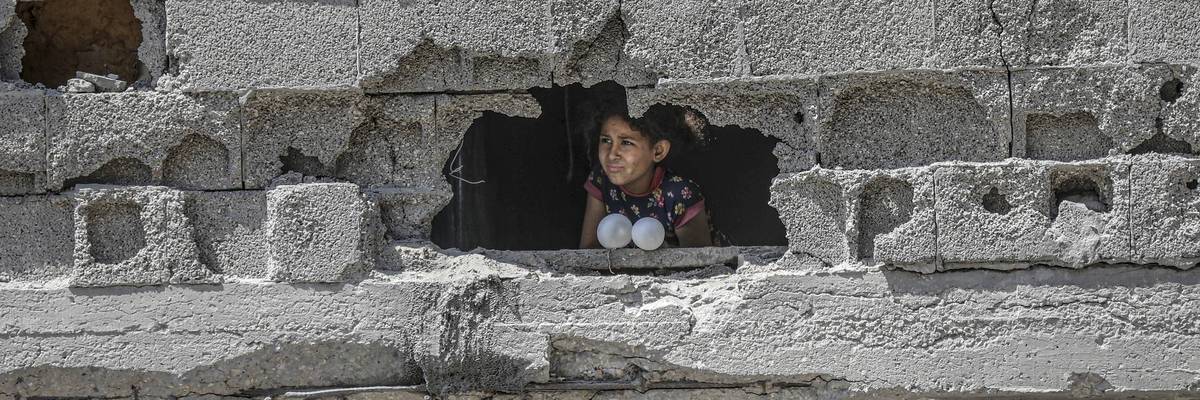
“The yellow line cannot be treated simply as a line on a map. It has become a mechanism of encirclement and ethnic cleansing.” A child peers through a hole in a damaged concrete wall in the Al-Tuffah neighborhood of Gaza City, Gaza Strip, near the yellow line, on September 22, 2026. (Photo by Faiz Qreqa/Middle East Images/AFP via Getty Images)
A year after a so-called “ceasefire” deal established the Israel Defense Forces’ “yellow line” in Gaza, separating the IDF-controlled eastern part of Gaza from about 47% of the strip that was originally set aside for Palestinians, the Israeli military has crept westward, block by block—effectively “asphyxiating” Gaza’s population of 2.1 million people, as one aid group said Monday.
Médecins Sans Frontières (MSF), also known by its English name, Doctors Without Borders, said that the US-backed IDF now occupies about 65% of the Gaza Strip, “squeezing people into a smaller and smaller area” and leaving Palestinians uncertain about where the yellow line begins and ends as they are forced to repeatedly move.
“People risk being shot by Israeli forces when they approach it, and MSF teams continue to treat people with gunshot wounds sustained nearby,” said the organization.
MSF released its statement on the shifting yellow line and the organization’s struggles to provide medical aid for Palestinians days after the Danish Refugee Council reported on refugee camps near the boundary, where 80% of Palestinians interviewed by the DRC said they’ve faced water shortage and people reported rat and rodent infestations, continued food scarcity despite a ceasefire deal that required a ramp-up of humanitarian aid, and rapid spread of illnesses.
DRC accused Israel of “a policy of protracted displacement,” which was supported by MSF’s reporting Monday.
“The October 2025 ceasefire in Gaza was supposed to end civilians’ suffering,” said DRC. “Nearly a year on, it exists largely in name only. Displacement in Gaza has not ended; it has changed shape.”
The United Nations Office for the Coordination of Humanitarian Affairs (OCHA) also warned last month about the IDF’s gradual push westward through demolitions and the movement of military forces, noting that residents have continued living in neighborhoods adjacent to the yellow line, such as Al-Tuffah and Al Zaytoun in Gaza City, “because they have nowhere else to go.”
“Where do we go? This is a question we’ve been asking ourselves for three years,” Safaa Mushtaha of Al-Tuffah told OCHA. “We accepted living near the yellow line, but it’s become unbearable.”
Ibtisam Malika, who also lives near the line, added that “every two to three months, we are forced to move and leave our belongings behind.”
MSF described how families are being “pushed into overcrowded and unlivable conditions” and how the group’s ability to deliver clean water has been impeded when there are attacks near the yellow line.
“The yellow line cannot be treated simply as a line on a map,” says Amande Bazerolle, head of emergency response for MSF in Gaza. “It has become a mechanism of encirclement and ethnic cleansing, while cutting communities off from the infrastructure, healthcare, water, and other essentials they need to survive.”
The medical aid group treated more than 1,500 cases of chickenpox in June and July, and has treated more that 11,000 cases of skin disorders including scabies this year.
One official said a majority of Palestinians in Gaza have less than six liters of water per day for drinking, bathing, and other domestic uses, and Israeli restrictions on the delivery of many items—ones that authorities claim are “dual-use” and could be used by Hamas for military purposes—have left families and medical providers without essentials.
“We are treating gastroenteritis, acute respiratory infections, a lot of skin conditions, hepatitis, bacterial skin infections, scabies, and lice,” said Dr. Murad Asaliyya, medical activities manager for MSF in Gaza. “At the same time, we are facing severe shortages in terms of medical supplies. Even the cream we need to treat scabies has been restricted by the Israeli authorities.”
Other crucial items that have been restricted by Israel include engine oil and spare parts, “crippling the infrastructure needed to keep hospitals, ambulances and water systems running,” said MSF.
MSF emphasized that the area near the yellow line is hardly the only part of Gaza where Palestinians face continued Israeli attacks. In June and July, the group’s medical teams treated more than 1,200 cases of “violent trauma” across the strip, “including blast injuries, burns, gunshot wounds, and injuries resulting from physical assault.”
Since Israel began relentlessly attacking Gaza in October 2023 in retaliation for a Hamas-led attack, the military offensive has killed more than 74,000 Palestinians, including more than 20,000 children, with experts warning that the true death toll is likely far higher. About 80% of all structures across Gaza have been damaged, said MSF.
The group released its findings as Israeli Finance Minister Bezalel Smotrich boasted in an interview about the IDF’s encroachment on the territory that had been ostensibly set aside for Palestinians last year, saying the moving of the yellow line and the destruction of Gaza and its infrastructure “encourages migration” and that “a world will not be built there.”
“Destruction, displacement, and deprivation have become normalized—practices Israel is carrying out with impunity,” said Bazerolle. “Governments must act now to ensure Israel stops the destruction and killing, prevents ethnic cleansing, and stops denying Palestinians the means of survival.”
Explosive CIA leak raises fears of imminent and ‘total collapse’ of major US ally; Israel
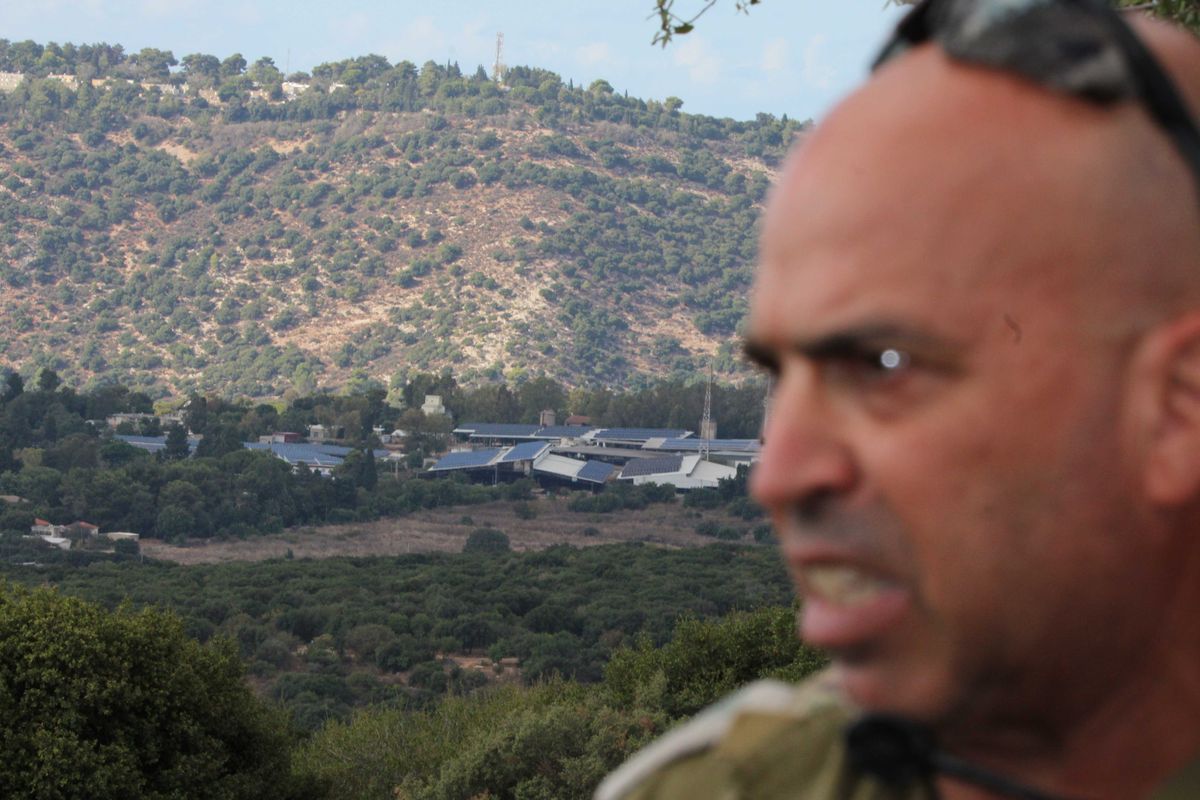
Israeli reservist Lt. Col. Dotan Razili stands at Israel's border with Lebanon, Sept. 17, 2024. (Alexander Willis / Raw Story)
CIA experts warned in a classified report that Israel could be headed toward “civil war” or “total collapse,” Drop Site News reported Monday after being briefed on the assessment by two U.S. sources.
“The writers of this are Israel experts,” one of the U.S. sources told Drop Site News, speaking on the condition of anonymity for the outlet’s report, which was co-published Monday alongside the news outlet Capital & Empire. “This isn’t a fantastical what if — with the upcoming election and the fissures in Israel we should take seriously their conclusion that Israel is one spark away from real internal conflict.”
Titled “Fracture From Within,” the report was compiled in August by Red Cell, an analytical unit within the agency created after the Sept. 11 attacks to “challenge conventional wisdom in the intelligence community” by producing “alternative analysis,” as described by Foreign Policy.
Drop Site News had the content of the report described to it by the two U.S. sources, with the assessment pointing to several “volatile” pressures that appeared to be "converging" ahead of Israel’s Oct. 27 elections, the outlet reported.
Among those pressures straining Israeli society cited in the report are economic struggles, record-high military spending, and mass psychological trauma and “mental illness.” The “deepest fractures in Israeli politics” cited in the report, Drop Site News noted, involved the nation’s growing ultra-Orthodox population, whose men have historically received broad exemptions to Israel’s mandatory military service “while continuing to receive state benefits.”
“Their collective refusal to serve is not rooted in opposition to Israel’s wars, as ultra-Orthodox leaders argue that military service threatens religious life and their obligation to Torah study,” Drop Site News’ report reads. “But after years in which reservists have been repeatedly called away from their jobs and families, the exemption has become a potent source of resentment in Israeli society.”
TRUMPS WAR ON CARIBBEAN FISHERS
‘More Performative Killing at Sea’: Another Trump Boat Strike Leaves 4 Dead
Condemning the “illegal campaign of extrajudicial killings” as “murder at sea,” Amnesty International USA asked, “Where is Congress to stop the horror?”
US Southern Command announced its 71st confirmed boat bombing, which killed four people, on October 4, 2026. (Photo: screen grab/US Southern Command/X)
US President Donald Trump’s boat-bombing spree continued on Sunday despite condemnation from around the world, claiming four more lives and bringing the death toll from the 13-month campaign to at least 238.
Sharing a video of the strike, US Southern Command said on social media late Sunday that “under the direction of SOUTHCOM, Joint Task Force Western Hemisphere executed a lethal, kinetic strike on a go-fast vessel operating along established narco-trafficking routes in the Caribbean.”
“Confirmed intelligence revealed the vessel’s active involvement in narco-trafficking,” SOUTHCOM continued, without offering any evidence, as with at least 70 previous strikes since September 2025. “The operation killed four narco-terrorists.”
Citing a federal memo that it aims to keep concealed from the public, the Trump administration claims to be at war with drug cartels and that the killings in the Caribbean Sea and Pacific Ocean are justified. Legal experts and human rights advocates argue the bombings are at least war crimes, if not outright murder.
Sunday’s strike was the administration’s first confirmed boat bombing since Ben Saul, the United Nations special rapporteur on human rights and counterterrorism, said last month that even if the targeted vessels were engaged in drug trafficking, there are no “international legal rights to unilaterally use military force” to counter cartels.
After SOUTHCOM’s announcement, Gizmodo reporter Matt Novak declared, “We murdered four more people in a boat today.”
Brian Finucane, a former State Department legal adviser who now advises the US Program at the International Crisis Group, called it “more performative killing at sea.”
Highlighting the rising death toll from Trump’s “illegal campaign of extrajudicial killings, ie, murder at sea” initiative, Amnesty International USA asked, “Where is Congress to stop the horror?”
The Republican-controlled Congress has declined to pass war powers resolutions intended to stop the strikes—though the odds of passage could change if Democrats reclaim one or both chambers in next month’s midterm elections.
Trump’s bombing spree has apparently been not only illegal but ineffective. The Washington Postreported in July that a Drug Enforcement Administration analysis concluded that the boat-bombing campaign has not “reduced the amount of cocaine entering” the United States.
Japan Anger Hits ‘Boiling Point’ as US Marine Accused of Murdering Okinawa Woman
“As long as there are US military bases in Okinawa, such incidents will occur,” said one former Japanese senator.
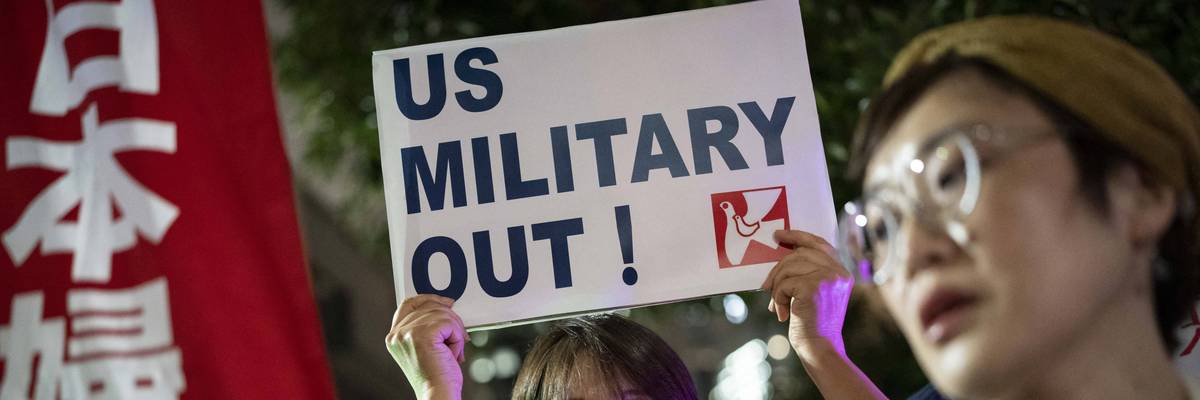
A woman holds up a placard reading ‘US Military Out!’ during a protest against the killing of a woman in Okinawa allegedly committed by a US Marine Corps member, in front of the Prime Minister’s Office in Tokyo on October 5, 2026. (Photo by Yuichi Yamazaki/AFP via Getty Images
Anger over the US military presence in Okinawa is growing anew this week after Japanese police arrested a Marine Corps lance corporal accused of robbing and murdering a local woman, prompting protests and renewed calls for a revision of the US-Japan Status of Forces Agreement and even the removal of American bases.
Lance Cpl. Devin Jacob Ballard, 20, who is stationed at Marine Corps Air Station Futenma, was arrested Sunday on suspicion of killing 39-year-old Anna Yagi at the Naminoue Crustal Hotel in Naha early Saturday and stealing her wallet and backpack. Yagi died from asphyxiation caused by pressure to her neck, according to Okinawa police. Ballard has denied the allegations.
The Japan Times reported that area surveillance cameras captured footage of a man with “distinctive features,” including tattoos on both arms and a shaved head, leaving the hotel carrying the woman’s backpack, which was later found nearby.
The killing sparked protests in Okinawa and Tokyo.
“How much longer do we have to bear this?” one protester asked outside the Okinawa prefectural government headquarters in Naha, according to Jiji Press.
A woman in her 40s from Nago said, “I feel it’s a contradiction that a serviceman stationed at a US military base in Okinawa to protect Japan has killed a civilian.”
Another woman at the protestsaid, “I don’t want to see any more people hurt.”
The advocacy group Femibridge Okinawa said on social media: “Anger has reached its boiling point. We don’t want to hear words like ‘refrain from commenting.’”
On Monday, Japanese Prime Minister Sanae Takaichi—who leads the right-wing Liberal Democratic Party (LDP) and supports US troops in Japan as a strategic deterrent to China—condemned the “heinous crime” in a speech to the Kokkai, or Parliament.
“The Japanese government has lodged a strong protest with the US side and has strongly demanded full cooperation with the investigation,” she added, “as well as strict disciplinary action against US military personnel and thorough measures to prevent a recurrence of such incidents.”
Okinawa Gov. Genta Koja, who has no party affiliation but was elected last month with LDP support, issued a statement Sunday calling Yagi’s killing “absolutely unforgivable.”
“I feel deeply outraged,” he continued. “It has come as a great shock to residents of the prefecture, who are forced to live in close proximity to bases, and has sparked fresh anxiety.”
“Although the prefecture has consistently demanded that the US military take measures to prevent recurrence whenever such incidents have occurred in the past, the fact that this type of incident has happened again compels us to conclude that the US military’s efforts to maintain discipline and educate its personnel are completely ineffective,” Koja added.
US Ambassador to Japan George Glass—who on Sunday was summoned by Japanese Foreign Minister Toshimitsu Motegi over Yagi’s killing—on Monday expressed his condolences and pledged “full cooperation” with investigators.
“I am speaking with US military commanders this week about how we continue to hold our American service members to the very highest levels of discipline and integrity,” he said, according to The Japan Times.
The Third Marine Expeditionary Force also said it was “actively cooperating” with Japanese officials in regard to the case, and that the US Marine Corps “takes these allegations very seriously and expects every Marine to adhere to the highest standards of behavior.”
In Naha, Okinawa’s prefectural capital, residents expressed their anxiety over the continued US military presence.
One 53-year-old woman said she has been “afraid to walk at night” in Naha.
“If we do not change the Japan-US Status of Forces Agreement, the crime of US soldiers will not decrease,” she asserted.
Hidekiyo Shinkawa, 89, expressed outrage over the number of people killed by US troops in Okinawa over the past eight decades.
“When I was a junior high school student, a classmate of mine died after being hit by a US military vehicle,” Shinkawa told Kumamoto Nichinichi Shimbun.
Okinawa was under US occupation from 1945-72. Today, the southern archipelago hosts 70% of US military bases in Japan and most of the 50,000 troops stationed in the country.
While many Okinawans appreciate the economic and security benefits of having US bases in their backyards, distrust of American troops in Okinawa—which was conquered during the closing months of World War II at the cost of over 100,000 civilian lives—runs deep.
Okinawans have been trying in vain to get the Americans to leave since the beginning of the occupation, when property was seized at gunpoint, residents were expelled, and homes and farms were bulldozed or burned. The Americans promised Okinawans good farmland and financial aid if they resettled in Bolivia. Thousands accepted the offer only to find themselves shipped off to an inhospitable wilderness where many died from disease. Much of the promised assistance was never delivered.
In Okinawa, the US military built more than 100 military facilities—over 30 of which are still in operation—on a series of islands roughly the size of Los Angeles. Washington forced the Japanese government to accept status of forces agreements that gave the US jurisdiction over all American personnel on Japanese soil.
US troops stationed in or visiting Okinawa have committed thousands of crimes, including at least dozens of murders and over 100 alleged rapes. In one six-month period in 1949, US troops killed 29 Okinawans and raped 18 more, including a 9-month-old infant.
The US military has also fired and lostnuclear weapons in local waters, leaked the deadly nerve agent sarin, and exposed residents to chlorine gas, to name but a handful of the most egregious environmental incidents over the decades.
Although the 1995 gang-rape of a 12-year-old girl by two Marines and a sailor led to a revision of the US-Japan SOFA so that Japanese authorities could convict and imprison Americans who commit the most heinous offenses—a development that led to scores of convictions—crimes against Okinawans and the local environment continue to this day.
On Monday, Koja argued in the wake of Yagi’s killing that “to ensure that such an incident never happens again, I strongly urge the Japanese and US governments to take responsibility and implement effective, fundamental measures—including a review of the Japan-US Status of Forces Agreement.”
Some Japanese went even further, demanding an end to US bases in Okinawa.
“As long as there are US military bases in Okinawa, such incidents will occur, and the fear that such incidents will occur and that they may happen in the future will continue,” wrote Keiko Itokazu, a former leftist lawmaker in the House of Councillors, the Kokkai’s upper chamber.
“How long will this pain and sorrow be felt by the people, especially women?” she added. “Such incidents have been repeated in the past, and each time the government and the US military have said that they will provide proper education to US soldiers... But is this the result of education?”
Former Japanese Prime Minister Yukio Hatoyama said on social media: “Once again, an incident that should never have happened has occurred. A woman was murdered in a hotel in Naha City, and a Marine was arrested.”
“Far from protecting Japan’s peace, the safety of women in Okinawa is being threatened,” he added. “As the nature of warfare changes, the Marines are no longer necessary for Japan’s peace. Voices calling for the Marines to leave will likely grow louder in Okinawa.”
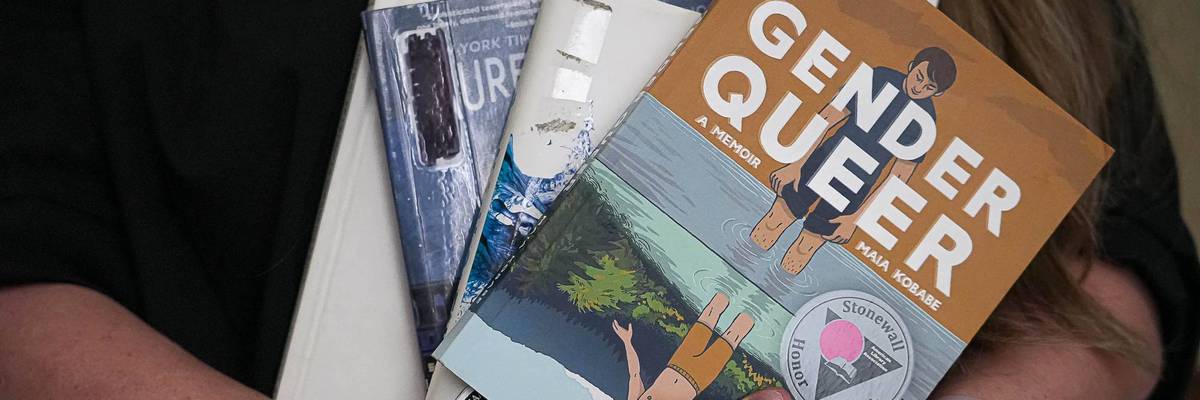
Led by Florida and Texas, US Book Bans Surge to Record 12,000
“In several cases, AI recommended banning books that were banned elsewhere, creating a snowball effect for frequently banned books while the expertise of librarians and the communities they serve are ignored.”
Suzette Baker, former head librarian at the Kingsland Branch Library in the Llano County Library System, holds some banned books at the Edwards Law office on March 4, 2024 in Austin, Texas. (Photo by Aaron E. Martinez/The Austin American-Statesman via Getty Images)
PEN America released a report on Monday documenting nearly 12,000 book bans involving more than 7,300 individual titles in US schools during the 2025-2026 school year, which the organization said were the largest censorship case numbers it had ever recorded.
The state of Texas accounted for more than 8,100 book bans—roughly three-fourths of the nationwide total and more than double that of Florida, which was the second-most censorious state with over 3,200 book bans.
PEN America said that the surge in Texas book bans came from SB 13, a state law passed in 2025 that banned a broad array of books that censorship proponents view as “profane” or “indecent.”
According to PEN America, the Texas book bans carried out over the last year have been particularly broad because officials in the state used artificial intelligence to make a recommended list of banned books.
“In several cases, AI recommended banning books that were banned elsewhere,” the report notes, “creating a snowball effect for frequently banned books while the expertise of librarians and the communities they serve are ignored.”
Sold, a 2006 young adult novel by journalist Patricia McCormick about a teenage girl in Nepal who gets sold into sexual slavery, was the most frequently banned book in the US.
Popular horror writer Stephen King was the most banned individual author, according to the report.
Kasey Meehan, director of PEN America’s Freedom to Read program, said that banning popular young adult titles was a particularly harmful policy given the broad decline in reading throughout the US.
“Schools should be doing everything possible to connect kids with reading by introducing them to engaging stories and formats,” Meehan said. “Instead, many are doing the opposite, banning books that help kids see themselves in literature, deepen their understanding and empathy of others, and develop their imaginations.”
Philomena Polefrone, senior manager of the Freedom to Read program, said the broad books bans documented by the PEN America report are due to “chilling directives from state politicians” that “have created chaos and fear.”
“Unsure how to comply, districts are removing books en masse, sometimes with the ‘help’ of crude AI tools that only make the problem worse,” Polefrone said. “Increasingly, these bans are invisible. Thousands of these cases are only recorded because of public information requests by Florida Freedom to Read and Texas Freedom to Read. Books paid for by taxpayers are being removed from shelves and the local community may not even know about it.”
Robert Reich
The Wealthy Hold More Power Than Ever—Can We Take It Back?
How can government enact and enforce the necessary reforms if it’s under the control of a power elite that won’t permit them?
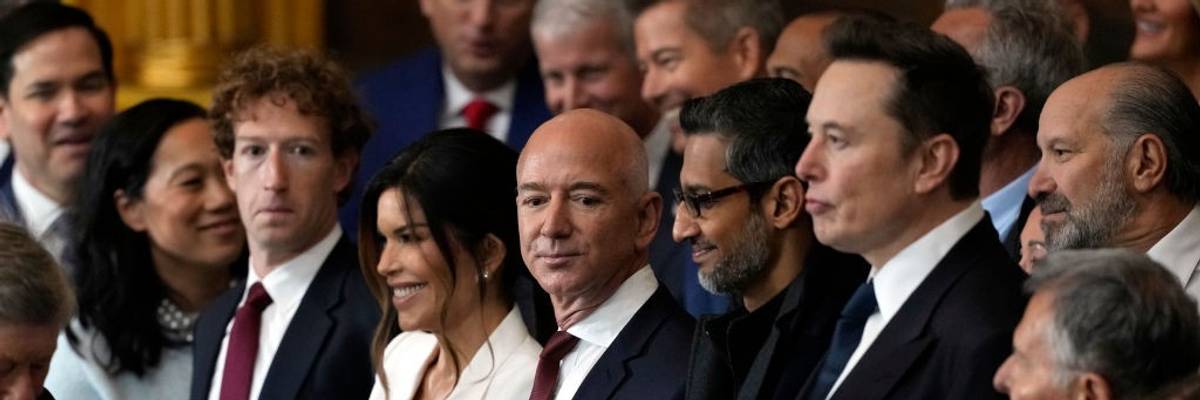
Guests including Mark Zuckerberg, Lauren Sanchez, Jeff Bezos, Sundar Pichai, and Elon Musk attend the Inauguration of Donald J. Trump in the US Capitol Rotunda on January 20, 2025 in Washington, DC. (Photo by Julia Demaree Nikhinson - Pool/Getty Images)
Behind this election’s dominant issue of affordability lies the record concentration of wealth at the top of America. The richest 0.001% of Americans—a handful of extraordinarily wealthy men—now control more of the nation’s wealth than at any time in modern history.
To be sure, wealth is not a zero-sum game in which the riches of those at the top necessarily come at the expense of everyone else. But power is a zero-sum game, because the more of it that is held by some people, the less of it is held by others.
Wealth cannot be separated from power. Great wealth becomes great power through campaign contributions, media ownership, the ability to buy off opposition, the capacity to wage pubic relations campaigns, and the resources to deploy armies of lawyers who litigate on your behalf. Recent years provide abundant illustration of all this.
This massive power shift is even more starkly illustrated by the billionaires, financial mavens, and tech bros who put Trump in power, who refuse to slow climate change, and who are now deciding on the future of AI and therefore humanity.
In these ways, great power also becomes great wealth. It buys changes in laws, regulations, and court decisions that bestow even more wealth on those with the power to alter the system to their benefit—and to siphon off resources from everyone else.
This power shift has also become clearly evident in recent years. In the Trump era it has taken the form of blatant corruption. But the political bribes, billionaire media ownership, PR campaigns, and well-financed litigation predated President Donald Trump.
For many years (with the notable exception of the Biden administration), antitrust enforcement has been defanged to make it easier for big firms to monopolize. Among the most widely discussed findings about the US economy is the rise of corporate concentration since the 1980s. The biggest firms, their top executives, and their major shareholders have all done wonderfully well. Consumers and employees, however, have faced higher prices, lower paychecks, and fewer choices.
At the same time, labor laws have been altered to make it more difficult to organize unions. In the 1950s, more than a third of private-sector workers were unionized. Now, fewer than 6% are.
Tax laws have been changed to reduce the rates and amounts paid by the super-wealthy, to the point where many pay no taxes at all—even though they have more wealth than ever.
This massive power shift is even more starkly illustrated by the billionaires, financial mavens, and tech bros who put Trump in power, who refuse to slow climate change, and who are now deciding on the future of AI and therefore humanity.
The question I keep coming back to is whether this can be reversed.
There is historic precedent. After the first Gilded Age—which ran from the 1890s to the start of World War I, and which featured wide inequalities of income, wealth, and political power—America reacted in what came to be known as the Progressive Era.
Starting under Theodore Roosevelt, monopolies were busted up, corporations were regulated, a progressive income tax was enacted, and corporate political donations (bribes) were barred. Then, starting in 1933, under Teddy Roosevelt’s fifth cousin, power continued to be shifted to what became the largest middle class in world history.
Then came the 1970s and 1980s, when the process began to go in reverse.
The challenge is arguably much greater today because wealth and power are more concentrated than in the first Gilded Age, creating a chicken-and-egg paradox: How can government enact and enforce the necessary reforms if it’s under the control of a power elite that won’t permit them?
Now, just four weeks from what could be a major political victory for the Democrats in taking back at least one chamber of Congress, this paradox should soon be the center of our national debate.
Robert Reich Robert Reich is professor emeritus of public policy at Berkeley and former US secretary of labor. His latest book is the No. 1 New York Times best-seller, "Coming Up Short." Full Bio >