Sunday, February 09, 2020

In pictures: Artists against the arms trade
The London-based Art The Arms Fair is an artistic movement against the arms trade, timed to coincide with the Defence & Security Equipment International (DSEI) military conference in London.
3/9

Peace Guard II by Shepard Fairey (2016)
The screenprints and stencils of Shepard Fairey are known primarily through work such as Hope, which was used in Barack Obama's 2008 US presidential election campaign. Fairey draws on street culture and graffiti for his work, which often addresses social issues: here, Peace Guard II shows his support for gun control. "I’m not anti-2nd Amendment, I’m pro-common sense,” he said in 2013. “No one needs an assault rifle with a 50 round clip, especially without a background check.” (Shepard Fairey/courtesy of Art The Arms Fair).


Dawn by Saba Jallas (2018) 
The photo collages of Yemeni artist Saba Jallas have come to prominence during the Yemeni war. Here her work Dawn juxtaposes the innocence of a child playing on a swing with the stark brutality of conflict. The result is an unreal yet almost ordinary presentation of everyday life in the Gulf nation (Saba Jallas/courtesy of Art The Arms Fair)


Marble Tub by Yasmine Diaz (2019)
Diaz was born and raised in Chicago to parents who came from the highlands of southern Yemen. Like Jallas, she also makes use of contrast, here mixing the luxury of a bathroom – symbolising class inequalities - with the burnt ruins of Yemen (Yasmine Diaz/courtesy of Art The Arms Fair)


SEE


Anti-arms trade group questions legality of Saudi ship set to dock in UK
Campaigners fear the Bahri Yanbu will bring military equipment to Saudi Arabia for use in the war in Yemen

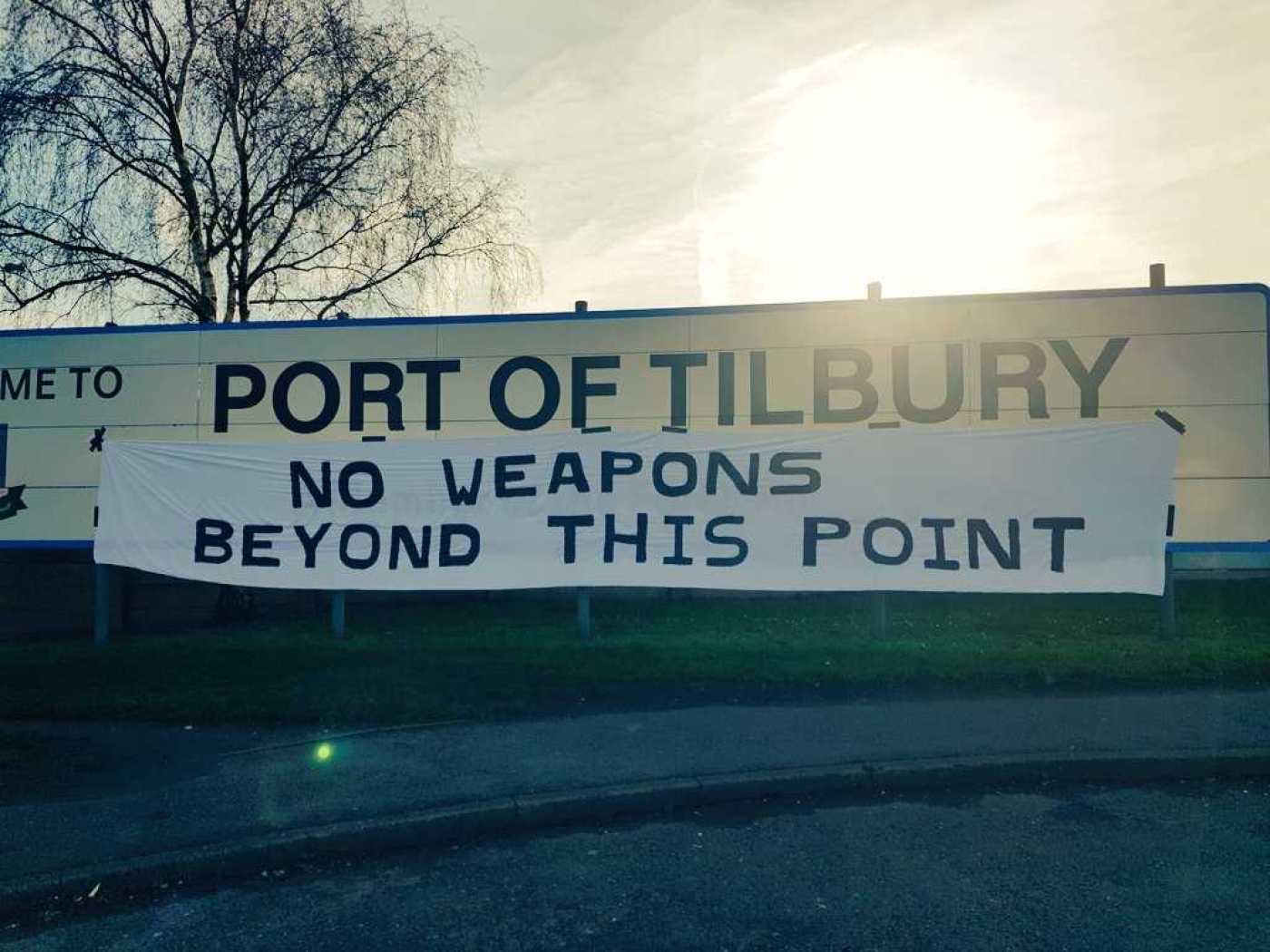
A sign hung by protesters on Wednesday morning in Tilbury in preparation for the Bahri Yanbu's arrival (Twitter/@CAATunis)

By  Dania Akkad Published date: 5 February 2020

Lawyers representing the Campaign Against Arms Trade (CAAT) have asked the British government whether a Saudi vessel, expected to arrive in the UK on Wednesday to pick up military equipment, should be allowed to enter the country.

Hours before the Bahri Yanbu, a Saudi state-owned cargo ship, was set to arrive at the port in Tilbury on the River Thames just outside of London, lawyers from Leigh Day sent the government a letter questioning on what grounds the vessel will be legally allowed to dock.


'The military equipment on that ship could be in human rights abuses for years to come. That is why we will continue to take action'

- Andrew Smith, Campaign Against Arms Trade

In particular, the lawyers have sought clarification about whether the licence that would be required for the ship to transport controlled goods is consistent with a landmark court ruling last June.

In that ruling, which resulted from a case raised by CAAT, the Court of Appeal said the UK government had acted unlawfully by failing to make an assessment of whether there was a risk that equipment sold to Saudi Arabia might be used in serious violations of international humanitarian law.

The government was ordered to review its multi-billion-pound arms trade with the kingdom and stop issuing new sales licenses as a result.

In a copy of the Leigh Day letter seen by Middle East Eye, the lawyers gave the UK government 24 hours to respond.

MEE has sought a comment from Bahri, the Saudi shipping company which operates the Bahri Yanbu, but had not received a response by the time of publication.

Last year, despite lawsuits and protests which blocked some of the cargo from making it onto the ship, the same vessel carried “tens of millions of dollars” worth of arms that were destined for Yemen, according to Amnesty International.
Ports and protests

Since the start of the year, the Bahri Yanbu has made its way to the US and Canada and is now making its way around Europe where it is expected to be met by protests in France and Italy.

It was scheduled to stop at Antwerp, but reportedly turned away following demonstrations at the Belgian port.

Campaigners are concerned that the ship will be loaded with weapons that may be used by Saudi Arabia in its war in Yemen.

A Dutch news outlet reported last week that the shipowners had confirmed that the vessel was carrying military equipment, but MEE has been unable to confirm this independently and has also asked Bahri to comment.


Saudi minister says arms sales to kingdom 'not affected' by UK court rulingRead More »


"The weapons transported by this ship could be used in human rights abuses in Yemen and beyond: it should not be allowed to use UK ports," said Andrew Smith, CAAT's media coordinator.

Smith acknowledged that while the court ruling last year was "extremely important", it has not stopped the transfer of arms that were licensed beforehand.

"Since the verdict, thousands of people have died as a result of the brutal conflict and the UK government has maintained its cozy ties to the Saudi regime," he said.

"The military equipment on that ship could be used in human rights abuses for years to come. That is why we will continue to take action."

More than 100,000 people have died since the Saudi-led coalition intervened in Yemens' war in March 2015 against the Houthi movement, according to a report released by an American NGO late last year.

During that same time period, the UK government has licensed at least £5.3bn worth of arms to Saudi Arabia, but is likely to have approved even more using 'open licenses' which obscure the total value and quantity of exports.

SEE

Italy calls on Egypt to release young researcher, activist

Issued on: 09/02/2020

Rome (AFP)

Italy on Sunday called on Egypt to release a young Egyptian researcher and activist based at Bologna University, saying it had reason to believe the security forces had tortured him.

The incident has revived painful memories of the 2016 disappearance and murder of an Italian researcher in Cairo, a case for which which the Italian authorities are still seeking answers.

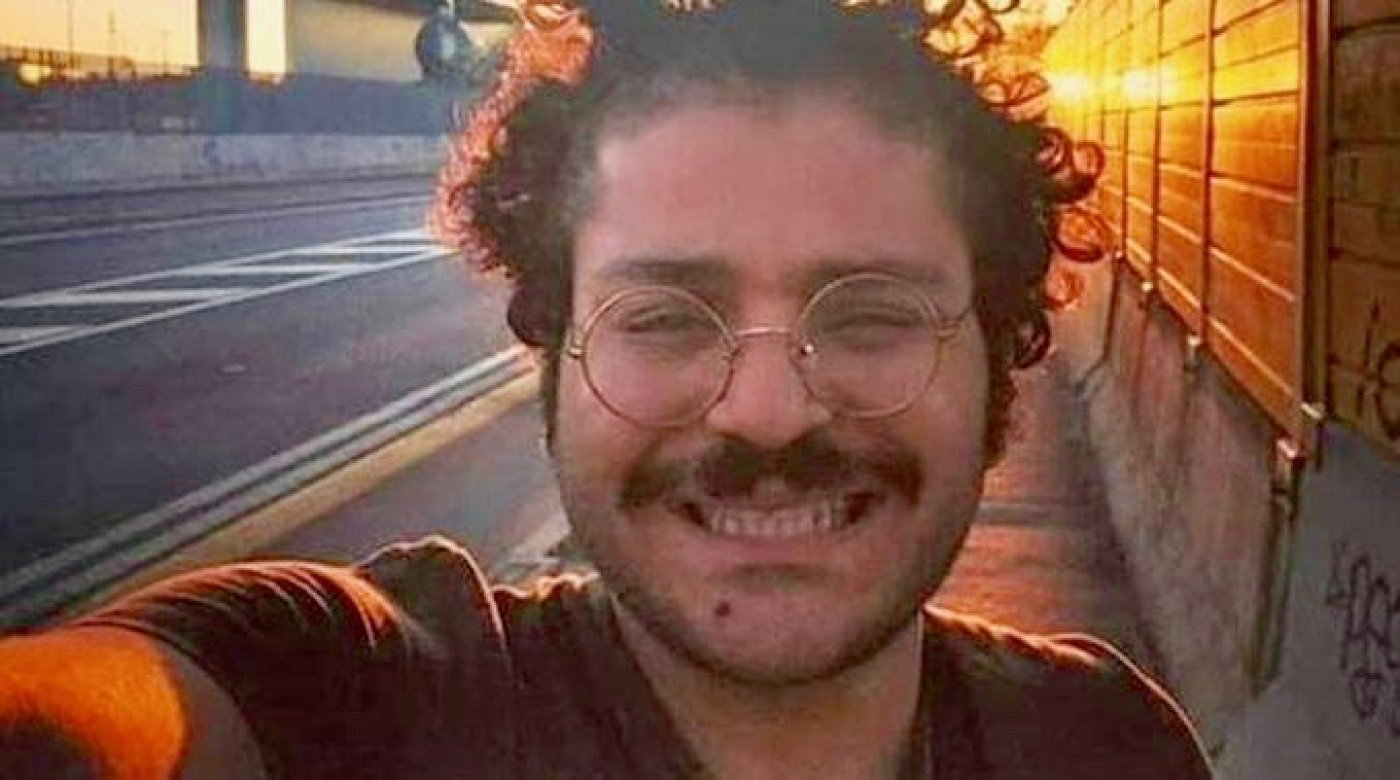
Patrick Zaky, 27, a graduate student at Bologna University in northern Italy, was detained late on Friday as he arrived to visit his family.

He was held on a warrant issued in September after he left to pursue his studies, according to the Egyptian Initiative for Personal Rights (EIPR), a prominent rights organisation where he is a researcher.

They said he had been charged with "harming national security" and "broadcasting false news" -- and that he had been beaten and electrocuted by security forces.

In a statement Sunday, Peppe De Christofaro, Under-Secretary for Education, expressed "great concern" for Zaky.

He had a "well-founded fear that the young Egyptian researcher... is currently suffering arbitrary and unjustified detention and that he is a new victim of violence and abuse from the Egyptian security forces", he said.

He called for other European Union states to join Italy in pressing Egypt to release him.

Everything had to be done to protect Zaky's safety and "avoid a repetition of unacceptable scenes of torture", he said.

- The Regeni affair -

Italy's reaction is in part informed by the January 2016 disappearance of 28-year-old Italian doctoral student Giulio Regeni in Cairo, where he was carrying out research on Egyptian trades unions.

His badly mutilated body was found in a suburb of the city a few days later, bearing the marks of torture.

Bologna University, where Zaky received a grant to study for a Masters degree, has already set up a crisis cell to help him. Students there are preparing a demonstration for Sunday evening to call for his release.

"We won't allow another Regeni case," organisers told Italian news agency Ansa. "We won't leave Patrick alone."

Last month, rights group Amnesty International organised a demonstration in the northern city of Turin to mark the fourth anniversary of Regeni's disappearance.

Although the Egyptian authorities have repeatedly denied any involvement in his death, the affair has soured relations between the two countries.

On Saturday, Zaky made an appearance before an Egyptian prosecutor in his home town of Mansoura, in the north of the country, said judicial and security sources.

He faces charges of "incitement to protest without a permit", "inciting to overthrow the state", "running a social media account intent on... harming national security", "broadcasting false news" and "promoting terrorist acts", the sources told AFP.

He will held for 15 days for questioning.

Since he led the 2013 military overthrow of Islamist president Mohamed Morsi, President Abdel Fatah al-Sisi has overseen a crackdown against Islamists and secular critics.

It has targeted prominent dissidents, academics, activists, journalists and lawyers.
Egyptian researcher faces charges of 'harming national security'
Since President Sisi led military takeover in 2013, his crackdown against critics has targeted dissidents, academics, activists, journalists and lawyers


Patrick Zaky is "at risk of prolonged detention and torture," according to Amnesty International spokesman in Italy (Twitter)
By MEE and agencies Published date: 8 February 2020 o

An Egyptian researcher and activist was arrested upon his arrival from Italy and charged with "harming national security" and with "broadcasting false news," lawyers and his employer said on Saturday.

Patrick Zaky, who is a graduate student at Bologna University, was detained at Cairo airport late on Friday as he arrived to visit his family, AFP reported.

He was held on a warrant that had been issued in September after he left to pursue his studies, according to the Egyptian Initiative for Personal Rights (EIPR), a prominent rights organisation where he is a researcher. The NGO said he was questioned about his research and activism.

Since President Abdel Fatah el-Sisi led a military takeover in 2013, a crackdown against critics has targeted prominent dissidents, academics, activists, journalists and lawyers.


'Be transparent about his whereabouts': US Senator tells Egypt to reveal location of Mostafa al-NaggarRead More »


Zaky appeared before the public prosecutor on Saturday in his hometown of Mansoura, 130km north of Cairo in the Delta region, security and judicial sources said.

Zaky faces charges of "incitement to protest without a permit," "inciting to overthrow the state," "running a social media account intent on... harming national security" and "broadcasting false news," as well as "promoting terrorist acts," they told AFP.

He will be held in custody for 15 days for further questioning.

Lawyers from two other rights groups in Egypt confirmed the list of charges.

EIPR said Zaky had been beaten and electrocuted by security forces while in custody overnight, claims that AFP could not verify.

The group called for his immediate release.

Riccardo Noury, Amnesty International's spokesman in Italy, wrote on Twitter on Saturday that the researcher is "at risk of prolonged detention and torture".

Zaky is one of a number of human rights defenders to be arrested or who have died in custody since 2013. Sisi's government has overseen a broad crackdown against dissent, with as many as 60,000 people jailed.

On Friday, US Republican Senator Marco Rubio called on the Egyptian government to disclose the location of Mostafa al-Naggar, a prominent activist and former politician who has been missing for more than 16 months.

Last month, an American imprisoned in Egypt for more than six years on what he insisted were false charges died after a long hunger strike, the State Department said. Moustafa Kassem, a dual Egyptian-American citizen, was arrested in Cairo in August 2013 after the military coup that brought Sisi to power.


US confirms 'avoidable' death of American held in Egyptian prison

Moustafa Kassem, who was arrested in 2013 after the overthrow of Egypt's first democratically elected president, had protested his innocence

Egyptian security forces are deployed near Cairo's Tora prison (File: AFP)
By
MEE staff Published date: 14 January 2020 


An American imprisoned in Egypt for more than six years on what he insisted were false charges, died on Monday after a long hunger strike, the State Department has said.

Moustafa Kassem, 64, a dual Egyptian-American citizen, was arrested in Cairo in August 2013 following a military coup that brought Abdel Fattah el-Sisi to power.

Kassem had insisted he had no links to opposition politics and had been wrongfully detained by Egyptian soldiers when he happened to be at a shopping centre near Cairo's Rabaa al-Adawiya square.

The dispersal of a sit-in at Cairo's Rabaa square on 14 August 2013 saw soldiers and police shoot dead more than 800 protesters in a matter of hours, and arrest thousands.

The bloody crackdown came weeks after the overthrow of Egypt's first democratically elected president, Mohamed Morsi.

Human Rights Watch concluded that the killings "likely amounted to crimes against humanity" and "were part of a policy to attack unarmed persons on political grounds."


'His death in custody was needless, tragic and avoidable,'

- David Schenker, Assistant Secretary for Near Eastern Affairs

After spending more than five years in pretrial detention, where he said his diabetes and a heart ailment went largely untreated, Kassem was convicted and sentenced to 15 years in jail in a mass trial involving hundreds of defendants.

Soon after that, Kassem went on the first of several hunger strikes, refusing solid food for months on end to protest what he called his unjust imprisonment.

He wrote letters to both US President Donald Trump and Vice President Mike Pence, asking them to secure his freedom and not make his wife a "widow".

"I am deeply saddened to learn today the death of US citizen Moustafa Kassem who'd been imprisoned in Egypt," Assistant Secretary for Near Eastern Affairs David Schenker told a State Department briefing on Monday.

"His death in custody was needless, tragic and avoidable," he added.

Kassem's brother-in-law Mustafa Ahmed, had previously described conditions at the maximum security Tora prison, where he was kept, as dire.

"The cells are filthy, infested with insects, rodents and snakes," he wrote in an op-ed for The New York Times last year.

"They have no ventilation, sun or light. Kassem and the other prisoners have no access to clean water, a bed, a chair or any books."
Trump's 'favourite dictator'

Since 2013, Sisi's government has overseen a broad crackdown against dissent, with as many as 60,000 people jailed.

While members of the Muslim Brotherhood - to which President Morsi belonged - were the main target, secular and left-wing activists have also been imprisoned.

Morsi died in jail last June, after enduring almost six years in solitary confinement.


How the death of a president shed light on Egypt's brutal dictatorshipRead More »


A 2018 report by members of the UK Parliament had warned that the "cruel, inhuman and degrading" conditions of Morsi's detention, including lack of medical care, may lead to his death.

Sisi won a second term in March 2018, in what critics called a "sham" election. He secured more than 97 percent of the vote.

The presidential elections featured only one other candidate - Moussa Mustafa Moussa - an ardent Sisi supporter who once formed a campaign group called: "Supporters of President Sisi's nomination for a second term."

Egypt is the second-biggest recipient of US military aid after Israel, receiving $1.3 billion every year.

Trump has repeatedly heaped praise on the Egyptian leader, even calling him "my favourite dictator".

What the West gets wrong about Russia's role in the Middle East


Dmitriy Frolovskiy 4 February 2020
Moscow appears to be a stone-cold tactical actor, filling voids across the region to boost its global stance

Russian President Vladimir Putin speaks in Moscow on 11 January (AFP)

Russia’s gains in the Middle East reveal how its actual capabilities have been overlooked. Perceptions of Moscow’s role have shifted from spoiler to skilful disruptor, with a coherent and expansionist strategy that strives to find a role where the West has failed.

Once a feared superpower that positioned itself as an ideological counterweight to the West, decades of post-Soviet decline saw Russia beset by feeble economic performance, ethnic separatism and poor demographic indicators. Moscow was seen as being too preoccupied with its domestic problems, even in the wake of the Ukraine intervention.
Underestimating Russia

Former US President Barack Obama did not see the Kremlin as a direct security threat, famously deploying a zinger to challenge Mitt Romney for labelling Russia as a significant geopolitical foe. Even after the annexation of Crimea, Obama denounced Moscow as “a regional power that is threatening some of its immediate neighbours … out of weakness”.

Advances in Syria and the enhanced use of cyber-warfare to undermine Western democracies, however, highlighted these miscalculations of Russia’s actual power. Amid the worst slump in diplomatic relations since the Cold War era, Moscow once again emerged as a key geopolitical rival. The policy of strategic restraint appeared to be misguided, while Russia’s advanced weapons capabilities boosted the need for western deterrence.


The Ukraine fiasco and Obama's policy of isolation revolutionised Russia's foreign policy

A declining power and only the world’s 11th-largest economy, Moscow’s ability to punch above its weight continues to foster global uncertainty.

Once a communist foe that employed every available tool against the West, Russia is today seen as operating within the same ideological discourse in the Middle East, despite its more pragmatic and mundane goals that utilise short-term tactical approaches to squeeze in where possible and secure its limited niche.

The annexation of Crimea and the hybrid warfare in the eastern Ukraine ultimately catalysed Obama’s policy of isolation, and revolutionised Russia’s foreign policy. Despite President Vladimir Putin’s anti-US bravado, his country was hit hard by sanctions, declining oil prices and a collective Western backlash. Although boosting outreach to China seemed a balancing step, the Kremlin still placed the highest premium on its damaged relations with the West.
Geopolitical gains

While Russia’s endgame in the Middle East may still remain unclear, it is not about economic interests, although Moscow clearly benefits from massive military contracts with Egypt and multi-million dollar deals with the GCC nations. It is rather oriented towards geopolitical gains that could elevate its power status, both regionally and in the eyes of Washington and Brussels. Stepping into the Syrian civil war, alongside Tehran’s support on the ground, seemed like a good bet.

Last June, Putin noted that the Syrian campaign had exceeded his expectations. Yet, despite positioning itself as a political mediator, Russia’s actions were never about bolstering a democratic transition in Syria. Moscow’s foothold in the Latakia region, and its capacity to secure access to other regional capitals, aimed to propel Russia to the status of global power broker.
 
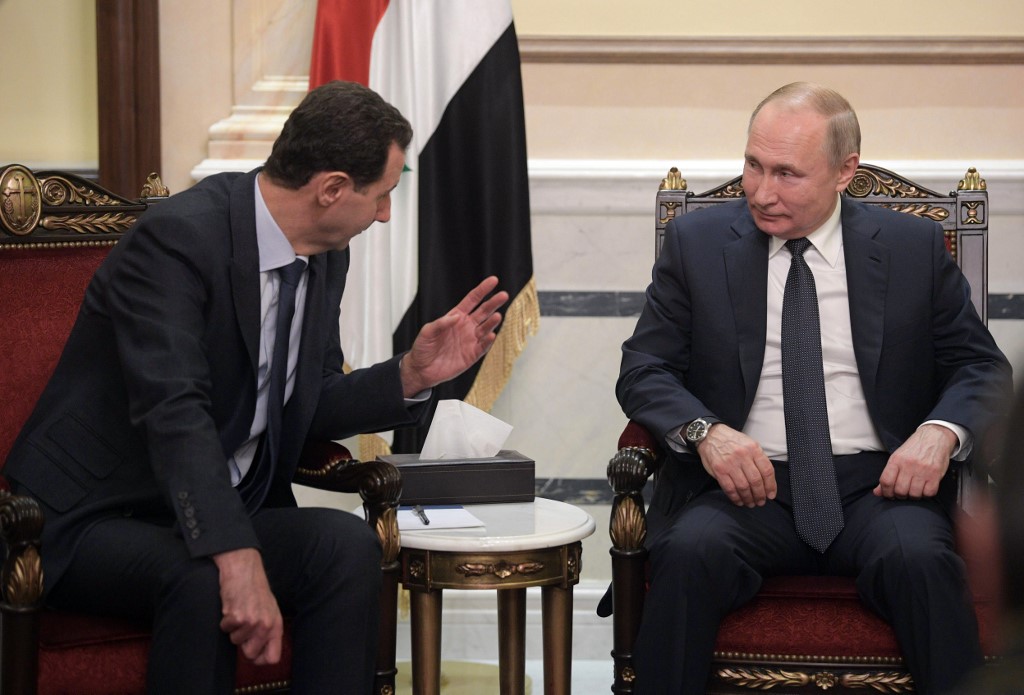
Putin meets Syrian President Bashar al-Assad in Damascus on 7 January (AFP)

Along the way, unexpected geopolitical achievements revealed to Russia its own capacities. The Kremlin discovered opportunities to act as a tactical player with no friends or enemies, but rather partners, amid a chaotic state of affairs in the Middle East. With Syria and Libya in crisis, Saudi Arabia and Iran striving to diversify relations, and the collective trauma of the unpredictable Trump administration, Russia merely needed to show up.

Putin’s authoritarian system, which delegated decision-making to a vicious group of kleptocrats, further greased the wheels for rapid rapprochements with despotic regimes across the region. Where Western nations might have felt constrained by complicated bureaucratic procedures or domestic ethics, Russia was eager to step in, relying on its secretive and largely unaccountable foreign policy establishment.
Unabashed pragmatism

Moscow parades its unabashed pragmatism, which allows it to strike deals equally with regional adversaries. The approach embodies the Kremlin’s desire to be seen as an honest broker that is more impartial than Washington.

While the US is constrained by close ties to Saudi Arabia and Israel, Russia can deal equally with all conflicting parties. It has space to draft frameworks reflecting mutual interests, as with the recently proposed collective security mechanism in the Gulf.

The dangers of Turkey's deepening relations with RussiaRead More »

Despite Russia’s currently uninterrupted access to the corridors of power in major capitals across the region, akin to what it enjoyed before Sadat’s expulsion of the Soviets from Egypt in the early 1970s, its endgame still triggers debate. Swayed by lasting legacies of the Cold War era, Moscow is now broadly perceived as a revisionist power that surgically squeezes in where the West has failed.

This notion, however, tends to distort the Kremlin’s actual capacities and embellish its actions with a coherent, expansionist strategy. In reality, Moscow appears to be a stone-cold tactical actor, filling voids across the region in order to boost its global stance and gain leverage in its broken relations with the West.


Dmitriy Frolovskiy is a political analyst and writer based in Moscow. He is a contributor to the Carnegie Moscow Center, European Union Institute for Security Studies, Middle East Institute and many other. Currently, He works as a private consultant on policy and strategy in the Middle East with Russian official and private entities.

Israel drawing up map for West Bank annexations: Netanyahu

Maayan Lubell

JERUSALEM (Reuters) - Israel has begun to draw up maps of land in the occupied West Bank that will be annexed in accordance with U.S. President Donald Trump’s proposed peace plan, Prime Minister Benjamin Netanyahu said on Saturday.


FILE PHOTO: U.S. President Donald Trump puts his hands on Israel's Prime Minister Benjamin Netanyahu's shoulders as they deliver joint remarks on a Middle East peace plan proposal in the East Room of the White House in Washington, U.S., January 28, 2020. REUTERS/Joshua Roberts

“We are already at the height of the process of mapping the area that, according to the Trump plan, will become part of the state of Israel. It won’t take too long,” Netanyahu said at an election campaign rally in the Maale Adumim settlement.

Netanyahu said the area would include all Israeli settlements and the Jordan Valley - territory Israel has kept under military occupation since its capture in the 1967 Middle East war but which Palestinians want in a future state.

“The only map that can be accepted as the map of Palestine is the map of the Palestinian state on the 1967 borders with Jerusalem as its capital,” said Nabil Abu Rdainah, spokesman for Palestinian President Mahmoud Abbas.

Prospects for annexations, which have already been widely condemned, are unclear.

Israel will hold a national election on March 2 and Netanyahu, who is facing criminal corruption charges, is hoping to win a fifth term in office. He presently heads a caretaker government, whose legal authority to annex territory is still undecided by judicial authorities.


Settlers make up part of Netanyahu’s right-wing voter base and many members of his coalition cabinet view the West Bank as the biblical heartland of the Jewish people.

Most countries consider Israeli settlements on land captured in war to be a violation of international law. Trump has changed U.S. policy to withdraw such objections.

Palestinians say the settlements make a future state non-viable. Israel cites security needs as well as biblical and historical ties to the land on which they are built.

Trump’s plan envisages a two-state solution with Israel and a future Palestinian state living alongside each other, but it includes strict conditions that Palestinians reject.

The blueprint gives Israel much of what it has long sought, including U.S. recognition of settlements and Israeli sovereignty over the Jordan Valley.

A redrawn, demilitarized Palestinian state would be subject to Israeli control over its security, and would receive tracts of desert in return for arable land settled by Israelis.


Right after Trump presented the plan on Jan. 28, Netanyahu said his government would begin extending Israeli sovereignty to the settlements and the Jordan Valley within days.

But Washington then appeared to put the breaks on that and Netanyahu has since faced pressure from settler leaders to annex territory despite any U.S. objections.


Israel plans West Bank annex after ‘deal of century’


February 9, 2020

An Israeli settlement in the West Bank on 19 November 2019 [Mosab Shawer/Apaimages]

February 9, 2020 at 11:36 am


Israel’s prime minister said his government has begun editing West Bank maps to include areas his country plans to annex, reports Anadolu Agency.

The move comes after US President Donald Trump released a “deal” to end the Israel-Palestine conflict.

Benjamin Netanyahu said lands that will be part of Israel are at the mapping stage and sovereignty will be applied to all land covered by the map, according to daily Yedioth Ahronoth.

Netanyahu said the new map will cover all the illegitimate settlements in the West Bank and the Agvar region.

READ: Israel is taking vengeance on Palestine for rejecting ‘Deal of the Century’

But Nabil spokesman for the Palestinian Authority president, Nabil Labu Ruedina, said the map of Palestine is recognized globally, according to United Nations resolutions.

“We will not have any relationship with any other map,” he said and indicated the current map belongs to the state dating June 4, 1967, whose capital is East Jerusalem.

Ruedina said it is the only map that will provide stability and peace in the region and the world.

Trump’s so-called “deal of the century” was announced January 28. It refers to Jerusalem as “Israel’s undivided capital” and recognizes Israeli sovereignty over large parts of the West Bank.

The plan has drawn widespread criticism from the Arab world and was rejected by the Organization of Islamic Cooperation, which urged “all member states not to engage with this plan or to cooperate with the US administration in implementing it in any form.”

Leaders of the Muslim bloc reiterated a need for a just and comprehensive solution that protects the rights of Palestinians.

Lebanon gathers to protest no-confidence vote
February 9, 2020

People stage a demonstration against the new government of Hassan Diab’ at in Beirut, Lebanon on 28 January 2020 [Mahmut Geldi/Anadolu Agency]

February 9, 2020 at 11:38 am


Hundreds of demonstrators protested Saturday in front of the Parliament building here against the Hassan Diab government and a vote of confidence to prevent a new government, Anadolu Agency reports.

The vote is expected Tuesday.

Another group gathered in front of the Association of Banks in Lebanon and protested its policy limiting foreign money transfer and withdrawing foreign currency. The policy was implemented 17 October 2019 when demonstrations began in the country.

Lebanon suffers from high unemployment, slow growth and one of the highest debt ratios in the world, with the debt burden reaching $86.2 billion in the first quarter of 2019, according to its Finance Ministry.
Malaysia trans woman arrested in Saudi’s Makkah
Malaysian cosmetic entrepreneur Nur Sajat was detained by Saudi authorities for wearing female clothing 

The US bought Sisi for $9bn, but the Egyptian people cannot be swayed


When Trump announced Jerusalem was Israel’s undivided capital under his so-called “deal of the century”, the Egyptian public questioned whether Al-Sisi had a hand in preparing the plan. His support, after all, came just half an hour after the announcement.

Officially, Egypt supports the establishment of a Palestinian state on its pre-1967 borders with East Jerusalem as its capital. According to Mada Masr, Al-Sisi’s statement originally included a sentence to that effect, but in a later draft it was removed, after it had passed through the president’s office for review.

Since he came to power, Abdel Fattah Al-Sisi’s rule has been decidedly anti-Palestinian. When Egypt’s military overthrew Mohamed Morsi on 3 July 2013, one of the first things the generals did was close the Rafah Crossing and deport Palestinians arriving in the country through Cairo Airport.


But in some respects the Egyptian dictator has tried to maintain nominal respect for the Egyptian position. In 2017, it was Egypt which filed a draft resolution rescinding Trump’s declaration that Jerusalem was Israel’s capital amid the global outrage that followed his announcement.

The price for Egypt’s new position was $9 billion, the amount promised at the economic workshop for the deal of the century in Bahrain last summer. It’s a big chunk of money for Egypt, given the dire straits it has found itself in under Al-Sisi’s mismanagement of the economy, and should provide some generous bonuses for the ruling generals, who we know through the whistleblower Mohamed Ali are getting rich through corruption and at the expense of their own people.

READ: Will Mohamed Ali’s document bring change to Egypt?

For its part, Israel has achieved political and economic gains it never imagined could be possible. This has been described as the golden age of Israeli-Egyptian relations symbolised by the transfer of Tiran and Sanafir islands to Saudi Arabia, which opened up the Straits of Tiran to Israel, and compounded by security cooperation between the Egyptian and Israeli army in Sinai.

As Yehya Okail, a former MP in Sinai, once told me:


Hosni Mubarak was a treasure to Israel, however Sisi is much more than that. Israel never imagined that it would be served by anyone in the history of Egypt as Sisi has done.

Trump’s plan proposes “cross-border services” including building desalination and power plants next to the Egypt-Gaza frontier. Observers have long talked about the US’ plans to build infrastructure projects in the Sinai Peninsula where Palestinians can work.

As Al-Sisi laid the groundwork for these projects, Sinai’s indigenous population, the Bedouin, have felt the plans acutely. The government has razed homes and obliterated fertile farmland, offering Sinawis no compensation for their loss. All of this has taken place under a protracted “war on terror” in Sinai authorities have been fighting for years now. As well as being accused of systematic war crimes, the army is no closer to defeating the estimated 1,000 militants there.

With Trump’s announcement, Egypt has another excuse to ramp up security in Sinai, which is already suffocating under a curfew and restrictions on goods entering the peninsula. No one knows better than the people of Sinai that increased security in the peninsula is a pretext for increased repression. At the beginning of the week, Egypt arrested 32 women from a prominent North Sinai tribe.


No photo description available.


READ: ‘Cold cells’ campaign hopes to close Egypt’s notorious Scorpion wing

Reports reveal high level military and intelligence leaders have demanded security forces be on high alert in anticipation of events in Gaza, including the claim that Palestinians will storm the border and make their way deep into Egyptian territory. With this, Egypt has flipped the narrative on its head to persuade the public it is Palestinians that want to flood Sinai, not that it is preparing to give its own land up at the behest of Israel and the US.


It’s not just in Sinai that people will feel the reverberations of Trump’s deal. Dual Palestinian-Egyptian national Ramy Shaath, the general coordinator of BDS Egypt who was imprisoned for speaking out about Egypt’s participation in the Bahrain workshop, and his colleague Mohamed El-Massry, are both imprisoned as part of the regime’s crackdown on pro-Palestinian solidarity. Their sentences and conditions could be negatively affected by the announcement and its aftermath.

Whilst the Egyptian regime has made a significant shift in its official position, in the long-term convincing its people isn’t so easy, as is evident from the public outcry in January, not just over the government’s official response to the deal of the century, but also because last month was when Israel began transporting natural gas to Egypt under a $15 billion deal.

In an attempt to change hearts and minds, Egypt intelligence sent round a WhatsApp to top media editors with instructions on how to report on the announcement. It asked them to refer to the US proposal as a “peace plan”, rather than the more negatively-viewed deal of the century, it said was viewed as an American-driven project to secure Israel’s interests. Editors were told not to address or focus on religious or national elements of the plan or to ask Al-Azhar for its view on the matter. It also asked journalists to emphasise the historical and pivotal role of Egypt on the Palestinian issue.

Attempts to control the narrative are widespread. One source in Sinai told me that two people were arrested in Arish around Christmas over Facebook posts about Israel, another researcher said that only high-ranking officers in the Egyptian army know they are cooperating with Israel in Sinai. These incidents show how entrenched pro-Palestinian sentiment is in Egypt, and how insecure the regime is. But it won’t stop Trump’s “favourite dictator”, as he presses ahead with the deal of the century to his benefit and to the detriment of his own people.
America's pig problem
The Week Staff

AP Photo/Eric Gay, File
February 8, 2020

Their population has exploded to an estimated 6 million across 39 states, with the greatest concentration in the South, particularly Texas. Feral hogs — also known as wild boars, wild pigs, and "razorbacks" — are prodigious breeders, have few natural predators, and are voracious, causing $2.5 billion in damage to farms and ecosystems annually. Like all pigs, the feral variety are omnivores and will devour anything they can tear up with their long snouts and 6-inch-long, razor-sharp tusks, including crops, gardens, frogs, worms, eggs, and even deer and lambs. They favor plants, and 50-pig herds, or "sounders," can empty whole fields of corn or wheat overnight. The invasive species has spread far and wide largely because it is well adapted to its environment and breeds so rapidly, with ranchers and hunters making the problem worse by trucking wild hogs into new areas so they can be shot for sport. Hunting them to control their population hasn't worked: You'd have to shoot 70 percent of the feral pig population every year just to keep it static.

Where did the hogs come from?
Their roots on this continent can be traced to Spanish conquistador Hernando de Soto, who brought black Iberian pigs to America around 1540. The pigs flourished in the New World, with some escaping to create a feral population. These wild pigs would later crossbreed with Eurasian wild boar brought into the U.S. for hunting in the 1890s and 1930s, producing what Canadian animal science professor Ryan Brook calls "a super pig" — weighing 200 to 500 pounds, capable of running up to 30 mph (or faster than sprinter Usain Bolt), and equipped with a wily intelligence that enables them to learn from their experiences. "They're one of the smartest animals on the planet," says wildlife biologist Alan Leary. They're also among the most prolific: Female hogs, or sows, begin breeding at around 6 months old and crank out two litters of four to 12 piglets every year. The hogs live five to eight years and are adapting to more northern climates, with their thick fur letting them migrate toward Canada. They've also learned to keep warm in colder states by burrowing into the snow to create "pigloos."


Are they a threat to humans?
Feral hogs are nocturnal and rarely attack people, although in the predawn darkness last November, wild pigs attacked Christine Rollins, 59, in rural Texas and bit her to death. New York Mets slugger Yoenis Cespedes missed all of last season after a wild boar lunged at him on his Florida ranch, causing Cespedes to step into a hole and break his ankle. Hogs are mostly feared, however, for their indiscriminate eating; researchers have cut open a dead hog's stomach and found it bursting with baby sea turtles. One study found that mammals and birds are 26 percent less diverse in forests with feral pigs. With no sweat glands, hogs wallow in water to cool off, introducing pathogens to water systems. They can carry at least 32 diseases, and scientists have blamed E. coli outbreaks on feral hogs defecating in spinach and lettuce fields. "Generally, an invasive species is detrimental to one crop," said Dale Nolte of the Department of Agriculture. "Feral swine are destructive across the board."

Can their population be controlled?
All efforts to curtail the hog invasion have thus far been futile. Congress included $75 million in the 2018 Farm Bill for "feral swine eradication," but actually wiping out the South's millions of pigs is widely considered impossible. In desperation, Texas — which has 2 million wild hogs — passed a law last year allowing people to shoot the marauders without a hunting license, and the state allows hog hunting year-round and without individual limits. Countless videos on YouTube show hunters on trucks or in helicopters blasting one scurrying pig after another like targets in an arcade game. Some ranchers even use bombs to blow up groups of hogs. Still, the wild hog population grows.

Can they be eaten?
Ranchers do trap feral pigs and sell them in Oklahoma and Florida to government slaughterhouses, which sell the pork cheaply. Many Southern restaurants are trying to make use of the excess meat, especially from sows and young boars. At his restaurant outside Austin, chef Taylor Hall only has to pay $35 per feral pig. The meat is very lean and has an intensely gamey flavor, but when mixed with fattier domestic pork to make a ragù for pasta, "it can be absolutely fabulous," Hall said. Unfortunately, pork-loving Americans can't solve the country's "greatest emerging wildlife challenge," said John Mayer, a government biologist in South Carolina. "We're not going to barbecue our way out of this one."


The threat of African swine fever

The U.S. is one of the few major pork producers unscathed by African swine fever, which is spreading throughout southeast Asia and eastern Europe. American pork is being shipped in record amounts to China, where African swine fever has already killed at least one-third of the pigs. Countries are frantically insulating themselves, with France building 82 miles of fence to keep wild boar out, and Denmark erecting fencing along its border with Germany. African swine fever doesn't affect humans, but it's highly contagious among pigs and kills them within a few days. The virus can also spread through ticks, manure, knives used to cut carcasses, even farmers' clothing. With a $1 trillion hog sector, China is the world's top pork consumer, and the financial firm Rabobank estimates that China's pig losses are closer to 55 percent. As the world's biggest pork exporter, the U.S. has a lot to lose if the disease reaches these shores, and the Department of Agriculture last year added 60 beagle teams to the 119 it already had sniffing for contraband pork at airports and seaports. "If this gets in," said Dave Pyburn, a scientist at the National Pork Board, "it will destroy our industry as we know it."
Furious Democrats call for Tom Perez's resignation after Iowa fiasco

Jeva Lange, The Week•February 7, 2020


Apparent attempts by Democratic National Committee Chair Tom Perez to absolve himself of responsibility over the Iowa caucus fiasco have sparked many in the party to begin calling for his resignation. "It's a lack of leadership," Rep. Marcia Fudge (D-Ohio) told The Hill in an interview Friday. "If you have the Iowa situation you don't throw them under the bus, you stand up and you support and you try to fix it. He doesn't lead on anything."

Party insiders have been particularly rankled by Perez's treatment of Iowa Democratic Party Chair Troy Price, who has publicly taken heat over the scandal that resulted from a failed app on election night and a week's worth of confusion over the winner. Perez took three days after the Iowa debacle to speak publicly about the caucuses, Politico reports, after having failed to appear alongside Price during an initial public address. "Loads of state party chairs are pissed that [Perez] would treat one of their peers like this," one state party official told Politico.

Perez has repeatedly attempted to distance himself from the scandal. On Thursday, he demanded a recanvass — essentially, a recalculation — of the election results, while Iowa Democrats were still counting votes. On Friday, asked by CNN's John Berman "how much of this is on you?," Perez dodged. "Well, again, the Iowa Democratic Party runs the caucus," he said. "Okay? And they — what happened was unacceptable."

The American Prospect's David Dayen blasted Perez, writing that the chair was "seeking to be an independent actor trying to 'clean up' the Iowa mess, when he was fully implicated in making the mess in the first place." Rep. Bennie Thompson (D-Miss.), speaking with Politico, called Perez's leadership "virtually nonexistent ... It's just a matter of time before he's going to go."