Sunday, February 09, 2020

Spectacular Sinn Féin victory reshapes Ireland's political landscape
Party leaders turn attention to how next government might be formed
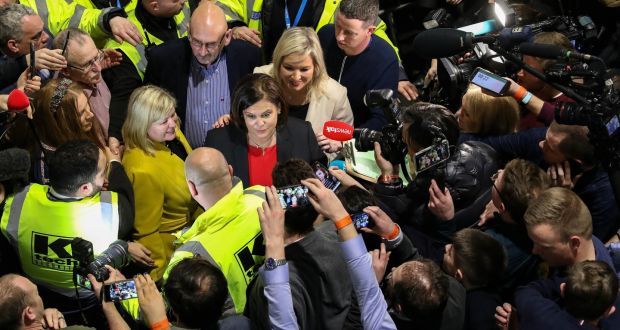

Sinn Féin president Mary Lou McDonald arrives at the Dublin election count centre at the RDS. Photograph: Crispin Rodwell

Sinn Féin candidates stormed to a series of spectacular victories in general election counts on Sunday, reshaping Ireland’s political landscape as party leaders begin to turn their attention to how the next government might be formed.

Though many seats remain to be filled and counts will continue this morning, a hung Dáil, which will be dominated by three big parties – Sinn Féin, Fianna Fail and Fine Gael – is inevitable.

Sinn Féin candidates all over the country won huge victories, with many elected on the first count with huge surpluses, catapulting the party into the front rank of Irish politics and making it a contender for government.

Fine Gael seems certain to suffer losses, while Fianna Fáil looks set to be the largest party in the new Dáil, analysts were projecting last night.

Taoiseach Leo Varadkar reiterated that he would not form a government with Sinn Féin, but indicated that a coalition with Fianna Fail could be possible, saying “we are willing to talk to other parties about the possibility of forming a new government, one that would lead the country forward for the next five years”.
Potential coalition

Fianna Fáil sources reported an emerging debate in the party about potential coalition with either Fine Gael or Sinn Féin. Party leader Micheál Martin appeared to soften his pre-election refusal to contemplate coalition with either of his two rivals, declining to explicitly rule out a coalition deal with either.

Mr Martin said that for any government to be sustainable, the policy platforms between the participating parties have to be compatible.

“It has to be coherent and it has to be sustainable and deliverable. They’re very significant issues that can’t be glossed over in the euphoria of an election day and all of the tension, interest and excitement around it,” he said.

Later, Mr Varadkar seemed to echo Mr Martin’s views when he said that to form a government together “you need to have roughly the same views around the courts of the criminal justice system, around how the economy and society should be run and also how democracy should function and that’s what makes my party, Fine Gael, not compatible with Sinn Féin”.
Fintan O’Toole: Election 2020 shows old political system in Ireland is finished
Detailed election 2020 exit poll results: How voters answered 15 questions
Meath West results: Surprise at Fianna Fáil loss as seismic shift to left


Election 2020 SEE FULL RESULTS

Results Hub
Seats by party
Party Seats  % 1st Pref
SF 29 24.53%
FG 11 20.86%
FF 10 22.18%
IO 6   15.39% 


GP 47.13%
SPBP 22.63%
SD 12.90%
LAB 04.38%
63 of 160 seats filled
7 of 39 constituencies complete
62.9% national turnout

Opinion was divided in Fianna Fáil on whether it should enter coalition with Sinn Féin or Fine Gael, or stay out of government entirely.

The divide was evident on the party’s backbench and among the frontbench of Mr Martin’s most senior TDs. “Government with Fine Gael isn’t a radical gesture,” said one member of the party’s frontbench. “I don’t see how Fianna Fáil and Fine Gael can be seen as reflecting a radical general election result. Sinn Féin is a mixture of Brexit Party populism and nationalism that kinda has to be tempered in my view – or else the centre collapses.”

Another TD said he would prefer coalition with Sinn Féin rather than Fine Gael, adding that Mr Martin “needs to swallow his pride” or step down as party leader.
Consider coalition

Galway TD Éamon Ó Cuív has suggested that Fianna Fáil must consider coalition government with Sinn Féin rather than a grand coalition with Fine Gael.

Mr Ó Cuív, who topped the poll in Galway West, said he has always been open to a coalition with Sinn Féin and that he would be “totally opposed” to any arrangements which would see Fine Gael retain power.

“There is great arguments going on all day about whether we are nearer Sinn Féin or Fine Gael,” Mr Ó Cuív said.

“My heart is much nearer the Sinn Féin side of the argument in terms of services for the people and putting the people before economic theory.”

Another senior Fianna Fáil TD last night said that if the party was to share power with Fine Gael, “We may as well shut up shop.” However, the TD also added that Sinn Féin should be allowed to form a government of the left.

But others in Fianna Fáil are more open to coalition with Fine Gael, perhaps including one of the small parties, such as the Greens.
A grand coalition

Senior Fine Gael sources said that they expected Mr Varadkar would approach Fianna Fáil about entering into a grand coalition.

But Sinn Féin leader Mary Lou McDonald, while hailing her party’s successes around the country, took steps to contact other left-wing parties to arrange talks on government formation. Speaking at Dublin’s RDS, she said she wants to explore whether such a new government would be possible.

“I also have consistently said that I will talk to and listen to everybody, I think that is what grown-ups do and that is what democracy demands.”

Ms McDonald, who was re-elected on Sunday evening with a big majority, said it was “not sustainable” for either the Fine Gael leader or the Fianna Fáil leader “to say they will not speak to us, representatives of such a sizeable section of the Irish electorate”.

Though most counts were continuing last night and will resume this morning, there were already some high-profile casualties. Minister for Transport Shane Ross lost his seat in Dublin-Rathdown, while his fellow Independent Cabinet minister Katherine Zappone looked set to lose out in Dublin South-West. Social Protection Minister Regina Doherty lost her seat in Meath East.

Minister of State for Higher Education Mary Mitchell O’Connor lost her seat in Dún Laoghaire, Solidarity TD Ruth Coppinger lost her seat in Dublin West and Government chief whip Sean Kyne looks likely to lose his seat in Galway West.

The former Labour leader Joan Burton lost her seat in Dublin West, while high-profile Fine Gael backbenchers Noel Rock and Kate O’Connell are also likely to lose out


Mary Lou McDonald hopes to lead left-wing government without Fine Gael and Fianna Fáil

Sinn Fein leader Mary Lou McDonald REUTERS/Phil Noble

Hugh O'Connell and Wayne O'Connor

February 09 2020 04:06 PM

SINN Féin leader Mary Lou McDonald has said she wants to attempt to become Taoiseach leading a left-wing government without Fine Gael and Fianna Fáil.

Ms McDonald has already spoken with the Green Party, Social Democrats and Solidarity-People Before Profit about forming a government without either Leo Varadkar or Micheál Martin’s party.


"The political establishment are still in a state of denial" - Mary Lou McDonald

Ms McDonald said the election result was a “a big statement of change” and that it is no longer a two-party system. She said her first priority was to attempt to deliver a new government without the involvement of the civil war parties.

"We have been in touch with the Greens, Social Democrats, People Before Profit and others. I said throughout the campaign, and I meant it, we need change, we need a new government, the best outcome is a government without Fine Gael and Fianna Fáil. So that’s the first thing I want to test, whether or not that is possible,” she said.

“I also have consistently said that I will talk to and listen to everybody. I think that’s what grown ups do. I think that’s what democracy demands.”

Ms McDonald was speaking as she arrived at the RDS count centre in Dublin where she will be re-elected to the Dáil on the first count in Dublin Central. She said the party could have fielded more candidates but that "hindsight is a great thing”.

She hit out at Fianna Fáil and Fine Gael saying she does not accept “the exclusion or talk of excluding our party that represents now almost a quarter of the electorate”.

She said this would be “fundamentally undemocratic”.

“I do not think that it is a sustainable position for Micheál Martin or Leo Varadkar to say that they will not speak to us representatives of such a sizable section of the Irish electorate," Ms McDonald said.

She said a vote for Sinn Féin was not a protest vote. She said it was an election that is “historic in proportion, this is changing the shape and the mould of Irish politics".

She added: “This is not a transient thing, this is just the beginning.”

Asked by Independent.ie if she could be leading a left-wing government and be Taoiseach, she responded: "Yes" and added: "Let’s see how the numbers stack up.


Sinn Fein Irish election surge leaves three main parties tied


DUBLIN (Reuters) - Support for left-wing Irish nationalists Sinn Fein surged in an election on Saturday, leaving it tied with the party of Prime Minister Leo Varadkar but unlikely to emerge with the highest number of seats, an exit poll showed.

Instead Varadkar’s Fine Gael is likely to compete with fellow center-right rival Fianna Fail to secure the most seats and the right to try to form a coalition government - a task analysts called extremely difficult.

RELATED COVERAGE

Factbox: Who's who in Ireland's national election


The Ipsos MRBI exit poll showed Fine Gael on 22.4%, Sinn Fein on 22.3% and pre-election favorites Fianna Fail on 22.2%.

Sinn Fein, the former political wing of the Irish Republican Army (IRA), is likely to fall behind the other two parties because it fielded far fewer candidates.

Still, its breakthrough represents a major realignment of Irish politics, which for a century has been dominated by Fine Gael and Fianna Fail.

“It’s a very, very good result for Sinn Fein... but even though it is a statistical tie, we would expect Fine Gael and Fianna Fail to fight it out to get the most seats,” said Gary Murphy, Professor of Politics at Dublin City University.

Fianna Fail has ruled out going into coalition for the first time with Fine Gael and both parties say they will not govern with Sinn Fein, meaning there is no obvious government to be formed, he added.

Prime Minister Leo Varadkar holds his ballot as he votes in Ireland's national election in Dublin, Ireland, February 8, 2020. REUTERS/Phil Noble

“There are very rocky times ahead,” he said.


“HISTORICAL ELECTION”

Counting begins at 0900 GMT on Sunday with some results expected from early afternoon. The final and potentially decisive seats in Ireland’s 160-member parliament may not be filled until Monday or even later.

Fine Gael and Fianna Fail have said they will look to smaller parties to form what would likely be another minority government requiring support of one of the two main parties from the opposition benches.

The parties have swapped power at every election since emerging from the opposing sides of Ireland’s 1920s civil war. They have similar policies on the economy and Brexit trade talks.

Sinn Fein has moved on from the long leadership of Gerry Adams, seen by many as the face of a bloody IRA war against British rule in Northern Ireland. Its candidates were the biggest gainers by vote share, up from 14% at the last election in 2016.

Slideshow (8 Images)

With Fine Gael and Fianna Fail marginally down, the outcome demonstrated some appetite for change.

“The days of Fine Gael and Fianna Fail dominating Irish politics are over,” Fine Gael parliamentary party chairman Martin Heydon told national broadcaster RTE.

“Our elections are becoming more volatile. More like a lot of other European countries. The ability to form governments is going to be hard after this.”

A new generation of politicians led by Mary Lou McDonald spearheaded the groundswell of support for Sinn Fein, particularly among younger voters on the defining election issue of the cost and availability of housing.

Her deputy leader in the Irish parliament, Pearse Doherty, said the exit poll represented a vote of “a historic nature” for the party.

“You can see in the figures there today that there is a mood for change,” he told RTE.


Irish vote may end Varadkar's spell as PM as Sinn Fein surges

DUBLIN (Reuters) - Irish voters look likely to dump Prime Minister Leo Varadkar from power on Saturday in an election that could alter the political landscape with a surge by Sinn Fein, which has struck a chord among younger voters.

The nationalist Sinn Fein party is unlikely to enter government, with opinion polls pointing to the main opposition Fianna Fail winning most seats and forming a coalition or minority government.

RELATED COVERAGE 
Factbox: Who's who in Ireland's national election 


Fianna Fail’s policies on the economy and post-Brexit are broadly similar to those of Varadkar’s center-right Fine Gael.

“I think there is a bit of a backlash coming (against Varadkar) from chatting to friends and colleagues,” said Shane Sullivan, a 31-year-old data analyst who voted for Fianna Fail because he wanted a focus on public spending rather than tax cuts. “I think they are just a bit out of touch to be honest.”

Left-wing Sinn Fein, which has moved on from the long leadership of Gerry Adams and is run by a new generation of politicians led by Mary Lou McDonald, could win the popular vote if the vote reflects the polls. On Monday, the former political wing of the Irish Republican Army (IRA) was polling at 25%, ahead of Fianna Fail on 23% and Fine Gael on 20%.

But Sinn Fein, which has appealed to younger voters on the defining issue of the election - the cost and availability of housing - has put forward too few candidates to capitalize, as the groundswell of support caught the party itself off guard after it sunk to 9% at local elections last year.

Analysts say it may only be able to gain a few seats and retain its position as the third largest party in parliament.

While both Fianna Fail and Fine Gael insist they will not govern with Sinn Fein, citing its IRA past and differing economic polices, such an outcome would demonstrate an appetite for change in decades-long centrist Ireland.

The IRA fought against British rule in Northern Ireland in a 30-year conflict in which some 3,600 people were killed before a 1998 peace deal. Sinn Fein’s ultimate aim is to unify Ireland and British-run Northern Ireland, where it shares power.

“I went for Sinn Fein this time because I really do believe it’s time for change,” said Siobhan Hogan, a 40-year-old childcare worker, who cited Fine Gael plans to increase the pension age and its failure to solve a housing crisis.


A  lorry showing images of Fina Gael leader and current Irish Taoiseach (Prime Minister) Leo Varadkar (R) and Micheal Martin of the Fianna Fail party is seen during the build-up to Ireland's national election in Dublin, Ireland, February 6, 2020. REUTERS/Phil Noble

A lorry showing images of Fina Gael leader and current Irish Taoiseach (Prime Minister) Leo Varadkar (R) and Micheal Martin of the Fianna Fail party is seen during the build-up to Ireland's national election in Dublin, Ireland, February 6, 2020. REUTERS/Phil Noble

“I’m lucky enough to have my own place but I look around and I see people struggling. People need a roof over their heads.”

Polls close at 2200 GMT and will be followed by an exit poll giving the first indication of the result. Counting begins at 0900 GMT on Sunday with some results expected from the early afternoon.

Varadkar had hoped the economic upturn his party has overseen since 2011 and his own diplomatic successes on Brexit - helping prevent a hard border on the island of Ireland after Britain’s departure from the EU - would extend his near three-year premiership.

The strategy appears to have fallen flat amid domestic issues such as healthcare and housing.

The immediate beneficiary looks set to be Fianna Fail leader Micheal Martin, a 59-year-old former teacher whose party suffered an electoral collapse nine years ago after the government he was a member of had to seek an EU/IMF bailout.

---30---


Astronomers Witness The Dragging Of Space-Time In Stellar Cosmic Dance


An international team of astrophysicists led by Australian Professor Matthew Bailes, from the ARC Centre of Excellence of Gravitational Wave Discovery (OzGrav), has shown exciting new evidence for 'frame-dragging'--how the spinning of a celestial body twists space and time--after tracking the orbit of an exotic stellar pair for almost two decades. The data, which is further evidence for Einstein's theory of General Relativity, is published in the journal Science.

Artist's depiction of 'frame-dragging': two spinning stars twisting space and time
[Credit: Mark Myers, OzGrav ARC Centre of Excellence]

More than a century ago, Albert Einstein published his iconic theory of General Relativity - that the force of gravity arises from the curvature of space and time and that objects, such as the Sun and the Earth, change this geometry. Advances in instrumentation have led to a flood of recent (Nobel prize-winning) science from phenomena further afield linked to General Relativity. The discovery of gravitational waves was announced in 2016; the first image of a black hole shadow and stars orbiting the supermassive black hole at the centre of our own galaxy was published just last year.

Almost twenty years ago, a team led by Swinburne University of Technology's Professor Bailes--director of the ARC Centre of Excellence in Gravitational Wave Discovery (OzGrav)--started observing two stars rotating around each other at astonishing speeds with the CSIRO Parkes 64-metre radio telescope. One is a white dwarf, the size of the Earth but 300,000 times its density; the other is a neutron star which, while only 20 kilometres in diameter, is about 100 billion times the density of the Earth. The system, which was discovered at Parkes, is a relativistic-wonder system that goes by the name 'PSR J1141-6545'.

Before the star blew up (becoming a neutron star), a million or so years ago, it began to swell up discarding its outer core which fell onto the white dwarf nearby. This falling debris made the white dwarf spin faster and faster, until its day was only measured in terms of minutes.

In 1918 (three years after Einstein published his Theory), Austrian mathematicians Josef Lense and Hans Thirring realised that if Einstein was right all rotating bodies should 'drag' the very fabric of space time around with them. In everyday life, the effect is miniscule and almost undetectable. Earlier this century, the first experimental evidence for this effect was seen in gyroscopes orbiting the Earth, whose orientation was dragged in the direction of the Earth's spin. A rapidly spinning white dwarf, like the one in PSR J1141-6545, drags space-time 100 million times as strongly!

A pulsar in orbit around such a white dwarf presents a unique opportunity to explore Einstein's theory in a new ultra-relativistic regime.

Artist's depiction of a rapidly spinning neutron star and a white dwarf dragging the fabric of space time
around its orbit [Credit: Mark Myers, OzGrav ARC Centre of Excellence]

Lead author of the current study, Dr Vivek Venkatraman Krishnan (from Max Planck Institute for Radio Astronomy - MPIfR) was given the unenviable task of untangling all of the competing relativistic effects at play in the system as part of his PhD at Swinburne University of Technology. He noticed that unless he allowed for a gradual change in the orientation of the plane of the orbit, General Relativity made no sense.

MPIfR's Dr Paulo Friere realised that frame-dragging of the entire orbit could explain their tilting orbit and the team presents compelling evidence in support of this in today's journal article--it shows that General Relativity is alive and well, exhibiting yet another of its many predictions.

The result is especially pleasing for team members Bailes, Willem van Straten (Auckland University of Tech) and Ramesh Bhat (ICRAR-Curtin) who have been trekking out to the Parkes 64m telescope since the early 2000s, patiently mapping the orbit with the ultimate aim of studying Einstein's Universe. 'This makes all the late nights and early mornings worthwhile', said Bhat.

Lead author Vivek Venkatraman Krishnan, Max Planck Institute for Radio Astronomy (MPIfR): 'At first, the stellar pair appeared to exhibit many of the classic effects that Einstein's theory predicted. We then noticed a gradual change in the orientation of the plane of the orbit.'

'Pulsars are cosmic clocks. Their high rotational stability means that any deviations to the expected arrival time of its pulses is probably due to the pulsar's motion or due to the electrons and magnetic fields that the pulses encounter.' 'Pulsar timing is a powerful technique where we use atomic clocks at radio telescopes to estimate the arrival time of the pulses from the pulsar to very high precision. The motion of the pulsar in its orbit modulates the arrival time, thereby enabling its measurement.'

Dr Paulo Freire: 'We postulated that this might be, at least in-part, due to the so-called "frame-dragging" that all matter is subject to in the presence of a rotating body as predicted by the Austrian mathematicians Lense and Thirring in 1918.'

Professor Thomas Tauris, Aarhus University: 'In a stellar pair, the first star to collapse is often rapidly rotating due to subsequent mass transfer from its companion. Tauris's simulations helped quantify the magnitude of the white dwarf's spin. In this system the entire orbit is being dragged around by the white dwarf's spin, which is misaligned with the orbit.'

Dr Norbert Wex, Max Planck Institute for Radio Astronomy (MPIfR): 'One of the first confirmations of frame-dragging used four gyroscopes in a satellite in orbit around the Earth, but in our system the effects are 100 million times stronger.'

Evan Keane (SKA Organisation): 'Pulsars are super clocks in space. Super clocks in strong gravitational fields are Einstein's dream laboratories. We have been studying one of the most unusual of these in this binary star system. Treating the periodic pulses of light from the pulsar like the ticks of a clock we can see and disentangle many gravitational effects as they change the orbital configuration, and the arrival time of the clock-tick pulses. In this case we have seen Lens-Thirring precession, a prediction of General Relativity, for the first time in any stellar system.'

From Willem van Straten (AUT): 'After ruling out a range of potential experimental errors, we started to suspect that the interaction between the white dwarf and neutron star was not as simple as had been assumed to date.'

Source: Swinburne University of Technology [January 30, 2020]
Showing How The Tiniest Particles In Our Universe Saved Us From Complete Annihilation

Recently discovered ripples of spacetime called gravitational waves could contain evidence to prove the theory that life survived the Big Bang because of a phase transition that allowed neutrino particles to reshuffle matter and anti-matter, explains a new study by an international team of researchers.
Inflation stretched the initial microscopic Universe to a macroscopic size and turned the cosmic energy into matter.
However, it likely created an equal amount of matter and anti-matter predicting complete annihilation of our universe.
The authors discuss the possibility that a phase transition after inflation led to a tiny imbalance between the amount of matter and anti-matter, so that some matter could survive a near-complete annihilation. Such a phase transition is likely to lead to a network of "rubber-band"-like objects called cosmic strings, that would produce ripples of space-time known as gravitational waves. 
These propagating waves can get through the hot and dense Universe and reach us today, 13.8 billion years after the phase transition. Such gravitational waves can most likely be discovered by current and future experiments [Credit: R. Hurt/Caltech-JPL, NASA, and ESA/Kavli IPMU - Kavli IPMU]

How we were saved from a complete annihilation is not a question in science fiction or a Hollywood movie. According to the Big Bang theory of modern cosmology, matter was created with an equal amount of anti-matter. If it had stayed that way, matter and anti-matter should have eventually met and annihilated one to one, leading up to a complete annihilation.

But our existence contradicts this theory. To overcome a complete annihilation, the Universe must have turned a small amount of anti-matter into matter creating an imbalance between them. The imbalance needed is only a part in a billion. But it has remained a complete mystery when and how the imbalance was created.


"The Universe becomes opaque to light once we look back to around a million years after its birth. This makes the fundamental question of 'why are we here?' difficult to answer," says paper co-author Jeff Dror, postdoctoral fellow at the University of California, Berkeley, and physics researcher at Lawrence Berkeley National Laboratory.

Since matter and anti-matter have the opposite electrical charges, they cannot turn into each other, unless they are electrical neutral. Neutrinos are the only electrical neutral matter particles we know, and they are the strongest contender to do this job. A theory many researchers support is that the Universe went through a phase transition so that neutrinos could reshuffle matter and anti-matter.


"A phase transition is like boiling water to vapor, or cooling water to ice. The behavior of matter changes at specific temperatures called critical temperature. When a certain metal is cooled to a low temperature, it loses electrical resistance completely by a phase transition, becoming a superconductor. It is the basis of Magnetic Resonance Imaging (MRI) for cancer diagnosis or maglev technology that floats a train so that it can run at 300 miles an hour without causing dizziness. Just like a superconductor, the phase transition in the early Universe may have created a very thin tube of magnetic fields called cosmic strings," explains paper co-author Hitoshi Murayama, MacAdams Professor of Physics at the University of California, Berkeley, Principal Investigator at the Kavli Institute for the Physics and Mathematics of the Universe, University of Tokyo, and senior faculty scientist at Lawrence Berkeley National Laboratory.

Dror and Murayama are part of a team of researchers from Japan, US and Canada who believe the cosmic strings then try to simplify themselves, leading up to tiny wobbling of spacetime called gravitational waves. These could be detected by future space-borne observatories such as LISA, BBO (European Space Agency) or DECIGO (Japanese Astronautical Exploration Agency) for nearly all possible critical temperatures.

"The recent discovery of gravitational waves opens up a new opportunity to look back further to a time, as the Universe is transparent to gravity all the way back to the beginning. When the Universe might have been a trillion to a quadrillion times hotter than the hottest place in the Universe today, neutrinos are likely to have behaved in just the way we require to ensure our survival. We demonstrated that they probably also left behind a background of detectable gravitational ripples to let us know," says paper co-author Graham White, a postdoctoral fellow at TRIUMF.

"Cosmic strings used to be popular as a way of creating small variations in mass densities that eventually became stars and galaxies, but it died because recent data excluded this idea. Now with our work, the idea comes back for a different reason. This is exciting!" says Takashi Hiramatsu, a postdoctoral fellow at the Institute for Cosmic Ray Research, University of Tokyo, which runs Japan's gravitational wave detector KAGRA and Hyper-Kamiokande experiments.

"Gravitational wave from cosmic strings has a spectrum very different from astrophysical sources such as merger of black holes. It is quite plausible that we will be completely convinced the source is indeed cosmic strings," says Kazunori Kohri, Associate Professor at the High Energy Accelerator Research Organization Theory Center in Japan.

"It would be really exciting to learn why we exist at all," says Murayama. "This is the ultimate question in science."

The paper was published in Physical Review Letters.

Source: Kavli Institute for the Physics and Mathematics of the Universe [February 03, 2020]
Arctic Permafrost Thaw Plays Greater Role In Climate Change Than Previously Estimated

Abrupt thawing of permafrost will double previous estimates of potential carbon emissions from permafrost thaw in the Arctic, and is already rapidly changing the landscape and ecology of the circumpolar north, a new CU Boulder-led study finds.

Aerial image of interspersed a permafrost peatland in Innoko National Wildlife Refuge in Alaska interspersed 
with smaller areas of thermokarst wetlands [Credit: Miriam Jones, U.S. Geological Survey]

Permafrost, a perpetually frozen layer under the seasonally thawed surface layer of the ground, affects 18 million square kilometers at high latitudes or one quarter of all the exposed land in the Northern Hemisphere. Current estimates predict permafrost contains an estimated 1,500 petagrams of carbon, which is equivalent to 1.5 trillion metric tons of carbon.

The new study distinguishes between gradual permafrost thaw, which affects permafrost and its carbon stores slowly, versus more abrupt types of permafrost thaw. Some 20% of the Arctic region has conditions conducive to abrupt thaw due to its ice-rich permafrost layer. Permafrost that abruptly thaws is a large emitter of carbon, including the release of carbon dioxide as well as methane, which is more potent as a greenhouse gas than carbon dioxide. That means that even though at any given time less than 5% of the Arctic permafrost region is likely to be experiencing abrupt thaw, their emissions will equal those of areas experiencing gradual thaw.

This abrupt thawing is "fast and dramatic, affecting landscapes in unprecedented ways," said Merritt Turetsky, director of the Institute of Arctic and Alpine Research (INSTAAR) at CU Boulder and lead author of the study published in Nature Geoscience. "Forests can become lakes in the course of a month, landslides occur with no warning, and invisible methane seep holes can swallow snowmobiles whole."

Abrupt permafrost thaw can occur in a variety of ways, but it always represents a dramatic abrupt ecological shift, Turetsky added.

"Systems that you could walk on with regular hiking boots and that were dry enough to support tree growth when frozen can thaw, and now all of a sudden these ecosystems turn into a soupy mess," Turetsky said.


Trees struggle to remain upright in a lake formed by abrupt permafrost thaw
[Credit: David Olefeldt]

Permafrost contains rocks, soil, sand, and in some cases, pockets of pure ground ice. It stores on average twice as much carbon as is in the atmosphere because it stores the remains of life that once flourished in the Arctic, including dead plants, animal and microbes. This matter, which never fully decomposed, has been locked away in Earth's refrigerator for thousands of years.

As the climate warms, permafrost cannot remain frozen. Across 80 percent of the circumpolar Arctic's north, a warming climate is likely to trigger gradual permafrost thaw that manifests over decades to centuries.

But in the remaining parts of the Arctic, where ground ice content is high, abrupt thaw can happen in a matter of months - leading to extreme consequences on the landscape and the atmosphere, especially where there is ice-rich permafrost. This fast process is called "thermokarst" because a thermal change causes subsidence. This leads to a karst landscape, known for its erosion and sinkholes.

Turetsky said this is the first paper to pull together the wide body of literature on past and current abrupt thaw across different types of landscapes.

The authors then used this information along with a numerical model to project future abrupt thaw carbon losses. They found that thermokarst always involves flooding, inundation, or landslides. Intense rainfall events and the open, black landscapes that result from wildfires can speed up this dramatic process

A massive thaw slump on the Yedoma coast of the Bykovsky Peninsula is inspected by an Alfred Wegener

Institute permafrost team [Credit: Guido Grosse, Alfred Wegener Institute]
The researchers compared abrupt permafrost thaw carbon release to that of gradual permafrost thaw, trying to quantify a "known unknown." There are general estimates of gradual thaw contributing to carbon emissions, but they had no idea how much of that would be caused by thermokarst.

They also wanted to find out how important this information would be to include in global climate models. At present, there are no climate models that incorporate thermokarst, and only a handful that consider permafrost thaw at all. While large-scale models over the past decade have tried to better account for feedback loops in the Arctic, the Intergovernmental Panel on Climate Change (IPCC)'s most recent report only includes estimates of gradual permafrost thaw as an unresolved Earth system feedback.

"The impacts from abrupt thaw are not represented in any existing global model and our findings indicate that this could amplify the permafrost climate-carbon feedback by up to a factor of two, thereby exacerbating the problem of permissible emissions to stay below specific climate change targets," said David Lawrence, of the National Center for Atmospheric Research (NCAR) and a coauthor of the study.

The findings bring new urgency to including permafrost in all types of climate models, along with implementing strong climate policy and mitigation, Turetsky added.

"We can definitely stave off the worst consequences of climate change if we act in the next decade," said Turetsky. "We have clear evidence that policy is going to help the north and thus it's going to help dictate our future climate."

Author: Kelsey Simpkins | Source: University of Colorado at Boulder [February 03, 2020]
New Thalattosaur Species Discovered In Southeast Alaska

Scientists at the University of Alaska Fairbanks have identified a new species of thalattosaur, a marine reptile that lived more than 200 million years ago.


Artist's depiction of Gunakadeit joseeae [Credit: Ray Troll ©2020]

The new species, Gunakadeit joseeae, is the most complete thalattosaur ever found in North America and has given paleontologists new insights about the thalattosaurs' family tree, according to a paper published in the journal Scientific Reports. Scientists found the fossil in Southeast Alaska in 2011.

Thalattosaurs were marine reptiles that lived more than 200 million years ago, during the mid to late Triassic Period, when their distant relatives -- dinosaurs -- were first emerging. They grew to lengths of up to 3-4 meters and lived in equatorial oceans worldwide until they died out near the end of the Triassic.

"When you find a new species, one of the things you want to do is tell people where you think it fits in the family tree," said Patrick Druckenmiller, the paper's lead author and director and earth sciences curator at the University of Alaska Museum of the North. "We decided to start from scratch on the family tree."

Prior to the discovery of Gunakadeit joseeae, it had been two decades since scientists had thoroughly updated thalattosaur interrelationships, Druckenmiller said. The process of re-examining a prehistoric animal's family tree involves analyzing dozens and dozens of detailed anatomical features from fossil specimens worldwide, then using computers to analyze the information to see how the different species could be related.

Druckenmiller said he and collaborator Neil Kelley from Vanderbilt University were surprised when they identified where Gunakadeit joseeae landed.

"It was so specialized and weird, we thought it might be out at the furthest branches of the tree," he said. Instead it's a relatively primitive type of thalattosaur that survived late into the existence of the group.

"Thalattosaurs were among the first groups of land-dwelling reptiles to readapt to life in the ocean," Kelley said. "They thrived for tens of millions of years, but their fossils are relatively rare so this new specimen helps fill an important gap in the story of their evolution and eventual extinction."


The fossil of Gunakadeit joseeae, which was found in Southeast Alaska. About two thirds of the tail had already
eroded away when the fossil was discovered [Credit: University of Alaska Museum of the North]
That the fossil was found at all is a remarkable. It was located in rocks in the intertidal zone. The site is normally underwater all but a few days a year. In Southeast Alaska, when extreme low tides hit, people head to the beaches to explore. That's exactly what Jim Baichtal, a geologist with the U.S. Forest Service's Tongass National Forest, was doing on May 18, 2011, when low tides of -3.7 feet were predicted.

He and a few colleagues, including Gene Primaky, the office's information technology professional, headed out to the Keku Islands near the village of Kake to look for fossils. Primaky saw something odd on a rocky outcrop and called over Baichtal, "Hey Jim! What is this?" Baichtal immediately recognized it as a fossilized intact skeleton. He snapped a photo with his phone and sent it to Druckenmiller.

A month later, the tides were forecasted to be almost that low, -3.1 feet, for two days. It was the last chance they would have to remove the fossil during daylight hours for nearly a year, so they had to move fast. The team had just four hours each day to work before the tide came in and submerged the fossil.

"We rock-sawed like crazy and managed to pull it out, but just barely," Druckenmiller said. "The water was lapping at the edge of the site."


Once the sample was back at the UA Museum of the North, a fossil preparation specialist worked in two-week stints over the course of several years to get the fossil cleaned up and ready for study.

When they saw the fossil's skull, they could tell right away that it was something new because of its extremely pointed snout, which was likely an adaptation for the shallow marine environment where it lived.

"It was probably poking its pointy schnoz into cracks and crevices in coral reefs and feeding on soft-bodied critters," Druckenmiller said. Its specialization may have been what ultimately led to its extinction. "We think these animals were highly specialized to feed in the shallow water environments, but when the sea levels dropped and food sources changed, they had nowhere to go."

Once the fossil was identified as a new species, it needed a name. To honor the local culture and history, elders in Kake and representatives of Sealaska Corp. agreed the Tlingit name "Gunakadeit" would be appropriate. Gunakadeit is a sea monster of Tlingit legend that brings good fortune to those who see it. The second part of the new animal's name, joseeae, recognizes Primaky's mother, Josee Michelle DeWaelheyns.

Source: University of Alaska Fairbanks [February 04, 2020]
One Single Primitive Turtle Resisted Mass Extinction In The Northern Hemisphere

Sixty-six million years ago, in the emerged lands of Laurasia -now the northern hemisphere- a primitive land tortoise, measuring about 60 cm, managed to survive the event that killed the dinosaurs. It was the only one to do so in this area of the world, according to a Spanish palaeontologist who has analysed its peculiar fossils, found in France.

A reconstruction of Laurasichersis relicta which lived in the northen hemisphere 66 millons years ago
[Credit: José Antonio Peñas (SINC)]
All turtle species we know of today are descendants of two lineages that separated during the Jurassic, more than 160 million years ago. But their members were not the only ones that existed. There had been many groups of primitive tortoises before them, in an earlier evolutionary position.

Some of these ancient reptiles managed to survive at a time when dinosaurs dominated the Earth. However, virtually all of the early groups of turtles disappeared after an asteroid impact that took place 66 million years and wiped out 70% of life on the planet.

Only the so-called "horned turtles" or meiolaniids managed to hold out, more specifically in Gondwana, the current southern hemisphere, according to fossils found in Oceania and South America. Their last representatives managed to co-exist relatively recently with humans, who hunted them to extinction. No other primitive turtle had appeared in the records of the last 66 million years.

After 10 years of study, the palaeontologist Adán Pérez García, from the Evolutionary Biology Group of the National University of Distance Education (UNED, Spain), now confirms that, in the northern hemisphere, on the ancient continent called Laurasia, a primitive land turtle also survived the mass extinction of the late Cretaceous period.

This was Laurasichersis relicta, an extinct turtle genus and species that corresponds to a new form, with very peculiar anatomical characteristics, and whose lineage evolved independently from that of the Gondwana tortoises, from which it separated 100 million years earlier.

"The reason why Laurasichersis survived the great extinction, while none of the other primitive North American, European or Asian land turtles managed to do so, remains a mystery," Pérez García, the sole author of the paper published in Scientific Reports, has confided to Sinc.

The impact of the asteroid plunged the Earth into a spiral of gas emissions, molten material and acid rain that caused a sudden warming of the climate and transformed the landscapes in which the turtles lived.


Laurasichersis relicta, an extinct turtle genus and species that corresponds to a new form
[Credit: José Antonio Peñas (SINC)]
"The fauna of European turtles underwent a radical change: most of the forms that inhabited this continent before the extinction disappeared, and their role in many ecosystems was left vacant until the relatively rapid arrival of new groups from various places in North America, Africa and Asia," the palaeontologist points out.

All of them, identified in these new ecosystems, seemed to belong to the two lineages that have persisted to this day, but the new study allows us to recognize that they were not alone. The appearance in a site in northeastern France of fossils of the shell, limbs and skull of Laurasichersis relicta shows that this primitive species also survived the mass extinction event in Laurasia.

However, its origin stems from another continent: "It is the last representative of a group previously identified in China and Mongolia, where it was known since the Jurassic, more than 100 million years before the new European Laurasichersis turtle existed. This group arrived on this continent very shortly after the end of the Mesozoic, 66 million years ago," says the researcher.

The shell of the newly discovered turtle was just over 60 cm long during adulthood and, like other primitive reptiles, it could not retract its neck into its shell to conceal its head from predators. This physical limitation allowed it to develop other protective mechanisms such as an armor with large, mutually linked spikes, which were hard structures located on the neck, legs and tail.

Its peculiar shell is one of the most remarkable features of this reptile and one of the characteristics that make it unique. This complex structure was made up of numerous plates. "Although the number of plates is usually the same in most turtles, the ventral shell region of the new species was provided with a greater number of these elements than those known in any other turtle," Pérez García stresses.

After the 10-km-diameter meteorite hit the Earth, the large dinosaurs ceased to be part of the landscape, but the turtle, which lived in humid environments with forest areas, coexisted with new predators. The latter quickly dominated the positions of the food chain that had remained available when most animals disappeared.

Author: Adeline Marcos | Source: Spanish Foundation for Science and Technology (FECYT) [February 03, 2020]
'Oldest Bamboo' Fossil From Eocene Patagonia Turns Out To Be A Conifer

A fossilised leafy branch from the early Eocene in Patagonia described in 1941 is still often cited as the oldest bamboo fossil and the main fossil evidence for a Gondwanan origin of bamboos. However, a recent examination by Dr. Peter Wilf from Pennsylvania State University revealed the real nature of Chusquea oxyphylla. The recent findings, published in the paper in the open-access journal Phytokeys, show that it is actually a conifer.

The holotype of the species Retrophyllum oxyphyllum (comb. nov.),
previously thought to be the oldest known bamboo
[Credit: Peter Wilf]
The corrected identification is significant because the fossil in question was the only bamboo macrofossil still considered from the ancient southern supercontinent of Gondwana. The oldest microfossil evidence for bamboo in the Northern Hemisphere belongs to the Middle Eocene, while other South American fossils are not older than Pliocene.

Over the last decades, some authors have doubted whether the Patagonian fossil was really a bamboo or even a grass species at all. But despite its general significance, modern-day re-examinations of the original specimen were never published. Most scientists referring to it had a chance to study only a photograph found in the original publication from 1941 by the famous Argentine botanists Joaquin Frenguelli and Lorenzo Parodi.

In his recent study of the holotype specimen at Museo de La Plata, Argentina, Dr. Peter Wilf revealed that the fossil does not resemble members of the Chusquea genus or any other bamboo.

"There is no evidence of bamboo-type nodes, sheaths or ligules. Areas that may resemble any bamboo features consist only of the broken departure points of leaf bases diverging from the twig. The decurrent, extensively clasping leaves are quite unlike the characteristically pseudopetiolate leaves of bamboos, and the heterofacially twisted free-leaf bases do not occur in any bamboo or grass," wrote Dr. Wilf.

Instead, Wilf linked the holotype to the recently described fossils of the conifer genus Retrophyllum from the same fossil site, the prolific Laguna del Hunco fossil lake-beds in Chubut Province, Argentina. It matches precisely the distichous fossil foliage form of Retrophyllum spiralifolium, which was described based on a large set of data - a suite of 82 specimens collected from both Laguna del Hunco and the early middle Eocene Rio Pichileufu site in Rio Negro Province.

Retrophyllum is a genus of six living species of rainforest conifers. Its habitat lies in both the Neotropics and the tropical West Pacific.

The gathered evidence firmly confirms that Chusquea oxyphylla has nothing in common with bamboos. Thus, it requires renaming. Preserving the priority of the older name, Wilf combined Chusquea oxyphylla and Retrophyllum spiralifolium into Retrophyllum oxyphyllum.

The exclusion of a living New World bamboo genus from the overall floral list for Eocene Patagonia weakens the New World biogeographic signal of the late-Gondwanan vegetation of South America, which already showed much stronger links to living floras of the tropical West Pacific.

The strongest New World signal remaining in Eocene Patagonia based on well-described macrofossils comes from fossil fruits of Physalis (a genus of flowering plants including tomatillos and ground cherries), which is an entirely American genus, concludes Dr. Wilf.

Source: Pensoft Publishers [February 04, 2020]
Detectorists Unearth 69,347 Iron Age Coins In Jersey, Channel Isles

Treasure hunters have set a record for the largest coin hoard discovered in the British Isles after unearthing 69,347 Roman and Celtic coins that were buried three feet beneath a hedge in Jersey, Channel Isles.

Britain's largest coin hoard of gold and silver pieces was found under a hedge on Jersey
in the Channel Islands [Credit: David Ferguson]
Metal detectorists Reg Mead and Richard Miles spent 30 years searching the field for the £10million treasure after a woman described seeing what looked like silver buttons in the area.
Their find - made in 2012 - trumps the previous record holding discovery of 54,951 Iron Age coins unearthed in Wiltshire in 1978.


The coins were found by metal detectorists encased in clay. It is believed that
they were hidden in the field around 50BC [Credit: Jersey Heritage]
Some of the silver and gold relics from the Guinness Record setting discovery, dated to around 50BC, will go on display at La Hougue Bie Museum on the island.

'We are not surprised at this achievement and are delighted that such an impressive archaeological item was discovered, examined and displayed in Jersey,' said curator of archaeology at Jersey Heritage Olga Finch.


The coins were carefully extracted after they were detected three feet
beneath a hedge [Credit: Jersey Heritage]

'Once again, it puts our Island in the spotlight of international research of Iron Age coinage and demonstrates the world class heritage that Jersey has to offer.'

Mr Miles said he and Mr Mead had been involved in the process the whole way through and described receiving the Guinness World Record certificates as 'lovely'.


Conservator for the Jersey Heritage Museum Neil Mahrer begins to carefully dig
the silver and gold treasures out of the clay [Credit: Jersey Heritage]
The coins were found to have been entombed in a mound of clay weighing three quarters of a ton and measuring 55 x 31 x 8 inches.

They were declared a 'treasure' under the Treasure Act 1996, which means they officially belong to the Queen, although the finders are entitled to a reward.

Detectorists Reg Mead and Richard Miles found the coins sealed
inside a slab of clay in 2012 [Credit: SWNS.com]
Mr Mead has said that the least valuable coins in the hoard are likely to be worth £100 each, suggesting a valuation of several million pounds, without taking into account the precious jewellery also found in it.


However, there has been discussion over whether the price would come down because so many coins had been found, reducing their rarity.


Some of the coins after cleaning [Credit: Jersey Heritage]
The previous largest coin hoard from Wiltshire was discovered in 1978 at the former Roman town of Cunetio near to Mildenhall.

The largest hoard of coins ever found in the world was in Brussels in 1908 with 150,000 silver medieval pennies from the 13th Century uncovered.

Author: Luke Andrews | Source: Daily Mail [February 02, 2020]
NOT WHAT YOU THINK OF WHEN YOU HEAR SYRIA

Syria: Assad's forces 'seize' crossroad town as Turkey sends convoy into Idlib

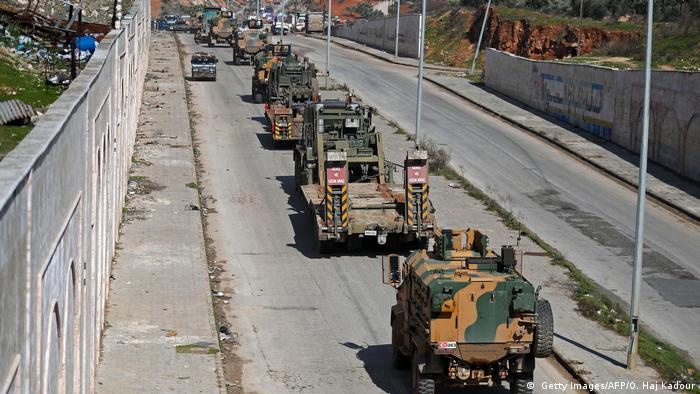
Syrian forces claim to have seized the highway junction town of Saraqeb near Idlib, capital of the last major rebel enclave in Syria. Since Friday, neighboring Turkey has dispatched 430 military vehicles into the region.


The Syrian army said on Saturday that it had taken control of the strategic northwestern town of Saraqeb as it continues an offensive in the Idlib region, the country's last major rebel stronghold.

News of the seizure was announced by Syrian state television broadcasting live from Saraqeb, located at the junction of the M4 highway, which stretches east from the Mediterranean, and the M5, which brings traffic 300 kilometers (186 miles) north from the capital, Damascus, toward Aleppo.

The junction town's capture capped a weekslong offensive by President Bashar Assad's forces. According to the UN, the operation has forced 580,000 people to flee, many of whom were already displaced, and left 300 civilians dead.

Read more: Idlib — the Syrian region abandoned by the world

Saraqeb, which months ago had had 110,000 residents, has been in large part leveled by bombardment, with many of its inhabitants fleeing the town, according to the Britain-based Syrian Observatory for Human Rights.

"Our aim is to clear the highway," a Syrian commander told state television, referring to the M5, which leads on to Aleppo, whose rebel-held eastern section was captured by Assad's forces back in 2016.

The Observatory said Assad's forces still did not have access to 30 remaining kilometers (18 miles) of Syria's northwestern highway network.

Turkish-manned observation posts

News of Saraqueb's capture comes after a convoy of 430 Turkish military vehicles crossed into Idlib, the province named like its densely packed regional capital, from Friday night, said the Observatory.

That brought Turkey's vehicle count since last weekend to over 1,000, it said.

Turkey has 12 observation posts inside Idlib province, set up under a 2018 truce, in a shrinking rebel area occupied by some 3 million people near Turkey's border.

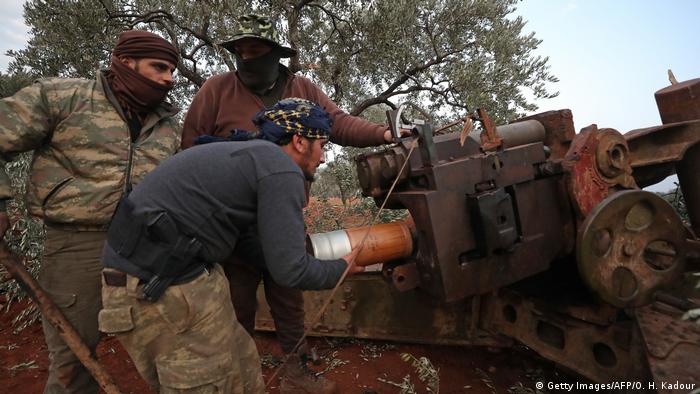
Some 50,000 rebel fighters, a mixture of jihadis and opponents to Assad's regime, are still in the area, according to Observatory estimates.


Rebels inside Idlib are continuing to fight government forces

Turkey's Anadolu news agency, citing a Turkish security source, said the sole mission of the convoy, which was accompanied by commandos, was to reinforce three outposts surrounded by Syria's army.

The Observatory said the Turkish vehicles were on a front line north of Saraqeb.

"In the event of a new attack, a proper response will be given in the strongest manner, based on the right of self-defence," the Turkish Defense Ministry said in a tweet.

Russia-Turkey frictions

On Saturday, a Russian delegation met with Turkish officials in Ankara. Turkey has long urged Moscow to convince Assad to end the offensive.

Last Monday, Turkish soldiers were caught in an exchange of shelling with Russian-backed Syrian troops, leaving more than 20 reported dead on both sides.

Fahrettin Altun, top press aide to Turkey's President Recep Tayyip Erdogan, on Saturday warned that Ankara would not tolerate the situation unfolding in Idlib.

"Bashar al-Assad's place in the future ... is not the presidential palace but the International Court of Justice at The Hague," said Altun.

The United Nations and aid groups warn that further Syrian encroachment into Idlib risks creating one of the worst humanitarian catastrophes of Syria's nine-year war.

ipj/jlw (AFP, Reuters, AP)

Syrian government set to retake key M5 highway: monitor

Issued on: 09/02/2020

Beirut (AFP)

Syrian regime forces Sunday were set to retake a key motorway connecting the capital Damascus to second city Aleppo following weeks of battles in the rebel-held Idlib region, a monitor said.

The M5 has been long in the sights of the Syrian government as it seeks to revive a moribund economy after nearly nine years of war.

It connects Aleppo, once Syria's economic hub, to Damascus and continues south to the Jordanian border and recapturing it would allow traffic to resume between economically-vital parts of war-torn Syria.

After weeks of steady regime advances in Syria's northwest, only a two-kilometre section of the M5 remains outside government control, said the Britain-based Syrian Observatory for Human Rights war monitor.

Pro-government forces on Sunday were closing in on the last sliver in the southwest of the Aleppo province neighbouring the Idlib region where they have been battling rebels and jihadists, the monitor said.

"Regime forces have gained new ground and now control several villages near the motorway," Observatory head Rami Abdul Rahman told AFP.

Since December, Russian-backed government forces have pressed a blistering assault against Idlib, Syria's last major opposition bastion, retaking town after town from their opponents in the region.

The violence has killed more than 300 civilians and sent some 586,000 fleeing towards relative safety nearer the Turkish border.

On Saturday, the Syrian army captured the Idlib town of Saraqeb, located on a junction of the M5 highway, state media said.

Troops then pressed north along the motorway past Idlib's provincial borders and linked up with a unit of Syrian soldiers in Aleppo province, according to the Observatory and state agency SANA.

It was the first time in weeks the two units joined up after waging separate offensives against rebels and jihadists in Idlib and Aleppo.

A little more than half of Idlib province remains in rebel hands, along with slivers of neighbouring Aleppo and Latakia provinces.

The region is home to three million civilians, half of whom have already been displaced from other parts of the country.

Some 50,000 fighters are also in the shrinking pocket, many of them jihadists but the majority allied rebels, according to the Observatory.

The United Nations and aid groups have appealed for an end to hostilities in the Idlib region, warning that the exodus risks creating one of the worst humanitarian catastrophes of the nearly nine-year war.

© 2020 AFP


Modi defeat in New Delhi state elections: exit polls

Millions in the Indian capital New Delhi have voted in a key regional election. Exit polls show a big defeat for Prime Minister Modi's Hindu nationalist party. Their policies of Hindu exceptionalism have caused protests.


Voting in a crucial state election took place Saturday in India's capital where Prime Minister Narendra Modi's Hindu nationalist party, emboldened by national victories, is hoping to retake power after 22 years on the side line.

Exit polls suggest a big defeat for Modi's Bharatiya Janata Party (BJP). The PM's policies of Hindu exceptionalism have caused widespread protests across India in the last few months.

An average of nine exit polls showed New Delhi's chief minister Arvind Kejriwal and his Aam Aadmi Party (AAP), or "common man's party," to win 52 out of 70 seats.

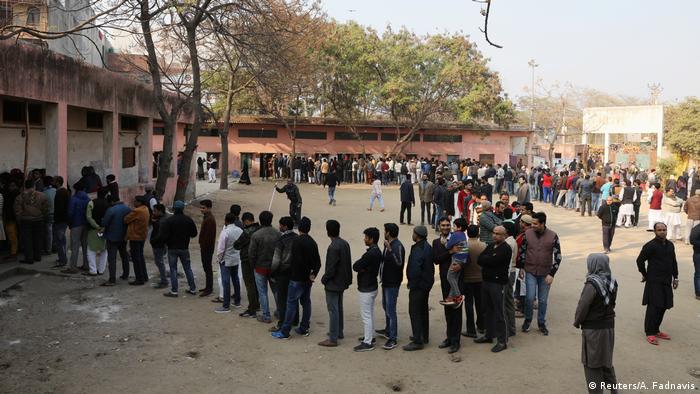
Long queues of voters waiting to cast their ballots could be seen across New Delhi neighborhoods on Saturday. Around 14.6 million people are registered to participate in the election, whose results will be declared on Tuesday.

What did Modi's party stand for?

Modi's BJP faced Kejriwal's party as their main opponent. Over the last five years in power, Kejriwal's party has focused on helping the state's poor by refurbishing public schools and providing bus fares for women and electric and healthcare subsidies.


Kejriwal's party was likely to win 52 out of 70 seats

The BJP's Federal Home Minister Amit Shah called a meeting for party members late on Saturday. He had campaigned vigorously for BJP, highlighting their tough stance on national security.

The BJP's campaign has aggravated Hindu-Muslim relations and positioned the election as a referendum on nearly two months of protests over a controversial new law that excludes Muslims from a fast-track to citizenship. The night before elections began, the BJP sent messages to constituents urging them to vote for the party if they want the rallies to end.

Will Modi mobilize Hindu supporters?

The party also hopes that Modi's decision last summer to strip Muslim-majority Kashmir of its semi-autonomous status will gain Hindu votes.

While these moves have proven favorable among BJP supporters, they have yet to make a difference at the polls. The party lost two state elections last year. Surveys by news networks predict another victory for the Aam Aadmi Party in the 70-seat state assembly.

A distant third party, the Indian National Congress, is not expected to perform well.

Were Modi's party to win, it could further bolster the BJP's pro-Hindu agenda, while defeat would be another blow to his policies.

The BJP hasn't been in power in New Delhi since 1998, when the Congress Party came to power. The Aam Aadmi Party has governed the state since a landslide victory in 2015, where it captured 67 out of 70 seats, just a year after the BJP won national elections.

---30---