Thursday, April 09, 2020

Gloomy report on US jobs suggests even bigger losses


WASHINGTON (AP) – A gloomy glimpse of the sudden collapse of the US labor market appeared on Friday with a report that employers cut hundreds of thousands of jobs last month due to the viral epidemic that brought the economy almost stalled.

The loss of 701,000 jobs, reported by the Ministry of Labor, ended nearly a decade of uninterrupted job growth, the longest streak of its kind ever recorded. The unemployment rate jumped from a low of 3.5% to 4.4% in 50 years in March – the largest month-over-month increase in the unemployment rate since 1975.

And this is just a preview of what will happen.

Economists expect record 20 million losses and unemployment rate of around 15%, the highest in years, for April employment report to be released in early May 1930.

The sheer scale of the layoffs is wreaking havoc on the economies of the United States and abroad, which are said to be in deep recessions. As more and more people lose their jobs – or fear they will – their consumer spending will decrease. This drop in spending, which is the main driver of the economy, is putting pressure on businesses that are still in business.


Economists hope that an extraordinary series of congressional and Federal Reserve bailouts will help stabilize the US economy in the months to come. The main goals of the recently promulgated $ 2.2 trillion congressional rescue program are to quickly get money into people’s hands and to encourage companies to avoid job cuts or to quickly recall dismissed employees.

The package includes an additional $ 600 a week in unemployment benefits in addition to regular government payments and ideally will allow millions of new unemployed people to pay their rent and other bills. But that will not compensate for the wide range of expenses that Americans generally incur and that have now been lost – from dining out and paying gym memberships to buying new furniture, cars and electronic gadgets. Indeed, Oxford Economics says that for the April to June quarter, this decline will likely result in the largest quarterly drop in consumer spending ever recorded.


Katharine Abraham, an economist at the University of Maryland, said that if the extra help succeeds in helping many unemployed people avoid excessive debt, “when businesses reopen … they should be able to spend money.”

Yet even taking into account government intervention, Joel Prakken, chief economist of the United States at IHS Markit, predicts that the economy will contract sharply in the quarter from April to June – by 26.5% per year, the worst record ever since the First World War. II.

Many economists say additional government support will be needed, especially if the virus persists until the end of the summer.

Job losses in March were probably even greater than what was reported on Friday, as the government questioned employers before the biggest layoffs in the past two weeks. Almost 10 million Americans claimed unemployment benefits in the last two weeks of March, far exceeding the figure for any corresponding period recorded. These layoffs will be reflected in the April job report.

“This is an ugly jobs report, showing that the pain in the economy started in early March, long before the surge in initial weekly job demand data,” said Joseph Song, economist at Bank of America Securities. “It will get worse in future reports.”

Brad Hershbein, a senior economist at the Upjohn Institute for Job Research, said the job loss last month likely reflected the nervousness of companies that had cut hiring before the deluge of layoffs.

A sign of the painful scale of the job losses is likely to come to light: in its nearly decade-long recruiting streak, the US economy created 22.8 million jobs. Economists expect the April employment report released in early May to show that all of these jobs could have been lost.

.


Low-income service workers were hit hard by job losses in March, with restaurants, hotels and casinos accounting for about two-thirds of them – a loss of 459,000 jobs. Retailers lost 46,000.

Yet layoffs have also started to infiltrate many other sectors of the economy. Doctors’ offices have cut 12,000 jobs, most according to records dating from 1972. Law firms have cut 1,700 jobs. Banks and real estate companies have also lost jobs.

Many employers have reduced the working hours of some employees. The number of part-time workers who would prefer full-time work jumped by a third in March to 5.8 million.

Bridget Hughes had her work hours cut in half before being forced to take two weeks off from Burger King and isolate herself after her aunt tested positive for COVID 19. She will be quarantined until next week. The restaurant where she worked in Kansas City, Missouri, has cut about two-thirds of its staff and offers only driving service. Hughes, 49, does not know when she can return to work.

She applied for unemployment benefits, but state officials told her it could take up to 30 days before her claim was processed and her first check was issued.

“We were already living paycheck to paycheck,” she said. “I don’t know if we’re going to make rent this month. We have a hard time putting food on the table. “


A key determinant of the future of the economy will be whether companies can survive the closure and quickly re-hire workers who consider themselves temporarily laid off. If so, it would help the economy to recede and avoid the kind of weak recovery that followed the last three slowdowns.

But if the virus epidemic forces businesses to remain closed until the end of the summer, many are at risk of going bankrupt or will not have the money to re-hire their former employees. This would mean that many workers who now consider themselves on temporary layoff could lose their jobs.


So far, some large and small businesses are still paying for health care benefits and staying in touch with their recently laid-off workers, a slightly optimistic sign amid the deluge of job cuts.

However, many are worried about the permanent disappearance of their jobs.

Megan-Claire Chase, 43, of Dunwoody, Georgia, was laid off a week ago from her job as a marketing manager in a recruiting company. Chase, a four-year-old cancer survivor, was laid off in 2008 and it took two years to find a job. This time, she is even more afraid.

“There is so much uncertainty,” she said. ″ How do you bounce? There is no calendar because there is no history. “

___

AP Retail editor Anne D’Innocenzio contributed to this report from New York.
US gig workers and self-employed face delays in jobless aid

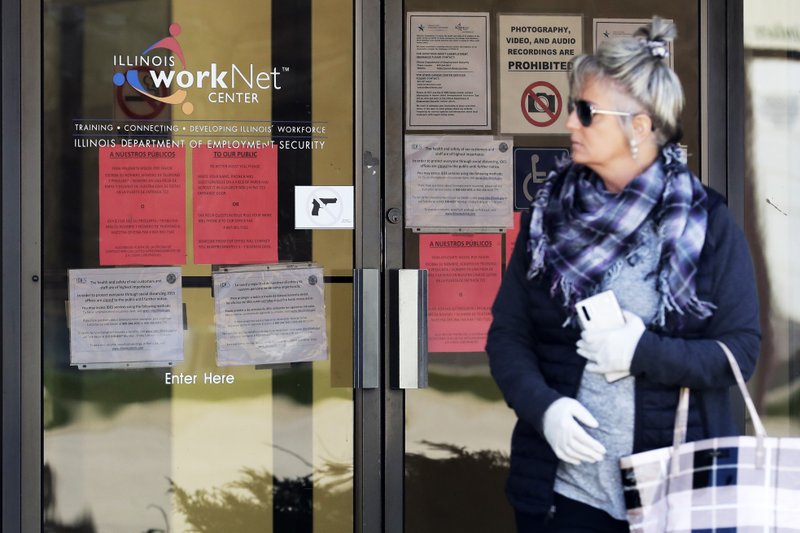
A woman looks to get information about job application in front of IDES (Illinois Department of Employment Security) WorkNet center in Arlington Heights, Ill., Thursday, April 9, 2020. Another 6.6 million people filed for unemployment benefits last week, according to the US Department of Labor, as American workers continue to suffer from devastating job losses, furloughs and reduced hours during the coronavirus pandemic. (AP Photo/N
am Y. Huh)


WASHINGTON (AP) — After Rich Cruse saw about $3,000 in income for his photography business quickly disappear to the coronavirus, he tried to apply for unemployment benefits in California. But like many states, his isn’t yet accepting claims from the self-employed like him.

That’s left Cruse, 58, earning just meager pay driving for Uber Eats near San Diego. And he worries about the health risks.

“I wear a mask and am practically eating hand sanitizer,” he said. “It’s not what I am supposed to be doing.”

Even as nearly 17 million Americans have sought unemployment benefits in the past three weeks — a record high, by far — millions of people appear to be falling through the cracks. They can’t get through jammed phone systems or finish their applications on overloaded websites. Or they’re confused about whether or how to apply.

And now there is a whole new category of people — gig workers, independent contractors and self-employed people like Cruse. The federal government’s $2.2 trillion economic relief package for the first time extended unemployment aid to cover those workers when they lose their jobs. Yet most states have yet to update their systems to process these applications.

The struggles at U.S. unemployment systems run by the states contrasts with the smoother and more robust protections that many European governments provide for millions who have been thrown out of work as a result of the viral outbreak. In France, for example, 5.8 million people — about a quarter of the private-sector workforce — are now on a “partial unemployment” plan: With the government’s help, they receive part of their wages while temporarily laid off or while working shorter hours.


Larisa Ignatovich, who works as a household helper for families around Paris, is among them. French confinement measures mean she can leave only to buy groceries or for medical emergencies. When the confinement rules were imposed in March, her husband’s construction work dried up, and she could no longer work. Ignatovich feared they would lack money for food and rent.

But then the government announced special programs to help prevent virus-related layoffs. Under the plan, Ignatovich’s employers continue to pay her, and the government reimburses the employer 80% of the sum.

Many European governments seek to subsidize wages in downturns so that workers can remain attached to their employers. By contrast, the U.S. approach typically is to provide support to those who’ve lost jobs. But unemployment aid doesn’t cover everyone. It can be limited to six months or less.

Some economists argue that the European approach explains why unemployment rates there don’t spike as high in downturns as in the United States, and fewer workers drop out of the workforce compared with the United States.

The new U.S. economic relief package does include $350 billion in loans for small companies that agree to retain or rehire their employees. These loans are forgiven if they’re used for wages. But that program is off to a rocky start. And Treasury Secretary Steven Mnuchin has already asked Congress for more money given the tidal wave of applications for the loans.

For workers with traditional jobs, state unemployment agencies can use their employers’ tax records to confirm that they’re employed and determine their earnings history to set their benefit levels. Those workers are eligible in part because their companies pay into state unemployment funds.

By contrast, self-employed and gig workers typically haven’t contributed to unemployment funds. And neither have the online platforms that they work through. Now that they’re eligible for jobless benefits, those workers will have to provide paperwork to document their incomes. Compounding the challenges, the federal government is providing an additional $600 per week of jobless aid beyond what states provide. This federal money must be routed through the states — another new responsibility.

All of this takes time, which means money can’t get to the jobless recipients very quickly.

This April 5, 2020, photo provided by Lauren Boisvert shows Boisvert Manchester, N.H. Boisvert, who had been working at a paint bar and as a substitute teacher for two schools while also finishing her senior year at the Institute of Art and Design at New England College, applied for unemployment benefits after going from three jobs to zero. The state has seen more unemployment claims in the past three weeks due to the virus pandemic. (Lauren Boisvert via AP)


“I suspect it may take much longer than governments and workers want before the unemployment benefits arrive,” said Dmitri Koustas, an assistant professor of public policy at the University of Chicago.

Under the economic relief package, the federal government will pay the benefits for the self-employed and other newly eligible groups. But states must evaluate whether an applicant is actually eligible. Koustas says many states fear they’ll be stuck with the bill if they mistakenly approve someone.

For that reason, some states are requiring the self-employed and gig workers to apply for regular state unemployment benefits first. Only if their claims are rejected can they apply for the new federal coverage.

Massachusetts has warned that its unemployment office won’t be able to accept claims from gig workers, contractors or the self-employed until April 30. The office has turned to a vendor to establish a new platform for those applications.

In North Carolina, the state unemployment office, which has received a whopping 497,000 jobless claims since mid-March, said it won’t likely be able to accept applications from independent contractors and the self-employed for two more weeks.

Pringle Teetor, 62, of Chapel Hill, had to close the glass-blowing studio she co-owns after her revenue evaporated once local art galleries shuttered and spring festivals were canceled. She’s filed for unemployment benefits. But Teetor isn’t sure whether her application cleared because she kept getting dropped off the computer system. Though she has some savings, she may seek other work if she can’t reopen her studio soon. Her husband’s dental practice remains closed.

“If this goes on much longer, it’s going to change everything,” Teetor said.

In California, Cruse tried to apply unemployment benefits after two of the road races that he photographs for charitable groups were canceled. But after filling out forms online, he was told he wasn’t eligible. The state has yet to update its website for self-employed workers.

Cruse used to regularly take sunset photos from the beach, which he would post on social media to promote his photography business. But with the beaches closed, he can’t even do that.

“The prospects aren’t that great for me for the next two to three months at least,” he said. “All the existing work that I have is gone.”

___

AP Writers Angela Charlton in Paris and Gary Robertson in Raleigh, North Carolina, contributed to this report.

Is this the end of civilisation as we know it? 

SOCIALISM OR BARBARISM

AFP / Alberto PIZZOLI

For many, the COVID-19 crisis has shown how fragile our civilisation is


"The world will never be the same again," has been the oft-repeated refrain since the coronavirus brought the global economy to a juddering halt.
For many it has shown how fragile our civilisation is.
The crisis has come as a new movement called "collapsology" -- which warns of the possible collapse of our societies as we know them -- is gaining ground.
With climate change exposing how unsustainable the economic and social model based on fossil fuels is, they fear orthodox thinking may be speeding us to our doom.
The theory first emerged from France's Momentum Institute, and was popularised by a 2015 book, "How Everything Can Collapse".
Some of its supporters, like former French environment minister Yves Cochet, believe the coronavirus crisis is another sign of impending catastrophe.
- Virus domino effect -
While the mathematician, who founded France's Green party "still hesitates" about saying whether the virus will be the catalyst for a domino effect, he quoted the quip that "it's too early to say if it's too late".
Yet Cochet -- whose book "Before the Collapse" predicts a meltdown in the next decade -- is convinced that the virus will lead to "a global economic crisis of greater severity than has been imagined".
The 74-year-old, who retired to France's rural Brittany region so he could live more sustainably, is also worried about an impending "global disaster with lots of victims, both economic and otherwise".
"What is happening now is a symptom of a whole series of weaknesses," warned Professor Yves Citton of Paris VIII University.
"It isn't the end of the world but a warning about something that has already been set in motion," he told AFP, "a whole series of collapses that have begun".
The slide may be slow, said Jean-Marc Jancovici, who heads the Shift Project think-tank which aims to "free economics from carbon". But "a little step has been taken (with the virus) that there is no going back on", he argued.
Pablo Servigne, the ecologist and agricultural engineer who co-wrote "How Everything Can Collapse", has a more chilling take.
"The big lesson of history... and of the Horsemen of the Apocalypse is that pestilence, war and famine tend to follow in each others' wake. We have a pandemic which could lead to another shock -- wars, conflicts and famines," he warned.
"And famines will make us more vulnerable to other pandemics...."
- A chance to change -
Grim as that prospect may be, influential philosopher and sociologist Bruno Latour said the crisis has give us a chance to imagine alternatives to neo-liberal capitalism.
He warned on his blog that the world had "to make sure that, after the virus crisis, things don't start again as they were before.
"Let us take advantage of the forced suspension of most activities to take stock of those we would like to see discontinued and those that we would like to see developed."
The virus had also shown, he wrote in a piece for the AOC online daily, "that it is possible in a few weeks to suspend a global economic system that until now everyone said was impossible to slow or adjust."
Servigne too can see a bright side, comparing the lockdown to someone "pulling the alarm signal on a train", with states now intervening in social and economic policy in ways that have long been taboo.
He was also "inspired by the way that nature has reacted as soon as we stopped our craziness" and taken back spaces freed up by our confinement.
The good news from an environmental point of view, said Jancovici, was that "money is no longer a problem" for political leaders. "'Need 500 billion? We will find it!'" he added.
But the bailout and economic salvage plans that are being set in place should be as non-polluting as possible, Jancovici argued, adding that we had to use this chance to move towards a system not based on carbon.
Nevertheless, he fears that "the only plan that will come to mind will be to continue as before to save jobs".
And it is not just down to governments. If the first thing people do when the lockdown ends is book a flight to get away from it all, Citton said, then we really will be sealing our own fate.
CAPITALIST CRISIS 

Coronavirus plunges world economy into brutal recession


AFP / Ludovic MARINSorry we're closed! - lockdowns are sending the world economy into a massive recession
Measures imposed to slow the spread of the coronavirus are pushing the world economy into a recession deeper and more painful than initially expected, even if a rebound is still on the cards for next year.
A week before the International Monetary Fund updates its forecasts for the global economy that will take into account the initial damage incurred since the coronavirus emerged in China at the start of the year, the first sets of data are coming in.
France's central bank estimated Wednesday that the country's economy contracted by around six percent in the first three months of 2020, its worst quarterly performance since World War II.
Meanwhile, the leading economic institutes in Germany expect Europe's top economy to contract by nearly 10 percent in the second quarter.
That would be twice as deep as the contraction Germany suffered in 2009 as the global financial crisis hit the continent, and it would constitute the country's worst performance since the institutes began keeping records in 1970.
"During the first two quarters of the year, the economies of Western countries are collapsing," said Philippe Waechter, economist at Ostrum Asset Management.
If the United States is somewhat behind Europe in terms of shutting down businesses to stem the spread of the coronavirus and first-quarter figures will not be impacted, the effect is likely to make itself felt in the second quarter.
- 'Deepest recession of our lives' -
"It's impossible to imagine that the United States could escape the deep recession being suffered elsewhere," said Waechter.
Both California, which has the world's fifth-largest economy ahead of Britain and France, and the US financial capital New York City are both under confinement measures.
Meanwhile, the World Trade Organization said Wednesday it expects world trade to tumble by between 13 and 32 percent this year.
WTO chief Roberto Azevedo warned the world is facing the "deepest economic recession or downturn of our lives."
Forecasts made just a few weeks ago have become outdated.
In mid-March, Moody's ratings agency said it expected moderate recessions of around two percent this year in the United States and 2.2 percent for the eurozone.
Since then, most of Europe has followed Italy and Spain into lockdown, as has much of the United States, slamming the brakes on both production and consumption.
The chief economist of the Organisation for Economic Co-operation and Development (OECD), Laurence Boone, told France Inter radio Wednesday that every month in lockdown would lead to 2.0-percent decline in annual gross domestic product.
"We have production levels dropping on the order of 25 to 30 percent across all of the countries" in the OECD club of industrialised nations, she said.
- A rebound in 2021? -
With none of world's regions set to escape unscathed, the recession could well last longer than some have so far expected.
"In 2021, we can hope for growth similar to that of the past, but there is a fair amount of uncertainty," said Waechter.
One of the big question marks is whether a vaccine can be developed and marketed quickly to avoid another wave of infections, and whether factories will be able to restart production quickly.
"Considering how slow China's recovery is becoming, it is hard to argue that the US and European economies will recover quickly," said Edward Moya, analyst at online forex trading firm OANDA.
"If China is only halfway back up and running, patience will be needed to see how the rest of the world will turn out," he wrote in a note to investors.
The OECD's Boone said forecasting has become very difficult.
"We could partially exit the lockdown, but if the population has little immunity and the rest of the world is the same, we could face a new wave of virus infections and a new period of lockdowns," she said.


Global trade will plunge by up to a third in 

2020: WTO

AFP / Fabrice COFFRINIWTO chief Roberto Azevedo gave the warning during a virtual news conference
Global trade could plummet by a third this year due to the coronavirus pandemic, the World Trade Organization said Wednesday, warning the deepest recession "of our lifetimes" could be on the horizon.
"COVID-19 has completely upended the global economy and with it international trade," WTO chief Roberto Azevedo told reporters in a virtual briefing from Geneva.
The global trade body was projecting that "trade in 2020 will fall steeply in every region of the world, and basically across all sectors of the economy," he said.
The WTO acknowledged that there was huge uncertainty around how the economic crisis around the pandemic, which has infected more than 1.4 million people globally and killed nearly 83,000, would unfold.
Stressing that the situation was first and foremost a health crisis, Azevedo warned that "the unavoidable declines in trade and output will have painful consequences for households and businesses, on top of the human suffering caused by the disease itself."
WTO presented two scenarios that it deemed "plausible", depending on how quickly the pandemic was conquered and the measures governments put in place to dampen the blow.
"In an optimistic scenario, our economists see the volume of global merchandise trade falling by 13 percent this year compared to 2019," Azevedo said.
That outlook points to a sharp drop in trade followed by a recovery starting in the second half of 2020.
- 32 percent drop, or more -
"If the pandemic is brought under control relatively soon, and the right policies are in place, trade and output could rebound nearly to their pre-pandemic trajectory as early as 2021, regardless of how steep the initial fall is," Azevedo said.
But he warned that "if the pandemic is not brought under control and governments fail to implement and coordinate effective policy responses, the decline could be 32 percent, or even more."
North America and Asia would be hardest-hit and could see their exports plunge by 40 and 36 percent respectively, while Europe and South America could see declines of more than 30 percent, the WTO said.
"These numbers are ugly," Azevedo acknowledged. "There is no way around that."
The downturn "may well be the deepest economic recession or downturn of our lifetimes", he said, calling on governments to "make the most of all potential drivers of sustainable growth to reverse this situation."
In its main annual forecast, the 164-member WTO pointed out that trade had already been slowing in 2019, before the emergence of the novel coronavirus.
Trade tensions, uncertainty and slowing economic growth weighed on global merchandise trade, which registered a slight decline of 0.1 percent in 2019 after rising 2.9 percent a year earlier.
The dollar value of world merchandise exports fell by three percent to $18.89 trillion, the WTO said.
World commercial services trade fared better last year, with exports in dollar terms rising by two percent to $6.03 trillion, but the expansion was far slower than in 2018, when services trade increased by nine percent, said the WTO.
- Worse that financial crisis -
However, the situation has taken a dramatic turn since COVID-19 first emerged in China late last year.
The WTO said that while the global shock might invite comparisons to the financial crisis of 2008-2009, the situation now was worse.
Governments around the world have taken radical measures to try to halt the spread of the deadly virus, including closing schools and public spaces and asking more than half of humanity to remain at home.
"Restrictions on movement and social distancing to slow the spread of the disease mean that labour supply, transport and travel are today directly affected in ways they were not during the financial crisis," it said.
"Whole sectors of national economies have been shut down, including hotels, restaurants, non-essential retail trade, tourism and significant shares of manufacturing."
Developments remained very uncertain, but WTO said countries could ensure a faster and stronger rebound through international cooperation.
"A turn towards protectionism would introduce new shocks on top of those we are currently enduring," Azevedo said.
"Keeping markets open to international trade and investment would help economies recover more quickly," he said, insisting that "we will see a much faster recovery than if each country goes it alone."


Coronavirus reaches Yanomami people in Amazon

AFP / POOLThe Yanomami people live in remote areas of the Amazon and are known for their vulnerability to foreign diseases
Brazil said Wednesday a first case of the new coronavirus had been detected among the Yanomami people, an Amazon indigenous group known for its remoteness and its vulnerability to foreign diseases.
"Today we confirmed a case (of the virus) among the Yanomami, which is very worrying," Health Minister Luiz Henrique Mandetta told a news conference.
"We have to be triply cautious with (indigenous) communities, especially the ones that have very little contact with the outside world."
The Yanomami patient, a 15-year-old boy, is being treated in the intensive care unit at a hospital in Boa Vista, the capital of the northern state of Roraima, officials said.
Brazil has now confirmed at least seven coronavirus cases among the indigenous population, according to the newspaper Globo.
The first was a 20-year-old woman from the Kokama ethnic group who was confirmed positive a week ago.
Brazil is home to an estimated 800,000 indigenous people from more than 300 ethnic groups.
The Yanomami, who are known for their face paint and intricate piercings, number around 27,000.
Largely isolated from the outside world until the mid-20th century, they were devastated by diseases such as measles and malaria in the 1970s.
Indigenous peoples in the Amazon rainforest are particularly vulnerable to imported diseases, because they have been historically isolated from germs against which much of the world has developed immunity.


Coronavirus reaches Yanomami people in Amazon

Brazil said on Wednesday a first case of the new coronavirus had been detected among the Yanomami people, an Amazon indigenous group known for its remoteness and its vulnerability to foreign diseases.

“Today we confirmed a case (of the virus) among the Yanomami, which is very worrying,” Health Minister Luiz Henrique Mandetta told a news conference.


“We have to be triply cautious with (indigenous) communities, especially the ones that have very little contact with the outside world.”


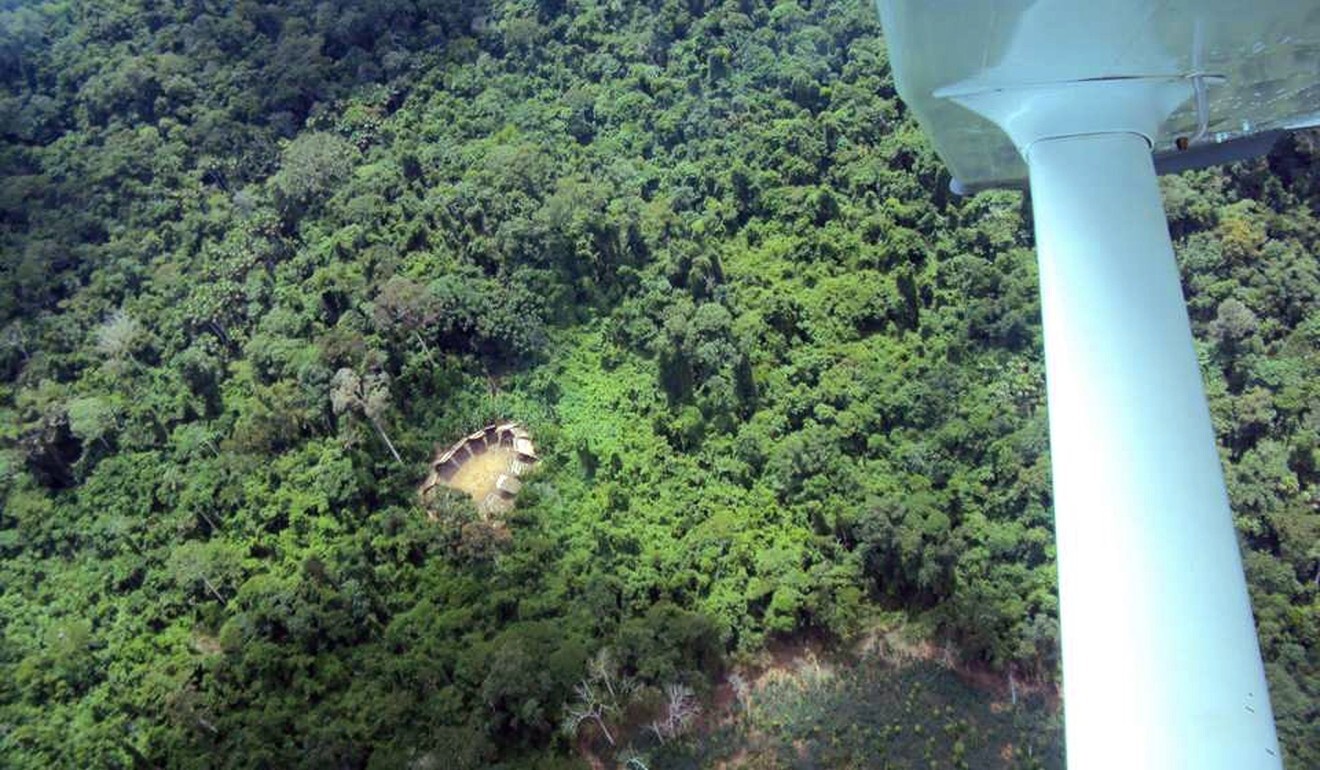
Huts of a Yanomami tribe, inside the Yanomami territory in Roraima, 
northern Brazil. File photo: AFT

The Yanomami patient, a 15-year-old boy, is being treated in the intensive care unit at a hospital in Boa Vista, the capital of the northern state of Roraima, officials said.

Brazil has now confirmed at least seven coronavirus cases among the indigenous population, according to the newspaper Globo.

The first was a 20-year-old woman from the Kokama ethnic group who was confirmed positive a week ago. Brazil is home to an estimated 800,000 indigenous people from more than 300 ethnic groups.

The Yanomami, who are known for their face paint and intricate piercings, number around 27,000.

Largely isolated from the outside world until the mid-20th century, they were devastated by diseases such as measles and malaria in the 1970s.


https://www.scmp.com/news/world/united-states-canada/article/3079074/coronavirus-latest-us-cases-pass-400000-wto-warns

GOOD NEWS  

Air Canada to rehire 16,500 workers laid off due to pandemic

AFP/File / JOEL SAGETAir Canada says it will rehire furloughed employees under a government relief program
Some 16,500 Air Canada employees who were laid off because of the coronavirus pandemic will be rehired under a government relief package for businesses, the airline said Wednesday.
Prime Minister Justin Trudeau announced during his daily news conference that the program would now be open to companies that suffered a drop of more than 15 percent in their revenues in March, against 30 percent previously.
Air Canada furloughed nearly half of its Canada-based workforce of 36,000 on March 30 after seeing business abruptly dry up by more than 90 percent as country after country imposed travel restrictions and people stopped flying.
The Canadian government stepped in April 1 with the emergency wage subsidy plan designed to help employers keep their workers or bring back ones that were laid off because of the pandemic.
It is retroactive to March 15 and the government will pay 75 percent of hard-hit companies' payrolls through June 6.
Air Canada said that under the "CEWS" relief package it will bring back the people it had furloughed.
"Subject to its adoption into law substantially as announced, Air Canada intends to adopt the CEWS for the benefit of its 36,000 Canadian-based employee workforce," the company said in a statement.
Trudeau also warned Canadians to brace for painful monthly unemployment figures to be released Thursday.
"It's going to be a hard day for the country," he said. "But I know that if we pull together, our economy will come roaring back after this crisis."
More than four million people have applied for emergency aid offered by the government since mid-March, about one fifth of the country's active population.
The figures point to an explosion in the unemployment rate for March from 5.6 percent in February.
Canada on Wednesday had more than 19,000 officially declared cases of coronavirus, and 456 deaths.

Strays feel the bite as pandemic spreads  

AFP / ANGELOS TZORTZINISThe global lockdowns against the coronavirus are tantamount to a death sentence of stray cats and dogs
As coronavirus forces billions of people around the world into lockdown, another sizeable population has also been hard hit -- stray animals.
While pet owners in many countries are still allowed to walk their dogs, thousands of other animals -- the exact numbers are unknown -- are starving and turning feral.
The mass closure of restaurants has also deprived hungry animals of leftover meals, forcing them to take greater risks.
For many, the restrictions are tantamount to a death sentence.
"We are seeing an increase in the numbers of cats in areas where we feed, some appear to have been abandoned, while others have roamed far from their usual spots in search of food," says Cordelia Madden-Kanellopoulou, a co-founder of Nine Lives Greece, a network of volunteers dedicated to reducing the overpopulation of stray cats in Athens and other cities.
According to the municipality, the stray dog population in Athens is put at hundreds while the cats run into the thousands.
"It is a huge worry to us that strays could be exposed to more cruelty and poisoning, being more visible and hungrier now, and thus more likely to trust and approach people," said Madden-Kanellopoulou.
Greek officials over the weekend said an online platform had been created for food donations and veterinary services for strays and pets whose owners are unable to care for them.
"During the lockdown, we make sure that all dogs have enough food so that they don't become aggressive. This week we will also start installing feeders in different areas of the city making sure that dogs and cats are fed regularly," said Serafina Avramidou, city of Athens councillor for animal welfare.
Avramidou said she has also already signed more than 350 permits for volunteers to visit feeding areas without getting fined.
In neighbouring Turkey, authorities in Istanbul distribute around a tonne of food for street cats and dogs every day.
- 'We'll care for your friends' -
"We were taking care of strays even before the coronavirus," Tayfun Koc, an Istanbul municipal feeding worker, told AFP.
"I say this to all our citizens, stay at home, we will take care of our little friends," he said.
AFP / ANGELOS TZORTZINISEuropean authorities are realising that allowances must be made for populations of stray animals
Authorities elsewhere in Europe are gradually realising that allowances must be made for stray populations.
After Spain went into a nationwide lockdown on March 14, Madrid officials closed down 125-hectare Retiro park in the city centre where around 270 cats live in 19 different colonies.
For days, volunteers were not able to enter. City hall authorities eventually allowed them to give food to park gardeners to distribute.
A single volunteer may also enter the park three times a week, for an hour at a time, to check on the health of the cats.
Mercedes Hervas, the president of the Association of Friends of the Cats of Retiro, says this was not enough time to check on them all and look after those in need of medical care.
On March 30, a park employee found dead a female cat that the group had been treating with antibiotics. Hervas predicted other cats would also die.
"You have to go from colony to colony and wait for the cat to come out. Maybe Olympic athletes can do it in one hour, we can't," she says.
Elsewhere in the Balkans, provision is more ad hoc.
In Serbia, where there is no state-organised effort to feed and shelter stray animals, people in several cities and towns have organised help locally.
A similar effort is under way in North Macedonia where NGOs are calling on people to leave food on the street for the estimated 10,000 stray dogs in Skopje.
In Croatia, about 40 animal shelters which had to close their doors for visitors are imploring citizens not to abandon their pets.
In Albania, locked-down citizens say it is impossible to secure permission to walk a dog, let alone feed strays, so people go out in secret.
- 'Death sentence' -
"These measures taken for humans are effectively a death sentence for dogs and cats," says Indrit Osmani who heads the Animal Rescue Albania volunteer group.
AFP / ANGELOS TZORTZINISPets are not entirely safe even at home
In Bulgaria, veterinary clinics ran an information campaign after pets were increasingly found on the street because their owners thought they may transmit the virus.
There was a similar campaign in Beirut, where Lebanese animal rights groups have reported an increase in abandoned pets.
The group, Beirut for the Ethical Treatment of Animals, last week said it had received "countless" calls concerning poisonings across the country, mainly around the capital.
Last month, it said that the number of abandoned pets had "at least tripled in recent weeks because of the panic" caused by the virus.
But in a time of heightened health concerns, pets are not entirely safe even at home.
French veterinarians last week warned owners against attempting to disinfect their dogs and cats with detergent or alcohol gel.
The move came after images online showed dogs whose legs had been burned by disinfectants.
"Soapy water or a dog shampoo works very well", said Christine Debove, regional adviser of the Order of veterinarians for Ile-de-France.
Not only are dogs and cats unable to digest alcohol properly, but these products can also cause respiratory irritation and skin reactions, Debove said.
burs-jph/bsp/spm/je