Wednesday, January 05, 2022

Warren, Jayapal blast Google over efforts to "bully" and "sideline" DOJ's top antitrust official

Google must stop attempting to intimidate US antitrust enforcers at the Justice Department, according to two congressional Democrats.
© Tom Williams/CQ-Roll Call, Inc/Getty Images
 Sen. Elizabeth Warren, D-Mass., right, and Rep. Pramila Jayapal, D-Wash., conduct a news conference in the Capitol to introduce the Ultra-Millionaire Tax Act which would tax high net worth households on Monday, March 1, 2021.

By Brian Fung, CNN 

On Wednesday, Sen. Elizabeth Warren and Rep. Pramila Jayapal wrote to Google CEO Sundar Pichai lambasting his company's efforts to get Jonathan Kanter — DOJ's top antitrust official — to recuse himself from all matters related to the company.

"These efforts to bully regulators and avoid accountability — which are similar to those of Facebook and Amazon this year — are untethered to federal ethics law and regulations, and we urge you to cease them immediately," the lawmakers wrote. "Google should focus on complying with antitrust law rather than attempting to rig the system with these unseemly tactics."

Google (GOOG) didn't immediately respond to a request for comment.

The lawmakers' letter comes amid an ongoing Justice Department lawsuit targeting Google's dominance in search and search advertising. It follows a request by Google in November seeking Kanter's recusal a day after his Senate confirmation.

It also comes on the heels of a pair of similar requests that Amazon and Facebook submitted to the Federal Trade Commission last year seeking recusal of Chair Lina Khan from matters involving those businesses.

In its initial request, Google argued that Kanter's previous representation of clients opposed to the search giant, such as Yelp, disqualified him from DOJ's Google oversight. But in Wednesday's letter, Warren and Jayapal charged that Google was misrepresenting federal ethics laws and that Kanter was "eminently qualified."

The lawmakers said Kanter would only be required to recuse himself if he stood to benefit financially from the litigation; if he had previously represented a party directly involved in the suit; or if a "reasonable person" might question his neutrality based on the public record.

Google has a "clear financial interest in weak antitrust enforcement," the two Democrats wrote, but Kanter's record "has aligned with the federal government's interest in robust enforcement of antitrust law."

"Your efforts to sideline key federal regulators... simply serve as further evidence that you will go to all lengths to ward off necessary scrutiny of your immense market power," the letter said. "We urge you to cease these actions and allow federal officials to do their jobs and enforce federal antitrust law."
Google boosted base pay for 4 top execs to $1 million and handed them up to $34 million in stock, weeks after refusing to raise wages to meet inflation

mcoulter@businessinsider.com (Martin Coulter)
Google CFO Ruth Porat 

Google has boosted base pay of four top execs to $1 million.

Two have are set to be awarded $34 million in stock grants.

The move comes weeks after the search giant declined to raise employee pay in line with inflation.

Four Google C-suite executives are set to get a salary bump to $1 million, plus a hefty increase in stock awards.

According to a summary of executive salaries disclosed in SEC filings, the four Google execs — chief financial officer Ruth Porat, senior VP Prabhakar Raghavan, chief business officer Philipp Schindler, and legal chief Kent Walker — will see their annual salaries bumped from $650,000.

All are also eligible for a $2 million bonus if they help Google to meet its "social and environmental goals" for 2022.

The execs' total compensation packages are considerably chunkier when taking equity into account. As well as their increased annual pay, the executives were granted millions of dollars' worth of performance and restricted stock units, which variously vest at different times and depend on the execs sticking around.

According to the filing, Porat and Walker were each granted $23 million total in stock units, and Raghavan and Schindler $34 million total each.

As of December 2019, chief executive Sundar Pichai's annual base salary comes in at $2 million. He's eligible for a further $150 million in restricted and performance stock units if he stays at Google and meets certain performance targets.

Google's finances are in good health following another record quarter in October, raking in revenue of $65.1 billion and almost $20 billion in profit.

But the move comes just weeks after a December all-hands meeting in which Frank Wagner, Google's compensation chief, told rank-and-file staff that the company would not be offering any "across-the-board" adjustment in line with inflation, which recently surged in to its highest level in decades.

"As I mentioned previously in other meetings, when we see price inflation increasing, we also see increases in the cost of labor or market pay rate," Wagner told employees, according to NBC. "Those have been higher than in the recent past and our compensation budgets have reflected that."

Insider approached Google for comment.
US population growth stalled to its lowest rate on record thanks to the pandemic — even slower than during the Great Depression
jepstein@insider.com (Jake Epstein) 
 A detail photo of the information table for the 2020 Census in Reading, Pennsylvania, on September 25, 2020. 
Photo by Ben Hasty/MediaNews Group/Reading Eagle via Getty Images

US population growth stalled to its lowest rate on record.

The population grew by just 0.1% in 2021 — measured from July 2020 to July 2021, according to Wells Fargo economists.

Economists blamed the slowdown on increased mortality rates, decreased birth rates, and less migration.

US population growth stalled to its lowest rate on record — even slower than during the Great Depression — because of the pandemic.


The population grew by just 0.1% in 2021 — measured from July 2020 to July 2021 — which is the slowest growth rate on record since 1900, according to an analysis released by Wells Fargo economists on Wednesday based on US Census data.


For comparison, population growth during the Influenza Pandemic and the First World War hovered just below 0.5% — rising slightly during the Great Depression to around 0.6%, according to the data.


The economists pinned the current growth slowdown on increased mortality rates, decreased birth rates, and less international migration during the COVID-19 pandemic.


"The period from 2010 to 2020 marked the second-slowest decade in history for U.S. population growth," Wells Fargo economists Mark Vitner, Charlie Dougherty, and Nicole Cervi wrote in their analysis.

Thirty-three states however marked a net gain in their population in 2021 — including Florida, Texas, and Arizona — while 17 states and Washington DC saw their net populations shrink, according to the data.

Hawaii, Minnesota, and Maryland led the pack of states with the lowest net domestic migration from July 2020 to July 2021.

The data comes as the US readies to mark two full years of the pandemic, a milestone preceded by a current surge in COVID-19 cases led by the highly transmissible Omicron variant. Over 1 million new COVID-19 cases were reported on Monday, according to Johns Hopkins University data, which shattered the previous record.
US agencies investigate Navy fuel leak's effect on civilians

HONOLULU (AP) — U.S. public health officials on Tuesday began investigating how civilians have been affected by the leakage of petroleum into Pearl Harbor's tap water from a Navy fuel storage facility.

The Hawaii state Department of Health said it asked the Centers for Disease Control and Prevention and the Agency for Toxic Substances and Disease Registry to conduct the study.

The department said the officials will survey civilians living in homes served by the Joint Base Pearl Harbor-Hickam water distribution system. They will also try to reach people who may have been exposed to contaminated water at work or school.

The Navy's water system serves some 93,000 people in residential homes, offices, elementary schools and businesses in and around Pearl Harbor.

Starting in late November, about 1,000 people complained that their tap water smelled like fuel or reported physical ailments like nausea and rashes after ingesting it.

Shortly after the Navy said it detected petroleum in a drinking well that serves its water system. Navy officials say they believe leaks from its Red Hill tank farm near Pearl Harbor polluted the well.

Dr. Diana Felton, the state toxicologist, said it’s vital that authorities track how the incident affected all Hawaii residents.

Meanwhile, Hawaii's congressional delegation urged the Navy to comply with a Monday order from the Hawaii Department of Health to drain fuel from the tanks to protect Oahu's drinking water.

“Defueling safely will require a coordinated effort, and the delegation will do everything possible to support this effort,” they said in a statement. "Clean drinking water is essential to our health and safety, and our future — we all agree this cannot be compromised for anything.”

The delegation consists of four members, all Democrats: U.S. Sens. Brian Schatz and Mazie Hirono and U.S. Reps. Ed Case and Kaiali‘i Kahele.

So far only the Navy's water system has been affected by the contamination. But Honolulu's water utility draws from the same aquifer as the Navy, and Hawaii officials are concerned leaks will contaminate its water too.

The Red Hill facility holds 20 giant underground tanks built into the side of a mountain during World War II. Each tank is roughly the height of a 25-story building. Collectively, they can hold up to 250 million gallons (946 million liters) of fuel, though two of the tanks are now empty.

The tank farm sits just 100 feet (30 meters) above the aquifer shared by the Navy and the Honolulu Board of Water Supply. It supplies petroleum to all branches of the military.

Audrey Mcavoy, The Associated Press
Experts puzzled by continuing South Carolina earthquakes

COLUMBIA, S.C. (AP) — Yet another earthquake has struck near South Carolina's capital city, the ninth in a series of rumblings that have caused geologists to wonder how long the convulsions might last.

Early Wednesday, a 2.6-magnitude earthquake struck near Elgin, about 25 miles (40 kilometers) northeast of Columbia, according to the U.S. Geological Survey. It was measured at a depth of 0.5 kilometers, officials said.

That area, a community of fewer than 2,000 residents near the border of Richland and Kershaw counties, has become the epicenter of a spate of recent seismic activity, starting with a 3.3-magnitude earthquake on Dec. 27. That quake clattered glass windows and doors in their frames, sounding like a heavy piece of construction equipment or concrete truck rumbling down the road.

Since then, a total of eight more earthquakes have been recorded nearby, ranging from 1.7 to Wednesday's 2.6 quake. No injuries or damage have been reported.

According to the South Carolina Emergency Management Division, the state typically averages up to 20 quakes each year. Clusters often happen, like six small earthquakes in just more than a week last year near Jenkinsville, about 38 miles (61 kilometers) west of the most recent group of tremors.

Earthquakes are nothing new to South Carolina, although most tend to happen closer to the coast. According to emergency management officials, about 70% of South Carolina earthquakes are located in the Middleton Place-Summerville Seismic Zone, about 12.4 miles (20 kilometers) northwest of Charleston.

In 1886, that historic coastal city was home to the largest recorded earthquake in the history of the southeastern United States, according to seismic officials. The quake, thought to have had a magnitude of at least 7, left dozens of people dead and destroyed hundreds of buildings.

That event was preceded by a series of smaller tremors over several days, although it was not known that the foreshocks were necessarily leading up to something more catastrophic until after the major quake.

Frustratingly, there's no way to know if smaller quakes are foreshadowing something more dire, according to Steven Jaume, a College of Charleston geology professor who characterized the foreshocks ahead of Charleston's 1886 disaster as “rare.”

“You can't see it coming,” Jaume told The Associated Press on Wednesday. “There isn’t anything obvious moving or changing that you can put your finger on that you can say, ‘This is leading to this.'"

Typically, Jaume said that the recent quakes near Elgin — which lies along a large fault system that extends from Georgia through the Carolinas and into Virginia — would be characterized as aftershocks of the Dec. 27 event, since the subsequent quakes have all been smaller than the first.

But the fact that the events keep popping up more than a week after the initial one, Jaume said, has caused consternation among the experts who study these events.

“They're not dying away the way we would expect them to,” Jaume said. “What does that mean? I don't know.”

___

Meg Kinnard can be reached at http://twitter.com/MegKinnardAP.

Meg Kinnard, The Associated Press
Scientists taught goldfish how to drive a tank on land
Joshua Hawkins 
© Provided by BGR Glass fishbowl on table

A new study from researchers has proven that goldfish are capable of learning how to navigate on land. No, they haven’t suddenly grown legs and started parading around in people’s backyards. Instead, the study showcases how researchers taught goldfish to traverse the land in a tank on wheels. The idea behind the study appears to have been an attempt to better understand animal navigation, including how animals change strategies to overcome certain obstacles.
Scientists made a fish operated vehicle

The tank that the researchers made is called a fish-operated vehicle, or FOV for short. It’s essentially just a tank attached to a wheeled terrestrial platform. The platform also has a LIDAR sensor, computer, and camera attached to it, to help process the animal’s navigational movements.

Basically, the platform works by moving in a direction based on where the fish is in the tank. Once they had it set up, researchers used color-coded environments to teach the goldfish how to navigate around a room. The results of these animal navigation tests are honestly intriguing.

Previously, researchers learned that goldfish are able to orient themselves using both allocentric and egocentric maps. Egocentric and allocentric are often used to help differentiate between two types of spatial information. For example, egocentric framing is when you frame the location based on the individual’s location in the environment. Allocentric framing, then, has to do with the general spatial information of the area, without taking the individual into account.

With this study, the researchers were able to dig a bit deeper into animal navigation as a whole.

To teach the fish how to drive, the researchers used visual targets. These targets were easily observable through the walls of the tank. Using those targets, the goldfish were able to successfully navigate terrestrial environments. Scientists even tried starting the fish out in different parts of the room. Each time, the goldfish were able to successfully navigate to the target. This showed that animal navigation can continue even when the target has to overcome certain obstacles.

But what does it all mean? That’s a great question. The researchers set out to study how animals navigate the world around them. Using the information that they’ve learned; they can dig a bit deeper into how those animals learn and change their navigation habits based on their environment. In this instance, the fish had to overcome several challenges. First, it had to learn the motor skills needed to drive the vehicle.

This meant that the fish had to be taught how the tank worked, and how its movements in the water could correspond with the tank’s movements. Furthermore, the fish had to learn how to navigate the world through its distorted view. Because the fish lives within the water, it sees the world in a distorted vision due to refraction in the water. So, the fish had to overcome this obstacle to navigate the world correctly.

Despite those challenges, the researchers were able to get the fish moving around the room quite well. As such, they say these behavioral results suggest that the fish has a level of universality in space representation, and its navigational strategies.

The post Scientists taught goldfish how to drive a tank on land appeared first on BGR.
How climate change primed Colorado for a rare December wildfire


Elizabeth Chuck
Sun, January 2, 2022

The rare December blaze that tore through Boulder County, Colorado, at frightening speed this week may not be that unusual in the future, wildfire experts warn, as climate change sets the stage for more.

Wildfires do not historically happen during the winter, particularly in areas like Boulder County, where the ground is normally moist from snow.

But in recent months, Colorado has experienced a severe drought. From July 1 through Dec. 29, Denver recorded its lowest amount of precipitation by over an inch, with snowfall at record low levels, too. Meanwhile, Boulder, which typically gets about 30 inches of snow from September to December, got just 1 inch in that period leading up to the day of the fire.

Combine that with an unseasonably warm fall, and the ground had significantly less moisture in it than it normally would — creating perfect conditions for a fire to flourish.

“Everything is kind of crispy,” said Keith Musselman, a snow hydrologist and assistant research professor at the University of Colorado Boulder. “In addition to the extreme drought, just 1- or 2-degree warmer days can really dry out the landscape quite a bit more, so everything is that much drier and flammable.”

Officials say wind gusts up to 105 mph fanned the flames, rapidly destroying 500 to 1,000 homes and giving residents barely any time to evacuate.

While gusts of that magnitude are somewhat out of the ordinary this time of year, they cannot be directly tied to climate change, said Daniel Swain, a climate scientist at UCLA and the nonprofit Nature Conservancy.

However, he said, climate change was definitely the reason the ground was primed for the wind-whipped fire to take off, and wildfire seasons could lengthen similarly in other areas.

“Climate change is clearly making the pre-conditions for wildfires worse across most fire-prone regions of the world,” he said.

In addition to the time of year, Colorado’s fire stood out for another reason, said Philip Higuera, a professor of fire ecology at the University of Montana. Very few burn as many structures.

“Unfortunately, this illustrates one of the worst-case scenarios,” he said of the fact that the blaze burned through densely populated neighborhoods. “These are these high-wind events under these extremely dry conditions, and you’re basically crossing your fingers and hoping there isn’t a human-caused ignition in the wrong place.”

Addressing the problem

The solution, the experts say, is two-pronged: Attack climate change through actions and discussions within communities and households in the long term and, in the short term, do not assume that certain areas are immune from fires.

“We as a society need to recognize that wherever we’re living in the West with vegetation is a fire-prone environment,” Higuera said. “This can happen anywhere.”

That might mean changing how homes are built or reinforced to make them more fire-proof or changing infrastructure so power lines are buried or shut off during high-wind events, he said.

Officials initially suspected that a downed power line caused the blaze Thursday in Colorado but said later that the investigation had revealed that there had not been any. They said they were still investigating.

While fires are likely to become more common year-round, Swain said, winter still would not be a time of high fire activity.

“I still don’t think winter is ever going to be peak fire season in the West,” he said. “But it used to be a fire non-season, and I really don’t think that’s the case anymore.”
REVERSE ZOONOSIS
'Very unsettling': Scientists see troubling signs in humans spreading Covid to deer


Evan Bush
Mon, January 3, 2022

Humans have infected wild deer with Covid-19 in a handful of states, and there’s evidence that the coronavirus has been spreading among deer, according to recent studies that outline findings that could complicate the path out of the pandemic.

Scientists swabbed the nostrils of white-tailed deer in Ohio and found evidence that humans had spread the coronavirus to deer at least six times, according to a study published last month in Nature.

About one-third of the deer sampled had active or recent infections, the study says. Similar research in Iowa of tissue from roadkill and hunted deer found widespread evidence of the virus.

The research suggests that the coronavirus could be taking hold in a free-ranging species that numbers about 30 million in the U.S. No cases of Covid spread from deer to human have been reported, but it’s possible, scientists say.

It’s a reminder that human health is intertwined with that of animals and that inattention to other species could prolong the pandemic and complicate the quest to control Covid-19.

Widespread, sustained circulation of the virus in deer could represent a risk to people if mutations in deer create a new variant. A population of wild animals harboring the virus could also retain variants that are no longer circulating among humans now and allow them to return later.

“The sheer possibility that these things are happening and it’s unknown makes this very unsettling,” said Suresh Kuchipudi, a virologist at Pennsylvania State University. “We could be caught by surprise with a completely different variant.”

Early in the pandemic, scientists grew concerned that the virus could jump from humans to other animals. One study found many mammals with receptors that could allow the virus to bind in their cells, with deer among those at high risk.

They began to investigate.

First, in a laboratory study, researchers spritzed four fawns’ noses with infectious coronavirus to test whether the virus could infect them. They also took two uninfected deer into the same room, keeping them separated with a plexiglass barrier that didn’t reach the ceiling.

“We had four inoculated animals and two contact animals. Everybody got infected and shed significant amounts of infectious virus. That was a surprise,” said Diego Diel, an associate professor of virology at Cornell University, who helped lead the research.

The deer most likely shared the virus through nasal secretions that traveled over the barrier by air, he said. The infected deer didn’t exhibit noticeable symptoms.

Deer often travel in herds and touch noses, making transmission a concern.

So federal scientists tested blood samples of wild deer in Illinois, Michigan, New York and Pennsylvania. They eventually tested 624 samples, finding that about 40 percent of samples that were collected last year had antibodies that suggested past infection.

The latest studies provide evidence of active and recent infection.

In the peer-reviewed Ohio State University study, 35.8 percent of 360 free-ranging deer tested positive through nasal swabs. The researchers were able to culture the virus for two samples, meaning they could grow live virus.

And after they reviewed genetic relationships among viruses from 14 deer, “we’ve got evidence we have deer-to-deer transmission occurring,” said an author of the study, Andrew Bowman, an associate professor of veterinary preventive medicine at Ohio State University. The researchers found six mutations in deer that are uncommon in people.

A preprint study led by Kuchipudi of Penn State found the coronavirus in lymph nodes of 94 of 283 deer that were hunted or killed by vehicles in Iowa in 2020.

Both studies suggest that the virus spilled over from humans to deer several times in several places. The common viral genomes circulating in humans at the time were also circulating in deer, the studies say.

Researchers can’t say for sure how the deer are becoming infected or whether the virus will persist in the species. Deer, ubiquitous in many U.S. communities, are among the most abundant large mammals in the country.

“If they’re maintaining the virus, that’s a whole other host we need to be looking at for future variants to assess whether current vaccines will be affected and how we need to control spread,” Bowman said. “It complicates things considerably.”

If the virus does establish itself long term, scientists say, it presents several potential risks.

Circulation in deer could allow variants that are no longer infecting humans — like the alpha variant, for example — to continue cycling in animals. That would give those strains the potential to reintroduce themselves to people, Kuchipudi said.

In another scenario, widespread transmission could allow the virus to accumulate mutations in deer and evolve differently before it spreads into people with new characteristics.

That’s what happened on Dutch mink farms in 2020. After the virus spread from people to mink, it returned with new mutations to infect humans.

The mink variant shows “spillback is possible,” Diel said.

If deer are hosts to the coronavirus, they could also pass it to other animals.

“Whenever the virus jumps into a different species, that could lead to adaptation,” Kuchipudi said.

And in a scenario some scientists view as unlikely, the virus could recombine with other coronaviruses already established in deer to create a hybrid virus.

“There are endemic coronaviruses in animals, some we know and many we don’t know,” Kuchipudi said. “Recombination could give rise to a completely different variant that can be very different from the parent virus, and it could have altered abilities.”

These are long-term concerns if deer are, in fact, a permanent host. So far, researchers haven’t found the virus moving from deer to people or discovered a new variant in deer alone.

“The greatest risk to people still remains transmission of the virus from person to person,” said Tom DeLiberto, the assistant director of the National Wildlife Research Center, who is helping lead federal efforts to identify the coronavirus in wildlife. “Could that change later on? Absolutely, and that’s why we’re doing these things to get a handle on what’s happening to deer.”

The American Rescue Plan Act provided $6 million for researchers to study the coronavirus in white-tailed deer. DeLiberto said researchers are searching for the virus among deer in 30 states.

Separately, scientists are collecting blood samples from other animals, such as coyotes, skunks and raccoons, to see whether any of them have antibodies.

“If we let the virus continue to circulate among humans, we are not only endangering the vulnerable sector of our population, but we could also be putting our animals and environment at danger,” Kuchipudi said.
Future of prayer site in doubt under Israel’s fragile govt
By TIA GOLDENBERG

1 of 6
 Members of Women of the Wall gather around a Torah scroll the group smuggled in for their Rosh Hodesh prayers marking the new month, at the Western Wall where women are forbidden from reading from the Torah, Sunday, Dec. 5, 2021. When Israel's new government took office last June, it indicated it would press ahead on an egalitarian prayer site at Jerusalem's Western Wall — a sensitive holy site that has emerged as a point of friction between Jews over how prayer is conducted there. 
(AP Photo/Maya Alleruzzo, File)


JERUSALEM (AP) — When Israel’s new government took office last June, it indicated it would press ahead on an egalitarian prayer site at Jerusalem’s Western Wall — a sensitive holy site that has emerged as a point of friction between Jews over how prayer is conducted there.

But the plan is coming up against the limits of Israel’s fragile government, which is struggling to move forward on the issue due to its own internal divisions. The inaction has disappointed both Israeli groups that promote religious pluralism and their American Jewish allies, who view the issue as an important test of recognition from the Israeli government.

“Anyone can topple the government if they sneeze in the wrong direction,” said Anat Hoffman, chairwoman of Women of the Wall, a group that advocates for pluralistic prayer at the holy site. “They are very cautious with the temperature of the hot potatoes that come their way and the Western Wall is a special hot potato.”

The Western Wall is considered the holiest site where Jews can pray. Under ultra-Orthodox management, the wall is currently separated between men’s and women’s prayer sections.

Under the more liberal Reform and Conservative streams of Judaism, women and men pray together and women are allowed to read from the Torah, which Orthodox Judaism prohibits. Those streams are a minority in Israel but make up the majority of American Jews. Israel’s refusal to recognize these liberal streams has long been a point of tension with American Jews.

After years of negotiations, Israel approved a plan in 2016 to officially recognize a special prayer area at the Western Wall. The $9 million plan vowed to expand an egalitarian prayer site and make it more hospitable to prayer and religious events held by Jews who don’t follow Orthodox traditions.

The deal was welcomed by Jewish American leaders and seen as a significant breakthrough in promoting religious pluralism in Israel, where the ultra-Orthodox authorities govern almost every facet of Jewish life. But then-Prime Minister Benjamin Netanyahu never implemented the plan due to objections from powerful ultra-Orthodox allies who had initially endorsed it.

He shelved the plan the following year, leading to strained relations with American Jewish leaders that continued until he left office last year. His tight relationship with President Donald Trump further unsettled the heavily Democratic-leaning Jewish community.

American Jews have long lamented that Israel should be as accepting of their religious practices as they are of their financial and political support.

The new government, led by Prime Minister Naftali Bennett — the child of American immigrants — brought hope that the plan may be revived.

As Israel’s minister of diaspora affairs at the time, Bennett voted in favor of the plan when it was initially tabled and repeatedly expressed the importance he placed in the relationship with the U.S. Jewish community. That his coalition excludes any ultra-Orthodox parties only heightened the feeling that the time was ripe for the plan to move forward.

Under Bennett’s leadership, contacts between U.S. liberal Jewish leaders and Israeli government officials have surged. Bennett himself met with the leaders in what was perceived as a major step in repairing ties.

But Bennett heads an unwieldy coalition of parties from across the political spectrum — ranging from nationalist parties to dovish liberal ones and even an Islamist faction — that was united behind the goal of ousting Netanyahu and very little else. While the Western Wall plan features in agreements that brought the coalition together, its leaders have generally chosen to sidestep divisive issues that might rattle its stability.

Moving ahead with the Western Wall plan could spark an outcry from ultra-Orthodox opposition parties, which in turn could exert pressure on more sympathetic elements of the coalition to oppose the move. And while the government isn’t likely to fall over the Western Wall plan, a public brawl over the issue within government ranks could wear down the already delicate ties that bind the coalition.

“We need to be careful. The make-up of this government is complex,” Diaspora Affairs Minister Nachman Shai told The Associated Press.

He said that Bennett had decided to hold off on the plan for now. “My bet is that it will happen in the end but it won’t happen tomorrow or the next day.”

Bennett’s office did not respond to a request for comment. In a statement, the Western Wall rabbi, Shmuel Rabinowitz, did not disclose his position on the agreement but said the site is “not the place to engage in political struggles.”

Tensions at the Western Wall continue to flare. On Monday, dozens of women arrived to pray wearing skullcaps and prayer shawls — items reserved for men under Orthodox Judaism. In what has become a monthly ritual, they were met by young women shrieking in an attempt to drown out their prayers.

In November, thousands of ultra-Orthodox Jews gathered to protest the Women of the Wall. They heeded a call by ultra-Orthodox leaders to not have the site “desecrated.” Netanyahu, now in the opposition with his ultra-Orthodox allies, retweeted one such call.

Ultra-Orthodox rabbis strictly govern Jewish practices in Israel such as weddings, divorces and burials. The ultra-Orthodox religious establishment sees itself as responsible for maintaining traditions through centuries of persecution and assimilation, and it resists any inroads from liberals it often considers to be second-class Jews who ordain women and gays and are overly inclusive toward converts and interfaith marriages.

Bennett’s government is taking steps to loosen the ultra-Orthodox hold. It has passed a reform in kosher certifications for restaurants and is attempting to allow conversions to Judaism outside of the ultra-Orthodox rabbinate.

The liberal streams have made strides in Israel in recent years, establishing synagogues, youth movements, schools and kindergartens. A former leader of the liberal Reform movement in Israel is now a lawmaker and Israel’s secular majority has become more accepting.

But authorities have generally tended to regard them as a somewhat alien offshoot imported from North America that does not mesh with how religion is typically practiced in Israel. That helps explain why the Western Wall agreement is so important to them.

Rick Jacobs, president of the Union for Reform Judaism, said that if implemented, the agreement would open the door to other steps toward religious pluralism in Israel.

“This is an issue that won’t change everything, but it will change and symbolically shifts things towards more respect or legitimacy,” he said. “I hope this government will find the political will to do it.”
Tattoo artist anger over new EU rules goes beyond skin deep

By RAF CASERT

1 of 3
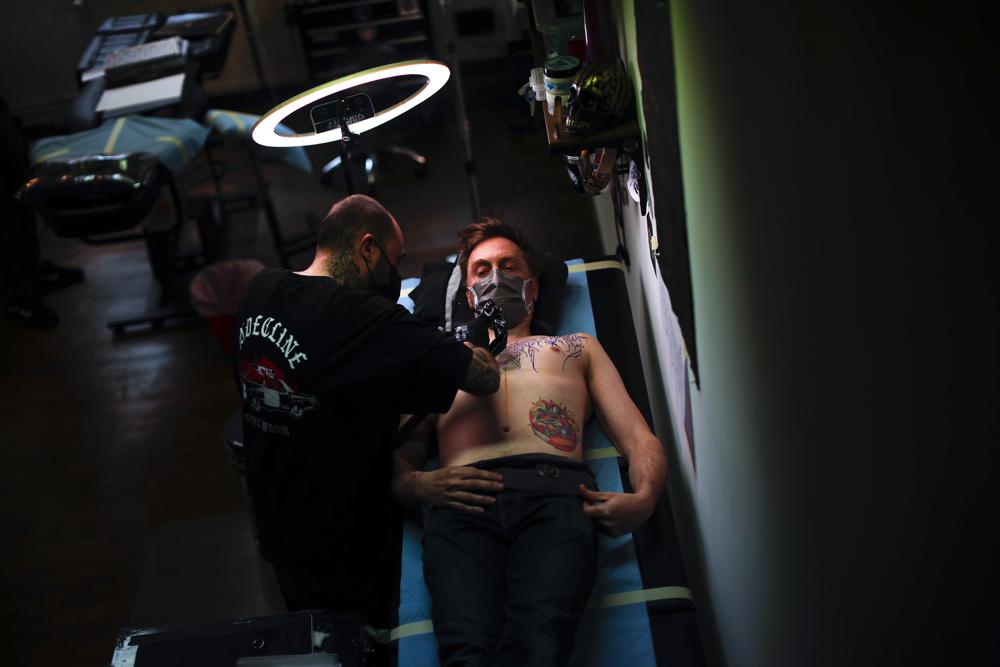
FILE - A man, wearing a protective face mask to prevent the spread of coronavirus, is tattooed at Paul and Friends tattoo parlour in downtown Brussels, March 26, 2021. The European Union is imposing restrictions on the inks that tattoo artists can use as of Wednesday, Jan. 5, 2022. The EU says it is a necessary move to protect the health of consumers because thousands of chemical elements now in use can cause anything from allergic reactions to cancer. The tattoo industry complains it is unfairly targeted and is losing an essence part of its art. (AP Photo/Francisco Seco, File)


BRUSSELS (AP) — Tattoo parlors say their art will lose a lot of its vibrancy after European Union rules banning thousands of chemicals in their coloring ink kick in on Wednesday. The 27-nation bloc answers back that public health will be much better served with tougher restrictions on elements in ink that may cause cancer or allergies.

The standoff between regulation and freedom of artistic expression has triggered a torrent of complaints and accusations.

In Amsterdam, Tycho Veldhoen has plied his trade for a quarter century and fears an “enormous impact” on his work once certain colors are banned. “Because, like a painter, you suddenly lose a gigantic part of your palette” with no alternatives in sight.

And he warned that it could even get worse next year when more inks currently in use could be banned. Tattoo shops in the 27-nation bloc have had a rough two years since COVID-19 hit with restrictions and lockdowns. Now they say a perfectly avoidable crisis is hitting them even harder.

“It is all rather sudden,” Veldhoen said. “There should have been a lot more preparation.”

The EU begs to differ. The bloc says the consultation process began in 2016 while the official regulation heralding Wednesday’s start of restrictions dates back to Dec. 14, 2020.

“So this is not something which is either a surprise or a complete novelty. It is a sort of generalization of practice which is already existing in quite a few member states,” said EU spokesman Eric Mamer. Seven EU nations already had national restrictions.

The Commission says alternatives to the banned products do exist but tattoo parlors say they’re too slow to make their way from the manufacturers to their shops.

Angelo Bedani of Brussels’ Boucherie Moderne tattoo parlor said he had nothing to prepare with since the new inks had only become available a week ago. On top of that “a bottle costs double compared to the one we have today.”

Considering that at least 12 percent of Europeans have tattoos, and double that number in the 18-35 age group, according to EU figures, strict health guidelines were necessary.

The EU’s chemical agency ECHA says that allergic and inflammatory skin reactions “are expected to decrease thanks to the restriction.” It adds that “more serious effects such as cancer, harm to our DNA or the reproductive system potentially originating from chemicals used in the inks could also decrease.”

Michl Dirks, who is behind a “Save the Pigments” petition which has already collected 176,000 signatures in the EU objects to such conditional phrasing and insists the ban is not sufficiently backed by science, something which the EU disputes.

Erich Maehnert, co-organizer of the petition, said such bans unduly hurt the industry since people will use illegal ways to get the products from third countries.

“They continue to obtain their tattooing products without any checks and without the possibility of tracing them,” he said. Others say the small tattoo industry is easily targeted while the tobacco and alcohol industries still hold much more sway.

The petition pair is already preparing for the next battle. Up to now pigments Blue 15 and Green 7 are still enjoying a grace period until next year because no alternatives are yet available.

Veldhoen said it leaves him with awful choices when a customer will walk into his Amsterdam shop. “A rose with brown leaves is a lot less attractive than a rose with green leaves,” he said.

___

AP videojournalist Sylvain Plazy contributed.