Wednesday, February 23, 2022

Democracy in decline worldwide

For the first time since 2004, the Bertelsmann Transformation Index (BTI) has recorded more autocratic states than democracies around the world. Civil society activists often represent the last bastion of resistance.
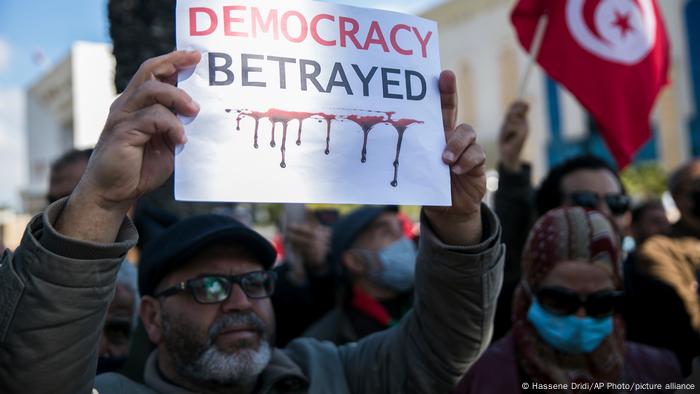


Tunisia is one of the countries where protesters have taken to the streets


Autocracies such as Russia and China on the one hand; democracies like the USA or Germany on the other. Is that the great conflict of our time? "It's a tough fight," said Chancellor Olaf Scholz, describing the global political climate during his visit to Washington on February 7.

In an interview with CNN, Scholz was optimistic: he was adamant that democracy would win in the end. Because it is not just a Western idea, but deeply rooted in people. "I am absolutely sure that people all over the world would appreciate our way of life that we have with democracy, rule of law, individual freedom and market economy."
Freedoms restricted, separation of powers abolished

Democracy is, however, farther away from a worldwide triumph than it has been for a long time. For the first time since 2004, the Bertelsmann Transformation Index (BTI) has recorded more autocratic than democratic states. Of the 137 developing and transition countries examined, only 67 are still considered democracies. The number of autocracies has increased to 70.

"This is the worst political transformation result we have ever measured in the 15 years of our work," says Hauke ​​Hartmann, BTI project manager at the Bertelsmann Foundation. This is due to the fact that around the world there are fewer free and fair elections, less freedom of opinion and assembly, as well as increasing erosion of the separation of powers.

Watch video 04:21 Tunisia's democracy in crisis

This is the case in Tunisia — a country that was long considered the last beacon of hope for the democratization movements of the Arab Spring. Yet President Kais Saied has ruled by decree since he ousted parliament and government in July 2021 and suspended parts of the constitution. Most recently, Saied dissolved the Supreme Judicial Council, which is supposed to guarantee the independence of the judiciary in the country.

That is just one example of many that Hartmann mentioned in an interview with DW. "Turkey has lost the most in the last ten years under President [Recep Tayyip] Erdogan, who actually started out as a beacon of hope," he says. "The separation of powers and participation are so limited there that two years ago we had to classify Turkey as an autocracy. Unfortunately, this assessment hasn't changed since."
The main drivers of autocracies: political and economic elites

It is a worrying trend that many democracies which had previously been well-established have now slipped into the category of "defective democracies," the study's authors note. For example, through the ethno-nationalist course of Prime Minister Narendra Modi in India and the right-wing authoritarian governments of President Jair Bolsonaro in Brazil and President Rodrigo Duterte in the Philippines.

"For me, these are the democracies that ten years ago we classified as consolidating, as stable, and which now have major defects in their political processes. In Europe, we know the examples of Poland and Hungary as thwarting EU principles of the rule of law."

Watch video  04:26'The era of appeasing autocrats should be over'

What does Hartmann see as strengthening autocratic systems and eroding democratic norms? The main drivers are political and economic elites who want to protect their clientelist and corrupt system, he says. "In the majority of the 137 countries we examined, we are dealing with a political system based on pseudo-participation and an economic system that distorts competition and prevents economic and social participation."

This can be observed particularly frequently in Central America, where politics is often undermined by mafia structures. In sub-Saharan Africa, this manifests through individuals securing political sinecures and exploiting the weak institutionalization of political processes.

The wave of populists

People whose daily lives are threatened by poverty, hunger and social exclusion and do not see any improvement through democratic processes have often been blinded by populist alternatives. This is the case not only in the countries examined, but also in long-established democracies such as the USA, which the BTI does not take into account. The index does not examine countries that were members of the OECD before 1989 and were therefore always considered to be democratic and market-economy consolidated.

"Since the election and the enduring popularity of Donald Trump, as well as the irresponsibility of the English elite, everyone has probably lost some illusions about the strength of our own democracies," says Hartmann. In addition to the marginalization of individual population groups, he sees simple majority voting as a problem, which often leads to two-party competition: "It seems to me to be a fuse for polarization, which we can probably observe best in the USA."


Repression in the shadow of the pandemic


The coronavirus pandemic has also brought further restrictions on political and civil rights in many countries. In most cases, these were moderate, limited to a certain time period and, as far as democracies are concerned, were also legitimized by parliament, says Hartmann. "But we do find exceptions in populist regimes with authoritarian traits, such as the Philippines or Hungary, or in autocracies including Azerbaijan, Cambodia or Venezuela, which have used the pandemic as an excuse to push the repression even further." In advanced autocracies such as China, the extent of digital surveillance has increased massively.

Despite the worldwide trend towards more autocracy, Hartmann also continues to believe that most people long for freedom and co-determination. One hopeful sign is that there has been no decline in the global average for civic engagement. "Take the courageous stand up for free elections in Belarus, civil society solidarity in Lebanon, the fight against military dominance in Sudan or the protest against the coup in Myanmar. These people don't just go to any demonstration, they risk their lives for a better society at stake." They are heroes, he says — the last and the toughest bastion in the global struggle against autocracy.

This article was originally written in German.
Sen. Sheldon Whitehouse Wants You to Know Why SCOTUS Is FUBAR

The right’s capture of the Supreme Court is the result of what he calls “the Scheme.”


DAVID SMITH Bio
Mother Jones
FEBRUARY 22, 2022

Sen. Whitehouse during the October 2020 confirmation hearings for Trump Supreme Court nominee Amy Coney Barrett.
Greg Nash/Zuma Press

This story was originally published by the Guardian and is reproduced here as part of the Climate Desk collaboration.

The US Senate is not a crowded, rambunctious place like Britain’s House of Commons or other more lively legislative bodies around the world. Members are accustomed to speaking among row after row of empty desks, unheckled by absent colleagues. This has not deterred Sen. Sheldon Whitehouse (D-R.I.) from stepping into the arena to champion urgent causes.

For almost nine years, the Democrat took to the Senate floor every week the chamber was in session to demand that attention be paid to the climate crisis. He retired the “Time to Wake Up” series last year after 279 speeches only to revive it again this year.

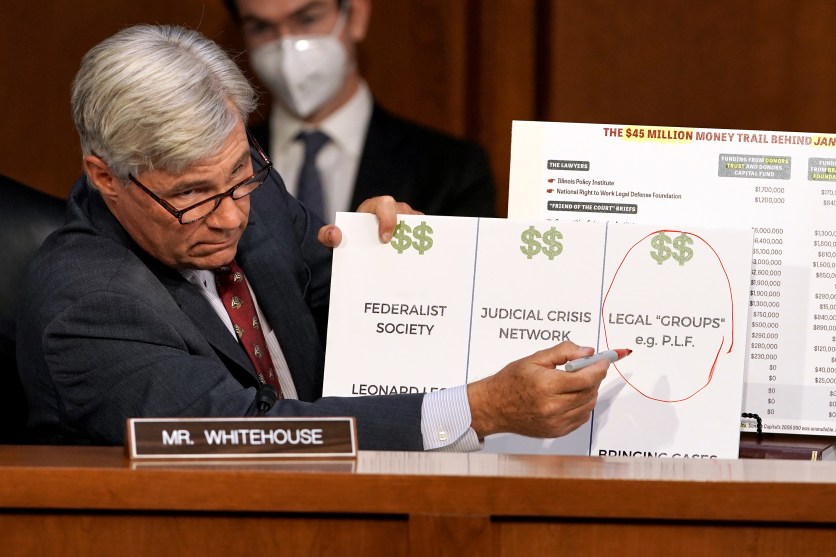
But now he has another alarm to sound: “The Scheme” is a series about the plot by rightwing donor interests to capture the Supreme Court and achieve through the institution’s power what they cannot through other branches of government.

For each speech, Whitehouse, whose desk is on the back row, rises to his feet beside a mounted sign with the words “The scheme” superimposed on an image of the court’s exterior. He expounds on the decades-long roots of the master plan, how it was watered by “dark money,” and how it bore full fruit when President Donald Trump installed a six-justice right-wing majority on the court.

In an interview with the Guardian, Whitehouse, 66, explains why he has no faith in Trump’s three appointees—Neil Gorsuch, Brett Kavanaugh and Amy Coney Barrett—and acknowledges the embarrassment that Democrats were “sleeping sentries” as the threat unfolded.

Fueled by dark money, Whitehouse argues, special interests groom young judges, promote them in advertising campaigns, and then try to influence them via legal briefs.

But first, does it bother him that he is not playing to a full house, perhaps shouting into the void? “One gets used to it in the Senate,” he says phlegmatically, sitting in a meeting room at his Capitol Hill office adorned with framed photos of lighthouses and starry skies from Rhode Island, the tiny state that he represents.

“Actually the last time I went out, a little troop of people who I didn’t recognize came out of the Republican cloakroom and went and sat on the staff bench on the other side and watched and then, when I was done, they trooped back off. I don’t think I have a fan club, but somebody wanted to get a report.”

The thread running through Whitehouse’s spoken essays is that the current 6-3 conservative majority on the court is no accident but the product of special interests and dark money—hundreds of millions of dollars in anonymous hidden spending.

Whitehouse chose his title carefully. “It implies that this is not random,” he says. “This is not just, ‘Oh, we’re conservatives, and so we’re going to appoint conservative thinking judges,’ which is the veneer. They would like to maintain this is just conservatives being conservatives.”

He suggests that the model of “agency capture,” when an administrative agency is co-opted to serve the interests of a minor constituency, was applied to the supreme court. “Once you’re over that threshold of indecency, it actually turned out to be a pretty easy target. The other construct to bear in mind is covert operations, because essentially what’s happened is that a bunch of fossil fuel billionaires have run a massive covert operation in and against their own country. And that’s a scheme.”

The senator has delivered 12 of the speeches so far. The first, last May, was entitled “The Powell Memo.” It focused on Lewis Powell, a corporate lawyer from Virginia in the 1950s and 1960s, a period of political turbulence that rattled America’s corporate elite. The US Chamber of Commerce commissioned from Powell a strategic plan for reasserting corporate authority over the political domain.

One section of Powell’s secret report, called “Neglected Opportunity in the Courts,” described “exploiting judicial action” as an “area of vast opportunity.” He added that “with an activist-minded Supreme Court, the judiciary may be the most important instrument for social, economic, and political change.” The report was dated August 1971; two months later, Republican President Richard Nixon nominated Powell to the Supreme Court.“Samuel Alito…has proven himself on the court as being a faithful workhorse for that dark money corporate right-wing crew.””

Whitehouse comments: “Having given the US Chamber of Commerce that warning and laid out that strategy, he then went on to the court and in three very significant decisions created a role for corporations in American politics that had never existed and was clearly not something that the founding fathers thought about or would have approved. Since then it’s gotten worse, but he teed it up in those earlier decisions and set the Republican justices of the court on that pathway.”

Another key player in the story is the Federalist Society, founded in 1982 by law students who wanted to challenge what they perceived as the dominant liberal ideology. Its co-chairman and former executive vice-president is Leonard Leo, who also advised Trump on judicial selection.

The Federalist Society “first showed its fangs” in 2005, Whitehouse says, when President George W. Bush chose Harriet Miers for the supreme court. “The Federalist Society came forward to defeat the nomination of an extremely talented lawyer by a Republican president because she was not, to quote what was said at the time, ‘one of us.'”

“It was at that point that the grip of this little donor elite and Leo, its Federalist Society operative, really took hold. Justice Samuel Alito was the product of that and he has proven himself on the court as being a faithful workhorse for that dark money corporate right-wing crew.”

There was no better example than 2010 and the Supreme Court’s 5-4 ruling in Citizens United v Federal Elec­tion Commis­sion, which allowed wealthy donors, corpor­a­tions and special interest groups to spend unlim­ited cash on elec­tions. Since then an estimated $6 billion in dark money, often from nonprofits that are not required to disclose their donors, has poured into political campaigns.

“They’ve got to try to keep the veneer. The instant that Roberts admits, ‘Okay, this is a captured court’…then they kind of blow themselves up.”

The Kryptonite to the scheme is transparency because it would enable the public to follow the money. So donors depend on the court to preserve their anonymity. The senator highlights last year’s case of the Americans for Prosperity Foundation, front group of the wealthy Koch brothers that successfully sued to prevent access to donor information.

Not surprisingly, the court’s reputation for independence has taken hit after hit and Senate nomination hearings have become partisan gunfights. In 2019 Chief Justice John Roberts felt compelled to push back: “We do not have Obama judges or Trump judges, Bush judges, or Clinton judges. What we have is an extraordinary group of dedicated judges doing their level best to do equal right to those appearing before them.”

“Piffle,” says Whitehouse. “They’ve got to try to keep the veneer. The instant that Roberts admits, ‘Okay, this is a captured court, we’re here to do dirty deeds for the big donors that got us on to the court,’ then they kind of blow themselves up.”

“So they’re not going to do that. Keeping a veneer that we’re all actually very serious judges here and this is all on the up and up is important to the success of the scheme.”

He adds: “The difference is the evidence of their behavior. There are things that are inexplicable in a legitimate court.”

Anonymous donors gave tens of millions of dollars to the Judicial Crisis Network, a rightwing advocacy organization, to fund advertising campaigns supporting Gorsuch, Kavanaugh, or Barrett for the Supreme Court. Whitehouse does not believe they are impartial justices.

Whitehouse predicts that court will “nibble away” at Roe v Wade, the 1973 decision enshrining a woman’s right to an abortion. “There are some things that it’s not worth doing all at once and creating a big political blowback,” he says, comparing it to rulings on Barack Obama’s signature healthcare law. “If my theory is correct, they have an eye to the political winds and don’t want to step out too far if they don’t have to. As long as they are continuing to feed the anti-choice base, step-by-step is fine.”“The more Mitch can lower the temperature and have everybody think that the Supreme Court is just normal—nothing to see here, folks—that’s in his interest.”

A similar pragmatism may play out when it comes to filling the vacancy left by Stephen Breyer, a liberal justice who last month announced his retirement. Whitehouse, who does not have a preferred candidate, says: “If you’ve captured the court already and you’ve got 6-3 and it’s doing what your big donors want, you don’t want to create a ruckus, you don’t want lots of controversy. It’s going to be 6-3 before; it’s going to be 6-3 after.

“The more Mitch can lower the temperature and have everybody think that the Supreme Court is just normal—nothing to see here, folks—that’s in his interest. The more that the red meat attack is not against the candidate but against Democrat dark money, the more you have success in the propaganda wars to fool the public about what you actually did.”

Democrats have been criticized for being complacent as Republicans unspooled their 50-year campaign to capture the courts. Whitehouse agrees. “It’s way late. It’s really embarrassing how we let this dark money crowd steal a march on us.”

He observes: “From a political perspective it never mattered as much to the Democratic base as it did to the Republican base because we did not have the history of Roe v. Wade, Brown v. Board of Education [desegregating public schools], decisions that provoked massive cultural objections on the far right.”

“So they got highly motivated and we did not, but then once we saw this machinery begin to go in operation to capture the court, we never bothered to call it out either. It’s not just that our base didn’t care as much. It’s that we were sleeping sentries.”

Whitehouse is planning at least three or four more speeches about The Scheme. As with his climate series, he hopes that the message will get through: It is time to wake up.

“I hope there’ll be a more general understanding that what’s going on at the court has a lot less to do with conservatism than it has to do with capture and, with any luck, it might cause a bit of an epiphany with some of the judges that they don’t want to be associated with what they’re actually associated with. And the American public will see it for what it is and give us in politics more opportunities to administer a repair.”
America's trucker convoy struggles to reach goal of shutting down the DC Beltway

Sarah K. Burris
February 23, 2022


Americans who supported the Canada trucker protest in Ottawa have decided to create a convoy of their own, but it isn't quite working out as they'd hoped.

Earlier this morning, one Scranton trucker, Bob Bolus, desperately waited for others who promised they'd join him. No one came. Then he found out he had two flat tires. Finally, once the tires were changed he did a "parade" with his truck in downtown Scranton. Once he took off for Washington he was able to collect at least 7 others to join with the convoy to the Capitol.

Bolus is well known to the Scranton community. He has run for mayor frequently, even as a write-in candidate.

He's was also charged with insurance fraud.

Meanwhile, in the western United States, it became clear that those leaving California for Washington weren't going to arrive for the movement Wednesday. In fact, they estimate that it will take them a week to get to DC, which means that they'll also miss protests of the State of the Union address.

Over 1,000 vehicles met at Adelanto Stadium for the California convoy. Most of them aren't staying with the convoy all the way across the U.S. As Reuters reported, even the leading live-streamer plans to stop in Arizona.

The low numbers could be a problem if the intent is to lockdown the Beltway, which is 64 miles long.

In an exchange with a person claiming to be from Montana fought with a person talking about the time for praying is over. "GET OFF YOUR ASS AND FIGHT!!???" the person said. Bragging about building ARs and posting photos of a gun cabinet, the "Montana Patriot" said that they were heading to DC to "fight."

Utah has many cars as part of their convoy, though claims of a "thousand" vehicles appears exaggerated. While there might be "six miles" of the convoy, there are quite a few large spaces between each vehicle.

"The People’s Convoy will abide by agreements with local authorities, and terminate in the vicinity of the DC area, but will NOT be going into DC proper," they said in a press release, according to WJLA news.

Washington, DC has laws about the constant movement of traffic. As the Capitol city, Washington has many areas with heavy security perimeters around them. The narrow neighborhood streets and constant battles for parking means the city isn't a friendly place for anyone stopping on the streets. In fact, DC DOT regulates "through truck travel" the website says. "Few streets in the District of Columbia are completely restricted to trucks. Except for a few locations near sensitive federal structures, a truck restriction means that the street is closed to through truck traffic, but open to trucks making local deliveries."

The laws also say, "no trucks are permitted on the Roosevelt Bridge entering/exiting Washington DC and Virginia." they also say, "trucks are prohibited on I-66 east of I-495."

While both Maryland and Virginia have Republican governors, blocking highways in their states isn't likely to go over well. The Beltway is the route typically taken for Pentagon workers, NSA staff, CIA staff, Andrews Air Force Base, and others.

One trucker linked the orbit of Pluto to their overall goals of the convoy. It was supposed to be about protesting vaccine mandates, which have been struck down by the Supreme Court. Given the lighter Omiceron variant more and more cities have begun to eliminate most mandates.

As the news and videos of the small convoys spread, they've become the butt of the joke for those living in the DMV metro area.


See the comments below:


US Truck convoy backers tied to Capitol riot — including MAGA lawyer who called for hangings on Jan. 5: report

John Wright
February 23, 2022

Shutterstock.

A new report claims that groups who are backing the so-called "Freedom Convoy" that was scheduled to leave from California on Wednesday include a political action committee that has focused on defending Florida GOP Congressman Matt Gaetz, as well as a group led by former Trump administration national security adviser Michael Flynn.

"Though it was billed as a grass-roots, nonpartisan event intended to oppose government Covid-19 mandates, a trucker demonstration that left California for Washington, D.C., on Wednesday appeared to be tightly aligned with far-right organizations and activists," the New York Times reports. "Many of those behind the demonstration, which was planned as an American version of last month’s chaotic Canadian protest, have connections to the violent attack on the Capitol in January 2021, or supported the lie that fraud in the 2020 presidential election was to blame for Donald J. Trump’s loss."

About 40 truckers reportedly gathered for the kickoff of the convoy Adelanto, Calif., on Wednesday.

"A flag-strewn send-off rally that resembled a Make America Great Again event drew about a hundred more vehicles," the NYT reports. "Unlike in Ottawa, where a recent weekslong protest shut down parts of Canada’s capital, the activity near Barstow, Calif., on Wednesday seemed highly staged, with memorabilia stands and food trucks."

Last month, the Great American Patriot Project PAC, which focused on defending Gaetz amid allegations that he sex-trafficked a minor, issued a call for people to support the convoy.

"Darrel Courtney, the chief executive of the Adelanto Stadium and Event Center, said he received a call last Tuesday from Leigh Dundas, an Orange County lawyer and Republican activist, who wanted to rent the parking lot," the NYT reports. "Ms. Dundas, a lawyer for an anti-vaccine group whose leader was charged with entering the U.S. Capitol on Jan. 6, Ms. Dundas was videotaped the day before the riot rallying pro-Trump crowds with calls to kill any “alleged Americans” who might have helped undermine the 2020 elections."

Dundas told a crowd in DC on Jan. 5, “We would be well within our rights to take any alleged American who acted in a turncoat fashion and sold us out and committed treason — we would be well within our right to take them out back and shoot them or hang them."

Other organizations supporting the convoy include those led by anti-vaxx leader Robert F. Kennedy Jr. and Flynn.

"That latter group, the America Project, has combined its attempts to challenge Covid-19 policies with the relentless promotion of pro-Trump election conspiracy theories," the NYT reports. "The group is run by Patrick Byrne, the former chief executive of Overstock.com who, with General Flynn, was central in a bizarre plot to persuade the former president to use the military to seize voting machines in a bid to stay in power."
KETTLE CALLING POT BLACK
QAnon fans don't want flat Earth 'conspiracy nutters' to be associated with their movement: new book

Sarah K. Burris
February 23, 2022


QAnon followers might believe that JFK Jr. is going to be resurrected to join Donald Trump on the 2024 presidential ticket, but they really want the crazy flat-Earthers out of their movement.

The Daily Beast's Will Sommer and Asawin Suebsaeng interviewed Kelly Weill about her new book, out this week, Off the Edge: Flat Earthers, conspiracy culture, and why people will believe anything. Weill revealed that there is trouble in conspiracy paradise and while it might be perfectly acceptable to wait for the return of JFK Jr., question the validity of the 2020 election, think that the COVID vaccine inserts a tracking chip in your body, or even that Hillary Clinton drinks the blood of children in a Washington pizza parlor's basement — "the Earth is flat" is too far.

In the podcast "Fever Dreams," Weill brought up the first time she learned about the flat-earth movement and interviewed a man arrested for handing out flat-earth propaganda on a school playground.

She began by explaining that after studying the flat-earth movement for the past two years found that the conspiracy world isn't exactly the most welcoming and "big tent" group.

Weill explained that a lot of people come to the flat-earth movement but ultimately become more and more engaged, pushing people in their lives away because it becomes an all-encompassing world. Instead of talking about football with family, for example, the flat Earth is all that matters to them.

"I thought flat-earth was an interesting parable about how people can believe anything," she said. There are other conspiracy theories that are more "reality-adjacent" and that it's easy to walk through the path of how someone got to the conclusion, based on their political beliefs. "But flat earth seemed so out there that I wanted to understand it better."

So, those in modern political conspiracies are a lot like the flat-earth movement in that there are people "who feel at odds with the reality that they live in and they want to be able to blame a person or a group for persecuting them. So, in a lot of ways, flat-earth is almost interchangeable with a lot of conspiracy theories that we deal with every day at work."

She went on to explain that there is a lot of overlap in the conspiracy world with flat-earthers and that it has even increased over the years. She cited one Facebook post she saw saying, "Globers = Antifa." Globers are what flat-earthers call those who believe our planet is round.

While at a flat-earth convention she saw two QAnon people selling jewelry who confessed they aren't totally believers in the flat-earth theory, but thought that it would be a receptive community to Q. But flat-earthers conflict with Q because in a Q&A someone asked "just to shut the flat-earthers up is the Earth round?" Q made it clear "of course, the Earth is round. We're not those conspiracy nutters!" The comments were filled with dissenters.

You can access the "Fever Dreams" podcast wherever you get your podcasts and Weill's book is on sale now.
Disgraced former NYPD union boss charged with defrauding fellow officers

Brad Reed
February 23, 2022

Screengrab.

Disgraced former NYPD's Sergeants Benevolent Association President Ed Mullins on Wednesday was criminally charged in a scheme to defraud his own union's members.

The United States Department of Justice has announced the Mullins is being charged with one count of wire fraud in connection with "a scheme to steal hundreds of thousands of dollars from the SBA, through the submission of fraudulent expense reports."

Specifically, the DOJ alleges that, over a four-year period starting in 2017, Mullins "defrauded the SBA by using his personal credit card to pay for meals at high-end restaurants and to purchase luxury personal items, among other things, and then submitting false and inflated expense reports to the SBA, seeking reimbursement for those bills as legitimate SBA expenditures when in fact they were not."

All together, the DOJ alleges that Mullins racked up bills for the SBA of over $1 million -- and it claims that the majority of it was "fraudulently obtained."

"As alleged, Edward Mullins, the former President of the SBA, abused his position of trust and authority to fund a lavish lifestyle that was paid for by the monthly dues of the thousands of hard-working Sergeants of the NYPD," said United States Attorney Damian Williams. "Mullins submitted hundreds of phony expense reports to further his scheme, stealing hundreds of thousands of dollars from the SBA."

The FBI raided Mullins's home late last year, and he resigned from his position as SBA president shortly afterward.
Former Texas power chief says Greg Abbott directed him to charge customers max amount during winter outages

Brad Reed
February 23, 2022


Greg Abbott

Bill Magness, the former CEO of the Electric Reliabilty Council of Texas (ERCOT), testified in court on Wednesday that millions of Texans received sky-high energy bills during last winter's deep freeze based on the instructions of Gov. Greg Abbott.

The Houston Chronicle reports that Magness alleged under oath that " when he ordered power prices to stay at the maximum price cap for days on end during last year’s frigid winter storm and blackout, running up billions of dollars in bills for power companies, he was following the direction" of the Texas governor.

Magness said that keeping prices as high as possible were the only way to follow Abbott's directive, which was relayed to him by then-Public Utility Commission Chairman DeAnn Walker, to keep power on at all costs.

“She told me the governor had conveyed to her if we emerged from rotating outages it was imperative they not resume,” Magness testified. “We needed to do what we needed to do to make it happen.”

Abbott's office did not immediately respond to the Chronicle's request for comment, although last year Abbott spokesman Mark Miner claimed that the governor was "not involved in any way."
US grant to Nepal puts spotlight on geopolitical rivalry with China

A plan for a $500 million grant has spurred China to warn the US against carrying out "coercive diplomacy" in Nepal. Meanwhile, protests have broken out over ratifying the proposal.


Protests erupted over the proposed infrastructure grant


Nepal is facing geopolitical pressure over whether to accept $500 million (€441 million) in Millennium Challenge Corporation (MCC) grant assistance from the United States.

Nepal and the United States signed an agreement on the MCC grant in September 2017 to upgrade the Himalayan nation's dilapidated road networks and build electric lines.

The agreement was supposed to be endorsed by Nepal's parliament by June 2019. However, it couldn't move forward due to differences within the then-ruling Nepal Communist Party (CPN), along with other political forces.

Meanwhile, the US has pressed Nepal to stick to the MCC agreement and ratify it through parliament, while China has publicly cautioned Washington to avoid "coercive diplomacy" in Nepal regarding the project.

US Assistant Secretary of State Donald Lu earlier this month had warned that the US could terminate the compact if Nepal's leadership failed to fulfill its own pledges to table and ratify accepting the grant by the end of February.

Watch video01:43 Nepal lawmakers mull US aid amid violent protests

Political divisions over US grant

Nepali political parties and citizens are deeply polarized over the project.

The ruling Nepali Congress — a liberal democratic party — has stood in favor of the assistance; while its leftist coalition partners— including CPN (Maoists) and CPN (Unified Socialists)— are against its outright endorsement.

They have dubbed the grant a part of the US Indo-Pacific strategy that aims to counter China in Asia.

Nevertheless, the Nepali Congress-led coalition government on Sunday tabled the MCC bill in the House of Representatives, amid chaotic protests held by supporters of left-wing parties outside the parliament building,

While tabling the bill, Gyanendra Karki, the Minister of Communication and Information Technology, appealed to all parties to endorse it, saying that Nepal itself had approached the US for the grant and that it was beneficial for Nepal's development and economy.

The House is set to discuss its content on Thursday. But it is unclear whether the bill will be endorsed or rejected.


US and China face-off in Nepal

The controversy over the MCC compact has dragged the US and China into a face-off in Nepal as their diplomats have indulged in verbal barbs.

US Assistant Secretary of State Donald Lu earlier this month warned that Washington will review its bilateral relations with Nepal in the event of its failure to ratify the compact by the February 28 deadline, according to The Kathmandu Post.

Strategic analyst Indra Adhikari told DW that the ongoing tension over the US assistance was a sign of how Chinese influence has increased in Nepali society.

China's footprint in Nepal has increased in recent years, especially after an Indian border blockade in 2015-2016, when Beijing had extended vital support, including petroleum goods and agreed to provide transit access to landlocked Nepal.

In the following year, Nepal joined the Belt and Road Initiative (BRI). In October 2019, Chinese President Xi Jinping paid a state-visit to Nepal, in which the two countries elevated their bilateral relations to a "strategic partnership" and signed a slew of infrastructure-related deals, including a plan to build a trans-Himalayan railway line under the BRI framework.

Although a section of Nepali society has questioned the conditions and financial implications of BRI projects, many people in Nepal have been attracted by China's "charm offensive."

During the visit, President Xi also warned that "anyone attempting to split China will be crushed and any external force backing such attempts will be deemed by the Chinese people as pipe-dreaming," apparently referring to the protests and activities of the pro-Dalai Lama forces in Nepal.

Nepal shares a 1,400 kilometer-long Himalayan border with Tibet and hosts almost 20,000 Tibetan refugees.

Protest against foreign development aid

Time and again, the US has tried to clarify that the MCC compact was purely a development grant. However, rumors and disinformation have been circulated both online and offline about it.

There have been a number of videos on YouTube full of disinformation, calling the MCC an American ploy to "trap Nepal and encircle neighboring China."

Talking to DW, Maoist party whip Dev Gurung claimed that US troops could be deployed in Nepal if they became part of the MCC compact.

Meanwhile, social media has been used to denounce and vilify those who make or share independent views or stand in its favor.


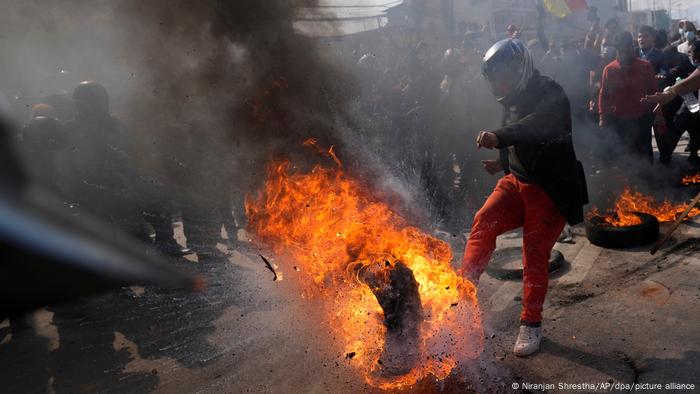
Earlier, many leftist parties had called a national strike to protest the MCC deal, whereas violent protests erupted outside the parliament with police resorting to using tear gas, rubber bullets and water cannons to disperse the crowds.

This is also not the first time that Nepal has faced controversy and politicization over external assistance or investment, mostly from the West.

In the early 1990s, the World Bank signed an agreement to build a 201-megawatt hydropower project and a 122 mile-access road in Nepal.

The World Bank in 1995 withdrew the $764-million deal following a heated political debate, and a request by the then-CPN-UML to the World Bank to withhold the project just ahead of the election in Nepal.

The World Bank didn't return and Nepal ended up facing more than two decades of electricity shortages.

Bikash Thapa, a journalist and writer, who has covered hydropower issues for more than two decades, told DW that the over-politicization of foreign grants and investments has eroded the prospects of foreign direct investment flow to the country, as well as "tarnished" the image of Nepali leadership.

Edited by: Leah Carter
RACIST COMMENT BY ANGLO CHAUVINIST
Vladimir Putin Has Gone 'Full Tonto' By Invading Ukraine, Says Ben Wallace

Kevin Schofield
Wed., February 23, 2022, 

Vladimir Putin takes part in a wreath laying ceremony at the Tomb of the Unknown Soldier in Moscow's Alexander Garden (Photo: Alexei Nikolsky via Getty Images)

Vladimir Putin has gone “full tonto” by invading Ukraine, according to defence secretary Ben Wallace.

He also suggested the Scots Guards could “kicked the backside” of the Russian president, just as they had done to Tsar Nicholas I in the Crimean War in 1853.


Wallace’s comments come after Boris Johnson accused Putin of behaving “in an illogical and irrational frame of mind”.

Wallace, who is a former Scots Guards officer, made the comments as he chatted with serving military personnel at the Horse Guards building in Westminster.

He said: “It’s going to be a busy Army. Unfortunately we’ve got a busy adversary now in Putin, who has gone full tonto.”

Wallace said the UK has 1,000 personnel on stand-by to respond to the crisis, adding: “The Scots Guards kicked the backside of Tsar Nicholas I in 1853 in Crimea – we can always do it again.”

He continued: “Tsar Nicholas I made the same mistake Putin did… he had no friends, no alliances.”

He made his remarks as the prime minister confirmed that more British weapons will be sent to Ukraine in response to the looming threat of a full-scale invasion by Russia.

At prime minister’s questions, he said: “In light of the increasingly threatening behaviour from Russia, and in line with our previous support, the UK will shortly be providing a further package of military support to Ukraine.

“This will include lethal aid in the form of defensive weapons and non-lethal aid.”


IT'S TIME FOLKS QUIT SAYING "OFF THE RESERVATION" AS WELL

Donetsk and Luhansk in Ukraine: A creeping process of occupation

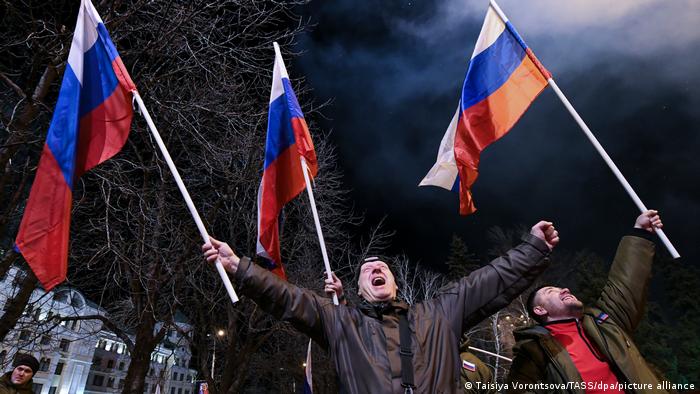
The Ukrainian cities of Donetsk and Luhansk are making global headlines. Russia-backed separatists declared independence from Kyiv in 2014. Since then Russian control over parts of the Donbas region has grown.


Shelling near Luhansk a day after Russia recognized east

 Ukraine's  breakaway republics


The significance of the Kremlin's move should not be underestimated. It completely overturns the status quo. By recognizing the independence of eastern Ukraine's Donetsk and Luhansk separatist-held regions and, above all, by the deployment of Russian troops to these areas, Russia has drawn a line under what has been its policy for nearly eight years. Up to now these breakaway regions had existed in a gray zone: formally part of Ukraine, but, de facto, under Moscow's rule.

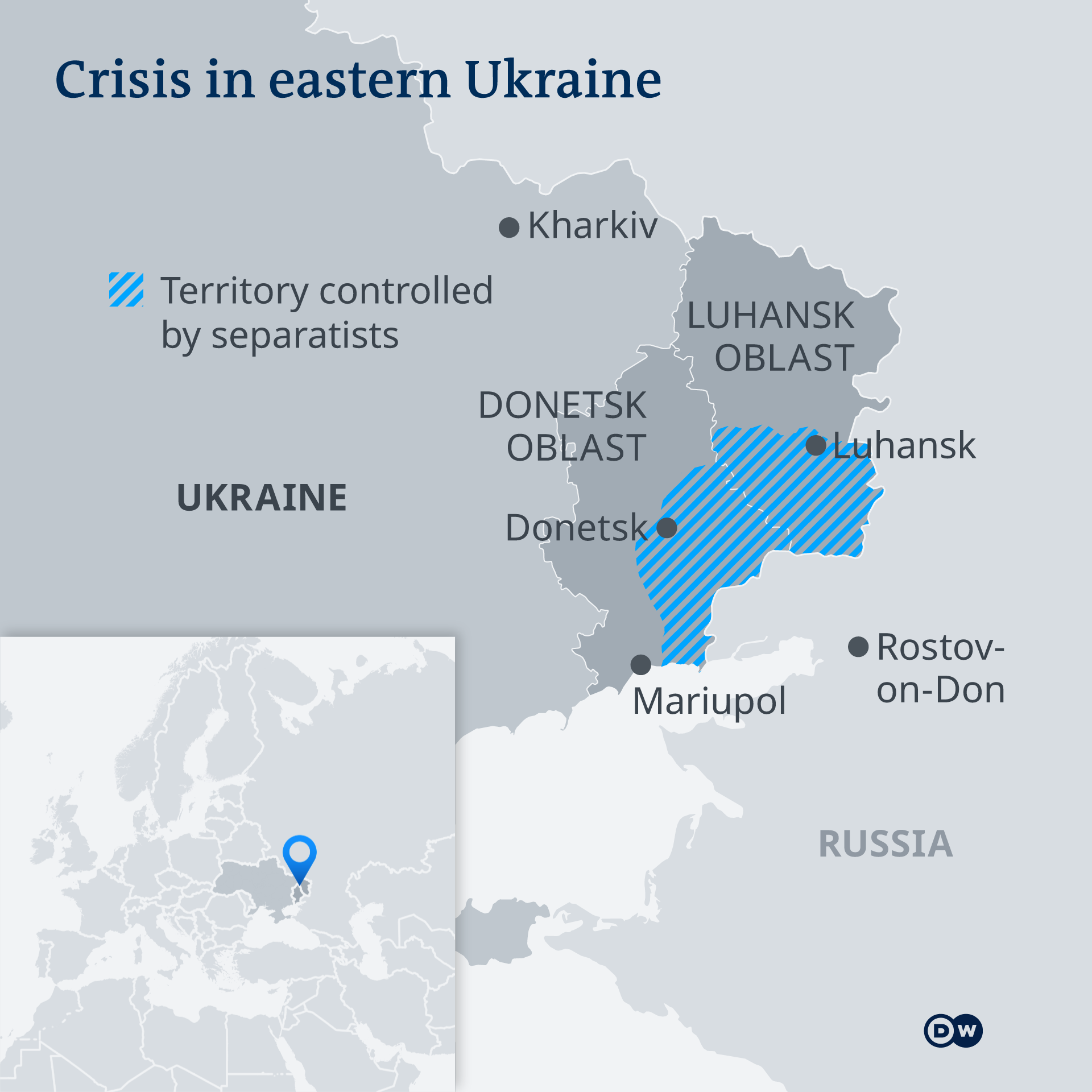
The self-proclaimed 'People's Republics' of Donetsk and Luhansk were formed in spring 2014, following Ukraine's pro-Western opposition protests and a change of leadership in Kyiv. Today, these areas take in about a third of the Donbas region and the cities of Donetsk and Luhansk. Like Germany's Ruhr Valley, these areas were very densely populated. Some six to seven million people used to live there.

Both areas have been shaped by the coal and steel industries, but there are also stark differences between them. While Luhansk was generally held to be Ukraine's poorest region, the city of Donetsk was relatively wealthy. In 2012, it was one of the hosts of the Euro 2012 football championships.


Since the conflict broke out, millions of people have left the separatist areas. A majority of the civilians fled to Ukraine, hundreds of thousands to Russia.


What led to the split?

There were barely any signs of separatist strivings after the collapse of the Soviet Union in 1991 until 2004. Back then, the Orange Revolution overturned the presidential victory of Viktor Yanukovych, a pro-Russian politician and former governor of the Donetsk region, amid claims of vote rigging. His Party of the Regions, whose power base was located in eastern Ukraine, threatened to break away, but ultimately did not carry through on that threat.

Yanukovych did, however, go on to become president in 2010, flipflopping politically between Russia and the EU. His final abrupt shift towards Moscow sparked opposition protests in the winter of 2013/2014, and he fled to Russia. The Kremlin took advantage of the power vacuum in Kyiv to annex Crimea. In eastern Ukraine, pro-Russian sentiment was not as strong as in Crimea. However, skepticism about the new leaders in Kyiv was strongest in Donetsk and Luhansk.

Some in the Donbas region also perceived Yanukovych's flight to Moscow as a defeat. Yet the pro-Russian and pro-Ukrainian camps seemed roughly equal. According to a survey, some 20% of the inhabitants of Donetsk said they were prepared to welcome Russian troops as their liberators. Around the same number wanted to fight for Kyiv.

In spring 2014, the administrations of several urban centers were occupied and police stations were stormed to seize weapons. Russian citizens with apparent links to the Russian secret services were the driving force. Subsequently, Moscow-backed separatists organized disputed referendums that sought to legitimize "self-rule."

Kyiv attempted to contain the insurgency. The Ukrainian army managed to regain control over most areas by summer 2014. But in August, the Ukrainian army suffered a defeat after being encircled in the battle of Ilovaisk, southeast of the city of Donetsk. Moscow still denies that regular Russian forces were involved. This put an end to major combat. The Minsk agreements of February 2015 laid down the front line. Since then, there has been a shaky ceasefire between the Ukrainian army and the Russian separatists.


Rapid Russification, creeping occupation


From the outset, both regions experienced a rapid process of Russification. It began with the introduction of Russian textbooks in schools and the Russian currency. Russian advisors allegedly helped build up the separatists' forces, something that Moscow denies. Industry in the region has suffered significantly as a result of the split with Kyiv. Some companies were relocated to Russia. Ukraine broke off all economic relations with the separatist areas.

Putin's move seals a long process of creeping Russian influence in the regions of Donetsk and Luhansk

In 2019, Russia began to distribute Russian passports to the area's inhabitants. According to the latest reports, some 800,000 eastern Ukrainians are said to have Russian citizenship — an estimated 15 to 25% of the population, although exact figures are hard to obtain. This is the central argument behind the Kremlin's recognition of the independence of the separatist regions.

Ukraine struggled to define the legal status of these regions. Initially, Kyiv described them as "terror organizations." Later, the Ukrainian parliament declared that Donetsk and Luhansk were occupied regions. However, Russia was not named as the occupying power until 2018. Under international law, they both remain part of Ukraine.


Language dispute

For decades now Moscow and Kyiv have been engaged in a dispute about language. Russia has long criticized the Ukrainian government, saying it discriminated against Russian speakers. Kyiv denies that. The fact is: The use of Ukrainian, as the country's only official language, has increased in the media and in written communication. However, Russian is spoken primarily in the cities of eastern and southern Ukraine while Ukrainian or a mixture of the two languages is spoken outside those urban centers. Two thirds of the inhabitants of the separatist regions say Russian is their mother tongue, according to a survey conducted by Berlin's Center for East European and International Studies (ZOiS) in 2019. About one in three people said they spoke both languages; only 3.5% said Ukrainian was their mother tongue.

The current mood among the population of the two regions can only be approximately gauged. According to the ZOiS study, which is three years old, about a third of the inhabitants of Luhansk and Donetsk were keen to gain autonomy within Ukraine or Russia. Almost 20% wanted to return to how things were before the split and just as many were in favor of becoming part of Russia without autonomous status. However, it is impossible to check the accuracy of these figures.

This story was originally written in German.

DW RECOMMENDS

Ukraine crisis: EU agrees to Russia sanctions package

EU leaders have "unanimously agreed" a list of measures against Russia over its recognition of Ukrainian separatist regions and deployment of troops.


Ukraine crisis: Russian lawmakers greenlight Putin's troop deployment — live updates

Russian lawmakers voted to allow President Vladimir Putin to use troops abroad after Moscow recognized two separatist regions in Ukraine as independent. Meanwhile, the G7 agreed a sanction package. DW has the latest.


Germany's Russia policy dealt a blow by Kremlin's escalation

Germany's historic Russia policy, which has been focused on "special relationship" diplomacy and economic ties rather than confrontation, has been struck a blow by Russia's escalation. What now for Scholz's government?


Kremlin reveals how borders of Donbass republics will be defined

The two breakaway regions are locked in a bloody territorial dispute with Kiev


Russia will acknowledge the borders of the two breakaway republics of Donetsk and Lugansk in line with where local leaders exercise authority and jurisdiction, the Kremlin has announced, after Moscow formally recognized the two regions as independent states. At present, Ukrainian forces control large swaths of the territory to which the separatist leaders lay claim.

Speaking to reporters on Tuesday, Russian President Vladimir Putin’s spokesman, Dmitry Peskov, explained that Moscow would support the Donbass republics in their territorial dispute. That meant acknowledging them “within the parameters they declared themselves,” he said. He added that this would be dependent on “when the two republics were proclaimed,” but declined to provide further information.

Deputy Foreign Minister Andrey Rudenko later added that Moscow will respect the borders as local leaders exercise authority and jurisdiction.

The remarks came less than a day after Putin announced that, amid escalating tensions in eastern Ukraine, Moscow would affirm the two breakaway Donbass regions as sovereign nations. Last week, amid what they claimed was a sharp spike in hostilities, Donetsk and Lugansk announced that they had begun evacuating residents to Russia and had ordered the mobilization of all able-bodied men, should conflict break out.

In recent days, both Kiev’s army and those loyal to the two separatist territories have accused each other of instigating aggression in the form of heavy shelling across the contact line. However, Ukraine has rejected allegations that it is preparing to attack, with Alexey Danilov, the secretary of the country’s National Security and Defense Council, claiming “there is an attempt to provoke our forces,” and that Kiev’s troops would open fire only “if there is a threat to the lives of our service members.”

The two republics declared their autonomy from Ukraine in 2014, in the wake of the Maidan revolution, when violent street demonstrations overthrew the elected government. Kiev has long insisted the separatists in the region are Russian-backed – an accusation Moscow has denied. At present, Ukrainian government forces effectively control over half the territory in the Donbass that had been part of the Donetsk and Lugansk regions before the split.

In recent months, Western officials have sounded the alarm that Moscow could launch an offensive against Ukraine. US President Joe Biden expressed concern last week that the uptick in fighting could be the beginning of a “false flag” operation, giving Russia’s armed forces an “excuse to go in” and invade its neighbor. The Kremlin has consistently denied it has any plans to launch such an incursion, however.

Militants attack Shchastya; shell hits apartment building

Source : 112 Ukraine

The shelling has not subsided during the day
12:22, 22 February 2022


Serhiy Gaidai Facebook

The militants continue shelling residential areas in Donbas. In particular, one of the shells hit a residential house in Shchastya as Head of the Luhansk Regional State Administration Serhiy Gaidai reported on Facebook.

"Militants hit a residential house in Shchastya. During the day the shelling has not subsided. At the address of Donetsk, 20 - hit, no victims," Gaidai said.

Related: 54 ceasefire violations reported in Donbas today; four Ukrainian soldiers wounded

He stressed that special services are waiting for the shelling to subside in the city, after which they will examine the house and evacuate the residents.

Besides, the windows are damaged at the house on Gagarin Street.

Related: Zelensky addresses Ukrainians: Russia is legalizing its troops, which were in Donbas

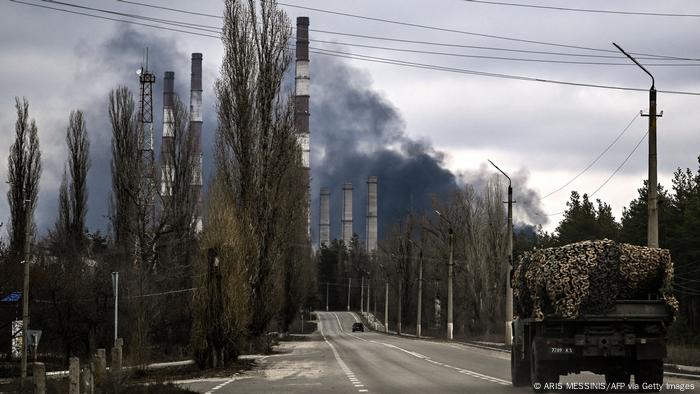
In the Luhansk region, militants are also shelling settlements. As a result of the shelling, residential houses were damaged and residents were left without light, gas, and water. The Luhansk Energy Association reported that the city of Shchastya, Peredilsk village, Staryi Aidar village, Kryakivka village, Trokhizbenka village, and Raihorodka village are completely de-energized

As we reported, 84 violations were recorded from the side of the illegal armed groups in Donbas over the past 24 hours, on February 21. 64 of them involved the use of weapons prohibited by the Minsk agreements.