Thursday, February 24, 2022

School Chief’s Firing By Conservative Board Sets Off Backlash

Jo Napolitano
Wed, February 23, 2022,


The November election of four conservative members to Colorado’s Douglas County school board led to the firing this month of the district’s beloved superintendent and the swift mobilization of teachers, students and community members against his dismissal.

Corey Wise, who served the district for 26 years in various capacities, was ousted during a special meeting Feb. 4 that barred public comment and came after the four members reportedly conferred on their own to strategize his removal

A day before, some 1,500 employees staged a sickout in protest of what was to come, forcing the state’s third-largest school district to close its doors.


“People are out of sorts right now,” teachers union President Kevin DiPasquale told The 74. “The way our former superintendent was fired without due process or any type of performance evaluation really has shaken the community and our staff. Employees feel like they could be next.”

Students were equally upset, walking out of school en masse Feb. 7, saying the board valued politics more than education.

“I get that Corey is beloved,” board President Mike Peterson said at the Feb. 4 meeting. “I will stipulate that. But just because a leader is loved and respected doesn’t mean he has the skills, the vision and capabilities to lead this large district.”


Mike Peterson, elected to the Douglas County school board in November, moved to oust popular superintendent Corey Wise at the Feb. 4 meeting. (Douglas County School District / YouTube)

The battle in predominantly white, affluent Douglas County mirrors those being fought in numerous districts throughout the country, some with very different demographics. As conservative parents have become organized during the pandemic, they are pushing back against what they see as government overreach, opposing COVID-related protocols and targeting the teaching of race and gender-related topics.

Other more moderate and liberal parent groups are beginning to rise up to counter those views.

Board member Elizabeth Hanson, who broke down in tears defending Wise at the board meeting, said the eyes of the state and nation are on Douglas County.

“This decision was not about performance in any way,” she said. “This is politics in its ugliest and purest and most destructive form. This is an attack on public education and I hope that it is something that will wake up our community, our state and our country. There are very calculated efforts that are happening right now and only the people have the power to stop that.”


Douglas County School board member Elizabeth Hanson speaks out in Corey Wise’s defense during Feb. 4 meeting in which the superintendent was fired. (Douglas County School District / YouTube)


Many community members are now considering a possible recall effort. A similar, successful push in San Francisco, in which three board members were removed last week, might serve as a playbook. The strategy seems to be gaining momentum: Ballotpedia, a nonprofit, nonpartisan online political encyclopedia counted 92 recall efforts in 2021, up from 29 a year earlier.

Related: San Francisco School Board Recall Hinged on Competence, not ‘Critical Race Theory.’ In a Rarity, it Succeeded

Neither Peterson nor the three other newly elected board members agreed to be interviewed. The slate, backed by deep-pocketed, individual donors and conservative groups, won election running on an anti-mask, anti-critical race theory platform. The phrase refers to a college-level academic framework but has become a catchall for any subject dealing with race or systemic racism in the K-12 setting.

Wise’s critics on the board said he did not have the leadership skills necessary to enact their vision, though they didn’t articulate what that is.

Wise, whose base salary was $247,500, told the board Feb. 4 that he recognized the division in the community and welcomed the chance to address members’ concerns about his performance.

“I love this district,” he said. “I love this county. It’s been my home. I have been working my tail off — as has all the staff.”


Corey Wise was superintendent of the Douglas County School District until his firing Feb. 4 by a newly elected conservative school board majority. (Douglas County School District / YouTube)

Wise’s firing has prompted legal action from community member and attorney Robert Marshall. He sued the school board and the four conservative members individually for discussing the superintendent’s employment outside a formal board session in violation, he said, of the state’s open meeting laws. He wants the termination vote thrown out.

“It’s the behind-closed-doors deal-making that is exactly what this law was put in place to prevent,” Marshall, a self-described conservative who wants to stop the board from acting similarly in the future, told The 74.

Board members David Ray and Susan Meek said Peterson, the board president, told them that the majority members talked about Wise’s job status amongst themselves and offered the superintendent an opportunity to resign before bringing the issue to the full board. The district is obligated to pay Wise’s salary for 12 more months.

Wise’s newly hired attorneys on Feb. 18 requested records from the school district and the preservation of evidence “for future litigation.” The lawyers are interested in board communications around Wise’s termination and topics such as masking, student racial demographics, banning books, the teachers union and the district’s equity policy.
‘Get Out and Leave’

The board majority has been openly anti-union — “We see the union as the bullies, as the power grabbers,” conservative board member Kaylee Winegar told Fox News Feb. 7 — and has pledged to revisit the equity plan, which took years to develop and was only just beginning to be implemented.

It was meant to help address the type of racial tension that led to the exodus of Black and other minority staff in recent years, including the former superintendent. Sixty-five principals and central office employees wrote a letter to the board Jan. 25 demanding the equity plan’s preservation. Parents are also concerned.

“I am a mom of some LGBTQ students and a student with special needs,” Tiffany Baker said. “We have to worry about equity.”

The mood in Douglas County schools continued to deteriorate after the Feb. 4 board meeting. Teachers in at least three district schools found fliers on their cars Feb. 16, admonishing them. “Most Teachers Are Good and We Appreciate Them!” it read. “You are Bad! Get Out and Leave!”
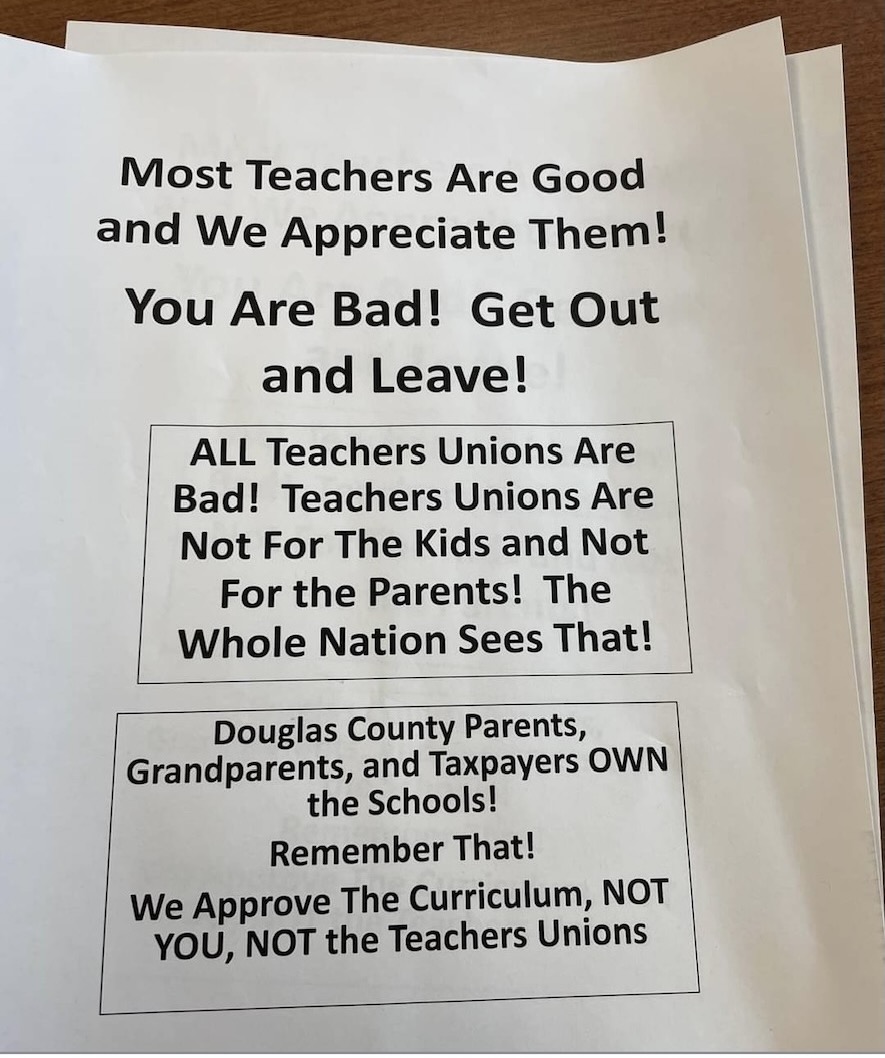


“It is shocking to see such high levels of hate being leveled at teachers and staff,” DiPasquale, the union head, said. “They should not have to worry about their safety at schools or in our community.”

The fliers came the same week teachers were informed by the district that someone asked, under the Colorado Open Records Act, for the names of all those who called in sick during the protest. The request, which alarmed many given the heightened tension in the community, has since been rescinded, Meek said.

A similar petition to release teachers’ names in Colorado’s second-largest school district was upheld by the state Supreme Court in 2016. That same district, Jefferson County, managed to recall three conservative board members a year earlier.

Parents have also said the district should be more concerned with student mental health than political infighting: In addition to the pandemic, Douglas County schools suffered a school shooting at one of its charter campuses in 2019 that left one student dead and many more injured. Parents still credit teachers for saving their lives — one mother was visiting campus when shots rang out — and that of their children.

“Bullying, social-emotional struggles, safety — that’s what we should be focusing on,” said parent Amy Valentine.

Kailani Smile, a 16-year-old junior, was among the students who walked off campus Feb. 7. The past two years have been an enormous challenge, she said: Turmoil at the administrative level has only added more stress.

“It’s great to see students my age and younger pushing for things like the equity policy,” she said. “But we shouldn’t have to be dealing with this. We are students and should be focusing on our education instead of worrying about our school board.”
‘Things we could have handled better’

The Douglas County School District serves 64,000 students some 30 miles south of Denver. It’s reliably Republican: Donald Trump won the U.S. presidential race by a comfortable margin in 2020, though not nearly as handily as the prior election.

The county, 90 percent white, is among the richest in the nation: The median home value between 2015 and 2019 was $468,700, more than twice the national average. The same held true for educational attainment and median household income, which was $119,730.

But those comfortable statistics have not stopped the chaos that has unfurled in the past few weeks, crystallizing around the superintendent’s removal. Board member David Ray called the barring of public comment on the matter a travesty.

“To take an action on an all-encompassing topic like ‘future direction of the district’ without allowing the public to formally address this is reckless and negligent,” he said. “It goes against decades of practice where this board has always allowed for public comment prior to taking any formal action.”

Board member Winegar, while criticizing Wise for, among other things, enforcing the district’s mask mandate, seemed to concede the move to get rid of him took place outside normal channels.

“Maybe there are some things we could have handled better, to bring in the whole board,” she said.

The conservative members’ plan was not flawlessly executed: Board member Becky Myers, who won election as part of the slate, at first voted against the superintendent’s dismissal and then hastily changed her answer to a “yes” after being prompted by Peterson, the board president.

The flip-flop incensed board member Hanson, who voted against Wise’s firing.

“If she cannot follow what is happening, it is not your responsibility to bring her up to speed,” Hanson said. “Her vote is ‘no.’”

Amid the board conflicts and the public protests, Peterson seemed to take his mandate to terminate Wise from a different source — the election that swept him and his fellow conservatives into office.

“I think we heard the voters loud and clear in November,” he said.

Lead Image: Teachers and their supporters rally outside Douglas County School District’s central office Feb. 3, a day before Superintendent Corey Wise’s ouster. (Courtesy of Kevin DiPasquale)
‘He won’t stop at Ukraine’: Warnings Putin could go further amid warnings of full-scale invasion


Kate Buck
Wed, February 23, 2022

Vladimir Putin "won't just stop at Ukraine" as the prospect of a "full-scale" invasion continues to loom, the foreign secretary has said.

Ukraine entered a state of emergency on Wednesday and began to call up military reservists amid fears of war, as Russian tanks and around 200,000 troops sit in readiness on the borders.

Russia has started evacuating its diplomatic staff from all of its diplomatic facilities in Ukraine, the TASS news agency reported, citing a representative of Russia's embassy in Kyiv.

Putin authorised "peacekeeping" soldiers into two breakaway regions in Donetsk and Luhansk on Tuesday, having formally recognised them as independent, in a move that amounts to the beginning of an invasion according to Western leaders.

Liz Truss warned Putin could have bigger plans under wraps.

She told ITV: "He’s said he doesn’t believe in the existence of Ukraine, he believes it should be under Russian control and I fear we have to take him at his word, he won’t just stop in Ukraine either.

“He has also talked about turning the clock back to the 1990s where Russia had control over vast swathes of eastern Europe.”

Moscow denies planning an invasion and has described warnings as anti-Russian hysteria. It has also taken no steps to withdraw the troops deployed along Ukraine's frontiers.

Read more: Ukraine to impose state of emergency, says top security official

A tank drives along a street after Putin ordered the deployment of Russian troops to two breakaway regions. (Reuters)

The UK will inflict more pain on Vladimir Putin if he decides to mount a full-scale invasion of Ukraine, the foreign secretary has said. (Getty)

Boris Johnson yesterday announced a series of sanctions after Putin ordered Russian tanks and soldiers into eastern Ukraine.

The PM targeted five banks and three individuals who have had their assets frozen and been banned from travelling to the UK.

Johnson has been accused of weakness and failing to go far enough with the measures.

Labour leader Sir Keir Starmer pressed the PM to impose more sanctions, saying: “There has already been an invasion. There is clearly concern across the House that his strategy, I accept unintentionally, could send the wrong message."

Johnson insisted the UK was poised to go further, insisting that “any Russian entity, any Russian individual” and members of the Russian parliament could now be targeted by UK sanctions if needed.

Read more: Vladimir Putin gets permission for military force outside Russia from parliament


NATO deployments in Europe as Russia mounts troops on the border with Ukraine (Reuters)

Putin formally recognised Donetsk and Luhansk as independent on Monday, effectively ripping up the 2015 Minsk peace treaty and further inflaming tense relations with the West.


Liz Truss says the UK will inflict even more pain on Putin if he invades Ukraine (Sky News)

Watch: Tanks and armoured personnel carriers near Donetsk

On Tuesday, the Russian parliament gave the green light for Putin to deploy troops abroad, further fuelling fears that a full invasion is imminent.

Around 200,000 Russia troops are now stationed along the Ukrainian border, sparking fears that a full assault on the capital of Kyiv could be part of Russia's plan.

Diplomacy attempts have been made in an effort to diffuse the situations, but summits have become increasingly fraught between Putin and the West.

The US ambassador to the United Nations has said it is still not too late for a diplomatic solution.

Linda Thomas-Greenfield said that war could be averted if Moscow ceased its aggression towards it neighbour and returned to the negotiating table.

“As you heard President Biden say yesterday, we have not given up on diplomacy,” Thomas-Greenfield told an online briefing.

“The Russians can cease their current actions and come back to the negotiating table and find a way forward that is not going to lead to this devastating conflict that will lead to the loss of thousands more lives in Ukraine.”

Her comments came after the White House announced earlier this week that it was scrapping plans for a possible summit between President Biden and President Putin following Russia’s recognition of the breakaway republics of Donetsk and Luhansk.

HUBRIS OR CHUTZPAH
Putin calls for international recognition of Russia’s 2014 annexation of Crimean Peninsula in Ukraine


Published: Feb. 22, 2022
Associated Press


Contrasts Russian territorial takeover in southern Ukraine with world’s reaction to Kosovo’s independence drive


Russian President Vladimir Putin gives a speech last March during a concert in Moscow marking the seventh anniversary of Russia’s annexation of Crimea. 
VYACHESLAV PROKOFYEV/AGENCE FRANCE-PRESSE/GETTY IMAGES

MOSCOW — Russian President Vladimir Putin has called for international recognition of Crimea as part of Russia, an end to Ukraine’s NATO membership bid and a halt to weapons shipments there.

Putin claimed Tuesday that Russia’s 2014 annexation of Ukraine’s Crimean Peninsula should be internationally recognized as a legitimate reflection of the local population’s choice, likening it to a vote for Kosovo independence.

The annexation has been widely condemned by Western powers as a breach of international law.

Key Words (March 2014): Putin: Russians are ‘always being cornered’

Also see (March 2014): Putin: Russia can’t ignore Crimea ‘calls for help’

To end the current crisis, he also called for the renunciation of Ukraine’s NATO bid, saying it should assume a “neutral status,” and said that the West should stop sending weapons there.


FALSE FLAG
Ukraine says Russia evacuates chemical plant in Crimea


Meeting of the U.N. General Assembly, in New York City

Wed, February 23, 2022

KYIV (Reuters) - Ukraine's Foreign Minister Dmytro Kuleba tweeted on Wednesday that Russia had evacuated night-shift staff at the Titan chemicals plant in Crimea.

The chemicals producer is in Armyansk in the northern part of the Ukrainian peninsula, annexed by Russia in 2014, about 2 km (1-1/4 mile) from territory under Ukrainian control.

While the West expects Russia to start a major invasion of Ukraine, separatist leaders of two breakaway regions, recognized by Russia as independent states this week, asked President Vladimir Putin for military help, the Kremlin said late on Wednesday.

The Titan plant and the Crimean department of the Russian emergency ministry were not available for comments in the early hours on Thursday.

Russian tanks and armoured personnel carriers were seen in Armyansk in recent days, a Crimean resident told Reuters.

"There is a lot of military hardware. The drill ended but it stayed," the resident said.

Ukraine's foreign minister said the evacuation of the plant was a possible preparation for another staged provocation by Russia.

"Moscow seems to have no limits in attempts to falsify pretexts for further aggression," he wrote.

The military intelligence unit of Ukraine's defence ministry said that 50 Titan employees were evacuated on Wednesday evening. The intelligence unit did not rule out that Russia could stage a "terrorist attack" or "chemical sabotage."

(Reporting by Maria Tsvetkova in Kyiv, Olesya Astakhova and Maria Kiselyova in Moscow; Editing by Leslie Adler and Cynthia Osterman)

WITH VASSELS LIKE THIS.....
Syria supports Russia's recognition of breakaway territories in Ukraine

Tue, February 22, 2022


Syria on Tuesday announced support of Russian President Vladimir Putin for recognizing two breakaway territories in Ukraine as independent.

Syria's foreign minister, Faisal Mekdad, issued direct support of Putin's recognition Monday of the Donetsk People's Republic and Luhansk People's Republic in eastern Ukraine, Reuters reported.

Mekdad also appeared to blame Western nations for tensions in Europe.

"What the West is doing against Russia is similar to what it did against Syria during the terrorist war," Mekdad said on state-run TV, according to Reuters.

Russia has allied with Syria since intervening in the Middle Eastern nation's ongoing civil war in 2015. Moscow has backed Syrian President Bashar Assad in the war effort despite alleged human rights abuses conducted by his regime.

Other Russian allies have been more hesitant to outright support Putin's move to increase tensions in Ukraine.

Azerbaijan and Armenia made no mention of Putin's recognition of the territories, The Associated Press reported. Belarus said it gave "respect and understanding" to Russia's decision, and Kazakhstan said recognizing the regions was not on the nation's agenda.

After declaring the two breakaway territories as independent, Russia sent troops into eastern Ukraine, prompting an outcry from world leaders.

President Biden's administration enacted sanctions prohibiting investments, trade and financing from U.S. citizens to people in the Donetsk People's Republic and Luhansk People's Republic and said more sanctions would follow.

Secretary of State Antony Blinken condemned Putin's escalation of the conflict in Ukraine.

"Russia's move to recognize the 'independence' of so-called republics controlled by its own proxies is a predictable, shameful act," Blinken wrote on Twitter.
French barrister fights for right to wear her hijab in court


Layli Foroudi
Wed, February 23, 2022
By Layli Foroudi

PARIS (Reuters) - French lawyer Sarah Asmeta wears a hijab at work but that means she is banned by her local Bar Council from representing clients in the courtroom.

She has been fighting to overturn that rule.

Next Wednesday, France's highest court is due to rule on Asmeta's case in a judgment that could set a nationwide precedent and will resonate in a country where the hijab - a headscarf worn by some Muslim women - has become a flashpoint in a debate over identity and immigration.

"I cannot accept the idea that in my country, to practice a profession, of which I am capable, I need to undress myself," Asmeta, 30, told Reuters.

Asmeta, who is French-Syrian, was the first person in her family to pursue studies in law. She was also the first person at her law school IXAD in the northern city of Lille to wear a hijab.

Back in 2019, when she was due to take an oath and enter the profession as a trainee barrister, there was no specific law that said she could not wear her hijab.

But in the months that followed her taking the oath, the Lille Bar Council passed an internal rule banning any signs of political, philosophical and religious conviction to be worn with the gown in court.

Asmeta challenged that as targeted and discriminatory.

She lost the case in an appeals court in 2020, pushing the matter up to the highest court, the Court of Cassation. The March 2 judgment will lay the groundwork for Bar Councils nationwide, Patrick Poirret, the attorney general, told the court last week.

While religious symbols and clothing are banned for public servants due to France's principle of "laïcité" (secularism) - the separation of religion and state - this does not extend to independent professionals like lawyers.

But above these legal specifics, the hijab carries a symbolic weight and is a recurring theme in French debates around so-called Republican values and national identity.

In France, Muslims represent around 6% of the population, according to the Observatory of Laïcité, many of whom have origins in African, Middle Eastern or other countries that were formerly colonised by France.

In past years, as politics has veered to the right, French lawmakers and politicians have sought to extend restrictions on wearing the hijab, for example, to cover mothers who accompany their children on school trips and football players.

As a presidential election in April approaches, candidates have zeroed in on identity issues, including the hijab, although Asmeta's case has not been referenced.

Marine Le Pen of the far-right Rassemblement Nationale said she would ban the garment from public space entirely. Right-wing Les Republicains candidate Valerie Pecresse, refering to the symbol of the republic, said in a campaign speech: "Marianne is not a veiled woman."

Currently in France, a majority of Bar Councils, including the largest in Paris, have internal rules that do not allow religious symbols such as the hijab.

Of Bar Councils representing 75% of practitioners, 56% have banned religious symbols to be worn with the gown, according to a survey requested by Poirret for this case.

"Within this general ban there is a precise and indirect discrimination [of Muslim women]," Asmeta’s lawyer Claire Waquet told the court on Tuesday last week.

The Lille Bar Council's lawyer, Jean-Philippe Duhamel, dismissed the idea that banning religious and political markers results in discrimination against Muslim women.

"If you want to play football but you prefer to pass the ball with your hands, are you discriminated against because we say you can’t play?" he told Reuters.

He said that wearing religious symbols detracts from the lawyer’s independence and equality within the profession.

NOT A PROBLEM

Asmeta said she found it more difficult than her peers to find work placements despite experience, good grades and language skills, which led her at times to seek internships with lawyers from a Muslim background.

A recent study found that email enquiries to law schools from a person with a North African name are a third less likely to receive a response, compared to 12.3% less likely for higher education establishments in general.

The argument put forward to ban the hijab in the courtroom in the name of equality and universalism is in line with France's historic philosophical tradition, said Clara Gandin, a lawyer for Asmeta.

"[That] to be equal, we need to erase all the signs that show we are different," she said.

In Britain, which has a more multicultural approach to immigration compared to France's more assimilationist policy, barristers can advocate for clients while wearing the hijab, alongside the robe, and are not required to wear the traditional wig.

After positive experiences interning at the International Criminal Court in The Hague and working as a legal assistant in Brussels, Asmeta is considering moving abroad again as a last resort.

"I was very happy there, I could work, people saw me as a person with competences and not like a problem," she said.

(Reporting by Layli Foroudi; Editing by Angus MacSwan)
How The Federal Tax Code Puts Black Americans at a Disadvantage While Benefiting White Families


Finurah Contributor
Wed, February 23, 2022

One of the things widening the racial wealth gap is the federal tax code. The way the tax code is written puts Blacks at a disadvantage, according to a law professor who has spent her career researching racism in the tax system.

Loopholes in the U.S. tax system have held back Black families, said Dorothy A. Brown, a professor of law at Emory University and the author of “The Whiteness of Wealth: How the Tax System Impoverishes Black Americans — and How We Can Fix It.”

Photo by Ron Lach from Pexels

“What the tax law does every April 15th is see to it that Black Americans pay higher taxes than their white peers because Black and white Americans engage in the same activity, but tax law impacts differently because we bring our racial identities onto our tax forms,” Brown told CBS News.

“Even though the IRS doesn’t ask about race, this doesn’t mean that the 1040 or the federal income tax system doesn’t have different effects for people of different races,” Kim Rueben, Sol Price fellow at the Tax Policy Center, told The Washington Post.

An analysis by the nonpartisan Tax Policy Center found that although high-income Americans pay a larger share of their income in taxes, they still have a significant financial advantage over African-Americans, according to a newly released report.

Tax Policy Center researchers took a line-by-line examination at the 1040 form for individuals and found that the tax code is not neutral when it comes to race.

Marriage tax disadvantage

Since a majority of Black married households both spouses work, this puts them at a disadvantage. Only when one spouse works does the couple get a tax cut. But if both spouses work, most likely, they will have their tax rate go up.

White, married couples are more likely to have a stay-at-home spouse and get a tax cut, according to the Census Bureau.

Read full story at Finurah here.
Home ownership in U.S. rose in 2020 by highest rate on record, survey says

The rate of ownership for Black Americans, however, is lower than it was a decade ago.


The report says that just 43.4% of Black Americans owned a home in 2020 -- compared to 44.2% in 2010 -- and that Black and Hispanic buyers are denied home loans more than any other racial group.
 File Photo by Alexis C. Glenn/UPI | License Photo

Feb. 23 (UPI) -- Home ownership in the United States surged by its greatest amount on record in 2020, but ownership rates for Black Americans remains lower than it was a decades ago, an analysis on Wednesday said.

The assessment by the National Association of Realtors says that overall American ownership in 2020 increased by 1.3% -- the steepest annual increase on record. It also showed 2.6 million additional homeowners compared to 2019.

The study, though, also shows that just 43.2% of Black Americans owned a home in 2020, compared with 72.1% of Whites, 61.7% of Asian Americans and 51.1% of Hispanics.

The Snapshot of Race and Home Buying in America report examines homeownership trends and challenges by race and location, and looks at characteristics of who is buying.

In 2020, just 43.4% of Black Americans owned a home, the report said -- compared to 44.2% in 2010.

"As the gap in homeownership rates for Black and White Americans has widened, it is important to understand the unique challenges that minority home buyers face," Jessica Lautz, NAR vice president of demographics and behavioral insights, said in a statement.

"Housing affordability and low inventory has made it even more challenging for all ... but even more so for Black Americans."

The report notes that Black and Hispanic buyers also face extra challenges in obtaining a home loan. Seven percent of Black and Hispanic buyers were denied mortgages -- compared to 4% for Whites and 3% of Asian Americans.

U.S. cities with average home price of $1 million tripled last year
By UPI Staff

Forty-four of the 146 new cities where the typical home price tops $1 million are located in California, and mostly in coastal regions like Los Angeles and San Francisco. 
 Photo by Terry Schmitt/UPI | License Photo


Feb. 23 (UPI) -- A record 146 cities in the United States gained million-dollar status -- where a typical home is valued at least that much -- in 2021.

The new cities crossing the threshold raise the total number of million-dollar cities to 481, according to Zillow.
Estimates show that 49 more cities could join the club by midyear as last year's numbers are almost triple those of 2020.

The average price of a home went up 19.6% last year to $408,100. That's $85,500 higher than in January 2020.

Home ownership had surged to the highest level on record in 2020, according to a survey released Wednesday by the National Association of Realtors. The assessment noted a decline in the number of Black homeowners.

The Zillow research showed Idaho, Tennessee and Montana gained million-dollar cities for the first time, while others, including Massachusetts, New York and California, added more million-dollar cities.

"We're seeing how the geography of wealth in the U.S. has begun to shift, as 2021 was the first year for both Idaho and Montana to place any cities on this list, and now those Western states boast three million-dollar cities each," Zillow said in its report.

Forty-four of the 146 new cities are located in California, and mostly in coastal regions like Los Angeles and San Francisco.

The most expensive city in the country is Indian Creek, an island in Biscayne Bay off Miami, where the typical home costs around $28 million and boasts owners like Tom Brady and Enrique Iglesias.

The surge in home prices comes as a result of a longstanding shortage of homes and an increased demand for homes during the COVID-19 pandemic.

RELATED Investors buy record share of U.S. homes

Escalating prices have made it more difficult for homeowners to afford a property.

A 7% down payment for first-time buyers translates to an average of $70,000 for a million-dollar city.


CAPITALI$M FAILS 
LA spending up to $837,000 to house a single homeless person


LA Homeless Count
Los Angeles city councilmember Paul Krekorian, right, walks past tents where people are living as he walks with staff member Karo Torossian during an official homeless count Tuesday, Feb. 22, 2022, in the North Hollywood section of Los Angeles. Los Angeles County has resumed its annual homeless count in full a year after it was limited over concerns that it couldn't be done safely or accurately during the coronavirus pandemic. (AP Photo/Marcio Jose Sanchez)More

MICHAEL R. BLOOD
Wed, February 23, 2022


LOS ANGELES (AP) — A $1.2 billion program intended to quickly build housing for Los Angeles’ sprawling homeless population is moving too slowly while costs are spiking, with one project under development expected to hit as much as $837,000 for each housing unit, a city audit disclosed Wednesday.

About 1,200 units have been completed since voters approved the spending in 2016, which was then a centerpiece in a strategy intended to get thousands of people off the streets. But the tally of units built so far is “wholly inadequate” in the context of the homeless crisis, said the audit issued by city Controller Ron Galperin.

In recent years, homeless encampments have spread into virtually every neighborhood, while the population has climbed to an estimated 41,000 people. Many are drug addicted or mentally ill, and violence is commonplace.


The program “is still unable to meet the demands of the homelessness crisis,” Galperin said in a letter accompanying the 31-page report. The pace of development is sluggish, he said, while the cost of each unit continues to rise -- in some cases to “staggering heights.”

Most of the units are studios or one-bedroom apartments. The audit found 14% of the units build exceeded $700,000 each, and one project in pre-development is estimated to cost almost $837,000 per unit.

The audit noted that higher prices for construction materials during the pandemic, including lumber, along with labor shortages could be contributing to rising costs.

In a tweet, Democratic Mayor Eric Garcetti appeared to dispute any suggestion that the program – formally known by its title on the 2016 ballot, Proposition HHH – was off track.

The program “is producing more units than promised, at a lower cost than expected,” Garcetti wrote. “There are already 1,200 units online providing critical housing and services. And HHH will deliver over 10,300 units of supportive and affordable housing by 2026.”

John Maceri, chief executive of the People Concern, one of L.A.’s largest nonprofits serving the homeless, agreed with the overall finding that the city needs to build housing faster and cheaper. But he warned the program, while a step in the right direction, represents only a small fraction of the money needed to complete projects.

The solution, he said, is innovative financing, slashing red tape that slows projects and incentives for developers to aggregate funding to speed up construction. “Housing has not kept pace with the urgency of the unsheltered homelessness crisis,” Maceri said.

The audit arrives at a time when homelessness is a dominant issue in the city’s mayoral election, with a large field of candidates promising to do more on an issue that has placed Los Angeles in an unwelcome national spotlight. Sagging tents, rusting RVs and makeshift structures used by homeless people have become familiar sights from Hollywood to Venice Beach and even in the shadow of City Hall.

Garcetti, who was nominated last year by President Joe Biden to become ambassador to India, is in the final year of his second term. He is barred by term limits from running for re-election.

Democratic Gov. Gavin Newsom, facing re-election this year, has budgeted record sums to combat homelessness that pervades all of the state's major cities and many smaller communities as well. The state is providing roughly $12 billion on homelessness programs over two years.

The scope of the expanding problem can be seen in the city budget: When Garcetti took office in 2013, the city was spending about $10 million treating homelessness. The budget he signed last year included about $1 billion.

Still, government's inability to clear encampments from streets, parks and sidewalks has left voters angry and frustrated. In 2019, then-President Donald Trump threatened to intercede, though he never acted on the threat. San Francisco's progressive mayor, London Breed, last month declared a state of emergency in the city's Tenderloin district after becoming fed up with the homelessness and open drug-peddling there.

In LA, the audit said the HHH project includes 8,091 housing units — most with connected services for mental health and substance abuse treatment — spread across 125 projects. About 4,200 are in construction. Other funds outside the HHH program are being used for another 2,369 units.

The audit signaled that a fresh approach – and billions more in spending --- would be needed in the future.

“While future plans have not been finalized, building tens of thousands of additional units using the same model will likely cost billions of dollars and will take far too long to match the urgency of the ongoing homeless emergency,” the audit concluded. It urged the city to “find ways to scale up faster and cheaper projects.”
ECOCIDE
A record 1,100 manatees starved to death last year from a man-made famine. Finally, the pace slows


Jim Waymer, 

Florida Today
Wed, February 23, 2022,

As bad as this year's manatee deaths seem, for the moment, at least, last year was way worse.

At least 326 manatees have died so far this year in Florida, through Feb. 18, compared to a five-year average of 167 for that same period and 356 for the same period last year.

Of this year's manatee deaths, 221 sea cows (67%) have been in Brevard, according to the most recent statistics available from the Florida Fish and Wildlife Conservation Commission.

Meanwhile, manatees have been starving in the Indian River Lagoon, as a result of decades of seagrass loss.


Manatees crowding a canal in Brevard County trying to keep warm in the cold weather.

A record 1,100 manatees starved to death last year from a man-made famine that has choked out the seagrass — the staple of the sea cow's diet.

A leafy lunch: The manatees are finally eating!

Lettuce rejoice!: Manatees finally munch down leafy greens biologists feed them

Seacows show resilience: Florida manatees brave extreme cold amid worst year of seagrass famine

The manatee death toll got so bad that in April 2021, the National Oceanic and Atmospheric Administration declared the die-off an Unusual Mortality Event. In a first-of-its kind pilot project to try to stave off further starvation, state and federal biologists have been feeding manatees at the FPL plant since mid December. They plan to feed the manatees through the end of March.

Manatees have been starving for years in the lagoon, as a result of seagrass die-off caused by decades of runoff, sewage, septic tank and other pollution.
Bringing up a child costlier in China than in U.S., Japan - research


Children at a playground inside a shopping complex in Shanghai

Tue, February 22, 2022
By David Stanway

SHANGHAI (Reuters) -The cost of raising a child in China stands at nearly seven times its per capita GDP, far more than in the United States and Japan, highlighting the challenges facing Chinese policymakers as they try to tackle rapidly declining birth rates, new research showed.

Experts warn China's ageing population will put huge pressure on its health and social security system, while a dwindling workforce could also severely limit growth for the world's second largest economy in the coming decades.

Although new policies allow families to have as many as three children, China's birth rate dropped to 7.52 births per 1,000 people in 2021, the lowest since the National Bureau of Statistics began recording the data in 1949.

The sky-high costs of child-rearing have helped prompt a crackdown by Beijing on the private tutoring industry while some regions have been giving couples cash for having a second or third child.

Beijing-based YuWa Population Research Institute said in a report published on Tuesday that the average cost of raising a child to the age of 18 in China in 2019 stood at 485,000 yuan ($76,629) for a first child, 6.9 times China's per capita GDP that year.

China ranks second highest among the 13 countries included in the study, behind only South Korea, which has the lowest birth rate in the world. The U.S. figure, based on 2015 data, stood at 4.11 times per capita GDP while Japan's figure, based on 2010 data stood at 4.26.

Child rearing costs are even higher in China's major cities, reaching more than 1 million yuan in Shanghai and 969,000 yuan in Beijing. Birth rates in the two cities are even lower than the national average.

One mother, writing under the username "Maning" on China's Twitter-like Weibo microblog site, said she believed child-rearing costs in Beijing were probably even higher than the report suggested.

"With such calculations, I can barely imagine a second child and any family that wants a third is just amazing," she said.

YuWa warned the declining birth rate would "profoundly affect" China's economic growth potential, its ability to innovate and its welfare burden.

China would need to spend at least 5% of its annual GDP to create incentives for couples to have more children, including education subsidies, preferential mortgage rates, tax breaks, equal paternity and maternity leave, as well as the construction of more childcare centres, it added.

On Weibo, another user writing under the name Lawyer Zhang, said that action needed to be taken to address the disproportionate burden faced by women, who are expected to give birth and raise children as part of their natural "motherhood".

"That's why the cost of childbirth is mostly borne by women, making women live in an unfair competitive environment for a long time."

($1 = 6.3292 yuan)

(Reporting by David Stanway; Editing by Shivani Singh)
Black Americans comprise highest percentage of 1 million COVID ‘excess deaths’ in U.S.

Candice Marie Benbow
Tue, February 22, 2022

Structural inequities and disparities in health and preventative care have left African Americans most vulnerable during the pandemic.

Last week, the United States hit one million “excess deaths” since the start of the COVID-19 pandemic. Scholars and demographers define “excess deaths” as the number of deaths that happen within a specific timeframe outside of what is considered normal or expected.

Photo: AdobeStock

As expected, the majority of excess deaths are due to the virus itself. However, according to the CDC, there has also been an increase in the number of deaths due to heart disease, hypertension and dementia. Robert Anderson, chief of the CDC’s mortality statistics department, spoke to The Washington Post last week after excess deaths reached 1,023,916. “We’ve never seen anything like it,” he said.

While the number of excess deaths has made a detrimental national impact, it has been uniquely felt in Black communities. In 2021, a collaborative study was conducted by the National Institutes of Health (NIH) and National Cancer Institute (NCI) to explore the impact of excess deaths during the COVID-19 pandemic on minority communities. The study found that excess deaths in Black, as well as American Indian/Alaskan Native communities were three to four times higher than white communities.

The study noted that the total mortality rate for Black men had increased from 26 percent in 2019 to 45 percent in 2020. This increase also comes as Black men’s life expectancy was reduced by three years, the most of any demographic due to the pandemic. Additionally, in 2019, Black women’s mortality rate was 15 percent higher than white women’s. In 2020, that doubled to 32 percent.

While the country experienced a significant decline in the number of Americans practicing preventative care, the outcomes were much more drastic for African-Americans. While the COVID-19 pandemic highlighted the many structural inequities and barriers that remain within healthcare, a study confirmed the impact of dwindling health resources in Black communities—which actually exacerbated comorbidities such as heart disease, diabetes and hypertension.

Another study found that those comorbidities and other social factors also increased the likelihood of death in Black patients with COVID. Lead study author Dr. Landan Golestaneh spoke to Medical News Today about the research and its findings. Dr. Golestaneh noted that “the worse severity of illness and mortality outcomes seen in racial/ethnic minorities have to do with low socioeconomic status, barriers to adequate high quality healthcare, and residential racial segregation, the latter resulting from a deliberate historical act by the U.S. government to separate residential communities by race and disinvest from Black residential communities.”

While there is hope as the country seems to turn a corner regarding the pandemic and vaccination confidence continues to rise in Black communities, researchers press for a more comprehensive approach to the disparities leaving African Americans most vulnerable. Meredith Shiels, an investigator in the NIH/NCI collaborative study told NBC News that, without it, “there is likely to be a severe widening of racial/ethnic disparities in all-cause mortality as longer-term data are released.”


Candice Benbow is theGrio’s daily lifestyle, education and health writer. She’s also the author of Red Lip Theology: For Church Girls Who’ve Considered Tithing to the Beauty Supply Store When Sunday Morning Isn’t Enough. Find her on Twitter and Instagram @candicebenbow.
Citing drought, US won't give water to California farmers


This Feb. 22, 2008 file photo shows the 602-foot, concrete Shasta Dam near Shasta, Calif. The U.S. Bureau of Reclamation announced, on Wednesday, Feb. 23, 2022, that it will not deliver any water to California farmers because of a severe drought. The decision will force many farmers to plant fewer crops in a region that supplies a quarter of the nation's food. 
(AP Photo/Rich Pedroncelli, File)More

ADAM BEAM
Wed, February 23, 2022


SACRAMENTO, Calif. (AP) — With California entering the third year of severe drought, federal officials said Wednesday they won’t deliver any water to farmers in the state’s major agricultural region — a decision that will force many to plant fewer crops in the fertile soil that yields the bulk of the nation’s fruits, nuts and vegetables.

“It's devastating to the agricultural economy and to those people that rely on it,” said Ernest Conant, regional director for the U.S. Bureau of Reclamation. “But unfortunately we can't make it rain.”

The federal government operates the Central Valley Project in California, a complex system of dams, reservoirs and canals. It's one of two major water systems the state relies on for agriculture, drinking water, and the environment. The other system is run by the state government.

Water agencies contract with the federal government for certain amounts of water each year. In February, the federal government announces how much of those contracts can be fulfilled based on how much water is available. The government then updates the allocations throughout the year based on conditions.

Farmers started last year with a 5% allocation from the federal government but ended at 0% as the drought intensified. This year, the federal government is starting farmers at 0% while water for other purposes, including drinking and industrial uses, is at 25%.

"Last year was a very bad year. This year could turn out to be worse,” Conant said.

Westlands Water District, the nation's largest agricultural water district covering 1,000 square miles (2,590 square kilometers) in Fresno and Kings counties, said drought conditions last year caused farmers to fallow 200,000 acres (80,937 hectares) while leaving “thousands of acres of food unharvested.” The district said it is the fourth time this decade that farmers south of the San Joaquin-Sacramento River Delta have gotten no water from the federal government.

The water system operated by the state government is also struggling. In December, state officials also announced a 0% allocation. They upgraded that to 15% allocation in January after strong December storms.

“Anyone who's looked out the window in the past two months knows that California has not seen any significant rain and snow during what are supposed to be our wettest months of the year,” said Karla Nemeth, director of the California Department of Water Resources. “While December saw record storms, this type of climate whiplash makes it challenging to forecast conditions ahead.”

State law requires both systems to have enough water available to maintain water quality throughout the San Joaquin-Sacramento River Delta, a sensitive environmental region home to endangered species of fish.

Despite that, endangered species of fish — including salmon — have been dying by the thousands because there hasn't been enough cold water for them to survive.

In a news release, the Westlands Water District said it was disappointed with the allocation but understood the drought and environmental laws “prevent Reclamation from making water available under the District's contract.”

Regina Chichizola, executive director for Save California Salmon, said environmental water releases are important because they keep ocean saltwater from creeping too far into freshwater rivers.

“Fish and people need that water,” she said.

Most of the water for both systems comes from rain and snow in the Sierra Nevada mountains. That water flows into the state's rivers, which then fill a series of major reservoirs throughout the state. Typically, the reservoirs get depleted during the dry summer months before being replenished by winter storms.

But California is now entering the third year of a severe drought, with rain and snowfall far below historical averages. January and February are usually the wettest months of the year in California. But the northern Sierra mountains, which are important for filling some of the state's biggest reservoirs, have had just 1.7 inches (4.3 centimeters) of rain over those two months. That's the lowest ever recorded, breaking a record set in 2013, said Kristin White, Central Valley operations manager for the U.S. Bureau of Reclamation.

The Central Valley Project's reservoirs have decreased by 26.5% compared with last year. And through the end of September, federal officials predict the reservoirs will get 1.2 million acre feet (1.4 billion cubic meters) less of water than they had planned. One acre-foot of water is typically enough to supply two average households for one year.