Wednesday, July 13, 2022

China’s Deep Space Radar May Have Military Uses

A model of China Fuyan, a new high-definition deep-space active observation facility in the Chongqing Municipality. Photo Credit: BIT's Chongqing Innovation Center

By 

China has started building what it calls “the world’s most far-reaching radar” in the country’s southwest – a facility that could also have a military purpose, an analyst warned.

Chinese broadcaster CGTN said the new high-definition deep-space active observation facility code-named “China Fuyan,” or “Facetted Eye” for its resemblance to an insect’s eye, is being built in Chongqing Municipality.

The radar system would help “better safeguard Earth” by boosting “the country’s defense capabilities against near-Earth asteroids as well as its sensing capability for the Earth-Moon system,” the state-run broadcaster said.

The Fuyan will have distributed radars with over 20 large antennas, capable of carrying out high-definition observation of asteroids within 150 million kilometers of Earth, according to CGTN.

“If the radar is designed to observe asteroids, it would generally possess the basic capabilities for space surveillance, meaning, the ability to distinguish objects detected in space, and hence track them,” said Collin Koh, Research Fellow at the S. Rajaratnam School of International Studies in Singapore.

“Where it comes to space, the lines between civilian and military applications can be blurred,” Koh said, adding that, given China’s predilection these days to go with civil-military fusion, “it’ll be of no surprise that the radar possesses both intended civilian and military applications.”

Civil-military fusion

The project is led by a team from the Beijing Institute of Technology (BTI), in cooperation with China’s National Astronomical Observatories under the China Academy of Sciences, Tsinghua University and Peking University.

China’s Defense Universities Tracker released by the International Cyber Policy Center at the Australian Strategic Policy Institute in 2019 listed the BTI as “one of the ‘Seven Sons of National Defence’,” and “a leading centre of military research and one of only fourteen institutions accredited to award doctorates in weapons science.”

It is categorized as “very high risk” and “top secret,” with 34 designated defense research areas including missile technology, radar and weapon systems.

Both Tsinghua University and Peking University are also listed in the Tracker as “very high risk” and “high risk”, respectively. 

Long Teng, President of the Beijing Institute of Technology, was quoted by Chinese media as saying the Fuyan program will have three phases of construction and by the end of Phase 3 China will have “the world’s first deep-space radar with the capability to carry out 3D imaging and dynamic monitoring as well as active observation of celestial bodies throughout the inner solar system.”

The first two radars are expected to become operational by September this year in Chongqing.

Asian defense analyst Collin Koh said the project will add new weight to China-U.S. rivalry in space.

“When we consider the current context, while there’s no overt clarion call for China to embark on a space militarization race with the West, especially the U.S., since it has a publicly-professed line of not engaging in one, it is nonetheless very much into the game,” he said.

“And all the more so, given the broader military rivalry with the U.S., which has extended into cyber and space domains.”

The U.S. established a Space Force in 2019, creating the first new branch of the armed services in 73 years. It resulted from what the Force said was “a widespread recognition that Space was a national security imperative.”

China has been actively engaged in radar development projects. The commercial satellite imagery company Maxar Technologies released a satellite photo in February, believed to be of a new long-range, early-warning radar that can be used to detect ballistic missiles from thousands of miles away.

The Large Phased Array Radar (LPAR) in Yiyuan County, Shandong Province, can cover Taiwan and all of Japan, according to U.S.-based Defense News.

The paper said China also has other radar facilities enabling early warning coverage of the Korean Peninsula and India.

Two-Decade-Old U.S. Sanctions Leave Zimbabweans Suffering, Triggering Protests

Wed, 13 Jul 2022 

The U.S. sanctions against Zimbabwe have been piled on since 2001, following a government decision to repossess land from minority white farmers for redistribution to landless indigenous Zimbabweans. The sanction-induced economic mire has inflicted a myriad of real challenges on Zimbabweans, especially amid an unprecedented global pandemic.

Given the distressing effect of the sanctions on the viability of businesses in Zimbabwe, there have been outcries against the economic punishment in and outside the country.

On July 4, the organizer of the camp — Broad Alliance Against Sanctions (BAAS), organized a demonstration outside the U.S. embassy compound while the Americans were observing their Independence Day.

“We’re demonstrating against the Americans for celebrating their Independence Day while we are suffering because of their sanctions,” said protestor Jesca Vhiyai, a BAAS member and mother of five.

The 48-year-old woman spoke out partly due to the agony afflicting millions of Zimbabweans from decades of sanctions imposed by the United States and its western allies. The anti-sanctions lobby BAAS said their camp set up on March 29, 2019, would only be removed when the sanctions are lifted.

UNREMITTING ANTI-SANCTION FIGHT

The sanctions against Zimbabwe have been piled on since 2001, following a government decision to repossess land from minority white farmers for redistribution to landless indigenous Zimbabweans.

Though the Zimbabwean government said the land reform would promote democracy and the economy, Western countries launched repeated sanctions with little regard for the average person’s suffering.

Over the years, Zimbabweans have spoken out against the sanctions. BAAS is one of the staunchest. “So we are here to stay until they remove these illegal embargoes that they have enforced on our nation,” said BAAS spokesperson Sally Ngoni.

“We realized that most industries closed due to sanctions, meaning that sanctions are actually the major cause for all our other problems in Zimbabwe,” she said.

Ngoni said they would soon build an anti-sanctions village at the campsite, which will be molded along the traditional African huts in rural areas, adding that they want the Americans to “feel the pinch” by seeing firsthand how the sanctions have impacted the lives of the poor.

Sally Ngoni, spokesperson of the Broad Alliance Against Sanctions, shows the pool where members of the group fetch water to the tents they live in Harare, Zimbabwe, on June 22, 2022. (Xinhua/Zhang Yuliang)

According to BAAS Chairperson Calvern Chitsunge, officials from the U.S. embassy have tried to bribe the group’s four leaders.

“They even offered us money,” Chitsunge said, noting the American staff have promised them each 100,000 U.S. dollars, a car and free accommodations at a location of their choosing.

“We said no. Paying us will not empower the 15 million Zimbabweans. Paying us will not change our industry,” he said. “We want our industry to function. We want our people to go to school. We want our people to seek medication which will be affordable.”

The U.S. embassy in Harare did not comment on the alleged bribe in its reply to Xinhua.

Linda Masarira, president of the Labour Economists and Afrikan Democrats (LEAD) political party, said sanctions have been used as a tool of economic warfare against Zimbabwe.

“It was an action that the United States of America decided to do on Zimbabwe to ensure that they make our economy scream, they make things hard for Zimbabweans and imply that black Zimbabweans, native Zimbabweans cannot do their own farming, or run their own economy,” she said.

REAL PAIN FOR ORDINARY PEOPLE

When asked about the impact of the sanctions, the U.S. Embassy in Zimbabwe directed Xinhua to a 2021 briefing by U.S. State Department spokesperson Ned Price in which he repeated that the sanctions target only 83 individuals and 37 entities, denying the Zimbabwean people as the targets.

However, the sanction-induced economic mire has inflicted a myriad of real challenges on Zimbabweans, especially amid an unprecedented global pandemic.

“The sanctions are slowing down our progress, inhibiting our economic recovery and punishing the poorest and most vulnerable in our society,” said Zimbabwean President Emmerson Mnangagwa.

Celia Rukato, founder of Chjaa Enterprises, a textile print and garment manufacturing company based in Harare, is one of the entrepreneurs suffering under sanctions.

Like many modern retailers, her brand promoting a Zimbabwean identity has utilized online platforms to reach a more extensive customer base in and outside Zimbabwe. However, payment options have been a problem due to Western sanctions.

“There are certain companies that are not allowed to interact or work with Zimbabwean-based companies,” she told Xinhua, citing U.S. firm PayPal.

“We have to make alternative plans that cause the customers to pay more for transaction costs or a middleman’s commission in a third country,” said Rukato, adding that these barriers have made Zimbabwe-based startups miss opportunities and funding.

In early June, The Herald newspaper reported that Andela, an international job placement network for software developers, had denied Zimbabwean national Michael Nyamande’s attempt to join the service because he resided in a country under U.S. sanctions.

“Sanctions are actually targeted at the ordinary men and women in the street, in the townships, in the rural areas,” said Obert Gutu, member of the National Peace and Reconciliation Commission and former deputy minister of justice and legal affairs.

Describing the sanctions as a weapon of mass destruction, Gutu said Zimbabwe has failed to build new roads, hospitals, clinics or even rehabilitate old infrastructure because it “has been denied access to affordable finance by international institutions.”

“Since 2002 when the sanctions were effected, this economy has never been the same again because the most deadly effect of sanctions on Zimbabwe was just to first and foremost paint Zimbabwe as a pariah state,” said Gutu.

Denford Mutashu, president of the Confederation of Zimbabwe Retailers, said the sanctions had a devastating impact on the Zimbabwean economy and the competitiveness of local businesses.

“The business operating environment changed for the worse, and foreign direct investment ceased to flow into the country,” he said.

“We will not allow the U.S. to continue lying to the people of Zimbabwe that the sanctions are targeted,” LEAD President Masarira said.

OUTCRIES FOR LIFTING SANCTIONS

On a public occasion in March 2022, Zimbabwean Finance Minister Mthuli Ncube said the country is reeling from the effects of sanctions. “Banks lost over 100 corresponding resources. We experienced massive loss of jobs, and we were unable to create jobs easily.”

The minister said foreign direct investment was 95 million dollars in the 1990s before plummeting to around 20 million yearly in the 2000s.

Given the distressing effect of the sanctions on the viability of businesses in Zimbabwe, there have been outcries against the economic punishment in and outside the country.

“You cannot do much when you are under a yoke,” said Mutashu, adding that some regard the sanctions as a new form of neo-colonialism.

“We should be seeing countries being able to determine and chart their own destiny according to their own traditional cultural, political, socio-political and socio-economic backgrounds,” Mutashu said, urging an immediate removal of the sanctions.

Led by President Mnangagwa, Zimbabweans embarked on a march to demand an end to foreign sanctions in 2019, which has gained support from various regional and international organizations.

In a statement released in October last year, Chairperson of the African Union (AU) Commission Moussa Faki Mahamat said the AU calls “for the immediate and unconditional removal of sanctions imposed against the Republic of Zimbabwe.”

The Southern African Development Community, a 16-country regional bloc, has designated Oct. 25th of each year as Anti-Sanctions Day since 2019 to show solidarity with Zimbabwe against illegal Western sanctions.

The United Nations special rapporteur on unilateral coercive measures, Alena Douhan, also called for the lifting of the sanctions after her 10-day visit to Zimbabwe to assess the impact of the sanctions in October last year.

“Over the last 20 years, sanctions and various forms of over-compliance with sanctions have had an insidious ripple effect on the economy of Zimbabwe and on the enjoyment of fundamental human rights, including access to health, food, safe drinking water and sanitation, education and employment,” Douhan said.

Despite minimal progress with several individuals and state entities removed from the sanctions list, mainly by the European Union, Zimbabwe and its anti-sanctions fighters have never given up.

“We have seen some institutions such as the Infrastructural Development Bank of Zimbabwe being removed from the sanctions list as well as some individuals,” said BAAS spokesperson Ngoni, who is confident that their efforts yielded some results.

“We can’t really say it was a direct result,” said Ngoni, “but it did contribute to the removal of those sanctions.”

Panamanians angry over inflation press on with protests

By Juan Zamorano | AP
July 12, 2022 

Unions march in support of striking teacher´s unions, toward the National Assembly in Panama City, Tuesday, July 12, 2022. Panamanians have taken to the streets in protest for more than a week, building upon anger over fuel prices that have nearly doubled to make known their general dissatisfaction with the government of President Laurentino Cortizo. (AP Photo/Arnulfo Franco)

PANAMA CITY — Frustrated Panamanians have taken to the streets in protest for more than a week, building upon anger over fuel prices that have nearly doubled to show their general dissatisfaction with the government.

The protests grew Tuesday despite Presient Laurentino Cortizo’s promise a day earlier to extend a freeze on gasoline prices to all Panamanians rather than just the public transport system.

Thousands marched in the capital and cities across Panama, while roadblocks brought traffic to a standstill on the Pan-American Highway.

Cortizo said Monday that he understood citizens’ dissatisfaction, and he blamed the COVID-19 pandemic and Russia’s invasion of Ukraine for the rise in prices.

Protesters maintained the pressure Tuesday.

“The cup of tolerance and patience that the Panamanian people showed during various (administrations) overflowed with the price of fuel, which is abusive, among other things,” said Miguel Antonio Bernal, political science professor at the University of Panama. “Additionally, we have the great corruption that has been unleashed.

Leaders of a teachers’ strike, which gave the initial spark that set off the nationwide protests more than a week ago, criticized Cortizo’s announcement of a fuel price freeze while talks to end the protests were underway.

They called the offer insufficient. Other groups have called for a larger reduction in the cost of gasoline.

“The price of gasoline is overwhelming those of us who have to travel to teach classes in our schools,” said Ilbis Rujano, a public school teracher in the central province of Veraguas who has participated in the protests. “Besides that, the cost of food rose, which is a hit on the poorest familias who have to send their children to school.”

“This can’t be tolerated,” she said.

Panama, a country of 4 million people, has historically maintained a fairly stable service-based economy that uses the U.S. dollar as its official currency. That has practically made inflation a non-issue in recent times. Now economists put inflation around 4%, which is significant but well below some other countries in the region, such as Mexico, where it is around 8%.

Protesters say the basic goods necessary for Panamanian families are more expensive.

Indigenous groups from western Panama, among the country’s most impoverished, joined the teachers’ protest as have workers from Panama’s powerful construction industry, who called for a protest Wednesday.

On Tuesday, the government asked protesters not to block buses that use the Pan-American Highway moving migrants who enter Panama from Colombia to the border with Costa Rica so they can continue their journey north. On Monday, buses that tried to cross roadblocks were damaged by protesters, though the government said no migrants were injured.

Early Tuesday, construction workers temporarily closed a main access route to the capital, while thousands of teachers marched to the National Assembly.

Did Khutulun and Other Warrior Women Actually Fight in the Mongol Army?

From wielding lethal bows to commanding troops, the female soldiers of the Central Asian steppe were formidable foes.
JULY 12, 2022

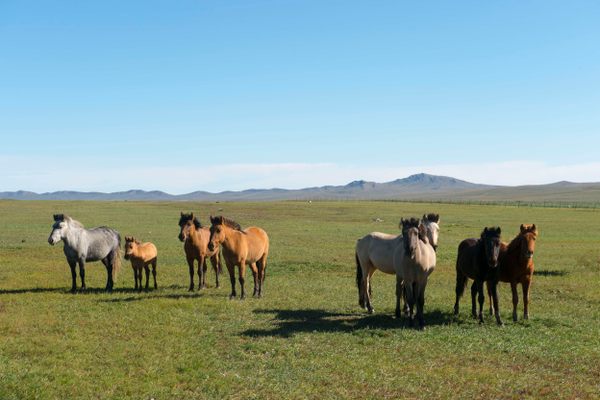
Mongol warriors often had three or four horses each to maintain the army's fast pace. Soldiers preferred riding mares for their nutrient-rich milk. HEMIS/ ALAMY STOCK PHOTO
In This Story


A CHILLY NIGHT SETTLES ACROSS the grassy knolls of the Mongolian steppe. Then, all at once, the thunder of galloping horses pierces the quiet. Screams erupt as the cavalry charges Kublai Khan’s unsuspecting forces. Khutulun’s horse rears, desperate to join the fray. But Khutulun holds the mare back—not yet. Even before Khutulun was born in 1260, her father, Kaidu, hated Kublai Khan. In their eyes, Kublai was a traitor shunning Mongolian traditions while adopting Chinese ones. But, if this raid goes according to plan, Khutulun and her father could deal a crucial blow. “Now, Khutulun!” Kaidu bellows. Kicking her horse into action, Khutulun flies at the enemy. Deftly as a hawk, she narrows in on her prey, the camp’s commander. She looses a bone-tipped arrow and it sails through the commander’s shoulder. Khutulun hoists his bleeding body onto her saddle and races back to her father’s side. Unceremoniously, she drops the enemy at Kaidu’s feet. “And this she did many a time,” wrote the globe-trotting Marco Polo, who spun Khutulun’s feats far and wide.

The great-great-granddaughter of Chinggis (aka Genghis) Khan, Khutulun, by all accounts, was a badass. Living in the late 13th century, she was her father Kaidu’s best warrior. A starry-eyed Polo wrote she was “so strong and brave that in all her father’s realm there was no man who could outdo her in feats of strength.” Persian chronicler Rashid al-Din agreed, writing that she “frequently [took] part in campaigns and perform[ed] acts of heroism.” But she wasn’t the only female warrior of the Eurasian steppe. Mongol women warriors “exist, but they’re not commonplace,” says Mongol military historian Timothy May of the University of North Georgia. But just how commonplace they were depends on who you ask. While some scholars believe women warriors were right there conquering the world alongside Chinggis, others doubt whether contemporary references to Mongol warrior women are little more than literary embellishments.

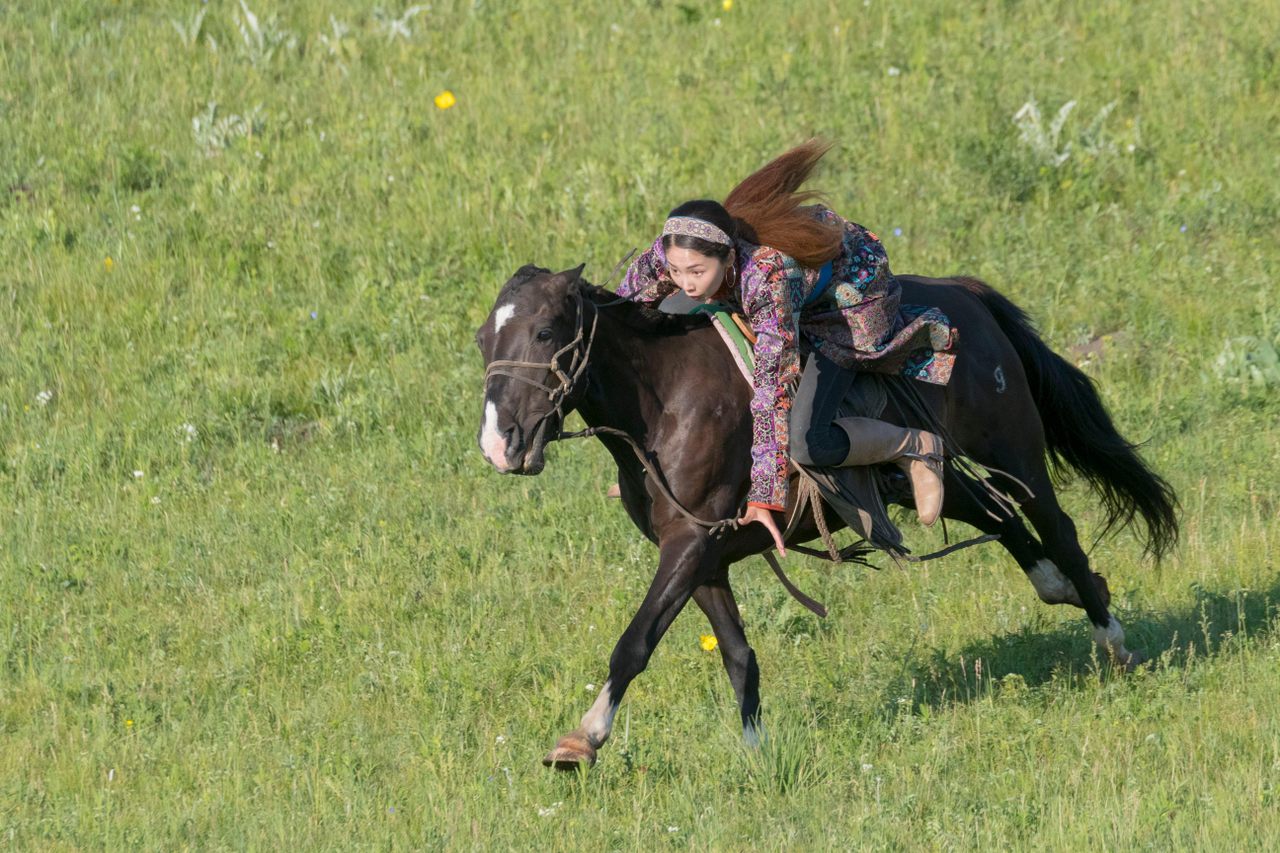
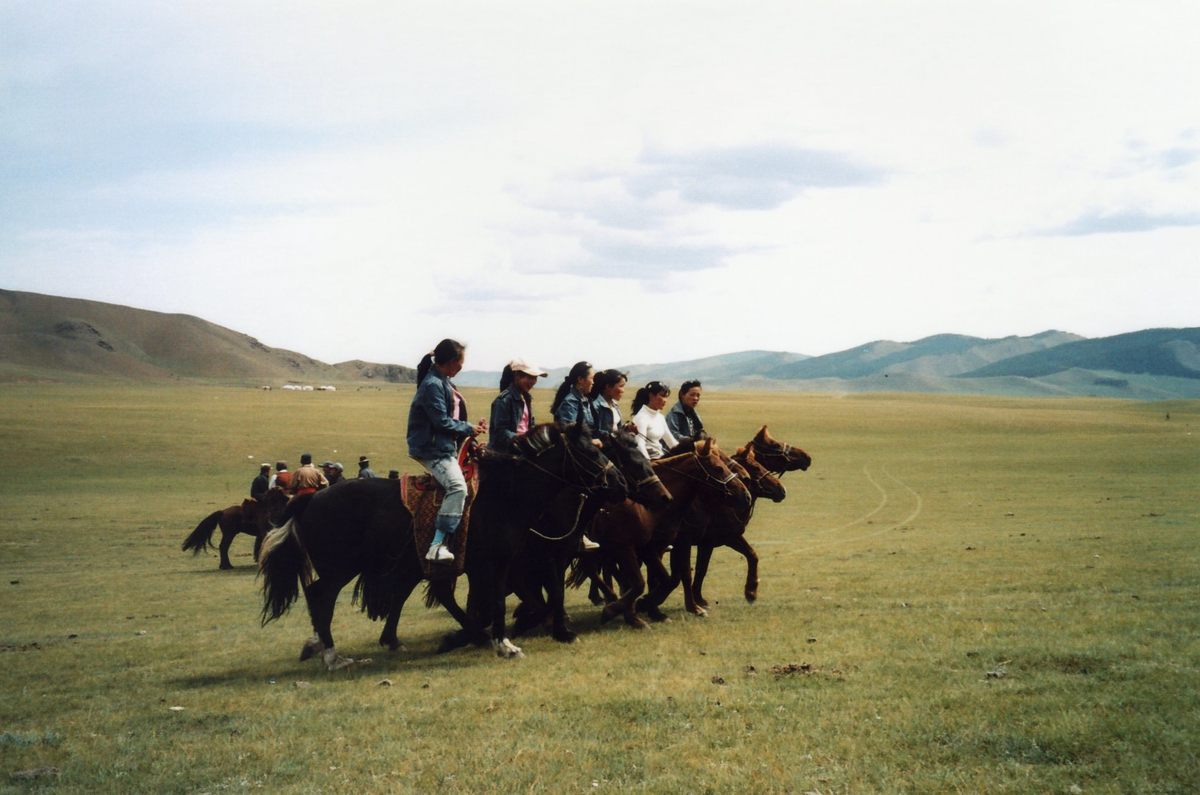
Despite conflicting opinions, most scholars agree that to be a Mongol, you needed to know two things: how to ride and how to shoot. As May puts it, “without your horse, you were dead.” And in Mongolia, you started learning young. Toddlers learned how to ride almost before they could walk. By seven years old, children were shooting arrows from the backs of horses, racing as jockeys, and, if necessary, riding into battle. “You’re looking at a seven-year-old soldier. It doesn’t matter what gender that child is,” says Columbia University PhD candidate Sally Greenland.

Just as they would have centuries ago, young Mongolian girls still learn to ride horses as toddlers today. JEANNE MENJOULET/ CC BY 2.0

Under Chinggis Khan, the Mongols forged the largest contiguous land empire ever known. According to some estimates, it stretched a mind-boggling twelve million square miles across Asia, from modern-day Poland to South Korea. The Mongols’ success had everything to do with their riding and archery skills. As one Chinese chronicler put it, “they took possession of the world through this advantage of bow and horse.” It’s also the reason why female warriors could be just as deadly as their male counterparts, says May.

On a horse, women are just as fast as men; and armed with a bow, they could be just as deadly. Made from sinew and horn, the Mongol bow was the sniper rifle of medieval Asia. A warrior wielding this bow could easily skewer an enemy more than 350 yards away—outshooting the contemporary English longbow by 100 yards. Yes, you had to be strong to use the Mongol bow. But, with this bow, skill trumped might every time. When the Mongols rained down a black cloud of arrows on their enemy, it didn’t matter whether a man or woman released the killing shot.

In the early days of the Eurasian steppe, knowing how to use a bow and ride a horse could be the difference between survival or death. Wolves, enemy tribes, and other dangers lurked everywhere. “You’re pretty much out on the steppe by yourself [so] the men had to learn how to do the women’s jobs and the women had to learn how to do the men’s job,” says May. While men traditionally protected the camp and women cared for the tribe’s herds, everyone had to be ready to pick up the slack, especially if an enemy tribe decided to raid your own. “If you’re living in a group of 20 people and another 20 people ride over the hill and they want what you have, whether that be water or sheep or you name it, anything, it would be silly to have ten of [your] people just sitting on the ground,” says Greenland.
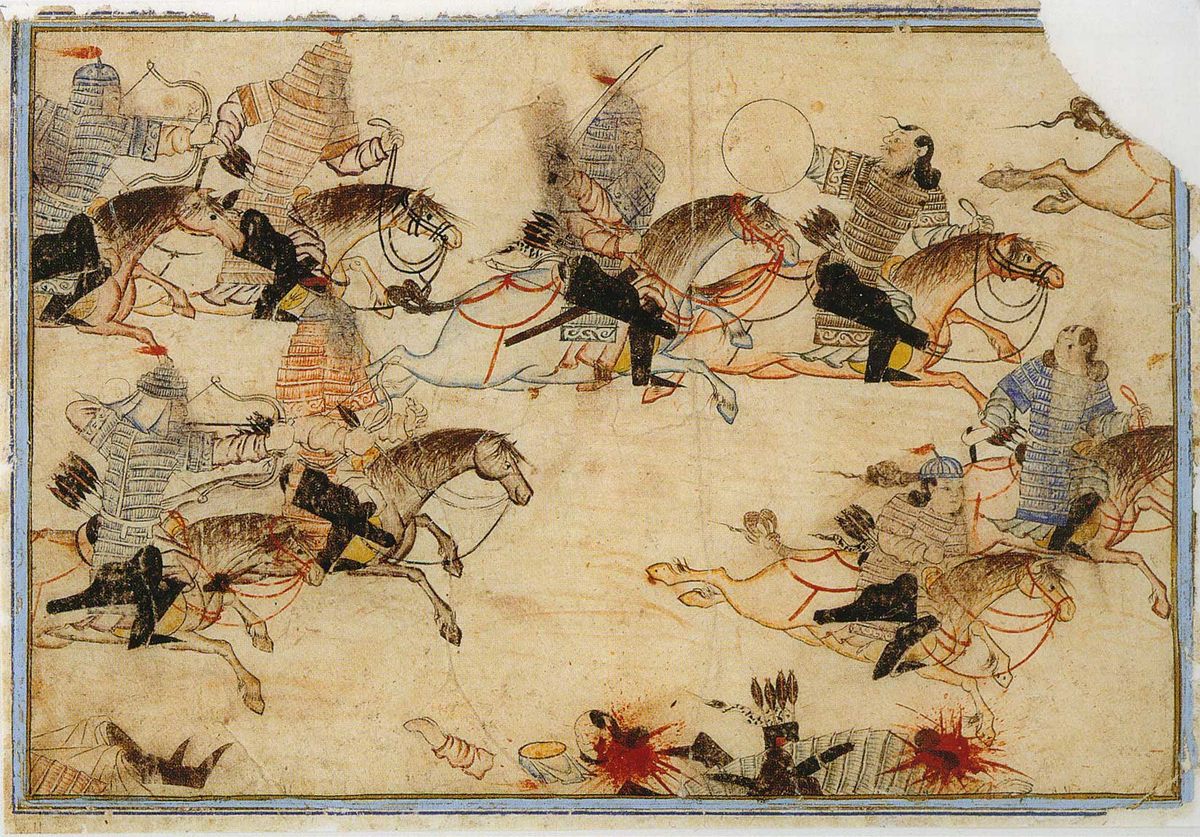
The Mongol army was notorious for cunning war tactics, like feigning days-long retreats before turning around on fresh horses and decimating the enemy. PUBLIC DOMAIN

In medieval Mongolia, nearly every activity, from races to wrestling matches, doubled as military training—perhaps the most important being the communal hunt or nerge. “Women were hugely involved in setting up the hunts,” says Greenland. Everyone, young and old, male and female, participated. As the sun rose across the hilly grasslands of the steppe, hunters rode off in search of game. When they found an unfortunate deer or boar, the group would encircle the animal, tightening and tightening their formation until someone dealt the panicked animal a killing blow.

Mongol soldiers used the same tactic in battle, encircling enemies with lethal efficiency. The hunt taught warriors how to remain calm in the face of a desperate enemy, and was a chance for everyone, men and women, to prove their mettle, says Greenland. In the nerge, “women had a chance to be heroes, and in being heroes, women were then very able to be perceived as warriors.”

Before the late 12th century, tribes scattered across the steppe often fought each other, so every warrior mattered. If an enemy tribe decided to raid your camp, everyone, men and women, took up their bows and battle axes to defend their home. But later on, as Chinggis Khan united the steppe and embarked on his campaign of world domination, his army grew and individual roles became more specialized. By and large, men became soldiers while women ran Chinggis Khan’s growing empire. Women warriors still fought at times, but they essentially became a reserve force. “When the battle is being hard-pressed against the Mongols, they bring in additional troops that tend to be women,” says May. But overall you see fewer female warriors in these latter days of the empire, says Greenland.

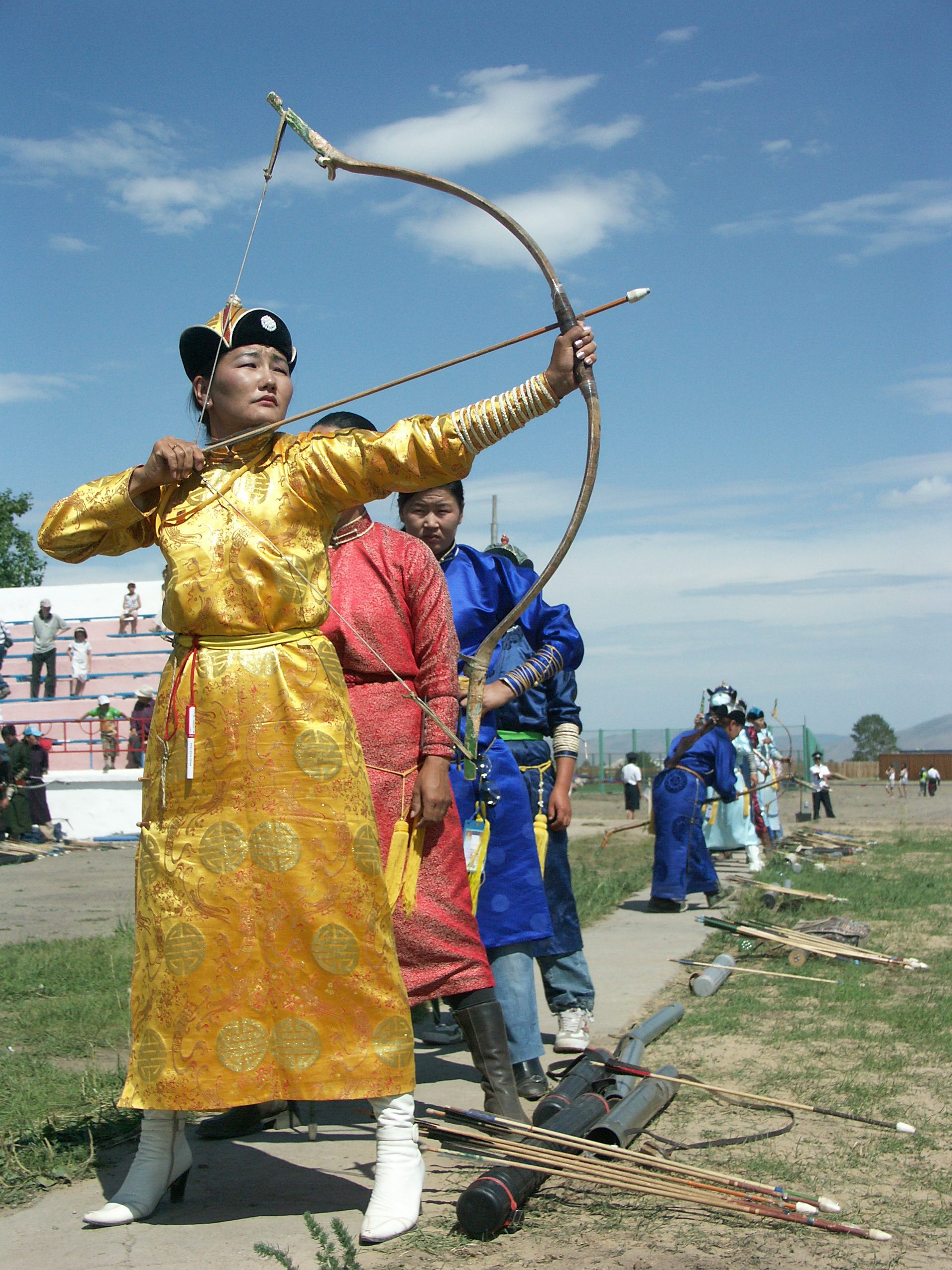
At the annual Naadam games in Mongolia, women compete in archery and horse racing games alongside male opponents. ZOHARBY/ CC BY-SA 3.0

As Chinggis’s army grew, it also became increasingly “composite,” says Greenland. He bolstered his forces with captured enemies, forcing them to do the most dangerous jobs of war like carrying battering rams to the city gates. He adopted other cultures’ military tactics, such as recruiting Chinese engineers to build trebuchets. But unlike the Mongols, these other cultures didn’t allow women to fight. “The cultures that the Mongols invaded around them, that then they subsumed within their own war machine, those cultures were male-dominated and that I think is why we see less frontline women [warriors],” says Greenland. But this didn’t stop all women from taking up arms and riding into the fray of a battle.

Sometimes women would inherit troops and military titles from dead husbands and fathers. These instances, though, are rare, says Bettine Birge, a scholar of Chinese history from the University of Southern California. “From my perspective, you see women exerting a lot of political power but not necessarily themselves being warriors individually except for these isolated cases.” However, even in the centuries following Chinggis Khan, a handful of women commanded and fought alongside their troops. In the early 13th century, Alaqa Beki, Chinggis Khan’s daughter, inherited troops from her father and had “several thousand women serving her. Whenever they go campaigning, they behead and kill,” the Chinese chronicler Zhao Hong wrote. In the 1280s, as Khutulun is busy leading armies in eastern Asia, Shazhi, who was ethnically Chinese but fought for the Mongol Empire, galloped into battles alongside her 10,000 troops earning the Mongol Empire’s highest military and civilian position. Towards the end of the 13th century, two other Chinese women, Shejie and Shigu, even took up arms against each other in the stead of a dead father and husband.

As the numbers of women warriors dwindled following Chinggis Khan’s rise to power in the early 13th century, Khutulun becomes unusual. She’s “held up as a Joan of Arc type character,” says Greenland. Living in the late 13th century, Khutulun was four generations removed from her famous empire-building grandfather Chinggis. Though other warrior women like Shazhi and Shejie are mentioned in historical sources, Khutulun’s story becomes the most widely circulated and leans into literary tropes of the time, says Bruno di Nicola of the University of London. “Marco Polo is trying to impress Europe so he’s not trying to tell a story of a factual Asia,” says di Nicola. He believes there’s likely “a bit of fantasy” in Khutulun’s story, especially when it comes to her ability to defeat any would-be husbands in a wrestling match.
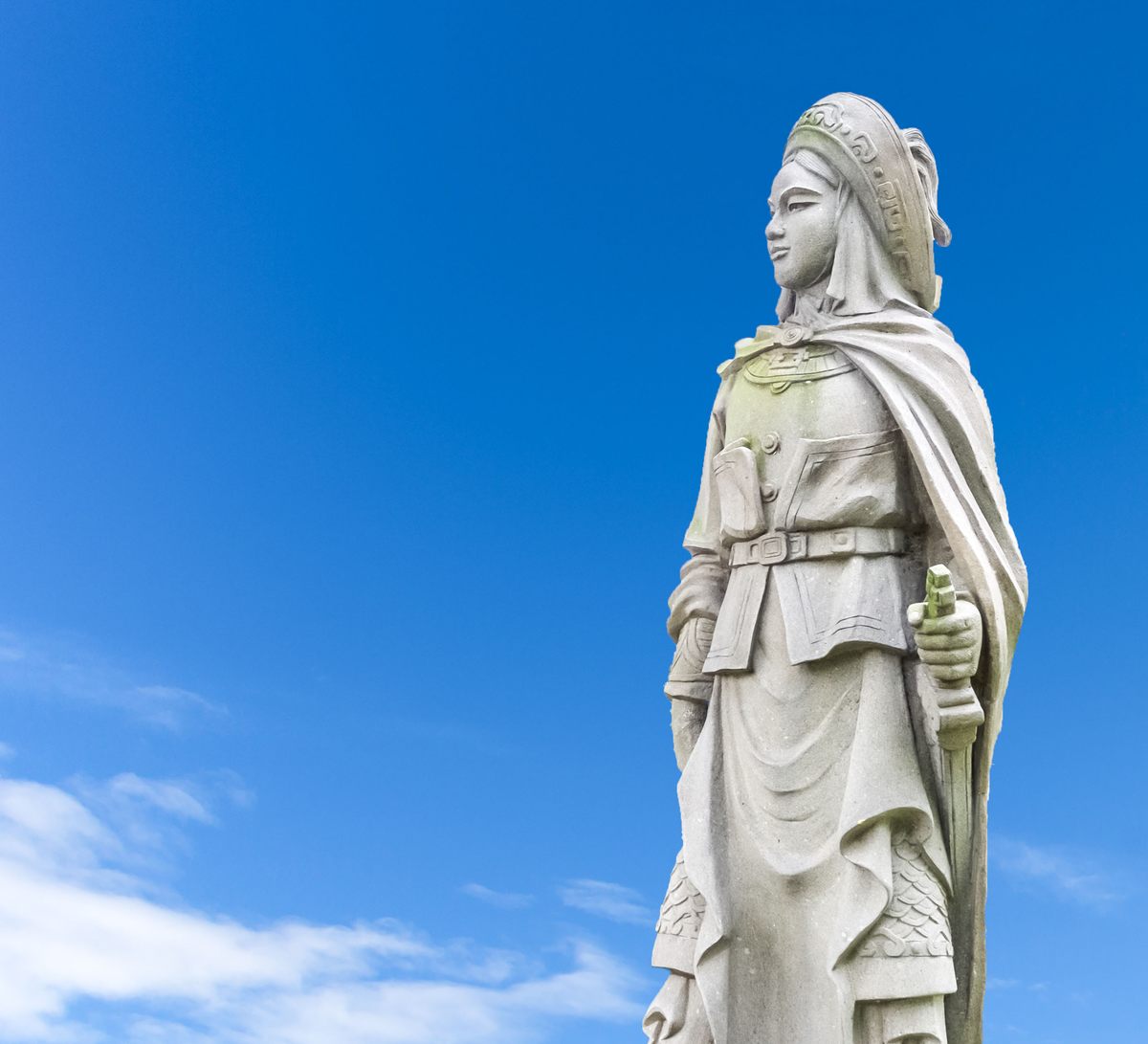
The Ballad of Mulan, which inspired the Disney film, likely drew inspiration from the female warriors of the ancient Central Asian steppe. This statue of the fabled female warrior can be found in Singapore. 
KC HUNTER/ ALAMY STOCK PHOTO

As a military scholar, May, however, doesn’t question Khutulun “was a great wrestler” and capable warrior. “The fact that she leads warriors for years, that suggests that she had not only great leadership skills but she was effective using weapons,” says May. Her story is also corroborated in Rashid al-Din’s Persian chronicle, a fact which convinces Birge Khutulun was a living, breathing warrior—one you’d be foolhardy to mess with. “Finding her both in Marco Polo and Rashid al-Din, the Persian historian, is quite telling,” says Birge. “I don’t think you’d find anybody denying that” she was a real warrior.

As with everything when it comes to the Mongols, parsing out fact from speculation, or even pure fiction, is a near-impossible task. The Mongols themselves left behind only one primary source. Every other source comes from outsiders, usually their enemies. But scholars increasingly believe Mongol warrior women were there, racing across the hilly grasslands of the Eurasian steppe armed with a drawn bow, their arrows ready to fly at any unsuspecting enemy.
WEF Gender Gap report shines harsh light on Asia's lopsided politics

Japan, China and others trail as region remains only 13% of way to political parity

Protesters criticize the treatment of women in Australian politics last year. Gender equality was a key theme of the recent Australian election that brought a change of government. 


Compounding Crises: Pandemic Disruptions and Weak Recovery Delay Time to Gender Parity to 132 Years

Published
08 Jul 2022

- Iceland remains the world’s most gender-equal country, followed by Finland, Norway, New Zealand and Sweden


- With a widening gender gap in the labour force, the cost of living crisis is expected to hit women hardest


- COVID-19 set gender parity back by a generation and a weak recovery isn’t compensating for it


- Explore the full report, infographics and more information here


Geneva, Switzerland, 13 July 2022 – After a big COVID hit, the gender gap hasn’t bounced back, according to the World Economic Forum’s Global Gender Gap Report 2022. As the global economy enters its third year of continued disruption, it will take another 132 years (compared to 136 in 2021) to close the gender gap.

The report suggests that of the 146 economies surveyed, just one in five has managed to close the gender gap by at least 1% in the past year. As a result, while gains have been made in the past year, they have reduced the time it will take to reach gender parity by only four years. This progress does little to offset the setback of an entire generation recorded in 2020-2021 at the start of the pandemic.


“The cost of living crisis is impacting women disproportionately after the shock of labour market losses during the pandemic and the continued inadequacy of care infrastructure. In face of a weak recovery, government and business must make two sets of efforts: targeted policies to support women’s return to the workforce and women’s talent development in the industries of the future. Otherwise, we risk eroding the gains of the last decades permanently and losing out on the future economic returns of diversity,” says Saadia Zahidi, Managing Director at the World Economic Forum.


The Global Gender Gap Report, now in its 16th year, benchmarks the evolution of gender-based gaps in four areas: economic participation and opportunity; educational attainment; health and survival; and political empowerment. It also explores the impact of recent global shocks on the growing gender gap crisis in the labour market.


Across the 146 countries covered in 2022, the health and survival gender gap has closed by 95.8%, educational attainment by 94.4%, economic participation and opportunity by 60.3% and political empowerment by 22%. Between 2021 and 2022, the economic participation and opportunity sub-index increased by 1.6%, based mainly on gains for women in professional and technical roles and a decrease in the wage gap, even as gender gaps in the labour force increased. For the health and survival sub-index, there was a small improvement from 95.7% to 95.8%, while the educational attainment sub-index fell from 95.2% to 94.4% and political empowerment stalled at 22%.


Taking a longer view over 16 years, at the current rates of progress it will take 155 years to close the political empowerment gender gap – 11 more than predicted in 2021 – and 151 years for the economic participation and opportunity gender gap. Although 29 countries have reached full parity, it will still take 22 years to close the educational attainment gender gap. And while more than 140 countries have closed at least 95% of their health gaps, overall backsliding in health and survival means there may be a reversal.


Global and regional highlights 2022


For the 13th consecutive year, Iceland is the most gender-equal country in the world and the only one to have closed more than 90% of the gender gap. The Top 10 countries include:


Image: World Economic Forum


North America is the best performing region, with 76.9% of its gender gap closed. The number of years it will take to close the gap has fallen from 62 to 59. There is slight improvement in the United States, while Canada’s score does not evolve.


Europe (76.6%) is close behind, clocking an improvement of 0.2% since 2021, resulting in a 60-year wait until the gender gap is closed. Six of the top 10 countries are European and nine of the 35 countries in the region have improved their score by at least 1%. Albania, Iceland and Luxembourg are the region’s three most improved countries.


Latin America and the Caribbean (72.6%) ranks third regionally, improving 0.4% points since the previous edition. Based on the current pace of progress, Latin America and the Caribbean will close the gap in 67 years. However, within the region only six of the 22 countries indexed in this edition improved their gender gap score by at least one percentage point, suggesting increasing regional divergence.


Central Asia (69.1%) has stalled in its progress, with a score unchanged from 2021. At this pace, it will take 151 years to close the regional gender gap. Six of the 10 countries in the region have seen an improvement in their scores, with Moldova, Belarus and Georgia representing the top-ranked countries.


East Asia and the Pacific (69%) saw 13 of the 19 countries in the region make progress since the last edition. But at its current pace, the region will need 168 years to close the gender gap. Progress is taking place at different speeds between countries, risking further regional divergence. The region’s top performers are New Zealand (84.1%), Philippines (78.3%) and Australia (73.8%).


Sub-Saharan Africa (68.7%) has registered its best score, with an improvement of 1.1% in the past year, reflecting positive changes in the economic gender gap in countries such as Nigeria, Ethiopia, Democratic Republic of the Congo and Kenya. At the current rate, it will take 98 years to close the gender gap.


Middle East and North Africa (63.4%) has the second-largest gender gap yet to close, with Israel, United Arab Emirates and Lebanon the highest performing countries. Some progress was made in closing the economic gender gap (+2%), with a number of countries improving women’s labour force participation and the share of women in technical roles. The region’s score remains similar to the last edition, which gives a timeframe of 115 years to close the gap.


South Asia (62.3%) has the largest gender gap of all regions, with low scores across all measured gender gaps and little progress made in most countries since the last edition. At its current pace, it will take 197 years to close the gender gap in the region. The economic gender gap has closed by 1.8%, with increases in the share of women in professional and technical roles in countries including Bangladesh and India, as well as Nepal.


Gender gaps in the workforce: a looming crisis


Global gender parity for labour force participation had been slowly declining since 2009 in the Global Gender Gap Index. The trend, however, was exacerbated in 2020, when gender parity scores decreased precipitously over two consecutive editions. As a result, in 2022, gender parity in the labour force stands at 62.9%, the lowest level registered since the index was first compiled. Among workers who remained in the labour force, unemployment rates increased. While the current unemployment rates for both men and women are higher than pre-pandemic levels, women’s 2021 global unemployment rate (6.4%) was higher than that of men (6.1%).


The disproportionately negative labour market impact of the pandemic can be explained partly through the sectoral composition of the shock and partly through continued disparities in care responsibilities that were exacerbated by the pandemic. The majority of care work fell on women as childcare facilities and schools were closed. Even before the pandemic, men’s share of time in unpaid work as a proportion spent in total work was 19%, while for women this was 55%.


The picture is brighter when it comes to women in organizational leadership. According to high-frequency data from LinkedIn from 23 leading economies, women have been hired into leadership roles in increasing numbers since 2016. While the share of women hired into leadership was 33.3% in 2016 in this set of countries, it increased to 36.9% in 2022. Progress stalled during the pandemic, with the annual share of women hired into leadership positions holding at 35% between 2019 and 2020 but then increasing to 36% in 2021.


This overall progress, however, masks differences in industries. Among the industries that hired the highest share of women into leadership positions in 2021 are non-governmental and membership organizations (54%), education (49%), government and public sector (46%), personal services and well-being (46%), healthcare and care services (46%), and media and communications (46%). In contrast, six industries hired significantly more men than women into leadership positions in 2021: Technology (30%), agriculture (28%), energy (25%), supply chain and transportation (25%), manufacturing (22%) and infrastructure (21%).


Finally, learning is also segmented by gender, changing the composition of talent available with future-ready skills. In higher education globally, women continue to be overrepresented in education and health and welfare degree subjects compared to men and underrepresented in STEM fields. There are nearly four times as many men as women graduates in information and communication technologies (ICT) and in engineering and manufacturing. High-frequency data from Coursera suggests that gender gaps are smaller in online enrolment. In ICT, for example, gender parity increased in online training between 2019 and 2021 during an overall rise in online learning. The Report also contains new metrics on wealth and on health from data collaborations with WTW and Hologic.


Urgency for action

Closing gender gaps remains a critical driver of national prosperity. Countries that invest in all of their human capital and make it easier for their populations to balance work and family life tend to be more prosperous. With an increasingly uncertain economic outlook, the Global Gender Gap Report 2022 calls on more leaders to unleash the creativity and dynamism of their countries’ human capital to overcome the current crises and accelerate a strong recovery.

The Closing the Gender Gap Accelerators work with government and business in advanced and developing economies to create structed public-private collaborations for rapid acceleration to economic parity, focusing on increasing women’s participation in the workforce, closing the gender pay gap and helping more women advance into leadership roles and develop in-demand skills. The model has been adopted in 12 economies, with Ecuador, Kazakhstan, Japan and Mexico joining the accelerator network in 2021-2022.


Notes to editors
Read the report and explore the data
Read more about the Centre for the New Economy and Society


 12.07.22 News

Albania’s government proposes fiscal amnesty law which opens door to massive money laundering


Tirana/Brussels, 12 July 2022, dtt-net.com – A draft-law proposed by Albanian government would allow Albania nationals, including those living abroad, to inject up to 2 million Euros in local banks without having to declare the origin of the money, a proposal which is criticized by the European Commission (EC) because of money laundering opportunity which the law would create if approved in the form proposed.


.................................................................................................................................................

Why did Joe Biden change his mind about making Saudi Arabia a ‘pariah nation’ over human rights?

There was talk of complete change in US-Saudi relations, so what happened asks Andrew Buncombe


Biden blamed Saudi’s crown prince for ordering murder of journalist Jamal Khashoggi

Joe Biden could not have been any clearer.

The administration of Donald Trump, it was put to him by a questioner, had failed to punish Saudi Arabia for the murder of Jamal Khashoggi. If anything, it had cemented its ties, with Trump bowing before the Saudi king to receive a heavy and pendulous gold necklace, the Collar of Abdulaziz al Saud no less.

If he was president, what would Biden do? Would he punish the Saudi leaders?

“Yes. And I said at the time, Khashoggi was in fact murdered and dismembered, and I believe on the order of the crown prince,” he said with no small steel to his voice.

“I would make it very clear, we were not going to sell more weapons to them. We are going to make them pay the price, and make them in fact, the pariah that they are.”

He said Saudi Arabia was killing children in its bombing campaign in Yemen, and added: “There’s very little socially redeeming value in the present  government in Saudi Arabia.”

That was November 2019, on the stage of the fifth Democratic debate in Atlanta, Georgia, along with rivals such as Bernie Sanders, Elizabeth Warren and Kamala Harris, as the party sought to select a presidential candidate to challenge Trump.

Two-and-a-half years later, sales of US and UK weapons to Saudi Arabia continue unabated, and nobody has been held accountable for the murder of the 57-year-old US-based Washington Post journalist.

There has been a four-month ceasefire in Yemen, yet to call it brittle would be to understate its fragility.

Despite some sanctions being directed at a handful of Saudi officials, there has been little genuine attempt to punish the most high-ranking in the kingdom, where all decisions of significance come from the top.

And this week, in what would be the clearest underscoring that the US-Saudi relationship is as solid as ever, Biden will make a four-day visit to the Middle East, part of which is an effort to help Israel, another longtime US ally, create a relationship with Saudi Arabia.

It is unclear if any agreement is to be announced this week – there may be an deal over allowing Israeli airliners fly over Saudi airspace – but Biden and others would like it to be in the vein of the 2020 Abraham Accords between Israel and the United Arab Emirates.

As part of his visit, Biden will travel to Saudi Arabia, as a guest of King Salman, together with eight additional heads of State for a meeting of the Gulf Cooperation Council (GCC), plus Egypt, Jordan and Iraq. The White House has said MBS is part of the Saudi team the president is due to sit and talk with during bilateral meetings.

Joe Biden vows to treat Saudi Arabia as 'pariah nation'

In a briefing to reporters National Security adviser Jake Sullivan, said Biden’s trip was intended to do several things.

Asked whether Biden would photographed with MBS, Sullivan said he would leave questions over “precise modalities” to the trip’s organisers.

Asked he would raise Khashoggi’s murder, he said he would not “characterise what the president will say privately in those sessions”. He said the White House had been in touch with Khashoggi’s family.

Asked whether the president regretted his language on the campaign trail, Sullivan said: “The president has not expressed regret about his statements.  What the president has been focused on is his view that the United States has important interests to advance and protect, including in partnership with Saudi Arabia.”

Sarah Leah Whitson, the Executive Director of Democracy for the Arab World Now (DAWN), a DC-based non-profit started by Khashoggi, has been among the most outspoken critics of Biden’s visit.

She tells The Independent Biden may at one point have genuinely wished to recalibrate the US’s relationship with the kingdom, but that the “overwhelming incentive structure in our government is to sell as much weapons as possible, maintain us control and hegemony and protect Israel”.

“The pressure on the Biden administration to go back to business as usual, is just overwhelming,” she says.

“The defence industry interests are completely tied to continuing to sell as much as possible to their number one and number two weapons clients in the world.”

She says Israel is seeking a deal with Saudi, and to become part of a strategic bloc – “a Middle East Nato” – set against Iran.

Yet, what is not on offer, she claims, are breakthroughs on human rights or even lower petroleum prices.

While some political prisoners have been released from jail, some remain subject to travel bans. Lina al-Hathloul, the sister of women’s rights activist Loujain al-Hathloul, on Monday urged Biden to raise the case of her sister – and those of all political prisoners when he meets the Saudi leadership.

Whitson says even if Saudi Arabia agreed to increase oil production, it was unlikely to get onto the markets soon enough to address the price hike created by energy sanctions against Russia. She says if Biden really wanted cheaper gas at the pumps, he would not have kept in place sanctions against oil from Iran and Venezuela.

Ahead of Biden’s visit, the widow of Khashoggi, Hanan El-Atr, wrote an open letter saying if the US president was to press ahead with the trip, he should use it to press the causes that were so important to her late husband.

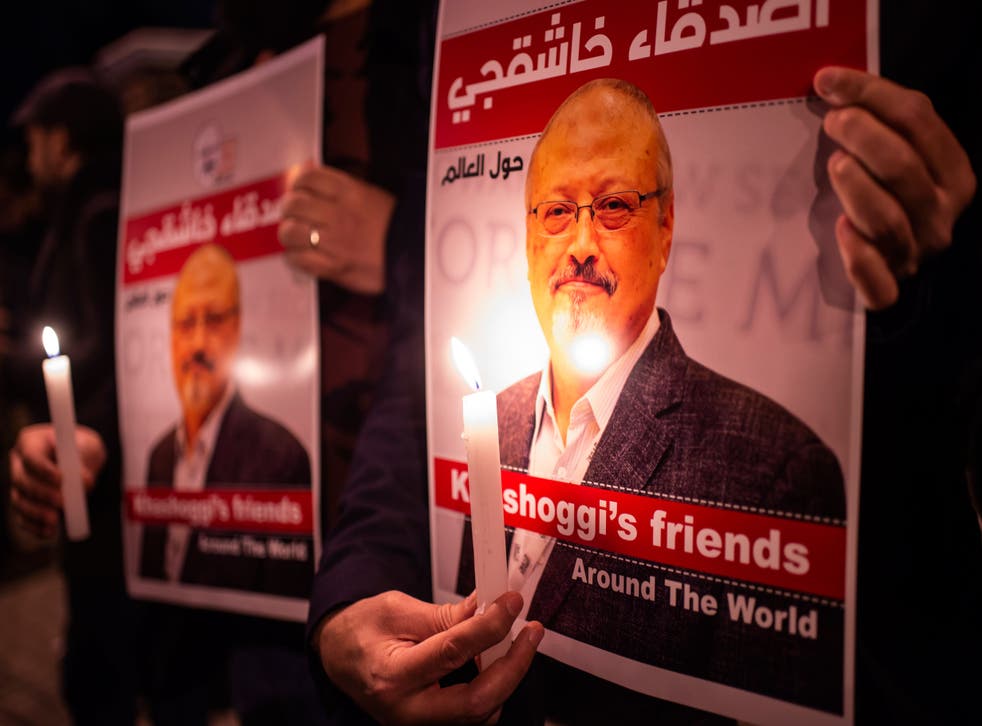
“As his only wife upon his death, it is important to me that Jamal’s legacy of freedom and tolerance outlive his death,” she wrote. (At the time of his murder in October 2018 at the Saudi consulate in Istanbul, it emerged he had been planning to visit Saudi Arabia and was trying to obtain a visa, having apparently proposed marriage to Hatice Cengiz, a Turkish student.)

On Tuesday, El-Atr and her lawyer, Randa Fahmy, were invited to the White House to meet with senior officials.

“I am here today, before President Biden departs to Saudi Arabia, to thank him and express what Jamal wanted most in this world: the release of all political prisoners being held in Saudi Arabia, including Jamal’s close friend, Essam Al-Zamil,” she said in a statement. “I do not want those political prisoners to suffer the same fate as Jamal.”

<p>Relations between US and Saudi Arabia were strengthened under Donald Trump</p>

Relations between US and Saudi Arabia were strengthened under Donald Trump

Fahmy says it was important for El-Atr, to be “able to express exactly what Jamal would have wanted if he were alive today, particularly right before President Biden’s departure to Saudi Arabia.”

She adds: “This meeting is just the beginning of her long road to closure amid her grief. Part of that closure is also to hold all parties accountable for the death of her husband.”

Also seeking the release of political prisoner from Saudi Arabia, is Ensaf Haidar, a Saudi-Canadian human rights activist whose husband, Raif Badawi, a Saudi writer and dissident, was sentenced to ten years in prison and 1000 lashes in 2014.

“I am asking [Biden] to help me to bring Raif back to home in Canada,” she says. “In all my tours with officials in Europe everyone says only Americans can help you and i think it’s true.”

The Saudi government has always denied that the crown prince had any role in Khashoggi’s murder.

On Tuesday, there was no immediate response to questions put to the Saudi Embassy in Washington DC.

A statement on its website said: “The Kingdom of Saudi Arabia looks forward to welcoming President Biden and defining the next chapters of our partnership. At a time of global challenges related to the global economy, health, climate and international conflict, the partnership between our two countries is as critical as ever to the promotion of peace, prosperity and stability around the world.”

Hussein Ibish is a strategic analyst and a scholar at The Arab Gulf States Institute, a Washington DC think-tank. He believes Biden’s turn around on the issue over treating Saudi Arabia as a “pariah nation”, is connected to his stymied domestic agenda.

Biden is an ambitious man, he says, who came into office wish a major Covid-spending bill and a desire to invest heavily in infrastructure.

Once those ambitions ran into Republican opposition, and that of individuals in his own party such as Joe Manchin, the war in Ukraine gave Biden to find an international diplomatic win.

With the talks over an Iran nuclear deal stalling, the US needs a way to contain Tehran, says Ibish. By formally strengthening a bloc against Iran, centered around Saudi Arabia and Israel, it would show “the world the US is back”.

But how does Biden go from “pariah” to ally in such a short period?

“By giving it up – I mean, that’s it. What you’re looking at is a complete abandonment of that hollow campaign pledge, that was never going to be possible,” he says. “It was something he said, and when he said that, he was giving voice to a lot of Democratic outrage.”

In his briefing to reporters, Sullivan said Biden was “trying to do multiple things all at once to advance along a number of different tracks”.

He added: “America’s values — human rights — are a strategic interest of the United States.  So is energy security, so is stopping terrorism, so is seeking peace in a place like Yemen.”


Myanmar junta leader Min Aung Hlaing visits Russia

The general who ousted Myanmar’s democratically elected government arrived in Moscow on an unannounced visit.
By RFA Burmese
2022.07.12


Myanmar junta leader Senior Gen. Min Aung Hlaing attends the IX Moscow conference on International Security in Moscow , June 23, 2021.
 AFP

Myanmar’s junta chief Min Aung Hlaing arrived in Moscow on Tuesday for what Russia’s Embassy in Myanmar called a “private” visit, only two days after U.S. Secretary of State Anthony Blinken vowed to ramp up international pressure on the military regime. 

Since Min Aung Hlaing led the military to seize power in Feb. 1, 2021, Myanmar has plunged into a deep economic and political crisis only worsened by the COVID-19 pandemic. While the West quickly moved to impose sanctions on the military, both Russia and China have supported the junta. 

Russia has continued to supply the Tatmadaw, as Myanmar’s military is known, with weapons and helicopters despite its continued and documented crackdown on civilians, killing at least 2,077 since the coup. The military has also launched a wide-ranging military operation in Sagaing region, where anti-junta militias have formed in rural areas. RFA has documented extensive targeting of civilians and the burning of wholesale villages as part of the military’s clearance operations in Sagaing. 

Min Aung Hlaing notably hosted Russia’s Deputy Defense Minister Lt-Gen Alexander V. Fomin in Myanmar’s capital Naypyidaw in March of last year, less than two months after ousting the democratically elected government. 

“[Min Aung Hlaing] plans to take part in the opening of a Myanmar cultural center," the statement from Russia’s Embassy in Myanmar said. But Russian state media reported that he would meet with officials from Moscow’s space and nuclear agencies. The visit was not heavily publicized by Myanmar’s junta-controlled media. It is unclear if Min Aung Hlaing will meet with Russian President Vladimir Putin or any other high-ranking Russian officials while in Moscow. 

Lin Thant, a representative of the shadow National Unity Government (NUG), told RFA Burmese that Min Aung Hlaing “doesn’t have much success in the international arena and so, he would be losing more face by making this trip because the junta leader is one of the few who had supported the Russian invasion of Ukraine while the rest of the world was condemning Russia. I see it as two evils forming an alliance.”

An announcement issued by the military on Monday night said the junta leader would attend religious ceremonies at the Shwezigon Pagoda in Ethnomir, a cultural museum in Moscow. It added that Min Aung Hlaing had met with the Chairman of Russia Myanmar Friendship Association and discussed further cooperation in economic and education sectors, tourism, and training for military and civilian officials. 

The two sides also discussed electric power generation, nuclear energy production and the latest agricultural methods for oil crops and import-exports matters, the statement added. Russia, for its part, has warmed up to Myanmar’s junta since launching the invasion of Ukraine, and Myanmar has launched a recent bid to secure an energy deal from Russia to offset fuel shortages caused by the sanctions. 

According to a June 20 report by the pro-military Myanmar Alin Daily, a junta delegation met with Russian Minister of Energy Shulginov Nikolay on the sidelines of the  June 15-18 International Economic Forum in St. Petersburg to discuss energy cooperation. 

The two sides reportedly held talks on Russian oil drilling in Myanmar and the export of oil and petroleum products, as well as the construction of a nuclear power plant, it said. They also discussed the possibility of direct exchanges of currencies between the two countries’ central banks and the purchase of fuel from Russia. 

But analysts have repeatedly raised doubts about the extent of Russia’s willingness to provide Myanmar with a major energy deal, and the junta’s ability to manage it.

Myanmar-based analyst Than Soe Naing said the junta is only in the beginning phase of negotiations with Russia to deal with its ongoing energy crisis and will need to overcome several obstacles before moving towards an agreement that will solve its problems.

“Cooperation with Russia over a nuclear program is unlikely without China’s support. In addition, the junta, which is facing a foreign exchange crisis, cannot afford to spend money on nuclear energy,” he said.

Translated by RFA Burmese. Written by Nawar Nemeh.