Thursday, November 03, 2022

Fiscal Update 2022: 
Freeland unveils tax credits of 30-40% for investment in clean technology and hydrogen

Incentives aim to keep pace with U.S. Inflation Reduction Act

Author of the article: Naimul Karim
Postmedia News
Publishing date :Nov 03, 2022 
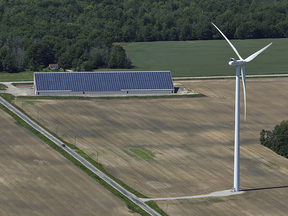
In its fiscal update, Ottawa has unveiled tax credits for clean-energy technology including for wind, solar and water. 
PHOTO BY BRIAN THOMPSON /The Expositor/


Ottawa has proposed new tax credits for investments made in clean technology and hydrogen in its fall economic statement with the aim to keep pace with the financial supports provided to manufacturers in the United States through the recently passed Inflation Reduction Act (IRA).

Under clean technology, it proposed a tax credit of up to 30 per cent of capital costs for investments made in electricity generation systems, such as small modular nuclear reactors and systems that depend on wind, water and solar, in storage such as batteries, in low-carbon heat equipment and in industrial zero-emission vehicles used in mining or construction.

The credit will be available from the first day of next year’s federal budget and will end in 2035.

Investment in the production of clean hydrogen could lead to a tax credit of at least 40 per cent. Work on the level of support needed for production and the appropriate carbon intensity tiers is underway, the statement said. The tax credit would be available as of the day of Budget 2023 and will be phased out after 2030.

“With major investment tax credits for clean technology and clean hydrogen, we will make it more attractive for businesses to invest in Canada to produce the energy that will power a net-zero global economy,” Deputy Prime Minister Chrystia Freeland said in a prepared statement.

Ottawa has also said that companies will need to meet labour conditions that include paying wages based on market conditions and ensuring training opportunities for workers to be eligible for the highest level of the tax credits. This “new approach” to tax credits, was “long overdue” and “entirely reasonable,” Freeland said in a press conference on Thursday.

The tax credits have been announced a day after representatives from the Canadian automotive, steel and manufacturing sectors warned that the IRA will pour billions into the American manufacturing sector over the next few years and could trigger a flight of investment capital south of the border, as well as result in fewer manufacturing jobs.

The bill, which passed the U.S. House of Representatives in August, has little to do with inflation but will result in dramatic changes to the American economy in service of the country’s climate goals through a mix of tax incentives, grants and loan guarantees aimed at boosting clean energy and clean transportation.

The IRA also offers a US$7,500 subsidy meant to encourage the production of electric vehicles in North America, which will benefit Canada.

But the act offers “enormous financial supports to firms that locate their production in the United States — from electric vehicle battery production, to hydrogen, to biofuels, and beyond” and “without new measures to keep pace … Canada risks being left behind,” the fall economic statement said.

The tax credits have been announced at a time when democratic countries in North America, including Canada, have been trying to offset China’s dominance of the battery supply chain for electric vehicles, the demand for which has been on the rise in recent years as nations look to meet their climate targets.

China dominates the EV supply chain through its refining and processing industries even though most of the metals required by EVs, such as lithium, nickel and cobalt, are mined outside the country. On Thursday, Canada ordered three Chinese companies to divest their investments in three Canadian junior lithium miners. Last week, Canada raised the bar that foreigners must clear to join the country’s critical minerals industry.

“We have the natural resources to power the global net-zero transition and to support our allies with their energy security … And our government believes that this ongoing shift is the most significant opportunity for Canadian workers and Canadian businesses in a generation,” Freeland said.

Fiscal Update 2022: 
Ottawa willing to accept lower returns, more risk to put $15-billion growth fund to work

Barbara Shecter -  Financial Post

Deputy Prime Minister and Minister of Finance Chrystia Freeland and Prime Minister Justin Trudeau before delivering the fall economic statement on Parliament Hill in Ottawa.


The federal government’s new $15-billion Canada Growth Fund is prepared to accept a lower return or increase its potential loss exposure in order to stimulate institutional investment in innovation and green projects with risky economic foundations, Ottawa announced Thursday as part of the fall economic update.

The fund, first announced in the April budget, will make what it calls “concessional” investments — in which the return and loss metrics would not be acceptable to classic private equity investors.

“Launching the new Canada Growth Fund … will help bring to Canada the billions of dollars in new private investment required to reduce our emissions, grow our economy and create good jobs,” Finance Minister Chrystia Freeland said, adding that the projects will have meaningful Indigenous participation and meet “the highest” environmental standards.

“From critical minerals, to ports, to energy , we will continue to make it easier for businesses to invest in major projects in Canada.”

The Liberal government has made several attempts to entice pensions and other institutional investors to fund projects to create jobs, improve Canada’s productivity and commercialize intellectual property.

In this latest iteration, the Canada Growth Fund will seek direct investments including co-investments with private investors and bilateral partnerships where the fund will invest in industrial emitters, clean-tech companies and other companies “across low-carbon supply chains” such as those involved in the production of critical minerals .

To “address demand risk and improve project economics,” the fund will also enter contacts to provide revenue for a certain volume of production in cases “where sufficient demand from prospective private buyers is still developing.”

It will provide anchor equity to fund projects in cases where the risk level or capital required would attract limited interest from private capital.

The fund plans to piggyback some of its investments on the pipelines of private funds, but there will also be sponsorships, where the fund identifies opportunities and tries to convene multiple financial and strategic partners.

Investment management teams will target companies and projects with “a reasonable chance to strengthen the development of Canadian workers and generate knowledge that will produce long-term benefits for the Canadian economy beyond those realized directly by the specific investment in the project or company,” according to a background document shared by the Finance Department as part of the economic update.

For example, companies and projects with a focus on intellectual property development and commercialization would be desirable, as would those that demonstrate an ability to improve Canadian competitiveness through new or existing value chains.

Investments will span the capital structure, and could include equity, debt and derivative contracts.

Ottawa said it will expect private investing partners to share in any downside, and will only make the concession investments — such as debt instruments where the Canada Growth Fund earns below-market returns or has higher exposure to loss through low-interest loans or subordinated debt — to the extent necessary to get a worthwhile project or company off the ground.

“While CGF may accept a first-loss position, for example, investors should share in the financial downside of under-performing investments,” according to the document.


What’s more, institutional investors will not be rewarded with “returns in excess of what the private sector requires to proceed with an investment given the level of risk it is bearing.”

Ottawa says the aim of the new fund is to generate returns on an overall rather than individual basis, “recovering its capital on a portfolio basis and recycling its capital base over the long term.”

Over the past seven years, Justin Trudeau and his government have made several attempts to attract Canada’s globally active pension fund investors to finance domestic projects.

In September, for example, industry minister François-Philippe Champagne, said he would be reaching out to large funds about building of dozens of electric battery plants in Canada and leasing them back to the automotive industry, a plan he said would help clear a “bottleneck” by accelerating construction of production facilities to process critical minerals that are abundant in Canada such as lithium, nickel, cobalt, manganese and graphite.

One of the most prominent and least-successful attempts to attract widespread interest from profit-seeking private investors was the creation five years ago of the Canada Infrastructure Bank. The vision behind the $35-billion CIB was to attract $4 to $5 of private money for every dollar invested, but it has fallen well short of that target.

• Email: bshecter@nationalpost.com | Twitter: BatPost
Fiscal Update 2022: 
Ottawa to permanently eliminate student loan interest

Ottawa plans to make permanent its pandemic-era pause on student loan interest in an effort to reduce some of the current financial pressures on young Canadians as the cost of living rises
.


As part of its fall fiscal update tabled Thursday, the federal government outlined plans to permanently eliminate interest on all federal student loans and apprentice loans including loans currently being repaid.

Interest rates will still apply on the provincial portion of a student’s loan.

While this move is helpful for students graduating, said Rebekah Young, director of fiscal and provincial economics at Scotiabank, it is ultimately relief for interest payments on debt rather than money toward tuition or other post-secondary school expenses.

“In the bigger picture, they're still confronting elevated expenditures across the board,” she said.

More than 1.8 million Canadian students owe the federal government a total of $20.5 billion, based on 2019 data from the Government of Canada website, with the average loan balance at about $13,367 at the time of leaving school.

The average undergraduate tuition fee is $6,482 for an academic year as of 2022, according to Statistics Canada, while the average graduate tuition fee is $7,053 as of 2022.

The Liberal government suspended the accumulation of interest on student loans in 2021 due to the effects of the pandemic on graduating students as they entered a unique job market. The measure was set to expire in March.


Related video: Ottawa's pandemic hiring boom adds billions to federal payroll
Duration 2:39  View on Watch
CONSERVATIVE OPPOSITION WANTED PASSPORTS ISSUED FASTER CALLED FOR AN INCREASE IN STAFFING 

The elimination of interest will begin April 1, 2023, the fiscal update said.

An average student loan borrower will save $410 per year as a result of their loan being interest-free, the government said in the fiscal update. (Student loan interest is calculated either at a fixed rate of 2 per cent plus prime, or a variable rate equal to the prime rate.)

The elimination of interest on these loans is estimated to cost of $2.7 billion over five years and $556.3 million ongoing, the federal government said.


The permanent elimination of interest on federal student loans was a Liberal campaign promise during the last federal election.

Young said some may fear the decision could stoke inflation, but that it isn’t be a particularly strong argument as the measure is a relatively small, contained one.

Ottawa said graduating students will still be able to use its repayment assistance plan, allowing them to pause student loan repayment until they are making at least $40,000 per year, and reducing payments for those earning slightly above that amount.

Earlier this week, the zero-payment income threshold for student loans increased from $25,000 to $40,000 for a household of one. The threshold increases based on the size of the household.

This move to tackle student loans comes just a few months after U.S. President Joe Biden announced a decision to cancel $10,000 for most student loan borrowers, and up to $20,000 for those borrowers who received a federal Pell Grant. It has received significant pushback.

The White House said Thursday that it has already approved 16 million requests. Close to 26 million Americans have applied for student loan forgiveness.

This report by The Canadian Press was first published Nov. 3, 2022.

Adena Ali, The Canadian Press
WINTER, IT HAPPENS...EVERY YEAR
Early winter-like storms are just a taste of what's to come, Alberta

Digital Writers - WEATHER NETWORK

Over 20cm of snow still to come across the Prairies

November has only just begun, but by looking at Alberta, you'd think we're already firmly locked into the heart of the winter season. Widespread snowfall warnings covered the region on Wednesday, with as much as 20 cm reported in major cities like Calgary. Though this system will make its way out of the region through Thursday, eyes are already shifting to the back-to-back storm systems ahead. A plunge into frigid cold as well as more snow will continue to keep things rather wintry as we make our way into the first weekend of November. See the timing and impacts, below.


Weekend and beyond: Wintry pattern tightens its grip

Heavy snow blanketed southern Alberta through Wednesday, prompting widespread warnings as conditions quickly deteriorated. While no official totals have been confirmed, between 10-17 cm of snow was recorded in Calgary and surrounding areas, with over 20 cm for the foothill regions.

RELATED: Why the first snowfall of the season can catch drivers by surprise

Calgary police were called to nearly 150 crashes throughout the storm, as drivers navigated one of the first major snowfalls of the season.


WATCH: Wintery blast causes traffic trouble on the Prairies

Unfortunately, for those not quite ready to dive into a full blown winter just yet, the snow and cold felt across Alberta this week is only a taste of what's to come.

Arctic air will plunge south into the region this weekend and continue for most of next week as well. Temperatures will drop into the minus teens, with wind chills making it feel closer to the -20s across parts of Alberta.


Early winter-like storms are just a taste of what's to come, Alberta© Provided by The Weather Network

"After extended summer-like temperatures started the fall season in Alberta, a flip of the switch has put the province into a free fall into deep winter-like weather," says Kelly Sonnenburg, a meteorologist at The Weather Network.

The daytime highs for next week will be 10 to 15°C below seasonal for this time of year, even cold by January and February standards!

Along with the frigid cold, there will be no shortage of snowfall either.


Early winter-like storms are just a taste of what's to come, Alberta© Provided by The Weather Network

Several systems, beginning as early as this weekend, will spread widespread swaths of accumulating snow southern and central Alberta next week. Forecasters are keeping a close eye on a more significant storm system for early and mid next week, one that could bring some heavy snow to the southern Prairies.

PHOTOS: First week of November brings a healthy dose of snow

Be sure to check back for the latest on conditions across the Prairies

Thumbnail image courtesy: Marco - Benalto, Alberta


POLITE TERM FOR;'STUPID'
Nixing mask mandate for schools 'shortsighted': EPSB chair

Hamdi Issawi - Yesterday

Edmonton Public School Board Chair Trisha Estabrooks said a decision to prevent school boards from mandating mask during the COVID-19 pandemic is© Provided by Edmonton Journal

Edmonton Public Schools has no plans to mandate masks for students, but for Alberta’s government to forbid a future order is “shortsighted” amid an ongoing pandemic, a school board trustee says.

Trisha Estabrooks, chairwoman of the Edmonton Public School Board, responded to Premier Danielle Smith’s statement Saturday that the province will not permit further masking mandates for Alberta grade schoolers.

“If there’s anything we’ve learned from this pandemic, it’s that we need to be nimble — we need to be flexible,” Estabrooks said. “I hope the worst of the pandemic is over. But is it?”

The premier’s statement follows the outcome of a judicial review into the United Conservative Party lifting a COVID-19 mask requirement for schools in February.


The Alberta Federation of Labour and five families of immunocompromised children prompted the review, which ultimately saw Court of King’s Bench Justice Grant Dunlop determine that the province acted unreasonably , and that politicians made the decision rather than Dr. Deena Hinshaw, Alberta’s chief medical officer of health.

Dunlop referred to a Feb. 10 news conference when Hinshaw referred a question about the rationale for the decision to Health Minister Jason Copping.

Estabrooks said both the board and superintendent similarly sought answers for the move, adding that it was “unfortunate” the source of the decision wasn’t more transparent.

“Health decisions need to be made by health officials,” she said.

In her statement, Smith cited “well understood,” and “detrimental” effects of mask mandates on the development, mental health and education of school children.

The premier’s office was unable to cite the evidence for those claims at the time, or whether her position against masking rules for students would apply to private schools. Her office did not respond to a followup from Postmedia on Tuesday.


Dunlop’s decision also found nothing preventing school boards from requiring masks in classrooms, despite a past statement to the contrary from Education Minister Adriana LaGrange.

The topic of masking students also follows dozens of “respiratory illness” outbreaks at Edmonton-area schools reported by Alberta Health Services.

With 213 schools in the district, Edmonton Public Schools has seen outbreaks at 41 schools since since the beginning of the 2022-23 year, most of which occurred September, spokeswoman Veronica Jubinville told Postmedia.


Addressing the board of trustees Tuesday, division superintendent Darrel Robertson reported outbreaks at six schools, which is up from only one outbreak reported on Oct. 18.

A Sept. 23 notice on the district’s website indicates Alberta Health Services has returned to a pre-pandemic reporting process, where the health authority investigates an outbreak if a school reports more than 10 per cent of students absent due to an illness.

“By and large, folks are doing a really good job of making sure that kids are staying home — or they’re staying home themselves — when they’re sick,” Robertson told the board. “That is not 100 per cent, though. Of course, we’ve heard stories of asymptomatic COVID.”

Estabrooks said that while COVID-19 undoubtedly plays a part in the outbreaks, there are other respiratory illnesses circulating.


Both students and staff still the have option of wearing masks, she added, and the district is prepared to act on the advice of health officials.


Related
Premier Danielle Smith exploring legal steps to halt school mask mandates
Opinion: With investment, Alberta's agri-food industry can help feed the world

Opinion by Stan Blade - 

A tractor is reflected in the Agri-Food Discovery Place building windows while tilling a field at University of Alberta farm in Edmonton

If your mental image of agriculture includes a photogenic red barn and a person holding a pitchfork, you should know that things have changed.

Alberta is an agri-food powerhouse with a history of innovation: a significant player in the $8-trillion global food system (World Bank, 2019). The province’s agri-food sector has an estimated annual value of $56 billion (Simpson Centre, 2021) and employs 275,000 people (Statistics Canada, 2021) in primary production, food processing, grocery retail, and food and beverage services.

But this sector faces multiple challenges, some of them global. Even though we have the resources right here in Alberta to address them, the solutions must be driven by public and private investment in research and innovation.

This September, I welcomed first-year students to the Faculty of Agricultural, Life and Environmental Sciences (ALES) at the University of Alberta. I reminded them that they will be engaged with some of the world’s most pressing challenges. Managing our natural resources in a sustainable manner. Addressing the impact of climate change on food, forestry and energy sectors. Improving productivity to feed the world’s population.

Our students will graduate with the mindset, education and skills needed to take on these global challenges and move us into the future. However, Alberta’s agri-food sector needs to come together to set clear targets for what that future will look like.

Researchers in the ALES faculty work across the spectrum of agriculture, food, nutrition and human health to support the sustainability of communities, economies and the globe. Their work leads to innovations that contribute to the profitability and competitiveness of the sector.

They are using the latest tools in genomics to enhance the yield and quality of crops, increase feed efficiency in cattle and control greenhouse gases. Our 25,000 acres of research farms and ranches are helping explore how to manage carbon by locking it into our soils. Food scientists are working to improve food safety and teaming up with industry to create new plant protein products for a burgeoning market. Our researchers are collaborating with Indigenous communities to establish food sovereignty by developing community-led systems to produce, distribute and consume food.

We also believe the faculty has the opportunity — and responsibility — to provide evidence-based information to the public, governments and our partners in industry about the complex issues facing the sector. To that end, we have hosted forums on animal welfare, transgenic technologies, lab-grown meat and the implications of multinational agri-food company consolidation.

With concerted effort, collaboration and investment, I believe Alberta has the capacity to double its agri-food exports to $25 billion by 2030 using sustainable practices. But achieving such a target will require investing in research and innovation. It will require a clear understanding of what’s at stake and a strong commitment — from our many communities, the private sector, research institutions and governments — to build the sector.

There are hopeful signs that the opportunity is being recognized. In 2021, $11.3 billion was invested in global agri-tech (Investment Monitor, 2021). The ALES faculty’s recent partnership with SVG Thrive, an agri-food innovation incubator, is an example of how agriculture and food technology has captured the attention of venture capital markets.

The potential impact of these investments can be summed up in one sentence from my personal hero, Dr. Norman Borlaug, the only agricultural scientist to be awarded the Nobel Peace Prize. His innovative research and humanitarian advocacy are said to have “saved more lives than any person who has ever lived,” as the World Food Prize phrased it. In the 1990s, I had the pleasure of speaking with Dr. Borlaug and he paraphrased a quote for which he is famous: “The first essential component is adequate food for all.”

This is our time. Alberta has all the elements — remarkable people, extensive natural resources, crucial infrastructure — to lead Canada and the world in implementing the next generation of innovation to create food-secure, economically vibrant and environmentally sustainable communities.

Stan Blade is dean, Faculty of Agricultural, Life and Environmental Sciences, University of Alberta.
Nutrien sticks to fertilizer expansion plan despite demand drop

By Rod Nickel - TODAY - 

FILE PHOTO: An interior view of the storage warehouse is seen at Nutrien's Cory potash mine near Saskatoon© Reuters/Nayan Sthankiya

WINNIPEG, Manitoba (Reuters) -Nutrien Ltd, the world's biggest fertilizer producer, intends to follow through with plans to expand production capacity of potash and nitrogen, despite a sharp pullback in potash demand due to high prices, its chief executive said on Thursday.

Nutrien is increasing Canadian potash production by 20% to an annual 18 million tonnes by 2025, helping to address tight global supplies related to sanctions against Russia and Belarus, the second- and third-largest producers after Canada.

Prices rose so high, however, that Nutrien's sales in North America and Brazil, its top two potash markets, disappointed investors during the third quarter.

"We view this as a temporary lull and our confidence in the outlook for the fundamentals of our business has not changed," CEO Ken Seitz said on a conference call.

Nutrien on Wednesday cut its full-year adjusted earnings forecast for the second time. Its shares plunged 12% in Toronto.

In an interview, Seitz said Nutrien has flexibility to adjust when it brings additional potash volume to market by 2025, but is not seeing reason to alter its plans.

"If the world changes on us, for sure, we can adjust our plans, pare back capital," Seitz said.

But the ratio of global grains stocks to use is at a 25-year low, requiring multiple crop seasons to rebuild, he said.

Russia's invasion of Ukraine, a significant wheat exporter, has crimped Ukrainian shipments. Droughts in China and the United States have further limited global grain supplies.

Russia re-entered this week a pact to free Ukraine shipments, but urged the United Nations to also ease Russia's fertilizer and food exports.

Seitz said U.S. Midwest farmers, who apply fertilizer in fall after harvesting, as well as in spring, are showing more interest now at the reduced potash prices.

Prices have tumbled during the past six months, though not enough to stimulate further demand, Scotiabank analyst Ben Isaacson said in a note.

(Reporting by Rod Nickel in Winnipeg; Editing by Chizu Nomiyama)
Harvest in Alberta finishes with above-average crops

Quinn Campbell - Yesterday

Magrath area farmer Gary Stanford has been busy getting all of his machinery tucked away before the cold snap hits in just a few days. He said after a tough start, his crops rebounded this season.


The Reid family harvest their wheat crop near Cremona, Alta., 
Tuesday, Sept. 6, 2022. THE CANADIAN PRESS/Jeff McIntosh© JMC

"This year we were very concerned about our harvest and by the first of June we had no moisture, but we had good rains in June and the beginning of July and so we had a fairly good crop," said Stanford.

"It was more of an average crop for us in this area."

Alberta Wheat and Barley Commission agronomy specialist Jeremy Boychyn said overall, Alberta crops did well.

Read more:
Southern Alberta farmers seeing average yields, high costs this harvest

"This harvest went relatively smoothly which was nice to see, things going into the bin well," said Boychyn. "Yields ended up being average or above the five-year average which was great to see, quality was also good across the province."

The final Alberta crop report shows hard red spring wheat, canola and dry peas were above their five-year averages, while durum wheat and oats were lower. Quality for malt and feed barley was steady with the five-year average.

Stanford said his crops in southern Alberta are on par with the rest of the province.

"Spring wheat went to 35 for bushel, but last year, you know, our crops were like 10 to 20 with the drought that was on."

Read more:
‘We need inches of rain to recover’: Alberta ranchers and farmers desperate for a downpour

This summer's lack of moisture is being felt as we head into winter. A heavy snowfall would help top up the depleted soil, but Boychyn added when we start to warm up again is when we really need to see some precipitation.

"We really need more rainfall in the spring to continue to help with germination, continue plant growth through the season to produce a good crop that producers can bank on," Boychyn said.

One advantage to the hot dry summer, farmers were able to wrap up harvest two to three weeks earlier than the five-year average.
Big agriculture warns farming must change or risk ‘destroying the planet’

Dominic Rushe - Yesterday - 
The Guardian

Food companies and governments must come together immediately to change the world’s agricultural practices or risk “destroying the planet”, according to the sponsors of a report by some of the largest food and farming businesses released on Thursday.


Photograph: Jeff McIntosh/AP

The report, from a task force within the Sustainable Markets Initiative (SMI), a network of global CEOs focused on climate issues established by King Charles III, is being released days before the start of the United Nation’s Cop27 climate summit in Egypt.

Related: Waterlogged wheat, rotting oranges: five crops devastated by a year of extreme weather

Many of the world’s largest food and agricultural businesses have championed sustainable agricultural practices in recent years. Regenerative farming practices, which prioritize cutting greenhouse gas emissions, soil health and water conservation, now cover 15% of croplands.

But the pace of change has been “far too slow”, the report finds, and must triple by 2030 for the world to have any chance of keeping temperature rises under 1.5C, a level that if breached, scientists argue, will unleash even more devastating climate change on the planet.

The report is signed by Bayer, Mars, McCain Foods, McDonald’s, Mondelez, Olam, PepsiCo, Waitrose and others. They represent a potent political and corporate force, impacting the food supply chain around the world. They are also, according to critics, some of those most responsible for climate mismanagement with one calling the report “smoke and mirrors” and unlikely to address the real crisis.

Food production is responsible for a third of all planet-heating gases emitted by human activity and a number of the signatories have been accused of environmental misdeeds and “greenwashing”. Activist Greta Thunberg is boycotting Cop this year having called the global summit a PR stunt “for leaders and people in power to get attention.”

“We are at a critical tipping point where something must be done,” said task force chair and outgoing Mars CEO, Grant Reid. “The interconnection between human health and planetary health is more evident than ever before..” Big food companies and agriculture must play a big part in changing that, said Reid. “It won’t be easy but we have got to make it work,” he said.

Agriculture is the world’s largest industry. Pasture and cropland occupy around 50% of the planet’s habitable land and uses about 70% of fresh water supplies. The climate crisis is challenging the industry across the world but the group’s call for change comes as the industry – which employs 1 billion people – is facing supply chain issues in the wake of the coronavirus pandemic and soaring inflation. It also comes amid mounting skepticism about promises to change from companies that have contributed to climate change.

Related video: WION Climate Tracker: US farmers practice regenerative agriculture to reduce emissions   Duration 2:30   View on Watch


These current issues must not detract from the need for change, the report argues. “With the inflationary environment and widespread supply chain disruption, it would be easy to reduce our focus on the longer-term challenge of scaling regenerative farming. But we believe it’s vital we maintain a sense of urgency. We must take action now to avoid more acute crises in the future,” its authors write.

Sunny George Verghese, chief executive of Olam, one of the world’s largest suppliers of cocoa beans, coffee, cotton and rice, said: “We can not continue to produce and consume food and feed and fiber in the way we are doing today unless we don’t mind destroying the planet.”

“The only way out for us is how we transition to a more resilient food system that will allow us to meet the needs of a growing population without the resource intensity we have today.”

The report studied three food crops, potatoes, rice and wheat, and has made policy recommendations it will present at Cop27.

The task force’s members are working to make the short-term economic case for change more attractive to farmers. “It’s just not compelling enough for the average farmer,” said Reid. More widely the report argues industry and government must also work harder to address the knowledge gap and make sure farmers are following best practices. Thirdly, all parties involved in the agriculture industry from farmers to food producers to government, banks and insurers need to align behind encouraging a shift to more sustainable practices.

“It involves change for all the players including the government, private, public companies and others. No one player can do this on their own, this has to be a collaboration of the willing. What needs to happen now is action and delivery,” said Reid.

Over the next six months, the group will assess how they can spread the task force’s work with the aim of establishing a common set of metrics for measuring environmental outcomes, establishing a credible system of payments for farmers for environmental outcomes, easing the cost of farmers transitioning to sustainable practices, ensuring government policy rewards farmers for greening their business and encouraging the sourcing of crops from particular areas converting to regenerative farming.


Devlin Kuyek, a researcher at GRAIN, a non-profit organization that works to support small farmers, said it was increasingly difficult for big agricultural and food companies to ignore climate change. “But I don’t think any of these companies – say a McDonalds – has any commitment to curtail the sales of highly polluting products. I don’t think PepsiCo is going to say the world doesn’t need Pepsi.”

Kuyek pointed out that Yara, another signatory to the report, is the world’s largest supplier of nitrogen-based fertilizers, “which are responsible for one out of every 40 tonnes of greenhouse gas emitted annually.”

“It’s pretty disingenuous,” said Kuyek. “Small, local food systems still feed most of the people on the planet and the real threat is that the industrial system is expanding at the expense of the truly sustainable system. Corporations are creating a bit of smoke and mirrors here, suggesting they are part of the solution when inevitably they are part of the problem.”

Considering the controversial histories of some of the companies involved in the report, Verghese said he expected criticism and scrutiny. “All companies have to stand up to the scrutiny of being attacked if there is real greenwashing. There is no place to hide,” he said. “As far as Olam is concerned we are very clear on our targets, we have had the confidence to make these targets public. All of us have progressed along the sustainable journey. It is not that we have not made mistakes in the past but as we have become better at this we are willing to be subject to scrutiny.”

Both Reid and Verghese said the scale of the issues the world’s food supply is facing can not be underplayed but that more governments and companies were becoming convinced of the need for urgent change. “I believe change can be made,” said Verghese. “I am optimistic. The fact that these kinds of coalitions are emerging is very positive. We are all otherwise very strong rivals and competitors. We hate each other’s guts, we don’t come together on anything unless there is a huge crisis. Everyone is recognizing there is a huge crisis. We need to come together.”
Canada to start targeting draws for skilled immigrants next year

By Julie Gordon - TODAY

Canada’s Minister of Immigration, Refugees and Citizenship Sean Fraser attends a press conference with United Nations High Commissioner for Refugees Filippo Grandi in Ottawa
© Reuters/BLAIR GABLE

OTTAWA (Reuters) - Canada will do targeted draws for skilled immigrants for the first time starting next year, allowing it to cherry pick applicants with the most in-demand skills for the regions of the country that most need workers, the federal immigration minister told Reuters.

A key focus will be on recruiting more doctors and nurses, but only for provinces that make it easier for health workers to validate their foreign credentials and start practicing when they arrive, Minister Sean Fraser said in an interview late on Wednesday.

"We can do a targeted draw beginning in 2023. That will allow us to select workers by the sector that they work in and the part of Canada that they are going to," said Fraser.

"This means we will be able to bring a greater focus to welcome more healthcare workers ... in jurisdictions that will allow them to practice."

In Canada, many economic immigrant candidates are ranked based on language, education and other skills, and those with the highest overall score are invited to apply for permanent residence status.

The change will allow Canada to filter for specific skills and sectors, or for people who will move to specific regions.

Related video: Canada announces new immigration target of 500K per year by 2025
Duration 1:32   View on Watch

Canada is struggling with an acute shortage of workers. The most recent job vacancy data showed there were 958,500 open roles in Canada in August and 1.0 million unemployed people.

Prime Minister Justin Trudeau's government this week boosted its immigration goals and said it aimed to bring in 1.45 million new permanent residents over the next three years. The targeted draws will be under Canada's federal "high skilled" category, accounting for roughly 21.1% of newcomers over that period.

Business groups have said the government needs to do more on immigration to help companies grappling with a historic labor shortage.

Canada's healthcare system is buckling under the strain of the COVID-19 pandemic and a nursing shortage. But the country has also struggled to accredit healthcare workers once they arrive, meaning many foreign-trained doctors and nurses do not end up working in their field.

The provinces are responsible for healthcare in Canada.

"I'm not interested in conducting a targeted draw for healthcare workers that are going to come to Canada and not be permitted to practice their profession," Fraser said.

He added the federal government would work with provinces to ensure a clearer pathway and go ahead with targeted draws for those provinces that ease the transition.

As immigration levels ramp up to record highs, questions are mounting on where the newcomers will live. Canada already faces a housing shortage.

Fraser said the government would focus on welcoming more skilled construction workers to help build new housing supply and on selecting newcomers for areas with the "absorptive capacity" to take them.

(Reporting by Julie Gordon in Ottawa, Additional reporting by Anna Mehler Paperny in Toronto; Editing by Matthew Lewis)


Canada Plans To Give Thousands More People Permanent Resident Status — But Quebec Doesn't

Thomas MacDonald - MTLBLOG

Canada unveiled an ambitious plan to welcome tens of thousands of additional permanent residents in the next few years. But the Quebec government, which selects its own immigrants, is standing its ground on its resistance to higher immigration levels.


MTL Blog

The federal plan calls for 500,000 new permanent residents nationwide by 2025, a big increase from the record 405,000 in 2021.

The goal is to address the country's labour shortage, specifically in the health care, manufacturing, construction and STEM sectors. The federal government also wants to boost immigration to less populous areas through targeted programs for Atlantic Canada, the north and other rural communities.

It has further vowed that a minimum of 4.4% of new permanent residents outside Quebec will be francophone by 2023.

"Last year, we welcomed the most newcomers in a single year in our history," federal Minister of Immigration, Refugees and Citizenship Sean Fraser said in a statement. "This year's immigration levels plan will help businesses find the workers they need, set Canada on a path that will contribute to our long-term success, and allow us to make good on key commitments to vulnerable people fleeing violence, war and persecution."


Quebec, meanwhile, is sticking to its own immigration levels, which it determines through its unique immigration powers.

"We acknowledge the immigration thresholds presented by the federal government" and "reaffirm that it is up to Quebec to determine its permanent immigration targets," newly minted Quebec Immigration Minister Christine Fréchette tweeted.

"The annual threshold in Quebec is 50,000 in order to respect our capacity to receive, francisize and integrate immigrants."

She also called on the federal government to transfer more immigration authority to the province.

"Our position remains the same: we need more powers in immigration if we want to protect the French language."

This article's cover image was used for illustrative purposes only.