Wednesday, May 03, 2023

Can Green FinTech Build Climate Justice?

By Laura Quinteros and Nick Bernards - 03 May 2023
CLIMATE CHANGE, ENERGY AND SUSTAINABILITY


Laura Quinteros and Nick Bernards review the landscape of green FinTech and offer some critical discussion of its limits and possibilities. This is the fourth post in a new EGG commentary series exploring how AI’s development is affecting economic, social and political decision-making around the world.

Meaningfully addressing the challenges posed by climate breakdown requires massive investments both in reducing emissions and in adapting to a changing climate. So far, despite considerable global efforts, the actual mobilization of climate finance has fallen far short of expectations, particularly in poor countries. These failures raise important questions as to the allocation of finance, as well as subsequent distributional and procedural questions with respect to climate justice -- who should pay for climate mitigation and adaptation, and who should decide how mitigation and adaptation take place?

One increasingly common response to these failures has been to turn to new financial technologies with environmental functions -- or, 'green FinTech’. The label ‘FinTech’ bundles together an array of different mobile and digital technologies applied to the delivery of financial services. Common examples range from mobile payment systems, crowdfunding and peer lending platforms, and alternative forms of credit data through to cryptocurrencies, automated investment advisory services (‘robo-advisers’), and online stock trading platforms.

‘Green FinTech’, by extension, is a loose term for the subset of these applications with expressly environmental aims. The Green Digital Finance Alliance (GDFA, 2022)-- a Geneva-based think tank launched by the UN Environmental Programme and Ant Group, gives the following definition: ‘Green fintech solutions are defined as technology-enabled innovations applied to any kind of financial processes and products all while intentionally supporting Sustainable Development Goals or reducing sustainability risks’. Notable examples include pay-as-you-go (PAYGO) electricity systems combining mobile money applications with off-grid solar photovoltaic (SPV) power generation, various efforts to apply blockchain or crypto-token systems to carbon credits and other emissions offsets, crowdfunding for clean energy projects, the deployment of satellite data and artificial intelligence to screen and verify carbon offsets, and automated investment screening. In recent years, green FinTech has gained growing attention from both financial regulators and environmental agencies as a potential means of responding to shortfalls of climate finance.

Our aim in this commentary is to review the landscape of green FinTech and offer some critical discussion of its limits and possibilities. We see a core tension with green FinTech projects: The basic promise of green FinTech applications is that they will enable the screening and financing of ‘green’ projects ‘at a distance’. They offer bundles of metrics, data, analytical tools, and payment infrastructures aimed at empowering investors to screen and verify ‘green’ projects quickly, cheaply, and remotely. Yet, these projects succeed or fail on their own terms (to say nothing of wider questions of climate justice) depending on how they are embedded with localized patterns of ownership, labour relations, and livelihoods -- precisely the complexities that, say, an AI programme scraping through satellite data is designed to remove. Moreover, they black-box vital and contested questions about how to reduce emissions or adapt to intensifying climate risks, and ultimately delegate decisions on those questions to software developers, investors, and automated programmes.

‘Green FinTech’: Merging climate finance and FinTech governance

Green FinTech bridges the landscapes of climate finance on one hand and the emerging governance of FinTech on the other. Both initiatives have come with some well-documented pathologies in practice.

Sarah Bracking and Benjamin Leffel point to the emergence of a regulatory architecture governing global climate finance which is increasingly polycentric, but also increasingly beholden to neoliberal logics privileging the interests of market actors. So far, the mobilization of climate finance through these arrangements has fallen well short of promises. As Table 1 shows, based on OECD data, the Paris Agreement pledge of USD 100 billion in climate aid annually has never come close to being met. Private finance was intended to provide a third of that 100 billion, but has only once reached half of that target.

Table 1: Climate finance provided or mobilized by donor countries, 2013-2019

2013

2014

2015

2016

2017

2018

2019

Public bilateral (in USD billion)

22.5

23.1

25.9

28.0

27.0

32.0

28.8

Public multilateral (in USD billion)

15.5

20.4

16.2

18.9

27.5

29.6

34.1

Climate related export credits

1.6

1.6

2.5

1.5

2.1

2.1

2.6

Private finance (in USD billion)

12.8

16.7

N/A

10.1

14.5

14.6

14.9

Total

52.2

61.8

N/A

58.6

71.2

78.3

79.6

Private finance as percent of total

24.5

27.0

N/A

17.1

20.4

18.6

18.7

Source: adapted from OECD (2021).


Notes: no private sector data for 2015, as OECD implemented new measurement criteria, private finance figures from 2013-14 are not directly comparable to 2016-19


Notes: no private sector data for 2015, as OECD implemented new measurement criteria, private finance figures from 2013-14 are not directly comparable to 2016-19

FinTech, meanwhile, has emerged as a key focus of financial regulators in recent years, particularly with respect to the promotion of ‘financial inclusion’ and poverty reduction. The World Bank and G20, together with a number of central banks and financial regulators in both Global North and South, have also increasingly promoted and coordinated targeted regulatory frameworks for FinTech applications aimed at promoting ‘access’ to finance for the ‘unbanked’. A loose network of central bankers in particular have promoted ‘regulatory sandboxes’ -- time-limited, product specific licenses for particular companies to conduct ‘experiments’ with ‘innovative’ practices and technologies.

There are important parallels to the promotion of private climate finance visible here. The turn to promoting FinTech betrays a similar emphasis on market-based solutions to social problems, and on mobilizing private investment. In practice, this has meant that many of the same problems have appeared with FinTech applications as with private climate finance. The actual rollout of FinTech applications has been uneven, with heavy investment driven by readily available venture capital concentrated on a few key markets, notably Kenya and India, and on more profitable services, notably high-interest lending predominantly to urban-dwelling, ‘less poor’ borrowers.

The promotion of green FinTech brings many of the same regulatory tools to bear on the problem of climate finance. For instance, the Financial Conduct Authority in the UK has run two iterations of the ‘Green Fintech Challenge’ in 2018 and 2021 -- rolling out a ‘regulatory sandbox’ exercise specifically targeted to FinTech start-ups ‘that will aid the transition to a net-zero economy’. The focus here, as with FinTech more broadly, is on creating an ‘enabling environment’ for FinTech experiments, in hopes of attracting private capital.

In sum, merging climate finance and FinTech regimes holds out the promise of breaking through some of the barriers to greater mobilization of climate finance. As we show in the next section using the example of PAYGO solar systems, this promise comes laden with significant tensions. The very features of green FinTech projects that make them potentially appealing to investors make them blind to important local dynamics which will determine their success or failure on their own terms, and threaten to undercut their viability as vehicles for climate justice.

Green FinTech in practice: Antinomies of PAYGO SPV electricity


In the context of the Global South, rural areas depict one of the main challenges for both public and private policies focused on universal energy access. Many rural households are scattered, have low and unpredictable incomes, and hence low energy demand. Central grid supply is thus often unprofitable for private suppliers and expensive for public ones facing fiscal constraints. Solar decentralized solutions are a key potential alternative for rural energy access, but the high upfront technology costs associated with both mini grid and stand-alone solar solutions remain a major challenge.

Against this backdrop, cutting-edge financial products relying on digital innovations are emerging and being deployed across different jurisdictions. For instance, PAYGO models coupled with mobile money for small-scale solar solutions are widely adopted energy access solutions in Southern countries. A digitally enabled PAYGO model allows users to pay for electricity in weekly, monthly instalments or when financially liquid using mobile payment platforms and enabled by machine-to-machine (M2M) technology incorporated in the solar solutions.

Many enthusiasts of digitally-enabled PAYGOs have been documenting the model’s benefits to users. These include success in delivering affordable solar power and fair repayment performance according to a number of evaluations of projects in different parts of in Sub-Saharan Africa. Yet other authors have noted that the overall picture is mixed. In many cases, PAYGO solar systems appear to be profit-led and guided by market logics rather than guided by companies’ supposed social vision. Measures of ‘success’ based on narrow measures of repayment rates and energy use risk missing out on key dynamics of power and exploitation. Lucy Baker describes the process as converting rural energy use into a set of financial assets grounded in new forms of consumer indebtedness.

Cross and Neumark document one such example: East Africa’s digitally-enabled, off-grid solar power diffusion, an adverse ‘infrastructure of inclusion’ in which final users are governed by new circles of data, capital and debt. Data generates inputs for modelling and optimizing PAYGO business alternatives that enable new connections. But it also sets the grounds for disconnecting those defaulting on agreed payments. This is because the digital infrastructure can remotely lock out or shut down systems. The possibility of remote disconnection is significant for users and businesses alike given high rates of default on one hand and the notable material and social costs associated with repossessing SPV systems on the other. The costs of disconnection could also be immense for vulnerable populations. This is particularly true in COVID-19 and post-COVID 19 scenarios, whereby the loss of radio, TV or mobile phone to stay informed, or the loss of light in tandem with falling ill could be excruciating.

Moreover, the dynamics of indebtedness and distancing implicit in PAYGO solar systems may also create new ecological costs. Disconnection without repossession risks exacerbating the existing hazards from solar e-waste. Previous studies have illustrated how toxic materials contained in PV films and batteries threaten local ecosystems. And in fact, there are limited incentives for operators to reclaim or recycle disconnected SPV kits. Additionally, the intensification of indebtedness in agrarian settings has often been associated with intensified exploitation and depletion of water and soil resources, for instance, in Cambodia and India.

Conclusion

In short, digital solutions to the need for clean energy risk creating or exacerbating localized social and ecological risks. Moreover, they create these problems precisely because they are designed around the priorities of investors, with limited input from targeted communities and indifferent to localized dynamics of power and exploitation. These concerns ultimately challenge the operationalization of widely adopted frames in the climate finance discourse, including ‘transformative change’ and ‘paradigm shift’ according to which climate finance delivers regime-altering, new and transformative socio-ecological interactions in addition to inflows of capital.


Laura Quinteros is a Bolivian energy scientist and a PhD Candidate in Global Sustainable Development at Warwick University. She is investigating governance structures, rationalities and power relations that emerge in solar projects funded via crowdfunding platforms in the Global South.

Nick Bernards is Associate Professor of Global Sustainable Development at the University of Warwick. He is author of A Critical History of Poverty Finance (Pluto, 2022) and The Global Governance of Precarity (Routledge, 2018).


Photo by RODNAE Productions
French unions plan June 6 protests against Macron and his pension law

2023/05/02


By Elizabeth Pineau

PARIS (Reuters) -French trade unions announced on Tuesday a new nationwide day of protests on June 6 against President Emmanuel Macron's decision to increase the retirement age by two years to 64.

The reform, which Macron signed into law last month despite weeks of protests and strikes, has crystallised discontent against a president perceived by many in France as being aloof and indifferent to their daily hardships.

With lawmakers poised to discuss on June 8 a draft bill proposed by the opposition Liot party to cancel the retirement age reform, the unions said in a joint statement that the day of industrial action on June 6 was meant to "allow all workers to make themselves heard by the MPs."

Aware that the government is closely monitoring whether they can maintain a rare unified stance, the unions headlined their statement: "Still united, numerous and determined to get the (pension law's) withdrawal and social progress."

The government wants to move on to other issues and has said it will send invitations to the unions for talks by the end of the week.

The unions said they would use the upcoming talks to reaffirm their opposition to the pension reform and would work on joint proposals to improve workers' conditions.

But some could possibly still decide not to go to the meetings with Borne, a source who took part in the morning's union discussions said, adding that the phrasing of the lines referring to these meetings was bitterly discussed.

"There is a deep distrust, and dialogue can only be reestablished if the government proves its willingness to finally take into account the proposals of the trade unions", the joint union statement said.

Opinion polls show a substantial majority of French people oppose the higher retirement age.

Police clashed on Monday with hundreds of black-clad anarchists in Paris and other cities during May Day union-led protests against the pension reform.

On Wednesday France's Constitutional Council will review a new bid by the opposition to organise a citizens' referendum on the pension reform.

It rejected a previous request last month, clearing the way for approval of the bill.

Bertrand Pancher, an MP who leads the Liot group, welcomed the unions' decision to call for a day of strikes and protests ahead of the vote on their legislative proposal to scrap the retirement age increase.

"It's only by joining forces that we can convince the lawmakers we need to vote the text and the government to back-track," he told Reuters.

Macron's centrist Renaissance group and their allies don't have an absolute majority in parliament, but are still the biggest force. Pancher said he hoped to convince a number of conservative Les Republicains to back his bid and give it a chance to succeed.

(Reporting by Dominique Vidalon, Jean-Stephane Brosse, Ingrid Melander and Elizabeth Pineau; Writing by Ingrid Melander; Editing by Sudip Kar-Gupta, Bernadette Baum and Gareth Jones)


© Reuters
Opponents make last-ditch effort to stop French pension change as protests continue


By —Sylvie Corbet, Associated Press
World May 2, 2023 

PARIS (AP) — Opponents of a law that would raise the retirement age in France from 62 to 64 are making last-ditch plans to prevent the change that is set to take effect in September.

The country’s main labor unions on Tuesday called for another round of nationwide demonstrations and strikes on June 6. May Day protests across France on Monday drew either 800,000 people — that’s according to French authorities — or 2.3 million people, which was the estimate given by organizers.

READ MORE: Pots and pans clang anew in France against Macron’s pension law

France’s top constitutional body is expected to rule Wednesday on a request from opposition lawmakers to start a lengthy process that could ultimately lead to a bill or a referendum to restore the minimum retirement age of 62.

With President Emmanuel Macron having demonstrated his determination to press on with the unpopular pension reform, here’s a look at the next steps for his government and the plan’s opponents.
A long shot at a referendum

The Constitutional Council’s role is to assess whether the opposition’s request over bringing the retirement age back to 62 meets the legal conditions for a potential referendum. If so, supporters would have nine months to collect signatures from at least 4.8 million, or 10 percent, of voters.

Macron’s government would then be able to choose between sending the opposition’s text to parliament for debate and eventually a vote, or waiting for six months to put the measure before voters in a referendum in six months. The proposal would only go to a national referendum if it were not debated by lawmakers.

However, the Constitutional Council rejected a similar proposal in April. The authors have revised the measure to add language stating that a change in the financing of France’s pension system is needed.

Regardless of what the council decides Wednesday, its ruling would not suspend the law that Macron’s government pushed through by using a special constitutional authority to raise the retirement age without a final parliamentary vote.
Macron wants to move on

In a televised speech last month, the French leader made clear his intention to move on to other topics now that his pension law was enacted.

Macron said he heard people’s anger but insisted that the law was needed to keep the pension system afloat as the population ages.

READ MORE: French President Macron says he hears people’s anger but insists pension change was needed

He announced negotiations to start this month on “key issues” such as improving employee wages, career progressions and working conditions, including for older workers, in the hope these would persuade some unions to get back to the negotiating table.

Last week, Macron’s government presented its road map for the coming months, with the aim of getting greater support for future bills. Parliament is set to debate a major military bill by the end of the month.

Legislators will then examine a government proposal on profit-sharing by companies with more than 11 employees. The proposal is intended to turn into law an agreement that unions and employers’ organizations signed in February.
Opponent’s next steps

Unions argue the higher retirement age erodes hard-won rights for workers. The date they chose for the next nationwide protests is two days before the lower house of France’s Parliament plans to debate a legislative proposal to bring back the retirement age back to 62.

A group of opposition lawmakers has championed the proposal, which is separate from the one before the Constitutional Council, in the hope that most members from the left and the right would vote in favor. Macron’s centrist alliance lost its majority in the National Assembly last year.

Yet there’s no guarantee such move will succeed, because some opposition lawmakers from the conservative party are in favor of the change.

In a statement Tuesday, unions said they would work together to issue common proposals to address employee concerns over “wages, working conditions, health at work, social democracy, gender equality and the environment.”

“There’s deep mistrust, and dialogue can only be restored if the government proves its intention to finally take into account unions’ proposals,” they wrote.

Opponents are also expected to stage more “casserolades,” or scattered protest actions in which they bang pots and pans to make noise near sites Macron and his government members are visiting.

“We will not turn over a new leaf as long as the pension reform is not withdrawn,” the head of the hard-left CGT union, Sophie Binet, warned Monday.

Left: Protesters react amid tear gas during clashes at a demonstration as part of the eleventh day of nationwide strikes and protests against French government's pension reform, in Paris, France, April 6, 2023. Photo by Sarah Meyssonnier/REUTERS

RelatedFrench President Macron says he hears people’s anger but insists pension change was needed

By Sylvie Corbet, Associated Press
French police prepare for protest violence as trash strike ends

By Nicolas Garriga, John Leicester, Associated Press
Macron says controversial French pension plan must be implemented by end of year

By Sylvie Corbet, Associated Press

Mother Jones Organized Against Child Labor 120 Years Ago: Let’s Resume Her Fight

This May Day, in a moment of resurgent child labor, let’s take time to remember and be inspired by Mother Jones.

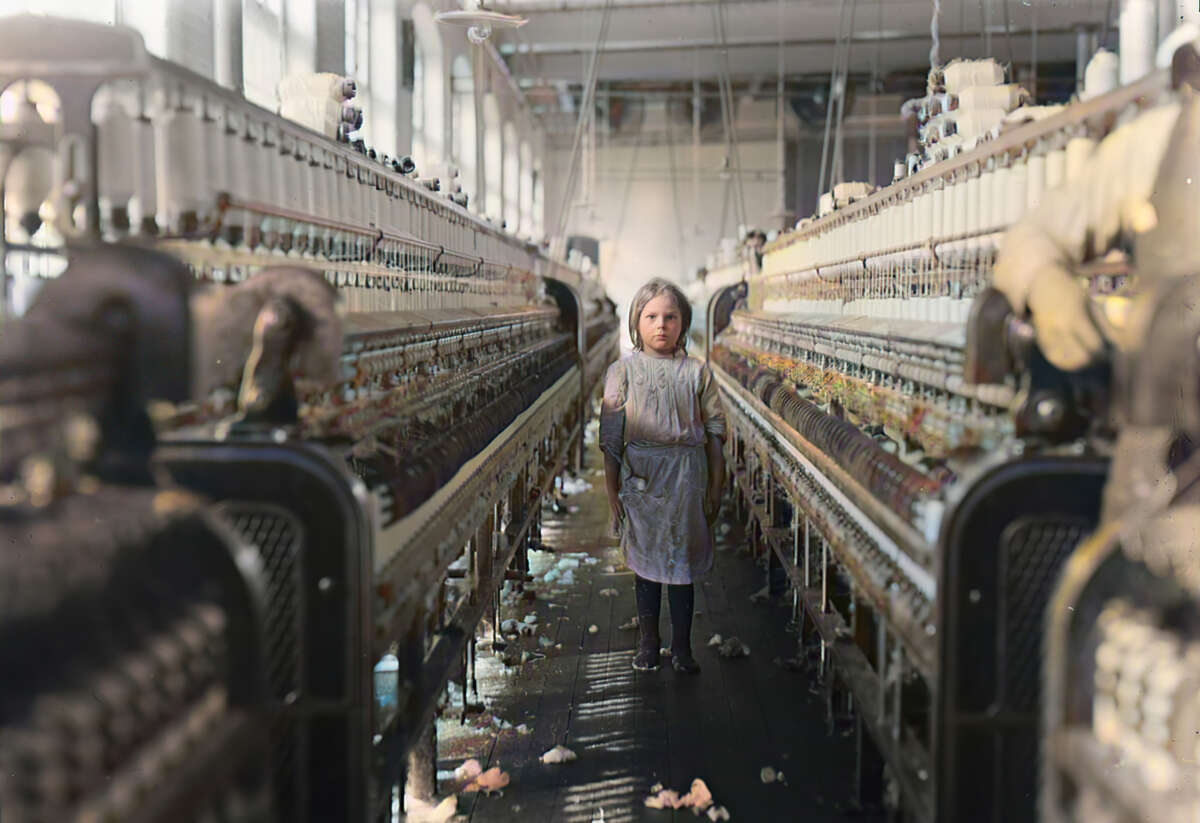
A colorized photo depicts a child laborer standing among machinery in a cotton mill in Newbery, South Carolina, 1908.

To the shock of many, the issue of exploited child labor has been grabbing headlines in the United States In late February, The New York Times published a major exposé that documented how migrant children as young as 12 are working as roofers and food deliverers, in slaughterhouses and industrial factories, for major corporations and private equity firms, suffering injury and even death, while authorities have ignored warnings and punished whistleblowers.

All this comes as a barrage of states, driven by corporate lobbying and billionaire dark money, move to weaken child labor laws. For example, Iowa’s new legislation loosening child labor regulations was virtually written by industry lobbyists and secretive think tanks funded by wealthy far right donors.

A big reason these developments feel so startling is because the battle against child labor at the state and federal level was — so we thought — fought and won long ago through a decades-long campaign that began in the late 19th century and ended with the passage and upholding of the 1938 Fair Labor Standards Act.

It is an apt moment to revisit that fight against child labor: This year marks the 120th anniversary of the famed protest, the 1903 March of the Mill Children, led by the legendary labor leader, Mother Jones.

Called “the most dangerous woman in America” by West Virginia District Attorney Reese Blizzard for her ability to “[crook] her finger” and have “20,000 contented men lay down their tools and walk out,” Mother Jones may have been the most famous woman in the U.S. during the early 20th century. An unmatched orator driven by a bottomless love for the working class, she overcame personal calamity to reinvent herself as the adored mother figure of the labor movement and as a crusader against child labor


Bills Enabling Child Labor Can Be Traced to This One Conservative Lobbying Group
The Foundation for Government Accountability has backed bills to expand child labor in at least three states.
By Sharon Zhang , TRUTHOUT
April 24, 2023

This May Day, as the injustices she fought against rear their heads once again, the history of Mother Jones — her 1903 children’s march, as well as her indomitable spirit that inspired thousands to fight — are as relevant as ever.

“She Was the Walking Wrath of God”

“She had force, she had wit, above all she had the fire of indignation — she was the walking wrath of God.” So wrote the famed muckraker Upton Sinclair sometime after the 1914 Ludlow Massacre in a fictional description of Mother Jones. By then, she was already an icon, the most notorious labor leader in the U.S.

But before she became Mother Jones, she was Mary Harris, born in Cork, Ireland, in 1837. The Great Famine drove her family to Toronto in the early 1850s. After stints as a teacher and seamstress in Chicago, Harris moved to Memphis, Tennessee, and married George Jones, a proud member of the Iron Molders Union. She soon bore four children, but disaster struck in 1867 when a yellow fever epidemic ripped through Memphis. In the span of a week, Mary Jones’s entire family perished.

Mary Jones almost never mentioned this catastrophe later in life, but it drove her transformation into Mother Jones.

“This is really the most important event in her life, and of course, it’s not the sort of thing one gets over, even if you don’t talk about it,” Elliott Gorn, author of the definitive biography of Mother Jones, told Truthout. “I really think that was what put the emotional dynamite into her life that allows her to go out and be this fearless organizer — she had nothing left to lose.” She soon moved back to Chicago and set up a dressmaking shop. It burned down in the Great Chicago Fire of 1871.

For the next 25 years, Mary Jones virtually disappeared. We know from her autobiography that she attended workers’ meetings, and joined the Knights of Labor. Then suddenly she reemerged toward the end of the century in a new public persona, Mother Jones, defender of workers’ rights everywhere.

Clad in an ornate, black Victorian dress and hat with her fluffy white hair falling into wire-rimmed spectacles, she mesmerized throngs of miners and mill workers with a piercing voice that flouted genteel etiquette, berating them like an angry grandmother to fight.

Portrait of Mother Mary Jones, the famous labor leader, on December 18, 1918.
Portrait of “Mother” Mary Jones, the famous labor leader, on December 18, 1918.

Gorn stresses how Mother Jones intuited a reworking of dominant ideas about gender and age to create a character that gave her power and influence to serve the labor movement.

“A poor, elderly, Irish immigrant woman: that is not a place of power in American society, or even in labor unions, which are mostly very male,” said Gorn. “But the character of Mother Jones gave her a source of power: the mother of the labor movement, the fearless protector of her brood.”

She even lied about her age, claiming she was a full seven years older than she really was. “She’s increasing her venerability,” said Gorn. “She wants to be able to go to a group of tough coal miners and say, ‘If me, an old woman, can be out here risking my neck, certainly you men can be doing the same.’”

From the late 1890s through her death in 1930, Mother Jones would become a national celebrity, and, for many workers, an almost mythical figure: the matron of the family of labor; the mother of soot-covered coal miners from Pennsylvania to Colorado; the nemesis of robber barons; speaking profanities in her Irish accent, urging workers to unite across divisions of race, gender and nationality, facing down armed mine guards, enduring arrests and prison time with aplomb.

As Gorn writes, “The first half of Mary Jones’s life prepared her for the task of becoming Mother Jones.” She was a survivor. She was angry. She carried with her a “suppressed rage” that she channeled into the fight for justice. She wanted workers to fight.

And nothing drew her wrath more than child labor.

“Well, I’ve Got Stock in These Children”

According to the 1900 U.S. census, one in five children under 16 years of age were employed (though that is certainly an underestimate). Then, as now, many of them were immigrants.

In 1903, nearly 75,000 textile workers struck in Philadelphia, including 10,000 children — “stooped things, round shouldered and skinny,” wrote Mother Jones. Pennsylvania was second only to Alabama in its number of child laborers, and, according to Mother Jones, when she asked reporters why they refused to cover the issue, they responded that they couldn’t because the mills’ owners had stock in the newspapers.

“Well, I’ve got stock in these little children,” she said, “and I’ll arrange a little publicity.”

She assembled a crowd of children in the city’s historic Independence Park, shouting at and shaming nearby city officials. “I held up their mutilated hands and showed them to the crowd and made the statement that Philadelphia’s mansions were built on the broken bones, the quivering hearts and drooping heads of these children,” she later wrote. “That their little lives,” she added, “went out to make wealth for others.”

She berated local officials as they passed by, lifting up gaunt children and yelling, “Some day the workers will take possession of your city hall, and when we do, no child will be sacrificed on the altar of profit.”

Met with only shrugs, Mother Jones concocted a brilliant public relations move: She would take the mill children on a weeks-long march from Philadelphia, up through New Jersey, past New York City, and all the way to Theodore Roosevelt’s summer mansion on Oyster Bay, Long Island. They would demand to speak to the president.

Mother Jones announced the march to the public on July 7, 1903, and soon set off with around 100 children carrying placards that read “We want time to go to school” and “We want time to play.” The media following them from town to town as they stopped in cities like Trenton, New Brunswick and Princeton, where Mother Jones spoke to a large crowd gathered near the town’s storied university about “higher education.”

“Here’s a textbook on economics,” she said, pointing to a “little chap” of 10 years who was “stooped over like an old man from carrying bundles of yarn that weighed 75 pounds.”

“He gets three dollars a week and his sister who is 14 gets six dollars,” she shouted. “They work in a carpet factory 10 hours a day while the children of the rich are getting their higher education.”

She lambasted not only the mill bosses but also their owners on Wall Street — the bankers and investors who were the ultimate profiteers behind child labor.

Gorn says the children’s march was a major success. “It was just a constant drumbeat of news. She just had this remarkable flair for the dramatic.” He emphasizes that while moral outrage drove Mother Jones’s hatred for child labor, it also symbolized, for her, capitalism’s cutthroat degradation of all workers.

“She understood that it’s a mistake to think of child labor as a separate category from all of labor,” he said. “One of the reasons you organize the children’s march is not just because it’s terrible exploitation of children, but because their cheap labor undercuts the work of adults.”

Mother Jones continued the march — smaller after a torrid heat wave shrunk its initial numbers — through Manhattan and Coney Island and finally, on July 28, to Oyster Bay, where Roosevelt refused to meet with them.

Nevertheless, the march was a resounding success, with the media closely covering the high drama. “She gained invaluable publicity for the issue of child labor,” wrote Gorn.

Moreover, the march was an important early catalyst for the reform movement that, in stops and spurts in the decades to come, ultimately won federal regulation regulating child labor.

“Pray for the Dead and Fight Like Hell for the Living”

After her death in 1930, Mother Jones faded softly from national memory, though not in the coal-mining communities that were her strongest base.

The award-winning actress Kaiulani Lee first learned about Mother Jones while performing in Appalachia during her tours with the NYC Street Theatre in the 1970s. She remembers visiting a miner’s cabin with an image of Jesus Christ hanging on the wall. Nearby, she saw another picture of an “old woman in Victorian garb.”

“I recognized Christ, but I didn’t know who she was,” Lee told Truthout.

Lee read Mother Jones’s autobiography and never forgot about her. Decades later, Lee decided to use her incredible writing and acting talents to bring Mother Jones back to life. “I knew hers was the voice that could speak for workers,” she said.

You can get a sense of what Mother Jones’s powerful presence must have felt like by watching Lee’s performance in the highly lauded new film, Fight Like Hell, praised by everyone from the Amazon Labor Union’s Chris Smalls to the Association of Flight Attendants’ Sara Nelson.

The 55-minute film takes place around the time of the 1921 Battle of Blair Mountain, perhaps the most violent strike in U.S. history. Mother Jones is in a secluded cabin in the woods of West Virginia.

“There is a war between the classes,” she begins, in her faint Irish brogue. “I have been present in that war for half a century.” What follows is an acting masterpiece, a one-shot monologue, where Lee takes you through the intense drama — and unfathomable tragedy — of Mother Jones’s life, all in the labor leader’s own words. The film is tense, brilliant, emotional, and most of all, invites the viewer to join in struggle.

Lee’s Mother Jones discusses the issue of child labor and recounts the children’s march.

“Struggle and lose, struggle and win,” she says during one of the film’s dramatic crescendos. “That’s the story down the stairway of the ages.” The film captures the spirit of struggle that drove Mother Jones’s life, and by example, pleads with us to continue that struggle today.

I watched the film from beginning to end twice, and both times it left me teary-eyed and filled with fire and fight, eager to dash to any rally or picket line within reasonable distance. I hope it is shown widely in union halls, left-wing bookstores and college campuses across the country.

Others are also keeping Mother Jones’s legacy alive. During the historic 1989 Pittston coal strike, dozens of women, mostly miners’ family members, banded together as the “Daughters of Mother Jones,” waging militant action to support the strike.

The Chicago-based Mother Jones Museum & Heritage Project holds regular events in her honor and, after years of campaigning, won permission to build a Mother Jones statue at a prime location in the Windy City.

In 2021, when striking Warrior Met Coal miners in Alabama staged a national solidarity rally, a 12-foot inflatable replica of Mother Jones, her fist in the air, greeted the gathering.

There’s a reason Mother Jones lives on: Through personal tragedy, she emerged as the very embodiment of labor’s struggle, a transcendent voice, mothering and thundering, that could wipe the fear and lethargy from the eyes of workers and embolden them to fight. When workers across the world today invoke her most famous slogan — “Pray for the Dead and Fight Like Hell for the Living” — they are recalling that spirit of solidarity and struggle that she embodied and tried to bestow on others.

One-hundred-and-twenty years after the iconic children’s march, with migrant kids filling factories and slaughterhouses, with our own modern-day robber barons strong-arming a rollback of child labor laws, and with thousands of workers, from coffee shops to warehouses, recreating anew labor’s militant tradition, the legacy of Mother Jones is as relevant as ever. She inspires workers today just as she did over a century ago.

The U.S. Should End Child Labor in Agriculture | Opinion

MARGARET WURTH , SENIOR CHILDREN'S RIGHTS RESEARCHER, HUMAN RIGHTS 
ON 5/2/23 

An important national conversation is happening on the harsh reality of child labor in the United States after it was revealed that many unaccompanied immigrant children are involved in hazardous work. But a group of often disregarded U.S. child workers—those working in agriculture—have been largely left out of the discussion and desperately need greater protection.

The U.S. Department of Labor has seen a sharp increase in child labor violations in recent years. It recently found over 100 children working dangerous, overnight shifts in meatpacking facilities. In late February, the Biden administration committed to step up child labor enforcement efforts.

Enforcement is essential, but it can't help children who are working dangerous jobs that are completely legal.

Over the last decade, I have researched the dangerous conditions children face while working in U.S. agriculture. I interviewed a 17-year-old boy who had two fingers sliced off in an accident with a mowing machine. A 13-year-old girl felt so faint working 12-hour-shifts in the heat that she had to hold herself up with a tobacco plant. An eighth grader said his eyes itched and burned when a farmer sprayed pesticides in a field near his worksite.

These were not children working on their own families' farms. These children were working as hired laborers, often on large commercial agribusiness operations.

Unlike situations in which children are working in meatpacking plants or on construction sites, almost none of the child labor I documented violated U.S. law or regulations. That's because children working in agriculture lack even the basic legal protections given to children working in all other workplaces in the U.S.

Longstanding exemptions in U.S. labor law allow children as young as 12 to work legally as hired laborers on commercial farms for unlimited hours with a parent's permission. At 16, children working on farms can do tasks considered particularly hazardous. In every other workplace, children have to be 16 to work full-time and 18 to do hazardous work.

The agricultural exemptions in U.S. labor law date back to New Deal-era legislation. They were intended to exclude Black workers from the rights and protections given to white workers, preserving a system that allowed employers to continue to profit off of racist exploitation, denying Black workers opportunities for economic advancement. The exemptions continue to have racist impacts, with Latinx children and families now most harmed.

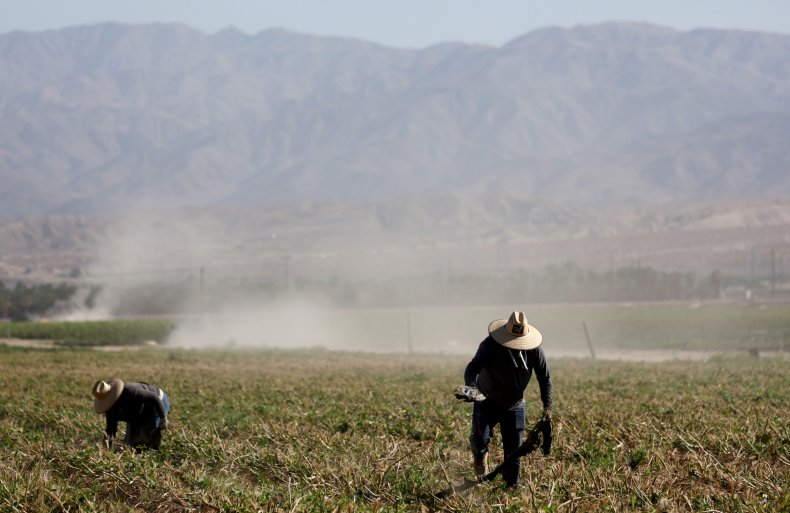
Farm workers clear out hosing which was used to irrigate an okra field on July 13, 2022, near Coachella, Calif.
MARIO TAMA/GETTY IMAGES

The weak protections are of great concern because more children die working in agriculture than in any other sector. Like the children I interviewed, thousands are injured or sickened each year while working on farms.

Members of Congress will soon reintroduce the Children's Act for Responsible Employment and Farm Safety, or the CARE Act, legislation to provide children working in agriculture with the same protections as children working in other sectors. The legislation would raise the minimum age for children's work on farms, and set the hazardous work age at 18, in line with all other kinds of work. The bill has never reached a floor vote. Congress should enact the legislation without delay.

Even without passage of a new law, under the leadership of Acting Secretary Julie Su, the Labor Department has a responsibility to update narrow, 50-year-old regulations governing hazardous work in agriculture. It should open new rulemaking on the topic swiftly.

Enacting better protections at the federal level is more important than ever as at least 10 states have moved to roll back child labor protections and put younger children to work in more dangerous conditions.

A strong legal framework will not end child labor overnight. Farmworkers need a living wage so they can support their families, and workers must be able to exercise their rights to organize and collectively bargain. Strong social protection programs can also provide relief to families experiencing economic insecurity.

But strong child labor laws are the foundation for protecting children from hazardous and exploitative work and set reasonable expectations for employers and companies to follow. It gives labor inspectors basic minimum standards to enforce. And most important, in line with international human rights law, strong laws affirm that children have a right to be protected from dangerous work that could harm their health and development or interfere with their schooling.

Child farmworkers in the U.S. lack that basic foundation.

U.S. leaders will not fix the country's child labor problem unless they commit to protecting all children from exploitative and hazardous work, including those working on farms.

Margaret Wurth is a senior children's rights researcher at Human Rights Watch.

The views expressed in this article are the writer's own.
Entire Super Mario Bros. movie was posted to Twitter, seen by millions

The animated film based on the Nintendo classic game has grossed over $1 billion in theaters. The film was posted to Twitter over the weekend.


Photo by: Nintendo and Universal Studios via AP

By: Scripps News Staff
Posted May 02, 2023

It's possibly one of the biggest entertainment surprises of the season, as the animated film "The Super Mario Bros. Movie" has seen success grossing over $1 billion at the box office since its release.

Another surprise came over the weekend after someone posted the entire film to Twitter, where it remained long enough for millions of people to watch the movie for free.

As Forbes reported, when Twitter employees were dealing with large-scale layoffs after billionaire Elon Musk's high-profile takeover of the social media giant, one contractor who worked with moderation on the site said, "I’m just really fearful of what’s going to slip through the cracks."

A significant number of employees with Twitter's trust and safety teams were made redundant, while video length allowances were hiked from 140 seconds to 60 minutes.

Gamespot cast doubt on Twitter's ability to now prevent piracy, which is still a large concern for the Hollywood.

Cartoon Brew reported that multiple verified Twitter accounts leaked the film, along with "Avatar" as well.

While Forbes reported that millions potentially viewed the film, others say it's hard to know exactly how many saw it or reproduced it. But what is clear is that it appeared that over 9 million accounts saw the tweet before Twitter took it down and suspended the account.