Wednesday, May 17, 2023

NASA spots sign of El Niño from space: 'If it's a big one, the globe will see record warming'

Story by Hannah Osborne • Yesterday  May 16,2023

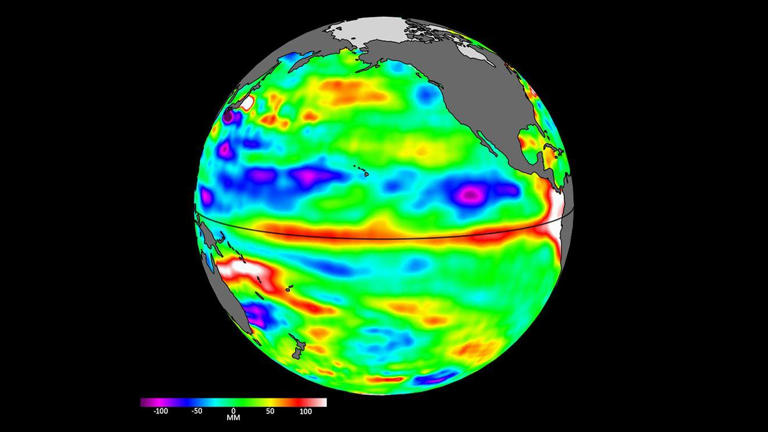
Data from the Sentinel-6 satellite on April 24 shows higher and warmer ocean water at the equator and the west coast of South America.© NASA/JPL-Caltech

NASA has identified early signs of El Niño from space, after one of its satellites spotted warm water in the Pacific Ocean moving eastward toward the west coast of South America in March and April.

Data from the Sentinel-6 Michael Freilich satellite, which monitors sea levels, showed Kelvin waves moving across the Pacific. These long ocean waves are just 2 to 4 inches (5 to 10 centimeters) high but are hundreds of miles wide. They are considered to be a precursor to El Niño when they form at the equator and move the warm upper layer of water to the western Pacific.

"We’ll be watching this El Niño like a hawk," Josh Willis, a project scientist on Sentinel-6 Michael Freilich at NASA's Jet Propulsion Laboratory (JPL), said in a statement. "If it's a big one, the globe will see record warming."
How often does El Niño occur?

El Niño is a part of the El Niño-Southern Oscillation (ENSO) climate cycle. Normally, prevailing easterly winds along the equator, known as trade winds, blow surface water west across the Pacific, moving warm water from South America towards Asia. As the warm water moves, cold water rises up to replace it.

Related: Mysterious, ultra low-frequency noises detected in Earth's atmosphere — and scientists can't explain them

El Niño is linked to weakened trade winds, causing the warm water to be pushed east.

This causes a significant impact on weather patterns around the world. For the U.S., it means wetter weather in the southern parts and hotter weather in northwestern areas.

Related video: World could face record temperatures in 2023 as El Nino returns (WION)
Duration 2:38   View on Watch

Its counterpart, La Niña, has the opposite effect, with strong trade winds pushing more warm water west.

El Niño normally hits once every three to five years, but it can occur more or less frequently. The last El Niño was in 2019 and lasted for six months, between February and August.

Is it an El Niño year?

On May 11, National Atmospheric and Oceanic Administration (NOAA) representatives said there was a 90% chance El Niño would hit this year and persist into the Northern Hemisphere's winter. According to NOAA's predictions, there is an 80% chance it will be at least a moderate El Niño — where ocean surface temperatures rise by 1.8 degrees Fahrenheit (1 degree Celsius).

There is a 55% chance of a strong El Niño, with temperatures rising by 2.7 F (1.5 C), NOAA said.

A statement from JPL released May 12 said images taken by the Sentinel-6 satellite between the start of March and the end of April show Kelvin waves moving warm water east, pooling it off the coasts of Colombia, Ecuador and Peru. The red and white parts of the animation represent warmer water and higher sea levels.

"Ocean waves slosh heat around the planet, bringing heat and moisture to our coasts and changing our weather," Nadya Vinogradova Shiffer, NASA program scientist and manager for Sentinel-6 Michael Freilich, said in the statement.

The NOAA and NASA will continue to monitor conditions in the Pacific over the coming months to determine if and when El Niño will hit — and how strong it could be. "Here in the Southwest U.S. we could be looking at another wet winter, right on the heels of the soaking we got last winter," Willis said.

In April, scientists recorded the highest ever ocean surface temperatures, with the global average reaching 69.98 F (21.1 C). This record reflects the impact of climate change and the last La Niña coming to an end. "Now La Niña is over and the tropical Pacific, which is a huge expansive ocean, is warming up," Michael McPhaden, an oceanographer at the NOAA Pacific Marine Environmental Laboratory, previously told Live Science.

Willis told Nature the combination of El Niño and supercharged ocean temperatures could mean a "string of record highs" in the next 12 months. “This coming year is gonna be a wild ride if the El Niño really takes off," he said. 

More than a third of the area charred by wildfires in Western North America can be traced back to fossil fuels, scientists find

Story by Rachel Ramirez • CNN
 Monday, May 15,2023

Millions of acres scorched by wildfires in the Western US and Canada — an area roughly the size of South Carolina — can be traced back to carbon pollution from the world’s largest fossil fuel and cement companies, scientists reported Tuesday.

The study by the Union of Concerned Scientists, published in the journal Environmental Research Letters, found that 37% of the area burned by wildfires in the West since 1986 — nearly 19.8 million acres out of 53 million — can be blamed on the planet-cooking pollution from 88 of the world’s major fossil fuel producers and cement manufacturers, the latter of which have been shown to produce around 7% of all carbon dioxide emissions.

The amalgam of megadrought and record-breaking heat that’s drying out vegetation due to climate change has stoked the West’s wildfires. And researchers found that since 1901, and the fossil fuel activities of these companies, including ExxonMobil and BP, among others, warmed the planet by 0.5 degrees Celsius — nearly half of the global increase during that period.

Carly Phillips, a research scientist with the Science Hub for Climate Litigation at the Union of Concerned Scientists and co-author on the study, said the findings add to a significant library of research that directly links climate change or the impacts of the crisis to burning fossil fuel.

“We know that many of these companies have known for decades about the consequences of climate change,” Phillips told CNN, referring to several studies and award-winning reports that have shown fossil fuel executives knew of but downplayed the growing threat. “But instead of sharing that information with the public, they engaged in this deliberate misinformation campaign to deceive the general public and cast doubt on climate science.”

Fossil fuel companies have denied the conclusions of those reports.

“The clear agenda of this group aside, America’s oil and natural gas industry is focused on delivering affordable, reliable energy while reducing emissions,” Christina Noel, a spokesperson for the American Petroleum Institute, which represents the oil and gas industry in the US, told CNN in an email.

BP and Exxon have announced goals to achieve net-zero emissions in its operations by 2050. CNN reached out to BP and ExxonMobil about Tuesday’s study, but did not hear back in time for publication.


A wildfire burns a section of forest in the Grande Prairie district of Alberta, Canada, Saturday, May 6, 2023. - Government of Alberta Fire Service/The Canadian Press/AP

The study comes as firefighters in Alberta, Canada, fight dozens of wildfires in the forest protection area of the province — fires that are being exacerbated by a dangerous heat wave with record-breaking temperatures in Western Canada and the US Pacific Northwest.

Researchers behind the study came to their conclusions using a method that scientists have relied on in recent years to quantify how much of a role the climate crisis is playing in extreme weather and environmental disasters: They took actual climate data and compare it to an idealized, modeled version of the world where there was no fossil fuel pollution from the 88 companies.

One metric they focused on was the region’s so-called vapor pressure deficit — or how thirsty the atmosphere is for moisture. It is a key indicator of fire danger and drought, Phillips said, and measures how much the air is sucking moisture out of soil and plants, which then ultimately become fuel for wildfires.

The methodology is “simple,” said Caroline Juang, researcher with the Lamont-Doherty Earth Observatory at Columbia University.

“The study takes what we know about the strong relationship between climate and burned area, and extends this understanding to the role of big fossil fuel emitters,” Juang, who is not involved with the study, told CNN. “The authors use how global mean temperatures scales with [vapor pressure deficit] and then looks at how changes in [vapor pressure deficit] will change burned areas.”

The researchers also accounted for aerosol pollution, which unlike planet-warming gases like carbon dioxide or methane, reflects sunlight back to space and has a cooling effect. Major oil and gas companies contribute roughly two-thirds of total industrial aerosol emissions, according to the study, which used fossil fuel emissions data through 2015, the latest available, and held figures constant from 2015 to 2021.

Jatan Buch, a postdoctoral research scientist in the Lamont-Doherty Earth Observatory at Columbia University, who was also not involved with the study, said that while vapor pressure deficit is the leading driver of year-to-year variability in burned area across the region, other factors play a role and should be examined in future studies. According to the study, those include precipitation and snowpack conditions and prescribed burns and fire suppression efforts that have led to a buildup of vegetation that help fuel fires.

The report also noted that development and growth contributed to a higher risk of human behavior-caused fires, with more people and property in harm’s way.


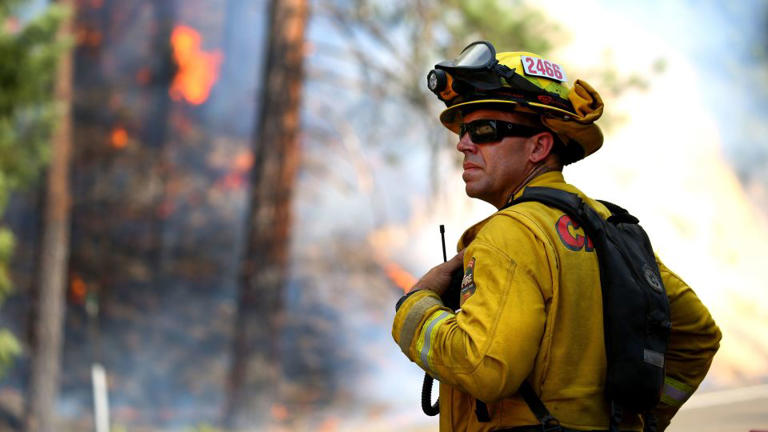
A firefighter monitors fire movement as it crosses Highway 299 in California.
 - Kelly Jordan/USA Today Network/Reuters

In recent years, fires have exhibited increasingly explosive behavior — leading to larger burned areas, more aggressive nighttime fires and even massive fire-induced tornadoes like in the Carr Fire in California in 2018. The largest fires are also pouring smoke into the atmosphere, which can be transported large distances, impacting millions with poor air quality potentially hundreds of miles away.

“Even if you’re not living near the fire, you can still feel those impacts,” Phillips said. “What public health experts share is that there’s no amount of exposure to wildfire smoke that’s safe.”

Climate scientists have said human-caused climate change plays a key role in making these extreme fire events worse and more likely to happen. Jennifer Marlon, a research scientist at the Yale School of the Environment, said that’s why this study is so important.

“It shows how quickly the science about climate change causes is moving and gives us vital information about the very real harms to people from pollution from burning coal, oil and gas,” Marlon, who is not involved with the study, told CNN.

“The failure of fossil fuel companies to abate their emissions after recognizing the climate risk of their activities in the mid-1960s is even more reprehensible,” Buch told CNN. “The continued greenhouse gas emissions due to these companies’ products in the late 20th century resulted in loading the dice for the western US climate toward a hotter and drier future with a higher likelihood of catastrophic wildfires.”

Phillips said the key message they want people to take away from this study is that fossil fuel companies need to be held accountable for exacerbating extreme climate events like wildfires, which are putting lives at risk.

“It didn’t have to be this way,” she said. They “should pay their fair share of the costs of these climate impacts.”
Alberta Wildfires: Two new evacuation orders issued as fires continue to burn out of control

Story by Anna Junker • Yesterday 

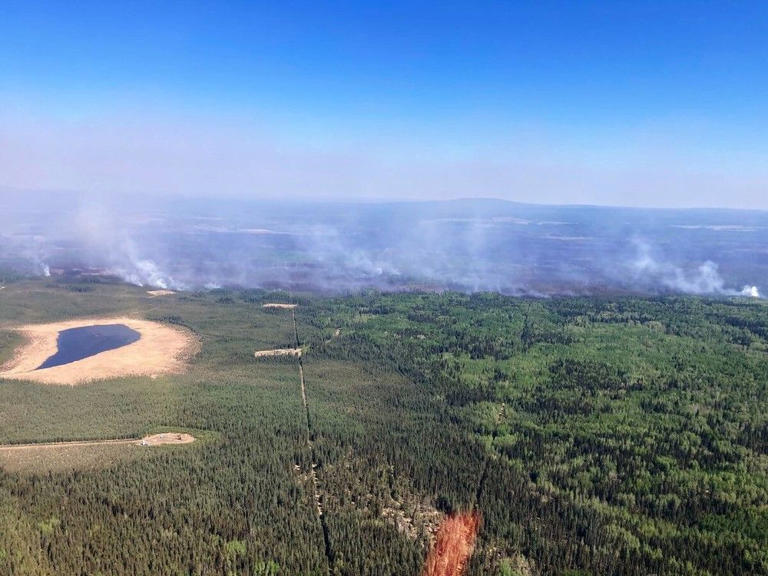
Smoke seen from wildfire EWF-035, located three kilometres from Shining Bank. The wildfire was detected on May 5, 2023.
 Photo supplied by Alberta Wildfire.© Provided by Edmonton Journal

New evacuation orders have been issued for communities west and north of Edmonton as numerous wildfires continue to burn out of control in the province.

At about 5:30 a.m. Tuesday, officials ordered everyone in Peavine Métis Settlement, in Big Lakes County, to evacuate due to an out-of-control wildfire that is an estimated 65,000 hectares.

The settlement, located approximately 56 kilometres north of High Prairie, has a population of 993 people and borders Gift Lake Métis Settlement.

Evacuees should proceed to the Kapawe’no Centre in Grouard, Alta., or to the Smoky River FCSS in Falher.

Just after 8 p.m. Monday, Yellowhead County issued an evacuation order for the Shining Bank Lake area.

The evacuation area includes north of Township Road 550, east of Highway 32, south of Township Road 570 east to Range Road 130, south to Township Road 561, and west of Range Road 120.


An evacuation order has been issued for the Shining Bank Lake area due to an out-of-control wildfire. Photo supplied.

The wildfire, EWF-035, is about three kilometres east of Shining Bank Lake and is an estimated 5,951 hectares.

A reception centre has been set up for evacuees at the Holiday Inn in Edson, located at 4520 2 Ave.

Yellowhead County said in an update on Facebook that crews continue to work through the night in the Shining Bank and other wildfire areas.

This includes structural protection, and crews will be out with special flags for approximately 100 homes in the county to identify the placement of pumps and structural protection sprinklers.

As of Tuesday morning, there are 87 active wildfires in the province with 24 out of control.

Related
Alberta Wildfires: Students displaced for 10 days or more to be exempt from diploma exams

Forestry, Parks and Tourism Minister Todd Loewen, Colin Blair, executive director of the Alberta Emergency Management Agency, and Christie Tucker, information unit manager with Alberta Wildfire, are scheduled to provide an update on the fire situation at 3 p.m. Tuesday.

Tucker said on Monday that the hot, dry and windy conditions over the weekend posed a challenge for firefighters. A change in the wind was also expected Monday which could lead to unpredictable fire behaviour.

“It could also affect the movement and intensity of wildfires,” she said. “Winds are expected to shift from the southeast to the northwest with gusts of up to 50 kilometres an hour. Combined with the heat and dryness, this will cause dangerous conditions for our firefighters on the ground.”

Meanwhile, some essential workers have been allowed to return to Drayton Valley and Brazeau County.

Select workers for critical infrastructure including hospital, power and gas utilities and retail services such as grocery stores, gas stations, and pharmacies have been allowed entry into the evacuation area, the town said in an update on Facebook .

The workers are under a “shelter-in-place order” to re-establish services in preparation for when it is safe to lift the evacuation order.

The town said “great progress” has been made on getting full containment on the fire guard despite adverse firefighting conditions.

An out-of-control wildfire in the area that is an estimated 4,958 hectares forced the evacuation of the town and parts of Brazeau County on May 4.

Sudan war lays bare 'fault lines' between capital and periphery

Issued on: 17/05/2023 


Black smoke billows over war-torn Khartoum in this image from AFPTV footage taken on April 19, 2023 
© Abdelmoneim SAYED / AFP/File

Cairo (AFP) – Sudan's brutal war has pitted the traditional urban elite that has long monopolised wealth and power in the capital Khartoum against forces from the marginalised rural periphery, analysts say.

For the past month, two rival generals have fought for control of the northeast African country in a war that has spread chaos, claimed at least 1,000 lives and displaced nearly a million people.

One of them is army chief Abdel Fattah al-Burhan, a lacklustre career soldier, born north of Khartoum, who toppled the veteran Islamist autocrat Omar al-Bashir after mass protests and then assumed full powers in a 2021 coup.

Also known as "Hemeti" or "little Mohamed", Daglo got his start in the notorious Janjaweed militia that Bashir unleashed in the early 2000s to brutally quash a rebellion by ethnic minority groups in Darfur.

In the years since, Daglo has manoeuvred his way into the top echelons of power in the capital of five million people, even as he has been mocked among its elite for his provincial accent and lack of formal education.

The Khartoum-centred old guard "view Hemeti as an illiterate upstart thug whom they first armed to do their dirty work" in Darfur, said Alan Boswell of think tank the International Crisis Group.

Sudan's army chief Abdel Fattah al-Burhan, pictured on the left, has been at war with his former deputy, Rapid Support Forces commander Mohamed Hamdan Daglo
 © ASHRAF SHAZLY / AFP/File

However, since then, Daglo has become a feared opponent, commanding the heavily armed RSF which is battle-hardened by service in Yemen and Libya and financed with profits from gold mines he controls.

'New phase of struggle'

Sudan, a vast country of 45 million people, has a long history of inequality and strife involving ethnic minority groups in remote regions.

Civilians flee conflict-racked Sudan 
© Sophie RAMIS / AFP/File

Since its days under British rule, "Sudanese political society has been centralised in the Nile Valley," said Marc Lavergne, a specialist on the Horn of Africa and the Middle East.

Even after independence in 1956, "there has been this dichotomy between the Nile Valley, Khartoum, the parts that the British could make use of," and the rest of the country, he told AFP.

The more remote areas experienced decades of struggle "that no Khartoum government cared to address", said Lavergne of France's University of Tours who has worked for UN and non-government missions in Sudan.

"But today these peripheral regions hold the richest potential," he said, referring particularly to large gold deposits in Darfur and elsewhere, from which Daglo has built a military and economic empire.

Sudanese Army soldiers near armoured vehicles in southern Khartoum, seen on May 6, 2023 amid ongoing fighting against the paramilitary Rapid Support Forces 
© - / AFP/File

A Rift Valley Institute report judged that, as a result, "the RSF is no longer a rag-tag militia but rather a well-trained and effective fighting force that can rival" the Sudanese Armed Forces.

"The current conflict represents a battle between the established military-political elite from the centre and an emerging militarised elite from Darfur to control the state, and is a new phase in the struggle between centre and periphery."
Intruder from Darfur

Daglo has been depicted by his rivals as "an intruder from Darfur in more cosmopolitan Khartoum", said Kholood Khair, founder of the think tank Confluence Advisory.

"Before the war, the RSF were getting some traction in trying to create a narrative that they were fighting for democracy, and that they were doing so on behalf of all the marginalised people of Sudan," she told AFP.

As he built his force, Daglo became "one of the best employers in the country", recruiting fighters from areas "that had historically been marginalised by Khartoum," according to Khair.


A market devastated in El Geneina, West Darfur, as fighting continues in Sudan between the forces of two rival generals, on April 29, 2023
© - / AFP/File

But she added that, "once the war broke out, that narrative became more difficult to keep up" as "his troops are far less disciplined" than those of the regular army.

"They do not always follow orders and have been creating a lot of havoc for the people of Khartoum," she said, as reports of assaults against civilians, looting and home invasions have risen sharply.

The threat of deepening ethnic strife looms over Sudan, a diverse country at the intersection of historical migration and trade routes with a history of slavery.

Its rulers have historically exploited economic inequalities to divide and conquer, between the core and the periphery, between north and south, and based on skin colour.

"To this day, Sudanese have a lexicon of skin colour" that discriminates against those with darker pigmentation, Sudan specialist Alex de Waal wrote recently in the London Review of Books.

"The darkest people of the south (are) still routinely called abid, meaning 'slaves'."

Skin colour may not be a defining factor in the current war. But experts warn that a prolonged conflict will deepen fissures along the kinship lines and tribal affiliations on which Sudan's many existing militias were formed.

"Both sides will, as they lose troops, need to recruit more," said Khair. "And the easiest way to do that in Sudan has historically been through ethnic allegiances."

© 2023 AFP

Why is Sudan so prone to civil war?

Greg Myre
Updated May 10, 2023
NPR
LISTEN· 4-Minute Listen
Download

Sudanese refugees who crossed into neighboring Chad receive aid at a distribution center on April 30. A growing number of Sudanese are fleeing their country following recent fighting between two rival generals in Sudan's capital Khartoum.
GUEIPEUR DENIS SASSOU/AFP via Getty Images

When Sudan won independence on New Year's Day in 1956, two features stood out in the new nation: it was the largest country in Africa, and it was already embroiled in civil war that had erupted several months earlier.

Some see a link between Sudan's vast landscape, the many different groups that make up the country, and the repeated internal conflicts that have plagued the nation for decades.

For the past month, two rival generals have been feuding for control of the capital Khartoum, raising fears of another major conflagration.

"If you take Sudan, and you look at other large countries throughout the world, not just in Africa, they are almost always very difficult to govern," said Susan D. Page, a former U.S. diplomat who spent years working in the country.


Sudan's rival generals share a troubled past: genocide in Darfur

She's one of three former negotiators who spoke to NPR about the challenges of establishing and maintaining a peaceful, stable Sudan.

"When people are very different from one another — farmers, herders, nomads — it's always going to be quite difficult to rule," said Page.

Sudan has multiple fault lines.

Britain and Egypt jointly ruled Sudan for the first half of the 20th century and essentially treated the north and the south as two separate colonial territories.

That division carried over when Sudan became independent, with Arab Muslims in the north dominating the country, alienating African Christians and other groups in the south and the west.

Sudan has a wide range of ethnic, linguistic and tribal differences. Residents in remote parts of the country feel the elites in Khartoum monopolize the country's limited resources.


Gen. Abdel Fattah Burhan (left), the head of Sudan's ruling military council, greets supporters near the capital Khartoum in 2019. Sudanese paramilitary commander Gen. Mohammed Dagalo, widely known as Hemedti, is shown on the right, in the capital earlier this month. The generals have been fighting for control of Sudan for nearly a month, leaving more than 500 dead.
YASUYOSHI CHIBA/AFP via Getty Images

The result: Sudan has suffered three domestic wars spanning well over 40 years of the country's 67 years of independence.

Page helped negotiate the end of one civil war, back in 2005. She later became the first U.S. ambassador to South Sudan when it broke away from Sudan in 2011 (South Sudan fought its own civil war just two years after gaining independence).
Risk of renewed civil war

Page is now worried about the current fighting that pits Gen. Abdel-Fattah Burhan, the commander of the military, against Gen. Mohammed Dagalo, the head of the paramilitary Rapid Support Forces.


CONSIDER THIS FROM NPR
Violence In Sudan Forces A Mother To Make Difficult Choice

"I think we have a notion that powerful countries can sort of wave a magic wand and get people to stop doing what they're doing," said Page, who now teaches at the University of Michigan. "That is what diplomacy is about. But it's very difficult once the big guns literally have come out."

The previous conflicts, waged in the remote southern and western parts of Sudan, were disasters for one of the world's poorest nations.

Yet the current fighting could potentially be even more devastating. More than 500 people have been killed in and around Khartoum – by far the most developed part of Sudan, and home to more than 5 million people.

"What we're essentially seeing is the deterioration of the Sudanese state itself with consequences, first and foremost, for the Sudanese people," said Payton Knopf. He was the U.S. deputy special envoy to the Horn of Africa until last year and is still working in the region.

There's no easy solution. Knopf says previous peace deals kept military figures in positions of power — which created conditions that then led to future conflicts.

"It's sort of like saying you're going to put the foxes back in charge of the henhouse after the foxes have bombed the hen house and killed a lot of the hens," said Knopf.


How Sudan's Democratic Dreams Were Dashed

"I think it's time to retire the notion that a power-sharing arrangement in which the military or the Rapid Support Forces are the dominant actors is ever going to be a stabilizing decision," he added.
A history of long wars

The two feuding generals have effectively controlled the country for the past four years and shown no sign of ceding power.

Alex DeWaal at Tufts University is an expert on Sudan and was called to the country in 2005 as part of an African Union effort to negotiate an end to fighting in Sudan's western region of Darfur.

That peace effort failed, and the military's brutal crackdown on rebels and civilians in Darfur was deemed a genocide by the United States and others in the international community.

That experience taught DeWaal how hard it is to end conflict in Sudan.

"Quite a few times I've been meeting with Sudanese generals, and they have this mindset when they go to war, which is, 'We will land a knockout, killer blow on the other guy. We can win a decisive victory and don't stop us.' And they're always wrong. Invariably, they cannot achieve that decisive victory," said DeWaal.

As a result, Sudan's wars have been painfully long.

"I recall from so many meetings that glazed look in their eyes when they had resigned themselves, pretending they had no agency and that war was inevitable. Getting them out of that mindset to recognize, yes, they started it, and yes, they can stop it, is the challenge of the mediator."

The U.S., Egypt and Saudi Arabia all have influence in Sudan. The rival Sudanese factions have sent representatives to Saudi Arabia in an attempt to halt the conflict. They've been talking since Saturday, but there's no sign of a breakthrough.

Meanwhile, growing numbers of Sudanese civilians are fleeing the country. Further fighting could set off a massive refugee outflow to neighboring states ill-prepared to handle such an influx.

Susan D. Page says it's always Sudan's civilians who bear the brunt of these conflicts.

"I just hope that the Sudanese people themselves are not forgotten, that everyone will pay more attention to the Sudanese population and their wants and desires, and not just those of the men with weapons," said Page.

The Looming Danger of State Disintegration in Sudan

AMR HAMZAWY
MAY 03, 2023
COMMENTARY

Summary: After the latest outbreak of violence, the country’s transition to democracy appears to be a pipedream.

Sudan is no stranger to civil war, but the latest outbreak of violence is a disappointing step back from recent advances in democratic progress. After numerous attempts at a cease-fire failed, the country seems headed for another protracted conflict over numerous deep-seated issues—including human rights violations, marginalization of minority groups, concentration of power and wealth in Khartoum, the expanding political and economic role of the army and paramilitary groups, and pervasive poverty and underdevelopment.

The confrontation between the Sudanese National Army (SNA) and the paramilitary Rapid Support Forces (RSF) shows the limits of nonviolent political change in countries tainted by a long history of civil war and politically involved national armies and militias.

SUDAN’S POWER STRUGGLE


Known for its vast territory, ethnic and religious diversity, and natural riches, Sudan has witnessed a string of civil wars since gaining independence in the 1950s. At the core of this conflict lies a power struggle between Sudan’s political center in Khartoum and its southern and western peripheries. From 1989 to 2019, President Omar al-Bashir, in alliance with radical Islamists, persecuted non-Muslim populations and African tribes living in these remote regions.

A protracted civil war led to the creation of the independent Republic of South Sudan in 2011. In the western region of north Sudan—namely Darfur—successive civil wars between 2003 and 2011 brought about mass atrocities and the depletion of human and material resources.

In 2019, the army leadership ousted al-Bashir and jailed him and his closest aides in response to widespread pro-democracy protests demanding his removal from office. Two generals advanced to the political fore: Abdel Fattah al-Burhan and Mohamed Hamdan Daglo, better known as Hemedti. Hemedti led the Arab paramilitary group Janjaweed, which emerged as a product of the civil war in Darfur—where it massacred an estimated 300,000 people from 2003 to 2005—before evolving into the RSF in 2013.

Both generals led political negotiations with civilian protest representatives, but the transition to democracy was a mere pipedream.

Despite the United Nations’ active mediating role, lengthy discussions on governing were unable to permeate Sudan’s political landscape. All the while, tensions between the government center in Khartoum and the country’s peripheries, as well as between the army and civilian groups on the one hand and the army and paramilitary militias on the other hand, were on the rise. In 2021, civilian prime minister Abdalla Hamdok resigned amid political deadlock, and army leadership and the militias assumed total control of executive powers. A period of political instability and growing hardship for 45 million Sudanese citizens has followed.

UNRESOLVED CONFLICTS

Much of the current outbreak of violence stems from the failure to integrate various armed groups after al-Bashir’s ouster. The SNA, led by al-Burhan, dominated the Transitional Sovereignty Council, which assumed executive power after ousting al-Bashir. A significant political role was also played by Hemedti’s RSF militia, which was reluctant to integrate its enrolled soldiers and accumulated arms into the national army. Efforts to broker a binding agreement that banned the militias from using arms for political purposes and stipulated their integration in the national army largely failed in recent years, hindering Sudan’s transition.

In addition, power sharing negotiations between the SNA, the RSF, and civilian forces failed to integrate consensus building plans that championed political and economic change. The countless rounds of negotiations and signed agreements that took place between 2019 and 2023 could not bring about a result that satisfied the sentiments behind the 2019 uprising, which demanded democratic governance in the Khartoum center, just distribution of power and wealth, and political and economic inclusion across the country. Sudan’s transition to democracy was significantly encumbered by numerous widespread revolts in its peripheries, where marginalized communities lost faith in the prospects of positive change.

THE WAY FORWARD

In this climate of social and political disarray, clashes between the SNA and RSF have progressively intensified. Al-Burhan’s and Hemedti’s previously agreed-upon roadmap to integrate the RSF, military personnel, and arms into the army has been hijacked by Hemedti’s political ambitions to monopolize executive power, triggering an outbreak of hostilities in the past few weeks.

To avert the looming danger of a protracted civil war and state disintegration, both parties must first find their way back to negotiations that prioritize the inclusive integration of all military actors in the national army; otherwise, the current escalation will persist. This is a most needed measure to protect Sudan’s territorial integrity and save its state apparatus from disintegration.

As a second step, the leaders must establish constitutional and legal safeguards to ban the use of arms for political purposes and to protect local communities—in Darfur and elsewhere—that have faced persecution and human rights violations and suffered due to the impunity enjoyed by both state and nonstate actors.

A third step is to restore political negotiations between the army leadership and civilian politicians representing pro-democracy groups. Hamdok’s resignation, which followed deadly protests and stalled negotiations, resulted in widespread popular resignation regarding Sudan’s democratic prospects. Bringing Hamdok and other civilian politicians back to the negotiating table with army leaders—with some guarantees given to civilians by regional and international actors such as the African Union and the United Nations—could help restore citizens’ hopes in Sudan’s democratic transition and peaceful power sharing arrangements between military and civilian groups.

Unresolved tensions between Sudan’s center in Khartoum and the peripheries over political power and the distribution of wealth have also ignited the present conflict. The civil wars in Darfur and other remote regions may have been brought to cease-fire and truce arrangements in recent years, but their root causes—namely the prosecution and marginalization of non-Muslims and African tribes residing remotely—have not been addressed.

Both contenders in the current military confrontation, al-Burhan and Hemedti, have attempted to co-opt movements and leaders representing the rebellious peripheries and to instrumentalize them in the quest for total power. Yet none of them has used executive power to address the legitimate social, economic, and political demands of the people in these regions.

RELATED ANALYSIS FROM CARNEGIE
Disruptions and Dynamism in the Arab World

Indeed, poverty and underdevelopment indictors in Sudan have only worsened since 2019, and even more since the civilian participation in the executive branch of government was eliminated following Hamdok’s resignation. Unless the socioeconomic and political grievances of the Sudanese peripheries are addressed in future negotiations, both between military leaders as well as between the army and civilian groups, peace and stability in Sudan will prove illusive.

No longer a case of hopeful democratic transition, Sudan is severely at risk for state failure and disintegration. However, for the first time in decades, Khartoum has become embroiled in the violence, and its residents are paying the price for the long-term warmongering against the country’s peripheries and for the nationwide instability. As a result, the increased internal and external attention might pull Sudan out of its stalemate. Saving Sudan from the horrible fate of state disintegration and restoring the prospects of stability, and later for democracy and development, are possible if regional and international actors work to integrate the militias in the national army and facilitate political talks between military and civilian groups.

End of document

Amr Hamzawy
Amr Hamzawy is a senior fellow and the director of the Carnegie Middle East Program. His research and writings focus on governance in the Middle East and North Africa, social vulnerability, and the different roles of governments and civil societies in the region.

Carnegie does not take institutional positions on public policy issues; the views represented herein are those of the author(s) and do not necessarily reflect the views of Carnegie, its staff, or its trustees.

Sudan: From Conflict to Conflict
MARINA OTTAWAY, MAI EL-SADANY

MAY 16, 2012

PAPER

Summary: The failure of efforts thus far to bring peace to greater Sudan does not bode well for the chances of avoiding new conflict.


Less than a year after the old “greater” Sudan split into the northern Republic of Sudan and the new Republic of South Sudan—or North and South Sudan, for clarity—the two countries were again in a state of war. Years of international efforts to bring an end to decades of conflict by helping to negotiate the Comprehensive Peace Agreement of 2005 and later efforts to ensure a smooth separation of North and South appear to have come to naught.

In January 2011, a referendum in the South, stipulated by the Comprehensive Peace Agreement, resulted in an overwhelming vote in favor of partition. Over the next six months, North and South were supposed to negotiate outstanding issues but failed to do so. As a result, conflict broke out again almost immediately after the South became independent..

At first, the conflict involved clashes along the border region between the northern Sudanese Armed Forces and liberation movements in regions that preferred incorporation into the South. By April 2012 though, the fighting had escalated into war between North and South, with the South’s army crossing into the North and the North’s military bombing villages across the border. Oil exports from the South had been halted and other conflicts had broken out in both countries.

Oil has long been one of the central drivers of conflict between the two Sudans. After independence, that conflict was heightened since about 75 percent of Sudan’s oil is produced below the border that now separates the two countries, leaving the North with greatly reduced revenues. Another set of conflicts, which has quickly led to violence, involves attempts to control territories along the border between the North and South, in particular, in South Kordofan, the Blue Nile, and Abyei. Meanwhile, both North and South struggle with internal political and tribal conflicts as they try to build states on truncated territory and woefully inadequate institutional foundations.

The failure of efforts thus far to bring peace to greater Sudan, especially the Comprehensive Peace Agreement project, does not bode well for the chances of avoiding new decades of conflict and the countries’ continued impoverishment. All signs suggest that the transition from greater Sudan to the Republics of Sudan and South Sudan is not the end of a conflict but rather the beginning of multiple new ones.

Interactive Map

INCXYZ[SudanMap.html]INCZYX

Marina Ottaway
Before joining the Endowment, Ottaway carried out research in Africa and in the Middle East for many years and taught at the University of Addis Ababa, the University of Zambia, the American University in Cairo, and the University of the Witwatersrand in South Africa

TO READ OR DOWNLOAD
For the birds: High-input agriculture destroys habitats & biodiversity, devastating bird populations

Issued on: 17/05/2023 - 

04:26  Video by: Tom Burges WATSON

Intensive farming has led to an alarming decline in bird populations. For more analysis, and a deeper perspective on this worrying trend, FRANCE 24 is joined by Vasilis Dakos, CNRS Researcher, Institut des Sciences de l’Evolution de Montpellier (ISEM) at the University of Montpellier, France.

Turkey's opposition plots fightback against Erdogan

Issued on: 17/05/2023


Opposition leader Kemal Kilicdaroglu intends to run a more hard-edged campaign ahead of the second round 
© BULENT KILIC / AFP

Istanbul (AFP) – Turkey's opposition tried on Wednesday to recover from a crushingly disappointing election performance and launch a new attack aimed at beating President Recep Tayyip Erdogan in a May 28 runoff.

Secular leader Kemal Kilicdaroglu huddled with the other five heads of his alliance on Wednesday to plot a harder-edged strategy for ending Erdogan's two-decade domination of Turkey.

Media reports said he had fired his PR team and planned to tap Istanbul mayor Ekrem Imamoglu -- a feisty figure with a history of bad blood with Erdogan -- to spearhead his campaign.

The reported promotion of Imamoglu and the mayor's lauded strategist Canan Kaftancioglu marks a reversal for Turkey's grandfatherly opposition leader.

The 74-year-old former civil servant tried to run an inclusive campaign that addressed voters in chatty clips recorded from his kitchen and ignored Erdogan's personal barbs.

That approach worked -- up to a point.

The opposition deprived Erdogan of a first-round victory for the first time and collected more votes than in any point of his rule.

But Kilicdaroglu's 44.9 percent still trailed Erdogan's 49.5 percent of the votes.

Pre-election polls showed Kilicdaroglu leading and possibly even winning outright last Sunday.

Kilicdaroglu's fightback began with a video on Tuesday in which he stared straight into the camera and slapped his desk a few times after banging his heart with his fist.

"I am here! I am here!" he shouted. "I am here!"

'Slight deficiencies'


Erdogan looked far more relaxed as he assessed his performance on late-night television on Tuesday.

The 69-year-old conceded that his Islamic-rooted party had lost a few seats in parliament and suffered from "slight deficiencies".

Provisional results showed his conservative alliance's share falling from 333 to 322 in the 600-seat parliament.

"Unfortunately, my party suffered some declines, there is a slight deficiency," Erdogan said in the interview.

"We need to make our preparations to eliminate them. We will do our internal accounting and take the necessary steps."

It was a rare admission for Turkey's longest-serving leader.

But he spoke in measured tones befitting an incumbent who is entering the second round as the overwhelming favourite.


The remaining votes went to a little-known ultra-nationalist who has much more in common with the right-wing Erdogan than the leftist Kilicdaroglu.


Erdogan said he would visit southeastern regions this weekend that were hit by a catastrophic February quake in which more than 50,000 lost their lives.

The president retained strong support in the area despite initial anger at the government's delayed search and rescue work.

Erdogan added that his team will be meeting with younger voters in Istanbul and Ankara to try and win in Turkey's two most important cities.

Imamoglu and Ankara mayor Mansur Yavas beat out Erdogan's allies in 2019 municipal polls.
'Credible and consistent'

The campaign's second stage is being accompanied by Turkish market turmoil that has seen the lira near historic lows against the dollar.

Investors are starting to price in an Erdogan victory and the long-term continuation of his unconventional economic policies.

The cost of insuring exposure to Turkey's debt is rising out of fears that the country's once-vibrant banking sector could soon experience serious difficulties.

Erdogan's decision to force Turkey's central bank to fight historically high inflation with lower interest rates has put unprecedented pressure on the lira.


The lira has been under intense pressure during Recep Tayyip Erdogan's second decade of rule 
Sylvie HUSSON, Laurence SAUBADU / AFP

Analysts believe Erdogan tried to prop up the lira ahead of elections through indirect market interventions that drained Turkey's hard currency reserves.

His government also introduced rules that required banks to purchase more and more liras with their foreign currencies.

Some analysts warn Turkey might have to impose capital controls if Erdogan -- who has pledged to keep interest rates low as long as he remains in office -- does not reverse course.

"Our focus after the election will be whether the policy mix becomes more credible and consistent," the ratings agency Fitch said.

© 2023 AFP

Turkey’s Opposition Struggles to Chart Path as Runoff Nears


President Recep Tayyip Erdogan looks likely to benefit most from the votes that went to an ultranationalist candidate eliminated in the first round.

A poster in Ankara, the Turkish capital, on Monday showing the opposition candidate, Kemal Kilicdaroglu.
Credit...Sedat Suna/EPA, via Shutterstock

By Ben Hubbard, Safak Timur and Gulsin Harman
Reporting from Ankara, Turkey.
May 16, 2023

After heading into elections with high hopes, Turkey’s political opposition is struggling to fight off despair and plot a course to give their candidate a fighting chance against the incumbent, Recep Tayyip Erdogan, in a runoff later this month.

While Mr. Erdogan, bidding for a third five-year presidential term, failed to win a simple majority in Sunday’s election, he still led the opposition by a margin of about five percentage points. That, and a number of other indications, point to a win for the president in the second round on May 28.

Importantly, Mr. Erdogan looks likely to be the primary beneficiary of votes from supporters of an ultranationalist third candidate, Sinan Ogan, who has been eliminated despite a surprisingly strong showing over the weekend. The first-round results pointed to growing nationalist sentiment across the electorate that will probably boost the president.

All of that amounts to an uphill battle for the challenger, Kemal Kilicdaroglu, who heads a six-party coalition that came together with the goals of unseating Mr. Erdogan, restoring Turkish democracy, righting the economy and smoothing over frazzled relations with the West.

“Obviously, it is difficult,” said Can Selcuki, the director of the Turkey Report, which publishes polls and political analysis.

Sinan Ogan, an ultranationalist candidate, in Ankara this month. Despite being eliminated after Sunday’s vote, he made a surprisingly strong showing.
Credit...Burhan Ozbilici/Associated Press

Mr. Selcuki, who had predicted a stronger showing by the opposition, said that the coalition now appeared to have at least two options: find a way to increase turnout among supportive voters and adopt a more nationalist tone that might attract crossover votes.

So far, opposition leaders have publicly said very little about how they might modify their campaign before the runoff.

“I am here, I am here,” Mr. Kilicdaroglu, the opposition candidate, said in a video posted on Twitter on Monday that showed him uncharacteristically banging on a desk. “I swear I will fight to the end.”

In another post on Tuesday, he tried to rally younger voters, cautioning that a win by his opponent would lead to “a bottomless darkness.”

Still, the math does not appear to be in his favor.

Mr. Erdogan won 49.5 percent of the vote, versus 44.9 percent for Mr. Kilicdaroglu, according to the Turkish electoral authority. The third candidate, Mr. Ogan, received 5.2 percent, and his right-wing supporters seem more likely to opt for Mr. Erdogan in the runoff.


Going into the first round, most polls indicated a slight lead for Mr. Kilicdaroglu, but since the results came out, analysts have tried to explain why the opposition performed worse than expected and how it might rebound in the second round.


“It seems like they didn’t make a plan for the second round, the Plan B,” said Seren Selvin Korkmaz, executive director of IstanPol, an Istanbul-based research group. “And now the opposition will spent a couple of days to make that plan and also to clean the wreck of the disappointment of that night. This is the biggest mistake in this election.”

The six parties that backed Mr. Kilicdaroglu represent a disparate range of backgrounds and ideologies, including nationalists, staunch secularists and even Islamists who had defected from Mr. Erdogan’s Justice and Development Party.


ELECTION RESULTS

While their primary unifying goal was to unseat Mr. Erdogan, they tried to sell voters on a different vision for Turkey’s future. That included restoring the independence of state institutions such as the Foreign Ministry and the central bank; a return to orthodox financial policies aimed at taming painfully high inflation and enticing foreign investors; and the strengthening of civil liberties, including freedom of expression and of association, which Mr. Erdogan has limited.

President Recep Tayyip Erdogan won 49.5 percent of the vote versus 44.9 percent for Mr. Kilicdaroglu, according to the Turkish electoral authority.
Credit...Sergey Ponomarev for The New York Times

Throughout the campaign, the opposition emphasized the breadth of its coalition, with the leaders of the six parties often appearing onstage together, sometimes with the mayors of Istanbul and Ankara, the capital, who are both supposed to be vice presidents.

Instead of unity, many voters saw potential chaos in the administration when it came time to divvy up jobs.

“And once and for all, the opposition’s campaign should get rid of this ‘picture of all the leaders together,’” Ates Ilyas Bassoy, a former campaign manager for the largest opposition party, wrote in a text message. “A leader is being selected, not a team. Only Kilicdaroglu must be onstage.”

The opposition also needed to remain upbeat and confident and make its plans clearer to voters, he said.

Mr. Erdogan mounted a campaign that linked him in voters’ minds to Turkey’s increasing military might and independence. In interviews, many pro-Erdogan voters expressed admiration for Turkey’s defense industry, particularly its drones, which have played key roles in a number of conflicts, including in Ukraine and in Ethiopia.

He also demonized the opposition, associating them with terrorism. This line of attack capitalized on the support that Mr. Kilicdaroglu has received from Turkey’s pro-Kurdish party, the country’s third-largest. The government has accused that party’s officials and members of cooperation with the Kurdistan Workers’ Party, or P.K.K., which it has designated a terrorist organization.

At campaign rallies, Mr. Erdogan even showed a video that had been manipulated to make it look as if a P.K.K. leader was clapping along with one of Mr. Kilicdaroglu’s campaign songs.

Turkey has fought a long and deadly battle against Kurdish militants, and the government often accuses Kurdish politicians of cooperating with them. Many Kurdish politicians have been jailed, prosecuted or removed from office because of such allegations.

The terrorism allegation proved to be painfully effective against the opposition, said Idris Sahin, an official with DEVA, an opposition alliance party.

Mr. Erdogan’s party’s campaign “revolved around identity politics and affiliating any opposition initiative with terrorism,” he said, adding that this gave them “the psychological upper hand.”

In the runoff, he said, the opposition needed to bring out supportive voters who did not participate in the first round and attract voters who had originally voted for Mr. Ogan, the third candidate, and now needed another option.

The overall results of Sunday’s vote, including for the Turkish Parliament, amounted to a strong showing by right-wing nationalists. The Nationalist Movement Party, Mr. Erdogan’s strongest ally in Parliament, increased its share, and Mr. Ogan did much better than polls had predicted.

Those candidates emphasize Turkish identity and national security, demonize the Kurds and call for the more than three million Syrian refugees in Turkey to be sent home. All appear to have benefited from Mr. Erdogan’s warnings about terrorism.

In the runoff on May 28, Mr. Erdogan looks likely to be the primary beneficiary of votes from supporters of Mr. Ogan.
Credit...Sergey Ponomarev for The New York Times

At the same time, some of the smaller parties that Mr. Kilicdaroglu brought into his coalition failed to mobilize significant numbers of voters.In his message aimed at Turkey’s younger voters on Tuesday, Mr. Kilicdaroglu returned to the state of the country’s economy, focusing on how inflation, which exceeded 80 percent last year, had eroded the value of people’s incomes.

“You don’t have money for anything. You have to do calculations for a cup of coffee,” he wrote. “Yet youth means being carefree. They didn’t allow you to have that for even a day.”

He also returned to the opposition’s central theme, the effort to remove Mr. Erdogan and reverse his tilt toward authoritarian rule.

“Those who want change in this country are more than those who don’t want it,” he wrote. “But this is clear: we are the side that needs to fight harder to get rid of such a tyrant government.”


Ben Hubbard is the Istanbul bureau chief. He has spent more than a dozen years in the Arab world, including Syria, Iraq, Lebanon, Saudi Arabia, Egypt and Yemen. He is the author of “MBS: The Rise to Power of Mohammed bin Salman.” @NYTBen

A version of this article appears in print on May 17, 2023, Section A, Page 10 of the New York edition with the headline: Facing Runoff, Turkey’s Opposition Struggles to Chart Winning Path


Turkey’s opposition denounces fairness of vote under Erdogan

By ANDREW WILKS
May 8, 2023

1 of 15

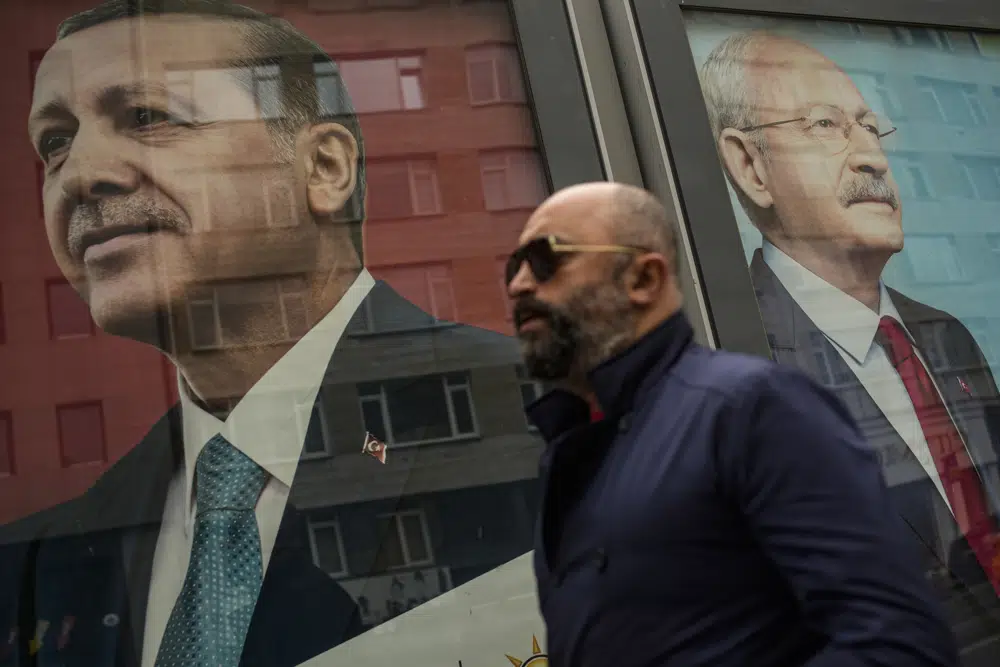
A man walks past election campaign billboards of Turkish President and People's Alliance's presidential candidate Recep Tayyip Erdogan, left, and CHP party leader and Nation Alliance's presidential candidate Kemal Kilicdaroglu in Istanbul, Turkey, Friday, May 5, 2023.
 (AP Photo/Emrah Gurel)


ISTANBUL (AP) — As Turkey heads for presidential and parliamentary elections at the weekend that are shaping up to be the strongest challenge to President Recep Tayyip Erdogan in his 20 years as leader, complaints are growing about the fairness of the vote.

Turkey’s opposition has long said that the country’s elections are played out on an unequal playing field, claims often backed by international observers.

Media coverage stands out as the most obvious example of where Erdogan enjoys an advantage over his opponents, but factors such as the use of state resources while campaigning and the questionable interpretation of electoral law also feature.

Some 90% of Turkey’s media is in the hands of the government or its backers, according to Reporters Without Borders, ensuring overwhelming airtime for the president. Only a handful of opposition newspapers remain in print, most having transitioned to online-only editions.

During April, Erdogan received nearly 33 hours of airtime on the main state-run TV station, according to opposition members of the broadcasting watchdog. His presidential opponent, Kemal Kilicdaroglu, received 32 minutes.

The main opposition party, the Republican People’s Party, or CHP, last month launched legal action against broadcaster TRT for failing to screen its campaign video.

“Unfortunately, the Turkish Radio and Television Corporation has moved away from being an impartial and objective institution and has turned into the Tayyip Radio and Television Corporation,” CHP lawmaker Tuncay Ozkan said.

The remaining independent media also face increasing restrictions. Last month, broadcasting authority RTUK fined independent channels Fox News, Halk TV and TELE1 over news and commentary deemed a breach of regulations. Ilhan Tasci, an opposition-appointed RTUK member, said in all three cases the stations had been accused of criticizing or questioning the actions of the ruling party.

In a statement following the last presidential and general elections in 2018, observers from the Organization for Security and Cooperation in Europe noted that Erdogan and his ruling Justice and Development Party (AKP) enjoyed “an undue advantage, including in excessive coverage by government-affiliated public and private media outlets.”

The government’s reach has also been extended over social media, where many opposition voices have retreated.

“disinformation” law introduced in October allows a jail sentence of up to three years for spreading false information “with the sole aim of creating anxiety, fear or panic among the public.”

Sinan Aygul, the only journalist to be prosecuted under the new law, was handed a 10-month prison term in February. He is currently free while appealing the case.

“The real aim is to silence all dissident voices in society,” said Aygul, chair of the journalists association in Bitlis, southeastern Turkey. It is “a law that targets anyone who expresses an opinion. It targets not only individuals but also media organs,” he said.

The ill-defined law criminalizes “basic journalistic activities,” Aygul said, adding that it could be used during the elections to target groups seeking to protect ballot box security who use social media to highlight abuses.

“If there is going to be fraud in the election, all opposition channels will be silenced by using this law,” he said.

The imposition of a state of emergency over the 11 provinces hit by February’s earthquake has also raised concerns about how the polls will be conducted in the region. A U.N. report published April 11 said at least 3 million people had relocated from their homes in the quake zone, many of them heading to other parts of Turkey.

However, just 133,000 people from the earthquake region have registered to vote outside their home provinces, the head of the Supreme Election Council said last month. Ahmet Yener added that election officials were overseeing preparations, including polling stations at temporary shelters.

In 2018, a nationwide state of emergency imposed following a 2016 coup attempt was in place until shortly before the election, which the OSCE said restricted the media and freedoms of assembly and expression.

Erdogan has stepped up his public appearances, which are closely followed by most TV channels, and uses these official duties to attack his rivals. At a ceremony on the Friday of Eid al-Fitr last month to mark renovations to Istanbul’s Blue Mosque, he accused the opposition of “working with terrorist groups.”

The previous evening, the leaders of four political parties allied to the AKP were present for an event to launch the delivery of Black Sea natural gas, despite none holding any government position.

Other large projects that were rolled out ahead of the vote include Turkey’s first nuclear power reactor built by Rosatom, the Russian state nuclear energy company, and several defense developments.

Critics also point to the bending of election law to allow government ministers to stand as parliamentary candidates while remaining in office, despite legal requirements to the contrary.

The election board, meanwhile, has previously faced criticism for siding with AKP objections during elections.

In the 2019 local polls, the victorious opposition mayoral candidate for Istanbul was forced to face a rerun following AKP complaints of ballot irregularities. Results from district and city council votes, which were collected in the same boxes and favored the AKP, were not questioned.

Adem Sozuer of Istanbul University’s law faculty told the opposition Cumhuriyet newspaper that voters had lost confidence in the election authorities. “There is widespread suspicion in a significant part of society that elections will be rigged,” he said.

DAS KAPITAL BLOG