Friday, May 19, 2023

New non-toxic powder uses sunlight to quickly disinfect contaminated drinking water

Peer-Reviewed Publication

STANFORD UNIVERSITY

water disinfection 

IMAGE: DISINFECTANT POWDER IS STIRRED IN BACTERIA-CONTAMINATED WATER (UPPER LEFT). THE MIXTURE IS EXPOSED TO SUNLIGHT, WHICH RAPIDLY KILLS ALL THE BACTERIA (UPPER RIGHT). A MAGNET COLLECTS THE METALLIC POWDER AFTER DISINFECTION (LOWER RIGHT). THE POWDER IS THEN RELOADED INTO ANOTHER BEAKER OF CONTAMINATED WATER, AND THE DISINFECTION PROCESS IS REPEATED (LOWER LEFT). view more 

CREDIT: TONG WU

At least 2 billion people worldwide routinely drink water contaminated with disease-causing microbes.

Now Stanford University scientists have invented a low-cost, recyclable powder that kills thousands of waterborne bacteria per second when exposed to ordinary sunlight. The discovery of this ultrafast disinfectant could be a significant advance for nearly 30 percent of the world’s population with no access to safe drinking water, according to the Stanford team. Their results are published in a May 18 study in Nature Water.

“Waterborne diseases are responsible for 2 million deaths annually, the majority in children under the age of 5,” said study co-lead author Tong Wu, a former postdoctoral scholar of materials science and engineering (MSE) in the Stanford School of Engineering. “We believe that our novel technology will facilitate revolutionary changes in water disinfection and inspire more innovations in this exciting interdisciplinary field.”

Conventional water-treatment technologies include chemicals, which can produce toxic byproducts, and ultraviolet light, which takes a relatively long time to disinfect and requires a source of electricity.

The new disinfectant developed at Stanford is a harmless metallic powder that works by absorbing both UV and high-energy visible light from the sun. The powder consists of nano-size flakes of aluminum oxide, molybdenum sulfide, copper, and iron oxide.

“We only used a tiny amount of these materials,” said senior author Yi Cui, the Fortinet Founders Professor of MSE and of Energy Science & Engineering in the Stanford Doerr School of Sustainability. “The materials are low cost and fairly abundant. The key innovation is that, when immersed in water, they all function together.”

Fast, nontoxic, and recyclable

After absorbing photons from the sun, the molybdenum sulfide/copper catalyst performs like a semiconductor/metal junction, enabling the photons to dislodge electrons. The freed electrons then react with the surrounding water, generating hydrogen peroxide and hydroxyl radicals – one of the most biologically destructive forms of oxygen. The newly formed chemicals quickly kill the bacteria by seriously damaging their cell membranes.

For the study, the Stanford team used a 200 milliliter [6.8 ounce] beaker of room-temperature water contaminated with about 1 million E. coli bacteria per mL [.03 oz.].

“We stirred the powder into the contaminated water,” said co-lead author Bofei Liu, a former MSE postdoc. “Then we carried out the disinfection test on the Stanford campus in real sunlight, and within 60 seconds no live bacteria were detected.”

The powdery nanoflakes can move around quickly, make physical contact with a lot of bacteria and kill them fast, he added.

The chemical byproducts generated by sunlight also dissipate quickly.

“The lifetime of hydrogen peroxide and hydroxy radicals is very short,” Cui said. “If they don't immediately find bacteria to oxidize, the chemicals break down into water and oxygen and are discarded within seconds. So you can drink the water right away.”

The nontoxic powder is also recyclable. Iron oxide enables the nanoflakes to be removed from water with an ordinary magnet. In the study, the researchers used magnetism to collect the same powder 30 times to treat 30 different samples of contaminated water.

“For hikers and backpackers, I could envision carrying a tiny amount of powder and a small magnet,” Cui said. “During the day you put the powder in water, shake it up a little bit under sunlight and within a minute you have drinkable water. You use the magnet to take out the particles for later use.”

The powder might also be useful in wastewater treatment plants that currently use UV lamps to disinfect treated water, he added.

“During the day the plant can use visible sunlight, which would work much faster than UV and would probably save energy,” Cui said. “The nanoflakes are fairly easy to make and can be rapidly scaled up by the ton.” 

The study focused on E. coli, which can cause severe gastrointestinal illness and can even be life-threatening. The U.S. Environmental Protection Agency has set the maximum contaminant-level goal for E. coli in drinking water at zero. The Stanford team plans to test the new powder on other waterborne pathogens, including viruses, protozoa, and parasites that also cause serious diseases and death.

Yi Cui is director of the Precourt Institute for Energy and the Sustainability Accelerator in the Stanford Doerr School of Sustainability. He is also a professor of photon science at SLAC National Accelerator Laboratory. Bofei Liu is now a research scientist at EEnotech Inc., a water purification spinoff co-founded by Cui. Tong Wu is on the faculty of Tonji University in Shanghai.

Other Stanford co-authors are Harold Y. Hwang, professor of applied physics in the School of Humanities and Sciences and professor of photon science at SLAC; former engineering postdocs Chong Liu, Jiayu Wan, Feifei Shi, Ankun Yang, Kai Liu and Zhiyi Lu; and former engineering PhD students Jie Zhao and Allen Pei.

Some climate-smart agricultural practices may not be so smart

Peer-Reviewed Publication

STANFORD WOODS INSTITUTE FOR THE ENVIRONMENT

-Several practices being promoted as climate smart could lead to land use spillovers that change their net impact on climate

-Most evidence is that cover cropping with rye, as done in the US, causes a yield loss. We show that the land use spillovers can then negate most of the climate benefit of cover cropping.

-The method and data we used were made available (as an R package) so that others can apply the same approach to other questions related to land use spillovers

Keeping California’s oil in the ground will improve health but affect jobs

Researchers investigated the carbon emissions, labor and health implications of several policies to reduce oil extraction

Peer-Reviewed Publication

UNIVERSITY OF CALIFORNIA - SANTA BARBARA

(Santa Barbara, Calif.) — As society reckons with climate change, there’s a growing call to keep fossil fuels right where they are, in the ground. But the impact of curtailing oil production will depend on the policies we implement to achieve this.

An interdisciplinary team of researchers investigated the carbon emissions, labor and health implications of several policies to reduce oil extraction, with a special focus on how the effects vary across different communities in California. Their results, published in Nature Energy, illustrate the tradeoffs between different strategies. For instance, models banning oil extraction near communities produced greater health benefits across the state, but they also led to more job losses, with disadvantaged communities feeling about one third of both the costs and the benefits.

With a goal to reach carbon neutrality by 2045, California is currently implementing some of the world’s most ambitious climate policies. As the country’s seventh largest oil-producing state and the world’s fifth largest economy, California provides a unique setting to study supply-side decarbonization policies. It already has a carbon cap-and-trade program and is currently debating a setback policy that would ban new oil production near communities.

Many considerations

Petroleum production is a multifaceted endeavor. The greenhouse gas emissions from burning fossil fuels are the main driver of climate change. Extracting these resources also emits CO2 into the environment, in addition to air pollution and toxic substances. Any policies seeking to curb oil production will affect people for better and worse. The industry employed 25,000 Californians in 2019, and provides tax revenue to local governments. “Our analysis is trying to quantify what those tradeoffs look like as the state considers different policies,” said co-author Kyle Meng, an associate professor in UC Santa Barbara’s economics department and the Environmental Markets Lab (emLab) at the Bren School of Environmental Science & Management.

“We’re taking traditionally climate-focused policies and comparing them along local impacts, health benefits and employment costs,” added co-lead author Paige Weber, an environmental economist at UNC Chapel Hill, previously an emLab post-doc.

The authors developed a framework to analyze the impact of three policies: an excise tax (paid per barrel); a carbon tax (paid per ton emitted); and setbacks at 1000 feet, 2500 feet and 1 mile. Taxes increase the cost of production, curbing activity and driving down emissions. Setbacks essentially ban extraction in areas where people live. In a previous study, the authors found that production decreases because it might not be economical to drill somewhere else.

To compare between the policies, each setback distance had a corresponding excise and carbon tax level that achieved the same emissions target in 2045.

The authors started with a suite of models to predict oil production in California. Using historical data and economic theory, the team attempted to answer the following questions: Will they drill here? How much will a well produce? When will it shut down?

The researchers then modeled the health impacts of oil production emissions as they spread across California’s communities. Finally, they modeled the outcome that each policy would have on jobs and worker compensation. The authors were especially curious how these effects fell on people living in areas that meet California’s definition of a disadvantaged community.

They calibrated the health and labor consequences of each policy based on its ability to reduce carbon. “We ask, for the same greenhouse gas reduction, which policy has greater health benefits and fewer labor costs, and how are these benefits and costs distributed?” Meng explained.

Always a tradeoff

Setbacks offered the greatest air-quality improvements, especially to disadvantaged communities. If you move oil production away from where people live, they’ll see health benefits. But there was a surprising tradeoff. When oil production is close to communities, so are the jobs it offers. “The same communities that benefit from cleaner air are also those facing labor market consequences,” Meng said.

During policy discussions, there’s often disagreement between groups highlighting the health impact of oil production and those focused on the employment benefits. “They’re often pitched as separate camps,” Meng continued. “But our analysis shows that costs and benefits can be borne by the same communities.”

Carbon and excise taxes both work by raising production costs, but the two policies target different oilfields. An excise tax eliminates the most expensive operations first, and falls roughly in the middle in terms of job and health implications.

“The cheapest way to reduce greenhouse gas emissions would be with a carbon tax because it goes after the most carbon-intensive oil extractors first,” Weber said. But since it takes the smallest number of wells out of production per ton of carbon emissions reduced, a carbon tax offers the lowest total health benefits, while also leading to the lowest job losses.

The authors believe their estimates of the health impacts are conservative. They focused solely on premature mortality, as other health impacts are more difficult to quantify. As a result, any action will likely improve the health of Californians more than what the study lays out.

Similarly, the researchers expect they overestimated the labor impacts because their framework doesn’t account for the possibility of re-employment. It assumes that every job lost results in unemployment.

The path forward

By 2045, California aims to reduce emissions in the transportation sector by 90% compared with 2019. And the Golden State is looking to many policies to achieve this.

“It’s a hotly debated issue right now because the governor just signed a law banning new oil drilling near communities,” said co-lead author Ranjit Deshmukh, an assistant professor in UC Santa Barbara’s Environmental Studies Program. The oil industry quickly circumvented this action by collecting enough signatures to place a referendum on the next ballot.

“Unfortunately, even the largest setback distance did not reach the state’s greenhouse gas reduction target,” Weber said. “So, you’d need to combine a setback with another policy.”

The state currently has no plans to use an excise tax to reduce greenhouse gas emissions from oil extraction, the authors said. On the other hand, the state’s cap-and-trade program functions much like a carbon tax. The only difference is that the market finds a price based on the cap, rather than it being set by the government. That said, the cap-and-trade program spans many sectors in the state, not just fossil fuel extraction.

This paper captured employment and health impacts on a much finer resolution than previous studies. Looking at, say, county averages for health benefits can be misleading, the researchers explained. Consider Los Angeles county: There’s a lot of variation between people living in Compton and Hollywood, or Long Beach and Lancaster. “A much finer resolution analysis is needed to accurately answer the question of how different communities bear the costs or get the benefits of this oil phase-out,” Deshmukh said.

The empirical aspect of their framework was also an innovation. Most other studies used only engineering models to forecast production. Using detailed historical extraction data gave the authors more confidence in the accuracy of their projections.

The team has begun similar work investigating the health and labor impacts of phasing out oil refining in California. And they plan to extend their analysis on petroleum production to the rest of the country. They hope their work will guide policymakers towards an effective, equitable solution for curbing fossil fuel extraction. One that maximizes its benefits while reducing its drawbacks.

Canada has a dental assistant shortage. Experts worry it’ll only get worse

"shortage of almost 5,000 dental assistants" 

A dental assistant works on teeth cleaning for a young Syrian girl 
who has never been to a dentist before.
© Sarah Kraus / Global News


Story by Katie Dangerfield • Global News
 Apr 18, 2023

A shortage of dental assistants across Canada may cause a backlog in oral health care and could impact dentists' capacity to take on new patients, experts warn.

The dental assistant shortage has been happening for years now, according to Lynn Tomkins, president of the Canadian Dental Association (CDA), and with the federal government's new dental care plan for Canadians, she worries that without proper staffing, many dentists may not be able to meet the patient demand.

"The shortage of dental assisting is the number one issue for dentists across the country," she said. "So dentists have had to alter their hours, in some cases reduce their hours because they don't have the support staff, just like operating rooms and hospitals. They don't have the nurses, you can't do the treatment."

Even before COVID-19 hit the health-care system, there was a shortage of dental assistants in Canada, she said.

The CDA states that in 2019, up to a third of Canadian dental offices were looking to add a dental assistant to their staff.

"COVID-19 exacerbated this problem," Tomkins said, noting that the pandemic pushed the Canadian health-care system to the brink, causing front-line staff workers, including dental assistants, to leave the profession.

"People have perhaps gone into other areas to work remotely and dentistry cannot be done remotely," she said.

Tomkins estimates that there is a current "shortage of almost 5,000 dental assistants" in Canada.

A 2022 survey conducted by the Canadian Dental Assistants Association (CDAA) and shared with Global News highlighted this problem amid the pandemic.

The survey found that during the height of the pandemic, around 57 per cent of dental assistants said their work environment became increasingly stressful and difficult and around 21 per cent felt the expectations of their employer became unreasonable.

The survey also showed that during the height of the pandemic, around 42 per cent of the respondents said they felt unfairly compensated given the higher level of risk they experienced at work.

One of the main drivers behind the shortage of Canada's dental assistants is a lack of proper compensation and benefits, said Kelly Mansfield, a board member of the CDAA.


Mansfield, who worked as a certified dental assistant for more than 30 years, said the shortage isn't because dental assistants are not graduating, it's that many are choosing to leave the profession.


"It's very hard to raise a family on a dental assistant salary. I was a certified Level 2 assistant for over 10 years and worked in private practice and I left because I just couldn't live on the salary of a dental assistant," she said.

"So I did take my oral health education and I went into a different profession."

There are other professions a dental assistant can go into, rather than working at a dentist's office, she said, such as working in dental insurance, sales or public health.

"There are many jobs that you can use the dental assisting profession, that will offer you better benefits and better compensation," Mansfield said.

Whether it's patient care, assisting with a dental procedure, sterilizing equipment or taking X-rays, Tompkins said the role of a dental assistant is crucial.

"We do rely on them a great deal," she said. "In many cases, they're like a surgical scrub nurse, working right beside the dentist, mixing materials, handing instruments, keeping the material dry. So it is actually quite a challenging job."

Without proper staffing, Mansfield and Tomkins believe dental offices may not be able to run at full capacity.

The risk is that many Canadians won't be able to receive oral health care, as "dentists cannot work without dental assistants," Mansfield warned.

"Although the biggest risk would be that dentists are hiring untrained individuals that are being hired to fill the role. This is a significant concern to dental assistants and a significant concern to the general public," she said.

And now that the federal government plans to roll out its Canadian Dental Care Plan, Tomkins said there is even more of a need for dental assistants.

In its March budget, the federal Liberals announced plans to expand its dental plan to provide coverage for an estimated nine million uninsured Canadians with an annual family income of less than $90,000, with no co-pays for those with family incomes under $70,000, by the end of 2023.

With an expected increase in demand for dental appointments because of federally funded dental coverage, Tomkins said the CDA wants to ensure the staffing capacity is there.

Video: Calgary dentists raise concerns about new federal dental benefit

Earlier this year, the CDA published a policy paper asking the government to develop an oral health staffing strategy in preparation for the increased dental service for nine million more Canadians.

"There will be a gradual rollout of this national dental care program. And it will give us some opportunity to increase our capacity. But we do need to recruit more dental assistants. We need to find ways to make them stay in the field," Tomkins said.

She said other ways to recruit and keep dental assistants in the office are to provide more mental health support services and give the option of distance learning in order to reach people in remote communities.

"We also need to make dental assisting aware to new Canadians, because it's a relatively short educational path, six months to nine months to a very good job that's very much in demand."


Feel sick when you play VR? It's pretty common and this Waterloo researcher wants to know why

Story by Kate Bueckert • Saturday, May 13, 2023

When Zubi Khan has friends over to play virtual reality video games, it's not unusual for someone to feel a little sick to their stomach.

"I've had friends come over where they would put a headset on and then, like, almost immediately they'd feel like that sense of vertigo and then they have to take it off," Khan said in a phone interview from a park near his Toronto home.

"For me, I use a motorized wheelchair to get around, so I think part of that has made me kind of, like, immune to getting motion sickness because I'm used to being stationary while I'm moving," said the avid VR gamer and content writer for comic and gaming CGMagazine.

"The only time where I'll feel vertigo or feel kind of dizzy is if I haven't used [VR] in a long period of time."

Feeling sick after entering a VR environment is not uncommon. Similar to motion sickness, it's dubbed cybersickness.

People who get cybersickness may experience a headache, vertigo (when you feel what's around you is moving or spinning) disorientation, eye strain or nausea.

One study published in June 2021 in the journal Nature that looked at predictors of cybersickness reported between 22 and 80 per cent of people who use VR may experience it. The percentages varied widely, depending on the intensity of the game and the headset the person was wearing.

What's not as clear is who will get cybersickness and who won't.

But that's something Michael Barnett-Cowan, a researcher at Ontario's University of Waterloo (UW), wants to figure out because the technology isn't just about gaming. Virtual reality can be used for other applications, such as therapy or training.

Research into why some people get sick

Barnett-Cowan is an associate professor in the university's department of kinesiology and health sciences, and director of the Multisensory Brain and Cognition Lab. For their research, he and his team collected data from 31 participants, and assessed how the subjects perceived the orientation of vertical lines — or the subjective visual vertical.

"What we basically found in our research was that after being exposed to a fairly nauseating game in VR, people change the way that they process sensory information," Barnett-Cowan said.

The participants were given a task before playing VR to test how they use different cues for their sense of orientation in the world. Then they'd play a game in virtual reality for 30 minutes and be retested.


Michael Barnett-Cowan, an associate professor in kinesiology and health sciences at the University of Waterloo, is also director of the Multisensory Brain and Cognition Lab, which seeks to determine how the brain integrates multisensory information.
© Kate Bueckert/CBC

"Those that change the way that they process sensory information … those were the ones that didn't get as sick," Barnett-Cowan said.


"Those that were really stubborn … so the way that they do this task before VR is the same as the way they do it after VR, those guys got fairly sick."

Barnett-Cowan said the researchers were "pretty excited" to make that discovery, because the findings of this study, which has been published in the journal Virtual Reality, could prove to be "invaluable" for developers and designers of VR experiences.

William Chung is co-author of the study and a former UW doctoral student who is now a postdoctoral fellow at the Toronto Rehabilitation Institute.

Chung said their test significantly predicted the severity of cybersickness symptoms.

"By understanding the relationship between sensory reweighting and cybersickness susceptibility, we can potentially develop personalized cybersickness mitigation strategies and VR experiences that take into account individual differences in sensory processing and hopefully lower the occurrence of cybersickness."

But Chung also cautioned this finding is only a first step and "there is still much to be explained."

People worry VR will make them sick

Such research is good news for Robert Bruski, chief executive officer and co-founder of Ctrl V, a virtual reality arcade that was started in Waterloo and has grown to include locations in Ontario, Alberta, Delaware and Texas.

It concerns Bruski when some people tell him they won't even try VR because they're afraid of getting sick.

"The vast majority of our content doesn't induce nausea," he said, noting staff put the games through a "very rigid 26-step vetting process" before people use them.

It means most people can feel confident putting on a headset to shoot orcs in Elven Assassin, slice up watermelon in Fruit Ninja or mess up an office in Job Simulator, he said.

For Bruski, research that will help everyone feel more comfortable entering a virtual reality environment is great, because along with the gamers who use his arcade, companies bring in workers to learn how to operate heavy equipment, schools have students use VR to learn chemistry or astronomy, and seniors use the technology to visit with gorillas or take a walk in Paris.

But even as researchers work on determining why some people experience cybersickness, Bruski said, that shouldn't keep anyone from trying VR now.

"The motion sickness is determined by the game itself and specifically the locomotion in the game. So if you have a good virtual reality provider or if you are aware of what causes it, then you can completely eliminate that possibility."

Khan said it's pretty simple — if you start to feel sick, take off the headset and wait a bit, but don't give up.

When his friends take off the VR headset, "I'll put it back on, and then they'll watch me play, and then I'll be having fun and we'll try it again."
ONTARIO
Not everyone loves Marineland. Park offers 'educational' shows but local schools aren't going

Story by Cara Nickerson • CBC
Tuesday, May 16, 2023

Marineland, which for years has faced allegations about its treatment of marine mammals and their use for entertainment purposes, is still offering field trips to schools.

But instead of going on these outings, students at some Ontario schools, including in Brantford and Hamilton, are engaged in curriculum that teaches them about controversies involving the Niagara Falls, Ont., theme park.

Marineland's website says the park offers educational activities and resources based on the Ontario curriculum.

The theme park did not respond to CBC Hamilton's request for an interview and updated its website following the request, removing a page about its educational video and worksheet series.

The updated website says trips to Marineland help teachers "bring science curriculum to life for your students in a memorable and exciting way."

Still, the school boards CBC Hamilton contacted say they're not taking field trips to Marineland, although it's not clear if that has anything to do with Marineland's controversial past.

What some school boards are saying

The Niagara public school board said schools in its district haven't gone on field trips to Marineland for seven years and it's "unaware" of any Marineland trips planned for this year.

The Niagara Catholic school board's spokesperson, Jennifer Pellegrini, said schools in her district went on trips to Marineland before the pandemic began early in 2020, but added no trips are planned for the end of this school year.

Pellegrini did not say why the school board isn't sending students, but said all trips in the district "must have a direct and enhancing relationship with the curriculum of the classroom."


In 2014, a concerned parent petitioned to stop her children's school, which was part of the Hamilton-Wentworth District School Board, from going on a field trip to Marineland. The class went to the Royal Botanical Gardens instead.
© Dan Taekema/CBC

In 2014, a parent with children at Mountain View Elementary School in Stoney Creek, part of the Hamilton-Wentworth District School Board, petitioned and stopped the school from going to Marineland.

The Hamilton-Wentworth public school board said no trips to the theme park are planned for this year.

Marnie Jadon, communications officer with the Hamilton-Wentworth Catholic District School Board, said, "While we don't have details, we expect some would have [gone to Marineland] years ago."


She also said no trips have been planned for this year.

In the past, schools in Brantford's Catholic school board visited the park, but the board also said no trips are scheduled for this year.

Brantford's public school board said it could not confirm whether its schools went on trips to Marineland in the past, and said no trips are planned for this year.

Last year, students in Grades 5 and 6 at Forest Run Public School in Vaughan created a website about returning Kiska, the last killer whale held in captivity in Canada, back to her natural habitat.

Earlier this year, students at Bayview Glen Public School in Thornhill, Ont., created a video for World Whale Day. The school tweeted the video and thanked the Grade 2 and 3 students for advocating for Kiska.

Kiska died on March 10 at age 47. Two months later, a beluga whale and bottlenose dolphin also died at the park.


'Not an actual learning experience'


Catherine Boutzis, a kindergarten teacher and animal rights activist in Waterloo, Ont., told CBC Hamilton that Marineland is an "attraction," not a conservation area, and doesn't teach children about animals in their natural habitats.

"It's there purely for [the kids] to bang on the glass and be entertained. It's not an actual learning experience."

She said she has had conversations with her students about Marineland, African Lion Safari and other animal theme parks.

"I've talked to them quite frankly about some of the things they use to train those animals and how those animals were taken from their natural habitat," she said.

"They're not living the life that was intended for them with their families."

Former Marineland trainer speaks out


Phil Demers, a former Marineland trainer and whistleblower, said that "for as long as I worked at Marineland, there was exactly zero emphasis on education and even less on conservation."

Under a section of the Canadian Criminal Code introduced in 2019, captive cetaceans — large sea mammals like dolphins — cannot be used "for performance for entertainment purposes" unless the performance is authorized with a licence from the Ontario government.

The new law was part of Bill S-203 passed in 2019 that, after years of debate, banned the captivity of cetaceans. It included a grandfather clause, however, for animals that were already in captivity.

In December 2021, Marineland was charged with using dolphins and whales to perform and entertain without authorization, Niagara police told CBC Hamilton in December 2022. The Crown stayed those charges on Dec. 21, 2022.

Demers told CBC Hamilton he has watched recent videos of dolphin performances. He said he had to review hours of taped dolphin performances when Niagara police were investigating the park in the fall of 2021 and he watches "countless" social media videos of the park when it's open to monitor the well-being of the animals.

He said the current "educational trainer talk" at King Waldorf Stadium, as advertised on Marineland's website, is still based on a show he designed himself 15 years ago.

He said the original show "was exclusively based on entertainment. Nothing's changed except for some of the stuff they say over the microphone."
MPs and activists push back as Ottawa pitches expansion of nuclear energy


Story by John Paul Tasker • Apr 25, 2023

Anti-nuclear activists and a cross-partisan group of MPs urged the federal government Tuesday to drop its support for nuclear energy projects, calling the energy source a "dirty, dangerous distraction" from climate action.

Nuclear power has long been an important part of Canada's energy mix. In Ontario, for example, an eye-popping 60 per cent of the province's power needs are met by nuclear generation — a non-emitting energy source that industry groups and some politicians view as fundamental to the net-zero transition.

Other provinces — notably New Brunswick (which already has a nuclear power plant), Alberta and Saskatchewan — have expressed interest in "small modular reactors" (SMRs), which have been billed as more affordable, less complex and easier to operate than traditional, large-scale nuclear plants.

The International Atomic Energy Agency, a UN-affiliated organization, has said SMRs could be crucial to the clean transition because, unlike renewable energy sources like wind and solar, these smaller nuclear plants don't depend on the weather or the time of day.

SMR boosters also say the technology can help high-polluting, industrial economies ween themlselves off dirtier fuel sources like coal.

But SMR technology is still in its infancy and it isn't widely used around the world.

As of 2022, there were only three SMR projects in operation — one each in Russia, China and India — according to the International Energy Agency.

There are dozens of others under construction or in the design and planning phase — including one at Ontario Power Generation's Darlington nuclear site.

Finance Minister Chrystia Freeland's recent federal budget included a generous tax credit to spur clean energy development, including SMRs.

The industry lobby group, the Canadian Nuclear Association, has said the 15 per cent refundable tax credit is a recognition by Ottawa that nuclear power is "a fundamental and necessary component of Canada's low carbon energy system."

Susan O'Donnell, a professor and a member of the Coalition for Responsible Energy Development in New Brunswick, said Prime Minister Justin Trudeau and his cabinet are getting bad advice about nuclear energy.

"The nuclear industry, led by the U.S. and the U.K., has been lobbying and advertising heavily in Canada, trying to convince us that new SMR designs will somehow address the climate crisis," O'Donnell told a press conference on Parliament Hill on Tuesday.

She said SMRs will produce "toxic radioactive waste" and could lead to serious "accidents" while turning some communities into "nuclear waste dumps."

She also said there's "no guarantee these nuclear experiments will ever generate electricity safely and affordably," since SMRs are still relatively untested.

"Canada is wasting time that must be urgently spent on genuine climate action," she said. "This is a dirty, dangerous distraction. We don't need nuclear power."

Asked how Canada would meet its baseload power requirements — the power that is needed 24 hours a day without fluctuation — without nuclear power or fossil fuel sources like natural gas, O'Donnell pointed to promising developments in energy storage technology.

Liberal MP Janica Atwin was also on hand for the anti-nuclear press event.

"I want to be clear, I'm here as an individual, a concerned individual and a mother," she said — before launching into remarks that raised questions about the "associated risks" and "many unknowns" of nuclear energy development, which is expected to see a sharp increase in activity due to her government's proposed tax policies.

"When it comes to nuclear, there's no margin for error," Atwin said. "This is a time of action. We don't have the luxury of waiting to see if things will pan out."

Green Party Leader Elizabeth May, who once sat in caucus with Atwin before she decamped to the Liberals, said government funding for nuclear projects is a "fraud."

"It has no part in fighting the climate emergency. In fact, it takes valuable dollars away from things that we know work, that can be implemented immediately, in favour of untested and dangerous technologies that will not be able to generate a single kilowatt of electricity for a decade or more," May said.

The SMR that is under construction in Darlington, Ont., is expected to be finished by 2028 — five years from now.

The project's proponents say this SMR, once operational, will deliver 300 megawatts of electricity — enough to power 300,000 homes in the country's largest province.

To address concerns about the reliability of clean energy sources, May said Canada should build a national grid, which could "essentially be a giant battery" — storing excess energy when solar panels and wind farms are producing electricity and feeding it back into the grid when they're not.

In a statement, a spokesperson for the Canadian Nuclear Association said that "Canadians deserve to be told the truth, and the truth is that there is no easy path to net zero for Canada."

"It is disingenuous to suggest that we can easily decarbonize through wind and solar alone, while at the same time doubling or tripling our total electricity demand to 2050," said Christopher Gully.

"Contrary to the statements made today by MP May and others, the changes necessary to support a fully renewables grid in Canada would be absolutely massive, including tens or even hundreds of billions in grid upgrades, fundamental changes to interprovincial power markets, and extremely long timelines for the necessary transmission corridors to be permitted and built. While that may be feasible in a research paper, it is more of a dream than a possible reality."

NDP and Bloc MPs were also on hand for the press conference. NDP MP Alexandre Boulerice said the government's recent support for nuclear power is the result of of heavy lobbying efforts.

He said Natural Resources Canada has somehow been infiltrated by pro-nuclear proponents. "They don't have to knock on the door to get into the house because they own the house," he said.

Federal Environment Minister Steven Guilbeault, who was an environmental activist before jumping into federal politics, has a history of anti-nuclear campaigning.

In 2018, Guilbeault tweeted that "it's time to close Pickering #Nuclear Plant and go for #renewables." Before running for federal office, he was involved with Greenpeace for ten years and was a founding member of Équiterre, two organizations that oppose nuclear energy.

Since his election, however, Guilbeault has been less vocal.

Late last year, he also decided that a proposed small nuclear reactor project at Point Lepreau in New Brunswick will not undergo an extra federal impact assessment.


A test engineer at TerraPower, a company developing and building small nuclear reactors, works on a project in Everett, Washington.© AP

Speaking at an event Monday in Ottawa with German President Frank-Walter Steinmeier, Trudeau said Canada is "very serious" about reviving nuclear power.

With Canada attracting substantial new industrial development, Trudeau said there's a need for new, cleaner energy sources.

"As we look at what baseload energy requirements are going to be needed by Canada over the coming decades, especially as we continue to draw in global giants like Volkswagen, who choose Canada partially because we have a clean energy mix to offer ... we're going to need a lot more energy," he said.

"We're going to have to be doing much more nuclear."
Trans Twitch star files human rights complaint against police after swatting arrest in London, Ont.

Story by Isha Bhargava • Apr 24, 2023

Transgender activist Clara Sorrenti has filed a human rights complaint against the London Police Service and the London Police Services Board, following her controversial arrest in August, 2022.© Michelle Both/CBC

Atransgender activist arrested at gunpoint in her London, Ont. home in a swatting hoax has launched a human rights complaint against the local police for discriminating against her based on her gender identity and expression.

Clara Sorrenti is asking the London Police Service (LPS) to change its record management, procedures, and policies to accommodate transgender people, including wearing body cameras when interacting with them. She also wants mandatory human rights training for every officer that emphasises interacting with trans people.

"LPS hasn't done nearly enough to start addressing the systemic issues that led to the encounter last year that left me in significant emotional and mental distress," Sorrenti said.

In a statement of claim filed to the Human Rights Tribunal of Ontario on April 10, Sorrenti is seeking $75,000 in damages for injury to her dignity, feelings, and self respect, plus an additional $50,000 for loss of income and other special damages incurred as a result of the swatting incident.

London police declined Sunday to comment on the matter.

The 29-year-old Twitch streamer, known as 'Keffals', was arrested at gunpoint by LPS officers in August after someone used her name and address to send threats to London city councillors. Police also received information that she confessed to a murder, Sorrenti said.

The person who called in the threats misgendered Sorrenti and referred to her with her birth name, which she said she changed more than a decade ago.

Five months before police came to her door, Sorrenti said she contacted the LPS to tell them she worried she'd become a swatting victim.

"There is simply no excuse for the LPS's records to have Ms. Sorrenti's old name and gender. She has had multiple interactions with them prior to the events in question to seek protection from the risks she faced due to her important work," said her lawyer Justin W. Anisman.

"It's concerning that they appear to have ignored her concerns, failed to update her records, or make appropriate notes which could have protected her."

Former police chief, Steve Williams, did order an internal review and determined that officers acted appropriately given the limited information they had during Sorrenti's arrest. However, several changes were made as a result of the incident.

Williams acknowledged that police records weren't updated to include her changed name. The London force also created a new system to flag locations or persons who have been the subjects of previous swatting attacks.

In September, the London Police Services Board (LPSB) drafted a policy called the 'Search and Detention of Transgender People' mandating officers to be sensitive to human rights, privacy issues, and to refer to individuals by their preferred pronouns.

Traumatic encounter

Sorrenti left Canada due to harassment and threats she received after going public with her story, and as a result, hasn't been able to stream and interact with her followers in months, she said.

Sorrenti says the encounter was traumatic and she's still reeling from its impact all these months later.

"It's been incredibly difficult for me to trust law enforcement and it's been really hard for me to feel safe in my own home after what happened," she said.

Anisman and Sorrenti say their ultimate goal is to sit down with LPS leadership to talk about her experiences and the shortcomings in systemic policies so they can collectively find a way to improve them and ensure that everyone feels safe.

"I know that unless something changes, the chances of this situation happening to another member of the community is fairly high but another person who goes through this might not be as lucky as I am," she said.
RIP
Brian McKenna, a founding producer of CBC's The Fifth Estate, dead at 77

Story by Erika Morris • May 6, 2023

Brian McKenna, a founding producer of CBC's The Fifth Estate, died Friday night 
at the age of 77.© Submitted by Conor McKenna

Brian McKenna, an acclaimed Montreal-born documentary filmmaker and a founding producer of CBC's The Fifth Estate, died Friday evening at the age of 77.

McKenna is remembered by his family as "passionate," an "incredible role model" and "somebody who was willing to ask difficult questions about the history of our country."

The family said McKenna had suffered a short illness.

His daughter, Robin McKenna, said her father had a great love of family and she remembers lots of laughing, joking and teasing. A filmmaker herself, she said her father was a great inspiration.

"We had a lot of adventures with him and he was inspiring as a father, I got to go along on many of his film shoots when I was young," she said.

"He had a big love of poetry and art and a sense of the sublime that he passed on to me. Dinner conversations were always spirited, we were encouraged to have our own opinions and disagree."

Award-winning career


McKenna's career started when he was editor-in-chief of his college newspaper, Loyola News, before joining the Montreal Star and later CBC.

He was best known for the award-winning series The Valour and the Horror. The three-part series examining Canadian involvement in three battles during the Second World War was the subject of controversy after its release and led to a five-week investigation by the Senate, a CRTC hearing, a $500 million lawsuit and a CBC ombudsman's report.

McKenna's most commended work delved deep into Canada's role in various wars over the last few centuries — having directed over 20 films on the subject — but he is also remembered for local Montreal news like the controversy surrounding the 1976 construction of the Olympic Stadium.

He also co-authored an unauthorized, bestselling biography of former Montreal mayor Jean Drapeau with his first wife Susan Purcell in 1980.

"He was a great father," said his son Conor McKenna, the host of The Morning Show on TSN 690.

"It left me with massive shoes to fill that I certainly don't think I could ever begin to do. But much to aspire to, much to live up to as both a father and a professional."

The filmmaker received 40 award nominations in Canada and internationally and won the 1993 Gordon Sinclair Award For Broadcast Journalism.

He received the Governor General's History Award for Popular Media in 2007 for "his exceptional ability to tackle the challenges of communicating history through a modern media with originality, determination, and a deep respect for those whose stories he tells."

McKenna was also an advocate for the freedom of the press and against the kidnapping of journalists and co-founded a group that later became the Canadian Journalists for Free Expression (CJFE).

His family also cited dining with Fidel Castro, filming in North Korea, sharing Montreal dinners with Pierre Elliott Trudeau and drinking vodka in the Soviet Union with Wayne Gretzky and Vladislav Tretiak among the other notable feats in his life.

He is survived by his life partner Renée Baert; his children Robin, Katie, Conor and their mother Susan Purcell; Emma and Tess and their mother Anne Lagacé Dowson; his grandchildren Leo, Aedan and Dylan; siblings William, Joan, John and Terence; and his lifelong friend Stephen Phizicky.
Free menstrual products will be available at federal workplaces later this year

Story by Saba Aziz • May 10, 2023

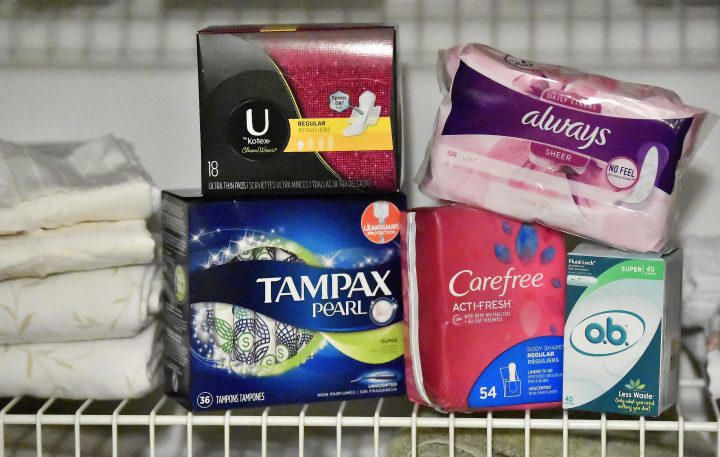
Various menstrual products are seen, Wednesday, Feb. 20, 2019, in Kennesaw, Ga. 
Georgia's legislature is joining a nationwide effort to provide menstrual products for public school students in need.© (AP Photo/Mike Stewart)

Employees in federally regulated workplaces will begin to have free access to menstrual products later this year.

The federal government made the announcement Wednesday, saying starting Dec. 15, 2023, employers will be required to make menstrual products available at no cost to public servants.

This means putting pads and tampons in washrooms or other places so that any worker who needs them while on the job has access, Employment and Social Development Canada said in a news release.

“Tampons and pads are basic necessities. So we’re making sure they’re provided to workers at no cost, because it’ll make for healthier and safer workplaces,” Labour Minister Seamus O’Regan Jr. said in a statement with the release.

Employers will have flexibility on how they implement the new rules.

A pilot project will roll out in the coming months and guidance material will be developed in consultation with employers and made available online prior to the rules coming into effect, the government said.

This comes after the Liberal government created a public consultation process in 2019 on providing menstrual products in federally regulated workplaces that came to a close in September 2021.

The Liberals pledged to provide free tampons and pads in federally regulated workplaces in their 2021 election campaign.

The changes would apply to nearly 1.3 million workers in the federal labour force, a group that includes banks, telecommunications and transport workers and makes up about eight per cent of the nation’s workers.

Of those workers, the rules would affect about 35 per of them — or about 455,000 workers, the government says.

The initiative is part of Ottawa's push to improve equity, reduce stigma around periods and make workplaces more inclusive.

The federal government removed the Goods and Services Tax from menstrual products in 2015 — also known as the "pink tax" — and other jurisdictions in Canada and the United States have followed suit.

At the same time, there has been a growing movement to provide free feminine hygiene products on campuses and in schools.

The cost of menstrual products varies significantly across the country.

A 40-pack of tampons in northern and remote communities can cost upwards of $15.

-- with files from The Canadian Press