Tuesday, July 04, 2023

Ubinas volcano set to trigger state of emergency in Peru

Previous eruptions from Peru’s most active volcano triggered mudslides and ash clouds responsible for killing livestock.
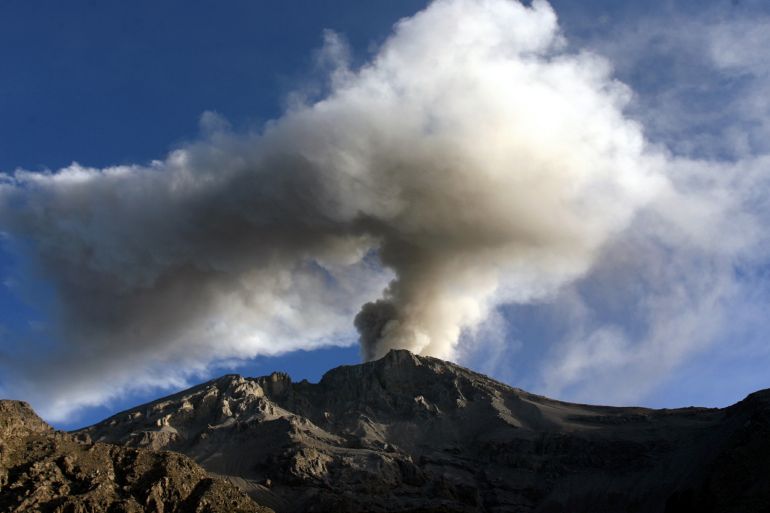
In the wake of a 2006 eruption, local officials blamed the Ubinas volcano for causing widespread respiratory problems and killing llamas that ate grass dusted with toxic emissions [Reuters]

Published On 4 Jul 2023

Officials in the Peruvian government have announced they will declare a state of emergency for the area surrounding the Ubinas volcano, after persistent seismic activity shook the region and sent a column of toxic gas into the air.

Alberto Otárola, the president of Peru’s Council of Ministers, announced on Monday that the emergency declaration was anticipated for the southern department of Moquegua, where the volcano is located.

“We are taking charge of these phenomena, and we are always proactively coordinating with all institutions to face them,” he said.

The emergency order will allow the government to take “the measures necessary” to prevent health risks, Otárola explained. Already, masks are being distributed as ash fills the air.
A calf is outfitted with a mask in the wake of a 2006 eruption of the Ubinas volcano [Reuters]

Some 2,000 people stand to be affected in the immediate area, Otárola said. He urged the population to remain calm.

Moguegua’s regional government raised the alert level on Sunday from yellow to orange, to indicate heightened danger from the volcano.

Ubinas is the most active volcano in the country, forming part of the “Ring of Fire”, an area of seismic activity that surrounds the tectonic plate underneath the Pacific Ocean.

The current eruption began around June 22, according to the Geophysics Institute of Peru (IGP).
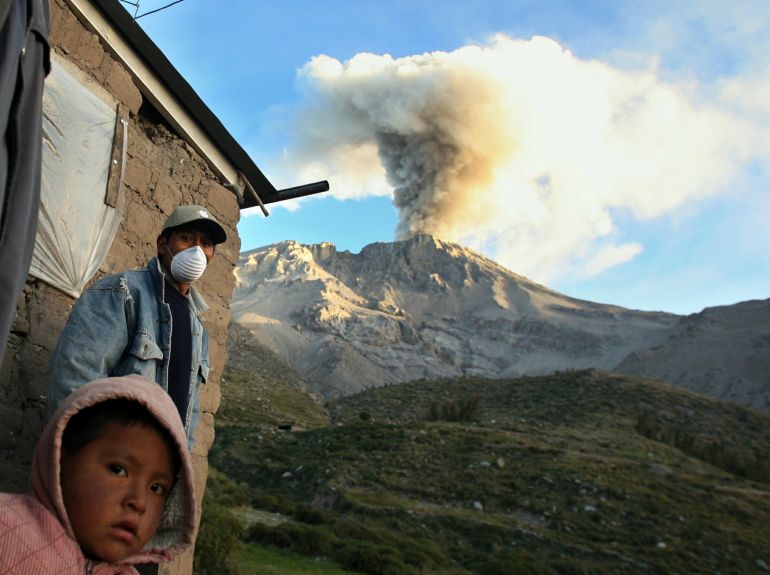
The Ubinas volcano is located some 990 kilometres (550 miles) south of the Peruvian capital Lima [Reuters]

The institute recorded 402 earthquakes associated with the volcano between June 23 and 25. During that period of activity, a plume of ash rose nearly 1,300 metres (4,265 feet) above the volcano’s peak.

The National Civil Defence Institute has since advised residents to wear face masks and protect their eyes from the ash as well as create an evacuation plan for use if necessary.

The last large eruption at Ubinas came in 2019, resulting in thousands of people being displaced. While Ubinas has been erupting regularly since 1550, one of the most dramatic incidents came in 2006 after several decades of relative dormancy.

That eruption blanketed the region with ash, prompting evacuations and killing livestock with its toxic emissions.


SOURCE: AL JAZEERA

Peru declares emergency status as Ubinas volcano spews ash


Ubinas volcano volcanic activity Moquegua region, Peru on July 2, 2023.
 (Reuters)

Reuters
Published: 03 July ,2023:

Peru will declare emergency status in the area around the Ubinas volcano in the southern region of Moquegua, the prime minister said on Monday, as the country’s most active volcano has been spewing ash for several days.

The National Institute of Civil Defense (INDECI) said in a statement that the area’s status alert has been raised to “orange” from yellow according to national standards after the volcano showed ash spill that reached 1,700 meters in height.

Southern Peru, an area where there are important mining sites, is home to a dozen active volcanoes. Peru is also in the so-called Pacific “Ring of Fire,” an area with a high incidence of earthquakes and volcanic activity.

Prime Minister Alberto Otarola told reporters at the Government Palace that the emergency status will probably be declared in the next few days in order to provide “the necessary prevention measures” for the region.

INDECI advised the region’s 2,000-strong population to stay away from the volcano and keep doors and windows closed.

Masks and glasses were delivered to the population, authorities added.

Peruvian authorities in 2019 evacuated hundreds of people living near the Ubinas volcano after explosions and ashes emissions.
UK okays bill barring public bodies from boycotting Israel

Government measure passes in 268-70 vote, with 84 Conservative MPs and all of Labour abstaining

By TOI STAFF
Today, 

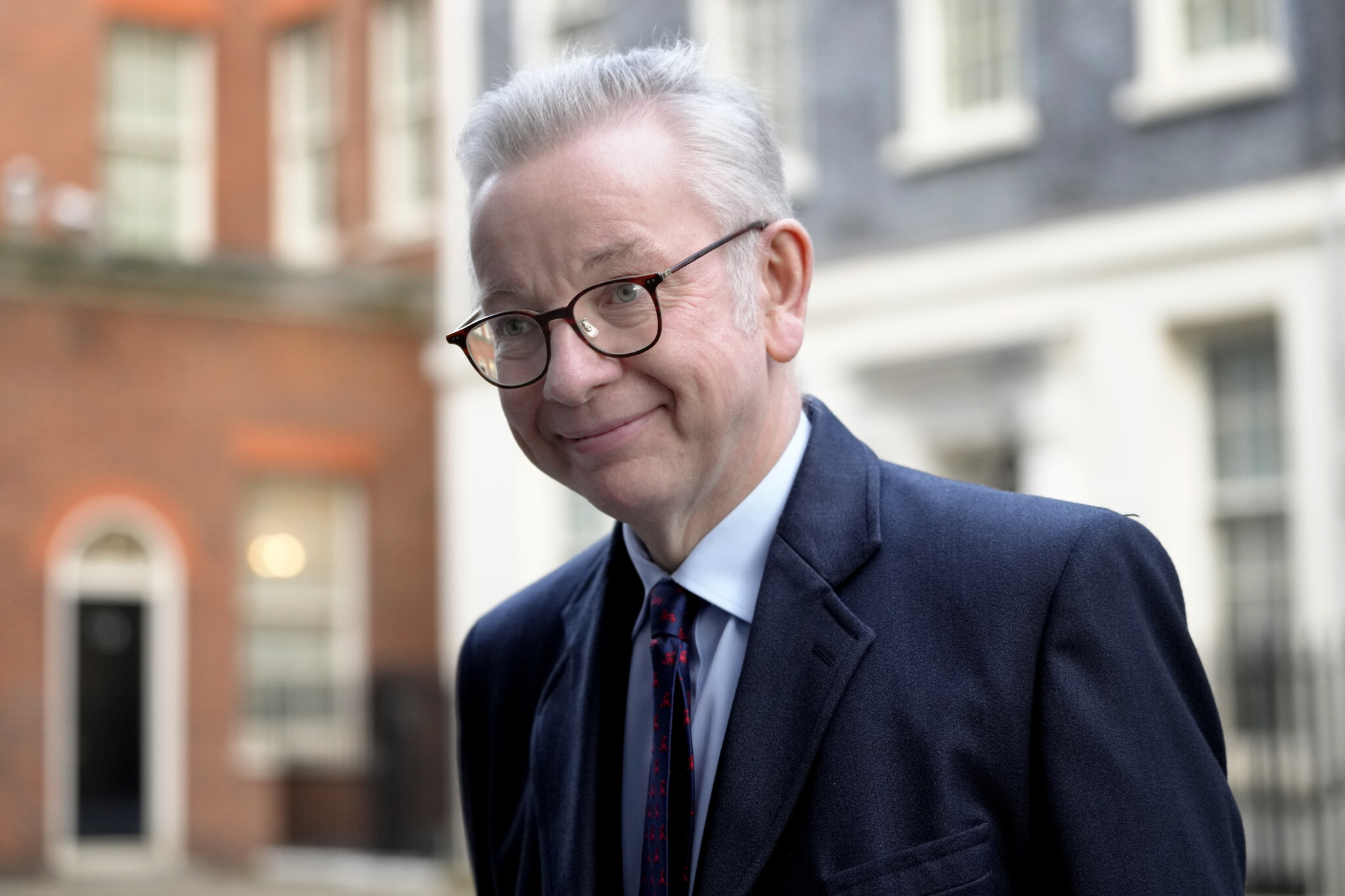
Michael Gove, Britain's Secretary of State for Levelling Up, Housing and Communities; Minister for Intergovernmental Relations, leaves after attending a cabinet meeting in Downing Street in London, January 17, 2023. (AP/Kirsty Wigglesworth)


Britain’s Parliament on Monday voted to approve a bill that will bar local councils and other public bodies from boycotting Israeli goods. The measure passed 268-70 with some Conservative members of Parliament opposing the bill, and Labour party MPs abstaining from the vote.

The government bill, advanced by Michael Gove, the minister in charge of local government (formally the secretary of state for Levelling Up, Housing and Communities and minister for Intergovernmental Relations), will ban public bodies from imposing economic boycotts on countries that are not already sanctioned by the government, with particular protection for Israel.

Gove has said that the bill sought to combat the Boycott, Divestment and Sanctions (BDS) anti-Israel movement, arguing that such initiatives are commonly accompanied by antisemitic discourse.

On Monday, ahead of the vote, Gove said that the bill “affirms the important principle that UK foreign policy is a matter for the UK government. It ensures local authorities focus their efforts on serving residents, not directing their resources inefficiently. And critically it protects minorities, especially Jewish communities, against campaigns that harm community cohesion and fuel antisemitism,” according to the Guardian.

The report said the Labour Party at first tried to block the vote on the bill before abstaining, allowing the measure to pass. Eighty-four MPs from the governing Conservative Party also abstained and two voted against the measure.

The Guardian said the Conservative MPs who abstained or voted against the government argued that the bill was too vague and “illiberal” and may hamper actions against other countries like China.

“We recognize the problem the [Gove] says this bill is needed to tackle. It is therefore deeply frustrating that the government has introduced a bill that is so needlessly broad, with such sweeping draconian powers … that he is faced with genuine legitimate heartfelt opposition from his own benches,” said Lisa Nandy, the shadow communities secretary from the Labour party, during the debate on the bill, according to the Guardian.

A commitment to advance such a law first appeared in a 2019 election campaign manifesto by the Conservative Party. This pledge was also featured in Queen Elizabeth II’s annual speech last year, a few months before she died at age 96.

Documentation that accompanied the queen’s speech cited as examples a decision by the city council of Lancaster to support Israel-related boycotts in 2021 and a similar move by the Leicester City Council in 2014. Other councils, including in Swansea and Gwynedd, have also previously launched boycotts of settlements, according to UK media.

The previous leader of the opposition Labour Party, Jeremy Corbyn, had supported boycotts targeting West Bank settlements, though not blanket boycotts of Israel. He was eventually ousted from the party over numerous accusations of antisemitism and failing to take adequate action against antisemitic remarks and individuals within the party.

Corbyn’s successor, Keir Starmer, has sought to distance himself from Corbyn’s legacy, has taken comprehensive action to root out antisemitism, and has said the party does not support BDS.
Taliban Ban Women Beauty Salons In Kabul: Report

The Taliban Ministry of Vice and Virtue also ordered the Kabul municipality to bring the new decree of the Taliban leader into effect and cancel the licenses of women's beauty salons.

Updated: July 04, 2023


The Taliban has cancelled the licenses of women's beauty salons in Kabul. (Representational)

Kabul:

The Taliban has in a new verbal decree, banned women's beauty salons in Kabul and other provinces across the country, a spokesman for Taliban Ministry of Vice and Virtue, Mohammad Akif Mahajar, told TOLO News.

The Taliban Ministry of Vice and Virtue also ordered the Kabul municipality to bring the new decree of the Taliban leader into effect and cancel the licenses of women's beauty salons.

"The men are jobless. When men cannot take care of their families, the women are forced to work in a beauty salon to find a loaf of bread. If they are banned there, what can we do?" said Raihan Mubariz, a makeup artist, as per TOLO News.

"We will not get out of the home if men (of the family) have jobs. What can we do? We should starve to death, what should we do? You want us to die," said a makeup artist.

This comes as the Islamic Emirate has banned girls and women from going to schools, universities and working at NGOs as well as going to public areas such as parks, cinemas and other recreation areas.

Kabul resident Abdul Khabir said: "The government should make a framework for it. The framework should be in a way that neither Islam would be damaged nor the country."

The imposition of restrictions on Afghan girls and women by the Taliban has sparked reactions at both the national and international levels.

Judith Butler: Mourning at the end of the world

Interview. According to philosopher Judith Butler, actions in defense of the climate, such as those taken by Ultima Generazione, are necessary. But public spaces are also needed to confront the risk of the end of the future.

Judith Butler, feminist philosopher and radical theorist, spoke in Venice at Palazzo Grassi on May 11th about art and activism. Regarding that speech, whose text was previewed by this newspaper, we asked her some questions about the repression faced by environmental movements in Italy, as well as in Germany and France.

In Italy, as in Germany, environmentalists are under trial and risk very serious sentences. In the case of Ultima Generazione, activists simulate damaging works of art in order to highlight the contradiction that the destruction of a painting or monument terrifies us, while the destruction of the planet Earth leaves us indifferent. Is it this contradiction that triggers judicial repression?

We have many reasons to worry when environmental activists who seek to bring media attention to climate destruction are branded as domestic terrorists or subject to prison sentences and harsh fines. The category of domestic terrorist continues to expand under a number of “democratic” countries justifying state surveillance and control. Even acts of assembly, fundamental to any democratic society, are characterized as threats to security or public health. So we should oppose these expanding forms of repressive and disciplinary forms of state power.

Linguist Vera Gheno has pointed out that many politicians and several newspapers have dubbed activists “eco-vandals.” She argues that this term evokes the barbarian invasions, thus reactivating the frame of a wild invasion against sacred soil. Moreover, Gennaro Sangiuliano, the Minister of Culture in the Meloni government, invoked a special law against environmental actions and stated that anyone who targets monuments attacks the homeland and should be considered a traitor to the nation. What is the relationship between nationalism and climate denial?

Of course, there are forms of nationalism that object to any threat to museums or their art holdings as an attack on the patria. This happens in France as well, as if eco activists are thrusting a knife into the patriarchal heart of the nation. At the same time, it is important to distinguish between the art we need to understand climate destruction and fight denialism, and the art that comes to represent the nation-state and its nationalism. It is important as well to distinguish between the national or state museums that make the case for the patria, the patrimony and the patriarchy and those art spaces where radical thought is taking place. The problem is not art. In fact, art is probably part of the solution to the extent that it has the power to contest denialism and compel us to think about the vanishing future.

These activists are often mocked for their apocalyptic messages, but they are slowly raising awareness in the collective consciousness. We are dealing with a sort of millenarianism in reverse: While millenarian narratives predict that only a few chosen ones who have seen the light will be saved, here the end of the world is announced to save the masses.

Perhaps what is needed is to amplify that message through more public debate and longer forms of reflection and practices of restructuring at several levels of society. Some climate activism depends on the power of the moment. But if the moment belongs to the media cycle, it is forgotten too soon. How do we take that crucial message and compel every institution to face the destruction and to make a plan. How, in other words, does the transient shock of some climate activism get transformed into vital, long-range political change?

Finally, in your reflections on “environment, art and politics,” you argue that the discussion on the relationship between art and life needs public spaces where “imminent destruction” can be discussed, as a form of mourning. Is this the missing step in order to make the actions we are talking about fully “political”?

All of us who are against denial have at some point to answer the question, what is denial? That is, how is it formed and sustained, and in whose interests is it reproduced?

Climate denialism is something that everyone engages in to some degree but the point is to find practices that allow all the destruction to stop and regeneration to begin. We can barely afford the recognition of the loss we are facing, the loss that we are making. To face it would be to the loss of life and the loss of futurity, and how does anyone grieve such a loss? We turn away from that question too soon. So what practices, what art practices can make us stay with what we have lost, are losing, and will lose so that grieving gives rise to resistance and to a politics for the living.

Giuliano Santoro
Originally published in Italian on June 30, 2023

https://ilmanifesto.it/elaborare-il-lutto-del-mondo

South Africa Women's World Cup Team Sits Out Game in Pay Dispute as 13-Year-Old Player Called In

South Africa's women's soccer team poses for photographers and fans during a welcome ceremony at the OR Tambo International Airport in Johannesburg, South Africa, July 26, 2022.

CAPE TOWN, SOUTH AFRICA — A standoff between South Africa's Women's World Cup squad and the national soccer association over pay and other issues forced officials to field a makeshift team of little-known players that included a 13-year-old for a game against Botswana on Sunday.

The game was supposed to be the final warm-up match for the African women's champion on home soil before it headed off to the Women's World Cup in Australia and New Zealand, but it turned into an embarrassment on and off the field as the entire World Cup squad sat out the game.

South Africa's team of replacement players hastily pulled together from local clubs lost 5-0 to Botswana at the Tsakane Stadium near Johannesburg. They were 4-0 down at halftime in a game that was delayed for an hour at the request of the South African Football Association, SAFA, so it could scramble and put together a team.

South Africa coach Desiree Ellis said one of the players she had to draft in was aged 13. In a post-match interview, she didn't comment on the problems.

The World Cup players only arrived at the match at halftime, when they emerged to watch from the stands.

SAFA also didn't immediately comment on what sparked the standoff, but Thulaganyo Gaoshubelwe, the president of the South African Football Players Union, which represents the interests of soccer players, said the incident was partly caused by poor pay for the players.

"They are fighting for their rights," Gaoshubelwe said of the South African players in a video posted on his union's official Twitter account. "SAFA doesn't want to include money in their contracts. We must fight for the rights of these players."

Gaoshubelwe, who was standing next to some of the players outside the team hotel in the video, said their complaints had been "dismissed" by SAFA. He was also seen in discussions with the players and accompanied them to the stadium when they turned up at halftime.

Gaoshubelwe claimed SAFA president Danny Jordaan was to blame for the standoff.

South Africa Sports Minister Zizi Kodwa said in a statement he would be meeting with the players' union on Tuesday "to hear the serious concerns expressed by the team."

The meeting would be about the players' "welfare" and issues related to their contracts, Kodwa said.

The squad is due to fly to New Zealand in two groups on Tuesday and Wednesday.

The South African Broadcasting Corporation reported that players were also annoyed that their farewell game before the World Cup was held at the Tsakane Stadium, which holds just 5,000 people and is not a high-profile soccer venue.

The players viewed that as a mark of disrespect for them from their national soccer association, the SABC reported.

SABC and other television networks broadcast images of the World Cup squad members standing around outside their team bus at a hotel shortly before the game was due to kick off. SAFA CEO Lydia Monyepao was seen speaking with the players.

South Africa won the Women's Africa Cup of Nations last year for its first major title, yet the players have often complained that they aren't given the recognition or benefits that the men's team gets.

South Africa is due to play Costa Rica in New Zealand on July 15 in its final World Cup warm-up game. South Africa plays Sweden, Argentina and Italy in the group stage at the World Cup, starting against the Swedes on July 23.
Factbox – Where are the strategic materials germanium and gallium produced?

by Sylvia Quarles
July 4, 2023
in Finance


BEIJING (Reuters) – China said on Monday it would impose export restrictions on certain gallium and germanium products from Aug. 1 to protect national security interests.

Here are some details about Gallium and Germanium

Where is germanium found?

Germanium ores are rare and most germanium is produced as a by-product of zinc production and from coal fly ash.

According to the European Union Critical Raw Materials Alliance (CRMA), China produces about 60% of the world’s germanium, with the rest coming from Canada, Finland, Russia and the United States.

According to Chinese customs, China exported 43.7 tons of raw and wrought germanium last year.

what about gallium?

Gallium is found in small amounts in zinc ores and bauxite, and gallium metal is produced when bauxite is processed to make aluminum. According to CRMA, about 80% of the production takes place in China.

Gallium is used to make gallium arsenide for use in electronics. CRMA says that only a few companies – one in Europe and the rest in Japan and China – can make it at the required precision.

According to Chinese customs, China will export 94 tons of gallium in 2022, up 25% from last year.

What are they used for?

According to the American company Wafer World, semiconductor wafers made from gallium arsenide instead of silicon can operate at high frequencies and are heat resistant.

Wafer World says they produce less noise than silicon devices, especially at high operating frequencies, which makes them useful in radar and radio communications equipment, satellites and LEDs.

Germanium is mainly used in fiber optics and plastics as well as in infrared radiation. The metal and its oxides are used in night-vision devices as well as in military applications such as satellite imagery sensors.

How much do they cost?

The final price of gallium at 99.99% purity in China was quoted at 1,775 yuan ($245) per kg on Monday, up 5.97% from the previous session and the highest since May 16, according to Shanghai Metal Exchange data on Refinitiv Eikon. Get to know from


China’s germanium ingot price was last seen at 9,150 yuan ($1,264) per kg on Monday, Shanghai Metal Exchange data on Refinitiv Eikon showed.

($1 = 7.2374 yuan)

(Reporting by Dominic Patten, Mai Nguyen and the Beijing newsroom; Editing by Tom Hogg)

Japan to get crucial UN verdict for Fukushima water release

Japan is set to receive a report from a United Nations nuclear watchdog on Tuesday approving its plan to release treated radioactive water from the tsunami-wrecked Fukushima plant

Reuters Tokyo Published 04.07.23


Japan is set to receive a report from a UN nuclear watchdog on Tuesday approving its plan to release treated radioactive water from the tsunami-wrecked Fukushima plant into the ocean despite fierce resistance from Beijing and some local opposition.

International Atomic Energy Agency (IAEA) chief Rafael Grossi begins a four-day visit to Japan on Tuesday, when he will meet with Prime Minister Fumio Kishida and deliver the results of the agency's final two-year safety review.

Japan has not specified a date to start the water release, which will take 30 to 40 years to complete, pending the IAEA's review and official approval from the national nuclear regulatory body for Tokyo Electric Power (Tepco). The nuclear regulator's final word could come as early as this week.

Some Japanese fishing unions have opposed the government's plan, conceived in 2021, saying it would undo work to repair their reputations after several countries banned some Japanese food products following the 2011 disaster.

Some neighbouring countries have over the years also complained about the threat to the marine environment and public health, with Beijing emerging as the biggest critic of the plan.

Through its embassy in Japan, Beijing on Tuesday said the IAEA's report cannot be a "pass" for the water release and called for the plan's suspension.

Japan maintains the process is safe as it has treated the water - enough to fill 500 Olympic-sized swimming pools - used to cool the fuel rods of the Fukushima plant after it was damaged by the earthquake and tsunami in 2011.

The water has been filtered to remove most radioactive elements except for tritium, an isotope of hydrogen that is difficult to separate from water. The treated water will be diluted to well below internationally approved levels of tritium before being released into the Pacific Ocean.

In a presentation given to foreign journalists in China last month, Japanese officials said the tritium levels in the water it plans to release are lower than that found in waste water regularly released by nuclear plants around the world, including in China.

The officials said that they had made multiple and repeated attempts to explain the science behind Tokyo's stance to Beijing, but that its offers had been ignored.

China on Tuesday said Japan's comparison of the tritium levels in the treated water and waste water was "completely confusing concepts and misleading public opinion."

IAEA's Grossi will visit the Fukushima plant on Wednesday. After his Japan trip, he is also due to visit South Korea, where consumers have been snapping up sea salt
and other items ahead of the water release.

He is also expected to visit New Zealand and the Cook Islands in a bid to ease concerns over the plan, according to media reports.

IAEA must not endorse Japan's wrongdoings in nuclear-contaminated water disposal: Spokesperson

Xinhua, July 4, 2023

China on Monday urged the International Atomic Energy Agency (IAEA) to come to a responsible conclusion on the ocean discharge of contaminated water from Fukushima, Japan.

Chinese foreign ministry spokesperson Wang Wenbin made the remarks at a regular press briefing when answering a query concerning that IAEA Director General Rafael Grossi will visit Japan starting Tuesday and deliver a report on the safety of discharge of tainted water from the Fukushima nuclear plant, which may give backing for Japan to proceed with the discharge.

Wang said China's opposition to Japan's efforts of pushing through the discharge plan of nuclear-contaminated water into the ocean is consistent, stressing that it is neither ethical nor lawful to spill the risk of nuclear pollution to the rest of the world.

China urges Japan to face up to the legitimate concern of the international community and people in Japan, stop forcibly proceeding with its ocean discharge plan, dispose of the nuclear-contaminated water in a science-based, safe and transparent manner and place itself under the strict monitoring of the international community, the spokesperson said.

China believes that the IAEA should come to a conclusion on the ocean discharge of contaminated water from Fukushima that is responsible and can stand up to the test of history and science, and must not endorse Japan's wrongdoings in the disposal of nuclear-contaminated water, Wang said.

"It is for the maritime environment that we all share, the life and health of all human beings and the only planet that we call home," the spokesperson said.

Explainer-How Japan plans to release Fukushima water into the ocean

Updated July 3, 2023

TOKYO (Reuters) -Japan is set to begin pumping out more than a million tonnes of treated water from the destroyed Fukushima Daiichi nuclear power plant this summer, a process that will take decades to complete.

The water was distilled after being contaminated from contact with fuel rods at the reactor, destroyed in a 2011 earthquake. Tanks on the site now hold about 1.3 million tonnes of radioactive water - enough to fill 500 Olympic-sized swimming pools. Here is how Tokyo Electric Power Company (Tepco) plans to deal with the water:

WATER RELEASE

Tepco has been filtering the contaminated water to remove isotopes, leaving only tritium, a radioactive isotope of hydrogen that is hard to separate from water. Tepco will dilute the water until tritium levels fall below regulatory limits before pumping it into the ocean from the coastal site.

Water containing tritium is routinely released from nuclear plants around the world, and regulatory authorities support dealing with the Fukushima water in this way.

Tritium is considered to be relatively harmless because it does not emit enough energy to penetrate human skin. But when ingested it can raise cancer risks, a Scientific American article said in 2014.

The water disposal will take decades to complete, with a rolling filtering and dilution process, alongside the planned decommissioning of the plant.

REACTION TO OCEAN RELEASE

Tepco has been engaging with fishing communities and other stakeholders and is promoting agriculture, fishery and forest products in stores and restaurants to reduce any reputational harm to produce from the area.

Fishing unions in Fukushima have urged the government for years not to release the water, arguing it would undo work to restore the damaged reputation of their fisheries.

Neighbouring countries have also expressed concern. China has been the most vocal, calling Japan's plan irresponsible, unpopular and unilateral.

(Reporting by Tokyo Newsroom. Editing by Gerry Doyle)


Social media giants failing to adequately address online abuse

International|Gender and Sexual Diversity
PEN America
3 July 2023

Venezuelan Yarani Acosta, 23, shows her mobile phone with the complaint she made public through social networks about her case of sexual abuse, while speaking during an interview in Caracas, Venezuela on 14 May 2021. YURI CORTEZ/AFP via Getty Images

New report exposes a “deeply flawed” reporting system and outlines a series of product design fixes that would help make reporting abuse online more transparent, efficient, equitable, and effective.

This statement was originally published on pen.org on 29 June 2023.


PEN America and Meedan recommend product design fixes to reduce online abuse while safeguarding free expression

Millions of social media users face harmful harassment, intimidation, and threats to their free expression online but encounter a “deeply flawed” reporting system that fails at every level to safeguard them and hold abusers to account, according to a new report by global nonprofits PEN America and Meedan.

In exposing these failures by Facebook, Twitter, TikTok, Instagram, YouTube and other social platforms, the report outlines a series of product design fixes that would help make reporting abuse online more transparent, efficient, equitable, and effective.

The report, Shouting into the Void: Why Reporting Abuse to Social Media Platform is So Hard and How to Fix It, highlights the dangerous repercussions of such abuse for social media users, especially for women, people of color, and LGBTQ+ people, as well as journalists, writers and creators, all of whom face more severe levels of abuse online than the general population. Given how effective it is in stifling free expression, online abuse is often deployed to suppress dissent and undermine press freedom.

Viktorya Vilk, director for digital safety and free expression at PEN America and the report co-author, said: “The mechanisms for reporting abuse are deeply flawed and further traumatize and disempower those facing abuse. Protecting users should not be dependent on the decision of a single executive or platform. We think our recommendations can guide a collective response to reimagine reporting mechanisms—that is, if social media platforms are willing to take up the challenge to empower users and reduce the chilling effects of online abuse.”

Kat Lo, Meedan’s content moderation lead and co-author, said: “Hateful slurs, physical threats, sexual harassment, cyber mobs, and doxxing (maliciously exposing private information, such as home addresses) can lead to serious consequences, with individuals reporting anxiety, depression, and even self-harm and suicidal thoughts. Abuse can put people at physical risk, leading to offline violence, and drive people out of professions, depriving them of their livelihood. Reporting mechanisms are one of the few options that targets of abuse have to seek accountability and get redress—when blocking and muting simply aren’t enough.”

The two organizations drew on years of work training and supporting tens of thousands of writers, journalists, artists, and creators who have faced online harassment. Researchers for PEN America, which champions free expression, and Meedan, which builds programs and technology to strengthen information environments, centered their research and recommendations on the experiences of those disproportionately attacked online for their identities and professions: writers, journalists, content creators, and human rights activists, and especially women, LGBTQ+ individuals, people of color, and individuals who belong to religious or ethnic minorities.

Interviews were conducted with nearly two dozen creative and media professionals, most based in the United States, from 2021 to this April.

Author and Youtube creator Elisa Hansen described the difficult process of reporting the flood of abusive comments she sees in response to videos she releases on the platform: “Sometimes there are tens of thousands of comments to sift through. If I lose my place, or the page reloads, I have to start at the top again (where dozens of new comments have already been added), trying to spot an ugly needle in a blinding wall-of-text haystack: a comment telling us we deserve to be raped and should just kill ourselves. Once I report that, the page has again refreshed, and I’m ready to tear my hair out because I cannot find where I left off and have to comb through everything again.”

She said: “It’s easy for people to say “just ignore the hate and harassment,” but I can’t. If I want to keep the channel safe for the audience, the only way is to find every single horrible thing and report it. It’s bad enough how much that vicious negativity can depress or even frighten me, but that the moderation process makes me have to go through everything repeatedly and spend so much extra and wasted time makes it that much worse.”

While the report acknowledges recent modest improvements to reporting mechanisms, it also states that this course correction by social platforms has been fragile, insufficient, and inconsistent. The report notes, for example, that Twitter had gradually been introducing more advanced reporting features, but that progress ground to a halt once Elon Musk bought the platform and–among other actions–drastically reduced the Trust and Safety staff overseeing content moderation and user reporting. “This pattern is playing out across the industry,” the report states.

The report found social media platforms are failing to protect and support their users in part because the mechanisms to report abuse are often “profoundly confusing, time-consuming, frustrating, and disappointing.”

The findings in the report are further supported by polls. A Pew Research Center poll found 80 percent of respondents said social media companies were doing only a “fair to poor job” in addressing online harassment. And a 2021 study by the Anti-Defamation League and YouGov found that 78 percent of Americans want companies to make it easier to report hateful content and behavior.

The fact that people who are harassed online experience trauma and other forms of psychological harm can make the troublesome reporting process all the more frustrating.


“The experience of using reporting systems produces further feelings of helplessness. Rather than giving people a sense of agency, it compounds the problem,” said Claudia Lo, a design researcher at Wikimedia.

The research uncovered evidence that users often do not understand how reporting actually works, including where they are in the process, what to expect after they submit a report, and who will see their report. Users often do not know if a decision has been reached regarding their report or why. They are consistently confused about how platforms define specific harmful tactics and therefore struggle to figure out if a piece of content violates the rules. Few reporting systems currently take into account coordinated or repeated harassment, leaving users with no choice but to report dozens or even hundreds of abusive comments and messages piecemeal.

Mikki Kendall, an author and diversity consultant who writes about race, feminism, and police violence, points out that some platforms that say they prohibit “hate speech” provide “no examples and no clarity on what counts as hate speech.” Natalie Wynn, creator of the YouTube channel Contrapoints, explained: “If there is a comment calling a trans woman a man, is that hate speech or is it harassment? I don’t know. I kind of don’t know what to click and so I don’t do it, and just block.”

The report was supported through the generosity of grants from the Democracy Fund and Craig Newmark Philanthropies.

About PEN America

PEN America stands at the intersection of literature and human rights to protect open expression in the United States and worldwide. We champion the freedom to write, recognizing the power of the word to transform the world. Our mission is to unite writers and their allies to celebrate creative expression and defend the liberties that make it possible. To learn more visit PEN.org

About Meedan

Meedan is a global technology not-for-profit that builds software and programmatic initiatives to strengthen journalism, digital literacy, and accessibility of information online and off. We develop open-source tools for creating and sharing context on digital media through annotation, verification, archival, and translation.


Read Media Matters’ public comment calling on Meta to address anti-abortion misinformation on Facebook and Instagram


Melissa Joskow / Media Matters

Special PROGRAMSABORTION RIGHTS & REPRODUCTIVE HEALTH

WRITTEN BY JASMINE GEONZON
RESEARCH CONTRIBUTIONS FROM CAMDEN CARTER, CARLY EVANS, KAYLA GOGARTY & JULIE TULBERT
PUBLISHED 06/30/23 


As the Meta oversight board debates how to proceed with abortion-related content on Facebook and Instagram, Media Matters for America has submitted a public comment asking the company to bolster its content moderation process and issue-specific policies to address rampant abortion misinformation on its platforms.

Meta currently has no community guidelines that speak to abortion-related content specifically. The company’s poor enforcement of its standing policies has allowed right-wing misinformers to continue spreading unfettered falsehoods about abortion and using its platforms to facilitate harassment of abortion patients and providers. As a result, Meta continues to privilege conservative talking points at the cost of suppressing accurate information about abortion — an especially concerning trend as reproductive health access is increasingly restricted in the post-Roe v. Wade era.

New data from Media Matters has shown that abortion-related posts from U.S. news and politics pages on Facebook that receive the most engagement — as measured by reactions, comments, and shares — came from right-leaning groups, often containing harmful and inaccurate messaging. After analyzing nearly 370,000 posts about abortion from January 1, 2021, to June 22, 2023, Media Matters found that right-leaning Facebook pages have dominated the conversation about abortion rights — earning nearly half of total interactions (46%) on abortion-related posts.

To put those numbers into perspective, right-wing pages accounted for only 35% of total abortion-related posts from U.S. news and politics pages. In comparison, left-leaning and nonaligned pages comprised 17% and 48% of all abortion-related posts. However, left-leaning posts only accounted for 30% of engagement, and nonaligned posts accounted for just 24%.


Further research from Media Matters reveals that since January 1, 2021, Meta has earned at least $700,000 on over 800 political ads from right-wing and anti-abortion Facebook pages that contain abortion misinformation related to “late-term abortion” or “infanticide.” Though the company ultimately removed some of the ads for violating its advertising policies, these ads have earned at least 37.6 million total impressions.

Read Media Matters' public comment here:

Why Canada’s Attempt to Save Journalism May End Up Crushing It Instead

BY NITISH PAHWA
SLATE
JUNE 29, 2023
Photo illustration by Slate. Photo by Getty Images Plus.

On June 22, the Canadian Parliament passed Bill C-18, also known as the Online News Act. The new law, according to a government news release, “will require the largest digital platforms”—in effect, calling out Facebook, Instagram, and Google without naming them—“to bargain fairly with Canadian news businesses for the use of their news content.” The intent here is to even out the skewed market imbalance between Canadian journalism and Big Tech platforms, many of which have offered distribution pathways and occasional payment agreements to digital news sites while also sapping them of revenue from native advertising—a sector dominated by those very corporations.

The logic behind the law goes like this: At first glance, when Facebook or Google displays a news article, whether on a specialized feed or a search-results index, that seems good for the news outlet; the platforms are helping it get information to more eyeballs. But it’s valuable for the website only if a user then clicks on the article and navigates the page in question, which hosts the ads the outlet was paid to feature. If users don’t click—and most users don’t—Google and Facebook get to keep the users’ eyeballs, and the advertising revenue that comes from that engagement. Over time, because they’ve come to rely on Facebook or Google for their news, users become less likely to navigate a media publisher’s site organically.
ADVERTISEMENT


By requiring digital platforms to compensate news publishers when posting and sharing their links, the Online News Act (in theory) tries to make this dynamic more beneficial for newsrooms. But that depends on the bigger platforms’ willingness to cede any bit of their power. The law is modeled after similar legislation passed in Australia in 2021, and has invited parallel waves of excitement (from continental news organizations and bigger media outlets) and backlash (from trade associations, independent publications, and Big Tech itself). In the months leading up to Bill C-18’s passage, Meta and Google threatened to revoke news access from Canadian users altogether, and they experimented with cutting off displays and shares of media links for small portions of the population, leading Parliament to summon Google executives for questioning. (Earlier this month, Prime Minister Justin Trudeau ruled out any legislative compromises and accused the two companies of employing “bullying tactics.”) Now that the bill is law, Canada’s Heritage Department will take charge of publishing specific regulations and offering guidance on implementation over the next few months; by the end of that period, the bill should be in full effect.

So far, Canada’s Big Tech confrontation seems to be mirroring Australia’s; Google is upset but has been quiet about its next steps, while Meta has aggressively moved to block Canadian Facebook and Instagram users from seeing and sharing news links. [Update, June 29, 2023, at 1:51 p.m.: On Thursday, Google officially announced that it will block news links on Search, News, and Discover to Canadian users in response to the Online News Act.] No negotiations, no relief: “We are proceeding toward ending the availability of news permanently in Canada,” Rachel Curran, a Meta executive and former politician, told the Canadian Broadcasting Corporation on Tuesday. “Our trajectory is set. There is no way to negotiate out of the framework of this bill.”
ADVERTISEMENT


But the Canadian government may think there is more room for negotiation, considering that Facebook ended up striking a murky deal with Australia in 2021 following outrage over its initial news blockage—which had the side effect of scrubbing pages belonging to essential weather and emergency services, and affecting the social media presence of unions, government agencies, and sporting organizations. Still, despite Heritage Minister Pablo Rodriguez’s assurance that Meta will suffer “reputational impact” and that his government has “options” to aid outlets that stand to lose Facebook traffic, there’s reason to take the platform’s “permanent” threat seriously—especially given the devastating impact the law could have on Canada’s crumbling media sector.

For one, said Michael Geist, a University of Ottawa professor who researches internet and e-commerce law, the circumstances that pushed Facebook to iron out agreements with Australia in early 2021 were very different. “The Australian experience took place in a different time, when news might have been viewed as a bit more valuable by the platforms—when platforms were a bit more flush in cash, weren’t laying thousands of their workers off, and weren’t inclined to risk actually blocking news sharing,” Geist told me. Fast-forward to mid-2023, however, and Facebook has much different priorities: cost cutting, layoffs, artificial intelligence, virtual reality, and returning account access to misinformation spreaders like Donald Trump and Robert F. Kennedy Jr. After the endless scandals of the past few years, many related to digital media’s presence on Facebook, the company is increasingly OK with continuing to deprioritize news. That’s been hard on publishers, Slate included. It’ll be even worse for Canadian news orgs, which will soon lack any access to Facebook referrals. “I think a lot of people have stopped getting their news from Facebook because it’s been choking off access to news for a long time,” said Jesse Brown, publisher and editor in chief of Canadaland, an independent media network. “I fully believe Facebook when they say they could just live without news. It doesn’t earn them much money.”
ADVERTISEMENT


What “options” does the Canadian government really have against Meta, then? Rodriguez suggested yanking back government-advertising funds offered to social media—which, at only about $8.3 million annually, will hardly make a dent in a nearly $714 billion company. Canadian-British author Cory Doctorow, who’s frequently written about Big Tech’s exploitation of news sites, suggested that “the shortest path to trying to make Facebook pay off on this law would be a ‘must-carry’ rule for news content.” But such an unprecedented move against Meta would raise free-speech concerns, and likely end up in Canada’s Supreme Court. A targeted measure like that against an American company would also run afoul of North American trade regulations, Geist said.

What about the threat to Meta’s long-battered reputation? That could matter to the company, per a former Facebook news feed employee who spoke with me on condition of anonymity. “I’m very surprised if, from the top of the company, the idea was that we just don’t care about news,” he told me. “Everything I heard, while I was there, was that it’s something valuable and important.” Still, as Geist put it, reputational impact is less concrete than the explicit costs to Meta from the legislation. All around, it’s unclear what leverage Ottawa actually has against Meta.

As for Google? In May, the company told Parliament that the debate over the Online News Act had created “dramatically unrealistic expectations among news publishers and politicians, treating Bill C-18 as an unlimited subsidy for Canadian media.” Google hasn’t yet risen to Meta’s level of brinkmanship; before Thursday’s announcement, it was possible the search giant could have expressed more interest in negotiating with news outlets. Even so, Australia has shown us that not all news outlets will be at the table. It’s easier, Doctorow said, for larger, richer media conglomerates (he gave the example of Rupert Murdoch’s News Corp., which has a notorious footprint in Australia) to work out deals, especially compared with “smaller publishers who have to form bargaining units.” That holds true in Canada as well, where traditional outlets are increasingly concentrated under large corporate owners, while tinier publications scramble for scraps. Doctorow pointed to Postmedia Network (majority-owned by an American private-equity firm that was recently forced to pay millions to settle regulatory charges), which holds major properties like the National Post. It’s also closed down several Canadian newspapers and laid off countless reporters, and is in talks to potentially merge with Nordstar, the private-equity firm that owns the company in charge of the storied Toronto Star. (The cited reason for merger talks, ironically, is the “existential threat” facing Canadian newspapers.) Nordstar and Postmedia, both of which lobbied in favor of the Online News Act and ran newspaper opinion pieces supporting the legislation, have an inherent monetary and resource advantage to pressing deals with search engines like Google.

“Think about a publisher that Google can’t live without because it’s the public’s most important publisher, and a search engine that the publisher can’t live without because it’s the public’s most common search engine, and they do a deal together,” said Doctorow. “If Google is the only one that can afford to pay for the one great news entity that everyone looks to, then no other search engine can.” An agreement could arise that would benefit the most powerful on both sides, and not those who need the support most.

Smaller outlets, meanwhile, risk getting hung out to dry. “We’re looking at these dinosaur legacy media companies getting prioritized for these deals with Google, to our detriment,” Brown said. “Now we’re looking at social media sites cutting off access to all news, including ours, whether or not we’re getting a dime from them.” Brown, notably, has been part of talks between news publishers and the government over the brittle media sector for nearly a decade now. As people attuned to the stakes of smaller Canadian journalism outfits, Brown and Geist were well aware of skewed priorities that ensured from the start that no changes to digital-media law would be universally beneficial. “The major media lobbies in Canada wanted the Australian model, and the government insisted that that was the approach that was going to be taken,” Geist said.

I asked Brown, Doctorow, and Geist whether anything can be done now, post-passage, to improve the Online News Act. None of them seemed bullish in that regard, and they referred mainly to things that could have been done before the act reached its final form. Brown brought up the Canadian government’s prior offerings of news subsidies, which most outlets were wary of because they didn’t want to be financially dependent on the officials they’re holding accountable. Doctorow said Parliament could have instead shaped a privacy law to crack down on surveillance advertising (the basis of Google’s and Meta’s business models)—which, he said, would have been “wildly, wildly popular.” Geist offered that he’d testified in favor of a quasi-tax on platform revenue from advertising, which could direct a percentage of that money toward “a fund that would support journalism.”

Of course, none of this came to be, and Canadians are now left with a strange, uncertain digital-media future, a poor prospect at a time of political realignment within Canada as well as a rise in far-right extremism and disinformation. Coupled with the Online Streaming Act, an April law that forces foreign-based digital streaming services to financially support domestic creators, “the internet in Canada will look different,” Geist predicted. “The government would say that’s a feature, not a bug. But I’m not sure that Canadians who find themselves unable to share news—or find that certain video services are blocked in the Canadian market because they think the regulatory costs of operating here have been too high—are going to be inclined to agree.” Doctorow characterized it more bluntly: “I think it was a catastrophic mistake.”

The former Facebook news feed worker I spoke with thought that users will find their own ways to resist restrictions, even if links are blocked. “The history of this sort of thing is, people find a way to share the content they want to share,” he said. Even if that’s the case, there could be broader implications for Meta’s actions. “They are aware that the Australian example is emboldening different governments to try similar things,” Brown said. “And frankly, I think they’re making an example out of Canada.”

Future Tense is a partnership of Slate, New America, and Arizona State University that examines emerging technologies, public policy, and society.