Tuesday, July 04, 2023

US maternal deaths doubled in last 20 years, study finds

  • PublishedShare


  • IMAGE SOURCE,GETTY IMAGES

Maternal mortality rates have doubled in the US over the last two decades - with deaths highest among black mothers, a new study suggests.

American Indian and Alaska Native women saw the greatest increase, the study in Journal of the American Medical Association (JAMA) said.

Southern states had the highest maternal death rates across all race and ethnicity groups, the study found.

Maternal mortality means a death during pregnancy or up to a year afterward.

In 1999, there were an estimated 12.7 deaths per 100,000 live births and in 2019 that figure rose to 32.2 deaths per 100,000 live births in 2019, according to the research, which did not study data from the pandemic years.

Unlike other studies, this one examined disparities within states instead of measuring rates at the national level, and it monitored five racial and ethnic groups.

Dr Allison Bryant, one of the study's authors, said the findings were a call to action "to understand that some of it is about health care and access to health care, but a lot of it is about structural racism".

She said some current policies and procedures "may keep people from being healthy".

Black women had the highest median maternal death rate per 100,000 live births, which had tripled in some north-eastern states over 20 years, the research found.

"Often, states in the south are called out as having the worst maternal mortality rates in the nation, whereas California and Massachusetts have the best. But that doesn't tell the whole story," Dr Bryant said.

"It's essential to look at the disparities between populations that exist even in the 'best' states."

While southern states had the highest maternal mortality rates for any demographic, figures showed they were especially high for black women.

The study found Midwest and Great Plains states had the highest death rates for American Indian and Alaskan Native women.

Missouri Governor Mike Parson recently signed a budget bill that includes $4.4m (£3.47m) for a maternal mortality prevention plan.

Maternal mortality rates for black women have long been an issue across the socioeconomic spectrum.

US Olympic champion sprinter Tori Bowie died in May from childbirth complications at the age of 32, her agent said.

Common causes of death within a year of pregnancy include mental health conditions, excessive bleeding, cardiac conditions, pregnancy-related high blood pressure, infections and blood clots, according to the US Centers for Disease Control and Prevention.

The JAMA study had some limitations - the researchers did not always have access to the cause of maternal death information and the way maternal deaths are recorded on death certificates changed in the US during the course of this study.

Dr Bryant said that if they were to study the years after 2019, during Covid-19, there would be a "continued increase in the risk of maternal mortality across all populations".

Sweden Orders Four Companies to Stop Using Google Tool

July 03, 2023 6:03 PM

FILE - A man walks past a Google sign in San Francisco, May 1, 2019.

STOCKHOLM, SWEDEN — Sweden on Monday ordered four companies to stop using a Google tool that measures and analyzes web traffic, as doing so transfers personal data to the United States. One company was fined the equivalent of more than $1.1 million.

Sweden's privacy protection agency, the IMY, said it had examined the use of Google Analytics by the firms following a complaint by the Austrian data privacy group NOYB (none of your business), which has filed dozens of complaints against Google across Europe.

NOYB asserted that the use of Google Analytics for web statistics by the companies resulted in the transfer of European data to the United States in violation of the EU's data protection regulation, the GDPR.

The GDPR allows the transfer of data to third countries only if the European Commission has determined they offer at least the same level of privacy protection as the EU. A 2020 EU Court of Justice ruling struck down an EU-U.S. data transfer deal as being insufficient.

The IMY said it considers the data sent to Google Analytics in the United States by the four companies to be personal data and that "the technical security measures that the companies have taken are not sufficient to ensure a level of protection that essentially corresponds to that guaranteed within the EU."

It fined telecommunications firm Tele2 $1.1 million and online marketplace CDON $27,700.

Grocery store chain Coop and Dagens Industri newspaper had taken more measures to protect the data being transferred and were not fined.

Tele2 had stopped using Google Analytics of its own volition, and the IMY ordered the other companies to stop using it.

IMY legal adviser Sandra Arvidsson, who led the investigation, said the agency has the rulings "made clear what requirements are placed on technical security measures and other measures when transferring personal data to a third country, in this case the United States.'

NYOB welcomed the IMY's ruling.

"Although many other European authorities (e.g., Austria, France and Italy) already found that the use of Google Analytics violates the GDPR, this is the first financial penalty imposed on companies for using Google Analytics," it said in a statement.

At the end of May, the European Commission said it hoped to conclude by the end of the summer a new legal framework for data transfers between the EU and the United States.

The RGPD, in place since 2018, can lead to penalties of up to $21.8 million, or 4% of a company's global revenue.


The Radical Right-Wing Court Has Destroyed a Crucial Judicial Guardrail

Now that the court has obliterated the distinction of what constitutes legal standing, there are no limits to what this least democratic branch of government — and its extremist majority — might do.


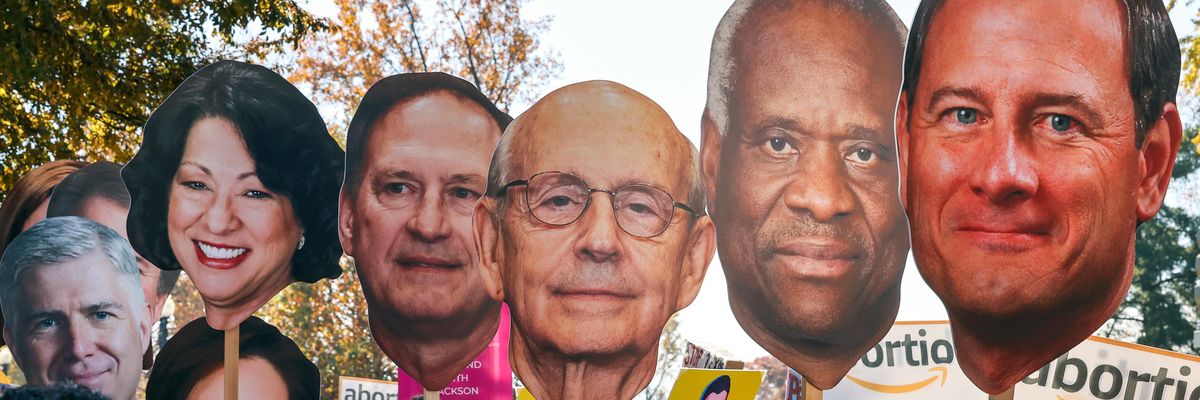
Activists with The Center for Popular Democracy Action hold photos of U.S. Supreme Court justices as they block an intersection during a demonstration in front of the U.S. Supreme Court on December 01, 2021 in Washington, DC.

(Photo: Chip Somodevilla/Getty Images)


ROBERT REICH
Jul 03, 2023
Robertreich.Substack.Com

One ruling hidden inside one of the Supreme Court’s horrendous decisions last week hasn’t got nearly the attention it deserves: the court’s radical expansion of who has standing to bring cases before the court.

When I argued cases before the Supreme Court in the 1970s, a challenger had to show they’d suffered a specific injury that could be remedied by relief from a federal court. If they failed to establish such standing, the high court would dismiss the case without considering the merits of their claim.
The necessity to establish standing to bring a case before the Supreme Court has been an important guardrail preventing the court from getting into matters the Constitution has reserved for the other branches of government.

But on Friday, in Biden v. Nebraska — striking down President Biden’s student loan program — the majority decided that Missouri had standing to challenge the program. Why? Because a quasi-independent state agency — the Missouri Higher Education Loan Authority (MOHELA) — might suffer financial losses from the loan program. As Chief Justice John Roberts wrote for the majority:
“The … plan harms MOHELA in the performance of its public function and so directly harms the State that created and controls MOHELA. Missouri thus has suffered an injury in fact sufficient to give it standing to challenge the Secretary’s plan.”

Directly harms the state? Hello?As Justice Elena Kagan wrote in her dissent, “In adjudicating Missouri’s claim, the majority reaches out to decide a matter it has no business deciding” — with a ruling that “blows through a constitutional guardrail intended to keep courts acting like courts.”

From now on, a state can challenge any action of the federal government merely by setting up a quasi-independent agency indirectly affected by it.

Bad enough that the court’s majority is now making up its own laws — disregarding the Supreme Court’s own precedents it disagrees with, deciding Congress hasn’t authorized certain actions it disagrees with, and finding certain practices it disagrees with to be unconstitutional.

Bad enough that three of the justices now in the majority were appointed by a man who lost the popular vote, who was impeached twice, and who promoted an insurrection against the United States. And two others were appointed by a man who also lost the popular vote and led the nation into war in Iraq under false pretenses.

Now that the court has obliterated the guardrail on what it can consider, there are no limits to what this least democratic branch of government — and its extremist majority — might do.

Which is why it’s so important to reform the court — in ways I’ve suggested here.

© 2021 robertreich.substack.com

Biden V. NebraskaDemocracyStudent Debt ReliefUS Supreme Court
As Justice Elena Kagan wrote in her dissent, “In adjudicating Missouri’s claim, the majority reaches out to decide a matter it has no business deciding” — with a ruling that “blows through a constitutional guardrail intended to keep courts acting like courts.”

ROBERT REICH
Robert Reich, is the Chancellor's Professor of Public Policy at the University of California, Berkeley, and a senior fellow at the Blum Center for Developing Economies. He served as secretary of labor in the Clinton administration, for which Time magazine named him one of the 10 most effective cabinet secretaries of the twentieth century. His book include: "Aftershock" (2011), "The Work of Nations" (1992), "Beyond Outrage" (2012) and, "Saving Capitalism" (2016). He is also a founding editor of The American Prospect magazine, former chairman of Common Cause, a member of the American Academy of Arts and Sciences, and co-creator of the award-winning documentary, "Inequality For All." Reich's newest book is "The Common Good" (2019). He's co-creator of the Netflix original documentary "Saving Capitalism," which is streaming now.
Full Bio >


FROM YOUR SITE ARTICLES
Protests in France over police killing of teenager spread to Greece

Members of various leftist groups gather in front of French Embassy in Athens

Derya Gülnaz Özcan |04.07.2023 
A women holds a sign that reads 'Justice for Nahel' as leftists stage a demonstration in front of the French Embassy in solidarity with the French riots in Athens, Greece on July 03, 2023.


ATHENS

A protest was held Monday in Greece in front of the French Embassy in the capital Athens over the police killing of a teenager last week in France.

Vasilissis Sofias Street, where the embassy is located, was closed to traffic for a while due to the gathering of members of various leftist groups.

After calling for justice, the demonstration ended without incident.

A group of protestors staged a brief march afterwards.

Protests have continued to shake France since last Tuesday, when a police officer shot dead Nahel M., a French citizen of Algerian and Moroccan descent, during a traffic check in the Paris suburb of Nanterre after he ignored orders to stop.

The officer faces a formal investigation for voluntary homicide and has been placed in preliminary detention.

Protests began in Nanterre and spread to other cities the next evening, including Lyon, Toulouse, Lille and Marseille.

Tensions rose following clashes between police and protesters.

Police have arrested hundreds since the protests erupted, including 157 people on the sixth night of the unrest, Le Figaro reported.

More than 350 fires were started on public roads and nearly 300 vehicles were set on fire, the report added.

According to information compiled by Anadolu, during the protests, at least 1,000 buildings and 5,000 vehicles were set on fire, more than 250 police stations were targeted, and around 3,200 people were arrested.

Man charged with arson following Lake Louise fire that destroyed staff residence, displacing 165 people

After receiving reports of a man appearing to be "in distress" on the roof of the Charleston Residence, RCMP found a man in possession of a weapon and managed to deescalate the situation

Article content

A 40-year-old Lake Louise resident has been charged with arson following a Monday fire that destroyed a staff residence building at a resort in the mountain hamlet, displacing 165 workers.

Lake Louise RCMP said Tuesday evening that they received a report around 12 p.m. Monday that the Charleston Residence was on fire, and there was a male on the roof “who appeared to be in distress.”

Officers found the man on the roof of the Charleston Residence in possession of a weapon. 

“Officers deescalated the situation and convinced the male to come down a ladder, however, he slipped and fell to the ground,” RCMP said in a statement.

The man sustained non-life-threatening injuries, police said, and was taken to a Calgary hospital for treatment.

Following an investigation from the Southern Alberta District General Investigation Section, the man was arrested and charged.

Timothy Alexander Peterson, 40, has been charged with arson with disregard for human life and possession of a weapon for a dangerous purpose.

Police said Peterson has been remanded into custody and is scheduled to appear in the Alberta Court of Justice in Calgary on Friday, July 7.

‘Some people have lost their life’s work in some of these places’

The Charleston Residence is considered a complete loss after the fire. The site was still smouldering Tuesday morning and was expected to remain active for the following 24 to 48 hours.

Advertisement 3

Article content

“It’s a tragedy,” said Dan Markham, spokesman forLake Louise Ski Resort and Summer Gondola, which operates the residence. “I think there’s a lot of folks that are really feeling displaced right now. They don’t feel secure, a lot of people have lost their passports, their visas, some people have lost their life’s work in some of these places.”

In the face of this fire the village of Lake Louise has rallied to the aid of those who lost their home.

Clothing drives have popped up throughout the community for those who escaped with only what they had on their back, while the resort has engaged businesses and community members to find housing for people as the busy season gets underway.

Still, more is needed.

“We’re definitely looking for people that are displaced,” said Markham. “Most of the places we have right now are short term. We’re looking for anything within the Bow Valley, Canmore to Field, anywhere that we can be putting some people for at least the next few weeks.”

Those with room to put someone up or other donations are asked to email Markham at info@skilouise.com.

Hundreds displaced as staff residence in Lake Louise engulfed in flames

'Quite likely that the entire building will be lost,' says resort 

official

A log building on fire is pictured with smoke in the background.
The Charleston Residence in Lake Louise was engulfed in fire on Monday afternoon. (Submitted)

Despite losing almost everything she owns on Monday, Hayleah Sabourin says she's grateful that she's still alive after a fire tore through her residence in Lake Louise, Alta.

"As much as, yeah, it really sucks that I lost literally everything that I own, I'd rather that than not have the chance to wake up tomorrow," Sabourin said.

"In the situation that I was in, how close I was to the fire and the fact that I was sleeping, I could have been in a way worse situation. I could have died." 

Residents of the Charleston Residence — a three-storey log building that houses hundreds of staff during the year — saw their living quarters go up in flames on Monday.

Police, along with local fire departments and EMS responded to the blaze at around noon. Buses transported people from the fire scene to a muster point at the Lake Louise ski hill, according to RCMP.

There is one person in custody following the fire. The cause of the fire is still unknown, RCMP said.

It's believed the Charleston Residence was housing between 150 and 200 people. It can house as many as 400 during the busy winter season.

There were no fatalities reported, but one person was assessed and taken to hospital following the blaze, Alberta Health Services said, adding the patient was in serious but stable condition.

Sabourin said she saw one person trying to escape the flames.

"There was a guy on the ledge of the actual building," said Sabourin. 

"He was on the ledge kind of trying to get away from the fire, trying to be safe."

WATCH | Smoke rises from a fire at the Charleston Residence:

Clouds of smoke can be seen from a distance after the Charleston Residence was engulfed in flames. (Video submitted by Alyssa Wadey)

A resort official said temporary accommodations for some of the people displaced have been arranged, but it is likely the building has been destroyed.

"It's quite likely that the entire building will be lost," said Dan Markham, communications director for the Lake Louise Ski Resort.

A log building is pictured.
The Charleston Residence, a log building that housed hundreds of Lake Louise staff during the year, is pictured in this file photo. (Charleston Residence Facebook)

He added the gondola as well as the restaurant and beverage operations at the ski resort will be shut down for the next few days.

A clothing drive has been set up at the Lake Louise Inn for residents of the Charleston.

Amazon Rolls Out First Electric Delivery Vans from Rivian in Europe

More than 300 new electric vans from Rivian will hit the road in Germany in the coming weeks

The state-of-the-art vehicles provide drivers with an entirely new working environment, including innovative technology for sustainability, safety, and comfort

The vans are part of Amazon’s commitment to create a more sustainable delivery fleet, and reach net-zero carbon by 2040

MUNICH--()--Amazon today announced the arrival of its new custom electric delivery vans from Rivian in Europe, with the first vans rolling out in Germany. More than 300 electric delivery vans are hitting the road in Munich, Berlin, and Dusseldorf in the coming weeks, joining a fleet of thousands of electric vans already in operation in Europe, including more than 1,000 electric vans in Germany. Amazon announced last year that it plans to invest more than €1 billion to electrify its European transportation network and reduce carbon emissions over the coming years, including more than €400M in Germany.

“Together, Amazon and Rivian designed and built a state-of-the-art electric vehicle from the ground up, and unlike anything else on the road today,” said Neil Emery, Amazon, Director, Global Fleet & Product. “The safety and comfort of our drivers were top of mind for us throughout this process, and we’ve raised the bar on both with the vehicle we are rolling out in Europe today.”

“We’re thrilled to see the EDV rolling out in Germany today,” said Dagan Mishoulam, Vice President, Strategy & Go To Market, Rivian. “This vehicle was designed in conjunction with our partners at Amazon and not only puts driver convenience and safety first, but also the environment. We’ve had incredible feedback from drivers in the US and we're excited to start international expansion in Germany. Today is a real milestone for us as it also marks the first Rivian vehicles in Europe and we’re very excited about our future in the region.”

“Amazon is committed to reaching net-zero carbon by 2040, and reducing our delivery-related emissions is a critical part of this goal,” said Rocco Bräuniger, Country Manager for Amazon.de. “Last year we delivered more than 45 million packages in Germany with electric vans and e-cargo bikes, and these new additions from Rivian will help us deliver packages more sustainably and to more customers.”

Amazon began rolling out its custom electric delivery vans from Rivian in the U.S. last summer and already has more than 3,000 vans delivering packages in over 500 U.S. cities and regions. The company aims to have 100,000 electric delivery vehicles from Rivian on the road globally by 2030, helping to save millions of metric tons of carbon per year.

Amazon’s custom electric delivery vans from Rivian are designed from the ground-up with safety, sustainability, and comfort in mind, and have been thoroughly tested by drivers in Germany. They are the product of Amazon’s partnership with Rivian, which the companies announced in 2019 when Amazon co-founded, and became the first signatory of The Climate Pledge—a commitment to reach net-zero carbon across its operations by 2040. As part of the pledge, Amazon is creating a more sustainable delivery fleet—and its work with Rivian is an important part of decarbonizing its last mile logistics as well as accelerating innovation that could help others reach net-zero carbon.

Amazon has been testing deliveries with Rivian preproduction vehicles in Europe since last year. This testing has allowed Rivian to continuously improve the vehicle’s performance, safety and durability in various climates and geographies as well as its state-of-the-art features to ensure driver satisfaction, and overall functionality. In Europe, Amazon and Rivian specially designed a shorter, thinner van than its U.S. counterpart in order to better fit in Europe’s cities.

The custom vehicles include innovative technology and features such as:

  • A safety-first design focused on superior 360-degree visibility, and vehicle features that protect drivers and pedestrians.
  • A suite of innovative safety features including a large windshield to enhance driver visibility, automatic emergency braking, adaptive cruise control, and collision warnings.
  • First-of-its-kind embedded technology that fully integrates the delivery workflow with the vehicle, enabling seamless access to routing, navigation, driver support and more.
  • Features to enhance the driver experience, and create ease on the road such as automatic door locking/unlocking as the driver approaches or leaves the vehicle, and a powered bulkhead door that opens when drivers reach their delivery location.
  • A strengthened door on the driver’s side for additional protection, and an ergonomically designed driver’s cabin and cargo area for safe, and easy movement inside the van.
  • Batteries that are light, resilient, and low cost in addition to lasting the lifetime of the vehicle.

Amazon has added thousands of charging stations at its facilities across Europe, and will continue to invest in building an infrastructure to support a more sustainable delivery fleet.

In 2022, Amazon used zero-emission vehicles, including electric vans and micro-mobility solutions like e-cargo bikes, e-scooters, and walkers, to deliver more than 120 million packages to customers in Europe. The new vans from Rivian, along with the expansion of micro-mobility hubs across European cities, will help Amazon deliver even more packages in zero-emission vehicles.

About Rivian:

Rivian (NASDAQ: RIVN) exists to create products and services that help our planet transition to carbon neutral energy and transportation. Rivian designs, develops, and manufactures category-defining electric vehicles and accessories and sells them directly to customers in the consumer and commercial markets. Rivian complements its vehicles with a full suite of proprietary, value-added services that address the entire lifecycle of the vehicle and deepen its customer relationships. Learn more about the company, products, and careers at www.rivian.com.

NEW HEAD OF THE INQUISITION

Bishop Accountability Group Voices Concerns About Archbishop Fernández Appointment

 Archbishop Victor Manuel Fernandez. | Daniel Ibanez/CNA


By 

By Peter Pinedo

A bishop accountability group that tracks sexual abuse in the Catholic Church released a statement July 1 voicing serious concerns about Pope Francis’ new appointment of Archbishop Víctor Manuel Fernández to head the Vatican’s Dicastery for the Doctrine of the Faith.

The group keeps an online database of sexual abuse by clergy on its website, BishopAccountability.org.

In its statement, written by co-director Anne Barrett Doyle, the group called Fernández’s appointment “a baffling and troubling choice” for a position that “will have immense power, especially when it comes to judging and punishing priests who abuse children.”

Fernández, who is almost 61, has served as the archbishop of La Plata, Argentina, since 2018.

Pope Francis announced Fernández’s appointment to the influential dicastery on July 1. A longtime personal theologian and ghostwriter for the pope, Fernández is expected to take up his new post in mid-September.

“As the new prefect of the Dicastery for the Doctrine of the Faith, I entrust to you a task that I consider very valuable,” Pope Francis wrote in a July 1 letter to Fernández. “I ask you as prefect to dedicate your personal commitment in a more direct way to the main purpose of the dicastery, which is ‘guarding the faith.’”

Doyle said that “Fernández’ recent handling of a clergy sex abuse case in his home archdiocese of La Plata raises great concern.”

According to Doyle, Fernández “publicly defended” and supported La Plata priest Father Eduardo Lorenzo in the face of five sex abuse allegations in 2019. Doyle said that Fernandez continued to stand by Lorenzo even after an arrest warrant was issued and the priest committed suicide.

“In his response to allegations,” Doyle said that Fernández “stoutly supported the accused priest and refused to believe the victims. Showing disregard for the safety of children, Fernández kept the priest at his parish post even as more victims came forward.”

“For his handling of this case, Fernández should have been investigated, not promoted to one of the highest posts in the global Church,” Doyle said. “Nothing about his performance suggests he is fit to lead the pope’s battle against abuse and cover-up.”

Doyle is especially concerned because part of Fernández’s responsibilities as head of the Dicastery for the Doctrine of the Faith will be responding to the abuse of minors.

“Fernández will have immense power, especially when it comes to judging and punishing priests who abuse children,” Doyle said. “It will be up to Fernández to implement and enforce [the] pope’s zero tolerance pledge. To do this, he will need to make child protection and justice for victims his highest priority.”

Fernández is a controversial figure in the Church in Argentina, in part because of some of his past publications. The theologian has published more than 300 articles and books.

The book commonly regarded as his most unusual is the 1995 work “Heal Me With Your Mouth: The Art of Kissing.” Regarding the book, Fernández explained that “in these pages I want to synthesize the popular feeling, what people feel when they think of a kiss, what they experience when they kiss … So, trying to synthesize the immense richness of life, these pages emerged in favor of kissing. I hope that they help you kiss better, that they motivate you to release the best of yourself in a kiss.”

The book has disappeared from most official lists of Fernández’s works.

Neither Fernández nor the Archdiocese of La Plata have responded to CNA’s requests for comment.


CNA
The Catholic News Agency (CNA) has been, since 2004, one of the fastest growing Catholic news providers to the English speaking world. The Catholic News Agency takes much of its mission from its sister agency, ACI Prensa, which was founded in Lima, Peru, in 1980 by Fr. Adalbert Marie Mohm (†1986).
RIGHT WING FAKERY
Legitimacy of 'customer' in Supreme Court gay rights case raises ethical and legal flags

By ALANNA DURKIN RICHER and COLLEEN SLEVIN Associated Press
JULY 4, 2023 — 12:45AM

ANDREW HARNIK, ASSOCIATED PRESS
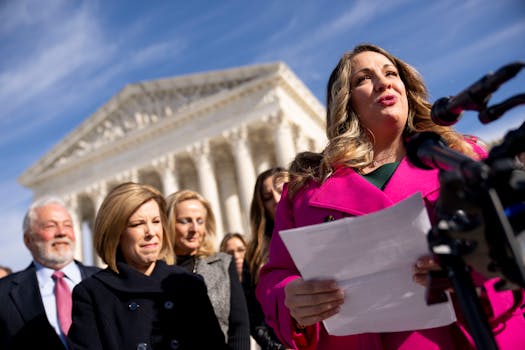
Lorie Smith, a Christian graphic artist and website designer in Colorado, right, accompanied by her lawyer, Kristen Waggoner of the Alliance Defending Freedom, second from left, speaks outside the Supreme Court in Washington, Monday, Dec. 5, 2022, after her case was heard before the Supreme Court. In a defeat for gay rights, the Supreme Court’s conservative majority ruled Friday, June 30, 2023, Smith who wants to design wedding websites can refuse to work with same-sex couples.

A Christian graphic artist who the Supreme Court said can refuse to make wedding websites for gay couples pointed during her lawsuit to a request from a man named ''Stewart'' and his husband-to-be. The twist? Stewart says it never happened.

The revelation has raised questions about how Lorie Smith's case was allowed to proceed all the way to the nation's highest court with such an apparent misrepresentation and whether the state of Colorado, which lost the case last week, has any legal recourse.

It has served as another distraction at the end of a highly polarizing term for a Supreme Court marked by ethical questions and contentious rulings along ideological lines that rejected affirmative action in higher education and President Joe Biden's $400 billion plan to cancel or reduce federal student loan debts.

Here's a look at the legal questions surrounding the mysterious would-be customer, ''Stewart:"

WHAT ROLE DID THE CLAIM PLAY IN THE CASE?

About a month after the conservative legal group Alliance Defending Freedom filed the case in Colorado federal court in 2016, lawyers for the state said it should be dismissed partly because Smith hadn't been harmed by the state's anti-discrimination law. Smith — who did not plan to start creating wedding websites until her case was resolved — would first have to get a request from a gay couple and refuse, triggering a possible complaint against her, the state argued.

Smith's lawyers maintained that she didn't have to be punished for violating the law before challenging it. In a February 2017 filing, they revealed that though she did not need a request to pursue the case, she had, in fact, received one. An appendix to the filing included a website request form submitted by Stewart on Sept. 21, 2016, a few days after the lawsuit was filed. It also included a Feb. 1, 2017, affidavit from Smith stating that Stewart's request had been received.

Two documents Smith filed with the Supreme Court briefly mention that she had received at least one request to create a website celebrating a same-sex wedding but do not elaborate.

The request stated that Stewart and his fiancé Mike were looking for design work on things like invitations and place setting cards for their upcoming wedding. ''We might also stretch to a website,'' the form said.

Lawyers for Colorado wrote in their brief to the Supreme Court in August that it did not amount to an actual request for a website and the company did not take any steps to verify that a ''genuine prospective customer submitted the form.'' It's not clear whether the state took any steps to verify whether Stewart — whose contact information was included in court papers — was a real potential customer.

Stewart told The Associated Press last week that he didn't even know his name had been invoked in the case until he was contacted by a reporter for The New Republic, which first reported his denial. Stewart, who declined to give his last name for fear of harassment and threats, said he was incredibly surprised, adding he has been married to a woman for 15 years.

COULD THE REVELATION IMPACT THE CASE NOW?

It's highly unlikely. The would-be customer's request was not the basis for Smith's original lawsuit, nor was it cited by the high court as the reason for ruling in her favor. Legal standing, or the right to bring a lawsuit, generally requires the person bringing the case to show that they have suffered some sort of harm. But pre-enforcement challenges — like the one Smith brought — are allowed in certain cases if the person can show they face a credible threat of prosecution or sanctions unless they conform to the law.

The 10th U.S. Circuit Court of Appeals, which reviewed the case before the Supreme Court, found that Smith had standing to sue. That appeals court noted that Colorado had a history of past enforcement ''against nearly identical conduct'' and that the state decline to promise that it wouldn't go after Smith if she violated the law.

''If there are other places where you can get standing, then legally speaking I don't think it actually does make a difference,'' said Jessica Levinson, a professor at Loyola Law School.

However, it could have affected the case by undermining the credibility of Smith's legal team, potentially causing the judge to look more skeptically at everything else they filed, Levinson said. It could also result in potential sanctions against Smith's legal team if it turns out they knew Stewart's request was false, Levinson said.

While the revelation cannot change the decision, ''it's something that should've come up in the litigation,'' said Erwin Chemerinsky, the dean of Berkeley Law, ''because then what the court should have done is say we have doubts about this, we can't resolve it, we send it back to the federal district court.''

Kristen Waggoner — the president of Alliance Defending Freedom, who argued the case before the high court— has said her client doesn't have a way of doing background checks on those requesting business nor is it her responsibility to do so. On Monday, Waggoner slammed suggestions that her client made up the request, adding that ''the more likely scenario'' is that "'Stewart' or another activist did in fact submit the request.''

''To say that Lorie Smith or ADF fabricated a request for a same-sex wedding website is a lie," she said in an emailed statement. ''It would make no sense to have fabricated a request because one wasn't required for the court to decide her case.''

HAS ANYTHING LIKE THIS HAPPENED BEFORE?

An error like that — especially at the level of the Supreme Court — is highly unusual, legal experts say.

''Assuming the allegation is correct that this was something that was factually inaccurate ... I've never seen anything that blatant happen before," said Adam Feldman, who follows the court as the creator of the Empirical SCOTUS blog.

Lawyers have, however, had to walk back statements made to the court before.

The solicitor general, who represents the government before the Supreme Court, apologized in a court filing this year for an ''inaccurate statement'' made to the court during oral arguments over a 2017 patent case. Solicitor General Elizabeth Prelogar wrote that the lawyer was given wrong information by the United States Patent and Trademark Office, adding: ''We regret any misimpression inadvertently created by the answer that was given.''

The court has also included errors in its own rulings. In 2017, ProPublica published a review of several dozen cases in which they found several ''false or wholly unsupported factual claims." Among them was an error in Shelby County v. Holder, which struck down part of the Voting Rights Act. The publication reported that Chief Justice John Roberts included incorrect data in a comparison of voter registration among Black people and white people in certain states.

____

Associated Press reporter Jesse Bedayn contributed from Denver.
A NEW OUTBREAK OF BIRD FLU IN POLAND KILLS NINE CATS

Global animal welfare organisation calls the situation “deeply worrying”


Vienna, 3 July 2023 – FOUR PAWS, the global animal welfare organisation, said the outbreak of Highly Pathogenic Avian Influenza (HPAI) A(H5N1) that has caused the death of nine cats across Poland is “deeply worrying”.

HPAI was discovered in June in cats residing in three separate regions of Poland: Tri-City, Lublin, and Poznan, with Polish authorities now urging all cat owners to take precautions to help stop the spread of the disease.

Wendla Beyer, FOUR PAWS Policy Coordinator, said, “What we are seeing in Poland is deeply worrying. This virus needs to be taken seriously, especially as the source of these infections has yet to be identified and there are no policies in place to address the underlying problem that has caused HPAI to spiral out of control, namely factory farming.

“Following on the heels of the COVID-19 pandemic, we saw the largest avian influenza outbreak worldwide, with devastating effects on animals, trade and the livelihoods of farmers. Infections in mammals spark fears of viral mutations that could become transmissible between humans, igniting a new pandemic. And now, as we have seen, house cats are dying from the virus."

“This is the looming pandemic if no action is taken to tackle the root cause of its unprecedented spread: industrial farming, which is driving the circulation and mutation of HPAI viruses. It's becoming obvious that biosecurity and vaccines are not enough to stop avian influenza; HPAI outbreaks are happening inside factory farms with the highest biosecurity too. Policy makers need to tackle the problem at its root.

With 75% of emerging human infectious diseases coming from animals, scientists and experts are highlighting the link between exploiting animals and increasing pandemic risks. Governments need to fully embrace the One Health approach, which seeks to optimise and balance the health of humans, animals and the environment. This is the only way to concretely tackle zoonotic diseases such as bird flu.”


Wendla Beyer, FOUR PAWS Policy Coordinator


Commonly known as Bird Flu, HPAI, reached unprecedented geographic spread across continents and record outbreaks, with 50 million poultry culled in the epidemiologic year 2021/2022 in Europe alone.

In wild birds, avian flu is causing alarming mortality rates, threatening to wipe out endangered species. The virus killed hundreds of thousands of wild birds, including 10% of the Humboldt penguins in Chile in 2023 and 50,000 Peruvian pelicans and boobies in 2022; it is decimating breeding colonies at the time of writing.

In 2022, European Food Safety Authority figures show rising infections among mammals, alongside 52,000 minks being killed in fur farms, and 8,117 sea lions on the Chilean coast, among other species. Despite the magnitude of outbreaks, the increased risk of mutations transmissible among humans, the loss of animal lives and economic repercussions, there are no strategies in place to address the root causes.