Saturday, August 26, 2023

Saskatchewan 

NexGen's Rook I proceeds to provincial public review

22 August 2023


NexGen Energy has completed the Provincial Environmental Assessment (EA) technical review process and submission of the Final Provincial Environmental Impact Statement (EIS) for its flagship Rook I project to the Saskatchewan Ministry of Environment.

Rook I (Image: NexGen)

The project, which is in Saskatchewan's southwestern Athabasca Basin, includes underground and surface facilities to support the mining and processing of uranium ore from the Arrow Deposit. The ministry has confirmed completion of its conformity review of the revised EIS submitted by NexGen in July 2023, and the planned advancement of the Provincial EA to the public review stage.

The next step under the Provincial EA process will be a 30-day public review, which is expected to begin on, or before, 2 September. After this, Ministry of Environment staff will compile the requisite EA materials and prepare a recommendation to the Saskatchewan Minister of Environment, who will then make a decision on the advancement of the project.

NexGen CEO Leigh Curyer said the submission of the Final Provincial EIS is a significant step in the regulatory advancement of the Rook I Project, marking the completion of a "robust and thorough" technical review process, and incorporating the diverse perspectives of multiple agencies and stakeholders.

"We are incredibly proud of the contribution and partnership of all four local Indigenous communities in the local project area whom, through industry-leading Benefit Agreements, have all confirmed their formal and legal consent for the company and project throughout its entire lifespan," he said. "In parallel to today's exciting milestone, we focus on the successful completion of the Federal EA and licensing process working diligently on delivering generational benefits to Saskatchewan and Canada to secure the clean energy transition for the globe."

NexGen describes Rook I as the largest development-stage uranium project in Canada. Rook I hosts the Arrow deposit with measured and indicated mineral resources of 256.7 million pounds U3O8 (98,739 tU) supporting an initial 10.7 year mine-life.

The company has adopted an integrated approach to the federal and provincial environmental licensing processes, with the provincial energy ministry and the federal regulator, the Canadian Nuclear Safety Commission, cooperating to share information while providing a comprehensive EA process in accordance with their separate requirements and guidelines. NexGen completed submission of all the final components of the complete licence application package earlier this year.

Researched and written by World Nuclear News

Sweden to lift parliamentary ban on uranium mining

The historically anti-nuclear country has announced plans to increase its nuclear generation dramatically.
Sweden’s Climate Minister Romina Pourmokhtari is advocating for increased nuclear generation.
Credit: Alexandros Michailidis via Shutterstock.

Sweden’s Climate Minister Romina Pourmokhtari has announced plans to lift the country’s ban on uranium mining and make way for greater nuclear energy capacity.

The Swedish Parliament has shown majority support for a lift on the ban, according to Pourmokhtari.

The government plans to build at least ten large reactors in the next 20 years to meet the demand for low-carbon energy. Swedish Prime Minister Ulf Kristersson told reporters in January that the government is “changing the legislation”, which will increase nuclear investment in the country.


Swedish ministers decided to phase out nuclear generation in 1980 and have historically taken an anti-nuclear stance. However, this policy was repealed in June 2010. Pourmokhtari is a public advocate of nuclear generation and says it should form a part of Sweden’s future energy mix.

“The government is aiming at doubling electricity production in 20 years,” Pourmokhtari told The Times this weekend.

“For our clean power system to function, a large part of this has to be dispatchable where nuclear power is the only non-fossil option. Nuclear power also has a reduced environmental footprint and requires limited resources in comparison with most energy sources.”

Uranium mining has become a point of concern for Europe’s nuclear industry as Russia dominates the processing of the fuel. Following the country’s invasion of Ukraine last year, the EU has sought to reduce its energy dependence on Moscow.

Kazakhstan, however, is by far the largest uranium miner. According to the World Nuclear Association, the country produced the largest share of mined uranium (43% of the global supply) in 2022, followed by Canada (15%) and Namibia (11%).


The European Parliament has been the site of heated debate over the role of nuclear generation in a net-zero future. France, which generates around 70% of its energy from nuclear sources, has been vocally pro-nuclear. Meanwhile, Germany, which has shut down its final three nuclear power stations this year, says that the fuel is not renewable.

Sweden accounts for 80% of the EU’s uranium deposits and already extracts uranium as a waste product when mining for other metals.

Several companies, including Australia’s Aura Energy and Canada’s District Metals, have already expressed interest in developing uranium sites in Sweden.
Hecla says production impacted at Idaho mine after fire incident

Reuters | August 21, 2023 | 

Lucky Friday silver mine. (Image courtesy of Hecla Mining.)

Hecla Mining said on Monday that production at its Idaho mine was hit after it suspended operations following a fire incident, sending the shares of the largest US silver miner down over 8%.


The company said a “fall of ground” incident occurred in one of the shafts at its Lucky Friday mine where the repair works were underway.

A “fall of ground” involves a collapse of a part of the mine shaft or tunnel roofs or walls crumbling.

No personnel were in the mine at the time of the failure, Hecla said, adding that it was working on a plan to resume production and would update 2023 outlook once that happens.

“A prolonged shutdown of operations at Lucky Friday following the ground fall/fire at the #2 shaft could materially impact 2023 guidance with the mine accounting for about 30% of our 2H23 consolidated EBITDA forecast,” said analysts at RBC Capital Markets.

“While management is working on a remediation plan, we expect this issue will further pressure near-term FCF (free cash flow) generation,” the analysts added.

Shares of the company fell to $4.18 in morning trading.

(By Tanay Dhumal and Arunima Kumar; Editing by Shweta Agarwal)

Companies keep mum on ESG initiatives as ‘greenhushing’ takes off

Tim Shufelt - The Globe and Mail investment reporter | August 18, 2023 | 

Stock image.

When it comes to what big business is doing to address climate change, corporate leaders would rather not talk about it.


As sustainable investing has become a cultural flashpoint in the United States, the term “ESG” has been practically expunged from the corporate lexicon.

In the latest round of quarterly earnings calls, just 56 companies in the S&P 500 Index commented on environmental, social and governance initiatives, according to Axios. That number is down by 64 per cent from its peak in the fourth quarter of 2021, when the corporate sector was eager to bask in the reputational glow of corporate sustainability.

A separate analysis by FactSet found that ESG mentions in the transcripts of management calls with analysts declined in four of the past five quarters.

Now, some companies seem to be distancing themselves from their own initiatives, at least partly as a result of the backlash against ESG. That doesn’t mean they are backing away from spending on their environmental commitments. By a range of measures, the energy transition is accelerating, while more and more companies are signing on to emissions-reduction targets.

“These investments in energy transition are still happening; they’re just maybe not being labelled and marketed as energy-transition investments,” said Sarah Thompson, the managing director of sustainable finance at RBC Capital Markets.

“Those companies are not really changing their strategy, they’re just less vocal about it to attract less attention.”

Many investors are by now familiar with greenwashing, whereby companies exaggerate their own environmental credentials.

This newer phenomenon is known as “greenhushing,” and is essentially the opposite.

There are, however, some constructive reasons for the lack of ESG chatter by management teams these days. A maturing of sustainable investing over the past few years has made basic green initiatives at the corporate level less novel and newsworthy.

“We’ve seen tremendous integration of ESG considerations into the investment process and corporate strategy. Now, it’s sort of table stakes,” Ms. Thompson said.

Additionally, securities regulators around the world have had time to catch up to the ESG boom, and the effort to stem the tide of greenwashing is well under way.

Universal reporting standards for ESG disclosures are also progressing quickly, with the International Sustainability Standards Board recently publishing a set of rules meant to establish a global baseline for reporting on carbon emissions. In June, the chief executives of 11 of Canada’s largest pension fund investors urged Canadian companies to adopt the new standards.

As a result, companies are becoming more cautious about publicly discussing ESG commitments, said Deborah Debas, a responsible investment specialist at Desjardins Wealth Management.

“Some companies wanted to make something happen, but they were not able to deliver. Then they were slapped on the wrist by regulators and now they’re a bit more fearful and prudent before they make those claims,” Ms. Debas said.

Still, the recent politicization of ESG investing seems to be a big force behind the chill in ESG public relations, at least in the U.S.

More than a dozen states have introduced legislation targeting ESG investing, which has been characterized as a perversion of the investment process in the name of a woke left-wing agenda.

“We want them to act as fiduciaries. We do not want them engaged on these ideological joyrides,” Florida Governor and Republican presidential candidate Ron DeSantis said in May as he signed a bill into law that prohibits state officials from investing public money to advance ESG goals.

One the main targets of the backlash is Larry Fink, CEO of BlackRock, which helped bring ESG investing to the masses. In June, Mr. Fink said that he has stopped using the term “ESG” altogether. “I don’t use the word ESG any more because it’s been entirely weaponized.”

But BlackRock isn’t changing is position on climate change, nor will it stop putting pressure on the companies it invests in to embrace decarbonization, Mr. Fink said.

“It’s funny to see that they’re avoiding the terminology but still doing the same things they were doing before,” Ms. Debas said.

That appears to be an emerging theme across the financial industry – increasing investment in ESG, but doing it more quietly.

Wednesday marked the one-year anniversary of the U.S. Inflation Reduction Act – the largest federal climate change response in the country’s history. A vast set of tax breaks for sustainable energy investments is proving so popular that it could end up costing more than US$1-trillion over the next decade, according to some estimates.

Meanwhile, more than 3,200 corporations have committed to the international Science-Based Targets initiative for reducing greenhouse gas emissions.

“The pace is remarkable,” Ms. Thompson said.
Solar money in China drives world renewable investment to record

Bloomberg News | August 20, 2023 | 

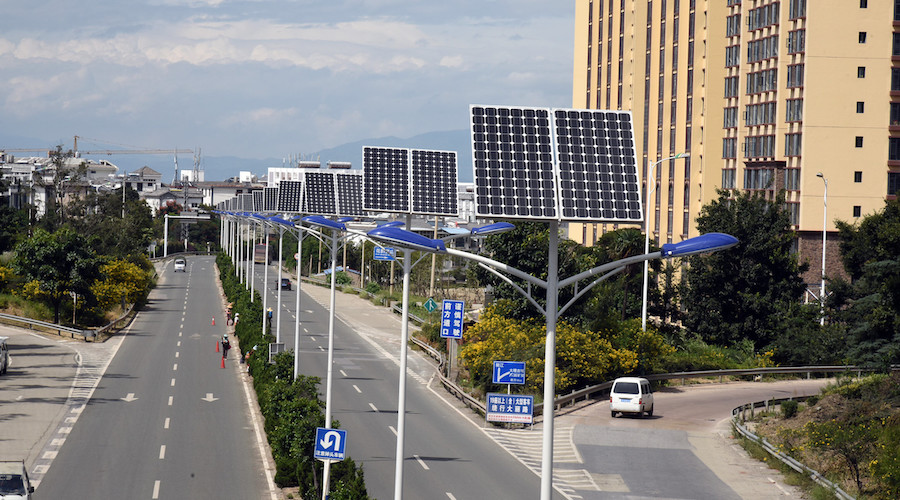
Solar panels in Dali City, located in China’s southwestern Yunnan province. (Image by the Asian Development Bank, Flickr.)

The world is spending more money than ever in renewable energy, most of it on solar power in China, according to a report from BloombergNEF.


China accounted for about half of a record $358 billion global investment in renewable energy in the first half of this year, thanks to cheaper modules, a robust rooftop PV market and the commissioning of energy megabase projects, according to the report. The US was a distant second.

Still, US investments in solar soared 75% from the first half of 2022 to $25.5 billion as supply chain constraints eased and clarity grew around the landmark Inflation Reduction Act, according to analysts, including Meredith Annex. The growth in solar outshone struggling wind investments, particularly for onshore projects.

The US was the top market for venture capital and private equity investments in renewables with a record $3.3 billion.

(By Chunzi Xu)


Tycoon Jindal's JSW Steel seeks significant stake in Teck's coal unit

JSW Steel Ltd. is looking to snap up a major stake in Teck Resources Ltd.'s metallurgical coal unit as it seeks to secure supplies for its expansion plans, according to Chairman Sajjan Jindal.

India's biggest steel producer intends to bid for 20 per cent to 40 per cent of Elk Valley Resources Ltd., a unit of the Canadian company, Jindal said. Japanese and South Korean mills also plan to buy a stake in the asset, and a combined offer could value the unit at US$8 billion, he said. 

A transaction is likely to happen within a month, the Indian tycoon said in an interview with Bloomberg Television on Friday.

Teck produces very high quality metallurgical coal, which India needs for steel-making, as the locally mined material is mostly of a lower grade, Jindal said. “We believe that this could be a very strategic fit for us, therefore we are taking a significant stake.”

Securing coal supplies is key for JSW's plan to almost double its annual steelmaking capacity to 50 million tons in India by the end of the decade. The company is looking for coal assets globally, including in Australia and Canada.


Bloomberg News reported last week that JSW was seeking partners for an offer to acquire a 75 per cent interest in Elk Valley. A JSW-led consortium could yet face competition for the asset from Glencore Plc, which in June proposed buying the business for about US$8 billion as an alternative to a full takeover of Teck.


Teck planning full exit from coal business, in


event of partial sale will spin off remainder

Niall McGee - The Global and Mail | August 18, 2023 | 

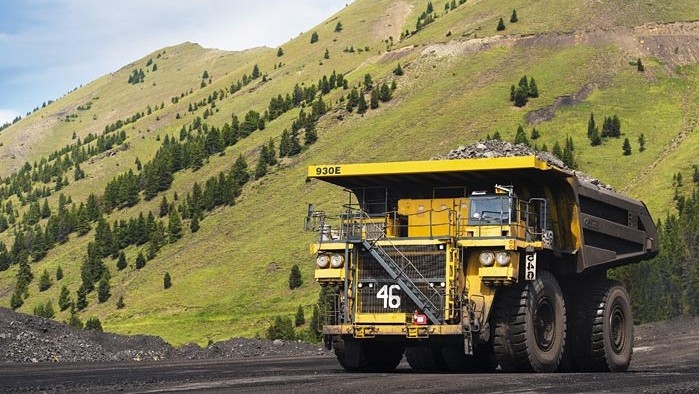
Teck’s Fording River metallurgical coal operation in B.C. Credit: Teck Resources

Teck Resources (TSX: TECK-B) intends to completely exit its coal business, but in the event of only a partial sale, would spin off the remainder to ensure a clean break, a source familiar with the situation said.


The Vancouver-based mining company has been entertaining a variety of bids for its metallurgical coal business since late April after an earlier restructuring plan failed.


Teck chief executive officer Jonathan Price said in a conference call last month that there has been “a lot of interest” in the coal business since it was put out for tender.

Glencore PLC GLNCY of Switzerland is the only known bidder for 100 per cent of the coal segment, with an offer worth up to $8.2 billion.

While that would appear to give Glencore a competitive advantage, the source said that Teck could also go the route of selling only a portion of the business to another party, and spinning off the remainder to its shareholders, if it deems that to be a better deal for stakeholders.

The Globe and Mail is not identifying the source because the person was not authorized to speak publicly.

Teck declined comment for this story.

Several contenders other than Glencore have emerged in recent months, submitting bids for only a portion of the coal business. Those include a consortium led by Canadian mining veteran Pierre Lassonde, as well as a bid from Japan’s Nippon Steel. Bloomberg News also reported on Thursday that Indian conglomerate JSW Steel is mulling a bid for up to 75 per cent of the coal business.

JSW did not respond to a request for comment.

A deal with Glencore could make life easier for Teck because a sale of the entire coal business would not require a shareholder vote, the source said, while a partial sale in combination with a spinoff may require one, depending on the exact structure of the transaction.

Teck earlier in the year intended to put its original restructuring plan to spin off the full coal business to a shareholder vote. However, after failing to receive sufficient support, the company pulled the proposal, illustrating the uncertainty created by the necessity to hold such votes.

Glencore last week reaffirmed its interest in Teck, saying it has set aside about US$2-billion in cash to be put toward a potential transaction.

While Glencore is focused on acquiring Teck’s coal business, it is still open to buying all of Teck, which would include its significant portfolio of copper and zinc mines.

Several federal ministers have expressed reservations about Glencore buying Teck, including Industry Minister François-Philippe Champagne, Natural Resources Minister Jonathan Wilkinson and Deputy Prime Minister Chrystia Freeland. In a letter to the Greater Vancouver Board of Trade earlier this year, all three wrote that “We need companies like Teck here in Canada – companies with a strong commitment to Canada.”

Teck’s history goes back to 1913, when Hughes Gold Mines Ltd. started up a gold mine in Teck Township on the shores of Kirkland Lake, Ont. Three generations of the Keevil family built what is now Canada’s biggest diversified mining company.

Family patriarch Norman B. Keevil told The Globe in April that he had no interest in allowing the whole of Teck to be sold to Glencore, no matter what the price. Teck’s board also twice rejected proposals by Glencore to buy all of Teck.

Glencore’s history in Canada dates back to 2013 when it bought fellow Swiss miner Xstrata PLC, which had earlier acquired Canadian nickel miner Falconbridge Ltd. Glencore employs around 9,000 people in this country.

Glencore also owns a 49.9-per-cent stake in Canadian grain handler Viterra Ltd. However, Glencore agreed in June to sell its stake in the company to American agribusiness company Bunge Ltd. The deal isn’t expected to close until the middle of next year.

Several years ago, Teck kicked off a strategic review after concluding that even though its coal business generates billions in cash flow every year, it is weighing down the valuation of the larger company. There has been less investment demand over time for coal companies owing to the detrimental impact that burning the fossil fuel has on the environment.

Glencore was among the earliest parties interested in buying Teck’s coal business. One of the world’s biggest thermal-coal companies, it operates around 25 mines in Australia, Colombia and South Africa.
Newmont ‘reviewing’ Mexico investments as worker strike drags on

Bloomberg News | August 18, 2023 | 

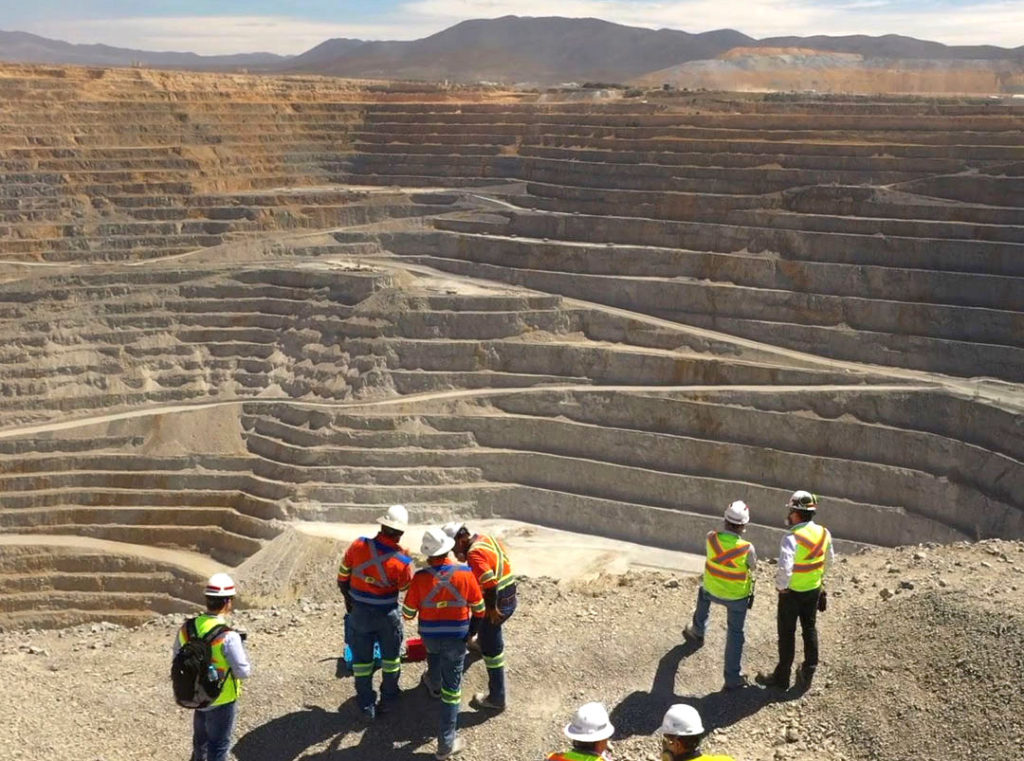
Peñasquito is the world’s fifth largest silver mine and Mexico’s second biggest. (Image courtesy of Newmont’s suppliers in Mexico.)

Newmont Corp., the world’s biggest gold miner, is reviewing its investments in Mexico with a workers’ strike at the country’s largest bullion mine now in its third month.


Top executives at the Denver-based firm, including chief executive officer Tom Palmer, traveled to Mexico City this week to meet with senior government officials, imploring them to help resolve what Palmer called a “very, very disappointing” dispute at the Penasquito mine.


“This situation is forcing us to critically review our investments here in Mexico,” Palmer said in a meeting with Penasquito’s operators, posted on the mine’s Facebook page. “While we want to find a way through this, we are not willing to resolve this at any cost.”

The mine shuttered in early June when about 2,000 unionized workers downed tools over a dispute regarding a profit-sharing agreement and alleged contract breaches. The company has since declared force majeure on products from the mine and is seeking a resolution to the dispute in a labor court.

Palmer said he told Labor Minister Marath Bolanos in a meeting that the company is “not willing to negotiate any additional payment” for the workers’ profit-sharing agreement — a sticking point in the negotiations.

Besides gold and silver, Penasquito is also a major supplier of zinc and lead.

(By Jacob Lorinc)

Canada poised for success in the space race, stakeholders say

Space exploration and research has become a booming industry and some players believe Canada is poised to become a serious player.

Christine Tovee, chief technology officer at the satellite imagery firm Wyvern, said Canada’s business interests in space are growing and the country has the expertise needed to excel.

“We’re seeing a lot of action right now in Canada,” she told BNN Bloomberg in a television interview this week.

She pointed to space-related skills in the country when it comes to robotics, AI and earth observation, her speciality area.

 “We have a lot of capability, we have a lot of people who are excited about it, who are world renowned.”


SATELLITES AND ROBOTICS

Wyvern recently launched a pair of satellites into orbit which will transmit images of features not seen with the human eye, such as infrared.

Tovee said the images will help identify wildfire risk areas and distressed plants, among other uses.

“It gives us a lot more data to make decisions when we’re in a global race to save the planet,” she said.

When it comes to areas of the space race that Canadians might specialize in, Tovee said robotics used to clean up space debris may be an emerging industry.

According to NASA, there is about 23,000 pieces of “space junk” larger than a softball orbiting the planet, with many smaller pieces still capable of disrupting space operations.

“Space is getting congested,” she said. “We need to decide how we’re going to manage the space in lower Earth orbit. Robotics is going to be a part of that.”

'NATIONAL PRIDE'

David Haight, director of economic analysis, international and regulatory affairs at the Canadian Space Agency, said Canada’s space research contributions have long been a source of pride for those involved.

“We have over 40 universities across the country that are doing space research, so it’s really a point of national pride,” he said in a television interview Wednesday.

“We’re pushing the envelope in terms of cutting edge technologies that are going to have benefits back on Earth.”


Earlier this week, India became the fourth country to land a rover on the moon and the first to do so near its south pole.

Haight said Canada is planning its own south pole moon landing for as early as 2026. The rover would examine the geology in the area and search the region for signs of water, Haight added.

“Canada’s in the game, we’re a player when it comes to this,” he said.


Crescent Point Energy signs deal to sell assets in North Dakota for $675M in cash

Crescent Point Energy Corp. has signed a deal to sell its North Dakota assets to a private operator for about $675 million in cash.

The Calgary-based company announced the sale Thursday, saying in a news release that the limited drilling inventory associated with the assets means oil production from the area is expected to decline over time. 

The company has decided instead to concentrate on Saskatchewan and Alberta, where it has been bulking up its strength through recent asset purchases.

"Over the last few years, we have taken several strategic steps to optimize our portfolio," said Crescent Point CEO Craig Bryksa in a news release. 

"This (North Dakota asset sale) allows us to realize future value for an area with limited scalability while immediately enhancing our financial position and increasing our focus on our core operating areas."

Crescent Point's North Dakota production was about 23,500 barrels of oil equivalent per day (boe/d) in the second quarter of this year. 

But the company said that is expected to decrease to 18,000 boe/d by 2027 and decline further in future years.

Earlier this year, Crescent Point acquired Spartan Delta Corp.'s Montney oilfield assets in Alberta for $1.7 billion, a deal that saw the company significantly grow its presence in what is one of North America's largest unconventional petroleum plays.

Through that deal, Crescent Point acquired 600 drilling locations in the Montney region, adding 38,000 boe/d to the company's production capacity.

The company's Montney assets are adjacent to the Kaybob Duvernay assets which Crescent Point acquired from Shell Canada for $900 million in 2021. Crescent Point has since been fortifying its position in that region with additional purchases.

On Thursday, Crescent Point lowered its 2023 annual average production guidance to a range of 156,000 to 161,000 boe/d, a reduction of approximately 4,500 boe/d in comparison with the midpoint of its prior guidance range. 

The company said the revised forecast includes the impact associated with the sale, which is expected to close in the fourth quarter of this year, subject to regulatory approvals.

Crescent Point also cut its development capital expenditures guidance for the year by about $100 million, to a range of $1.05 billion to $1.15 billion, partly reflecting the sale of the assets in North Dakota.

This report by The Canadian Press was first published Aug. 24, 2023.

Companies in this story: (TSX:CPG)


TC Energy seeks approval for potential minority interest sale of NGTL system

TC Energy Corp. has applied for regulatory approval for a potential minority interest sale of its Nova Gas Transmission Ltd. (NGTL) system, one that could include possible participation from Indigenous groups.

No transaction has been announced, but in its application dated Aug. 18, the Calgary-based pipeline company said it wants to complete a restructuring in order to facilitate potential future minority ownership of the system.

TC Energy's NGTL system transports natural gas production from Alberta and northeast B.C. to domestic and export markets. It spans 24,631 km and connects with TC Energy’s Canadian Mainline system, Foothills system and other third-party pipelines.

In its application to the Canada Energy Regulator, TC Energy asks for a decision from the commission by Nov. 1, to support closing of the reorganization on Jan. 1, 2024.

CIBC analyst Robert Catellier said in a note to clients that TC Energy's move with respect to NGTL is somewhat surprising. While the company has been open about its plan to divest assets in order to pay down debt and pave the way for future growth projects, the NGTL system wasn't on observers' radar.

"We had previously believed the NGTL system was unlikely to be sold due to its highly stable, low-risk business profile," Catellier said.

"There is still a lot of uncertainty regarding whether a sale will be concluded at all, let alone at what valuation. Nevertheless, an NGTL sale could generate considerable interest given the low-risk profile."

TC Energy has been under scrutiny by analysts and credit rating services this year for its significant debt load as well as for cost overruns on the Coastal GasLink project, which is currently nearing completion in B.C.

The projected cost of that project has grown to $14.5 billion, up significantly from a previous estimate of $11.2 billion and more than double the initial cost estimate of $6.2 billion.

Last month, the company announced it would sell off a 40 per cent stake in its Columbia Gas Transmission and Columbia Gulf Transmission systems to New York City-based Global Infrastructure Partners for $5.2 billion.

CEO François Poirier has said he hopes to achieve an additional $3 billion in divestitures between now and the end of 2024.

TC Energy also recently announced plans to split into two separate companies by spinning off its crude oil pipelines business. A shareholder vote on that transaction won't be held until mid-2024.

This report by The Canadian Press was first published Aug. 24, 2023.

Companies in this story: (TSX:TRP)