Saturday, August 26, 2023

ECUADOR
Luminex Reaches Historic Agreement with Informal Miners Around Condor North


NEWS PROVIDED 
BY Luminex Resources Corp.
21 Aug, 2023, 

Highlights:

Luminex participated in a mediated negotiation process with 19 mining operators, most of whom hold historical operating permits granted by the Ministry of Energy and Mines within the Condor project.

The agreement resolves outstanding issues with a critical mass of local miners through a newly constituted local entity, Minera La Pangui S.A.S.

The 53-hectare area that will be transferred to Minera La Pangui S.A.S. is not of interest to Luminex for integration into the Condor North mine plan.

Once they become mineral concession owners, the mining operators will assume responsibility for all legal and regulatory obligations arising from their current and historic operations, as well as collaborate with Luminex to facilitate the Condor project's peaceful development.

This agreement is unprecedented in Ecuador and will serve as a model to be replicated in other projects facing development challenges from artisanal mining operations.


VANCOUVER, BC, Aug. 21, 2023 /PRNewswire/ - Luminex Resources Corp. (TSXV: LR) (OTCQX: LUMIF) (the "Company" or "Luminex") is pleased to announce that it has reached a historic and unprecedented mediated agreement with informal miners in the Condor North portion of its Condor gold project in southeast Ecuador (the "Condor Project"). The Ecuadorian counterparty is Minera La Pangui S.A.S. (the "Local Entity"), which incorporated members of Asolapanguina and Asopromidiche, neighbouring associations of informal miners. The Agreement enables the Company to secure areas in strategic proximity to the Condor North portion of its Condor Project and, at the same time, satisfies the decades-long desire of these informal artisanal miners to gain legal mineral concession rights over informal mining properties in the Company's Chinapintza area (see Figure 1, La Pangui area). The Local Entity has 19 shareholders (all operators), and the Agreement is expected to benefit a large number of additional individuals within the area of influence of the Condor Project.
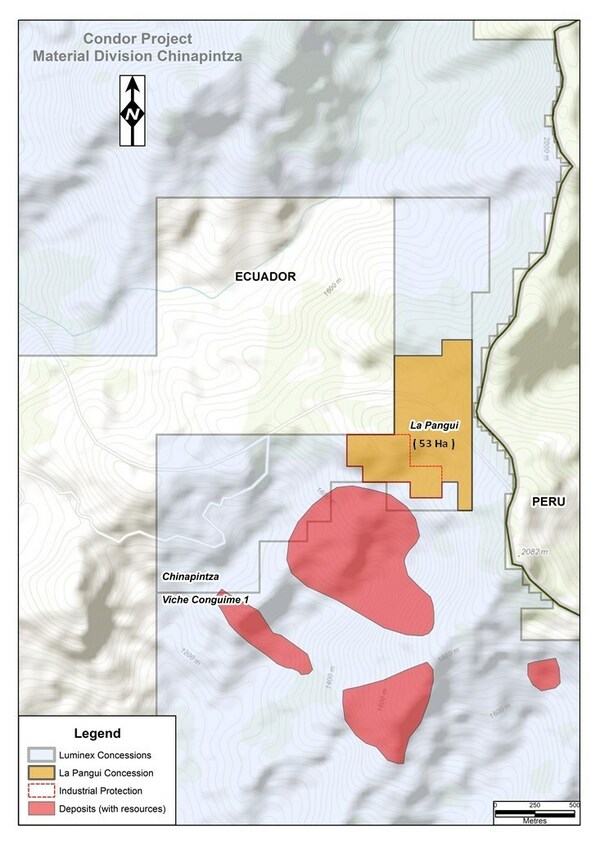

Figure 1: Planned concession areas to be transferred within the Chinapintza area 
(CNW Group/Luminex Resources Corp.)

The majority of the shareholders of the Local Entity were granted artisanal mining permits to work within the Chinapintza mineral concession area following the Government of Ecuador's 2010 Artisanal Mining Census, which registered a number of artisanal miners with long-term operations in the area of the Condor Project. These artisanal mining permits are approaching expiration, a condition which generated concern among the shareholders of the Local Entity regarding their future prospects. Over the past decade, Luminex has improved its understanding of the areas that might be necessary for mine development, as well as identified areas of mineral value that, owing to economic and technical reasons, will not be incorporated into the Condor North mine plan. In order for the Condor Project to advance successfully towards production, a sustainable solution to the issues with the informal miners had to be found; the mediation process and ensuing agreement provided a forum that enabled both parties to build trust and negotiate positive outcomes that ensure their long-term economic and technical viability.

The Agreement is the result of a series of negotiations that commenced in February 2022, under the leadership of a highly regarded professional mediator, who promoted transparency and good faith to build trust between the parties. The process enabled the parties to discuss their critical needs and find long-term solutions to the benefit of all those involved. Throughout the negotiation process, as well as in the drafting and finalization of the terms, each of the parties were supported by independent legal, financial and tax advisors. Pursuant to Article 47 of the Ecuadorean Law on Arbitration and Mediation, the mediation act has the effect of a legal judgment and executed sentence, effectively making the agreement between the Company and the Local Entity final and legally binding.

Under the terms of the Agreement, the Company agrees to execute a material division of its Chinapintza concession in order to create four new mining titles, one of which will be transferred to the Local Entity. The transfer of this title (La Pangui, 53 hectares) will ensure that the Local Entity has legally secure and long-term mineral concessions, along with the obligation to obtain all the regulatory and environmental permits and licenses necessary for the mining operations. This was possible, because, based on past exploration and technical studies, the Company determined that these areas were not required for the development of the Condor Project now or in the future.

The Local Entity agrees that, once the transfer of the mining title has been completed, it will grant the Company a voluntary mining easement (see Figure 1, Industrial Protection area) for the duration of said mining title and its renewals and extensions. This easement will cover a portion of the Local Entity's concession that, due to technical and industrial safety considerations, the Company may require when the Condor Project is at a more advanced stage. As part of the agreement, the Local Entity and the five directly affected shareholders agree that they will over time abandon certain current operations located in this area, which will be necessary for industrial safety.

In addition to relinquishing their permits and committing to not request any new rights or undertake operations in any areas where the Company has mining rights, the shareholders of the Local Entity collectively and individually agree to collaborate with the Company to help restrict the entrance of illegal miners to the concessions of the Condor Project. The Local Entity and their shareholders also commit to conduct environmental audits that may be requested by the Ministry of Environment, Water and Ecological Transition of its operations, as well as to remediate any environmental impacts their operations may have caused and assume responsibility for any environmental liability that may arise as a result of their past activities. They also grant the Company a right of first refusal over any future sale of the mining title, and commit that if this right is not exercised, any future purchaser of the mining title will commit to abiding by the terms of the Agreement.

The parties are bound to make their best efforts to execute their respective commitments, staggered across three defined phases. The process of implementing the Agreement is expected to take approximately two years in total to complete, depending on regulatory approvals.

The Company will continue working to resolve issues with other smaller groups of long-established miners within the Condor Project through a similar mediation approach.

About Luminex Resources

Luminex Resources Corp. (TSXV:LR, OTCQX:LUMIF) is a Vancouver, Canada based precious and base metals exploration and development company focused on gold and copper projects in Ecuador. Luminex's inferred and indicated mineral resources are located at the Condor Gold-Copper project in Zamora-Chinchipe Province, southeast Ecuador. Luminex also holds a large and highly prospective land package in Ecuador, including the Pegasus and Orquideas projects, which are being co-developed with Anglo American and JOGMEC respectively.

Further details are available on the Company's website at https://luminexresources.com/.
GEMOLOGY
692-Carat Diamond Recovered From Karowe Mine

Lucara said it’s the 20th stone weighing more than 100 carats the mine has produced this year.

Michelle Graffmichelle.graff@nationaljeweler.com

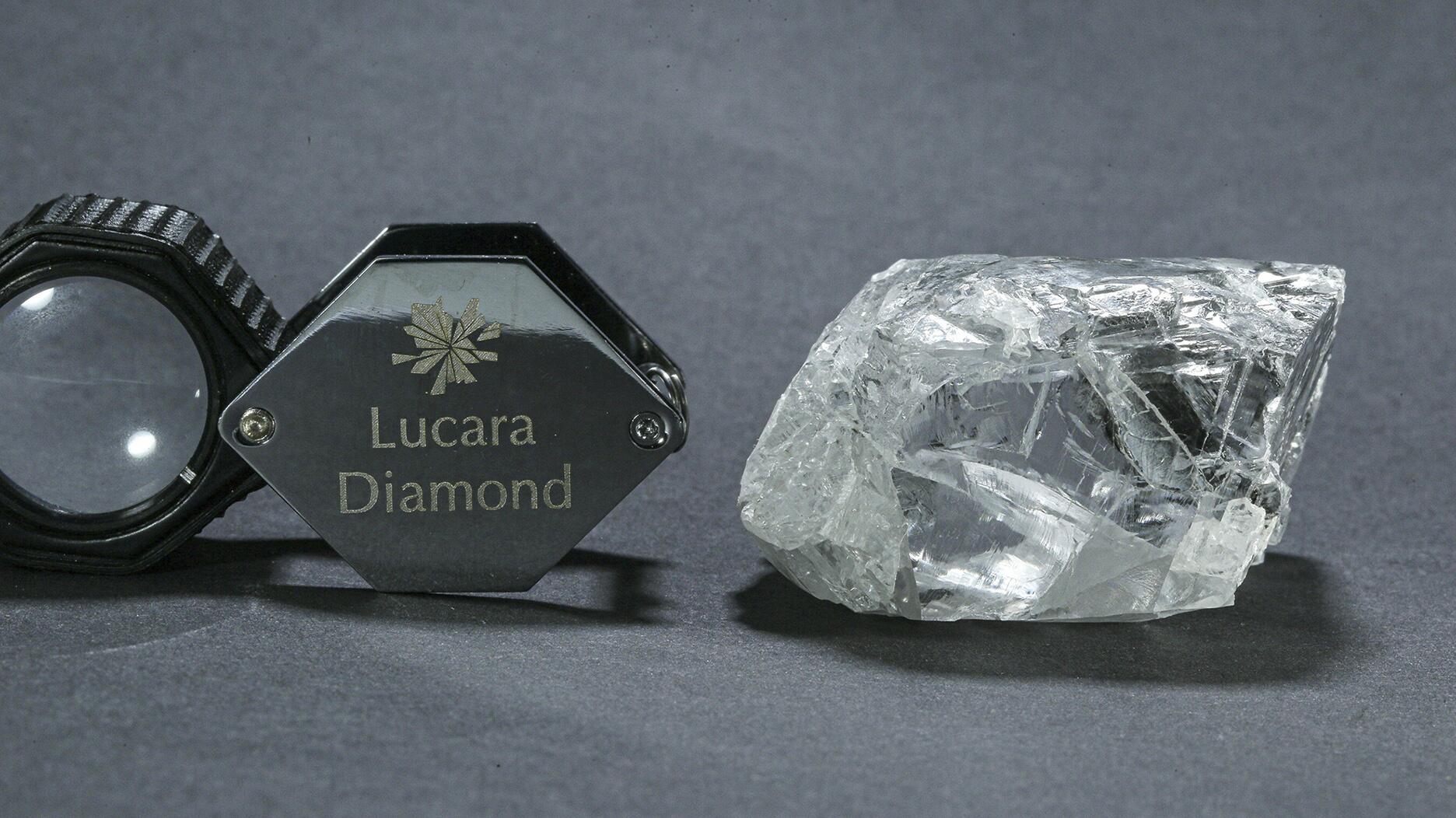
This 692.3-carat rough diamond was just recovered from the Karowe Diamond Mine in Botswana. It is a Type IIa diamond and measures 46.5 x 40.7 x 28.4 mm.

Vancouver, British Columbia—The Karowe Diamond Mine in Botswana just delivered another 100-carat-plus diamond.

Owner and operator Lucara Diamond Corp. announced Monday that it has recovered a 692.3-carat stone from the mine.

The diamond, which measures 46.5 x 40.7 x 28.4 mm, is a Type IIa diamond. Lucara said it was found in the MDR (mega-diamond recovery) XRT unit from direct milling of ore sourced from the mine’s South Lobe.

The discovery of the 692-carat diamond comes less than two weeks after the company announced that the South Lobe had produced its fourth rough diamond weighing more than 1,000 carats since 2015.

The 1,080.1-carat diamond also is a Type IIa stone and was recovered in the Coarse XRT unit.
US seeks trade panel to fix labour issues at Mexican mine

Grupo Mexico has been the subject of a long-running dispute over workers’ rights, which the US hopes to resolve under USMCA.
Grupo Mexico is the subject of a long-running labour dispute. 
Image by T. Schneider via Shutterstock

The US Government has requested a dispute-settlement panel for Grupo Mexico’s San Martin mine, with hope of resolving long-term labour issues there.

This follows news from June when the US requested that Mexico reviewed allegations of worker rights abuses at the mine, under the U.S.-Mexico-Canada Agreement (USMCA). However, Mexico declined to investigate, claiming the matter did not warrant review under the trade deal.

Under the USMCA, companies can be sanctioned if labour complaints are not dealt with quickly. In a statement on Tuesday, Mexico’s economy ministry argued that the case should be excluded, as it had already been reviewed by the national authorities.

The Mexican union that represents mine workers, The Miners, has claimed that Grupo Mexico violated a worker’s strike when it resumed operations at the San Martin mine, as well as negotiated with workers who did not have the right to represent them. If true, this would be a violation of Mexican law, which bars companies from normal operation while strike action takes place. A letter from the US government to Mexican officials stated that workers “are being denied the right of free association and collective bargaining.”

Grupo Mexico has broadly denied the allegations of worker rights violations, and in a statement on Tuesday claimed that the panel would vindicate them.

“For the San Martin mine it is important to put a final period to this chapter that unfortunately has hurt many workers and their families for more than 15 years,” Grupo Mexico said, adding that “no strike continues (at the mine) since the will of the workers is to continue working.”

Grupo Mexico is one of the world’s largest copper producers, with the San Martin mine also containing lead, zinc, and silver.

US requests labor review at mine owned by Mexican billionaire

Bloomberg News | August 22, 2023 | 

Image courtesy of Grupo Mexico

The US is asking a panel to review a labor dispute at a mine in Mexico owned by billionaire German Larrea.


US Trade Representative Katherine Tai in June had asked Mexico to review whether employees at a Grupo Mexico SAB mine in Zacatecas were being denied the right of free association and collective bargaining.


Mexico had a 45-day review period and found no denial of rights, according to a USTR statement released Tuesday.

“The US disagrees with this determination,” it said, and is asking for a panel to review the situation. It’s the first time ever the US has requested a Rapid Response Labor Mechanism panel under the US, Mexico, Canada free trade agreement (USMCA), the USTR said.

Grupo Mexico said the panel review will prove the company hasn’t violated labor rights at the mine and that it hasn’t prevented its workers from having “decent work and to join the union of their choice.”

The company, owned by Larrea, also operates railroads throughout Mexico. In May, the Mexican government seized a section of its freight railway, ultimately prompting Larrea to scrap a bid to buy one of the country’s biggest retail banks from Citigroup Inc.

Larrea is worth $31.4 billion, according to Bloomberg’s Billionaires Index. Mexico’s Economy Ministry did not immediately reply to a request for comment.

The USTR in June said it had received a request from unions in the US and Mexico alleging Grupo Mexico had resumed operations at the San Martin mine despite an ongoing strike. The company also engaged in collective bargaining with a workers’ coalition even though a different union holds the right to represent workers, according to the request.

Grupo Mexico said in its statement there’s no strike going on and that mining workers want to continue operating.

Back in June, Tai directed the Treasury Secretary to suspend the final settlement of customs accounts related to the entries of goods from San Martin’s lead, zinc and copper mine.

(By Andrea Navarro, with assistance from Amy Stillman and Eric Martin
Ford and partners to build $887m EV battery materials plant in Canada

The plant will be located in Becancour, Quebec, and will provide electric vehicle (EV) battery materials to the company’s future fleets of EVs.
Ford has been growing its EV portfolio rapidly in order to keep up with global targets to phase out combustion engine vehicles. Credit: D K Grove via Shutterstock.

Aconsortium of companies led by automaker Ford will build a C$1.2bn (US$887m) cathode manufacturing facility in Canada, the company announced on Thursday.

Free Report
How is the Mining industry adopting electric technologies?

As miners strive to reduce greenhouse gas emissions, many, particularly those with underground mines, are beginning to invest in battery-powered and electric-powered mining fleets. As of March 2022, GlobalData was tracking 207 trolley assist trucks operating on...

The plant will be located in Becancour, Quebec, and will provide electric vehicle (EV) battery materials to the company’s future fleets of EVs. The facility is Ford’s first investment in Quebec and is part of the carmaker’s plan to localise battery raw material processing and supply for its EV production in North America, the company said in a statement.

Construction has already begun on the 280,000m², which will include a six-floor building. Production is set to begin in the first half of 2026. The site will have the capacity to produce up to 45,000 tonnes of cathode active materials per year, which will support the production of up to 225,000 EVs annually.

The consortium includes South Korean battery producers EcoPro BM and SK On, according to the statement. SK On’s annual production capacity in North America is expected to reach more than 180 gigawatt-hours after 2025, which is enough to power approximately 1.7 million EVs per year.

EcoPro will manufacture cathode active materials and high-quality nickel cobalt manganese, essential for rechargeable batteries.

Both Canada’s Federal Government and Quebec’s Provincial Government will provide funding for the project. The federal government will provide the consortium with a conditional loan of C$322m, with Quebec offering the same amount as a partially forgivable loan.

“We are excited to invest in this new facility to create a vertically integrated, closed-loop battery manufacturing supply chain in North America designed to help make electric vehicles more accessible for millions of people over time,” said Bev Goodman, president and CEO at Ford of Canada.

Industry Minister Francois-Philippe Champagne told Reuters: “This is a big vote of confidence in the [EV] ecosystem we’ve been building, this is very significant for Quebec, because as you know the auto sector has been primarily investing in Ontario, but now we have Ford in Becancour.”

Many automakers and battery producers have moved operations to North America in the past year to take advantage of the US Inflation Reduction Act, which offers significant tax breaks and subsidies for clean energy technologies produced with locally sourced materials. In June, the US Department of Energy loaned Ford $9.2bn for the development of battery plants in the US states of Tennessee and Kentucky, with SK On agreeing to join the venture.

Ford has been growing its EV portfolio rapidly in order to keep up with global targets to phase out combustion engine vehicles. In May, it signed lithium supply agreements with lithium miners Nemaska Lithium, Albemarle, Sociedad QuĂ­mica y Minera de Chile and Compass Minerals. According to the agreement, Canada-based Nemaska Lithium will provide lithium products to Ford for the next 11 years.

Catholic Church begins class action against BHP and others

The lawsuit was filed on behalf of 17 current and former mine workers, who came to the Catholic Church for help after contracting incurable coal workers’ pneumoconiosis.

By Annabel Cossins-Smith
August 21, 2023
A South32 open-pit manganese mine in South Africa. Credit: South32.

The Southern African Catholic Bishops’ Conference (SACBC), an organisation of Bishops in Botswana, South Africa, and Eswatini, has filed a class action lawsuit against mining major BHP over lung diseases found in former and current employees.

SACBC, which serves the South African provinces of Cape Town, Durban, Pretoria, Johannesburg and Bloemfontein, said on Wednesday it had begun the process of filing a class action lawsuit against Australian multinational miner BHP, its subsidiary South32, and South African energy company Seriti.

The lawsuit was filed on behalf of 17 current and former mine workers, who came to the Catholic Church for help after contracting incurable coal workers’ pneumoconiosis, also known as black lung disease, and chronic obstructive pulmonary disease.

The application for certification of the class action, originally brought by the SACBC’s Commission for Justice and Peace, accuses South32 of failing to provide its employees with “adequate training, equipment and a safe working environment”.

The application also argues that both diseases are caused by coal dust entering the lungs and are “wholly preventable” if the right measures are taken. “The applicants argue that South32 breached the legal duties owed to the miners by failing to implement statutorily mandated procedures and protections. As a result, the miners developed incurable lung diseases,” the complaint reads.

Cardinal-elect Stephen Brislin, the Archbishop of Cape Town, said in the application statement: “Ex-mine workers are no longer under trade unions and this renders them voiceless and incapable of demanding social justice for the sickness that they incurred while working in the mines. Very often workers do not have the means to seek legal recourse from large companies which have huge resources at their disposal.

“The Church is always concerned about the well-being of people with whom we work and live. It is thus incumbent on the Church to give assistance where it can so that the rights of the vulnerable are respected and so that they can access compensation that is legally due to them. Many companies are amenable to settling such cases, but in some instances court action is necessary.”

A spokesperson for South32 confirmed with the Catholic News Agency that it has been served with an application for certification of a class action on behalf of mine workers in South Africa. “This matter is currently being considered by the business,” a spokesperson said. “We are unable to comment further at this point in time.”

South32, which has three mining operations in South Africa and employs approximately 500,000 people in the country, has already run into other legal trouble this year. Last month, it was ordered to pay $2.9m (A$4.5m) in compensation after an investigation found one of its coal mines had been draining local drinking water to its facility over the last five years. The mine’s operator Illawarra Coal Holdings, a subsidiary of South32, admitted that it never had the licence to use any surface water supply for its mining activit
AUSTRALIA
Worker strike at South32 mine extended by another week

Industrial action at South32’s Appin mine was initially due to end on 25 August but has been extended to 1 September.
South32’s Appin Mine in the Wollondilly region of New South Wales.
 Credit: South32.

Collieries’ Staff and Officials Association (CSOA), Australia’s trade union that represents thousands of workers in the coal mining industry, said on Tuesday that mining employees at South32’s Appin mine voted to extent strikes for another week.

Industrial action was initially due to end on 25 August, but has been extended to 1 September, Reuters reports. Dissatisfaction among workers about working conditions triggered the strike. According to the CSOA, the dispute is over demands for “a reasonable work/life balance,” such as access to leave and certainty around weekend work.

“To date, South32 has not come back with a formal offer that addresses any of our concerns,” CSOA Lead Organiser Belinda Giblin said.

A spokesperson for South32 told Reuters that work rotas for mining supervisors rotate between three days on and four days off, or four days on and three days off. They added that a workplace agreement would have given them a 6.3% pay rise for this financial year, and that employees due to work on public holidays receive ample advance notice and additional pay.

Some parts of the Appin mine, located in New South Wales, will remain non-operational for the duration of the strike. Another meeting is scheduled for Wednesday, in which negotiations between the company and union representatives will continue.

Last week, a branch of the Catholic Church in South Africa filed a class action lawsuit against South32 on behalf of 17 current and former employees who have contracted incurable lung diseases since working at its mines in the country.

The application for certification of the class action accuses the company of failing to provide its employees with “adequate training, equipment and a safe working environment,” adding that the two types of lung disease found among workers are “wholly preventable”.

A spokesperson for South32 told the Catholic News Agency that the matter “is currently being considered by the business,” adding that the company is “unable to comment further at this point in time.”


In July, South32 was ordered to pay out $2.9m (A$4.5m) after an investigation found it was illegally syphoning local supplies of drinking water to use in its facility in Mount Kembla, Australia.

South32 Appin mine workers to continue strike as talks stall
Reuters | August 23, 2023 |

Image courtesy of South32

The Australian trade union said on Thursday workers at South32’s Appin mine failed to reach an agreement with the diversified miner over leave provisions and remuneration.


Supervisors at South32’s Appin coal mine will continue their work strike until at least Sept. 1, the Collieries’ Staff and Officials Association (CSOA) said.

The dispute was about “having a reasonable work-life balance” such as access to leaves and certainty around weekend work, according to the CSOA.

“Despite members attending the meeting in good faith, South32 refused to put forward a fair and decent offer on conditions and wages,” said CSOA lead organiser Belinda Giblin.

South32 had met with mining supervisors and their representatives on Wednesday and outlined some further changes to the offer, the spokesperson said.

“We are disappointed that our offer was not accepted,” the spokesperson added.

Australia’s South32, which had spun off from BHP Group, said it has taken the necessary decision to continue to make parts of the Appin mine non-operational during the strikes.

The company said it will continue to stand down some members of their workforce during the period of industrial action.

“There might be some impact as we move into the development phase, but no material impact as of now,” chief executive officer Graham Kerr said on a call.

“We are very much focussed on trying to resolve this.”

Shares of the miner were down nearly 3% at A$3.6, as of 0132 GMT.

“The ongoing industrial action being undertaken by mining supervisors will impact our ability to supervise our underground workforce and meet our work health and safety obligations,” a company spokesperson told Reuters.

South32 offered marginal changes to rostering, but nothing on the substantive issues of other conditions and remuneration, said a spokesperson for the union.

Workers at the Appin mine have been negotiating with the company for more than eight months, and are now seeking assistance from a government body to resolve the dispute.

They have lodged a bargaining dispute with the Fair Work Commission, which is an Australian industrial relations tribunal.

The trade union on Tuesday notified that it would extend the strike until Sept. 1, while indicating chances of a further extension.

(By Rishav Chatterjee and Sameer Manekar; Editing by Shailesh Kuber, Maju Samuel and Sherry Jacob-Phillips)
Did Canada fail to protect a human rights defender from a miner’s targeted violence?


Mariano Abarca was brazenly murdered in daylight in 2009, after speaking out against
a local mining project. Fourteen years later, his family are taking their fight for justice
to an international human rights court. Kit Million Ross investigates.

By Kit Million Ross
August 22, 2023

Mariano Abarca

On 27 November, 2009, while sat outside of his family restaurant in Chicomuselo, Mexico, Mariano Abarca was approached by a lone figure, who shot him four times before escaping on an awaiting motorbike. In the years leading up to his murder, the father of four had tirelessly campaigned against the actions of Canadian mining firm Blackfire at its chillingly-named Payback mine in the Chicomuselo area. Despite taking place in plain view, no-one involved in Abarca’s killing has been charged. The four suspects who were arrested and later released all had ties to Blackfire.

In the 14 years since his murder, Abarca’s family have continually alleged that the Canadian Embassy’s ties to the Blackfire company, and their failure to act on Mariano Abarca’s serious concerns for his own safety, helped to facilitate his murder and the events that led up to it.

Finding no justice in lower courts, the Abarca family, aided by Mining Watch Canada and the Justice and Corporate Accountability Project, have submitted a complaint to the Inter-American Commission on Human Rights (IACHR), alleging that the Canadian Embassy failed to protect Abarca’s right to life. The filing leans heavily on over 1000 pages of internal embassy reports and emails obtained through an access-to-information request, shining a light on just how deep the ties between the embassy and Blackfire ran.

Timeline of tragedy around a Mexico mine

Around 2005, a small Canadian mining firm by the name of Blackfire Exploration gained permits to mine for barite in the small community of Chicomuselo in the south of Mexico. Three years later, Blackfire’s “Payback” mine went into production.

Not long after the mine began operations, Mariano Abarca, responding to fears from the community about environmental damage, including water contamination and shortages, became a founding member of the Mexican Network of Mining-Affected People. According to the June 2023 IACHR filing, in March 2008 “Blackfire began making regular secret payments into the personal bank account of the mayor of the local town of Chicomuselo to “keep the peace and prevent local members of the community from taking up arms against the mine.”

In September 2008, Canadian Embassy staff met with a Blackfire representative in an attempt to obtain an explosives license so the company could bypass a certified supplier. The following day, Blackfire wrote an email to the embassy directly thanking them for their support, stating that “[all] of us at Blackfire really appreciate all what the embassy has done to help pressure the state government to get things going for us. We could not do it without your help.”

In August 2008, three armed Blackfire employees broke into Abarca’s home and beat him and his son. Undeterred, Abarca led a peaceful protest by Chicomuselo residents in June 2009, blocking a transport route to the Payback mine. The protestors demanded reparations for damage to homes caused by heavy mining traffic; the embassy was aware of the protest. The blockade continued for some time and in July, with the blockade still ongoing, Abarca and other community members travelled to Mexico City to protest at the Canadian Embassy there. While speaking with an embassy officer, Abarca stated that Blackfire was using some of its workers as “thugs” against opponents of the mine, and that community members who spoke out against Blackfire were at personal risk.

This wouldn’t be the last time concerns about Abarca’s safety would be raised with the embassy. In August 2009, while Abarca was being detained without charge by police, the Canadian Embassy received around 1400 emails expressing major concern for Abarca’s safety. On 23 November 2009, Abarca told the Chiapas State Attorney General that a Blackfire employee had threatened to “pump him full of lead”, and asked for an investigation into threats made against him.


Four days later, he was murdered.

The case against Canada, made in Canada


In the 14 years since Abarca’s murder, his family has continually campaigned to find the truth of the matter, on the domestic and international stage. According to a June 2023 petition to the IACHR, at least four individuals associated with Blackfire were detained as part of the murder investigation, with one being acquitted on appeal and the rest being released. Blackfire denied any involvement in the murder, and Embassy staff reported in January 2010 that the Chiapas government did not suspect the company was behind the killing.

Formal investigations into Blackfire have been few, and fruitless. In December 2009, the Royal Canadian Mounted Police opened an investigation into corruption at Blackfire, which it closed in 2015. The Mounties stated that the evidence did not support criminal charges, but did not provide any details about the investigation or how it came to this conclusion.

Despite the multiple occasions where Abarca raised concerns for his safety to the embassy, and the 1,400 emails that the Embassy received expressing concern, a December 2009 statement from the Canadian government claimed that “the Government of Canada had no knowledge of potential acts of violence against Mr Abarca.”

An Access to Information and Privacy Request filed in Canada by the Abarca family yielded hundreds of pages of documents painting a damning picture of the Embassy’s involvement in the project. In their search for justice, the family asked Canada’s Public Sector Integrity Commissioner to investigate the embassy’s conduct, but the commissioner declined to investigate. This decision was then upheld by Canada’s Federal Court and its Federal Court of Appeal.
Why the family fights

In January 2023, Canada’s Supreme Court refused to hear the case. With all other options exhausted, the family has now taken its case to the IACHR, alleging that Canada’s actions in Mexico failed to protect Abarca’s right to life.

The Abarca family hopes that their case teach a lesson of community rights in mining communities. The persistence of the Abarca family is not just in hopes of finding justice for Mariano, but also that communities around the world can be empowered to defend their rights against mining firms, including those with supposedly close ties to government. As Mariano’s son, JosĂ© Luis Abarca puts it:

“My father is not coming back. But we believe that this process can set an important precedent for the struggles of other communities who are in danger, because they are fighting to protect their environment and health from the enormous damage caused by mining.”
The race to ditch Russian uranium starts in New Mexico’s desert

Bloomberg News | August 22, 2023 |
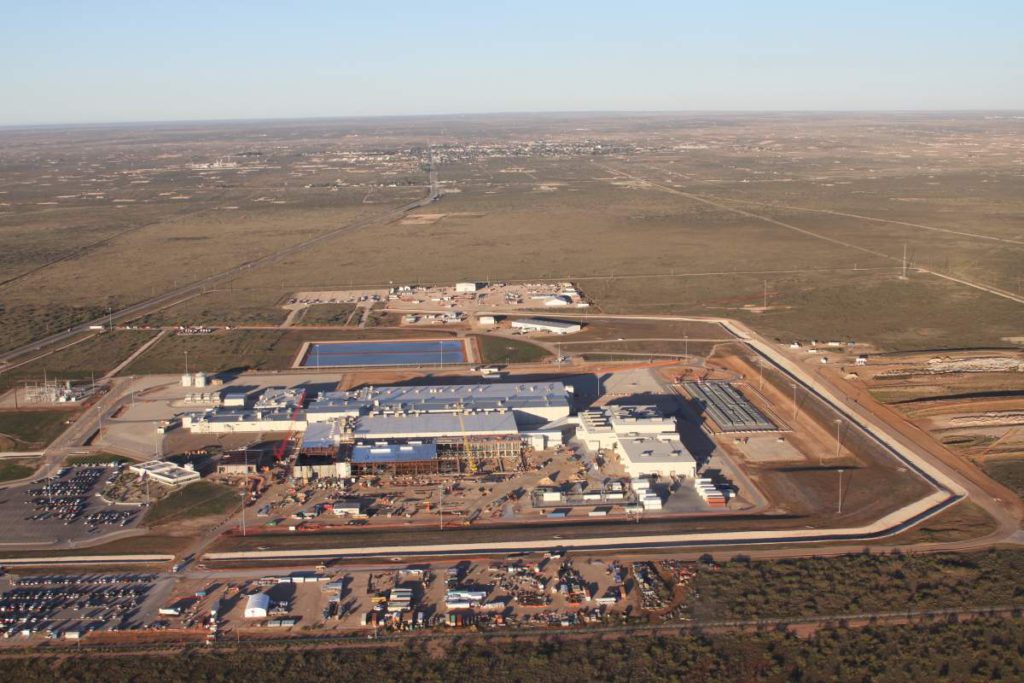
Urenco’s facility began producing enriched uranium in June 2010. Credit: Urenco

In a remote, dusty corner of New Mexico, so near to the Texas border that if you wander too close your smartphone changes time zones, sits a pristine factory that is the best chance for the US to wean itself off an addiction that few knew it had: uranium enriched in Russia.


Outside the $5 billion Urenco plant in Eunice, cacti and lizards bask in the fierce sunlight, watched by heavily armed guards. Inside, the facility is spotless, with bright, polished machinery that looks brand new even though some of the equipment has been in service for years. Hundreds of centrifuges, each at least 20 feet tall, spin at supersonic speeds and generate an ear-piercing whine that reverberates across a cavernous hall, where they separate the uranium isotopes needed to make fuel for nuclear power plants. For security reasons, parts of the piping that connect the Eunice machines are shielded from curious visitors.

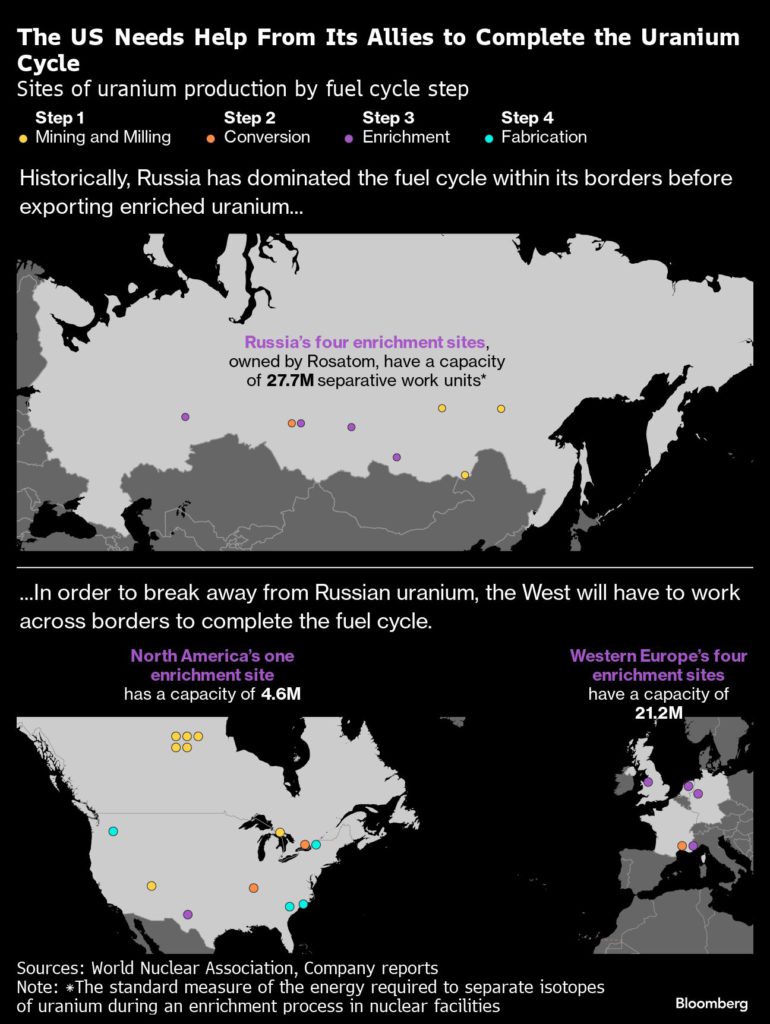
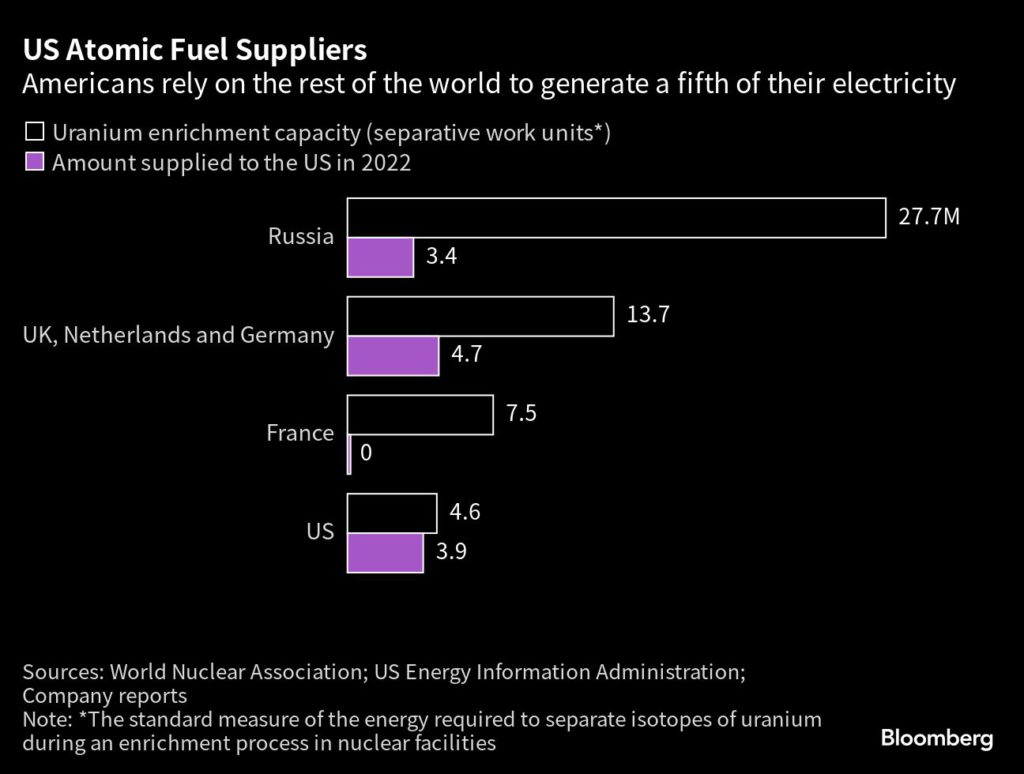
The plant supplies about one-third of US demand for enriched uranium and is in the process of boosting output by 15%. It’s the centerpiece of a transatlantic project to rejuvenate production of the fuel to feed the West’s fleet of nuclear reactors, a linchpin of energy security and efforts to reduce carbon emissions. Urenco Ltd. is the only commercial supplier of enriched uranium in North America. Currently, about half of the global supply comes from Russia, an uncomfortable reality for leaders in the US and Europe in the wake of Moscow’s invasion of Ukraine.

The high levels of security are easily understood. The recipe to make nuclear fuel is one of mankind’s most-guarded secrets: its dual-use technology means the same methods for feeding reactors also apply to building bombs. For years, the US has refused to share or transfer fuel-manufacturing technologies — first developed for the Manhattan Project in the 1940s that made the bombs dropped on the Japanese cities of Hiroshima and Nagasaki. But now, Washington is urging more countries to develop that capacity.


The trigger for that change of mind was the attack on Ukraine. Some 18 months on, Rosatom Corp. — the Kremlin-controlled nuclear group — is still the world’s biggest uranium enricher. It still supplies almost a quarter of America’s 92 nuclear reactors and dozens of other plants across Europe and Asia.

Western governments have avoided sanctioning Rosatom because doing so risks damaging their own nuclear industries and economies more than Vladimir Putin’s.

“We’re bearing the costs of an overreliance on Russia for nuclear fuel,” said Pranay Vaddi, a White House nuclear adviser at the National Security Council. “And it’s not just us, it’s the entire world.”

‘Frankenstein’s monster’

Reconstituting a North American fuel cycle and boosting the capacity of European providers is a massive undertaking. The recent coup in Niger, which has about 5% of the world’s uranium and has long been a significant supplier for former colonial ruler France, underscores the geopolitical stakes inherent in the business. South Africa’s national utility, Eskom Holdings SOC Ltd., allowed a nuclear trade agreement with the US to expire in December and then signed a deal with Russia to jointly produce nuclear fuel, part of an initiative to rebuild the African country’s own fuel cycle.

If Western nations fail in their bid to rebuild the sector, they will face a series of unpalatable options. They could continue to rely on Rosatom, presuming Moscow is still willing to do business. But given that most utilities only keep about 18 months of fuel inventory, if Russia were to stop selling, existing reactors may have to start powering down in the absence of alternative supplies.

Urenco, which is based outside London, reveals few details about how its centrifuges work, their dimensions or even how much nuclear fuel each one produces. The planned expansion of its New Mexico facilities to boost capacity will be completed in 2027 and, when combined with the parent company’s ramp-up in Europe, would be enough to cover Rosatom’s share of the American market, said Karen Fili, chief executive officer of Urenco’s US subsidiary, without disclosing the cost of the Eunice expansion.

“We are the very reasonable solution for the US,” Fili said. “The increased production from Urenco would be enough to cover any gap in Russian imports.”

While welcome, those reassurances underscore the economic vulnerability behind the efforts to reboot the West’s uranium-fuel business. US President Joe Biden and Canadian Prime Minister Justin Trudeau pledged during a March meeting to diversify the nuclear fuel supply chain with “like-minded allies” and to better coordinate conversion, enrichment and fabrication. Within three weeks, they recruited France and the UK to help push Russia out of the nuclear fuel business altogether.

Although Europe gets about 30% of its enriched uranium from Russia, it has a larger installed production capacity than the US, and should be better able to adjust quickly. Urenco, a consortium of the UK, Germany and the Netherlands, is weighing expansion at sites in those countries, while France’s Orano SA plans to enlarge its domestic facility.

By the time uranium reaches a factory like Urenco’s in Eunice, it has already been through several stages of processing.

The first step is to identify rare uranium deposits in far-flung regions. Once it is mined and milled, the ore is converted into a fluorine gas and injected into casks. Those are shipped to enrichment facilities, where the uranium-hexafluoride — or UF6 — is fed into cascades of centrifuges making more than a thousand rotations per second. The uranium-235 isotope that’s needed to sustain a fission chain reaction makes up less than 0.7% of the raw ore. The enrichment process boosts the concentration to about 5%.

The process of converting milled uranium into UF6 gas is the most acute bottleneck in the US nuclear fuel cycle. The only conversion facility in the US was shuttered in 2017, when the global market was oversupplied and prices plunged. That forced utilities to draw down inventory and purchase internationally, opening the door to Russia and China, which together control about two-thirds of the global uranium conversion market.

Prices for UF6 have since rebounded tenfold, so Colorado-based ConverDyn is reopening its mothballed conversion facility in Illinois this year. But the company — a joint venture between Honeywell International Inc. and General Atomics — wants assurances from potential customers before it considers expanding enough to displace Russian supplies.

“Everybody is asking: What would it take? How much would it cost?” said Malcolm Critchley, ConverDyn’s CEO. “If people genuinely want to move away from Russia and genuinely want an alternative, they must underpin those commitments with long-term contracts.”

Around 10 customers signing decade-long contracts would justify a full expansion, Critchley added.

Even this approach looks piecemeal. Rosatom has integrated all parts of the nuclear-fuel cycle from tip to tail inside Russia. So far, about $20 billion of investments — including Eunice — and new commitments have been made by Western governments and companies toward replicating Rosatom’s reach, but it still looks like a complex jigsaw involving mining and conversion in Canada, with the sole US enrichment facility owned by a European consortium.

The Kremlin has derided the effort. “The agreement looks like an attempt at creating Frankenstein’s monster,” Rosatom said in its June newsletter. “History shows that only individual parts of this ‘supply chain monster’ have been functional so far.”

Even with a full-court press, it still may take the West five years to wean itself off Rosatom, said Dan Poneman, a former deputy US secretary of energy who’s now chief executive officer of Centrus Energy Corp. The Maryland-based company is developing a $150 million plant to produce a new type of uranium fuel for the next generation of nuclear reactors.

“There’s not enough non-Russian enrichment to fuel the world’s reactors,” he said, even with Urenco’s 15% boost in Eunice. “It’s not even close.”
The road from Los Alamos

The cycle for turning uranium into nuclear fuel was developed in the 1940s so J. Robert Oppenheimer could test atom bombs in the New Mexico desert in a race against Nazi scientists trying to develop the same destructive power. Almost eight decades on, the industry is in a different kind of competition.

Urenco is the second-largest enricher with a global market share of about 30% and half of the US market. It entered the sector in the mid-1970s, when the uranium-enrichment industry was dominated by US and Russian engineers whose purpose was to refine and stockpile huge volumes of the heavy metal for warheads. Urenco centrifuges in Europe are among the few outside Russia still spinning from the Cold War era.

“You switch them on,” said Boris Schucht, chief executive of global operations at Urenco Ltd., the ultimate owner of the Eunice plant, “and the only thing you don’t want to do is switch them off.”

The last US-owned commercial enrichment plant in Paducah, Kentucky, closed in 2013 after more than 60 years of operation. That loss of capacity — combined with the growing aversion to nuclear power that followed the 2011 meltdown at Japan’s Fukushima Daiichi nuclear power plant — fostered more reliance on Rosatom, even after Russia annexed Crimea in 2014.

But Russia isn’t just fueling yesterday’s projects, it’s also securing tomorrow’s customers by building nuclear power plants in China, India, Egypt, Turkey and Bangladesh that are locked into Rosatom fuel-supply contracts for decades. Due to the national-security dimensions and complexity, nuclear-fuel manufacturers tend to be government-controlled. That’s the case in China, Europe and Russia. Analysts estimate that Iran, a relatively new member of the uranium enrichment club, spent more than $13 billion on infrastructure costs alone to join.


Yet it’s not a particularly big business, at least when considering its strategic importance. Urenco made €427 million ($463 million) profit on €1.7 billion in sales last year. The real value of nuclear plants is that they stay in service for decades, lead to lengthy international relationships, and are viewed as important tools of diplomacy. That explains government involvement and why Rosatom packages long-term agreements to supply fuel with reactor construction deals.

The US wants to see investors profit from each link in the supply chain. Congress is considering legislation to establish a national stockpile of nuclear fuel made in the US — equivalent to the country’s strategic oil reserve that can be tapped in an emergency — with at least two contracts signed before 2027. On top of that, the US Inflation Reduction Act offers tax benefits and loan guarantees to the industry.

Urenco isn’t the only company set to benefit. Canada’s Cameco Corp., the biggest North American uranium miner and a key provider of other nuclear services, is acquiring a stake in Westinghouse Electric Co., which takes enriched uranium and makes fuel rods, in a deal that values the US-based company at about $8 billion. It’s expected to give North America a vertically integrated powerhouse — from digging the mineral out of the ground all the way to putting it inside a reactor — providing a blueprint for the development of an industry-wide supply chain.

Canada has the world’s third-biggest reserves of uranium and is the fourth-largest producer of ore which feeds reactors in the US and Europe among other places. “We’re getting invited to parties we never got invited to before,” said Brian Reilly, chief operating officer of Cameco. “We have tailwinds we haven’t seen in a long time.”

Before the coup in Niger, France’s state-controlled Orano proposed expanding the capacity of its domestic enrichment plant by about 30% by 2028, assuming it received enough commitments from international clients to justify spending €2 billion. That extra capacity could supply about 20 more reactors.

In the wake of Russia’s invasion of Ukraine, Orano signed enrichment contracts with some central European utilities, said Jacques Peythieu, the company’s senior executive vice president for customer and strategy. It’s also considering building a facility in the US.

“We have some clients that have clearly understood the strategic stakes, others that are still in a wait-and-see mode,” CEO Philippe Knoche said, “waiting for the outcome of the war.”

The International Energy Agency estimates that global nuclear capacity needs to double by 2050, from 2020 levels, to keep on track for helping reach net zero emissions targets. And the demand from individual countries is building. Sweden announced in August that it needs to triple nuclear power capacity over the next couple of decades to meet a surge in electricity demand and build at least 10 new conventional reactors by 2045 — all of which will need enriched uranium.

To hit the IEA target, reactors worldwide, including Russia, may need about 80% more uranium by 2040, or about 112,300 tons annually, according to the World Nuclear Association industry group.

In 2021, Urenco had no plans to expand in the US. But standing in a vast storeroom in Eunice crammed with ready-to-ship canisters, each filled with more than 2 tons of enriched uranium and worth $1 million, Keith Armstrong, the company’s chief of staff, said orders have increased almost 25% in the past year as the world tries to avoid Rosatom.

Armstrong, who has worked at Urenco for 11 years, said Moscow’s militarism had jolted the industry and exposed gaping vulnerabilities. “The invasion of Ukraine changed the market dramatically,” he said. “It went from a static state to ‘we need to expand now.’”

(By Jonathan Tirone, Will Wade and Francois De Beaupuy, with assistance from Samuel Dodge)


OPG ad campaign recasts nuclear

24 August 2023


Ontario Power Generation (OPG) has launched a new public education campaign that uses the power of movies to tackle misperceptions of nuclear power.

OPG's campaign casts nuclear in the leading role (Images: OPG)

The Recast Nuclear campaign has been created in partnership with advertising agency Forsman & Bodenfors. Described by OPG - operator of the Darlington and Pickering nuclear power plants - as a first-of-a-kind campaign, it presents the unique benefits of nuclear power through a series of themed film posters and trailers, digital and radio adverts.

In recent years, opinions on nuclear power have started to shift with the rising challenges of climate change and energy security, but more needs to be done to educate and raise awareness of nuclear power's essential role for the future, the company said.

"For years, popular culture has distorted perceptions about nuclear power with false narratives that served to stoke fear," said OPG Vice-President of Stakeholder Relations Kathy Nosich. "This education campaign aims to recast nuclear power as a true hero of our clean energy mix. We hope this will grow understanding and acceptance of this beneficial technology that is so important to our economic and environmental wellbeing."

The campaign is designed to reflect many recent and popular blockbusters, which OPG says makes it look and sound familiar for movie fans. A video clip - styled like a film trailer - begins with an unidentified, gigantic creature terrorising a rain-soaked, neon-lit night-time city. "This is not sci-fi," the voiceover begins - before the dramatic scenes fade to an image of OPG's nuclear power plant. "This is the true story of nuclear: the safe, clean and reliable energy Ontario depends on."

The message is all about nuclear, and undoing decades of misinformation, OPG said. The campaign microsite contains information about nuclear's "leading role" in Ontario's current and future electricity mix. Movie poster-style graphics promise "other exciting nuclear titles" to come, "from medical superhero to the enabler of the electric vehicle revolution".

Researched and written by World Nuclear News

Saskatchewan seeks to develop SMR supply chain

25 August 2023


Saskatchewan's Crown Investments Corporation (CIC) is providing CAD479,000 (USD352,296) to the Saskatchewan Industrial and Mining Suppliers Association (SIMSA) and its partners to prepare local companies for their future participation in provincial, national and global small modular reactor development.

SaskPower has selected GEH's BWRX-300 for potential deployment in Saskatchewan (Image: GEH)

The two-year funding agreement between CIC and SIMSA - a non-profit organisation representing more than 300 Saskatchewan-based suppliers to the industrial, mining and energy sectors - will support a small modular reactor (SMR) supply chain specialist position with SIMSA.

The funding will also help engage First Nations Power Authority (FNPA) for its assistance to explore Indigenous economic opportunities and enable the Organization of Canadian Nuclear Industries (OCNI) to deliver its Ready4SMR programme to develop local suppliers, including Indigenous-owned companies.

"Programming and resources made available through this funding are crucial to moving toward building a nuclear industry in Saskatchewan," said Minister of Crown Investments Corporation Don Morgan. "Our province has a long successful history of nuclear research and development, and we are a world-class supplier of high-quality uranium ore. Advancing Saskatchewan's SMR supply chains will unlock economic and job potential for communities near and far, including our rural, northern and remote regions, and Indigenous communities."

"SIMSA is excited to work with CIC to build additional resources to enhance the development of qualified nuclear manufacturing and construction companies in our province," said SIMSA Executive Director Eric Anderson. "One crucial component of this work is the recruitment of an SMR supply chain specialist. The specialist has outstanding nuclear and supply chain experience and knows the current market elements. This position will be an invaluable asset to advance SMR development in Saskatchewan."

"The Organization of Canadian Nuclear Industries is proud to be working in Saskatchewan with SIMSA and FNPA to implement our Ready4SMR programme," added OCNI President and CEO Bill Walker. "We'd also like to acknowledge and thank the Crown Investments Corporation of Saskatchewan for their contribution in making this project possible.

"Canada is leading the world in the deployment of small modular reactors and we're excited to see Saskatchewan planning for SMRs as part of their clean energy mix. Our role is to build a pan-Canadian supply chain that gives provinces like Saskatchewan an opportunity for economic development as your already thriving supplier base considers joining the Canadian nuclear industry."

Last week, the Canadian government approved CAD74 million of federal funding for SMR development in Saskatchewan. The funding - including more than CAD24 million from the proceeds of Canada's pollution pricing system - will support work to advance the project led by utility SaskPower.

In 2022, SaskPower selected GE-Hitachi's BWRX-300 SMR for potential deployment in Saskatchewan in the mid-2030s, subject to a decision to build that is expected in 2029. SaskPower has identified the regions of Elbow, in south-central Saskatchewan, and Estevan, in the far south of the province, as potential areas to host an SMR. It has begun an engagement exercise to share information and gather input as it works to narrow down a site. According to its project timeline, it expects to finalise its site selection in 2025.

Although all of Canada's uranium production comes from Saskatchewan, the province does not currently use nuclear power. However, Saskatchewan's government identified development of SMR technology as a goal for growth in its 2019 development roadmap, and in March 2022, alongside the governments of Ontario, Saskatchewan, New Brunswick and Alberta, it released a joint strategic plan setting out a path for developing and deploying SMRs.

Researched and written by World Nuclear News