Monday, December 11, 2023


Technology not growing fast enough to decarbonize steel and cement industries by 2050


New study shows that for decarbonization goals of steel and cement to be met, along with new green technology, consumption habits need to change.


Peer-Reviewed Publication

NATIONAL INSTITUTE FOR ENVIRONMENTAL STUDIES

Steel and cement are two materials that no society can do without. Their production comes with a significant carbon footprint, however. To meet zero-emission targets under the Paris Agreement, countries, cities, and industries are depending on new large-scale infrastructure for CO2 transport and storage, renewable electricity and green hydrogen. A new study by researchers at the National Institute for Environmental Studies, Japan, and the University of Cambridge, United Kingdom, shows that the current rate of deployment of this infrastructure is insufficient. The study argues that changes in how steel- and cement-based materials are used or consumed must also be considered for the Paris targets to be met.

The study, led by Dr. Takuma Watari, unveils a significant gap between anticipated and actual infrastructure deployment. For instance, scenarios made by the International Energy Agency (IEA) in 2010 estimated that nearly 200 million metric tons of CO2 from the steel and cement industries would be captured and stored by 2021. However, Watari and his colleagues found that this number was woefully off; in reality, the amount was only 1 million metric tons, which questions the 2000 million metric tons expected by the IEA to be captured and stored by 2050.

"We are not saying that the existing scenarios are physically or economically unrealistic. But simply waiting for new infrastructure to emerge and solve all our problems away is a very risky way of tackling the problem, given the scale of the challenges and the limited timeframe," said Watari.

Assuming infrastructure deployment based on historical trends and current construction plans, the study goes on to further show that the supply of steel and cement in line with carbon budgets based on the Paris Agreement will not meet demand.

"We need to be well prepared for a future shortfall between feasible supply and expected demand," noted Watari. "The construction and manufacturing industries will have to provide the same level of services with less material by changing the way products are designed, used, and disposed of."

To quantify the sense of the scale of action required, the study provides a benchmark in line with the estimated feasible supply: following Paris-compliant budgets, the same level of services with 60% less material use in construction and 40% less in manufacturing is needed.

On a positive note, the study found that the limited feasible supply at present is on pace to satisfy the basic needs of a growing world population. Indeed, the global material demand for the provision of basic needs such as electricity, water, sanitation, shelter and mobility, is far less than the estimated feasible supply.

"The challenge is more about equitable distribution than total quantity," said Watari. "We recommend a greater responsibility be placed on high-income countries, which have much larger in-use material stocks than low-income countries."


Rail industry urged to consider safety risks of space weather


Peer-Reviewed Publication

LANCASTER UNIVERSITY

Railsignal 

IMAGE: 

“WRONG SIDE” FAILURES - WHEN THE SIGNAL GOES FROM RED TO GREEN - ARE MUCH MORE HAZARDOUS THAN "RIGHT SIDE" FAILURES WHICH ARE GREEN TO RED


view more 

CREDIT: LANCASTER UNIVERSITY


Train accidents could be caused by solar storms switching signalling from red to green according to new research examining the impact of space weather.

Solar storms can trigger powerful magnetic disturbances on Earth, creating geomagnetically induced currents (GICs) which could potentially interfere with electricity transmission and distribution grids.

A team led by PhD researcher Cameron Patterson and Professor Jim Wild from Lancaster University modelled how GICs flowed through the track circuits of AC electrified lines powered with overhead cables.

Using two routes - the Preston to Lancaster section of the West Coast Main Line, and the Glasgow to Edinburgh line – the team modelled how GICs induced in the rails could cause rail signalling to malfunction.

There are more than 50,000 signalling track circuits in the UK, where the signal is controlled by an electrical circuit between the rails.

Physics PhD researcher Cameron Patterson said: “Crucially, our research suggests that space weather is able to flip a signal in either direction, turning a red signal green or a green signal red.  This is obviously very significant from a safety perspective.

“By building a computer model of the signalling track circuits using realistic specifications for the various components of the system, we found that space weather events capable of triggering faults in these track circuits are expected in the UK every few decades.”

Cameron’s earlier research in the journal Space Weather explored what is known in the industry as “right side” failures, where the signal is switched from green to red.

This is a fail-safe scenario but the converse “wrong side” failures - when the signal goes from red to green - are much more hazardous.

This latest study, also in Space Weather, shows that “wrong side” failures could occur at a lower geoelectric field strength than for “right side” failures, meaning a weaker geomagnetic storm could more easily trigger “wrong side” failures.

It was estimated that, for the lines studied, “wrong side” failures could occur due to a geomagnetic storm with a frequency of about one or two decades.

The analysis was also performed for once-in-a-century extreme event, and it was shown that it could potentially cause many malfunctions of both typs throughout the lines in both directions of travel, depending on the number of trains on the line at that time.

Cameron said: “When we experience severe space weather which happens every few decades or extreme space weather seen every century or two, then there is a potential for significant signalling misoperation, which has an obvious safety impact.”

There have been several examples of space weather impacting power grids in the last few decades, including power outages affecting millions across the Canadian province of Quebec in 1989 and the Swedish city of Malmo in 2003.

There are also historic examples of space weather interfering with railway signalling as far back as the nineteenth century. And in 1859, a massive solar eruption triggered a geomagnetic storm that disrupted telegraph lines across the world. The team also assessed the impact of a solar storm of the size of the 1859 event, predicting that it would cause widespread problems with signalling on both lines studied.

Cameron said: “Our research shows that space weather poses a serious, if relatively rare, risk to the rail signalling system, which could cause delays or even have more critical, safety implications.  This natural hazard needs to be taken seriously.  By their nature, high-impact, low-frequency events are hard to plan for, but ignoring them is rarely the best way forward.

Jim Wild, Professor of Space Physics at Lancaster University said: “Other industries such as aviation, electricity generation and transmission, and the space sector are considering the risks to their operations, and exploring how these might be mitigated. It’s important that the rail sector is included in this planning.”

“As our understanding of the space weather hazard improves, it’s possible to consider how to reduce the risks. In future, we could see space weather forecasting being used make decisions about limiting railway operations if an extreme event is expected, just as meteorological forecasts are used currently.

Severe space weather is included in the UK Government’s National Risk Register for Civil Emergencies which lists the risk posed to the UK’s economy and society as “significant”.


Vandalism at Delhi’s Mughal mausoleums sparks outrage

Monitoring Desk Published December 11, 2023
VANDALS have destroyed part of the jali (railing) in front of the tombs of three Mughal emperors and Bahadur Shah II’s empty tomb.—X/@sunitarora

A PART of the jali or railing in front of the tombs of three Mughal emperors, as well as Bahadur Shah Zafar’s empty tomb, at Zafar Mahal in Delhi’s southern Mehrauli village has been vandalised, triggering outrage on social media.

The incident drew sharp criticism from many, particularly heritage lovers.

Historian William Dal­rymple while taking to X, formerly Twitter, said in a terse comment, “Appalling- and appalling negligence by the ASI”. His comment apparently referred to the Archaeo­logical Survey of India.


Mr Dalrymple, author of The Last Mughal and several other acclaimed books, was commenting on a tweet that carried a picture showing the broken jali in front of what appears to be a grave. The picture carries a caption that read, “Someone has attacked and destroyed India’s last Mughal tomb. One jali us [sic] completely smashed and the other is damaged.”

Historian Dalrymple terms incident appalling, slams India’s archaeological department for negligence

Confirming the incident, journalist Sunit Arora wrote on X on Sunday, “Reporting vandalism at Zafar Mahal in Delhi’s Mehrauli village.”


Mr Arora quoted the guard as informing him that “8 days ago, vandals destroyed” part of the jali in front of the tombs of three Mughal emperors and Bahadur Shah II’s empty tomb.

Since Bahadur Shah Zafar is buried at Yangon in Myanmar, the historian’s remarks generated a debate of sorts on the micro-blogging site.

Some users expressed surprise over the claim it was the emperor’s burial site, while others questioned which Indian institution was responsible for its care.

In reply to a question whether the place is not owned by waqf, Mr Dalrymple said ASI looks after the monument.

Adjacent to Moti Masjid are the graves of the Mughal royal family. According to monumentsofdelhi.com, two predecessors of Bahadur Shah Zafar — his father Akbar Shah II and grandfather Shah Alam II — are buried there. Besides, one of Bahadur Shah Zafar’s sons is also said to be buried there.

It is said that Bahadur Shah Zafar wanted to be buried next to his father in the Sardgah, the marble enclosure, at Zafar Mahal. However, in 1858, he was exiled to Yangon in the British-controlled Burma, where he died on Nov 7, 1862.

Zafar Mahal was built by Akbar Shah II in the 18th century, according a report published by The Wire. The building was then called Lal Mahal and Rang Mahal. Later, Bahadur Shah Zafar built the Hathi Gate and eventually, gave it its present name, the Zafar Mahal.

The ASI earlier reportedly said they would restore Zafar Mahal in October, but they never did. “This is so so sad! Legal action should be taken against ASI for this negligence. They have let the palace to ruin for years! This needs to stop,” one X user said.


Published in Dawn, December 11th, 2023
India’s top court rules special status of held Kashmir was a ‘temporary provision’
KASHMIR IS INDIA'S GAZA

Dawn.com | Reuters 
Published December 11, 2023 

India’s Supreme Court on Monday ruled in a unanimous verdict that the special status of held Kashmir was a temporary provision and upheld the order abrogating Article 370 in the constitution, the Times of India reported.

It also directed the election commission to hold elections in held Kashmir by September 30, 2024.

In 2019, India’s ruling Bharatiya Janata Party (BJP) had revoked occupied Kashmir’s special status by repealing Article 370 of the constitution. The law had limited the power of the Indian parliament to impose laws in the state, apart from matters of defence, foreign affairs and communications.

The move allowed people from the rest of the country to have the right to acquire property in held Kashmir and settle there permanently.

Kashmiris, international organisations and critics of India’s Hindu nationalist-led government had termed the move an attempt to dilute the demographics of Muslim-majority Kashmir with Hindu settlers.

A five-member bench headed by Chief Justice of India (CJI) D.Y. Chandrachud had begun hearing the set of petitions challenging the reading down of Article 370 of the Indian constitution on on July 11 and reserved its verdict on September 5.

The pleas, including those filed by the National Conference and the People’s Democratic Party, had also challenged India-held Kashmir’s bifurcation into two union territories.

Today, CJI read out the operative part of the verdict written by him for himself and Justices B R Gavai and Surya Kant, TOI reported. Justices Sanjay Kishan Kaul and Sanjiv Khanna wrote separate but concurrent judgments.

CJI Chandrachud observed the petitioners’ contention that the centre could not take any decision during proclamation under Article 356 was not acceptable, TOI said.

“Article 370 of the Constitution was an interim arrangement due to war conditions in state. Constituent assembly of Jammu and Kashmir was never intended to be permanent body,” CJI Chandrachud was quoted as saying.

The Indian apex court said occupied Kashmir did not retain the element of sovereignty after joining India. It further said it did not need to adjudicate on the validity of the presidential proclamation in the region as the petitioners had not challenged it.

According to the report, the ruling also termed petitioners’ arguments that the union government cannot take actions of irreversible consequences in the state during presidential rule as unacceptable.

Noting that Article 370 was a temporary provision, the SC said India-held Kashmir became an “integral part” of the country as reflected in Articles 1 and 370 of its constitution.

The CJI observed that Article 370 was meant for constitutional integration of the region with the union and not for disintegration, and that the President can declare that the said article ceases to exist.

The SC also upheld the reorganisation of Ladakh as a union territory.

The apex court also directed the country’s election commission to take steps to conduct elections for legislative assembly and ordered that statehood should be restored as soon as possible, TOI stated.

Remarking that the people of occupied Kashmir “went through a lot and wounds need healing”, Justice Kaul directed that a truth and reconciliation commission be set up to probe human rights violations by state and non-state actors since the 1980s, the report said.

Ahead of the verdict’s announcement, Mehbooba Mufti and Omar Abdullah, the president of the PDP and the National Conference — petitioners in the case — were put under house arrest, TOI reported.


Reacting to the ruling, senior Congress leader Karan Singh said a section of the people in occupied Kashmir “will not be happy with this judgment”.

Interview: China drives global climate action with economical solutions, says Swiss explorer Bertrand Piccard

Source: Xinhua
Editor: huaxia
2023-12-11 
by Martina Fuchs

GENEVA, Dec. 11 (Xinhua) -- China is a driving force in global climate action in boosting renewable energy sources and relevant investments, a famed Swiss environmentalist said during the ongoing COP28 in Dubai.

"We need the cheapest possible renewable energy in solar, wind, biomass, biogas, hydroelectricity, geothermal, and so on. I have to say that I admire very much all the work of the Chinese innovators and the Chinese industries to produce this at a cheap price," Bertrand Piccard, founder and chairman of the Solar Impulse Foundation, told Xinhua during COP28, or the 28th meeting of the Conference of the Parties to the United Nations Framework Convention on Climate Change.

"There is a climate urgency, which is coupled with an economic imperative to be efficient, and the solutions exist. We have all the solutions we need to become efficient and reduce the waste in every sector," he said.

Piccard is also an adventurer himself. Together with Brian Jones, Piccard was the first to complete a non-stop balloon flight around the globe in a balloon named Breitling Orbiter 3 in 1999. The United Nations Environment Programme designated him a Champion of the Earth in 2012.

In 2016, Piccard and co-pilot Andre Borschberg completed their first-ever solar-powered flight worldwide together with the airplane Solar Impulse.

"My goal is really to have cheap energy that is clean for the world. This is the only way to save the world," he said, praising China's efforts in this respect.

China has scaled up its renewable energy investment over the years as it pursues low-carbon and green development.

Three years ago, China announced at the 75th Session of the United Nations General Assembly its pledge to have CO2 emissions peak before 2030 and achieve carbon neutrality before 2060.

Regarding global climate action, Piccard said a top priority will be creating an efficiency fund that brings together investors who understand that "efficiency pays for itself."

"We now have 1,600 economically profitable solutions for climate action and the protection of the environment," Piccard said of his foundation, which has been committed to identifying solutions to better protect the environment in a financially profitable way.

Equally important is to spread the narrative to overcome the resistance to climate action, he said. "There is an economic imperative to stop wasting money on inefficient and polluting things that can be modernized." ■

Japan PM to replace 4 ministers over fundraising scandal: Report


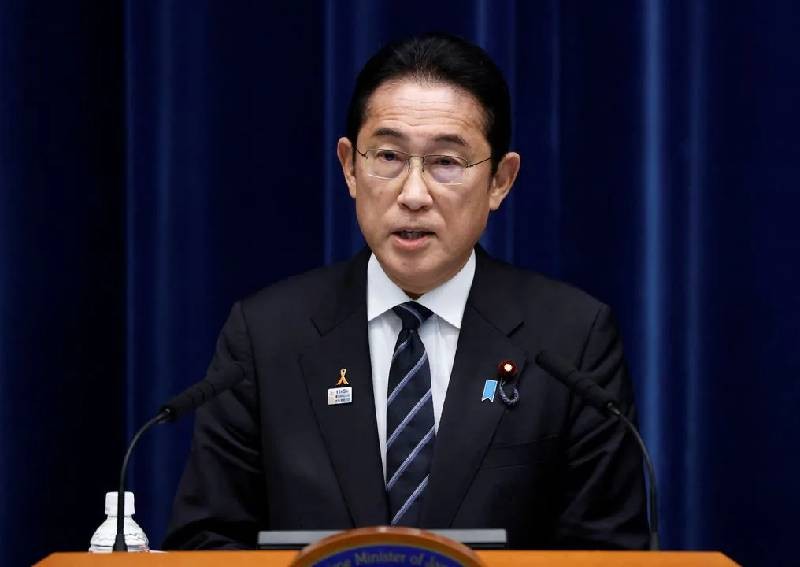
Fumio Kishida, Japan's prime minister, speaks during a news conference at the prime minister's official residence in Tokyo, Japan, Nov 2, 2023.


DECEMBER 10, 2023 

TOKYO — Japan's Prime Minister Fumio Kishida said on Monday (Dec 11) he would take steps to restore trust in his government amid a fundraising scandal, but declined to confirm a media report that he was set to replace four ministers in his cabinet.

Allegations over unreported funds have posed the biggest political challenge to the ruling Liberal Democratic Party (LDP) since it took back power in 2012, rattling the foundation of the current administration.

Speaking to reporters on Monday morning, Kishida said he is aware of the seriousness of the situation.

"We'll consider appropriate measures at the right time to restore public trust and prevent delays in national politics," Kishida said.

The Asahi newspaper reported late on Sunday that Kishida has decided to replace four ministers and 11 other ministerial positions in his cabinet as a scandal over alleged undisclosed funding has fuelled public disapproval.

Chief Cabinet Secretary Hirokazu Matsuno, Trade Minister Yasutoshi Nishimura, Internal Affairs Minister Junji Suzuki and Agriculture Minister Ichiro Miyashita are among those to be replaced, which also included deputies and parliamentary secretaries, Asahi reported.

Nishimura on Sunday said he would stay in the post and review his fundraising proceeds after media reports of an imminent cabinet reshuffle over allegations about unreported funds.

The 15 officials to be sacked belong to the LDP's biggest "Abe faction", which prosecutors have investigated for allegedly hiding more than 100 million yen (S$923,000) of political funds over the five years.

The LDP — which has held power for nearly all of Japan's post-war era — is due to hold leadership elections in September with a general election due by October 2025 at the latest.

The scandal could stir up a power struggle inside the party that could influence the outcome of the leadership contest and the party's management.

Kishida is set to hold a press conference on Wednesday at the end of the current parliament session to explain his administration's responses, Asahi said.

Kishida's cabinet approval ratings were hovering below 30 per cent even before the fundraising scandal, a record low in his premiership since October 2021, reflecting voter worries over rising living costs and looming tax hikes.

ALSO READ: Japan industry minister reviewing finances amid funds scandal

Source: Reuters

Sunday, December 10, 2023

Argentina’s newly sworn-in President Milei warns of shock adjustment to economy

By —David Biller, Associated Press
By — Debora Rey, Associated Press
 Dec 10, 2023 

BUENOS AIRES, Argentina (AP) — It wasn’t the most uplifting of inaugural addresses. Rather, Argentina’s newly empowered President Javier Milei presented figures to lay bare the scope of the nation’s economic “emergency,” and sought to prepare the public for a shock adjustment with drastic public spending cuts.

“We don’t have alternatives and we don’t have time. We don’t have margin for sterile discussions. Our country demands action, and immediate action. The political class left the country at the brink of its biggest crisis in history,” he said in his inaugural address to thousands of supporters in the capital, Buenos Aires. “We don’t desire the hard decisions that will be need to be made in coming weeks, but lamentably they didn’t leave us any option.”

READ MORE: After electing right-wing populist Milei as president, Argentina faces uncharted path

South America’s second largest economy is suffering 143 percent annual inflation, the currency has plunged and four in 10 Argentines are impoverished. The nation has a yawning fiscal deficit, a trade deficit of $43 billion, plus a daunting $45 billion debt to the International Monetary Fund, with $10.6 billion due to the multilateral and private creditors by April. “There’s no money,” is Milei’s common refrain. He repeated it Sunday to explain why a gradualist approach to the situation, which would require financing, was not an option.

But he promised the adjustment would almost entirely affect the state rather than the private sector, and that it represented the first step toward regaining prosperity.

“We know that in the short term the situation will worsen, but soon we will see the fruits of our effort, having created the base for solid and sustainable growth,” he said.

Milei, 53, rose to fame on television with profanity-laden tirades against what he called the political caste. He parlayed his popularity into a congressional seat and then, just as swiftly, into a presidential run. The overwhelming victory of the self-declared “anarcho-capitalist” in the August primaries sent shock waves through the political landscape and upended the race.

Argentines disillusioned with the economic status quo proved receptive to an outsider’s outlandish ideas to remedy their woes and transform the nation. He won the election’s Nov. 19 second round decisively — and sent packing the Peronist political force that dominated Argentina for decades. Still, he is likely to encounter fierce opposition from the Peronist movement’s lawmakers and the unions it controls, whose members have said they refuse to lose wages.

Earlier on Sunday, Milei was sworn in inside the National Congress building, and outgoing President Alberto Fernández placed the presidential sash upon him. Some of the assembled lawmakers chanted “Liberty!”

Afterward, he broke tradition by delivering his inaugural address not to assembled lawmakers but to his supporters gathered outside — with his back turned to the legislature. He blamed the outgoing government for putting Argentina on the path toward hyperinflation while the economy stagnated, saying the political class “has ruined our lives.”

“In the last 12 years, GDP per capita fell 15 percent in a context in which we accumulated 5,000 percent inflation. As such, for more than a decade we have lived in stagflation. This is the last rough patch before starting the reconstruction of Argentina,” he said. “It won’t be easy; 100 years of failure aren’t undone in a day. But it begins in a day, and today is that day.”

Given the general bleakness of Milei’s message, the crowd listened attentively and cheered only occasionally. Many waved Argentine flags and, to a lesser extent, the yellow Gadsden flag that is often associated with the U.S. libertarian right and which Milei and his supporters have adopted.

“Economically, we are just like every Argentine, trying to make it to the end of the month,” said Wenceslao Aguirre, one of Milei’s supporters. “It’s been a very complicated situation. We hope this will change once and for all.”

As Milei takes office, the nation wonders which version of him will govern: the chainsaw-wielding, anti-establishment crusader from the campaign trail, or the more moderate president-elect who emerged in recent weeks.

As a candidate, Milei pledged to purge the political establishment of corruption, eliminate the Central Bank he has accused of printing money and fueling inflation, and replace the rapidly depreciating peso with the U.S. dollar.

But after winning, he tapped Luis Caputo, a former Central Bank president, to be his economy minister and one of Caputo’s allies to helm the bank, appearing to have put his much-touted plans for dollarization on hold.

Milei had cast himself as a willing warrior against the creep of global socialism, much like former U.S. President Donald Trump, whom he openly admires. But when Milei traveled to the U.S. last week, he didn’t visit Mar-a-Lago; rather, he took lunch with another former U.S. leader, Bill Clinton.

READ MORE: Trump tells Argentina’s President-elect Javier Milei he plans to visit Buenos Aires

He also dispatched a diplomat with a long history of work in climate negotiations to the ongoing COP28 conference in Dubai, Argentine newspaper La Nacion reported, despite having insistently rejected humanity’s involvement in global warming. And he backtracked on plans to scrap the nation’s health ministry.

And during his inaugural address, he directed some comments to the political class, saying that he has no intention to “persecute anyone or settle old vendettas,” and that any politician or union leader who wants to support his project will be “received with open arms.”

His moderation may stem from pragmatism, given the scope of the immense challenge before him, his political inexperience and need to sew up alliances with other parties to implement his agenda in Congress, where his party is a distant third in number of seats held.

He chose Patricia Bullrich, a longtime politician and first-round adversary from the coalition with the second most seats, to be his security minister, as well as her running mate, Luis Petri, as his defense minister.

Still, there are signs that Milei has not given up his radical plans to dismantle the state. Already he has said he will eliminate multiple ministries, including those of culture, environment, women, and science and technology. He wants to meld the ministries of social development, labor and education together under a single ministry of human capital.

Following his inaugural address, Milei traveled in a convertible to the presidential palace. Later on Sunday he is scheduled to swear in his ministers and meet with foreign dignitaries.

Prominent far-right figures will be among them: Hungarian Prime Minister Viktor Orbán; the head of Spain’s Vox party, Santiago Abascal; former Brazilian President Jair Bolsonaro and Bolsonaro-allied lawmakers, including his son.

Milei reportedly sent a letter inviting Brazil’s current president, Luiz Inácio Lula da Silva, after calling the leftist “obviously” corrupt last month during a televised interview and asserting that, if he became president, the two would not meet.

Lula dispatched his foreign minister to attend Milei’s inauguration.

Also joining was Ukrainian President Volodymyr Zelenskyy, who is making his first visit to Latin America as Kyiv continues to court support among developing nations for its 21-month-old fight against Russia’s invading forces. Zelenskyy and Milei shared a close exchange just before the inaugural address.

Biller reported from Rio de Janeiro. AP writer Almudena Calatrava contributed from Buenos Aires.
UN climate talks home in on fossil fuel deal


By AFP
Published December 10, 2023

COP28 is due to end on Tuesday but could go into overtime in nations fail to agree on a deal on time -
Copyright AFP Giuseppe CACACE

Laurent THOMET

UN climate talks enter their endgame on Monday as negotiators seek to convince an increasingly isolated Saudi Arabia and other holdouts to give up their opposition to a historic phase-out of fossil fuels.

With 24 hours to go before the official end of COP28 in Dubai, a new draft deal was expected in the morning in the hope that the right language may have finally been found to achieve a consensus among nearly 200 countries.

The annual Conference of the Parties, or COP, has rarely finished on schedule in its 28-year history, but COP28 president Sultan Al Jaber has called on countries to wrap things up on time on Tuesday.

It would coincide with the anniversary of the 2015 Paris Agreement, which set the increasingly elusive target of limiting warming to 1.5 degrees Celsius from pre-industrial levels — Jaber’s “North Star”.

Jaber, the head of the national oil company of the United Arab Emirates, has repeatedly promised to deliver a historic deal and urged countries to find a “consensus and common ground” on fossil fuel.

“Failure is not an option,” he said on Sunday.

Saudi Arabia, the world’s top oil exporter, has opposed any phase-out or phase-down of fossil fuels and told COP28 that its “perspectives and concerns” must be taken into account.

Iraq has also publicly rejected an exit from fossil fuels.

But veteran climate campaigners and negotiators say the world has never been so close to a deal on winding down oil, gas and coal.

The pressure is now on Jaber — whose role as oil executive has caused angst among climate campaigners — to make the final edits to a deal that would bring a consensus.

In a bid to find common ground, Jaber invited ministers on Sunday to lay out their positions during a “majlis” — a traditional Gulf Arab meeting held in a circle.

“I hope that you won’t let me down,” he said at the end of the meeting.

– Several options –


Negotiators have failed to produce a new draft agreement since the last text was released on Friday.

The document includes four different paths out of fossil fuels, but it also has a fifth option: leaving the issue out of the final deal.

China, the world’s biggest emitter, was also initially seen as hostile to a phase-out but has since been working to find a compromise.

Chinese climate envoy Xie Zhenhua recalled on Saturday that the United States and China issued a joint statement last month agreeing on the need to speed up the deployment of renewable energy in order to gradually substitute the use of oil, gas and coal.

Friday’s draft deal includes similar language on the need to triple renewable energy capacity by 2030, to “displace fossil fuel-based energy”.

Countries are waiting for a new draft deal before putting all their negotiating “chips” on the table, said a source close to the COP28 presidency.


Foodservice Footprint hour2 Time running out to transform food system Out of Home News Analysis

Time running out to transform food system

As we approach the end of another year, the evidence suggests the food industry response to environmental crisis remains underpowered. Nick Hughes reports.

The end of the hottest calendar year ever recorded feels like an appropriate moment to take stock of the progress made on key environmental and social issues during 2023.

Amid the noise of the annual COP climate jamboree it can be hard to separate genuine measures of progress against key sustainability indicators from the political and corporate spin that events of such global significance inevitably attract.  

For the UK food industry specifically, the picture has become clearer following the publication of a series of reports charting progress against time-bound commitments to tackle critical issues such as greenhouse gas emissions, water security and waste.

In each case, the answer to the question ‘what progress are we making?’ is – to put it mildly – ‘not nearly enough’.

Wrap found that progress against all three Courtauld Commitment 2030 targets (covering water, waste and greenhouse gas emissions) needs to speed up rapidly or risk failure. The Food Foundation described a state of stagnation in business transparency on key health and environmental indicators. WWF, meanwhile, reported that food retail has a very long way to go to meet the target of halving the environmental impact of UK shopping baskets by 2030.

Certain companies have shown leadership throughout the year: we’ve seen caterers continue their efforts to shift diets by substituting meat with vegetables and pulses; businesses engagement with regenerative agriculture is growing; new partnerships have been formed to redistribute food surplus; and some businesses have parked commitments to carbon neutrality (largely achieved via offsetting) and pledged to refocus on deep decarbonisation.

But an overall conclusion is straightforward to reach: progress on key issues is nowhere close to where it needs to be as we enter the middle years of a critical decade for action on climate and the environment. As UN secretary-general António Guterres told COP28 delegates in Dubai: “We are living through climate collapse in real time.”

On health, meanwhile, a recent report by the Tony Blair Institute for Global Change found that the cost to the UK of obesity and overweight spiralled to £98bn in 2021, up from the previous estimate of £58bn and equivalent to almost 4% of GDP.

Targets slip

Wrap is known for maintaining a diplomatic tone in its public communications no matter how frustrating the news it has to report, but reading between the lines of its latest milestone report for the Courtauld Commitment 2030 the signs of exasperation are evident. “It is never easy to report that targets are slipping,” wrote Estelle Herszenhorn, head of food systems transformation. On emissions, companies need to “move from measurement to action”, she urged. On water, “we need more businesses to engage” given a dearth of signatories to Wrap’s water roadmap.

On waste, director of behaviour change and business programmes, Catherine David, offered a polite rebuke of her own. “The latest food waste headline statistics are not where we need them to be,” she wrote.

That’s something of an understatement. Despite per capita food waste falling by 18.3% between 2007 and 2021 (against a 50% target by 2030), Wrap reported that food waste actually rose by 5.6% between 2018 and 2021 driven by an increase in household waste.

Although the manufacturing sector is on track to achieve the 50% by 2030 target and retailers are just over halfway there, data for the hospitality and foodservice sector is still not sufficiently reliable to report progress – a familiar failing not just on waste but across a range of health and environment measures.

There are signs too that Wrap is close to hitting a ceiling of businesses willing to commit to its food waste reduction roadmap: 366 out of 690 large food businesses in the UK are now committed to the roadmap, up 15 on last year compared with a 33 jump in signatories the year before and a 57 increase between 2020 and 2021. Hopes to grow industry engagement perhaps now rest on a possible reversal of the government’s decision not to require mandatory food waste reporting for large businesses. 

On greenhouse gas emissions, the picture is not much better. Wrap modelled a 14% reduction in total emissions between the baseline year of 2015 and 2021 against a target for a 50% absolute reduction in emissions associated with food and drink consumed in the UK by 2030. The biggest drivers of the reduction have been a decrease in the GHG intensity of energy since 2015 and improvements to energy use efficiency – relatively low-hanging fruit in an emissions reduction context – and Wrap said current action and investment is not sufficient to achieve the net-zero ambitions of the food and drink sector.

Stuck on scope 3

Measurable progress in reducing scope 3 emissions remains a major sticking point for businesses. Wrap said the absence of a consistent methodology for measuring scope 3 emissions is creating an unreasonable burden on producers and suppliers in food supply chains, generating mistrust in the data being reported and blocking meaningful action on reducing food system impacts.

WWF highlighted a similar issue in its latest report charting retailer progress towards meeting a target of halving the environmental impact of UK shopping baskets by 2030. With Asda engaging for the first time this year, 10 out of the 11 major UK food retailers representing over 90% of the UK grocery market are now reporting against at least some of WWF’s basket metrics (Iceland is the exception).

The report found some cause for optimism in areas like tackling deforestation and land conversion in palm oil supply chains, yet overall it found food retail “has a very long way to go” if it is to spearhead the change that’s needed to hit the shopping basket target, both within supply chains and across the wider food system.

On scope 3 emissions specifically, WWF found no indication that emissions are reducing across the sector. Of the six retailers to have provided data across multiple years, half have produced increases in scope 3 emissions. The remaining three have reported small reductions, however WWF said the data has neither the coverage nor the comparability, to report an overall figure.

Transparency lacking

The news doesn’t improve as we turn to The Food Foundation’s latest annual assessment of the state of the nation’s food industry. Business transparency has stagnated, the charity claimed, with fewer companies disclosing sales-weighted data against key environment and health metrics than in the previous year.

The Food Foundation said the negative trend has not been helped by the lack of leadership from government, and the fact there is still no agreed way of consistently measuring and reporting the nutrient and carbon content of food (as had been the intention of the UK government’s food data transparency partnership, which has since been made voluntary for health reporting and had its environmental scope narrowed to measuring scope 3 emissions).

Overall, the out of home sector performed worse than retailers on setting targets and disclosing data for sales of both foods high in fat, salt or sugar (HFSS) and fruit and vegetables. Of the 27 largest retailers and out of home sector companies assessed, none has both a target for and currently discloses relative sales of animal and plant protein.

Contact caterers are leading the way on shifting consumption from meat to plants. The report highlighted Compass’s target for a 25% reduction of animal protein by 2025 and 40% by 2030, alongside Elior’s ambition for a 40% reduction in beef consumption by 2025, and Sodexo’s goal for 33% of menus to be plant-based worldwide by 2025.

The final report for The Food Foundation’s Peas Please campaign meanwhile showed 23 businesses obtained a green traffic light for fully meeting their pledge commitments to sell or serve more portions of vegetables. These included out of home brands like Greggs, JD Wetherspoon, Brewers Fayre and Zizzi.

Such commitments hint that some progress is being made on previously intractable issues like dietary change. But as a collective, the level of business ambition across a range of sustainability indicators is nowhere near high enough – a problem exacerbated by a lack of government leadership on food systems change.

Speaking at the launch of The Food Foundation industry report, Juliane Cailloutte-Noble, CEO of the Sustainable Restaurant Association, recalled a recent conference she had attended in which a World Bank representative noted how the energy and transport sectors had been working hard on decarbonisation for the past ten years and warned that without action the food system could account for 60% of global emissions within the next decade (up from a current 25-30%). 

It’s important not to lose hope. There are reasons to believe that the food system can be transformed in a way that respects planetary boundaries and supports healthy lifestyles (look out for a ‘Five reasons to be positive’ Footprintanalysis in early January). Yet as the climate crisis continues to unfold around us in 2024 and beyond, food businesses risk finding the finger of blame increasingly pointed in their direction. 


She’s with him: Hillary Clinton steps out as a key player in Biden’s re-election effort

Clinton hosted a $1 million fundraiser at her Georgetown home.

Former President Bill Clinton speaks as former Secretary of State Hilary Clinton looks on during a conversation about current global challenges at Swansea University Bay Campus in Wales on Nov. 16.
Ben Birchall / PA via AP

Dec. 10, 2023
By Jonathan Allen, Peter Nicholas and Megan Lebowitz

WASHINGTON — On the final Monday in November, in a Washington home stately enough to have a name — Whitehaven — members of the Women’s Leadership Forum raised just shy of $1 million for President Joe Biden’s re-election effort. Their host: Hillary Clinton.

Two weeks earlier, Clinton published an op-ed in The Atlantic that forcefully made the case for Biden’s approach to the Israel-Hamas war, putting her credibility on the line as progressives demanded a cease-fire. And two weeks before that, at a Columbia University panel on the anniversary of the Universal Declaration of Human Rights, Clinton shut down a heckler who asked her to comment on Biden’s “warmongering.”

In those moments, in an interview on “The View” and in social media posts, the 2016 Democratic presidential nominee is stepping into a role as one of the most prominent and influential surrogates in Biden’s re-election effort. As a former secretary of state, she has the bona fides to provide Biden with a measure of political cover amid a war in the Middle East that has split the Democratic Party.

Clinton is popular with women and key parts of the Democratic base and remains a fundraising draw who can help ensure Biden has the money to get his message out. There is still a two-for-the-price-of-one theme when it comes to her family: Husband Bill Clinton made a cameo at the fundraising event at their Washington home.

Clinton’s role is only expected to grow in the new year, but for now, she is filling a space that at a later point in the campaign season former President Barack Obama will join. Obama’s habit is to plunge in closer to Election Day — a reality that rankles some Democratic strategists who say the party sorely needs him right now.

Biden and Clinton have not always been close — she elbowed him out of running in 2016, and her first visit to the White House during his presidency was in September — but the president is thirsty for allies right now. His approval numbers are at an all-time low, and he is running neck and neck with a Republican front-runner, former President Donald Trump, who is under indictment in four separate cases.

“At the end of the day, Biden needs all the help that he can get,” a Democratic strategist said, speaking on condition of anonymity to talk openly about Biden’s prospects. “What he needs is both the spirit and the actual reality of unity.”

Clinton’s re-emergence is emblematic of a larger Democratic effort to more fully deploy high-profile allies in Biden’s re-election fight, according to two people familiar with his campaign’s effort. While Obama has appeared in fundraising videos for Biden, some Democrats would like him to be more visible on the campaign trail and use his formidable star power to give Biden a much-needed boost.

“We are very eager to get our surrogates engaged,” one of the people said, pointing specifically to the Clintons and former first couple Barack and Michelle Obama as figures who can gin up excitement for a Biden candidacy that could use more of it.

When Biden flew on Air Force One to a memorial service for former first lady Rosalynn Carter late last month, the Clintons and Michelle Obama accompanied him. The group, which included first lady Jill Biden, was photographed together on a tarmac, creating an indelible image of unity among three Democratic first families in support of a grieving fourth.

The White House recently hired Dennis Cheng, a longtime fundraiser for both Clintons, to bolster its outreach to political allies. The hire had more to do with Cheng’s ability to connect with party elites than his relationship with the Clintons, the two people familiar with Biden’s re-election campaign said, but it won’t hurt in sealing the bond between Biden and his onetime intraparty rival.

The same day Hillary Clinton raised money for Biden, her husband sat down to lunch in New York with Argentina’s President-elect, Javier Milei and former Sen. Chris Dodd, who is Biden’s special adviser for the Americas. In doing so, Bill Clinton served as a high-profile surrogate for Biden, who did not meet with Milei. Dodd checked in with the White House before the lunch to go over discussion points, and Bill Clinton alerted the State Department that he would be meeting with Milei, said people familiar with the lunch.

“I don’t know of a couple that could be any more helpful to President Biden than the Clintons,” said Tom Daschle, a former Senate Democratic leader. “They have an enormous level of support and admiration within the Democratic Party.”

“You’ve had politicians over the years say that every election is the most important election in our lifetimes,” Daschle continued. “This is literally the most important election in all of American history. The stakes have never been this high. Everyone feels the need to do their part to ensure that we get through the next 14 months.”

People close to Hillary Clinton anticipate she’ll be a tireless campaigner for the Biden campaign, rallying Democratic voters by laying out the stakes and explaining why a Trump victory could subvert America’s democratic norms.

Both she and Bill Clinton feel a degree of loyalty to the Democratic Party that not everyone in the party’s orbit shares, a person close to her said.

“She and her husband will do whatever is asked of them,” this person said. “Some elected [officials] and former elected [officials] are, ‘Send us a list and we’ll do two out of the 20’” events. “She’ll do 18 out of the 20.”

She is also well positioned to caution voters that if they support a third-party candidate, they may cut into Biden’s margin and flip the election to Trump, Democratic strategists said.

In her 2016 loss to Trump, she saw some of her support peel off in favor of Green Party candidate Jill Stein’s campaign, contributing to her defeat in closely contested states like Michigan and Wisconsin.

“She is the proof point of what can happen if you throw away your vote on someone other than President Biden because you’re mad at one little thing,” said a longtime Democratic strategist, speaking on condition of anonymity to talk more freely. “That happened to her.”

Among other lessons learned from 2016 was the need to engage earlier, explained Amanda Renteria, Clinton’s former national political director for the 2016 campaign.

“What folks have now realized is actually you have to push back early and make sure you don’t get defined by whatever is happening out there,” Renteria said. “And so not only are you seeing Hillary pick up, but there’s a lot more pushback on what the narrative is out there, what the theme is out there.”

Dick Harpootlian, former chairman of the South Carolina Democratic Party, said in an interview that “Barack Obama ought to step up. Every Democrat and independent who cherishes the democracy that we have gotten to know — and if they want to stop it from unraveling — better step up with checkbooks and every waking moment try to motivate people to vote.”

Democrats seem happy to have any amount of Obama. “We would like to have him out there for as much time as he’s willing to give us,” the Democratic strategist said. “And if he’s willing to give us more than he already does — which is not much — we’d be very relieved.”

But people close to both presidents say that Obama’s value grows as the election draws nearer.

“Obama drives turnout,” said one Democrat who has raised money for Obama and Biden. “That happens later in the campaign.”

A Biden campaign spokesperson, Seth Schuster, said in a prepared statement that Biden “is proud to have the support of President Obama and Secretary Clinton. They are both trusted leaders, and we’re grateful that — a year out — when the focus is building the infrastructure, raising money, and mobilizing our voters to carry us to victory in November 2024, they have already been effective mobilizers of the Biden-Harris coalition.”

An Obama spokesman suggested that the former president’s objective is not simply to campaign for its own sake, but to choose moments and spots that maximize the chance of reaching voters.

“Our strategy will be based on driving impact,” said Eric Schultz, a senior Obama adviser. “We place a huge emphasis on finding creative ways to reach new audiences, especially tools that can be directly tied to voter mobilization or volunteer activations. We are deliberate in picking our moments because our objective is to move the needle.”

As the calendar turns to 2024, Biden’s team will continue to push for high-level surrogates to make the case that democracy is on the line with Trump on the ballot. Biden’s allies say there’s no excuse for any top Democrat to stay out of the fray.

It’s “all hands on deck,” said one of the people familiar with his campaign.

Former President Bill Clinton and former Secretary of State Hillary Clinton disembark Air Force One at Dobbins Air Reserve Base in Marietta, Ga., on Nov. 28 to attend services for former first lady Rosalynn Carter.
Anbdrew Caballero-Reynolds / AFP - Getty Images

Jonathan Allen is a senior national politics reporter for NBC News, based in Washington.

Peter Nicholas is a senior national political reporter for NBC News.

Megan Lebowitz is a politics reporter for NBC News.

Carol E. Lee contributed.