Wednesday, March 13, 2024

Martini Judaism

When Jewish rights were human rights

A chance encounter with the son of one of the great Jewish moral heroes of the last half century. Few people think of him now, and therein lies the story.
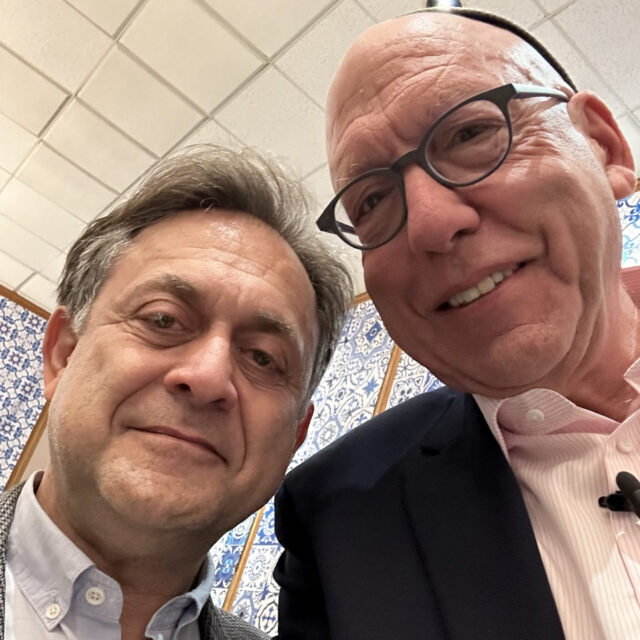

Author Jeffrey Salkin, right, with Mr. Slepak, son of Vladimir Slepak.
 (RNS photo/Jeffrey Salkin)

March 6, 2024
By Jeffrey Salkin


(RNS) — I had just finished giving a talk on my new book on the state of American Judaism, post-Oct. 7. It was at the 92nd Street Y in New York, in conversation with Rabbi David Ingber. A man approached me and introduced himself, in a soft Russian accent.

He told me his name was Slepak.

“As in … ?”


“Yes,” he replied. “My father was Vladimir Slepak.”

That name instantly carried me back, decades ago, in Jewish and world history. That name had been on the lips of a generation of Jewish activists — a name spoken with deep reverence.

The late Vladimir Slepak was a Russian dissident and one of the heroes of the Soviet Jewry movement.

For those of us too young to remember, the Soviet Jewry movement was an international human rights movement that advocated for religious freedom for Jews in the former Soviet Union (or, more accurately, the future former Soviet Union).

Those freedoms included the right to study Judaism, to worship freely and openly, and to emigrate from the USSR to Israel. Those who had applied for permission to emigrate, and had been refused such permission by the Soviet authorities, were known as refuseniks.

Their lives were wretched; once you applied for permission to emigrate, that information would make its way to your employer, you would lose your job, and that would plunge your family into a financially precarious position.

Read the indispensable history of the movement: “When They Come For Us, We’ll Be Gone: The Epic Struggle to Save Soviet Jewry,” by Gal Beckerman.

The Soviet Jewry movement flourished in the 1960s through the 1980s. It captured the imagination of a generation of Jews. It involved massive rallies (especially the Freedom Sunday rally in Washington, D.C., on Dec. 6, 1987 — 200,000 people), letter writing campaigns and surreptitious missions to Russia to visit refuseniks.

If my memory serves me correctly, I had met Slepak on my own trip to Russia, back in 1983. His son confirmed it was possible; their apartment in Moscow had been a gathering place for such activists. “Natan Sharansky was arrested in our apartment,” he told me proudly

On that trip, in the darkest days of the oppression of Soviet Jews, I visited a major bookstore in what was then Leningrad. An entire section of the bookstore featured anti-Israel and antisemitic posters. One poster depicted Israel’s then-Prime Minister Menachem Begin and Hitler, goose stepping over the bodies of dead Palestinians.

Let us also remember: The “Zionism is racism” canard, peddled in the United Nations in 1975 and still parroted to this day, was a Russian export — pure Soviet propaganda.

The Soviet Jewry movement galvanized the entire Jewish world. Activism for Soviet Jewry was a key part of my Jewish youth and young adulthood; my first public act of Jewish solidarity was attending a Soviet Jewry rally at Eisenhower Park on Long Island, in 1966 when I was barely 12 years old. It was hardly to be my last; such demonstrations for Soviet Jewry were part of my youth group days, wherein we spent many evenings protesting at the United Nations.

We wore bracelets adorned with the names of the refuseniks, the “prisoners of Zion.” Years later, young people would symbolically share their bnai mitzvah ceremonies by “twinning” with young Russian Jews who had been denied the ability to learn and practice Judaism.

But there was something else about the Soviet Jewry movement.

To quote the old Levy’s rye bread commercial: You didn’t have to be Jewish to care about Soviet Jews.

Some years ago, I spent a social evening with the actress-activist Jane Fonda. In preparation for our time together, I had read her autobiography, and I told her how much I had enjoyed it.

She told me she had originally written in depth about her deep friendship with the Soviet Jewish activist Ida Nudel, who was known as the “Guardian Angel” for refuseniks. Jane had made such visits to Russia to visit refuseniks.

Alas, those pages were left, somehow, on the cutting room floor.

Consider all of the other causes, many of them controversial, that occupied Jane’s time and energy. Soviet Jewry was part of her moral portfolio. That fact speaks volumes — not only about her, but about the times.

And then, there was the late Mary Travers, of Peter, Paul and Mary. She was also part of that 1983 trip to the Soviet Union. She was also not Jewish. An enduring memory: her concert at the Moscow residence of the United States ambassador, when she sang the song “Sweet Survivor” and dedicated it to the Jews who were captive in the Soviet Union.

And then, of course, there was the Jackson-Vanik Amendment to the Trade Act of 1974, which most people, to this day, simply call “Jackson-Vanik.” Its intent: to deny favored nation trading status to countries that restricted Jewish emigration and other human rights (since repealed in 2012).

Neither of its sponsors — Sen. Henry M. “Scoop” Jackson of Washington and Rep. Charles A. Vanik of Ohio — was Jewish. Neither of them had particularly Jewish constituencies. They did it because it was the right thing to do.

The Soviet Jewry movement cared about Jews being free to live as Jews. But it saw the plight of Jews as being a universal human concern — a cause all decent people might embrace. Those rights did not only include the right to learn Judaism; it meant the right to live in the Jewish state (and yes, many of those Russian Jews wound up in the United States). No matter: Human rights advocates knew we were all in this together.

The Soviet Jewry movement was uniquely Jewish and yet also universal in its appeal.

And it was, perhaps, the last time that happened. Since those heady days of the Soviet Jewry movement, I cannot think of another time when a particularly Jewish cause has aroused international and universal sympathy.

Moreover, the vulgarity and the sheer horror of such Soviet-era images as the ones on that poster — Begin and Hitler walking over Palestinian cadavers — have become mainstream, both visually and verbally.

Those images far exceed any criticism of particular Israeli policies. The only people who are subject to attack because of their co-religionists’ policies — on the other side of the world — are Jews. Nine-year-old Jewish kids in public schools in California now pay the price for what Israelis are doing in the Middle East. In such a way, the hateful protesters have gotten their way; the intifada has been globalized.

But, getting back to my surprise encounter with the son of one of modern Jewry’s great heroes.

It was a pleasant conversation — after which we embraced, almost as long-lost brothers.

As we parted, I thought of the old song of the Soviet Jewry movement, which the late Theodore Bikel had sung and which we sung in Jewish summer camp — in Russian!

“I shall not be afraid of anyone, and I shall not believe in anyone, except for God alone.”

Amen.
A new Holocaust Museum shows how three-quarters of Dutch Jews were deported and killed

Three-quarters of the prewar Dutch Jews were among the six million Jews murdered by the Nazis, the largest proportion of any country in Europe.


A Star of David badge with the Dutch word "Jood", or "Jew", worn during World War II, is displayed at the new National Holocaust Museum in Amsterdam, Netherlands, Tuesday, March 5, 2024. (AP Photo/Peter Dejong)

March 6, 2024

AMSTERDAM (AP) — The Dutch resistance spirited newborn Flip Delmonte away after his parents were detained by Nazi occupiers of the Netherlands in World War II.

They were among 102,000 Jews deported from the Netherlands and murdered in Nazi death camps. Delmonte’s mother was killed as soon as she arrived at Auschwitz while his father, “a strong man,” was worked to death.

On Tuesday, the 80-year-old Delmonte attended the official preview of the Netherlands’ National Holocaust Museum, pointing proudly at a picture he donated of himself after the war.

“The Jewish people were murdered. There are people, children who survived and we cannot forget them. They must be remembered also in the future,” Delmonte said.

The museum will be officially opened Sunday by Dutch King Willem-Alexander. It tells the story, in video footage, photos, scale models and mementos, of Dutch victims of the Holocaust.

Three-quarters of the prewar Dutch Jews were among the six million Jews murdered by the Nazis, the largest proportion of any country in Europe.

Head curator Annemiek Gringold pulled together exhibition rooms that do not shy away from the atrocities. There is a prominent photo of a boy walking past bodies in Bergen-Belsen shortly after the liberation of the concentration camp.

But the museum also features small mementos of the lives lost: a doll, an orange dress made from parachute material and a collection of 10 buttons excavated from the grounds of the Sobibor camp.

“Perhaps this is the closest I can come to the thousands and thousands of anonymous people that were rushed into the gas chamber,” Gringold said. “This is something that they chose to wear, and it is one of the last items that they touched.”

Gringold said the museum opens at a time “that the generation that survived the Shoah is slowly leaving us.”

Now she wants to tell their story “to be aware of where antisemitism might lead to in certain circumstances.”

The walls of one room are filled, floor to ceiling, with the texts of hundreds of laws discriminating against Jews that were enacted by the German occupiers of the Netherlands, to show how the Nazi regime, assisted by Dutch civil servants, dehumanized Jews ahead of operations to round them up.

The museum is in the Dutch capital’s historic Jewish Quarter and close to a memorial officially opened in 2021 that honors Dutch victims of the Holocaust.

It opens against a backdrop of Israel’s devastating attacks on Gaza that followed the deadly incursions by Hamas in southern Israel on Oct. 7.

“The actual events as they are happening in Israel, with the war going on, they are … on my mind. But I focus on the history of this particular site,” Gringold said.

Delmonte was happy to contribute a photograph to the museum, but he kept his most treasured keepsake for himself.

“I have a cookie plate at home which used to be my mother’s, and my aunt has given that to me at my birthday,” he said. “I still have that at home. So that’s very special for me.”
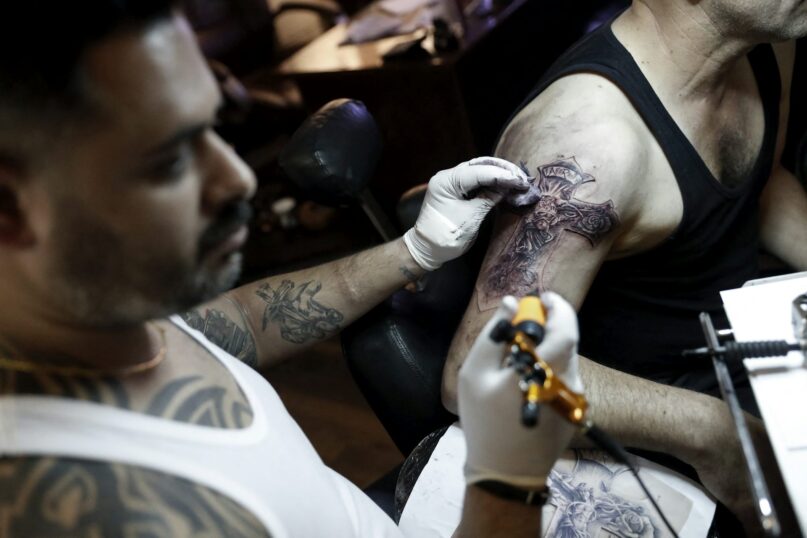
WHY YOU WILL ALWAYS FIND JESUS IN A US JAIL


Tattooing has held a long tradition in Christianity − dating back to Jesus’ crucifixion

Historically, many Christians got tattoos around Holy Week − usually a cross − to honor Christ’s martyrdom.


March 7, 2024
By Gustavo Morello

(The Conversation) — Holy Week and Easter are perhaps the most important days in the Christian calendar. Many associate those celebrations with church services, processions, candles, incense, fasting and penances.

However, there is another tradition that many Christians follow – that of tattooing. Historically, Easter was an important time for tattoos among some Christian groups. Today, Christian tattooing happens in many parts of the world and all year around. Some Christians visiting Jerusalem around Easter will get a tattoo of a cross, or a lamb, usually on their forearms.

As a sociologist of religion and a Jesuit Catholic priest, I have long studied tattoos as religious practices. I have interviewed tattoo artists in Jerusalem, Bethlehem and Loreto in Italy who have been continuing and recreating the tradition of Christian tattooing. Evidence is clear the practice started shortly after Jesus’ crucifixion and spread across Europe in later centuries.

The first Christian tattoos

The Romans, like the Greeks, tattooed slaves and prisoners, usually with letters or words on their foreheads that indicated their crime. Soon after Jesus’ death, around the year 30 C.E., they started enslaving and tattooing Christians with the marks “AM” – meaning “ad metalla,” or condemned to work in the mines, a punishment that often resulted in death.

Almost at the same time, Christians who were not enslaved got tattoos of the early Christian signs such as fish or lambs in solidarity and to show that they identified with Jesus.

There were no specific words in Latin or Greek for tattooing, so the words “stizo,” “signum” and “stigma” were used. The word stigma also referred to the marks of nails on Jesus’ hands and foot, as a result of his crucifixion. Christians often got their own “stigmas”: a sign – usually a cross – in Jerusalem to honor Christ’s martyrdom.

The beginning of a tradition

There are several documented accounts of the tradition.

One from the third century mentions Christians in present-day Egypt and Syria getting tattoos of fish and crosses.

Another tells about the commentary that Procopius of Gaza, a theologian who lived between 475 and 538 C.E., wrote on the Book of Isaiah after he found that many Christians living in the Holy Land had a cross tattooed on their wrists. “Still others will write on their hand, ‘The Lord’s,’ and will take the name Israel,” he noted.

When a plague hit the Scythians, nomadic people living around the Black Sea, in 600 C.E., tattoos were believed to provide protection from the deadly disease. Theophylact Simocatta, one of the last historians of late antiquity, mentioned that missionaries among them recommended that “the foreheads of the young be tattooed with this very sign” – meaning that of a cross.

Many testimonies mentioned Crusaders and pilgrims returning from the Holy Land with a tattoo during the Middle Ages – a tradition that continued in early modern times, between the 16th and 18th centuries.

Christian tattoos in Great Britain

Other cultures used tattoos in different ways. When Romans came in contact with the Celts tribes that inhabited the British Isles in 400 C.E., they called them Picts because they were covered in body art.

The word Picts is derived from the name given to them by the Romans because of their painted bodies.
Hulton Archive/Getty Images

Pope Gregory the Great sent envoys to convert the Celts to Christianity, followed by a visit from another Vatican delegation. While missionaries were against “pagan tattooing,” both delegations agreed that tattoos done for the Christian god were fine. The members of the second delegation in the late 700s even said, “If anyone were to undergo this injury of staining for the sake of God, he would receive a great reward for it.”

Similar was the conclusion of the Northumbria Council, a church gathering in Northern England in 787: Tattoos done for the right god were acceptable. At that time, the Anglo-Saxon elite also had tattoos; the bishop of York, Saint Wilfrid, for example, got a tattoo of a cross.

Tattoos in Italy


Around the 1300s, as the Christian kingdoms in the Holy Land were losing control with the coming of the Ottomans, there appeared in Italy shrines called “Sacri Monti.” These shrines were placed on “holy mountains” where devotees could pilgrimage safely, instead of risking their lives going to Jerusalem, which by then was under the control of the Ottomans.

These shrines were established in cities such as Naples, Varallo and Loreto. Pilgrims could get tattoos in some of these shrines. One place was Loreto’s sanctuary, established in the early 1300s. A relic from the “Holy House,” which, according to the Christian tradition, is the house where the Virgin Mary is believed to have received the news that she will bear God’s son, was brought to Loreto’s sanctuary.

Tattooing in Loreto’s sanctuary was a communal activity, done by carpenters, shoemakers and artisans, who brought their stalls and tools to the main square
during the days of celebrations and tattooed whoever wanted to get a mark of their devotion. These tattoos typically used wood planks for transferring the design on the body, like a stamp. However, the city of Loreto banned tattooing for hygienic reasons in 1871, according to Caterina Pigorini Beri, an anthropologist, who was one of the first to document the practice.

But people kept getting them. A shoemaker, Leonardo Conditti, was among those who kept doing tattoos in hiding during the 1940s.

The history of tattooing.

Present but unseen


From the 1200s to the 1700s, the custom of Christian tattooing was prevalent in Europe among peasants, seafarers, soldiers and artisans as much as among nuns and monks. They were getting crosses, images of the Virgin Mary, the name of Jesus, and some sentences from the Bible.

Following the Renaissance, however, European culture came to associate tattoos with those considered “uncivilized,” such as peoples in the colonies, criminals and poorer Catholics. Many European intellectuals viewed Catholicism as a superstition more than a real religion.

The word “tattoo” came to the Western languages after the French admiral and explorer Louis de Bougainville and British explorer James Cook returned from their trips to the South Pacific at the end of the 1700s. There, they saw local people getting marks on their bodies and using the word “tatau” to name those drawings. However, it does not mean that tattoos came back at that time. They had never left.

The practice today

These days, some churches in the Middle East, such as some Coptic Christian churches in Egypt, incorporate the practice of getting a tattoo into the baptismal rituals.

Indeed, Holy Land tattooing has never stopped. Wassim Razzouk, whom I interviewed in 2022, is a 27th-generation tattooist – his family has been marking pilgrims in Jerusalem since 1300. Razzouk claims to have some of the 500-year-old wood planks his family used for tattooing.

Another tattoo artist whom I interviewed, Walid Ayash, does pilgrimage tattoos for those who visit the Nativity church in Bethlehem – a beloved custom among Arab Christians. He said that tattooing happens all year around, as long as there are pilgrims visiting the Nativity church. Although this year, as a result of the war in Gaza, Israeli authorities have restricted access to Jerusalem and Bethlehem.

In Italy, artist Jonatal Carducci is working on recovering the tradition of religious tattooing in Loreto. In a 2023 interview with me, he explained how he has painstakingly replicated the designs of the wood planks, which are both in the Museum of the Holy House and the Folkloric Museum of Rome. In 2019, he opened a parlor where Leonardo Conditti used to work. Visitors to the parlor can choose among more than 60 designs for their tattoos, including the Virgin Mary of Loreto, crosses and representations of Jesus’ heart.

This Easter, as some Christians get tattoos, this history might serve as a reminder of tattooing as a legitimate Christian practice, one that has been in use since the beginnings of the Common Era.

(Gustavo Morello, Professor of Sociology, Boston College. The views expressed in this commentary do not necessarily reflect those of Religion News Service.)
Animal chaplains offer spiritual care for every species
HUMANS ARE ANIMALS TOO
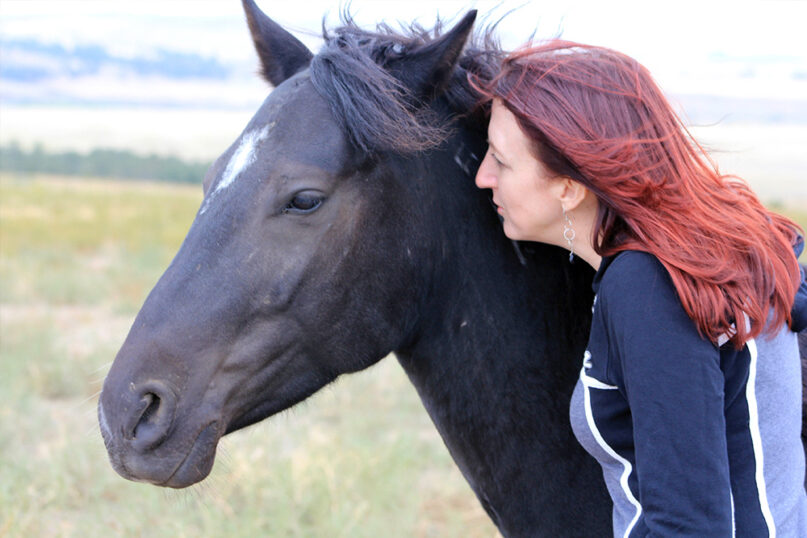
'This is beyond animal blessings and pet funerals,' said animal chaplain Sarah Bowen.
Animal chaplain Sarah Bowen interacts with a horse.
 (Photo by Sean Bowen)


March 8, 2024
By Kathryn Post

(RNS) — Sarah Bowen says she’s been doing the work of an animal chaplain since she was 6 years old.

Raised in the Midwest as a Presbyterian preacher’s kid, she was often hauled to hospice facilities and funeral homes but noticed that the chipmunks and other animals crumpled by the side of the road weren’t treated with the same compassion shown to people.

“At a very young age, I began picking up those little animals, putting them in my lunchbox, and giving them burials in the way my father did when he was working with humans,” said Bowen, who recalls saying “May the force be with you!” after the burials

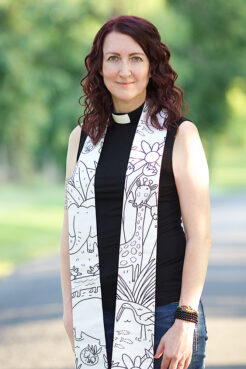
Today, Bowen is an interfaith animal chaplain with credentials from Chicago Theological Seminary, One Spirit Interfaith Seminary and Emerson Theological Institute, and she continues to create rituals that both dignify the death of animals and empower those grieving that death, whether it’s the loss of a loyal golden retriever or the untimely death of a “feisty, beloved goat.”


Animal chaplain Sarah Bowen. 
(Courtesy photo)

“That’s one of the more powerful things I think I’ve ever witnessed in my life,” Bowen said. “That goat was originally intended for a dinner plate.”

Bowen remembers getting the call from the animal sanctuary in 2022, reporting a favorite goat had been fatally wounded in a vehicle accident. Bowen led sanctuary staff and volunteers in a ritual that involved writing letters to the goat on dissolvable paper, then dropping them in a bowl of water, “representing all of the tears that were being shed or the tears that people felt they could not shed,” said Bowen. She also held a “furry wake,” where humans gathered alongside other goats and sheep to share stories about the goat’s antics. Bowen left the group with a wind chime placed where the accident happened.

The field of animal chaplaincy — including pet and veterinary chaplaincy — is nascent but growing and involves ministering to animals, pet owners, animal care providers and entire communities affected by wildlife conflicts.

“The scale can really vary widely, but any place where there is a relationship between some number of humans and some number of animals, that is where an animal chaplain is going to work,” said Michael Skaggs, director of programs for the Chaplaincy Innovation Lab.

What started as a few individuals offering ad hoc support for people grieving pets has become an informal network of professionals, both paid and unpaid, providing spiritual support everywhere from veterinary clinics to animal shelters. Animal chaplain training programs are reporting increased enrollment year over year, as well as a growing recognition that the work they do is no joke.

“This is beyond animal blessings and pet funerals,” said Bowen. “What we’re talking about are deep systemic and existential questions about our relationships with other species.”

The definitions of animal, veterinary and pet chaplains aren’t universally agreed upon. Most often, animal chaplaincy is used as an umbrella term, and while veterinary chaplains may work in a veterinary clinic, some also use the term interchangeably with animal chaplains. Rob Gierka, who founded the Pet Chaplain organization in 2004, owns the registered trademark for the phrase “pet chaplain” and says the term refers specifically to his organization.


Burial following an animal funeral. (Photo courtesy Sarah Bowen)

Though not always overt, faith is central to many animal chaplains’ practices. Some provide spiritual care for animals themselves, holding animal blessing events, praying for pets or being a grounding presence during euthanasia.

It’s not just pets and their owners who require spiritual support. Veterinarians are more likely than the general population to die by suicide, and many in animal care fields grapple with moral injury and compassion fatigue.

“Some shelter workers euthanize 100 cats a day as part of their job. So attending to loss in the community is important,” said Bowen.

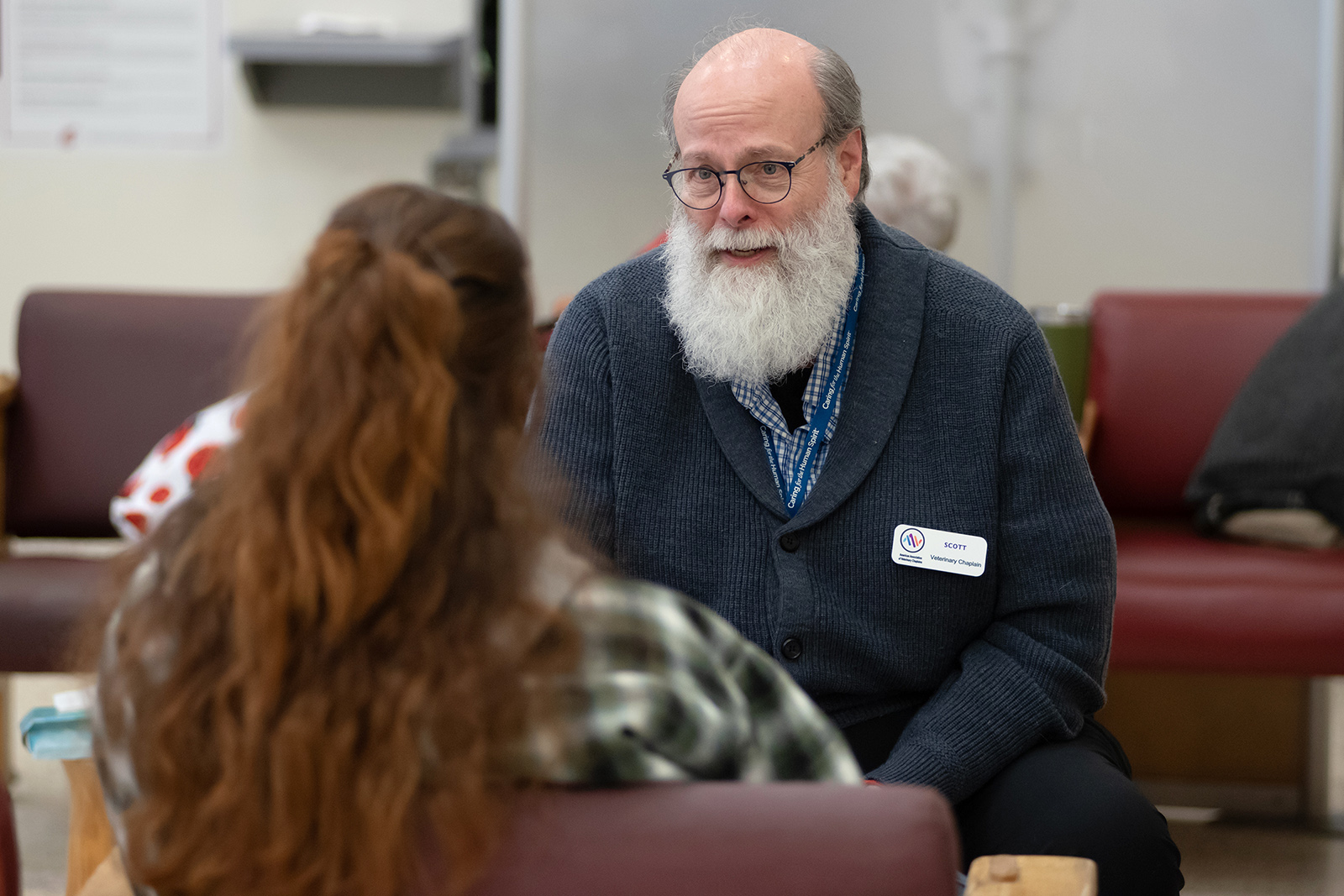
Scott Campbell, a veterinary chaplain at the Washington State University College of Veterinary Medicine, said it was seeing the toll of the veterinary field up close that drew him to becoming a veterinary chaplain.


Scott Campbell, right, the veterinary chaplain at Washington State University’s College of Veterinary Medicine, visits with Payton Silva, Wednesday, Jan. 10, 2024, in the lobby of the Veterinary Teaching Hospital in Pullman, Washington, while she waits for her dog to receive care. (College of Veterinary Medicine/Ted S. Warren)

“I became aware of the suicide statistics in the veterinary profession. I’ve been around the veterinary profession for, like, 45 years now,” said Campbell, whose father-in-law and wife both worked in the field. “I realized that that’s an area that really needed help.”

About every 10 days, Campbell said, he wanders throughout the teaching hospital, offering a listening ear to everyone from the veterinarians to folks working in shipping and receiving.


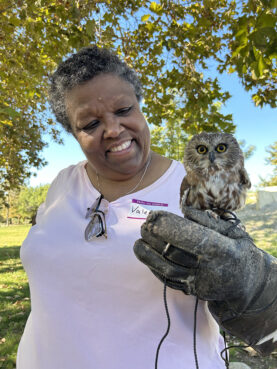
Valerie Richards. (Courtesy photo)

For many animal chaplains, their vocational path stems from personal loss. That was true for Valerie Richards, a cradle Catholic and longtime social worker now enrolled at a Buddhist seminary, and for Delores Hines-Kaalund, who completed a training program through Pet Chaplain in 2021.

Both lost longtime pets — Richards, a cat named Ellington; and Hines-Kaalund, her Chihuahua, Taz — and were taken aback by the intensity of their grief.

“It left such an impact on me, in terms of grief or bereavement. It was far beyond what I’d experienced with a human loved one,” said Hines-Kaalund, who describes herself as a “charismatic and nondenominational” Christian. She integrates her pet chaplaincy training into her full-time work as a hospice chaplain, helping patient families make decisions about the pets of their dying loved ones while also supporting people grieving dying pets.

A few years after Ellington died of cancer, Richards attended a Chaplaincy Innovation Lab webinar on animal chaplaincy hosted by Bowen, when something clicked. “I was like, I have to do this,” said Richards, who enrolled in Bowen’s online course on animal chaplaincy, hosted through the Compassion Consortium, in September 2023. She hopes to become a full-time animal chaplain supporting others struggling with pet loss and illness.

“People are often really surprised by how intensely they grieve. We hear it all the time, people saying they’re ashamed to say this, but they grieved more for their pet than when their mother died,” said Karen Duke, who, along with her partner Gierka, runs the Pet Chaplain organization where Hines-Kaalund was trained.


Scott Campbell, left, the veterinary chaplain at Washington State University’s College of Veterinary Medicine, visits with Olivia and Phinehas Lampman, center, owners of Goose, a Husky mix dog, as Phinehas’ mother and WSU Honors College Associate Professor Annie Lampman, right, looks on, Wednesday, Jan. 10, 2024, in the lobby of the Veterinary Teaching Hospital in Pullman.
(College of Veterinary Medicine/Ted S. Warren)

Gierka added that, unlike other chaplaincy fields, animal chaplains often support people whose grief is minimized by family, employers and faith leaders.

Animal loss can also trigger existential questions about God’s existence and character, or whether animals are in the afterlife. Trained chaplains aren’t there to provide answers but are familiar with a range of religious and spiritual worldviews and can help people make meaning from their circumstances.

Campbell recalled one man he met with at a veterinary clinic who seemed to be in good spirits as his dog received chemotherapy.

“I was preparing to close, and the client stopped, was quiet for a moment, looked at me and said, ‘You know, I have the exact same kind of cancer my dog has. And so I’m seeing my future laid out before my eyes,’” said Campbell. “All of a sudden, that turned into a completely different kind of conversation.”


(Photo by Eric Ward/Unsplash/Creative Commons)


Because veterinary and animal chaplaincy are still emerging fields, there’s little consistency around training and credentials. According to Skaggs, ordination is common for non-animal chaplains who work in highly institutionalized settings, like hospitals or the military, but it’s rarely a requirement for animal chaplains. Financial compensation is also inconsistent, with some animal chaplains charging hourly rates or being paid by an institution and others working on a volunteer basis and accepting donations.

Gierka and Duke are passionate about empowering lay people to be animal chaplains and did so for years through their online Introduction to Pet Chaplaincy course. What started two decades ago as a six-week course with six people became a 15-week course with more than 30 people a semester. In 2022, the pair paused the course to translate it into a book series, which is expected out later this year.

“We’re seeing, after 20 years, now we’re at a tipping point,” said Duke. “There’s definitely a need.”

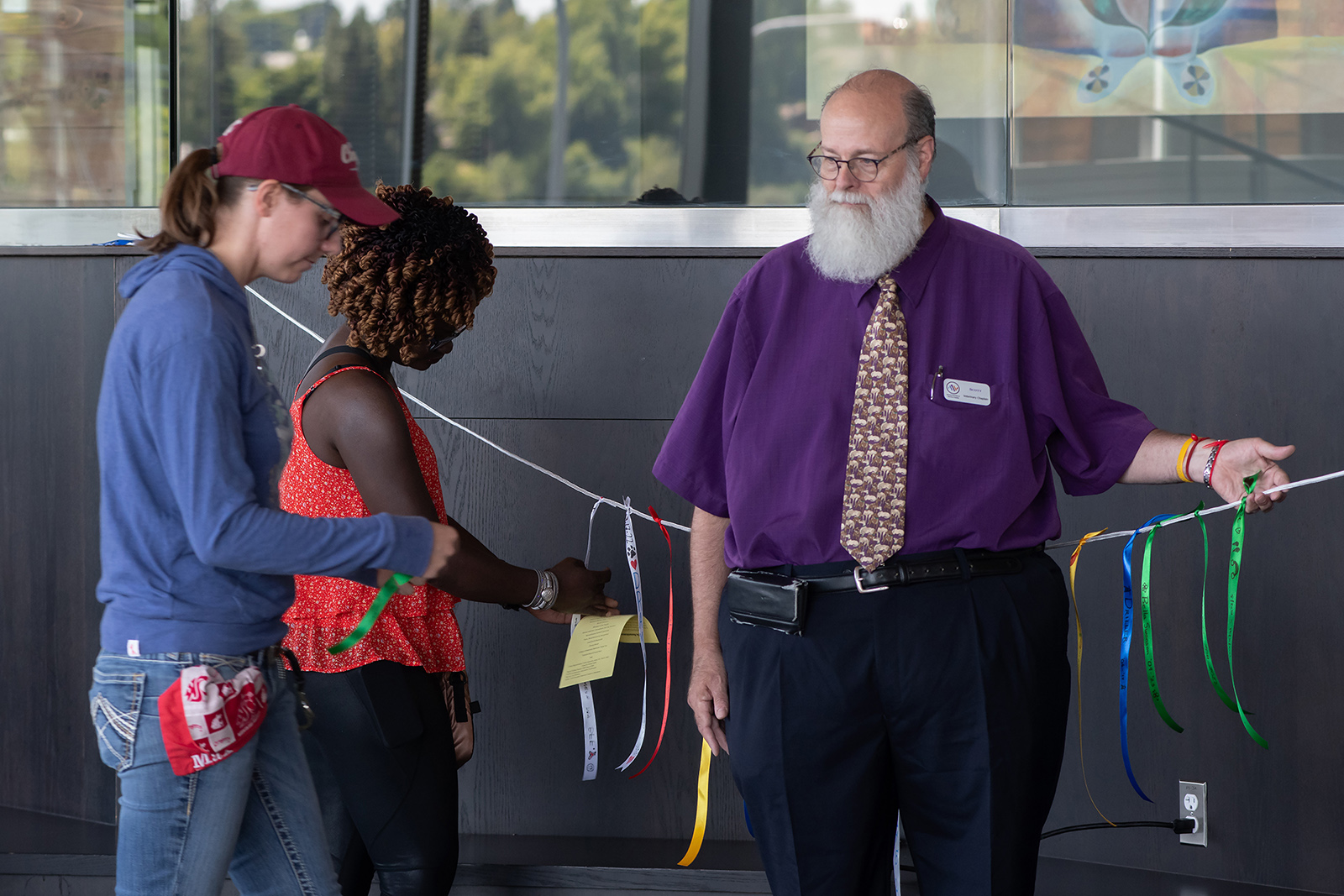
In this photo taken July 15, 2023, Scott Campbell, right, veterinary chaplain at Washington State University’s College of Veterinary Medicine, looks on as people tie ribbons honoring pets that have passed away during the Garland Ceremony that was part of a “Celebration of Life & Remembrance for Our Companion Animals” event on Saturday, July 15, 2023, in Pullman, Washington. 
(WSU College of Veterinary Medicine/Ted S. Warren)

Campbell is hoping to help animal and veterinary chaplains connect through the American Association of Veterinary Chaplains, a professional membership organization he recently founded he hopes will eventually certify veterinary chaplains.

And Bowen launched an online animal chaplain training program in 2022 and told RNS that more than 50 people are completing the nine-month program each year. Her students include ministers, rabbis, veterinarians and animal activists. While there’s not a professional board for animal chaplains, Bowen is currently completing a Ph.D. program where she’s developing guidelines for the field.

“What I would say is, the field is gathering,” Bowen said. “This field started around pet bereavement. This field has grown to encompass so much more than that.”
THE HOLY SPIRIT IS SOPHIA

‘In the name of the Mother, Daughter and Holy Spirit’: Catholic women advocate change

Women meeting in Rome this week to promote female leadership in the Catholic Church are challenging the hierarchy’s resistance to change and its theological emphasis on ‘natural’ gender divisions

.

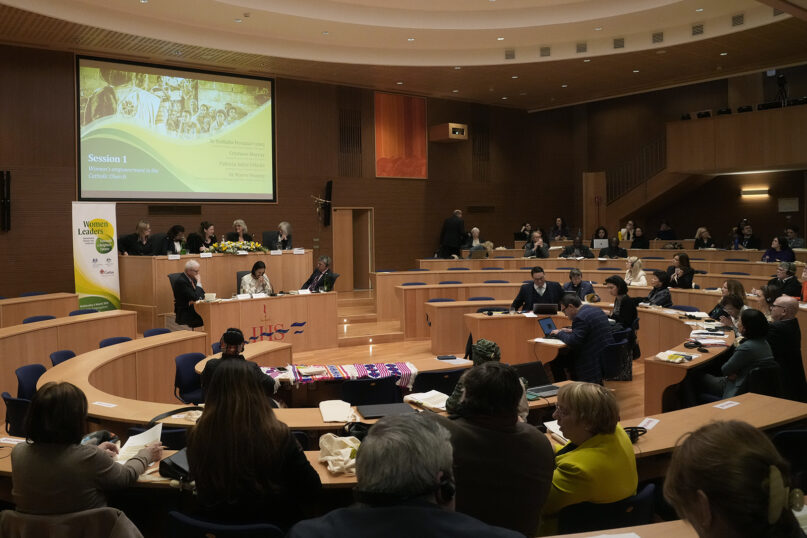
Participants at the conference titled “Women Leaders: Towards a Brighter Future,” to mark International Women’s Day 2024, listen to a speech by Cristiane Murray, deputy director, Holy See press office, at the Vatican, March 6, 2024.
 (AP Photo/Gregorio Borgia)


March 7, 2024
By Claire Giangravé


VATICAN CITY (RNS) — In the week leading up to International Women’s Day, Catholic women gathered near the Vatican and online to promote female leadership in the Catholic Church, demanding equality and visibility while urging the institution to set its fears about change aside.

“It’s so important that the Catholic Church be engaged in this issue, not just internally, but also externally given the contribution they make in the education sphere and the health care sphere,” Chiara Porro, Australia’s ambassador to the Holy See, told Religion News Service on Wednesday (March 6).

Acknowledging that in her four years in Rome the Vatican has taken significant steps forward, with high-ranking Vatican positions being filled by women, Porro represents a country that “has a very strong agenda in empowering women and women in leadership,” she said, “including in our own foreign service, which like the Catholic Church has been very male dominated for a very long time.”

She said her female colleagues — the number of women ambassadors to the Vatican has risen to 40 — talk about the issue of women’s influence often. “It’s an incredible group, an informal group, and we come from many different areas of the world. We support each other, we share ideas, we network,” she said.

Pope Francis has supported the trend, she said, meeting with the female ambassadors last year on International Women’s Day.


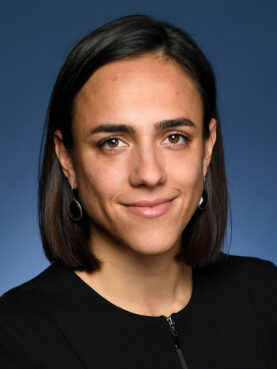
Chiara Porro. (Photo by Penny Bradfield AUSPIC/DPS)

Porro works closely with the International Union of Superiors General, the leaders of the world’s religious orders, to put a spotlight on the work nuns do, especially in the poorest places in the world. But their focus goes beyond Catholicism. This week, the embassies of Australia, France and the Netherlands, all woman-led, sponsored “Women Sowing Seeds of Peace and Cultivating Encounter,” a conference of Christian, Jewish, Buddhist and Hindu female faith leaders.

“When we talk about interfaith dialogue, when we talk about religious leaders coming together, we find that a lot of the religions around the world are led by men, so it’s really important to bring female faith leaders together,” Porro said.

On Thursday, women theologians, experts and leaders met for a one-day discussion on female leadership, asking the tough questions facing the Catholic Church on the issue. In her presentation, ordained missionary and theologian Maeve Louise Heaney questioned Catholic theology that attempts to “essentialize” women. “They speak of complementarity and name the contribution of women as essentially different to that of men,” she explained, “pitching love, spirituality and nurturing against authority, leadership and intellect.”

Heaney challenged Catholics to reconsider their idea of God and the Holy Spirit as neither male nor female, quoting her “yoga-loving” niece who prays to “the Father, the Son and the Holy Spirit. And the Mother, the Daughter and the Holy Spirit.”

A 2022 survey of 17,200 women in 104 countries by the international forum Catholic Women Speak found that two-thirds of women in the church support “radical reform,” with 29% saying they will consider leaving the church if women aren’t given more prominence.

In her interview with RNS, Heaney recognized that the church, “like any big ship, moves slowly,” adding, “We don’t have a time frame.” She took encouragement, she said, from Francis’ Synod on Synodality, born from a massive consultation of Catholics on hot-button issues including female empowerment and LGBTQ inclusion, which will hold its second session at the Vatican in October.

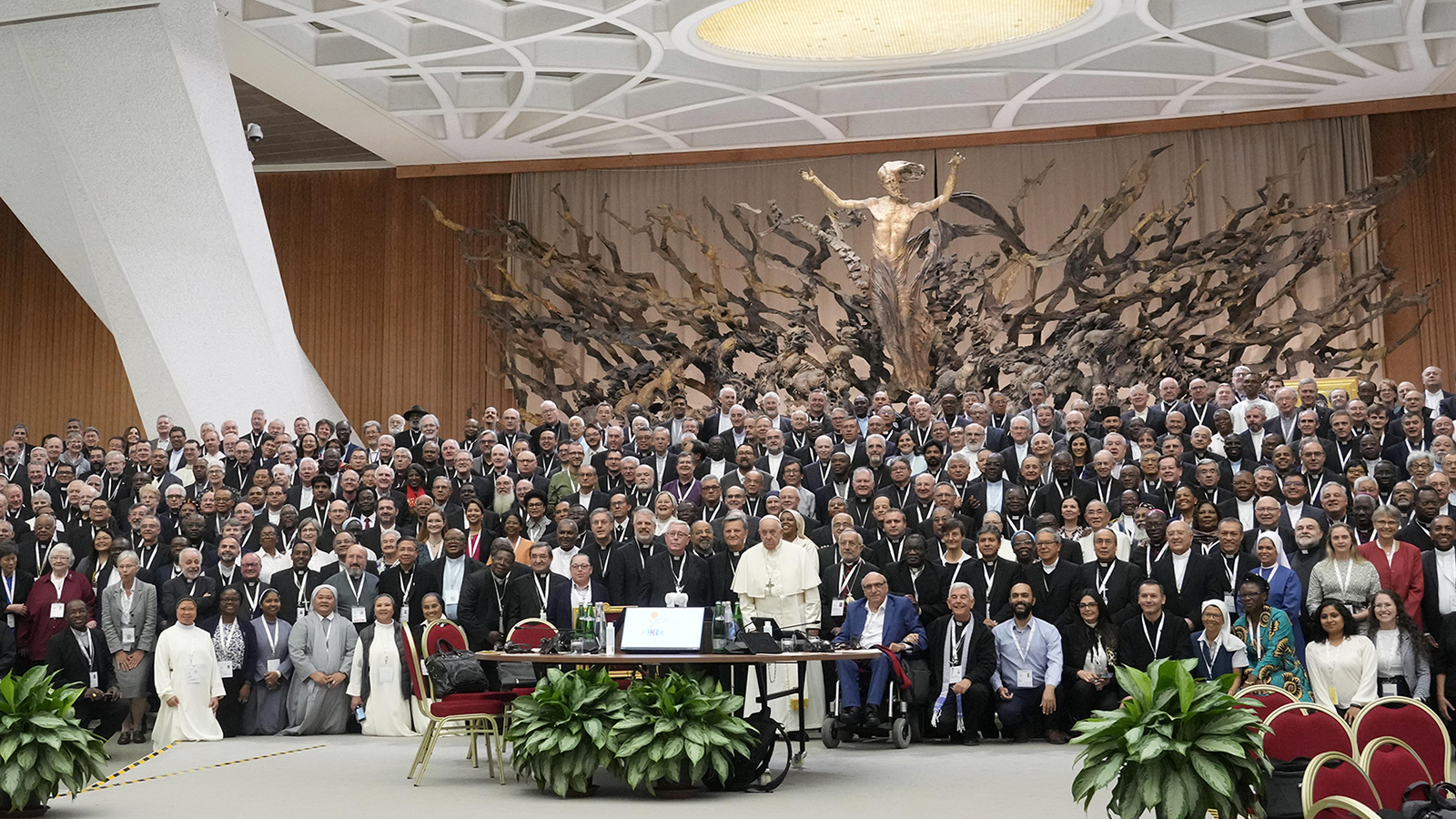
Pope Francis poses for a picture with participants of the Synod of Bishops’ 16th General Assembly in the Paul VI Hall at the Vatican, Oct. 23, 2023. 
(AP Photo/Gregorio Borgia)

She also supports the discussions underway at the Vatican about allowing women to be ordained as deacons, who can preach at Mass but cannot perform some other priestly functions, such as consecrate Communion or hear confessions.

“I think the people have a right to hear women preaching,” Heaney said. “There are spaces in which the best person to speak on a theme would be a woman. And I think a theological, doctrinal and canon law structure could open spaces for that to happen.”

According to Heaney, there are no theological barriers to ordaining women as deacons, nor would women deacons present any difficulty in terms of the church’s organization. What stands in the way, she said, is the fear that allowing women deacons would bring women closer to the altar, the priests’ dominion.

“Fear is a bad adviser,” she said. “What if we gave the church that? What if we allowed spaces for women to preach? Under the authority of the bishop, in collaboration with the parish priest, with the proper formation like all the rest of the ministry. You might find that the issue of priesthood changes in color if we have different kinds of leadership.”

While theologians push the envelope on female leadership, women who have climbed up the Vatican administration have learned to have patience about penetrating the male-dominated bureaucracy.

“It’s a long process that has to be continued,” said Sister Nathalie Becquart, the first female secretary of the Vatican’s Synod office and a leading figure in the pope’s synodal process. “They will need more time,” Becquart said, while teasing that the Vatican might soon announce a new development on this front.

On Thursday, the Catholic charity network Caritas published “Equality, Encounter, Renewal,” a pamphlet urging its 162 affiliated Catholic charities to create spaces for dialogue about women’s leadership. In an introduction, Sister Alessandra Smerilli, the secretary of the Vatican Dicastery for Promoting Integral Human Development, laments that the “systematic social and cultural exclusion of women can also be seen when looking at the face of leadership in the world today.”

Francis, meanwhile, continues to use language that reinforces the role of women as mothers and caregivers. Speaking to organizers of the conference “Women in the Church: Builders of humanity,” taking place in Rome this week to recognize the contributions of 10 female saints, the pope said “the church is female” and women have a “unique capacity for compassion” that allows them “to bring love where love is lacking, and humanity where human beings are searching to find their true identity.”

But some women in Rome this week said that Catholic theology can often emphasize too much women’s natural inclinations, which it sees as reflecting the relationship that Christ has with his church. The women asked how this view affects the roles men and women occupy in the church.

Heaney said: “It is not easy to broaden our understanding of the One who brought us to life, as no one image will work. But we owe it to the future generations.”
In rights landmark, Greek novelist and lawyer are the first same-sex couple wed at Athens city hall

A cross-party majority of Greek lawmakers approved same-sex marriage in a vote on Feb. 15, despite strong opposition from the socially conservative Orthodox Church.


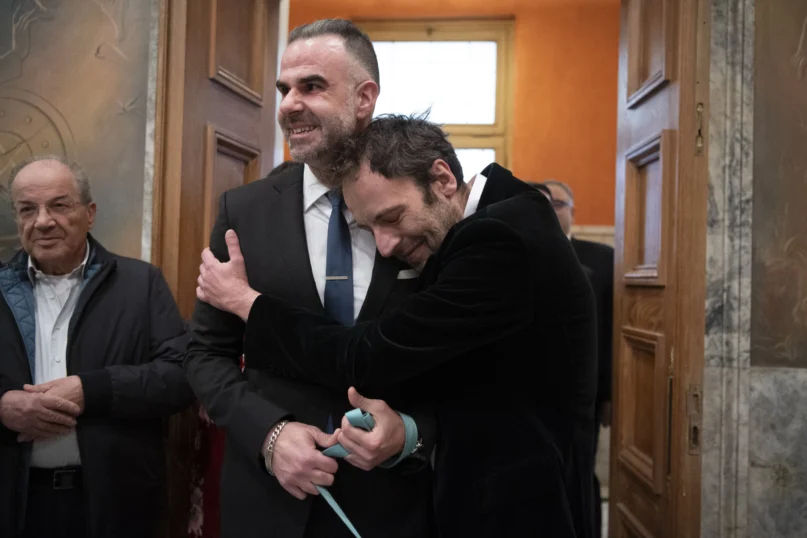
Greek author Petros Hadjopoulous, who uses the pen name Auguste Cocteau, hugs his husband, lawyer Anastasios Samouilidis, before their wedding at Athens City Hall, Greece, on Thursday, March 7, 2024. 
(AP Photo/Michael Varaklas)

March 11, 2024
By Associated Press


ATHENS, Greece (AP) — A Greek novelist and his partner on Thursday became the first same-sex couple to be married in Athens’ city hall, three weeks after the legalization of same-sex marriage in Orthodox Christian Greece.

The Greek capital’s mayor officiated at the civil wedding of Petros Hadjopoulos, who writes under the pen name Auguste Corteau, and lawyer Anastasios Samouilidis.

Hadjopoulos said the event was “a dream that we didn’t dare entertain when we were in our teens.”

“There is a symbolism to this,” he told The Associated Press. “I understand that (marriage) doesn’t work for everyone, but for people who grew up in Greece in the 1980s and 90s, when guys like us lived a very lonely existence, even symbols have a great value.”

The couple arrived with their dog, to the applause of more than two dozen guests.

A cross-party majority of Greek lawmakers approved same-sex marriage in a vote on Feb. 15, despite strong opposition from the socially conservative Orthodox Church.

While polls show that a slender majority of Greek public opinion backs same-sex marriage, the Church has been fuming at its legalization. On Tuesday, Church officials on the island of Corfu imposed a religious ban on two local lawmakers who voted for the reform.

The law also confers full parental rights on married same-sex partners with children. But it precludes gay couples from parenthood through surrogate mothers in Greece — an option currently available to women who can’t have children for health reasons.

Athens Mayor Haris Doukas described Thursday’s ceremony as a “historic moment,” and encouraged other same-sex couples to follow suit.

“Every citizen of Athens … should be able to live and love in the way they choose,” he told the AP.

The first same-sex wedding under the new law was held over the weekend in the southern Athens municipality of Nea Smyrni.

Greece is the first majority Orthodox Christian country to allow same-sex marriage. It legalized same-sex civil unions nearly a decade ago.


Poll shows slight dip in US support for LGBTQ rights across religious groups

A strong majority of Americans, and majorities of many religious groups, still broadly support LGBTQ rights.

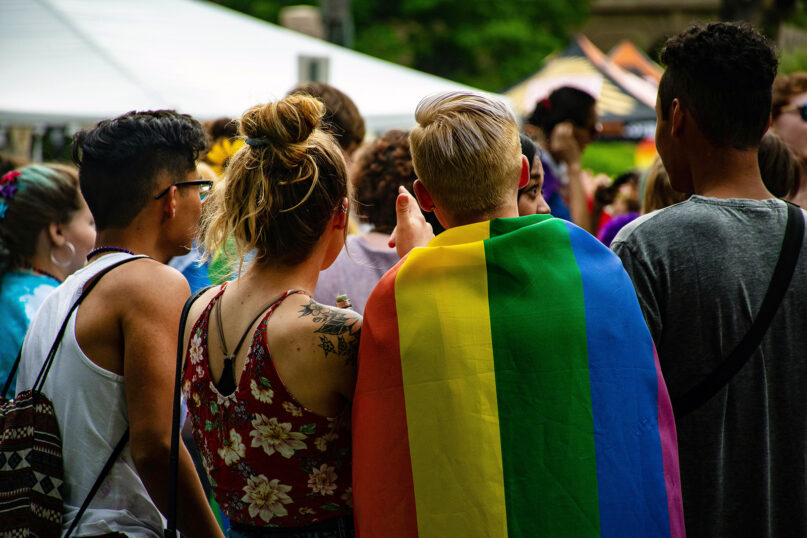
(Photo by Brett Sayles/Pexels/Creative Commons)


March 12, 2024
By Kathryn Post


(RNS) — While most Americans continue to broadly support LGBTQ rights, that support may be waning, including among religious Americans, according to a new poll from PRRI. The report, based on interviews with more than 22,000 U.S. adults in 2023, found that Americans are slightly less likely to support same-sex marriage and LGBTQ nondiscrimination protections and less likely to oppose allowing business owners to refuse to serve LGBTQ people for faith reasons, compared with the year before.

“I think the big story is that most Americans of faith are broadly supportive of LGBTQ rights,” said Melissa Deckman, CEO of PRRI. “However, we do see slight declines in three of the questions we tracked when it comes to Americans’ attitudes on LGBTQ rights. …That was somewhat surprising to us.”

Deckman said that for groups who advocate for LGBTQ rights, this data is akin to “a canary in the coal mine.”

Seventy-six percent of American adults reported supporting LGBTQ nondiscrimination policies in public accommodations, housing and employment, the survey found, down from 80% the year before. The majority of respondents from most faith groups also embrace LGBTQ nondiscrimination laws, though many religious groups saw slight drops in support from 2022. Among Muslims, for example, PRRI reports a drop from 70% support in 2022 to 56% in 2023; white evangelical Protestants saw a drop from 62% to 56%, and Hispanic Catholics from 86% to 78%.

A majority of Americans (67%) also continue to support same-sex marriage, though that number was down 2 percentage points from the previous year. While majorities of all but a handful of religious groups favor legal recognition of same-sex marriage (most Jehovah’s Witnesses, white evangelical Protestants, Muslims, Hispanic Protestants and Latter-day Saints are in opposition), many groups also saw dips in support. The biggest drops in support were among Hispanic Catholics, with a decline of 7 percentage points from 2022, and Muslims, which dropped 13 percentage points.

Since PRRI began tracking the issue in 2015, a majority of Americans have opposed allowing a small-business owner to refuse services to LGBTQ people for religious reasons. As in the other categories, that majority still stands, but fell from last year — in 2023, 60% of Americans said they were opposed, compared with 65% in 2022. Dips were also seen in nearly every religious group.

Across all three policy categories, Unitarian Universalists, the religiously unaffiliated, Jewish Americans and non-Hispanic Catholics of color consistently showed the highest support for LGBTQ rights, while Jehovah’s Witnesses, white evangelical Protestants and Hispanic Protestants showed the least support.
RELATED: LGBTQ+ Americans are more religious than our Supreme Court battles let on

Deckman partially attributed the declines in support to political polarization, and specifically to the divisiveness around LGBTQ policies, including bathroom policies and laws impacting gender affirming care.

“Republicans have very strategically, I think, used that as a wedge issue,” said Deckman. “What might be happening, though it’s hard really to tell from this one cross section … is that continuing to talk about LGBTQ identity and emphasizing the division among Americans in terms of transgender issues is having a larger impact on Americans’ attitudes about LGBT rights more broadly.”

These observations are reflected in the findings, which showed that while Democrats’ support for LGBTQ rights remained steady across all three measures, there was a drop in support among Republicans compared with last year. Political ideology also seems to be a factor. PRRI found that support for Christian nationalism — which Deckman defined as the idea that America was founded as a Christian nation, and should remain so — is negatively correlated with support for LGBTQ rights across all 50 states; as states scored higher on PRRI’s Christian nationalism scale, support for same-sex marriage, support for LGBTQ anti-discrimination laws and support for opposing religious refusals to LGBTQ customers decline.

“We often assume in public opinion, when it comes to LGBTQ issues, that Americans are destined to become far more embracing of the rights to LGBTQ Americans,” said Deckman. “But this data shows you that that assumption of more progressive and accepting attitudes toward LGBT Americans shouldn’t necessarily be taken for granted.”


Scripture-quoting Alabama judge in IVF case bridges natural law and Christian nationalism

But those who know Tom Parker say his IVF concurring opinion was not simply a heartfelt expression of faith, but part of a strategy the chief justice has used to create legal precedent for conservative causes


.
Alabama Supreme Court Justice Tom Parker speaks on the steps of the state judicial building on April 5, 2006, in Montgomery, Ala. When the court ruled that frozen embryos are children, Parker, who is now its chief justice, made explicit use of Christian theology to justify the court's decision in his concurrence, where his language echoed the broader anti-abortion movement. (AP Photo/Jamie Martin, File)

March 9, 2024
By Jack Jenkins, Paul O'Donnell


(RNS) — The same day that Alabama Supreme Court Chief Justice Tom Parker issued his concurring opinion in a ruling that frozen embryos have legal standing as children, Johnny Enlow, a longtime pastor who runs a ministry called Restore7, posted an interview with Parker on its website. The two only vaguely allude to a case that Parker can’t discuss, spending most of their time bemoaning the fact that the U.S. government has gone “into the possession of others.”

Enlow, a 2020 election denier who for many years pastored churches in Georgia, is a proponent of the Seven Mountains Mandate, a theology that encourages Christians to strive to influence seven “mountains” of society — family, religion, education, media, entertainment, business and government. For most of his interview with Enlow, posted by liberal watchdog group Media Matters, Parker, who reportedly worships at a megachurch that broke away from the United Methodist Church to join the Free Methodist denomination in 2022, makes clear he ascribes to these ideas as well.

The state of U.S. leadership, Parker said, is “why (God) is calling and equipping people to step back into these mountains right now.”

For those who have followed Parker’s activities off the bench in recent years, his opinion, filled with references to Scripture and a “theologically based view of the sanctity of life” and insisting that “human life cannot be wrongfully destroyed without incurring the wrath of a holy God,” came as little surprise. He has been forthright in several recent appearances about his strong conservative faith and the need for America to adhere to it.

Last year, Christian worship musician and anti-COVID-19-vaccine activist Sean Feucht, who has also said he only wants “believers” writing laws, celebrated Parker at an event outside the Alabama Statehouse. Bringing Parker onstage, Feucht declared his wish for God’s “kingdom to come to the Capitol in the state of Alabama.”

Taking the microphone, Parker identified himself as “a state official and head of one of the three branches of government” before leading the crowd in prayer, calling on God to “flood” the state with a “comprehensive awakening” that would be “so powerful that it will bring forth reformation in government that will affect the nation.”

Critics of Parker’s opinion in the in vitro fertilization case call its reasoning a flagrant violation of the separation of church and state, but it appears to match Parker’s personal theory of law, which emphasizes a specific interpretation and application of what is often called “natural law.” A well-known concept in many legal circles, the foundations of natural law can be traced to ancient thinkers such as Plato and Cicero, as well as early Christian theologian Augustine. Thomas Aquinas, the medieval Catholic philosopher (whom Parker quotes in his concurrence), also based much of his moral teachings on basic human desires, arguing for instance that since humans wanted to live, killing is wrong.

The idea also appeared in the writing of 18th-century English political philosophers and jurists, who espoused natural law as the basis for all government, which, they argued, derives political rights from human behavior. In the broad sense, natural law ideas influenced American founders — Thomas Jefferson’s appeal to “inalienable rights” in the Declaration of Independence owes something to natural law ideas — in the legal philosophies inherited from England.

But the idea has taken an ideological turn in recent years, when natural law has been invoked by American conservatives who see it as a way to refute certain kinds of legislation. Supreme Court Justices Amy Comey Barrett, Neil Gorsuch and Clarence Thomas have shown an affinity for natural law ideas, and in 2020 legal scholar Adrian Vermeule argued in an Atlantic magazine article that “principles of objective natural morality” should replace originalism as the guiding principle in conservative jurisprudence.

Parker, for his part, appears to forward a classic form of natural law — but with a modern twist that emanates from conservative forms of Christianity. Buried in the Alabama justice’s opinion are multiple references to William Blackstone, a conservative English jurist who lived around the time of the American Revolution. Still a recurring footnote in jurists’ opinions today, Blackstone was once a mainstay of a legal education. Answering a young lawyer’s letter about how to gain a knowledge of the law the year he was elected president, Abraham Lincoln responded, “Begin with Blackstone’s Commentaries.” (He added, “Work, work, work, is the main thing.”)

Parker seems to have taken Lincoln at his word. “You can’t spend a great length of time in Alabama Supreme Court Associate Justice Tom Parker’s chambers,” began a 2018 profile of Parker in the Montgomery Advertiser, “without him pointing out the books, copies of William Blackstone’s ‘Commentaries on the Laws of England’ scattered across his office.”

But Parker’s use of Blackstone is not what most constitutional scholars tend to emphasize. In a May 2022 podcast episode hosted by the Providence Forum, a group aiming to “preserve, defend and advance the Judeo-Christian values of our nation’s founding,” Parker quoted Blackstone to Jerry Newcombe, the group’s executive director, as believing that human reason is corrupt, and thus can be corrected by divine intervention or revelation, arguing that “the revealed or divine law” is to be found “only in the Holy Scripture.”

Parker also cited Blackstone’s writings on the “law of nature,” which is described as God’s will and “superior in obligation to any other.”

“This is what our Founding Fathers were reading,” Parker said during the podcast, later adding: “We can see that this description of the nature of law going back to God, the laws of nature, and the laws of God, as revealed in Scripture, was what was read by our founders. And there’s no way that that didn’t have an impact.”

Thus, when Parker rooted his opinion regarding frozen embryos in Scripture and theology instead of established legal precedent, he appears to have been enacting a belief he has held for some time: that U.S. law is subservient to a specific interpretation of God’s law, one that assigns legal figures like himself a duty to correct earthly policy

But those who have observed Parker’s career as a jurist, especially those who oppose him, point out that this month’s IVF concurring opinion was not just an homage to Blackstone or even to put IVF in play in the national abortion debate.

The 2018 Advertiser profile cited a 2014 ProPublica article detailing, according to the investigative journalism site, “how Parker has used the concurrence to strategic effect.”

Since the U.S. Supreme Court struck down Roe v. Wade — whose attachment to the question of fetal viability Parker once called in a concurrence “arbitrary” and “incoherent” — it seems that Parker’s concurrence was part of this strategy: an anti-abortion crusader’s attempt to give his and other courts precedent to make Alabama’s IVF policy the law of the land.


Strike Threat Wins in Confrontation over Remote Work


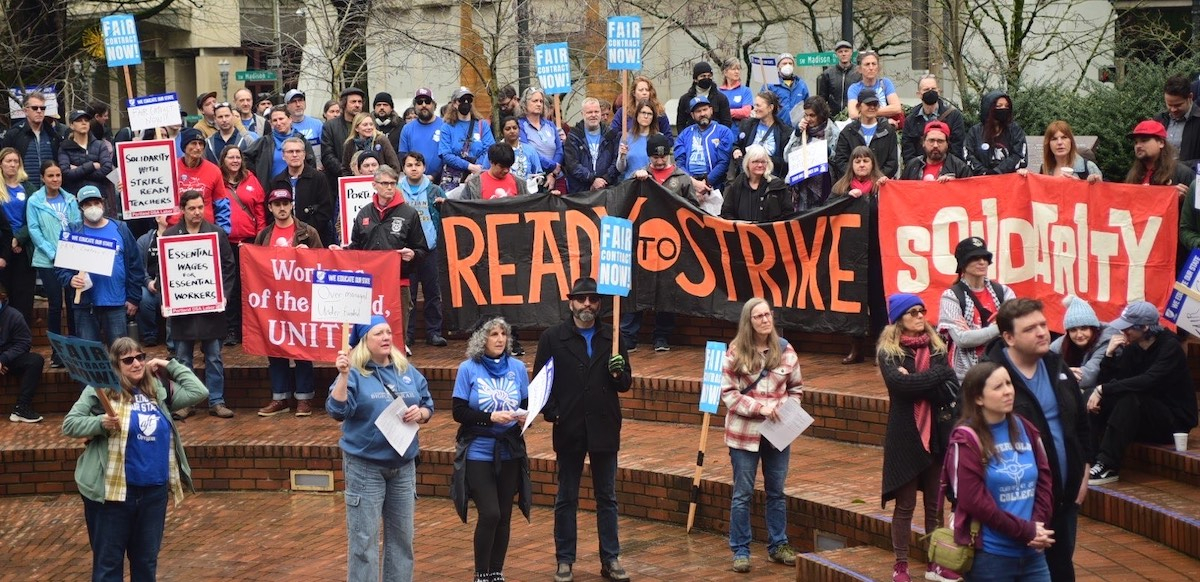
People rally on brick steps (Portland's Pioneer Courthouse Squre) on a rainy day. Many wear blue or red T-shirts under their coats. Banners say "Ready to strike" and "Soldarity." Picket signs say "Fair Contract Now," "Solidarity with Strike-Ready Teachers," and "Essential Wages for Essential Workers."

Faculty and professional staff at Portland Community College stopped management from ending flexible work arrangements. Photo: Ramy El Mongi, PCCFFAP.

When “Reclaim your Momentum” was unveiled as the theme for Portland Community College’s 2023 in-service training, it struck a discordant note with members of my union, the PCC Federation of Faculty and Academic Professionals. We hadn’t lost our momentum so much as we’d been subjected to two years of organizational restructuring in the midst of a global pandemic.

The reorganization had concentrated power at the top, and now the college president was rolling out her plan to end the flexible work arrangements developed for the pandemic. This was despite the fact that more than 60 percent of students were still accessing classes remotely, and nearly all students preferred to access services like advising, counseling, and financial aid via Zoom.

At the time, our members ranged from working fully in person to fully remote, with most somewhere in between. If there was a silver lining to the pandemic, it was flexibility in where we work, including freedom from miserable and sometimes dangerous commutes.

This was especially true for employees with disabilities, like my colleague Patricia Kepler, an accessibility specialist who is visually impaired and relies on public transportation. Returning to in-person work would mean taking the bus on dark rainy mornings, even on days when she has no in-person appointments. Kepler told me that flexible work arrangements had vastly improved her working conditions as well as those of colleagues with so-called “invisible” disabilities like ADHD, depression, anxiety, and chronic fatigue.

Now full-time employees were being handed new “hybrid” schedules that required them to be on campus four days per week and adhere to set hours that often interfered with student and department needs. Academic advisors who once could structure their days around student availability were barred from accepting evening or drop-in appointments. Faculty counselors were being forced to take lunch breaks at set times, rather than scheduling them around meetings with students.

TOP PRIORITY

Those who returned to on-site work found facilities in a state of disarray. Food services were not operating and entire buildings were closed. Shuttle buses between campuses were not running. Faculty who were teaching classes online didn’t have privacy or a quiet space to teach and meet with students. Plus, there were rodent infestations, broken printers, and Wi-Fi was often inaccessible.

To enforce the president’s plan, the administration leaned on provisions in our contract that required full-time faculty to be on campus 30 hours per week and gave managers near-complete control over the schedules of Academic Professionals—an employment category that includes overtime-exempt positions like Advisors, Employment Specialists, Research Analysts, and Accountants.

As we began contract negotiations in 2023, members made it clear that protecting the flexibility we had gained during the pandemic was a priority. At the bargaining table, management flatly rejected our proposals, and we realized that winning on this issue would require a massive organizing effort, including a credible strike threat.

Early in negotiations, we had insisted on open bargaining, including access via Zoom, as part of our ground rules. This turned out to be enormously helpful, as it allowed members to follow along in real time.

In between bargaining sessions, the union hosted weekly Zoom meetings for members to share what was happening in their departments, and educated members about their rights as overtime-exempt employees. The union publicized department-level pushback against directives via email, social media, petition drives, and organizing turnout to PCC Board of Directors meetings. We also filed an unfair labor practice charge on behalf of faculty counselors and academic advisors after management made a unilateral change to their schedules.

Even with all this effort, the administration did not relent until we presented a strike pledge signed by more than 700 of our members and requested mediation. And this was even before we started talking seriously about money at the bargaining table.

FORCED THE ISSUE

After more than a year of bargaining, we signed a tentative agreement on January 29 that protects our members against blanket directives about schedules and remote work. The flexibility we gained during pandemic closures is now codified in the contract, protecting our members from the whims of administrators and enabling them to meet students where they are at. The new contract was ratified on February 17, with 97.5 percent of our members voting in favor.

Our contract also includes 20 percent pay increases over two years and important gains for our part-time faculty.

As a member of the bargaining team, I would love to take credit for this victory, but if I’m being honest it was not well-written proposals or righteous arguments that brought us to this point—it was relentless organizing and solidarity across different employee categories, including full-time faculty, part-time faculty, and academic professionals.

Had the administration consulted our science faculty about the theme “Reclaim your Momentum,” they might have learned that momentum cannot be created, claimed, or reclaimed. It can only be changed through the action of force. That’s the power of a union.

Michelle DuBarry is a grants officer, and vice president for communication for the PCC Federation of Faculty and Academic Professionals.

MONOPOLY CAPITALI$M
The Mega Grocery Merger That Workers Would Pay the Price For

The Kroger-Albertsons merger is a threat to grocery workers everywhere. Let’s join the fight to stop it.

ANN LARSON 
MARCH 12, 2024
IN THESE TIMES
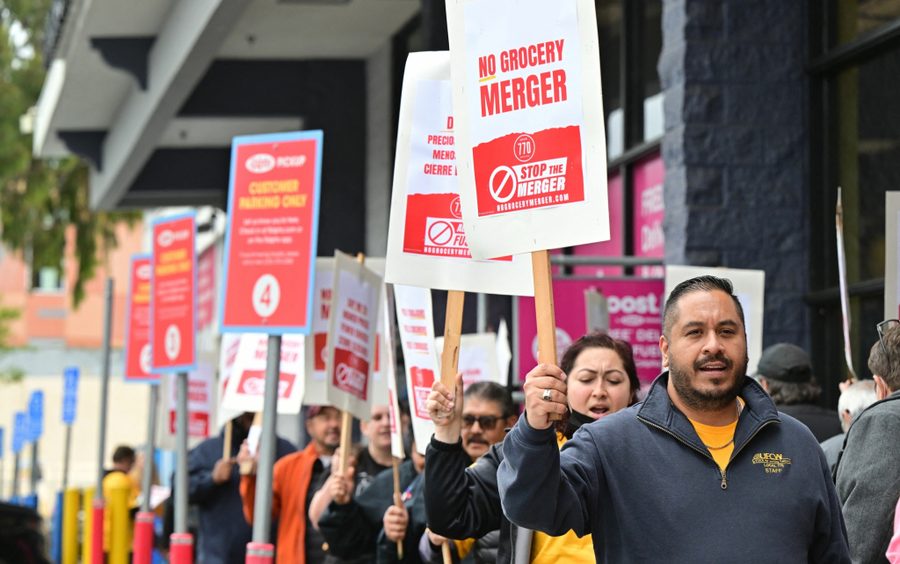
Unionized grocery store workers rally to oppose the proposed merger between Kroger and Albertsons in Los Angeles on April 13, 2023, out of concern for less competition, increasing food prices and putting union jobs at risk.(PHOTO BY FREDERIC J. BROWN / AFP)

As a former grocery store cashier, the recent news that the Federal Trade Commission (FTC) is suing to block a merger between supermarket giants Kroger and Albertsons prompted a sigh of relief. My experience cashiering and bagging taught me just how it is critical to stop further concentration in the industry when just five companies already control over 60% of U.S. grocery sales.

First proposed in 2022, the $24.6 billion deal would be the largest supermarket merger in history and would create the second largest grocery company in the United States (after Walmart). The biggest beneficiary of the deal would likely be Cerberus Capital Management, the private equity firm that controls Albertsons. Shareholders already received a $4 billion dividend related to the proposal last year.

A private equity windfall would come at the expense of shoppers who are already paying 25% more for groceries than four years ago. Analysts say that grocery mergers contribute to price inflation because stores can increase costs when consumers have nowhere else to shop.

But the FTC’s case is not just about the cost of groceries. The Biden administration is employing a novel application of the law by focusing on how the deal would affect workers. The government’s complaint notes that the merger would lead ​“to lower wages and reduced benefits” and harm unionized employees who benefit when there is competition for their labor. Academic research supports the argument. Marshall Steinbaum, Assistant Professor of Economics at the University of Utah, wrote last year that the Kroger-Albertsons merger ​“is likely to increase employers’ concentrated power at the bargaining table.”

The FTC’s strategy comes after a dialogue that the agency had with organizers from the United Food and Commercial Workers International Union (UFCW). Joe Mizrahi is the Secretary-Treasurer of UFCW 3000, a local that has also been at the center of a reform movement. He described to In These Times ​“many discussions” where organizers ​“explained the negotiation process” to federal officials. At one session in Washington D.C., FTC officials asked detailed questions about how the union bargains with employers. ​“It felt like a cross examination,” Mizrahi said. When organizers said that the merger could lead to job cuts, officials asked, ​“Why couldn’t someone just go across the street and get a new job?” Organizers explained that a loss of benefits could follow. ​“They could but they have a pension, and they are not going to get that at a nonunion store.” Mizrahi said that, from his perspective, the discussion was intended to help officials ​“build the strongest case” for blocking the merger.

Tom Olson, a Safeway employee and UFCW Local 7 steward outside of Denver described a similar back-and-forth between the union and the Biden administration. Olson met FTC Chair Lina Khan in Denver in 2023. ​“Khan listened and asked good questions,” Olson said. ​“I felt heard.” And at town halls last year, Olson urged Colorado Attorney General Phil Weiser to oppose the Kroger-Albertsons deal. ​“He knows how it will affect the workers.” (Weiser recently announced a lawsuit to stop the merger that cited job cuts and higher prices.)

But while workers and labor organizers have opposed the deal, it has received support from corporate actors and business executives. C&S Wholesale Grocers is buying 400 stores from Kroger and Albertsons in a bid to help convince the government to approve the merger. Olson met C&S President Mark McGowan this year at a meeting of the coalition of UFCW locals in Seattle. ​“I just didn’t get a warm feeling about how he felt about taking on union contacts,” Olson said. When asked about stores unionizing, Olson says McGowan responded by claiming, ​“We would fight you every step of the way.”

Olson has his own experience feeling the negative impacts of corporate mergers. In 2015, Albertsons bought Safeway where he had worked as a produce manager. The company closed outlets which forced some employees, including Olson, to move to new stores. ​“They just came in and said, ​‘Sorry you’re going to have to go.’” At Olson’s new job, he earned less money and was not eligible for the bonus he had previously received since he was no longer a manager.

Another merger threatens more of the same — or worse. ​“If the only option is to potentially go to some employer that wants to eliminate unions, then a lot of people are going to lose their healthcare and their pension,” he said.

The Albertsons-Safeway deal was a harrowing experience for Monique Hightower, a member of UFCW Local 770 in Los Angeles. Hightower lost her job at Albertsons when the two companies merged. Hightower had to move back in with her mother and clean houses to survive. ​“I know firsthand what it’s like to lose your job, lose your benefits,” she told In These Times. ​“I also lost my medical [benefits].” Hightower was rehired as a deli clerk about a year later. But the experience taught her that mergers are likely to be ​“a difficult time for employees such as myself.”

Hearing stories of disrupted lives and a fight for survival reminded me of conversations in my own (non-unionized) store which confirmed that the danger of corporate concentration goes beyond price hikes. When prices for basic goods went up in 2021, a longtime cashier named Terri told me that she was worried about keeping food on the table. When I asked her what she thought was causing the spikes, she pointed to stimulus checks sent out during the Covid-19 crisis. ​“I needed that money,” she said. ​“But now we are paying for it with higher prices.”

Terri’s fear of rising prices was entirely justified given reports showing that food insecurity among grocery workers has long been a national crisis while across the country food insecurity is rising significantly. Though progressive economists have pointed to corporate profiteering as a source of the price hikes, Terri’s views reflected mainstream discussions in outlets from Vox to the New York Times.

“If the only option is to potentially go to some employer that wants to eliminate unions, then a lot of people are going to lose their healthcare and their pension.”

My conversations on the job show that stopping corporate concentration in the food business is critical to protecting unionized workers like Tom and Monique as well as employees who don’t have a collective bargaining agreement. That’s because corporate mergers give employers more power while increasing the chances of job cuts and benefit losses — enriching shareholders at the expense of workers. UFCW’s effort to stop the Kroger-Albertsons deal stands to help all grocery workers in the present while providing a model for future battles.

But even more is at stake. Progressives must do a better job explaining how laws favorable to corporations cause high prices and wage stagnation in the first place and how essential industries could be made to serve the public, not just shareholders and executives. The task is especially critical because defending corporate interests is common across the spectrum of political pundits. In 2022, for example, Catherine Rampell wrote a Washington Post column blaming the ​“anti-corporate populist left” for the ​“conspiracy theory” that companies were to blame for price hikes.

The FTC’s case helps to make clear that corporate power is not a conspiracy theory. And fighting back requires a deep collaboration between employees, elected officials and policymakers. Workers know better than anyone how to connect individual experience to larger social and political trends. What grocery employees like Terri need is not lecturing or pandering but a union of their own that brings them into a dialogue about the origins of their problems and the mechanisms that exist to improve their lives.

This story was supported by the journalism non-profit the Economic Hardship Reporting Project.

ANN LARSON is a writer and activist focused on education, debt, and low-wage work. Her writing has appeared in The New Republic, The Chronicle of Higher Education, and other publications.