Thursday, December 26, 2024

Syrian medics say were coerced into false chemical attack testimony


By AFP
December 23, 2024

Syrians wave the independence-era flag after midday prayers at the Umayyad Mosque in Damascus on Friday - Copyright AFP/File AAREF WATAD
Layal ABOU RAHAL

Two Syrian doctors and a nurse told AFP in a series of interviews over the weekend that Bashar al-Assad’s government coerced them into providing false testimony to international investigators after a deadly 2018 chlorine attack.

The three, who treated the wounded at a field hospital in the rebel-held town of Douma near Damascus after the April 7, 2018 attack, said they were summoned to national security headquarters in the capital.

“I was told… that they knew where my family is in Damascus,” said orthopaedic surgeon Mohammed al-Hanash, giving public testimony which would have been impossible before the fall of Assad’s government on December 8.

Emergency and intensive care specialist Hassan Oyoun said that “when I arrived before the investigator… his gun was on the table pointing towards me.”

“I immediately understood what was being asked for and that the objective was for us to say” there had been no chemical attack, he said.

Muwafaq Nisrin, 30, who worked as an emergency responder and nurse in 2018, said: “I was under pressure because my family lives in Douma — like most of the medical personnel’s families”.

The attack targeted a building near a field hospital, where the wounded were taken and where the three personnel were among those working.


Syrian orthopaedic surgeon Mohammed al-Hanash, at his Douma clinic on December 21, 2024, says he and other medical staff were summoned by national security after the 2018 chemical attack – Copyright AFP JOHAN ORDONEZ

A video soon circulated online showing chaos at the facility, with medics treating the wounded including children, and a man spraying people with water.

Assad’s government called the images “fake”, and security services questioned those who appeared in the video, including the medical staff whom AFP met.

In January last year, the Organisation for the Prohibition of Chemical Weapons (OPCW) blamed the Damascus government for the attack, which killed 43 people.

Investigators said there were “reasonable grounds to believe” that at least one Syrian air force helicopter had dropped two cylinders of the toxic gas on Douma.

Damascus and ally Moscow said the attack was staged by rescue workers at the behest of the United States, which afterwards launched air strikes on Syria, as did Britain and France.

– Broadcast on TV –

“A team of us doctors who were at the hospital went to the national security building and met an investigator, and we tried as much as possible to give vague answers,” Hanash said.

“I was asked, for example, what happened that day… I told them that I was in the operating room,” where chemical attack victims would not have been taken, he added.

Oyoun said that “all those at the hospital at the time were put under intense pressure, reaching barely concealed threats”.

“We denied the incident… we avoided responding to certain questions, such as ‘where were the dead taken?’,” he said, and tried to blame cases of suffocation on “the dust, the dirt and the smoke from the fighting”.

Nisrin, seen in the video helping a girl in extreme distress, said the authorities “told us that no chemical attack happened” and that they “wanted to end this story and deny it so that Douma could turn a new page”.

The OPCW watchdog said an “elite” Syrian unit known as the Tiger Force had launched the attack during a military offensive to reclaim Douma, and that Islamist rebels had agreed to withdraw the day afterwards.

All three medical personnel said that after the first round of questioning, they were told to repeat their responses in front of a camera as testimony for an investigating committee working with the OPCW.

The footage was “edited and some passages where deleted or taken out of context to serve the point of view” of the authorities, Hanash said, and broadcast on state television the following day.

The trio found themselves turned into false witnesses for the very government whose overthrow they had hoped for.

– Joy ‘incomplete’ –

On April 14, the trio — among 11 members of the medical personnel who were not allowed to return to Douma — were told an OPCW fact-finding mission would interview them at a Damascus hotel.

But hopes of telling the true story were dashed when authorities put recorders in their pockets or ordered them to record the interview on their phones.

“They forced us to repeat the story that they wanted,” Hanash said.

Days later, authorities told them they would go to the Netherlands, where the OPCW is based, to testify “on neutral ground”. On April 25, with several other witnesses, they travelled to The Hague via Moscow.

“We expected to meet the investigating committee behind closed doors, but were shocked” to find it was “an open session for members” of the OPCW, Hanash said.

Russia at the time had said Damascus would put forward witnesses to demonstrate that footage of the attack was fabricated.

The OPCW last year said its investigators “considered a range of possible scenarios” and concluded that “the Syrian Arab Air Forces are the perpetrators of this attack”.

OPCW investigators have concluded that chemical weapons were used or likely used in 20 instances in Syria.

The medics said the findings eased a burden they had been struggling with for years.

Hanash said he and his colleagues had waited a long time for “the security grip upon us to lift and for the day we could talk truthfully about what happened”.

“We were happy… that our testimony did not impact the course of the investigation,” he said.

But until those who carried out the attack are punished, “the joy is incomplete”.

NO CENTRALIZATION OF ARMS!
Syrian Druze brigade reluctant to give up their arms in uncertain times


Syria's new rulers have called for the disbanding of all armed groups. But in the southwestern town of Suwayda, a small group of Druze fighters are reluctant to give up their arms. These fighters from the Druze religious minority say they prefer to rely on their own men, rather than the promises made by Syria’s transitional authorities.


Issued on: 24/12/2024 - 
By: FRANCE 24
Video by:
Liza KAMINOV
Mohamed FARHAT

 © Screengrab, FRANCE 24


A small group of armed fighters renew their allegiance to their brigade commander with a traditional Druze dance in the Syrian town of Suwayda near the border with Jordan.

Suwayda is the bastion of the Druze, one of the Middle East’s most insular minorities based largely in the borderlands between Syria, Lebanon and Israel.

Chekib Azzam is the strongman of Suwayda, with a brigade of around 7,000 fighters under his command.

He welcomes all the fighters who have pledged loyalty to him and states his position clearly.


02:23A small group of Druze fighters in Suwayda, Syria, say they are reluctant to give up their arms after the fall of Bashar al-Assad.

“Our brigades are all united. But we categorically refuse to give up our weapons, we are in the field, and we are used to the fear and distrust,” he says.

Following the ouster of Bashar al-Assad, Syria’s de facto leader Ahmed al-Sharaa, also known by his nom de guerre Abu Mohammed al-Jolani, has said the country’s myriad armed factions will be dissolved and enter the national army with all weapons coming under state control.

Read moreSyrian rebel leader Ahmed al-Sharaa says state to control all weapons

But in this southwestern corner of Syria, there is still distrust in these uncertain times.


SYRIA NEEDS TO BECOME A DEMOCRATIC CONFEDERATION 

Syrian authorities say armed groups agree to disband, merge under defence ministry


Syria's new authorities announced Tuesday that they had reached an agreement with the country's rebel groups on their dissolution and integration into the regular defence forces.

Issued on: 24/12/2024 - 
FRANCE 24
Ff Syrian rebel leader Ahmed al-Sharaa taken in Damascus on December 17, 2024. 
© SANA via AFP


"A meeting of the heads of the groups" with new Syrian leader Ahmed al-Sharaa "ended in an agreement on the dissolution of all the groups and their integration under the supervision of the ministry of defence", said a statement carried by state media agency SANA and the authorities' Telegram account.

No details of the armed groups were provided.

Photos published by the state-run SANA news agency showed the country's new leader, Ahmed al-Sharaa, surrounded by the heads of several armed factions -- but not representatives of the Kurdish-led forces in Syria's northeast.

The announcement comes just over two weeks after president Bashar al-Assad fled Syria, following a lightning offensive spearheaded by Sharaa's Hayat Tahrir al-Sham (HTS) group.

Syria's new prime minister, Mohammed al-Bashir, had said last week that the ministry would be restructured using former rebel factions and officers who defected from Bashar al-Assad's army.

On Sunday, Sharaa said the new authorities would "absolutely not allow there to be weapons in the country outside state control".

That also applied to the Kurdish-led Syrian Democratic Forces, he said.


Read moreSyrian rebel leader says state to control all weapons

The country's new rulers appointed Murhaf Abu Qasra, a leading figure in the insurgency against Assad, as defence minister in the interim government.

Sharaa will face the daunting task of trying to avoid clashes between the myriad groups.

Last week, the military chief of Sharaa's Hayat Tahrir al-Sham (HTS) – the Islamist group that spearheaded the offensive that toppled Assad – told AFP that Kurdish-held areas would be integrated under the new leadership, and that "Syria will not be divided".

Syria's historic ethnic and religious minorities include Muslim Kurds and Shiites – who feared during the civil war that any future Sunni Islamist rule would imperil their way of life – as well as Syriac, Greek and Armenian Orthodox Christians, and the Druze community.


Sharaa has told Western officials visiting him that the HTS will neither seek revenge against the former regime nor repress any religious minority.

Thirteen years of civil war in Syria has left more than half a million people dead and fragmented the country into zones of influence controlled by different armed groups backed by regional and international powers.

SDF spokesman Farhad Shami told AFP the question of his group's integration into the national armed forces "should be discussed directly".

He did not dismiss the possibility, saying that doing so would strengthen "the whole of Syria".

Shami added that his forces prefer "dialogue with Damascus to resolve all questions".

'Economic leverage'


Turkey has long held ties with HTS, and analysts say that since the Islamists took over Syria, both sides have sought to profit from the relationship.

Ankara accuses the People's Protection Units (YPG) -- the main component of the SDF -- of being affiliated with the Kurdistan Workers' Party (PKK), which has waged a decades-long insurgency on Turkish soil.


Earlier this month, a Syria specialist who advises Western diplomats in Turkey said: "The Turks would like to push HTS into striking at the Kurds but HTS doesn't want to get involved."

Although Ankara's role in Assad's overthrow had been "overstated", Turkey now has "real economic leverage" thanks to the 900-kilometre (560-mile) border it shares with Syria, the source said on condition of anonymity.

How the situation develops will also depend on US President-elect Donald Trump, who takes office on January 20 but has already proclaimed that "Turkey is going to hold the key to Syria".

Since late November, the SDF has been battling Turkey-backed fighters who launched an offensive on Kurdish-held areas at the same time as HTS's anti-Assad campaign.

On Tuesday, the SDF said in a statement its fighters were waging deadly combat to the east of the key city of Manbij, with 16 deaths in its ranks.

Syria's Kurds, long oppressed under Assad's rule, saw an opportunity during the war to carve out a semi-autonomous territory in the northeast.

They proved an indispensable ally to the US-led coalition battling the Islamist State group.

Since Assad's ouster on December 8, they have issued numerous statements welcoming his downfall, and also put out calls for dialogue with the new leadership in Damascus and with Turkey.


In Syria's northeast, both the Kurdish flag and the three-star independence-era flag used by the new authorities can be seen.

(FRANCE 24 with AFP and Reuters)

Who Are the Persians – Part I


Ardishir Rashidi-Kalhur - April 17, 2017


Swiss lawmakers officially recognize Yazidi genocide by Islamic State


By: TII team
December 17, 2024
A wide view of the Chamber of the National Council, the lower house of the Swiss Federal Assembly, in Bern, January 1, 2011. Photo: UN

ZURICH,— The Swiss parliament has formally recognized the atrocities committed by Islamic State (ISIS) militants against Iraq’s Yazidi community as genocide, calling for international justice and reparations for the victims.

On Tuesday, the National Council voted 105 in favor, 61 against, with 27 abstentions, according to an official statement.

Lawmakers strongly condemned the “systematic and genocidal expulsion, rape, and murder” of Yazidis and the destruction of their cultural heritage, urging the government to support reparations for the crimes.

The Yazidi community suffered unimaginable horrors beginning in August 2014, when ISIS militants stormed the Sinjar district in northwest Iraq.

The attack followed the withdrawal of Kurdish militia forces under the command of former Kurdistan President Massoud Barzani, leaving the Yazidis vulnerable.

Thousands fled to Mount Sinjar, trapped without food or water. ISIS militants slaughtered men and boys, while thousands of women were raped, enslaved, and sold into captivity across Iraq, Syria, and beyond.

According to the Yazidi Rescue Office, approximately 360,000 Yazidis managed to escape and seek refuge, but their suffering remains acute.

Before the genocide, Iraq’s Yazidi population was estimated at around 600,000, with many living in Nineveh province near Mosul. Today, much of their community remains displaced.

The Yazidis, a Kurdish-speaking religious minority with roots in ancient Mesopotamia, practice a faith influenced by Zoroastrianism and Sufism. Hardline Islamist groups, including ISIS, regard them as heretics, fueling the violence against them.

Switzerland joins other Western countries in officially acknowledging the genocide and advocating for justice. This recognition reinforces the global call for accountability and reparations for the Yazidi community, whose recovery depends on sustained international support and commitment.

Copyright © 2024 The Insight International. All rights reserved
Iraqi Kurdish Peshmerga Contributing Well to Stabilize a Volatile Region


By: Manish Rai
Date: December 23, 2024

Manish Rai (left) with Iraqi Kurdish Peshmerga forces from Brigade 14 at the Qarachoq Mountains in the Makhmour sector, Iraqi Kurdistan, December 2024. Photo: Manish Rai/handout

Manish Rai | The Insight International

While on my recent visit to Iraqi Kurdistan, I visited several frontline positions of the Peshmerga forces, where they are facing the Iraqi Army and active ISIS cells. Firstly, I visited Brigade 14 headquarters near Dibak, approximately 60 km from the Kurdistan capital, Erbil. There, I met with Brigadier General Almi Mzuri; he is a seasoned soldier who worked in the Iraqi Army for a long time in different senior positions but, in 2014, joined Peshmerga forces to save Kurdistan from ISIS onslaught.


General Mzuri fought on other fronts like Baghdad, Fallujah, and Mosul. He advised that his brigade is responsible for the Makhmour sector, including the Qarachoq mountains, and his units are very vigilant as there is constant movement of ISIS cells. From the Brigade HQ, I continued visiting the Peshmerga border posts in the Qarachoq mountains.

I was amazed to see that in addition to 24-hour manual observation by the soldiers, advanced electronic surveillance, such as HD CCTV cameras with night vision capabilities, was also done. On all the border outposts I visited, one thing I found in common was that Peshmerga soldiers, despite lacking heavy weapons, are highly motivated and determined to finish off ISIS remnants.

The Peshmerga, meaning “those who face death”, are the armed forces of the Kurdistan Regional Government (KRG). The Peshmerga has a long history of fighting and resistance. First, it was against the British colonial administration and then against the Iraqi central government. It continued years of guerrilla warfare with the advantages offered by northern Iraq’s mountainous terrain and weather conditions.


Its members developed a reputation as fearsome fighters in decades-long battles against Saddam Hussein’s armies, especially his elite force, the “Republican Guards.” The Peshmerga is a highly effective and well-trained military force that defends Kurdistan and North Iraq. We know that when the Iraqi military melted away after putting up only minimal resistance to ISIS in 2014, it was the Peshmerga alone that stopped the expansion of the Islamic State and even rolled it back.

The Peshmerga is a proven humanitarian force that provides security to all ethnicities and is also an integral partner in the fight against terrorism. During the US-led invasion of Iraq, the Peshmerga helped the United States in their mission to capture Saddam Hussein. They also captured Al-Qaeda chief Osama Bin Laden’s messenger Hassan Ghul in 2004.

For the decade since the US invasion of Iraq in 2003, the US poured billions of dollars into training the Iraqi Army, while the Peshmerga was not provided with the sophisticated weaponry for fears it would accelerate Kurdish moves towards secession. But now it is Peshmerga only, which delivers results on the ground. But looking back to years when Peshmerga forces did not enjoy the training or funds given to the Iraqi Army, things could have been quite different if they had been paid attention.


The Iraqi Federal government invests way more resources in Popular Mobilization Forces, AKA Ḥashd ash-Shaʿbi than in Peshmerga. Even though the Peshmerga play a proactive role in securing Iraq, the PMF has often tried to get Iraq involved in an external conflict. PMF units, which were formed to combat ISIS in 2014, are loyal primarily to Iran.

They have also built up a much vaster arsenal than the Peshmerga has ever had, including drones, cruise missiles, and even short-range ballistic missiles. They have fired several of the former at Israel during the present Israel-Hamas war. Such attacks run the risk of dragging Iraq into ongoing wider regional conflict, which most Iraqis do not want.

Meanwhile, the Peshmerga is continuing anti-ISIS cooperation with the Iraqi Army in the disputed territories. They are currently working together to plug the security gaps that have existed between them since 2017, which ISIS remnants have repeatedly exploited. The constructive cooperation is another example of how the Peshmerga is a factor in Iraq’s stability and contributes to its security.

Ideally, Peshmerga troops operating in joint brigades with the Iraqi Army against ISIS in the disputed territories should have access to some of the more advanced equipment operated by the Iraqi Army, such as tanks and artillery. But instead of assisting, Baghdad is trying to block any arms transfer to Erbil by the United States-led international coalition.

At the very least, Baghdad should not oppose or hinder the US from supplying drones, artillery, or anything else that would enhance the Kurdish force’s capabilities against ISIS and bolster Iraqi Kurdistan’s security against other threats like drones and rockets. Short-range air defences are essential for protecting critical infrastructure in Iraqi Kurdistan, such as the Khor Mor gas field, from aerial attacks. It is not that Peshmerga doesn’t have any internal problems.

While I was conducting an interview with Mr Shoresh Ismail, Minister of Peshmerga Affairs in Kurdistan’s capital Erbil I was advised that they are taking all the required steps to address them. The Peshmerga forces have undergone comprehensive modernization and unification since 2019.

The reforms aim to transform traditionally party-affiliated units into a unified professional military force under the direct command of the Ministry of Peshmerga Affairs. The Kurds realized that in the long term, the Peshmerga would get greater international assistance and more advanced weapons only if all the units of Peshmerga are united under the ministry. No one will ever call the Peshmerga a militia again if they are fully under the command of the Ministry of Peshmerga Affairs.

Kurdistan is the most convenient and safe base for the anti-ISIS coalition anywhere in the region. That is why, previously, over half the senators in the US Congress voted to arm the Kurds directly. In the past, Kurds were considered a destabilizing element in the Middle East, challenging the status quo.

Seemingly forgotten by the international community until 2014, these heroic forces have made the world realize their essential contribution to stabilizing the region and fighting radical Islamists. It is high time that the Peshmerga, who are all-weather friends of the US-led international coalition, should be supported and strengthened.

Manish Rai, Manish Rai, is a columnist for Middle-East and Af-Pak region.

The views expressed are the writer’s own and do not reflect the opinions of The Insight International or its editorial team.

Copyright © 2024 The Insight International. All rights reserved

Iraqi Kurdistan unemployment hits 25% amid ongoing salary crisis: data


By: TII team
December 24, 2024

People waiting for their salaries in Sulaimani, Iraqi Kurdistan, 2024. Photo: NRT TV

ERBIL,— Unemployment in Iraq’s Kurdistan region has climbed to nearly 25%, with young people bearing the brunt of the crisis, according to recent data, NRT TV reported.

As economic struggles persist, the jobless rate highlights growing challenges for the region’s workforce, even as other nations capitalize on their youthful populations to drive economic growth.

Despite a large, capable workforce, the unemployment crisis has deepened under the governance of regional authorities. Official figures indicate that 64% of the Kurdistan region’s population falls within the working-age bracket of 15 to 63 years old.

Yet, a staggering portion remains out of work. International standards generally consider unemployment rates between 4% and 6% acceptable, but Kurdistan’s current figures have far exceeded that threshold.

According to NRT and the latest statistics from international labor organizations, unemployment in the Kurdistan Region has surged to over 24%, leaving 37% of the labor force jobless. In comparison, countries with thriving economies report significantly lower unemployment rates: the U.S. at 3.6%, Germany at 3%, and Japan at 2.6%. Even Brazil, with a higher unemployment rate of 8%, demonstrates far greater stability than Kurdistan

Neighboring regions, including Qatar and Cambodia, boast near-zero unemployment, at 0.1% and 0.2% respectively, according to data compiled at the close of 2023. Meanwhile, the Kurdistan Region faces one of the highest unemployment rates globally.

Observers point to governance issues as a primary cause. Critics accuse the ruling Kurdistan Democratic Party (KDP) and Patriotic Union of Kurdistan (PUK) of neglecting economic priorities in favor of political disputes.

“The workforce here is talented and willing, but opportunities are scarce, and the authorities seem indifferent,” a local economist said.

As the global economy increasingly depends on skilled youth for innovation and growth, the situation in Kurdistan starkly contrasts with international trends. Without significant policy shifts, experts warn that unemployment will remain a barrier to the region’s development.

Sources indicate that tackling the issue will require addressing systemic challenges, including political reform and improved investment in job creation programs. For now, however, the region’s unemployment crisis continues to overshadow its potential.

For years, the Barzani clan’s KDP and the Talabani family’s PUK have dominated the Iraqi Kurdish region. Both families frequently face allegations of corruption.

Copyright © 2024 The Insight International. All rights reserved


Baghdad won’t fully fund Kurdistan’s salaries, says Iraqi PM


By: TII team
Date: December 5, 2024

Iraq’s Prime Minister Mohammed Shia’ al-Sudani addressing the parliament on December 4, 2024. Photo: Iraqi PM’s Press Office

BAGHDAD,—Iraq’s Prime Minister Mohammed Shia’ al-Sudani has informed lawmakers that the Kurdistan Regional Government (KRG) will not receive the full amount needed to pay its civil servants, citing insufficient funds in the Kurdish region’s share of the federal budget.

The announcement has sparked concerns over ongoing financial disputes between Baghdad and Erbil.

According to Kurdish lawmaker Sabah Habib, who spoke to Rudaw TV, Sudani confirmed that only 760 billion dinars (approximately $580 million) will be sent to Erbil for the remainder of the year. The allocation falls short of the over 900 billion dinars (around $687 million) that the KRG says it needs each month to meet its payroll obligations.

Baghdad has already earmarked 761 billion dinars for the KRG’s October salaries, but the Kurdish government has yet to accept the payment. Officials in Erbil remain hopeful that ongoing negotiations will secure the full amount.

During a parliamentary session on Wednesday, held to assess his administration’s performance, Sudani addressed questions about delays in salary payments for KRG employees. Kurdish MP Soran Omar shared on social media that the prime minister reiterated Baghdad’s adherence to a Federal Court ruling from February. The ruling mandated that the federal government assume responsibility for covering KRG salary payments, while requiring Erbil to transfer all oil and non-oil revenues to Baghdad.

The session, closed to the media, revealed a stark reality: the federal budget allocation for the KRG’s civil servants has already been exhausted. A video circulating online shows Sudani explaining that any increase in funds would necessitate reallocating money from other parts of the federal budget.

Iraq’s federal budget law, passed in June 2023, stipulates that the KRG must transfer its non-oil revenues to the federal government in exchange for receiving 12.6% of the national budget. However, Sudani stated that Erbil has not fully complied with this requirement, despite contributing half of its local income to Baghdad.

The prime minister also highlighted the potential role of oil exports in resolving the financial standoff. Oil exports from the Kurdistan Region through the Iraq-Turkey pipeline have been suspended since March 2023. This suspension followed an arbitration ruling that sided with Baghdad, holding Ankara responsible for permitting Erbil to independently export oil since 2014—a violation of a 1973 agreement. Before the halt, the Kurdistan Region had been exporting approximately 400,000 barrels of oil daily.

Sudani has proposed a bill to the Iraqi parliament aimed at restarting KRG’s oil exports by increasing the cost for production and transportation by nearly $10 per barrel. The bill has passed its first reading. He emphasized that Baghdad’s stance is not politically motivated but hinges on the KRG meeting its financial obligations.

“We might find a solution,” Sudani said, suggesting that resuming oil exports could provide the much-needed revenue to address salary delays and other budgetary challenges.

Copyright © 2024 The Insight International. All rights reserved
IRAQI KURDISTAN DOSSIER

Why and how the Kurdish autonomous state ended in jeopardy


By: Rauf Naqishbendi
Date: May 10, 2024

Iraqi President Jalal Talabani (R) speaks with Kurdish President Massoud Barzani, Dukan, Iraqi Kurdistan, July 29, 2009. Photo: Reuters

Rauf Naqishbendi | Exclusive to Ekurd.net

The Arab-fashioned leadership in Iraq is at work to consolidate its power and solidify its armed forces, targeting the restoration of a strong sovereign government, which means an authoritarian government that will reveal its ugly smite upon Kurdish leaders, implying that, as a minority in Iraq, they wouldn’t be trusted to act or behave in any manner like the sovereign state, thereby defying Baghdad’s authority.

To start, the Iraqi government thwarted Kurds from selling their oil, employing Iraqi troops in borders to collect tariffs, the central government paying employees’ wages without KRG’s involvement, reducing the number of seats held by Kurds in the parliament from 110 to 100, and more to come.

After the American invasion of Iraq, in 2005 new Iraqi constitution was written and supported by the United States and was endorsed by the Iraqi parliament. Kurdistan was declared as an autonomous region. But in many crucial aspects, the Iraqi constitution was ambiguous, vague, and open to speculation. Amongst the most vital issues are: first: Iraq’s constitution calls for shared responsibility between the federal government and the Kurdish Regional Government(KRG) over the oil and gas sector. Second: Kurdistan was declared an autonomous region of Iraq, yet its border was not defined. Third: the federal government is given exclusive control over foreign policy, national security matters, and fiscal and monetary policy
.
A man reads Iraqi constitution draft in Baghdad, Iraq, 2005. Photo: Reuters

In a federalist system, federated states are bound by the national constitution where deviation from the federal constitution is disallowed within the individual states, yet they are empowered to institute their constitution in matters deemed appropriate to their local jurisdiction, such as budgeting, taxation, education, minimum wage, occupational health, safety, managing state properties, and law enforcement institution.

The Iraqi constitution and the role of the federated Kurdistan region were from the beginning a flaw. The way the constitution has been written made Iraqi federalism unique to Iraq. For instance, there was an objection by Ayatollah Sistani to the provision states Kurds have an effective veto over the text of Iraq’s permanent constitution, that provision doesn’t exist anywhere else in the world. Kurdish leaders had gone too far in their demand for two levels of government to rule the same land and people.

Matters essential to the life of the nation such as defense, foreign policy issues, controlling natural resources, printing money, declaring war, post office, establishing army and navy, and commerce with other nations are powers exclusively reserved to the federal government. Should control of these matters be shared with any other groups within the country, it assuredly will weaken the central government, disfiguring economic, social, and political conditions.

Iraqi Kurdistan oil. Photo: Rudaw

The Kurdish leaders, particularly Barzanis breached the constitution. For instance, Nechirvan, and Masrour Barzani acted like the head of state undermining the Iraqi government by making agreements and contracts with other sovereign nations and corporate enterprises ignoring that Kurdistan was legally part of Iraq.

Regarding the Constitutional article calling for shared responsibility between the feral government and KRG over the oil and gas sector, the detail of how this article was applied was not defined and its execution was left in limbo. The Iraqi government had a constitutional obligation to share oil revenue with Kurds. But that wasn’t enough for tribal Barzani and Talabani, instead, they embarked on drilling oil and exporting it. Not only that, imagine while exporting oil and gas, they insisted the Iraqi government pay salaries of Kurdistan public employees. That was as ridiculous as it can be.

Kurdistan was declared an autonomous region of Iraq, yet its border was not defined and, therefore, the contested areas remained in dispute after the ratification of the Iraqi constitution.

The Kurdish leaders could have been reasonable, and honest with their people and the Iraqi people, and should not have exceeded the rights of Kurds in the federated Iraq and taken advantage of the Iraqi government’s weakness. When it comes to agreements with Iraq, they should have trodden a fine line in a way that their demand will stand the test of time. They should have left nothing vague, ambiguous, or open for speculation which could come back and hunt them resulting in disputes and contentions as it happened. But Kurdish leaders were naïve and ignorant of laws and constitution, they rushed to consent without sealing the deal, for their agenda was money and power not the interest of the nation.

Now the Iraqi government is planning to re-assert its authority over Kurdistan must understand that Kurds have been victims of tribal Barzani and Talabani, and the two dynasties are not standing for Kurds, and they are criminal enterprises and must be dealt with as such in a court of law.

A PUK security officer kicks a student protester hard in the head in Sulaimani, Iraqi Kurdistan, November 23, 2021. Video/SM

Should the Iraqi government promote peace and security, it must understand without Kurds there will be no peace and tranquility in Iraq. To this end, the Iraqi government must promote Kurds to run their affairs and have control over their jurisdiction. Iraq to share proceeds from its natural resources with Kurds proportional to their population within Iraq. Otherwise, any violation of Kurdish human rights and undermining their autonomous state will have dire consequences for Iraq as a whole. Kurds must not be judged by their corrupt leaders for Kurds are a loving nation struggling for peace and freedom.

Iraq for more than half a century has been a war-torn country hamppered by its social and economic advances and with disheartened tragedies. It’s about time to learn about the past and give the future a chance for peace to take its course. There will never be peace in Iraq without a free Kurdistan. Kurds and Arabs to live together in harmony is a recipe for national prosperity and social and economic progress. Once more, Kurds are left friendless and with corrupt leaders. Time is now for them to react and shake the yoke of repression and announce new leadership to negotiate with Baghdad otherwise the tragedies of Halabja and Anfal will be revisited.

Rauf Naqishbendi is a retired software engineer in the San Francisco Bay Area. A long-time senior contributing writer for Ekurd.net. His memoirs entitled “The Garden Of The Poets”, recently published. It reads as a novel depicting his experience and the subsequent 1988 bombing of his hometown with chemical and biological weapons by Saddam Hussein. It is the story of his people´s suffering, and a sneak preview of their culture and history.

The opinions are those of the writer and do not necessarily represent the views of Ekurd.net or its editors.Read more about Independent Kurdistan state

Copyright © 2024 Ekurd.net. All rights reserved

How Kurds Missed Their Opportunity to be an Independent Nation


By: Rauf Naqishbendi
Date: April 20, 2024

Retired US Lt General Jay Garne raises arms with PUK leader Jalal Talabani, left, and KDP leader Massoud Barzani, in Dukan, Sulaimani governorate, Iraqi Kurdistan on April 22, 2003. Photo: AP

Rauf Naqishbendi | Exclusive to Ekurd.net

After the American Invasion of Iraq, the climate matured for independent Kurdistan. It was the responsibility of Kurdish leaders to react, preparing the nation and leaving America with no choice but to submit to our national demand. But our national agenda took a backseat to the leader’s personal gains, prejudices, and tribal ambitions. For over sixty years of current leaders’ reign, they added nothing positive to our lives, but they detracted enough to be lamented for generations to come.

We must understand that independent Kurdistan must be a divine miracle given enormous stumbling blocks in a way. But the American invasion of Iraq was God’s long-awaited gift bestowed upon Kurds. That was one of a rare opportunities in the life of our nation; and made Kurds’ dream for independence come to fruition should Kurdish leaders were to pursue it prudently. The role of leadership is to prepare the nation for all occasions; study risks and plan for emergencies, react to opportunities, march, and galvanize the nation toward its aimed destination. But our leaders went after their personal gains ignoring our national ambition. They accumulated wealth beyond anyone’s imagination to become one of the wealthiest people not only in Kurdistan but the world. They engaged in the assassinations of journalists, suffocating the voice of their opposition, and expanding their criminal enterprises.

Kurdistan occupiers for centuries have been persistent to our subjugation to their dominion, but the American invasion of Iraq rendered them irrelevant on this occasion. Iran and Syria were on American Hit List, and Turkey an old American friend, when America called for its assistance when invaded Iraq, it refused to assist and proved itself perfidious.

A U.S. Marine covers the face of a statue of Iraqi President Saddam Hussein with a U.S. flag in Baghdad, on April 9, 2003. Photo: Reuters

America has never favored Independent Kurdistan. But the American invasion of Iraq had ashamed America in the sight of the world and was ready to make concessions to save its faith; besides American casualties were piling up; the economic cost was exuberance; and support for the war at home was fading away as more and more dead and lame soldiers delivered home. At the same time, the Iraqi government was unstable and incapable to fight insurgency and was crippled. That was when Kurds could have taken advantage of the situation and acted accordingly. But their leaders failed them miserably. When they reacted with the referendum of independent Kurdistan, it was too late as they rushed to action and caused the Iraqi government to re-assert its authority over the country’s internally disputed territories, particularly Kirkuk.

It has been six decades since Kurds took arms and fought against Iraq for free Kurdistan. Kurds sacrificed their lives and properties, supported the revolution, endured death, imprisonment, destruction, genocide, and gave everything they had in support of the revolution. Looking back in history, Kurds would have been better off without this bloody and futile revolution which became an instrument to fuel the greed of the two Kurdish dynasties and divide the nation.
Members of the Barzani clan and close supporters. Photo: Ekurd.net/SM/FB/AFP

After all the atrocities committed by the two ruling dynasties, they perceived they were immune from prosecution. Considering what had happened recently in the United States, proves their assumption is invalid. They accumulated wealth by robbing the nation and expanding their criminal enterprises, for example, please visit Michael Rubin from American Enterprise Institute, his article titled “Did the Barzanis kill a US government employee in cold blood?”

According to Mr. Rubin The Kurdistan Victims Fund, a charity incorporated in Wyoming, filed a lawsuit against the Kurdistan Regional Government Barzani’s family for (A) Murder of a United States Agent (B) U.S Immigration fraud and perjury (C) Extrajudicial murders and disappearance (D) Genocide and human rights abuse (E) torture of a U.S. citizen (F) illegal exile of Kurdish citizens (G) international narcotics trafficking.

I heard similar lawsuits have been filed against Barzani’s family in the EU, but I couldn’t confirm it. Based on Mr. Rubin’s analysis, Masrour Barzani, son of Masoud Barzani can’t evade prosecution based on legal precedents before the United States Supreme Court. Let it be known to Talabani’s and Barzan’s clan there will be no hideout places for them, and people in Kurdistan will follow them no matter where they land.

For Iraq to re-assert its control over Kurdistan is dreadful. But how these two dynasties have been bleeding Kurds for six decades is even more tragic. Assuredly, they will not be forgiven, and people will not let them escape unpunished. Unarguably, nothing good comes from the two ruling dynasties, and no good can happen during their reign. Therefore, these corrupt leaders and Mafia thugs must be toppled, let the new page of our history start, and let us give their opposition Goran, New Generation, and others a chance to shape our future.

Regardless of what happens people will not be silenced, and nothing can take away their inspiration for freedom and liberty. The last sixty years of the two dynasties have been deplorable and futile episodes of our history. Let us hope the future years will be different with a new leadership unifying Kurdistan, devoted to our wellbeing and our interest rather than compromising our national inspiration for their own personal gains; and with their creativities transforming our nation from its primitive status to one of the advanced societies. This transformation will be long in the making and painful. Sadly, I will not see it, but I pray my children and grandchildren will.

Rauf Naqishbendi is a retired software engineer in the San Francisco Bay Area. A long-time senior contributing writer for Ekurd.net. His memoirs entitled “The Garden Of The Poets”, recently published. It reads as a novel depicting his experience and the subsequent 1988 bombing of his hometown with chemical and biological weapons by Saddam Hussein. It is the story of his people´s suffering, and a sneak preview of their culture and history.

The opinions are those of the writer and do not necessarily represent the views of Ekurd.net or its editors.Read more about Independent Kurdistan state


Copyright © 2024 Ekurd.net. All rights reserved

Trump’s Choice for Social Security Admin Leads to Fears of Austerity and Cuts


The Social Security Administration’s incoming head is a Wall Street insider who may help the right slash benefits.

By Tyler Walicek ,
Truthout
December 22, 2024
First Data Corporation CEO Frank Bisignano (center) looks around the New York Stock Exchange after ringing the opening bell to celebrate First Data's initial public offering on October 16, 2015, in New York City.Yana Paskova / Getty Images

Independent journalism like Truthout has been struggling to survive for years – and it’s only going to get harder under Trump’s presidency. If you value progressive media, please make a year-end donation today.

Earlier this month, in a post on Truth Social, Donald Trump announced his incoming administration’s nomination to head the Social Security Administration (SSA). Should he be confirmed in the Senate, the SSA’s next commissioner will be the wealthy corporate CEO, Trump and Ron DeSantis donor and Wall Street “fixer,” Frank Bisignano.

Bisignano is currently the CEO of Fiserv Inc., a leading payment processing service; he has also held positions at Shearson Lehman Brothers and Citigroup, and was formerly the co-COO of JP Morgan Chase. In 2017, he was the second-most highly compensated CEO in the nation, earning over $100 million that year. Among Social Security experts, advocates and recipients alike, this résumé has not inspired confidence in Bisignano’s prospective tenure.

Republicans, of course, have long had designs on Social Security, and have sought ways to undermine the program and cut benefits at every turn. The next Trump presidency has presented an opportunity to press the matter and achieve cuts long considered politically impossible, thanks to the extreme unpopularity of such a proposal. There is no indication that Bisignano will refuse to aid Trump and the right as they test the waters and explore various means of sabotaging one of the nation’s most successful, longstanding and crucially important social programs.


The “Fixer”


In response to the news of Bisignano’s appointment, Richard Fiesta, executive director of the Alliance for Retired Americans, released a statement with pointed criticisms of the nominee: “Nothing in Mr. Bisignano’s career suggests that he understands the unique needs of older and disabled Americans. His record in the private sector doesn’t instill confidence that he will protect beneficiaries from plans to dismantle and replace the SSA workforce, [or that he might act as] a cheerleader for risky schemes like allowing investment firms and crypto corporations to gamble with the trust funds and benefits that Americans paid for and earned[.]”

Fiesta is not alone in his disapproval of the pick. Truthout reached out to Nancy Altman, the president of Social Security Works, the leading advocacy organization for the administration. Altman, who is also the chair of the Strengthen Social Security Coalition, is a former tax lawyer and pensions expert, congressional adviser and faculty member at Harvard’s Kennedy School of Government.

“He’s totally unqualified,” said Altman. “In terms of expertise, he has none. That’s the first issue.”

The first of many. In his corporate career, Bisignano has practiced a kind of slash-and-burn leadership: He oversaw multiple waves of layoffs and cuts at Fiserv in 2022. Pumping a company’s stock price can often be accomplished by announcing these sorts of drastic reductions in the cost of labor — the news of potentially increased profits causes an uptick, enriching shareholders. Fiserv also spent $3.7 billion on buybacks from 2017 to 2019, another costly tactic that boosts share value.

In other words, Bisignano delivers for wealthy investors and shareholders, at any cost; he is especially willing to sacrifice workers. What else can we anticipate of Bisignano’s leadership style? Perhaps the following may be instructive: On December 6, just two days after Bisignano’s nomination was unveiled, Fiserv (with him still at the helm), laid off another 1,500 employees. Both before and after that event, numerous Fiserv employees, commenting on the anonymous testimonial site The Layoff, expressed outrage over Bisignano’s SSA appointment along with utter disgust over his tenure at Fiserv, with many citing his insensitivity and his heavy-handed role in its culture of overwork and intensive surveillance. Glassdoor reviews bode no better for the CEO.

There is no indication that Bisignano will refuse to aid Trump and the right as they explore various means of sabotaging one of the nation’s most successful, longstanding and crucially important social programs.

Bisignano is poised to run a highly complex federal agency of immense size, with 1,200 field offices and around 60,000 employees. He has done no work in the field of social services or public policy. “What he has done,” Altman continued, “doesn’t give me any confidence — because he’s overseen what they would call ‘efficiency,’ and what I would call ‘cutting off the workers at the neck.’”

It is additionally difficult to imagine that Bisignano, a man who earns tens of millions of dollars a year (and reportedly has a net worth of almost $1 billion), would understand the needs of elderly retirees in a nation where around half of senior Americans struggle to afford basic living expenses. Social Security aids over 70 million people, many of them living solely on SSA benefits — which, in 2024, averaged $1,862 a month. (SSA also provides disability benefits, survivor benefits and Supplemental Security Income to the very poor.)

Diana Madoshi, 79, is a retired registered nurse, now living in a one-bedroom apartment in California. She shared some of her story with Truthout via phone: “I’ve been working since I was 17 years of age. I’ve been putting into Social Security system as part of my wages, and at one point in my life I had contributed to an IRA account.”

“But then thanks to illness — which is expensive to have — I ended up having to use my IRA early. It was an autoimmune disease, lupus. Consequently, what I had left was just Social Security. Social Security is my lifeline. That is the only income that I have. If I don’t have my Social Security check coming to me, I would be homeless.”

“It means a lot to me, and not only to me, but to a lot of other people. I really feel strongly, because this is something I’ve worked and I’ve put into. Social Security is not a welfare check. I worked hard and I paid into the system.”

Madoshi described how she finds it difficult to watch the wealthy and powerful propose, with cavalier attitudes, to take her sole livelihood away from her. A critical, load-bearing social program, of the utmost importance to the well-being of Madoshi and tens of millions of retired Americans like her, is under incessant attack. These threats are soon to be intensified under the incoming Trump administration — with the probable collaboration of the agency’s own new commissioner.

A Well-Protected Entitlement


Slashing millions of seniors’ aid outright, though, will not be easy. Social Security is so popular that cutting benefits is seen as politically anathema. It is the proverbial “third rail” of American politics — untouchable, and practically suicidal for any politician who ventures that way. (This fact alone attests to the power of universal public benefits; their institution creates a ratcheting effect, such that revoking them guarantees colossal backlash.) Even the most hell-bent Republicans are obliged to pay lip service to the program publicly and dance around their real intent (including Trump himself, who on December 8 said his administration is “not touching” Social Security). Congressional Republicans must seek more covert means of undermining it, or face a swift ousting.

In a call with Wall Street analysts that was quoted in Bloomberg, Bisignano predictably declared the same: “I have no objective to cut the benefit of any American, I’m going to fix it by doing other things. I hope you guys root for me to do that in the way that I did other turnarounds.” Bloomberg noted that he gave no other details on his actual plans.

Social Security has other defensive ramparts as well. Efforts to open SSA funds up to investment speculation would be difficult, though not impossible — there are legal barriers that would forestall a ransacking by private equity. The fund is forbidden from investing in anything other than federally backed treasury bonds; these investments make up 5.4 percent of SSA revenue. (The vast majority is from the Federal Insurance Contributions Act (FICA), a payroll tax, which is the familiar charge contributed monthly by employees and employers.)

It would require congressional legislation to change the treasury bonds investment requirement and open up funds to speculation. However, Altman notes, Bisignano “could certainly advocate for that [legislation], and try to get powerful people to push for it.”

But there are more feasible means of undermining SSA. She went on: “They’ve been unsuccessful in even cutting the program, much less terminating it, destroying it. But they wouldn’t do it [overtly], so that anyone could tell. Instead, they would decimate it” by indirect means. “It’s really death by a thousand cuts.”

Fixing What’s Not Broken

The House Republican Study Committee, which comprises a large majority of Republican House members, has proposed making harsh reductions in SSA benefits by increasing the retirement age to 69. Why is the right so eager to slash the beloved program? “One [reason] is ideological: their idea that government is the problem. But the other reason is, there’s about a trillion dollars flowing through Social Security each year. Of that, the wealthy get zero,” Altman explained.

“If the benefits were cut, to even have a chance of being able to retire, you’d have to accumulate the funds on your own. To do that, you’ll have to invest money in Wall Street, to buy stocks and bonds, and you’d have to pay high fees. There’s a lot of money to be made,” Altman continued. Eliminating SSA would essentially force the privatization of retirement. As such, “Conservatives have a solution in search of a problem. Every answer is, cut the benefits.”

Indeed, there has been a longstanding ideological effort to convince the public to consent to cuts. In the media, doomsaying analyses professing the imminent demise of Social Security are commonplace. (Bloomberg’s December 7 article uncritically parrots findings on the necessity of SSA cuts from the “Committee for a Responsible Federal Budget,” an ostensibly nonpartisan group that has links to the tobacco industry and multiple billionaires and advocates for the diminution of social welfare spending.)

“I did not anticipate celebrating my 79th birthday and being worried about some fools, who got more money than they need to, trying to cut Social Security, and being so blasé about saying we should all feel the pain.”

This narrative — of the imminent bankruptcy and failure of the agency — is as pernicious and persistent as it is baseless. Social Security cuts are often proposed in the name of “fixing the deficit.” This is a smokescreen. “The important thing to know about Social Security is: it doesn’t add a penny to the deficit,” Altman said. “That’s also true of the associated administrative cost. It’s completely self-financed. It has no borrowing authority. In fact, it’s a creditor, not a debtor to the United States. But that’s the argument they use.”

Credulous reporting and think-tank fearmongering have produced a narrative, widely believed, that Social Security is worsening the deficit, or is somehow insolvent or out of funds. The sleight of hand, Altman said, goes like this: “You tell old people, don’t worry, you’re going to get your benefits. You tell young people, you’ve got to retire using your private accounts [and can’t expect Social Security money].… This is how they’ll get people to turn against the program.”

In truth, said Altman, Social Security is self-funding and abundantly secure. If it ever actually went insolvent, “we’d have way more serious problems than Social Security. It would mean that nobody is working. And I mean zero. One hundred percent unemployment.”

Still, Social Security’s actuaries have predicted a potential shortfall in the 2030s — one that wasn’t supposed to occur until 2075. This is due to one of the actual impediments to Social Security: the rise of extreme wealth and income inequality. There is an earnings cap on Social Security’s funding payroll taxes, and high earners making over $160,200 (as of 2023) are exempt. This skewing of the tax structure, with the greater share of wealth going to the rich, is hurting Social Security’s FICA income, as the Economic Policy Institute has documented. Earlier this month, the Congressional Budget Office released a policy option report exploring methods of keeping SSA solvent by raising the cap, so that higher earners would pay more.

“It’s destabilizing, this income inequality,” Altman said. But any shortfall could still easily be remedied — by taxing the high earners who have avoided contributing. “There’s a chance for meaningful tax reform by getting rid of the most egregious tax loopholes and giving that revenue to Social Security,” she went on.

Cuts, in other words, are not a foregone conclusion, as many claim. In the scheme of things, not all that much is required: “Whether we expand benefits or cut benefits is really a matter of values. Currently, the program costs about 5 percent of GDP. By the end of the 21st century, it’ll cost 6 percent of GDP. That’s all we’re talking about.”

A Thousand Cuts

What the right has been more successful in doing is in undermining the SSA’s effectiveness by limiting its administrative capabilities — with the aim of making it so frustrating to use that people turn on the program. “Already people die waiting to get their benefits.… Lots of Republican Congresses have starved the agency. It’s got large backlogs, it’s really understaffed, morale is very low,” said Altman. An inspector general audit of the SSA reported a backlog of 5.2 million pending actions, which are complex benefits decisions that must be processed by employees, not computers, at SSA processing centers (PCs). The backlog has resulted in delays and miscalculated overpayments and underpayments to beneficiaries. In August, the agency said that these problems are attributable to “unexpected staff reductions, increased workloads, and less than expected overtime funding that would have been used to pay employees to process more PC pending actions.” Bisignano’s favorite means of cost-slashing, the layoff, and his choice to forbid telework at Fiserv bode poorly for the chances of remediating these concerns.

Altman also worries that “deficit hawk” liberals — Joe Biden himself, for instance, has consistently advocated SSA cuts to “balance the budget” over the course of his career — might aid the right’s efforts. While many congressional Democrats do continue to advocate for SSA expansion, there is a demonstrated history of centrist liberals’ willingness to compromise on the issue, as in 2013, when President Obama offered Republicans a “Grand Bargain” that included recalculating SSA payments to disburse lower benefits, drawing the ire of his progressive supporters.

Should cuts be on the table, warned Altman, “centrist Democrats would say, ‘Oh, we’re concerned about the deficit, we hate this provision, but what can we do.’ That’s the real threat. That’s what our concern is: to make sure Democrats don’t agree in the name of deficits.”

The Beneficiaries

Social Security is one of the few remaining guarantees that the United States still makes to its citizens — the vestige of a time before the brutal austerity of the neoliberal consensus. It recalls the promise of the New Deal and a mid-century span of relatively fairer pay, social benefits and workers’ rights. Altman described Social Security’s centrality to the lives of working people, noting, “There are field offices in every neighborhood, and they’re like post offices. They’re really vital. They’re the face of the government to a lot of people. And that’s probably part of the reason I think Republicans have been starving it.”

Diana Madoshi’s story — when her savings were eradicated by illness, the social safety net caught her — underscores the program’s fundamental humanity.

“I’m very incensed that very well-heeled people, who’ve never done any decent work in their lives, like Mr. Trump, want to be going after Social Security,” Madoshi told Truthout.

“Tomorrow,” she went on, “I’ll be 79 years old. And I did not anticipate celebrating my 79th birthday and being worried about some fools, who got more money than they need to, trying to cut Social Security, and being so blasé about saying we should all feel the pain. Well, they’re not feeling no pain. I’m not no billionaire.”

“If I sound very passionate about it, I am. I’m scared. I am scared. I’m scared not only for myself, but for so many other people too.”


This article is licensed under Creative Commons (CC BY-NC-ND 4.0), and you are free to share and republish under the terms of the license.


Tyler Walicek is a freelance writer and journalist in Portland, Oregon.
Record 88 US Jurisdictions to Raise Minimum Wages in 2025 as Federal Pay Floor Remains Stagnant

"It's time for Congress to deliver for workers on the federal level," said one advocate.


Eden Austin waits on customers at the Same Day Cafe in the Logan Square neighborhood on August 18, 2023 in Chicago, Illinois.
(Photo: Scott Olson/Getty Images)

Eloise Goldsmith
Dec 24, 2024
COMMON DREAMS

While the federal minimum wage hasn't budged from a paltry $7.25 an hour since the last time it was raised in 2009, states and local governments are taking action to boost wages in the face of rising costs.

A record 88 jurisdictions will raise their minimum wage floors by the end of the coming year, according to a report from the National Employment Law Project (NELP), a nonprofit advocacy organization. The 88 jurisdictions include 23 states and 65 cities and counties—of those, 70 jurisdictions are enacting wages that will reach or exceed $15 an hour for some or all employees, and 53 jurisdictions will enact a wage floor that reaches or exceeds $17 an hour for all or some workers.

The states enacting increases include Alaska, Arizona, California, Colorado, Connecticut, Delaware, Illinois, Maine, Michigan, Minnesota, Missouri, Montana, Nebraska, New Jersey, New York, Ohio, Rhode Island, South Dakota, Vermont, Virginia, and Washington, per NELP.

"Next year, Illinois's workers are getting another raise," Illinois Governor JB Pritzker announced proudly on X. Workers will be getting a minimum wage increase of $1 per hour in Illinois in 2025, from $14 to $15.

"In the absence of progress at the federal level, workers and advocates are continuing to take action at the ballot box, statehouses, and in their city councils. Thanks to years-long worker-led campaigns, these victories will help workers keep up with the rising cost of living, especially Black and brown workers who are disproportionately affected by low wages and economic insecurity," said Rebecca Dixon, president and CEO of the NELP in a statement.

"Now it's time for Congress to deliver for workers on the federal level," she added.

Arkansas, Hawaii, Maryland, Massachusetts, Nevada, New Mexico, and West Virginia, which all have minimum wage laws above the federal rate of $7.25, are not slated to raise their minimum wages in 2025. Currently there 20 states with a minimum wage of $7.25 an hour, either because the state's minimum wage is $7.25 or below, or there is no state-mandated minimum wage, so the federal dollar amount applies, according to the Economic Policy Institute.

The NELP report highlights particularly consequential wage increase victories. For example, voters in the GOP-controlled state of Alaska approved a ballot initiative that raised the minimum wage to $15 by 2027 and also enacted a paid sick leave policy, according to NELP.

"Alaska is one of seven states that do not currently allow employers to subsidize their payroll costs through the use of tip credits, making this victory especially consequential for tipped workers," according to the report.

In Arizona, voters defeated Proposition 138 by a wide margin. The ballot measure was restaurant industry-backed and "would have cut wages for tipped workers by expanding the 'tip credit' from a fixed $3.00 less than the full minimum wage to 25% less than the full minimum wage," according to NELP.
Starbucks Strike Expands to 300+ US Stores as Workers Demand a Just Contract


"Workers shouldn't struggle to pay their bills while working for one of the biggest fast-food corporations in the world," said Starbucks Workers United.


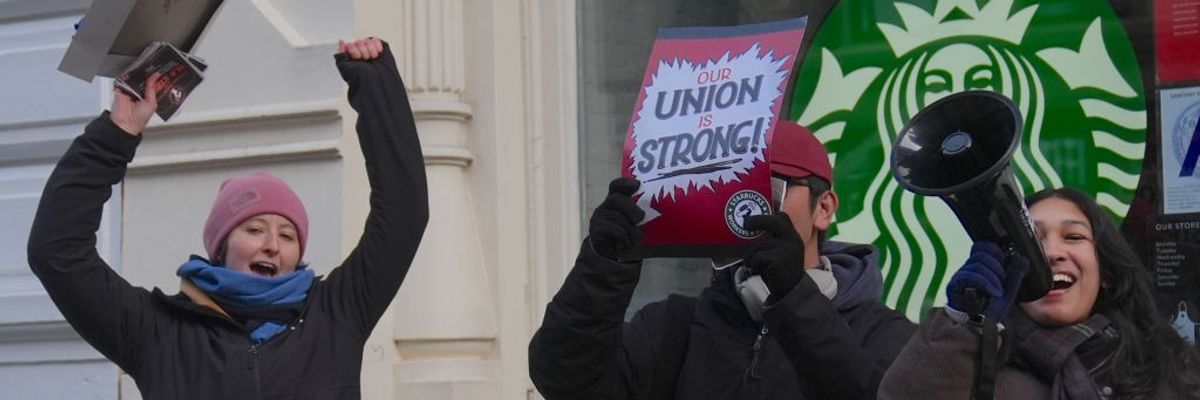
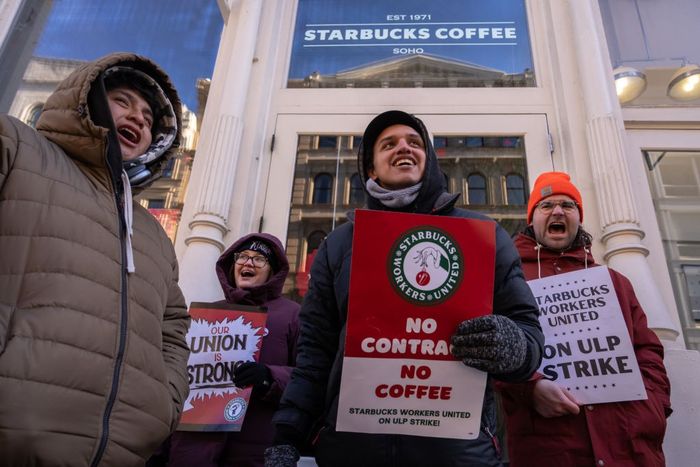
Starbucks employees in Manhattan participate in a strike on December 23, 2024.
(Photo: Selcuk Acar/Anadolu via Getty Images

Jake Johnson
Dec 24, 2024
COMMON DREAMS

Starbucks workers at more than 300 locations across the United States, from Atlanta to Boston to Los Angeles, are expected to walk off the job Tuesday to pressure the coffee giant to come to the bargaining table with a just contract offer that includes a living wage, benefit improvements, and fair scheduling.

As the Christmas Eve strikes kicked off, Starbucks Workers United (SBWU) wrote in a social media post that management's latest economic offer to unionized workers, which included no immediate wage increases, indicated that the $100 billion corporation "seems to prefer investing in CEO Brian Niccol's $113 million compensation package."


"SBWU is demanding the company present us with a serious economic offer at the bargaining table," the group wrote. "Workers shouldn't struggle to pay their bills while working for one of the biggest fast-food corporations in the world."

"If Starbucks wants to put their money where their mouth is," SBWU added, "it's time to invest in WORKERS the way they're investing in rich CEOs. We demand Starbucks bargain a fair contract!"

Over 5,000 Starbucks workers have walked off the job so far as part of the latest strikes, according to one organizer.


Starbucks employees and supporters rally outside of a Starbucks store on December 23, 2024 in New York City. (Photo: Adam Gray/Getty Images)

Since the groundbreaking victory in Buffalo, New York just over three years ago, the Starbucks union movement has expanded to more than 500 stores across the U.S., with over 11,000 baristas organizing in the face of aggressive and often illegal opposition from the company's management.

Unionized Starbucks workers are demanding a base wage of at least $20 an hour for baristas, with an elevated wage floor in high-cost-of-living areas and annual inflation adjustments.

They're also calling for healthcare benefit improvements, protections against union-busting, and "a fair process to obtain consistent schedules."

SBWU said Tuesday that the Christmas Eve walkouts mark the largest-ever unfair labor practice strike at Starbucks, and the organization urged customers and allies to boycott the company for the duration of the actions.

"Spread the word—and friends don't let friends cross the picket line!" SBWU wrote on social media.