It’s possible that I shall make an ass of myself. But in that case one can always get out of it with a little dialectic. I have, of course, so worded my proposition as to be right either way (K.Marx, Letter to F.Engels on the Indian Mutiny)
Monday, February 03, 2025
UKRAINE SOLIDARITY FORUM
The Ukraine Solidarity Campaign forum on the Reality of Russian Occupation was interrupted by the Russian aggression - two of speakers were unable to participate - however two alternative speakers atttended including Olesia Briazgunova is the international secretary of the Confederation of Free Trade Unions in Ukraine (KVPU) and Anatoliy Chorniy of the Independent Trade Union of Mineworkers in Donetsk Oblast, part of the 10th Mine Rescue Squad
Alberta Premier Danielle Smith speaks to the media during the fall meetings of Canada's premiers hosted by Ontario in Toronto, Monday, Dec. 16, 2024.
THE CANADIAN PRESS/Nathan Denette
Alberta’s premier says she’s “disappointed” with U.S. President Donald Trump’s decision to implement tariffs on Canadian goods and said she’ll work together with Ottawa on a response.
Trump signed an executive order Saturday following through on threats to impose 25 per cent tariffs on Canadian goods.
Afterward, Premier Danielle Smith posted to social media to say the province “will do everything in its power” to convince the U.S. to reverse the “mutually destructive policy.”
Smith pointed out and appeared to take some credit for Trump’s decision to reduce tariffs on Canadian energy to 10 per cent, including electricity, oil and natural gas.
“Which is partially a recognition of the advocacy undertaken by our government and industry to the U.S. Administration pointing out the substantial wealth created in the U.S. by American companies and tens of thousands of American workers that upgrade and refine approximately $100 billion of Canadian crude into $300 billion of product sold all over the world,” the post read.
CNN reports that Trump’s trade advisor Peter Navarro said the reduced tariff on energy was to “minimize any disruptive effects” they may have.
While Smith expressed her intention to continue diplomatic efforts in the U.S., Alberta NDP leader Naheed Nenshi accused her of missing the mark on protecting Albertan interests.
“It’s very clear that the Premier’s strategy of taking selfies and going to balls and parties ... it didn’t work,” Nenshi said.
“Unfortunately, spending all the time doing that has meant that the premier hasn’t been part of any conversations about, how do we protect workers and businesses and families in Alberta now? What do we do to help restructure our economy, and how do we move forward in this world?”
Speaking to press after the 2025 NDP Provincial Council, Nenshi said Smith’s very public work to try and secure exemptions for oil and gas ignores the needs of other Albertans who will be affected.
“Let’s keep in mind that while oil and gas is our most important export market or our largest export market, it’s not the only one,” he said. “The premier’s done nothing to assuage the fears of people in agriculture, and for producers, for ranchers, for all the other industries that export to the United States.”
Smith’s refusal to use export taxes on Canadian energy as a leveraging tool led her to split from the “Team Canada” approach at a First Ministers' Meeting on tariff responses in January.
In her Saturday post, Smith called for Canada to “come together” and committed to working collaboratively with the federal government and other Canadian leaders on a “proportionate” response using import tariffs on U.S. goods that can be easily purchased in Canada.
“This will minimize costs to Canadian consumers while creating maximum impact south of the border,” the post read. “All funds raised from such import tariffs should go directly to benefit the Canadians most harmed by the imposed U.S. tariffs.
“Alberta will, however, continue to strenuously oppose any effort to ban exports to the U.S. or to tax our own people and businesses on goods leaving Canada for the United States. Such tactics would hurt Canadians far more than Americans.”
Smith’s post also included her calls for the appointment of a border czar and the fast-tracking of new pipelines to Canadian coasts and increased national refining capacity.
Trump’s tariffs, which include tariffs on Mexican, Canadian and Chinese goods, are slated to come into effect Tuesday.
Prime Minister Justin Trudeau met with Canadian premiers Saturday afternoon. Later that night, he announced retaliatory 25-per-cent tariffs on $155 billion worth of American goods.
Those will come also come into effect on Tuesday.
Companies embrace 'buy Canadian' sentiment as tariffs approach
The produce section of a Toronto Loblaws is seen on Friday, May 3, 2024.
THE CANADIAN PRESS/Chris Young
Canadian businesses preparing for Tuesday’s imposition of tariffs are leaning into the “buy Canadian” sentiment.
Grocery chain Loblaw Companies Ltd. has committed to securing more food grown and made in Canada, after U.S. President Donald Trump announced sweeping tariffs to be enacted Tuesday.
Per Bank, the company’s CEO, made the commitment on LinkedIn over the weekend. He also said Loblaw would seek Mexican alternatives for products it would usually purchase from the U.S., since Mexico is also facing the tariffs.
Meanwhile, Shopify CEO Tobi Lütke promised to bring features aimed at encouraging people to buy local in Canada, the U.S. and Mexico to his company’s Shop app.
The push to buy domestically ramped up over the weekend, after Trump announced he would apply 25 per cent tariffs to Canadian goods, with a lower 10 per cent duty on energy.
Canada has $30 billion worth of retaliatory tariffs on American products set to take effect the same day and will boost the package to $125 billion in 21 days if the U.S. doesn’t back off.
This report by The Canadian Press was first published Feb. 3, 2025.
How Canada could use lumber as a winning weapon in a U.S. trade war
While both sides are likely to lose a trade war, Canada would score a win over the U.S. by leveraging the country’s lumber assets, according to one prominent economist.
Jens Peter Barynin, chief economist at Vivi Economics, told BNN Bloomberg that Canada can and should use lumber as a potent weapon to strike back against any import tariffs, possibly by putting export taxes on lumber.
That’s because despite U.S. President Donald Trump’s claims that the U.S. “doesn’t need” anything Canada produces, that’s very much not the case in lumber, where Canada produces about 25 per cent of the U.S. demand.
Theoretically, the U.S. has enough trees to meet their domestic demand “but if you really wanted to do that you would be unlocking state-owned forest in Washington, Oregon and Idaho which is going to be met with fierce resistance… and could be in conflict with the EPA,” he said in a Friday interview.
Even if those hurdles were passed, the U.S. does not have enough milling capacity to process and ship all that new timber.
Barynin said Canadian policymakers should feel confident that even if they were to implement an export tax that doubled the current price of lumber, the U.S. market would still buy it. He notes the example of the pandemic, when prices rose by 400 per cent but demand stayed strong to supply a busy housing construction market.
“If we put a tax of double the price in the past month, they’ll still pay it,” he said.
Barynin says counter to what Trump alleges, the current free trade deal between Canada and the U.S. has been “a really good deal for them so if you want to upset that, we have things we can push back. We shouldn’t be on our heels.”
Instead of winners and losers, overall this trade trade will bring more losers than winners on both sides. “Free trade was the win-win and we were there already,” he said.
“What we are talking about is… aggressively making the pain as bad as it can be for the U.S. from a trade perspective. They’re doing that to us too, that’s what a trade war is.” Peter Evans
Supervising Producer, BNN Bloomberg
Observers call for pressure on U.S. corporations as Trump, Musk take aim at Canada
Elon Musk speaks at an indoor Presidential Inauguration parade event in Washington, Monday, Jan. 20, 2025. (AP Photo/Matt Rourke)
OTTAWA — As U.S. President Donald Trump and Elon Musk take aim at Canada, some high-level observers are calling on the federal government to consider sanctioning or even banning corporations owned by those close to Trump — much as it did with Russian oligarchs after the invasion of Ukraine.
“We better have a report coming up on American interference,” former foreign affairs minister Lloyd Axworthy said at a recent panel discussion.
He told the Jan. 27 event held by the Canadian International Council that he’s increasingly worried about meddling in Canadian domestic affairs by Musk, a social media mogul and the world’s richest man.
He added that “other owners of big digital platforms” could undermine Canadian democracy.
“They are going to try to affect our election,” said Axworthy, who was foreign minister from 1996 to 2000.
Axworthy argued the federal government must “make sure that they don’t screw the thing up, and make sure that we aren’t denied our rightful place to make our own choices” in the next election.
Musk has emerged as a close ally of Trump. He raised some $200 million US for Trump’s election campaign and attended the president’s swearing-in ceremony. At an inauguration rally later that day, Musk made a gesture that many interpreted as a Nazi salute; he denied that was the case.
In recent weeks, Musk has promoted far-right groups and parties engaged in election campaigns in Germany and the U.K. He addressed supporters of the far-right Alternative für Deutschland (AfD) in Halle, Germany on Jan. 25.
He has been accused of using his social media site X, formerly known as Twitter, to spread disinformation about European policies on public safety and online regulation.
Musk also has tweeted occasionally about Canadian politics. He praised Prime Minister Justin Trudeau’s resignation and dismissed him online by echoing Trump’s talk of Canada becoming a U.S. state.
“Girl, you’re not the governor of Canada anymore, so (it) doesn’t matter what you say,” Musk posted on Jan. 8.
Musk has faced pushback elsewhere over allegations of meddling in democracy. For five weeks ending last October, Brazil’s supreme court had internet providers block X over a dispute that stemmed from the company’s refusal to ban far-right accounts affiliated with a 2023 attack on that country’s Parliament.
X ultimately complied with those orders and paid millions of dollars in fines.
The European Commission is investigating whether X is breaching EU content-moderation rules. It has stepped up a probe launched in 2023 by seeking new information to determine whether the site’s algorithms are boosting far-right views while limiting other perspectives.
Musk is also CEO of the automotive corporation Tesla. Liberal leadership candidate Chrystia Freeland recently called on Ottawa to impose a 100 per cent tariff on Tesla vehicles in retaliation for Trump’s planned 25 per cent tariffs.
University of Waterloo political scientist Emmett Macfarlane has called on the federal government to go much further. In a Jan. 21 blog post, he argued that Ottawa should consider banning X, Tesla and Musk’s satellite broadband company Starlink.
“We should treat Trump and members of his administration like Elon Musk as akin to Russian oligarchs,” Macfarlane wrote. “We need to impose meaningful costs on the U.S. for its economic aggression.”
Both Freeland and Macfarlane cited concerns about tariffs, not political interference.
But Axworthy said both things should worry the federal government. He said Ottawa should apply measures to the U.S. and people in Trump’s inner circle using the same logic of containment that Washington applied to the Soviet Union after the Second World War.
Axworthy described that policy as one of deploying sanctions and diplomatic measures that send a strong message without leading to direct conflict.
“Every time they may make a move, there’s a counter-move,” he said. “Do it nicely, do it quietly — but also let them know what’s happening.”
NDP MP Charlie Angus said recently that he’s asked Elections Canada to join European efforts to investigate the algorithms used by X “to see if (Musk) is trying to push content for extremist groups.”
“I do not believe we’re prepared in any way for dealing, particularly, with the threat that is coming from Elon Musk, who has revealed himself to be dangerously anti-democratic,” he said.
He criticized those who seek to “appease the gangster class from Mar-a-Lago,” referring to Trump’s private residence.
The Canadian Press has asked for Musk’s response to these criticisms through the media relations offices for X and Tesla.
Axworthy said Trump’s “threats” to expand American territory — and make Canada part of the United States — should be met with a united front among the countries he is talking of absorbing.
“I would be more supportive if our foreign minister was visiting Greenland and Denmark and Panama and Colombia and Mexico to talk to them about, ‘How do we contain this a — hole?’” he said.
Axworthy argued Canada instead “almost threw Mexico under the bus” when Trump started threatening tariffs. Some premiers suggested that Canada draft a trade deal with the U.S. separate from Mexico and blamed the country for driving Trump’s concerns about fentanyl and migration.
“If you’re into a tough negotiation, it’s better to have three people” on your side, Axworthy said.
Former prime minister Joe Clark told last Monday’s panel that Washington has become a “hostile neighbour” and Canada must manage the relationship without losing sight of its own interests and relations with other countries.
“No one knows when the barrage will stop,” he said. “We have a role of our own, a history of our own (and) interests of our own in the wider world.”
This report by The Canadian Press was first published Feb. 3, 2025.
Dylan Robertson, The Canadian Press
National Bank closes Canadian Western Bank acquisition
Bank. A National Bank sign in Montreal. THE CANADIAN PRESS/Paul Chiasson
MONTREAL — National Bank of Canada says it has completed its acquisition of Canadian Western Bank.
The Montreal-based bank says integration activities will now begin as it looks forward to onboarding CWB clients and employees in the coming months.
National Bank chief executive Laurent Ferreira says the combined organization will provide customers with an expanded product and service offering nationally, while maintaining regional expertise.
National Bank announced an all-stock deal to buy Canadian Western in June last year.
The takeover will see National Bank expand further westward as it takes on CWB’s Alberta and B.C.-focused operations.
CWB common shares are expected to be delisted from the Toronto Stock Exchange as of the close of business on Tuesday.
This report by The Canadian Press was first published Feb. 3, 2025.
Kairos Power fabricates and installs test unit reactor vessel
A deal signed in October by Kairos and Google will support the first commercial deployment of Kairos Power's reactor by 2030
Friday, 31 January 2025
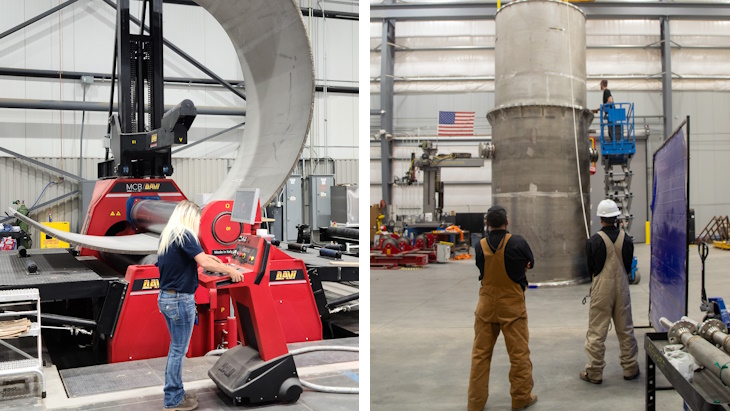
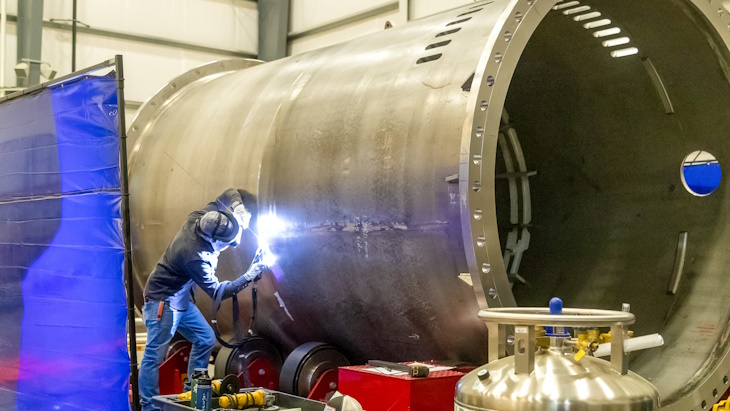
The central component for the second-iteration test unit for Kairos Power's Hermes reactor is the first reactor vessel to be fabricated in-house at Kairos Power’s Manufacturing Development Campus in Albuquerque, New Mexico.
(Image: Kairos Power)
Kairos is following an iterative approach for the development of its Fluoride Salt-Cooled High-Temperature Reactor (KP-FHR) technology. The non-power Engineering Test Unit 2 (ETU 2.0) follows ETU 1.0, a full-scale, electrically heated prototype of the Hermes reactor which carried out more than 2000 hours of pumped salt operations demonstrating the design and integration of key systems, as well as exercising the supply chain and establish new capabilities, including the production of the high-purity fluoride-lithium-beryllium (FLiBe) salt coolant.
ETU 1.0 completed operations in mid-2024. ETU 2.0 will demonstrate modular construction methods: as part of the project the company is ramping up output of ASME U-stamped pressure vessels, producing specialised reactor components, and gaining proficiency in modular construction methods.
The dedicated shop for KP-FHR vessel production at Albuquerque includes large-scale plate-rolling, cutting, automated welding and machining capabilities. (Image: Kairos Power)
Kairos Power has established a dedicated shop in its Albuquerque facility for KP-FHR vessel production. Its in-house engineering, procurement, and manufacturing teams collaborated closely in the project to deliver the ETU 2.0 reactor vessel, enabling key learnings that will carry forward to future iterations, the company said. The company is minimising outsourced production of specialised components under its vertical integration strategy, aiming for 80% of ETU 2.0 costs to derive from raw materials or commercial off-the-shelf parts which it says gives better control over product cost, quality, and schedule.
Kairos Power co-founder and CEO Mike Laufer described the completion of the ETU 2.0 vessel as a "monumental achievement" for the company, illustrating the synergy between its rapid iterative development approach and vertical integration strategy. "We are systematically building the capabilities and know-how to self-produce major reactor components over multiple iterations - an investment that will ultimately lower costs for the commercial fleet," he said.
(Image: Kairos Power)
The KP-FHR is one of five technologies selected in 2020 to receive federal funding for risk reduction projects under the US Department of Energy's Advanced Reactor Demonstration Program, with the department investing up to USD303 million in the Hermes reactor project. The DOE ETU 2.0 reactor vessel is a contract milestone under that investment agreement.
ETU 2.0 will be followed by a third non-nuclear iteration, ETU 3.0, which will be built adjacent to the site in Oak Ridge, Tennessee, where the Hermes Low-Power Demonstration Reactor will be built. Both ETU 3.0 and Hermes will use reactor modules fabricated at the Albuquerque facility.
Hermes is the first non-light-water reactor to be permitted in the USA in over 50 years. It will not produce electricity, but Hermes 2 - a two 35 MWt-unit plant for which the US Nuclear Regulatory Commission issued a construction permit in November - will include a power generation system.
A deal signed in October by Kairos and Google will support the first commercial deployment of Kairos Power's reactor by 2030, with multiple reactors supplying clean electricity to Google data centres through power purchase agreements.
IAEA finds commitment to safety at Novovoronezh plant
Monday, 3 February 2025
The operator of Russia's Novovoronezh nuclear power plant has shown a commitment to enhancing operational safety, an International Atomic Energy Agency mission team has concluded.
The Novovoronezh plant (Image: Kitashovroman / Wikipedia)
The aim of IAEA Operational Safety Review Team (OSART) missions is to assess safety performance against IAEA safety standards, highlight areas of good practice and propose improvements.
Requested by the Russian government, an OSART mission was conducted from 13 to 30 January. The team was composed of seven experts from Belarus, Brazil, China, Iran and South Africa, as well as four IAEA staff members and an observer from Russia. The team reviewed operating practices in units 4 and 6 of the Novovoronezh plant in the areas of leadership and management for safety, training and qualification, operations, maintenance, technical support, radiation protection, chemistry and accident management. An OSART mission was previously completed for unit 5 in 2015.
The Novovoronezh plant is located in the Voronezh region, about 600 kilometres south of Moscow. It is owned by state nuclear corporation Rosatom and operated by Novovoronezh NPP, a subsidiary of the Rosenergoatom Joint Stock Company. The plant consists of seven units. Units 1, 2 and 3 are permanently shut down and under decommissioning. Units 4, 5, 6 and 7 are operating. All units are pressurised water reactors (VVERs); units 4 and 5 are VVER-440 and VVER-1000, respectively. Units 6 and 7 are both VVER-1200.
Rosatom noted the OSART mission was unique in that, "for the first time, it was carried out at two Russian power units at once - unit 4 and unit 6 with reactors of different generations of VVER - 440 and 1200".
(Image: Rosatom)
"The OSART team observed that the staff at the plant are knowledgeable and professional and are committed to improving the operational safety and reliability of the plant," the IAEA said.
The team identified one good practice to be shared with the nuclear industry globally: the main control room operators at the plant have access to an electronic display for real-time indication of hydrogen ignition risk inside the containment building in the case of a severe accident.
The mission also provided some suggestions to further improve safety, including that the plant should consider enhancing: the consistent use of tools to minimise human error; the quality of maintenance activities; and the arrangements for the monitoring and reporting of equipment condition and material deficiencies to ensure that any degradation is identified and reported.
"We are grateful to the international experts of the IAEA for conducting a comprehensive inspection at two power units of the Novovoronezh NPP – unit 4 and unit 6," said Novovoronezh Plant Director Vladimir Povarov. "This is a reputable team with over 282-years combined operational experience in the nuclear power industry.
"Three of the four Novovoronezh NPP power units in operation have already successfully undertaken an IAEA international peer review. And we plan for power unit 7 to be subjected to this procedure in the future."
A draft copy of the mission's report has been provided to the plant management, and following any factual comments provided, the final copy will be submitted to the Russian government within three months.
Indian budget launches Nuclear Energy Mission
Monday, 3 February 2025
Minister of Finance Nirmala Sitharaman promised federal funds for an initiative to develop at least five Indian-designed small modular reactors to be operational by 2033, as well as amendments to Indian legislation to encourage private sector participation, in the budget for 2025-2026.
Minister for Finance and Corporate Affairs Nirmala Sitharaman arrives at Parliament House in New Delhi to present the 2025 Union Budget (Image: Press Trust of India)
In her budget speech, Sitharaman announced the Nuclear Energy Mission for Viksit Bharat (Viksit Bharat is the government's strategy to make India into a completely developed nation by 2047).
"Development of at least 100 GW of nuclear energy by 2047 is essential for our energy transition efforts. For an active partnership with the private sector towards this goal, amendments to the Atomic Energy Act and the Civil Liability for Nuclear Damage Act will be taken up," Sitharaman said.
"A Nuclear Energy Mission for research & development of Small Modular Reactors (SMRs) with an outlay of INR20,000 crore will be set up. At least 5 indigenously developed SMRs will be operationalized by 2033."
INR20,000 crore is around USD2.5 billion (1 crore is 10 million).
This follows commitments in 2024's budget to partner with the private sector on the development of the Bharat Small Modular Reactor - a compact 220 MW pressurised heavy water reactor based on India's reactor technology.
The Atomic Energy Act of 1962 prohibits private control of nuclear power generation in India: only two government-owned enterprises - NPCIL and Bharatiya Nabhikiya Vidyut Nigam Limited (BHAVINI, set up to build and operate fast reactors) - are legally allowed to own and operate nuclear power plants in India. Amendments to the act made in 2016 allow public sector joint ventures, but private sector companies and foreign investments are not allowed to invest directly in nuclear power in India.
The Civil Liability for Nuclear Damage Act of 2010 places responsibility for any nuclear accident with the plant operator and limits total operator liability - but allows the operator to have legal recourse to the reactor supplier, with no limit on supplier liability. This has been a stumbling block for overseas nuclear power plant vendors.
According to a statement from India's Department of Atomic Energy, the legislative changes are expected to create a more conducive environment for investment and innovation in the nuclear sector. The mission aligns with India's commitment to achieving 100 GW of nuclear energy capacity by 2047, a milestone deemed essential for reducing carbon emissions and meeting future energy demands.
India is already working to expand its nuclear capacity from 8180 MW today to 22,480 MW by 2031-2032, including the construction and commissioning of ten units totalling 8,000 MW across Gujarat, Rajasthan, Tamil Nadu, Haryana, Karnataka, and Madhya Pradesh, the DAE said. Pre-project activities for a further ten reactors are under way, and in-principle approval has been given for the construction of up to six units in cooperation with the USA: a site at Kovvada, in Andhra Pradesh, was earmarked for the construction of six AP1000 pressurised water reactors as long ago as 2016, but contractual arrangements have yet to be finalised.
In early January, India's nuclear power operator NPCIL issued a Request for Proposals from 'visionary Indian industries' to finance and build a proposed fleet of 220 MW Bharat Small Reactors to help decarbonise Indian industry.
"Civil nuclear energy will ensure a significant contribution to the country's development in future," Prime Minister Narendra Modi said in his response to the budget, which he said includes "significant steps" towards reforms.
India's budget is presented on 1 February, ahead of the start of the financial year on 1 April. Last year, due to Lok Sabha elections, an interim budget was presented in February: the full budget for 2024-2025 was not presented until July.
Start-up work under way for Akkuyu pumping station
Monday, 3 February 2025
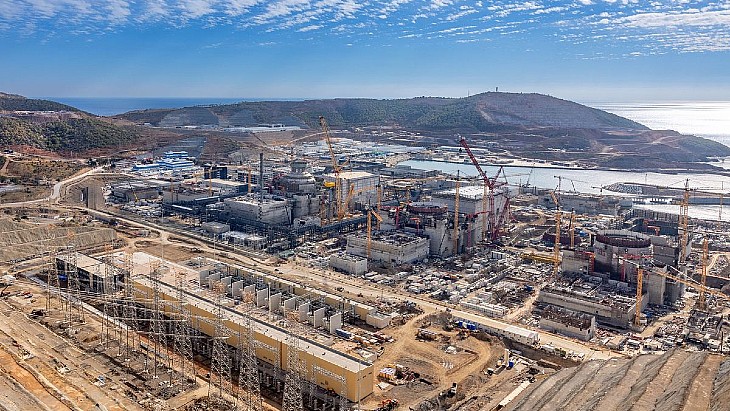
The start-up and testing phase of the on-shore pumping station for Turkey's Akkuyu nuclear power plant's first unit has begun.
Akkuyu is to be Turkey's first nuclear power plant (Image: Rosatom)
The pumping units for the main cooling water supply and pumps connected to the back-up diesel power supply are now undergoing load tests, with operating parameters of the equipment being checked, following test runs of the main cooling water pumping units.
The four-unit Akkuyu nuclear plant will be cooled by water from the Mediterranean Sea. There will be one pumping station for each power unit, a drainage channel, siphon wells, a distribution chamber, a water intake and spillway structure and desalination processes. Rosatom says the total capacity in the normal operation of the power unit will be 260,000 cubic metres per hour and that the design "will reliably protect the pumping station equipment from any external factors including floods and tsunamis".
Akkuyu Nuclear JSC CEO Sergei Butckikh said: "Construction and installation works at the pumping station are almost completed ... the nuclear power plant's largest pumps ... will provide water to all the cooling systems of the power unit, that is why stable operation of the pumps is extremely important for the reliable operation of the main equipment, including the reactor plant and the turbine unit. The onshore pumping station is a unique hydraulic engineering structure. The station’s design solution, developed taking into account the advanced safety standards, was successfully implemented thanks to the well-coordinated work of the Turkish-Russian team of designers and builders."
Background
Akkuyu, in the southern Mersin province, is Turkey's first nuclear power plant. Rosatom is building four VVER-1200 reactors, under a so-called BOO (build-own-operate) model. According to the terms of the 2010 Intergovernmental Agreement between the Russian Federation and the Republic of Turkey, the commissioning of the first power unit of the nuclear power plant must take place within seven years from receipt of all permits for the construction of the unit.
The licence for the construction of the first unit was issued in 2018, with construction work beginning that year. Nuclear fuel was delivered to the site in April 2023. Turkey's Nuclear Regulatory Agency issued permission for the first unit to be commissioned in December, and in February it was announced that the reactor compartment had been prepared for controlled assembly of the reactor - and the generator stator had also been installed in its pre-design position.
The aim is for unit 1 to begin supplying Turkey's energy system in 2025. When the 4800 MWe plant is completed, it is expected to meet about 10% of Turkey's electricity needs, with the aim that all four units will be operational by the end of 2028.
Blykalla starts work on non-nuclear prototype SMR
Monday, 3 February 2025
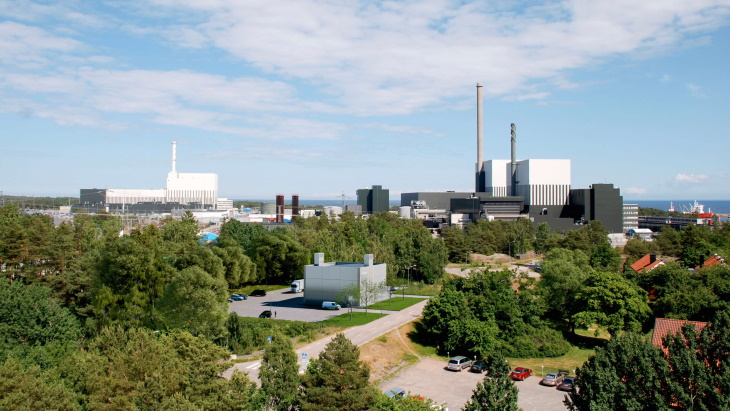
Swedish lead-cooled small modular reactor technology developer Blykalla had broken ground for the construction of an electrical small modular reactor pilot facility near Oskarshamn to test proof of concept of its SEALER technology.
A rendering of the Advanced Reactor Testing Site at Oskarshamn (Image: Blykalla)
The groundbreaking ceremony was attended by Swedish Deputy Prime Minister and Minister of Energy Ebba Busch.
The Advanced Reactor Testing Site will house the electrical SEALER-E prototype reactor and aims to validate critical components and safety systems. The project is a collaborative effort including partners from Uniper, ABB, NCC and the Royal Institute of Technology (KTH). The Swedish Energy Agency has awarded a SEK99 million (USD9.3 million) grant for the project.
"This test facility is a significant step forward for Swedish nuclear innovation and a testament to the power of collaboration," said Blykalla CEO Jacob Stedman. "By uniting public and private partners, we are creating a foundation for the energy solutions the world urgently needs."
On 31 January, Blykalla announced it had selected NCC AB as the construction partner for the new test facility next to the Oskarshamn nuclear power plant. NCC will be responsible for the construction of the test facility, including site preparations and necessary installations.
The first phase of construction is expected to be completed by June with tests starting during the third quarter of 2025.
Blykalla - formerly called LeadCold - is a spin-off from the KTH, where lead-cooled reactor systems have been under development since 1996. The company - founded in 2013 as a joint stock company - is developing the SEALER.
A demonstration SEALER (SEALER-D) is planned to have a thermal output of 80 MW. As in future commercial reactors from Blykalla, the fuel rods will be cooled by 800 tonnes of liquid lead. The reactor will have a height and diameter of about 5 metres.
Blykalla's goal is for its first 140 MWt SEALER-55 commercial reactor to be ready for operation in the early 2030s.





_18684.jpg)
_31757.jpg)
_93545.jpg)