German Elections, Right-Wing Parties, and Trump
The final results for German’s Bundestag election show that the Alternative for Germany or AfD finishing a strong second with 20.8% and 152 seats. The CDU/CSU finished first by garnering 28.52% and 208 seats, while Chancellor Olaf Scholz’s Social Democrats had a record low 16% and 120 seats.
The New York Times found that the overriding concern in German life according to interviews and polls, and the thing most likely to drive the choice of voters, is the country’s anemic economy.” (NYT, 2/22/25). I don’t know how typical she is, but one probable AfD voter volunteered that she didn’t share all AfD positions: “People are angry with the government because they can’t pay their bills.” They aren’t wrong about the economy, as all available evidence suggests that Germany’s economy is flatlining and hasn’t grown in five years. German experts are predicting an anemic 0.3 percent growth rate this year and the country is facing an ailing industrial sector, low productivity, an absence of competitiveness and especially, very high energy costs. Emblematic of what’s occurring is the news that BASF, the world largest chemical company has already begun closing down factories in Germany and shifting production to China and the United States.” (NYT, 2/23/25).
Frederick Merz, the conservative candidate from the Christian Democratic Party, is now poised to become the next Chancellor. What is his response to the current crisis? He promises to increase defense spending, continue supporting the war in Ukraine with longer range Taurus missiles and take a strong stance against China. The New York Times suggests that Merz’s “fresh face is a jolt Europe needs” but his position is consistent with other European vassals who live in some fantasy land and marched lockstep with Biden in backing the US proxy war against Russia. By doing so, they utterly and almost incomprehensibly ignored the consequences, especially increased dependence on the United States. For example, think of how Europe was forced to buy much more expensive gas from the US when they went along with Washington’s sanctions and blowing up the Nord Stream pipeline. None of this was by accident.
I would argue it was always the part of the neocon plan to deindustrialize Europe to the economic benefit of the United States. Now Trump has pulled the rug out from under these “allies” and he will not only normalize relations with Russia but lift sanctions and US companies will re-enter Russia where the prospects for making massive profits await. One calculation suggests that U.S. companies leaving Russia, like I.T. And Media, lost $123 billion and Consumer and Health, $94 billion. “Foregone profits” since the start of the war have been calculated at more than $100 billion. (NYT, 2/19/25).
My point is that the neocons fleeced Europe and their leaders not only went along but are continuing to do so. Russia has everything that Europe needs but the EU’s hapless leaders recently announced a new set of sanctions on Russia and want to ramp up defense spending. Ursula von den Leyen, president of the European Union’s executive arm, recently declared that the destiny of Ukraine is also “Europe’s destiny.” As this proceeds, the vaunted European welfare state will continue to decline because the ruling elites have abandoned any responsibility to their own populations. And if right-wing parties continue to flourish, these leaders and their onetime US collaborators have only themselves to blame. The chickens are coming home to roost.
In addressing a recent gathering of the EU Parliament, Prof. Jeffrey Sachs (no left-wing radical) patiently explained, chapter and verse, how their present situation unfolded over the years as European leaders lost their voice and became subservient to Washington’s desire for unilateral dominance of the globe. Fittingly, he repeated Henry Kissinger’s famous adage, “To be an enemy of the United States is dangerous but to be a friend of the United States is fatal.” What next? I’m hardly the first person to conclude that sooner than many observers realize, Trump is going to tell Europe’s leaders that a serious reckoning looms if they don’t sign on to the Ukraine deal. To put it bluntly, either they go along or the exports and imports (think cars and gas) they need to survive as viable economies will not be forthcoming from the U.S. and its Russian, Saudi Arabian and Chinese allies.
Is Fascism on the Rise in Germany?
The German establishment is in crisis. Is has ruled for 80 years by charting a middle course between progressive and conservative policies. Labor and business have cooperated to achieve social and economic stability. But that consensus isn’t functioning anymore. The standard of living is declining, crime is increasing, fear and anger infect social discourse. Nothing the mainstream political parties have done has improved the situation.
The fundamental cause for this crisis is the decay of capitalism. This long-term trend is forcing European and North American governments into more intense exploitation: reducing benefits at home and aggressively manipulating the economies and politics of weaker nations. One of the mains tools for this is the North Atlantic Treaty Organization, which overthrows recalcitrant foreign governments and installs obedient ones.
These wars of regime change have generated waves of refugees fleeing the violence in their homeland. Germany has taken in millions of refugees from the NATO-sponsored wars, far more than any other country. This has created an enormous financial and cultural strain in a country that historically has had little immigration. It comes at a time when poverty is increasing and social services are being reduced. The once-generous welfare state is gradually being dismantled. This financial squeeze is worsening now because of expenses for the immigrants. The newcomers receive enough money to live on plus free healthcare, education and access to special programs. Some cheat on this, registering in several places under different names and getting multiple benefits. Many Germans resent paying for all this with high taxes while their own standard of living is declining.
The trauma of war and displacement has caused a few refugees to lose their moral compass. They do things here they wouldn’t do at home.
Two-thirds of the immigrants are young men, some of them convinced Allah has ordained males to dominate females. In their view, women who aren’t submissive need to be punished. Since being male is the only power many of them have, they feel threatened by women in positions of power, and they sometimes react with hostility. Thousands of women have been physically attacked — some murdered and raped and many aggressively grabbed on the breasts as a way of showing dominance. Tens of thousands of women have been abused — insulted, harassed, spat upon.
Many refugees are aware that Germany, as a member of NATO, supports these wars that have forced them to flee their homes. They’re not fooled by the rhetoric of “humanitarian intervention.” They know NATO’s motives are imperialistic: to install governments agreeable to Western control of their resources and markets. Although they are now safe, their relatives and friends are still being killed with weapons made in Germany and oppressed by soldiers and police trained and financed by Germany. Rather than a grateful attitude, some have come with a resentful one.
Crime has increased, especially violent crimes such as knife attacks. Hundreds of people have been killed and wounded by refugees. Organized criminal clans have become established in Germany’s lenient legal atmosphere. A few IS and al-Qaeda members slipped in with the refugees. They have bombed marketplaces, attacked synagogues, murdered Jews on the street, recruited new members in mosques. Although only a fraction of immigrants are criminals, they’re the ones who make the news.
Some statistics here and here.
In the past 80 years Germany has become a peaceful country. The current violence is profoundly disturbing to them. It brings back terrible memories.
The mainstream German parties and media are committed to these wars and therefore refuse to substantially reduce immigration. One party in parliament, however, is demanding an end to mass immigration and to the NATO wars that are causing it. As a result, 25% of the population has abandoned the establishment and now support Alternatives for Germany.
The mainstream is panicking and waging a defamation campaign against the new party, saying it is anti-democratic and far-right extremist. It’s true that the AfD has attracted extremist voters, but the establishment uses them to smear the whole party. AfD leadership and most of its voters are libertarian conservatives who want to reduce the role of government and protect the cultural integrity of the country. They’re not narrow-minded bigots. Their chancellor candidate, Alice Weidel, is a lesbian with a woman partner who came originally from Sri Lanka. The party’s platform clearly states their deportation program applies only to criminals and to people who have entered the country illegally, and then only when their home country is no longer at war. These facts are ignored by the established parties and media, who are trying to crush this threat to their power. Since the US media gets their information from the German media, it’s no wonder they present a false view of the AfD, labeling it as fascist.
Fascism is not on the rise in Germany. That’s a perennial scare story. What is rising is public outrage. The form that will eventually take remains to be seen.

riedrich Merz of the Christian Democratic Union and Alternative for Germany’s Alice Weidel greet each other at a TV debate in Berlin on February 16, 2025. (Photo: Kay Nietfeld)
On Tuesday evening, in the building of the left-wing newspaper Junge Welt in east Berlin, the rich allegro sounds of the first movement of Mozart’s clarinet quintet filled the halls, played by the Palestinian Nasmé string and clarinet ensemble. Half a dozen heavily armored police officers, ordered there by Berlin’s mayor, stood in the corridor. The tense atmosphere was punctuated by the lyrical strings, while the crowd waited eagerly and somewhat anxiously for the appearance of one of the United Nation’s best-known figures.
A few days earlier, an event featuring Francesca Albanese, the UN Special Rapporteur on the Occupied Palestinian Territories, at the so-called Free University of Berlin had been cancelled after the German capital’s mayor called her appearance “a disgrace”; the Israeli ambassador to Berlin is reported to have requested the cancellation because of Albanese’s critical comments about Israel. A re-scheduled event at Junge Welt was only permitted with the presence of police.
“Talking about Israeli violations of Palestinian rights has always been sensitive in Germany. But the problem has escalated to the point that is really, really scary,” Albanese told the press before her talk. Germany’s support for Israel, known as the Staatsräson, has become a major domestic political issue in recent years and especially since the Israel-Gaza conflict escalated after the Hamas attack on October 7 2023, with the country using harsh laws intended to combat neo-Nazis against Palestinian activists. “After a while it really gets under your skin,” Albanese added. “There has been a crackdown on freedom of expression, of freedom of assembly.”
The newspaper’s publisher, Dietmar Koschmeider, told Drop Site that police were monitoring the event for any illegal speech, including from members of the audience. “What I experienced today, I haven’t seen in 30 years, it’s terrifying,” Koschmeider said. Though the event, which featured readings of children’s poetry and a panel with Albanese and Forensic Architecture’s Eyal Weizman, ended peacefully, participants feared a repeat of last year’s Palestine Congress, where armed police shut down an event and livestream—and arrested a Jewish activist for calling a police officer antisemitic.
What observers both domestic and international have missed, however, is that the German mainstream’s rejection of international law and civil liberties and the rise of its far right are intrinsically linked. Germany’s far-right party, the Alternative for Germany (AfD), has played a key role in forefronting Staatsräson for its own purposes—using the topic as a wedge issue to demonize migrants from Muslim countries as well as left-wing activists.
This Sunday’s election is set to see the best result for the far-right in German post-war history, with AfD predicted to finish second, ahead of both incumbent chancellor Olaf Scholz’s Social Democrats and the Green Party. But, by pushing anti-Muslim, anti-immigrant, and anti-Palestinian laws to the political forefront, AfD has already mainstreamed its agenda and changed the country.
The right has pushed the boundaries of what is acceptable, manipulating Germany’s culture of reckoning with its past into a commitment to defend Israel at all costs and no matter how extreme its actions. This proxy nationalism is defended by an unholy alliance of right, left, and center. Almost all German political parties, media, police, citizenship authorities, and even universities and cultural institutions are working together to suppress activists, scholars, and even the UN’s special rapporteur.
“I was really shocked by the political pressure on the universities and the anti-Palestinian racism, and I intend to write a report about it,” Albanese, the U.N. rapporteur, told Drop Site after the event. “It’s clear that there is racism against the Palestinians here, negating their identity.”
Under the mayoralty of Kai Wegner of the conservative Christian Democrats—whose party is predicted to lead in Sunday’s national elections—the city of Berlin has turned into a flashpoint for cracking down on pro-Palestinian speech, with protesters regularly brutalized, including Jewish students at a university occupation and women at marches protesting violence against women, as well as at a memorial for people killed by a right-wing terrorist.
Wegner had previously said in September 2024 at a town hall meeting that in Gaza, “a genocide isn’t taking place, period.” After a United Nations special committee found Israel’s warfare methods “consistent with genocide,” his office responded to a Drop Site request for comment that “there is no reason to correct or add to the statements.”
“Zionist McCarthyism”
Germany has been struck with what political analyst Hans Kundnani calls “Zionist McCarthyism”—the cancellation of events, funding, media campaigns, and police brutality regularly administered to those who criticize Israel’s occupation of Palestine and the brutal war in Gaza. Even leading human rights groups and senior European government figures have warned of this repression. “Freedom of speech is at stake in Germany,” said Petra De Sutter, Belgium’s deputy prime minister. Amnesty International condemned Berlin police violently shutting down a protest due to what the police called the “public safety risk” of foreign languages, particularly Arabic, being spoken and sung.
This McCarthyism across the political spectrum was accelerated and instrumentalized by the far-right, who realized that portraying antisemitism as primarily foreign or left-wing would help achieve its political goal of demonizing Muslims and Arabs.
The early stages of this crackdown was branded “atonement gone haywire” by philosopher Susan Neiman, who wrote a book, Learning From the Germans, about the country’s memory culture. Nieman, who is Jewish, swiftly disowned her own book’s thesis after encountering the “straightforward McCarthyite practices in which many people, from the director of the Jewish Museum in Berlin to the Palestinian German journalist Nemi El-Hassan, have been forced from their jobs, and many others have been denied funding, prizes, or performance space.”
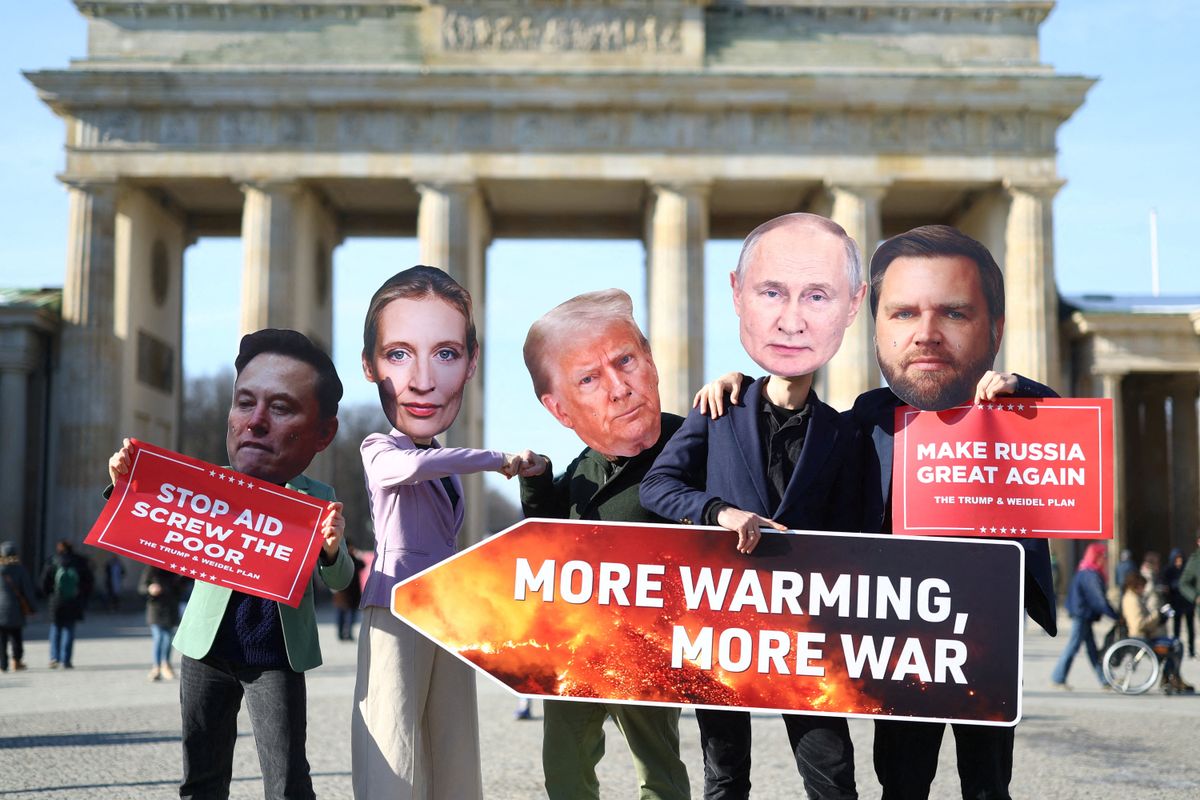
The party has also arrived on the global stage, with explicit support from Elon Musk—who, according to the Washington Post, has used X to amplify AfD, tweeted multiple times that “only AfD can save Germany,” and invited its candidate for chancellor Alice Weidel to a discussion on X. AfD was suddenly sharing space with the ascendant global far right and reportedly meeting Vice President JD Vance at the Munich Security Conference—while Scholz was snubbed.
In late 2024, the AfD became the first far-right party to win a state election in Germany since the Nazis. In 2025, a post-war political taboo—known as the “firewall”—against collaboration with the far-right was loudly broken with the conservative Christian Democrat opposition working with them to pass a Bundestag (German parliament) resolution about restricting the right to asylum. Liberal Germans were outraged, with hundreds of thousands going out on the streets to protest.
Though openly embracing Nazism is effectively illegal, the party’s co-founder Alexander Gauland notoriously downplayed the Nazi dictatorship as a mere “birdshit” in one thousand proud years of German history—allowing the party to flirt with Nazi rhetoric and advance a xenophobic nationalist politics. Firebrand state leader Björn Höcke has been convicted twice under anti-Nazi laws for using the Nazi paramilitary slogan, “Alles für Deutschland” (everything for Germany) and at a party conference recently delegates celebrated their candidate Alice Weidel’s speech with “Alice für Deutschland.”
Under the comparative stability of former, longterm chancellor Angela Merkel, Germany was often internationally celebrated as a liberal country that had admirably faced the weight of its dark history. Welcoming refugees, ruling out cooperating with the far right, and repenting for the crimes of the Nazis made the erstwhile homeland of National Socialism appeared to Europe’s liberal classes to be a powerful bulwark against the rise of the far right.
But it was also Merkel who coined the Staatsräson that made German support of Israel a “reason of state” for the country, a key part of national interest and identity, from the stage of the Israeli Knesset in 2008. Almost all German political parties, alongside local authorities and even cultural institutions have joined together in an alliance reaching from right and far-right through the center and even parts of the left to defend the “Reason of State” and crack down on migration from supposedly antisemitic countries, citizenship for foreigners, and civil liberties such as freedom of speech and assembly and academic freedom.
As a result, recent years have seen drastic repression against solidarity with Palestine in Germany, with criticism of Israel often portrayed as antisemitic. This has obviously only accelerated since Hamas’s attack on Israel on October 7, 2023 and Israel’s brutal war on Gaza.
Indeed, during her X space with Musk, AfD party co-leader Weidel described Adolf Hitler as a socialist, adding after that “only the leftish [sic] Palestinians criticize [pro-Israel] policies here. You have a deeply vested antisemitism within the leftish movement, and it was always that case.”
“The nationalist party has questionable interest in protecting Israel, but doing so helps wave away Nazi allegations while also pushing the notion that Jewish life is at risk from imported antisemitism,” say Chris Reiter and Will Wilkes in their forthcoming book about German decline, Broken Republik. The idea that antisemitism comes from abroad is “much easier for mainstream Germans to accept than the domestic variety. The assertion, which isn’t backed up by official statistics, helps promote an agenda that seeks to clamp down on migration from Muslim countries,” fitting right into the AfD’s agenda. Reiter & Wilkes point out that Israel isn’t mentioned once in the AfD’s platform, but “Islam” and “Muslim” are mentioned 50 times.
Daniel Weissmann, a political communications scientist who studies antisemitism research, said the AfD “didn’t pioneer this idea that antisemitism is left-wing, but they jumped on it at the perfect time. The AfD made this explicitly political—they pioneered this as political weapon within the parliamentary framework with the first draft of the BDS resolution” in 2019.
Many view this non-binding Bundestag resolution that branded the Boycott, Divestment and Sanctions movement against Israel as antisemitic as a watershed moment in the development of a political omertà around Israel. Welcomed at the time by Israeli Prime Minister Benjamin Netanyahu and various Israel lobby organizations, the initial proposal came from the AfD, which explicitly claimed BDS “originated in antisemitic and anti-Zionist initiatives of Arab groups.”
“And then, of course, all the other parties immediately panicked and said that we must not leave this to the AfD under any circumstances,” said historian Barbara Stollberg-Rilinger, rector of Berlin’s Wissenschaftskolleg at a press conference. It shouldn’t look as if the AfD is the only party here that is doing something against antisemitism, which would be quite ironic.” An adapted version of the resolution—which likened BDS’s “Don’t Buy” stickers slapped on Israeli products to the Nazi boycott of Jewish goods—passed with support of all parties except the left-wing party, Die Linke, and the AfD, who voted for their own versions. (Die Linke has seen a last minute rise in the polls and is predicted to win enough votes to cross the 5% threshold to return to parliament.)
“The AfD is the one that got the ball rolling. They are driving the policies of the other parties,” agreed Weissmann.
In November 2024 a similar resolution provocatively titled “Never Again is Now” applying the disputed IHRA definition of antisemitism—which clearly limits criticism of Israel—to research and arts funding also passed. This time the AfD voted with almost all the other parties. The Staatsräsonquerfront—a term I have coined to describe an alliance from across the political divide to defend Germany’s reason of state—sprang into action.
When the law was passed, senior AfD politician and granddaughter of Hitler’s finance minister Beatrix von Storch celebrated the motion, claiming in a speech to the Bundestag that its “suggested solutions go in our direction.” The law promises to “exhaust repressive possibilities, especially in criminal and citizenship law” to fight antisemitism, which von Storch translated into “put Muslim Antisemites on the plane and, bye, back home.”
In her speech, Storch also mocked the outraged gasps when the AfD started to talk about “imported Muslim antisemitism” but pointed to the motion’s language which points to “antisemitism from the countries of North Africa and the Middle East” which she called liberal “Green codes for Muslim, imported antisemitism.”
“The Staatsräson was there before the AfD but the AfD instrumentalized it,” said Ilyas Saliba, research fellow at Berlin’s Global Public Policy Institute. Saliba is also a member of the KriSol Alliance for Critical Scholarship that formed in response to the German education minister creating lists of academics to strip funding after they signed a public letter to defend their students’ right to protest for Palestine.
The idea to strip these critical academics of funding had come from the powerful Bild tabloid newspaper, which is vociferously pro-Israel and makes their journalists sign that they agree with Israel’s “right to exist” alongside their employment contracts. The education minister seemed to think attacking academia in the name of the Staatsräson would have been an easy political win—with the measure only being stopped by a small number of defiant civil servants.
“With more vote share for the AfD, the other parties have moved in their direction – this helped them morph the Staatsräson into something that has become very dangerous for civic space, academic and artistic freedom, and freedom to protest” continued Saliba.
Critics charge that the AfD have realized the ways that they can manipulate both Germany’s vaunted “memory culture” and strict infringements on free speech. “For the AfD there’s been a rapidly growing awareness of the opportunities presented by Israel,” said Deborah Feldman, author of both Unorthodox and Judenfetisch, about Germany’s frequently bizarre and fetishizing relationship with Jews. “All of the laws designed to keep the far right from power can be used to target their opponents by presenting themselves as the protectors of Jews. Initially Nazis tried to argue for free speech but they realized they could become beneficiaries of those laws by using them against their opponents.”
Indeed, from the campaign trail in the east Berlin district of Lichtenberg, von Storch told Drop Site that “‘From the river to the sea’ means kill all Jews—I don’t think we should have that free speech, I don’t think that’s a good idea.” In 2018, when von Storch was investigated for online incitement for anti-Arabic comments, Weidel decried “censorship” and then-leader Gauland said, “freedom of opinion came to an end in 2017.” But since 2019, AfD has become one of the strongest advocates for curtailing the wrong type of speech from the wrong type of people.
Feldman thinks that the AfD was effectively following Netanyahu’s footsteps. “At some point the far right realized that the best way to normalize their issues was to align with the Israeli far right. Israel would use the narrative of Holocaust memory to achieve this exceptional status to break rules,” she said.
Weissmann agrees. “The AfD recognize this narrative for the cultural power it has, but it happened at the time that the global right saw a blueprint in Israel for itself—the AfD would have never adopted the narrative of Holocaust memory if there hadn’t been Israel as a shining ethnically pure city on the hill.”
Liberal Israelis charge that this works both ways, with an op-ed in the Haaretz broadsheet arguing that “under the patronage of Musk and Trump the Israeli government is training the new Nazis in Germany” and that “the Israeli silence in front of [the AfD] and Musk protection is a critical milestone on the way to their full legitimacy in Germany.” Israel’s “exceptional status” is perhaps more obvious in Germany than elsewhere, with the country, a co-founder and major funder of the International Criminal Court, making clear that it would not implement an outstanding warrant against Netanyahu.
“The last 18 months have been to the favor of the AfD,” said Matthias Goldman, Professor of international law at EBS Law School, amid “large scale debates about migration, the conflict in Gaza and the relationship with international law.”
“There has been a turn away,” he continued, “from formerly held beliefs in an internationally open order and the rule of law and fundamental rights. Questioning that goes quite some way towards an ethno-nationalist framework advocated by the AfD from the start. The more you think in terms of national interests and less in terms of human rights or global interests the more that will benefit a political force like the AfD.”
United for Democracy?
In January, when Friedrich Merz, the conservative Christian Democrat leader and frontrunner for German chancellor, announced plans to vote alongside the AfD to radically reform asylum law, hundreds of thousands went out into the streets to protest.
Merz, who served on the powerful U.S. investment firm BlackRock’s advisory board when he stepped back from frontline politics during Merkel’s tenure, was seen by his CDU party as an archconservative prince across the water. After his return to politics, he promised to “halve” the AfD by distancing himself from his longtime rival Merkel’s relatively liberal migration policies. This has clearly not worked, with the far-right party more than doubling in popularity since Merz became leader.
“The more the other parties talk about the core issues of the radical right and the more they try to copy the policies that the radical right, the more successful these parties become,” said Heiko Giebler, a political scientist at WZB Berlin Social Science Center.
Merz has increasingly adopted AfD-style rhetoric on migrants. During the debate on his proposed law with the AfD, Merz falsely claimed that there are “daily gang rapes coming from asylum seekers.” In September, Merz made a similar claim that “far more than half of gang rapes come from migrants or people with migrant backgrounds.” These claims were based on an erroneous interpretation of statistics, which initially came from AfD requests, according to an analysis by Drop Site News.
“The police crime statistics for” both states of North Rhine-Westphalia and Berlin “show that in the majority of cases, the suspects identified in gang rapes … did not have German citizenship (54%)” a CDU spokesperson told Drop Site, adding that “police crime statistics only record citizenship, not the broader migration background. The latter covers a larger group of people.”
These statistics only refer to suspects, not criminal convictions, while Berlin and North Rhine Westphalia are both relatively diverse states and not representative of broader German society—this would be akin to cherry-picking crime statistics from Louisiana and Georgia and claiming they represent the whole of the U.S..
The recent protests echoed those from early 2024, when over a million and a half people took to the streets to protest a supposedly secret plan for “remigration”—deportation and repatriation of non-ethnic Germans—which was followed by a dip in the AfD’s support. In a sign of how rapidly the AfD has shifted the Overton window, it now proudly advertises the formerly scandalous term “remigration” on posters and at party conferences, as AfD surged to its former height of 22 percent in the polls.
Some are also skeptical of the sincerity of the protests themselves, seeing the mostly white German crowds as, at best, silent and, at worst, complicit in the repression. “Over the past eighteen months, Germany has consistently demonstrated that while it may stage grand performances of anti-fascism, it remains deeply complicit in upholding the very structures of fascism,” said anti-Zionist Jewish writer Emilia Roig, who was targeted with wanted posters outside a university event where she was due to speak, on her Substack.
“Those who actively challenge these structures—whether through their politics, activism, or public speech—are not celebrated as defenders of democracy but punished, ostracized, and vilified” she continued, asking “do you really trust the people who claim to oppose the AfD but refuse to condemn the Israeli government’s far-right policies?”
Germany’s Dual “Loyalty Declaration”
In late January 2025, Dror Dayan, a filmmaker and activist for the German branch of Jewish Voice for Peace, appeared before Berlin’s main criminal court in Moabit.
Dayan had provocatively uttered the phrase, “From the river to the sea, Palestine will be free” on social media in response to an article in November 2023 saying that the slogan should be prosecuted. Since Hamas was officially labeled a terror group in Germany in the wake of the October 7 attack, the phrase has been criminalized under the same law that bans the swastika—despite multiple courts finding any link between the slogan and Hamas to be spurious.
Reporters were not allowed to bring in their laptops to the court, and the police representative due to give an expert opinion on why the slogan is linked to Hamas called in sick, so the case was delayed. “I think it’s just another repression tactic,” said Dayan. “The point is to just make people tired, to not come, to not show solidarity… the German justice system was too cowardly to take it on.”
The German chapter of anti-Zionist group Jewish Voice for Peace has been a key target of repression by the German state, with its bank account illegally shut down in March 2024, and many of its mostly middle-aged Israeli activists have been detained at protests for signs like “another Jew for a free Palestine” and “stop the genocide in Gaza.”
In a sign of how commonplace the repression of journalists and activists has become, the former editor-in-chief of Junge Welt, Stefan Huth, was arrested just after the hearing was adjourned, with an officer claiming somewhat incredulously that he had recognized him from a demonstration against the Covid lockdowns in the summer of 2021, an allegation Huth vociferously denies. “As a journalist I don’t go to protests anyway, and I don’t share the politics of those demonstrations.”
Citizenship—and with it the bounds of German identity—has emerged as a central battleground. Reforms brought in by Olaf Scholz’s outgoing centrist “traffic-light coalition” liberalized dual citizenship, but allowed more invasive, political questions during the “loyalty declaration” section of the application process.
Applicants for citizenship in the southwestern city of Stuttgart are asked, “What do you think of the antisemitic and anti-Israel events that have taken place in Germany and elsewhere?,” according to documents obtained by Drop Site—meaning pro-Palestine protests during Israel’s assault on Gaza. It also asks, “Do you support Israel’s right to exist?”
Drop Site asked the Stuttgart municipality press office to comment about the new citizenship laws requiring applicants to answer questions about “the recognition of the special and close relationship between the Federal Republic of Germany and the State of Israel, in particular that Israel’s security and right to exist are part of German Staatsräson.” The press office responded that “if Israel’s right to exist is called into question, the naturalization authority examines whether this is due to an anti-Semitic attitude.”
One applicant in the state of Baden Württemberg also received a question asking leading and highly political questions, taking Qu’ranic verses out of context. The Stuttgart office told web page islamiq.de that this was a “one-off mistake” that they “deeply regret.”

Helen Fares, an activist and former public TV presenter whose call for a boycott of Israeli goods was also reportedly included in the list of issues for applicants to comment on, called it “both appalling and deeply revealing.”
“This is not just an isolated “mistake”—it is a reflection of a broader, systemic attempt to criminalize any solidarity with the indigenous people of Palestine and to silence those who speak up against apartheid and genocide,” she said, calling the claim “neither credible nor acceptable” because “Germany’s institutions reflexively shield themselves from accountability when it comes to suppressing pro-Palestinian voices. This is not an accident—it is a continuation of a calculated crackdown on dissent.”
ZNetwork is funded solely through the generosity of its readers. Donate
James Jackson
Independent journalist reporting on German psychodrama and repression