Friday, February 28, 2025


The 2025 German election: First impressions and implications (plus: How Die Linke turned the tide)



Die Linke celebrates its victory on election night: co-chairs Ines Schwerdtner and Jan van Aken with lead candidate Heidi Reichinnek (centre).

First published at Rosa-Luxemburg-Stiftung.

The 2025 German federal election, held some eight months ahead of schedule following the collapse of the governing coalition late last year, largely proceeded as expected, with losses for the coalition partners, gains for the centre-right, and big gains for the far-right Alternative für Deutschland (AfD). Only the impressive result for Die Linke proved to be a real surprise.

At 82.5 percent (+6.2 percent), voter turnout was significantly higher than in the last federal elections (2021: 76.4, 2017: 76.2). It would appear that social polarization in the country drove people to the ballot box. Yet the theory that a higher voter turnout would help to dampen support for far-right parties did not stand up to empirical evidence. The AfD benefited from the increased voter turnout, winning over the most non-voters (1,810,000) by far.

A bruising for the centre

The Christian Democratic Union and its Bavarian sister party (CDU/CSU) emerged from this election as the winner, albeit barely — as expected, it won by a large margin over the runner-up, while still facing its second-worst result in history. The party achieved 28.6 percent (CDU: 22.6, CSU: 6.0) and thus improved by +4.4 percent (CDU: +3.6, CSU: +0.8) compared to its 2021 result (24.1), the worst election result ever achieved by the CDU/CSU in a federal election.

Nevertheless, the CDU/CSU remained below most poll predictions. As Leader of the Opposition, the CDU’s chancellor candidate actually had a pretty easy time of it against the most unpopular government in German history. Yet he jeopardized his foreseeable victory unnecessarily with an unexpected volte-face and, in his own words, went “all in” by breaking a historic taboo and creating parliamentary majorities with the help of the AfD for the first time in the country’s history. In doing so, he not only invited a rebuke from Angela Merkel, the defining CDU figure of the last two decades, but also public opposition from the Catholic and Protestant churches. CDU headquarters may have breathed a sigh of relief when the first polls showed no significant downward trend, but the move is still a heavy burden for Friedrich Merz and the CDU/CSU that will last far beyond election day.

Politically speaking, the CDU/CSU’s campaign offered few surprises now that Merz has positioned the party much further to the right: The party promised to “bring Germany back to the top” and achieve an economic turnaround through deregulation and corporate tax breaks, close the borders to “illegal migration”, and cancel unemployment benefits under certain conditions. In his personal letter to voters, Friedrich Merz wrote that he wanted to be “proud of Germany again”.

The Social Democratic Party (SPD) faced an expected election debacle of 16.4 percent (-9.3) — never before has the party performed so badly in a federal election. The fact that the party stumbled at the start of the campaign with a brutal internal debate over who to nominate for chancellor (Olaf Scholz or Boris Pistorius) and apparently chose the wrong one, should not obscure the Social Democrats’ structural problems: if the SPD candidate has nothing to offer on the issue of migration other than the assertion that deportations are already being carried out and will soon be accelerated, then it matters little what the candidate’s name is.

The impetus for renewal that the SPD received after electing Norbert Walter-Borjans and Saskia Esken and mastermind Kevin Kühnert as chair seems to have reached its end. Walter-Borjans has retired and Kühnert has now left politics for health reasons. The SPD's competence ratings on issues of social justice are at an all-time low (26 percent, -14). The SPD literally lost voters to all sides: 560,000 votes to Die Linke and a further 440,000 votes to BSW, but it lost the significantly larger share of votes to the right, losing 1,760,000 voters to the CDU and an additional 720,000 to the AfD.

The Greens lost -3.6 and end up with 11.6 percent, which is still their second-best result in a federal election. They lost less than the other governing parties, but the project launched by then party leaders Robert Habeck and Annalena Baerbock to become the new hegemonic centre-left party and systematically reach out to new groups of voters has failed. The Greens were unable to cover the entire spectrum and lost ground to Die Linke. Green lead candidate Habeck explained that this is the price they must pay for being willing to govern under these circumstances and under a Chancellor Merz.

The “Green boom” sparked by growing climate mobilizations in the late 2010s and early 2020s has thus finally ebbed away, as the Greens are collapsing, especially among younger voters (16–24 years: -12 percent). The Greens lost the majority of voters to Die Linke (-700,000) and the CDU/CSU (-460,000). Of those who still voted Green, 74 percent think a coalition with the CDU is a good option. For 62 percent of their voters, “climate and environmental policy” was the decisive reason for voting.

A fever dream for Die Linke

Die Linke is the party of the hour, securing 8.8 percent of the vote (+3.9) and winning six direct mandates. After just 2.7 percent in the European elections in June 2024 and years at well below 5 percent in the polls, the party managed to triple its support in just a few weeks of campaigning, building on previous electoral successes and breaking one membership record after another. With 4.35 million votes (4,355,382 to be precise), the party achieved its second-best result ever in a federal election, and its best-ever result in the West (3,034,032 votes). Die Linke remains a party of its politics: 80 percent of Die Linke supporters voted for the party because of its programme (9 percent party loyalty, 12 percent because of the candidates). It increased its vote share among blue-collar workers (8 percent, +3) and white-collar workers (9 percent, +4), as well as among women (10 percent, +5), among male voters it reached 7 percent.

This impressive “comeback of the year” is a collective success and therefore not easy to grasp: it is “like a fever dream” explained party chairwoman Ines Schwerdtner, who herself has only been a member for around a year and a half. Even long-standing party members are puzzled. Anyone searching for explanations will come across various factors, a few of which were fortunate circumstances, but the vote in the Bundestag announced by Merz on 24 January, which led to the first majority in the Bundestag with decisive votes for the AfD on 29 January, functioned like rocket fuel for a dynamic that had already begun to developing in the weeks before. The success will continue to be discussed for weeks and months, but a few vital components can already be identified:

  • The party’s programme, which takes on capital and the super-rich in order to overcome the crises of our time as part of a socio-ecological transformation, remains a unique selling point in the political arena.
  • The substance of the party is intact and has been renewed in many places in recent years. In addition to the often unseen, long-standing rootedness in local initiatives or the many years of social counselling, the party has repeatedly shown what it is capable of in recent years with surprisingly powerful and sometimes successful local election campaigns. It is a process that often took place under the radar and became even more dynamic since the departure of Sahra Wagenknecht: Die Linke is gaining ground and can finally show what it is capable of.
  • Unlike in previous election campaigns, there was no sabotage from the parliamentary group. Indeed, the parliamentary group even worked together with the party leadership, functioning as a tool of the party. This has been completely normal in other parties for decades and is now also the case in Die Linke.
  • The new leadership’s first official act was to limit their own salary to the average workers’ wage, which boosted their credibility both internally and externally. They also made a few adjustments, such as focusing on the right topics in communication (rent caps, price increases and wealth redistribution) even if another issue, the “fight against the right”, ultimately proved decisive for many new members and voters.
  • The entire party stared into the abyss after the 2024 European elections and was disciplined accordingly. The fact that the party was able to agree on two leading candidates so quickly was an expression of this new unity. Accordingly, the entire election campaign was characterized by unity and free of technical errors. The fact that the party had already developed a roadmap to the federal election at the beginning of 2024 and was in the process of conducting widespread door-to-door surveys in the autumn and was able to develop its election manifesto based on the results allowed it to enter the surprise election campaign prepared.
    By election day, the party had knocked on more than 600,000 doors across the country and established its own channels beyond the opinions broadcast on talk shows, acting as both a seismograph (reading the mood) and an information channel (broadcasting information into society). The practice of door-to-door campaigning, introduced under the leadership of Katja Kipping and Bernd Riexinger and continuously developed since, proved to be a useful counterpart to the social media offensive, an important tool in the analogue space to be close to the people.
  • Not only Die Linke, but the wider Left would have faced a catastrophe without a left-wing party in parliament. As a result, not only did swathes of new members join the party, but Die Linke benefitted from a broad spectrum of endorsements, statements, positive newspaper commentaries and other forms of direct and indirect support, from the left-wing newspaper Taz to influencers, trade union circles, movement activists, and media presenters. All in all, this created momentum for the party.
  • The party responded to the decline in support below 5 percent with a few lively ideas: with Mission Silberlocke, the party demonstrated a path to parliament even without 5 percent, which was equally important for their own supporters as well as for sceptical voters. The party demonstrated its practical value with an app that checked tenants’ heating bills and another that tracked exorbitant rents.
  • The election itself was favourable for Die Linke: there was no close race for the chancellorship, so that, unlike in 2021, there were no “tactical” reasons for centre-left swing voters to vote for the SPD or the Greens. Friedrich Merz’s taboo-breaking gave Die Linke additional momentum.
  • Die Linke’s top candidates were also at the right place at the right time: Jan van Aken’s appearances on talk shows were enthusiastically received not only within the party, while Heidi Reichinnek’s speech against Merz was viewed by over 25 million people.

In light of the membership boom, it will now be important to use this success to analyse the political situation. Despite the good mood, a sober look at the general social conditions is still needed. The AfD is at over 20 percent, it has established relatively stable networks in parts of the country (especially in the East). We thus probably find ourselves in a dynamic of “fascization”, in which it is unclear what path the CDU/CSU and its associated power elites will take. That said, upcoming struggles would certainly be worse off without a left-wing voice in parliament.

The momentum unfolding around Die Linke is impressive. The party has effectively been re-founded: around 60 percent (59.9 to be precise) of members have joined since the 2021 election, and more than 50 percent since Wagenknecht’s departure. Back in November 2023, a study by the Rosa Luxemburg Foundation found that Die Linke’s electoral potential approached 15 percent. This must now firstly be exploited even more and secondly expanded with the obvious new appeal. The fact that Die Linke won the under-18 vote with 20.8 percent can give the party just as much confidence as its strong election results among the younger voter groups (18–25 years: 25 percent (+17), 25–34 years: 16 percent (+9). Many of them apparently voted for the Greens or FDP in recent years, and one of the central challenges for Die Linke is to hold these voters in the long term. It should also not forget that the over-60 voter group makes up 42.1 percent of the electorate (whereas the under-30s only make up 13.3 percent of the electorate). As in the 2021 federal election, Die Linke received 4 percent of voters over 60, which means there is enormous potential for it to expand further.

Battered opposition

The Free Democratic Party (FDP) lost the “open battle” it instigated and finds itself kicked out of the Bundestag again with 4.3 percent (-7.1). On the one hand, this is an expression of the party’s long-term crisis: since joining the traffic light coalition, the FDP failed to reach the 5 percent threshold in 7 out of 10 state elections, and in the state elections in eastern Germany it failed to reach the 5 percent threshold. The party was almost pulverized in the state elections in autumn 2024 (Thuringia: 1.1 percent, Saxony: 0.9 percent, Brandenburg: 0.8 percent).

On the other hand, Christian Lindner, as party leader, clearly overplayed his hand in his search for a way out of this crisis. There was not the necessary unity within the party to handle sinking the government, which is why Transport Minister Volker Wissing preferred to remain in the coalition over the FDP. In the vote initiated by the CDU on a law to “limit migration”, in which the CDU was dependent on the votes of AfD and FDP, significant parts of the FDP parliamentary group (including the deputy party leader) refused to follow their leadership.

Politically, the FDP appears to be exhausted after 12 years of the one-man show Christian Linder. His demand to “dare more Milei” and the almost embarrassing public begging for attention from Elon Musk, who courted the AfD instead, have apparently been just as unconvincing as the work of FDP government ministers and their riotous course within the governing coalition, which helped to make the population simply annoyed by the work of the coalition at some point. In the end, the CDU/CSU also distanced itself. The future of the Liberals seems completely open. Lindner already announced the end of his political career.

The Alternative für Deutschland achieved a record result of 20.8 percent. It is the strongest party in the East and will be represented in parliament with 151 MPs — more than ever before. This also means that in the next four years — as long as the party is not banned — more state money will be transferred to the AfD via state party funding than ever before and even more Nazis will be given paid positions in parliament. For AfD voters, “immigration” (38 percent) and “domestic security” (33 percent) were the decisive issues in the election. A majority (54 percent) say they support the party out of conviction, 39 percent say they do so out of “disappointment with other parties”. The party is particularly popular among workers (38 percent,+17) and the unemployed (34 percent, +17). It managed to draw supporters from all parties, with the exception of BSW, as the latter is new (the 60,000 voters who migrated to BSW are hardly significant, however).

The Sahra Wagenknecht Alliance (BSW) fell just short of the 5 percent threshold with 4.97 and failed to enter parliament. This leaves Sahra Wagenknecht in a shambles. She had put all her eggs in one basket in the last few metres of the election campaign, staking her personal future on the election result — if she keeps her word, her career as a politician is likely over. But it is not just Sahra Wagenknecht as a person who failed with this result. The idea of fighting the AfD from the left by adopting its positions in certain policy areas (migration and right-wing culture wars) has also failed.

The BSW explicitly set out to weaken the AfD, but a look at voter migration patterns shows that it took more votes from all other parties than from the AfD — only 60,000 voters who voted for the AfD in 2021 switched to BSW, compared to 410,000 from the SPD, a further 410,000 from non-voters and 340,000 former voters of Die Linke. As things stand today, we can conclude that the BSW’s strategy strengthened right-wing discourse, but without weakening the AfD electorally.

After its meteoric rise this year and its successes in the three state elections in the East, problems have recently been mounting. There was unrest over a double candidacy in the Hamburg state chapter, MEP Friedrich Pürner left the BSW, accusing it of being run by old cliques from Die Linke, while in Bavaria prominent party members resigned in protest at the BSW’s parliamentary votes, having abstained from the CDU’s historic taboo-breaking with the first parliamentary majority thanks solely to AfD votes, and two days later even voting with the CDU and AfD in favour of a law to limit migration.

In the European elections in June 2024, 86 percent of BSW voters stated that they voted for the BSW because of the charisma of leader Sahra Wagenknecht. The BSW as a party is likely to continue to exist, the already planned renaming to “Alliance for Prosperity and Security” will probably still be carried out, but most of those involved probably wonder whether the BSW as a political project is at an end. In any case, it is now clear that the “representation gap” claimed by Wagenknecht is not large enough for a “social and conservative” party to break the 5-percent threshold.

The smaller parties are worth a special look in this election: the Animal Welfare Party: 1.0 percent (-0.5), Die Partei: 0.5 percent (-0.5), Volt: 0.7 percent (+0.4). While in previous elections, and especially in the 2024 European elections, the rise of the Animal Welfare Party, Die Partei, the Pirates, and Volt in recent years can be read as a symptom of the unattractiveness and weakness of Die Linke, the opposite is likely to be true now. At the very least, it is noticeable that the stronger Die Linke became in the polls, the lower the score of the other parties.

Translated by Loren Balhorn. Moritz Warnke is Senior Fellow for Social Infrastructure and Connective Class Politics at the Rosa Luxemburg Foundation.


How Die Linke turned the tide

Ines Schwerdtner & Jan van Aken

First published at Rosa-Luxemburg-Stiftung.

When we announced our candidacy for the chair of Die Linke last summer, the situation seemed hopeless: the Sahra Wagenknecht Alliance (BSW) had split from the party and we were limping into the state elections in eastern Germany. Last Sunday, only six months later, we won just under 8.8 percent in the federal elections. That was no coincidence.

The party congress in Halle already signalled the beginning of a transformation. The mood was great, and a new beginning was on the horizon, albeit still tentative and initially at the local level. With the end of the coalition government and the announcement of snap elections, we suddenly found ourselves in the middle of an election campaign. We found ourselves in a party that was more united and disciplined than it had been for a long time. “Revolutionary friendliness” spread, paired with a good mood and a lot of energy.

Fortunate circumstances certainly played a role in Die Linke’s comeback, but it was above all the result of a well thought-out strategic process within the party — a process that began long before our time as party chairs, and gave us the ability to respond flexibly to the constantly shifting social situation. We would like to highlight what we believe was decisive in this regard.

In October, we were elected leaders of Die Linke. At the time, our party was polling at just 3 percent. Two-and-a-half weeks later, the traffic light coalition collapsed — and the general election that was supposed to take place in a little under a year’s time was suddenly only four months away.

At first, a turnaround appeared impossible. But while the media were busy pronouncing us dead on arrival, we realized in our talks with local branches throughout Germany that new life had been breathed into our party. At first, hardly anyone believed us when we said that Die Linke was alive. But some crucial adjustments had been made and the foundations for a new beginning had been laid.

The social backdrop to this election campaign naturally played a role: many people, especially young people, were frustrated and resigned after three years of a coalition government. Friedrich Merz’s pact with the Alternative für Deutschland (AfD) revitalized the movement against the Right — and Die Linke was the only force to stand firm. As a result, we came to represent hope for a solidary alternative for many. However, that was only possible because we as an entire party had done some things right in the previous months.

The recipe for revitalization

The recipe for Die Linke’s successful resurgence in recent months can be summarized as follows: As a party, we managed to agree on a common strategic plan and take major steps in party building and organizing work in a short period of time. With a joint project (the pre-election campaign), we, on the one hand, established effective structures to maximize our activity in the few months available. On the other hand, we really got in touch with our (potential) voters. By focusing on very concrete and realistic demands such as the rent cap, the abolition of sales tax on basic foodstuffs, and a wealth tax, we succeeded in rebuilding our profile as a social opposition. Through a communications strategy with clear “us-versus-them” messaging, we foregrounded the things the class has in common and made it clear what we stand for and for whom our politics are as Die Linke. Moreover, we proved that we don’t just talk — we act, with concrete tools such as the exorbitant rent calculator or our heating cost check. And last but not least, for the first time in years, we presented a united front to the public again — and were enjoying ourselves!

Ten ingredients for success

The strength of our party is our members. However, our party had shrunk as a result of years of infighting, and many of our local chapters were weakened and in some cases barely active. That’s why, over the last year-and-a-half, the focus has been on recruiting new members and rebuilding the party. The following ten ingredients were important for this undertaking. It was crucial that all of these ingredients were harmonized with each other and, as a whole, created a common, coherent image.

  1. Recruiting new activists and strengthening local chapters. After years of faction fights, our structures were thinned out and overloaded. A campaign in autumn 2023 managed to recruit thousands of new members. Many of them reorganized their chapters and became core activists. The decisive factor was that experienced people worked together with new members. This makes us all the more hopeful about the many new comrades who have joined us in recent weeks. In summer and autumn 2024, we toured around 100 chapters across the country, provided comprehensive training in organizing methods, and continued to provide close support. This enabled us to build up a new capacity to act in order to systematically implant left-wing politics on the ground.
  2. The largest organizing campaign in the party’s history. Since spring 2024, a debate has been taking place at all levels within the party about our path to the federal election, the so-called “Roadmap25”. The centrepiece was the major door-to-door survey, our “pre-election campaign”. The aim was to knock on 100,000 doors by the end of February and involve the people we care about. The pre-election campaign was based on systematic data analysis, which enabled us to go into the areas where people with little money and non-voters live. These were precisely the people we wanted to reach again. As a party, we derived our election campaign priorities from the conversations, so that every conversation and every contribution from activists was decisive for Die Linke’s new profile. The success of Team Nam Duyalso made it clear what potential we can unleash if we tackle doorstep conversations and the development of our neighbourhoods on a large scale. We then expanded this even further in the federal elections and were able to win direct mandates for Die Linke with large-scale organizing campaigns in Lichtenberg, Treptow-Köpenick, Neukölln, Leipzig II and Erfurt-Weimar. Ultimately, we knocked on more than 638,123 doors by election day — Die Linke’s largest organizing campaign to date.
  3. Making a difference in concrete terms. A left-wing force is always strong when it makes a difference in people’s lives. We realize that this does not work overnight. Nevertheless, Die Linke was able to fulfil this claim with a number of campaigns, proving in practice what we stand for. Whether the exorbitant rent calculator or our heating cost check: the campaigns had a tangible benefit for people. We were able to reach many with whom we otherwise never would have had a conversation. Die Linke has done more for tenants in three months than the coalition government in three years. We were also able to gain first-hand experience of how this translates into a joint fight for improvements by organizing tenants’ meetings.
  4. Prioritize issues. We focused on a few core demands and issues that we constantly emphasized, just as we did when Die Linke was founded. This does not mean that we neglected to take stances on a large number of issues, but by focusing on the rent cap, high prices, and the wealth tax, we succeeded in developing a recognizable profile and once again breaking through the static with our demands. After a short time, people knew what we stood for again.
  5. Us down here versus them up there. Die Linke put class conflict at the heart of the campaign and thus made it clear which social conflicts are important to us, who we are fighting for, and who our common adversaries are. Moreover, we demonstrated how we can change society: by joining forces and standing up for our interests together.
  6. Speak in a way that is understandable, communicate in such a way that we are heard by many. We realigned Die Linke’s communication by developing a common narrative as well as a direct and mobilizing language and spreading it throughout the party. It is based on the shared values of the people we want to reach. As a result, people started to understand what we stand for as Die Linke again and began to identify with us. No more complicated explanations or preachy messages. From the local chapters to the national level, we used the same narrative, said the same sentences, and communicated in a simple and understandable way.
  7. Strong social media work. Our social media work has become more professional at all levels of the party. We have started to communicate in a target group-specific and up-to-date manner. It enabled us to reach younger people in particular much more effectively. That was an important factor behind Die Linke becoming visible again.
  8. Moving forward while keeping an open mind. The political situation remains dynamic and confusing. We need to develop goals and a plan and measure ourselves against them. We did this during the election campaign, but without designing everything on the drawing board. We tried things out and continued what worked. As a result, our campaign developed a strong dynamic and we were able to respond to political opportunities successfully.
  9. A clear stance. We have shown that we maintain our stance even when everyone else is moving further to the right. This enabled us to become a place of hope for all those who are frightened by the shift to the right and who support a politics of solidarity.
  10. New cohesion. For the first time in years, we as a party once again appeared as a team. For a long time, it wasn’t easy to be on the Left. Not everything is strategy — without the right atmosphere, everything is nothing. We know that we are still fighting for important issues in our party — drilling down to the nitty-gritty, with all our strength and all our heart. But a new culture of togetherness emerged in recent months. Frustration and disputes were replaced by team spirit, enjoying political work, and joint organization. We all felt the power that this unleashes over the last few weeks. May the principle of revolutionary friendliness continue to be our guiding principle.

Continuing on our chosen path

Of course, the party still needs a lot of work. Of course, we also made mistakes, and of course, there are major tasks ahead of us. But we as a party have achieved a great deal in recent months — and we are incredibly proud of that. We are proud of the steps we have taken together and of every single comrade — and those who could become comrades — who contributed. This is just the beginning.

Die Linke did not enter the federal election simply to achieve a good result — we want to change this society. Many people have placed their hopes in us again in recent weeks and given Die Linke a second chance. We are determined not to disappoint them. This means continuing on the path we have taken, rebuilding Die Linke and turning it into a force that can change things for the better. We see this as our mission, and it’s one we wouldn’t trade for anything.

Translated by Loren Balhorn. Ines Schwerdtner and Jan van Aken have served as co-chairs of Die Linke since October 2024 and were both elected to parliament in the 2025 federal election.


Organized US Labor’s Anticommunism


On December 2, 2024, MLToday posted Ruth Needleman’s review of Jeff Schuhrke’s outstanding book, Blue Collar Empire: The Untold Story of US Labor’s Global Anticommunist Crusade (London:  Verso). Without taking anything away from either the reviewer or the author, I would like to make a few supplementary points.

Needleman credits Schuhrke with providing “a clearly written, comprehensive and meticulously documented account of the AFL-CIO’s decades of subversive actions aimed at dividing, replacing or just destroying labor federations and movements throughout the world.” In the name of fighting communism, this campaign began before the Cold War, peaked during the Cold War and continues after the Cold War  under the auspices of the AFL-CIO’s Solidarity Center. By undermining militant trade unionism and pro-labor political leaders in Europe and the Third World, the AFL-CIO not only palpably worsened the wages and conditions of workers abroad but also injured American workers by diverting resources that could have been used for domestic organizing to the pursuit of the government’s foreign policy objectives and by making these countries more attractive for American capital investment  encouraged the deindustrialization that began in earnest in the 1980s.

All that Needleman says is true, but it leaves out part of the story, namely why did labor play this role?

One could come away from Needleman’s review as well as many other accounts by thinking that labor’s anti-communism just represented a kneejerk response to the Cold War or a kind of psychological disturbance, a form of paranoia. Of course, labor’s anticommunism did reflect the times and had an exaggerated and irrational aspect. Schuhrke, however, explains that  labor’s anti-communism was  rooted in the dominant ideology of the labor movement that emerged under AFL leader Samuel Gompers in the 1890s. This was the ideology of class collaboration. This ideology posited that labor would benefit by cooperating with employers to increase production, productivity and profits and by eschewing strikes and other conflicts and by avoiding  political involvement with any radical movements or parties. This ideology reflected the interests of what Karl Marx called the “labor aristocracy,” the most well-placed members of the labor movement.

The ideology of class collaboration did not reign uncontested. Throughout the history of American labor, another ideology opposed it, namely the ideology of class struggle. His ideology reflected an analysis by Karl Marx and others that under capitalism the interests of workers and capitalists were inherently and inevitably in conflict. Demands for better wages, shorter hours, and safer conditions inevitably conflicted with the capitalists’ desire for greater profits. In this situation, workers could advance only by using strikes, slowdowns, and other means of force to wring concessions from the capitalists.  Early in his career as leader of the Cigarmakers, Samuel Gompers read Marx and more or  less agreed with his analysis and its implications for trade unions. At a time when the Knights of Labor, the largest labor organization of its time, welcomed workers and nonworkers and relied on education and cooperatives to improve the workers’ lot rather than strikes,  Gompers argued that workers needed an organization  exclusively of workers, and one that defended the workers’ right to strike. By the end of the 19th century, as President of the AFL, Gompers changed beliefs and came to embody the ideology of class collaboration, and while not opposing strikes in principle, opposed them in practice.

In opposition to Gompers, the ideology of class struggle gained adherents.  Before World War I the ideology of class struggle was embraced by the William Haywood and the Western Federation of Miners,  Elizabeth Gurley Flynn and the Industrial Workers of the World, the Syndicalist League of North America, and leftwing Socialists like Eugene V. Debs.  In the 1920s and early 1930s, the class struggle  ideology found expression in William Z. Foster and the Communist Party and the Communist-initiated Trade Union Education League, and later the Trade Union Unity League.  From the mid-1930s to the end of the 1940s, militant class struggle ideas served as  the ideology of the Communists and other militants who organized the industrial unions of  the CIO. After the expulsion of the so-called Communist-led unions by the CIO in 1949, the ideology of class conflict was largely confined to those unions that had been expelled and to pockets of Communists and leftists in other unions. George Meany and the leaders of the AFL-CIO trumpeted the dominant ideology of class collaboration.

Leading capitalists and politicians, at least among those not openly hostile to unions, supported the ideology of class collaboration. Promoting this ideology was the raison d’etre of  the National Civic Federation, an organization of capitalists and union leaders formed in 1900, whose first president was the capitalist Republican Mark Hanna and whose vice-president was Samuel Gompers, president of AFL. Thus, the ideology of class collaboration represented the ideology of the capitalists within the labor movement. This ideology did not result in any meaningful gains for workers or labor.  From 1900 until 1935,  most workers labored under subsistence wages, long hours, unhealthy conditions, and less than 10 percent of the workers (mainly skilled workers, and miners and garment workers) belonged to a union.

This situation did not change until the mid-1930s when Communists, Socialists and other militants with a class struggle orientation succeeded in organizing the workers in such mass production industries auto, rubber, steel and electrical, waged successful strikes, won union recognition and collective bargaining agreements, and became the leaders of these unions.

The scandalous foreign policy that mainstream labor pursued and that Schuhrke describes cannot be understood apart from the equally scandalous behavior that most labor leaders followed at home.  Needleman does not fully appreciate this connection. This is reflected by her neglect of Schuhrke’s discussion of the World Federation of Trade Unions (WFTU).

At the end of World War II, unions in the Allied countries formed the WFTU.  This move  was spearheaded by the Soviet trade unions and the CIO. Following  meetings of representatives of the Soviet trade unions and the CIO, the CIO issued a document calling for cooperation of all the trade unions in the allied countries and  the promotion of  peace, justice and prosperity for all workers.  In a preface, Phil Murray, President of the CIO, wrote, “I consider this document of first-rate importance, not only for American labor but for all who are interested in knowing the truth about the Soviet trade union movement and promoting friendship and understanding between the peoples of our two countries.”1

As constituted in October 1945 and headquartered in Paris, the WFTU represented unions in 56 countries, representing 67,000,000 workers.  The largest organizations were those of the USSR, Great Britain, the USA (CIO), Italy, France, and Latin America.  The preamble of its constitution stated that its purposes, among others,  were to organize and unite trade unions in the whole world, to assist workers in less developed countries in forming unions, to fight against fascism, to combat war and the causes of war, to support the economic, social and democratic rights of workers, as well as the worker security and full employment, the progressive improvement of wages, hours and working conditions, and social security for workers and their families.2  Underpinning the WFTU was a shared ideology of militant, class- struggle unionism.

Schuhrke points out that the WFTU and its affiliated unions became the major target of the AFL’s disruptive anticommunist campaign. In 1945, the AFL established a Free Trade Union Committee (FTUC)  which would serve in Schuhrke’s words as “its primary weapon for waging the Cold War.” Initially,  free trade unions referred to unions purportedly not dominated by a Communist state, but “by 1945 the term was being used by the AFL as a synonym for anticommunist unionism. In other words, even if a union were autonomous and democratic, the AFL would still consider it illegitimate and ‘unfree’ if it happened to be led or influenced by communists.” This included, for example, the French CGT (General Confederation of Labor), the largest labor federation in France, two thirds of whose affiliates were led by Communists. After 1949, when the CIO’s expelled its leftwing unions and acquiesced in the Taft-Hartley Act’s requirement that all union officers sign non-Communist affidavits,  the CIO leaders adopted the AFL’s “free trade unionism” position and rejected the WFTU. This meant not only the rejection of unions in Communist countries and unions anywhere led by Communists but also a rejection of the kind of class struggle unionism that these unions represented, that is to say a unionism rooted in the Marxist idea that the essential interests of labor and capital were in conflict, and that furthering the interests of labor required international cooperation and economic and political struggle on behalf of their interests and against the employers.

Support for “free trade unionism” meant that American labor leaders would become adjuncts of American foreign policy.   It also meant adherence to a class collaboration ideology at home. It meant that AFL leaders like George Meany and the UAW (United Automobile Workers) leader Walter Reuther (head of the CIO after 1952) opposed the kind of progressive, class struggle oriented unionism that the WFTU and the CIO had hitherto stood for and adopted  a unionism that prioritized class collaboration, the idea that the interests of workers was best served by cooperating with the employer and the foreign policy operations of the government. After World War II, Walter Reuther, who continues to enjoy an undeserved reputation as a progressive labor leader, actually spearheaded the class collaboration ideology. Schuhrke said, “Instead of a constant struggle for control of the workplace through strikes, slowdowns, and similar militant tactics, Reuther held that unionized workers would gain far more by behaving themselves on the shop floor and boosting production in exchange for getting to partner with government and industry in economic planning.”

Did the class collaboration bring workers and unions the benefits Reuther promised? It opened a spigot of government money to fund labor’s overseas operations, and gained leaders like Reuther a measure of respectability, but  in the main, it produced the exact opposite of what was promised. Labor organizing diminished. The CIO abandoned Operation Dixie, its stillborn campaign to organize the South, which remained ever since a bastion of the open shop and right-to-work laws. After expelling eleven leftwing unions like the United Electrical Workers (UE) and the Farm Equipment Workers (FE) in 1949, the CIO devoted resources to raiding the members of the expelled unions instead of organizing the unorganized. The Communist and other militant organizers of the CIO’s heyday were shunted aside. Reuther and his followers weakened the steward system, abandoned the right to strike between contracts,  extended the length of collective bargaining agreements (often to five years), introduced the idea that wage increases should be linked to productivity gains, initiated labor-management administered benefit programs,  and downplayed civil rights, and made labor a junior partner of the Democratic Party.  Meanwhile,  the percentage of organized workers peaked in the mid-1950s at about 33 percent and declined thereafter. Today less than 10 percent of workers belong to unions. Moreover, in  Left Out: Reds and America’s Industrial Unions, Judith Stepan-Norris and Maurice Zeitlin show, unions led by non-Communists, acted less militantly, gained worse contracts, and behaved less democratically than unions led by or influenced by Communists.

Moreover, by undermining militant trade unions abroad and cooperating with rightwing dictators who suppressed unions, the AFL-CIO contributed to the low wage environment in Latin America and Asia  that produced the offshoring and deindustrialization that has plagued the American working class since the late 1970s.

In the end, Schuhrke’s treatment of labor’s global anticommunist crusade provides a more trenchant and far-reaching critique of mainstream labor leadership than even such a discerning reviewer as Needleman recognizes.

Schuhrke’s book provokes a question that goes beyond his focus on labor’s foreign policy. After the expulsion of the leftwing CIO unions in 1949, what happened to the militant, class struggle ideology? The radical tradition remained alive in what remained of the left-wing CIO as UE, FE and the Westcoast Longshoremen. Schuhrke shows that an echo of this ideology manifested itself in dissent from the AFL-CIO’s foreign policy. In the 1960s and 1970s, opposition to the War in Vietnam developed in some sections of the labor movement, and in the 1980s a segment of labor supported the movement for democracy and human rights in El Salvador and the movement against South African apartheid.

Still, the real “untold story” was the persistence of labor activists who, even through the dark days of the Cold War and McCarthyism, upheld a militant class struggle ideology. These were mainly Communists and those who had been or remained close to them. Schuhrke does not mention them. Indeed,  he does not mention any Communist role after 1947. Of course, the ranks and influence of those who upheld the ideas of militant class struggle were greatly reduced by the persecution and ostracism of those times.   One has only to look at the fate of UAW Local 248 at Allis-Chalmers in Milwaukee and its leader Harold Christoffel to appreciate the sledgehammer that fell on such militant unionists. (See Stephen Meyer, Stalin Over Wisconsin.) Nevertheless, these ideas had a voice in such leaders as Mo Foner and Leon Davis of District 1199 of Hospital Workers, and David Livingston and Cleveland Robinson of District 65 of the Retail, Wholesale and Department Store Workers (RWDSU). It also had a voice in UAW Local 600 at Ford,  which with some 60,000 members in the 1950s was the largest local union in the world and which practiced what historians Stepan-Norris and Zeitlin (see above) called a “homegrown American workers’ version of “‘Communist ideology.’” It also continued in the ideas and practices of the Farm Equipment Workers (FE) at International Harvester. (See Toni Gilpin, The Long Deep Grudge: A Story of Big Capital, Radical Labor and Class War in the American Heartland.)

The main proponent of militant trade unionism and class struggle ideas after 1950 was the Communist Party and its affiliated organizations. Until 1960, William Z. Foster kept promoting class struggle unionism in his writings, and the Party kept his books, including American Trade Unionism and Pages from a Worker’s Life, in print. George Morris, labor editor of the Daily Worker, wrote a regular column on labor and several books including in 1967 one of the first accounts of American labor’s betrayals abroad, CIA and American Labor: The Subversion of the AFL-CIO’s Foreign Policy. Moreover, the International Publishers issued Philip Foner’s multi-volume The History of the Labor Movement in the United States, which recounted the contest between class collaboration and class conflict in the history of American labor. In 1971, Foner published American Labor and the Indo-China War: The Growth of Union Opposition. This book and Morris’s show that labor’s anticommunist crusade abroad was not completely, as Schurhrke would have it, an “untold story.” Plus, the Party-affiliated Labor Research Association produced a yearly fact book of working class conditions and labor struggles. Throughout the Cold War, the WFTU maintained an American presence through its representatives, Ernest DeMaio, Fred Gaboury and Frank Goldsmith, who promoted militant unionism and international solidarity. These figures remain heroes of an untold story.

In his recent book, The Truth About the ’37 Oshawa GM Strike in Canada, Tony Leah submits that the revival of American and Canadian labor will depend on absorbing an important lesson of that struggle, namely the need to transform unions into “organizations that are based on the interests of their members as part of the working class — on class struggle not class collaboration.” This transformation will involve learning the history that Schuhrke tells as well as the history he does not tell, namely the history of those who against all odds kept the ideas of Marxist class struggle alive to pass on to a new generation of activists.

  • First published at Marxism-Leninism Today.
  • Endnotes:

    Roger Keeran is now Professor Emeritus of the Empire State College at SUNY after retiring in 2013. He has taught at Cornell, Princeton, Rutgers, and the State University of New York. In 1980, he published The Communist Party and the Autoworkers UnionsRead other articles by Roger.


    Is USAID “a criminal organization?”


    In Nicaragua, the evidence suggests it was

    President Trump has just closed down USAID after Elon Musk branded it “a criminal organization,” adding “it’s time for it to die.” Is there any truth at all in Musk’s allegation?

    One “beneficiary” of USAID is Nicaragua, a country with one of the lowest incomes per head in Latin America. Between 2014 and 2021, USAID spent US$315,009,297 on projects there. Uninformed observers might suppose that this money helped poor communities, but they would be wrong. Most of it was spent trying to undermine Nicaragua’s government, and in the process gave lucrative contracts to US consultancies and to some of Nicaragua’s richest families.

    USAID has been working in Nicaragua for decades, but this article focuses on the period 2014-2021. The story is not a pleasant one. The key element is the agency’s role in the coup attempt against Nicaragua’s Sandinista government in 2018 and, later, in trying to disrupt the country’s general elections in 2021. Detailed information has been revealed by websites such as NicaleaksTortilla con Sal and Behind Back Doors, but after 2021 many of the local “non-governmental” organizations USAID funded were closed (voluntarily in some cases, in others following resolutions by Nicaragua’s parliament). In the last few years, the agency’s operations, in Nicaragua at least, have become more obscure.

    The last major operation that was exposed to the public gaze, via a leaked document, was called “RAIN” (“Responsive Assistance in Nicaragua”). If you ask Google’s AI assistant, Search Labs, what it is, you will be told that it provides rapid aid in response to natural disasters. But it does nothing of the sort. It started with a $2 million program in 2020-2022 to try to ensure that the Sandinistas were defeated in the 2021 elections. I described the project here and an article by Ben Norton went into further detail. The contract, active until recently, is now recorded as worth $5 million and was extended at least to April 2024.

    The RAIN contract was awarded to the Navanti Group, one of many large consultancies that have benefitted from USAID’s Nicaraguan projects. Binoy Kampmark recently noted in Dissident Voice that nine out of every ten dollars spent by USAID goes to a limited number of consultancies, mostly based in Washington. Back in 2023, New Lines Magazine commented that “USAID and its massive budget have spurred a network of firms, lobbyists, academics and logistics personnel that would cease to exist without government funding.”

    One such firm is Creative Associates International, a company described by Alan MacLeod in Mintpress News as “one of the largest and most powerful non-governmental organizations operating anywhere in the world,” its regime-change work has taken place in Cuba, Venezuela and elsewhere, mostly marked by failure. In Cuba alone it received $1.8 billion of USAID money. Then from 2018-2020, Creative Associates was awarded $7.5 million-worth of projects in Nicaragua. One, dubbed TVET SAY, was to train young opposition political leaders in towns on Nicaragua’s Caribbean coast so that they could engage more effectively with business leaders opposed to the government.

    Manuel Orozco, a Nicaraguan organizer of the 2018 coup attempt, later became a director of Creative Associates. Now based in Washington, when he last planned to visit Nicaragua in June 2021, he was advised by USAID to cancel his trip as he risked being arrested for his role in the coup. Shortly afterwards he was formally accused of conspiracy by the Nicaraguan prosecutor.

    Another large company, Dexis, which had $144 million of new contracts with USAID in 2024, ran a $9 million “Institutional strengthening program” in Nicaragua between 2013-2018. Its purpose was to help opposition leaders mobilize and to run media campaigns. In 2023, USAID audited Dexis contracts and found over $41 million of ineligible or unsupported costs.

    Dexis subcontracted the Nicaraguan work to another US firm, Chemonics, which has 6,000 employees (“teammates”) and is USAID’s biggest contractor. It received awards of well over $1 billion in both 2023 and 2024, despite heavy criticisms of its previous work, for example in Haiti. Chemonics’s founder told the New York Times in 1993 that he created the firm to “have my own CIA.”

    Two US consultancies had USAID contracts to promote anti-Sandinista opinion and instill antigovernment practices. DevTech Systems, a company awarded $45 million in USAID contracts in 2024, ran a $14 million education project on the Caribbean coast with these objectives, from 2013 to 2019. Global Communities, two-thirds of whose income ($248 million in 2023) comes from the US government, ran a similar, $29 million program.

    Yet another large consultancy, the International Research and Exchange Board (IREX), formed close ties with one of Nicaragua’s richest families, the Chamorros. IREX has a global staff of 760 and over 80% of its $155 million income comes from the US government. It ran “media strengthening” programs in Nicaragua worth $10,300,000. Ticavision, a Costa Rican TV channel, recently reported that USAID is investigating the misuse of $158 million allocated through IREX to Nicaraguan projects, including this one. The money went to a number of well-known Nicaraguan journalists, now based abroad, including Confidencial’s Carlos Fernando Chamorro.

    The Chamorro family, owners of the newspaper La Prensa and online outlet Confidencial, were the main beneficiaries of USAID in Nicaragua. The Violeta Barrios de Chamorro Foundation is named after a former president and run by her daughter, Cristiana Chamorro. It received $7 million in USAID funds to promote opposition media platforms, including those owned by the family. From this it disbursed smaller sums – typically $40,000 each – to other media organizations such as 100% Noticias and various radio and TV channels. But the bulk of the money stayed with the Chamorros.

    All the media that received money were openly anti-Sandinista. In 2018, the owner of 100% Noticias, Miguel Mora incited a violent arson attack against Sandinista-supporting Radio Ya, from which the journalists barely escaped alive. Later he told Max Blumenthal of The Grayzone that the US should have intervened militarily to remove the Nicaraguan government. Mora was later welcomed at the White House by then vice-president Mike Pence.

    Another Chamorro organization, the thinktank FUNIDES, was allegedly created by USAID and received $3,699,221 to run anti-government research projects. Its head was Juan Sebastián Chamorro (cousin of Cristiana and Carlos).

    Yet another Chamorro thinktank, CINCO, headed by Carlos Fernando and opposition activist Sofía Montenegro, received $3,247,632. There is considerable evidence of close liaison between the Chamorros, Montenegro and US officials. For example, Montenegro received money directly from USAID and was also photographed at the US embassy; USAID representative Deborah Ullmer met Juan Sebastián Chamorro in October 2018 to discuss why the coup attempt had failed. Juan Sebastián was then head of one of the main opposition political parties, the Civic Alliance.

    In total, it is estimated that the Chamorros benefitted personally to the tune of $5,516,578 in US government money. In 2022, Cristiana Chamorro was found guilty of money laundering (her eight-year sentence was commuted to house arrest; after a few months she was given asylum in the US).

    Luciano García Mejía, a wealthy member of the family of the former dictator, Anastasio Somoza, was another beneficiary of Washington’s dollars. He ran another political pressure group, Hagamos Democracia (“Let’s make democracy”). This was funded partially by USAID but principally (with $1,114,000) by the CIA. Hagamos Democracia openly called for criminal acts during the coup attempt, recruited known criminals and directly threatened President Ortega to “look to his own and his family’s safety and leave without further repercussions.”

    Other affluent Nicaraguans to receive USAID money included Mónica Baltodano who, through her Fundación Popol Na was paid $207,762. Similarly, Violeta Granera’s Movement for Nicaragua was paid $803,154. Both were opposition leaders; Granera later called for US sanctions against Nicaragua.

    Not only did USAID fund and actively monitor the 2018 insurrection as it developed, but once it realized that the coup had failed, it began to undermine the 2021 elections. This was another failure, but the corporate media’s current depiction of Nicaragua as a “dictatorship” or an “authoritarian regime” is due in no small part to the work of the US government’s “aid agency.”

    Very little of USAID’s work over the past eleven years benefitted ordinary Nicaraguans. Instead, millions of dollars were creamed off by wealthy consultants in Washington and wealthy oligarchs in Nicaragua. Evidence of fraud comes mainly from Nicaraguan government investigations but, as noted in the examples in this article, it fits within a pattern of US-government largesse with limited accountability and plentiful evidence of bad practice.

    This is only a small part of the story in which the agency spent $315 millions in training and funding Nicaraguan opposition leaders who coordinated the violence and criminality of the 2018 coup attempt. In Nicaragua at least, the evidence arguably supports Musk’s contention that USAID is “a criminal organization.”FacebookTwitterRedditEmail

    John Perry is based in Masaya, Nicaragua and writes for the London Review of Books, Covert Action, Council on Hemispheric Affairs, Fairness & Accuracy in Reporting, Counterpunch, The Grayzone and other publications. Read other articles by John.

    Telus offers hundreds of buyouts to workers across Canada

    February 27, 2025 

    Telus Place in Montreal, Thursday, November 14, 2024. THE CANADIAN PRESS/Graham Hughes

    VANCOUVER — For the second time this month, Telus is offering buyouts to hundreds of employees across the country.

    The telecom company said it’s offering “generous” buyout packages as part of the company’s push for more self-serve solutions.

    The United Steelworkers union says Telus has offered buyout packages to about 560 workers across the country.


    The union condemned the move, accusing the company of reducing service levels and outsourcing work overseas.

    Telus spokesperson Catherine Leclerc said it’s standard for the company to offer the packages to a broad number of team members.

    She said Telus anticipates a very small number of those offered buyouts to take them, and said the company may limit the number of departures.

    The Steelworkers union said the latest offers come after a wave earlier this month when Telus offered voluntary severance packages to 545 employees in several departments.
    Canada’s Oil Heartland Sees Trade War Sparking Budget Shortfall


    February 27, 2025 


    (Bloomberg) -- Alberta, Canada’s top oil-producing province, is projecting its first budget deficit after four years of surpluses as the prospect of a trade war with the US weighs on the outlook for economic growth and oil revenue.

    The shortfall of C$5.2 billion ($3.6 billion) in the fiscal year starting in April would be driven largely by a C$4 billion drop in bitumen royalties and a C$1.2 billion drop in personal and corporate income taxes, according to forecasts released Thursday.

    Expenses are expected to rise 3.3% to C$75.3 billion.

    Alberta stands to be among the Canadian provinces hardest hit by President Donald Trump’s planned tariffs as it provides the vast majority of the roughly 4 million barrels a day of crude the US imports from its northern neighbor. While US imports of Canadian energy products are facing a 10% levy — less than half the proposed duty on other goods — a potential trade war still threatens to lower Alberta oil prices and volumes, reducing the resource revenue that accounts for about a quarter of the province’s inflows.

    “While we work closely with partners to find solutions to a possible trade conflict, we will continue our work to make sure Alberta’s economy is strong — in and outside of the energy sector — so that we can manage any turbulence that comes our way,” Finance Minister Nate Horner said in a statement.


    Trump’s 25% tariffs on most US imports from Canada and Mexico were set to take effect Feb. 4, then pushed back by a month after those countries’ leaders announced new border security measures. Trump said in a social media post Thursday that the levies are on track to go into place on March 4, saying drugs from the US’s North American neighbors are still entering “at very high and unacceptable levels.”

    In January, US authorities seized 0.03 pounds of fentanyl at the northern border, according to figures from US Customs and Border Protection. Longer-range data on drug seizures from CBP also suggest the amount of fentanyl coming from Canada is small — about 70 pounds since October 2021, compared with 67,000 pounds at the Mexico-US border.

    With the trade threat looming, Alberta’s government said it’s taking a cautious approach to economic projections for this year, including a forecast that real gross domestic product growth will decelerate to 1.8% from about 3% in 2024.

    Alberta projects population growth will slow to 2.5% this year, down from a record 4.4% in 2024. The province’s population has boomed in recent years amid an influx of Canadians from Ontario and British Columbia in search of more affordable housing.

    US benchmark West Texas Intermediate oil, which has a significant effect on the price of Canadian crude exports, is projected to average $68 a barrel for the next fiscal year, down from $74 in the current fiscal cycle, the province said.

    The government also said it will introduce a lower personal income bracket of 8% on Albertans’ first C$60,000 of income, saving Albertans as much as C$750 in 2025.

    The government expects total borrowing requirements to rise 0.8% to C$11.4 billion next year, with further increases to C$13.9 billion in the 2026 to 2027 fiscal year and $20.8 billion in the year after that.

    ©2025 Bloomberg L.P.
    CAPITAL FLIGHT

    Canada Tech Firm Shopify Fuels Fear of US Move With Filing Change
    February 27, 2025 


    (Bloomberg) -- E-commerce platform Shopify Inc. listed a New York headquarters in a US regulatory filing for the first time, stoking speculation about a US move amid anxiety in Canada about capital flight south of the border.

    The Ottawa-founded company filed a 10-K annual report on Feb. 11 to the US Securities and Exchange Commission that mentions New York as a “principal executive office” alongside its Canadian address.

    Shopify filed the domestic issuer 10-K instead of the foreign issuer 40-F form, analysts at TD Securities Inc. said in a note. They highlighted that the form contains a US employer identification number, a “key consideration” for FTSE Russell and other significant US index providers.

    Shopify also reordered how it reported segmented assets, “which flips the geographic breakdown” from majority Canadian to majority US.

    “Since the country with the majority of assets is now the US and that matches the HQ, we expect that SHOP will be eligible for inclusion in the US indices at the next annual review in June,” the note added.

    “Shopify operates on the internet, everywhere — we’re a global company,” a company spokesperson said by email. “We chose to voluntarily file certain SEC forms, such as a 10-K, in order to align our disclosures more closely with other software peers we believe our investors are familiar with.”

    Shopify is the Toronto Stock Exchange’s best performing equity over the past decade, and has always been dual-listed on the New York Stock Exchange. The stock already enjoys average higher trading volumes in the US.

    At the top of its press releases, the company describes its location as “Internet, Everywhere.”

    The filing change, first reported by the Financial Post newspaper, comes amid a fierce debate in Canada over capital drift to the US, stoked by President Donald Trump’s protectionist “America First” policy agenda.

    On Monday, Montreal-based trucking company TFI International Inc. abandoned a decision to move its legal headquarters to the US after shareholder backlash. But Toronto’s Allied Gold Corp. is applying to list on the NYSE, while Barrick Gold Corp. is considering moving its headquarters to New York, it told Canada’s Globe and Mail newspaper.

    “This has become an existential crisis for Canada as this is likely only the beginning of the migration south,” the TD analysts said. “It is time for Canadian officials to wake up and fight back to defend against the company migration to the US – this is Defcon 1 for the country that just celebrated its 65th year with a red maple leaf in the middle of its flag.”

    Company domicile is also an issue in the contest to replace Prime Minister Justin Trudeau, who announced his resignation in January. One of his would-be successors to lead the ruling Liberal Party, former central banker Mark Carney, was attacked by the opposition Conservatives for his board role at Brookfield Asset Management Ltd., which announced in late 2024 it would move its head office to New York from Toronto to gain access to US indexes.

    Carney resigned that role and others, including his chairmanship of Bloomberg Inc., in January.

    ©2025 Bloomberg L.P.


    Milestones for Canada's Bruce Power units


    Monday, 24 February 2025

    The refurbishment of unit 3 at Bruce Power's Ontario plant has passed a major milestone with all eight steam generators now in place. Meanwhile, the company has also completed its largest ever harvest of the vital cobalt-60 isotope during a planned outage at Bruce unit 5.

    Milestones for Canada's Bruce Power units
    One of the steam drums is moved into place above a row of steam generators at Bruce 3 (Image: Bruce Power)

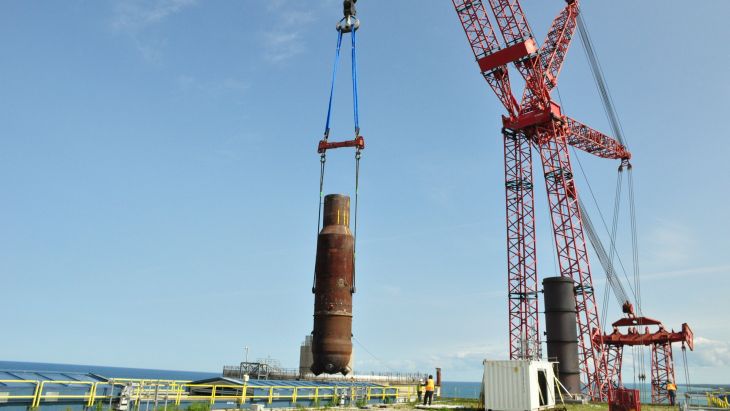
    Bruce 3's steam generators are being replaced as part of the company's Life-Extension Program and Major Component Replacement - or MCR - Project. Over the past six months, Bruce Power has worked with the Steam Generator Replacement Team (SGRT) joint venture of Aecon and SGT (a partnership between Framatome Canada Ltd and United Canadian Operations Ltd) to carry out the process. First, the 300-tonne steam drums which sit above the steam generators had to be moved out of the way on a track system and set aside for inspection and maintenance. The original steam generators - which weigh 100 tonnes each - were then lifted out through the roof, and the new ones lifted back in using Mammoet's PTC-35 crane, which stands more than 100 metres high.


    The PTC-35 crane in action at Bruce (Image: Mammoet/X)

    "This was a huge undertaking that required more than a year-and-a-half of planning just to get to the execution phase, which was delivered safely and successfully through a high degree of collaboration," Bruce Power’s Vice-President of MCR Execution Rob Hoare said.

    Bruce 3 was taken offline to begin its MCR outage in March 2023. It is the second of six units at the Bruce site which will undergo the process, which involves removing and replacing key reactor components including steam generators, pressure tubes, calandria tubes and feeder tubes and adding 30-35 years to the reactor's operating life.

    The new steam generators were manufactured by BWXT around 20 years ago and have been stored on the Bruce Power site, the company said.

    Radioisotope record


    Separately, Bruce Power announced it had completed its celebrated its largest-ever harvest of cobalt-60 during a planned outage at Bruce unit 5 during which upgrades will also be carried out to allow an increase in the production of cobalt -60 and High Specific Activity (HSA) cobalt-60. Cobalt-60 is used to sterilise around 40% of the world's single-use medical devices, including syringes, catheters, IV sets, surgical gloves and gauze used in a wide range of health care applications. HSA cobalt-60 is a medical-grade radioisotope used in the treatment of brain tumours and breast cancer through non-invasive procedures.

    "The production of these potentially life-saving medical isotopes is a beacon of hope that is provided by our nuclear industry," Bruce Power Chief Operating Officer and Executive Vice-President and Chair of the Canadian Nuclear Isotope Council James Scongack said.

    World Nuclear News