Wednesday, April 02, 2025

‘Canada’s Liberals are riding a national pride wave – could Labour do the same?’
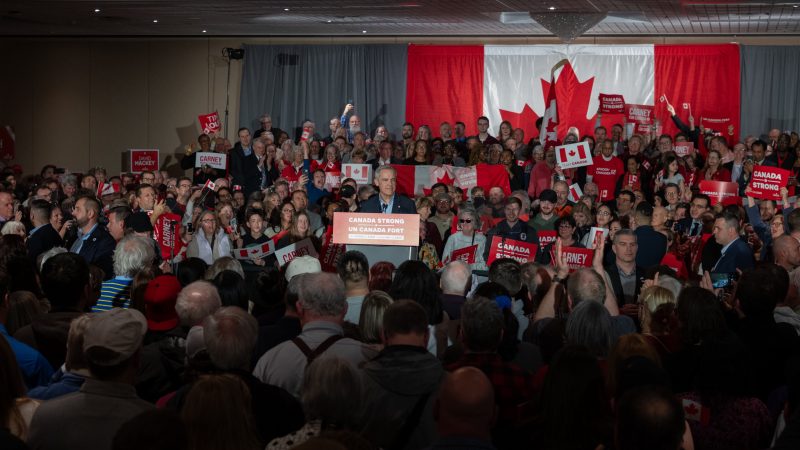

Photo: Liberal Party of Canada

The first time I noticed “it” was on a Friday night, trying to tune out the stressful news that U.S. President Donald Trump was taking aim at my country – Canada. 

First, through threats of a tariff war. Second, by “joking” about making Canada the 51st state of America and calling our prime minister “governor” of the 51st state.

Whether fact or fiction, Canadians are renowned for politeness. Trump’s taunting unleashed a nationalistic pride that feels uncharacteristically defiant.

So that Friday night watching TV, “it” hit me. 

Team Canada queued up in the opening game of “The 4 Nations Faceoff”, involving hockey teams from Finland, Sweden, Canada, and America.

During the U.S. anthem, Canadians booed—loudly drowning it out. During the Canadian anthem, the audience sang as though their life depended on it. With pride, defiance, harmony.

Even Prime Minister Justin Trudeau, who was in that Montreal audience, was captured on video singing with his compatriots.

Then the gloves came off

An American player literally dropped his gloves and started a fight with Canadians… before the puck even dropped.

That was Act One of Canada’s new story. It’s a story of nationalist pride that surprised Canadians, laid bare hard truths about our friendship with America, and turned a disadvantage for Canada’s ruling Liberal government into a sudden advantage.

Until that moment, Liberal popularity had been tanking to levels that seemed beyond repair. The Conservative party, which had embraced Make America Great Again, or MAGA, style politics, seemed to be poised to take power.

That party had skillfully played off the politics of division, with slogans like “Canada is broken”. They had embraced the post-pandemic Freedom Convoy movement that turned Canada’s flag upside down and bombarded us with “F*ck Trudeau” messages.

As his personal and party popularity plummeted, Trudeau’s own caucus revolted, forcing a pre-election resignation. It proved to be a turning point.

Canadians are nice, but not that nice
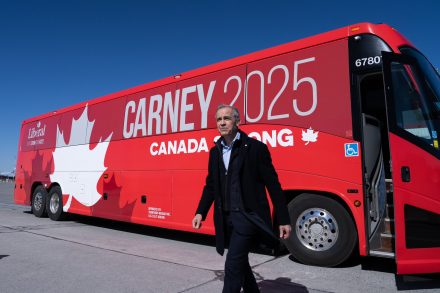
Photo: @MarkJCarney


Enter Mark Carney, former Bank of England governor during the Brexit crisis and former Bank of Canada governor during the 2008-09 global economic crisis.

Carney had earned a reputation of being a steady hand at the wheel but had never held political office. Nevertheless, after throwing his hat in the Liberal party leadership ring, he was quickly elevated to Canada’s new prime minister. This all got swept up with the country’s hour of heightened nationalistic pride.

Mark Carney is now at the start of a federal election, playing the role of Captain Canada.

Elbows up

Cherished Canadian actor and comedian Mike Myers stepped into the Trumpian fray by appearing on Saturday Night Live in a “Canada is not for sale” T-shirt, mouthing the words “elbows up” at the end of the show. For those uninitiated in the sport of hockey, players are taught at a young age to keep their elbows up as a defensive measure.

Few things evoke “Canadian” more than hockey, and since then, elbows up has become a rallying cry. Myers followed up with an election campaign opener video, appearing with the new prime minister, reinforcing the elbows up theme while wearing a hockey jersey with the words “Never 51.”


You may be wondering: how could the UK Labour Party capture a similar wave, bursting the alt-right populism bubble?

Policy matters. But in communications, there’s a saying: the best storyteller wins. Today, the Liberal Party is enjoying a storytelling resurgence. 

There’s another saying: campaigns matter. Anything can happen. Especially when you’re running an election campaign in the middle of Trumpian chaos.

Is the secret for a political party to embrace nationalistic pride? That’s not only complicated, it’s fraught.

READ MORE: Labour criticised for not consulting on disability and poverty in policymaking forum for next manifesto

Nationalism can exclude a lot of people

Nationalism can obscure past wrongs, like the ongoing impact of colonialism on Canada’s Indigenous Peoples. It can ignore the imperfections that need to be addressed, like a lack of inclusiveness.

It can encourage people to look the other way, for the sake of unity while under threat, as neoliberalism stealthily tightens its grip.

Focusing on the public good remains dangerous to the neoliberal order. And neoliberalism remains alive and kicking. In the first week of Canada’s federal election, both the Liberal and Conservative parties rolled out a quintessentially neoliberal plan: a promise to reduce personal income taxes while insisting their goal is balanced budgets. 

Those two aims do not square. So, in the neoliberal playbook, cuts to public services and social supports ensue.

We’re too early into Canada’s federal election to know how the nationalistic populist wave will end. There’s talk of strategic voting, hurting the New Democrats, traditionally the voice of workers.

Then there’s the importance of getting out the vote

When you’re vying for the attention of the masses, trying to initiate change, you also need an effective ground game to get voters to the polls —a video just won’t cut it.

In the U.S., Democratic stalwarts Bernie Sanders and Alexandria Ocasio-Cortez are turning heads by focusing on their next ground war. They’re filling stadiums of 20,000+ people when they barely expected 3,000. They’re encouraging transformative change, not tax cuts and not mere slogans.

Unfortunately, that’s not the conversation we’re having in Canada today.

As the British know from the Brexit experience, national insecurity can undermine progressive outcomes for those seeking better working conditions, reduced income inequality, climate change initiatives, and the transformation of a neoliberal system that’s rigged in favour of the rich.

In Canada, we’re in elbows up defensive mode. Whether this succeeds in smashing the status quo or simply propping it up, it’s still too soon to tell.



The left in retreat

CANADIAN SOCIALIST JOURNAL

April 1,2025

Mike Phipps reviews Openings and Closures: Socialist Strategy at the Crossroads, Socialist Register 2025, edited by Greg Albo and Stephen Maher, published by Merlin.

The 61st volume of Socialist Register comes at a transitional moment, say editors Greg Albo and Stephen Maher, in a period marked by ‘morbid symptoms’. The left appears on the defensive, with many of the new left experiments in western Europe, from Corbynism to Podemos, defeated, and the ‘pink tide’ of Latin America in retreat.  

In Europe, those parties that got closest to power, such as Greece’s Syriza, underestimated, as Panagiotis Sotiris argues, the extent to which Eurozone institutions cold block progressive movements, which lacked the strategic vision to see that a rupture with these institutions was the precondition for reform. Another problem with many similar left-populist projects has been their short-termism and a reliance on media popularity rather than long-term mass organisation.

In Britain, argue Michael Calderbank and Hilary Wainwright, the electoral defeat of Labour under Jeremy Corbyn in 2019 cannot fully explain the marginalisation of the left subsequently. Momentum’s efforts to organise after this defeat were made all the more difficult by Keir Starmer’s rightward march, the witch-hunt against leading people allied to Corbyn, the exodus of many of their supporters from the Party and the conditions of Covid Lockdown. This, as well as making organising more challenging, also handed control of online meetings and elections to a factional Party apparatus.

Yet as the authors point out, “Starmer could not have achieved such an iron grip over the internal culture of the party without a notable shift in the mood of the unions on the NEC.” Arguably, their support has been rewarded by a manifesto commitment to a ‘New Deal for Working People’ – albeit quite diluted in practice – above-inflation pay awards in the public sector and public ownership of part of the railways.

But not much else, it seems to me, and not much for working people more broadly: the precariat, renters and those suffering most from the cost of living crisis, above all people on benefits – which often includes those in work. If Labour continues to plummet in the polls and gets thrown out at the next general election – admittedly some way off – it will be a defeat for the unions as well. Should their leaders not be making more demands on the Government?

Last year’s Party Conference saw unions voting against the Government’s cut to Winter Fuel Payments, indicating tensions between the drive to improve living standards on one side and Chancellor Rachel Reeves’ commitment to tight spending rules and neoliberal fiscal orthodoxy on the other. The rise of far right agendas since the general election, however, makes it unlikely that any affiliated unions will break from Labour. This means that, electorally at least, left alternatives are likely to be personality-based or single-issue, like the four Independents elected in 2024 alongside Jeremy Corbyn, primarily because of their stance on Gaza. Consequently, however far to the right the Labour leadership leans, the battle for a government that meets the immediate interests of working people is likely to continue to be centred on the Labour Party itself.

This is not to say that the left cannot work creatively in their communities beyond the political and organisational limits of Labourism, as has been the case in activities in solidarity with Palestine, for example. But it does underline the uphill nature of building any electoral alternative to Starmer’s Labour at present.

Elsewhere, signs of municipal radicalism, such as Barcelona en ComĂș, also appear to be in retreat. As Greig Charnock, Jose Mansilla and Ramon Ribera Fumaz explain, this insurgent movement, itself very diverse, once in office had to build coalitions with a range of other forces. This blunted its radicalism, which was already constrained by having to work in the framework of multi-level governance in the Spanish state. For example, as Barcelona city council sought to stem the influx of short-stay tourists, the regional government promoted the exact opposite policy. Notwithstanding these obstacles, Barcelona en ComĂș did pioneer some vital measures for tackling the city’s housing crisis and significantly increased social services spending at a time of continued austerity across the rest of Spain.

Across Europe, the left has collided with the restrictive rules of the EU. Catarina Principe asks “what it is about the European Union that makes it so hard for states – namely peripheral ones – to both thrive and leave?” In Portugal, the Left Bloc entered a left government led by the Socialist Party in 2015 to keep out the right and contribute to a progressive agenda. But four years later, it was the Socialist Party that increased its vote share, and in 2022, it got an absolute majority with the radical left vote cut in half. The result underlined the dilemma facing the Left Bloc and similar currents which are tempted to join coalitions to their right: attempting to influence government policy from the inside, but being co-opted into a limited policy agenda and being held accountable for it at the ballot box.

Not all the analysis here is uniformly incisive. On Germany, Ingar Solty attributes the decline of Die Linke to its support for Covid lockdowns and its deference to “NATO discourse” on the war in Ukraine. Yet in retrospect, the breakaway split led by Sahra Wagenknecht, who rejected these positions, opposing vaccine mandates and calling for closer ties with Russia, proved unpopular with the voters in February’s parliamentary elections. The new leadership of the Left Party, on the other hand, was able to gain an unexpected 9% of the vote on the basis of its anti-austerity policies and support for migrants’ rights.

Other contributions here look at the state of the left in the USA and countries in Asia and Latin America, as well as broader themes the left might focus on, such as the re-municipalization of public services – 1,600 cases in over 70 countries have been documented – and the transformative potential of public banks.

It’s an eclectic collection, with no instant solutions to what the left should do in these unpredictable times. At least, it indicates that some serious thinking is going on and that’s positive – but a lot more will be needed!

Mike Phipps’ book Don’t Stop Thinking About Tomorrow: The Labour Party after Jeremy Corbyn (OR Books, 2022) can be ordered here.

UK

The Assault on Living Standards: How Disabled Gypsies and Travellers Are Being Left Behind

MARCH 31,2025

Unless urgent action is taken, more people will be pushed into extreme poverty and even premature death, argues Claire Rice.

The UK’s poorest are facing yet another wave of economic hardship, as outlined in the Joseph Rowntree Foundation’s response to the Chancellor’s Spring Statement, “Cuts to push 250,000 into poverty as living standards for the poorest under continuing assault.” But for Gypsy and Traveller communities—particularly those who are disabled—the impact of these cuts and rising costs is even more devastating.

A Community Already on the Brink

Gypsies and Travellers are already among the most disadvantaged groups in the UK. They have lower life expectancy, worse health outcomes and higher rates of disability compared to the general population. Many live in insecure housing—whether on council sites with inadequate facilities, roadsides with no access to basic services, or in bricks and mortar housing that doesn’t meet their needs. The rising cost of living, coupled with a social security system that increasingly fails to provide a safety net, is pushing many to breaking point.

For disabled members of the community, the challenges are even more severe. Many rely on Personal Independence Payments (PIP) or other disability benefits to survive, but with growing delays, harsher assessments, and increasing thresholds for support, many are being denied the help they need.

The Rising Cost of Being Disabled

Being disabled in Britain has always been expensive, but the cost-of-living crisis has made it unbearable. Research shows that disabled people face extra costs averaging £975 per month. This is even higher for those living on Traveller sites or in mobile homes, where energy prices are extortionate due to reliance on bottled gas, electric meters, or generators.
• Many disabled Gypsies and Travellers need medical equipment such as oxygen machines or electric wheelchairs, which require constant power—something that’s unreliable or unaffordable on many sites.
• Poor site maintenance means that disabled residents are often living in unsafe conditions, with no proper access to sanitation, heating, or even smooth paths to move around.
• For those in bricks-and-mortar housing, the lack of culturally appropriate support often leads to isolation, poor mental health and difficulties accessing services.

Cuts to Benefits and Services: A Death Sentence for Some

With changes to disability benefits and ever-tighter eligibility criteria, many disabled Gypsies and Travellers are being forced to survive on less. The push toward means-testing benefits, alongside increased scrutiny and reassessments, means that even those with lifelong disabilities are at risk of losing vital financial support.

The impact?
• More disabled people are unable to afford heating, food or transport to medical appointments.
• The mental health crisis among disabled people—already at shocking levels—is worsening, with many struggling to see a way forward.
• Some are being forced into unsuitable housing or even left homeless due to rising costs and lack of accessible accommodation.

A System That Doesn’t Work for Gypsies and Travellers

One of the biggest issues facing disabled Gypsies and Travellers is the inaccessibility of the benefits and social care system. The move toward digital applications and online-only support services excludes those who cannot read or write, have no fixed address, or lack access to the internet.

Many Gypsies and Travellers who are disabled or caring for disabled family members struggle to get the support they are entitled to because of systemic discrimination, complex bureaucracy, and a lack of cultural awareness among professionals.

The Government’s Responsibility

The Government cannot claim to be ‘supporting the most vulnerable’ while simultaneously making it harder for disabled people to live with dignity. For disabled Gypsies and Travellers, the situation is critical. There needs to be:
• A review of how disability benefits assessments impact nomadic and site-based communities.
• A commitment to ensuring all social security and support services are accessible to those with literacy barriers or no fixed address.
• Targeted financial support for disabled people facing the highest energy costs, particularly those on Traveller sites.
• Proper maintenance and investment in site infrastructure to ensure disabled residents have access to the same basic living standards as everyone else.

A Fight for Survival

For disabled Gypsies and Travellers, these cuts and rising costs are not just an inconvenience—they are a fight for survival. Unless urgent action is taken, more people will be pushed into extreme poverty, worsening health conditions, and even premature death.

This isn’t just about numbers on a spreadsheet. It’s about real people—elderly residents who can’t afford to heat their caravans, disabled children going without vital equipment, and families struggling to care for their loved ones in impossible conditions.

The Government’s policies are not just failing disabled Gypsies and Travellers—they are actively harming them. And unless we stand up and demand change, this crisis will only get worse.

Claire Rice is Project Coordinator for Drive2Survive.

Image: Traveller community. Source: News Øresund – Johan Wessman. Licence: CC BY 2.0.

Tax wealth to invest in social and physical infrastructure


MARCH 31, 2025

Özlem Onaran outlines what ought to be the economic priorities of the Labour Government.

The expected outcomes of the Chancellor’s Spring Statement were assessed by the Resolution Foundation to mean nothing less than a deep recession for the bottom half of society by the Resolution Foundation. The Government’s own impact assessment shows that changes to social security are likely to result in an alarming 250,000 more adults and 50,000 children being pushed into poverty. The largest group affected by the changes will be single women, who make up 44% of those losing out, at an average of £1,610 a year, according to the Women’s Budget Group. But these assessments contain nothing on the impact on carers, nor the likely impact on people who may have to drop out of the workforce to pick up the care of people whose benefits have been cut, most of whom will be women.

This latest set of cuts comes on top of the negative aspects of the Chancellor’s 2024 budget, which failed to undo some of the punitive measures introduced since 2010, including  the two-child limit, the benefit cap and tougher sanctions for those on benefits. Meanwhile, more unfavourable headwinds internationally mean there will be a need for more cuts and/or tax increases in autumn 2025.

Against this backdrop, the best way to strengthen the UK economy and its resilience to these threats is to repair the UK’s crumbling social infrastructure and maintain our spending on foreign aid, as opposed to imposing spending cuts.  

An economic alternative needs to be structured around public provision of universal basic services in health, social care, disabled care, childcare, education and public investment in housing, public transport and renewable energy.  This public investment push would drive  new employment opportunities with decent pay attached. This full-employment targeting fiscal policy in combination with a revamped genuine Employment Rights Bill, adequate decent income support for special needs – disability, unemployment, parental leave – and an end to punitive sanctions would have been the adequate basis for welfare reform.

A green, red and purple transition

What’s required is a paradigm shift towards a needs-based approach to policy. We should start by asking: How many care workers are needed to meet the UK’s demographic needs, with decent pay for these key workers involved?

Instead of erecting a false competition between different public spending needs, we should recognise that they are complementary. All policy tools need to be utilized and all means of funding be mobilized, with an effective coordination across fiscal, monetary, industrial, labour and social policies.

How can this be funded? Public investment will generate new employment, resulting in an increase in total income and correspondingly more tax revenues, even without any increase in tax rates.

However; at the core of the funding drive for a big push in public investment lies  progressive taxation on both income and wealth.

On borrowing, we need to widen the definition of infrastructural investment and relax the Chancellor’s self-imposed fiscal rules. A national investment bank, networked with public and cooperative banks, should be created.

As for monetary policy, the key aim should  be to accommodate full employment targeting fiscal policy, and targeting inflation should be subordinated to that, with an inflation target around 4 to 5%, rather than as low as possible. The Bank of England should buy government bonds in primary markets if needed: in short, monetary policy should accommodate an expansionary fiscal policy.

The Government should bring in a progressive wealth tax on the top 1%, starting with a marginal tax rate of 1% reaching to 4% for the top 0.1% on their net wealth including all assets (minus liabilities).

As our research at the University of Greenwich illustrates, if we taxed those individuals with above £2.2 million net wealth (the top 1%) at a marginal rate of 1%, and those with above £3.6 million (the top 0.5%) at a marginal rate of 2%, and those with above £11.2 million (the top 0.1%) at a marginal rate of 4%, we would raise £46 billion, if 50% of the tax is avoided, £69bn if 25% is avoided, and £78 billion, if 15% of the tax is avoided.

That is equivalent to  8-12% of total tax revenues taken by the UK government in a year. This would increase the average effective tax rate on wealth to 1.37% from 0.99% (by an increase of 0.38% point).

Alternatively, a flat tax rate of 1% on the top 1% wealthiest individuals would raise £17bn, if 50% were avoided, £25bn if 25% were avoided, or £28bn, if 15% were avoided.

We should start campaigning on this now, as the Chancellor may in any case need to increase tax rates in the autumn 2025 given the global turmoil.

This needs-based approach would see urgent and largescale public investment leading the way. The priority would include ‘purple’ care infrastructure: education, childcare, healthcare and social care, and a recognition of this as social infrastructure, with direct and indirect productivity effects, for example effects on the future labour force, the social fabric and freeing the unpaid domestic care workers, most of whom are women.

Other infrastructure investment would be  social housing, hospitals, schools, nurseries and care homes, alongside the green economy: renewable energy, energy efficiency, public transport, organic agriculture and forestry.

These priorities should be embedded in a democratic, participatory plan, at least covering the key sectors. At its heart should be publicly owned enterprises (central, local, cooperatives),  and democratic, participatory decision-making by workers and users of their services.

 Ă–zlem Onaran Is Professor of Economics, Co-Director of  Centre of Political Economy, Governance, Finance and Accountability and Associate Head of the School of Accounting, Finance & Economics – Research and Knowledge Exchange at the University of Greenwich. This article is an edited version of a speech she made at this weekend’s Socialism or Barbarism event, organised by Arise- a festival of Left Ideas on 29 March 2025.

Image: c/o Labour Hub.

Thames Water: public ownership is long overdue

APRIL 1, 2025

By Murad Qureshi

Thames Water bills will go up this month by 31%. The average annual bill will increase from £488 to £639.

Yet, as the Express revealed recently, “Over a third of customers’ bills for water in England and Wales are not used for water and sewerage services. An average of 35% of customer bills in 2023-2024 was taken out to pay for the interest on water companies’ debt piles and to pay dividends to the shareholders.”

Thames Water currently has a debt mountain of £20 bn – there is a debt of £60 bn across the industry. Meanwhile £80 bn has been paid out in dividends over the last 35 years since privatisation.

Last month, it was revealed that a record 3.6m hours of sewage was dumped in UK waters in 2024. Friends of the Earth’s senior sustainability analyst, Paul De Zylva, commented: “Water customers – who are about to be hit with even higher water bills – will wonder what happened to their money which should have been used to prevent pollution long before now. We need urgent, bold action by the government, not more anti-regulation rhetoric from ministers, to hold these and other serial polluters to account.”

Thames Water alone pumped human waste into the Greater London area of the River Thames for a staggering 1,914 hours in the first eighty days of 2024 alone. Over 90% of samples taken from the river revealed a significant presence of coliform bacteria, with oxygen levels on occasion being so low as to threaten aquatic life.

In July 2023, Thames Water was fined £3.33m after millions of litres of raw sewage flooded two rivers near Gatwick. The untreated effluent killed several thousand fish. The presiding judge said the company deliberately misled the Environment Agency during its investigation.

In November of that year, the Guardianreported that Thames Water had pumped at least 72bn litres of sewage into the River Thames since 2020. The company was fined a total of £35.7m between 2017 and 2023 for pollution incidents – fines that are paid for by higher bills for consumers. A failure to  invest in new treatment works is the key reason the company fails to meet its legal targets. Last year London Mayor Sadiq Khan called on the company’s Chief executive to “get a grip of the situation.”

My CLP, Queens Park and Maida Vale, recently passed a resolution expressing our deep concerns about the recent proposed hikes in Thames Water charges for residents in our constituency. We noted that during a cost of living crisis, Thames Water has gone to court for a loan of £3 billion when it already has £17 billion debt, and wants to increase our water bills to fund their dividends to shareholders where a third of customer bills will cover interest payments alone.

We noted that globally full privatisation of water supply and sanitation is an exception today, being limited to England, Chile and some cities in the United States. Public ownership is popular with 82% of the UK population, more popular than that of our railways, which have already been partly brought back into public ownership by the Labour government.

Thames Water’s record in London has been pretty awful, with investments like desalination plants of £500 million hardly being used since they were built. In particular in W9, where even after Flip kiosks at several million pounds’ cost were installed, we still had flash floods in 2021 that they could not cope with at all.  Meanwhile, road works for water leaks are a major cause of road closures in Central London, with up to 3,000 holes dug annually in the City of Westminster alone!

We should not permit the socialization of their losses, while the profits are privatised again in the future. On this basis, the customer is bailing out the privatised water industry for the work they failed to do with the money we gave them in the first place.

We want our elected members to make the case for government to explore national ownership of Thames Water, similar to the mutualisation of water facilities by local regional government in Wales. The spectacle of ​​Thames Water seeking permission from the Competition and Markets Authority to allow it to increase water bills by 59% over five years is quite incredible. I trust the CMA does not forget their mission to make markets work in the interests of consumers, ensuring fair competition and consumer protection.

Murad Qureshi was a member of the London Assembly from 2004 to 2016 and from 2020 to 2021. He blogs at http://www.muradqureshi.com/

Image: https://equalitytrust.org.uk/tag/privatisation/ Creator: rawpixel.com / U.S. Department of Agriculture (Source) | Credit: rawpixel.com / U.S. Department of Agriculture. Licence: CC0 1.0 Universal CC0 1.0 Deed


Thames Water picks US investment firm KKR as ‘preferred partner’


A tanker from Thames Water

Morning Star | The People’s Daily

Tuesday, April 1, 2025

THAMES WATER has picked US investment firm KKR as its “preferred partner” in a bid to fight off renationalisation.

The privatised utility, which recently went through court proceedings to secure a £3 billion bailout, is hoping to finalise the terms of a possible deal with KKR in the second quarter of this year and aims to complete it in the second half of 2025.

The US private equity firm is understood to have lodged a £4bn equity bid in return for a majority stake.

We Own It founder Cat Hobbs said: “If KKR secure a £4bn stake in Thames Water, this will do nothing to change the picture.

“They will still be drowning in over £16bn of debt, still trying to dodge environmental fines and will still prioritise shareholders over bill-payers and the environment

“The government has ducked the issue for too long — special administration to slash the rotten debt, then full public ownership, is the only way to reverse this catastrophe.”

Thames Water said there was still “no certainty” over a deal, adding that “certain senior creditors continue to progress in parallel alternative transaction structures to seek to recapitalise the business.”


 UK

Shock by-election win for Ilford independents

APRIL 2, 2025

How did Labour come to lose one of its safest seats in the borough?

“Labour crashed to defeat in the latest London borough by-election, which took place in Redbridge Council’s Mayfield ward on Thursday,” reports On London. The election saw a convincing Ilford Independent win.

It was a huge swing against Labour in a previously very safe ward, where two-thirds of the population are of Asian ethnic origin. Turnout was 25%, which is not especially low for a local by-election.

The ward was previously held by Labour’s Jas Athwal, who was elected to Parliament in last year’s General Election, following a controversial selection process in which he unseated sitting MP Sam Tarry, who went so far as to claim the contest had been rigged. Tarry had earlier been sacked by Labour leader Keir Starmer from his position as Shadow Minister for Buses and Local Transport, for an unauthorised media appearance, and having appeared on picket lines. It was one of a series of controversial selection processes in Labour’s usually safe east London heartlands.

Labour’s vote share plummeted in this by-election. The winner, Noor Jahan Begum, was a strong candidate, who works as a commissioner of health and social care and serves as a local magistrate. She was the independent Ilford South candidate at last year’s General Election and got over 9,000 votes.

Independents: We will challenge Labour in every seat in Redbridge

Rita Mahli, of Chingford & Woodford Green Community Independents, told Labour Hub: “The success of the Redbridge and Ilford Independents candidate in the recent Mayfield ward by-election should serve as a warning for Labour councillors in the borough and beyond.

“Mayfield was the ward previously held by Jas Athwal, the former leader of Redbridge Council who became the MP for Ilford South at the general election last year. Exposed as the landlord of unlicensed mould- and ant-infested flats, he had ignored calls to stand down – and the result of the by-election gives us all a clue as to why he wanted to hang on for so long.

“Labour’s vote share plummeted by 45 per cent in Mayfield. Locally and nationally the Party seems to be haemorrhaging support with a raft of ill-judged and unpopular policies, with voters demonstrating in local by-elections and national opinion polls that they will no longer support a Party who, it is sometimes hard to believe, came to power only less than 12 months ago. Labour has thrown away its lead in the polls and its goodwill among voters in a quite spectacular fashion.

“In Mayfield, the Party’s failure to speak out about the genocide in Gaza and its continued arms sales to Israel no doubt played a massive part in the loss of one of the safest seats in the area.

“Local Muslim voters feel betrayed by Labour, a Party traditionally strongly supported by the community at the polls. The population of Mayfield ward is 51 per cent Muslim and the Party showed contempt for the electorate by choosing to hold the election during Ramadan.

“But, on the doorstep, other recurring themes were just as damning.  Locally, voters raised the lack of standards in public office – Athwal’s record as a landlord and a Labour councillor in neighbouring Hainault ward being convicted of sex offences.

“Nationally, withdrawing winter fuel payments from pensioners, cutting benefits for the  disabled, cuts to public services and failure to fund the NHS were all raised.

“Voters routinely stated that Labour lied to get elected. That the Party has let them down. That they are dishonest and not to be trusted. That the mainstream parties are all the same – it doesn’t matter who you vote for, your life doesn’t get any better. And that’s from voters across the spectrum, not just from the Muslim community.

“And Labour cannot say the result comes as a surprise. In the general election, independent candidates in all the parliamentary constituencies covering parts of the borough Redbridge cleaved huge chunks from the Labour vote.

“Shanell Johnson, an independent councillor in the borough, got 4,173 votes in Leyton and Wanstead. Noor Jahan Begum, the victorious independent candidate in the Mayfield by-election, took 9,643 votes in Ilford South, where the victor Jas Athwal polled 18,548 votes fewer than his Labour predecessor Sam Tarry.

Faiza Shaheen, who was deselected as the Labour candidate after the election had already begun, won 12,445 votes in just a four-week campaign in Chingford & Woodford Green.

“And, most astoundingly, 24-year-old British Palestinian activist Leanne Mohamad came within 500 votes of beating Health Secretary Wes Streeting in Ilford North.

“Does Labour really think that it can keep breaking its promises, pledge investment while delivering austerity, ignoring the wishes of its voters on deeply felt issues like Palestine, denying genocide and enabling war, and there will be no electoral consequence?

“Does it think that it can put up public representatives who break its own rules for landlords, leaving desperate tenants in ant-infested flats, and people will still come out and vote for them?

“Redbridge voters deserve better and the movement of progressive, independents, rooted in their communities, arguing and striving for improvements for local people is becoming stronger every day.

“At the 2026 council elections, it’s safe to say there will be more independent challenge and at the next general election too.

“Labour is a Party whose credibility as a progressive force in our society is slipping away, in Redbridge and elsewhere. Unless it alters course quite dramatically, the pounding the party took in Mayfield will be the first of many.”

Vaseem Ahmed, Chair of Redbridge & Ilford Independents, stated: “This evening, Labour suffered its worst local election defeat in Redbridge for over a decade. This momentous result shows that people desperately want change. Noor Jahan Begum, our fantastic local candidate, proved that ordinary people can make a difference with organisation, tenacity and solidarity…

“But we know the battle is far from won, not by any means! Labour still have over 50 Cllrs and two MPs, but we will challenge them for every one of these seats as Redbridge & Ilford Independents. We are now a serious and organised opposition in the borough. Only we can defeat Labour in Redbridge and that is what we intend to do.”

Labour members feeling bruised

Labour, meanwhile, are despondent. “This was one of the safest seats in Redbridge,” a local Labour activist told Labour Hub. “If this trend continues, the Party will struggle to hold onto the council at the next local elections.” There are other wards in the borough that resemble Mayfield demographically, so Labour could face a serious challenge from its left.

Local Party members are feeling bruised. The last-minute deselection of Faiza Shaheen as Labour’s Chingford parliamentary candidate in the middle of the 2024 General Election campaign still rankles with many. Members have felt shut out from local selection processes, with candidates effectively appointed by London Region, one Labour insider said. As a result, members have not been keen to canvass.

Last year, Councillor Rosa Gomez quit the Party and sat as an independent, complaining of the “ill treatment I have received from the leadership in Redbridge.” She too cited the apparatus’s shabby treatment of Faiza Shaheen in her resignation statement.

Last November, Labour hung on to Wanstead Park ward in a by-election, only after the Party mobilised canvassers from across the borough. It will be interesting to see how the Party fares in the next by-election in the borough on May 1st, which will take place following the resignation of Sam Gould from the council. Gould, a former senior aide of Health Secretary Wes Streeting, stood down after being convicted of two counts of indecent exposure last month, to which he pleaded guilty.

Image: Redbridge / tube station | Architect: Charles Holden, design… | Flickr https://www.flickr.com/photos/rogersg/14136870485. Licence: Attribution-ShareAlike 2.0 Generic C BY-SA 2.0 Deed


Callous cuts cost lives – austerity is the wrong choice


By Michael Calderbank

In last week’s Spring Statement, Rachel Reeves made a clear political choice to embrace a second round of austerity. She aims to balance the books on the backs of the sick and disabled, by cutting benefit entitlements to levels which even the Government’s own impact assessment indicates will push a further 250,000 (including 50,000 children) into poverty.   

It wasn’t the only choice she could have made. Few would dispute the difficulty of the inheritance Labour received following the disastrous Tory years of austerity, the challenges posed by the US’s withdrawal of military support for Ukraine and the impact of Trump’s damaging tariffs on trade. But given that the ‘world has changed’ since Reeves set her own self-imposed fiscal rules, it would only have been prudent to revisit these strictures to allow for greater levels of borrowing in the short term. Even a moderately social democratic Chancellor would surely have taken the opportunity to raise taxes on the super-rich. Oxfam and Tax Justice UK calculate that a 2% wealth tax on assets exceeding £10 million in the UK could potentially raise around £24 billion annually.

Reeves and Welfare Secretary Liz Kendall present further welfare reform as some kind of liberation for people trapped by a ‘broken system’ into subsisting on state handouts rather than enjoying the benefits of a fulfilling career. It’s basically the same ‘workers versus shirkers’ rhetoric we saw from George Osborne and Iain Duncan-Smith under the Tories. It ignores the reality of people’s lives, the spiralling mental health crisis amid inadequately funded mental-health services and the profoundly depressing, stressful and exhausting reality of trying to eke out a living on low paid, insecure jobs. Coercing sick people back into the labour market by slashing their minimal support payments is cruel and callous. It’s not exactly the change people voted Labour for.

But if the Government thinks it can implement these attacks without paying the political price, it is surely delusional. Activists from Disabled People against the Cuts (DPAC) have already proved themselves a formidable fighting force, ending ATOS’s contract for delivering the Work Capability Assessment. Just months ago, DPAC member Ellen Clifford won a judicial review against the Department for Work and Pensions’ attempt to cut nearly £5,000 a year from almost half a million disabled people. And while disabled people and their organisations will be at the forefront of the fightback, they won’t be alone.      

“Labour is the party of work…the clue is in the name,” ministers argue, as though workers don’t have sick and disabled family members or neighbours. Or as though workers don’t value security in the event that we fall sick ourselves or become disabled? The campaign against benefit cuts is a class issue. Eleven trade union General Secretaries from the Trade Union Coordinating Group – the vast majority of which are affiliated to no political party – have written an open letter to Starmer and Reeves to commit their support to the campaign to reverse the cuts.  Significantly, this includes the PCS union – whose members work for the Department for Work and Pensions, including in the job centres. They know all too well what distress results from such policies.    

Nor are campaigners without allies inside the Labour Party, whatever the leadership might say. Already at least 25 MPs have said they will rebel rather than back the Government’s plan, with more speaking out by the day. With many areas facing local elections in May, reports are feeding back that the mood on the doorstep towards Labour is becoming utterly toxic. Angry local councillors will be pressuring MPs, many of whom – even at this early stage in the Parliament – will be starting to worry about their own future electability. A serious coalition of resistance is building, outside and inside the Labour Party, and now is the time to build maximum pressure on MPs to defy the whips and force through a change of direction.

The Trade Union Coordinating Group is holding an online discussion with Arise tomorrow (Wednesday April 2nd from 6.30pm) to review the Spring Statement and discuss building a coalition against the next wave of austerity cuts – with John McDonnell MPEllen Clifford and Paula Peters from DPAC and Fran Heathcote (PCS General Secretary), chaired by Sarah Woolley (BFAWU General Secretary). 

Register here.  

Michael Calderbank is Political Education Officer of Tottenham CLP.


Say No to welfare cuts!

MARCH 30, 2025

At least 25 Labour MPs are already planning to vote against the Government’s welfare cuts, announced last week. This number is set to grow and may well become the largest rebellion against Keir Starmer’s Government to date.

The cuts to benefits to disabled people in particular has unleashed a storm of protest, which has seen prominent members, including former Scottish Labour MSP Neil Findlay, resign from the Party.

Many Labour MPs who have not previously been critical of the Government have delcard their opposition. It’s good to see MPs speak out, but more must be urged to take a stand. To that end, Momentum are urging members to use its lobbying tool to write to their Labour MP urging them to vote against any cuts to welfare if they go to a vote – and to oppose through any other channels.

Ian Byrne MP at yesterday’s event

Speaking at yesterday’s packed Socialism or Barbarism event organised by Arise -A festival of Ideas, anti-poverty campaigner Ian Byrne MP said this was “a hugely important pivotal moment for our movement and we’ve got to make the Labour Government see sense.”

Former Shadow Chancellor John McDonnell MP agreed, saying the cuts to disability benefit were barbaric and that “you cold cut the disillusionment with a knife.”

Speaking about the Arise event, he tweeted: “There’s something definitely building. Every session at the numerous workshops at the Arise festival of Left Ideas is packed but more importantly the strength of feeling against the disability benefit cuts is mobilising people and forging new alliances to demand a change of policy.”

He added: “There’s a growing consensus across all wings of Labour Party, combined with deep anxiety  in the trade union movement and our political base in communities across the country that the disability cuts are wrong and there has to be a U-turn sooner rather than later.”

Tempting though it may be for members to walk out in disgust, now more than ever, it’s vital socialists stay in the Labour Party and join forces with trade unions to challenge the Labour right’s betrayal of the fundamental principles of the Party. Momentum have produced a briefingWhy Socialists should be in the Labour Party, to persuade comrades to stay in, join, or rejoin Labour.

Photo of Ian Byrne MP by Bryn Griffiths