Sunday, May 11, 2025

Hope Is Not a Strategy: The Urgent Need for India and Pakistan to De-escalate


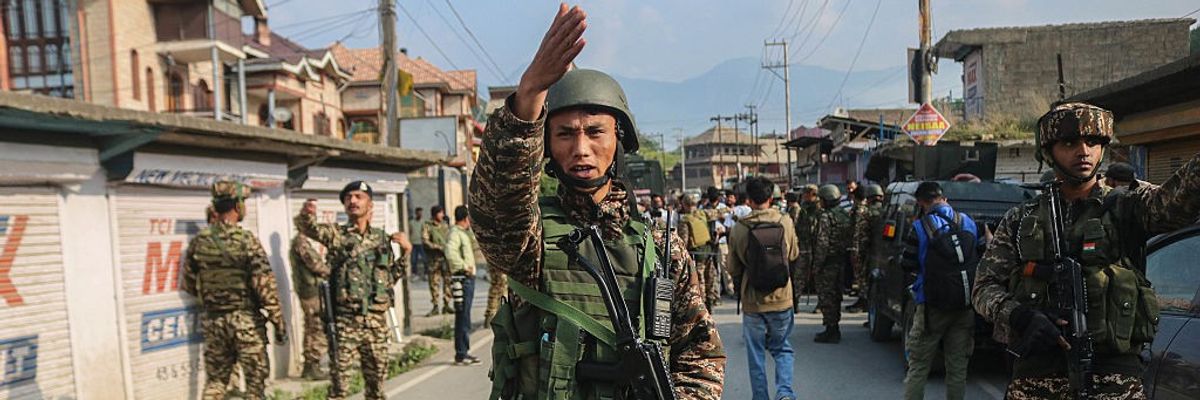
Indian paramilitary soldiers stand guard in Pampore, Pulwama district, south of Srinagar, Jammu and Kashmir, on May 7, 2025. On May 7, the Indian Armed Forces launch 'Operation Sindoor', targeting alleged terrorist infrastructure in Pakistan and Pakistan-occupied Jammu and Kashmir.
(Photo by Firdous Nazir/NurPhoto via Getty Images)


Daryl G. Kimball
May 10, 2025
Common Dreams

The heinous terrorist attack near Pahalgam in Indian-administered Kashmir on April 22 and the retaliatory May 6 missile and drone attacks by India, including on targets in Pakistani territory, have created the conditions for a dangerous escalation of hostilities between these two nuclear-armed states.

UN Secretary General Antonio Guterres, as well as leaders from other key countries, including China, Iran, Saudi Arabia, the United Arab Emirates, the United Kingdom, and the United States, have called for urgent, direct dialogue leading to immediate de-escalation between nuclear-armed India and Pakistan. Nevertheless, the danger of a wider war has not yet been abated.

So far, President Trump has apparently only offered vague words of hope that a more serious crisis can be averted. "They've gone tit-for-tat, so hopefully they can stop now," Trump said at the White House on May 7, adding he knew both sides "very well" and wanted "to see them work it out." He added: "And if I can do anything to help, I will be there."

But given what is at stake, hope is not enough.

India has accused Pakistan of direct involvement in the terrorist attack through Islamist militant organizations it says have the backing of Islamabad. Pakistan has denied involvement and condemned the terror attack. But, following India’s missile volley, Pakistan’s Prime Minister Shehbaz Sharif said India must “suffer the consequences” for the attack and authorized “corresponding action,” which could trigger a chain reaction of strikes and counterstrikes against important military and political targets on each side.

With approximately 170 nuclear warheads each, India and Pakistan have enough nuclear firepower to obliterate the other; Pakistan retains the option to use nuclear weapons first against non-nuclear military threats. In recent days, Pakistan has continued to issue inflammatory statements hinting at potential nuclear use.

Following India's April 24 announcement regarding the suspension of the Indus Waters Treaty, Pakistan declared that it would react with "full force across the complete spectrum of national power," which is a not-so-veiled reference to the possible use of nuclear weapons.

Speaking to Pakistani TV channel Geo News Wednesday, Pakistan's Defense Minister Khawaja Asif said: "If they [India] impose an all-out war on the region and if such dangers arise in which there is a stand-off, then at any time a nuclear war can break out."

Any use of nuclear weapons in a conflict involving nuclear-armed states will likely lead to a wider nuclear war. Such a catastrophe in South Asia, one of the most populous areas of the world, would produce a catastrophe with regional and global effects beyond imagination.

A 2019 study published in the Bulletin of the Atomic Scientists estimates tens of millions of people would be killed, "many major cities largely destroyed and uninhabitable, millions of injured people needing care, and power, transportation, and financial infrastructure in ruins," and the soot that would be ejected into the atmosphere by an India-Pakistan nuclear war would adversely affect the global climate.

The unfolding crisis highlights the reality that the possession and buildup of nuclear arsenals, the perpetuation of nuclear deterrence strategies, and threat of use of nuclear weapons by any state -- whether considered a friend or foe -- is an existential danger to international peace and security.

Senior U.S. leaders, including some presidents, have played an important and sometimes direct role in defusing earlier crises that could have led to nuclear war between India and Pakistan.

On Thursday, Secretary of State Marco Rubio reportedly “emphasized the need for immediate de-escalation” in separate calls with Pakistan’s Prime Minister, Shehbaz Sharif and India’s external affairs minister, Subrahmanyam Jaishankar. These efforts are encouraging but not likely sufficient to avoid a spiraling, out-of-control crisis, which continues to worsen.

The most senior officials in the Trump administration, as well as Chinese leaders who have greater influence with Pakistan, will need to more actively and directly press both sides to refrain from issuing further threats or engaging in further military strikes against civilian or military targets -- whether that be in the form of ballistic missile attacks, drone attacks, or artillery bombardments across the line of control -- which could lead to disaster.

In addition, a second UN Security Council meeting this month on the topic should be scheduled to foster a serious dialogue on off-ramps, to increase the pressure on India and Pakistan to avoid further hostilities, and to explore options for longer-terms exchanges of views on how to reduce the role of nuclear weapons and the risk of nuclear war in the region.

Since the Indian and Pakistani nuclear tests of 1998, India continues to steadily develop more advanced nuclear weapons delivery systems while Pakistan produces more fissile material and new and longer-range missile capabilities in the name of “full spectrum deterrence” against India.

If and when this latest and immediate risk of escalation between India and Pakistan is averted, responsible global leaders need to implement a more comprehensive, balanced, and pro-active strategy to reduce nuclear risks in South Asia and bring India and Pakistan into the global nuclear disarmament enterprise.
BIG BEAUTIFUL EMOULMENT

'Bribery in broad daylight': Experts stunned by Qatar plan to gift Trump $400 million 'flying palace'


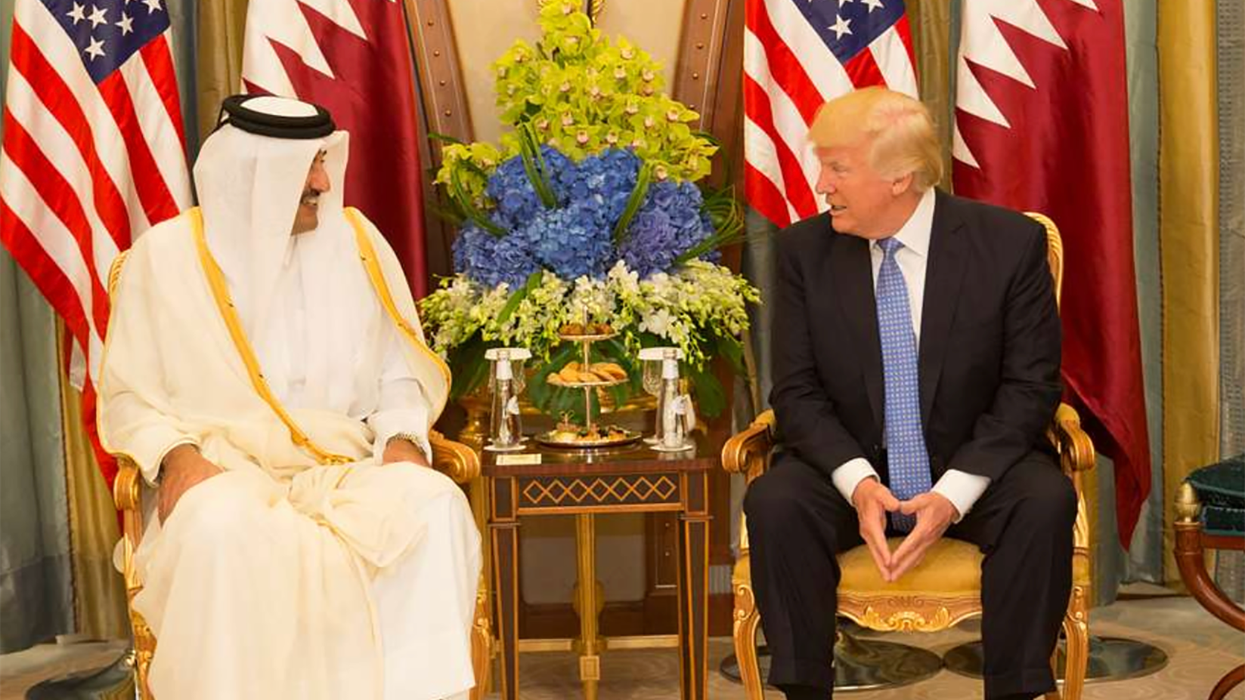
President Donald Trump meets with the Emir of Qatar during their bilateral meeting, Sunday, May 21, 2017, at the Ritz-Carlton Hotel in Riyadh, Saudi Arabia. (Official White House Photo by Shealah Craighead)

May 11, 2025
ALTERNET

President Donald Trump is slated to “accept a super luxury Boeing 747-8 jumbo jet from the royal family of Qatar,” known as “a flying palace,” ABC News reports.

Attorney General Pam Bondi, along with White House counsel David Warrington, advised the Trump administration “it would be ‘legally permissible’ for the donation of the aircraft to be conditioned on transferring its ownership to Trump's presidential library before the end of his term, according to sources familiar with their determination,” ABC News reports.

The report describes the arrangement as “unprecedented,” noting it raises “questions about whether it is legal for the Trump administration, and ultimately, the Trump presidential library foundation, to accept such a valuable gift from a foreign power.”

READ MORE: 'Pretty bleak': Trump-voting Nevada truckers face 'significant hardship' from his policies

Aviation industry experts told ABC the aircraft is estimated to value "about $400 million,” — not including the cost of retrofitting the craft with “the additional communications security equipment the Air Force will need to add to properly secure and outfit the plane in order to safely transport the commander in chief.”

Trump’s potential acceptance of what amounts to a $400 million gift from a foreign government stunned experts and journalists alike.

Democratic Pollster and Strategist Matt McDermott noted that just last week, “[the] Trump Organization announce[d] new $5.5 billion golf course in Qatar.”

“Surely just a coincidence,” McDermott wrote of Qatar’s latest gift to the president.


READ MORE: 'Rigged for the rich': Dems propose a different kind of Social Security overhaul

McDermott described himself as “speechless” upon learning of the president’s new plane.

“A foreign regime gifting a jet to a former president,” McDermott posted on X. "It’s bribery in broad daylight.”

ABC News Chief Washington Correspondent Jonathan Karl called the plane “perhaps the biggest foreign gift ever.”

“[Department of Justice] insists it’s legal, not bribery, not violation of emoluments clause,” Karl added.

READ MORE: There's only one thing blocking Trump's treason

CNN Senior National Security Analyst Juliette Kayyem warned “the surveillance and security aspects are also as disturbing as the grift.”

“Qatar will surely offer a plane that satisfies their needs as well,” she wrote.

CNN Medical Analyst Jonathan Reiner noted Air Force One is "a military aircraft" and is "not intended to be a palace because the U.S. doesn’t have a king.”

Read the full report at ABC News.


'Very bad idea': Even Republicans are revolting over Trump scheme to get $400 million plane from Qatar


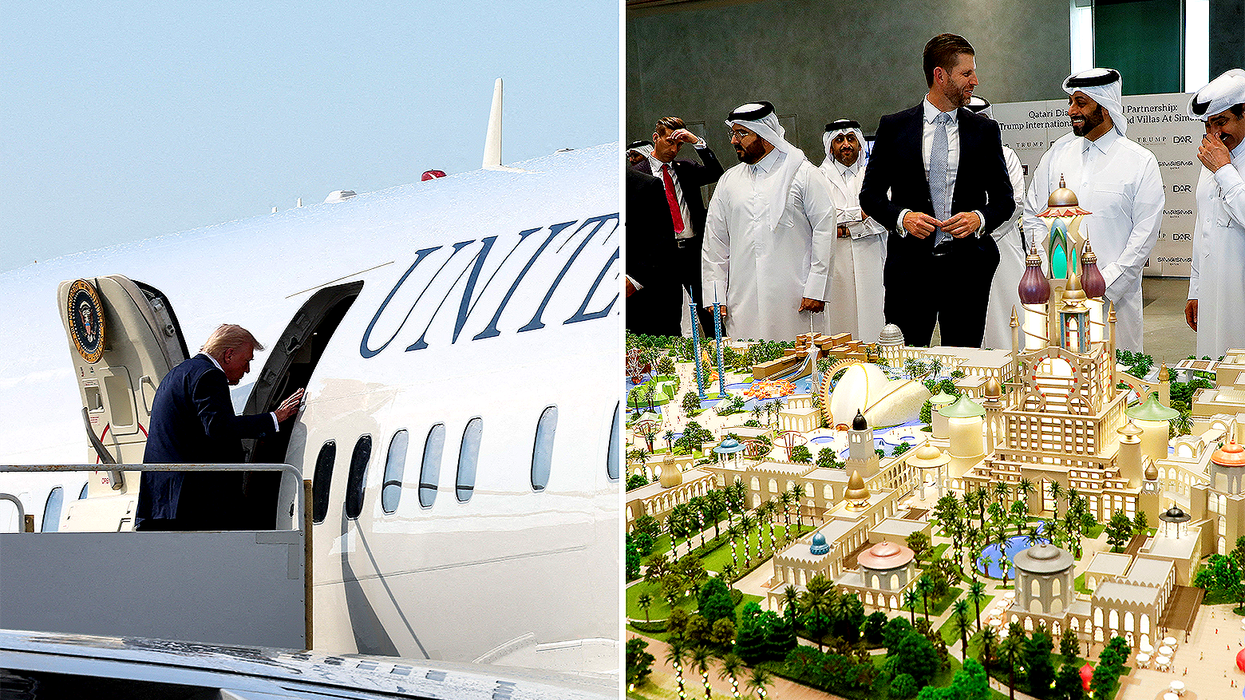
Left: FILE PHOTO: U.S. President Donald Trump boards Air Force One for travel back to Washington, D.C., at Palm Beach International Airport, in West Palm Beach, Florida, U.S. May 4, 2025. REUTERS/Leah Millis/File Photo. Right: Eric Trump, Executive Vice President of the Trump Organization and son of U.S. President Donald Trump looks at the 3D model of Trump International Golf Club & Trump Villas project with Qatari Minister of Municipality & Chairman of Qatar Diar Abdullah Al Attiya, launched between Qatar Diar and DarGlobal in Doha, Qatar, April 30, 2025. REUTERS/Bassam Masoud
May 11, 2025
ALTERNET


'ABC News on Sunday reported President Donald Trump is poised to accept “what may be the most valuable gift ever extended to the United States from a foreign government” — “a super luxury Boeing 747-8 jumbo jet from the royal family of Qatar” to be used “as the new Air Force One until shortly before he leaves office, at which time ownership of the plane will be transferred to the Trump presidential library foundation.”

According to ABC News, “the gift is expected to be announced next week” after “lawyers for the White House counsel's office and the Department of Justice drafted an analysis for Defense Secretary Pete Hegseth concluding that is legal for the Department of Defense to accept the aircraft as a gift and later turn it over to the Trump library.”

As AlterNet reported Sunday, the proposed gift — which aviation industry experts told ABC is estimated to value "about $400 million” — stunned Democrats and journalists alike. But, as news of the plane plan proliferated on social media Sunday, even some Republicans were concerned about conflicts of interest arising from the proposal.

“I’m sure the podcasters who are deeply alarmed by foreign influence will be all over this,” National Review editor Philip Klein wrote Sunday on X.

Call me a crazy RINO neocon, but I think it’s bad for the President of the United States to accept a $400 million ‘gift’ from an Islamist regime that funds terrorist organizations that murder Americans,” conservative writer and podcast host Ian Haworth argued.

Conservative radio host Erick Erickson agreed.

“The Qatari government is not our friend, cooperates with Iran and its proxies, and funds terrorism and pro-terror propaganda around the world,” Erickson wrote in a tweet Sunday.

READ MORE: 'Buyer’s remorse' as MAGA faithful face 'gradual — then sudden — realization' Trump only hurts them

The Bulwark podcast host Tim Miller suggested Trump’s interest in receiving a gift from Qatar undermines the president’s “anti-semitism initiative.” The Trump administration has threatened funding for private universities over what it claims is a failure of universities to address rampant antisemitism on campus.

“Hamas’ sugar daddies are giving Trump a fancy plane? I guess the admin’s anti-semitism initiative has some carve outs,” Miller wrote Sunday.

National Review commentator Stephen L. Miller offered a succinct analysis on reports of Trump’s gift from Qatar.

That sounds like a very bad idea,” Miller wrote.

Read the full report from ABC News.


As Trump family’s Gulf empire grows, rulers seek influence, arms, tech

By AFP
May 10, 2025


Eric Trump recently signed a luxury real estate deal for the Trump Organization in Doha - Copyright AFP Karim JAAFAR

Aya Iskandarani

Ahead of US President Donald Trump’s Gulf visit next week, his son Eric was promoting his crypto firm in Dubai, while Don Jr prepared to talk about “Monetising MAGA” in Doha.

Last month, the Trump Organization struck its first luxury real estate deal in Qatar, and released details of a billion-dollar skyscraper in Dubai whose apartments can be bought in cryptocurrency.

In a monarchical region awash with petrodollars, the list of Trump-related ventures is long and growing. However, the presidential entourage is not the only party cashing in, analysts say.

“Gulf governments likely see the presence of the Trump brand in their countries as a way to generate goodwill with the new administration,” said Robert Mogielnicki of the Arab Gulf States Institute in Washington.

If the president chose, he could hopscotch the region from one Trump venture to another when he visits Saudi Arabia, Qatar and the United Arab Emirates next week on the first foreign tour of his second term.

From Dubai’s Trump International golf course, to a high-rise apartment block in Jeddah and a $4-billion golf and real estate project on Omani state-owned land, business links are not hard to find in the desert autocracies.

At the Dubai crypto conference in April, Eric Trump and Zach Witkoff — the son of Trump’s Middle East envoy, Steve — announced that Emirati fund MGX would use USD1, a cryptocurrency developed by their firm, to invest $2 billion in Binance, a crypto exchange.

– Political influence –

The original title of Donald Trump Junior’s talk at this month’s Qatar Economic Forum, “Monetising MAGA: investing in Trump’s America” was later changed to the more neutral “Investing in America”, cached versions show.

Among such investments is the $2 billion that Saudi Arabia’s sovereign wealth fund reportedly ploughed into the private equity fund of Jared Kushner, Trump’s son-in-law and former advisor.

The Qatar Investment Authority and Abu Dhabi-based asset manager Lunate have also invested $1.5 billion into the fund, according to Bloomberg.

The Trump Organization has been run by the president’s two eldest sons, Don Jr and Eric, since his 2016 election win. While he no longer holds an executive title, Trump has retained his stake in the family business via a trust.

For the Gulf states, which are trying to diversify their fossil fuel-reliant economies by attracting tourism and investment, Trump-branded, luxury-focused developments are a good fit.

However, that is not the only benefit, as they spy an easy route to access and influence at the heart of the world’s most powerful country, experts say.

According to Hasan Alhasan, a senior fellow for Middle East Policy at the IISS think tank, signing deals with Trump beats the well-worn approach of buying US weaponry.

“For decades, the Gulf states’ colossal weapons purchases have lined the pockets of US defence companies whose PACs (political action committees) are among the largest donors to US election campaigns,” he said.

“Catering to the Trump family’s commercial interests is perhaps seen as a shorter and more effective route toward the same objective: political influence,” he said.

– ‘More than commercial plays’ –

“In return, the Gulf states want US arms, assurances and advanced technology,” notably artificial intelligence, Alhasan said.

One major interest for the UAE, which aims to be a leader in artificial intelligence, is securing access to advanced US technologies including AI chips under restricted export.

The USD1 transaction by state-owned AI fund MGX, chaired by the president’s brother Sheikh Tahnoon bin Zayed, came after he visited Washington in March and reportedly lobbied for access to the chips.

Gulf dealings with the Trump Organization pale in comparison with government pledges, including the Saudi promise of $600 billion for US trade and investments.

The White House has said the UAE has committed to a 10-year, $1.4-trillion dollar investment framework, a figure not confirmed or denied by Abu Dhabi.

Riyadh was Trump’s first official visit in his inaugural term. Ahead of this trip, the United States approved a $3.5-billion sale of missiles to Saudi Arabia.

“From the Gulf side, these investments are far more than just commercial plays -– they are strategic transactional levers,” said Middle East analyst Andreas Krieg.


Scottish refinery closure spells trouble for green transition


By AFP
May 11, 2025


Andrew Petersen, a mechanical maintenance technician who was recently made redundant from the Grangemouth Oli Refinery - Copyright AFP Richard A. Brooks

Akshata KAPOOR

Andrew Petersen is a third-generation oil refinery worker from a small, industrial Scottish town.

When he was growing up, working at Grangemouth refinery meant you “had a job for life”.

But last month “everything changed”, Petersen told AFP near the refinery, its giant cooling towers looming in the background.

On April 29, owner Petroineos announced it had ended operations at the refinery after more than a century, triggering the first of a phased wave of redundancies, including Petersen’s.

The closure of the UK’s oldest and Scotland’s only refinery will result in more than 400 job cuts, which locals say the impoverished adjoining town of Grangemouth can ill afford.

Petroineos — a joint venture of British chemical giant Ineos and the Chinese state-owned PetroChina -– says the refinery was losing around $500,000 (£376,600) a day as a result of changing market conditions and carbon-cutting measures.

It will be replaced by an import terminal, employing just 65 of the workforce including Chris Hamilton, who currently works as a refinery operator.

Since Petroineos announced its intention to wind down operations in 2023, workers like Petersen and Hamilton who are members of the Unite trade union have been campaigning to “Keep Grangemouth Working”.

The campaign was not against ending polluting refinery work, but sought to “future-proof” the site and transition to low-carbon options such as Sustainable Aviation Fuel (SAF) without job losses, explained Hamilton.

However, Petroineos told AFP the “existing regulatory, policy and fiscal framework did not support low-carbon manufacturing” at Grangemouth, or any of the UK’s other industrial clusters.

A recent report by Scotland’s Just Transition Commission (JTC) concluded that Grangemouth had seen an “accountability breakdown” on the part of the government and Petroineos.

As a result, for the last six months, Petersen and his colleagues have been shutting down the refinery’s units one-by-one.

“It was really tough,” said Petersen. “You got the feeling you’re almost digging your own grave.”

– Just transition –

Located between Glasgow and Edinburgh on the Firth of Forth, the refinery, which first opened in 1924, is part of a sprawling industrial site.

Petroineos and the UK government this year published Project Willow, a feasibility study into low-carbon futures for the site.

However, its suggestions — including SAF production or plastic recycling — would take years to implement and billions of pounds of investment.

And £200 million pledged by the UK government for the site is contingent on private investment, which is not yet forthcoming.

“With the refinery closing… workers can’t wait a decade,” Grangemouth’s Westminster MP Brian Leishman told AFP.

“A real, proper, just transition means that you take the workers and their communities along with you,” he added.

JTC commissioner Richard Hardy told AFP that the refinery’s “car crash” closure was a “litmus test for just transition”.

He argued that the UK and devolved Scottish governments needed to do more to bridge the gap between shuttering polluting industries and the transition to greener energy — which will accelerate closer to Britain’s 2050 net zero target.

Just last month, the UK had to step in to save hundreds of jobs at a British Steel plant after its Chinese owners decided to shut down the furnaces.

Leishman had called for the government to do the same for Grangemouth.

One of the UK’s six remaining crude refineries, Grangemouth was the primary supplier of aviation fuel to Scotland’s main airports and a major petrol and diesel supplier in the central belt.

“Being in charge of our own destiny, for me, that’s just plain common sense,” said Leishman.

– ‘Ghost town’ –

Built around the refinery and once known as Scotland’s “boomtown”, Grangemouth has seen a steady decline in recent years.

The population has fallen in the last decade to about 16,000 residents, with more expected to leave with the refinery’s closure.

Petersen said he would likely move elsewhere, and had even considered the Middle East.

There are options there, he said: “But just not here.

“It’s going to turn into a ghost town,” he added.

In the run-down town centre dotted with half-shuttered shop fronts, the local butcher Robert Anderson said he was already losing business.

“We don’t see them anymore”, he said of the workers in their high-visibility vests.

Hannah Barclay, a homelessness support worker, told AFP that the refinery employed many of her friends.

For a “lot of people here, uni and college and further education, it is not an option,” said the 19-year-old.

The refinery closing is “taking away so much opportunity for people”, and leaving behind an “uncertain” future.

“It’s just quite disheartening to see all these young people who should be really excited for the future, who are just scared.”
ANTI WOKE, ANTI DEI; IS FASCISM

Under Trump pressure, Columbia University ends semester in turmoil

HITLER AND MUSSOLINI TOOK OVER UNIVERSITIES


By AFP
May 10, 2025


Flanking a famous Alma Mater statue, students sit on the steps of the Low Memorial Library at New York's Columbia University on April 14, 2025 - Copyright AFP/File CHARLY TRIBALLEAU

Andréa BAMBINO

Biliana, an international student at New York’s Columbia University, is studying for exams but fears being arrested by immigration police.

Columbia professors meanwhile are scrambling to save research funding in the crosshairs of President Donald Trump’s administration.

An atmosphere of crisis hovers over campus as the semester winds down, as the White House accuses the prestigious university and other Ivy League schools of anti-Semitism and “woke” liberal ideology.

Several hundred foreign students nationwide have been threatened with the cancellation of their visas, while others have been targeted — and a few arrested, including at Columbia — over everything from participation in pro-Palestinian protests to traffic violations.

“The situation is just terrifying,” said Biliana, a 29-year-old law student, who feels such dread that she asked not to be identified by her real name or even the Latin American country she comes from.

“You feel like you cannot say anything, you cannot share anything.”

She went on: “Me and my friends, we have not been posting anything on Twitter,” and many are deleting old posts for fear of crossing an invisible red line.

“Basically, what we’re trying to do is just to go to normal classes,” she said.

– ‘No longer welcome’ –

Last week, with final exams looming, 80 pro-Palestinian protesters were arrested after attempting to overtake the main library.

The university’s interim president quickly condemned the protest action.

Biliana said she made sure to stay far away from these kinds of demonstrations, fearful she might show up in a photo and be falsely linked to the group.

Secretary of State Marco Rubio said officials were reviewing the visa status of the “vandals” involved, adding: “Pro-Hamas thugs are no longer welcome in our great nation.”

For newly elected student body president Oscar Wolfe, “There is definitely a heightened level of anxiety among international students, regardless of their involvement in the protests.”

Wolfe arrived on campus in September 2023, just before Hamas militants launched their October 7 attack on Israel, sparking the Gaza war and giving rise to protests that continue. He said he has known little more than a month of “normal” campus life.

Reflecting the turmoil, Columbia — which normally draws thousands of tourists to its Manhattan campus featuring colonnaded buildings, sweeping lawns and famous Alma Mater statue — has largely cut off public access to its grounds.

– Research jobs cut –

The Trump administration has accused the university of allowing anti-Semitism to flourish on campus — something the school strongly denies — and has slashed some $400 million of Columbia’s federal funding.

Harvard, another Ivy League college, has defiantly pushed back — suing the administration to halt a federal freeze of $2 billion in grants.

Columbia, for its part, is negotiating with the government. But on Wednesday, interim President Claire Shipman announced that “nearly 180 of our colleagues who have been working, in whole or in part, on impacted federal grants” were going to lose their jobs.

Rebecca Muhle, a professor of psychiatry, said her grant for a research project on autism was “not canceled, but it’s not funded — it’s in limbo.”

“I cannot hire anyone or make large purchases,” she said.

“There are many, many grants in this situation,” Muhle added. “It’s chaos, and you can’t conduct good science in chaos.”

– ‘No real reason’ –

History professor Matthew Connelly, who specializes in state secrets and their declassification, said he had been notified that the National Endowment for the Humanities had canceled two grants, with “no real reason given.”

The grants, he said, were intended to train scholars and archivists in analyzing and preserving historical records, particularly those in digital form — “one of the great challenges facing researchers.”

But Connelly said he was not about to throw in the towel.

“Universities are a target, because everything we do is completely contrary to what the Trump administration is trying to achieve,” he said.

“If we stopped teaching… if we stopped doing our research, we would be handing them a victory.”

Student leader Wolfe also views this as part of a broader battle.

“This is not just an attack on Columbia,” he said, “it is the opening act of an attack against civil society.”
FASCISTS HAVE NO RIGHT TO EXIST

Court allows controversial ultra-nationalist rally in Paris


Around 1,000 activists, many clad in black and wearing masks, marched through the streets of Paris on Saturday to commemorate the 1994 death of an ultra-nationalist student. The event, which was initially banned, took place without major incident, according to police, though 13 arrests were made.

MODELED ON THE NAZI MARTYR HORST WESSEL

 A counter rally was not authorised.


Issued on: 11/05/2025 - RFI

Members of far-right group "Comite du 9 Mai" (C9M- Committee of May 9) march behind a banner reading "Sébastien Deyzieu present!" in homage to the young ultra-nationalist who died during a march 31 years ago. AFP - GEOFFROY VAN DER HASSELT


Demonstrators carried a banner reading “SĂ©bastien Deyzieu PrĂ©sent” and walked to the beat of drums while chanting “Europa, Youth, Revolution" – the slogan of the GUD, a violent, far-right student union officially disbanded in 2024.

Many participants covered their faces, which is prohibited in France. Some carried torches and displayed symbols linked to far-right movements such as Celtic crosses, and wore black t-shirts with neo-Nazi and hooligan imagery.

The march was organised by the May 9 Committee (C9M). It holds the rally around May 9 every year to mark the anniversary of the death of Sébastien Deyzieu who fell from a building when he was trying to escape the police during a march against American imperialism on 9 May 1994.

Deyzieu was a member of "Oeuvre Française" – a French nationalist, anti-semitic movement founded in 1968 by the son of a Nazi collaborator. Described by the interior ministry as "propagating xenophobic and anti-semitic ideology, racist and Holocaust-denying theories", it was dissolved in 2013.

Members of far-right group "Comite du 9 Mai" (C9M- Committee of May 9) stand with flags as they take part in a demonstration to commemorate the 30th anniversary of the death of Sebastien Deyzieu of the "Oeuvre Francaise" ultranationalist group, during a rally at Port-Royal in Paris, on May 10, 2025. AFP - GEOFFROY VAN DER HASSELT

Thirteen arrested

Some people attending the rally had come from abroad, including Germany, Italy, Hungary, and Spain.

Thirteen people, including counter-protesters, were arrested during the event though police said no major clashes occurred.


Last Wednesday, the Paris prefecture banned both the ultra-right C9M rally and a counter rally described as "antifascist and antiracist", citing public safety concerns.

However, the Paris administrative court overturned the ban on the C9M rally on Friday evening, noting that last year’s march had not led to any legal action.

The counter-march was not authorised. But left-wing activists, backed by the hard-left France Unbowed (LFI) party, organised an "antifascist village" near the Patheon where figures of the French Resistance such as Jean Moulin, Josephine Baker, Missak and Mélinée Manouchian are honoured.

The event, in its second year, is designed to be a "reminder that neo-nazis have no more place in our streets than their ancestors". Some 3,000 people attended, according to the organisers.


Xenophobic groups banned


In 2023, the ultra-nationalist rally sparked controversy when around 600 neo-Nazis marched through Paris on 8 May, when Europe commemorates the victory of Allied forces over Nazi Germany.

Facing criticism for allowing the march, Gérald Darmanin, interior minister at the time, told police chiefs to ban far-right extremist demonstrations in France, leaving it up to the courts to authorise them or not.

In December 2023, the ultra-right Division Martel group was disbanded following violent clashes with police in the south of France. Founded in 2022, it promoted "the use of violence to foster the advent of nationalist and xenophobic supremacy".

Government bid to outlaw French far-right group prompts online petition

Génération Identitaire (Generation Identity), which gained notoriety through several attempts to block migrants from entering the country, was banned in 2021, and the Turkish ultra-nationalist Grey Wolves movement in 2020.
FASCIST FRIENDS OF A FEATHER

Nationalist George Simion wins Romania’s first round with help from TikTok, rural voters and Trump

Propelled by nationalist rhetoric, rural discontent and a viral TikTok strategy, far-right leader George Simion won almost 41% in the first round of Romania’s re-run presidential vote on Sunday, setting up a decisive run-off with a pro-EU candidate that will determine the country’s democratic and geopolitical course.


Issued on: 05/05/2025 
FRANCE24
By: Anaelle JONAH

George Simion, the leader of nationalist sovereign party 'Alliance for the Union of Romanians' AUR addresses the audience in Bucharest on March 14, 2025. © Daniel Mihailescu, AFP

Far-right presidential candidate George Simion surged to first place with 41% of the vote in a re-run vote widely viewed as a referendum on the country's political future. His closest rivals – Bucharest Mayor NicuÈ™or Dan (21%) and veteran liberal Crin Antonescu (20%) – trailed by wide margins.

The run-off, set for May 18, will see him face off against the pro-EU Bucharest mayor in a vote that will determine whether Romania continues along its pro-European course or pivots toward a nationalist model anchored in Simion’s hardline rhetoric and admiration for US President Donald Trump.

Far-right candidate wins first round in Romania's presidential vote

02:12© France 24


From fringe to front-runner

Romanians went to the polls last November in what was supposed to be a routine presidential vote. But after Romania’s intelligence services warned that Russian had interfered in a vote that propelled far-right outsider Călin Georgescu to victory – he won despite polling in the single digits ahead of the election – Romania took the unprecedented decision to annul the election and hold another.

Moscow denied the allegations of interference, but Georgescu was disqualified from running again.

Georgescu’s disqualification left a political vacuum on the nationalist right – one quickly filled by Simion, who had endorsed Georgescu at the time and absorbed much of his disaffected base.

Simion’s Alliance for the Union of Romanians had already made headlines in 2020 by securing parliamentary seats just a year after its formation. However, his impressive performance in the presidential rerun marks its shift from protest movement to mainstream political force, largely driven by rural mobilisation and a strategic use of social media.

'A great TikToker'


While establishment candidates focused on traditional media, Simion’s campaign flooded TikTok with dozens of videos daily, often filmed in rural settings. Many featured fiery monologues, flag-waving backdrops and anti-Brussels messaging.


His videos outperformed his rivals’ in views and shares during the final week of campaigning, according to social media monitors.

Simion’s campaign also benefited from meme pages and nationalist influencers who helped spread his message in formats tailored to a younger, disillusioned audience. Videos often portrayed him as a relatable, honest and down-to-earth figure challenging the elites.


"If he wasn't a politician, he would have been a great TikToker," one comment read.

TikTok, under extra scrutiny since last year’s disinformation controversies, said it removed over 27,000 fake accounts linked to Simion and Georgescu and formed a Romanian election task force to combat manipulation.
Rural strongholds

But Simion's appeal reached far beyond social media. He swept economically struggling rural regions, where discontent with unemployment and state neglect runs deep. Many voters saw him as the only candidate speaking to their frustrations.

He often cast himself as the voice of Romanian farmers, claiming he defends "those who want to work but are mocked" by the system.

"At least he talks to people," said 56-year-old Marius Valeriu, a farmer who backed Simion.

Historian Jacques Rupnik said the vote revealed a deep divide. "There’s the Romania of big cities, which are more prosperous, with a better-educated population that is familiar with Europe," he said. "And then there is the Romania of small towns, economically less developed, with a rural population. That's where the nationalist rhetoric comes in."

Simion’s campaign focused on reclaiming sovereignty, including promises to nationalise farmland and strategic sectors.
Make Romania great again ?

Oana Popusco, director of the GlobalFocus Center in Bucharest, noted that "the dynamics mirror the dynamics of the United States".

"People want to take back control," she explained. "They want to feel that they really have agency when they send elected representatives to high position of power."

The resemblance with the US does not end there. Donning a "Make America Great Again" cap at rallies, Simion has branded himself Romania’s "MAGA president", tapping into the rising tide of American-inspired populism across Europe.

Presidential candidate and leader of the far-right Alliance for the Unity of Romanians AUR party, George Simion, holds a cap in support of US President-elect Donald Trump at the Romanian Parliament's Palace in Bucharest on November 15, 2024. 
© AFP, Daniel Mihailescu

"We are a Trumpist party which will govern Romania and which will make Romania a strong partner in NATO and a strong ally of the United States," Simion told foreign media shortly before polling stations closed.

His rhetoric has caught the attention of Washington, which has increasingly weighed in on Romania’s political futures. In February, US Vice President JD Vance condemned the annulment of Georgescu’s first-round victory, while White House adviser Elon Musk repeatedly criticised Romanian authorities on his social media platform X.

Read more


The road to May 18


With no candidate passing the 50 percent threshold needed to avoid a run-off, attention now turns to the May 18 second round. Analysts say Simion faces a tougher challenge if centrist voters consolidate behind Dan.

"All the polls had predicted Simion in the first round," Rupnik said. "But it’s far from certain he’ll win overall."

Turnout will play a pivotal role. In the first round, just over 9.5 million voters participated, representing 53.2 percent of eligible voters. For Dan, mobilising urban and diaspora voters will be essential. After the first round, he called for a democratic coalition, stressing that the vote represented "the trust of Romanians and our partners".

Analysts warn a Simion victory could decisively shift Romania’s foreign policy and its commitment to democratic institutions, including how it behaves as an EU member.

“In the pro-democratic camp, there’s a fear that Romania could turn towards [nationalist, far-right premier Viktor] Orban’s Hungary,” Popusco said. "There would be less support for Ukraine, more MAGA-aligned interests and a potential democratic backsliding."

Simion, in a speech posted shortly after the polls closed, struck a defiant tone. "The Romanians have risen,” he said, adding: “The people want their country back."
International report

Turkey's independent media on alert over stance of tech giants

RFI
Issued on: 11/05/2025 

Play Audio - 06:34

As Turkey slipped further down in the latest Press Freedom Index, the country's besieged opposition and independent media are voicing concerns that some of the tech giants are increasingly complicit in government efforts to silence them.

The impartiality of the tech companies has come under scrutiny after the opposition politician Ekrem Imamoglu was jailed and his social media account was cancelled. 
AP - Francisco Seco

While protests continue over the jailing of the Istanbul mayor Ekrem Imamoglu, his account on social media platform X has been cancelled.

X, formerly Twitter, claims it was in response to a Turkish court order. Dozens of Imamoglu supporters have also had their accounts suspended, drawing widespread condemnation.

The controversy is stoking broader concerns over the stance of the world's tech giants towards Turkey.

"These international tech companies find it well to keep good relations with the Turkish authorities because their only evaluation is not just on the side of democratic standards," said Erol Onderoglu of the Paris-based Reporters without Borders.

"But there is another challenge which is based on financial profit. The country's advertising market is very vibrant regarding social media participation," he added.

Google is also facing criticism. The US tech giant was recently accused of changing its algorithms, resulting in a collapse in people accessing the websites of Turkey's independent media and therefore depriving the companies of vital advertising revenue.

Turkish radio ban is latest attack on press freedom, warn activists
Fewer alternative voices

Until now, the internet has provided a platform for alternative voices to Turkish President Recep Tayyip Erdogan, who controls around 90 percent of the mainstream media.

"Google has a very big effect when you search the web for news, the most visible ones are always from pro-government media or state media. But the omission of independent media from results is just a mystery right now," said Volga Koscuoglu, editor-in-chief of the independent news portal Bianet.

Turkey's independent media is battling arrests and fines by the Turkish authorities. Reporters Without Borders' latest index on press freedom saw Turkey slip further down the rankings to 159 out of 180 countries.

Koscuoglu fears the government is seeking to extend its control over the media to the internet.

"We don't know whether there was any political pressure as no reports have been made about that," said Koscuoglu. "But the government has passed several laws in recent years and those were aimed to bring large social media under control in Turkey.

"You wouldn't expect Google to be excluded from this control; so yes, there could be political influence on that decision."

How Turkish voters are beating internet press clampdown before polls
Threat to reduce bandwidth

Duvar, one of Turkey's largest and most prominent independent news portals, closed its doors in March, citing a loss of revenue following the collapse in internet hits, which it blamed on Google's change to algorithms.

Google was approached to comment on the accusations but did not reply.

However, a spokesperson speaking anonymously to Reuters news agency said that any algorithm changes were simply aimed at enhancing the search facility.

Internet experts believe the Turkish government has controlled the world's tech giants by making them liable to Turkish law.

"The government, in addition to warnings, financial penalties and an advertisement ban, was going to impose a bandwidth restriction," said Yaman Akdeniz, a co-founder of Turkey's Freedom of Expression Association.

"The government was going to throttle the social media platforms that didn't comply...up to 50 percent of their bandwidth access was going to be reduced, and that was going up to 90 percent of their bandwidth being restricted from Turkey.

"Social media providers didn't want to risk that," he concluded.

Press freedom concerns as Ankara forces internet giants to bow to Turkish law
'Extinction of pluralism'

With some of Turkey's independent media organisations claiming their web activity has dropped by as much as 90 percent in the past few months, many are struggling to survive and are laying off journalists.

The experience of Turkey could well be the canary in the mine.

Onderoglu of Reporters Without Borders claims the plurality of the media is at stake.

"Extinction of pluralism within the media, which means that you'll have just one echo from a country which is the official line, is extremely dangerous," he warned.

"This is the main concern not only in Turkey but in dozens of countries around the world," he added.

"Journalists are trying to make viable another view within society, another approach from the official one."

Questions over Google's power as effective gatekeeper to the internet and what critics claim is the lack of transparency over the search engine's algorithms are likely to grow.

Meanwhile, the algorithm changes leave Turkey's besieged independent media, already battling arrests and fines, fighting for financial survival.
By:Dorian Jones
Where do jihadist groups in the Sahel get their weapons?

Jihadist groups in the Sahel region are arming themselves largely through looting their countries' own military stockpiles, new research reveals, debunking theories that jihadists are being supplied by foreign weapons pipelines such as France.


Issued on: 11/05/2025 - RFI/AFP
This video grab obtained by AFPTV from Office de Radiodiffusion-TĂ©lĂ©vision du Mali (ORTM) on September 17, 2024 shows what appears to be weapons seized by the military in Bamako. © AFP

The latest report by Conflict Armament Research (CAR) found that Salafi jihadist groups had no unique weapon supply sources and rely on local, predatory acquisition methods just like other regional armed actors.

At least 20 percent of the weapons used by Salafi jihadist groups in the Sahel had been seized from regular armies of eight North and West African countries, researchers found.

The weapons were seized during attacks on national forces, particularly in Mali, Niger, and Burkina Faso, the European research body found. Researchers also identified weapons that originally belonged to forces in CĂ´te d’Ivoire, Liberia, Libya, Nigeria and Chad.
Map showing locations where weapons used by Salafi jihadist groups were recovered 
© Conflict Armament Research (CAR)

This kind of military looting, the report says, is the main source of weapons for groups like JNIM (the al-Qaeda-affiliated Group for the support of Islam and Muslims) and the Islamic State in the Greater Sahara (ISGS).

Researchers describe the tactic as a "key element" of the jihadists’ dual strategy of undermining state authority while arming themselves through direct confrontation.

JNIM regularly promotes such a method in its propaganda, publishing videos showcasing its captured "war trophies".

Niger, Mali and Burkina Faso to launch anti-jihadist force

Researchers analysed more than 700 weapons – including rifles, machine guns, grenade launchers and mortars – recovered during counterterrorism operations between 2015 and 2023.

Nearly all the weapons and ammunition were acquired locally due to geographic and logistical limitations.

Older weapons, when not seized from state forces, were often passed between illicit actors in the region while newer arms were acquired "mainly, if not exclusively," through direct attacks on Sahelian armed forces.

Fighters with the al-Qaeda affiliated JNIM in Mali. © AP/STR


Little evidence of foreign arms pipelines

The report found "no evidence that the groups are able to access weapons directly from outside of the central Sahel, or that they have established supply sources distinct from those available to other illicit armed actors in the region".

This debunks the idea that either al-Qaeda or the Islamic State are supplying weapons to Sahel-based jihadist groups directly. It also undermines online conspiracy theories claiming that foreign powers – particularly France – are arming the fighters.

Should Niger's coup heighten fears over terrorism in the Sahel?

Burkina Faso, Mali and Niger have all experienced military coups since 2020, as well as the associated withdrawal of international security forces, including the United Nations Multidimensional Integrated Stabilization Mission in Mali (MINUSMA) in 2023.

The three countries all severed military ties with longstanding partners, including France, to form a cooperation pact in September 2023 known as the Alliance of Sahel States. In January this year they officially withdrew from the Economic Community of West African States (Ecowas).
Remembering SĂ©tif, the VE Day colonial massacres that ‘lost Algeria’ for France

Eighty years ago this week, as jubilant crowds in Europe celebrated the defeat of Nazi Germany, French forces launched a ferocious colonial crackdown in eastern Algeria where demonstrators had dared to raise the Algerian flag. The SĂ©tif massacres would lead Algerian nationalists to embrace armed struggle, paving the way for the country’s gruesome war of independence. Long forgotten in France, the tragedy still poisons relations between the two countries.


Issued on: 09/05/2025 
By: David GORMEZANO
FRANCE24

Demonstrators wave Algerian flags in Sétif, in French-ruled Algeria, May 8, 1945.
 © Rights reserved

On the morning of May 8, 1945, even as revellers thronged the streets of French cities to celebrate the end of World War II, a crowd of around 10,000 people gathered in SĂ©tif, a commercial hub in Algeria’s Constantine region, east of Algiers.

The local authorities, in what was then a French département, had authorised a rally to celebrate the victory over Nazi Germany, while forbidding any flag other than that of liberated France.

Still, some demonstrators showed up waving Algerian flags and singing the patriotic chant “Min Djibalina” (From our Mountains), which would later become an anthem of the independence struggle. Some cried “Free Messali Hadj”, calling for the release of a jailed champion of Algerian independence. Others shouted, “We want to be your equals” and “Down with colonialism”.

Suddenly, “a policeman shot an Algerian flag-bearer, sparking shock and anger among the crowd, who then turned on the Europeans who were present,” Benjamin Stora, an Algeria-born French historian, said in a 2022 interview with FRANCE 24.

Stora, who spent half a century investigating the fraught history between Algeria and its former colonial power, said “tens of thousands of people” were killed in the ensuing repression, which he described as a weeks-long “massacre”.

“It was a war of reprisal that lasted practically two months,” he explained. “We talk about the events of May 8 but in truth the repression lasted through May and June 1945.”

12:16 FRANCE IN FOCUS © FRANCE 24


Algerian nationalists at the time said some 45,000 people were killed in the massacres at Sétif and in the towns and surrounding areas of Guelma and Kherrata, an estimate later adopted by independent Algeria in 1962.

French authorities in 1945 put the death toll at 1,500 Algerians and 103 “Europeans”, the term used to refer to Algeria’s white, settler population.

“Various figures have been put forward,” said Stora. “US intelligence spoke of 30,000 dead, while historians’ estimates range between 8,000 and 20,000 dead. There were summary executions, arbitrary arrests and murders committed by the regular army, but also by European militias (...) The repression was absolutely appalling.”

Point of no return

A turning point in Algerian history, the SĂ©tif massacres are intimately tied to the end of the World War II, during which General Charles de Gaulle’s Free French forces – opposed to Nazi-allied Vichy France – had relied heavily on colonial troops.

In the months following the bloody repression, hundreds of thousands of Algerian Muslim soldiers, who had fought with the Allies against Nazi Germany at the battle of Monte Cassino in Italy and during the Provence landings, were gradually demobilised and sent home.

“Upon returning home, Algerians who had fought with the Allies for two or three years were shocked to discover the scale of repression. Many families had been affected, since all the northern part of Constantine province had been bombed, particularly by the air force,” said Stora.

Veterans who “took part in the war effort had thought they would be rewarded. Or at least that their rights would be recognised,” he added.


An aerial view of SĂ©tif in 1935. © AFP file photo

The scale and horror of the massacres perpetrated by police, the army and parts of the settler population persuaded many advocates of Algerian independence that peaceful dialogue was simply not on the agenda in the wake of World War II.

Algerian nationalists who had opposed colonial rule since the 1930s soon turned to armed struggle, launching a bloody war of independence in November 1954 that would end nearly eight years later with the departure of over a million French and other nationals who were living in Algeria.

Indifference, then ignorance


The massacres of May-June 1945 marked a turning point for a generation of Algerians who believed that fighting to liberate France would in turn pave the way for their liberation from colonial rule.

Read moreSixty years on, Algerian and French nationals share stories of the Algerian War

In mainland France, however, indifference prevailed. Absorbed by his efforts to rebuild France and restore its standing among the world’s powers, Charles de Gaulle devoted just two lines to the subject of SĂ©tif in his memoirs.

Two voices attempted to break this deafening silence.

One was JosĂ© Aboulker, an Algerian member of the French Resistance who denounced the massacres in a speech at the National Assembly in Paris in June 1945. The other was Albert Camus, “who protested vigorously against these massacres, saying that Algerians were considered inferior, as though they were subhumans”, said Stora.

“Camus spoke vehemently against the colonial system,” he added. “He was one of the few French intellectuals, perhaps the only one in 1945, to realise the significance of these terrible events, which would lead to a hardening of Algerian nationalism.”

Eighty years on, recognition of this tragic episode is still in its infancy.

In 2005, at the request of then president Jacques Chirac, the French ambassador in Algiers, Hubert Colin de Verdière, referred to the “massacres” of May 8, 1945, as an “inexcusable tragedy”, marking the first such acknowledgement by a French official.

On a visit to Guelma University three years later, another ambassador to Algeria, Bernard Bajolet, acknowledged “the very heavy responsibility of the French authorities of the time in this outburst of murderous madness [which claimed] thousands of innocent victims, almost all of them Algerian.” Referring to the hundreds of Algerians thrown into the town’s mountain gorges, Bajolet said the massacres “insulted the founding principles of the French Republic and left an indelible mark on its history”.

04:45 FOCUS © FRANCE 24


In April 2015, a French minister laid a wreath in front of a stele commemorating the first Algerian victim of the crackdown on the SĂ©tif protest of May 8, 1945. Three years earlier, former president François Hollande had acknowledged in a speech to the Algerian Parliament “the suffering that colonisation inflicted” on Algerians.

No French president has apologised for the colonial crimes perpetrated during more than a century of French rule over Algeria.

Since 2020, May 8 has been known in Algeria as “National Remembrance Day”.


Divided memories


French officials’ tentative gestures to acknowledge colonial-era crimes in Algeria have so far failed to bridge a deep divide in the way the two countries perceive their shared past.

“The fact that it has taken so long to face up to the reality of colonial rule has only widened this divide,” Stora observed. “These opposing memories need to be bridged, so that we can move forward together and so that historical memory is not an obstacle to a Franco-Algerian relationship.”

Since 2022, Stora has co-chaired a committee of French and Algerian historians tasked with reviewing the countries’ shared past and achieving a “reconciliation of memories”. Its work has been derailed by a resurgence of diplomatic tensions between Paris and Algiers, inflamed by France’s recognition last year of Moroccan sovereignty over the disputed Western Sahara, where Algeria backs the pro-independence Polisario Front.

In a recent interview, Stora said the historians’ work was effectively at a standstill.

“The commission has not met for a year now,” he said. “Political issues have interfered with its work.”

Read moreOn Algeria visit, Macron says 'painful' shared past 'prevents us from looking to the future'

Meanwhile, a group of French lawmakers led by leftwinger Danièle Simonnet has launched a separate initiative to recognise the “Other May 8” – a phrase used to refer to the SĂ©tif massacres – as a “state crime”.

“France has recognised these terrible massacres, but it hasn't acknowledged that this was a state crime,” said Simonnet. “SĂ©tif was bombarded, it was a massacre on a huge scale, and it’s important that we face up to that fact.”

A former member of the hard-left France Unbowed (LFI) party, Simonnet has set up a cross-partisan group at the National Assembly that auditioned historians and organised a conference on the events of May-June 1945. She is now urging President Emmanuel Macron to directly address the Sétif massacres.

“Many families are still scarred by this history,” she said. “To move forward together, it would help if the president could put words on what happened, even if it’s just a speech.”

Simonnet was part of a delegation of French lawmakers who travelled to Algiers on Thursday to attend events marking 80 years since the massacres at Sétif, Guelma and Kherrata.

In a message this week, Algerian President Abdelmadjid Tebboune framed the commemorations as a matter of national pride and described the events of May-June 1945 as a prelude to Algeria’s fight for independence.

“The commemoration of May 8 reflects the Algerians’ commitment to freedom and dignity, for which they took to the streets with bare hands to confront an enemy,” Tebboune said, calling French colonialism “genocidal” and a crime against humanity.

This article was adapted from the French original by Benjamin Dodman.
German burials of Nazi remains stir controversy over national memory

Long read


World War II ended in Europe 80 years ago this Thursday, but the remains of German soldiers are still being found. As Germany's far-right AfD party rallies behind a broader effort to reframe national memory, the discoveries – and the German commission in charge of providing “dignified” burials for them – are reigniting questions around remembrance.


Issued on: 08/05/2025
By: Lara BULLENS
FRANCE24

A worker takes part during a demonstration of the equipment that will be used during the search campaign to find the remains of 47 German soldiers and a French woman accused of collaboration, executed in June 1944 by the local resistance, in Meymac, France, June 27, 2023. © Pascal Lachenaud, AFP

A meeting for veterans in the small town of Meymac in central France was coming to an end. All items on the agenda had been discussed when 95-year-old Edmond Reveil announced to the group he had a confession to make – a secret he could no longer hold on to.

The former Resistance member explained to attendees how in June 1944, the small group of fighters he was with had captured 47 German soldiers and a French woman suspected of collaborating with the occupying forces. Lacking the means to keep them prisoner and afraid the soldiers would destroy Meymac as they had nearby Tulle just a few days earlier, the group decided to kill their captives.

Their remains, Reveil said, may still be buried on a wooded hill nearby.

Meymac’s mayor, who was at the meeting, knew nothing about the drama that had unfolded in his commune until Reveil made his confession back in 2019. Shortly after, he informed both the French National Office for Veterans and Victims of War (ONaCVG) and its German counterpart, the War Graves Commission (Volksbund).

After years spent verifying the veteran’s claims, waiting for the Covid-19 pandemic to pass and getting the green light from authorities, the search for the remains began in August, 2023.

A ‘dignified’ burial


World War II ended 80 years ago but the remains of Germans are still being discovered today.

A Dutch couple unearthed a Nazi helmet while digging for a water pipe on their property in Poland. After an extensive excavation effort led by the Volksbund, the remains of 120 German civilians and eight soldiers were uncovered from the depths of their garden in March 2023.

Ukrainian servicemen found the remains of two Wehrmacht soldiers in the northern outskirts of Kyiv while digging a trench in April 2022. And in early 2023, the Volksbund unearthed the bones of 41 German soldiers in a small town in western Ukraine after a local pastor gave a tip saying a medical plane had crashed near the village during the war.

Whether Nazi soldier or child caught in artillery fire, it is the goal of the Volksbund to look for and recover the bodies of Germans abroad who died in both the first and second World Wars and offer them a “dignified” burial. On its website, the commission says it is “committed to the culture of remembrance”.

Read moreFrom RavensbrĂ¼ck to freedom: The story of Sweden’s daring ‘White Bus’ rescue

The Volksbund, founded in 1919, was a citizens' initiative before it was handed it over to the Nazi government and the Wehrmacht graves service. When WWII ended, the Volksbund slowly restructured itself and in 1954, the German government officially commissioned the organisation to take on the role it occupies today.

The commission says it receives more than 20,000 inquiries a year about the whereabouts of Germans who died or went missing during both World Wars.

It claims to be mostly self-funded through donations and “income from legacies and bequests”, with the rest of its costs covered by public funds from the German government.

Countries generally have an organisation similar to the Volksbund, like the ONaCVG in France or the Commonwealth War Graves Commission. But when it comes to Germany, memory is in constant battle with the past, and the Volksbund's activities can be a contentious issue.

Thorny questions

Critics of the Volksbund have argued that in providing proper burials to Wehrmacht soldiers, the commission indirectly puts their lives on equal footing with the victims of WWII. And even the former president of the organisation, Markus Meckel, acknowledged the complex nature of burying the remains of German soldiers in an interview with the New York Times.

“How do we mourn and remember these soldiers without honouring them?” he said.

The Volksbund's activities have also become increasingly muddied with the rise of extremist parties across Europe. For the first time since WWII ended eight decades ago, a far-right party – the AfD – came in second during the German parliamentary elections on February 23, doubling its votes from 2021. The party is a fervent supporter of the Volksbund. Its leader, Alice Weidel, called on the German government in October 2024 to provide more financial support to the organisation.

The left in Germany has criticised the use of public funds for the Volksbund, calling it “intolerable”. In response, the Volksbund insisted “war dead have a right to permanent rest”.

“There is a danger that the Volksbund becomes instrumentalised,” says Darren O’Byrne, a historian of modern Germany at Cambridge University. “Although it existed before the AfD, its interests align with those of the party, who are in favour of a more honourable treatment of Germany’s war dead.”

But O’Byrne, who lived in Germany for 12 years, says that the controversies around the organisation are “not much discussed” in the country and that the work they do is “quite respected”.

“[The Volksbund] carries out what would be perceived by many as a rather mundane task,” he explains. “There seems to be a broad political consensus among German parties, broadly speaking, of an appreciation of its work. The AfD is not the only party who wants to provide it with public funding.”

Read more'We'll make it home together': A friendship between two deported women in RavensbrĂ¼ck camp

However, the way German history is framed and remembered is also a broader, ongoing discussion in the country, especially in far-right circles. Senior figures of the AfD have called for an end of the country’s post-war repentance and dubbed the Holocaust memorial in Berlin a “memorial of shame”.

“Whether the [Volksbund] exists or not, it will have a very little role in the change in German memory culture,” says O’Byrne. “That is not to say that it doesn’t have a certain responsibility, though.”

“There is [also] a dissonance between the perceptions of the Volksbund from the outside and how it is treated inside Germany,” the historian explains. “In the Western historical consciousness, places like the US or UK, Nazism is the evil. It is literally north on the moral compass. So it does not come as a surprise that other countries are saying, ‘How can you be burying people who not only took part in, but largely drove the greatest human catastrophe in modern history?’”

“Does it come down to who deserves a burial?” O'Byrne asks. “It is a really complex question.”

The grey zones of remembrance


Lucien Tisserand was hired by the Volksbund to be the custodian of Normandy's La Cambe German cemetery from 1991 to 2014. Beyond maintaining the grounds, he was also tasked with exhuming the remains of German soldiers killed during WWII. Tisserand recovered the remains of 200 bodies throughout his career.

“A lot of tips came to us a few decades after the war,” he told daily newspaper Ouest France in May of last year. “Many people knew [where German soldiers were buried], but said nothing. It was taboo. I remember a farmer who knew bodies were on his plot of land but would make a detour to avoid driving past them.”

Read moreWorld War II veterans leave their children a legacy of trauma

Like Reveil, the former Resistance fighter, who waited over seven decades to go public. Once the others in the group who had witnessed the killings with him had all died, he decided it was time – he did not want to take the secret with him to his grave.

“We felt ashamed, but did we have a choice?” Reveil told local newspaper La Vie Correzienne, who first published his testimonial in May 2023.

Once it was in the press, the story spread like wildfire. And in the lead-up to the search for remains that began in August 2023, Reveil's critics said he had smeared the image of the French Resistance by talking about mass killings. He had tarnished the heroic image they had upheld since the end of the war.

“[Reveil] offered history. It seems his critics were interested in memory. They were interested in a version of history that was probably bound up in their identity,” says O’Byrne. “History and memory clash all the time.”

A search was carried out in Meymac in the 1960s, and 11 of the 47 bodies were excavated. The mission was abruptly stopped after five days, and no one knows why. But the most agreed-upon hypothesis is that the Volksbund was facing intense anger from local memorial associations.

No remains were found following Reveil’s confession and the consequent search that took place in August that year. In October 2024, search efforts were given one “last chance”. The excavation lasted three days before being officially shut down for good.

As time passes, those like Reveil who were alive during World War II and witnessed events first-hand are becoming fewer and farther between. "Once the last victim, perpetrator or bystander dies, the Third Reich will cease to be a living memory. All that will be left is history," says O'Byrne. "Then we, the living, get to negotiate what lessons we take from it."

The historian ends with a cautious eye to the future. “In this climate, everything is being questioned again … We are finding ourselves at an inflection point in history where everything is being renegotiated.”