Monday, May 12, 2025

PRIVATIZATION BY ANY OTHER NAME

Iraq probes brutality in prisons after leaked TikTok videos of inmate abuse

"Militias control many Iraqi prisons," said a civil society activist, who asked not to be named. "The strong abuse the weak with impunity."

Dana Taib Menmy
Iraq
12 May, 2025
THE NEW ARAB


"Inmates buy drugs from staff, and others are bought and sold for systematic rape," Iraqi journalist Othman al-Mukhtar wrote on X social media platform. [AFP]

The Iraqi government has launched an investigation into alleged abuse at a Baghdad prison after leaked footage emerged online showing inmates being beaten, humiliated, and, according to activists, sexually assaulted by fellow detainees.

While The New Arab could not verify the footage, Iraq's justice ministry spokesperson Ahmed Al-Luaibi confirmed the incidents took place, telling state media that the videos, which surfaced on social platforms, were "mostly old" but did not specify when they were filmed.

Al-Luaibi added that the ministry had formed a committee to investigate the matter and would pursue legal action to deter further violations in the prison system.

The videos, reportedly recorded inside Taji Central Prison in Baghdad, appear to show prisoners from the capital assaulting fellow inmates from Najaf province. Activists allege the abuse included sexual violence, beatings with sharp objects, and sectarian insults.

Some of the inmates shown in the footage appear to be using mobile phones and posting content to social media platforms, including TikTok, raising concerns about security breaches and oversight failures inside Iraqi prisons.


The leaks have triggered widespread anger among the public and renewed criticism of Iraq's prison conditions, which rights groups have long described as overcrowded, poorly supervised and rife with abuse.

Justice Minister Khalid Shwani confirmed he dismissed the director of Taji Prison in January, around the time the abuses are believed to have taken place.

"Militias control many Iraqi prisons," said a civil society activist, who asked not to be named. "The strong abuse the weak with impunity. Even some prison officers fear intervening, knowing the consequences outside the prison walls."

Journalists and activists have described a climate of impunity and a lack of accountability.

"Inmates buy drugs from staff, and others are bought and sold for systematic rape," Iraqi journalist Othman al-Mukhtar wrote on X, formerly Twitter. "Some prisoners must pay for medicine, sunlight, or access to the Qur'an. If they don't pay, they're punished."

In parliament, MP Mukhtar al-Mousawi told local Iraqi media that the clips revealed "a serious failure in prison management". He questioned how inmates had gained access to mobile phones and warned that some may be using them to coordinate with outside networks, including criminal and militant groups.

"The inspection procedures are clearly insufficient," he said. "This level of internal collapse is a threat to national security."

Former MP and judge Wael Abdul Latif told Al-Rasheed TV that Iraqi prisons were in a state of collapse. "The Justice Ministry oversees food and services, but internal security falls under the interior and defence ministries," he said. "Sexual assaults, drug trafficking and mobile phone circulation are all criminal acts under Iraqi law—yet they are rampant."

A report by the Justice Network for Prisoners in Iraq, published in January, found that more than 80 percent of the country';s prisons and detention centres are unfit for human habitation. The report cited severe overcrowding, lack of medical care, and systemic mismanagement.

Earlier this month, Justice Minister Shwani told the Associated Press that Iraq's 31 prisons are holding approximately 65,000 inmates—double their intended capacity. "When we took office, overcrowding stood at 300 percent," he said. "After two years of reform, we've reduced it to 200 percent. Our goal is to bring that down to 100 percent by next year, in line with international standards."

He said thousands more detainees remain in the custody of security forces, awaiting transfer to the prison system once space is available. Four new prisons are under construction, while two have recently opened, and six others have been expanded.

Last week, two inmates escaped from Hillah Central Prison, south of Baghdad, in a separate incident that has raised further concerns about prison security in Iraq.

The scandal comes amid growing public anger over broader allegations of abuse by Iraqi law enforcement. Last month, the death of engineer Bashir Khalid ignited a fierce debate over police brutality, triggering protests and demands for urgent reform.
Southeast Asia, Australia, and the Trumpian Worldview

A conversation about the crisis of integrity with journalist Huw Watkin.


By Luke Hunt
May 12, 2025
The Diplomat


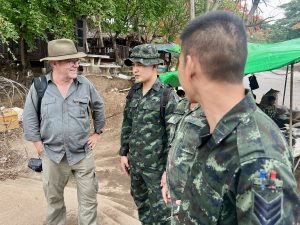
Huw Watkin chats with Thai troops on the country’s border with Myanmar.
Credit: Luke Hunt


Tragedy and major events have dominated headlines across Southeast Asia and beyond in recent months, including the civil war and earthquake in Myanmar, half-century commemorations marking the fall of Indochina to communism, and elections in Australia and Singapore.

Among the headline writers was veteran correspondent Huw Watkin, who began his career in journalism in Australia in the mid-1980s before moving to Asia where, over the course of three decades, he lived and worked in Cambodia, Thailand, Vietnam, Malaysia, and Hong Kong.

He is also the principal of Drakon Associates, a research and investigation consultancy focusing on the Asia Pacific. Now based in Australia, he continues to travel widely and writes about a range of subjects and issues from across the region.

Watkin returns to Beyond the Mekong for a conversation with The Diplomat’s Luke Hunt after they both traveled through Cambodia, Vietnam, and Thailand.

He says the crisis of integrity, which he spoke about at length during a previous podcast, has escalated in the West with the return to office of U.S. President Donald Trump, but this has provoked a backlash, evident at recent elections in Australia and Canada.

Rapidly developing nations in Southeast Asia, like Vietnam and Thailand, are also in focus with Asian and Western countries like Australia looking to bolster alternative trade destinations that bypass the U.S., as Trump imposes a new and harshly protectionist tariff regime.


Contributing Author
Luke Hunt is a Southeast Asia correspondent for The Diplomat. He has spent three decades working in the region and produces the Beyond the Mekong podcast. He can be followed on Patreon and X – formerly Twitter.View Profile
Despite doubts, international students eye US graduate school as enrollment dips under Trump

Students have expressed concern about securing visas, but most of the school's international students are from India and report they are getting appointments

(AP) Published 12.05.25


Representational Image Shutterstock

As he finishes college in China, computer science student Ma Tianyu has set his sights on graduate school in the United States. No country offers better programmes for the career he wants as a game developer, he said.

He applied only to US schools and was accepted by some. But after the initial excitement, he began seeing reasons for doubt.

First, there was President Donald Trump's trade war with China. Then, China's Ministry of Education issued a warning about studying in America. When he saw the wave of legal status terminations for international students in the US, he realised he needed to consider how American politics could affect him.

The recent developments soured some of his classmates on studying in the US, but he plans to come anyway. He is ready “to adapt to whatever changes may come," he said.

American universities, home to many programmes at the top of their fields, have long appealed to students around the world hoping to pursue research and get a foothold in the US job market. The durability of that demand faces a test under the Trump administration, which has taken actions that have left international students feeling vulnerable and considering alternate places to study.

“All of the Trump administration's activities have been sending a message that international students are not welcome in the US," said Clay Harmon, executive director of AIRC, a professional association for international enrolment managers at colleges.

Competitors see an opening to carve into US dominance

Around 1.1 million international students were in the US last year. A large decline in their ranks could cripple school budgets that rely on tuition from foreign students, who are ineligible for federal student aid and often pay full price to attend.

It's too early to quantify any impact from the administration's crackdown, which has included new scrutiny of student visas and efforts to deport foreign students for involvement in pro-Palestinian activism. But many fear the worst.

“Students and their families expect and need certainty,” said Fanta Aw, executive director and CEO of NAFSA, an association of international educators. “And they do not function well in a volatile environment like the one we have currently.”

The US has been rebounding from a decline in international enrolment that was exacerbated by the COVID-19 pandemic. As top competitors such as Canada, Australia and the United Kingdom rolled back recruiting efforts and made immigration policies less welcoming, the U.S. appeared ready to bring in far more students.


Now, a few months into the Trump administration, industry experts say it's unlikely the U.S. will be able to capitalize.

“The U.S. was so perfectly positioned to become the far and away, clear first-choice destination for international students,” said Mike Henniger, CEO of Illume Student Advisory Services. His company works with colleges in the U.S., Canada and Europe to recruit international students. "Then it just went out the door."

In Canada, where colleges saw enrolment increases during the first Trump administration, they are hoping for another bounce. In a letter following the recent election, a member organization for Canadian universities urged the new Liberal government to address immigration policies that have affected recruitment of foreign students.

“This is a moment of real opportunity for the country to attract international talent,” said Gabriel Miller, president of Universities Canada.


America's appeal as a place to start a career remains resilient

The US holds strong appeal for students prioritizing career outcomes, in part because of the “optional practical training” program, which allows foreign students to stay on their student visas and work for up to three years, said Lindsey Lopez of ApplyBoard, an application platform for students seeking to study abroad.

Graduates earning this post-college work experience were among the foreigners whose legal status or visas were terminated this spring.

Still, the diversity and size of the US job market could help American schools stay ahead of the competition, López said.

“The US is the largest economy in the world,” she said. “It's just the vastness and also the economic diversity that we have in the US, with a whole variety of different industries, both public and private, for students to choose from.”

William Paterson University, a public institution of 10,000 students in New Jersey, typically has around 250 international students. It expects an increase in foreign students in the fall, according to George Kacenga, vice president for enrollment management. The school has focused on designing programs around STEM majors, which appeal to international students because they open access to OPT programmes.

Students have expressed concern about securing visas, but most of the school's international students are from India and report they are getting appointments, he said.

In Shanghai, many students in Austin Ward's 12th grade class have either committed to attending U.S. colleges or are considering it. Ward teaches literature in a high school program offering an American Common Core curriculum for Chinese students.

Ward said he avoids discussing politics with his students, but some have asked him about the US government's termination of students' legal statuses, signalling their concern about going to the US.

To Ward's knowledge, the students who planned to attend American colleges have not changed their minds. Frustrated with the stress the situation has caused, Ward said he wrote a letter to his US representative on the need to protect international students.

His students are coming to America to “expand their horizons,” he said, not threaten the country.

“If my students have to worry about that, and if students are losing their visas, then America is not going to have that strength of being an academic centre,” he said.
New Pope, new Chancellor, same old Trump

12 May 2025
Dennis Sammut
 commonspace.eu


The Catholic Church has a new leader. Robert Prevost was not discussed by the media before being announced as the new Pope on Friday. He will follow the Church’s mantra, which has served it well over two thousand years, to be as flexible as necessary and as rigid as possible Europe has fresh energy in the person of the new German chancellor, Friedrich Merz. Despite the wobbly start in the German Parliament, Merz in the four days after his swearing-in met key European leaders, and laid the basis for his Chancellorship. Meanwhile, Donald Trump's statements continue to hanker for the past. His call for the re-opening of the prison on Alcatraz is a case in point. Trump marks the end of the “American era”. The US will remain a rich and powerful country, but its global role will be much diminished.

We have a new Pope, Cardinal Robert Prevost

A week of speculation after the death of Pope Francis saw a media frenzy around the names of those considered “papabile”. In the programmes I listened to, or the articles I read, the name of Robert Prevost did not feature amongst those with a chance of becoming Pope. In the one hour between the white smoke coming out of the Sistine Chapel, a sign that a new Pope had been chosen, and the name of the new Pope being announced, the BBC interviewed one Vatican expert who speculated, that given the relatively short time taken to choose a new Pope, he was probably a Vatican insider. In the end, the media had to eat humble pie, and admit that it had gotten it all wrong, and scramble to find out who Robert Prevost was.

I will not repeat the same mistake, and will not speculate whether he will continue, perhaps accelerate, the reforms initiated by Pope Francis, or whether he will prefer to consolidate around the established teachings of the Roman church.

The Roman Catholic Church is a large institution, deeply embedded in tradition, and parts of it are very corrupt. It has survived for two thousand years by being as flexible as necessary and as rigid as possible. Cardinal Robert Prevost will follow this mantra. How the world will remember Pope Leo will depend on how he and his retinue will decide on presenting themselves.

The new Pope knows the world. He was born and raised in Chicago, but lived for a long time in Peru, where he saw poverty first hand. Apart from English he also speaks fluently Spanish and Italian. One suspects he will quickly become very popular amongst the 1.4 billion Catholics and beyond. But he will have to manage the labyrinth and intrigue of the Vatican, and that is no mean task.

During the 1946 Potsdam Conference Stalin reportedly interrupted Churchill who was speaking about Poland, and the need not to displease the Pope, asking “How many divisions does the Pope have?”

Pope Leo will soon learn that whilst he does not have army divisions at his behest, his word carries moral authority. Thus, he will shape global opinion and thinking on multiple issues. One suspects that the new Pope has the skills to do this efficiently and effectively.

Despite a wobbly start, Chancellor Friedrich Merz, brings a fresh energy to Europe

The other person who came on the world stage in the last week is Friedrich Merz, who on Tuesday became the Chancellor of Germany. Untypical of Germany, the process in the German Parliament was messy. Merz could not be elected in the first round of voting in a secret ballot, and there was a lot of finger-pointing. Some blamed the JUSOS, the youth wing of the coalition social democratic partner, the SPD. Others however said that it was disgruntled members of Merz’s own party (CDU/CSU) who were left out of cabinet posts and other government appointments, who derailed the plans. However, a second vote was hastily called for later in the day, and Merz duly received the votes necessary, and was sworn in minutes later by the German President. CDU General Secretary Carsten Linnemann said it was important to press ahead. "Europe needs a strong Germany, that's why we can't wait for days," he told German TV.

As if to press the point that this was an election for Europe, as much as for Germany, the following day Merz visited Paris for meetings with French President, Emanuel Macron, and Warsaw for meetings with Polish Prime Minister, Donald Tusk. Poland also at the moment has the presidency of the EU. German leaders normally visit Paris early in their term, but Merz's decision to visit Poland on the same days adds a new twist to German diplomacy.

And before the week was out, Merz was in Brussels for a whirlwind six hours of meetings with European leaders, including with European Council President Antonio Costa, European Commission President Ursula von der Leyen, European Parliament President Roberta Metsola, and NATO Secretary-General Mark Rutte.

Antonio Costa summed the situation best, referring to the fresh energy Merz brought to Brussels. In Brussels, Merz, speaking mostly in German in his public utterings, highlighted four priorities: New trade deals; strengthening European defence, curbing irregular migration and managing and de-escalating the tariff conflict with the United States.

Conscious that Germany still carries on its shoulders the burden of history, Merz emphasised that his country wanted to be a reliable partner, including by doing more on defence. But he was also careful to point out the role of the US, saying that "America is indispensable for Europe’s security, now and for the long term". Chancellor Merz expressed hope that the upcoming NATO summit in The Hague in June would result in a "shared strategy" with Washington. From Brussels, Merz went to Kyiv, were together with Macron, Tusk and British Prime Minister Starmer he reiterated once more support for Ukraine, and for the leadership of President Zelensky.

On the whole, the first days of the Merz chancellorship were a good preview of what was to come. In the coming years, Merz and his Germany, will be at the forefront of European processes, and will be instrumental in the forging of the new world order.

Trump’s presidency marks the end of the “American era”

Donald Trump is not the beginning of something, but the end. The 20th century has often been called the American century. It ended with the US being the only superpower, and with the American order being supreme across the world. In the 21st century, China has risen, Russia broke loose from the world order, and many countries in the global south cheered. Trump put the final nail in the American coffin. But to be fair the process had started before. Many think that America could have done this more elegantly. Under Trump the process has been crude, and in many cases nasty. And he has only been in office for a little more than a hundred days. The decline is now irreversible. The US will remain a rich and powerful country, but its global role will be much diminished.

Trump himself is a symbol of the past. A US president who seriously thinks that re-opening the prison on Alcatraz is a good idea is not the future, but the faraway ugly past. An American leader, that alienates with his statements and actions the two closest neighbours, Canada and Mexico, raises question marks across the world. Most of the world, China apart, is being polite. But the US has already lost its moral authority.

This week Trump goes on his first trip abroad in his second term, apart from a quick trip to Rome to attend the funeral of Pope Francis. He will go to Saudi Arabia, Qatar and the United Arab Emirates. Of course, he will be greeted and feted. But the three countries have long ago decided not to put all their eggs in the American basket. They want to talk business with Trump, which is a language that he understands. But when it comes to regional and global issues: Iran, Gaza, and China to name a few, the differences are big, and they are likely to agree to disagree. Trump wants his “deal”, so he will acquiesce.

The Catholic Church has a new leader. Europe has fresh energy in the person of the new German chancellor. The United States has opted for Donald Trump whose statements hanker for the past. He symbolises the end of the American era.

Please click here to download this week's Monday Commentary.
Source: Dr Dennis Sammut is the Director of LINKS Europe and Managing Editor of commonspace.eu.
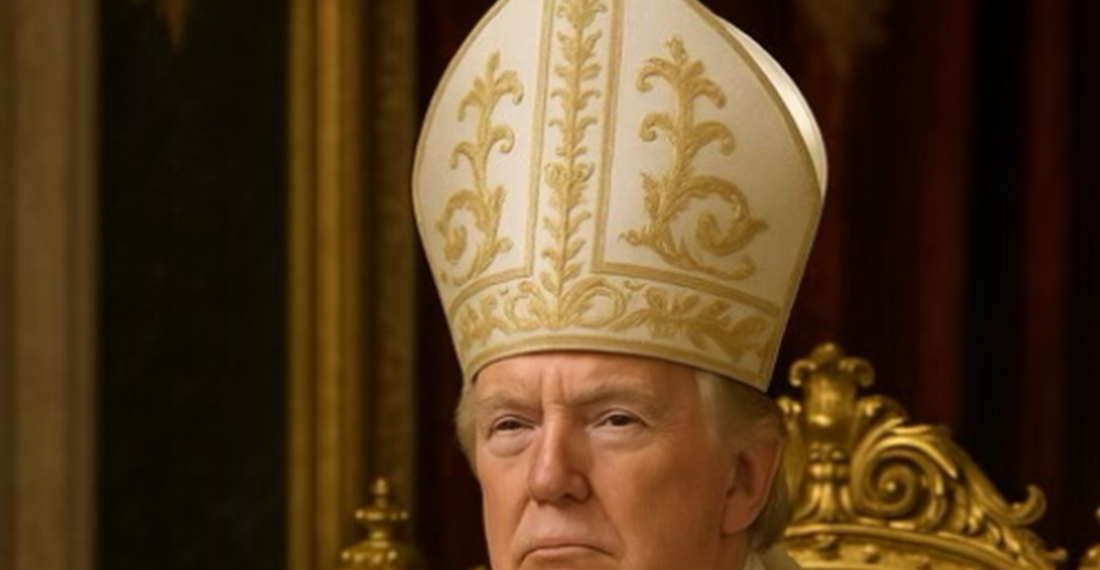
Photo: USA President Donald Trump posts AI-generated image of himself dressed as pope/Truth Social platform

The views expressed in opinion pieces and commentaries do not necessarily reflect the position of commonspace.eu or its partners.
Why Donald Trump is going after Europe’s Green Deal

The US administration is cutting funds and jobs in areas that will be critical to tackling (and even monitoring) climate change. But Donald Trump also seems intent on entrenching dependence on fossil fuels beyond America's borders. How is Europe responding?

Published on 5 May 2025 
Angelo Romano - Valigia Blu
Translated by Voxeurop

 
Derkaoui Abdellah | Cartoon movement

“A180-degree pivot.” This is how US energy secretary Chris Wright described, to a group of oil-industry bosses in March, the new direction the Trump administration intends to impose on America’s climate and energy policies.

During the meeting, Wright argued that climate change “is a side effect of building the modern world.” In other words: to power the planet there is no alternative to fossil fuels.

The Inflation Reduction Act, approved by President Joe Biden in 2022, was the biggest federal investment in United States history. It was designed to combat climate change. The law's reversal will mean budget cuts that affect the entire scientific sector and could lead to the cancellation of whole research programmes, from climate to space.
More : Environmental journalist Hervé Kempf: ‘The ecological and social issues are inextricably intertwined’

Indeed, the Trump administration is seeking to shut down virtually all research conducted by the National Oceanic and Atmospheric Administration (NOAA), the federal agency that leads the world in climate modelling. Across the USA, NOAA operates dozens of research labs that study the atmosphere, oceans, rivers and lakes. They monitor many of the natural and artificial processes that occur on Earth, including greenhouse-gas emissions and phenomena such as heat waves and droughts.

As in other policy areas, President Trump has been forcing major changes in climate and environmental policy by means of executive order.

On the first day of his term, he withdrew the United States from the Paris climate agreement, launched plans to open up parts of Alaska to mining, blocked federal permits for new wind farms, ordered federal agencies to halt subsidies for electric vehicles, and suspended authorizations for renewable-energy projects on public lands.

Trump also set his sights on the Environmental Protection Agency. Its new director, Lee Zeldin, began dismantling regulations and investments in clean energy the moment he took office. The axed projects were related to climate, scientific research and emissions data collection by private companies.

The White House has decided to cut funding for the US Global Change Research Program, which issues the government's main climate report and assesses the effects of global warming on the USA every four years. A similar fate has befallen the National Weather Service. Meanwhile, subsidies are being ramped up for the fossil-fuel industry, starting with coal.

Europe, the tariff war and the Green Deal

Tariffs, which have been repeatedly announced, withdrawn and reintroduced, are part of the Trump administration's new approach to industrial and energy policy. It amounts to a form of trade warfare.

And this is where Europe comes in, with its Green Deal.

In late February, Trump announced that he wanted to impose 25% tariffs on cars and other goods, including steel and aluminium, imported from the EU. Brussels initially considered countermeasures but then proposed to Washington a mutual elimination of tariffs on such goods. This proposal was rejected by Trump. He instead raised the stakes, arguing that the only way to achieve a trade truce would be for the EU to purchase $350 billion worth of US energy, particularly liquefied natural gas (LNG).

What was Trump's motive for this demand and for the 25% tariff on EU industrial goods and cars? After all, 50% of European LNG already comes from the US: Europe turned to it to replace Russian supplies. And there is no major EU-USA trade imbalance (3%) that could justify a trade war.

More : How Big Oil buys our consent through sports, arts and more

Trump’s real goal is something else: it is to undermine the EU's Green Deal. As highlighted in an analysis by the think tank ECCO, more than 50% of US exports to Europe are fossil-fuel products. The EU and countries around the world are supposed to be phasing these out following the 2015 Paris climate agreements (from which the US is once again pulling out).

Through the Green Deal, the EU is freeing itself from fossil fuels and building its own independence, energy security, and competitiveness.

In the electricity sector alone, since the launch of the Green Deal in 2019, renewable energies have made it possible to avoid hydrocarbon imports worth €59 billion. The United States is already the world's leading exporter of LNG. Europe's Green Deal poses a serious threat to Donald Trump's industrial and energy policy of “drill, baby drill”.

Trump's goal, says ECCO, is to keep Europe buying gas for the long term, thus undermining its independence from fossil fuels. This would prevent Europe from turning to other partners, primarily China. Unlike the USA, China is pushing forward its energy transition and is becoming dominant in the whole clean-tech sector.

So what will Europe do? And what role will Italy play? Prime Minister Giorgia Meloni's government has repeatedly said that it wants to focus on LNG and make Italy a gas hub.

At EU level, Energy Commissioner Dan Jørgensen has expressed interest in purchasing American LNG, but his words suggest that this must not undermine the Green Deal. For ECCO, the Green Deal “represents a strategic lever to enhance European and Italian competitiveness, promoting innovation in production processes, products and energy efficiency.” Abandoning it would mean being anchored to outdated economic models tied to fossil fuels and “aligning with Trump's policies, which transparently seek to protect only partisan interests.”

“The great climate disconnect”

“Trump's return to power must be a strong push for the EU and its members to overcome political divisions and unite around the objective of pursuing decarbonisation”, say Simone Tagliapietra and Cecilia Trasi of Bruegel, a think tank.
More : Renewable energy frenzy triggers land grabbing in ‘Wonderful Puglia’

The signals coming from various European capitals are not encouraging. Pilitia Clark, of the Financial Times, believes we are witnessing an ever-deepening disconnect between the climate crisis and climate policy. Just as extreme weather events continue to escalate and each successive year becomes the hottest on record, it seems that the whole planet has agreed to put the fight against global warming on hold.

In Europe's largest economy, Germany, the far-right Alternative for Germany (AfD) has enjoyed huge electoral success by promising to tear down wind farms, which it calls “windmills of shame”.

In Austria, the far-right ÖVP focused its election campaign on a complete rethink of climate policy. The party is part of Patriots for Europe, the third-largest group in the European Parliament. Its leaders attacked the “ideology” of the Green Deal during a recent rally in Madrid.

The narrative pushed by these groups, that green policies are a burden on ordinary people, is gaining traction. Last year's massive farmers' protests in Central Europe provided some evidence of that.

More : How Italy’s largest fossil fuel company uses climate-related bonds as a loophole to keep financing hydrocarbons

Meanwhile, the list of companies scaling back their environmental efforts continues to grow. Even Norwegian energy giant Equinor (which changed its name from Statoil seven years ago in a green pivot) now plans to ramp up its hydrocarbons business and halve its spending on renewables.

This is the backdrop as we approach the tenth anniversary of the 2015 Paris Agreement, the global pact that should be driving action to slow global warming. “Why is all this happening now?”, asks Clark. ”What has changed since 2020, when companies and countries alike were scrambling to support net zero policies? There is no single answer, but it is no coincidence that the green backlash has emerged as countries stop merely setting net zero goals and start launching policies to meet them.”

And the window of opportunity for the fossil-fuel industry just keeps getting larger.
Original article on Valigia Blu


Adapt or be undone: climate resistance from below

As the world barrels toward climate tipping points, fields and forgotten urban areas are devising their own survival strategies. We look at examples from Bulgaria to Brittany, fog water harvesters, urban communities resisting unfair emissions zones, and precarious workers.

Published on 6 May 2025 
Emanuela Barbiroglio
VOXEUROPA

 
Vasco Gargalo | Cartoon movement

The Copernicus Climate Change Service (C3S) and the UN's World Meteorological Organization (WMO) have just published the European State of the Climate report 2024, and the news is far from good.

Europe is confirmed as the fastest-warming continent, and 2024 as the warmest year on record for Europe, with record temperatures in central, eastern, and southeastern regions. Severe storms and widespread flooding claimed at least 335 lives, affecting an estimated 413,000 people.


This year, the report also featured a new layer highlighting examples of climate resilience and adaptation initiatives in cities across Europe. It shows that 51% of European cities have adopted dedicated climate adaptation plans, representing encouraging progress from 26% in 2018.

More : From breakdown to crackdown: environment and climate activists in the crosshair

WMO Secretary General Celeste Saulo called adaptation “a must”. “We are making progress but need to go further and need to go faster, and we need to go together," she said.

EU Climate Commissioner Wopke Hoekstra is meanwhile due to "lead the work on a European Climate Adaptation Plan to support member states, notably on preparedness and planning and ensure regular science-based risk assessments", his mission letter said last summer. "This should, for example, cover the impact on infrastructure, energy, water, food, and land in cities and rural areas" and "look at incentives for nature-based solutions".

A recent Guardian feature suggests to avoid the usual suspects, given the current geo-political tensions within the US, and look at Africa instead. The article’s authors William Ruto and Patrick Verkooijen say “Africa was an early champion of climate adaptation”, with 17 of the 20 countries most vulnerable to climate change on the continent.

“We wanted to move beyond disaster management to forward-looking strategies that reduced our exposure to climate risks. We sought solutions to protect our people and businesses from ever-more destructive weather extremes. Adaptation is not simply a means of minimising the damage inflicted by extreme weather, although that alone would justify the investment. Done properly, it can transform economies, as well as strengthen them against natural disasters.”

Poorer, developing nations could show Europe the way: how to avoid the destructive steps of capitalism altogether and move on to the next stages, where people and the planet have found a way to survive together.

Ekhosuehi Iyahen, secretary general of the Insurance Development Forum (IDF), explores the flip side of the adaptation coin for Italian newspaper Domani: insuring ourselves from climate change. “Urgent action is needed to protect these ecosystems, but many coastal communities do not have the necessary financial resources. Closing the financial gap is essential to mitigate the effects of climate change: the insurance sector can be a powerful driver of positive change,” she writes.

More : How Italian newspapers greenwashed the bonds of national oil champion Eni

In Portugal, with Marie-Cécilia Duvernoy and Reporterre, we meet engineers André Mota and Paula Pereira. Despite the droughts and the fires, the Life Nieblas team remains enthusiastic. By capturing fog water with nets, thousands of replanted oak trees thrive year after year in central Portugal.

And yet, across the EU, low-income communities are pushing back against climate measures that ignore social realities. In Alternatives Economiques, Mines Paris’ professor Blanche Segrestin explores the backlash against Low Emission Zones in cities like Paris and Lyon, where the poorest risk being priced out of mobility: “The general average then imposes a rule of solidarity: a sacrifice to ensure the ‘rescue’ must be shared in proportion to the wealth that will actually be saved. In the case of the danger of the city becoming unusable, we could thus at least replace polluting cars by sharing the effort not only among the owners of these cars, nor among motorists, but among all those who have something to save.”

Talking about the just transition, Cross-border Talks zooms in on Bulgaria and Romania, where fossil fuel workers fear they’re going to be left behind. Trade unions and local leaders warn that without genuine dialogue and investment, the shift could deepen inequality and fuel populist backlash.

More : Environmental journalist Hervé Kempf: ‘The ecological and social issues are inextricably intertwined’

“We really need a clear direction and a clear commitment. We need to know what is going to be done year by year. Only this way the measures applied within the just transition framework would be properly aligned with everything else. Then, nobody will be left behind in the process of decarbonisation. Instead, we see right-wing populist parties using the issue of just transition to make a political scandal. They are stopping the process. We are nowhere in the process of reviewing and changing the just transition plans, indicators and milestones,” Georgi Stefanov, founder of the Climate Coalition Bulgaria, told Małgorzata Kulbaczewska-Figat.
Debunking the far-right myth: there is not such a thing as little room for the environment

As part of a push to water down the EU’s Green Deal, far-right and conservative politicians are claiming that the measures being discussed to tackle biodiversity loss in Europe will undermine the economy. But research and data show that failing to restore nature poses a greater financial risk.


Fact-checking RightWatch | Climate
Published on 7 May 2025 
Emanuela Barbiroglio
VOXEUROP

 
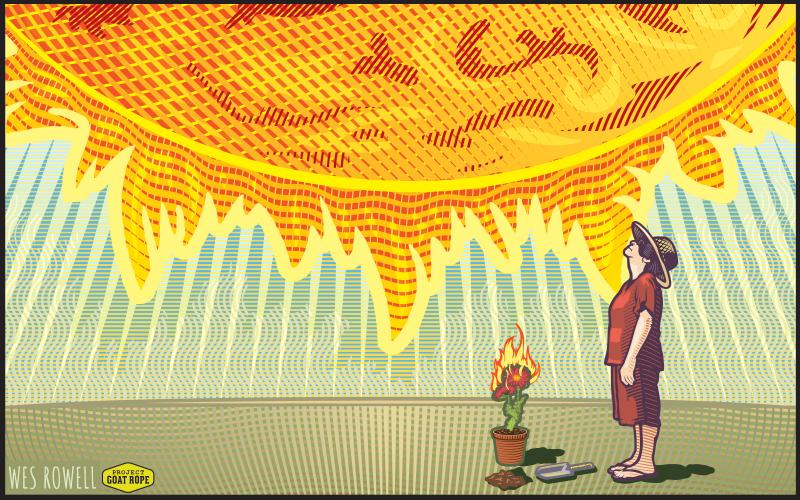
Wes Rowell | Cartoon Movement

Claim to be verified: During the discussions on the EU Nature Restoration Regulation, in early 2024, Dutch member of the European Parliament from the far-right European Conservatives and Reformists Group (ECR) Bert-Jan Ruissen claimed that “too much land was reserved for nature restoration”. Like several other right wing officials, he took up the argument that conservation undermines economic stability.

Background: The Nature Restoration Regulation was a key component of the European Green Deal aimed at reversing biodiversity loss and mitigating climate change. Originally, it was expected to impose the restoration of only a part of the EU’s land and seas considered degraded, after which no further ecosystem degradation would have been allowed. The Commission tabled its proposal in 2022 with targets of "at least 20% of Europe's marine and terrestrial land" and "30% of habitats in poor conservation status" by 2030 – followed by a 100% restoration of ecosystems in need by 2050.

Far-right politicians were not the only ones who did not welcome the file: anticipating a shift, the centre-right European People Party (EPP) started fuelling concerns about environmental policies that could threaten farmers, food supply, and economic stability. As the EU neared its Parliament’s elections in summer 2024, and the political debate started heating up, statements like that of Ruissen became the common argument for right parties to undermine the Green Deal and therefore gain votes.

As the 2024 European elections closed in, right-wing candidates wanted to move the majority away from that of 2019: quite progressive in fact, where the Greens played a crucial role for the first time, in the wake of public movements like Fridays for Future.

Dutch MEP from the far-right European Conservatives and Reformists Group (ECR) Bert-Jan Ruissen and his peers began a series of actions aimed at, if not dismantling the Green Deal, slowing its pace on a pretence of social justice and framing it as an economic threat. Ruissen was by February 2024 shadow rapporteur in the Committee on Agriculture for the development of the Nature Restoration Regulation, known as “nature law” in the public debate.

Because a green transition was costly and risked leaving behind those citizens whose jobs and entire lives still evolve around traditional ways of production, it should be revised and made more “pragmatic” or “realistic”, according to the far-right.
More : Why Donald Trump is going after Europe’s Green Deal

For former MEP of the European People's Party (EPP, conservative), Marlene Mortler, who drafted a report on food security, the “Green Deal mustn’t jeopardise food security” – something she considered a potential risk as more land becomes “useless” due to protection measures.

Calling for a complete rejection of the Commission’s proposal, the EPP leader Manfred Weber said in 2023 that “the law’s objective is to restore nature back to its state of 1950”. “It challenges local and regional governments to do the impossible: turn back 70 years of changes to nature in about 25 years,” he added.
A series of unfortunate events

Opponents of the law have falsely claimed that vast areas of farmland will be rewilded.

In reality, the bill does not expropriate farmland, as it prioritises degraded ecosystems and explicitly acknowledges the need to balance conservation with economic activity. The nature law also includes flexibility mechanisms, ensuring that restoration efforts are compatible with food production and rural livelihoods.

Although opposers made the legislative procedure a painful journey, co-legislators reached a deal in a last-minute battle and signed a final act in June 2024 – just before the EU elections.

The text will oblige EU member states to restore at least 30% of habitat types covered in the bill by 2030, prioritising protected sites under the existing Natura 2000 network. Now the EU’s 27 member states have until 1 September 2026 to submit their draft national restoration plans to the Commission.

Ruissen’s claim, not supported by scientific evidence or public consultation data, was the perfect way to ruin the Green Deal’s reputation. Policy making in 2025 is still paying the price for this trend.

“As the protests spread, the agricultural lobbies and the conservative right began to exploit those squares,” said Associazione Terra!.

With a certain degree of success: last year, several bits of European legislation fell victim to such worries.

The Common agricultural policy (CAP) was modified in order to enable farmers to get EU farming subsidies even if they don’t meet the bloc’s environmental standards, known as conditionality rules.

The European Parliament rejected a text for a proposal to limit the use of pesticides.

The Regulation on Deforestation-free Products was delayed, following a push from conservative parties to water down the requirements for third parties.

Emissions from intensive farming were not equated with industrial emissions in 2040 targets.

The Farm to Fork strategy, the agri-food component of the previous mandate, should be declared dead too.


Neoliberal agricultural policies


But a closer examination at farmers’ protests, often portrayed as a direct reaction to nature restoration policies, reveals that their primary concerns lay elsewhere.

For instance, the EU-Mercosur trade agreement has the potential for lower-cost agricultural products from Latin America to disrupt the EU market.

International movement La Via Campesina pointed out that farmers in 2024 were “fed up with spending their lives working incessantly without ever getting a decent income.”
Contrary to claims that land conservation undermines economic stability, research shows – if anything – that failing to restore degraded ecosystems poses a far greater financial risk

“We have reached this point after decades of neoliberal agricultural policies and free trade agreements”, it says, “production costs have risen steadily in recent years, while prices paid to farmers have stagnated or even fallen [...] Since the 1980s, various regulations that ensured fair prices for European farmers have been dismantled. The EU put all its faith in free trade agreements, which placed all the world’s farmers in competition with each other, encouraging them to produce at the lowest possible price at the cost of their own incomes and growing debt. Producing ecologically has huge benefits for the health and the planet, but it costs more for the farmers, and so to achieve the agroecological transition, agricultural markets need to be protected. Unfortunately, we were not heard.”

What data says


Contrary to claims that land conservation undermines economic stability, research shows – if anything – that failing to restore degraded ecosystems poses a far greater financial risk.

The Intergovernmental Panel on Climate Change (IPCC) highlights how ecosystem degradation directly threatens agricultural productivity and food security: “observed climate change is already affecting food security through increasing temperatures, changing precipitation patterns, and greater frequency of some extreme events” and “food security will be increasingly affected by projected future climate change”.

Furthermore, continues the IPCC, “about 21–37% of total greenhouse gas (GHG) emissions are attributable to the food system”.

Taking the current food system for granted, the UN Food and Agriculture Organization (FAO) estimates that there is a need to produce about 50% more food by 2050 in order to feed the increasing world population. “This would engender significant increases in GHG emissions and other environmental impacts, including loss of biodiversity,” says the IPCC.

With 2 billion people more on planet Earth, we simply can’t afford to continue living as we do. And yet, it is not a simple matter of space: only new, sustainable forms of agriculture can respond to the issues industrial agriculture created in the past few decades.

More : Cop29: climate leader or fossil regime?

“Combining supply-side actions such as efficient production, transport, and processing with demand-side interventions such as modification of food choices, and reduction of food loss and waste, reduces GHG emissions and enhances food system resilience,” says the IPCC.

Consultancy firm PwC estimates that over 50% of global GDP is at risk due to biodiversity loss, meaning that protecting nature is an economic imperative, not a hindrance.

The World Resources Institute (WRI) has demonstrated that climate finance investment in nature restoration yields substantial economic returns and job creation.

While a vision is needed, this is something undeniably hard to propose at a time of wars and fear. Other climate policies are facing strong resistance, in the name of the status quo. It’s not by chance that the same rhetoric responsible for attacking the nature law was also behind a roll back on energy policies.

While the EU’s Renewable energy directive raised the targeted share of EU consumption of renewable energy to 42.5% by 2030, with an additional 2.5% indicative top-up that would allow the bloc to reach 45%, some expressed concerns that agriculture production was also in danger as renewables compete for available land.

But a study by the European Environmental Bureau (EEB) and a report published by EU power association Eurelectric said biodiversity and electric grids can co-exist without compromising on nature or food production.

Conservatives say the planet is too small for both activities that have been ruining it and those activities that are attempting to save it. They are right, but guess which ones should be abandoned?

As climate risks escalate, scientists do not consider restoring nature a luxury: they found that is a necessity. In other words, preserving and restoring ecosystems is not a threat to economic stability – it is a safeguard against future collapse.


This article was produced with the support of the European Media and Information Fund (EMIF). It may not necessarily reflect the positions of the EMIF and the Fund Partners, the Calouste Gulbenkian Foundation and the European University Institute.
The sole responsibility for any content supported by the European Media and Information Fund lies with the author(s) and it may not necessarily reflect the positions of the EMIF and the Fund Partners, the Calouste Gulbenkian Foundation and the European University Institute.
Abortion in Italy: a combination between neo-fascism and neoliberalism

The experience of Non Una di Meno Padua reflects a situation in Italy, where the right to abortion is diminishing due to conscientious objection, lack of information and the presence of "pro-life" groups, all in the context of a far-right government and cuts to public health.

Published on 12 May 2025
Margherita Gobbo
Translated by Ciarán Lawless
VOXEUROP

 
Emanuele Del Rosso | Cartoon Movement


on Una di Meno (NUDM, "Not One Less") is a transfeminist movement that began in Argentina in 2015, then spread globally, fighting against patriarchy, male violence, and gender-based violence. Active in several Italian cities, NUDM, among other activities, has taken action in defence of family planning clinics: public social and health services dedicated to sexual and reproductive health, born out of the feminist struggles of the seventies and institutionalised by law in 1975. Originally created as social, political and feminist health centres as well as gynaecological hospitals, these clinics have been under growing attack for years, with closures and funding cuts.

8 March 2024: the Liberated Clinic | Photo: NUDM Padua.

The Non Una di Meno Padua Clinic

The Consultoria was symbolically born on 8 March 2024, with the occupation of a former family planning clinic that had been vacant and unused since 2019. The choice of name, which transforms the masculine noun “consultorio” (clinic) into the feminine “consultoria”, is a political act and a reclaiming of these structures as places of collective care and self-determination.

The initiative, led by NUDM Padua, was born from the desire to reclaim a political and feminist space within the city, to create a self-managed sexual health centre, and to mount a defence against gender-based violence and institutional shortcomings, which are both physical (lack of facilities) and informational, especially with regard to abortion.


NUDM activists paint furniture donated by citizens to furnish the Consultoria | Photo: NUDM Padua.


The Consultoria involved the local community, which took part in its assemblies, sexual health workshops and social events. In its nine months of existence, numerous activities were performed, developed on the basis of the needs expressed by the community. These included speech circles, sexual and emotional education workshops with gynaecologists and healthcare professionals, as well as self-managed feminist self-defence workshops and support and information hubs against gender-based violence, in synergy with the work of Anti-Violence Centres.

One of the most important services provided in the Consultoria – a service that NUDM has been running for years – is the Abortion Desk, through which the volunteers offer information on abortion and accompany those who request it to their medical appointments for an abortion. “These help desks, which received at least two requests for help per week at the Consultoria, constitute the political framework of NUDM’s activity: not to replace public health services, but networking and fighting for a secular and accessible health service, where abortion is a right and not a privilege”, explains Cecilia, an activist for NUDM Padua.

Conscientious objection and lack of data

Abortion in Italy was decriminalised by the Law n°194, in 1978. This was the result of years of parliamentary debate, by which the feminist movement’s desire for self-determination was largely scaled back in order to reach a compromise with the conservative political forces of the time.

This is clear from the title of the law itself: “Rules for the social protection of maternity and on the voluntary termination of pregnancy”, which prioritises the protection of maternity before establishing the circumstances in which abortion is not a crime. As such, in Italy, unlike in other legal traditions, abortion is not conceived as a right of free choice, but as a health measure aimed at protecting human life.
More : ‘She’s his wife, he can do what he wants’: after #MeToo, the Mazan rape trial and the banality of patriarchal violence

As Cecilia explains, “The Law 194 is in fact an antinomy, since it includes within the legislation itself the instrument to weaken it, namely conscientious objection”. Article 9 guarantees that healthcare personnel, when faced with a woman’s request for an abortion, have the full right to refuse to perform the procedure for ethical and moral reasons. Although the latest report from the Ministry on the implementation status of Law 194 states that “there are no utilisation problems” and that “it is not affected by the right to conscientious objection”, the reality of the situation seems rather different.

Mental Health and Yoga in the Consultoria | Photo: NUDM Padua.

In Italy in 2025 the rate of conscientious objectors, including doctors and healthcare personnel, is so high that for many women, especially migrants or those with fewer economic opportunities, having an abortion becomes a bureaucratic and cultural obstacle course. Women wishing to access abortion services are faced with long waiting times and unhelpful information, and often find themselves forced to move between cities and regions in the hope of finding a doctor willing to perform the procedure.

Article 16 of Law 194 establishes that every year, by February, a report on the status of abortion, from the number of conscientious objectors to the total number of procedures performed, must be presented to the Italian Parliament. The most recent data from the Ministry of Health reports that, in 2022, 60.5% of gynaecologists, 37.2% of anaesthetists and 32.1% of non-medical personnel declared themselves to be objectors.

In 2021, the regions with the highest number of objecting gynaecologists were Sicily (85%), Abruzzo (84%) and Puglia (80.6%), while the lowest percentages were recorded in Trento (17.1%) and Valle d’Aosta (25%). In addition to the fact that the Report on the Implementation of Law 194 is chronically overdue—the most recent available report contains data from three years ago—the information provided by the Ministry is often confusing, obsolete and useless. As can be seen in Graph 1, the Ministerial report publishes aggregate data by average region, and not by hospital, making it difficult for a woman to understand which hospital to go to for an abortion.


Objecting gynaecologists by regions. Data processed from Mai Dati Maps, Ministry of Health (2021 data)


For many years, journalists Chiara Lalli and Sonia Montegiove from the Luca Coscioni Association have been conducting a periodic survey to address this situation, asking individual regions to publish updated data on abortion that references individual local health authorities and healthcare facilities.

However, many regions have refused to provide this information, have obscured specific data or made it unreadable. The picture that emerges from the “Mai Dati” report, which resulted from this investigation, depicts an even more critical situation than that suggested by the official version provided by the Ministry. According to Mai Dati, in 2022, between 80% and 100% of healthcare personnel in no fewer than 72 Italian hospitals were objectors; 100% of healthcare personnel in four clinics and 20 hospitals were objectors; and all the gynaecologists in 18 hospitals were objectors. In the Molise region access to abortion is especially prohibitive, with only one abortion clinic in the whole region.

In light of this, as Lalli and Montegiovi report in Mai Dati, the institutions perpetrate a double abuse when it comes to abortion. On the one hand, they violate Article 16 of Law 194 by failing to provide annual statistics in the Annual Report on the Implementation of Law 194. And they also contravene the 2016 Freedom of information act, which guarantees the right of access to information held by public administrations, by concealing data on conscientious objection. Access to abortion in Italy is therefore not only hindered by Law 194 itself, which allows conscientious objection, but also by the lack of information and the impossibility of accessing the information that exists.

In addition to the lack of information about where abortion services can be accessed, and the scarcity of locations that offer the service, the Ministry of Health, on its institutional webpage, provides very little practical information about abortion. As Cecilia says, “In Italy, access to abortion is not guaranteed, and part of this is not even knowing how to access it”.

Talking to me about their work in the Consultoria’s Abortion Help Desk, NUDM volunteers emphasise how often people call to get basic information, which seems trivial, but can be difficult to find: “How much will I bleed with RU486? How much pain will I feel? Can I drive the day after? Can I go to work?” In addition to providing answers to these and other questions, the help desks also offer psychological and emotional support in a welcoming and non-judgemental environment, filling a need that is often lacking in the public service.

The judgemental atmosphere that seems to characterise family planning clinics is not only a cultural issue, but has legislative roots that draw on the ambiguities inherent in the law itself.

In fact, the Italian law on abortion not only allows, but also provides for and encourages the presence of pro-life individuals and organisations supporting maternity in family planning clinics. These associations are in charge of “resolving” the motives underlying a woman’s decision to terminate her pregnancy – that is, “economic, social, family or health circumstances” (Law 194, Article 4) – thereby completely excluding the idea that a woman can have an abortion for personal reasons, and subordinating her will to a process of justification from the outset. For this very reason, Law 194 is an antinomy: it decriminalises abortion, but at the same time, in the very locations designated for its practice, it places people responsible for convincing women to do the opposite.
The role of the Meloni government

If Law 194 already limited women’s self-determination, recent regulatory changes have managed to further strengthen the influence of anti-abortion groups in clinics and hospitals. From April 2024, the agreements that sanction the access of “pro-life” organisations to clinics are no longer only financed with regional funds, but also with public and state funds, which draw on the PNRR (National Recovery Plan).

This change came about thanks to an amendment proposed by the ruling Fratelli d’Italia in April 2024 which strengthens the power of anti-abortion associations and “third sector organisations with proven experience in maternity support” to operate in clinics.

Pro-Life posters in the streets of Padua | Photo: NUDM Padua.

The party led by Giorgia Meloni described this measure as a tool to inform women about available welfare measures in order to prevent abortion being chosen for economic or social reasons. These changes were not simply theoretical, but had tangible consequences: they further strengthened the presence of pro-life groups in the territory.

In a “Catholic country” like Italy, Francesca from NUDM Padua explains, “anti-abortion organisations operate as militant groups with a widespread presence, from ecclesiastical settings to Centres for Assistance to Life” (CAV).

These Centres, voluntary Catholic associations where people can access Christian charity for the support of a child, are financed by public money (as in the case of the Piedmont region) and supported by the current government, which thus strengthens the anti-abortion influence in the country.

Guaranteed institutional access for pro-life groups is not limited to greater visibility in clinics, but also translates into an increasingly structured presence within the public health system. “Following the Fratelli d’Italia amendment, there are cities in which anti-abortion organisations have gained semi-institutional access to hospitals, obtaining the management of dedicated spaces”, explains Francesca. The most striking case, according to the activists, is that of the Sant’Anna Hospital in Turin, where a counselling room has been set up where pro-lifers have been given access to an information space for abortion “which in fact provides scientific misinformation”.
More : Healthcare in Greece: the ongoing ruination of a public service

As for the city of Padua, since December 2024, the hospitals of Camposampiero and Cittadella have renewed the agreement between the ULSS 6 Euganea regional health authority and the anti-abortion association Movement for Life (CAV), which allows anti-abortionists to volunteer in hospitals and to have notice boards and informational material made available.

Faced with this progressive dismantling of the right to abortion, NUDM’s struggle and resistance also takes form in Obiezione Respinta SoS Aborto ("Objection Denied SoS Abortion"), a project that aims to map conscientious objection in Italy, based on anonymous testimonies organised by facility. Using a QR code, people can access a portal that lists all the public health centres in the area, and describe their experience with the medical staff, reporting the presence of objectors or anti-abortion groups, as well as empathetic and qualified staff.
The crisis in Italian healthcare and ideological attacks

According to a 1996 Law, there should be one family planning clinic for every 20,000 inhabitants in Italy. However, in Padua, a city of 200,000 inhabitants, four clinics have been closed in the last ten years. In the Veneto region the rate of conscientious objection is close to 70%.

These dynamics are part of the general attack on Italian healthcare, due to the simultaneous defunding and downgrading of the National Health Service (SSN), which is losing its universalistic nature due to massive cuts. The Health Report edited by CREA (Centre for Applied Economic Research in Health, 2024) shows that total Italian national per capita health expenditure in 2023 was 37.8% lower than that of the other countries that joined the EU before 1995. The result is that healthcare in Italy is increasingly privatised, with strong regional disparities and access to care becoming increasingly difficult for the most vulnerable sections of the population, including migrants.
More : Elżbieta Korolczuk: ‘The struggle is now about how gender equality is defined and which women will be included or not’

In this context, with more than €37 billion taken from public health in the decade between 2010-2019 (GIMBE, 2024) by the ruling class over the last twenty years, regardless of political persuasion, more and more family planning clinics are being merged and closed. In Italy, 300 family planning clinics have been closed in the last 10 years (from 2,430 in 2013 to 2,140 in 2023, according to the National health service statistical yearbooks) and those that remain open are experiencing reductions in opening hours and staff.

The consequence and parallel phenomenon to this has been the depoliticisation of these structures, which are changing from innovative centres with multidisciplinary approaches to physical, mental and collective health, to becoming increasingly basic clinics.

The attack on family planning clinics should first be contextualised within the progressive weakening of Italy’s National Health Service, but it also fits into a broader ideological framework, that of the far right Meloni government.
Feminist community and socialising at the Consultoria. | Photo: NUDM Padua.


In addition to the April decree and the funding allocated by the state to the Centres for Life, the force behind the closure of family planning clinics in Italy also involves the vision of women as political subjects as portrayed by the current ruling class.

According to Francesca and Cecilia of NUDM, it is wrong to think that the Meloni government “is just a neo-fascist government, because Meloni has the ability to combine neo-fascism and neoliberalism in a very powerful way”. The woman appointed by the President is not only a mother, “but a woman, mother, worker, who finds her freedom in the freedom of the market”. Although the government, with the Ministry of Equal Opportunities, Family and Birth led by the pro-life minister Roccella, goes on about being pro-birth, which has led to comparisons with historical fascism, “the issue of the birth rate seems to be increasingly part of an anti-immigrant, racial discourse, where obstructing abortion in Italy is closely linked to a political will: that of reproducing the family, and therefore the white homeland”.


The Eviction of the Consultoria


The Consultoria was interrupted on 12 December 2024, when it was evicted nine months after it began its occupation, a period of time that the NUDM activists find ironic, given the theme of gestation.

The Padua Police Headquarters and the Territorial Agency for Residential Housing justified the intervention with the need to free up the space for a co-housing project. However, as the NUDM activists point out, the action was carried out in the most depoliticised way possible: in silence, without warning or possibility of dialogue, simply by changing the locks.

The Consultoria was not created to compensate for the privatisation of a public service, explains Cecilia, but to propose an alternative, grassroots health model that would operate “within and against” the system, while at the same time addressing the loneliness that characterises an increasingly atomised society. Today the NUDM Padua Consultoria is looking for a new home, and is currently negotiating with the local council to find a suitable space.

🤝 This article is published within the Come Together collaborative project
The weaponisation of feminism in Operation Sindoor

From its name to the imagery of two women leading the charge, India positioned its offensive against Pakistan as a triumph for its women.


Iqra Shagufta Cheema
12 May, 2025
DAWN


After the deadly Pahalgam attack in the Baisaran valley in India-administered Kashmir on April 22, the image of Himanshi Narwal sitting stoically by her husband’s body went viral. This image of a young woman, newly married to a naval officer, and widowed on their honeymoon in India-held Kashmir, became the symbol of the Pahalgam attack in India. More critically, it was extended into the signifier of what the Pahalgam attack means and must mean for India and its people.

In his speech after Pahalgam, Indian Prime Minister Narendra Modi declared it an assault on the soul of India and vowed unimaginable punishment for the attackers, while his audience chanted his name. On May 6, India launched “Operation Sindoor”.

Sindoor is the vermilion red powder that, traditionally, married Hindu women wear in the middle parting of their hair as a marker of their married status, as a religious symbol to wish for their husbands’ prolonged lives, and to show a wife’s commitment to protect her husband. Upon becoming widows, women stop wearing the sindoor. After the Pahalgam attack, many reported that the attackers exclusively targeted Hindu men, thus effectively erasing women’s sindoor.

With these significations, Operation Sindoor, dubbed “a tribute to the women who lost their husbands in the terror attack,” became the mission to symbolically restore women’s sindoor, to showcase that the state is capable of protecting them and their families. Many applauded the operation’s name for its commitment to women and their honour.

But in a patriarchal context, this name has broader connotations. Operation Sindoor draws an equivalence between the honour of the nation-state and its women nationals. It assigns a woman’s marriage a higher value than a woman’s full life, which may extend well beyond her marriage. It conflates a gendered religious marker with militaristic aspirations and in doing so, it attempts to expand the meaning of what sindoor means in Indian imagination. It tries to create an affiliation, one based on emotion, between Hindu women’s lives and the Indian military’s operation. It capitalises on women’s emotional attachments and familial investments to use them to promote war, which, as history shows us, hurts both women’s emotional well-being and family stability.

Wars take place in gendered histories and between gendered nations. In her book, Twelve Feminist Lessons of War, American political theorist Cynthia Enloe points out a wartime narrative centring “a story or a photograph intended to make a complex, violent conflict” where “the women featured are usually crying. They are crying over the dead body of a husband or son.” But rarely “are they interviewed and asked for their ideas about the war.”

Narwal, in an interview after the attack, made an appeal for peace, saying she did not want any hate towards Muslims or Kashmiris. She faced a barrage of vitriol, trolling, slut-shaming, and rape threats for expressing her desire for peace and justice, and for implicitly challenging brewing pro-war national sentiments.

In another interview after India launched Operation Sindoor, Narwal thanked the government for the operation and hoped that it was only the “start of the end of terrorism.” Given the criticism and harassment she faced for her anti-violence and pro-peace position, it is unclear whether her tilt towards supporting Operation Sindoor and giving up her pro-peace position was a strategic response shaped by personal loss, online harassment, and demands to prove her allegiance both to her late husband’s memory and to the state.

These pre-war (and post-war) patriarchal conditions lead Enloe to observe that “women’s wars are not men’s wars” because women’s wars are shaped by “gender politics during patriarchal peacetime.” Sexual violence, gender-based violence, underemployment, unpaid and underpaid work, and limited reproductive rights are women’s wars.

Criticising the name of this operation, Vaishna Roy, editor of Frontline, an English language magazine published by The Hindu Group, noted in a since-deleted tweet that it “reeks of patriarchy, ownership of women, ‘honour’ killings, chastity, sacralising the institution of marriage, and similar Hindutva obsessions.” Roy was also trolled and harassed for her critique, which again proved that “women’s wars are not men’s wars.”

Given the challenges of gender-based and sexual violence, responses to Narwal, Roy, and other women’s anti-violence positions and critiques of the patriarchy make it even clearer that South Asian, particularly Indian, women’s wars are different than South Asian men’s wars. However, Operation Sindoor conjoins men’s and women’s wars.

Examining Operation Sindoor is, therefore, important because men’s wars are often played around the spectacle of women’s bodies — like the photo where a shocked Narwal is sitting by her husband’s body.

In another viral image, Colonel Sofia Qureshi and Wing Commander Vyomika Singh sat alongside Indian Foreign Secretary Vikram Misri to lead the Operation Sindoor media briefing, lending a feminist face to the lingering India-Pakistan conflict. Indian media reported this as a historical milestone for Indian women’s representation. However, this curated image of communal and religious unity has been criticised as being mere “secular tokenism” that hides Indian Muslims’ and Kashmiris’ lived reality of discrimination and violence. The name also misrepresented women like Qureshi and Singh.

The name centres on women’s role as wives in traditional marriages. The professional work of women like Colonel Qureshi and Wing Commander Singh only becomes visible when they step in to protect the sindoor. This valorisation of militarism as feminism also overlooks the fact that Indian women are significantly underrepresented in the Indian military. In 2023, Indian women made up only one per cent of the army, one pc of the air force, and six pc of the navy.

The image also created women heroes of the war to ramp up support for the war. One headline read: “The terrorists ‘spared’ women, but India’s women will not spare them.” Unsurprisingly then, many Indian celebrities with feminist reputations shared the image of Qureshi and Singh’s media briefing to express their support and celebration. One viral image on X portrayed Qureshi and Singh’s portraits in military uniform alongside a topi-burqa-clad woman to compare feminist India against regressive Pakistan, to show that Indian women are ‘better’ than Pakistani women.

But the fact remains that both Pakistani and Indian women fight similar fights in pre-war or peacetime conditions. Eventually, this feminised spectacle that centred two women became one more building block for the hyper-masculinised spectacle of the conflict that followed soon after.

The image of Qureshi and Singh was the bandaid for the problem that Narwal inadvertently named when she asked for nonviolence toward Muslims and Kashmiris and advocated for peace and justice. However, what remain missing in these images and spectacle are Indian and Pakistani women married to men on the other side of the border, and images of Kashmiri women whose homes were demolished, and the women family members of at least 1,500 more Kashmiris who were detained after the Pahalgam attack. What doesn’t go viral are the images of Kashmiris on both sides of the border who have been exposed to more violence since May 6.

All this shows that feminising wars does not make wars feminist; women’s wars remain different than men’s wars even when it is Operation Sindoor — or especially when it is Operation Sindoor.