Monday, May 12, 2025

Global perceptions of US fall below China, survey says

The net perception rating of the United States fell to -5 per cent from +22 per cent in 2024, indicating a greater number of respondents with a negative view of the country.


UPDATED May 12, 2025

COPENHAGEN - Global perceptions of the United States have deteriorated across the world over the past year and are now worse than views of China, according to an annual study of perceptions of democracy published on May 12.

The survey did not go into details on the criteria used, but the Alliance of Democracies Foundation which commissioned it says its aim is to defend and advance democratic values.

When asked why perceptions of the US had slipped, Alliance founder and former Nato secretary-general Anders Fogh Rasmussen said: "President Trump has triggered a trade war, scolded Ukraine's president in the Oval Office, left allies feeling vulnerable and enemies emboldened."

"It's no surprise that opinions have slipped even among people like me who spent their lives admiring the United States and what it stood for," he added.

Mr Trump has said he is pushing for a peace deal between Russia and Ukraine and on May 8 called for a 30-day unconditional ceasefire between the two countries.

He has also said that tariffs are defending the US economy against what his administration sees as unfair trade conditions.

The conclusions in the Democracy Perception Index survey, conducted between April 9 and April 23 with polling firm Nira Data, were based on more than 111,000 respondents worldwide, the Alliance said.

The perception of Mr Trump was negative in 82 of the 100 countries surveyed, higher than Russian President Vladimir Putin and Chinese President Xi Jinping, who were viewed negatively in 61 and 44 countries, respectively.

The survey also ranked the perception of countries from -100 per cent to +100 per cent.

The net perception rating of the United States fell to -5 per cent from +22 per cent in 2024, indicating a greater number of respondents with a negative view of the country compared with those with a positive view.

The share of countries with a positive image of the US dropped to 45 per cent from 76 per cent in 2024, the survey showed.

For China, the net perception rose to +14 per cent for 2025 from +5 per cent in 2024, the survey found.

The report was published ahead of the Copenhagen Democracy Summit, which takes place on May 13 to May 14. 

REUTERS


Russia, Vietnam agree to 'promptly' negotiate, sign nuclear power plants deal

Vietnam has resumed plans to develop nuclear power plants suspended nearly decade ago

Aamir Latif |12.05.2025 - TRT/AA

Vladimir Putin - To Lam meeting in Moscow

ANKARA

Russia and Vietnam have agreed to "promptly" negotiate and sign agreements on building nuclear power plants in the Southeast Asian nation, and elevate the bilateral comprehensive strategic partnership to "a new level in terms of quality," local media reported on Monday.

"The two sides agreed to promptly negotiate and sign intergovernmental agreements on the construction of nuclear power plants in Vietnam, ensuring the application of advanced technology and strict compliance with regulations on nuclear and radiation safety serving socio-economic development," Vietnam Pictorial News reported, citing a joint statement issued by the two countries.

The statement followed a visit to Moscow by Vietnamese Communist Party chief To Lam.

"The development of the plants with advanced technology will strictly be compliant with nuclear and radiation safety regulations and for the benefit of socio-economic development," the statement further said.

Vietnam has resumed plans to develop nuclear power plants that were suspended nearly a decade ago, as part of its efforts to increase its power generation capacity to support its fast-growing economy.

The two sides stressed the need to improve the effectiveness of existing cooperation mechanisms, particularly the intergovernmental committee on economy-trade and sci-tech cooperation, as well as the defense strategy dialogue.

Both sides affirmed that the defense-security cooperation continues to be an important pillar of bilateral relations.

"Joint work in this field is not aimed against a third country and is completely in line with the principles and regulations of international law, contributing to ensuring security and sustainable development in the Asia-Pacific and the world," the statement added.

The two sides also agreed to strengthen collaboration in the energy and oil-gas industries, including Russia’s supply and processing of crude oil and liquefied gas for Vietnam.

Vietnam and Russia also agreed to strengthen close and effective cooperation in the fields of mining industry, transport, shipbuilding and machinery manufacturing, railway modernization, and the expansion of transport corridors between the two countries to boost trade and investment.
China hosts Latin American, Caribbean nations amid US trade war talks
\

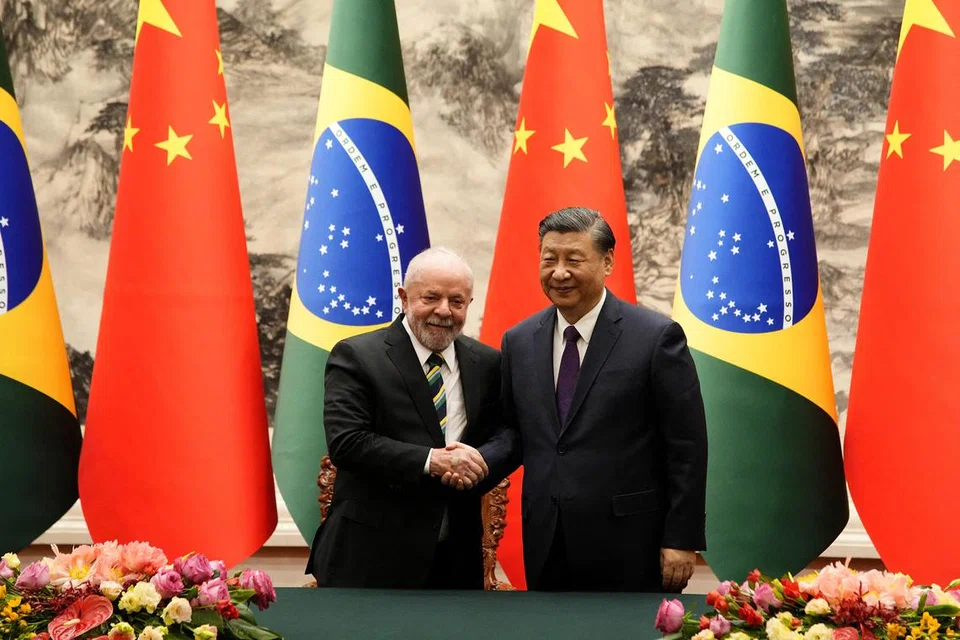
Brazilian President Luiz Inacio Lula da Silva meeting Chinese President Xi Jinping after a signing ceremony in Beijing on April 14, 2023.PHOTO: REUTERS

UPDATED May 12, 2025


BEIJING – China will host a summit that includes its key Latin American trade partners this week in an effort to advance influence and partnerships in the region, as Beijing and Washington try to defuse their trade war.

Latin American and Caribbean officials including the presidents of Brazil, Colombia and Chile are set to attend the China-Celac Forum ministerial meeting in Beijing on May 13.

Bilateral trade with the bloc was worth US$427 billion (S$554 billion) from January to September 2024, according to Chinese data.

China’s President Xi Jinping will deliver a speech to the summit. The last time Mr Xi addressed the forum was at the first such meeting 10 years ago.

The China-Celac Forum challenges longstanding American geopolitical and economic dominance in the region, which the Trump administration has sought to counter, and takes place after a weekend of high-stakes trade talks between the US and China that ended on a positive note.

American officials touted a “deal” to reduce the US trade deficit, while Chinese officials said both sides had reached “important consensus” and agreed to launch another new economic dialogue forum. Both countries were expected to release a joint statement on May 12.

China has been trying to marshal a global coalition against what it called an “abuse of tariffs” by the United States.

Since the world’s two largest economies imposed steep tariffs well above 100 per cent on each other’s goods in April, China has reached out to South-east Asia and Central Asia calling on its trade partners to hold the line against “unilateral bullying” and to uphold multilateralism.

China also made progress on trade issues with the European Union, agreeing to discuss setting minimum prices on Chinese-made electric vehicles.

The China-Celac Forum has been a vehicle to deepen dialogue between China and Latin American and Caribbean nations over trade, investment and infrastructure cooperation under Beijing’s Belt and Road Initiative (BRI).

Highlighting tensions between China and the US in the region has been the Panama Canal, which US President Donald Trump has threatened to take back.

The US-based BlackRock consortium’s US$23 billion deal to acquire Hong Kong-based CK Hutchison’s port operations near the Panama Canal, which Mr Trump hailed as “reclaiming” the waterway, triggered Beijing’s concerns and prompted a regulatory review.
Commodities trade

China is the primary buyer of raw materials from Latin America, including copper, iron ore and minerals, but its trade with Brazil could feature this week.

Coinciding with the summit, Beijing will also welcome Brazilian President Luiz Inacio Lula da Silva on a state visit on May 13. More than a dozen bilateral signings are expected.

China is Brazil’s largest export market by some length, a trade dominated by commodities like soya beans, iron ore and crude oil.

In 2024, China bought US$37 billion worth of soya beans from Brazil, making it China’s primary soya bean supplier as the world’s largest soya bean buyer diversifies away from the US.

China resumed imports of Brazilian soya beans last week from five firms previously suspended over phytosanitary concerns.

In a social media post, Chilean President Gabriel Boric confirmed attending the summit in Beijing and said he would be meeting President Xi.

The meeting could discuss business interests from Chinese firms in the world’s No. 2 lithium producer after metals group Tsingshan said it remains keen on investment opportunities in Chile’s downstream lithium sector.

On other fronts, more infrastructure cooperation could be highlighted as the high-profile meeting paves a path towards the Brics summit to be hosted in Rio de Janeiro in July.

Unlike Panama, which exited the BRI earlier in 2025, Colombia has ambitions to join China’s flagship BRI programme. It will be following the footsteps of Peru, where the BRI-linked Port of Chancay was inaugurated half a year ago to serve better maritime connectivity between China and South America. 

REUTERS
Gaza aid flotilla stranded after Israeli attack as Malta blocks repairs

An Israeli attack on the Gaza-bound Freedom Flotilla has left a damaged aid ship stranded off Malta, which is refusing docking rights.


Rima Abou Khalil
Beirut
The New Arab Staff
12 May, 2025


The vessel, al-Ḍamīr, suffered damage on 2 May during what organisers call a deliberate Israeli attack in international waters [Getty]


A week after an Israeli strike targeted the Freedom Flotilla on its way to break the blockade on Gaza, one of its ships remains stranded in international waters near Malta with its crew still onboard.

The vessel, al-Ḍamīr, suffered damage on 2 May during what organisers call a deliberate Israeli attack in international waters. Since then, Malta has refused to allow the ship to dock for repairs, drawing sharp criticism from human rights activists and flotilla organisers.

Speaking to The New Arab's Arabic language edition, Al-Araby Al-Jadeed, Palestinian-American human rights lawyer Huwaida Arraf, a founding member of the International Solidarity Movement and one of the flotilla's organisers, accused the Maltese government of complicity.

"We have received reports suggesting that Israel pressured Malta to deny us entry," she said. "If true, this demands a full investigation."

The flotilla forms part of ongoing efforts to challenge Israel's siege on Gaza, which tightened drastically on 2 March when Israel shut all crossings and halted aid entry amid its ongoing war on the Strip.

Arraf described Malta's refusal to let the damaged ship dock as both a legal and moral failure.

"They ignored our distress calls after the attack. Cyprus responded first, but couldn’t help. Eventually, a nearby tugboat helped us extinguish the fire," Arraf said.

Turkey has since evacuated six of its nationals from the vessel via its embassy in Malta, but the remaining 12 crew members have chosen to stay onboard. Arraf says leaving the ship would risk its confiscation and jeopardise the mission.

"We didn’t want to abandon the cargo or the cause," she said.

Last week, Malta proposed carrying out repairs at sea, a move Arraf dismissed as "theatrical". She said the repairs cannot be completed safely in open waters. "They should let us dock, plain and simple. Anything else is a smokescreen."

Roughly 70 activists from 21 countries are currently in Malta, training for the mission’s next phase. But the Israeli strike has stalled their plans indefinitely, with the only vessel now unfit for travel.

"It's devastating," Arraf said. "Last year, we had three ships ready. Bureaucratic sabotage stopped us then, and this year, it’s violence."

She accused Mediterranean states of bowing to Israeli and US pressure. "They’re not only refusing to send aid to Gaza. They’re stopping us from doing it too. That’s complicity in a crime."

Arraf called out the international community for inaction.

"It's disgraceful," she said. "Israel is openly starving civilians as a military tactic, which is a war crime under international law. And still, most governments do nothing while some even help."


She also had harsh words for Arab governments: "Their silence is criminal. If they truly wanted to, they could force Israel to end the blockade. But they’ve exposed their weakness to the world."

Despite the setbacks, Arraf vowed that Freedom Flotilla would continue its mission. "We’re not giving up. We will sail to Gaza."
Legal push for accountability

The flotilla’s organisers are also pursuing legal avenues. Arraf confirmed that complaints have been filed with the International Criminal Court (ICC), and that flotilla members are lobbying EU politicians and global human rights groups to exert pressure.

One activist addressed the European Parliament last week, while others have met with officials arriving in Malta to assess the situation.

Lawyer Farouk al-Maghribi, commenting on possible legal actions, said the attack on the flotilla could fall under ICC jurisdiction.

"The court has already ruled it can investigate crimes committed in Palestinian territories, including Gaza," he said, noting that Israeli officials have already faced arrest warrant requests for using starvation as a weapon of war.

He urged flotilla groups to submit all documentation to the ICC and to Palestine’s UN-mandated fact-finding mission. He also encouraged victims to file claims in national courts across Europe and Asia, using principles of universal jurisdiction.

Al-Maghribi said Israel’s strike likely violated international humanitarian law and the Rome Statute, adding: "It breached multiple treaties it is party to, including civil and political rights conventions. This must not go unchallenged."

In the meantime, the flotilla has launched a petition demanding an independent investigation into the Israeli strike and the immediate lifting of the blockade on Gaza.

Barcelona court investigates Maersk over alleged arms shipments to Israel

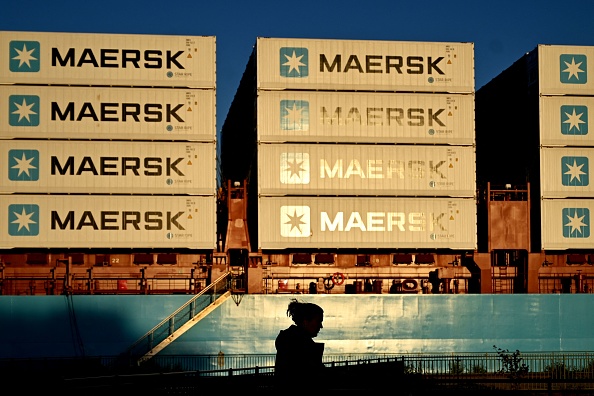
A Barcelona court is investigating shipping giant Maersk over allegations it transported US weapons to Israel.


The New Arab Staff
12 May, 2025


Spain halted arms sales to Israel after it launched a military onslaught against Hamas in the Gaza Strip [Getty]

A court in Barcelona has launched an investigation into the shipping giant Maersk over allegations that it had transported weapons from the United States to Israel in the past six months.

The case was prompted by a complaint from the Catalan campaign group Prou Complicitat amb Israel (Stop Complicity with Israel), according to the Catalan News Agency (ACN).

The group is calling on Spanish authorities to identify the captains of two vessels, Nexoe and Detroit, which it alleges were involved in the arms shipments.

Last Wednesday, the investigating judge ordered that the two captains, along with Maersk's legal representative in Spain, be summoned to testify.

Their hearings were scheduled for Monday, coinciding with the Nexoe's arrival at the Port of Barcelona, where it was due to remain until 19:00 local time, according to Maersk's public records.

The activist campaign has long accused Spanish ports of being used to transfer military equipment to Israel and reiterated calls for the Spanish government to impose an arms embargo.

"This is further proof that Spain has yet to enforce any ban on arms exports to Israel - something it must do immediately," the group said in a statement.

Spain halted arms sales to Israel after it launched a military onslaught against Hamas in the Gaza Strip. In May 2024, it recognised the State of Palestine, joining several other European nations in what Prime Minister Pedro Sanchez called a "historic" move.

At the time, Sanchez told parliament that "no matter how many walls are erected or towns bombed, Palestine's identity will endure - in our hearts, in international law, and in the vision of a peaceful Mediterranean future."

The country has been one of Europe's most critical voices about Israel's Gaza offensive and is working to rally other European capitals behind the idea of recognising a Palestinian state.
UK to argue F-35 export outweighs Gaza genocide risk in landmark case

London is facing a High Court case over allegations that its continued export of F-35 fighter jet components to Israel breaches domestic and international laws.


The New Arab Staff
12 May, 2025


The government's legal argument centres on the claim that any disruption to the F-35 supply chain would damage NATO's security [Getty]


The UK government is set to argue in a landmark High Court case that preserving Britain's role in the global F-35 fighter jet programme takes precedence over compliance with domestic arms export laws or any legal duty to prevent genocide in Gaza.

The four-day hearing, beginning on Tuesday, will test whether ministers acted unlawfully by continuing to supply parts for F-35 jets that may be used by Israel in its ongoing assault on Gaza.

The case has been brought by Palestinian human rights organisation Al-Haq, and is backed by leading UK-based groups including Amnesty International, Human Rights Watch, Oxfam, and the Global Legal Action Network (GLAN).

The government's legal argument centres on the claim that any disruption to the F-35 supply chain would damage NATO's security, the Guardian reported on Monday.

Britain supplies around 15 percent of the jet's value, including ejector seats, rear fuselage parts, targeting lasers, and other components primarily through BAE Systems. It is the second-largest contributor to the F-35 programme after the United States.

Government lawyers acknowledge that UK arms export laws prohibit supplying equipment where there is a clear risk of it being used to commit serious violations of international humanitarian law.

However, they argue that parts are supplied to a global stockpile, not "directly" to Israel, and that halting the supply could harm UK credibility within NATO and damage relations with the US.

In submissions to the court, Defence Secretary John Healey claimed that suspending exports would have a "profound impact on international peace and security", and that such a move could undermine US confidence in the UK at a "critical juncture in our collective history.” He further warned that adversaries could “take advantage of any perceived weakness".

GLAN lawyer Charlotte Andrews-Briscoe, representing Al-Haq, said the UK's continued support for the F-35 programme has enabled Israeli attacks on Gaza with "catastrophic and continuing" consequences.

She cited more than 15,000 air missions by Israeli F-35s since 7 October, including the 18 March strikes that killed over 400 Palestinians in a single day, among them 183 children and 94 women.

Related
Oliver Mizzi

"These warplanes cause deaths and life-changing injuries," Andrews-Briscoe told the Guardian. "They also support ground troops that are intentionally starving an already decimated population."

She warned that the government's approach risks gutting the legal meaning of genocide prevention. "They’ve effectively said the Geneva Conventions have no domestic application unless an international court conclusively rules on genocide - something they admit could take years. If this argument is accepted, it would strip the duty to prevent genocide of any practical relevance."

Al-Haq's barrister Jennine Walker also criticised the government's reliance on national security arguments, saying: "Of course it is possible to stop British-made F-35 parts from reaching Israel without collapsing the entire programme. What really threatens international peace and security are these flagrant violations of international law."

Speaking to The New Arab, Campaign Against Arms Trade (CAAT)’s media coordinator Emily Apple said: "The government's position in this case is untenable, illegal and immoral. In continuing to supply F-35 spare parts through the global stockpile, it is breaking both domestic and international law.

"It is not disputed that there is a clear risk that Israel is using F-35s to commit war crimes, and that it is not committed to upholding international law. Yet this government is making the outrageous assertion that stopping the supply of F-35 parts would put global security at risk. However, ignoring the Genocide Convention, and ignoring domestic and international law, is the greatest threat to global peace and security we could possibly face."

Apple added that it was "a moral and legal outrage that this legal case is necessary", and accused the UK government of putting arms industry profits above Palestinian lives. "We hope this court case will finally end the UK’s complicity in Israel’s horrific war crimes," she said.

Related
Anam Alam

The case comes amid renewed attention to the UK’s military support for Israel. In September 2023, the government suspended 30 arms export licences just 90 minutes before a scheduled court hearing, but notably excluded F-35 parts from the suspension, arguing they were too critical to NATO to restrict.

Human Rights Watch UK director Yasmine Ahmed said the government had failed its responsibilities under the Genocide Convention.

"By 2 September, ministers knew over 41,000 Palestinians had been killed, including 15,000 children, and that 1.9 million people had been forcibly displaced. Yet they still maintained the supply of F-35 parts without even considering the risk of genocide," she said.
The strategic illogic of Israel's actions in Syria

Israel has adopted a more aggressive and high-risk approach that readily employs military force to escalate conflicts to reshape the regional balance of power


Analysis
Rob Geist Pinfold
12 May, 2025
THE NEW ARAB

For much of the international community, the jury is still out over Ahmed al-Sharaa’s near-transformation from jihadist revolutionary to Syria’s sober statesman.

Israel, by contrast, has long ago passed judgment on al-Sharaa and his administration, with Israeli ministers describing Syria’s interim president as “pure evil” and “an al-Qaeda terrorist.”

Since Assad’s regime fell, Israel has struck Syria an unprecedented number of times. Its troops have captured over 460 square kilometres of Syrian territory and on several occasions exchanged fire with and killed the territory’s residents.

Israel’s justifications for these actions are not credible. Its officials claimed that its expansion into Syria would be temporary. But Israel’s troops have pushed further into Syria, whilst Defence Minister Israel Katz later declared that the occupation would be “indefinite,” contradicting the earlier statements by his own officials.

In December 2024, Israel argued its airstrikes were necessary to eliminate the Assad regime’s conventional and chemical weapon stocks. Yet if this were true, why is Israel not only still striking Syria today, but escalating its attacks?

Equally implausible is Israel’s claim that its latest intervention in early May 2025 was to protect Syria’s Druze from a “pogrom” by al-Sharaa’s forces. What is true is that from 28 April, scores of Syrian Druze were killed. The attackers, though, were not the security forces, who later intervened to restore order, but primarily militias outside government control.

Despite Israel’s self-designated role as the protector of Syria’s Druze, most community leaders condemned the strikes. Druze leaders then reached a power-sharing agreement with Syria’s central government that restored a tentative calm.

But this did not stop Israel from launching the most extensive series of strikes this year so far. Gone were any pretences of targeting former regime installations or weapons caches. Israel’s attacks killed members of the security forces and deliberately struck just 500 metres from al-Sharaa’s presidential palace to “send a message” that it could “reach” Syria’s leader.

This episode reveals Israel’s true strategic logic in Syria. It sees al-Sharaa as a threat and is responding as it often does when it feels threatened, through military force and territorial conquest. This perception also informs its furtive objective: not to protect the Druze, but to exacerbate instability in Syria to keep the government and country as weak as possible.

On the face of it, none of this makes sense. Israel and the al-Sharaa government share common foes, most notably Hezbollah and Iran. There have been no attacks on Israel from Syria since Assad’s departure from the country. Al-Sharaa, in turn, has repeatedly stressed he does not seek conflict with Israel - words that Assad himself would rarely dare utter.

Why, then, is Israel determined to destabilise Syria? The roots of its policies there are little to do with what the al-Sharaa government does or does not believe and more a product of systemic changes in Israel’s foreign and security policy - its “grand strategy” - after 7 October.

Since Assad's regime fell, Israel has struck Syria an unprecedented number of times, while its troops have captured over 460 square kilometres of Syrian territory. [Getty]

Before the current regional conflict, Israel adopted a “better the devil you know” policy towards its neighbours. It was, in political science language, a “status quo power” that sought to freeze and perpetuate the Middle East’s balance of power.

Israel employed its qualitative military edge to “mow the lawn” and trim any threats to itself or the regional order down to size.

This was exceptionally bad if you were a Palestinian living under an indefinite Israeli military occupation. But it did mean that Israel was unlikely to start or escalate a regional war. Prime Minister Benjamin Netanyahu regularly advocated regime change in Lebanon, the Gaza Strip and Syria. Israel’s actions, however, did not match his bellicose rhetoric; Israel even helped supply fuel, energy and money to Gaza to keep Hamas’s impoverished regime afloat.

There was an underlying strategic logic to Israel’s tolerance of threats on its borders. In leaked remarks from 2019, Netanyahu claimed that “anyone who opposed” Palestinian statehood should support the status quo, because it kept the West Bank and Gaza divided.

That same logic worked in Syria. Israel tolerated the Assad regime because it was too weak and too illegitimate to pose a threat. Assad’s callous massacres of his own citizens ensured that any external pressure on Israel to return the Golan Heights - Syrian territory it captured in the ‘Six Day War’ of June 1967 - dried up overnight.

Conversely, after Russia’s intervention in the Syrian Civil War, Israel deemed the now propped-up Assad regime strong enough to keep both countries’ mutual border clear of any threats, such as jihadists or other militias.

But 7 October engineered a fundamental change in Israel’s grand strategy. In response to its colossal intelligence failure, Israel adopted a more aggressive and high-risk approach that readily employed military force to escalate conflicts in order to reshape the regional balance of power.

This is as evident in Syria as it is on any of Israel’s borders. Finance Minister Bezalel Smotrich recently boasted that Israel will strike Syria until the country is “partitioned” and effectively ceases to exist.

In May 2025, an Israeli soldier serving in the Golan ominously warned that the distance between the Syrian city of Quneitra and an Israeli kibbutz “is about five minutes.” The Israeli media article that the quote appears in describes the Israel-Syria border as “an illusion of calm”.

Related
Post-Assad Syria
Mawada Bahah

The implication here is obvious: another 7 October awaits on Israel’s border with Syria. The only way to stop it is through a buffer zone (read: occupation) and pre-emptive military force.

This is the real reason why Israel is destabilising Syria. This is an outcome that is eminently achievable, given that Syria is already unstable. Yet it is also a poor one in that it is a self-fulfilling prophecy.

Israel is repeatedly striking Syria and expanding its occupation because it fears al-Sharaa’s government and Turkey’s influence in the country. But it is these actions that are putting it on a collision course with both Turkey and the new Syrian government.

At the time of writing, Israel’s strikes have relented after talks with Turkey. Al-Sharaa even admitted to a UAE-sponsored backchannel between his government and Israel that has sought to simmer down tensions. Yet the backchannel has existed since 13 April and failed to stop Israel’s recent escalation.

The same is true of Israel’s “deconfliction” agreement with Turkey that both sides instituted in early April. Equally, given that all the conditions that drove Syria’s recent internecine conflict remain - poverty, sectarian tension and the lack of a strong central government - it may only be a matter of time before another outbreak of violence occurs.

If and when it does, Israel will likely use it as an excuse to intervene and create more chaos.

Rob Geist Pinfold is a Lecturer in Defence Studies (International Security) in the School of Security Studies at King's College London. His book, Understanding Territorial Withdrawal: Israeli Occupations and Exits, was published by Oxford University Press in 2023
Engulfed in paranoia Israel sets stage for Gaza 'final solution'

Setting the wildfires aside, Israel and its society must confront the crimes, both ecological and engineered, it is committing in Gaza, writes Alex Foley.


Alex Foley
09 May, 2025


The settler-colony is known for its siege mentality, a product of, depending who you ask, either its being surrounded by hostile neighbours or the latent knowledge of the mass graves under its beaches, writes Alex Foley [photo credit: Getty Images]


On the evening of April 29, a spasm of panic broke out at a Memorial Day ceremony in Tel Aviv’s Habima Square. Ushers at the event were arrested after someone pointed out the “suspicious individuals wearing vests” to police. The arrests cause attendees to flee. Video footage shows crowds running from the square in a near-crush that left twenty injured. Rumours began circulating of gunfire, which the police later had to quell.

The next morning, Israel was burning. According to Israeli fire services, a fire broke out near the Mesilat Zion settlement near Jerusalem, and was quickly blown by strong winds first West, then eastward, causing fears they would reach Jerusalem itself.

By the end of the week, with help from Italy, Croatia, and North Macedonia, firefighters had largely managed to control the blaze, but not before it had consumed over 6,000 acres of land.

On the face of it, these were two independent events connected only temporally. But as I watched footage of the fires my mind went to Joan Didion’s 1968 essay The Santa Anas, a meditation on the katabanic wind event that occurs when high-pressure air masses from over the Great Basin and the Mojave Desert drive down the mountains into low-pressure areas over the Pacific.

These hot winds, Didion understood, bring not only a risk of wildfires, but a mood, a general agitation that makes classrooms unmanageable and drives people to murder or suicide. “The wind,” she writes, “shows us how close to the edge we are.”

In Didion's essay, she name-checks a number of other similar foehn winds, including the khamsin winds of Egypt and the Levant. Perhaps, then, a similar agitation had blown over the crowds at Habima Square the night before the fires broke out.

Israel has certainly been close to the edge for a while. It is easy to forget, with the intervening genocide, how precarious the situation in Israel was before the Al-Aqsa Flood. People were openly discussing the “curse of the eighth decade,” the tendency of Jewish states to begin collapsing around 80 years into their existence. Months before October 7, I had the displeasure of being stuck in a room with a prominent Zionist figure as she expressed her feelings that the only thing that could keep Israeli society together was “an all-out war on the Arab nations.”

Israel is, at the best of times, a paranoid nation. The settler-colony is known for its siege mentality, a product of, depending who you ask, either its being surrounded by hostile neighbours or the latent knowledge of the mass graves under its beaches. It did not take long for a paranoid discourse to take hold in relation to the fire.

Yair Netanyahu, son of the Prime Minister, announced on X (Twitter) that, “Something here is suspicious,” and intimated that the Israeli left could be behind the fires in a plot to stop “Independence Day” celebrations.

Elsewhere, predictable claims that the Arabs were responsible came thick and fast while authorities stressed they were still investigating the cause, though they made arrests of suspects. Some inverted, with glee, the usual line around indigeneity and who respects the land, conveniently ignoring the total destruction of the South and West in Gaza.

In reality, the speed and ferocity of the fires were due, in large part, to settlement. Didion, the neurotic, was obsessed with infrastructure and wrote about LA freeways, aqueducts, shopping centres, urban sprawl, and the Hoover Dam as a means of keeping the chaos at bay.

She would likely have taken interest in Ghada Sasa’s explanations of how Israel’s efforts to “make the desert bloom” have contributed to the likelihood of wildfires. The large-scale planting of non-native trees like Australian eucalyptus and increased desertification of the Negev due to plantations has made the landscape a tinderbox.

Back in Didion’s native California, another set of embers have been catching, seeds of a coming inferno. Shaiel Ben-Ephraim, an Israeli academic and host of Israel Explained, took to Substack to announce he had, reluctantly, come to the conclusion that Israel is committing a genocide. In the lengthy piece, he outlines how he came to the conclusion that Israel’s assault on Gaza was not being carried out for the stated aims, but rather to eradicate the Palestinians in part or in whole.

Crucially, much of the evidence he presents, especially the statements from Israeli politicians, date from the early days of the genocide. The argument he constructs for dolus specialis, or specific genocidal intent, is based on a pattern of Israeli actions spanning the decades since its inception. The question that presents itself, then, is what changed for him now?

After all, he spent the first year and a half of the genocide engaging in the classic “liberal Zionist” two-step, vacillating between expressing horror over the violence necessary for Israel’s existence and outright atrocity denial.

Back in January of last year, under a video of women and children being forced to flee, Ben-Ephraim commented, “Genocide [sic] are famous for allowing people to leave for their own safety.”

After Aaron Bushnell’s self-immolation, he said, “The American left is solely responsible for his death,” for having pushed the “lie” of genocide. “Your cheap propaganda killed a gullible and mentally disturbed individual.”

Most egregious, in response to a now deleted photo of Sidra Hassouna’s body, the 7-year-old girl who was found hanging from a wall following an Israeli air strike, both her legs shorn from her body, Ben-Ephraim said, “Nice AI bullshit.”

None of this stopped Owen Jones from hosting him on his YouTube channel for what he described as a “robust interview.” The ethics of giving a platform to this man for his image rehabilitation given the above could be the subject of its own piece. Ben-Ephraim seems largely lacking in contrition; when Jones pressed him on his past accusations of “blood libel” towards those calling out the genocide, he claimed he believes that was still an accurate description in many instances.

However, the interview does get to the question of why now. At the beginning of the video, Ben-Ephraim states that one of the things that pushed him over the line was the polarisation forming within his “moderate” sources in the Israeli military between those who began blowing the whistle that the IOF was carrying out mass death atrocities and those who were spouting increasingly genocidal rhetoric.


Gaza War
Alex Foley

This tension will presumably only worsen as Israel moves to enact its forced displacement campaign, “Gideon’s Chariots,” likely the final act of the genocide.

Self-professed liberals, like Ben-Ephraim, will have to contend with the crimes committed for their benefit. There is an open-ended question as to how to react to those who have, like Shaiel, come to the realisation this late in the game, but it is certain that more and more will come.

Already, the Israeli army is facing a crisis of huge numbers of reservists refusing to show up for military service. The Shin Bet has announced they are increasing security measures for Netanyahu at public events in response to increasing political tensions.

The winds appear to have blown in pre-October 7 discontent, along with some other anxiety about the edge on which Israel is perched. In the crackle of the blaze was the echo of the final moments for Shaban al-Dalou and the countless others Israel has burned alive.

As the old spiritual says, "God gave Noah the rainbow sign / No more water, the fire next time."


Alex Foley is a researcher and painter living in Brighton, UK. They have a background in molecular biology of health and disease. They are the co-founder of the Accountability Archive, a web tool preserving fragile digital evidence of pro-genocidal rhetoric from power holders.
Follow them on X: @foleywoley
Susan Sarandon, Frankie Boyle, and Lindsey Hilsum among 600 media figures urging BBC to air shelved Gaza medics documentary

Over 600 media figures have called on the BBC to air a shelved documentary about Palestinian medics under Israeli fire.


Sarah Khalil
12 May, 2025
THE NEW ARAB


The signatories of the letter urging BBC to air the documentary on Gaza's medical workers include Oscar-winning actor Susan Sarandon [Getty]

More than 600 leading figures from the media, arts, and cultural sectors have signed an open letter demanding that the BBC immediately broadcast 'Gaza: Medics Under Fire', a completed yet unaired documentary exposing Israeli attacks on Palestinian healthcare workers in Gaza.

The signatories include Oscar-winning actor Susan Sarandon, comedian Frankie Boyle, Channel 4's news editor Lindsey Hilsum, and more than a dozen current BBC staff. They accuse the broadcaster of suppressing the film for political reasons, despite it having already undergone months of editorial reviews and fact-checking.

"This is not editorial caution. It's political suppression," the letter states, calling out what it describes as a double standard when it comes to Palestinian testimony. "Every day this film is delayed, the BBC fails in its commitment to inform the public, fails in its journalistic responsibility to report the truth, and fails in its duty of care to these brave contributors."

The documentary, produced by Basement Films and directed by an award-winning team including Ben de Pear, Karim Shah, and Ramita Navai, focuses on Palestinian medics working under fire during Israel's ongoing assault on Gaza.

It features eyewitness accounts from frontline doctors and nurses who describe treating the wounded in overwhelmed hospitals and targeted clinics.

British filmmaker Sophie Binyon told The New Arab that several independent and prominent journalists had exposed the BBC's clear bias in covering Gaza over the past 19 months and that the findings were "damning".

Binyon referenced the BBC's recent decision to pull the Gaza documentary 'Gaza: How to Survive a War Zone', after it was revealed that one of the 13-year-old narrator was the son of a "Hamas official" in a move widely criticised as a disturbing precedent for censoring Palestinian narratives based on family affiliations.

"The BBC's self-preservation at Portland Place has overtaken its duty to report the truth. It's disgraceful," Binyon added.

An internal source at the BBC, who asked to remain anonymous due to fear of professional repercussions, told TNA that the current controversy reflects long-standing internal concerns:

"This isn't an isolated incident. Many filmmakers and journalists who have worked with the BBC have long encountered similar patterns - stories reshaped, voices sidelined, and editorial decisions made to appease political sensitivities rather than serve the public," the source sad.

"This moment reveals a deeper structural problem: who gets to tell the story, whose pain is seen as legitimate, and which narratives are allowed to reach the screen."

Also among the signatories is veteran documentary filmmaker Ruhi Hamid, who emphasised the stakes involved in reporting from conflict zones like Gaza.

"As a documentary filmmaker, I know how much work, risk, and responsibility go into telling the truth – especially in places like Gaza," she said.

"When the BBC chooses to suppress a film that highlights the lifesaving work of doctors under siege, it doesn’t just fail the filmmakers. It fails the public."

Documentary editor Rose Glandfield added: "As a Jewish woman from a family of pacifists, I was raised with the belief that our humanity is defined by how we respond to the suffering of others. Bearing witness to injustice and standing up for those in danger is not only a moral imperative - it is part of who I am."

The advocacy group Health Workers 4 Palestine has also condemned the delay, warning that it obscures critical evidence of violations of international humanitarian law and undermines accountability efforts.

Basement Films confirmed it was still waiting for a release date.

"We gathered searing testimony from multiple Palestinian doctors and health care workers," the team said. "We are desperate to tell the surviving doctors and medics when their stories will be shared."

The letter, addressed to BBC Director-General Tim Davie, ends with a call for the broadcaster to honour its public service mandate and broadcast the documentary without further political interference.
Hundreds march in West Bank against Israel's killing of medics

Hundreds of Palestinian Red Crescent staff marched in the occupied West Bank city of Ramallah on Monday to protest Israel's killing of medical workers.


The New Arab Staff & Agencies
12 May, 2025


Israeli forces have killed 1,400 humanitarian and medical workers since the beginning of the war. [Getty]

Hundreds of Palestinian Red Crescent staff marched in the occupied West Bank city of Ramallah on Monday to protest Israel's killing of medical workers in Gaza over the past 19 months of war.

Gathering in the city's Clock Square, medical personnel, support staff and volunteers wore white and orange vests and waved flags bearing the Red Crescent's emblem.

The demonstration marked World Red Cross and Red Crescent Day, usually observed on 8 May, and called for the "protection for medical and humanitarian workers".

In a statement released Monday, the Red Crescent said 48 of their staff members have been killed in Gaza and the West Bank since the war began on 7 October, 2023 - including 30 who "were killed while performing their humanitarian duty wearing the Red Crescent emblem".

Protesters carried symbolic white shrouds bearing the names and pictures of the dead, as well as signs demanding the release of three staff members who have been detained by the Israeli army for over a year.

Israeli forces have killed 1,400 humanitarian and medical workers in Gaza since the beginning of the war, according to the statement, which added that "dozens of medical personnel working in Gaza... were detained while performing their humanitarian duties."

It highlighted a particularly deadly attack in March in the southern Gaza city of Rafah, when 15 first responders including eight Red Crescent paramedics were massacred by Israeli soldiers.

The first responders were answering distress calls after Israeli air strikes.

The incident drew international condemnation, including concern about possible war crimes from UN human rights commissioner Volker Turk.

An Israeli military investigation, the results of which were published, acknowledged "professional failures" and "violations of orders" during the shooting.

(AFP and TNA staff)


Israel’s total war on healthcare in Gaza is designed to deprive Palestinians of their means of survival

The endless slaughter of Gaza medics reveals the truth: Israel’s disregard for Palestinian life isn’t a mistake, it’s the strategy, says Ghassan Abu-Sittah.


Ghassan Abu-Sittah
12 May, 2025
THE NEW ARAB


The martyrs of the aid worker convoy massacre join over a thousand other healthcare and humanitarian workers killed by Israel in Gaza, writes Dr. Ghassan Abu-Sittah [photo credit: Getty Images]


In the last minutes before dawn, seven emergency response vehicles travel through Al-Hashashin, north of Rafah in Gaza. They’ve been called out to recover and treat casualties from Israeli fire overnight. The convoy stops and pulls over, its personnel get out to begin their work: “It looks like an accident”, one man says, as they reach the site of Israel’s overnight attack.

Within minutes, without warning, they are under fire. Shots from distance by Israeli troops kill some convoy members immediately. Others are found by approaching troops. They are then bound and later executed. Two paramedics are abducted from the scene and taken into detention.

Rifatt Radwan, of the Red Crescent, recorded his last moments before his execution by the Israeli troops. "There is no God but God, and Muhammad is his messenger. Forgive me, mother, because I chose this way, the way of helping people. Accept my martyrdom, God, and forgive me."

Fifteen paramedics and emergency personnel were killed during the massacre, including Palestine Red Crescent medics Mostafa Khufaga, Saleh Muamer and Ezzedine Shaath, first responder volunteers Mohammad Bahloul, Mohammed al-Heila, Ashraf Abu Labda, Raed al-Sharif and Rifatt Radwan.

Civil Defence Head of Mission Anwar Al-Attar was killed alongside his team members Fouad Al-Jammal, Yousef Khalifa, Zuheir Al-Farra, Sameer Al-Bahabsah, and Ibrahim Al-Mughari, as was one worker from the UN Relief and Works Agency.


In Gaza, Israel mark medics for murder

Their bodies were found four days after their killing, buried in a shallow grave along with their destroyed vehicles. Rifatt’s phone, and its recording of the team’s last moments, was found on his body. There were only two survivors, paramedic Munther Abed and ambulance driver Assad al-Nasasra, both of whom were beaten and detained – Assad for over five weeks.

The martyrs of the aid worker convoy massacre join over a thousand other healthcare and humanitarian workers killed by Israel in Gaza. These workers were killed in a deliberate nature: an ambush was set for them, in which they were trapped, before being executed and buried.

It took numerous days before a UN-led mission was able to find their bodies. Many other healthcare and aid workers have not been extended this ritual – they have been blown apart by American-made bombs, or sniped and left dead on the streets. Many hundreds more have been abducted. For some, including my friend Dr Adnan Al-Bursh, they have been killed by the torture inflicted upon them during their kidnapping.
Related


Gaza medic massacre
Mohamed Duar

Regardless of method, the effect of their killing is the same: Palestinians are deprived of those with the means and the expertise of saving lives. In murdering individual doctors or launching a total war on healthcare in Gaza, Israel intends to deprive Palestinians of the means of their survival.

These acts of genocide intend to erase Palestinian life and the evidence of its existence. Gaza’s hospitals, some of them older than the State of Israel itself, were filled with world-leading Palestinian healthcare specialists. Despite the siege, this system was built to the highest degree of excellence in care. These hospitals, despite the war against them, continue to treat and rehabilitate those whom Israel has attempted to murder.

The success of these facilities and the resilience of their doctors and emergency staff are a thorn in Israel’s side. The aid workers tirelessly, courageously recovering wounded or dead Palestinians, or the doctors and hospital staff who refuse to leave their patients — they are a nuisance and a problem for Israel. In a war of extermination, they are marked for killing.

But it matters, too, to see how these fifteen were killed, and the public display of their deaths. The occupying military knew that vehicles would be found. Their bodies were buried shallowly – the Israelis not even bothering to remove the hand-ties, which show that they were executed.

Their deaths and the manner of their killing serve as a spectacle, to show how little Israel cares for even its most liberal, soft-handed critics. They know that the lies spun about the incident – of ‘suspicious vehicles’ and ‘Hamas operatives’ – would not hold water, but that is not their purpose.
Related


Gaza War
Sally Ibrahim

A UN Commission identifies that the destruction of Gaza’s healthcare system amounts to a crime of extermination. The International Criminal Court indicts Israel’s leaders for depriving Palestinians of their right to health. The UK government calls for Israel to ‘adhere to international law’ – this massacre happens not in spite of but because of these developments.

To maintain its occupation, Israel needs to show that it does not care for its liberal critics or the language of humanitarianism they use. By making the display of their disregard for international law, for human decency, the occupier deprives its critics of the logic of their appeals for restraint.


The worse the atrocities, the less believable their excuses, the stronger their hand. Israel’s soft-handed critics in the UK, EU, and UN have not yet come to understand what genocide, extermination, military occupation, and settler colonialism mean. When they do, they will understand why these healthcare workers in Gaza were made to die in the way that they did.


Professor Ghassan Abu-Sittah is a renowned, multi-award-winning Plastic and Reconstructive Surgeon, internationally recognised as a leading expert in craniofacial surgery (facial deformities), aesthetic surgery, cleft lip and palate repair, and trauma-related injuries. A dedicated humanitarian, he has served as a war surgeon in several conflict zones, including Syria, Yemen, Iraq, South Lebanon, and the Gaza Strip.

Of British Palestinian heritage, he is the Clinical Lead for the Operational Trauma Initiative at the World Health Organisation’s EMRO Office and Professor of Conflict Medicine at the American University of Beirut. He also sits on the board of directors of INARA, a charity that provides reconstructive surgery to children injured by war in the Middle East, and on the Board of Trustees of Medical Aid for Palestinians, a UK-based organisation.

Follow Ghassan on X: @GhassanAbuSitt1