Tuesday, May 27, 2025

Trump’s Golden Dome Project Includes Challenging Costs, Political Risks
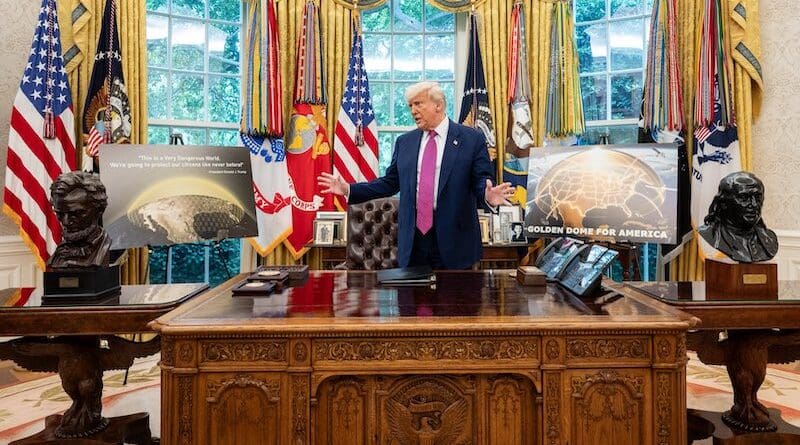
US President Donald Trump announces plans for Golden Dome in the Oval Office. Photo Credit: White House, X

By 

By Brett Rowland


(The Center Square) – President Donald Trump’s plans for a $175 billion missile defense shield include significant technical challenges and political risks.

Trump outlined plans for his Golden Dome in the Oval Office last week. The system Trump envisions would protect the U.S. and Canada using multiple layers of defense against diverse potential attacks, making it much more complex than previous proposals. The Golden Dome would also include space-based sensors and interceptors that the president said would be able to intercept missiles “even if theyare launched from other sides of the world and even if they are launched from space.” 

The president said the missile defense system would be operational before he leaves office in 2029. Trump’s plan is loosely modeled after Israel’s Iron Dome – but on a much larger scale. Israel’s Iron Dome defends a nation the size of New Jersey against short-range missiles built in underground tunnels. Trump’s system would protect a much larger area – North America – against more challenging threats, including intercontinental ballistic missiles and hypersonic weapons.

The Congressional Budget Office, which helps Congress understand the cost of budget proposals, said in a letter earlier this month that lower launch costs could reduce the price tag for deploying a constellation of space-based interceptors designed to defeat one or two intercontinental ballistic missiles fired at the U.S. by a regional adversary, such as North Korea, a nation with limited resources.

CBO noted that a reduction in launch costs would “cause the total estimated cost of deploying and operating the SBI constellation for 20 years to fall from $264 billion to $161 billion (in 2025 dollars),” according to the letter. On the high side, the total estimate would fall from $831 billion to $542 billion, CBO said.


However, the system discussed in the CBO letter has little resemblance to what Trump is planning. Trump’s executive order on the Golden Dome called for deploying a missile defense system to protect the United States from attacks by regional adversaries and attacks by peer or near-peer adversaries, including those with military capabilities similar to the U.S.

“Such a defense could require a more expansive SBI capability than the systems examined in the previous studies,” CBO noted. “Quantifying those recent changes will require further analysis.” 

Nearly every president since Ronald Reagan has discussed a missile defense system for the U.S. In 1992, the U.S. Government Accountability Office concluded that a proposed space-based interceptor system known as “Brilliant Pebbles” was based on immature simulations that “use many unproven assumptions.” Some such projects cost taxpayers billions before being scrapped.

The Missile Defense Agency, a U.S. Department of Defense component, has been working on a Ground-Based Midcourse Defense system to defend the U.S. against a limited ballistic missile attack from potential adversaries such as North Korea and Iran since 2002.

Its latest project, called the Next Generation Interceptor, was designed to respond to new threats and eventually replace aging Ground-Based Interceptors. DOD’s Director for Cost Assessment and Program Evaluation estimated the total cost to design, develop, produce, operate and sustain an initial capability of 20 production unit NGIs and additional test articles would exceed $17 billion, according to a 2024 report from the Government Accountability Office. 

“MDA is making progress developing NGI and the program is currently estimating initial interceptor deliveries will occur by the fourth quarter of fiscal year 2027, 1 year ahead of schedule,” the GAO report noted. “However, we found that NGI’s schedule is optimistic when compared to DOD’s historical performance developing and testing systems similar to NGI.”

That GAO report further noted that the NGI “program’s prime contract development costs have increased by hundreds of millions of dollars in the last year (specific details are sensitive) but remain within the program’s current budget.”

Todd Harrison, a senior fellow at the American Enterprise Institute, said Trump’s ambitious project comes with challenges and risks. Scale will be a key challenge, he said. 

“The physics of space-based interceptors mean that they inherently have an absenteeism problem – each interceptor spends the vast majority of its time each orbit out of range of any missiles it could intercept,” Harrison wrote for AEI. “According to my calculations and using fairly generous assumptions for the performance of each interceptor, it takes about 950 interceptors spread out in orbit around the Earth to ensure that at least one is always in range to intercept a missile during its boost phase. If an adversary launches ten missiles in a salvo, it requires some 9,500 interceptors in space to ensure at least ten are within range to intercept all of the incoming missiles.”

The numbers get much bigger very quickly, Harrison said.

“Given that China has about 350 ICBMs and Russia has 306, not including their sub-launched ballistic missiles, scaling a space-based interceptor system to meet the threat quickly becomes impractical,” he wrote. “In peacetime competition, this means an adversary can build missiles faster and more affordably than we can build the space-based interceptors needed to counter them.”

Harrison said lawmakers should put expectations in check.

“No matter how many different layers are included in Golden Dome, whether space-based or not, homeland missile defense will never be iron clad. Policymakers should limit their expectations for what can be deployed by the end of 2030,” he said. “The objective should be a system that can reliably defeat an attack by North Korea or Iran and merely blunt a large-scale attack by China or Russia. This much is technically feasible, but it will require substantial and sustained funding on the order of tens of billions of dollars over the next decade and beyond.”

Harrison noted the Golden Project faces political challenges as well. 

“Golden Dome is technically feasible and strategically sound overall, with the notable exception of space-based interceptors, which the laws of physics continue to render impractical,” he wrote. “The main mark against Golden Dome is the political risk that a future Congress or new administration will terminate it … The U.S. military could spend billions of dollars developing it only to have a subsequent administration kill the effort before it bears fruit. Golden Dome could become the poster child for waste and inefficiency in defense.”

Defense contractors are eager to join the effort. Lockheed Martin has already launched a Golden Dome website, suggesting how the company could help make it a reality. 



The Center Square

The Center Square was launched in May 2019 to fulfill the need for high-quality statehouse and statewide news across the United States. The focus of their work is state- and local-level government and economic reporting.

 

Lutnick Likely To Have A Lasting Role In The Trump Administration – Analysis

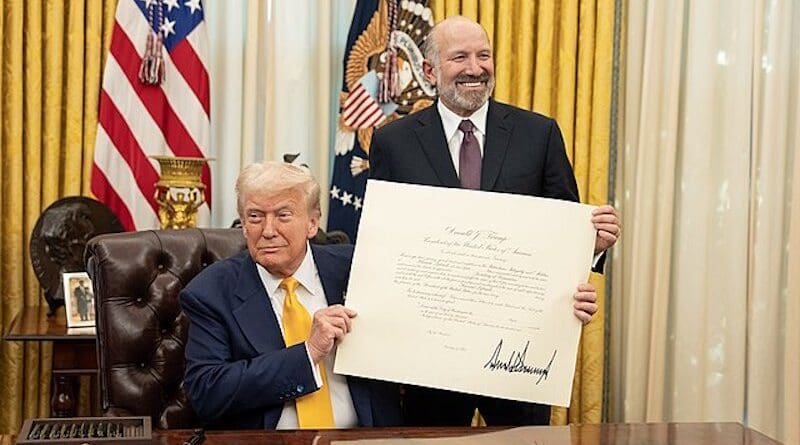
US President Donald Trump with Howard Lutnick, US Secretary of Commerce. Photo Credit: White House

By 

By Zhao Zhijiang


The current American news programs often showcase a balding man who passionately defends U.S. President Donald Trump’s reciprocal tariff and cryptocurrency policies, arguing against the media’s scrutiny of the White House. That man is Howard Lutnick, now serving as the U.S. Secretary of Commerce, known for once proudly declaring that the work of “millions and millions of human beings screwing in little, little screws to make iPhones” would come to the U.S. and be automated, thereby creating jobs for the Americans.

Sometimes seen as the enemy of Wall Street, Lutnick is actually quite an interesting figure with many stories behind him. Compared to the ambitious but incompetent Scott Bessent, Lutnick truly has talent and exercises sound strategy. Judging from his past experiences and interactions with President Trump, it seems Lutnick may have a longer path ahead of him within the Trump administration than others.

Lutnick was born in July 1961 into a Jewish family on Long Island, New York. His father was a history professor at a local university, while his mother was a painter and sculptor. Although his high school and college years were far from smooth, as his parents passed away during this time, Lutnick did not give up on his future. Instead, he continued his education while working to repay the debts left by his father. With the help of a university scholarship, he chose to major in economics and, after graduating in 1983, successfully entered the world of finance on Wall Street.

He began his career at Cantor Fitzgerald, a financial services firm founded in 1945. The company specialized in institutional equities, fixed income, investment banking, and commercial real estate financing. While not as large or wealthy as giants like Goldman Sachs or JPMorgan Chase, Cantor Fitzgerald had long been a major player in the bond market. Financial firms regularly relied on intermediaries like Cantor to execute bond trades without revealing their own trading intentions.

Bernard Cantor, the founder of Cantor Fitzgerald, greatly appreciated Lutnick’s capabilities and later appointed him as the company’s chief executive and president. Within the industry, Lutnick has a reputation that’s often described as complicated. Many see him as a cold and ruthless figure who has made plenty of enemies over the years. At the same time, Lutnick placed a strong emphasis on technology and digitization, believing that these innovations were key to maintaining the company’s competitiveness and profitability. In 1999, he made the decision to take Cantor’s electronic trading subsidiary, eSpeed, public. However, some of the firm’s brokers feared that the new electronic trading system would eventually put them out of work.


In fact, it was the much-doubted eSpeed that ended up saving Cantor Fitzgerald at its most critical moment. On the morning of the 9/11 attacks in 2001, the plane struck the World Trade Center tower where Cantor’s offices were located, killing all 658 employees present. That day, Howard Lutnick survived only because he was taking his son to the kindergarten.

With two-thirds of its workforce lost, industry observers predicted that Cantor Fitzgerald would soon collapse. Yet, thanks to eSpeed, the company was able to quickly restore its electronic trading operations. Just 47 hours after the attacks, the bond market reopened under intense pressure, and Cantor, with support from its London office and the resilience of eSpeed, managed to resume business. Sympathy from the public and the broader financial community following the tragedy also played a role in helping Lutnick and his company weather the crisis.

In 2008, Lutnick merged eSpeed with other brokerage operations to form a publicly traded company called BGC Partners. The market initially responded with skepticism, downgrading BGC’s valuation. One investor even referred to this reaction as applying the “Lutnick discount”. To navigate around the issue, Lutnick spun eSpeed off from BGC and, in 2013, sold it to the NASDAQ OMX Group for USD 750 million in cash plus stock payments to be made over 15 years. As NASDAQ’s stock price rose over time, the value of those stock payments increased significantly, ultimately pushing the total value of the deal above USD 2 billion, surpassing BGC’s entire market capitalization at the time.

In addition to e-payment system, Lutnick has also shown great interest in the potential of cryptocurrencies and blockchain technology. As early as 2020, after the U.S. Office of the Comptroller of the Currency (OCC) issued new regulations on digital asset custody and settlement, Lutnick partnered with Tether CFO Giancarlo Devasini to promote Cantor Fitzgerald’s entry into the digital asset management sector. Beginning in 2021, the company started helping Tether manage its substantial U.S. Treasury reserves that back its stablecoin USDT (the currency code for Tether).

Lutnick is a staunch supporter of Bitcoin. In an exclusive interview with Bitcoin Magazine, he stated, “Bitcoin is a commodity, and it should be treated like a commodity. It should be treated like oil. It should be treated like gold”. He emphasized that this means Bitcoin should be freely traded. These remarks, along with his vision of turning the U.S. into a Bitcoin nation, have drawn considerable attention within the industry. As digital gold, Bitcoin’s decentralized nature and limited supply have increasingly solidified its role in global asset allocation. As Secretary of Commerce, Lutnick’s support undoubtedly injects strong momentum into Bitcoin’s path toward regulatory compliance and mainstream acceptance. Trump himself also places significant value on virtual currencies, which is one reason why he and Lutnick are considered relatively compatible.

It is worth noting that Trump and Lutnick share a number of similarities. According to a Forbes report, both men amassed their initial fortunes in New York during the 1980s; Trump through real estate, and Lutnick on Wall Street. Their business approaches also bear resemblances: both have frequently shifted between various profit-making ventures, and both have at times attracted regulatory scrutiny for issues such as alleged fraud, poor record-keeping, or concerns over money laundering. They are known for their hardline personas and their affinity for a lavish lifestyle. Of course, they also differ in key ways, such as their attention to detail. Unlike Trump, who is often seen as unconcerned with minutiae, Lutnick is known for his meticulousness. Despite these personality differences, Trump chose Lutnick as a close advisor. In part, this is because Trump sees value in having someone like Lutnick support his policies on Bitcoin and economic affairs. Trump also draws on Lutnick’s personal narrative of loss and resilience during the 9/11 attacks to present a narrative of perseverance and patriotism within his administration. A senior researcher at ANBOUND noted that Trump’s core team consists primarily of fighters rather than academic or establishment figures focused solely on theory. Moreover, Trump tends to appoint his personnel in phases, and some current appointees may be replaced within a year or two. Given Lutnick’s hands-on business experience and his personal rapport with Trump, as well as their ideological and temperamental similarities, he is likely to remain influential over the longer term.

Final analysis conclusion:

In contrast to the overly ambitious yet underqualified and unrefined Scott Bessent, U.S. Secretary of Commerce Howard Lutnick brings substantial experience and genuine competence to the table. His strategies and perspectives within the Trump administration are also relatively pragmatic. Moreover, both he and Trump place significant value on the role of virtual currencies. Compared to others, it appears that Lutnick is likely to have a more enduring presence within Trump’s team.

  • Zhijiang Zhao is a Research Fellow for Geopolitical Strategy programme at ANBOUND, an independent think tank.


Anbound Consulting (Anbound) is an independent Think Tank with the headquarter based in Beijing. Established in 1993, Anbound specializes in public policy research, and enjoys a professional reputation in the areas of strategic forecasting, policy solutions and risk analysis. Anbound's research findings are widely recognized and create a deep interest within public media, academics and experts who are also providing consulting service to the State Council of China.


How GenAI Influenced The 2025 Philippine Election – OpEd

artificial intelligence eye medicine

By 

The rise of generative artificial intelligence (Gen AI) is quietly reshaping electoral politics in Southeast Asia. Gen AI is becoming increasingly like a co-pilot in political understanding, structuring choices, and influencing opinions rather than merely serving as a tool to assist with information seeking. As these technologies become more integrated into daily life, they are beginning to influence how people participate in democratic processes and political decision-making.


In the Philippines’ 2025 midterm elections, more voters turned to tools like ChatGPT to look up facts and help make strategic voting decisions, narrow down candidate options, and sometimes change how they voted. The experiences of Filipino voters provide an understanding of how Gen AI systems move from novelty to necessity in democratic participation. 

One of the most notable patterns emerging from voter engagement with Gen AI is the transition from simple information gathering to strategy formulation. Voters said they no longer just ask who is running or what a candidate stands for; they ask AI how best to vote and prevent undesired electoral outcomes. Gen AI tools facilitate this shift by offering prompt-responsive outputs tailored to the user’s intent. For instance, some voters sought AI guidance on abstaining from races where no candidate aligned with their political values. Others asked for strategic approaches to block frontrunners or fill out 12 senatorial slates to avoid vote dilution. In many cases, voters acknowledged that their final decisions were shaped, in part, by the reasoning and advice generated by AI tools.

Conversations between users and the Gen AI suggests that the tools are no longer just information vessels. They now play a role in how political meaning is made, which helps voters articulate values, weigh trade-offs, and frame arguments. In this sense, AI functions as a mediating agent in democratic judgment, where it collaboratively shapes political reasoning through interactive engagement. 

Still, the discursive power in this engagement has limits. The AI-human conversations depend entirely on what the user asks, the available online information, and the built-in filters that prevent AI from leaning too far from one’s political direction. While AI can guide the decision, the voter is still in control.

AI tools often reinforce existing biases when users ask to validate a pre-selected candidate or craft social media postings aligned with their partisan views. In that role, Gen AI becomes a mirror more than a moderator — organizing arguments to support prior beliefs rather than challenging them. However, for some users who asked more open-ended questions, the tool produced results that were not part of their preliminary choices, allowing them to reconsider, which they had previously ignored. The recommended candidates frequently come from grassroots or activist movements with limited attention from the mainstream media. 


These contrasting experiences highlight the voter’s role in shaping the outcome. Users with technical know-how and critical thinking skills can better frame productive questions and assess AI outputs. Others, however, who lack these skills have a higher risk of accepting AI responses at face value despite their inherent limitations.

Unlike static media sources, Gen AI platforms are highly responsive to user intent. The tone, scope, and neutrality of the information depend almost entirely on how voters structure their prompt. This user-driven experience provides a sense of empowerment, but also carries risks to how people form information-based opinions. If a prompt is biased toward the user’s beliefs, the AI may reinforce existing opinions rather than challenge them. This can lead to echo chambers, where voters are exposed to views that confirm their political perceptions, which eventually limits critical thinking and distorts their understanding of the political landscape.

While the user’s intent is central to navigating Gen AI, the systems in which these tools operate cannot be overlooked. It is essential to emphasize that these tools are developed by private tech companies that identify which content is prioritized, how the responses are framed, and which information sources are considered credible, a process that can result in harmful consequences without any public scrutiny. 

Take OpenAI’s Chat GPT, for example It generates political advice using algorithms the company claims are neutral. Yet, such advice is grounded in proprietary criteria not disclosed to users. The risk is that voters unknowingly rely on a system shaped by corporate interests rather than democratic transparency. 

Despite Gen AI’s growing interest, many voters were clear: AI did not decide for them. Human judgment remained central. Voters often verified AI outputs, especially when the tool failed to mention known advocacy work of specific candidates or omitted perceived qualified candidates due to data gaps. Sometimes, users manually reinserted these names into their shortlist after realizing the AI response lacked completeness. 

At present, Gen AI tools are not a substitute for political agency. Instead, these tools can accelerate and structure political decision-making, provided that users retain a healthy skepticism and commitment to verifying the outcomes through credible networks and independent thinking. 

The experience of Filipino voters in the recent 2025 Philippine midterm elections offers early insights into the role of AI technology in democratic participation in Southeast Asia. As digital literacy increases and Gen AI tools become more accessible, we can expect broader integration of AI in political decision-making not only among voters but also in political campaigns, advocacy groups, and institutions.

As the technology becomes more integrated in people’s lives, we need a proactive framework for Gen AI literacy in a democratic context that goes beyond prompt engineering. We need a framework highlighting source evaluation, ethical awareness, and civic responsibility. Institutions must also play a role in ensuring that Gen AI supports, rather than distorts democratic norms.

Generative AI is no longer just for work productivity or casual chats. It now affects how people understand and act in political systems. As evidenced by the experiences of voters from the Philippines during the 2025 midterm elections, AI didn’t just inform voters, it helped shape their political decisions. 

The challenge ahead is to ensure that AI’s expanding role in electoral politics leads to deeper understanding and broader engagement, not just more personalized choices or politically filtered results.Facebook


Christian Jaycee Samonte

Christian Jaycee Samonte is a researcher at an AI-driven research and strategy company. His work focuses on political communication, gender, and emerging technologies. He holds a master’s degree in Speech Communication from the University of the Philippines Diliman.


When The Sea Moves Inland: A Global Climate Wake-Up Call From Bangladesh’s Delta

Ships River Bangladesh Cargo Shipping Travel Port

By 

As sea levels climb and weather grows more extreme, coastal regions everywhere are facing a creeping threat: salt. 


Salinization of freshwater and soils adversely affects 500 million people around the world, especially in low-lying river deltas.

A new study led by researchers at the University of Portsmouth, in partnership with Dhaka University and Curtin University, sheds light on how rising oceans are pushing saltwater into freshwater rivers and underground water sources in the world’s largest river mouth – the Bengal Delta in Bangladesh.

Drawing on nearly two decades of data from over 50 monitoring stations in coastal Bangladesh, the team tracked a consistent rise in salt levels in rivers and estuaries, particularly since the mid-2000s. 

The western parts of the delta, already more prone to tidal influence, showed the fastest increases in salinity. The data suggests that the combination of sea-level rise, reduced freshwater flow, and increasingly frequent storm surges are all contributing to the inland movement and retention of saltwater.

Since around 2007, many parts of the delta have experienced stepwise increases in salinity, often linked to powerful storms like Cyclone Sidr. These changes can devastate crops, erode food security, and force communities to move. While the analysis focused primarily on environmental data, it underscores how salinity intrusion is increasingly a threat to livelihoods, public health, and regional stability.


The study, published in Ecological Indicators, uses one of the most detailed and long-running salinity datasets in any delta system worldwide. It applied advanced statistical methods to distinguish long-term trends from short-term weather or seasonal changes. 

The researchers introduced a new conceptual model called the Offshore Controlled Estuarine and Aquifer Nexus (OCEAN) framework, that highlights how offshore features like steep underwater slopes and restricted tidal flows can trap salt in low-lying coastal zones.

Dr Mohammad Hoque from the University of Portsmouth’s School of the Environment and Life Sciences: said: “What we’re seeing in the Bengal Delta is not just a local crisis, it’s a signal of what’s coming for low-lying coastal areas around the world.

“Salinity is rising faster and reaching farther inland than many people realise, and it’s happening quietly with major consequences for water security, agriculture, and livelihoods. This study helps us understand the mechanics behind it, and underscores the urgency for coordinated, global action.”

The findings also show the limits of relying only on land-based solutions. Human interventions like embankments, riverbed alterations, and upstream dams have often made things worse by restricting freshwater flows. 

Meanwhile, offshore dynamics – such as sediment build-up and ocean current shifts – play a larger role than previously appreciated. Addressing the problem, therefore, requires integrated approaches that connect rivers, oceans, and climate systems.

Coastal regions in California, including Los Angeles County and the Sacramento-San Joaquin Delta, are combating saltwater intrusion through innovative measures. In LA, freshwater is injected into aquifers to create hydraulic barriers against seawater. However, population growth and groundwater extraction continue to challenge these efforts. 

“While the focus is on Bangladesh, the study’s implications are global”, said Dr Sean Feist, former PhD researcher at the University of Portsmouth and now Scientific Officer at Test Valley Borough Council.  “Coastal regions from the Mekong Delta in Vietnam to Louisiana’s wetlands in the United States face similar pressures. As sea levels continue to rise, the risk of agricultural land turning salty, drinking water becoming undrinkable, and shallow groundwater becoming permanently brackish grows ever more serious.”

The paper recommends that similar long-term investigations into changing salinity levels be conducted in other vulnerable coastal regions around the world, particularly in low-lying deltas facing rising seas, reduced river flows, and increasing storm activity. Short-term datasets can often misrepresent the scale or pace of salinisation, while extended records offer a clearer picture of how saltwater intrusion evolves over time.

Dr Ashraf Dewan from Curtin University said: “Ultimately, this study highlights that the creeping salinisation of deltas is a slow-moving but deeply disruptive force. Without urgent investment in salt-tolerant agriculture, better water storage, and strategic planning across entire river basins, the disruptive impacts of salinity are likely to intensify. The Bengal Delta is on the frontline of climate change, but it is not alone. The patterns observed here are emerging in many of the world’s great coastal regions. What happens next depends on how quickly we respond.”


Eurasia Review

Eurasia Review is an independent Journal that provides a venue for analysts and experts to disseminate content on a wide-range of subjects that are often overlooked or under-represented by Western dominated media.


Tariffs: Why You Should Fear Them – OpEd


They won’t end the income tax, bring back jobs, or stop China. They will make you poorer.


Stock Market Chart Smartphone Finance Investment

By 

By Douglas Carswell

President Trump has established a baseline 10% tariff on nearly all imports. Additionally, the White House announced plans for reciprocal tariffs on 57 countries. A week later, on April 9, the administration then paused these measures for 90 days.

We still don’t know whether the reciprocal tariffs will take effect after July 9. What is certain is that, in addition to the 10% baseline, there is a 25% tariff targeting car imports and most goods from Canada and Mexico, and a staggering 125% levy is in place on most Chinese imports.

Some of my conservative friends like to imply that tariffs are part of a clever strategy to eliminate the federal income tax. They point out that until 1913 America had no such tax and the federal government was largely funded by tariffs.

Now, I’m all in favor of eliminating income taxes; I spent much of the last legislative session in Mississippi advocating for the repeal of our state income tax. But the numbers don’t add up for tariffs to replace the federal income tax entirely. To raise the $2.6 trillion annually that the income tax provides, tariffs would need to average 127% on all imports (even accounting for an estimated 20% drop in import volume). Do that, and only the wealthy will be able to shop at Walmart.


Others argue that tariffs are necessary to protect American industry against offshoring and job losses. Really?

Today, US output is close to three times higher than it was when Lyndon B. Johnson was President. American factories make almost double what they did when Ronald Reagan left the White House. The growth in industrial output happened even as tariffs declined from 6–8% in 1969 to about 2% by 2010 (with a slight increase by 2020 due to higher tariffs on China).

Yes, manufacturing employment in America has fallen, even as output has grown. But that is because fewer workers are needed to make more. The same trend played out in agriculture a century before. Fewer farm jobs did not make Americans poorer—it freed them to pursue better-paying jobs.

That’s why total employment in America has continued to rise even as manufacturing’s share of the workforce has fallen. There were 70 million jobs in 1969, and there are 160 million jobs today. So much for free trade “taking away” our jobs.

“But what about China?” some ask.

America should be worried about China. It’s alarming that China’s Jiangnan Shipyard builds more ships in a single year than all US shipyards combined. It’s concerning that China produces more drones in a day than the US does in a year.

But if China is the threat, why hit countries like Vietnam, South Korea, and India—potential competitors to China—with crippling tariffs?

Tariffs won’t abolish the federal income tax, reverse a supposed industrial decline, or solve the question of how to deal with an aggressive China. What they will do is make you poorer and America less competitive.

Consider your cell phone. Apple has already stated that tariffs will increase its costs by nearly $1 billion this quarter alone. That extra cost? It’s coming out of your pocket when you upgrade your iPhone. To dodge new tariffs on Chinese goods, Apple is shifting much of its manufacturing from China to India. Don’t expect new iPhone factories in Mississippi or Michigan—think Madras instead.

Ironically, the high-value work on smartphone production—the design, software, and chips—is already done in the US. Tariffs will simply move low-value assembly from one Asian nation to another, leaving you to foot the bill.

My big fear is that tariffs won’t just be seen as having triggered an economic downturn; they’ll also overshadow all other conservative wins.

During my recent trip to Washington, several administration insiders suggested that the current tariff strategy is part of a broader plan. They claim it’s intended to gain leverage to eliminate restrictions on US exports. Whether or not this was the original intent, I hope it becomes the retrospective rationale. For instance, if a close ally like the UK, which runs a trade deficit with the US, agreed to eliminate all its tariffs and allow any product sold in America to be sold in the UK, that would justify a reciprocal response and could set a precedent. Other allies—Japan, India, Australia—might follow suit, resulting in the complete removal of trade barriers between the US and its allies.

That’s the optimistic scenario. The alternative is higher costs for everyone, leaving us all poorer.

  • About the author: Douglas Carswell is President and CEO of the Mississippi Center for Public Policy.
  • Source: This article was published by FEE

FEE

The Foundation for Economic Education's (FEE) mission is to inspire, educate, and connect future leaders with the economic, ethical, and legal principles of a free society. These principles include: individual liberty, free-market economics, entrepreneurship, private property, high moral character, and limited government. FEE is a tax-exempt, 501(c)3 educational foundation