Monday, November 17, 2025

What does ‘pro-life’ mean? There’s no one answer – even for advocacy groups that oppose abortion

(The Conversation) — The term ‘pro-life’ can seem simple – but how Americans and advocacy groups interpret it varies widely.
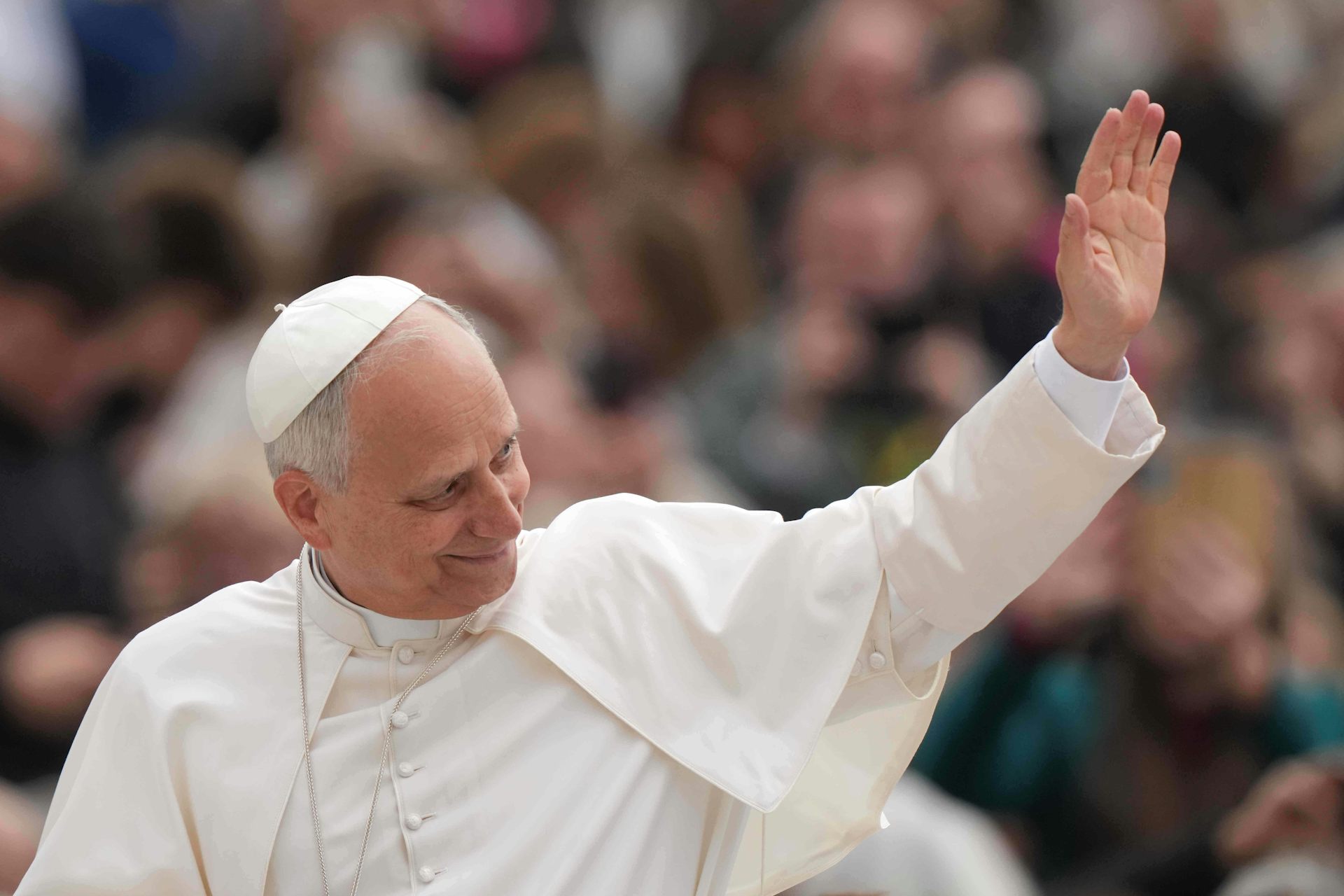

Pope Leo XIV arrives for his weekly general audience in St. Peter's Square, at the Vatican, on Oct. 22, 2025. (AP Photo/Andrew Medichini)

Anne Whitesell
November 12, 2025
(The Conversation) 

As the first American pope, Leo XIV has largely avoided speaking out about domestic politics in the United States.

He waded into controversy, however, by commenting on the Archdiocese of Chicago’s plan to honor U.S. Sen. Dick Durbin, who has represented Illinois since 1997, with a lifetime achievement award for his work on immigration issues. Some Catholic critics were opposed to Durbin, who has supported the right to a legal abortion, receiving such an award – and he ultimately declined it.

On Sept. 30, 2025, when reporters in Italy asked about the situation, Leo said, “It’s important to look at many issues that are related to the teachings of the church.”

“Someone who says I’m against abortion but is in favor of the death penalty is not really pro-life,” he said. “And someone who says I’m against abortion but I’m in agreement with the inhuman treatment of immigrants in the United States, I don’t know if that’s pro-life.”


The family of a detained man from Ecuador is comforted by a priest on Sept. 25, 2025, in New York City.
Stephanie Keith/Getty Images

In American politics, being “pro-life” is often equated with being opposed to abortion. But as Leo’s comments highlight, it’s not so simple.

In my research into the modern pro-life movement, I have found great variety in how different people and organizations use the term, what issues they campaign for, and how religious convictions drive their work.
Public opinion

If being pro-life means caring about immigrants’ rights and opposing abortion, a minority of Americans appear to subscribe to the pope’s vision.

On Oct. 22, 2025, PRRI – a think tank that researches the intersection of religion, culture and politics – released results from a survey asking respondents about immigration and abortion. The survey was conducted online in August and September.

Among all respondents, 61% say that immigrants, regardless of legal status, should have basic rights and protections, including the ability to challenge deportation in court. Sixty-five percent oppose deporting undocumented immigrants without due process to prisons in other countries.
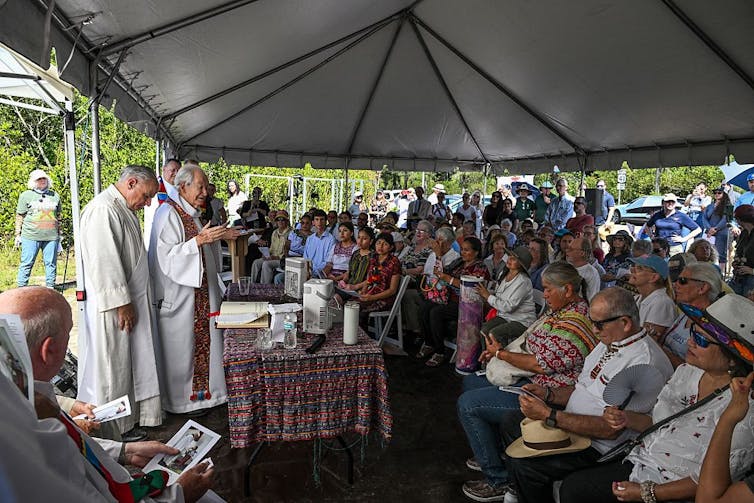


The Rev. Frank O’Loughlin, an Irish priest, celebrates Mass on Aug. 16, 2025, outside the immigrant detention center known as ‘Alligator Alcatraz’ in Ochopee, Fla., standing in solidarity with those detained.
Chandan Khanna/AFP via Getty Images

Support for immigrants’ rights is less common, however, among people who oppose the right to an abortion.

Overall, 36% of respondents believe abortion should be illegal in all or most cases, while 61% believe the procedure should be legal in all or most cases.

Among people who believe abortion should be illegal, only 40% say immigrants should have basic rights, compared to 75% of respondents who believe abortion should be legal in all or most cases.

When asked whether the government “should detain immigrants who are in the country illegally in internment camps until they can be deported,” only 37% of Americans agree. Among those who oppose legalized abortion, however, that percentage increased to 57%. Among Americans who support legalized abortion, only 27% support detention.

Looking at responses from U.S. Catholics, there are clear patterns based on race and ethnicity.

Forty-two percent of white Catholics believe abortion should be illegal in all or most circumstances, compared to 35% of Hispanic Catholics.

Forty-seven percent of white Catholics, meanwhile, disagree with immigrant detention. Among Hispanic Catholics, that percentage rises to 76%. Similarly, 50% of white Catholics believe immigrants should have basic rights, compared to 76% of Hispanic Catholics.
‘Pro-life’ label

Leo’s comments and public opinion data demonstrate the challenge of defining what it means to identify as pro-life.

In my interviews with pro-life activists and research into their advocacy, I have also observed wide variation within the movement.

Organizations are strategic in choosing the pro-life issues they work on.

Some groups that use that label advocate against abortion and do not see it in their mission to go beyond that. One advocate I interviewed said, “We want to be single-issue. … We want to have a large coalition, and being single-issue is how we do that.”

This advocate works for a secular, national organization that opposes abortion because it ends the life of a human organism. She acknowledged that it can be difficult to decide where to draw the line: “How connected does something have to be to abortion for it to count?” This question arises when the group chooses whether to take a position on policies such as expanding funding for adoption services.
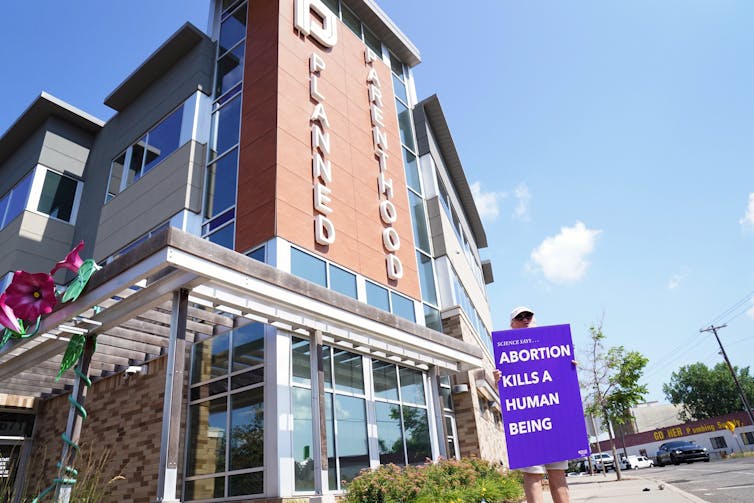


A protester demonstrates in front of a Planned Parenthood clinic on July 12, 2022, in Saint Paul, Minn.
AP Photo/Abbie Parr

Other groups that identify as pro-life are ideologically conservative and often take on other culture war issues. The Center for Christian Virtue, for example, advocates against abortion but also is in favor of school choice and increased funding for “responsible fatherhood initiatives,” such as parenting classes and mentorship programs.

Still other groups focus on both beginning-of-life and end-of-life issues. These organizations are inspired by religious beliefs that life is a gift from God and should be protected from conception until natural death. In addition to abortion, these organizations oppose the use of embryos and fetal stem cells in scientific research and often oppose in vitro fertilization. They also advocate against legalizing euthanasia and physician-assisted suicide.

A fourth type of group has a more expansive definition of pro-life, closely aligned with Leo’s comments. These groups, whose mission statements are often secular, sometimes refer to themselves as protecting life “womb to tomb,” or “pro-life for the whole life.” Groups such as Democrats for Life of America and New Wave Feminists incorporate issues such as economic inequality, systemic discrimination and support for migrants into their advocacy.

Organizations with this type of holistic approach may also describe themselves as following a “consistent life ethic.” Popularized by Cardinal Joseph Bernardin in the 1980s, the term stems from Catholic social teaching but is also used by secular groups. This approach emphasizes human dignity and supporting policies that affirm life at all stages. That may include opposition to the death penalty and support for social programs, such as food and housing assistance.

Role of religion


From my research, I have not found a clear relationship between the policies a group advocates on behalf of and its religious affiliation.

Many explicitly call themselves Catholic or Christian. Their mission statements may mention religion. Their publications may include Bible quotes or prayers. They sponsor events in collaboration with churches.

For example, the American Life League identifies itself as “the oldest grassroots Catholic pro-life education organization in the United States.” Students for Life of America calls its statement of faith “Judeo-Christian,” even though roughly 8 in 10 American Jews support legal abortion.
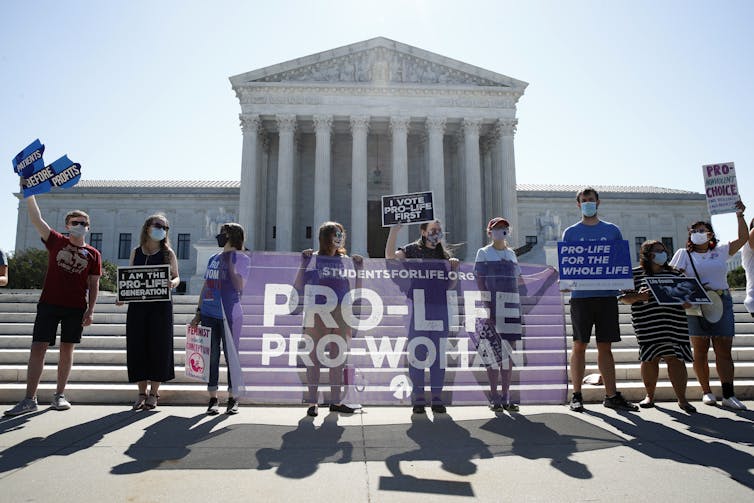


Anti-abortion protesters wait outside the Supreme Court for a decision on the Russo v. June Medical Services LLC case on June 29, 2020.
Patrick Semansky/AP

Even in groups that do not describe themselves as religious, though, some leaders and members say they are drawn to the cause because of their faith. An advocate from one such group described many of the members as “Pope Francis Catholics,” indicating a more progressive view on many social issues.

Another advocate I spoke with described herself as a devout Catholic but recognized that the anti-abortion movement is often “bashed for being religious.” To break away from that stereotype, she said, “That’s why we’re kind of relying on the science. And when I send emails, I never bring in Scripture, and I think people think I might be just agnostic or whatever.”

Other secular groups tie their pro-life advocacy to a broader fight for human rights. Rehumanize International, to name one, says its mission is to “ensure that each and every human being’s life is respected, valued, and protected.” Such groups may hold progressive views such as opposing war and the death penalty, as well as concern about climate change. Political science research indicates that positioning opposition to abortion as a human rights issue, rather than a religious one, may attract more younger Americans.

It would be a mistake to assume that everyone in these movements adheres to one viewpoint, or is interested only in stopping abortion. In reality, there are many motivations that lead to people using the phrase “pro-life.”

(Anne Whitesell, Associate Professor of Political Science, Miami University. The views expressed in this commentary do not necessarily reflect those of Religion News Service.)


Trump confronts 'game-changer' as cruelty provokes 'unbelievably radical' revolt: analysts

Tom Boggioni
November 17, 2025
RAW STOR

Comments made by Pope Leo and a widely spread attack on President Donald Trump by Catholic bishops on his harsh immigration policies should give his administration pause that the ground beneath them is shifting — and not in a good way, it was warned Monday.

The hosts of “Morning Joe,” noted the Pope calling the treatment of undocumented immigrants a “grave injustice” and combined that with a statement from America’s Roman Catholic bishops asserting, “We are disturbed when we see among our people a climate of fear and anxiety around questions of profiling and immigration enforcement. We are saddened by the state of contemporary debate and the vilification of immigrants. We are concerned about the conditions in detention centers and the lack of access to pastoral care.”

That led MS NOW's Joe Scarborough to tell his panel, ”One of the most remarkable things I've seen is Pope Leo, Catholic bishops, doing something unbelievably radical. I'm sure the White House thinks this is radical Republicans. They are quoting Jesus Christ, and they are quoting Jesus Christ from the pulpit, and they are showing how un-Christ-like these ICE raids are, where they're ripping children from their mothers' hands.”

“They are going into schools.,They are tearing teachers out. I mean, this is the Catholic bishops and Pope Leo. This is a game changer.”

“I know, I know, people have people outside the faith community may not understand this, but this is a game changer,” he added. “And Pope Leo saying, ‘Oh, really? You call yourself pro-life just because you're against abortion, but you support this inhumane treatment of immigrants?’ No, no, no, those those two don't square up.”


This Republican vowed to protect the unborn — then worked to strip moms of healthcare

Megan O'Matz,
 ProPublica
November 17, 2025 


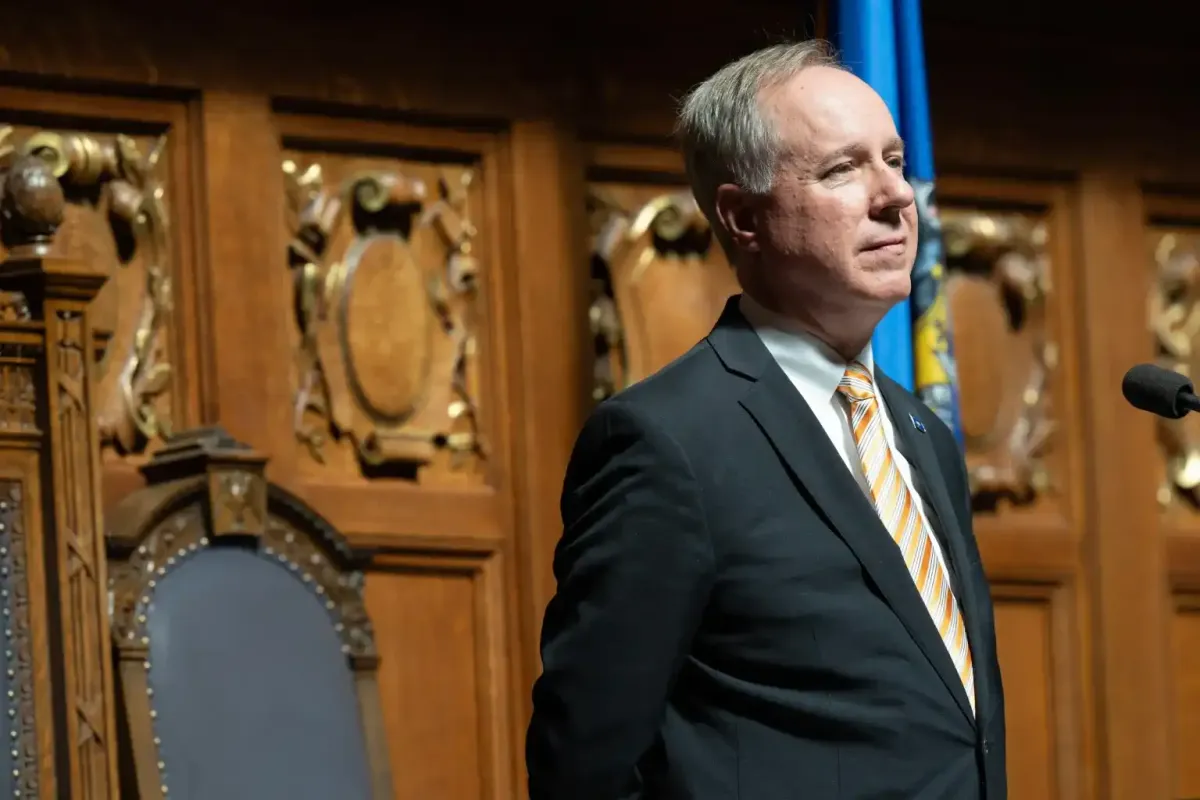
Wisconsin Assembly Speaker Robin Vos during a session at the Capitol in Madison in 2023 Mark Hoffman/Milwaukee Journal Sentinel/Imagn/ProPublica

The most powerful Republican in Wisconsin stepped up to a lectern that was affixed with a sign reading, “Pro-Women Pro-Babies Pro-Life Rally.”

“One of the reasons that I ran for office was to protect the lives of unborn children,” Assembly Speaker Robin Vos told the cheering crowd gathered in the ornate rotunda of the state Capitol. They were there on a June day in 2019 to watch him sign four anti-abortion bills and to demand that the state’s Democratic governor sign them. (The governor did not.)

“Legislative Republicans are committed to protecting the preborn because we know life is the most basic human right,” Vos promised. “We will continue to do everything we can to protect the unborn, to protect innocent lives.”

Now, however, Vos has parted with some in the national anti-abortion movement in its push for a particular measure to protect life: the life of new mothers.

Many anti-abortion Republicans have supported new state laws and policies to extend Medicaid coverage to women for a year after giving birth, up from 60 days. The promise of free health care for a longer span can help convince women in financial crises to proceed with their pregnancies, rather than choose abortion, proponents say. And many health experts have identified the year after childbirth as a precarious time for mothers who can suffer from a host of complications, both physical and mental.

Legislation to extend government-provided health care coverage for up to one year for low-income new moms has been passed in 48 other states — red, blue and purple. Not in Arkansas, where enough officials have balked. And not in Wisconsin, where the limit remains two months. And that’s only because of Vos.

The Wisconsin Senate passed legislation earlier this year that would increase Medicaid postpartum coverage to 12 months. In the state Assembly, 30 Republicans have co-sponsored the legislation, and there is more than enough bipartisan support to pass the bill in that chamber.

But Vos, who has been speaker for nearly 13 years and whose campaign funding decisions are considered key to victory in elections, controls the Assembly. And, according to insiders at the state Capitol, he hasn’t allowed a vote on the Senate bill or the Assembly version, burying it deep in a committee that barely meets: Regulatory Licensing Reform.

Vos’ resistance has put him and some of his anti-abortion colleagues in the odd position of having to reconcile their support for growing families with the failure of the Assembly to pass a bill aimed at helping new moms stay healthy.

“If we can’t get something like this done, then I don’t know what I’m doing in the Legislature,” Republican Rep. Patrick Snyder, the bill’s author and an ardent abortion foe, said in February in a Senate hearing.

Reached by phone, Vos declined to discuss the issue with ProPublica and referred questions to his spokesperson, who then did not respond to calls or emails. Explaining his opposition, Vos once said, “We already have enough welfare in Wisconsin.” And in vowing to never expand Medicaid, he has said the state should reserve the program only for “those who truly need it.”

His stance on extending benefits for new mothers has troubled health care professionals, social workers and some of his constituents. They have argued and pleaded with him and, in some cases, cast doubt on his principles. ProPublica requested public comments to his office from January 2024 to June 2025 and found that the overwhelming majority of the roughly 200 messages objected to his stance.

“I know this is supported by many of your Republican colleagues. As the ‘party of the family’ your opposition is abhorrent. Get with it,” one Wisconsin resident told the speaker via a contact form on Vos’ website.

Another person who reached out to Vos chastised him for providing “lame excuses,” writing: “The women of Wisconsin deserve better from a party that CLAIMS to be ‘pro-life’ but in practice, could care less about women and children. We deserve better than you.”


“A Commonsense Bill”


Donna Rozar is among the Wisconsin Republicans who staunchly oppose abortion but also support Medicaid for new mothers.

While serving as a state representative in 2023, she sponsored legislation to extend the coverage up to one year. Her effort mirrored what was happening in other states following the end of Roe v. Wade and the constitutional right to an abortion. Activists on both sides of the abortion issue recognized that there could be a rise in high-risk births and sought to protect mothers.

“I saw this as a pro-life bill to help mothers have coverage for up to a year, in order to let them know that they would have the help they needed if there were any postpartum complications with their pregnancy,” said Rozar, a retired registered nurse. “I thought it was a commonsense bill.”

Vos, she said, would not allow the bill to proceed to a vote even though it had 66 co-sponsors in the 99-person chamber. “The speaker of the state Assembly in Wisconsin is a very powerful individual and sets the agenda,” she said.

Rozar recalled having numerous “frustrating” conversations with Vos as she tried to persuade him to advance the legislation. “He was just so opposed to entitlement programs and any additional expenditures of Medicaid dollars that he just stuck to that principle.

 Vehemently.”

Vos has argued as well that through other options, including the Affordable Care Act, Wisconites have been able to find coverage. While some new mothers qualify for no-cost premiums under certain ACA plans, not all do. Even with no-cost premiums, ACA plans typically require a deductible or co-payments. And next year, when enhanced premium tax credits are due to expire, few people will be eligible for $0 net premiums unless Congress acts to change that.

Rozar lost her race for reelection in August 2024 after redistricting but returned to the state Capitol in February for a Senate hearing to continue advocating for the extension. She was joined by a variety of medical experts who explained the extreme and life-threatening risks women can face in the first year after giving birth.

They warned that without extended Medicaid coverage, women who need treatment and medication for postpartum depression, drug addiction, hypertension, diabetes, blood clots, heart conditions or other ailments may be unable to get them.

One legislative analysis found that on average each month, 700 women fell off the Medicaid rolls in Wisconsin two months after giving birth or experiencing a miscarriage, because they no longer met the income eligibility rules.

Justine Brown-Schabel, a community health worker in Dane County, told senators of a new mother diagnosed with gestational diabetes who lost Medicaid coverage.

“She was no longer able to afford her diabetes medication,’’ Brown-Schabel said. “Not only did this affect her health but the health of her infant, as she was unable to properly feed her child due to a diminishing milk supply.”

She described another new mother, one who had severe postpartum depression, poor appetite, significant weight loss, insomnia and mental exhaustion. Sixty days of Medicaid coverage, Brown-Schabel said, “are simply not enough” in a situation like that.

Currently, new moms with household incomes up to 306% of the poverty line (or $64,719 a year for a single mom and baby) can stay on Medicaid for 60 days after birth. But the mother must be below the poverty line ($21,150 for that mom and baby) to continue with coverage beyond that. The new legislation would extend the current protections to a year.

Bipartisan unity on the legislation is so great that Pro-Life Wisconsin and the lobbying arm of the abortion provider Planned Parenthood, which offers some postpartum services, both registered in support of it before the Senate.

“It’s something that we can do and something that’s achievable given the bipartisan support for it,” Matt Sande, a lobbyist for Pro-Life Wisconsin, said in an interview. “It’s not going to break the bank.”

Once fully implemented, the extended coverage would cost the state $9.4 million a year, according to the state Legislative Fiscal Bureau. The state ended fiscal year 2025 with a budget surplus of $4.6 billion.

With the Assembly bill buried by Vos, Democratic Rep. Robyn Vining tried in July to force the issue with a bit of a legislative end run. She rose during floor debate on the state budget and proposed adding the Medicaid extension to the mammoth spending bill.

All of the Republicans who had signed on to the Medicaid bill, except one absent member, voted to table the proposal, sinking the amendment. They included Snyder, the bill’s sponsor, who in an email to ProPublica labeled the Democrats’ move to raise the issue during floor debate “a stunt.”

“Democrats were simply more concerned with playing political games to garner talking points of who voted against what, than they were in supporting the budget negotiated by their Governor,” he said.

Said Vining of the Republicans who tabled the amendment: “They’re taking marching orders from the speaker instead of representing their constituents.”

Well-Funded Opposition


Vos’ opposition echoes that of influential conservative groups, including the Foundation for Government Accountability, a Florida think tank that promotes “work over welfare.” Its affiliated lobbying arm openly opposed the Medicaid extension for new moms when it first surfaced in Wisconsin in 2021, though it has not registered opposition since then. Reached recently, a spokesperson for the foundation declined to comment.

Over the past decade, the foundation has received more than $11 million from a charitable fund run by billionaire Richard Uihlein, founder of the Wisconsin-based shipping supplies company Uline. In recent years, Uihlein and his wife, Liz, also have been prolific political donors nationally and in the Midwest, with Vos among the beneficiaries.

Since 2020, Liz Uihlein has given over $6 million to Wisconsin’s Republican Assembly Campaign Committee, which is considered a key instrument of Vos’ power. And in February 2024, she donated $500,000 to Vos’ personal political campaign at a time when he was immersed in a tough intraparty skirmish.

One concern cited by extension opponents such as the Foundation for Government Accountability is that Medicaid coverage for new moms could be used for health issues not directly related to giving birth. Questions over how expansive the coverage would be spilled into debate in Arkansas in a Senate committee in April of this year.

“Can you explain what that coverage is? Is it just like full Medicaid for any problem that they have, or is it somehow specific to the pregnancy and complications?” asked GOP Sen. John Payton.

A state health official told him new mothers could receive a full range of benefits.

“Like, if they needed a knee replacement, I mean, it’d cover it?” Payton said.

“Yes,” came the reply.

The bill failed in a voice vote.

In Wisconsin, no lawmaker voiced any such concern during the February Senate hearing, which was marked by only positive feedback. In fact, one lawmaker and some medical experts in attendance openly snickered at the thought that Arkansas — a state that ranks low in public health measurements — might pass legislation before Wisconsin, leaving it the lone holdout.

Ultimately, the Wisconsin Senate approved the legislation 32-1 in April, sending it along to the Assembly to languish and leaving Wisconsin still in the company of Arkansas on the issue.

Despite the setbacks and Vos’ firm opposition, Sande of Pro-Life Wisconsin and other anti-abortion activists are not giving up. He thinks Vos can be persuaded and the bill could move out of its purgatory this winter.

“I’m telling you that we’re hopeful,” Sande said.

Rozar is, too, even though she is well aware of Vos’ unwavering stance. “He might have egg on his face if he let it go,” she said.

Opinion

Tolkien, Lewis and the problem of 'Christian' art

(RNS) — The Bible still has the capacity to inspire profound art in those who love it.


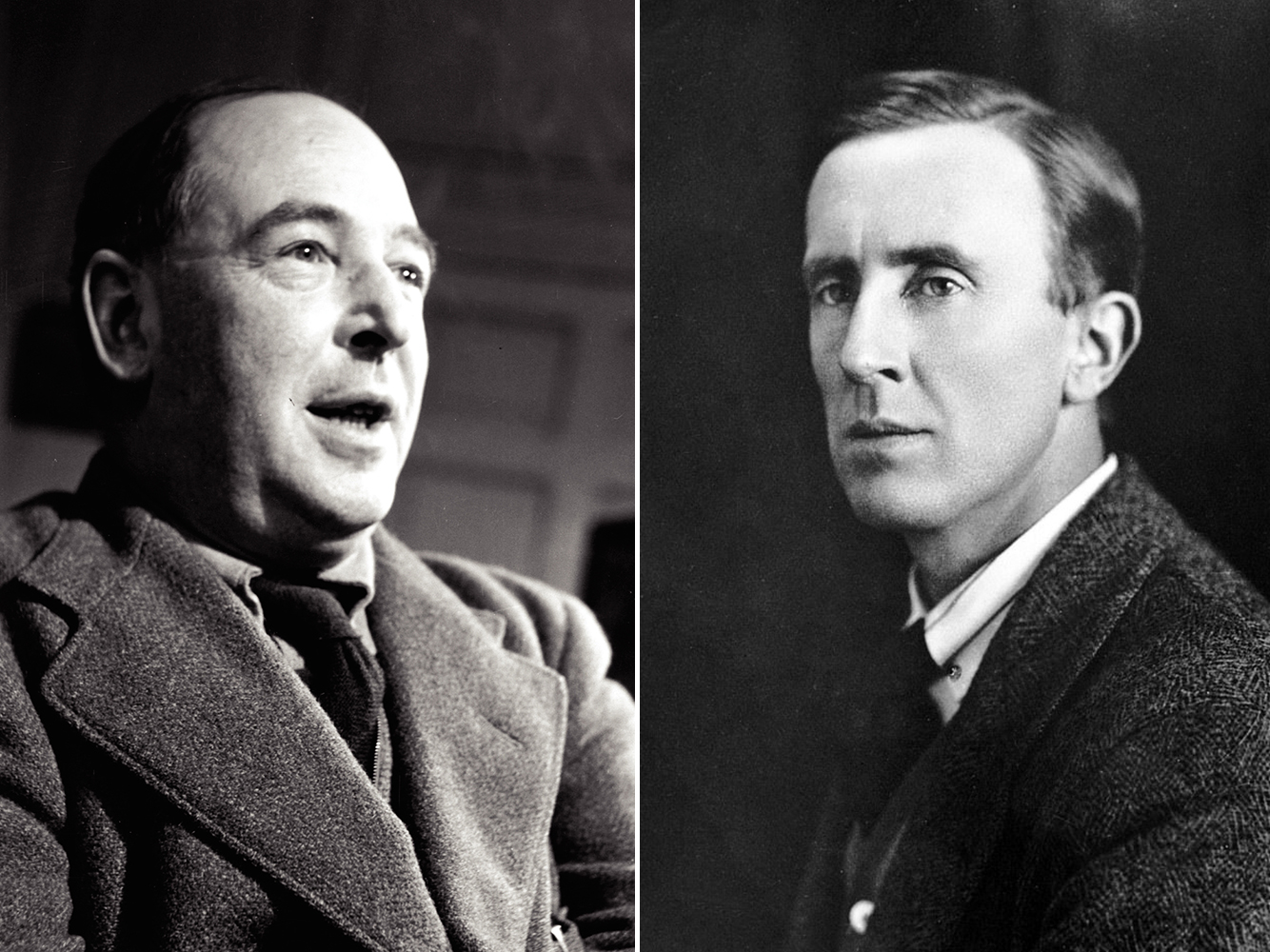
Authors C.S. Lewis, left, and J.R.R. Tolkien. (Lewis photo courtesy Hulton Deutch Collection/John Chillingworth; Tolkien photo courtesy Wikimedia/Creative Commons)


Carlos Campo
November 10, 2025
RNS

(RNS) — When friends mention some new Christian artwork, movie or novel, I confess my first thought is usually, “I wonder how bad it is.”

It’s not the artistic treatment of faith that discourages me. J.R.R. Tolkien and C. S. Lewis were profound storytellers whose narrative, and their power to narrate, was enhanced by their faith. But neither is commonly called a “Christian writer,” nor are their books limited to the Christian shelves of bookstores. To do so would be to diminish their reach.

Art worth seeing or reading, in short, needs no qualifier. It stands and falls on excellence alone. Their faith places them squarely within one of the greatest narrative and literary traditions in history — that line of artists for whom the Bible is at the center of their education. But they never limited themselves to Christian texts: They immersed themselves in ancient languages, art, myths, parables and plays. Tolkien went so far as to create his own languages and creation narrative in his “The Silmarillion.” Lewis created a world called Narnia that is so compelling to us — despite being crafted primarily for children — that we can’t seem to help returning to it.

They were profoundly accomplished readers, writers and thinkers with a broad and abiding popularity, but an undeniably biblical imagination underpins their respective works.

Tolkien drew deeply from the Bible in “The Lord of the Rings.” Frodo’s burden of the One Ring and its power to overcome him symbolizes the darkness of sin. Gandalf’s battle with the Balrog and return echoes Christ’s death and resurrection, as found in the Gospel of John. And Galadriel’s light given to Frodo echoes John 1:5: “The light shines in the darkness, and the darkness has not overcome it.” Aragorn as the “returning king” recalls the New Testament’s Book of Revelation, which portrays Christ as King of Kings, and Sam’s hope in darkness reflects the Apostle Paul’s Letter to the Romans, in which he discusses enduring present sufferings for future glory. Many other examples abound.

In similar fashion, C.S. Lewis wove biblical themes throughout his “Chronicles of Narnia.” Aslan has often been seen as an image of Christ, willing to sacrifice himself in the haunting story of the first Narnia novel, “The Lion, the Witch, and the Wardrobe.” Aslan mirrors Christ’s atonement— “the Lamb of God who takes away the sin of the world” — in the words of John’s gospel. When he appears again to certain children of the Pevensie family, it is a haunting allusion to the resurrection described in the Gospel of Matthew.

These are all books of children, but no less profound for that. They reflect the childlike faith that Jesus calls for in Matthew’s gospel: “Unless you change and become like little children, you will never enter the kingdom of heaven.”

Though Tolkien and Lewis were bound by friendship and faith, their creative and theological visions often diverged. Tolkien, a devout Catholic, distrusted allegory and preferred sub-creation — worlds that hinted at divine truth without direct symbolism. Lewis, an Anglican apologist, embraced allegory. Making Aslan a Christ figure whose actions overtly retold the Gospel is a perfect example.

Philosophically, Tolkien emphasized providence and myth as veiled truth, while Lewis emphasized clarity and accessibility of doctrine. Their tensions reveal a deeper harmony: God’s truth can shine through both mythic subtlety and allegorical boldness, reminding us that divine beauty is not confined to a single style of expression.

That tension, and its harmony, is part of the enduring appeal of their relationship for those who take faith and art seriously. It’s why we’ve returned to their letters, their works and even speculated about their friendship for so long.

At Museum of the Bible in Washington, an exhibition, “Lewis & Tolkien,” explores, among other things, their shared grounding in the beauty and solidity of Scripture — despite sometimes great suffering and personal difference.

At the museum, we realized that too often Christians allow art works’ overt religious messaging to diminish their artistry. That is beginning to change. Streaming series such as “The Chosen” and “House of David” are receiving widespread acclaim because of their production quality and masterful storytelling. We know — because we have seen — that the Bible and deep religious faith can be the basis for great artistic work. Lewis and Tolkien stand as powerful contemporary examples of its enduring relevance.

What remains is one of the few things in which I have an unshakable hope: The enduring power of the Bible and its capacity to shape lives and inspire profound art in those who love it.

(Carlos Campo is the CEO at Museum of the Bible. The views expressed in this commentary do not necessarily reflect those of Religion News Service.)
Israeli survivors of Kristallnacht mark 87th anniversary of Nazi riots amid rising antisemitism


JERUSALEM (AP) — The Nov. 9, 1938, attack was a stark turning point in the escalating persecution that led to the killing of 6 million European Jews by the Nazis and their supporters during the Holocaust.


Melanie Lidman
November 12, 2025
RNS

JERUSALEM (AP) — Walter Bingham was 14 years old when Nazis plundered Jewish businesses and places of worship across Germany and Austria in what became known as Kristallnacht, or the “Night of Broken Glass.”

Bingham is among a dwindling number of Holocaust survivors marking the 87th anniversary of Kristallnacht Sunday, at a time when antisemitism is on the rise, especially in the wake of the Israel-Hamas war.

The Nov. 9, 1938, attack was a stark turning point in the escalating persecution that led to the killing of 6 million European Jews by the Nazis and their supporters during the Holocaust.

The recent attacks against Jewish symbols across the world, including synagogues in Australia and Israeli sports teams in Europe,among others, worry the survivors.

“We live in an era equivalent to 1938, where synagogues are burned, and people in the street are attacked,” said Bingham, now 101.

During the Kristallnacht riots, the Nazis killed at least 91 people, vandalized 7,500 Jewish businesses and set fire to more than 1,400 synagogues, according to Israel’s Yad Vashem Holocaust memorial.

Up to 30,000 Jewish men were arrested, many taken to concentration camps such as Dachau or Buchenwald. Hundreds more died from mistreatment or killed themselves in the camps, years before official mass deportations began.


Synagogues smoldering, violent crowds in the streets


Bingham and two other Kristallnacht survivors shared memories of the destruction during an Associated Press interview last week in Jerusalem’s Great Synagogue, where light streamed through stained-glass windows at one of Israel’s most ornate synagogues. The survivors, who often give testimony at the annual March of the Living at the site of Auschwitz, considered the location symbolic of the flourishing of Jewish houses of worship despite the Holocaust.

Though his memory sometimes fails as a centenarian, Bingham said he can remember every detail of the aftermath of the Kristallnacht attack 87 years ago.

He was walking to school in Mannheim, south of Frankfurt, the morning after the riots, he said. When he got to the synagogue where his classes were held, it was a smoldering wreck. He watched as firefighters let the synagogue burn while dousing neighboring properties to ensure the fire didn’t spread.

Months later he was put on a Kindertransport from Germany to England — among the nearly 10,000 children in Nazi-occupied Europe brought to safety by the 1938-1939 British rescue mission. Bingham’s father had already been deported to Poland, where he would die in the Warsaw Ghetto, and Bingham never saw his mother again.

“Antisemitism, I don’t think, will ever fully disappear because it’s the panacea for all ills of the world,” Bingham said. But he believes that educating younger generations can help fight intolerance, even with the wave of right-wing populism sweeping across the world.

George Shefi agrees. The 94-year-old Holocaust survivor said he has spoken to more than 12,000 students in Germany and elsewhere, sharing his experience of antisemitism as a young boy in Berlin — the benches painted yellow where Jews were allowed to sit, and the chaos of Kristallnacht when, as a second grader, he wasn’t allowed out of the house for three days.

When he finally ventured out, he saw crowds intimidating those cleaning up the destruction of Jewish businesses and the synagogue. He traveled to England alone on a Kindertransport soon afterward. Shefi said he never saw his mother again; she perished in the Auschwitz concentration camp.

His message is younger generations of Germans aren’t responsible for the sins of their grandparents, but they are responsible to make sure it doesn’t happen again.

The Holocaust was preceded by more than six years of indoctrination, including increasingly harsh Nuremburg Laws targeting Jews, Shefi noted — a period when people could see the march toward antisemitism and attempt to stop it. His message has resonated, he said, with students who want to look forward and apply the lessons of history to their daily lives.

Paul Alexander, at 87, was less than a year old during Kristallnacht. Weeks later his parents sent him on a Kindertransport to England, where he spent time in a children’s home before being reunited with his parents in September 1942 — one of the few children who were.

“It was because of Kristallnacht … that the Jewish people in England decided that they must save Jews, families from Germany and get them out as quickly as possible,” Alexander said.

“I was sent out on the Kindertransport in July 1939, exactly six weeks before the war broke out,” he added. “So it was because of Kristallnacht that I was lucky and fortunate to escape from Nazi Germany.”

Concerns over antisemitism grow

Antisemitic attacks have increased dramatically since the war in Gaza began, though the numbers declined slightly last year from a peak immediately after the Oct. 7, 2023, Hamas attack against Israel, according to an annual report about global antisemitism from Tel Aviv University released earlier this year.

Bingham said he feels like he’s living through the events of 1930s Germany again — but there is a difference.

“In those days, the Jewish mentality was apologetic,” he said. “Please don’t do anything to me, I won’t do anything to you.”

“Today, we have, thank God, the state of Israel, a very strong state,” he said. “And whereas antisemitism is still on the increase, the one thing that will not happen would be a Holocaust, because the state will see to it” that doesn’t happen.

Bingham spent the war years with a Jewish youth group in a derelict castle in Wales, then joined the British military, serving as an ambulance driver and an intelligence officer who interrogated high-ranking Nazi leaders after their capture. Today, he still contributes to Israeli news websites and radio, and has held the Guinness World Record for oldest working journalist since 2021.

There are approximately 200,000 remaining Jewish Holocaust survivors, but 70% are expected to pass away in the next decade. That makes their testimony and experiences even more important to pass on lessons about taking action against antisemitism to the younger generation, the survivors said.

“What we have to do … in addition to education, is to actually, literally, fight,” Bingham said of antisemitism. “If we see it, we have to hit back.”


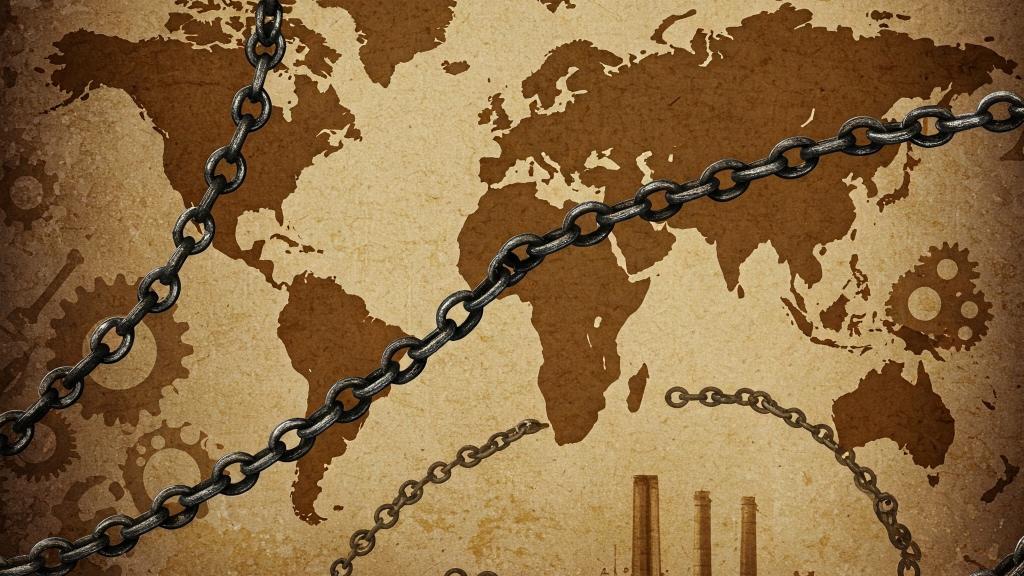
Imperialism’s essence, new mechanisms of domination and reclaiming Lenin’s method of analysis: An interview with Blanca Missé

 (Part I)

Colonialism imperialism

Blanca Missé is an associate professor at San Francisco State University and a Workers Voice member, who is active with the Ukraine Solidarity Network and the Labor for Palestine National Network. Together with Ashley Smith, she is co-host of The Real News Network podcast series Solidarity Without Exception.

In the first part of this extensive interview with Federico Fuentes for LINKS International Journal of Socialist Renewal, Missé argues for reclaiming Lenin’s method for analysing imperialism and suggests updates, particularly on understanding China and Russia’s global status. In Part II, Missé looks at inter-imperialist rivalry today, the need to oppose all imperialisms and the case for a class-based internationalism.

Discussions regarding imperialism often refer to Lenin’s pamphlet on the subject. How do you define imperialism? Do you see Lenin’s concept as still valid?

The core of Lenin’s concept of imperialism remains valid. Still, his work on imperialism cannot be boiled down to a simple formula or treated as dogma. More than Lenin’s theory, I consider it as one developed by revolutionaries who combated chauvinism during World War I and helped build the Third International until its degeneration in the mid-1920s. In simple terms, imperialism says that the rise of monopoly production and finance capital gave rise to multinational corporations needing to expand beyond national borders. This accelerated imperialist rivalry, national oppression, chauvinism, militarism, and war. Looking at today’s world, this phase of capitalism has not disappeared or weakened — quite the opposite.

The value of the Marxist theory of imperialism, which has been much enriched throughout the 20th and 21st centuries, lies in documenting the specific mechanisms leading capitalist states to intervene economically abroad to extract value and profits, eventually resorting to military intervention to protect their investments. Its goal is to connect what mainstream liberal thinkers keep separate: the inner trends of world capitalism and the political manifestations of national oppression (such as wars, plundering, coercion, targeted repression of movements and the overthrow of governments) in colonial and semi-colonial countries. But while the essence of imperialism — “the dominance of monopolies and finance capital” as Lenin put it — and the relentless effort to divide and redivide the world remains unchanged, the form of imperialist domination has evolved.

The fact that today we might see a different configuration of imperialist powers, with new imperialisms rising such as China and Russia, does not negate the ongoing trend of the monopolisation, concentration and centralisation of capital in the hands of imperialist bourgeoisie, or their ruthless competition. A compelling 2011 study by Swiss researchers presented a startling scenario. Their analysis of 43,000 transnational corporations revealed that 147 of them — less than 1% of the total surveyed — control 40% of global wealth through ownership connections. More importantly, the study showed that 75% of those leading companies are financial corporations (with JP Morgan, Citigroup, BNP, HSBC and Credit Suisse at the top).

Economic capital, the defining feature of imperialism, continues to shape today’s world economy, which is controlled by giant banks and financiers. This aligns with Lenin’s early 20th-century observation that “a personal link-up, so to speak, is established between the banks and the biggest industrial and commercial enterprise.” Today’s transnational corporations also remain concentrated in key countries and are not evenly spread around the globe. Of the top 200 corporations identified in the study, 122 are located in five Western imperialist countries.

Do you think some on the left and in the socialist movement have tended to move away from Lenin’s conception of imperialism?

Yes. This is due to two combined processes — the post-war economic surge and the reestablishment of capitalism in former worker states — that were very confusing for the socialist movement.

The continued growth of Western capitalism after World War II, along with the economic and ideological impacts of capitalist restoration in the former worker states, supported a strong propaganda effort asserting that world capitalism had stabilised and could be managed, ultimately reducing wars and improving global living standards. Of course, the facts contradict any idea of a “peaceful” post-war period. The Military Intervention Project at Tufts University documents more than 120 US military interventions abroad between 1946–89, which is three times as many as the period before (1918-45).

The fact that after WWII, the US quickly rose to become a virtually uncontested world superpower for five decades, presenting a different configuration of imperialist forces than the one sketched by Lenin, led some to conclude that the Marxist theory of imperialism was no longer valid. For a generation or two, the predictions of the Marxist theory of imperialism did not immediately ring true for those in imperial centres. In the Marxist tradition, some narrowed Lenin’s theory to the export of capital from the core to the periphery, fetishising that feature and concluding, as Michael Kidron did, that Britain was no longer an imperialist power.

However, during the postwar period, for most socialists and Marxists in the semi-colonial world, the nature of imperialism was not at stake, but rather the need to understand its new forms of domination. Socialists grappled with the need to analyse the contradictions of formal independence, the mutations of the world division of labour across successive waves of accumulation and technological innovation, and, alongside that, the new forms of colonial and imperialist domination.

The restoration of capitalism in the Soviet Union triggered a major crisis within Socialist and Communist groups, as well as those who looked to them as a point of reference. It raised doubts about Marxism as a theory capable of explaining global politics. This was combined with confusion and pessimism stemming from the general decline in both socialist and activist working-class forces worldwide at the end of the 20th century.

This resulted from the ruling class’s economic and political offensive against the working class in that epoch, and even some key defeats (Chile, Indonesia, Tiananmen Square, etc). And the subjective factor came into play — the ongoing impoverishment of theory, strategy and uncompromising leadership (mainly by the Stalinists) — which held back working people’s ability to recover and fight back.

New theories emerged along with mainstream neoliberal thinking about the end of socialism, which posited that imperialism — the era of wars and revolutions — was a thing of the past. Some reduced imperialism to foreign policy driven by military aggression, in a neo-Kautskian way, and predicted the possibility of everlasting peace.

For instance, Michael Hardt and Toni Negri argued in Empire (2000) that the classical form of imperialism — where a few dominant nation-states compete for colonies and global dominance — has been replaced by a new international order. This new order is not centred on territorial disputes but is instead a decentralised, de-territorialised network of power that controls the world economy. Sovereignty is shared among transnational institutions (such as the International Monetary Fund, World Trade Organization and United Nations), multinational corporations and global legal frameworks (such as human rights and trade laws).

Other prominent Western political theorists of the post-war era moved even further away from Marxism by separating imperialism and capitalism, and suggesting broad, diluted theories. Imperialism was seen by some, such as Giovanni Arrighi, as a transhistorical process, either as a political and organisational form of governance developed by states. For others, such as Immanuel Wallerstein, it is a simple opposition between a core and its periphery through various relations.

If revising, or even moving away from, the Marxist theory of imperialism had an audience in the Western world for a few decades, that began to change at the start of the Iraq War (2003–11), when revolutionary socialists began to use events to challenge these arguments. With the protracted war in Ukraine and heightened inter-imperialist rivalry, they are hardly useful to explain what is happening today in the world.

Today, the Marxist understanding of imperialism is being reconsidered by almost every serious, committed labour or social movement activist, socialist and revolutionary worldwide. The illusion of a stable capitalism that imbued the Western world started to fade in the early 21st century, prompted by waves of uprising in Latin America due to debt-caused impoverishment, failed wars in Iraq and Afghanistan, the 2008 financial crisis, and new movements led by millennial youth — from the Indignados in Spain to Occupy in the US — in response.

This trend deepened with the first wave of the so-called Arab Spring in 2011, followed by the Maidan protests in Ukraine, huge farmers’ struggles in India, the 2019 popular insurrection in Chile (with echoes in Colombia), the return of mass strikes across continental Europe, and the recent mass protests by Generation Z in MoroccoNepal, and Madagascar. These recurring popular uprisings demanding an escape from the imposed future of poverty, war, austerity, and environmental destruction, combined with two major wars (Ukraine and Palestine), clearly show that we are still living in an era of wars and revolutions — powered by imperialism as the deadliest phase of capitalism.

Given this, should socialists seek to reclaim Lenin’s method to analyse today’s crisis of world imperialism?

Absolutely. We need to update it to account for significant global evolutions in capitalism since WWII, but yes, of course. It was not so much the method of a great individual, but rather the result of a collective elaboration by revolutionary Marxists deeply embedded in the struggles of the working class. They made a deliberate attempt to develop an internationalist perspective by engaging with revolutionaries in other countries, rather than being satisfied with a narrow national viewpoint.

Lenin and Leon Trotsky were able to analyse the emergence and development of world imperialism from an actual internationalist viewpoint because they were simultaneously invested in building an international organisation for struggle with other revolutionaries in different countries. Because they had to constantly account for uneven and contradictory trends in the world-class battle, they did not see imperialist rivalry as a confrontation between fixed blocs — a sort of trench war — but as a totality of contradictory relations in constant movement.

In fact, in his preparatory Notebooks for Imperialism, Lenin insisted on analysing the different imperialist states as embedded in a totality — a dynamic world order with living inter-relations among states, consisting of complex relations of subordination, domination, or codependency. Each imperialist state has its own strengths and weaknesses, due to a varying combination of economic and political transformations.

Imperialist powers should never be considered in isolation from their historical background or by abstract standards or norms. Lenin analysed imperialist states based on their capacity to enforce their rule abroad without outside support. While Britain, Germany and the US had risen to be “fully independent” powers, Lenin viewed Russia and Japan as “not fully independent” imperialisms.

The contradictions inherent to dependent and uneven imperialisms are not an exception to the Marxist theory of imperialism. The anomaly, instead, has been the US’s uncontested world domination for several decades. If we recover Lenin’s method, we can understand why, for example, Russia can be an imperialist state today, oppressing its near neighbours abroad while depending economically on China, or how Spain still enforces its imperialist domination in Latin America while being subordinated to German capital inside the European Union.

In the interwar period, Trotsky rescued Lenin’s method against Josef Stalin. In The Third International After Lenin, he questioned the nascent Soviet bureaucracy’s abandonment of internationalism, in both theoretical and practical terms. Arguing that “not a single communist party can establish its program by proceeding solely or mainly from conditions and tendencies of developments in its own country”, he said the world revolutionary movement must develop an analysis “of the world political system taken as a whole in all its connections and contradictions, that is, with the mutually antagonistic interdependence of its separate parts”. This work led to The War and the Fourth International and the foundation of the Fourth International.

Today, like in the early decades of the 20th century, we are again experiencing an imperialist world order in deep crisis and constant change. To understand its main trends and contradictions, we must revisit this analytical method.

Could you elaborate a bit more on what parts of Lenin’s understanding of imperialism you think have been superseded by subsequent developments or require updating?

As for the most critical contemporary updates, I list four.

The first involves updating our understanding of the various mechanisms of economic and financial domination. It is true that Lenin highlighted in Imperialism the export of capital (or foreign direct investment), as the primary form of value extraction at the time, but he never claimed it would always be that way or that it was the definitive criterion.

In fact, he briefly noted that “the world has become divided into a handful of usurer states and a vast majority of debtor states.” At the time, he was considering, for example, the role of Britain in financially subjugating “Egypt, Japan, China, and South America”. These countries, although recently gaining formal independence, were developing new forms of economic dependence.

In the postwar period, Marxist economists, such as Ernest Mandel, Samir Amin and Arghiri Emmanuel, identified other forms of imperialist domination, such as unequal exchange arising from a structurally fraught global division of labour between commodity producers and industrialised countries. More recently, Marxist scholars such as Andy Higginbottom and Intan Suwandi have examined how this hierarchy is embedded in today’s global value chains.

Another crucial form of domination is debt. The use of debt service payments became the main form of US imperialist domination after WWII, especially following the oil crisis of the mid-70s. Also, so-called “multilateral” organisations (WTO, WB, IMF) emerged as significant mechanisms of imperialist domination. National and foreign debt have been a double form of imperialist oppression: extortion through extracting direct surplus value via interest payments, and coercion by forcing national governments to implement economic policies that open markets, assets, and natural resources to predation by foreign capital.

Eric Toussaint has written extensively on what he calls “ the tyranny of global finance,” highlighting the subtle mechanisms of imperialist domination through neoliberal and free-market policies. As he recently explained, the international financial institutions were created “to enforce payment and finance the reconstruction of Europe” and “to maintain [Western] imperial domination of countries that became independent through national liberation struggles and decolonization after the war.”

study from 2021 calculated that since 1960, the imperialist West has drained $62 trillion in real terms, and that “if this value had been retained by the South and contributed to Southern growth, tracking with the South’s growth rates over this period, it would be worth $152 trillion today” — 5 times the US’s GDP in 2025.

The second update concerns establishing distinct labour markets and imperialist powers relying on both steady flows of immigration to imperialist centres and enforcing a capitalist border regime to enable the overexploitation of the semi-colonial world, or the “Global South”. John Smith has explained this in his analysis of the global hierarchy of labour, where he documents how surplus value is extracted in the Global South and realised in the Global North. The “global labour arbitrage” developed in the neoliberal period may not be the “central” mechanism of modern imperialism, but it is a fundamental one.

On the other hand, and to complete Smith’s picture, we need to look at the role of migrant labour in imperialist centres. Mass immigration is a result of capital exports and the destruction of national economies. According to the UN, in 2024, the global number of international migrants was nearly 304 million. International migrants comprise 3.7% of the global population today.

Justin Akers Chacon has developed a sharp Marxist analysis of the role of immigration in the post-WWII imperialist world. He says that the pro-capitalist border regime is designed to favour capital, which has the complete right of mobility. This allows profits to be repatriated on a large scale with little or no actual taxation, while ensuring needed labour is offshored to peripheral countries with significantly lower wages and migrant labour at home is criminalised to make it more exploitable.

The third major change concerns the looming ecological disaster and the need to embed the concept of a metabolic rift with nature within any analysis of imperialist domination. The foundational work of John Bellamy Foster, Paul Burkett, and the early publications of Kohei Saito are essential to reestablish the true scope of Marxist analysis of capitalism. Nature has always been, like human activity, one of the vital forces of production exploited by capitalism, which now drastically disrupts the possibility of sustainable renewal.

Monopoly production is fuelled by the abstract logic of capital accumulation, which constantly expands the number of commodities and depletes natural resources. As it assumes resources are unlimited, it poses the greatest threat to the environment and humanity.

Also, some scholars examine what they call “climate” or “ecological imperialism,” which focuses on the environmental aspect of profit extraction and value transfer. They describe the shift toward “offshore” or externalising environmental costs onto poorer countries, and the monopolisation of green transition profits within rival imperialist centres, while maintaining control over global environmental governance. Today, it is impossible to seriously oppose world imperialism without fully adopting a socialist ecological perspective.

Finally, and this is still developing, we see in the early 21st century another historical trajectory, unforeseen by early 20th century Marxists, for the rise of new imperialist powers: the transformation of powerful productive forces — initially developed by a workers’ state — into private monopoly capital as they became intertwined with the capitalist mode of production and accumulation through a top-down process capitalist restoration.

Could you further outline your views on Russia and China, particularly on how the economic foundations for these new imperialist forces were laid and what specific characteristics enabled them to join the imperialist camp?

There are two major new imperialist powers today that are upending the old world order: China and Russia. Both result from capitalist restoration in former deformed worker states, yet through very different processes.

Russia today is an imperialist state resulting from an uneven industrial development focused on fossil fuels, petrochemical mining, nuclear energy, and arms production, with new openings in agrochemicals and other sectors. The economy of today’s Russian Federation was built on the foundation of the Soviet workers’ state, first degenerated by decades of bureaucratic Stalinism then rapidly privatised in the 1990s after the collapse of the Soviet Union.

The capitalist restoration process was contradictory and chaotic. In the ’90s, living standards for Russia’s proletariat rapidly declined, and Western capital invested in a predatory way to plunder state assets. This did not result, however, in its wholesale subordination, because by the early 2000s, the crony capitalists of the Boris Yeltsin era were displaced by oligarchs from Vladimir Putin’s intelligence milieu.

Putin laid the foundations of a new imperialist state by strengthening the remaining strategic industrial sectors of the Soviet state, such as fossil fuels and heavy industry, and deploying one of the world’s strongest militaries to secure its assets in the former Soviet republics. His strategy was to integrate new bourgeois elements closely into the state, demanding their unconditional allegiance and rewarding them with public financing, procurement contracts and direct state protection.

The country became the world’s second-largest natural gas producer, supplying 12% of global demand, and before the 2022 Ukraine War, it produced 13% of crude oil and 11% of refined oil. Russia also leads in metals, being the top producer of palladium and a primary source of cobalt, gallium, and phosphates — key for electronics, batteries, AI, and fertilisers. This resource base, combined with a strong agrochemical sector, underpinned Russia’s strategy of leveraging industrial and energy dominance to sustain economic and geopolitical power. Since 2022, the Russian state has bolstered the industrial-military complex, with many plants repurposed or intensified to produce arms, munitions, and military hardware.

In parallel, the new regime did not hesitate to rely disproportionately on its military apparatus to exert dominion in particular regions and areas abroad. To that end, it established the Collective Security Treaty Organisation in 2002 to institutionalise control of its near abroad. It also brutally intervened to maintain its power in its near abroad, starting with the war in Chechnya (1994-96, 1999-2009), then Tajikistan (1992-97), Georgia (2008), and finally the two military aggressions against Ukraine (2014, 2022). Putin also led direct and indirect political interventions in Kazakhstan, Armenia, Azerbaijan, Georgia, Abkhazia, Serbia, and Bosnia to secure his interests over the past two decades.

China is the result of a different process of capitalist restoration — one that began earlier and has since the start been channelled by the Chinese state and the Communist Party of China (CPC). China’s CPC-led capitalist restoration in China was inseparable from its reconciliation with US imperialism.

Starting in the late 1970s under Deng Xiaoping, this process transformed China into the world’s leading platform for capitalist manufacturing, culminating decades later in its emergence as a rival imperialist power to the US. The CPC bureaucracy — heir to the Mao-Stalinist apparatus that had usurped the 1949 revolution — played the central role, preserving its political monopoly while directing the transition to capitalism in a controlled, gradualist fashion. Its dictatorship guaranteed the conditions required by foreign capital: huge profits, a super-exploited and politically disenfranchised working class, cheap infrastructure, and a favourable business environment.

The restoration began with the “Reform and Opening-up” policy (1978-79), which dismantled collective farms and introduced the “family responsibility system” in the countryside. Decollectivisation released hundreds of millions of peasants, who were driven into the cities as migrant labourers under an apartheid-like hukou regime. Their cheap, unprotected labour became the foundation of China’s rapid capitalist accumulation. The state also created Special Economic Zones (SEZs) and coastal investment corridors to attract foreign direct investment (FDI), integrating China into regional production networks dominated by Japan and the “Asian Tigers.”

The repression of the Tiananmen uprising in 1989 marked a decisive turn: after crushing the mass movement for democracy and social justice, the CPC accelerated full-scale capitalist restoration. Following China’s accession to the WTO in 2001, US and European multinationals relocated production to China, making it the “factory of the world.” The Chinese bourgeoisie emerged as both partner and rival of foreign capital, strengthened by integration into global supply chains, massive infrastructure projects, and state-directed credit. By the 2010s, China had surpassed the US as the largest manufacturing nation, while maintaining extraordinarily high investment rates (about 40% of GDP).

A distinctive feature of Chinese capitalism is its fusion of state and private capital. The CPC regime retained control over banking, energy, and strategic industries, while supporting the rise of private oligopolies in technology, electronics and consumer sectors. State banks and enterprises provide financing, subsidies, and favourable policies to these “national champions,” ensuring political control and coordinated international expansion. By 2017, the private sector accounted for more than 60% of GDP, 70% of high-tech firms, and more than 80% of urban employment.

China’s imperialist drive intensified after the global crisis of 2007-08, which cut exports and threatened domestic overaccumulation. The CPC responded by unleashing huge state investment — 45% of GDP — and launching a new development model under Xi Jinping. Programs such as Made in China 2025 and China Standards 2035 sought technological autonomy and global leadership in sectors such as 5G, AI, and semiconductors. Simultaneously, Chinese capital exports soared, overtaking inward FDI by 2020. The Belt and Road Initiative (BRI), launched in 2013, became the vehicle for China’s global expansion, securing energy resources, raw materials, and markets across Asia, Africa, and Latin America.

Through the BRI and state-backed monopolies, China emerged as the principal creditor of the Global South, the leading trade partner in Asia, Africa and Latin America, and a major military power asserting influence in the South China Sea. Its imperialist ascent — rooted in bureaucratically managed capitalism — has destabilised the US-led world order that once fostered its rise, inaugurating a new epoch of global inter-imperialist rivalry.


Iran: Three Things The New York Times Gets Wrong


by Ted Snider | Nov 17, 2025 | 


On November 9, The New York Times published an update on the situation with Iran’s nuclear program. The article contains some valuable material. But it also gets three important things wrong.

The article badly misses the shift in relations in the region. By implying that other countries in the region are more willing to work with the U.S. and insisting that “Iran is more isolated from the West than it has been in decades,” the article presents an Iran who is increasingly alone in the region. Nothing could be further from the truth.

The biggest rift in the region was the rift between Iran and Saudi Arabia. In 2023, Iran and Saudi Arabia stunned the world by announcing that China had brokered an agreement between the opposing regional powers “to resume diplomatic relations between them and re-open their embassies and missions.”

In 2024, Bahrain, who had long ago followed Saudi Arabia in cutting ties with Iran, sent a message to Iran through Russia requesting the re-establishment of diplomatic relations. Soon, Bahrain and Iran would announce that they had agreed to create a framework on initiating talks on resuming diplomatic relations. “The two sides,” a statement said, “agreed in this meeting to establish the necessary mechanisms to begin talks between the two countries to study how to resume political relations between them.” In October 2024, Iran’s Foreign Minister Abbas Araghchi met with King Hamad bin Isa Al-Khalifa in Bahrain.

In 2025, Egypt, whose relations with Iran had been broken since 1979, began to welcome Iran back into the region. Saying that there is now “a mutual desire to develop our relations,” Egypt’s Foreign Minister, Badr Abdelatty, and President el-Sisi met with Iran’s Foreign Minister Abbas Araghchi. Araghchi said that, “[a]fter many years, diplomacy between Iran and Egypt has entered a new phase. The level of political interaction and cooperation, and more importantly, the level of trust and confidence in relations between the two countries, is unprecedented.” The two countries signed an agreement “to launch periodic consultations at the sub-ministerial level to address aspects of bilateral cooperation.”

Most recently, Oman’s Foreign Minister, Badr Al Busaidi, “encouraged fellow Gulf countries to engage with Tehran rather than isolate it.”

Iran’s reintegration into the region has been accompanied by the wider integration into the Shanghai Cooperation Organisation and BRICS. Contrary to picture painted by The Times, Iran is less isolated than it has been in a long time.

And contrary to the implication that regional powers like Saudi Arabia, Egypt and the United Arab Emirates are more willing to work with the United States, increasing Iran’s isolation, those countries have developed a deeper distrust of the U.S. and a greater reluctance to partner with them. Though The Times article enters Saudi Arabia’s recent mutual defense treaty with Pakistan as evidence of Saudi Arabia’s continued concern with a nuclear Iran, that treaty likely had at least as much to do with the Kingdom’s uncertainty with the U.S. as with its uncertainty with Iran.

The Saudi-Pakistani defense agreement is more reasonably seen as a growing realization in the region that their interests are better served by relying on each other – including Iran – than by relying on the United States. The bilateral security agreement joins calls by Turkey, Egypt and Pakistan for a pan-Islamic security alliance. Most recently, Oman’s Foreign Minister, Badr al-Busaidi, called for an regional Gulf security architecture that includes Iran.

As this adjusted picture suggests, The Times article equally misses the mark with its portrayal of the “regional powers… respect[ing] Iran’s ability, however weakened, to create instability” in the region.

While the Gulf states are not fully free of their concerns with Iran’s ability to disrupt, their foreign policy is no longer focused on Iran as the defining threat. Oman’s Foreign Minister, Badr al-Busadi, told the Manama Dialogue in Bahrain on November 1 that “We have long known” that Iran is not “the prime source of insecurity in the region.”

Oman is a close friend of the United States and a highly respected diplomatic broker. It’s assessment of Iran and the security situation in the region turns long standing U.S. policy for the region on its head. As Trita Parsi, Executive Vice president of the Quincy Institute for Responsible Statecraft, points out, Al-Busaidi emphasized that “we have long known” that Iran is not “the prime source of insecurity in the region,” indicating a shift in the region that now allows Arab officials to state that knowledge publicly.

And thirdly, in its discussion of Iran’s nuclear program, the current appearance that negotiations are dead at least for now, and the risk of renewed military strikes on Iranian nuclear facilities, The Times at least includes the qualifier that “Iran has always denied” that it intends to produce a nuclear weapon.

But, while seemingly generous, that formulation is deceptively dangerous. It is not only Iran that has denied that its nuclear program is intent on building a bomb, but the United States. And The New York Times article should have said that.

The 2022 U.S. Department of Defense Nuclear Posture Review concludes that “Iran does not today possess a nuclear weapon and we currently believe it is not pursuing one.” That conclusion was repeated and reinforced by the 2025 Annual Threat Assessment, which “reflects the collective insights of the Intelligence Community,” and which clearly states that U.S. intelligence “continue[s] to assess Iran is not building a nuclear weapon and that [Ayatollah] Khamenei has not reauthorized the nuclear weapons program he suspended in 2003.”

Joining the United States, while Iran’s nuclear facilities were being bombed, IAEA director general Rafael Grossi declared that the IAEA “did not find in Iran elements to indicate that there is an active, systematic plan to build a nuclear weapon” and concluded that “We have not seen elements to allow us, as inspectors, to affirm that there was a nuclear weapon that was being manufactured or produced somewhere in Iran.”

If war in Iran is to be avoided, the truth needs to be told, starting with truthful reporting. Iran is not being isolated by the regional powers but integrated. Iran is not seen by the countries of the region as the primary threat or source of instability. And Iran is not building a nuclear bomb.


 Antiwar.com.

Ted Snider is a regular columnist on U.S. foreign policy and history at Antiwar.com and The Libertarian Institute. He is also a frequent contributor to Responsible Statecraft and The American Conservative as well as other outlets. To support his work or for media or virtual presentation requests, contact him at tedsnider@bell.net.


Women riding the streets of Tehran on motorbikes is the latest sign of Iran's societal change

TEHRAN, Iran (AP) — In the beliefs of some conservative clerics and hard-liners, a woman riding a scooter or a motorbike is “tabarruj,” or an excessive flaunting of her beauty prohibited by Islam.


Mehdi Fattahi
November 13, 2025
RNS


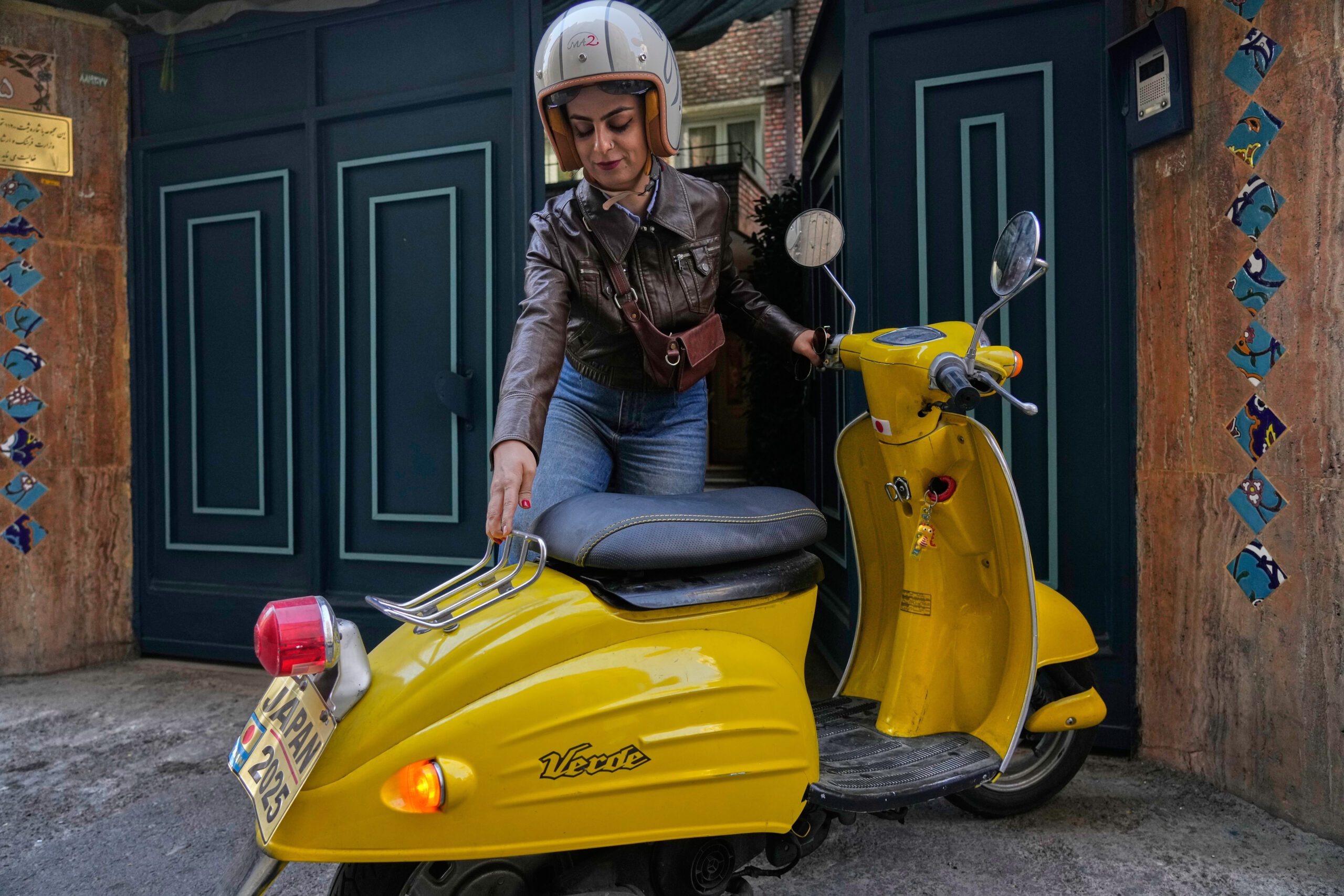
TEHRAN, Iran (AP) — When Merat Behnam first gathered enough courage to ride her yellow scooter through the gridlocked streets of Iran ‘s capital to the coffee shop she runs, traffic wasn’t her main worry.

She instead girded herself for disapproving looks, verbal abuse and even being stopped by the police for being a women riding a motorbike in Tehran, something long frowned upon by hard-liners and conservative clerics in Iran.

But Behnam, 38, found herself broadly accepted on the road — and part of a wider reconsideration by women about societal expectations in Iran.

It’s not all encompassing, particularly as hard-line politicians call for laws on the hijab or headscarf to be enforced as Iran cracks down on intellectuals in the wake of the 12-day Iran-Israel war in June — but it does represent a change.

“It was a big deal for me,” Behnam told The Associated Press after riding up to her café on a recent day. “I didn’t really know how to go about it. In the beginning I was quite stressed, but gradually the way people treated me and their reactions encouraged me a lot.”

‘Exposed to the wind’


Two things in the past prevented women from driving motorbikes or scooters. First of all, police regulations in Iran’s Farsi language specifically refer to only “mardan” or “men” being able to obtain motorcycle licenses. It’s a very gender-specific wording in Farsi, which broadly is a gender-neutral language grammatically.

“This issue is not a violation but a crime, and my colleagues will deal with these individuals, since none of these women currently have a driver’s license and we cannot act against the law,” Gen. Abulfazl Mousavipoor, Tehran’s traffic police chief, said in a report carried by the semiofficial ISNA news agency in September.

Then there’s the cultural aspect. While women can now hold jobs, political office and a car license, since its 1979 Islamic Revolution the country has imposed a strictly conservative, Shiite Islam understanding of conduct by women. That includes Iran’s mandatory hijab law, which sparked mass demonstrations in 2022 after the death of Mahsa Amini, who had allegedly been detained over not wearing a headscarf to the liking of authorities.

In the beliefs of some conservative clerics and hard-liners, a woman riding a scooter or a motorbike is “tabarruj,” or an excessive flaunting of her beauty prohibited by Islam.

“Keeping proper covering for women while riding a motorcycle is very important,” hard-line lawmaker Mohammad Seraj told the semiofficial ILNA news agency in September. “A woman sitting on a motorcycle cannot maintain the modest attire expected of her, since both of her hands are occupied with steering the vehicle and she is exposed to the wind.”

Avoiding congestion charges


For many, the motorbike ban runs directly into the reality of Tehran’s streets, crowded with an estimated over 4 million cars and another 4 million motorcycles on the road daily. For decades, women in the all-encompassing black chador could be seen riding side-saddle on motorbikes driven by men.

But after women began forgoing the hijab, more women began taking the risk and riding their motorbikes through Tehran as well, avoiding the congestion charges levied on cars that run over 20 million rial ($20) a month. While still a small percentage of the overall traffic, their presence on the road has become more common.

“There is not any political manifesto or social agenda here,” Behnam said. “It’s just that since my workplace is downtown and I had to commute every day from (the western neighborhood of) Sattarkhan, the traffic there — and the parking issue, plus the traffic zone restrictions — were driving me crazy.”

‘Symbol of choice and independence’

But for others, it is a political issue. There’s been speculation the administration of reformist President Masoud Pezeshkian, who campaigned on openness to the West before the war, may try to change the regulations to allow women to be licensed. Reformists — those who seek to change Iran’s theocracy from within — also have called for the change.

“It’s time to move past the invisible walls of cultural judgment and bureaucratic rules,” the Shargh newspaper said in September. “For women, riding a motorcycle is not just a way to commute but a symbol of choice, independence and equal presence in society.

Benham, says riding her motorbike also gave her the first positive interaction she’s had with the police.

“For the first time, a police officer — well, actually, a traffic officer — made me feel encouraged and safer. I could feel that there was some kind of support,” she said. “Even the times they gave me warnings, they were technical ones — like where to park, not to do certain things or to always wear a helmet.”


POLLUTER PAYS

Vale to book extra $500M provision for Fundao dam obligations

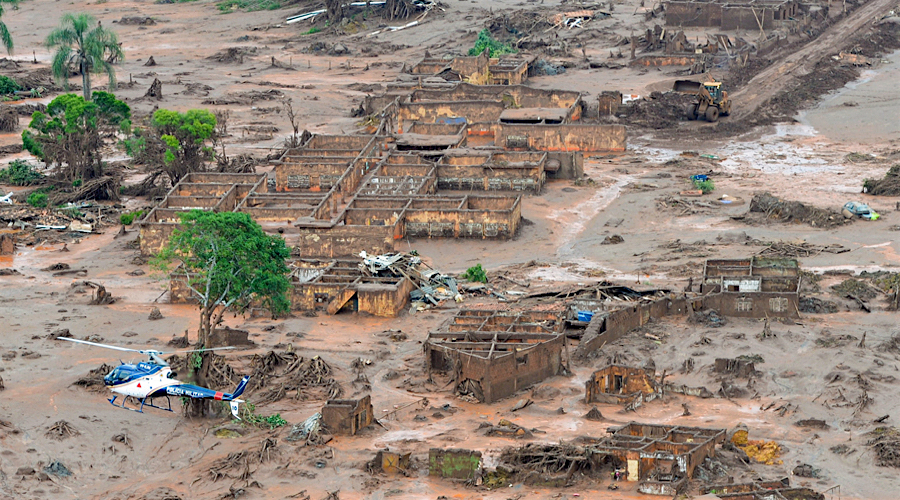
The collapse of the Fundao tailings dam in 2015 killed 19 people and polluted hundreds of miles of rivers. (Image: Agência Brasil Fotografias.)

Brazilian miner Vale said on Friday that it estimates an additional provision of about $500 million in its 2025 financial statements to cover obligations linked to the Fundao dam disaster.

The announcement followed an English High Court decision that considered BHP liable under Brazilian law for the failure of the Fundao dam in Mariana, southeastern Brazil, which was owned and operated by BHP and Vale’s Samarco joint venture.

The company said in a securities filing that it expected cash outflows tied to the agreement to remain in line with the guidance disclosed in its third-quarter earnings release. It had already recognized a provision of $2.401 billion for obligations under the agreement in Brazil, it added.

(By Isabel Teles)