Showing posts sorted by relevance for query BLACKWATER. Sort by date Show all posts

Monday, September 17, 2007

Moral Turpitude Is Spelled Blackwater

This is what happens when you contract out your war to private armies.

"A state that privatizes most of its functions will inevitably defend itself by employing its own people as mercenaries-with equally profound strategic consequences. " Philip Bobbitt

- Iraq's Interior Ministry canceled the license of controversial American security firm Blackwater USA today after Iraqi officials charged that eight civilians were shot by company bodyguards accompanying a U.S. State Department motorcade the day before in Baghdad.

"It has been revoked," said Brig. Gen. Abdul Kareem Khalaf, a spokesman for the ministry. "They committed a crime. The judicial system will take action."

The decision marks Iraq's boldest step yet to assert itself against foreign security contractors, who arrived in Iraq after the U.S.-led invasion in March 2003. Blackwater has become the symbol of foreign gunmen accused by many Iraqis of speeding through Baghdad's streets and shooting wildly at anyone seen as a threat.

moral turpitude

1. depravity
2. (law) Any base or vile conduct, contrary to accepted morals, that accompanies a crime

turpitude

"depravity, infamy," 1490, from M.Fr. turpitude (1417), from L. turpitudinem (nom. turpitudo) "baseness," from turpis "vile, ugly, base, shameful," used in both the moral and the physical senses; of unknown origin. Perhaps originally "what one turns away from" (cf. L. trepit "he turns").

TURPITUDE - Everything done contrary to justice, honesty, modesty or good morals, is said to be done with turpitude.

Moral Turpitude is a legal concept in the USA, which refers to "conduct that is considered contrary to community standards of justice, honesty, or good morals"

Blackwater was founded by an extreme right-wing fundamentalist Christian mega-millionaire ex- Navy SEAL named Erik Prince, the scion of a wealthy conservative family that bankrolls far-right-wing causes.

Erik Prince was political at a very early age and watched as his father used his company as a cash-generating engine to fuel the rise of what we now know as the religious right in this country, as well as the Republican Revolution of 1994. His father gave the seed money to Gary Bauer to found the Family Research Council. Young Erik Prince was in the first crop of interns to serve at the Family Research Council. They gave significant funding to James Dobson and his group Focus on the Family, which is now sort of the premier evangelical organizing network in this country, the “prayer warriors.”

Personnel

Blackwater's president, Gary Jackson, and other business unit leaders are former Navy SEALs. Blackwater was founded and is owned by Erik Prince, who is also a former Navy SEAL.

Prince and Jackson are also major contributors to the Republican party. In addition, Prince was an intern in George H.W. Bush's White House and campaigned for Pat Buchanan in 1992.

Cofer Black, the company's current vice chairman, was the Bush adminstration's top counterterrorism official when 9/11 occurred. In 2002, he famously stated: "There was before 9/11 and after 9/11. After 9/11, the gloves come off." But Black is not alone, Blackwater has become home to a significant number of former senior CIA and Pentagon officials. Robert Richer became the firm's Vice President of Intelligence immediately after he resigned his position as Associate Deputy Director of Operations in fall 2005. He is formerly the head of the CIA's Near East Division.

In October 2006, Kenneth Starr, independent counsel in the impeachment case of Bill Clinton in 1999, represented Blackwater in front of the US Supreme Court in a case related to the March 2004 killing of four Blackwater employees in Fallujah, Iraq. In response to that event, Blackwater also hired the Republican lobbying and PR firm, the Alexander Strategy Group.

Iraq pulls Blackwater license
Ahmad Al-Rubaye / AFP / Getty Images
Blackwater USA contractors secure the site of a roadside explosion in central Baghdad in 2005. The U.S. Embassy said that the Blackwater convoy accused of killing eight civilians during a shootout on Sunday had come under fire, and some local Iraqi television accounts reported an exchange of gunfire at the scene in Baghdad.


The Iraqi government said Monday that it was revoking the license of an American security firm accused of involvement in the deaths of eight civilians in a firefight that followed a car bomb explosion near a State Department motorcade.

Interior Ministry spokesman Abdul-Karim Khalaf said eight civilians were killed and 13 were wounded when contractors believed to be working for Blackwater USA opened fire in a predominantly Sunni neighborhood of western Baghdad.

"We have canceled the license of Blackwater and prevented them from working all over Iraqi territory. We will also refer those involved to Iraqi judicial authorities," Khalaf said.

The spokesman said witness reports pointed to Blackwater involvement but said the shooting was still under investigation. It was not immediately clear if the measure against Blackwater was intended to be temporary or permanent.

Blackwater, based in Moyock, N.C., provides security for many U.S. civilian operations in the country.

The secretive company, run by a former Navy SEAL, has an estimated 1,000 employees in Iraq and at least $800 million in government contracts. It is one of the most high-profile security firms in Iraq, with its fleet of "Little Bird" helicopters and armed door gunners swarming Baghdad and beyond.

The decision to pull the license was likely to be challenged, as it would be a major blow to a company at the forefront of one of the main turning points in the war.

The 2004 battle of Fallujah — an unsuccessful military assault in which an estimated 27 U.S. Marines were killed, along with an unknown number of civilians — was retaliation for the killing, maiming and burning of four Blackwater guards in that city by a mob of insurgents.

Tens of thousands of foreign private security contractors work in Iraq — some with automatic weapons, body armor, helicopters and bulletproof vehicles — to provide protection for Westerners and dignitaries in Iraq as the country has plummeted toward anarchy and civil war.

Monday's action against Blackwater was likely to give the unpopular government a boost, given Iraqis' dislike of the contractors.

Interior Minister Jawad al-Bolani called the shootings "a crime that we cannot be silent about."

Many of the contractors have been accused of indiscriminately firing at American and Iraqi troops, and of shooting to death an unknown number of Iraqi citizens who got too close to their heavily armed convoys, but none has faced charges or prosecution.

"There have been so many innocent people they've killed over there, and they just keep doing it," said Katy Helvenston, the mother of Steve Helvenston, a Blackwater contractor who died during the 2004 ambush in Fallujah. "They have just a callous disregard for life."

Helvenston is now part of a lawsuit that accuses Blackwater of cutting corners that ultimately led to the death of her son and three others.

The question of whether they could face prosecution is legally murky. Unlike soldiers, the contractors are not bound by the Uniform Code of Military Justice. Under a special provision secured by American-occupying forces, they are exempt from prosecution by Iraqis for crimes committed there.

Khalaf, however, denied that.

The embassy also refused to answer any questions on Blackwater's status or legal issues, saying it was seeking clarification on the issue as part of the investigation, which was being carried out by the State Department's diplomatic security service and law enforcement officials working with the Iraqi government and the U.S. military.

Is there even a license to revoke? Buzz on the contractor street is that it isn't clear how this development will affect Blackwater. Allegedly, Blackwater doesn't have a "license" to revoke, and its contracts with the State Department and CIA may not be immediately affected. This could play out in an interesting (albeit depressing) powerplay between the al-Maliki, Iraq's Ministry of Interior, and the U.S. Government.

The issue of accountability is a troubling one, however, as Scahill reveals the Blackwater operatives are essentially above the law in Iraq. They can’t be prosecuted under military law because they’re civilians. But they have little to worry about from civilian law in the chaos of Iraq.

At one point in the book, a politician confronts a military official and claims Blackwater agents can get away with murder, and the official more or less admits he’s right. It’s a point that’s highlighted by another video featuring an alleged mercenary shooting people at random on a highway in Iraq (YouTube link).

It was inevitable. Private military contractors have been involve din all sorts of questionable incidents, since the very start of the Iraq enterprise. U.S. military officers frequently expressed their frustrations with sharing the battlefield with such private forces operating under their own rules and agendas, and worry about the consequences for their own operations. For example, Brigadier General Karl Horst, deputy commander of the US 3rd Infantry Division (responsible for Baghdad area) tellingly put it two years back, “These guys run loose in this country and do stupid stuff. There’s no authority over them, so you can’t come down on them hard when they escalate force. They shoot people, and someone else has to deal with the aftermath.”

Karel Prinsloo/AP, File
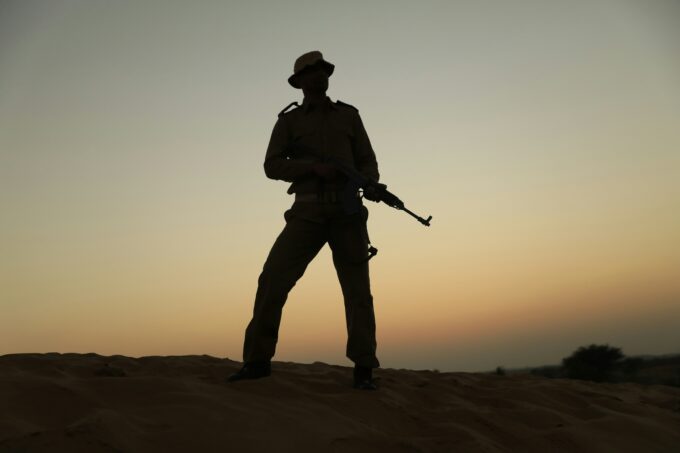
A U.S. private security officer, with his face covered against dust, on board a Chinook helicopter in Iraq.

Blackwater Guards Accused of Past Deaths

NEW YORK (AP) — In the past year, employees of the Blackwater USA security firm have been involved in other incidents in which they were accused of killing civilians and security forces in Iraq.

On Dec. 24, 2006, a drunken Blackwater employee shot and killed a bodyguard for Iraq's Shiite vice president, Adel Abdul-Mahdi, according to Iraqi and U.S. officials.

The contractor had gotten lost on the way back to his barracks in the Green Zone and fired at least seven times when he was confronted by 30-year-old Raheem Khalaf Saadoun, an official in the vice president's office said on condition of anonymity because the case is still under investigation.

The contractor fled after the incident. Eventually, he made his way to the U.S. Embassy, where Blackwater officials arranged to have him flown home to the U.S., said American officials.

Blackwater spokeswoman Anne Tyrrell said earlier this year the company was cooperating with investigators from the Justice Department and the FBI. She declined to provide further details.

In May, Blackwater guards under contract to the State Department were involved in two other shootings in Iraq.

In one, a Blackwater guard shot to death an Iraqi deemed to be driving too close to a security detail near the Interior Ministry in Baghdad, enraging Iraqis. At the time, Tyrrell said the guard acted lawfully and appropriately, given the incident reports and witness accounts.

A day earlier, Blackwater guards and Interior Ministry forces exchanged gunfire on the streets of the capital. A passing U.S. military convoy intervened and stopped the fighting.


The Nation's Jeremy Scahill describes the rise of Blackwater USA, the world's most powerful mercenary army.


"As the government of the United States is not, in any sense, founded on the Christian religion; as it has in itself no character of enmity against the laws, religion or tranquility of Musselmen (Muslims) ... it is declared ... that no pretext arising from religious opinion shall ever product an interruption of the harmony existing between the two countries....
"The United States is not a Christian nation any more than it is a Jewish or a Mohammedan nation."


-- Treaty of Tripoli
(1797), carried unanimously by the Senate and signed into law by John Adams (the original language is by Joel Barlow, US Consul)

PAMBLOQ Rules! Yesss!!

SEE:

IRAQ- THIS WAR IS ABOUT PRIVATIZATION

Bad News For Bush

U.S. Supplies Iraqi Insurgents With Weapons

Surge Blackout


Find blog posts, photos, events and more off-site about:
, , ,
, , , , , , ,

a href="http://tagcentral.net/?tag=President" bush="" rel="tag">President Bush,
, , , , , , , , , , , , , , , , , ,

Wednesday, December 23, 2020

'Our blood is cheaper than water': anger in Iraq over Trump pardons

Joe Biden to be lobbied to reverse decision to pardon security guards jailed over massacre

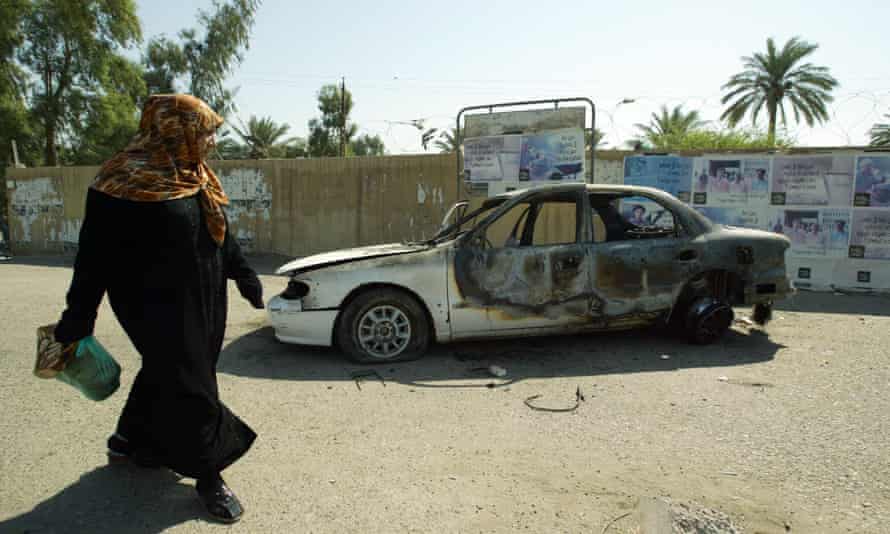
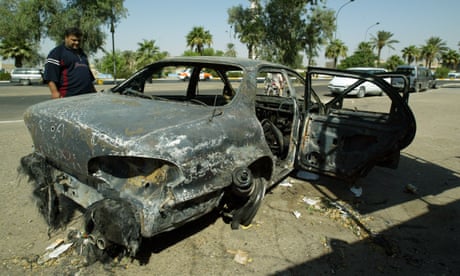
A burnt-out car at the site where Blackwater guards opened fire in western Baghdad on 16 September 2007. Photograph: Ali Yussef/AFP/Getty Images


Martin Chulov and Michael Safi
Wed 23 Dec 2020 

Iraqis have reacted with outrage to Donald Trump’s move to pardon four security guards from the security firm Blackwater who were jailed for a 2007 massacre that sparked an outcry over the use of mercenaries in war.

The four men were part of a security convoy that fired on civilians at a central Baghdad roundabout, killing 14 people including a nine-year old child and wounding many more.

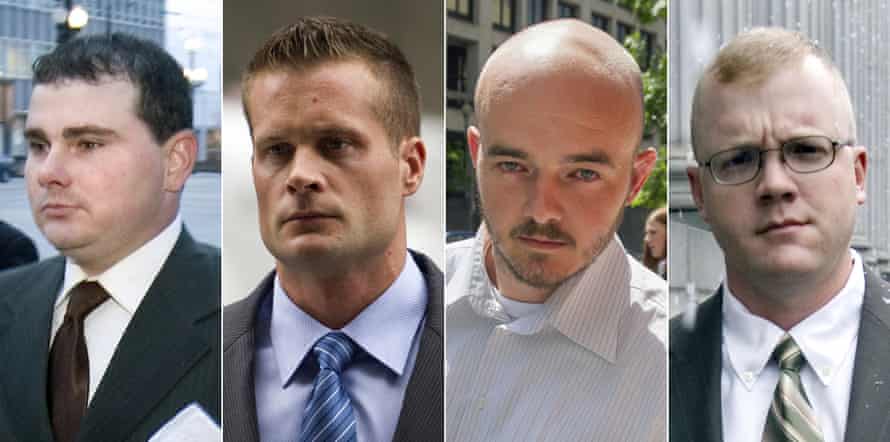
The four guards – Paul Slough, Evan Liberty, Dustin Heard and Nicholas Slatten – opened fire indiscriminately with machine guns, grenade launchers and a sniper on a crowd of unarmed people at a roundabout, known as Nisour Square.


Trump pardons Blackwater contractors jailed for massacre of Iraq civilians
Read more


The killings were one of the lowest points of the US-led invasion of Iraq, and many Iraqis saw the convictions as a rare occasion where US citizens had been held to account for atrocities committed during the aftermath. Baghdad residents who spoke to the Guardian described the outgoing US president’s announcement as a “cruel slap” and an insult.
Advertisement


“Trump has no right to decide on behalf of victims’ families to pardon these criminals,” said Dr Haidar al-Barzanji, an Iraqi researcher and academic. “It is at odds with human rights and against the law. In Iraqi law they can only be pardoned if the families of victims pardon them. I encourage the families of the victims to request a complaint against Trump when the Biden administration starts.”

The Iraqi human rights activist Haidar Salman tweeted: “I still remember my professor of haematology at Baghdad University department of pathology (who was shot during the massacre along with his family) when he returned to life after his two children and his wife were killed in Nisour Square and almost lost his mind.

“One reason for him to survive was to condemn the murderers. The person who releases these criminals is more of a criminal. The Iraqi government should ask the Biden administration to revoke the pardon.”

The carnage at Nisour Square came more than four years into the US invasion, which sparked a vicious sectarian war and mass displacement of Iraqis. The long US occupation had left citizens resentful of security convoys that carved swathes through traffic at will, sometimes shooting towards cars that had trailed too closely.

Private security contractors, supporting logistics companies, or in some cases the US military, were a frequent source of complaints about heavy-handed and disrespectful behaviour towards locals.

“We used to be terrified of them, especially Blackwater, who were the nastiest of them all,” said Ribal Mansour, who heard the chaos at Nisour Square on 16 September 2007, and ran to the scene. “What I saw there will haunt me for ever. It should have been a red line. For them to be freed by the US commander-in-chief is shameful.”
Advertisement

Slough, Liberty and Heard were convicted on multiple charges of voluntary and attempted manslaughter in 2014, while Slatten, who was the first to start shooting, was convicted of first-degree murder. Slatten was sentenced to life and the others to 30 years in prison each.
(Left-right) Dustin Heard, Evan Liberty, Nicholas Slatten and Paul Slough. Photograph: AP

A federal judge threw out an initial prosecution, but the then vice-president, Joe Biden, promised to pursue a fresh prosecution, which succeeded in 2015.

As the incoming president, Biden is certain to be lobbied heavily by Iraqi officials to reverse the decision. “It will be the first thing we discuss with him,” said an aide to Mustafa al-Kadhimi, the Iraqi prime minister.

At the sentencing hearing, the US attorney’s office said in a statement: “The sheer amount of unnecessary human loss and suffering attributable to the defendants’ criminal conduct on 16 September 2007 is staggering.”

After news of the pardon emerged on Tuesday night, Brian Heberlig, a lawyer for one of the four pardoned Blackwater defendants, said: “Paul Slough and his colleagues didn’t deserve to spend one minute in prison. I am overwhelmed with emotion at this fantastic news.”

The pardons are among several the president has granted to American service personnel and contractors accused or convicted of crimes against non-combatants and civilians in war zones. In November last year, he pardoned three US servicemen who had been accused or convicted of war crimes, including a former army lieutenant convicted of murder for ordering his men to fire at three unarmed Afghans.

During the trial of the Blackwater contractors, defence lawyers argued their clients returned fire after being ambushed by Iraqi insurgents.

Pardons sink Trump further into swamp of his own shamelessness

Read more


But in a memorandum filed after sentencing, the US government said: “None of the victims was an insurgent, or posed any threat to the Raven 23 convoy.”
Advertisement


The memorandum also contained quotations from relatives of the dead, including Mohammad Kinani, whose nine-year-old son Ali was killed. “That day changed my life for ever. That day destroyed me completely,” Kinani said.

FBI investigators who visited the scene in the following days described it as the “My Lai massacre of Iraq” – a reference to the infamous slaughter of civilian villagers by US troops during the Vietnam war for which only one soldier was convicted.

The Iraqi government announced an immediate ban on Blackwater following the killings – though it continued to operate in the country until 2009 – and the state department ultimately stopped using the firm to provide diplomatic security.

The massacre led to successive investigations into Blackwater and the wider private contractor industry by the US state department, the Pentagon, Congress and the UN.

Amid intense scrutiny, founder Erik Prince cut ties with the company in 2010, though he continued to work in the field, setting up an American-led mercenary army in the UAE that has since reportedly been deployed in Yemen.

Blackwater’s latest incarnation, Academi, is owned by private investors and continued after Prince’s departure to win state department and Pentagon contracts to protect US installations in war zones and train armed forces personnel.

The 14 victims killed by the Blackwater guards were Ahmed Haithem Ahmed Al Rubia’y, Mahassin Mohssen Kadhum Al-Khazali, Osama Fadhil Abbas, Ali Mohammed Hafedh Abdul Razzaq, Mohamed Abbas Mahmoud, Qasim Mohamed Abbas Mahmoud, Sa’adi Ali Abbas Alkarkh, Mushtaq Karim Abd Al-Razzaq, Ghaniyah Hassan Ali, Ibrahim Abid Ayash, Hamoud Sa’eed Abttan, Uday Ismail Ibrahiem, Mahdi Sahib Nasir and Ali Khalil Abdul Hussein.

All but one of the victims’ families accepted compensation payments from Blackwater: $50,000 for the wounded, and $100,000 for relatives of the dead.

Haitham al-Rubaie – who lost his wife, Mahassin, a doctor, and his son Ahmad, a 20-year-old medical student – was the only one to turn down the offer.

A former classmate of Ahmad said that Trump’s pardon was not surprising for Iraqis.

“The Americans have never approached us Iraqis as equals,” she told AFP. “As far as they are concerned, our blood is cheaper than water and our demands for justice and accountability are merely a nuisance.”

Additional reporting: Nechirvan Mando in Erbil

Thursday, September 20, 2007

Sounds Familiar

Gee this sounds familiar.....

a preliminary Iraqi report on the shooting involving a US diplomatic motorcade claims Blackwater security guards had not been ambushed, as the company reported, but instead fired at a car when it did not heed a policeman's call to stop, killing a couple and their infant.


Yep reminds me of other deaths in Iraq like that of the Italian Secret Agent,
where innocents are shot in their cars for failing to obey a stop sign.

Wonder if those guys were Blackwater as well. After all it's hard to tell the players without a program.

And with the Rumsfeld Doctrine of integrating private mercenaries and contracted out support services with the regular Armed forces it is even harder to tell.

But the vision that Rumsfeld sort of laid out that day would become known as the Rumsfeld Doctrine, where you use high technology, small footprint forces and an increased and accelerated use of private contractors in fighting the wars.


And the Iraq report on gung ho merc's from Blackwater goes on....

The report, prepared by the interior and defence ministries, was presented to the Iraqi cabinet and, though unverified, seemed to contradict an account offered by Blackwater that the guards were responding to gunfire by militants.

The report said Blackwater helicopters had been involved and 20 Iraqis were killed — a far higher number than had been reported before.

"There was not shooting against the convoy," the Iraqi Government's spokesman, Ali Dabbagh, said. "There was no fire from anyone in the square."

Shoot first ask questions later seems to be Blackwater's motto, which is what got them killed in Fallujah in the first place and set off the American revenge attack on that city.


SEE:

Moral Turpitude Is Spelled Blackwater

Bad News For Bush

U.S. Supplies Iraqi Insurgents With Weapons

Surge Blackout

IRAQ- THIS WAR IS ABOUT PRIVATIZATION


Find blog posts, photos, events and more off-site about:
, , ,
, , , , , , ,

a href="http://tagcentral.net/?tag=President" bush="" rel="tag">President Bush,
, , , , , , , , , , , , , , , , , ,

Monday, September 24, 2007

Blackwater On YouTube

I look forward to seeing this on Youtube.

Iraqi investigators have a videotape that shows Blackwater USA guards opened fire against civilians without provocation in an incident last week in which 11 people died, a senior Iraqi official said Saturday. He said the case had been referred to the Iraqi judiciary.


While the U.S. government might want to look at Blackwater instead of Iran for weapons smuggling into Iraq. Oh yes and ask them about the tons of missing weapons that they were supposed to be guarding.

Feds probe whether Blackwater smuggled weapons into Iraq: Federal prosecutors are investigating whether employees of the private security firm Blackwater USA illegally smuggled weapons into Iraq that may have been sold on the black market and ended up in the hands of a U.S.-designated terrorist organization, officials said Friday.


File this under oops we spoke to soon.

Iraq says won't move to expel Blackwater: "If we drive out or expel this company immediately there will be a security vacuum that will demand pulling some troops that work in the field so that we can protect these institutes," spokesman Tahseen al-Sheikhly, speaking through an interpreter, told a news conference.


SEE:

Sounds Familiar


Moral Turpitude Is Spelled Blackwater


Find blog posts, photos, events and more off-site about:
, , ,
, , , , , , ,

a href="http://tagcentral.net/?tag=President" bush="" rel="tag">President Bush,
, , , , , , , , , , , , , , , , , ,

Thursday, February 20, 2025

Another Blackrock? Nearly 100 U.S. Mercenaries are in Gaza Right Now

DON'T CALL THEM CONTRACTORS


 February 20, 2025
Facebook

Image by Charanjeet Dhiman.

Armed to the teeth with M4 rifles and Glock pistols and pockets stuffed with their $10,000 advance plus some, 96 former U.S. special forces veterans are currently stationed in Gaza.

These mercenaries have been hired by UG Solutions, a North Carolina-based military contractor, to patrol the intersection that Israel used to separate the north from the south of Gaza. What the Occupation called the “Netzarim Corridor” split Gaza with a fortified wide road to re-supply weapons and tanks as well as providing a vantage point to launch attacks on both the north and the south. Named after the settler encampment in the same area from 1975-2005, the area was once again made into a violent and deadly zone. After the occupation forces withdrew from the intersection, the decomposing bodies and skeletal remains of Palestinian people were found.

In a recruiting email from UG Solutions, they describe the primary purpose of the soldiers as “internal vehicle checkpoint management and vehicle inspection.” They claim to be searching for weapons moving in Gaza, of course only on Palestinians, not their or their colleagues’ own American and Israeli guns, nor those of the Israeli occupation forces (IOF.) We know this means that these soldiers are doing the work of the occupation forces. Like the checkpoints that slice into the occupied West Bank and Jerusalem, these armed and oppressive checkpoints aim to terrorize Palestinians, securitize their land, and provide outposts for attacks. As the ceasefire unfolds in stages, all eyes should be on these checkpoints to ensure all soldiers are removed, American or Israeli.

The images of these mercenaries, being paid a minimum of $1,100 a day, standing with their sunglasses and rifles next to Palestinians trying to travel in their own land is infuriating. But it’s also revealing. American boots have been on the ground in Gaza many times over the past 15 months of the accelerated genocide, and certainly before that. You might recall the since deleted photograph accidentally posted by the White House’s Instagram account that revealed the high-level U.S. Delta Squad were in Gaza, or when American forces assisted the occupation by committing a heinous massacre in Nuseirat refugee camp, killing at least 300 Palestinians and wounding 1,000 more. Not to mention the many, many Americans in the IOF – either settlers or enthusiastic killers travelling from the US – who have had their hand in committing genocide, perhaps recording a video celebrating themselves blowing up a mosque or parading in their victims’ undergarments, before returning to the United States – if not after taking a brief vacation to Dubai or Brazil first.

This is not the first time that U.S. private mercenaries have been hired to provide assistance to U.S. military invasions. Blackwater, a private mercenary company also headquartered in North Carolina, was hired to send U.S. mercenaries to both Afghanistan and Iraq shortly after the U.S. invasions. Between 2001 and 2007, Blackwater received $1 billion in U.S. government contracts. On September 16 2007, Blackwater mercenaries massacred 17 Iraqi civilians, aged between 9 and 77, and wounded more than 30 people in Nisour Square, Baghdad. Four Blackwater mercenaries were convicted of their murders: Dustin Heard, Evan Liberty, Nicholas Slatten, and Paul Slough. Despite the global outrage, Blackwater CEO, Erik Prince, maintained that they acted “appropriately” and, in his first term, Trump pardoned all of the killers.

The Nisour Square massacre is but one example of the violence of Blackwater in Iraq. Between 2005 and 2007, U.S. mercenaries attacked Iraqi civilians at least 195 times. The actions of Blackrock employees revealed in the WikiLeaks’ War Logs uncover that these were not only random acts of violence but how the private soldiers were acting in coordination with the U.S. military themselves. Blackwater is but one of the many companies like it exerted imperialist violence on behalf of the U.S. empire. The U.S. government turned to using privatized militaries to outsource accountability and actions, often opting for private contractors in the years after they officially withdrew from countries, or in places where they wanted a presence but fewer U.S. soldiers.

The presence of U.S. mercenaries in Gaza highlights a disturbing pattern of American involvement in the region’s violence. In Gaza today, these mercenaries fulfill a role without scrutiny that neither the U.S. military nor Israeli occupation forces could with the same guns and boots but different logos. These soldiers, whether it’s the IOF, Blackwater, U.S. military, or UG Solutions, only mean violence for the Palestinian people. The continuation of using private mercenaries reflects the unaccountability and disregard for Palestinian lives that characterizes U.S. foreign policy in the region, underscoring the need for global scrutiny and calls for justice, and the potential for escalated violence continues.

Nuvpreet Kalra is CODEPINK’s Digital Content Producer. She completed a Bachelor’s in Politics & Sociology at the University of Cambridge, and an MA in Internet Equalities at the University of the Arts London. As a student, she was part of movements to divest and decolonize, as well as anti-racist and anti-imperialist groups. Nuvpreet joined CODEPINK as an intern in 2023, and now produces digital and social media content. In England, she organizes with groups for Palestinian liberation, abolition and anti-imperialism.

Tuesday, March 14, 2023

ArcWest shares jump on Freeport earn-in deal as majors eye British Columbia copper

Alicia Hiyate | March 10, 2023 |

Todd Creek project in British Columbia. (Reference image by ArcWest Exploration).

Shares in junior explorer ArcWest Exploration (TSXV: AWX) jumped more than 80% in morning trading in Toronto after it announced an earn-in deal with Freeport-McMoRan (NYSE: FCX) on one of its copper-gold properties in BC’s Golden Triangle.


Under the agreement, Freeport will be able to earn up to 80% of ArcWest’s Todd Creek project which is next to Newcrest Mining’s (TSX: NCM; ASX: NCM) Brucejack mine. To earn an initial 51% interest, Freeport needs to fund C$20 million of work at ArcWest over five years, and make staged payments to the company totalling C$900,000. ArcWest will remain operator during this stage.

Once it earns its initial stake, Freeport can up its interest to 80% by funding C$30 million in work at Todd Creek over five years and making staged payments totalling C$750,000.

After Freeport has finalized its ownership level (whether at 51% or 80%), each party will be responsible for funding its proportionate share of work at Todd Creek.

ArcWest believes the project, which it says covers one of the fundamental north-south structural corridors in the Stikine terrane and is near multiple major projects and mines, could be an analogue to the Hod Maden gold-copper project in Turkey.

“ArcWest looks forward to advancing our Todd Creek project in partnership with Freeport, one of the world’s largest copper miners and a team with a track record of global copper-gold discoveries that have proceeded to mine development,” said Tyler Ruks, president and CEO of ArcWest, in a release.

“ArcWest’s Todd Creek project is host to one of the largest underexplored copper-gold systems in BC’s Golden Triangle, and Freeport’s endorsement of the project is a testament to its potential for hosting a world class copper-gold deposit.”

Ruks added that ArcWest is in discussions with other mining companies on potential earn-in agreements for its other copper-gold porphyry projects. The company has seven in BC.

ArcWest isn’t the only BC junior to attract the attention of copper majors recently.

Amarc Resources (TSXV: AHR), which already had a strategic exploration partnership with Freeport at its JOY project, also signed a deal with Sweden’s Boliden in November for its DUKE copper-gold district in the Babine region of BC.

ArcWest shares reached a new 52-week high of C$0.10, up 82% or C$0.045, at noon ET. The stock has traded between C$0.05 and C$0.10 over the last year and has a market cap of C$7.6 million.

Artemis Gold passes final regulatory hurdle to begin works at Blackwater mine

Staff Writer | March 9, 2023

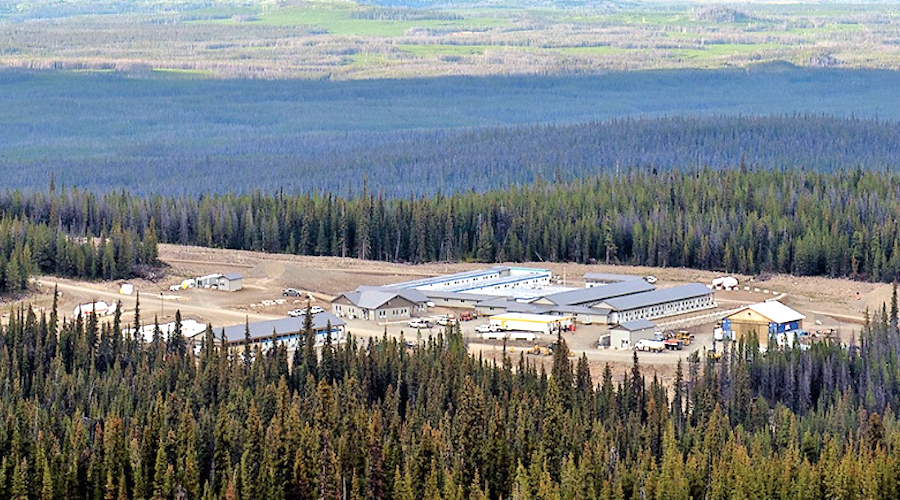
Site of the Blackwater gold project in central B.C. (Image courtesy of Artemis Gold.)

Artemis Gold (TSXV: ARTG) has announced the approval of its BC Mines Act Permit for the Blackwater project in central British Columbia, which is the final step required to allow the company to begin major construction activities at the mine site with the expectation of an initial gold pour in the second half of 2024.


Located about 446 km northeast of Vancouver, the Blackwater project comprises the construction, operation and closure of an open-pit gold mine and ore processing facilities that will be developed in multiple stages.

“The approval of the BC Mines Act Permit is the culmination of a substantial amount of work completed by our team in collaboration with our First Nation partners and the provincial government,” Steven Dean, Artemis Gold CEO, said in a news release.

The Blackwater mine is estimated to be the largest gold mine development project in the Cariboo region of BC in more than a decade, supporting regional employment over multiple decades with the potential to be extended through further exploration.

In addition, the Blackwater mine “has been designed to have one of the smallest carbon footprints for an open pit gold project in the world, with a defined path forward to substantially reduce that footprint further and potentially achieve net zero carbon emissions through the integration of a zero-exhaust-emission haul fleet by 2029,” Dean said.

The mine will be connected to the BC Hydro grid, which is powered by hydroelectricity. This provides the foundation for Blackwater to be developed into one of the lowest greenhouse gas (GHG) emitting open pit mining operations in the world, according to Artemis. The company also invested in a fully electrified process plant with all diesel and propane components replaced with electric equipment.

Artemis is planning a 22-year mine life with open pit methods and using gravity and conventional cyanidation methods for gold recovery. Over that period, it is expected to produce an average of 339,000 oz. of gold per year. Life-of-mine capital costs are estimated at C$2.25 billion, beginning with C$645.2 million to be spent before production begins next year.

As part of the permitting process, Artemis said it also collaborated with the federal and provincial governments as well as First Nations communities on the development of environmental management plans related to caribou habitat offsetting, fish habitat offsetting, wetlands offsetting, and conservation and enhancement activities.

David Eby, Premier of British Columbia, also put out a statement on Thursday: “The Blackwater gold project will put lots of people to work and create a wide range of opportunities and benefits for local businesses, communities and First Nations while ensuring the highest standards of environmental protection, mitigation and sustainability.”

Josie Osborne, British Columbia’s Minister of Energy, Mines and Low Carbon Innovation, added: “British Columbians will benefit from hundreds of new jobs from this new mine, with both its construction and multiple decades of operation.”

An economic impact study completed by KPMG on the Blackwater project in November 2020 anticipates that it will create 457 direct full-time jobs per year over the operating life of the mine and with 825 direct full-time jobs per year created during the construction/expansion phases of mine development.

Additionally, the mine is expected to contribute C$13.2 billion ($9.5bn) to the provincial economy, over the life of the mine, including C$2.3 billion ($1.6bn) to provincial revenues, the report said.

Tuesday, August 27, 2024

British Columbia gov’t orders Artemis to remove camp near Blackwater project

Staff Writer | August 26, 2024 | 

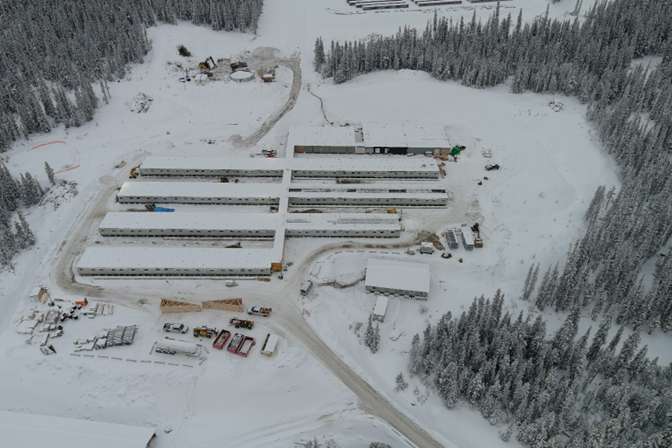
Blackwater project construction camp area. Credit: Artemis Gold Inc.

The British Columbia government has directed Artemis Gold (TSXV: ARTG) to remove a construction worker camp near its Blackwater project by the end of August for breaking environmental guidelines.


Early this month, the BC Environmental Assessment Office issued an enforcement order to remove the camp after an on-site inspection in May found part of it was on a hydro transmission corridor in violation of the company’s permit.

The company said it was having no problems complying with the order after spending C$200,000 on cleaning up the site it had occupied with the permission of the separate Ministry of Energy Mines and Low Carbon Innovation. Known as the Chu site, it dated proved a previous owner, Artemis said in an emailed statement.

“We saw an opportunity to assist the provincial government with clean up of the Chu camp site, while also ensuring our transmission line workforce was close to their job sites,” an Artemis spokesperson said. “We agreed to remediate the existing site, which contained old buildings and infrastructure.”

Artemis was initially given a deadline of Aug. 7 to close the infringing camp, but it was extended when BC wildfire-fighting contractors used it.
First gold

The proposed open-pit gold and silver mine about 600 km north of Vancouver was nearly 90% complete at the end of June, according to the company. A first gold pour is planned for the fourth quarter. Blackwater aims to mill 60,000 tonnes a day over at least 17 years.

Artemis said its workers had already left the Chu site and striking the campy wouldn’t affect Blackwater’s construction schedule or materially impact costs.

The Blackwater environmental certificate allows for a main construction camp of up to 1,000 workers and an operations camp housing up to 500 people. Both facilities must be located entirely within the project site.

Inspection records showed the camp had at least 48 accommodation units, three generators and potable water storage on the corridor outside the Blackwater site.

Also, the camp site wasn’t part of the construction plans, and therefore not contemplated in the project’s environmental assessment.

Shares in Artemis Gold fell 2.2% on Tuesday afternoon in Toronto to C$12.62 apiece, valuing the company at C$2.8 billion. They’ve traded in a 52-week range of C$4.98 to C$13.48.

Sunday, July 18, 2021

NDP GOVT
BC approves early construction at Artemis Gold’s Blackwater
Canadian Mining Journal Staff | July 15, 2021 | 

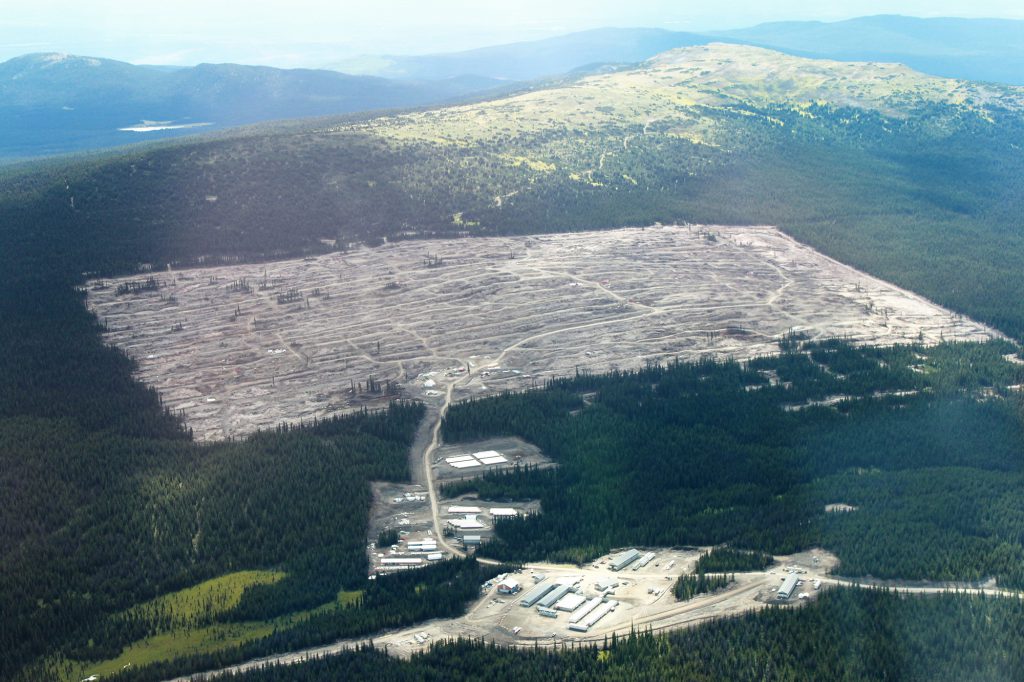
An aerial view of the Blackwater gold project. Credit: Artemis Gold

British Columbia has granted a permit for early construction work at the Blackwater gold project belonging to Artemis Gold (TSXV: ARTG). This is the first step in construction of a mine, allowing for site preparations and land cleaning at the site 150 km southwest of Prince George, BC.


Blackwater is estimated to be the largest gold mine development in the Cariboo region of BC in the last decade, supporting regional employment over 25 years, including the construction period, with the potential for that to be extended through further exploration.

DAM C

Blackwater is to be connected to the BC Hydro grid, which is powered by hydro-electricity providing it with a sustainable source of low-carbon power, with the potential to produce gold and silver with one of the lowest GHG emissions from an open pit in the world.

BLACKWATER HAS THE POTENTIAL TO PRODUCE GOLD AND SILVER WITH ONE OF THE LOWEST GHG EMISSIONS FROM AN OPEN PIT IN THE WORLD

The project will be developed in phases as an open pit and carbon-in-pulp processing plant. Initial capital requirements will be C$592 million ($470m) for phase one with a mill capacity of 5.5 million t/y and an annual output of 248,000 oz. of gold. Over the 23-year life of the mine, throughput will be increased to 20 million t/y with two further expansion phases.

The Blackwater gold project has an after-tax net present value (5% discount) of C$2.2 billion ($1.75bn), an internal rate of return of 35%, and a payback period of 2 years.

The deposit is estimated to contain 251 million measured and indicated tonnes grading­ 1.04 g/t gold and 8.3 g/t silver for 8.4 million oz. gold and 68 million oz. silver. The inferred estimate is 5.6 million tonnes at 0.79 g/t gold and 26 g/t silver, containing 142,000 oz. gold and 4.6 million oz. silver. These numbers reflect a 0.5 g/t gold cut-off.

(This article first appeared in the Canadian Mining Journal)