Suez Canal Upbeat About Traffic Rebound as CMA CGM Boxships Make Transit
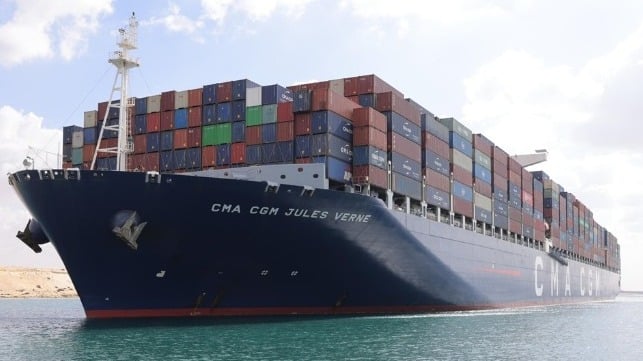
The Suez Canal Authority (SCA) is optimistic that transits are gradually returning to normal after the canal witnessed the passage of three mega ships operated by CMA CGM in a span of one week.
Just a day after the UN Security Council overwhelmingly voted to renew sanctions against the Yemeni Houthis’ who have been waging attacks on commercial vessels forcing them to avoid the Red Sea, SCA now believes the situation is easing and mega ships are making transits through the canal.
On November 15, the Suez Canal celebrated an operational milestone after the newly delivered CMA CGM ship Helium made its maiden transit through the waterway. Delivered by South Korean shipbuilder HD Hyundai Samho last month, the 335 meters with a gross tonnage of 130,000 tonnes is part of new series of 12 container vessels fitted with dual-fuel engines that can operate on methanol that are being built by CMA CGM, the world’s third-largest container shipping company. The ship transited the canal as part of the northbound convoy en route from Singapore and calling at Egypt’s Alexandria port.
Another CMA CGM boxship, Jules Verne, also transited the waterway as part of the northbound convoy en route from Singapore to Lebanon after safely passing through the Red Sea and the Bab El-Mandab Strait, a development the comes after the Houthis promised to stop attacks on ships following the ceasefire between Israel and Hamas.
Built in 2013, the voyage by the 396 meters ship with a gross tonnage of 176,000 tonnes is the first transit from the south through Bab El-Mandab, and its third transit through the canal. SCA is highlighting that Jules Verne is resuming transits after its last two southbound voyages this year in June and September, with the transit being inspired by incentives introduced in June.
Back then, SCA introduced an incentive scheme that introduced a 15 percent toll discount for container ships with a net tonnage exceeding 130,000 tonnes to encourage shipping lines to resume transits through the waterway.
The passage of Helium and Jules Verne came just a week after another CMA CGM container ship, the Benjamin Franklin, became the largest container ship to transit the canal in the past two years. The 399 meters ship with tonnage of 177,000 tonnes and a capacity of 17,859 containers, transited the waterway as part of the north convoy travelling from the United Kingdom to Malaysia, before safely passing through the Bab el-Mandeb Strait.
“The restoration of calmness once more to the Red Sea region will impose a new reality on the shipping community; that is the necessity of serious consideration by the shipping lines of amending navigation schedules so as to return to transiting through Bab el-Mandab and the Suez Canal once more,” said Admiral Ossama Rabiee SCA Chairman.
SCA is buoyant the gradual return of transits on Suez Canal, which before the onset of the Houthis attacks was one of the world’s busiest waterways with about 12 percent of the world trade volume passing through it, will result in improved revenues. The authority is forecasting to generate $4.2 billion in 2025, up from $3.9 billion last year. The canal achieved its highest-ever annual revenue in 2023, reaching $10.2 billion.
To achieve the revenue targets, SCA is hoping the calmness currently being witnessed in the Red Sea is sustained. As part of measures to further cripple the Yemeni Houthis, the Security Council agreed to renew sanctions on the militant group for another year until November 14, 2026. The resolution to renew the sanctions garnered 13 votes in favor with Russia and China abstaining.
Morocco's Nador West Med Port to Start Up Ahead of Schedule
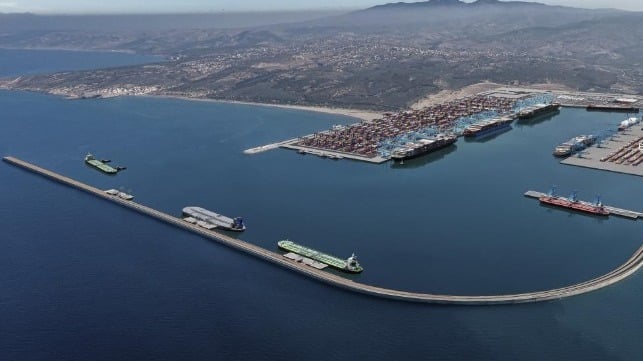
Morocco’s much awaited transshipment hub, Nador West Med Port, could be opened earlier than expected. In a budget presentation in Morocco’s parliament last week, Equipment and Water Minister Nizar Baraka revealed that the port is fully ready. The minister added that the port complex could begin operations by end of 2026, almost a year earlier than the scheduled opening time in 2027.
The government has now shifted focus to building port access roads and improving connectivity to other regions in Morocco. According to the Minister, the plan is to establish connections to major towns in northern Morocco including Fès, Taourirt and Oujda.
Terminal operators are also readying for the port’s opening. Last month, Morocco’s Marsa Maroc and CMA Terminals (a subsidiary of CMA CGM) finalized a joint partnership for the concession of the West Terminal at the Port of Nador West Med. MSC Group - through its subsidiary Terminal Investment Limited (TIL) - has also signed an agreement with Marsa Maroc for the concession of the second container terminal at Nador West.
With Nador West Med modeled on the success of Tanger Med port, it is expected to further disrupt container shipping market in the Mediterranean region. In its first phase, Nador Port will have capacity to handle 1.8 million TEU per year, which will rise to around 5.5 million TEU in the subsequent phases. This places the port in direct competition with established European transshipment ports such as Algeciras (which handled 4.7 million TEU in 2024) and Valencia (5.5 million TEU in 2024).
In fact, there have been concerns in Spain that emerging hubs such as Nador West Med could exacerbate the decline of Port of Algeciras. The argument is that strict environmental regulations in Europe create competitive disadvantages for Spanish ports compared to their Moroccan neighbors in the Mediterranean.
Spain’s State Ports agency has in the past urged for regulatory balance in Europe, warning of a possible decrease in shipping traffic in favor of Morocco. The Port Authority of the Bay of Algeciras estimates that its port could lose almost 60 percent of its transshipment volume to Tanger Med under a scenario of strict environmental regulations.

No comments:
Post a Comment