It’s possible that I shall make an ass of myself. But in that case one can always get out of it with a little dialectic. I have, of course, so worded my proposition as to be right either way (K.Marx, Letter to F.Engels on the Indian Mutiny)
Sunday, August 16, 2026
Trump biographer torpedoes catapult 'fixation': 'It's a brain malfunction'
Wolff made this bold claim during a video interview with the Daily Beast's Joanna Coles.
"This is not Donald Trump seeing a greater truth!" Wolff declared. "It's a brain malfunction."
The subject of Wolff and Coles' discussion was a bombshell Washington Post report that the Navy might redesign new aircraft carriers over Trump's concerns about the “look."
Trump’s preference would be for the new aircraft carriers to look more like those deployed in World War II, according to the report. Trump also demanded the Navy develop a plan to revert to older steam-powered catapults.
"The cost and time to do so would just be extraordinary,” a former official told the Post.
On Saturday, Coles suggested that Trump's demands for older technology was "insane" but also strategic — he understood modern technology could appear too complicated to people.
Wolff erupted with an energetic rebuttal.
"This is fixation," he said. "It doesn't have anything to do with any intellectual point of view!"
Wolff argued that Trump was literally unable to make himself stop thinking about steam catapults.
"It has to do with something that's gone wrong in his brain," said Wolff. "He can't move off of it."
Wolff asked viewers to imagine a fixation that "keeps you up at night," then drew a comparison to Trump.
"We've all had this at various times... then you think, 'Jesus, I really went a little nuts on that,'" he said. "He can't go off of it."
Trump Orders Removal of Ford-Class's Electromagnetic Systems
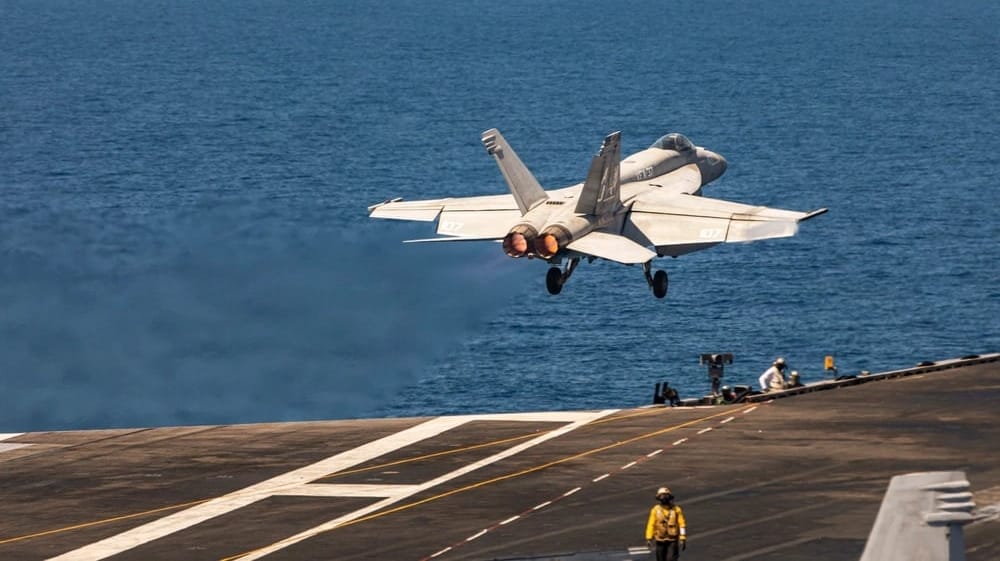
EMALS catapult-assisted launch, USS Gerald R. Ford, April 2026 (USN)
Nine years after announcing his preference for steam catapults, President Donald Trump has ordered the U.S. Navy to remove the electromagnetic aircraft launch system at the heart of the Ford-class carrier design and replace it with what he has referred to previously as "god-mn steam." The decision would affect all hulls from fourth-in-class USS Doris Miller onwards.
The president's choice will require deep design revisions, affecting the full ship from the engineering compartments to the berthing areas to the flight deck; if implemented, it will add billions of dollars in capex and tens of millions in annual operating costs, reports the Wall Street Journal.
Trump's objections to the electromagnetic advanced launch system (EMALS) trace back to 2017, in the technology's troubled early years. At that time, the first-in-class USS Ford was behind schedule, over budget and having difficulty reaching operational readiness. Ford was commissioned in partially-functioning form in 2017, but persistent reliability problems with her electromagnetic systems (including EMALS) set back her first full-scale deployment until 2023.
The Navy has given EMALS generally positive marks in public in recent years, but the independent reviewers at the Pentagon Department of Operational Testing & Evaluation (DOT&E) said as recently as FY2023 that its failure rate was far higher than planned, showing a tendency to break down after about 450-600 launches. The office's FY2025 review found that little had changed in two years, and added that the EMALS system is reliant on "off-ship technical support" to keep it running - a challenge for long deployments.
Though it may require regular service, EMALS offers the Navy some distinct advantages. Lacking any steam components, it is more compact, mechanically simpler, and less manpower-intensive to operate. It is also capable of varying the force that it applies to an aircraft during launch to minimize stress on the airframe - unlike steam launches, which exert sudden and constant pressure.
The electromagnetic technology aboard Ford was designed for lighter manning than the previous Nimitz-class carriers, saving millions in crewing costs each year. Putting steam catapults back on Ford would materially increase the crew size; more sailors would also increase the requirements for berthing areas, galleys, laundry rooms, sewage treatment plants and other compartments that must be scaled to accommodate the crew. Interior volume would also have to be allocated for new steam pipe runs. All of these changes would require tradeoffs and thousands of hours of engineering.
General Atomics, which designed EMALS, told the Wall Street Journal that the president's decision is worth "careful reconsideration." The company said that it is 50 percent through the work on the EMALS equipment for USS Doris Miller, and canceling now would send an unwanted signal about defense industrial base stability - and "[create] opportunities for adversaries to close the capability gap."
Ford is in rare company with its EMALS system, but other countries are catching up. China is the only other nation with a working EMALS-type carrier - the newly built Fujian, which commissioned in November 2025. China's navy has also installed a variant of this system aboard a "drone carrier" amphib, the Sichuan (Type 076), still in testing as of early August.
Trump's order would also require the Navy to remove the future Ford-class ships' electromagnetic weapons elevators - another iconic design element of the class, and the element that has given the Navy the most trouble. Faulty weapons elevators delayed USS Gerald R. Ford for years, and problems with the same system are contributing to delays in commissioning second-in-class USS John F. Kennedy. The White House memo insists that the service must return to hydraulically-actuated elevator technology for hulls from USS Doris Miller onwards.
The changes would almost certainly have an effect on delivery timeline for USS Doris Miller, already years behind schedule. Module construction is under way, the keel-laying is scheduled for later this year, and later design revisions could turn into rework of physically-completed modules. Because of yard constraints and delays on Kennedy, Miller will deliver in 2034, plus additional time required for changes mandated by the White House's new memo.

No comments:
Post a Comment