Ukraine launches large-scale drone attack on Russian military and energy infrastructure
Long-range attacks have been stepped up as talks between the two countries remain stagnant.
Ukraine launched hundreds of drones across Russia targeting military industries and energy facilities on Sunday, killing at least six people in one of Kyiv’s largest aerial attacks since Russia's full-scale invasion of the country began in early 2022.
Kyiv has stepped up its attacks on Russia this year with long-range missiles and drones. Aside from hitting military and energy targets, it has also increasingly targeted Wildberries depots, burning billions of dollars’ worth of merchandise belonging to the Russian online retail giant.
Ukraine also came under attack overnight into Sunday, with two people were killed at a steel plant in Kryvyi Rih, one of the country's largest steel factories.
Strikes also killed two people in the Zaporizhzhia region and one in Sumy.
Ukraine's president Volodymyr Zelenskyy took to social media to give an update on the response to the damage caused by Russian strikes.
Zelenskyy reiterated that Russia has been using North Korean ballistic missiles on Ukraine, and urged that European missile interceptors should be mobilised to help Ukraine rather than "be allowed to sit in storage".
In total, the Ukrainian president said more than 1,500 drones have been launched into Ukraine by Russia over the past week.
In Russia, authorities said five people died in the southern region of Rostov.
Two were killed in Belgorod and Moscow, where the Ukrainian military said it was targeting military factories and energy facilities.
Russia's military said it had destroyed 822 Ukrainian drones, 600 of which it claimed were heading for the capital.
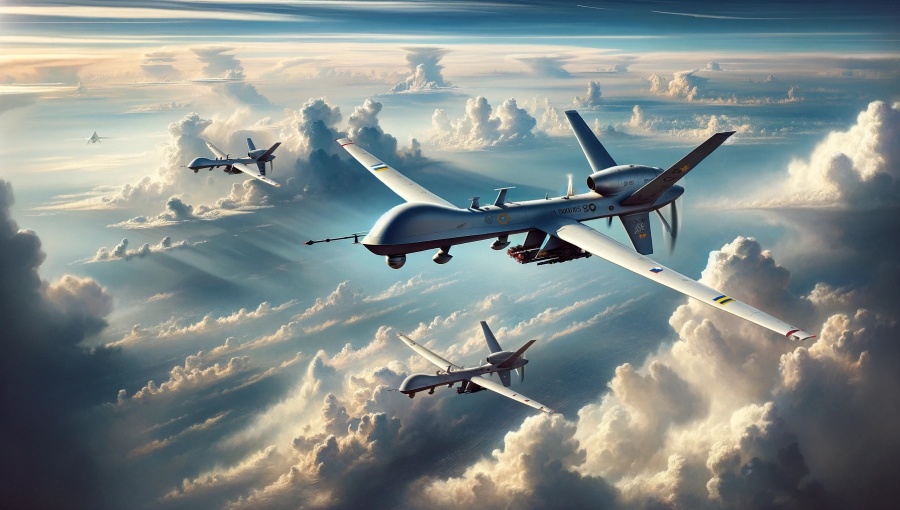
Ukraine has begun combat-testing jet-powered interceptor drones fast enough to run down Russia's new deadly class of Geran-4 drones that can evade even the best of Ukraine’s new class of interceptor drone, as the drones arms race between the two adversaries continues to unfold.
Ukraine’s new drones fly at more than 600 km/h, and the first confirmed kills are still awaited, former defence minister Mykhailo Fedorov said after visiting one of the manufacturers involved.
Fedorov set out the programme on Telegram on August 14, Interfax-Ukraine reported. Several Ukrainian producers already have working designs, developed over the past year with grants routed through the defence-tech cluster Brave1, which also ran the analysis and testing.
The push matters because Russia is quietly changing the weapon Ukraine has spent a year learning to shoot down.
"The first Ukrainian jet-powered interceptor drones for combating Shahed jets are undergoing combat testing. Today, we are observing a trend: the Russians are gradually replacing conventional Shaheds with jet-powered ones," Fedorov wrote. "This is a change in aerial warfare strategy. Our response must be swift to continue defeating Russia in every technological cycle."
Interceptor drones are the one part of Ukraine's air defence that has actually worked at scale. Cheap, locally built and produced in the tens of thousands, they took down the bulk of incoming Shaheds through 2025 and gave Kyiv what Fedorov calls one of the world's most advanced "small" air-defence systems, now being studied by other armies.
The jet-powered Geran variants broke that model. They fly higher and faster than the propeller-driven originals, and outpaced Ukraine's existing interceptors when they appeared in numbers, forcing Kyiv back onto scarce guided missiles for targets it had been handling with drones.
That is the expensive end of the problem. Ukraine's stock of US-made guided interceptors has run down close to zero, with only around seven of roughly 150 Iskander-M ballistic missiles fired at the Kyiv area since July 1 shot down. Russia, meanwhile, has expanded its missile and drone output faster than Ukraine and its allies can drain it.
"Now the task is to increase our efforts tenfold to combat the threat of jet drones as quickly as possible," Fedorov said, calling for more money for research, testing and production capacity, ahead of the widely anticipated winter Russian missile barrage aimed at destroying what is left of Ukraine’s power sector.
The government is saying much the same thing. Acting Defence Minister Yevhen Khmara told his Swedish and Norwegian counterparts on August 10 that countering ballistic missiles, cruise missiles and Shaheds was an urgent priority, and that Ukraine needed "interceptor missiles and asymmetric capabilities" to do it, alongside the Freyja anti-ballistic project.
The arithmetic is what makes the drone route attractive. A jet interceptor built in Ukraine costs a small fraction of a Patriot round that Kyiv can no longer reliably obtain, and can be built at home rather than waited on from a partner capital.
Russia Fields a Floating Pillbox to Defend Against Ukraine's Drones
The invasion of Ukraine has crystallized the rapid changes in warfare brought about primarily by advances in electronic applications. Ukraine, kept short of the technology transfers it needs to defend itself from Russian aggression, has had no choice but to develop and innovate its own systems, and to be fair, the Russians - while behind - have not been far behind in the contest between newly fielded offensive capabilities and the means to defend against them. Any nation wishing to prepare for the next war needs therefore to keep a careful eye on both the Ukrainians and Russians for what naval technical developments may impact future warfare at sea.
HI Sutton, the naval analyst at the forefront of detecting new developments in the maritime space, has been among the first to notice a new Russian capability designed to defend Russian ports from the increasingly damaging impact of Ukrainian attacks at sea, both on naval targets and on Russia’s dark fleet of tankers (as well as on others deriving benefit from exporting Russian oil and gas). The need to defend ports in particular has been demonstrated frequently in recent weeks, most notably in Novorossiysk, which was attacked by hundreds of drones on August 11 and 12.
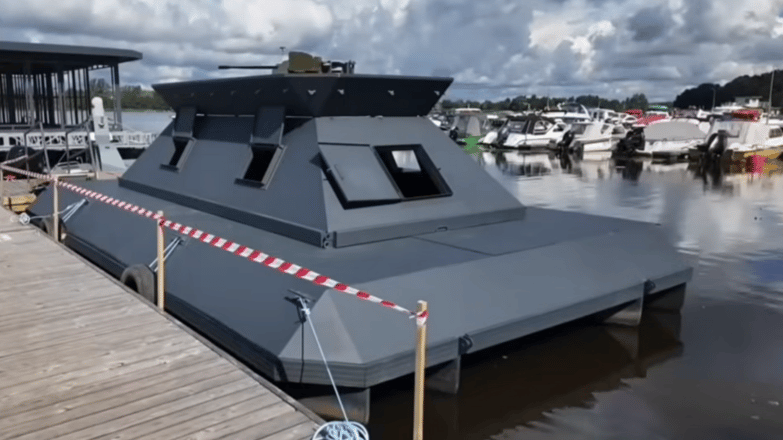
The new Russian PLOT-40 (or PLOT-47) appears to be a naval sentry box, designed to be stationed at sea to protect the approaches to Russian ports and anchorages. Best described as a pontoon rather than a boat, the 4.5m x 2.5m rectangular structure sits on top of four cylindrical floats; PLOT (or ????) means ‘raft’ in Russian. Atop the sloping-walled pillbox shape is what appears to be a 12.7 or 20mm automatic cannon with guidance system.
With two opening hatch windows on either side, and one each fore and aft, it is not clear if the sentry box is supposed to be manned by sailors keeping watch and servicing the weapon, but benches can be seen inside. The interior must also house an electrical system to power the automatic cannon and its sensors. The craft appears to be unarmored, but would in any case be vulnerable to the kinetic effect of any impacting strikes.
For a young Russian naval officer looking for a career at sea it would be a disappointing first command, as the PLOT-40 does not appear to have an engine. As a target, it appears vulnerable - but given the success of recent Ukrainian attacks, a wide range of desperate countermeasures are being trialed by the Russians.

No comments:
Post a Comment