Showing posts sorted by relevance for query DISASTER MOVIES. Sort by date Show all posts

Saturday, March 29, 2025


The Pleasures of Cinematic Disasters


MARCH 28, 2025
Facebook

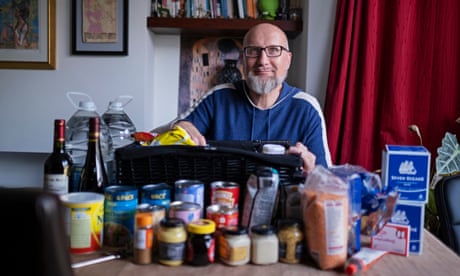
Image by Jeremy Yep.

When I need to relax for just half an hour, I often enjoy watching films on Netflix or Amazon about disasters. Popular entertainments that I am sure no cinema connoisseur would tolerate. The James Bond films, yes!, and the Jason Bourne adventures and also those with Tom Cruise. And the three movies starring Denzel Washington, as well as movies from the special category, films with female action heroes— Atomic Blond or Salt for example. And single-shot productions, White House Down or Olympus Has Fallen, for example, are sometimes good. There are a lot of such movies, so obviously they must be popular. I wouldn’t argue for the aesthetic merits of these violent artworks, but, speaking here as a political philosopher, they strike me as worth serious attention. Why do we enjoy them?

These films are exciting right now because of what they tell about our responses to the world of real politics, by which I mean events in the news. Consider, for example, Bourne’s Mission Impossible franchise, whose basic premise is that a rogue government agency has trained this automaton, who is ready and able to kill on demand. Or Cruise’s films, there there is a whole secret bureau that acts outside the law. And of course there’s Bond, who is not really a spy, but an assassin. In Washington’s three Equalizer films, extreme close up violence seems to have put off some reviewers. But in truth, all these disaster films seem heavily dependent upon cinematic blood shedding. And upon wholesale destruction of expensive cars. It’s true, of course, that the high culture of traditional theater and opera also deals frequently in extreme violence. And thanks to novel film making technologies, it’s now possible to amplify the effect of these scenes. You only compare the fight scenes in the early Bond movies with those in the recent films starring Daniel Craig to see this dramatic difference. As in the culture at large, technology progresses while social morality does not.

In responding to these artworks, it’s useful to consider what assumptions we take for granted— what conventions we find unproblematic. We assume, for example, that the hero is invulnerable. All the many shots fired at him miss, while the few bullets he gets off inevitably hit their targets. But after all, having the hero be killed would not leave much of interest to happen in the rest of the film. Typically the lone hero overcomes all obstacles. In the Die Hard franchise he suffers dramatically, I grant, but he does triumph in the end. The vast array of surveillance operatives never have a chance against the lone Matt Damon, so fast and skilled as he is. But after all, a film about a group of secret agents is hardly likely to be as exciting as the story about one, adept, very good-looking man. With some exceptions: but the Mission Impossible films present a gang of characters. A certain suspension of disbelief is needed, especially when the female action hero can disarm any number of male bullies, sometimes without removing her high heels or getting her makeup messed up. I once read a political critique of the Bond films, which to me seemed like a bizarre waste of time; I mean, who doesn’t see that Bond is about as politically incorrect as someone can be. Nor do I see these films as what used to be called ‘camp’.

No one thinks that any mere mortal could survive as do these male or female cinematic heroes. Heroes cannot fly, except of course for Batman and Superman, who have special powers. And no one can survive the destruction of the body, as does the Terminator, but of course he’s not human at all. But what then can be said about the more general picture of our political institutions in these films? I have the disconcerting sense that right now, wildly paranoid films are barely keeping up with reality. Might the government finance costly quasi-military operatives that operate outside of the law? Why not! Alas! Sometimes I find these disaster fictions more soothing than news from actual reality. The series Designated Survivor starts with an unparalleled disaster, everyone but the secretary of housing and one senator blown up at the presidential inauguration. But then these survivors act in restrained rational ways compared with some of our present leaders. Often in disaster films the world is saved only thanks to what looks like sheer good luck. But some films of cinematic disasters, the Schwarzenegger films, for example, we get pure terror, with no happy endings. Who knows that their deep pessimism may not turn out to be truthful.

The older classic disaster film, which is a masterpiece, is Doctor Strangelove (1964). Catastrophe can be funny— that’s a challenging idea to say the least. And from what we know now, that ending wasn’t altogether impossible. None of the recent disaster films which I’ve mentioned were intentionally funny. I don’t know what to make of that. In my settled opinion: In a better country, we wouldn’t allow such films to be made. (Or, if you will, no one would want to watch them.) And were I a better person, I wouldn’t watch them. But in this country here and now cinematic disasters attract many viewers, myself amongst them. I don’t say that to suggest that watching them makes me feel guilty. I feel guilt about many things, but not from these cinematic pleasures.

I do believe that total disaster is a real possibility right now. Civil War (2024) shows an unhappy ending in graphic realistic terms. That’s why I found that film almost unwatchable, unlike these scenes of cinematic disasters. I felt the same way about Netflix’s production of The Alternate History, Man in the High Tower. But when I watch Bond save the world, yet again!, I think: real life’s not so bad, not yet! I am vaguely aware that I will not take these mere games too literally in agreeing to watch them. Like the battle scenes of my favorite painter, Nicolas Poussin, these films showing cinematic disasters are just fantasies. Now I’m just watching Zero Day. Scary! So stay tuned!

David Carrier is a philosopher who writes art criticism. His Aesthetic Theory, Abstract Art and Lawrence Carroll (Bloomsbury) and with Joachim Pissarro, Aesthetics of the Margins/ The Margins of Aesthetics: Wild Art Explained (Penn State University Press) were published in 2018. He is writing a book about the historic center of Naples, and with Pissarro he conducted a sequence of interviews with museum directors for Brooklyn Rail. He is a regular contributor to Hyperallergic.

LA REVUE GAUCHE - Left Comment: Search results for DISASTER MOVIES


Saturday, June 08, 2019

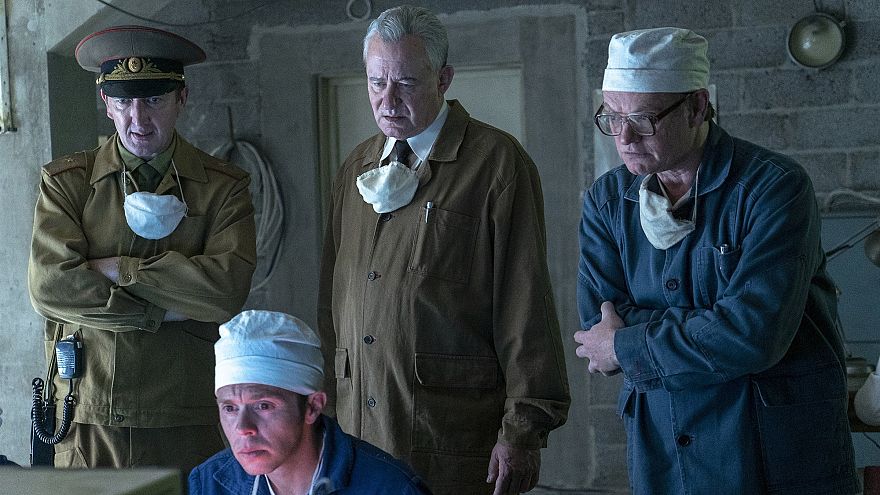
"Svetlana Alexievich, the Russian-language Belarusian writer who won the Nobel Prize for Literature, in 2015, for her work with oral history, has said that the book she found easiest to report was her book about Chernobyl. (Its English title, depending on the translation, is “Voices from Chernobyl” or “Chernobyl Prayer.”) The reason, she said, was that none of her interlocutors—people who lived in the area affected by the disaster—knew how they were supposed to talk about it. For her other books, Alexievich interviewed people about their experience of the Second World War, the Soviet war in Afghanistan, and the dissolution of the Soviet Union. For all of these other events and periods in Russian history, there were widely adopted narratives, habits of speaking that, Alexievich found, had a way of overshadowing actual personal experience and private memory. But when she asked survivors about Chernobyl they accessed their own stories more easily, because the story hadn’t been told. The Soviet media disseminated very little information about the disaster. There were no books or movies or songs. There was a vacuum.
Alexievich’s book about Chernobyl was published in Russian in 1997, more than ten years after one of the reactors at the Chernobyl power plant exploded, in what was probably the worst nuclear accident in history. One of the most remarkable facts about Chernobyl is that the narrative vacuum had persisted for that long, and, in fact, it has persisted since: Alexievich’s book came to prominence, both in Russia and in the West, only following her Nobel Prize win. There have been stories in the media in Russia and abroad, many of them on the odd tourist industry that has sprung up in the disaster zone; there has been a BBC documentary and a bizarre American-Ukrainian documentary. But in the past year two books, one by a historian and the other by a journalist, have attempted to tell the definitive documentary story of the disaster. Finally, the HBO series “Chernobyl,” the fifth and final episode of which aired Monday, tells a fictionalized version. It being television, and very well-received television at that, it is the series, rather than the books, that will probably finally fill the vacuum where the story of Chernobyl should be. This is not a good thing."


Hit series Chernobyl has people sharing their memories of the disaster

 
 COMMENTS


"I haven't seen a single episode of HBO's Chernobyl, but here, close to the Kantemirovskaya, there's a granite monument with a black plaque dedicated to the liquidators. It just stands by itself near the road," reads a tweet in Russian. "Today, for the first time since I've lived here, someone left flowers on it."
Tasha, a young photographer whose family once lived in Pripyat, the ghost city founded in 1970 to serve the Chernobyl nuclear plant, answers back.
"Well, at least the series showed people the real scale of the disaster. My grandfather was a liquidator, too", she writes.
A month ago, very few people even knew what a liquidator was.
Aside from history enthusiasts, documentary aficionados, the odd dark tourist and the more informed citizens of the former Soviet Republics, very few were familiar with — or even interested in — the details of what happened at the Chernobyl Nuclear Power Plant on April 26, 1987.
Then came the five-part TV drama.

Already acclaimed as the highest-rated series in TV history, Chernobyl has waved past the likes of shows like The Sopranos and Breaking Bad as all of its five episodes rose to the top of IMDb's top 10 for the database’s “Top Rated TV Shows” list.
As the new episodes aired, week after week, new fans swarmed to social media to praise its eerie atmosphere, the grandiose cinematography, the realism and the scenography.
For people who grew up in the former Soviet Union though, watching the series was more about dealing with the past: that of their country's, their family's, even their own.

'It took me 30 years to realise the scale of the feat of thousands 

of my compatriots'

Many were touched by the unsung vicissitudes of the liquidators — hundreds of thousands of civil and military personnel who were called upon to deal with consequences of the 1986 nuclear disaster.
Tasked with anything from deactivating the reactor to evacuating the population from the highly radioactive exclusion zone, a large number of liquidators suffered health issues in the months and years following their exposure to ionizing radiation. According to Vyacheslav Grishin of the Chernobyl Union, the main organisation of liquidators, 10% of the original 600,000 liquidators died in the aftermath of their work, and 165,000 were left disabled. Other estimates attribute way fewer deaths to the radiation from the disaster.
Although many liquidators were praised as heroes by the Soviet regime at the time and statues were built around the USSR to celebrate them, several social media users reported HBO's Chernobyl was what really made them realise what so many people had to endure for them to be safe today.

"The feat of the liquidators is really incredible, I am so ashamed that I had not paid enough attention to this catastrophe before," wrote Russian user Vladimir Tchernov. "I'm shocked by the fact that it took me 30 years, a team of brilliant Western actors and filmmakers, as well as a whole American channel to realise the scale of the feat of thousands of my compatriots", agreed another.
The fourth episode of the mini-series, "The Happiness of All Mankind", dedicated much of its running time to depicting what liquidators had to go through in painstaking detail — including shooting puppies that had been contaminated and dumping them in common graves to be covered with cement and men clearing the debris from the most dangerous roof in the world, a couple of minutes at a time.

For some, watching the series opened old wounds. Ukrainian software developer Den Hellder, 28, says the show made him cry. "Yes, people die from different things. But when their deaths are followed by a lie, and this lie continues to flow from the TV channels of a country known to all — it is very painful", he tweeted.
Speaking to Euronews, he opened up about his grandfather, a driver who took part in the damage control stage of liquidation.
"He never told me about Chernobyl because I was very little," he said. Unfortunately, when I was six, grandfather became very ill, he had a cerebral haemorrhage at the age of 57 and died at 62. We always thought it was because of radiation in his body."
Despite his work as a liquidator, Hellder says, his grandad never received a certificate of participation in these events. His mother and him blame it on regime corruption. "For us, that TV series is not only about fighting the disaster, but fighting against a government full of lies on every level — and how that lie affects people".

Depicting a painful page of Soviet history

Some thanked the show's creator, Craig Mazin, for all they learnt throughout the five episodes.
Mark Savchuck, a 29-years-old Ukrainian, remembers the disaster only being mentioned very vaguely when he was in school.
"It was extremely downplayed — we had a nuclear meltdown, it was contained. Lots of resources were put into this catastrophe, but we eventually made it", he said. "For most people, it was like a nasty fire that blew poison over a big territory. We couldn't even imagine that so many people died."
"Thank you for this series. Thank you for educating the world about what happened here in 1986. It is an important event that must never be forgotten. I will share it with my children when they are older to remind them how much their country has suffered and overcome", a Ukrainian aid worker wrote to Mazin.
For others, it felt more like therapy. Russian journalist Slava Malamud, who live-tweeted all of the discrepancies and accuracies she could find as someone who lived in the Soviet Union at the time, was shaken by the effect the series had on her.

Neuroscientist Luis Perez de Sevilla watched the series with his wife, who grew up in Belarus, next to the Ukrainian border. "It was hard for my wife to watch it with me," he wrote. "She said that many scenes you showed were very familiar to her."
Oleg Balakin, a service designer born in Odessa, Ukraine, a little more than a year after reactor four exploded at the nuclear power plant, remembers families in his town — over 500km away from Chernobyl — being told to keep windows closed at all times, his childhood friend's dad working as a helicopter pilot in the exclusion zone, children being sent away from the region by worried parents.
"They found very right the tone of voice for telling the story, they put ethical accents very precisely," he says about the mini-series. "They are not depicting the evil empire, nor the pathetic heroic story."

If someone was not impressed by Chernobyl, though, it's the Russian government. The state TV announced it will be airing its own version of the drama — revolving, this time, around the claim that a CIA spy was present and could be to blame for one of the worst nuclear accidents in human history.
ACTUAL PHOTOS OF THOSE STILL LIVING IN CHERNOBYL


Saturday, August 20, 2022

Fear for future after mass die-off of fish in Poland's Oder river

By Agnieszka Pikulicka-Wilczewska
and Kuba Stezycki


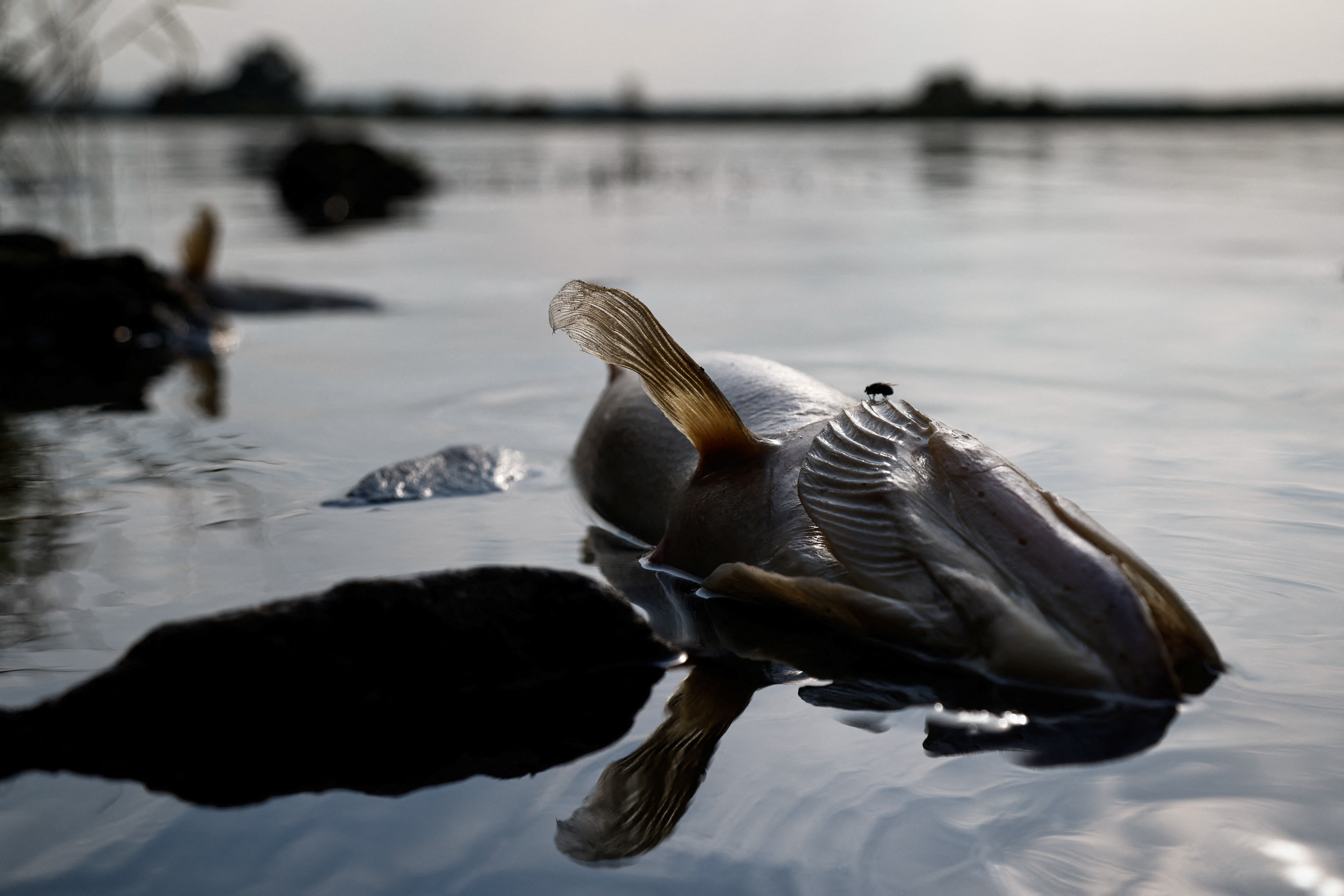
WIDUCHOWA, Poland, Aug 20 (Reuters) - As thousands of dead fish neared the banks of the Oder River in the village of Widuchowa in western Poland on Aug. 11, local people realised an ecological disaster that started in late July in the country's south-west was heading towards the Baltic Sea.

As Widuchowa's residents searched for tools to remove the lifeless bodies from the the river, the government began crisis response that many scientists say came too late.

"It's been the hardest five days of my life," said Pawel Wrobel, the mayor of Widuchowa, which is around 400 kilometres (250 miles) from the town where dead fish had first been spotted. "I'd never imagined experiencing such a catastrophe, it is something you see in disaster movies."

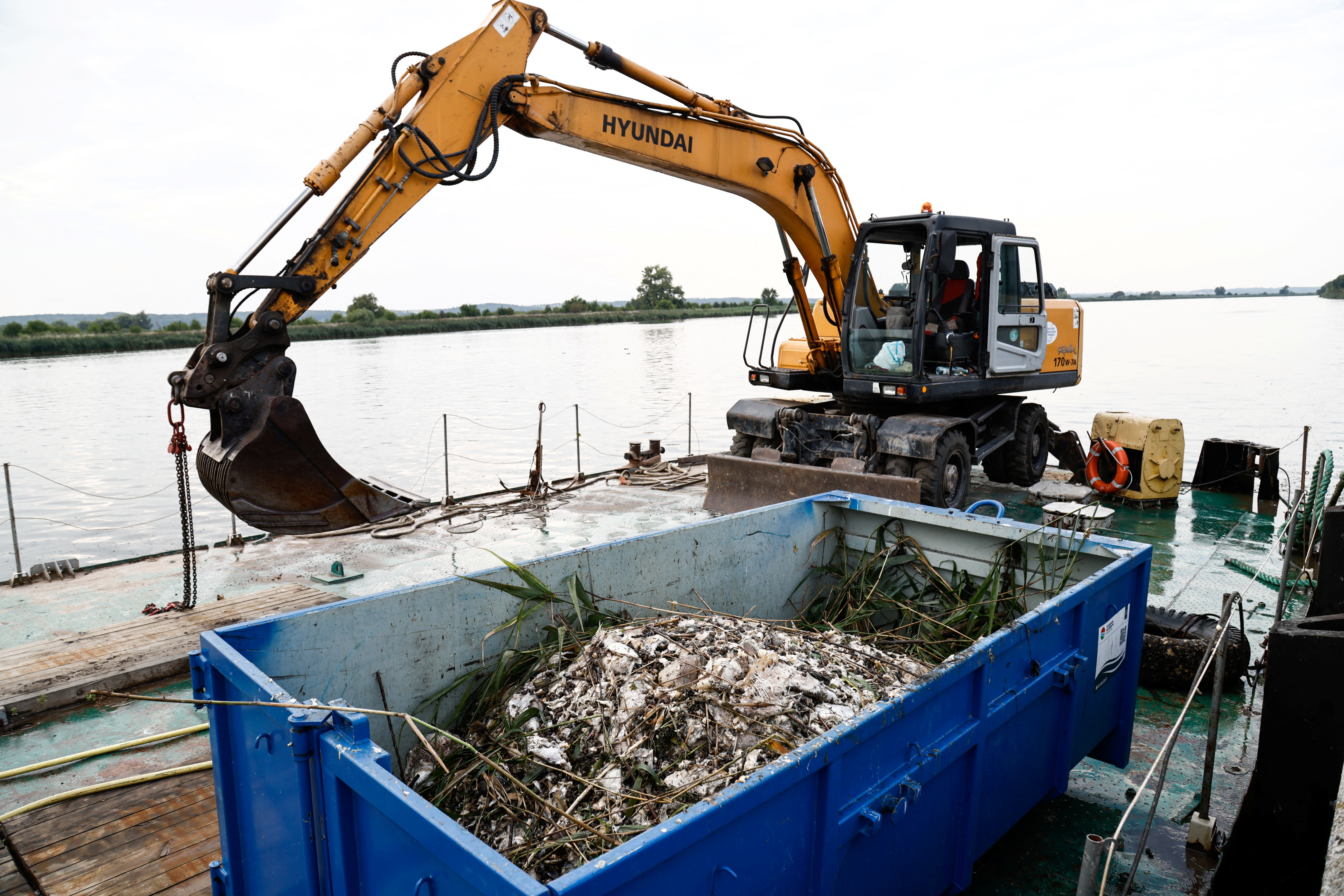
With the help of the local community, he gathered dozens of pitchforks, used to lift potatoes, to remove dead fish from the river, which marks part of the Polish-German border.

"We don't know how to do it and what tools to use, we learn from our mistakes," Wrobel said.

On Aug. 12, Prime Minister Mateusz Morawiecki fired the head of Poland's national water management authority and the head of the general environmental inspectorate, saying that their institutions should have reacted earlier. read more

Despite numerous tests of fish and water samples conducted by Polish and foreign laboratories, and a 1-million-zloty ($211,775) reward for information on the source of contamination, it is still unclear what poisoned the Oder, Poland's second largest river.

"We are focused on, on the one hand, stopping what is happening, and on the other hand, finding the reason for this situation," said climate ministry spokesman Aleksander Brzozka.

Researchers in Germany and Poland's climate ministry have pointed to a large overgrowth of toxic algae as a possible cause for the mass die-off. read more

"The most likely hypothesis is that it was a combination of various natural factors," said Brzozka.

'SOMETHING IS WRONG'

Local people told Reuters that firefighters and territorial defence forces deployed by the government to remove tonnes of dead fish were not prepared for what awaited them in the river.

The stench around the waters was so bad that most of them vomited during their work, according to residents of the village.

Local businesses have also been hit.

When Piotr Bugaj, a passionate angler and owner of boats, a slip and rooms to rent on the Oder heard what was coming, he knew that it was time to put his business on hold.

He asked his guests from the Czech Republic to leave the water and cancelled all future reservations from clients, who flock to Widuchowa from around Europe for its wilderness and diverse population of large fish such as catfish and pike-perch.

"If it's possible with such a tragedy, I would really like to learn that only what was on the surface died out and not more. But for the moment, no one has checked what is currently at the river bottom," he said.

The government has promised support for those affected by the crisis.

Piotr Piznal, a local activist, has dedicated his life to photographing wildlife around the Oder. For the past week he has been documenting the disaster.

"It is hard because in fact, the world we've observed and photographed with my friend for the past few years is disappearing," he says. "I think that after what has happened in the Oder it will take years to rebuild the ecosystem... It will all have to be reborn to function the way it has until now."

Meanwhile, among Widuchowa's residents fear and uncertainly prevail.

"The dead fish have warned us that something is wrong," said Sylwia Palasz-Wrobel, wife of Widuchowa's mayor, standing next to her husband at the foul Oder shore. "When the fish are gone, who will inform us next time when a disaster happens? We would like to know who is responsible for this."

 ($1 = 4.7220 zlotys)

Reporting by Agnieszka Pikulicka-Wilczewska and Kuba Stezycki, Editing by Alan Charlish and Alex Richardson

Sunday, August 21, 2022

Fear for future after mass die-off of fish in Poland's Oder river

By Agnieszka Pikulicka-Wilczewska and Kuba Stezycki - Yesterday

© Reuters/JAKUB STEZYCKI
Dead fish in Poland's Oder river approach to the sea

WIDUCHOWA, Poland (Reuters) - As thousands of dead fish neared the banks of the Oder River in the village of Widuchowa in western Poland on Aug. 11, local people realised an ecological disaster that started in late July in the country's south-west was heading towards the Baltic Sea.

As Widuchowa's residents searched for tools to remove the lifeless bodies from the the river, the government began crisis response that many scientists say came too late.

"It's been the hardest five days of my life," said Pawel Wrobel, the mayor of Widuchowa, which is around 400 kilometres (250 miles) from the town where dead fish had first been spotted. "I'd never imagined experiencing such a catastrophe, it is something you see in disaster movies."


© Reuters/JAKUB STEZYCKIDead fish in Poland's Oder river approach the sea

With the help of the local community, he gathered dozens of pitchforks, used to lift potatoes, to remove dead fish from the river, which marks part of the Polish-German border.

"We don't know how to do it and what tools to use, we learn from our mistakes," Wrobel said.

On Aug. 12, Prime Minister Mateusz Morawiecki fired the head of Poland's national water management authority and the head of the general environmental inspectorate, saying that their institutions should have reacted earlier.


© Reuters/JAKUB STEZYCKIDead fish in Poland's Oder river approach the sea

Despite numerous tests of fish and water samples conducted by Polish and foreign laboratories, and a 1-million-zloty ($211,775) reward for information on the source of contamination, it is still unclear what poisoned the Oder, Poland's second largest river.

"We are focused on, on the one hand, stopping what is happening, and on the other hand, finding the reason for this situation," said climate ministry spokesman Aleksander Brzozka.

Researchers in Germany and Poland's climate ministry have pointed to a large overgrowth of toxic algae as a possible cause for the mass die-off.

Related video: Mysterious mass fish deaths in Oder River

"The most likely hypothesis is that it was a combination of various natural factors," said Brzozka.

'SOMETHING IS WRONG'

Local people told Reuters that firefighters and territorial defence forces deployed by the government to remove tonnes of dead fish were not prepared for what awaited them in the river.

The stench around the waters was so bad that most of them vomited during their work, according to residents of the village.


© Reuters/JAKUB STEZYCKI
Dead fish in Poland's Oder river approach the sea

Local businesses have also been hit.

When Piotr Bugaj, a passionate angler and owner of boats, a slip and rooms to rent on the Oder heard what was coming, he knew that it was time to put his business on hold.

He asked his guests from the Czech Republic to leave the water and cancelled all future reservations from clients, who flock to Widuchowa from around Europe for its wilderness and diverse population of large fish such as catfish and pike-perch.

"If it's possible with such a tragedy, I would really like to learn that only what was on the surface died out and not more. But for the moment, no one has checked what is currently at the river bottom," he said.

The government has promised support for those affected by the crisis.

Piotr Piznal, a local activist, has dedicated his life to photographing wildlife around the Oder. For the past week he has been documenting the disaster.


© Reuters/JAKUB STEZYCKI
Dead fish in Poland's Oder river approach the sea

"It is hard because in fact, the world we've observed and photographed with my friend for the past few years is disappearing," he says. "I think that after what has happened in the Oder it will take years to rebuild the ecosystem... It will all have to be reborn to function the way it has until now."

Meanwhile, among Widuchowa's residents fear and uncertainly prevail.

"The dead fish have warned us that something is wrong," said Sylwia Palasz-Wrobel, wife of Widuchowa's mayor, standing next to her husband at the foul Oder shore. "When the fish are gone, who will inform us next time when a disaster happens? We would like to know who is responsible for this." ($1 = 4.7220 zlotys)


(Reporting by Agnieszka Pikulicka-Wilczewska and Kuba Stezycki, Editing by Alan Charlish and Alex Richardson)

Monday, May 29, 2023

No cellphone? No problem! The vintage radio enthusiasts prepping for disaster

Ham radio users, from teenagers to eightysomethings, are ready to communicate in the next crisis – be it a wildfire, pandemic or ‘the big one’


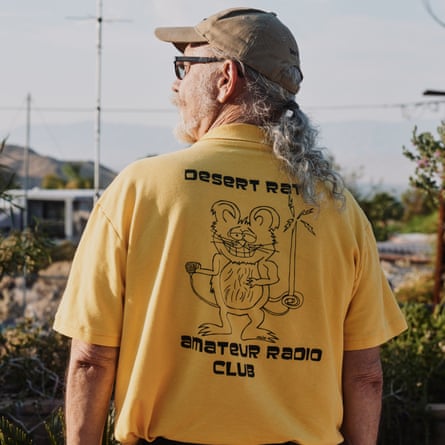
Glenn Morrison, president of the Desert Radio Amateur Transmitting Society, a Palm Springs-based club dedicated to everything ham radio. 
Photograph: Adam Amengual/The Guardian


by Amanda Ulrich in Palm Springs
THE GUARDIAN
Sat 27 May 2023 

There’s an ancient fable that Glenn Morrison, a pony-tailed, 75-year-old who lives in the California desert, likes to tell to prove a point. As the lesson goes, one industrious ant readies for winter by stocking up on food and supplies, while an aimless grasshopper wastes time and doesn’t plan ahead. When the cold weather finally arrives, the ant is “fat and happy”, but the grasshopper starves.

In this telling, Morrison is the ant, and those who don’t brace themselves for future emergencies – they’re the grasshoppers.

Morrison is in the business of being prepared. He’s the president of the Desert Rats (or the Radio Amateur Transmitting Society), a club based in Palm Springs that’s dedicated to everything ham radio.

The old-school technology has been around for more than a century. In lieu of smartphones and laptops, ham radio operators use handheld or larger “base station” radios to communicate over radio frequencies. The retro devices can range from the size of a walkie-talkie to the heft of a boxy, 20th-century VCR.

Generations after its invention, one of ham radio’s biggest draws for hobbyists is its usefulness in an emergency – think wildfires, earthquakes or another pandemic. If disaster strikes and internet or cellular networks fail, radio operators could spring into action and help with emergency response communications, and be able to keep in contact with their own networks.

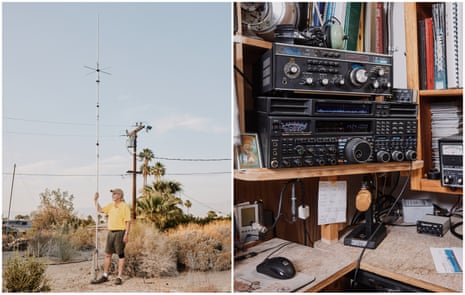
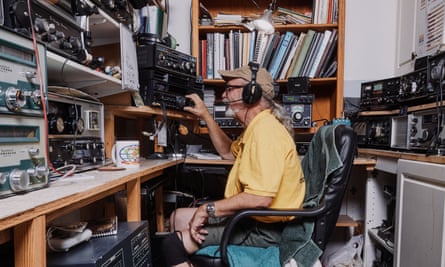
Left: Glenn Morrison standing with a U-band vertical antenna in his backyard. Right: Morrison’s main ‘rig’ in his home radio room. 
Photograph: Adam Amengual/The Guardian

And the historically fringe world of ham radio is having a moment. In California, there are now nearly 100,000 licensed amateur radio operators, often simply called “hams”, and more than 760,000 across the country. That total greatly surpasses the number of hams from 40 years ago, even as newer technology has left radio in the dust.

In an era of climate crisis with more intense storms and more frequent wildfires, and other disasters such as global pandemics, ham radio is becoming a tool for some who want to regain a modicum of control.

“Ham radio,” Morrison said, “is like the original social media.”

“People aren’t prepared. And they keep thinking, ‘Well, that’s not going to happen in my lifetime.’ And it may not, but you never know.”

‘I’ve always wanted to be ready for what’s next’

On a balmy Saturday morning in Palm Springs, the thermostat already creeping its way towards 80F (27C), a few dozen people trickled into a local gymnasium, finding seats at folding tables set up below the basketball hoops. Volunteers with the Desert Rats, who had organized the makeshift radio testing day for new hams, handed out a stack of exams. If the hams passed the 35-question test, they could become licensed as entry-level amateur operators by the Federal Communications Commission.

‘Ham radio is like the original social media,’ Morrison says. 
Photograph: Adam Amengual/The Guardian


One prospective ham was a high school student, a 17-year-old in a gray sweatshirt named Boaz, who took the course with his dad. Boaz first got into amateur radio through YouTube videos, he said, a year before the pandemic started.

“I’ve always wanted to be ready for what’s next,” he said. “If something happens and there’s no cell service, how am I going to talk to people?” Getting his driver’s license, his dad added, is Boaz’s next major goal.

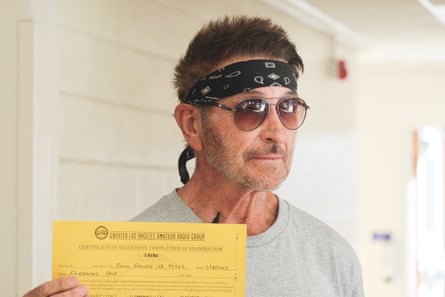
Another newly christened ham, a college professor named Skip Fredricks who sported a black bandanna, tinted aviator sunglasses and a Star Wars T-shirt, said he was hoping to use amateur radio in the classes he teaches about drones. In disaster areas, where drones are sometimes used for search and rescue missions, the radios could help drone pilots communicate better, he said.
Skip Fredricks, a college professor, recently obtained his radio certificate.
 Photograph: Amanda Ulrich

“In very remote areas, communication is a problem,” he said. “The ham radio support is better than just walkie-talkies – and cellphones are useless in the mountains.”

Fredricks held up his new radio certificate, proving he had passed the exam, printed on a bright yellow sheet of paper. “Pretty cool, huh?” he said, looking it over. “My students will probably be impressed.”

Ham radio and ‘the big one’


Since the early 1900s, ham radio has been used as a lifeline during storms, disasters, wars and other emergencies.

Hams, a term thought to have originally been a smear targeting unskilled amateur operators, were deployed to the Caribbean in the aftermath of Hurricanes Irma and Maria in 2017. Shortwave radio also became a way for Ukrainian citizens to get news after Russia attacked communication towers last year, and Taiwanese ham radio enthusiasts have used it to prepare for potential war with China. Astronauts have even used ham radio to chat with people back on Earth.

The astronaut Mamoru Mohri, wearing a headset to communicate with students and other ham operators during a mission in 1992. 
Photograph: Space Frontiers/Getty Images

The radios have even cropped up in disaster movies and TV shows – most recently in scenes from HBO’s The Last of Us that show a clandestine radio operator sending messages across a zombie-ravaged country.

Living in southern California and considering the region’s web of fault lines, Morrison, the club president, often thinks about earthquakes.

“If ‘the big one’ hits, we’re not going anywhere,” he said. “You have to be self-reliant. You’re going to need food supplies and all that stuff. But also if you want Aunt Marge in Portland to know that you’re OK, then we can send her a radio gram.”

More specifically, if organizations such as hospitals, fire stations and emergency command centers call for communications assistance, qualified amateur operators can mobilize to help; many hams have “go kits” for just that purpose, with supplies including handheld radios and portable antennas.

One such emergency response took place this year, as winter storms pummeled California. In Big Bear, a remote, mountainous community that saw an onslaught of heavy snow over the past few months, amateur radio operators frequently went on the air to broadcast road closures and other local news to their networks. “I knew the roof on one market had collapsed before it was on the news because I heard it on the radio first,” Morrison said.

As an informal slogan for the American Radio Relay League, a national association for amateur radio, promises, ham radio is the ultimate backstop for “when all else fails”.

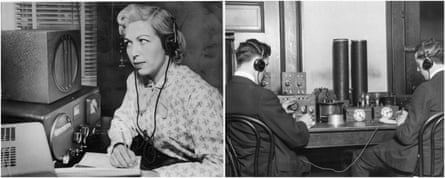
Left: Dorothy Strauber, member of the Young Ladies Radio League of Long Island, uses earphones to listen to her ham radio receiver in 1954. Right: Early radio ham operators circa 1919. 
Photograph: Tom Maguire/Newsday RM/Bettmann Archive/Getty

Richard Norton, director of the league’s south-western division, first got hooked on ham radio in high school because he was drawn to the hobby’s technical side. Decades later, he’s seen newer hams’ interest shift to emergency preparedness. In the little town of Topanga outside Los Angeles, where Norton lives, many residents have thought about what they would do during an earthquake or wildfire if cell signal was lost, he said.

One answer? Get a ham radio.


“Even when cellphone systems go down, our ham systems generally are working and we can communicate,” he said.

‘Working the world’


From a hushed neighborhood tucked into the base of desert mountains, about 10 miles down the road from downtown Palm Springs, Morrison took a seat at his desk and “worked the world”. Spinning a large black dial on the face of a bulky base station radio, he tuned into a realm of static and distant, garbled voices. He strained to listen, parsing faint words, then pulled forward a gold microphone.

Morrison listening for contacts at his home. 
Photograph: Adam Amengual/The Guardian

“Uh, Whiskey, Bravo, six, Romeo, Lima, Charlie,” Morrison said into the static, adopting the upbeat lilt of a radio DJ. The illogical string of words represents WB6RLC, his call sign, or the unique signature assigned to each ham that inevitably becomes as important as a name. Morrison’s sign was printed in bold letters on his hat, and the back of his T-shirt proudly displayed the Desert Rats club logo: a grinning rodent, its tail wrapped around a radio antenna.


Still spinning the radio dial, Morrison stumbled into a perfunctory conversation between someone around the general Nevada and Utah “call area” (the designation for where a radio license was issued) and a man in Barcelona.

“That’s how you just tune around and find somebody,” Morrison said happily. “And oh, look, he’s in Barcelona.”


‘Everyone should prep’: the Britons stocking up for hard times

On a computer monitor connected to his radio, Morrison pulled up a comprehensive list of 215 countries, territories and other areas he’s “worked”, or contacted, from this small town in southern California: Argentina. Australia. Algeria. American Samoa. “And those are just the A’s,” he said.

Around Morrison’s one-story home, everything revolves around radio. Desert Rats sketches and maps adorn the walls. A tangle of antennas sprouts from the corner of his roof. The camper van parked in his driveway is equipped with a “mobile station” radio for any necessary on-the-go calls. There are radios in every room of his house, save for the guest bathroom.

And Morrison’s main radio room, where he overheard the Barcelona conversation, is the crown jewel. The small space attached to his garage has a command center-style feel, with an entire wall devoted to dozens of vintage radios, some over a hundred years old, that Morrison sources from flea markets and friends.

“Sometimes they just find me,” he added.

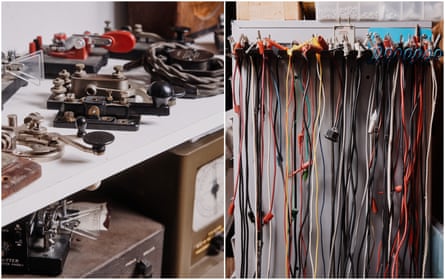
Morse code keyers and cables in Morrison’s home. 
Photograph: Adam Amengual/The Guardian


Beyond using the radios for emergency communications, hams find meaning in the hobby for its own sake, and in the almost-instant network it provides. Every Monday night, the Desert Rats host a radio “net”, similar to a public conference call, where amateur operators check in and go through a simple verbal roll call of names and call signs. That type of basic welfare check was particularly important three years ago, during the very first isolating, stay-at-home phase of the pandemic.

“It gave me something to do,” Morrison said. “I’d go to my radio shack in the garage, flip on the radio and find somebody, God knows where, to talk to.”
More than an ‘old guys’ club’

Back in the Palm Springs gymnasium, volunteers with the Desert Rats graded exams, their own handheld radios holstered at the hip. Annie Larson, head of membership for the club, buzzed around the room’s periphery, glancing at some of the complex test questions about signal frequencies and the properties of radio waves. “I don’t know if I would pass today,” she joked.

Larson, who recently turned 80, has been a licensed ham for more than a decade, but she doesn’t think of herself as a “tech-y” person. “I’m just interested in being able to take care of myself in an emergency,” she said.

Larson grew up in Idyllwild, a small town lodged in the mountains that loom above Palm Springs. The community, heavily wooded and right on the doorstep of Mount San Jacinto state park, is often threatened by wildfires. A few years ago, as one blaze moved closer and closer to the town, Larson ignored local evacuation warnings and stayed behind with a few park rangers. Having her radio with her was a great reassurance.

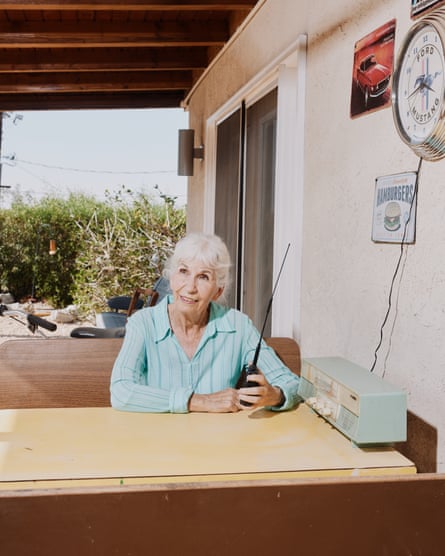
Annie Larson has been a licensed ham for more than a decade. 
Photograph: Adam Amengual/The Guardian

“I could listen to it at night and just leave it on,” she said, instead of needing to constantly check her phone. “If something came up, I was available.”

While amateur radio used to be something of a boys’ club (and “it still is a little bit”, she added), Larson said she sees more female operators today; about a quarter of those at the Palm Springs testing day were women. And with the wide-ranging impacts of the climate crisis, Larson thinks the hobby is relevant for all.

“People used to think it was like this old guys’ club, guys just putzing around,” she said. “But it really is important, because the population is increasing and there are many more disasters.”

Fortunately, within the Desert Rats club, hams remain a tight-knit bunch. As the latest batch of radio operators received their certificates after the testing day, some were emotional as they walked out into the desert heat. Morrison stood by the exit, congratulating and shaking hands with each person.

“We’ll catch you on the air,” he called behind them.