Sunday, February 09, 2020

Can coffee growing in Mozambique save a rainforest and keep the peace?

Conflict and logging have decimated Mozambique's central rainforest. One coffee project is trying to restore lost trees. Some hope it will also help keep fighting at bay.


Mozambique: Protection from cyclones

Project aim: Protecting the rainforest on Mount Gorongosa

Project implementation: 300,000 coffee plants and 50,000 native trees have been planted on a 145 hectare (358 acre) area. The Gorongosa project is planning to plant another 150 hectares in 2020

Project scope: 400 farmers are involved in the project of around 1000 people living on the mountain.

In March 2019, cyclone Idai swept through Africa, bringing with it the worst floods in 20 years. Mozambique was particularly badly hit. Idai destroyed houses, inundated farms and left many dead.

It's a devastating picture, but scientists say it could have been much worse were it not for a rainforest in Gorongosa National Park in central Mozambique. When the cyclone struck that area, the intact wetland ecosystem was able to absorb much of the torrential rainfall.

But the green paradise — home to diverse plants and animals — is under threat from logging and intermittent conflict. A sustainable coffee project, set up by Mozambique's government and US nonprofit, the Carr Foundation, aims to protect the ecosystem and, some hope, to keep the peace too.

A film by Stefan Möhl

Rainforest Coffee


Our coffee is now for sale! Click here to get it shipped to you. 

OVERVIEW
Gorongosa Coffee is a large-scale agroforestry initiative with enduring socio-economic and environmental benefits. This Mozambican based project is being implemented on Mount Gorongosa, designated as part of Gorongosa National Park due to the rich endemism and critical hydrologic function for the Greater Gorongosa Landscape. The mountain is covered in a tropical rainforest; a rainforest that once extended across the continent, supporting an explosion of wildlife. Gorongosa Coffee is currently working with a thousand families living on the Mountain with plans to reach three times that number living on the mountain; all endorsing a common vision of the integrated relationship between sustainable land use, community development, and biodiversity.
 
RESILIENCE 

After three years spent establishing a pilot project, Gorongosa Coffee reached a milestone in 2016 by harvesting the first high quality Arabica coffee beans ever grown by small-scale producers in Mozambique. Collaborating with key stakeholders from the community, the government, and the private sector has led to innovated and integrated solutions illustrated by livelihood improvements of participating families and the proliferation and conservation of indigenous trees in the project area. Unlike similar projects in the region, Gorongosa Coffee is the first to use a fully integrated approach: bringing together a network of human development interventions in health and education with a targeted effort of creating jobs and establishing alternative livelihoods for families on the mountain.
 
·       Created as a community-based project, Gorongosa Coffee’s development has been community driven including: integrating local leaders in the planning process and day-to- day operations of the project;
 
·       Hiring key members of the community with an affinity for conservation and consensus building;
 
·       Coordinating with community organizations in natural resources management, education and health.
 
As a result, the project has proven resilient against the periodic onset of regional instability and extreme climatic events.
 
APPROACH
Gorongosa Coffee also offers small producers the option for expansion over time, focusing on developing emerging farmers through an array of agroforestry alternatives such as honey production and most importantly upskilling farmers with training that they can apply in any aspect of their livelihoods. This critical flexibility has promoted ownership of the project and adoption of conservation principals by the community. 
 
Through the implementation of more sustainable agricultural practices, smallholder farmers are learning inter-row cropping and crop rotation methods, between each line of coffee trees. Inter-row cropping reduces the risk for farmers who have chosen to dedicate some of their land area to coffee cultivation. Improved crop rotation methods, cycling between maize and legumes, help to return nitrogen back into the soil after each season; reducing the need to find new lands to cultivate and curbing the use of slash and burn agricultural practices in the rainforest. 
 
VISION
Gorongosa Coffee is based on the idea of an alliance between Gorongosa Project and the local community where 1,000 hectares would be developed under high quality shade grown Arabica coffee; which will translate into over 5,000 hectares of protected and restored rainforest and sustainable livelihoods for over 2,500 families; securing the 40,000 hectare portion of the national park. 
 
Mozambicans flee in fear of beheadings in extremist north

A militia affiliated with the "Islamic State" militant group has reportedly targeted homes, schools and health clinics, the UN said. The region is home to billion-dollar liquified natural gas projects.


A surge of extremism has torn through northern Mozambique, forcing residents to flee, the UN said on Friday. Officials confirmed that attacks by an Islamic insurgency have increased, with eyewitnesses saying that mass kidnappings have taken place and villages have been burned to the ground.

Seven people are said to have been beheaded earlier this week, AP reported. Homes, schools and health clinics have all been targeted by the rebels, who have been operating in the Cabo Delgado province.

More than 156,000 people are said to have been affected by the insurgency, Cabo Delgado's provincial government said this week.

Read more: Growing domestic instablity or risk of terrorism in Mozambique?

The Islamic extremists call themselves Ahlu Sunnah Wa-Jama and began operating in northern Mozambique since 2017.

Since then, some 500 people have been killed, many of them beheaded. Last year, the group pledged allegiance to the Islamic State, which routinely assumes responsibility for the attacks in Mozambique.

The UN refugee agency's spokesman Andrej Mahecic said in Geneva that the displaced villagers have recounted the horrors of what they have experienced.

"They speak of men in particular being targeted and beheaded, and many, many reports of women and children ... being kidnapped or simply disappearing," Mahecic said.

"In total, at least 28 attacks were carried out in the province since the beginning of the year," he added.

Read more: Can coffee growing in Mozambique save a rainforest and keep the peace?

Mahecic said the UN would step in to take over coordinating "all protection activities in partnership with the government,'' and would deploy ''additional aid and staff to meet the need, initially for 15,000 internally displaced people and host communities in the coming weeks.''

Northern Mozambique is home to one of the largest natural gas reserves in the world, where multibillion-dollar projects are underway.

France's Total and the US firm ExxonMobil, which operate the two onshore gas liquefaction projects, have asked the Mozambique government to send more troops to protect their installations, according to local media.

jcg/sms (AP, Reuters)


Next East Africa locust swarms airborne in 3 to 4 weeks, UN warns

Baby desert locusts in Somalia will become East Africa's next plague wave, UN agronomy experts have warned. Climate change-driven rain has triggered "unprecedented" breeding, says UN chief Antonio Guterres.


The UN's Food and Agriculture Organization (FAO) warned Sunday that nymph (baby) desert locusts maturing in Somalia's rebel-held backcountry, where aerial spraying is next to unrealizable, will develop wings in the "next three or four weeks" and threaten millions of people already short of food.

Once in flight and hungry, the swarm could be the "most devastating plague of locusts in any of our living memories if we don't reduce the problem faster than we are doing at the moment," said UN humanitarian chief Mark Lowcock.

Read more: Why are locusts so destructive?

The locusts were now "very hungry teenagers," but once mature, their progeny would hatch, generating "about a 20-fold increase" in numbers, warned Keith Cressman, FAO locust forecasting officer.

"Mother Nature" alone would not solve the crisis, said Dominique Burgeon, resilience director of the FAO, which has urged international donors to give $76 million (€69.4 million) immediately.

Swarms, which left damage across parts of Ethiopia and Kenya in December, could also put Uganda, South Sudan, Eritrea and Djibouti at risk, making it the worst such situation in 25 years, the FAO said.

East Africa already has 19 million people facing acute food insecurity, according to the regional inter-agency Food Security and Nutrition Working Group (FSNWG).

Read more: Pakistan declares national emergency over locust swarms

East Africa struggles against locust swarms

'Huge' consumption of foodstuffs and fodder

Somalia last week declared a locust emergency, with its agriculture minister, Said Hussein Iid, warning that "food sources for people and their livestock are at risk."

Desert locusts, normally solitary but triggered to swarm by certain conditions, could consume "huge amounts of crops and forage" when present in large numbers, said Iid.

Experts say aerial pesticide spraying is the only effective control, but that the current hotspot for maturing locusts is in an inaccessible swathe of Somalia held by or under threat by the al-Qaida-linked al-Shabab extremist group.

"This is where it begins," FAO spokesman Alberto Trillo Barca said at a police-guarded press briefing in northern Somalia attended by The Associated Press news agency.

"In the next three or four weeks, these nymphs, as we call them, will develop wings," Barca said on Thursday.

Read more: Locust swarms plague East Africa as wildfires burn Australia


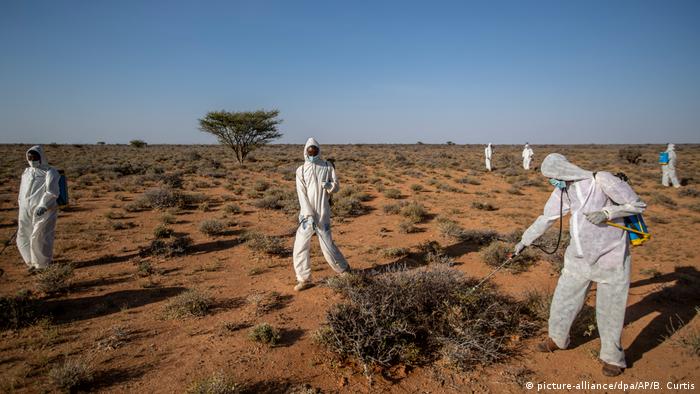
These officials in Puntland, Somalia, are spraying by hand, but only aerial spraying is really effective, say experts

'Unprecedented locust crisis'


UN Secretary-General Antonio Guterres, speaking in the Ethiopian capital, Addis Ababa, as an African Union (AU) summit kicked off, said Saturday: "There is a link between climate change and the unprecedented locust crisis plaguing Ethiopia and East Africa."

"Warmer seas mean more cyclones generating the perfect breeding ground for locusts. This is getting worse by the day," said Guterres.

Climate experts point to a rain-bearing cyclone that reached Somalian waters in December. Its winds had carried locusts from the Arabian Peninsula. Last week, the FAO said swarms had also been sighted in Oman and Yemen.

The locust density in East Africa was so high that even normal drier weather would still fail to inhibit another breeding generation, said Burgeon.


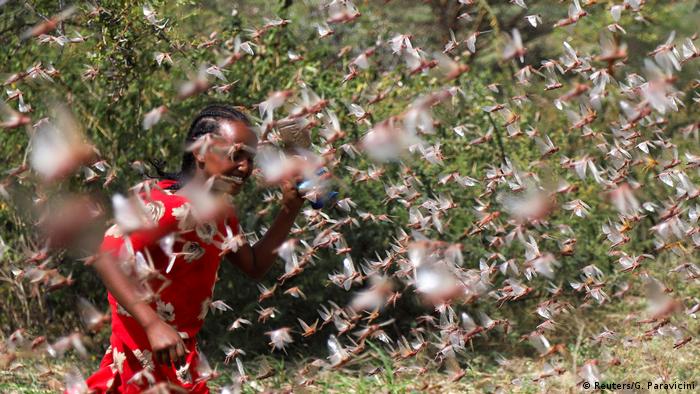
A locust swarm in Jijiga in Ethiopia in January decimated crops

Replacement crop unrealistic

A farmer in Kenya's eastern Kitui County, Esther Kithuka, told the Reuters news agency last Monday that she was worried about crop destruction. Another growing season due to start in April would be too short for any meaningful production.

Since last century, six desert locust plagues or what experts called region-wide "upsurges" have occurred. One of the worst occurred in 2003-2005 in North and West Africa.


SEE  https://plawiuk.blogspot.com/search?q=BIBLICAL
SEE  https://plawiuk.blogspot.com/search?q=PLAGUE
SEE  https://plawiuk.blogspot.com/search?q=LOCUSTS
SEE  https://plawiuk.blogspot.com/search?q=AFRICA
SEE  https://plawiuk.blogspot.com/search?q=KENYA
SEE  https://plawiuk.blogspot.com/search?q=SOMALIA
SEE  https://plawiuk.blogspot.com/search?q=PAKISTAN
Africa holds 'silence the guns' summit

Africa remains beset by conflict and terrorism, the continent's leading diplomat has told an African Union summit headlined "Silencing the Guns." Moussa Faki Mahamat warned that some member states even faced "collapse."


African Union Commission chairman Moussa Faki Mahamat told leaders of the 55-member bloc, which held its annual summit in Addis Ababa, that new crises in Cameroon and Mozambique had joined lingering conflicts in Libya and South Sudan.

The continent was hampered, said Mahamat, "by "terrorism, intercommunal conflict and pre- and post-election crises."

Read more: UN's Guterres warns of global 'wind of madness'

He noted, however, progress in Central African Republic and Sudan, after its civic uprising and reiterated the AU's intention to find "African solutions to African problems."

Ramaphosa takes over AU chair

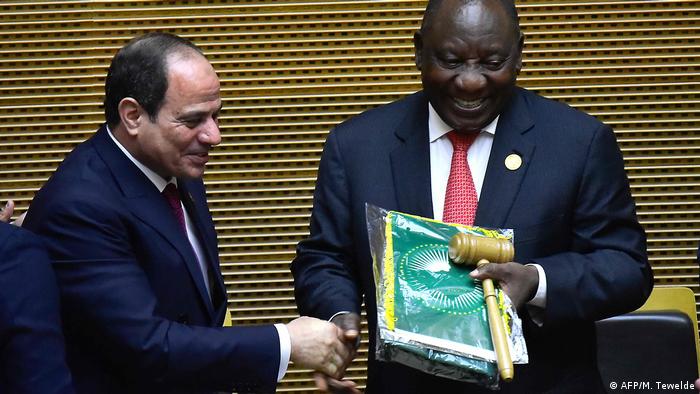
South African President Cyril Ramaphosa — taking over the AU chair from Egyptian ruler Abdel Fattah el-Sissi — said he planned two summits in May focused on conflict resolution and the other on African continent free trade.

Mahamat, originally from Chad, said that root causes of African conflicts were poverty and social exclusion.

Full UN support for AU initiative

Visiting the summit, United Nations chief Antonio Guterres said silencing the guns was about human rights and sustainable development, and the AU's initiative had the UN's full support.

Reacting to AU complaints about being sidelined on Libya, Guterres spoke of a "new framework of cooperation" to overcome AU vagaries over how to fund its inclusion in peace keeping missions.

On Friday, the International Crisis Group think-tank had urged the AU to finalize an agreement that would see the UN financing 75% of peacekeeping missions, when endorsed by the UN Security Council.

Guterres said African peacekeeping contributions must be adequately and predictably financed.

Merkel visited Ramaphosa

Last Thursday, German Chancellor Angela Merkel, visiting Ramaphosa in Pretoria, said African nations must be involved in shaping a solution in Libya.

Libya, a migration conduit, has been in turmoil since the 2011 overthrow of dictator Muamar Gadhafi and is now a battle zone for proxy forces, pitting General Khalifa Haftar against the UN-backed government of Fayez al-Serraj in Tripoli.

Ramaphosa had told Merkel he expected a "much clearer African position" on Libya to emerge after the Addis Ababa summit.

Mediation bid for South Sudan

In a bid to jumpstart fresh mediation efforts on South Sudan, Ramaphosa on the summit's eve Saturday met separately with President Salva Kiir and rebel leader Riek Machar.

The rival leaders face an extended February 22 deadline to form a power-sharing government after two previous failed attempts.

South Sudan's civil war, which began in 2013, has left 380,000 people dead and millions of people in dire poverty.

Also on Sunday, the AU announced that the Democratic Republic of Congo would assume the bloc's rotating chair in 2021, after South Africa.

In mid-January, France President Emmanuel Macron hosted West African heads of state from the sprawling Sahel region, including Chad and Mali, where extremist fighters move with little challenge.


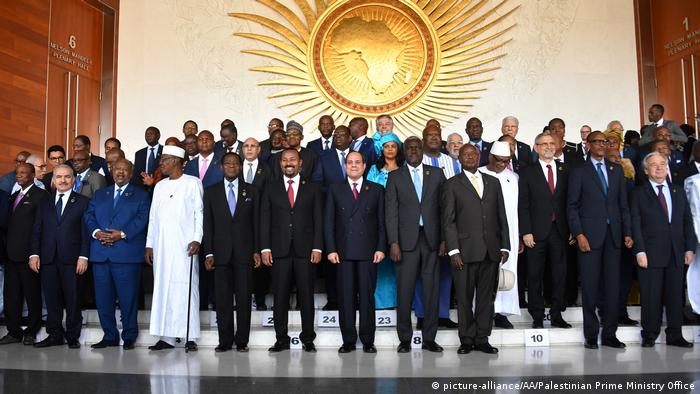
February 9, 2020: photo line-up at AU summit focused on 'Silencing the Guns'

ipj/shs (AFP, dpa)
Brazil police kill suspect in Rio councilwoman's murder
AIN'T THAT CONVENIENT A PATSY SCAPEGOAT SACRIFICIAL LAMB TO COVER UP FOR THE DEATH SQUADS 


09/02/2020

Rio de Janeiro (AFP)

A suspect in the 2018 assassination of an outspoken Afro-Brazilian member of Rio de Janeiro's city council was shot to death Sunday after he fired on police sent to arrest him, Brazilian authorities said.

Adriano Magalhaes da Nobrega, who had been on the run for more than a year, was located by police in a rural area of the city of Esplanada, 170 kilometers (105 miles) north of Salvador, the capital of the state of Bahia.

"At the moment of his arrest, he fired on officials and was wounded in the shootout," the state's security agency said in a statement. "He was taken to a hospital but died as a result of his wounds."

Magalhaes, a decorated former captain in an elite Rio military police battalion, was suspected of organizing the March 14, 2018 murder of Marielle Franco, a ground-breaking feminist on the Rio city council known for her denunciations of police brutality and extra-judicial executions.
She and her driver were shot multiple times by occupants of another vehicle as they pursued her car in Rio de Janeiro.

Two former police officers -- Ronnie Lessa, 48, and Elcio de Queiroz, 46, -- were arrested for the crime.

Suspicion on who ordered it fell on a powerful paramilitary group known as the "Office of Crime," which Magalhaes is believed to have led.


Franco's Socialism and Liberty Party issued a statement Sunday demanding that the circumstances around Magalhaes's death be clarified.

"The militia he belonged to was suspected of being implicated in the assassination (of Franco) and he was a key figure for shedding light on a series of crimes," it said.


According to the daily Estado de Sao Paulo, Magalhaes had told his lawyers he feared being killed "to make evidence disappear."

Magalhaes in 2005 received the Tiradentes medal, the state of Rio de Janeiro's highest, at the initiative of then deputy and current senator Flavio Bolsonaro, the son of Brazilian President Jair Bolsonaro.

Often formed by former police officers, the militias began appearing for the first time in Rio about two decades ago, supposedly to fight drug traffickers in the city's slums but often unleashing violence in poor communities.

© 2020 AFP
UPDATED

CBS denounces threats against anchor over Kobe Bryant story
09/02/2020


Washington (AFP)

The president of CBS News on Sunday denounced as "reprehensible" a comment by famed rapper Snoop Dogg that appeared to threaten a news anchor over an interview about late basketball star Kobe Bryant.

Bryant died, along with his daughter and seven other people, in a helicopter crash on January 26 in California. Since then, references to a 2003 sexual abuse allegation against him have drawn a furious reaction from fans.

Snoop Dogg's harangue on social media followed an interview that Gayle King, anchor of "CBS This Morning," had about Bryant with Lisa Leslie, a former star player in women's professional basketball.

In it, King seemed to press Leslie about the 2003 case, while Leslie repeatedly portrayed her friend as someone who "was never like that" and who would "never do something to violate a woman."

A seething Snoop Dogg then posted an obscenity-laced video online, calling King a "funky dog-head bitch."

He added, ominously, "Respect the family and back off, bitch, before we come and get you."

CBS President Susan Zirinsky called the remarks "reprehensible," adding in a statement to The Hill news website, "We fully support Gayle King and her integrity as a journalist."

- Multiple death threats -

In the wake of the exchange, King has received multiple death threats, according to her good friend, media mega-star Oprah Winfrey.

"She is not doing well," Winfrey said Friday on NBC, adding, "She has now death threats, and now has to travel with security, and she's feeling very much attacked."

Also coming to King's defense was former national security adviser Susan Rice, who bluntly warned Snoop Dogg in a tweet to "back the fuck off," adding, "You come for @GayleKing, you come against an army. You will lose, and it won't be pretty."

King herself posted two videos saying the interview had been edited in a way that misrepresented its actual tone.

"I know that if I had only seen the clip that you saw, I would be extremely angry with me too," she said in one video. "I am mortified. I'm embarrassed and I am very angry."

The video, she went on, was "totally taken out of context."

- A fuller interview -

King said that in the full interview she had spent much more time talking about Bryant's career, his mentorship of younger people and his sense of humor.

A statement from CBS appeared to concede problems in the editing process.

"Gayle conducted a thoughtful, wide-ranging interview," it said. "We are addressing the internal process that led to this, and changes have already been made."

Earlier, the Washington Post briefly suspended reporter Felicia Sonmez after she posted a link, the day of Bryant's death, that called attention to the 2003 allegations.

She said she received thousands of angry emails, including death threats.

Senior editors at the Post told her she had shown poor judgment, though other journalists at the Post rallied around her.

Bryant was arrested in 2003 after a woman in Colorado said he had sexually assaulted her in his hotel room there.

He insisted he had believed the encounter was consensual, but later reached an undisclosed settlement with the accuser.

Disney heiress says Kobe Bryant 'was not a god' in lengthy Twitter thread about rape allegations
abigail disney
Abigail Disney spoke out about Bryant's rape allegations 
Saturday. Phillip Faraone/Getty Images for Refinery29

Disney heiress Abigail Disney spoke out in two-dozen tweets Saturday about the late Kobe Bryant's 2003 rape allegations. 

The allegations never made it to trial, and though Bryant said the sex was consensual, he eventually apologized to his accuser, The New York Times reported.

Disney said Bryant could be mourned but said people should not "deify him because he was not a god."

Disney heiress Abigail Disney addressed the rape allegations against late NBA star Kobe Bryant in a 24-tweet thread on Saturday that urged people to avoid turning Bryant into a god.

The 60-year-old, who is the granddaughter of Roy O. Disney — a cofounder of the Walt Disney Company — had in a tweet January 29 shared an op-ed from the Washington Post about allegations Bryant faced some 17 years ago, writing "The man was a rapist. Deal with it."

On February 1, the Disney heiress, who has a net worth of over $120 million, doubled down on her previous statement, offering new commentary on Bryant, who died January 26 in a helicopter crash in Calabasas, California.

"OK, time to bite the bullet and say something," Disney said when she began her Twitter thread early Saturday morning. "If you don't like it, just stop following. First of all, yes, it IS my business because I'm a woman who has herself been assaulted and spent my life knowing, loving and feeling for women for whom it's been so much worse."
—Abigail Disney (@abigaildisney) February 1, 2020

At the onset of the thread, Disney offered praise for Bryant amid her discussion of the rape allegations, noting that a person can do both good and bad things in their lifetime. "I mourn Kobe too," she wrote. "He went on to be a man who seemed genuinely to want to do good. The face[sic] that he raped someone does not change any of these other facts."

As The New York Times reported, the allegations stem from Bryant's 2003 a trip to Colorado for an operation on his knee. Byrant reportedly asked a concierge at the spa where he was staying for a private tour. Following the tour, he invited her to his room where they began kissing. Bryant had said what followed was consensual sex, though his accuser said she was raped.

Court documents revealed the woman had bruises on her neck and tears on her vaginal wall, The New York Times reported. While the case never went to trial, reportedly over the accusers' refusal to testify, a lawsuit between Bryant and the accuser resulted in an undisclosed settlement.

Bryant later apologized to his accuser.

"Although I truly believe this encounter between us was consensual," he said in a statement, "I recognize now that she did not and does not view this incident the same way I did."

Disney went on to compare the allegations against Bryant to a drunk driver killing a person. "Does his lack of intention absolve him of responsibility for the death?," Disney asked. "If he said he wasn't that drunk or didn't know he was drunk, or didn't mean to kill the person, or is really really really sorry, does any of this absolve him?"

"Of course not," she added in the next tweet.

Disney's final takeaway: don't worship the NBA star.

"So yes, we should mourn him," Disney said. "We should mourn his daughter and his family and all the other lives lost on the helicopter. It was horrible. But don't deify him because he was not a god. That's all. Just don't deify him".

There has been a flood of discourse since Bryant's death over whether his 2003 rape allegations should be revisited as the world mourns the basketball star's tragic death. The Washington Post received backlash when it suspended a reporter for sharing an article about the 2003 case on Twitter after Bryant's death. The DC newspaper would later walk back its decision to suspend the reporter, saying her tweets did not violate WaPo policy. Still, it said her tweets were "ill-timed."

The reactions to Disney's two-dozen tweets were largely negative.

"Breaking: bored heiress of a multimedia empire has nothing better to do on a Wednesday because her life is completely empty & meaningless," one Twitter user said in a tweet that was retweeted more than 120 times.
—michelle Polite (@michellePolit10) February 1, 2020
—Splash (@flashazoid) February 1, 2020

Not all of the reactions to Disney's thread were negative, however.

"What a thoughtful thread," one person tweeted. "Thank you for writing it. I have seen the way that fierce emotional identification and defense of abusive behavior can happen with sports figures."

Abigail Disney did not return Business Insider's request for comment.

Opinion: We Have To Tell The Whole Truth About Kobe Bryant
We still struggle to tell fully human stories about the people we love — only heroes’ journeys or villains’ defeats.

THE OTHER FOUR LETTER WORD; RAPE

LINKING A TWEET TO THIS STORY GOT A WAPO REPORTER SUSPENDED 

Jill Filipovic  BuzzFeed Contributor
Posted on January 27, 2020,

Frederic J. Brown / Getty Images
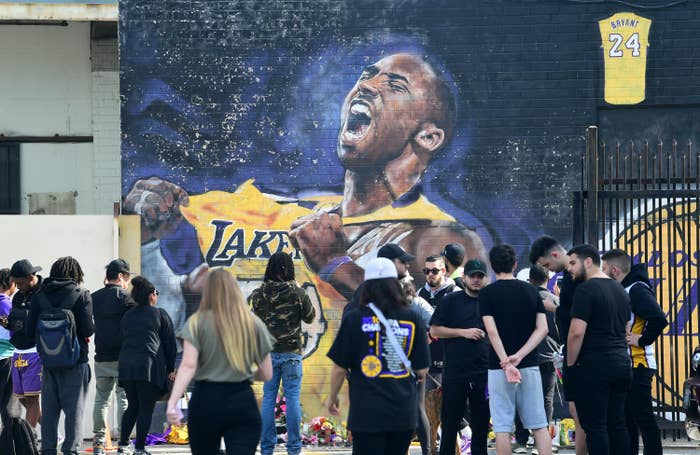
Fans gather to mourn Kobe Bryant at a mural near the Staples Center in Los Angeles.

The death of a celebrity leaves its mark even on distant admirers. We live in a cynical culture, and yet the young, beautiful, talented, and famous still thrill us. They remind us we’re still optimistic, still capable of being awed. Kobe Bryant was one of the greatest athletes in the world, someone whose beauty and grace and power on the court was, even for total laypeople like me, still so very obvious and so very stunning. He was only 41, a dedicated father, a beloved son, a caring husband, a good friend. The eight people who died with him, including three young girls — Payton Chester, Alyssa Altobelli, and Bryant’s own daughter Gianna — had so much promise and were beloved by so many people. They are all grieving today, and my heart hurts for all of them.

And also.

You know the and also, don’t you? That Kobe Bryant was accused of raping a woman? My heart hurts for her too.

It’s uncomfortable to raise the worst thing someone has ever done when that someone dies, especially when they are beloved. And I suppose it matters I write this as someone who thinks that very, very few of us are all good or all bad; few of us are saintly, even fewer irredeemable. We can admire aspects of a person’s talent without erasing the ways they also did irreparable damage. We can be horrified and angry about what someone did without writing them off as worthless, without seeing them go away — to jail, to the grave — and saying “good riddance.”

But is it an affront to bring up the bad things someone did, so soon after they die, when their loved ones and their admirers are still grieving? How bad do those bad things have to be to merit immediate mention? How good do the good things have to be to justify silencing the rest? (Do we imagine, for example, that when Harvey Weinstein dies, his talents and wonderful movies will merit courteous silence on his alleged sexual abuses?)

How do you balance the pain that raising sexual assault allegations will cause family and fans against the pain felt by so many survivors of sexual violence who are again watching a beloved man being internationally lauded, the inconvenient parts of his story — the woman who says he raped her — politely excised?


These are not easy questions. There is no scale to weigh them on.

Kobe’s extraordinary ability is key to his story. And it is not the whole story. Out of some mislaid definition of respect, we are so excellent at sidelining the inconvenient parts — at least when the inconvenient parts are women, and the one who is inconvenienced is a man we would prefer to keep admiring without complication.

The inconvenient part of Kobe’s story was a teenager, 19 years old. She worked at a hotel where Kobe stayed. The details are all out there if you want to know them.

Kobe initially told the police nothing happened. Then when the police told him they had blood and semen evidence, he said, well, ok, something did happen, but it was consensual.

The woman had a bruise on her neck. She had genital injuries and vaginal tears consistent with trauma. Her underwear and a T-shirt of Kobe’s were stained with her blood.

The full weight of Kobe Bryant’s money, power, and influence came down on her. His lawyers suggested she was sexually promiscuous. One psychology professor studied the coverage of the case and found that more than 40% of news stories questioned the truthfulness of the woman’s account; only 7.7% questioned Kobe’s honesty.

The young woman — the teenager — settled out of court. As part of the agreement, Kobe apologized.


We like to think of celebrity-watching as an escape from real life, but it’s more of a mirror. The way we bestow celebrity status reflects what we value; so too does where and how and why we deem celebrities good or bad or admirable or deplorable. The Kobe Bryant rape case reflected something very ugly back at us, and the fact that we just don’t know what to do with that information upon his death shows that, yes, we have changed — at least editors and anchors and reporters and commentators are wringing their hands about how to deal with it.

But we are still very much in flux. We still don’t know how to tell human stories when a life ends, only heroes’ journeys or villains’ defeats. A lot of people want Kobe to be an uncomplicated luminary, a great man without inconvenient addendums, and yet here is the inconvenient shadow of a female form darkening the background.

Maybe the stories we tell about our culture’s most resonant figures should strive to be true, for better or worse.

Maybe the reason we care about Kobe Bryant dying is because his life was never just about Kobe Bryant, but about all of the aspirations and values we pinned onto him, and it is for exactly that reason that there is no disrespect or invasion of privacy in insisting that the inconvenient parts live alongside the admirable ones, that the ugly is a neighbor to the exquisite.

People are grieving for a much-admired man, for too many lives cut short, for promise snuffed out, and for families in pain. Others — especially those whose lives have been impacted by sexual violence — may be grieving in another direction, painfully reminded of all the ways women are erased so great men may be sanctified. We can make space for both experiences without shouting each other down or suggesting that one set of emotions has less of a right to be expressed than another does.

That same work of compassion also calls on us to remember that no person is an island. All our lives leave ripples. Some lives are tsunamis. Compassion is not summarizing the beauty of the wave; it’s picking through the wreckage, reckoning with who was hurt.

Awe without honesty isn’t respect; it’s myth. Admiration of only the easy parts is fanaticism, not reverence. And if we want a world in which our stories are more honest than the heroes-and-villains framework allows, then we have to start by telling the whole truth.


Jill Filipovic is the author of The H-Spot: The Feminist Pursuit of Happiness. A version of this article was originally published in her newsletter.

THE RESULT OF A TWEET LINKING TO THIS  A WAPO REPORTER WAS SUSPENDED  THOUGHT WAPO BELIEVED IN REPORTING FACTS


Washington Post reporter has been suspended after she shared a link to a story about allegations of rape against Kobe Bryant hours after his death.
In a since-deleted tweet, Felicia Sonmez’s—who covers politics for the Post—shared a story published by The Daily Beast titled “Kobe Bryant’s disturbing rape case,” which details allegations made against the basketball legend in 2003. The tweet came only hours after Bryant’s untimely death, prompting outrage and backlash from his fans.
“Well, THAT was eye-opening. To the 10,000 people (literally) who have commented and emailed me with abuse and death threats, please take a moment and read the story—which was written 3+ years ago, and not by me. Any public figure is worth remembering in their totality,” Sonmez tweeted after receiving an outpouring of hate mail.
“That folks are responding with rage and threats toward me (someone who didn’t even write the piece but found it well-reported) speaks volumes about the pressure people come under to stay silent in these cases,” she continued in a follow-up tweet.
Sonmez deleted all of the tweets amid the backlash but not before they were captured in screenshots and shared with criticisms of the reporter’s timing.
Tracy Grant, the Washington Post’s managing editor, told the Daily Mail that Sonmez’s tweets violated the newsroom’s social media policy.
“The tweets displayed poor judgment that undermined the work of her colleagues,” she reportedly said.
Initially, reports attributed Sonmez’s suspension from Post to the tweets about Bryant, but it was later reported that she was reprimanded for outing the people who trolled her via email.
“A person who works at the Washington Post says @feliciasonmez was NOT suspended for linking to the Daily Beast story on Twitter. Her suspension was related to a follow up tweet that contained a screen shot of her work email inbox, which revealed full names of emailers,” reporter Matthew Keys said.
Users on Twitter continue to criticize the political reporter, with many flat out telling her “bye Felicia” and using the hashtag #FireFeliciaSonmez.
“@washingtonpost you should #firefeliciasonmez for this classless and heartless post with the passing of an iconic superstar literally HOURS after a horrific crash that also killed his daughter and 7 other along with them,” one user wrote.
Bryant died in a helicopter crash on Sunday that also claimed the lives of his 13-year-old daughter Gianna and eight others on board.
READ MORE:
Tiffanie Drayton is a geek culture and lifestyle reporter whose work covers everything from gender and race to anime and Xbox. Her work has appeared in Complex, Salon, Marie Claire, Playboy, and elsewhere.


IT IS ALSO IMPORTANT TO NOTE THAT KOBE BRYANT WAS RAISED IN ITALY
ITALIAN IS HIS SECOND LANGUAGE, ITALY HAS A NOTORIOUS TOXIC MASCULINITY THAT HE WAS RAISED IN, AGAIN NOT AN EXCUSE BUT A 

FACT OFT OVERLOOKED

Brazil's military elite sees France as country's biggest threat, leaked report reveals


09/02/2020
France's President Emmanuel Macron and Brazil's President
 Jair Bolsonaro attend an event on women's empowerment 
during the G20 Summit in Osaka, on June 29, 2019. 
© Brendan Smialowski, AFP

Text by:Henrique VALADARES

France is expected to be Brazil's biggest military threat over the next 20 years and could invade the Amazon in 2035, according to a secret report published by Brazilian media on Friday. Although the French embassy jokingly "saluted" its "limitless imagination", the military document is aimed at redefining the country's foreign policy strategy and could add yet another chapter to its troubled relations with France.


France has seemingly occupied the minds of Brazil's military elite ever since French President Emmanuel Macron and Brazilian President Jair Bolsonaro engaged in a diplomatic spat last August. An article published on Friday in the premier daily Folha de São Paulo sourced a leaked military document that reveals Brazil’s highest rank-and-file believe France could become the country’s biggest threat over the next 20 years, due to a possible dispute over the Amazon.

Named "Defence scenarios 2040", the 45-page-long document was based on interviews with 500 highly-ranked army officers, who listed their biggest concerns and predictions during individual interviews.

But France's embassy in Brasilia reacted moments later in an ironic tweet, jokingly "saluting" the "limitless imagination of its authors"
pic.twitter.com/l8U8b63awy— France au Brésil (@franceaubresil) February 7, 2020

'Somewhat delirious hypothesis'

According to the Folha de São Paulo article, the individual interviews were conducted during meetings at the Defence Ministry's Superior School of War, which were then compiled into a 20-year-long foreign policy strategy, outlining possible case scenarios.

It includes other "somewhat delirious hypotheses", such as an organised coronavirus attack against the 2039 Rock in Rio music festival by "Southeast Asian ultranationalists", Folha revealed.

Although the document lists four different strategic scenarios, France appears as the only common threat to all – an illustration of the fractured relations between the two countries, which soured in August 2019 when the Amazon fires made headlines and shocked the world.

Brazil's army has speculated that France could demand the UN back an intervention in 2035 in indigenous lands located in the heart of the Amazon, for example, which would be conducted from French Guyana – the French territory shares a 730-kilometre border with Brazil.

France is Brazil's 'main military partner'

But the document omits, be it intentional or not, that France is actually Brazil's "main military partner", the French embassy said in its tweet, adding that both armies have had "a close and friendly relationship for decades, conducting joint operations on a daily basis". Both countries also have signed major partnership agreements, including the construction of submarines and helicopters, and exchange over 7 billion euros of goods every year.

"This is nonsense, a thing written by amateurs," Rubens Barbosa, ambassador and director at the Foreign Relations and International Trade Institute (Ifrice), told Brazilian magazine Veja. "How could France go to war against Brazil when it actually is Brasilia's most important military partner?"

According to the article in Folha, as "delirious" as some scenarios appear, these are expected to be part of the country's national defence strategy, which the parliament should start evaluating in June.

"It has a lot of inconsistencies," Nelson During, director at the website Defesanet, told AFP. According to During, the document was written when both countries were at the peak of their scuffle in August, and has been "influenced by the dispute between Macron and Bolsonaro".

'Tarnishing relations'

In August, Macron criticised Bolsonaro's environmental policies as the Amazon's fires made headlines all over the world, pushed for strong international action and suggested the world's largest rainforest could become a UN-administered international territory. A "colonialist mentality", said the Brazilian leader, who was then caught insulting France's first lady, Brigitte Macron, on social media.

Under increasing international pressure, Bolsonaro then promised to fight the fires. But last Wednesday, the climate change sceptic unveiled a sweeping plan for the Amazon rainforest that would open indigenous lands to mining, farming and hydroelectric power projects.

"This latest report risks further tarnishing relations between the two countries," Nelson During told AFP.

Brasilia quickly tried to play down the proposal. In a statement released on Friday evening, the ministry of defence said the report was nothing but an "academic document", "the first draft of a primary study" and did not "represent the government's views".


#NotaOficial | Sobre matéria recentemente publicada pela @folha, a respeito de cenários de defesa, o documento mencionado pelo veículo não reflete a posição da Escola Superior de Guerra ou do Ministério da Defesa.
Veja nota oficial na íntegra https://t.co/EEeeogK89e pic.twitter.com/b6OBhFz2Dl— Ministério da Defesa (@DefesaGovBr) February 7, 2020

In line with Bolsonaro's views

Although the document references a future Chinese military base in Argentina, an open conflict with Venezuela, and even a "terrorist attack by an environmental group", the military elite also pens "realistic geopolitical considerations", according to Folha, such as a NATO base in West African Coast in order to stem a growing Chinese presence in Africa.

But the report’s projected scenarios for the next 20 years seem particularly aligned with President Bolsonaro's existing agenda, which has led to growing international ties with the US and Israel. Further proof of the leader’s far-right views and policy intentions came to light in the report with references made to NGOs as "terrorists" and the depiction of indigenous people as undermining Brazil's development.
Research Sheds Light On The Evolutionary Puzzle Of Primate Coupling

2/03/2020

A UTSA researcher has discovered that, whether in a pair or in groups, success in primate social systems may also provide insight into organization of human social life.


UTSA and German collaborators have discovered that, whether in a pair or in groups, successin primate social systems may also provide insight into organization of human social life[Credit: German Primate Center-Leibniz Institute for Primate Research]

Assistant professor Luca Pozzi in UTSA's Department of Anthropology in collaboration with Peter Kappeler, a colleague at the German Primate Center-Leibniz Institute for Primate Research, investigated how different primate societies evolved and which factors may be responsible for transitions among them.

Their reconstructions showed that the evolution from a solitary way of life to group living usually occurred via pair living. Pair living thus served as a stepping stone for group living and therefore plays a key role in the evolution of social systems.

In the course of evolution, species had to adapt to changing environmental conditions, according to Pozzi. A crucial adaptation in this process is the modification of social behavior. About half of all primate species live in groups and around one third in pairs; the rest live solitarily.


Why these different forms of social complexity evolved, how many transitions among them occurred and which factors led to the transitions was analyzed on the basis of genetic data and behavioral observations of 362 primate species.

"Living as a pair represents an evolutionary puzzle in the evolution of mammalian social systems because males could achieve higher rates of reproduction if they did not bond to a single female," says Pozzi.

Yet evolutionary biologists still struggle to find the advantages of pair living for males, according to Peter Kappeler, who is one of the lead researchers of the study.

At first glance the two current hypotheses on the development of pair living--the female distribution hypothesis and the paternal care hypothesis--seem to be mutually exclusive.

Yet results in this work indicate that the two factors may be complementary. Initially it was believed that an ecological change in the habitat led to female spatial separation and that solitary males, which previously had several females living in their territory, were subsequently only able to gain access to one female. Paternal care resulting from the pair formation in turn increased the survival probability of the offspring and thus reinforced pair living.

The further transition to group living was possible through an improvement of the ecological situation, which allowed related females to live in close proximity. These could then be joined by one or more males.

"However, the pair bond typical for humans within larger social units cannot be explained with our results, since none of our recent ancestors lived solitarily. Nevertheless, the advantages of paternal care also may have led to a consolidation of pair living in humans," said Kappeler.

"The evolution of complex social systems in mammals, and more specifically in primates, is a challenging and exciting area of research. Our study shows that pair living--although rare--might have played a critical role in it," says Pozzi.

The research was published in Science Advances.

Author: Milady Nazir | Source: University of Texas at San Antonio [February 03, 2020]

Palestinians 'betrayed again' by Trump deal

Palestinians 'betrayed again' by Trump deal: Palestinian activist Raja Abdulhaq compares Trump's Middle East plan with the 1993 Oslo Accords