Wednesday, February 24, 2021

$20 PLUS BENEFITS 
A $15 minimum wage still won't be a living wage for many families, MIT and CNBC analysis says
AND A TRANSFERABLE DEFINED BENEFIT PENSION

Living Wage Calculator (mit.edu)

Juliana Kaplan Mon, February 22, 2021, 

A protestor holds a sign in Upper Senate Park during a rally on Capitol Hill in Washington, Wednesday, July 22, 2015, to push for a raise to the minimum wage to $15 an hour. Al Drago/CQ Roll Call


A CNBC analysis of cost-of-living data looked at how minimum wages compare to living wages.

For families, the proposed $15-per-hour minimum wage still falls short of a living wage.

For single adults, the $15 wage would bring about half of states to a living wage.


A new CNBC analysis of cost-of-living data from Massachusetts Institute of Technology researchers looks at how a $15 minimum wage stacks up against a living wage.

For families with two children and two parents working at the minimum wage, current minimums in every state are below a living wage, and even the proposed increase to $15 an hour may still fall short for those families. As CNBC reports: "A $15 minimum wage would push a number of states closer to a living wage, but none would meet or exceed it."

That data doesn't take into account any income those families receive from safety net programs. A recent study from UC Berkeley's Labor Center found that lower wages cost taxpayers more than $100 billion a year, as almost half of the families who would see a raise from a $15 minimum wage rely on at least one social safety net program. The study found that 42% of the $254 billion spent on safety net programs goes to those families.

A $15 minimum wage would go a little bit further for single adults, according to the CNBC analysis. For them, minimum wages currently "fall short" of a living in every state. However, a $15 minimum wage would be a living wage for single adults in about half of the states.

Insider previously reported on the value that a $15 minimum wage would have in every state. Since the cost of living varies in each state, the value of the wage also fluctuates. Insider found that the new potential minimum would go the furthest in Mississippi, where it would be worth $17.77. Per the CNBC analysis, Mississippi is one state where a $15 minimum wage would provide a living wage for single adults.

Democrats are currently pushing for a $15 minimum wage as part of President Joe Biden's $1.9 trillion stimulus relief package, aiming to pass the increase through reconciliation. However, Biden has reportedly indicated that he thinks the raise won't be feasible - and two Democratic senators have also expressed their hesitations.

But the $15 minimum-wage's champion, Sen. Bernie Sanders (I-Vt.), has said he's "confident" the hike will stay in the stimulus package. Under the current Democratic plans, the minimum wage would gradually increase to $15 by 2025. By then, $15 won't even be worth what today's $15 is because inflation will impact its value.

Read the original article on Business Insider
For Women in Economics, the Hostility Is Out in the Open

Arindrajit Dube
Justin Wolfers
Ben Casselman
Tue, February 23, 2021

Attendees mingle at an American Economic Association conference 
in San Diego on Jan. 3, 2020. (Sandy Huffaker/The New York Times)

A few years ago, economists Alicia Sasser Modestino and Justin Wolfers sat at the back of a professional conference and watched Rebecca Diamond, a rising star in their field, present her latest research on inequality. Or at least she was meant to present it — moments after she began her talk, the audience began peppering her with questions.

“She must have gotten 15 questions in the first five minutes, including, ‘Are you going to show us the data?’” Modestino recalled. It was an odd, even demeaning question — the session was in the data-heavy field of applied microeconomics. Of course she was going to show her data.

Later that morning, Modestino and Wolfers watched as another prominent economist, Arindrajit Dube, presented a paper on the minimum wage. But while that was one of the most hotly debated topics in the field, the audience allowed Dube to lay out his findings for several minutes with few interruptions.

Over a drink later, Modestino and Wolfers wondered: Had the audiences treated the two presenters differently because of their genders?

They couldn’t be sure. Maybe the audience treated Dube differently because he was more senior. Maybe they had simply found his paper more convincing, or less interesting. Maybe the observations of Modestino and Wolfers were a result of their own biases — Dube, in an email, recalled getting lots of questions, some of them quite skeptical. (He added that he didn’t know how his reception compared with Diamond’s, and he said he didn’t challenge Modestino’s recollection overall.)

So Modestino and Wolfers, who has written on economics in The New York Times, did what economists often do: They gathered data. Along with two other economists, Pascaline Dupas and Muriel Niederle, they recruited dozens of graduate students across the country to attend hundreds of economics presentations to record what happened. Their findings, according to a working paper that is expected to be published next week by the National Bureau of Economic Research: Women received 12% more questions than men, and they were more likely to get questions that were patronizing or hostile.

“It measures something that we thought couldn’t be measured,” Modestino said. “It links it to a potential reason that women are underrepresented in the profession.”

The paper is the latest addition to a mounting body of evidence of gender discrimination in economics. Other researchers in recent years have found that women are less likely than men to be hired and promoted, and face greater barriers to getting their work published in economic journals. Those problems are not unique to economics, but there is evidence that the field has a particular problem: Gender and racial gaps in economics are wider, and have narrowed less over time, than in many other fields.

In response to those concerns, the American Economic Association commissioned a survey of more than 9,000 current and former members that asked about their experiences in the field. The results, released in 2019, revealed a disturbing number of cases of harassment and outright sexual assault. And it found that subtler forms of bias were rampant: Only 1 woman in 5 reported being “satisfied with the overall climate” in the field. Nearly 1 in 3 said they believed they had been discriminated against. And nearly half of women said they had avoided speaking at a conference or seminar because they feared harassment or disrespectful treatment.

“Half of women are saying they don’t even want to present in a seminar,” Modestino said. “We’re losing a lot of ideas that way.”

The harsh reception faced by women is particularly striking because they are also less likely to be invited to present their research in the first place. Women accounted for fewer than a quarter of the economic talks given over recent years, according to another paper. Racial minorities were even more underrepresented: Barely 1% of the speakers were Black or Hispanic.

“It’s just embarrassingly bad,” said Jennifer Doleac, an economist at Texas A&M University who is one of that study’s authors. Only about 30 talks have been delivered by Black or Latina women since the authors began tracking the data, she noted. “These scholars are just not being invited, ever.”

The lack of representation is so significant that Modestino and her colleagues could not study whether Black and Latino economists were treated differently in seminars than their white counterparts — there were too few examples in their data to analyze.

The lack of opportunities has potentially significant career consequences. Research presentations, known as seminars, are an important way that academics, particularly those early in their careers, disseminate their research, build their reputations and get feedback on their work.

Seminars play a particular role in economics. In other fields, they tend to be collegial affairs, with mostly respectful questions and few interruptions. In economics, however, they often resemble gladiatorial battles, with audience members vying to poke holes in the presenter’s argument. Seemingly every economist, regardless of gender, has at least one horror story of losing control of a presentation. Many say they have been brought to tears.

Most economists acknowledge that there are bad actors who are more interested in scoring debating points than raising legitimate questions. But many defend the field’s culture of aggressiveness, saying it is helpful to get feedback — even critical feedback — from colleagues.

“I expect a room full of economists to speak up and have their own opinions and ideas,” said Ioana Marinescu, a University of Pennsylvania economist. “To me, if they’re not asking questions, they might be a little bit zoned out.”

Marinescu recalled a talk she gave at a prestigious conference several years ago, where she, too, faced frequent interruptions. It was terrifying, she said — but also stimulating.

“The questions were incessant, but they were awesome questions from the top people in the profession,” she said. “From my perspective, it was one of the best experiences I ever had.”

Still, Marinescu said, reforms are needed.

In recent years, some economists have begun to question the field’s culture of aggressiveness, arguing that it discourages people from entering the field. Several universities have instituted rules meant to cut down on bad behavior, such as banning questions for the first 10 or 15 minutes of a talk so that speakers can get through at least the beginning of their presentations uninterrupted.

But Judith Chevalier, a Yale economist who chairs the American Economic Association’s Committee on the Status of Women in the Economics Profession, said rules intended to improve seminars would not address the underlying problems that Modestino’s research revealed.

“Seminars are a public setting — seminars are when they are on their good behavior,” Chevalier said. “We can’t declare victory even if we fix seminars. We need to reexamine everything. Are we biased when we hire? Are we biased when we mentor? Are we biased in seminars? Are we biased when we promote?”

This article originally appeared in The New York Times.
SOUTH CAROLINA
Wateree power plant targeted for closure. How many jobs are on the chopping block?


Sammy Fretwell
Tue, February 23, 2021, 

Dominion Energy plans to close a 51-year-old Columbia-area power plant that has employed generations of workers but also has polluted groundwater and the Wateree River while burning coal to make electricity.

Company plans show that two other coal-burning power plants in Berkeley and Orangeburg counties also would close in the next decade, a change that would effectively end South Carolina’s production of power through coal.

Air pollution from coal plants is a leading cause of man-made climate change. If the Dominion plan becomes final, all of Dominion’s once robust fleet of coal-fired power plants would be closed by 2030. Santee Cooper and Duke Energy already have closed or announced plans to close coal plants in South Carolina.

The impact on jobs remained unclear this week because Dominion declined to say how many employees might be affected by the proposed closures.

But it could affect several hundred positions, if other coal plant closures are comparable. In announcing two years ago it would close a power station in Georgetown County, Santee Cooper said the change could affect 200 jobs.

A Dominion spokesman said the proposal is not final and is subject to change. The Orangeburg coal plant would close, but a natural gas plant also on the site would remain.. Dominion’s plans follow a ruling in late December by the state Public Service Commission. The PSC ordered the power company to study in more detail the possibility of closing coal plants and relying more on other forms of energy.

Now, Dominion said it is moving to close the three plants under a comprehensive energy resource plan it must provide to the PSC.

Closing the three coal stations is “the most reasonable and prudent resource plan to pursue at this time,’’ Dominion said in a recent filing with the PSC.

The Virginia-headquartered company says it is looking to replace the South Carolina power plants with solar and natural gas-generated energy, as well as relying on battery storage.

What impact the retirement of coal plants would have on rates remained unclear this past week, but the company said shifting from coal to more natural gas could mean the need for more gas pipelines — an issue sure to bring criticism from environmentalists.

The company had been considering closing the coal fired power plants decades into the future, but last week’s filing with the PSC sped up the timetable following the December utility board ruling.

Plants that generate electricity from coal have been used for decades, but have begun to close in recent years for a variety of reasons, among them their environmental impacts. Coal-fired power plants release mercury into the air that later rains back into rivers and contaminates fish. Such plants also contribute gases, such as carbon dioxide, that cause global warming.

Water pollution also is an issue. The Wateree plant in lower Richland County was the subject of a lawsuit more than a decade ago over plans to build a landfill to serve the facility.

Evidence presented in the trial showed that groundwater pollution from the coal plant had been extensive. At the same time, toxin-laden water was trickling from a coal ash waste pond into the Wateree River, upriver from Congaree National Park.

The Wateree plant is a visible part of the landscape of eastern Richland County, with emissions stacks rising high above the rural farmland.

According to the new Dominion Energy plan, the Wateree station would close in 2028, as would the company’s Williams’ plant in Berkeley County.

“The plan … indicates that the most reasonable and prudent path for the company is a plan to retire Wateree and Williams stations in 2028,’’ the company said in an email Tuesday. “Natural gas, solar and battery storage resources would be added to the system.’’

Dominion would close its Cope coal plant in Orangeburg County by 2030 and focus exclusively on using natural gas at the site. The plant now uses both coal and natural gas.

The company’s statement said detailed studies are underway before another proposal goes to the Public Service Commission.

Dominion, which acquired SCE&G two years ago, said in 2019 that it had no plans to retire its remaining three coal plants, including Wateree.

Officials with the Sierra Club and the S.C. Coastal Conservation League said they are glad Dominion is moving away from coal. The three power plants are in largely minority communities that have suffered from power plant pollution, the Sierra Club said.

“The closure of these plants will be a huge health benefit for families and children who have been forced to live, work and play in the shadow of coal-burning plants that pollute their air and the rivers where they boat and fish,’’ the club’s Will Harlan said in a news release. “These communities have fought long and hard for protections that others take for granted, and now there’s hope for real change.’’

Still, he and the Conservation League’s Eddy Moore said relying too heavily on natural gas could be a problem. Some of the gas would come from fracking, a controversial practice of extracting natural gas from underground, the Sierra Club said.

Both organizations favor greater use of renewable energy, namely wind and solar power. Moore said laying more pipelines for natural gas isn’t the answer.

“We should be super cautious about putting our eggs in the gas basket,’’ Moore said.
KILLER KOPS 
Man dies after police kneel on his neck for nearly 5 minutes, family says in wrongful death claim

By Stella Chan and Leah Asmelash, CNN
Wed February 24, 2021

(CNN)
A 30-year-old Northern California man undergoing a mental health episode died days after police officers kneeled on the back of his neck for nearly five minutes to subdue him, lawyers for his family said.

Angelo Quinto had been "suffering from anxiety, depression, and paranoia for the previous few months," his family's attorneys said in a wrongful death claim, filed on February 18.

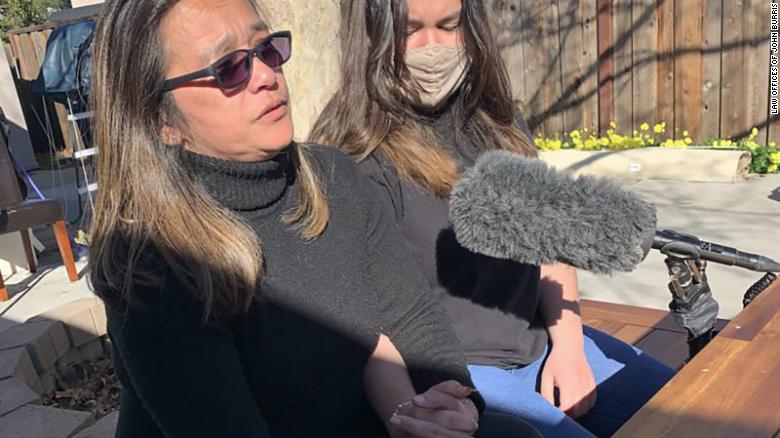
His sister Isabella Collins called police to their Antioch, California, home on December 23 because she feared he would hurt their mother, family lawyer John L. Burris said during a February 18 press conference.

Before police arrived, Quinto's mother had been holding him to her chest with her hands clasped around his back for a few minutes, and "he had already started to calm down," the claim stated. When two officers from the Antioch Police Department arrived, Burris said they made no attempt to understand the situation and instead, immediately grabbed Quinto from his mother's arms.

Quinto lost consciousness and was taken to a local hospital, where he was pronounced dead three days later, family attorneys say in the claim.
Maria Quinto-Collins, Quinto's mother, used her cell phone to record part of the incident.

"What happened?," she says breathlessly as Quinto is seen not moving and laying on his front. Officers roll him over to carry his body out, and his face is bloody. He is moved to a gurney and paramedics administer chest compressions on Quinto as his mother records on her phone, asking questions.


Quinto's mother and sister.

It was not clear from the video if the officers were wearing body cameras.
"As far as we know, they were not," Burris said last week.

In the nearly two months since Quinto's death, police have not issued a press release on the incident. The Antioch Police Department and the Contra Costa County Sheriff's Coroner's Division did not respond to requests for comment Monday.

"These Antioch police officers had already handcuffed Angelo but did not stop their assault on the young man and inexplicably began using the 'George Floyd' technique of placing a knee on the back and side of his neck, ignoring Mr. Quinto pleas of 'please don't kill me,'" Burris said.

Quinto's cause of death is still pending, the Contra Costa County Sheriff Coroner's office told CNN on Monday. His death is under investigation by the Contra Costa County District Attorney's office.

Isabella Collins said she called police in hopes they would help de-escalate the situation.

"I don't think I will ever not feel bad," she told CNN affiliate KGO. "If it was the right thing to do, it wouldn't have killed my brother."

The Antioch city clerk and attorney's office did not respond to requests for comment.
KILLER KOPS USA
No charges against officers involved in Daniel Prude's death

Police officers who put a hood over the head of a mentally distraught Black man, then pressed his body against the pavement until he stopped breathing will not face criminal charges after a grand jury declined to indict them, New York's attorney general announced Tuesday.

© Provided by The Canadian Press

Daniel Prude, 41, died last March, several days after his encounter with police in Rochester, New York. Police initially described his death as a drug overdose. It went mostly unnoticed. But nightly protests erupted after body camera video was released nearly six months later following pressure from Prude's family.

Attorney General Letitia James, whose office took over the investigation, said her office had “presented the strongest case possible” to the grand jury, but couldn’t persuade it that the officers had committed a crime.

“I know that the Prude family, the Rochester community and communities across the country will rightfully be disappointed by this outcome,” said James, who travelled to Rochester to announce the grand jury’s decision at a church near where Prude was fatally injured.

She said she was bound to respect the grand jury’s decision, but she also condemned a system that she said had “frustrated efforts to hold law enforcement officers accountable for the unjustified killing of African Americans."

“What binds these cases is a tragic loss of life in circumstances in which the death could have been avoided,” said James, who, like the mayor of Rochester and the city’s current and former police chiefs, is Black.

“One recognizes the influences of race, from the slave codes to Jim Crow, to lynching, to the war on crime, to the overincarceration of people of colour: Eric Garner, Tamir Rice, Breonna Taylor, George Floyd. And now Daniel Prude,” she said.

Lawyers for the seven police officers suspended over Prude’s death have said the officers were strictly following their training that night, employing a restraining technique known as “segmenting.” They claimed Prude’s use of PCP, which caused irrational behaviour, was “the root cause” of his death.

Calls were made to the officers’ attorneys. Matthew Rich, who represents four officers, said “we’re still taking it in” and that the attorneys would speak to the press later.

Hundreds of protesters gathered Tuesday evening on the street where Prude was detained.

The March 23 video of Prude’s fatal encounter with officers was initially withheld by police in part because of concerns it would inflame street demonstrations occurring nationwide over George Floyd’s death.

Ultimately released Sept. 4, it showed officers placing a mesh bag over Prude’s head to stop him from spitting after they detained him for running naked through the streets. Prude had been evaluated at a hospital for odd behaviour a day earlier, but he wasn't admitted. His family called police because they were concerned about Prude's safety after he bolted from the house.

One officer pushed Prude's face against the ground, while another officer pressed a knee to his back. The officers held him down for about two minutes until he fell unconscious. He was taken off life support a week later.

“The system failed Daniel Prude again," Prude family lawyer Elliot Shields said of the grand jury's decision. ”It failed him on March 22 when he was released from the hospital. It failed him on the night of March 23 when the police used deadly force against him. And it failed him again today."

Shields said Prude's brother, Joe Prude, was “heartbroken.”

Officers Troy Taladay, Paul Ricotta, Francisco Santiago, Andrew Specksgoor, Josiah Harris and Mark Vaughn, along with Sgt. Michael Magri, were suspended after Prude’s death became public. The officers will remain on leave pending the outcome of an internal investigation, according to Rochester police chief Cynthia Herriott-Sullivan.

The Rochester police union said in a statement it would not immediately comment.

The grand jury decision isn't likely to end scrutiny of the Rochester Police Department, which has been heavily criticized over the past year over numerous incidents involving allegations of excessive force.

James, a Democrat, said that in addition to meeting with Prude’s brother, she wanted to speak with a 9-year-old girl who was recently pepper sprayed by city police officers responding to a family dispute.

The department has also been criticized for rough treatment of protesters last summer.

The U.S. Justice Department planned to review the attorney general’s findings, according to a joint statement from its Civil Rights Division, the U.S. attorney in western New York and the FBI.

“I don’t think it’s over,” said Mike Johnson, a Rochester activist who joined the protest of the grand jury decision Tuesday evening. “I don’t think this grand jury decision is the last say in seeking justice for this issue.”

“This is just another slap in the face," said Johnson, noting that Tuesday was the anniversary of the death of Ahmaud Arbery, a Black man who was chased and shot by armed men in Brunswick, Georgia, one year ago.

James said that for the sake of public transparency, she had asked a judge to unseal some records related to the grand jury proceeding.

She also issued a report recommending, among other things, that officers be trained to recognize the symptoms of excited delirium syndrome, which can make people vulnerable to cardiac arrest. The medical examiner and the attorney general’s expert both concluded that Prude was in a state of excited delirium because of his drug use.

The attorney general also called for communities to minimize or eliminate police responses to mental health calls and to find alternatives to the type of “spit sock” officers placed over Prude’s head. She said the mesh hood clearly added to Prude’s stress and agitation.

A police-practices expert hired by the attorney general found some of the officers’ actions, including the “segmenting” tactic, were reasonable — but the expert said keeping Prude on his stomach for three minutes, including nearly a minute after he’d apparently vomited, “was unnecessary, unreasonable, and against accepted police practice,” James’ office said in a report.

The county medical examiner listed the manner of death as homicide caused by “complications of asphyxia in the setting of physical restraint” and cited PCP as a contributing factor.

Rochester's mayor, Lovely Warren, who fired police chief La’Ron Singletary over his handling of the Prude case, called the grand jury decision “hard for many of us to understand."

“There are no words that can comfort a family who has lost their loved one in this tragic way," she said. "Our actions going forward will ensure that Daniel Prude’s death was not in vain.”

Some activists said that they never expected the officers to face charges.

“Historically, we can see when Black and brown people are killed across this nation, most times there is no indictment. However, it isn’t any less offensive, any less hurtful, any less painful,” said Ashley Gantt of Rochester, as she headed to protest the decision. “I’m disgusted."

Michael Hill And Carolyn Thompson, The Associated Press

‘We’ve been electrified’: after success in Georgia, Black organizers look to transform the south


Sam Levine in New York 

Ever since the runoff elections in Georgia, people have been talking.

They’ve been talking about how turnout among Black voters surged in December and January, propelling two Democrats to stunning victories in the state, long seen as a Republican stronghold. And how those same voters had helped Joe Biden become the first Democratic presidential candidate to carry the state in nearly 30 years.

They’ve also been talking about how it was a success made possible by years of voter mobilization led by Black organizers, including many groups led by Black women.

And this success is sending ripples in neighboring states across the US south. Since the election, Black women who helped organize the transformation in Georgia have been fielding calls from their counterparts in other states, asking them to come speak to organizers and share strategies for replicating it.

Related: Georgia Republicans in sweeping new effort to make it harder to vote

“Everybody in the south that I talk to is talking about what happened in Georgia,” said Oleta Fitzgerald, a Mississippi organizer who runs the Southern Black Women’s Rural Initiative, which targets barriers faced by southern Black women. “It’s like we’ve been electrified.”

Mobilizing voters in the south is not easy, Fitzgerald and other organizers said. Many southern states, including Mississippi, Alabama, Tennessee and Texas, make it difficult to cast a ballot with strict voter ID laws and draconian restrictions on voting by mail.

White Republicans hold the levers of power in state houses and governor’s mansions. And gerrymandered electoral districts have helped entrench Republican power and Jim Crow-era laws disenfranchising people with felony convictions leave swaths of the Black voting population unable to vote.

“Georgia couldn’t carry a torch to the racism in Alabama,” said Sheila Tyson, a Democratic county commissioner in Birmingham.

Each state also has its unique politics and geography. Mississippi, for example, has a sizable and growing non-white population, but does not have the same kind of growing urban areas that helped carry Democrats to victory in Georgia, Politico reported in January. Voting in the state has become racially polarized – White people overwhelmingly vote Republican while Black voters back Democrats – making it difficult to build a multiracial coalition to back a Democratic candidate. There has not been a Black official in statewide office in Mississippi in over 150 years.

Some learnings from Georgia, however, could spread elsewhere in the south. Over the last two decades, organizers in Georgia have built a strategy around investing in Black communities, even when there’s no election around the corner, signalling to voters that the goal is building their communities, not just helping a particular candidate win. When an election does come around, organizers are already deeply embedded and connected to the communities they want to turn out and vote.

This was one of the lessons Cassandra Welchlin, a co-convener of the Mississippi Black Women’s roundtable, took away from a recent discussion with Helen Butler, an organizer in Georgia. In speaking with Butler, Welchlin said she recognized a lot of similar work was already going on in her state.

“We didn’t really see that there were these differences. They just got to it quicker than we did … We didn’t have a Stacey Abrams,” Welchlin said. “But we can continue the organizing year round.”

And many of the women who helped transformed Georgia are already connected to organizers in other states through a national group called the Black Women’s Roundtable. They talk regularly to not only share strategy, but also offer encouragement when organizing seems quixotic.

“When you want to give up it’s like, ‘Oh my goodness, are we doing this in vain or do people really need it?’” said Salandra Benton, co-convener of the Florida Coalition on Black Civic Participation. “It’s become a sisterhood.”

Welchlin added that it was “motivating and invigorating” to see the organizers she had worked with for years finally succeed in Georgia. She can now use the success in Georgia as a concrete example to show Black voters in Mississippi the power of their vote. She already has plans to have Georgia organizers speak to activists in Mississippi this month.

“It really just reminded us of our power as Black women in the south and in Mississippi,” she said. “After so long of doing the grinding you wonder, ‘is it ever gonna be [possible]?’”

“It has meant so much to these Black women in these local communities,” Fitzgerald added. “It’s almost like metamorphosis. It’s almost like we can do something.”

Tom Bonier, the CEO of TargetSmart, a Democratic data firm, said there are states in the south that had a potential path to follow Georgia, but it’s difficult to predict.

“A decade ago, Georgia seemed like a bad investment for Democrats. Yet the combination of favorable demographic trends with organizing strength built over several years created an opportunity,” he said in an email. “Looking at most other southern states at this point, it would appear that they don’t have enough well-educated white voters, along with a critical mass of voters of color, to deliver Democratic victories. Yet investment and organizing, along with favorable national trends, could change that.”

Despite the success in Georgia, getting financial support for organizing could still be difficult. National groups and philanthropic funders often look at long-term investments to mobilize voters of color with skepticism, several organizers said.

“We have been on the ground educating people for well over 10 years, so the footprint is there,” said Tyson, who also leads the state’s Black women’s roundtable. “What we don’t have, is what Georgia had, is funding. That’s what’s stopping us.”

In 2017, Black women in Alabama helped propel Doug Jones, a Democrat, to an unlikely victory in a US Senate race. In November, Jones lost his seat by nearly 20 points. “We didn’t have the resources in 2020 that we had in 2017, nowhere close to it,” said Tyson, the Alabama county commissioner.


We are the secret sauce. If you need the Black vote to win, you have to talk to Black women 
Melanie Campbell

“We drive the Black vote,” said Melanie Campbell, who leads the national Black women’s roundtable. “We are the secret sauce. If you need the Black vote to win, you have to talk to Black women.”

Teresa Younger, the CEO of the Ms Foundation for women, noted that groups centered around women and girls of color in the south often are underfunded. The Georgia election, she hoped, would be a wake up call. In December, the Ms Foundation, which focuses on backing women-led movements, announced an effort to fund organizations led by women of color.

“I actually hope people don’t just go, ‘Wow, what happened in Georgia was great,’” she said. “What happened in Georgia was a plan, it was a commitment, and it recognized that change takes time. And that you have to build relationships and deepen those relationships.”

While there are signs of new political force in the south, the structural barriers are increasing. State Republicans are advancing measures that would make it harder to vote by mail in what seems to be an obvious reaction to the high record turnout among minority voters. There are at least 165 bills in state legislatures across the country to make it harder to vote, according to the Brennan Center for Justice.

“These bills are coming up because people are watching. And they see what happened in Georgia and so they’re trying to do whatever they can to stop that from happening here,” said Welchlin, the organizer in Mississippi, where Republicans are advancing legislation that would make it easier to purge the voter rolls.

Even if it takes years to achieve, the Georgia election gave organizers a glimpse of what may be on the horizon.

“In southern states, in Mississippi, the minority are gonna become the majority,” Welchlin said. “It’s a matter of time and so we know it’s coming.”
GREEN CAPITALI$M
Show us the plan: 
Investors push companies to come clean on climate


By Simon Jessop, Matthew Green and Ross Kerber
Reuters/DENIS BALIBOUSE FILE PHOTO: 
2020 World Economic Forum in Davos

LONDON/BOSTON (Reuters) - In the past, shareholder votes on the environment were rare and easily brushed aside. Things could look different in the annual meeting season starting next month, when companies are set to face the most investor resolutions tied to climate change in years.


Those votes are likely to win more support than in previous years from large asset managers seeking clarity on how executives plan to adapt and prosper in a low-carbon world, according to Reuters interviews with more than a dozen activist investors and fund managers.

In the United States, shareholders have filed 79 climate-related resolutions so far, compared with 72 for all of last year and 67 in 2019, according to data compiled by the Sustainable Investments Institute and shared with Reuters. The institute estimated the count could reach 90 this year.

Topics to be put to a vote at annual general meetings (AGMs) include calls for emissions limits, pollution reports and "climate audits" that show the financial impact of climate change on their businesses.

A broad theme is to press corporations across sectors, from oil and transport to food and drink, to detail how they plan to reduce their carbon footprints in coming years, in line with government pledges to cut emissions to net zero by 2050.

"Net-zero targets for 2050 without a credible plan including short-term targets is greenwashing, and shareholders must hold them to account," said billionaire British hedge fund manager Chris Hohn, who is pushing companies worldwide to hold a recurring shareholder vote on their climate plans.

Many companies say they already provide plenty of information about climate issues. Yet some activists say they see signs more executives are in a dealmaking mood this year.

Royal Dutch Shell said on Feb. 11 it would become the first oil and gas major to offer such a vote, following similar announcements from Spanish airports operator Aena, UK consumer goods company Unilever and U.S. rating agency Moody's.

While most resolutions are non-binding, they often spur changes with even 30% or more support as executives look to satisfy as many investors as possible.

"The demands for increased disclosure and target-setting are much more pointed than they were in 2020," said Daniele Vitale, the London-based head of governance for Georgeson, which advises corporations on shareholder views.

COMPANIES WARM THE WORLD

While more and more companies are issuing net-zero targets for 2050, in line with goals set out in the 2015 Paris climate accord, few have published interim targets. A study https://www.southpole.com/news/survey-just-1-in-10-businesses-have-backed-up-net-zero-ambitions-with-science-based-targets from sustainability consultancy South Pole showed just 10% of 120 firms it polled, from varied sectors, had done so.

"There's too much ambiguity and lack of clarity on the exact journey and route that companies are going to take, and how quickly we can actually expect movement," said Mirza Baig, head of investment stewardship at Aviva Investors.

Data analysis from Swiss bank J Safra Sarasin, shared with Reuters, shows the scale of the collective challenge.

Sarasin studied the emissions of the roughly 1,500 firms in the MSCI World Index, a broad proxy for the world's listed companies. It calculated that if companies globally did not curb their emissions rate, they would raise global temperatures by more than 3 degrees Celsius by 2050.

That is well short of the Paris accord goal of limiting warming to "well below" 2C, preferably 1.5C.

https://tmsnrt.rs/3iJoUC8


At an industry level, there are large differences, the study found: If every company emitted at the same level as the energy sector, for example, the temperature rise would be 5.8C, with the materials sector - including metals and mining - on course for 5.5C and consumer staples - including food and drink - 4.7C.

https://tmsnrt.rs/3c13GhC


The calculations are mostly based on companies' reported emissions levels in 2019, the latest full year analysed, and cover Scope 1 and 2 emissions - those caused directly by a company, plus the production of the electricity it buys and uses.

'TAILWIND ON CLIMATE'


Sectors with high carbon emissions are likely to face the most investor pressure for clarity.

In January, for example, ExxonMobil - long an energy industry laggard in setting climate goals - disclosed its Scope 3 emissions, those connected to use of its products.

This prompted the California Public Employees' Retirement System (Calpers) to withdraw a shareholder resolution seeking the information.

Calpers' Simiso Nzima, head of corporate governance for the $444 billion pension fund, said he saw 2021 as a promising year for climate concerns, with a higher likelihood of other companies also reaching agreements with activist investors.

"You're seeing a tailwind in terms of climate change."

However, Exxon has asked the U.S. Securities and Exchange Commission for permission to skip votes on four other shareholder proposals, three related to climate matters, according to filings to the SEC. They cite reasons such as the company having already "substantially implemented" reforms.

An Exxon spokesman said it had ongoing discussions with its stakeholders, which led to the emissions disclosure. He declined to comment on the requests to skip votes, as did the SEC, which had not yet ruled on Exxon's requests as of late Tuesday.

'A CRUMB BUT A SIGN'


Given the influence of large shareholders, activists are hoping for more from BlackRock, the world's biggest investor with $8.7 trillion under management, which has promised a tougher approach to climate issues.

Last week, BlackRock called for boards to come up with a climate plan, release emissions data and make robust short-term reduction targets, or risk seeing directors voted down at the AGM.

It backed a resolution at Procter & Gamble's AGM, unusually held in October, which asked the company to report on efforts to eliminate deforestation in its supply chains, helping it pass with 68% support.

"It's a crumb but we hope it's a sign of things to come" from BlackRock, said Kyle Kempf, spokesman for resolution sponsor Green Century Capital Management in Boston.

Asked for more details about its 2021 plans, such as if it might support Hohn's resolutions, a BlackRock spokesman referred to prior guidance that it would "follow a case-by-case approach in assessing each proposal on its merits".

Europe's biggest asset manager, Amundi, said last week it, too, would back more resolutions.

Vanguard, the world's second-biggest investor with $7.1 trillion under management, seemed less certain, though.

Lisa Harlow, Vanguard's stewardship leader for Europe, the Middle East and Africa, called it "really difficult to say" whether its support for climate resolutions this year would be higher than its traditional rate of backing one in ten.

'THERE WILL BE FIGHTS'

Britain's Hohn, founder of $30 billion hedge fund TCI, aims to establish a regular mechanism to judge climate progress via annual shareholder votes.

In a "Say on Climate" resolution, investors ask a company to provide a detailed net zero plan, including short-term targets, and put it to an annual non-binding vote. If investors aren't satisfied, they will then be in a stronger position to justify voting down directors, the plan holds.

Early signs suggest the drive is gaining momentum.

Hohn has already filed at least seven resolutions through TCI. The Children's Investment Fund Foundation, which Hohn founded, is working with campaign groups and asset managers to file more than 100 resolutions over the next two AGM seasons in the United States, Europe, Canada, Japan and Australia.

"Of course, not all companies will support the Say on Climate," Hohn told pension funds and insurance companies in November. "There will be fights, but we can win the votes."

(Additional reporting by Sonali Paul in Sydney, Francesca Landini in Milan, Clara-Laeila Laudette in Madrid and Shadia Nasralla in London; Editing by Katy Daigle and Pravin Char)
CANADA HAS LITHIUM
China, Europe winning EV ‘battery arms race,’ House committee told


China and Europe are winning the “global battery arms race,” seen as a key factor in determining which economies will dominate in a decarbonized future, a parliamentary committee heard Monday.

The House of Commons natural resources committee has embarked on a study of “critical minerals” in Canada — a term referring to the raw materials like lithium, nickel, cobalt, graphite, aluminum and copper that go into making lithium-ion batteries, the standard workhorse of the electric vehicle (EV) and energy-storage world.

Canada has a large domestic supply of these minerals, witnesses told the committee. But they aren't being mined in large amounts, they said. There is little ability in Canada to process the raw material into the components that ultimately go into producing batteries.

“Relative to the European Union and Asia, Canadian battery metals supply chains are currently in their infancy,” said Liz Lappin, president of the Battery Metals Association of Canada.

“However, with surging demand for battery metals to serve the expanding EV supply chain, the market opportunity for Canada is growing.”

In January, the European Commission approved a $4.4-billion package by 12 member states for a project to boost Europe's "battery value chain."

This month, Swedish battery manufacturer Northvolt said it would build Europe’s largest energy-storage factory in Poland.

Meanwhile, China controls four-fifths of the world's refining capacity for lithium-ion battery minerals, as well as over three-quarters of battery cell manufacturing capacity and almost two-thirds of component manufacturing, according to BloombergNEF.

Simon Moores, the London, U.K.-based managing director of Benchmark Mineral Intelligence, said there has been a global rush to build up battery manufacturing capacity, illustrated by almost 200 specialized factories — what EV-maker Tesla calls “gigafactories” — popping up around the world that produce lithium-ion battery cells at scale and at low cost.

“We are in the midst of a global battery arms race," said Moores. “These super-sized battery plants are becoming physical embodiments of a country’s industrial and technological ambition."

A quarter of the cost of an EV is the lithium-ion battery, while four-fifths of the cost of the battery itself is the minerals, metals and chemicals that go into it, he said.

Benchmark estimates that by 2030, China will hold 67 per cent of battery capacity and Europe will hold 18 per cent, while North America will hold 12 per cent.

“While the world’s governments and automakers focus on building EVs and battery plants, a true leader is yet to emerge in building the supply chains to feed them,” said Moores.

The federal government has touted EV manufacturing as a “critical” component of Canada’s climate plan. Automakers like GM and Ford have announced plans to build or retool large-scale EV manufacturing plants in Canada.

The government has also talked up “critical minerals,” promoting a joint plan on the issue with the United States in summer 2020.

Industry representatives say what's missing is more of a managed, coherent strategy to tie together all the different components of a battery supply chain.

“There has to be effort to put in to just co-ordinating everything and making it one sensible, strategic package for developing this industry,” Jamie Deith, chef executive officer of Eagle Graphite Corporation, told the committee.

“In other words — we should be doing this with intent and deliberately ... because that is what’s going to attract investors and what’s going to impress the end users, such as the automakers.”

Flavio Volpe, president of the Automotive Parts Manufacturers' Association, has also tied a billion-dollar commitment from GM to build an all-electric delivery van in Ontario to the assumption that Canada is heading towards a fully domestic battery producing industry.

Natural Resources Minister Seamus O’Regan announced Monday that a new "federal-provincial-territorial task team" is developing an inventory of Canadian “critical minerals” that would help build an "integrated, all-Canadian critical minerals and battery value chain.”

Canada is the world’s third-largest aluminum producer, fourth-largest cobalt producer and fifth-largest nickel producer, according to Natural Resources Canada’s “Canadian Minerals and Metals Plan,” released in 2019.

The plan says the country is also “primed” to meet demand for graphite and lithium.

Carl Meyer / Local Journalism Initiative / Canada’s National Observer
Microsoft president: The only reason we know about SolarWinds hack is because FireEye told us

Lauren Feiner CNN

The massive hack into government systems through a software contractor would have remained unknown by the public if not for one company's decision to be transparent about a breach of its systems, Microsoft President Brad Smith told lawmakers at a hearing Tuesday.

Smith's testimony highlights how cybersecurity incidents can potentially go undisclosed.

He planned to tell lawmakers that private sector companies should be required to be transparent about significant breaches of their systems

.
© Provided by CNBC Microsoft president Brad Smith takes part in a roundtable discussion with US President Donald Trump and industry executives on reopening the country, in the State Dining Room of the White House in Washington, DC on May 29, 2020.

The massive hack into government systems through a software contractor would have remained unknown by the public if not for one company's decision to be transparent about a breach of its systems, Microsoft President Brad Smith told lawmakers at a hearing Tuesday.

"The fact that we are here today, discussing this attack, dissecting what went wrong, and identifying ways to mitigate future risk, is occurring only because my fellow witness, Kevin Mandia, and his colleagues at FireEye, chose to be open and transparent about what they found in their own systems, and to invite us at Microsoft to work with them to investigate the attack," Smith told the Senate Select Committee on Intelligence, according to his prepared remarks.

"Without this transparency, we would likely still be unaware of this campaign. In some respect, this is one of the most powerful lessons for all of us. Without this type of transparency, we will fall short in strengthening cybersecurity."

Smith's testimony highlights how many cybersecurity incidents can go undisclosed. Smith told lawmakers that private sector companies should be required to be transparent about significant breaches of their systems. He compared the "patchwork" of disclosure requirements in the U.S. to more consistent obligations in places like the European Union.

FireEye disclosed in a regulatory filing in December that it had been hacked by what it believed to be a state-sponsored actor who mainly sought information related to its government customers. The company said the attack was unusually advanced, employing "a novel combination of techniques not witnessed by us or our partners in the past."

Soon after, Reuters reported that hackers possibly linked to Russia accessed email systems at the U.S. Commerce and Treasury departments through SolarWinds software updates. The Defense Department, State Department and Department of Homeland Security were also affected, The New York Times later reported. Reuters reported, citing sources, that the SolarWinds attack was related to the FireEye incident.

A few days later, Reuters reported that Microsoft was also hacked. U.S. agencies later shared that Russian actors were likely the source of the attack. Smith said in his written testimony that Microsoft does not dispute that assessment while he said, "Microsoft is not able to make a definitive attribution based on the data we have seen."

Smith told Congress that Microsoft notified 60 customers, mainly in the U.S., that they were compromised in connection to the attack. But he warned lawmakers that there are certainly more victims that have yet to be identified. A White House cybersecurity advisor said
last week that nine government agencies and roughly 100 private companies were affected by the attack. Smith told Congress that Microsoft identified further government and private sector victims outside the U.S. that were impacted.

VIDEO

Smith proposed that in addition to requiring more disclosures from private companies, government should provide "faster and more comprehensive sharing" with the security community.

"A private sector disclosure obligation will foster greater visibility, which can in turn strengthen a national coordination strategy with the private sector which can increase responsiveness and agility," Smith said in his written remarks. "The government is in a unique position to facilitate a more comprehensive view and appropriate exchange of indicators of comprise and material facts about an incident."

But Mandia, FireEye's CEO, told CNBC's Eamon Javers in an interview ahead of the hearing Tuesday that disclosure is "a damn complex issue."

"The reason it's a complex issue is because of all the liabilities companies face when they go public about a disclosure," Mandia said. "They have shareholder lawsuits, they have lots of considerations of business impact. You also don't want to unnecessarily create a lot of fear, uncertainty and doubt."

Intelligence Committee Chairman Mark Warner, D-Va., said in his opening remarks Tuesday that it may be worth considering greater disclosure requirements, even if it means creating liability protection for companies that follow those disclosure obligations.

-- CNBC's Jessica Bursztynsky contributed to this report.
Hearings examine consequences of massive SolarWinds breach


© Greg Nash Hearings examine consequences of massive SolarWinds breach

The massive Russian hacking incident that has become known as the SolarWinds breach will be in the spotlight on Capitol Hill this week as multiple House and Senate panels examine the extent of what is likely the largest cyber breach in U.S. history.

"Preliminary indications suggest that the scope and scale of this incident are beyond any that we've confronted as a nation, and its implications are significant," Senate Intelligence Committee Chairman Mark Warner (D-Va.) plans to say as part of his opening statement, which was provided to The Hill.

President Biden has made responding to the breach a priority. He intends to roll out an executive action to address "gaps" in federal cybersecurity, has tasked the intelligence community with completing an assessment on the extent of the breach and brought it up during his first call in office with Russian President Vladimir Putin.

Warner is among the many bipartisan members of Congress focused on creating meaningful change in the wake of the breach, planning to discuss with witnesses topics including whether norms in cyberspace needed to be established and potential mandatory reporting with some liability protections for companies that get hacked.

The Senate Intelligence Committee will kick off the week of hearings on the breach on Tuesday afternoon, when SolarWinds CEO Sudhakar Ramakrishna will testify alongside Microsoft President Brad Smith, FireEye CEO Kevin Mandia and CrowdStrike President and CEO George Kurtz.

Former SolarWinds CEO Kevin Thompson will join Ramakrishna, Mandia and Smith on Friday morning to testify on the SolarWinds breach during a joint hearing held by the House Homeland Security and House Oversight and Reform panels.

Warner plans to use his panel's hearing, which follows a classified briefing the committee received in January, to underline the enormity of the threat from the cyber espionage incident, which was ongoing for more than a year before it was discovered.

"Even though what we've seen so far indicates this was carried out as an espionage campaign targeting 100 or so networks, the reality is that the hackers responsible have gained access to thousands of networks, and the ability to carry out far more destructive operations ... if they wanted to," Warner will say.

Both Congress and the Biden administration are still confronting fallout from the incident, which a White House official announced last week involved breaches of at least nine agencies and 100 private sector groups.

Agencies impacted by the breach - which U.S. intelligence officials have said is "likely" Russian in origin - include the Commerce, Defense, Homeland Security, State and Treasury departments. FireEye and Microsoft were also compromised as part of breach, and FireEye has been credited with drawing attention to the incident by announcing it had been breached.

The House Homeland Security and Oversight and Reform panels announced a joint investigation into the breach in December shortly after its discovery, and since the announcement, the House Armed Services Committee formed a specific cyber subcommittee that intends to also examine the hacking incident.

The House Homeland Security Committee held a hearing on a variety of cybersecurity concerns earlier this month, during which committee Chairman Bennie Thompson (D-Miss.) emphasized that the committee would "treat cybersecurity as a central national security priority."

"We will use what we learn to inform policy that will raise the costs of sophisticated cyber campaigns, prevent intrusions into Federal and private sector networks when we can, and detect and eradicate the adversary more quickly when we cannot," Thompson said in a statement.

"We hope to learn how private sector companies doing business with the government will evolve their approach to cybersecurity in the wake of these attacks, whether there were missed opportunities for better information sharing that could have identified this campaign sooner, and how the Federal government can support private sector cybersecurity and supply chain risk management efforts," he continued.

A spokesperson for committee ranking member John Katko (R-N.Y.) also told The Hill Monday that Katko intended to use the hearing to zero in on risks associated with the supply chain and using third-party vendors in government.

"As SolarWinds has reinforced, third-party and supply chain risk is now a core component of all cybersecurity conversations, adding a new layer that amplifies the impact of a cyber-attack," the spokesperson said. "We expect witness testimony to provide key insight into significant questions that must be addressed to prevent and respond to future cyber espionage campaigns."

"Ranking Member Katko also expects the witnesses to highlight just how labor and resource intensive it is to hunt out adversarial access and remediate networks after a campaign of this magnitude and sophistication," the spokesperson added.

IT group SolarWinds has seen the intensive efforts of the hackers involved up close.

The company became the face of the breach in December, when it was revealed that Russian hackers had infiltrated up to 18,000 of its customers through software updates. The Wall Street Journal reported last month that up to 30 percent of compromised organizations have no affiliation with SolarWinds products.

Ramakrishna, who took over as CEO less than two months ago as the scope of the breach was beginning to come into view, said Monday at a virtual event hosted by the Center for Strategic and International Studies that the hackers were extremely advanced and experienced in clearing their tracks.

"There wasn't one single technique used and it was a long drawn out process with a very deliberate focus on cleaning up after themselves at every step of the way, so that requires more manual focus and more deliberation and understanding of the environments," Ramakrishna said.

He noted that many of those customers did not install the compromised software, meaning that "a very small number of customers" were actually impacted by the hack, but emphasized that this did not mean that the nation had escaped damage.

"Given the tools, techniques and processes that they have been using, and the attribution to a nation state we feel that they were after a few prized assets ... maybe in some cases simply learning about those environments, and in some cases trying to get something out of those environments from an intelligence standpoint," Ramakrishna said.

There are many questions still unanswered about how the hackers were able to infiltrate and stay in classified systems for as long as they did, and Congress could have a role to play in ensuring the government is better prepared to defend itself against attacks in future.

Kiersten Todt, the former executive director of a cybersecurity commission under former President Obama, told The Hill that while the multiple public hearings were important to responding to the breach, concrete action is needed in order to allow Congress and the White House to work together.

"The size of this breach is so massive and disparate and we are still understanding it, we don't need siloed activities," said Todt, managing director of the Cyber Readiness Institute. "This is truly a case where Congress needs to be working with the executive branch to figure out what makes the most sense for action."