Saturday, April 09, 2022

Edmonton Journal
Opinion: Edmonton finally undertaking ecological thinking

Raquel Feroe , Kristine Kowalchuk , Rod Olstad , Mary Lou McDonald - 

Edmonton just got a whole lot healthier. On Monday, city council approved two policies that were long overdue: ending the aerial spraying of wetlands around the city (which we’d been spending over half a million dollars a year on, during a global biodiversity crisis) and committing to a 2023 cosmetic pesticide ban (preventing the non-essential use of pesticides).


A Western Tiger Swallowtail butterfly feeds on some flower nectar in Edmonton on the first day of summer in 2021.

The former means protecting the birds, dragonflies, and other species that naturally control mosquito populations. Edmonton has apparently had an aerial mosquito spraying program since 1974. Well, Canada and the U.S. have lost nearly one third of birds since 1970, and scientific research points to the collapse in insect numbers as a main cause. The greatest decline has been in “aerial insectivores.” Bank swallows, for example, were once common in Edmonton’s river valley; after a 98-per-cent decline in the last 40 years, however, they are now a threatened species. As every elementary school child knows, we can’t simply remove the base of the food chain.

Most Edmontonians get this. In a 2019 survey , citizens’ top priorities in city “pest” and “weed” management were:

Health of wildlife, including pollinators that might be exposed to pesticides: 93 per cent;

Health of the public that might be exposed to pesticides: 85 per cent;

Health of aquatic ecosystems that might be exposed to pesticides: 85 per cent.


Thankfully, a majority of council listened to citizens and voted for ecological (and economical) thinking. An even greater majority — 12 to one — voted in favour of a cosmetic pesticide ban beginning next year. This will ensure that the landscape alternatives the city is undertaking — including permaculture, naturalization, and urban gardening — will not be undermined by pesticide use. Currently, pesticides sprayed on lawns, golf courses, and university grounds drift in the air, enter the waterways, and accumulate in the soil. What would be the point of planting wildflowers or vegetables if we continued poisoning the birds, bees, and butterflies they are meant to support, and need support from, to be healthy?

Over 180 cities across Canada already have cosmetic pesticide bans — some for over 20 years. They’ve done so to protect human and environmental health. Health Canada registers pesticides based not on “safety” but rather on “acceptable risk,” and is in court now for re-registering glyphosate, deemed a “probable carcinogen” by the World Health Organization. The provinces, meanwhile, only enforce Health Canada’s regulations (and a scathing recent audit showed Alberta’s deficiency in even doing this). So cities have acted.

Edmonton, however, continued to allow pesticides linked to cancer and other diseases, especially in children. A 2017 city audit found that between 2010 and 2016, city pesticide use more than doubled. Despite promises since then, increases have continued — sometimes by outrageous amounts. For example, use of acephate (linked to lower IQ in children) increased 7,016 per cent from 2019 to 2020. The city injects this product into boulevard trees even though the chemical is 10 times more toxic to birds than DDT. What happens if a woodpecker eats an insect from a treated tree?

Pesticide use occurs even in the river valley, despite the fact it is a high-use, ecologically sensitive area, and despite the fact pesticides should not be used next to rivers. Kudos to city council for saying “no more.”

The health emergency we face today is not a need to control inconvenient “pests” or “weeds” but harm from pesticide exposure, disease caused by destruction of nature, and antimicrobial resistance (superbugs). The World Health Organization has now adopted a “One Health” approach to acknowledge that human and environmental health are inseparable — that the best way to protect ourselves is through supporting healthy ecosystems. Going to war against nature leads to far greater problems (including for us) that we urgently need to recognize.

The pathway is clear. Stop spraying, and start protecting nature. Restore wetlands for dragonflies. Allow the bank swallows to rebound. Plant resilient turf on golf courses. Celebrate organic food growing. Such a shift in turn enables new possibilities. In Montreal, citizens are reclaiming back alleys for planting gardens, supporting pollinators and birds, and creating safe places for kids to play.

These are possibilities our city can now embrace. It was a major win that Edmonton is finally joining other cities in undertaking ecological thinking.

Dr. Raquel Feroe and Kristine Kowalchuk are with Pesticide Free Edmonton; Rod Olstad is with the Edmonton Chapter, Council of Canadians; Mary Lou McDonald is with Safe Food Matters.
IMPERIALISTS TAKE WESTERN SAHARA FROM THE POLISARIO 

Morocco, Spain patch up diplomatic feud after Spanish shift on Western Sahara

RABAT (Reuters) - Morocco said on Thursday it will open a new page in its ties with Spain, apparently ending a diplomatic crisis after Madrid supported Rabat on the question of sovereignty over Western Sahara.

During a meeting in Rabat, King Mohammed VI and Spanish Prime Minister Pedro Sanchez "reiterated their willingness to usher a new phase, based on mutual respect, mutual trust, permanent consultation and frank and loyal cooperation," a statement issued by the Royal Palace said on Thursday.

MASONIC HANDSHAKE


© Reuters/MONCLOA
Spanish Prime Minister Sanchez meets with Moroccan King Mohammed VI at the Royal Palace in Rabat

It also said Sanchez reaffirmed a position he has expressed last month, describing Morocco's autonomy plan for Western Sahara as "the most serious, realistic and credible" basis for solving the conflict.

Last month's Spanish statement showed a shift in the country's policy in favour of Morocco's claim to the territory, a former Spanish colony, where the Algeria-backed Polisario Front seeks to establish an independent state

The shift was heavily criticized in Spain where a wide majority of lawmakers, including from the left- and right-wing opposition as well as Unidas Podemos, the junior government partner to Pedro Sanchez's Socialist Party, voted a resolution against the foreign policy change."What is not understandable is this turn from the Socialist Party," Labour Minister Yolanda Diaz, from Unidas Podemos, said after the vote. "I suspect it is related to the prime minister's trip."


© Reuters/MONCLOASpanish Prime Minister Sanchez meets with Moroccan King Mohammed VI at the Royal Palace in Rabat

Spain is Morocco’s main trading partner and the two countries have worked together on issues including migration, anti-terrorism and energy.The diplomatic move though has strained the relationship between Madrid and Morocco's arch-rival in the region, Algeria, which supplies gas to Spain.The relationship between Spain and Morocco had turned glacial last year after Spain admitted Polisario leader Brahim Ghali for medical treatment, without officially telling Rabat.While he was hospitalized, Moroccan authorities appeared to relax border controls with Ceuta, a Spanish enclave in northern Morocco, leading to an influx of at least 8,000 migrants, most of whom were later returned.The Spanish support for the autonomy plan comes after similar positions by the United States, Germany, France, Israel and other countries in Africa and the Arab world.Polisario Front and Algeria reject autonomy and insist on holding an independence referendum.


© Reuters/MONCLOASpanish Prime Minister Sanchez meets with Morocco's Prime Minister Akhannouch in Rabat

The United Nations has urged parties to the conflict to negotiate in a spirit of compromise towards a "mutually acceptable solution".

(Reporting by Ahmed Eljechtimi in Rabat and Inti Landauro in Madrid; Editing by Alistair Bell)
UN inaction on China abuses 'huge disappointment': Uyghur campaigner


AFP - Thursday

The UN rights chief has miserably failed to address China's "genocide" against the Uyghur minority, a leading campaigner told AFP, demanding that a long-delayed report on abuses be released "immediately".

Uyghur campaigner Rushan Abbas, who is American, decried that Michelle Bachelet had, to date, been so restrained in her criticism of the well-reported rights violations taking place in China's far-western Xinjiang region.

"I am very, very disappointed in her," Abbas told AFP on the sidelines of the Geneva Summit for Human Rights and Democracy, insisting that what is happening "is clearly genocide".

If the UN high commissioner for human rights herself "does not defend the founding principles of the United Nations and fundamental rights... who is going to be out there to defend innocent people like my sister?"

"We have been begging for her to speak up, to do something," said Abbas, who maintains her activism led to China detaining her sister, retired doctor Gulshan Abbas, almost four years ago.

She said she had been very hopeful when Bachelet, a former Chilean president and torture survivor, became the UN rights chief in 2018.

"We thought she was going to remember and defend justice," she said, lamenting that instead Bachelet has been all but "silent".

"There can be no neutrality in genocide."

The US government and lawmakers in a number of other Western countries have also labelled China's treatment of the Uyghurs in Xinjiang "genocide" -- a charge Beijing vehemently denies.

Rights groups say that at least one million mostly Muslim minorities have been incarcerated in "re-education camps" in the region, and face widespread rights abuses, including forced sterilisation and forced labour.

- 'What is she waiting for?' -

Bachelet has issued cautious criticism, but observers suggest she has refrained from more forceful statements as she has strived to negotiate a visit to Xinjiang with "meaningful and unfettered access".

She recently announced that an agreement had finally been reached and she will visit the region in May.

Rights groups welcomed the visit, but voiced concern it might delay further a long-postponed report by Bachelet's office on the rights situation in Xinjiang.

Diplomatic sources say the report has been ready since last August.

"She needs to release that report. She has all the evidence," Abbas insisted, asking: "What is she waiting for? The green light from the Chinese government?"

Abbas insisted publishing the report was more important than the visit, which would certainly be "staged, with coached interviews", and used by Beijing for "propaganda".

"If she doesn't release the report, and if she doesn't have unfettered access, which she will not... this trip will hurt the Uyghur people."

Abbas meanwhile said that if Bachelet does go, she hopes she will ask to meet with her sister, whom she has not heard from since her "abduction" in September 2018.

"At least give us a proof of life," she said. "I don't know where she is, what kind of health situation she has."

- 'Hypocrisy' -


Abbas also slammed the "hypocrisy" of countries and companies continuing to do business with China, pointing to the stark difference in the reaction to Moscow's invasion of Ukraine.

"All those companies rightfully left Russia so quickly, but they're all doing business in China," she said, suggesting the different approach might be because "these companies are not making enough money in Russia."

"But everybody has double standards when it comes to (China's) genocide," she said, insisting that in the "information era, the 21st century, no one can claim ignorance" about what is happening in Xinjiang.

Abbas hailed Ukrainian President Volodymyr Zelensky's blistering address to the UN this week, and his call for it to "dissolve" if it could not act to halt atrocities in his country.

"I couldn't agree with him more," she said.

The UN's lack of action "has been a huge disappointment for Uyghurs, and now they are being a huge disappointment for President Zelensky and the Ukrainian people.

"They must act."

nl/rjm/kjm
Earliest-known galaxy offers clues about the primordial universe


By Will Dunham - Thursday

WASHINGTON (Reuters) - Astronomers have discovered what may be the earliest and most distant galaxy ever observed, one that formed relatively soon after the Big Bang event that marked the origin of the universe and may be populated by the novel first generation of stars.

The galaxy, called HD1, dates from a bit more than 300 million years after the Big Bang that occurred about 13.8 billion years ago, researchers said on Thursday. The observations suggest HD1 formed stars at a staggering rate - perhaps about 100 new stars annually - or instead harbored what would be the earliest-known supermassive black hole, they added.

Because of how long light takes to travel immense distances - 5.9 trillion miles (9.5 trillion km) in a year - observing objects such as HD1 amounts to peering back in time. If the data is confirmed by future observations, HD1 would supplant one called GN-z11 as the earliest-known galaxy by about 100 million years. HD1 would be considered the earliest and furthest known astronomical entity.


© Reuters/HARIKANE ET ALTimeline graphic displays the earliest galaxy candidates and the history of the universe

The researchers used data from telescopes in Hawaii and Chile and the orbiting Spitzer Space Telescope. They hope to obtain more clarity using the James Webb Space Telescope, due to become operational within months after being launched by NASA in December.

"Observational information on HD1 is limited and other physical properties remain a mystery including its shape, total mass and metallicity," said University of Tokyo astrophysicist Yuichi Harikane, lead author of research detailing the discovery published in the Astrophysical Journal.

Metallicity refers to the proportion of material other than the gases hydrogen and helium that were present in the primordial universe.

"The difficulty is that this is almost the limit of the capabilities of current telescopes in terms of both sensitivity and wavelength," Harikane added.

Galaxies are vast assemblages of stars and interstellar matter bound by gravitational attraction, like the Milky Way in which our solar system resides. The first galaxies, arising 100 million to 150 million years after the Big Bang, were less massive and denser than those existing today, with many fewer stars.

The researchers said HD1, with a mass perhaps 10 billion times greater than our sun, may have been populated with the very first generation of stars. These so-called Population III stars are hypothesized as extremely massive, luminous, hot and short-lived, composed almost exclusively of hydrogen and helium.

"After the Big Bang, some regions in space ended up being denser than others, and this attracted progressively more matter. This effect created large concentrations of gas, some of which collapsed to form stars," said astrophysicist Fabio Pacucci of the Center for Astrophysics-Harvard & Smithsonian, lead author of a related study


Elements heavier than hydrogen and helium were absent in the universe's initial stages, forged later inside the earliest stars and then spewed into interstellar space when they exploded at the ends of their life cycles.

HD1 was observed to possess extreme ultraviolet luminosity. Population III stars could emit more UV light than ordinary stars, with HD1 possibly "undergoing a very abrupt starburst," Pacucci said.

An alternative explanation for the UV luminosity could be a supermassive black hole about 100 million times more massive than our sun situated inside HD1, Pacucci added. Many galaxies including the Milky Way hold supermassive black holes at their centers. Until now, the earliest-known one of these was dated to about 700 million years after the Big Bang.

The earliest stars and galaxies paved the way for those existing today.

"The first galaxies ... were a millionth of the mass of the Milky Way and much denser. One way to think of them is as the building blocks in the construction project of present-day galaxies, like our own Milky Way," Harvard University theoretical physicist and study co-author Avi Loeb said.

(Reporting by Will Dunham; Editing by Lisa Shumaker)
Dark matter could be a cosmic relic from extra dimensions

Robert Lea - 
Live Science


Dark matter, the elusive substance that accounts for the majority of the mass in the universe, may be made up of massive particles called gravitons that first popped into existence in the first moment after the Big Bang. And these hypothetical particles might be cosmic refugees from extra dimensions, a new theory suggests.

The researchers' calculations hint that these particles could have been created in just the right quantities to explain dark matter, which can only be "seen" through its gravitational pull on ordinary matter. "Massive gravitons are produced by collisions of ordinary particles in the early universe. This process was believed to be too rare for the massive gravitons to be dark matter candidates," study co-author Giacomo Cacciapaglia, a physicist at the University of Lyon in France, told Live Science.

But in a new study published in February in the journal Physical Review Letters, Cacciapaglia, along with Korea University physicists Haiying Cai and Seung J. Lee, found that enough of these gravitons would have been made in the early universe to account for all of the dark matter we currently detect in the universe.

The gravitons, if they exist, would have a mass of less than 1 megaelectronvolt (MeV), so no more than twice the mass of an electron, the study found. This mass level is well below the scale at which the Higgs boson generates mass for ordinary matter — which is key for the model to produce enough of them to account for all the dark matter in the universe. (For comparison, the lightest known particle, the neutrino, weighs less than 2 electronvolts, while a proton weighs roughly 940 MeV, according to the National Institute of Standards and Technology.)

The team found these hypothetical gravitons while hunting for evidence of extra dimensions, which some physicists suspect exist alongside the observed three dimensions of space and the fourth dimension, time.

In the team's theory, when gravity propagates through extra dimensions, it materializes in our universe as massive gravitons.

But these particles would interact only weakly with ordinary matter, and only via the force of gravity. This description is eerily similar to what we know about dark matter, which does not interact with light yet has a gravitational influence felt everywhere in the universe. This gravitational influence, for instance, is what prevents galaxies from flying apart.

"The main advantage of massive gravitons as dark matter particles is that they only interact gravitationally, hence they can escape attempts to detect their presence," Cacciapaglia said.

In contrast, other proposed dark matter candidates — such as weakly interacting massive particles, axions and neutrinos — might also be felt by their very subtle interactions with other forces and fields.

The fact that massive gravitons barely interact via gravity with the other particles and forces in the universe offers another advantage.

"Due to their very weak interactions, they decay so slowly that they remain stable over the lifetime of the universe," Cacciapaglia said, "For the same reason, they are slowly produced during the expansion of the universe and accumulate there until today."

In the past, physicists thought gravitons were unlikely dark matter candidates because the processes that create them are extremely rare. As a result, gravitons would be created at much lower rates than other particles.

But the team found that in the picosecond (trillionth of a second) after the Big Bang, more of these gravitons would have been created than past theories suggested. This enhancement was enough for massive gravitons to completely explain the amount of dark matter we detect in the universe, the study found.

"The enhancement did come as a shock," Cacciapaglia said. "We had to perform many checks to make sure that the result was correct, as it results in a paradigm shift in the way we consider massive gravitons as potential dark matter candidates."

Because massive gravitons form below the energy scale of the Higgs boson, they are freed from uncertainties related to higher energy scales, which current particle physics doesn't describe very well.

The team's theory connects physics studied at particle accelerators such as the Large Hadron Collider with the physics of gravity. This means that powerful particle accelerators like the Future Circular Collider at CERN, which should begin operating in 2035, could hunt for evidence of these potential dark matter particles.

"Probably the best shot we have is at future high-precision particle colliders," Cacciapaglia said. "This is something we are currently investigating."

Originally published on Live Science.
TAU physicist and Israeli artist's sculpture headed for space

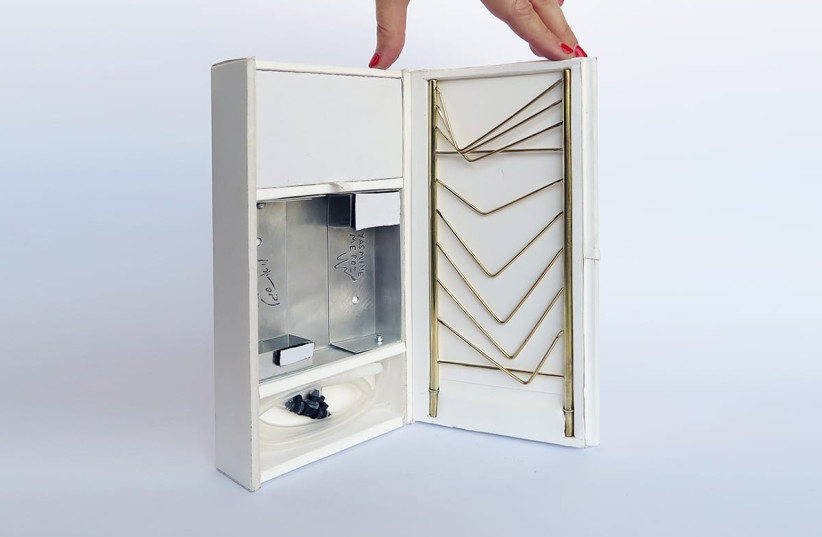
The sculpture, called "Impossible Object," is made of water and can only take its intended form in space, as it is designed to only hold its intended form in the absence of gravity.

By JERUSALEM POST STAFF
Published: APRIL 8, 2022

The ‘Impossible Object’ artwork.
(photo credit: DR. YASMINE MEROZ AND LIAT SEGAL)

Tel Aviv University physicist Dr. Yasmine Meroz and artist Liat Segal collaborated to create a sculpture that will be sent to the International Space Station (ISS).

The sculpture, called "Impossible Object," is made of water and can only take its intended form in space, as it is designed to only hold its intended form in the absence of gravity. The sculpture is made of brass pipes and rods that carry water. In zero gravity conditions, the water envelops the brass to form a 3D shape that resembles an endless staircase.

Meroz said the project bridges the gap between science and art: "There is much in common between art and scientific research: both are the result of a thought process in which creativity plays a central role and are motivated by the desire to ask interesting questions. 'Impossible Object' is a research-based artwork, where the medium is basically the physics underpinning water behavior in the absence of gravity. I learned a lot in the process, and I have no doubt it will contribute to research in my laboratory. In this respect, this work expresses the unrealized potential of the synergy between art and scientific research."


Segal said the project was a real cooperative effort with Meroz and that she was thrilled to have had the chance to work with her. "I am very happy about my collaboration with Yasmine, she said. "In this collaboration, we not only shared knowledge and inspiration, but we were also able to bring about a true co-creation, which could not have been realized by each one of us individually. ‘Impossible Object’ is timely, weighing the role of culture and art at an era when humanity is experiencing accelerated scientific and technological developments.


Segal also highlighted the significance of this artwork amid unprecedented advances in science. "Following incredible technological and scientific achievements in space, and as space tourism becomes tangible, it is important to reflect on the place of culture and arts in our lives, on earth and beyond," she said.


Giant, mysterious megalithic jars were unearthed in northeastern India

By Megan Marples, CNN - Thursday
© Courtesy Tilok Thakuria

Dozens of megalithic jars have been unearthed in Assam, India, at four previously unknown sites, according to a study published in the journal Asian Archaeology.

The stone jars range from 1 to 3 meters (about 3.2 to 9.8 feet) tall, according to study coauthor Nicholas Skopal, doctoral candidate at Australia National University in Canberra.

Some of the jars feature decorative carvings, while others are plain, he said. Around 65 jars have been discovered so far, but many more could be lurking beneath the ground, according to Skopal.

Researchers have yet to unravel the mystery of when these jars were made and which civilization used them, he said.

A handful of sites in the region with the same stone jars were discovered by the British in the 1920s, and prior to Skopal's 2020 excavation, there were seven known sites. His team was analyzing jars found at three of the locations.

While exploring the surrounding areas, they stumbled across four previously unknown sites with partially exposed jars, which was a pleasant surprise, Skopal said.

"By going out, surveying and documenting them properly, the government and universities can manage their heritage a lot better and preserve these jars for future generations," Skopal said.
A history of looters

By the time the research team found the exposed jars, most of their contents were long gone, Skopal said.

There are oral historical accounts of the Naga, local villagers, pulling beads and other items out of the jars, he said. While it's not known precisely when the beads were removed, since some of the locals still have them as family heirlooms, it's likely they unearthed the jars not too long ago, Skopal added.

"In one of the villages we're staying in, one of the elderly ladies actually showed me (some jewelry) that had been pulled out of the jar," he said.

Similar jars have been discovered in Laos, and researchers there have been fortunate to find jars that were still intact with artifacts like beads and human remains inside, Skopal said. He is hoping his team will eventually find unopened jars at the new sites in Assam to study the culture they originated from.


© Courtesy Tilok Thakuria
A handful of the jars featured chiseled designs.

"Some of the buried ones might have things still inside, but we haven't excavated yet," he said.
An unsolved mystery

It is difficult to date when these jars were first created, so researchers are not yet able to determine which civilization crafted the stone jars, Skopal said.

Early estimates date the artifacts to 400 BC or earlier, according to lead study author Tilok Thakuria, assistant professor in the History & Archaeology Department at the North-Eastern Hill University Tura Campus in Meghalaya, India.

Nailing down the time period in which these jars were created is the team's next priority, Skopal said.

To determine when the artifacts were buried, his team plans to use optically stimulated luminescence, called OSL. This is a dating method where you take a sediment sample from directly underneath the jar and determine when light last hit that sample, Skopal said.

The date would correspond with when the jars were buried, giving researchers a much better idea of when the jars were made.

Unearthing unopened jars will also be a big help in dating the stone pieces, according to Thakuria.

"We need to have a plan for excavation in Assam to recover material culture and to reconstruct social and cultural behavior of these groups of people," he said.


https://en.wikipedia.org/wiki/Plain_of_Jars

The Plain of Jars is a megalithic archaeological landscape in Laos. It consists of thousands of stone jars scattered around the upland valleys and the lower ...

https://www.atlasobscura.com/places/plain-of-jars

Nov 18, 2009 ... The Plain of Jars is a collection of large stone jars interspersed throughout the Xieng Khouang plain in the Lao Highlands.

https://www.livescience.com/plain-of-jars-burial-site-true-age.html

Apr 28, 2021 ... The mysterious Plain of Jars in northern Laos — a landscape dotted with massive stone jars hewn from sandstone thousands of years ago — was ...

Ichthyosaurs had BLUBBER just like whales, study finds

Shivali Best For Mailonline - Thursday

From seals to whales, many marine animals have a thick layer of fat directly under their skin, known as blubber.

Now, a new study has shown for the first time that ichthyosaurs – ancient marine reptiles that lived 150 million years ago – also had blubber.

Scientists from the Natural History Museum in Oslo have studied the remains of an ichthyosaur discovered in the Solnhofen area in Southern Germany.

The specimen includes the complete internal skeleton, which was stunningly preserved thanks to its blubber, according to the team.


© Provided by Daily Mail
A new study has shown for the first time that ichthyosaurs – ancient marine reptiles that lived 150 million years ago – had blubber

What is blubber?

Blubber is a thick layer of fat, also called adipose tissue, directly under the skin of all marine mammals.

Blubber covers the entire body of animals such as seals, whales, and walruses - except for their fins, flippers, and flukes.

Blubber an important part of a marine mammal's anatomy. It stores energy, insulates heat, and increases buoyancy.

Source: National Geographic

Ichtyhosaurs were marine reptiles that lived in the age of the dinosaurs, and are famous for their fish-like shape, resembling today's dolphins.

The team studied the remains of two ichthyosaur specimens found in the Sonhofen area and housed in the Jura Museum.

The first was a complete ichthyosaur, which the researchers believe landed on its back on the seafloor either during or after its death, where it was covered in fine sediments.

Meanwhile, the second was a tail fin with intact tail vertebrae and soft tissue around – confirming ichthyosaurs had moon-shaped tails.

Dr Lene Liebe Delsett, who led the study, said: 'The complete specimen is really what makes this project unique because it tells a complete story.

'Ichthyosaurs are not common as fossils in Solnhofen, which at the time was a relatively shallow area with many islands, whereas ichthyosaurs were open ocean dwellers.

'We do not know why this one entered the lagoons, but it might be the reason why it died.


© Provided by Daily MailIn the study, the team studied the remains of two ichthyosaur specimens found in the Sonhofen area and housed in the Jura Museum. The first (pictured) was a complete ichtyosaur, which the researchers believe landed on its back on the seafloor either during or after its death, where it was covered in fine sediments


© Provided by Daily MailTo analyse the ichthyosaurs, the researchers took samples of the soft tissue and looked at it via X-ray crystallography and a scanning electron microscope, while UV light (pictured) was used to study the shape of the bones

'Seeing the specimen makes an impact because it is so obviously a complete, dead animal body, where we can see its shape because of the unique preservation.'

To analyse the ichthyosaurs, the researchers took samples of the soft tissue and looked at it via X-ray crystallography and a scanning electron microscope, while UV light was used to study the shape of the bones.

Their analysis revealed that phosphate in the tissues of the ichthyosaurs likely contributed to the preservation of their skin and connective tissue.

'We know from earlier research that ichthyosaurs likely had blubber, like whales have today,' Dr Delsett explained.

'Our research confirms this, for a group of ichthyosaurs where this has not been certain.

'The blubber is another strong similarity between whales and ichthyosaurs, in addition to their body shape.

'In the future, I hope that these two ichthyosaurs from Solnhofen can be used to enhance our understanding of swimming, as they preserve tail and body shape.'
United Airlines is delaying the return of Boeing 777 planes after dozens were grounded last year due to an engine failure

rhogg@insider.com (Ryan Hogg) - 

© Provided by Business Insider
United grounded its fleet of Boeing 777s carrying Pratt & Whitney engines following an incident last year. AP

United has pushed back the return of some Boeing 777s to late May.

Those carrying Pratt & Whitney 4000 engines were grounded in 2021 after a serious incident.

United told Insider it was working with authorities to ensure the safe return of the fleet.

United Airlines is delaying the return of Boeing 777 planes that contain the same engines as one that failed and shed debris over Denver last year.


CNBC reported the news on Friday.

Dozens of planes containing Pratt & Whitney 4000 engines have been grounded since the incident in February last year. The Boeing 777 jet had been headed for Honolulu, Hawaii, but was forced to return to the airport when its right engine failed. Debris fell from the plane but no injuries or damage to property was reported.

"Due to the delay in the return of our PW777 aircraft to active service, the May flight schedule is being reconfigured to account for the lack of these aircraft," United told pilots in a note circulated on Friday and seen by CNBC.

CNBC reported that 52 United planes carried the Pratt & Whitney 4000 engines. The aircraft are now unlikely to return until at least May 12.

"We continue to work conscientiously with Boeing, Pratt & Whitney and the FAA to safely return these aircraft to service soon, and our current plan will allow them to return in the second half of May," United told Insider in a statement.

In a safety directive issued last month, the Federal Aviation Administration (FAA) last month issued safety directives to increase inspections of fan blades on those engines. Those directives go into effect April 15.

Boeing did not immediately respond to Insider's request for comment made outside of normal working hours.
 
More safety concerns for Boeing aircraft

The delay marks the latest signal of safety fears around some Boeing aircraft. On Tuesday, an Air France pilot was recorded as he seemingly struggled to control a Boeing 777 in Paris as it arrived from New York.

In March, China grounded its entire fleet of Boeing 737-800 passenger jets after a China East airliner with 132 people crashed in the southern Chinese region of Guangxi.
 
CARGILL
America's wealthiest agriculture family has gotten even richer as the Ukraine war sends food prices skyrocketing

htowey@insider.com (Hannah Towey) -

Martha "Muffy" MacMillan speaks during Women's Entrepreneurship Day at the United Nations in 2015. She is one of 12 billionaire heirs to the Cargill dynasty. 
Jemal Countess/Getty Images

The Cargills, an agricultural dynasty going back six generations, are one of America's richest families.

Three more Cargill heirs just joined Bloomberg's Billionaire Index, bringing the total to five.

The Ukraine war has sent food prices to a record high, "hitting the poorest the hardest," the UN says.


Three heirs of the Cargill-MacMillans, a six-generation dynasty that founded the world's largest agriculture company, have joined Bloomberg's Billionaire Index — bringing the total number of family members on the list to five.


The Cargill-MacMillans have consistently ranked among the 25 richest families in America, and are currently listed by Forbes as the nation's fourth-richest family, behind the Waltons, Kochs, and Mars. Together, the family has a combined net worth of $51.6 billion, Bloomberg reported in September.

The recent rise in the secretive family's fortune comes as the Ukraine war sends food prices around the world to record highs, a trend that will hit "the poorest the hardest," the UN said Friday.

But as rampant inflation and instability spark fears of a global food crisis, Big Agriculture companies have so far benefited from the volatility.

Cargill Inc. made $4.9 billion last year, its highest profit ever, per the Bloomberg report. And public competitors like Tyson Foods, Archer Daniels Midland, and Bunge each out-performed the market this week as the cost of soybeans, grains, and corn surge.

Approximately 90 family members own 88% of Cargill Inc., according to a Forbes profile from 2020. That makes the agriculture and commodities behemoth one of the largest, closely-held private companies in the country.

Cargill was one of the later companies to announce it would be scaling back its business in Russia, despite the fact that a shipping vessel charted by the company was hit by a missile as it left a Southern Ukraine port in late February.

When contacted by Insider, a Cargill spokesperson said they "cannot speak for the family members" and pointed to the company's statement on the situation in Ukraine posted to its website.

"We are scaling back our business activities there to only operate essential food and feed facilities and have stopped investment," the company announced on March 30. "This region plays a significant role in our global food system and is a critical source for key ingredients in basic staples like bread, infant formula and cereal. Food is a basic human right and should never be used as a weapon."

Cargill will also be donating "any profits from these essential activities to humanitarian aid," the statement continued.

SEE


• Plawiuk, Eugene W. Background on Cargill Inc., the Transnational Agribusiness Giant // Corporate Watch: GE Briefings. November 1998. 

https://www.academia.edu/33513470/William_Engahl_Seeds_of_destru