Thursday, May 05, 2022

Carbon, climate change and ocean anoxia in an ancient icehouse world

earth
Credit: CC0 Public Domain

A new study describes a period of rapid global climate change in an ice-capped world much like the present—but 304 million years ago. Within about 300,000 years, atmospheric carbon dioxide levels doubled, oceans became anoxic, and biodiversity dropped on land and at sea.

"It was one of the fastest warming events in Earth's history," said Isabel Montañez, distinguished professor in the Department of Earth and Planetary Sciences at the University of California, Davis.

Although several other 'hyperthermal' or rapid warming events are known in Earth's history, this is the first identified in an icehouse Earth, when the planet had ice caps and glaciers, comparable to the present day. It shows that an icehouse climate may be more sensitive to changes in  than warmer conditions, when CO2levels are already higher. The work is published this week in Proceedings of the National Academy of Sciences.

Montañez' lab has studied the period from 300 million to 260 million years ago, when Earth's climate went from a glacial icehouse to a hot, ice-free greenhouse. In 2007, they showed that the climate swung back and forth several times during this period.

More recently, Montañez' team and others have been able to home in on a transition 304 million years ago, the Kasimovian–Gzhelian boundary or KGB. They used multiple proxies, including  and  from rocks and plant fossils, and modeling to estimate atmospheric CO2 at the time.

The researchers estimate that about 9000 Gigatons of  were released into the atmosphere just before the K-G boundary.

"We don't have a rate, but it was one of the fastest in Earth's history," Montañez said. That doubled atmospheric CO2from approximately 350 parts per million, comparable to modern pre-industrial levels, to about 700 ppm.

Deep ocean dead zones

One of the consequences of global warming is marine anoxia, or a drop in dissolved oxygen in the . Melting ice caps release  onto the , creating a barrier to deep water circulation and cutting off the supply of oxygen. Without oxygen,  dies.

Lack of oxygen leaves its mark in uranium isotopes incorporated into rocks forming at the bottom of the ocean. By measuring uranium isotopes in carbonate rocks in present-day China, the researchers could get a proxy for the amount of oxygen—or lack of it—in the ocean when those rocks were laid down.

About 23 percent of the seafloor worldwide became anoxic dead zones, they estimate. That lines up with other studies showing big losses in biodiversity on land and at sea at the same time.

The effect of carbon release on ocean anoxia was significantly greater than that seen in other studies of rapid warming during 'greenhouse' conditions. That may be because the baseline level of atmospheric CO2 was already much higher.

"If you raised CO2 by the same amount in a greenhouse world, there isn't much affect, but icehouses seem to be much more sensitive to change and marine anoxia," Montañez said.

The massive carbon release may have been triggered by  that tore through carboniferous coal beds, Montañez said. The eruptions would also have started fires, and warming may have melted permafrost, leading to the release of more organic carbon.

Montañez is co-corresponding author on the paper with Jitao Chen, formerly a postdoctoral scholar at UC Davis and now at the Nanjing Institute of Geology and Palaeontology, China and Xiang-dong Wang, Nanjing University, China.

Changing resilience of oceans to climate change

More information: Marine anoxia linked to abrupt global warming during Earth's penultimate icehouse, Proceedings of the National Academy of Sciences (2022). DOI: 10.1073/pnas.2115231119

Journal information: Proceedings of the National Academy of Sciences 

Provided by UC Davis 


Researchers home in on Thera volcano eruption date

Researchers home in on Thera volcano eruption date
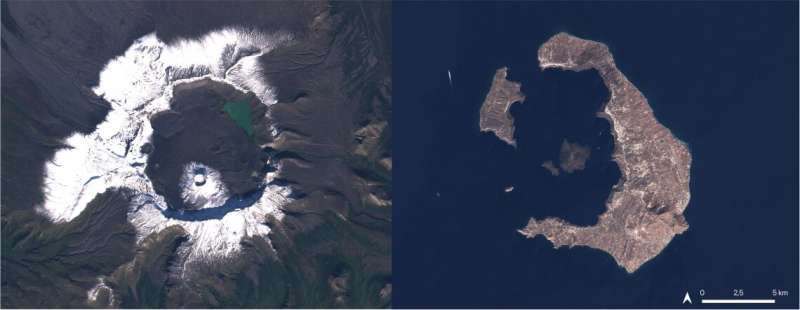
The volcanic craters of Aniakchak II (left) and Thera (right). Credit: Charlotte Pearson

A University of Arizona tree-ring expert is closer than ever to pinning down the date of the infamous Thera volcano eruption—a goal she has pursued for decades.

Charlotte Pearson, an associate professor in the Laboratory of Tree-Ring Research, is lead author of a new paper in PNAS Nexus that combines a mosaic of techniques to confirm the source of a volcanic eruption in 1628 B.C. While the eruption was previously thought to be Thera on the Greek island of Santorini, Pearson and her colleagues found instead that it was Alaskan volcano Aniakchak II.

The finding helps researchers narrow down when the actual Thera eruption took place.

Thera's massive eruption, known to have occurred sometime before 1500 B.C., buried the Minoan town of Akrotiri in more than 130 feet of debris. But the exact date of the eruption and its impact on climate have been debated for decades.

If a  is large enough, it can eject sulfur and debris called  into the stratosphere, where both can be circulated to places very far away. The  from the eruption that makes it into the upper atmosphere reflects heat from the sun and causes temperatures around the world to drop. This climatic shift is reflected in trees, which show reduced growth or frost rings that effectively mark the year in which the eruption occurred.

The sulfur and tephra can also rain down on Earth's poles, where they are preserved in layers of ice. When ice cores are analyzed, the amount of sulfate in them can also be used to estimate the likely impact of an eruption on climate. High-sulfate eruptions have greater potential to cause short-term shifts in climate. At the same time, the ice cores' tephra, which has a unique geochemical fingerprint, can be used to link the sulfur in the ice to an exact volcanic source.

Pearson and her collaborators—which included Michael Sigl of the University of Bern and an international team of geochemists,  experts and tephra chronologists—aligned data from  and from ice cores in Antarctica and Greenland to create a comprehensive record of volcanic eruptions across the period when Thera must have occurred—1680 to 1500 B.C. They used sulfate and tephra evidence to rule out several of the events as potential Thera dates and used high-resolution techniques to geochemically confirm through the ice cores that the eruption recorded in1628 B.C. was Aniakchak II.

Researchers home in on Thera volcano eruption date
The dark ring in this cutting of California Bristlecone pine marks an area of frost damage
 caused by the rapidly cooling climate due to the large amount of sulfate released by what
 scientists confirm was Aniakchak II rather than Thera. This marker (1627 BC) first 
connected tree grow and volcanic climate response, and ignited the work to synchronize 
tree rings and ice cores. Credit: Charlotte Pearson

The exact Thera eruption date remains unconfirmed, but the team has narrowed it down to just a handful of possibilities: 1611 B.C., 1562-1555 B.C. and 1538 B.C.

"One of these is Thera," Pearson said. "We just can't confirm which one yet, but at least we now know exactly where to look. The challenge with Thera is that there's always been this discrepancy between multiple lines of dating evidence. Now that we know what the possible dates are, this evidence can be re-evaluated, but we still need a geochemical fingerprint to clinch it."

A blast from the past

As an undergraduate student in 1997, Pearson read two papers that not only sparked her interest in tree-ring science but also marked the starting point of the larger Thera date debate.

The first paper, written by UArizona tree-ring researchers Valmore LaMarche and Katherine Hirschboeck, identified frost damage in bristlecone pine tree-rings from California that corresponded to the year 1627 B.C. The other paper, by Queen's University's Mike Baillie and UArizona's Martin Munro, identified a period of very narrow tree-rings in oak trees from Ireland that started in the year 1628 B.C. Both tree-ring anomalies indicated the sort of abrupt, severe climatic shift that occurs when volcanoes spew sulfate into the stratosphere.

Both sets of authors linked the tree ring-anomalies to Thera because at the time of the studies, Thera was the only known eruption in that approximate time period. But Pearson's latest paper confirms those tree-ring anomalies are actually evidence of a different, unusually high-sulfate eruption—Alaska's Aniakchak II volcano.

"We've looked at this same event that showed up in tree rings 7,000 kilometers apart, and we now know once and for all that this massive eruption is not Thera," Pearson said. "It's really nice to see that original connection resolved. It also makes perfect sense that Aniakchak II turns out to be one of the largest sulfate ejections in the last 4,000 years—the trees have been telling us this all along."

Researchers home in on Thera volcano eruption date
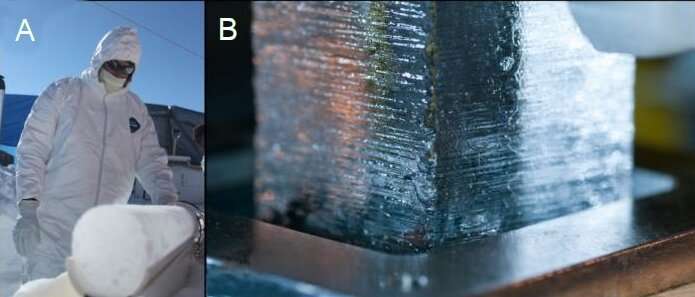
A: And ice core section from Greenland containing a record of volcanic sulfate. B: 
The ice is slowly melted and a variety of elements and chemical are simultaneously 
analyzed. Credit: Michael Sigl

The Thera eruption hunt continues

Archaeological evidence has suggested the date of the Thera eruption is closer to 1500 B.C., while some radiocarbon dating has suggested it's closer to 1600 B.C.

"I favor the middle ground. But we are really close to having a final solution to this problem. It's important to stay open to all possibilities and keep asking questions," Pearson said.

"Building evidence in this research is best compared to criminal cases, where suspects must be shown to be linked to both the scene and time of the crime," Sigl said. "Only in this case, the traces are already more than 3,500 years old."

The study also confirms that any climatic impact from Thera would have been relatively small, based on comparisons of sulfate spikes within the period with those of more recent documented eruptions.

The next step is to home in on the possible Thera  years and extract further chemical information from the sulfur and tephra in the ice cores. Somewhere in one of those sulfates there might be one piece of tephra that would have a chemical profile matching Thera.

"That's the dream. Then I'll have to find something else to obsess over," Pearson said. "For now, it's just nice to be closer than we have ever been before."

The study is part of a European Research Council-funded project led by Sigl at the Oeschger Centre for Climate Change Research at the University of Bern in Switzerland. The project is named THERA, short for Timing of Holocene volcanic Eruptions and their Radiative Aerosol forcing. In addition to UArizona, the study was carried out by an international network of experts from the University of Bern, University of St. Andrews, Swansea University, University of Maine, South Dakota State University and University of Florence.Dating the ancient Minoan eruption of Thera using tree rings

More information: Charlotte Pearson et al, Geochemical ice-core constraints on the timing and climatic impact of Aniakchak II (1628 BCE) and Thera (Minoan) volcanic eruptions, PNAS Nexus (2022). DOI: 10.1093/pnasnexus/pgac048

Provided by University of Arizona 

A new approach to improve the power control of wind farms

A new approach to improve the power control of wind farms
Figure summarizing the controller framework. Credit: Silva et al

To slow down climate change and prevent its adverse consequences, humans will need to transition to more sustainable energy sources. Engineers worldwide have thus been working on a wide range of technologies that can convert natural resources, such as sunlight, wind, and water, into electrical energy.

Wind turbines, devices that can convert the 's kinetic energy into electricity, are among the promising and widely implemented sustainable energy solutions. Despite their advantageous characteristics, the  of most existing wind turbines and other alternative energy solutions can be significantly unstable.

Several governments have thus started introducing legislation that forces wind turbine operators to offer ancillary grid services. These are essentially functions that help grid operators to maintain a reliable flow of electricity, addressing discrepancies between energy supply and demand.

Researchers at Delft University of Technology (TU Delft) have recently developed a controller that could help to better manage the  power of wind farms, through what is known as "active power control." This controller, presented in a paper pre-published on arXiv, could help to enhance the performance of wind farms, thus facilitating their implementation worldwide.

"The proposed design enhances power tracking stability and allows for a simple understanding, where each  is considered as a pure time-delay system," Jean Gonzalez Silva, Bart Matthijs Doekemeijer, Riccardo Ferrary, and Jan-Willem van Wingerden wrote in their paper.

To track the power of wind turbines, the researchers' approach employs a closed-loop algorithm. This algorithm has a feedforward and a feedback loop. The first ensures the tracking of power when turbines are not saturated, while the latter tracks power when one, but not all, of the turbines are saturated.

Gonzales Silva and his colleagues evaluated their controller in a series of test ran on SOWFA a high-fidelity wind plant simulator. Remarkably, they found that their approach improved the total active power tracking for the simulated wind farms significantly, increasing power production by up to 15% more than a baseline approach.

"The paper investigated the control performance with different nominal power distributions in a fully waked condition and limited power availability," the researchers explained in their paper. "Results demonstrate the improvement in power production obtained by closing the control loop, compared to greedy operation."

The improvement in the total active power tracking and  of  highlighted by the researchers' simulations suggests that their approach could help to significantly improve the performance of real-world wind farms. However, the team also observed a series of undesirable small spikes and oscillations on the active power of their closed-loop solution. In their next studies, they plan to try to devise a strategy to either eliminate or accommodate these oscillations, to improve their approach's performance and reliability.

"Our future research will elaborate smart time-varying distribution of the nominal active power by predicting available power, as well as consider designed constrained turbines due to faults and failures in the proposed APC solution," the researchers wrote in their paper.Steering wind turbines creates greater energy potential

More information: Jean Gonzalez Silva, Bart Matthijs Doekemeijer, Riccardo Ferrari, Jan-Willem van Wingerden, Active power control of wind farms: an instantaneous approach on waked conditions. arXiv:2204.05417v1 [eess.SY], arxiv.org/abs/2204.05417

© 2022 Science X Network

TC Energy interested in helping bring nuclear power to oilsands

The head of Canadian pipeline giant TC Energy Corp. says the company sees a future opportunity to get involved in providing small-scale nuclear power for Alberta's oilsands.

Chief executive François Poirier told analysts on a conference call Friday that TC Energy believes the oilsands are "an excellent use case" for small modular nuclear reactors, or SMRs.

He pointed out the company already has a 48.4 per cent ownership stake in Ontario-based nuclear generating company Bruce Power, which would make TC Energy's entry into the SMR space a logical step.

"We've got the technical expertise to develop and evaluate those technologies, but I think equally importantly we've got the commercial relationships with the oilsands producers. We have all the surrounding and supporting infrastructure on site to provide their steam and power needs," Poirier said Friday.

TC Energy has repeatedly stated that it believes "all forms of energy" will be needed in the coming decades to address growing global energy demand and concerns about energy security.

The company is also working to address its greenhouse gas emissions. Earlier this week, it announced plans to evaluate a hydrogen production hub in Crossfield, Alta., and last week it announced a collaboration with GreenGasUSA to develop a network or renewable natural gas (RNG) hubs in the United States.

TC Energy is also actively seeking potential contracts and investment opportunities in wind, solar and energy storage projects to meet the electricity needs of the U.S. portion of the Keystone pipeline system, and to supply renewable energy to the North American industrial and oil and gas sectors.

Poirier suggested Friday that nuclear could be the next step in this process for the company, though it won't happen this decade.

"The technology needs to be proven up. And in our view, the oilsands producers would need to buy into one common technology so that they have the requisite expertise to operate and maintain a fleet for these purposes. All of this is going to take time," he said. "So we view this more as an opportunity for the 2030s than for the second half of the 2020s."

According to the federal government, which has been investing in small modular nuclear research in the belief that it has potential to help Canada reach its climate goals, the technology has the potential to replace conventional coal and fossil fuel power generation and replace the use of fossil fuels in heavy industrial applications.

The Oil Sands Pathways to Net Zero initiative, an alliance of Canada's largest oilsands companies, has also proposed accelerating the application of small-scale nuclear reactors as part of its plan to reach net-zero carbon emissions from oilsands production by 2050.

Poirier's comments on nuclear power came the same day TC Energy said it earned $358 million in its first quarter compared with a loss of $1.06 billion in the same quarter last year when it took a charge related to the cancellation of its controversial Keystone XL project.

The company said the profit amounted to 36 cents per share for the quarter ended March 31 compared with a loss of $1.11 per share in the first three months of 2021.

Revenue for the three-month period totalled $3.5 billion, up from $3.38 billion a year earlier.

TC Energy said its comparable earnings for the quarter totalled $1.12 per share, down from a comparable profit of $1.16 per share a year earlier.

Analysts on average had expected a profit of $1.11 per share for the quarter, according to financial markets data firm Refinitiv.

In its outlook, TC Energy said it expects capital expenditures this year to be about $7 billion, up from an earlier forecast for about $6.5 billion, primarily due to higher costs for the NGTL System.

TC Energy's share price closed down $3.72, or 5.19 per cent, to $67.95 on the Toronto Stock Exchange on Friday.

A FIRST FOR CANADA: NEW TYPE OF NUCLEAR PLANT OPENING BY 2028

Published on Apr. 30, 2022,
Isabella O'Malley, M.Env.Sc
Reporter


Small, transportable modules could emerge as future nuclear plants are distributed across Canada.

Canada to welcome new nuclear technology
This new type of nuclear plant is scheduled to begin operating in Ontario by 2028.

Significant technological advancements have been made in nuclear energy over the past decades and it is being increasingly developed in Canada and other countries that are looking to lower their greenhouse gas emissions.

Nuclear energy is one of the more divisive carbon-free energies due to historic disasters and the disproportionate impacts that nuclear waste has had on marginalized communities. What’s clear is the confidence that many nations have in improving the safety of this energy, and experts say a major growth in this sector is just around the corner.

In March 2022 the energy ministers from Alberta, Saskatchewan, Ontario, and New Brunswick announced a joint strategic plan to develop innovative nuclear energy facilities. A small modular reactor (SMR) is planned for construction at the Chalk River Laboratories site in Ontario by 2028, which will be a first-of-its-kind in Canada. New Brunswick could see its first SMR in 2030 and Saskatchewan intends to construct their own by the mid 2030s


Chalk River Laboratories seen from Ottawa River, Ontario. Chalk River is considered to be the epicenter of nuclear research in Canada because of the large facilities where fundamental research for a number of industries is conducted. 
(Padraic Ryan/ Wikimedia Commons) (CC BY-SA 3.0)


SMRs are nuclear reactors that typically produce up to 300 megawatts (MW) of electricity, which is enough energy to power 300,000 homes for one year. SMRs can also support remote off-grid communities and supply power to existing grids.

“Currently, the [Chalk River] project is scheduled to come online around 2026 or 2027, which would make it Canada's first operating SMR,” Ken Darlington, VP of Corporate Development at Ultra Safe Nuclear Corporation (USNC), told The Weather Network.

USNC is a developer of micro modular nuclear reactor (MMR) technology and focuses on off-grid and remote markets to displace fossil fuels for electricity and heat generation. Every MMR is an SMR, as SMR is a broad term used for small modular reactors.


A rendering of USNC’s micro modular nuclear reactor. (USNC)


Darlington noted that Canada’s extensive land mass means that many northern and remote communities rely on diesel, a costly fossil fuel that releases significant amounts of greenhouse gases.

In terms of Canada’s national strategy to step away from fossil fuels as an energy source, Darlington said that time is of the essence for nuclear research and development.

“I personally don't believe there's a path to net zero without nuclear energy in the mix. Our reactors enable smaller communities and our resources sector to decarbonize. On a larger scale, looking at other current and future nuclear technologies needed to get to net zero in Canada, these technologies will need to be implemented with other clean technologies if we want to succeed in that goal.”

TECHNOLOGICAL DIFFERENCES FROM OLDER NUCLEAR PLANTS

USNC’s MMR technology is considerably different from the traditional nuclear plants of the past for a number of reasons.

Simply put, conventional nuclear plants split uranium atoms to release a significant amount of heat. This heat boils water, turning it into steam that rises and spins turbines to generate energy. Cooling towers are used to cool the steam to convert it back into water, which is then reused.

Used fuel contains radioactive material, which is extremely hazardous to human health, and can leak out of its containment areas if some type of damage occurs to the nuclear plant. One example is the Fukushima Daiichi Accident (2011), which happened when an earthquake-triggered tsunami crashed into the nuclear plant and caused three nuclear meltdowns that leaked radioactive materials for several days.


An aerial view of Fukushima Daichi Nuclear Power Station in Fukushima, Japan captured on February 21, 2007. (TEPCO/ Wikimedia Commons)(CC BY-SA 2.0)

Darlington said that SMRs are often referred to as “fourth generation advanced nuclear technology” that was designed to never release any radioactive materials into the environment.

The SMR’s reactor vessel, which is transportable and the size of a tanker truck, comes pre-fuelled and acts as a “nuclear battery.” The fuel inside of this vessel are solid kernels made from a mix of uranium, carbon, and oxygen, with each being roughly the size of a poppy seed. These kernels, which are covered in several ceramic coatings, are then encased in a diamond-like substance, which USNC calls Fully Ceramic Micro-Encapsulated (FCM) Fuel.

“The radioactive materials stay fully encased for their entire life and beyond. It's a very robust, strong fuel that's designed to make sure it indefinitely keeps the fuel safely inside the pellet,” Darlington said.

The silicon carbine used in USNC’s FCM Fuel is the diamond-like substance that helps encase the radioactive materials. (USNC)

The fuel pellets are stacked into graphite blocks where helium gas flows through cooling channels to moderate temperatures. USNC says the benefit of using helium is that it does not react with the fuel or main parts of the reactor and remains free of radioactive products.

Some of the main differences that the MMR has from conventional nuclear plants is that the reactor cannot meltdown as the heat is passively released into the environment, does not need any active systems to remove heat, and requires no on-site fuel storage, handling, or processing. These aspects are why USNC has dubbed this design a “walk-away safe reactor” that can last for 20 years once installed.

Darlington explains that during the decommissioning process, the core of the reactor could be replaced or the reactor could be removed and enter the federally regulated nuclear waste stream.

David Novog, a nuclear energy professor at McMaster University, explains that there is currently zero nuclear waste buried in Canada and that spent nuclear fuel is stored at the facilities where it was used to generate electricity. However, this could change in the future.

“The proposed long term vision is that we would develop a site and right now there's two sites that are being developed and explored for long term repository. So the goal of this is to find a really old rock formation, one that's hundreds of thousands of years old and hasn't moved in a very long time, and to bore into this rock and use that as a long term repository.”

CONSULTING LOCAL COMMUNITIES

Chalk River Laboratories, where Canada’s first SMR is planned for construction, is what Novog describes as the nation’s “epicentre of nuclear research” and has over 50 facilities and laboratories where research is conducted.

Communities and regions in eastern Ontario that are located near Chalk River have historically expressed concern about nuclear energy and mistrust of the organizations that oversee nuclear activity, particularly communities that have been historically oppressed by the governing bodies in Canada.
Article continues below

Some concerns also stem from several nuclear accidents that occurred at Chalk River in the 1950s. Ottawa Riverkeeper, a grassroots charity, states in a blog published in February 2022 that “several Waste Management Areas at the Chalk River site that have caused contamination of the groundwater, which continues to be released into the freshwater streams and lakes of the region to this day.”

“[There’s] nothing that I am aware of today,” Novog stated when asked if radioactive materials are currently being released from Chalk River.

“Chalk River is what we call a legacy nuclear site. Work was done there even during World War 2 in terms of developing and supporting the U.S. nuclear energy efforts and weapons. When we have a site that is that old, we have safety officers in every building. We track down to the gram for every level of contamination that we have in any facility. But it wasn't always that way in the 1950s and 1960s.”


An aerial view of Chalk River Laboratories in Ontario, Canada. (Government of Canada)

Eric McGoey, communications and engagement director for Global First Power, told The Weather Network that consultation with local Indigenous communities has been an essential aspect of developing the SMR at Chalk River.

“We’re talking to Algonquin communities on the Ontario side of the Ottawa River, Algonquin communities on the Quebec side of the Ottawa River, Métis communities, and the Mississauga communities that are part of the Williams Treaties First Nations whose treaty territory includes the Ottawa Valley.”

Understanding how SMRs impact the environment and people that live closely with the land will be essential for transitioning northern and remote communities from diesel to a carbon-free energy source. McGoey notes that building relationships with Indigenous communities that could one day opt for SMRs must be done in a meaningful way.

"Canada's shame is our mistreatment of Indigenous peoples and the legacy of colonialism. And if we don't build our projects in a way that is inclusive and that brings tangible benefits to Indigenous communities, this will have been a massive miscalculation," said McGoey.

"There are some communities that are just not going to be interested in nuclear power in their territory for a very long time. And we have to respect that. That's going to be slow work, but it's really important work."

Novog says that what makes SMRs particularly suitable for electrifying remote and northern communities is the “equalization and quality of life and equalization in costs” that diesel does not provide.

“There’s a lot of extra things you can do with SMR energy. The natural waste heat can heat a greenhouse, you can establish agriculture facilities connected to the SMR energy source, which provides a massive benefit to the community. You can think of the reactors in the North as an hub for a whole bunch of tangential benefits.”

“When you start looking at it, you can start seeing how not just the energy problem can be solved, but much more.”

LIFE WITH NUCLEAR ENERGY


According to a survey by the Canadian Nuclear Association published in 2021, 86 per cent of Canadians believe the government should invest in clean technologies including renewables and nuclear energy, but nearly half (42 per cent) say they need to understand more to form an opinion about this energy source.

When asked why nuclear energy is such a taboo topic, Novog cited the severe social and economic consequences that historic nuclear accidents have had, which stays in peoples’ long term memories.


McMaster University, roughly a one-hour drive from Toronto, is home to the largest research reactor in Canada and the university offers tours to the public to provide an opportunity to learn more about nuclear energy.

The McMaster Nuclear Reactor (MNR) first became operational in 1959 and is a world leader in the production of iodine-125, a radioactive isotope that is used in the treatment of prostate cancer, with hundreds of doses produced each week. (McMaster University)

“We bring people into McMaster because we have a 5 MW reactor on campus. We have students all around, people live in the community very close to the reactor, and it's sort of like a model of how these reactors could fit into communities. You can actually see used nuclear fuel. It’s not a taboo topic because we can show everybody the different elements of nuclear energy, from fresh fuel to the reactor to medical isotopes.”

“Some of our highest support for nuclear energy is in the community surrounding our nuclear power plants or nuclear research facilities. And that's not surprising, because they get to know the technology the best by interacting with their neighbors or being employees at the sites.”

Under Canada’s SMR Action Plan, released December 2020, the federal government stated that $100 million will be invested in three major projects and 100 partners, including governments, industry, and Indigenous peoples will collaborate to advance SMRs.

Despite the complex nature of this energy source, split public opinion, and emerging technologies that have yet to be commercialized — what’s clear is that big bets are being made on nuclear energy in Canada, and concrete developments are likely coming much sooner than what some may think.

Thumbnail credit: USNC


‘We were told our brothers were dead’: Chile’s lost tribe reclaims identity

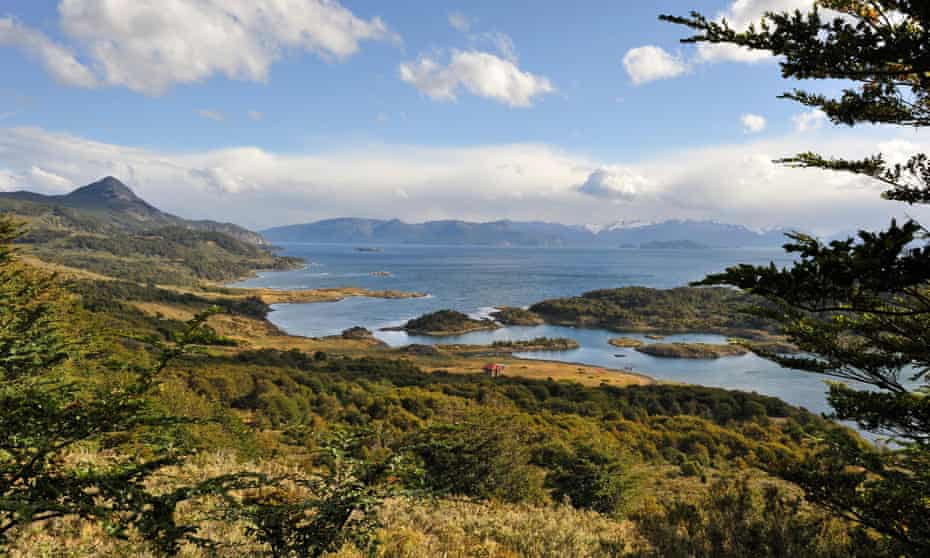
Tierra del Fuego, the remote South American island now divided between Chile and Argentina, was home to peoples such as the Selk’nam for 10,000 years. 
Photograph: Age Fotostock/Alamy


History books said the Selk’nam, inhabitants of Tierra del Fuego at the southern tip of South America, were extinct but Chile may be about to legally recognize their descendants

Mat Youkee in Tierra del Fuego
@matyoukeeTue 3 May 2022 

One of José Vásquez Chogue’s enduring childhood memories is that of his grandfather on the doorstep of his home in the Chilean capital, Santiago, staring at the night sky. “He would always face south,” Vásquez recalled. “He would point out the Southern Cross and show me the stars which represent our ancestors.”


‘For our grandchildren’: the man recording the lives of Paraguay’s vanishing forest people

The older man had grown up on a frozen and remote island in Patagonia and was a member of the Selk’nam tribe. But Chilean history books had declared the people extinct. When José, captivated by the anthropological displays of Chile’s National History Museum, tried to explain his bloodline to a member of staff he was met with derision. “I told him that they were my people, but he didn’t believe me. We were taught at school that all our brothers were all dead.”

The redrafting of Chile’s constitution has created the opportunity to set the history books straight. After Vásquez made an impassioned intervention at the constitutional convention in August, the government released funds for an anthropological, historiographic and archeological study of the Selk’nam. The results of that study, released earlier this month, acknowledged the continued existence of the people and called for their legal recognition.

“The Selk’nam people are not extinct, they are currently in a process of cultural reappropriation and recreation, and they have the right to reconstruct their own [historical] memory,” said Karla Rubilar, the minister of social development.

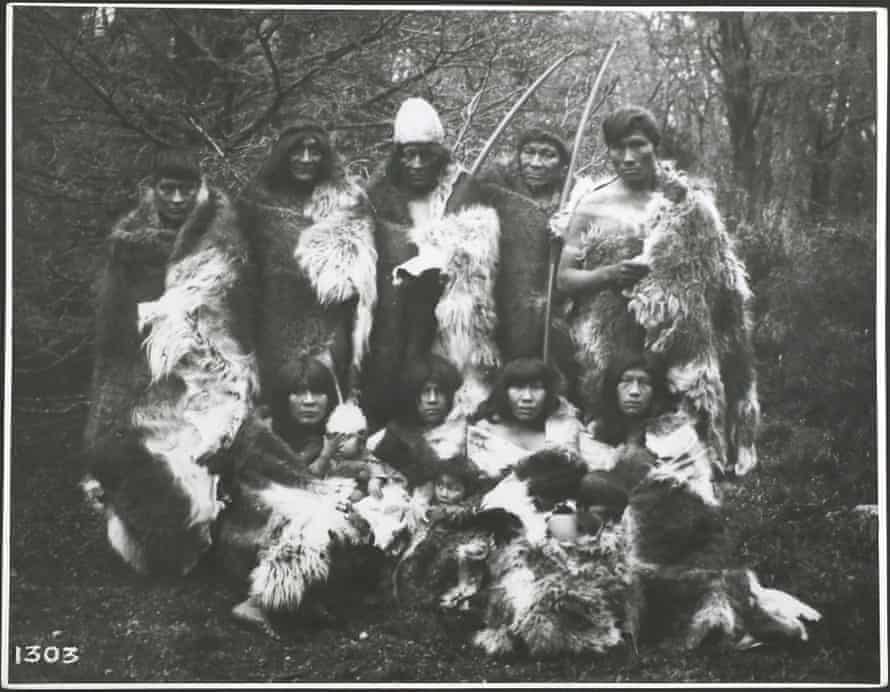
People of the Selk’nam tribe wearing furs, circa 1890-1900. 
Photograph: Hulton Archive/Getty Images

If, in the months ahead, the government of Gabriel Boric legally recognizes the Selk’nam, they could be eligible for land and legislative representation. But more important for Vásquez would be the recognition of the crimes committed against his ancestors.

“It’s important that the history of our people and the truth come to light, so people know what happened to the Selk’nam and the other Indigenous peoples in Chile,” he says.

When Ferdinand Magellan rounded the southern tip of South America in 1520, it was the campfires of Indigenous tribes, burning on the hillside, that gave the region its name: Tierra del Fuego (Land of Fire). The main island – now split between Chile and Argentina – and the surrounding archipelago had been inhabited for over 10,000 years by hunter-gatherer peoples feeding on shellfish, berries and guanaco, a relative of the llama.
Jose Vásquez: ‘It’s important that the history of our people and the truth come to light.’ Photograph: Alberto Valdés/EPA

Subsequent European exploration left a legacy of bleak place names – Port Famine, Useless Bay, Tortuous Passage – but the newcomers had limited contact with Indigenous people.

In November 1886 Ramón Lista, an Argentinian explorer landed on the windswept and barren shores of the Bay of San Sebastián in Tierra del Fuego. By his own account, lacking the resources to take them prisoner, he ordered his accompanying soldiers to shoot 28 Selk’nam, including women and children, that they encountered there.

In the following 40 years Argentinian and Chilean ranchers and miners would exterminate thousands of Selk’nam, dispatch others to German human zoos, and send many more to Salesian Christian missions where they frequently succumbed to disease. The last known full-blood Selk’nam died in 1974.


Indigenous Chileans defend their land against loggers with radical tactics

On the Argentinian side of Tierra del Fuego, the Selk’nam of the maternal line have been recognized by law since 1994 and 36,000 hectares provided to the community as ancestral lands. Last year 25 November - the anniversary of the massacre perpetrated by Lista - was recognized as the Day of the Selk’nam Genocide and flags were flown at half-mast.

“The Argentinian state came to exterminate, it was a genocide and now it is a day of mourning” says Vanina Ojeda, a Selk’nam who is now secretary of Original Peoples for Tierra del Fuego. “For years the state tried to make invisible the crimes of the past, now it has a duty of historical reparation.”
Advertisement

In 1993 Chile enacted its Indigenous law, recognizing eight peoples, including the Mapuche – who make up 12% of Chile’s population – and the Rapa Nui of Easter Island. In some cases land titles and limited legislative representation have been offered, but the continued expansion of timber, mining and agricultural projects – combined with heavy-handed policing – has led to rising social tensions in the south of the country.

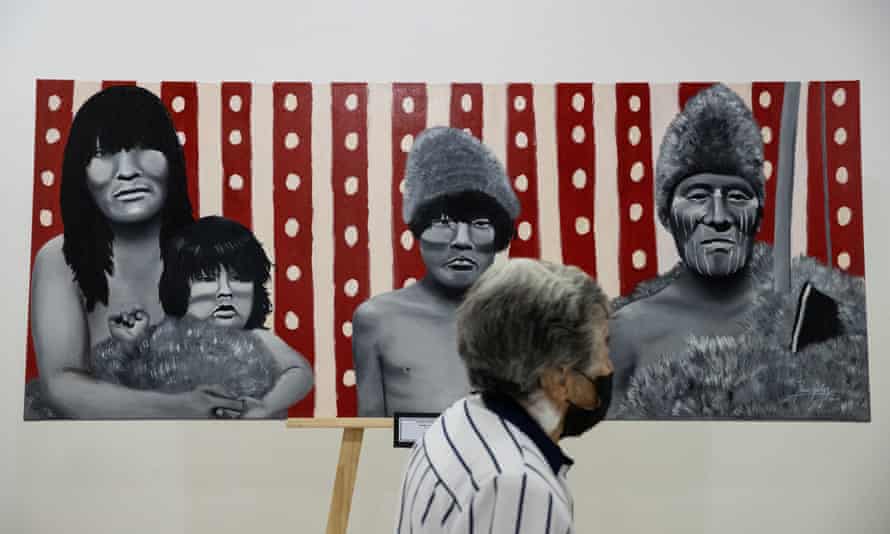
A woman looks at a painting representing members of the Selk’nam people in Santiago, Chile, in February.
 Photograph: Alberto Valdés/EPA

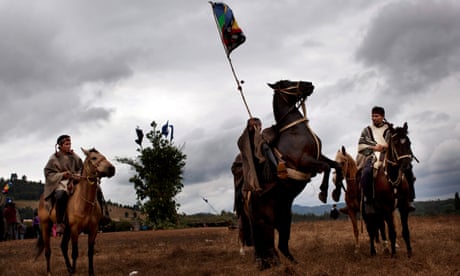
Mapuche flags were a prominent symbol of Chile’s 2019 protest movements that coalesced around the goal of changing the constitution.

In Chile’s 2017 census 1,144 respondents self-identified as Selk’nam but they were dispersed across the country. In 2018 Vásquez attended a cultural event for Selk’nam that he had seen posted on Facebook. “We hugged and we cried because it was the first time we had met people from our community, our brothers and sisters,” he says.

With the help of the community he was able to gather further details of the life of his grandfather, Carmelo Chogue, who had spent his childhood in the Salesian mission on Isla Dawson, a remote island so inhospitable it was later used to intern political prisoners during the Pinochet dictatorship.

In October 2020 Vásquez was able to visit Tierra del Fuego for the first time. When he crossed the Strait of Magellan, emotion overcame him.

“I saw the land where my father had come from, I saw Isla Dawson and when I got off the boat the first thing I did was to take a handful of earth and grasp it tightly with my hand. Then I started to cry and cry.”
OTTAWA
Kanata's Blanding's turtles headed for extinction as development breaks up their habitat

"They play an important role in the ecosystem, and for that reason alone it’s important not to let them die off.”

Author of the article: Bruce Deachman
Publishing date: May 02, 2022 • 
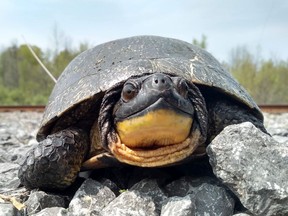
Between 2010 and 2020, the adult population of Blanding's turtles in and around the South March Highlands Conservation Area fell from 81 to 25, with computer models suggesting that they will become functionally extinct in the area by 2030.

 PHOTO BY PROVIDED /Courtesy of Anni Auge
Article content

Every year for four years, Anni Auge would come across Sparkles, an adult female Blanding’s turtle who lived — and perhaps still resides — in and around the South March Conservation Area in Kanata.

It’s nearly impossible to accurately determine Sparkles’ age. Blanding’s turtles stop growing when they’re about 20 years old and, unlike readers of this story, don’t show the typical signs of aging brought on by cellular deterioration, making them valuable for research into longevity. Named for 19th-century American naturalist William Blanding, the turtles can produce offspring into their 80s.

“They’re one of the longest-lived freshwater turtles,” says Auge, “so there’s some knowledge in them.”

Beyond simply their research value, Auge says the turtles significantly contribute to the biodiversity of the region. “That, by itself, is important. They’re predators, while their eggs and hatchlings are eaten by other predators. They play an important role in the ecosystem, and for that reason alone it’s important not to let them die off.”

Unfortunately, that’s precisely what’s happening.

Anni Auge is a PhD student at Trent University who studied the decline of the population of the already threatened Blanding’s turtles due to urban development along Terry Fox Drive in Kanata. Her research suggests the animals will be ‘functionally’ extinct by 2030. 
PHOTO BY JEAN LEVAC /Postmedia

Using GPS tags, Auge, an Ottawa resident and a PhD candidate in Trent University’s Environmental Life Sciences department, tracked and studied Kanata’s Blanding’s turtles from 2017 to 2020 as part of a requirement that land developers hire biologists to study the effects of urban growth. Auge’s findings, coupled with those of a similar study conducted through the City of Ottawa from 2010-13, paint a grim picture for the region’s Blanding’s population: over the past decade, the adult Blanding’s population fell from 81 to 25, a nearly 70 per cent decline, as the wetland area shrunk by 13.6 per cent and suitable habitat for the turtles was cut by almost 10 per cent.

Worse, however, is the expected trajectory for the yellow-necked animals that always appear to be smiling. Already listed as threatened in Ontario and endangered elsewhere, Auge says that computer models indicate that, at the present rate, Blanding’s turtles will become functionally extinct in the Kanata area by 2030, meaning that the female adult population will have dwindled to four or fewer individuals, ensuring an unavoidable path to extinction.

“There just won’t be enough to sustain a population in the area. The road mortality rate is so high, and we’re already at such a low population. It’s inevitable.”

She hopes to have her 48-page report published in Biological Conservation, a peer-reviewed journal.

Loss of habitat is the largest threat to the freshwater turtles, with increasing road mortality, especially of females in search of or returning from nesting grounds, the leading cause of death. About four adult females are killed each year by vehicles, she says, with devastating consequences for such a small population.

Auge points to recent development, both commercial and residential, along Terry Fox Drive as an example. Developers’ efforts at mitigation, she says, while good in theory — fences to keep the turtles off roads, for example, culverts to allow them subterranean road passage, and the creation of artificial wetlands — aren’t doing enough. Human-made wetlands, often little more than a large puddle when they’re created, take time to grow into a viable ecosystem, while fencing damaged by storms or removed due to development, as well as other hard-to-isolate features such as railroad tracks, make it difficult to keep the turtles, who may travel more than 20 km. in a year, safe.

“They also want to nest on the side of the road,” Auge adds. “The gravel is good material. It’s warm, which is good for the nest, and so they think that’s a good place to lay their eggs. And if they lay their eggs there and they hatch, the hatchlings often go onto the road.”

Auge would like to see more and better mitigation measures. The artificial habitats, she says, have been built close to roads and railway lines, when they would be more effective farther from human activity. Additionally, there’s less new habitat being created than what’s being developed. Fences, she adds, could also be better maintained.

“The theory is good, but the implementation could have been better.”

She also feels that monitoring the effectiveness of mitigation measures is a vital but under-utilized tool to study the turtle population. “We monitored the turtles for four years, but that was really only when the development began. Who know what’s happening now? It should be monitored long term, to get an idea of how well these measures work.”

Ultimately, though, she feels urban development and natural ecosystems will always clash. “The results weren’t surprising. We know that development always contributes to habitat destruction and population extinction. And in this case it’s terrible for the (Blanding’s) population. And this is happening everywhere else, too.

“My data ended in 2020 and it’s now two years later,” she adds, “so who knows what the population is down to. I wonder what happened to Sprinkles.”

bdeachman@postmedia.com

Burkina Faso investigates B.C. mine company after flood leaves 8 trapped underground

Heavy rainfall in April caused flash floods and left workers in West African country missing

Stock image of mining operations. Efforts to find and rescue eight miners trapped underground in Burkina Faso are ongoing, B.C.-based Trevali Mining Corp. said on Monday. (Shutterstock

The government of Burkina Faso, a land-locked country located in West Africa, has launched a judicial investigation into a flood at a zinc mine that left eight workers trapped, with rescue efforts entering a third week, it said.

B.C.-based Trevali Mining Corp. suspended operations at its Perkoa mine on April 16, when heavy rainfall caused flash floods and left eight workers missing underground. Search and rescue efforts are ongoing, it said on Monday.

Following a visit to the site on Sunday, Burkina Faso Prime Minister Albert Ouedraogo said that managers of the mine had been banned from leaving the country while investigations were underway into the cause of the incident.

"Precautionary measures have been taken to prevent the persons in charge of the mine from leaving the country and instructions have been given firmly to the minister of security for this," said a statement from the prime minister's office.

Trevali, whose headquarters are in Vancouver, said it had received no official communication but was aware of the prime minister's comments. The company is also investigating the cause of the accident, it said.

"Senior management of Trevali remains at the Perkoa Mine and are overseeing the active dewatering and mine rehabilitation work," said Jason Mercier, the company's director of investor relations.

"Trevali continues to work at maximum capacity, 24 hours a day, to locate the missing workers," he told Reuters.

In a previous statement, the company said that while most workers underground were able to safely evacuate, the eight missing workers were working below Level 520, which is 520 metres from the surface, at the time of the flooding.

There are two refuge chambers located below Level 520 designed in case miners become trapped, but the company said it did not know if any of the missing workers had been able to reach them.

Mexico’s media tackles deadly 2022, but president plays victim

AFP 03/05/2022

Relatives of Mexican journalist Armando Linares mourn during his funeral in Zitacuaro, Michoacan state, Mexico, March 16.
Enrique Castro/AFP/Getty Images

Mexican journalist Armando Linares sheds tears as he describes the press’s powerlessness to defend itself in an area filled with drug cartel activity.

In an emotional Facebook video posted earlier this year, he announced the murder of an aide, Roberto Toledo, who was shot dead in January in the garage of a law office in the western state of Michoacan. He said the murders followed threats made against Monitor Michoacán, a publication Mr Linares worked for that was digging into local corruption.

“We don’t carry weapons. Our only defense is a pen, a pencil and a notebook,” Mr. Linares said in the video. “There are names and we know where it all comes from.”

Mr Linares was killed six weeks later, as gunmen shot him at home in front of his family. The journalists covering his funeral were chased away by the thugs. Monitor Michoacan subsequently suspended its operations.

Mexico has long been the hemisphere’s deadliest country for news media worker. The confluence of rampant drug cartel violence, political corruption and total impunity – few crimes committed against journalists are prosecuted or punished – has turned the country into a graveyard for journalists.

According to the New York-based Committee to Protect Journalists, eight Mexican journalists have been murdered so far in 2022 – which corresponds to nine murders in 2021. This is the highest total for any country outside the war zone.

“Tolerating violence against journalists is what generates and allows this violence against journalists to continue,” said Diego Peterson Farah, a columnist for the Guadalajara newspaper El Informador. “It is relatively cheap to kill a journalist in many parts of Mexico knowing there are no consequences.”

President Andres Manuel López Obrador has added to the sadness for journalists. He has expressed condolences and expressed solidarity after the killing of news media personnel. But he has also described himself as a victim, calling the widespread outrage over such killings a “false” attack on his administration.

“Of course our adversaries take advantage of anything to attack us,” Mr. López Obrador said in January after the assassination of Tijuana journalist Lourdes Maldonado. The second murder of a journalist in a border town in less than two weeks.

Mr. López Obrador later attributed the violence to the lingering legacy of neoliberalism in Mexico. He enthused the European Parliament after passing a resolution expressing concern over the killing of journalists in country.

“It is regrettable that you will be involved like sheep in the reactionary and coup tactics of a corrupt group that opposes the Fourth Change,” wrote Mr. López Obrador, referring to his government’s branding.

He has also targeted journalists probing his government and family. He also used his daily press conferences to allegedly spread personal financial information on journalist Carlos Lorette de Mola, whose outlet, Latinas, reported the president’s sons living in a Houston luxury home owned by a senior executive with a state contractor. uncovered one. -run oil company Pemex. (The president’s son, Jose Ramón López Beltrán, has denied any wrongdoing.)

AMLO – as the President is known – will stop attacks on journalists when he comes to power in December 2018. But according to the press freedom organization Article 19, attacks have increased by 85 percent.

Observers say they fundamentally misunderstood the matter. AMLO speaks of the state that journalists are no longer being persecuted, but that it “disregards the responsibility of the state to prosecute and punish those who attack and kill journalists,” in the northern city of Torren. Javier Garza, a journalist from

Mexican press-freedom advocates have described a complex reality of “narco-politics”, the intersection of drug cartel control and state authority in many parts of the country along the line between the two blurring. This creates areas of silence as cartels intimidate journalists and news media outlets do not know what content is safe to publish.

Monitor Michoacan covered an area of ​​silence in western Michoacan state, an area rife with violence in the form of drug cartels and criminal groups that were involved in activities such as illegal logging. The outlet focused on police issues and was often the first to be on the scene of breaking stories, broadcast live on social media. But like many other media outlets in the region, it steered clear of directly covering the cartel.

Advocates wonder whether AMLO’s verbal attacks on the news media lead to physical attacks, and say local politicians are imitating his belligerence, sparring with journalists and fighting at press conferences. The president holds a two-hour press conference every morning, in which he trolls his political opponents and fields softballs from “YouTubers” – friendly journalists livestreaming the event.

He raises some tough questions – but the journalists who ask him are later besieged by AMLO partisans on social media. The President also includes a weekly section known as “Who’s in the Lies”, which aims to point out the mistakes of the press, although there are often errors in the process.

Journalist Gildo Garza, who was forced to flee northern Tamaulipas state in 2017 after being threatened by Los Zetas, a notoriously violent drug cartel, said, “This is a gathering where they hunt down journalists and activists and everyone is telling the truth. Which bothers this man.”

,He is openly hostile to the press. Others were more prudent, more hypocritical,” said Carlos Bravo Rezidor, a professor of journalism in Mexico City, referring to former presidents. “He didn’t like the press, but he felt he had to adjust to it. AMLO just hates the press and wants to end it.”