Wednesday, May 25, 2022

IT'S PLANTING TIME 

Grow tomatoes, not carrots and other tips for keeping lead out of your garden produce

Chicago soil can contain high levels of lead and other heavy metals.

 Check out this guide to making gardening safer.
Curious City lead gardening
Maggie Sivit / WBEZ
WBEZ brings you fact-based news and information. Sign up for our newsletters to stay up to date on the stories that matter.

Kat Powers has grown herbs, tomatoes and native plants in her garden in Andersonville.

“I’ve been lucky enough to have dug up two backyards,” she said. She’s about to start planting a

new summer garden in Lincoln Square. This time the project is more “ambitious,” as she plans to grow tomatoes, eggplant, squash, peppers and maybe even some peas.

While Kat enjoys gardening and considers it a healing practice, she’s always wondered whether any of the pollutants in the soil, things like lead and other heavy metals, actually seep into the stuff she’s growing. And if they do, she wonders whether there are things she can do to try to minimize any health risks. So she wrote into Curious City to find out.

These are good questions because decades of industrial pollution from heavy industry, the use of lead paint on older homes (federal restrictions were not imposed until the late 1970s), gasoline exhaust and old plumbing infrastructure made with lead can all contaminate the soil. Once accumulated in the soil, heavy metals like lead lurk indefinitely and if ingested, can pose health risks including developmental issues in children and heart problems in adults.

Since lead occurs naturally in soil, we’ve all been exposed to a little lead. But “the dose matters,” said Gabriel Filippelli, a professor of earth sciences and director of the Center for Urban Health at Indiana University – Purdue University Indianapolis. In urban settings Filippelli says it’s possible to find as much as 100 times the natural levels of lead due to contamination. Plus, where there is lead, you usually find other heavy metal contaminants like mercury and arsenic.

In a recent study, Andrew Margenot, a University of Illinois crop sciences researcher took 2,000 soil samples from across Chicago backyards and parkways and found the city’s median soil lead level is 220 parts per million (ppm) — that’s ten times higher than the 20 ppm natural level. Margenot also found that 20 percent of the city exceeds the Illinois Environmental Protection Agency’s safe limit of 400 ppm for growing crops, and all of the city is well above the California EPA state limit of 80 ppm. Some areas on the South and West Sides exceed 1,000 ppm.

So what does that mean for gardeners like Kat and the city’s nearly 900 community gardens growing produce in that soil? Here’s what you need to know about how likely it is your produce might be contaminated with lead, how to get your soil tested and what you can do to minimize the risks of growing contaminated produce.
Maggie Sivit / WBEZ

How does lead get into your produce in the first place?

Lead finds its way into plants in two main ways. The first is through adhesion — that’s when dust from the soil containing lead sticks to the surface of plants like tomatoes or kale and can get into your body if you don’t thoroughly wash it. That’s a problem for some leaf and root vegetables that are difficult to wash thoroughly.

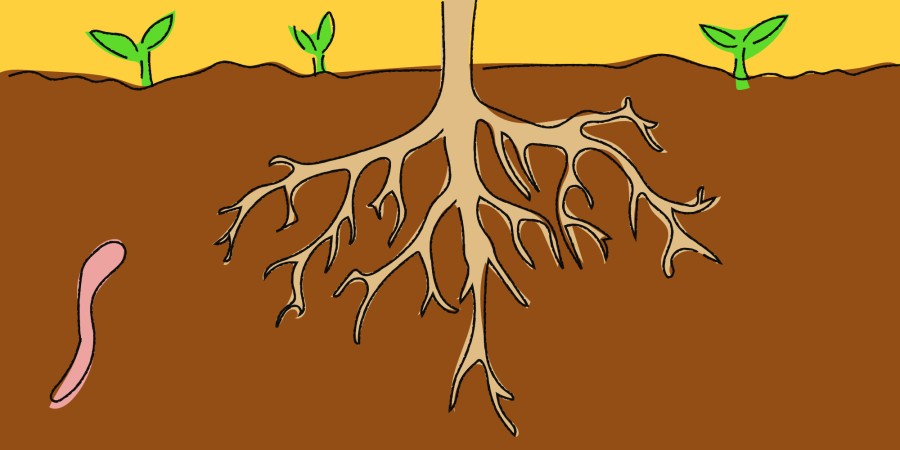
The second way lead can enter produce is by uptake. That’s when lead in the soil gets sucked up into a plant’s vascular system through its roots. That can happen in two ways, U of I’s Margenot said. First, harmful heavy metals closely mimic the shape and size of nutrients the plant wants — for example, to a plant, lead looks a lot like calcium and arsenic looks a lot like phosphorus. That allows them to enter roots undetected through ion transport channels designed to let in nutrients.

“These ion transport channels in the roots, they’re like tiny doors … like a puzzle piece, if the metal is the right size and fit, it’ll sneak in,” Margenot said.

Heavy metals can also bypass those ion transport channels completely and break in by building up on top of a root’s protective film barrier layer, which then breaks like a dam under the pressure.

Once inside the plant’s vascular system, heavy metals move around and accumulate in edible tissue, like leaves and fruit.
Maggie Sivit / WBEZ

Avoid the roots and shoots, go for the fruits

That old gardener’s adage turns out to be pretty good advice, Margenot said. The idea is that the most lead accumulates in a plant’s roots, with less in the leaves and even less in the fruits.

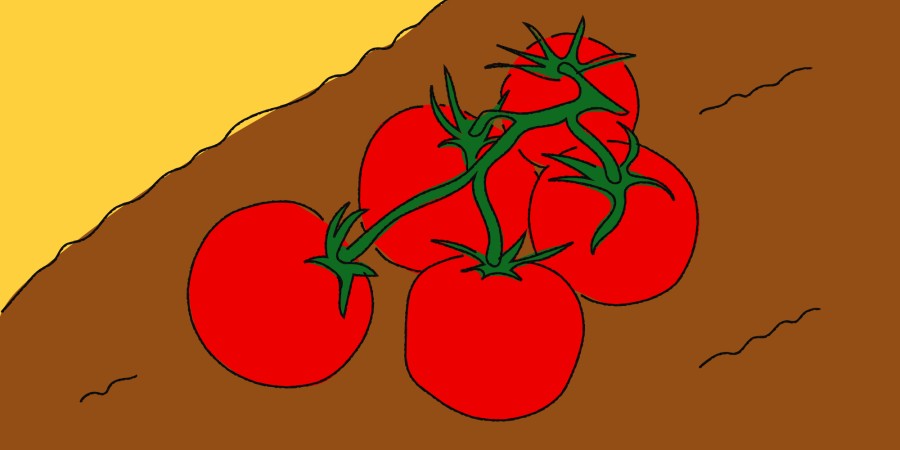
Tomatoes are a good example. In the first study of lead uptake in Chicago garden plants, Margenot found that even when the soil they were grown in had 1200 ppm of lead (the EPA says not to grow produce in soil with more than 400 ppm), lead levels were high in the plants leaves but low in the tomatoes.

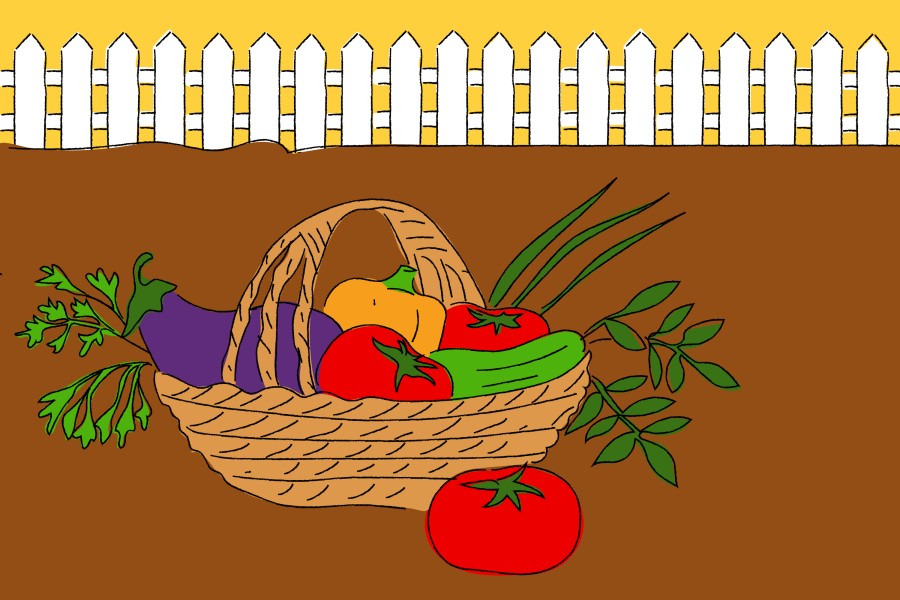
Besides tomatoes, Margenot recommends growing fruiting vegetables, things like zucchini and cucumbers.

Peppers, melons and strawberries are also good options, Filipelli added.

Though his study didn’t address root vegetables, Margenot said he would avoid growing them altogether in Chicago soil.

“For root crops like carrots, or onions, or potatoes, even if you peel them, you still may have this higher lead in the tissue,” Margenot said. “So I think it’s fair to say that if you’ve got a high amount of lead in your soil, you just don’t want to put in root vegetables.”

How do you know if you should be concerned about the level of lead in your soil?

You can find your neighborhood on the soil lead level map Margenot created. If you’re in a hotspot, above about 200 ppm, you should definitely get your soil tested before planting crops, he said.

Gardener Amy Olson, who runs communications for the 1,800-member Chicago Community Gardeners Association, tests the soil in her Humboldt Park community garden every few years. She says their lead levels have remained below 100 ppm but it’s important to continue testing, especially when construction happens nearby.

“Lead contamination is kind of a given in Chicago,” she said. “Anytime someone starts a new community garden, getting a soil test with a heavy metal screen is an absolute necessity.”

If you’re gardening near an old home, a street or an old industrial site, it’s fairly likely your soil is contaminated, Margenot said. So it’s helpful to know the history of your yard — were there sheds or other structures in the past that have since been removed? When in doubt, Margenot said, avoid growing crops within 10 feet of streets and structures.

“Typically, most people’s backyards in Chicago have issues from paint chips that are falling off from old houses. So putting a garden bed right next to your house, if that house has paint from before 1980, that’s not a good idea,” he added.
Maggie Sivit / WBEZ

How can you test your soil?

The University of Illinois Extension maintains a list of commercial labs that test soil samples using a heavy metals panel that looks for lead, cadmium, arsenic, mercury, zinc and cobalt. Depending on the lab, tests can cost between $30-100 per sample.

Indiana University also offers free soil test kits and free soil testing.

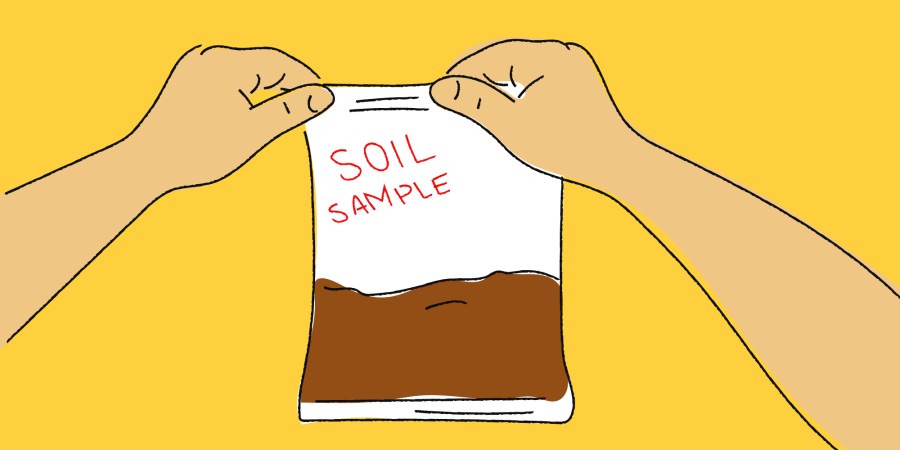
If you want to test your soil, there are a few important things to keep in mind. First, you should take your sample from the first couple of inches of soil, where lead concentrations tend to be highest. Make sure your sample is dry when you send it in. And don’t mix samples from different locations together. It’s a good idea to take distinct samples from areas of your yard you manage differently and to keep them separate when you send them to the lab. You can also send in samples from certain distances away from structures to see where the contamination drops off.

Soil tests can also tell you about your garden’s fertility — the essential nutrients that are present and your soil’s pH.
Maggie Sivit / WBEZ

There are some ways to reduce contamination and exposure

If you choose to plant directly in contaminated soil, you can minimize adhesion (that’s contaminated soil dust that sticks to the edible parts of plants) by “mulching the heck out of it” with straw or woodchips to prevent soil from being kicked up onto fruits or leaves when it rains, Margenot said.

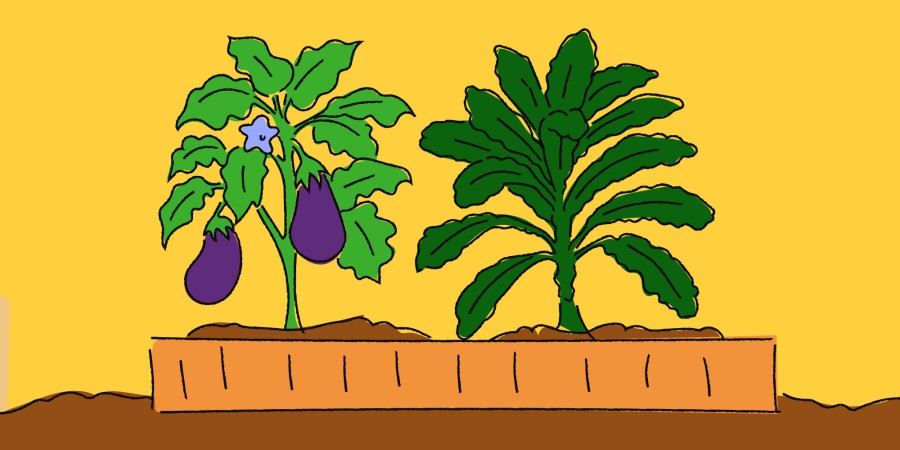
But it’s much safer to avoid planting directly in heavily contaminated soil by building raised beds, filling them with fresh soil or compost, and using landscaping fabric to separate the bed from the ground.

It’s not a given that the soil you buy is safe to use either. You should test the soil you use to fill your raised beds yourself, or insist the company you’re buying from does a test, Margenot said. If you’re buying yard waste-based compost, it could contain high lead levels from the leaf tissue of decomposed grass clippings. A safer bet for clean soil is the Metropolitan Water Reclamation District, Margenot said.

“MWRD will give you biosolids, or composted human feces, which I know sounds wicked gross, but they’re always tested for lead and they’re actually very, very safe to use,” Margenot said. “I use them in my own garden and they’re a great compost.”

And it’s not just fruits and vegetables you have to worry about. Dust from lead-contaminated gardens can also be directly harmful to your health.

“You inhale that dust when you’re working the soil, and that goes right into your body,” Margenot said. “The fruit might be lead free, but the soil still presents a risk. I wouldn’t be comfortable working soil with a hoe above 400 ppm because of that dust.”

To stay safe, the University of Illinois Extension recommends always wearing gloves when gardening, wearing a mask to avoid soil inhalation, leaving shoes outdoors and carefully washing hands after gardening. Children should not be allowed to play in contaminated soil, as they are at higher risk of lead poisoning.

Courtesy Kat Powers

More about our question-asker

Chicago native Kat Powers has always been an avid gardener. She attributes her love of gardening to her mother, who grew drought-resistant plants in California in the mid-1980s and ’90s.

Kat said she’s often wondered about the ability of toxins to get into fruit and plant leaves since she started growing produce a decade ago at her previous home in Andersonville.

This summer, she’ll be planting an extensive garden with tomatoes, peppers, eggplants, squash, onions, lettuce and even a pergola of native grapes as part of a work exchange for a woman in Lincoln Square.

Regarding her question, Kat said, “I’m delighted to have it addressed because I’ve talked to a lot of people about it and everyone was like, ‘I had no idea that this was an issue.’ I’m definitely going to have to start testing the soil.”

When she’s not gardening, Kat works as a potter at Lillstreet Art Center and at Bistro Campagne in Lincoln Square.

The Conscious Universe


The radical idea that everything has elements of consciousness is reemerging and breathing new life into a cold and mechanical cosmos.


Matthew Craven
FEATUREPHILOSOPHY & CULTURE
BY JOE ZADEHNOVEMBER 17, 2021
FacebookTwitterEmail


Joe Zadeh is a writer based in Newcastle.

London was a crowded city in 1666. The streets were narrow, the air was polluted, and inhabitants lived on top of each other in small wooden houses. That’s why the plague spread so easily, as well as the Great Fire. So did gossip, and the talk of the town was Margaret Cavendish, the Duchess of Newcastle.

Cavendish was a fiery novelist, playwright, philosopher and public figure known for her dramatic manner and controversial beliefs. She made her own dresses and decorated them in ribbons and baubles, and once attended the theater in a topless gown with red paint on her nipples. In his diaries, Samuel Pepys described her as a “mad, conceited, ridiculous woman,” albeit one he was obsessed with: He diarized about her six times in one three-month spell.

The duchess drew public attention because she was a woman with ideas, lots of them, at a time when that was not welcome. Cavendish had grown up during the murderous hysteria of the English witch trials, and her sometimes contradictory proto-feminism was fueled by the belief that there was a parallel to be drawn between the way men treated women and the way men treated animals and nature. “The truth is,” she wrote, “we [women] Live like Bats or Owls, labour like Beasts and die like Worms.”

In 1666, she released “The Blazing World,” a romantic and adventurous fantasy novel (as well as a satire of male intellectualism) in which a woman wanders through a portal at the North Pole and is transported to another world full of multicolored humans and anthropomorphic beasts, where she becomes an empress and builds a utopian society. It is now recognized as one of the first-ever works of science fiction.

But this idea of a blazing world was not just fiction for Cavendish. It was a metaphor for her philosophical theories about the nature of reality. She believed that at a fundamental level, the entire universe was made of just one thing: matter. And that matter wasn’t mostly lifeless and inert, like most of her peers believed, but animate, aware, completely interconnected, at one with the stuff inside us. In essence, she envisioned that it wasn’t just humans that were conscious, but that consciousness, in some form, was present throughout nature, from animals to plants to rocks to atoms. The world, through her eyes, was blazing.

Cavendish was not the only one to have thoughts like these at that time, but they were dangerous thoughts to have. In Amsterdam, the Jewish philosopher Baruch Spinoza wrote that every physical thing had its own mind, and those minds were at one with God’s mind; his books were banned by the church, he was attacked at knifepoint outside a synagogue, and eventually, he was excommunicated. Twenty-three years before Cavendish was born, the Italian Dominican friar and philosopher, Giordano Bruno — who believed the entire universe was made of a single universal substance that contained spirit or consciousness — was labeled a heretic, gagged, tied to a stake and burned alive in the center of Rome by the agents of the Inquisition. His ashes were dumped in the Tiber.

If the dominant worldview of Christianity and the rising worldview of science could agree on anything, it was that matter was dead: Man was superior to nature. But Cavendish, Spinoza, Bruno and others had latched onto the coattails of an ancient yet radical idea, one that had been circulating philosophy in the East and West since theories of mind first began. Traces of it can be found in Hinduism, Buddhism, Taoism, Christian mysticism and the philosophy of ancient Greece, as well as many indigenous belief systems around the world. The idea has many forms and versions, but modern studies of it house them all inside one grand general theory: panpsychism.
“If the panpsychists are right, it could cast doubt on the foundations of a worldview that has been deeply embedded in our psyche for hundreds of years: that humans are superior to everything around them.”
FacebookTwitterEmail


Derived from the Greek words pan (“all”) and psyche (“soul” or “mind”), panpsychism is the idea that consciousness — perhaps the most mysterious phenomenon we have yet come across — is not unique to the most complex organisms; it pervades the entire universe and is a fundamental feature of reality. “At a very basic level,” wrote the Canadian philosopher William Seager, “the world is awake.”

Plato and Aristotle had panpsychist beliefs, as did the Stoics. At the turn of the 12th century, the Christian mystic Saint Francis of Assisi was so convinced that everything was conscious that he tried speaking to flowers and preaching to birds. In fact, the history of thought is dotted with very clever people coming to this seemingly irrational conclusion. William James, the father of American psychology, was a panpsychist, as was the celebrated British mathematician Alfred North Whitehead; the Nobel Prize-winning physicist Max Planck once remarked in an interview, “I regard consciousness as fundamental.” Even the great inventor Thomas Edison had some panpsychist views, telling the poet George Parsons Lathrop: “It seems that every atom is possessed by a certain amount of primitive intelligence.”

But over the course of the 20th century, panpsychism came to be seen as absurd and incompatible in mainstream Western science and philosophy, just a reassuring delusion for New Age daydreamers. Karl Popper, one of the most influential philosophers of recent times, described it as “trivial” and “grossly misleading.” Another heavyweight, Ludwig Wittgenstein, waved away the theory: “Such image-mongery is of no interest to us.” As the American philosopher John Searle put it: “Consciousness cannot be spread across the universe like a thin veneer of jam.”

Most philosophers and scientists with panpsychist beliefs kept them quiet for fear of public ridicule. Panpsychism used “to be laughed at insofar as it was thought of at all,” wrote the philosopher Philip Goff in his latest book, “Galileo’s Error: Foundations for a New Science of Consciousness.” But now, we are in the midst of a “full-blown panpsychist renaissance.” Goff is one of a rising tide of thinkers around the world who have found themselves drawn back to this ancient theory. Spurred on by scientific breakthroughs, a lost argument from the 1920s and the encouraging way panpsychism is able to bypass the “hard problem” of consciousness, they are beginning to rebuild and remodel its intellectual foundations, transforming it into a strong candidate for the ultimate theory of reality.

“According to panpsychism,” Goff told me when we met recently in the garden of a pub near Durham University, where he teaches, “consciousness pervades the universe and is a fundamental feature of it. So, it doesn’t necessarily mean everything is ‘conscious.’ The basic idea is that the fundamental building blocks of the universe, perhaps electrons and quarks, have incredibly simple forms of experience, and very complex experience — like that of a human brain — is somehow built up from these very simple and rudimentary forms of experience. … That doesn’t mean your chair is conscious. It means the tiny particles the chair is made up of have some kind of rudimentary experience.”

If the panpsychists are right, it could cast doubt on the foundations of a worldview that has been deeply embedded in our psyche for hundreds of years: that humans are superior to everything around them, disconnected from the insensate matter of nature, marooned on a crumbling planet in a cold and mechanical universe. Panpsychism re-enchants the world, embeds us profoundly within the climate crisis and places us on a continuum of consciousness with all that we see around us.

“We have become used to the Copernican idea that we are not at the center of the universe but simply one planet among many,” Goff wrote in his first book, “Consciousness and Fundamental Reality.” “Perhaps it’s time for a Copernican revolution about our own consciousness.”

The notion of a world awake might seem unintuitive to most of us, but it is something we adopt naturally in childhood. In 1929, the Swiss psychologist Jean Piaget found that children between two and four years old are inclined to attribute consciousness to everything around them. A child can happily talk to a grasshopper and blame the pavement if they trip up, and it isn’t such an alien thought, at that age, to think a flower might feel the sunlight and perhaps even enjoy it. Fairy tales and children’s media are infused with animate worlds in which trees, animals and objects come to the aid or annoyance of a protagonist.

Most of us dismiss these notions as we mature. Gradually, we rein the concept of consciousness closer and closer in, until, at least in the West, we usually settle on the traditional view that consciousness is present only in the brains of humans and higher animals.

Along with this goes the premise that consciousness must have sparked into existence from completely non-conscious matter quite recently, cosmically speaking — and only in a tiny corner of the universe. Perhaps a few hundred million years ago, a light bulb flickered on, and something somewhere felt reality for the first time. Before that miraculous spark, the great physicist Erwin Schrodinger wondered, was the universe “a play before empty benches, not existing for anybody, thus quite properly speaking not existing?” As for which higher animals have it and which don’t, there is no agreement, but we have a vague sense. Monkeys and dolphins, definitely conscious; cats and dogs, surely; worms, butterflies and Antarctic krill, probably not.

But in the last 10 years or so, this understanding has been repeatedly disrupted by new scientific breakthroughs. We are now well versed in the playfulness and creativity of cephalopods, the intelligent communication between fungi and the interspecies sharing economy in forests. Honeybees recognize faces, use tools, make collective decisions, dance to communicate and appear to understand higher-order concepts like zero. Plants can feel you touching them. In fact, the evolutionary ecologist Monica Gagliano has suggested that pea plants can learn behavior, identify the sound of running water and grow towards it and communicate via clicking sounds. When you consider that plants account for around 80% of the total biomass on Earth (the biomass of humans is roughly equivalent to that of Antarctic krill), then extending consciousness to them would mean we are living on a vastly conscious planet.

Recent research into slime mold — a single-celled eukaryotic organism that has no brain, no nervous system and looks like a yellow puddle — found that it makes decisions, perceives its surroundings and can choose the most nutritious food from numerous options. As an experiment, researchers arranged oat flakes in the geographical pattern of cities around Tokyo, and the slime mold constructed nutrient channeling tubes that closely mimicked the painstakingly planned metropolitan railway system. At Columbia University, the biologist Martin Picard has discovered that mitochondria, the organelles found in the cells of almost every complex organism, “communicate with each other and with the cell nucleus, exhibit group formation and interdependence, synchronize their behaviors and functionally specialize to accomplish specific functions within the organism.” Nobody is concluding that mitochondria are conscious, but if an animal the size of a dog acted like this, would we intuitively ascribe to it some basic level of consciousness?

“I find it striking,” the neuroscientist Christof Koch told me on a video call, “that after 2,400 years, we are now back to panpsychism. This is like scientists discussing whether the Earth is actually flat, or if the heart is the seat of the soul. I mean …”
“Panpsychism re-enchants the world, embeds us profoundly within the climate crisis and places us on a continuum of consciousness with all that we see around us.”
FacebookTwitterEmail


Koch, one of the world’s most renowned neuroscientists, is the chief scientist of the MindScope Program at the Allen Institute for Brain Science in Seattle. Throughout the 1990s and early 2000s, he worked closely with the late Nobel Laureate Francis Crick (who, alongside James Watson, Maurice Wilkins and Rosalind Franklin, discovered the double helix structure of DNA) to build the foundations for a neuroscience of consciousness.

In recent years, Koch has become a champion and staunch defender of Integrated Information Theory (IIT), a leading theory in the neuroscience of consciousness developed by the Italian neuroscientist and psychiatrist Giulio Tononi. IIT is concerned with developing a method to measure the amount of integrated information (which, it posits, represents consciousness) in a physical system. In other words, is something conscious and, if so, how conscious? One of Tononi and Koch’s many ambitions is to create a practical device, “a consciousness meter,” which could measure the level of consciousness in patients in a vegetative state.

Tononi’s scientific research aligned with what some philosophers of consciousness believe about panpsychism: “It says consciousness is graded and much more widely distributed,” Koch said. “Giulio tried to downplay that at first because he felt people would then reject it out of hand, but I kept on pushing.” In 2015, they published a paper together titled “Consciousness: Here, There and Everywhere?” in which they stated that while IIT was not developed with panpsychism in mind, it did seem to share its central intuitions.

“A lot of people say that’s wacky: Any theory that predicts a microbe is conscious is crazy because it’s so different from my insight into the state of the world,” Koch told me. When people hear the word consciousness, he explained, they assume qualities like self-awareness, emotion, pleasure and pain, but here we are talking about a degree of consciousness that is far more basic: experience. “Clearly, the paramecium doesn’t have psychology; it doesn’t hear bees, it doesn’t worry about the weekend. But the claim is: It feels like something to be the paramecium — and once the cell membrane dissolves and it disintegrates and dies, it doesn’t feel like anything anymore.”

In 2013, Koch traveled to a Tibetan monastery in southern India for a symposium on physics, biology and brain science between Buddhist monk-scholars and Western scientists where he presented the contemporary Western consensus that only humans and some animals are blessed with consciousness. While there, Koch helped with teaching at the monastery. “We showed some movies of little bacteria moving around and asked them what they thought,” he told me. “They said they were clearly sentient. They had no trouble with that.”


Matthew Craven

Arthur Stanley Eddington was a pacifist Quaker from a family of farmers in the north of England. In 1913, at the age of 30, he started working as a professor of astronomy at Cambridge. Six years later, he and the Royal Astronomer Frank Watson Dyson became perhaps the first scientists to prove Albert Einstein’s general theory of relativity, catapulting Einstein, who was then mostly unknown in the English-speaking world so soon after the end of World War I, to global notoriety. Eddington and Dyson organized expeditions to Principe and Brazil to observe a solar eclipse and record what Einstein had predicted: Gravity bends light. Newton was overthrown, and a new revolution in science began.

Upon his return from Brazil, Eddington dove into the work of the mathematician Bertrand Russell. One of Russell’s observations, first developed in the 1920s and furthered in the 1950s, was this: “All that physics gives us is certain equations giving abstract properties of their changes. But as to what it is that changes, and what it changes from and to — as to this, physics is silent.” In other words, while physical science might appear to give us a nearly complete account of the nature of matter — what everything is made of — it really only provides a description of mathematical structures: the “causal skeleton” of reality. These descriptions are incredibly valuable and have led to many of humanity’s greatest scientific achievements, because they can be used to predict how matter will behave. But as Goff said to me: “Physical science only tells us what stuff does, not what stuff is. It’s not telling us the underlying nature of the stuff that is behaving in this way.”

Consider this crude breakdown of water. What is water? Water is a colorless, transparent, odorless chemical substance that fills our oceans, lakes, rivers and bodies. But what is it composed of? It is composed of sextillions and sextillions of tiny water molecules. What are they composed of? Well, each molecule contains three atoms: two hydrogen and one oxygen. And what are hydrogen and oxygen made of? Subatomic particles like neutrons and electrons. What is an electron made of? An electron has mass and charge. And what are mass and charge? They are properties of the electron. But what is the electron?

“When I was a young physics student,” wrote the astrophysicist Adam Frank in a 2017 essay, “I once asked a professor: ‘What’s an electron?’ His answer stunned me. ‘An electron,’ he said, ‘is that to which we attribute the properties of the electron.’ That vague, circular response was a long way from the dream that drove me into physics, a dream of theories that perfectly described reality.” In a strange and convoluted way, there is a sense in which we don’t really know what water is. We don’t really know what anything is. As Stephen Hawking wrote in “A Brief History of Time”: “Even if there is only one possible unified theory, it is just a set of rules and equations. What is it that breathes fire into the equations and makes a universe for them to describe?”

Eddington, who by the late 1920s was seen as one of the greatest living scientists in the world, agreed with Russell: “The physicist cannot get behind structure,” he wrote in a glowing review of Russell’s 1927 book “The Analysis of Matter.” That same year, Eddington was invited to give the prestigious annual Gifford Lectures in Edinburgh, which he then turned into his own book, “The Nature of the Physical World.” Written for a wider audience, it contained echoes of Russell and became one of the most influential popular science books of the era, selling 72,000 copies in Britain alone.

“Even if there is only one possible unified theory, it is just a set of rules and equations. What is it that breathes fire into the equations and makes a universe for them to describe?”
— Stephen Hawking

“The Victorian physicist felt that he knew just what he was talking about when he used such terms as matter and atoms,” wrote Eddington. “Atoms were tiny billiard balls, a crisp statement that was supposed to tell you all about their nature in a way which could never be achieved for transcendental things like consciousness, beauty or humor. But now we realize that science has nothing to say about the intrinsic nature of the atom. The physical atom is, like everything else in physics, a schedule of pointer readings” — measurements on a machine.

Eddington, like Russell before him, felt that the intrinsic nature of matter, the thing that has mathematical structure, could be integral to explaining consciousness. He wrote that there is one clump of matter that we know and experience directly, not through perceptions, equations or measuring devices: the matter that constitutes our brains. We know that the intrinsic matter that constitutes our brains must involve consciousness because that is our rich and subjective moment-to-moment experience of reality.

Throughout the history of consciousness studies, the mind-body problem has caused theory after theory to collapse and falter. How does the matter of the brain, which we know and understand, give rise to the mystery of consciousness? Eddington’s panpsychist argument, said Goff, “turned the problem upside down.” In Eddington’s view, matter is the mystery; consciousness is the thing we understand better than anything else. The only matter we experience directly is the matter in our living brains, and we know that to be conscious. Therefore, we have good reason to believe that all matter is conscious. And while critics of panpsychism are quick to challenge its proponents to prove that consciousness is the intrinsic nature of matter, the panpsychists are equally poised to respond: Prove that it isn’t.

This argument, Goff wrote in “Galileo’s Error,” “is hard to really absorb” because “it is diametrically opposed to the way our culture thinks about science. But if we manage to do so, it becomes apparent that the simplest hypothesis concerning the intrinsic nature of matter outside of brains is that it is continuous with the intrinsic nature of matter inside of brains.” As Eddington wrote in the conclusion to his book: “The stuff of the world is mind-stuff.” Consciousness didn’t emerge or flicker into existence; it has always been there — the intrinsic nature of us and everything around us. This is what breathes fire into the equations.

Despite the popularity of Russell and Eddington’s work in the 1920s and 30s, these ideas were largely lost. Western academia was then being seized by a group known as the Vienna Circle and their logical positivism movement. Interwar Europe was being overrun by extremist violence, dogmatic ideologies and political propaganda, and the logical positivists railed against it all by calling for “exact thinking in demented times” — strict scientific standards and rigorous objectivity. Logical positivism swept through Anglo-American universities and caused a wholesale rejection of abstract metaphysical discussions. The scientific method relied on what could be observed; what went on inside the mind was largely ignored in favor of how humans behaved, ushering in the rise of B.F. Skinner and behavioral psychology. Eddington’s work in particular remained forgotten until Galen Strawson, one of the elder statesmen of modern British philosophy, found his book on the shelf of a holiday home in Scotland and used it to bolster his modern argument for panpsychism.

Since the 1930s, our scientific understanding of the fundamental building blocks of reality has become even weirder. Particles have been shown to behave like waves and waves like particles, depending on the experimental conditions. Particles no longer seem to be the fixed and knowable objects they once were, and different particle physicists will give you different answers to the question, “What is a particle?” Perhaps it is a quantum excitation of a field, vibrating strings or simply what we measure in detectors. “We say they are ‘fundamental,’” Xiao-Gang Wen, a theoretical physicist at the Massachusetts Institute of Technology, told Quanta Magazine. “But that’s just a [way to say] to students, ‘Don’t ask! I don’t know the answer. It’s fundamental; don’t ask anymore.’”

“Physical science only tells us what stuff does, not what stuff is. It’s not telling us the underlying nature of the stuff that is behaving in this way.”
— Philip Goff

In a landmark 2003 essay, Strawson wrote that this ambiguity only strengthened the argument for panpsychism. The idea of our brains as “lumpish, inert matter, dense or corpuscled, stuff that seems essentially alien to the phenomenon of consciousness,” he wrote, “has given way to fields of energy, essentially active diaphanous process-stuff that — intuitively — seems far less unlike the process of consciousness.” Physics doesn’t show our brain as a spongey blood-filled mass composed of tiny concrete particles, but as “an astonishingly (to us) insubstantial-seeming play of energy, an ethereally radiant vibrancy.”

Of course, panpsychism has its flaws. In October, the Journal of Consciousness Studies dedicated an entire issue to responding to Goff’s book. It featured both critical and supportive essays from philosophers, psychologists, neuroscientists, the bestselling author Annaka Harris and renowned physicists like Carlo Rovelli, Sean Carroll and Lee Smolin. “The real problem with panpsychism is not that it seems crazy,” wrote the British neuroscientist Anil Seth in his essay, “it is that it explains nothing and does not generate testable predictions.”

Physicists critical of it have said it is trying to add something new into our scientific picture of reality that wasn’t there before, and that would therefore require alterations to the proven laws of physics to accommodate it. But in one of the journal essays that addressed this point, the philosopher Luke Roelofs (of NYU’s Center for Mind, Brain and Consciousness) argued the opposite: Nothing is being added to our scientific picture of the world — this is just a different interpretation of that picture. “It rests on recognizing that the physical picture itself is just under-specified: It tells us how this thing called an ‘electron’ behaves, and how these properties called ‘charge’ affect that behavior, but never says (never could say) what any of this is in and of itself.” In other words: Consciousness is exactly what the physicists have been studying the structure and behavior of all along. “For a panpsychist,” Goff said, “the story of physics is the story of consciousness. All there is is forms of consciousness, and physics tracks what they do.”

The most notorious hurdle for panpsychism is known as the combination problem. It has been framed in various ways, but its essence is this: How can lots of tiny conscious entities, like fundamental particles, combine to create one big conscious entity, like the human mind? Goff has explored a possible solution via quantum entanglement. The Norwegian panpsychist philosopher Hedda Hassel Mørch has worked with Tononi and IIT to overcome it. And Roelofs has investigated split-brain cases — a radical procedure used for severe epilepsy in which a patient’s corpus callosum, which connects the two hemispheres of the brain, is severed — that seem to result in patients experiencing a split or partial split of consciousness. If consciousness can be split, then why couldn’t it be combined?

“Some people dismiss panpsychism simply because the combination problem has not yet been solved,” Goff wrote in “Galileo’s Error.” “To my mind, this is like someone in 1859 rejecting Darwinism on the basis that ‘On The Origin of Species’ did not contain a completely worked-out history of the evolution of the human eye.” Panpsychism as a research program, he told me, is only just getting started.

In the freezing winter of Boxing Day, 1966, the medieval historian Lynn Townsend White Jr. delivered a speech to the American Association for the Advancement of Science in Washington. Fifty-nine years old at the time, White was a rigorous and provocative historian, and also a devout Christian. But through his studies, he had found something that deeply troubled him, something he felt resonated with the time in which he lived. In 1960s America, the general American public was becoming aware of the effects of pollution and global warming. Rachel Carson’s “Silent Spring” had been out for a couple years, and the landmark Air Quality Act (1967) and the Clean Air Act (1970) were not far off. Just four weeks before White gave his speech in Washington, a toxic copper-colored cloud of acrid smog, so thick it could be wiped off car windscreens, smothered New York for three days, causing 168 deaths and adverse health conditions for hundreds of thousands of people.

How we view the world determines how we treat it, and White felt the roots of the climate crisis went deep into ancient history. They must be analyzed, he thought, because to address the climate crisis we must rethink the fundamental mindset that caused it, without which our solutions might create even more serious problems than they solve. “What people do about their ecology,” he said during his speech, “depends on what they think about themselves in relation to things around them.” In his eyes, the causes weren’t solely scientific, technological, political or economic — they were ideological. Christianity in the West, he thought, was what first separated man from nature and established a relationship of superiority and exploitation with everything around.

Prior to Christianity, ancient paganism revolved around the idea of an animate world. “Before one cut a tree, mined a mountain or dammed a brook, it was important to placate the spirit in charge of that particular situation, and to keep it placated,” White wrote. But Christianity siphoned these spirits out of the Earth and placed them in heaven. “By destroying pagan animism, Christianity made it possible to exploit nature in a mood of indifference to the feelings of natural objects. … The spirits in natural objects, which formerly had protected nature from man, evaporated … and the old inhibitions to the exploitation of nature crumbled.” This led White to describe Christianity as the most “anthropocentric religion the world had seen.”

“Consciousness didn’t emerge or flicker into existence; it has always been there — the intrinsic nature of us and everything around us.”

Christianity didn’t create the ecological crisis, White asserted, but it laid the foundations for an abusive relationship between man and nature. This religious ideology was infused with the Scientific Revolution (of which the key drivers were deeply religious Christians like Galileo, Descartes, Newton and Bacon) and ushered in an age of technology, capitalism and colonialism that thrived on exploiting the Earth. The universe came to be viewed not as organic and animate, but as a mindless machine, like a clock, the gears of which are governed by scientific laws. The wonder and unpredictability of nature was transformed into something stable, predictable, knowable and therefore controllable. Forests were there to be cleared, hills were there to be mined and animals were there to be slaughtered. This became known as the “mechanistic worldview.” As the science historian Carolyn Merchant wrote in a 1980 book: “Because it viewed nature as dead and matter as passive, mechanism could function as a subtle sanction for the exploitation and manipulation of nature and its resources.”

While we might think we are now living in a “post-Christian age,” this deeply entrenched mindset still haunts us. This “relation to nature,” White wrote, is “almost universally held not only by Christians and Neo-Christians but also by those who fondly regard themselves as post-Christians. Despite Copernicus, all the cosmos rotates around our little globe. Despite Darwin, we are not, in our hearts, part of the natural process.” Echoes of this story, Naomi Klein wrote in her 2014 book “This Changes Everything,” reverberate through a “cultural narrative that tells us that humans are ultimately in control of the Earth, and not the other way around. This is the same narrative that assures us that, however bad things get, we are going to be saved at the last minute — whether by the market, by philanthropic billionaires or by technological wizards.”

White’s paper caused shockwaves. Biblical scholars and theologians criticized him heavily, and he received torrents of hate mail accusing him of being the anti-Christ, a Kremlin agent and more. But he was a religious man, with no intention of turning his back on his God. In the final third of the paper, he reminisced on the forgotten panpsychists of Christianity who had implored people to recognize themselves as within nature, not above it. White called for his fellow Christians — roughly a quarter of the world’s population at the time — to look for ways forward in the example of a saint like Francis of Assisi, who spoke to his flowers and envisioned the Earth itself as something divine.


Throughout the 1970s, environmentalists and political activists pored over White’s thesis, and it became a seminal text in universities and ecological studies. But his panpsychist conclusions went largely under the radar. His critique became mainstream, but his call to action, at least in the 1960s, largely failed.

The essence of what White, Marchant and then Klein are getting at is that our mechanistic worldview is not an objectively true portrayal of reality, but something that has been constructed. Therefore, it can be reconstructed. Panpsychism is one possible reconstruction. Our inability to fully comprehend the widespread decline of the natural world could be a consequence of our refusal to see ourselves as part of it. And the potential of panpsychism to put mind back into matter, reconnect us to nature, dispel human exceptionalism and revolutionize our ethics is, for many, a clear way forward.

While analytic philosophers like Goff and Strawson are keen to emphasize that their argument for panpsychism is technical, logical and based on strict theoretical frameworks, the Australian philosopher Freya Mathews has reached similar conclusions via environmental philosophy, which is more concerned with questions about how we live in this world. In 1991, Mathews wrote “The Ecological Self,” a book that essentially described a panpsychist view without using the word — “I didn’t want to shoot myself in the foot by calling it that,” she told me.

She went on: “I don’t think just accepting something like this at a theoretical level would change us. I don’t think that’s how psychology or motivation works. Reason can’t touch motivation; it doesn’t touch our deeper psyche. But if a theory like this gives us permission to experiment experientially with new ways of seeing and exploring the world — and looking for our purpose, as it were — then we might have a chance of discovering it.”

In the 1960s, the physicist and philosopher Thomas Kuhn analyzed what it takes to cause a paradigm shift in our scientific perspective. A paradigm shift is when a dominant theory is suddenly or gradually overturned when significant anomalies that disprove the theory continue to arise until it goes into a state of crisis. During this crisis, Kuhn wrote, we witness “the proliferation of competing articulations, the willingness to try anything, the expression of explicit discontent, the recourse to philosophy and to debate over fundamentals.” An example of a Kuhnian paradigm shift is the sudden change from Newton’s simple physics to Einstein’s far weirder theories, which, among many things, completely upended the understanding of time.

Mathews thinks we are now on the verge of another paradigm shift, whether that is to panpsychism or some other worldview that sees nature as more than unfeeling matter. “Our current worldview is leading to the ecological collapse of the planet,” she said. “And it is completely pragmatically self-defeating to continue with it.”

Margaret Cavendish had a fairly robust set of environmental ethics that was rare in 1600s Europe. At a time when Descartes — who gave his dog the very human name Monsieur Grat (“Mr. Scratch”) — was arguing that animals were machine-like senseless automata that felt neither pain nor pleasure, Cavendish was trying to create a dialogue between man and nature.

In her poems “The Hunting of the Hare” and “The Hunting of the Stag,” she abandoned the human perspective to adopt that of the animal being killed. In another, she imagined a conversation between a man and the tree he is about to cut down. These views and others ostracized her from the 17th-century scientific community, and much of her work was either ignored or dismissed. When she became the first woman to visit the all-male scientific institution of the Royal Society in May 1667, Pepys’ account of her visit focused mostly on the offensiveness of her dress. She was viewed by many as insane and irrational; they labeled her “Mad Madge.”


But none of this dissuaded Cavendish, who, in her lifetime, published numerous books of philosophy, fiction, plays and poetry. “I had rather appear worse in singularity,” she said, “than better in the mode.” And if anyone was being irrational, thought Cavendish, it certainly wasn’t her. “Man is more irrational,” she wrote in 1664, “when he believes that all knowledge is not only confined to one sort of Creatures, but to one part of one particular Creature, as the head, or brain of man.”

All That Is Solid Melts Into Information

The torrent of accelerated time without narrative is disorienting our society and fragmenting community, says philosopher Byung-Chul Han. Art can help put the pieces back together.


Sophie Douala for Noema Magazine

APRIL 21, 2022

Byung-Chul Han is a South Korea-born German philosopher and cultural theorist whose recent books include “The Burnout Society” and “The Disappearance of Rituals.” He recently spoke to Nathan Gardels, Noema’s editor-in-chief.

Nathan Gardels: Johann Wolfgang von Goethe once commented that: “When eras are on the decline, all tendencies are subjective; but, on the other hand, when matters are ripening for a new epoch, all tendencies are objective. Each worthy effort turns its force from the inward to the outward world.”

By that definition, ours is an era of decline that has turned from the outward to the inward obsession with identity and “authenticity,” both personal and tribal, fueled by digital connectivity. Paradoxically, social media in this sense is antisocial, leading to the disintegration of community through a kind of connected isolation.

What is the dynamic and what are the mechanisms behind what you call “the crisis of community?” What are the consequences for how we feel and live in our daily lives?

Byung-Chul Han: The inwardly turned, narcissistic ego with purely subjective access to the world is not the cause of social disintegration but the result of a fateful process at the objective level. Everything that binds and connects is disappearing. There are hardly any shared values or symbols, no common narratives that unite people.

Truth, the provider of meaning and orientation, is also a narrative. We are very well informed, yet somehow we cannot orient ourselves. The informatization of reality leads to its atomization — separated spheres of what is thought to be true.

But truth, unlike information, has a centripetal force that holds society together. Information, on the other hand, is centrifugal, with very destructive effects on social cohesion. If we want to comprehend what kind of society we are living in, we need to understand the nature of information.

Bits of information provide neither meaning nor orientation. They do not congeal into a narrative. They are purely additive. From a certain point onward, they no longer inform — they deform. They can even darken the world. This puts them in opposition to truth. Truth illuminates the world, while information lives off the attraction of surprise, pulling us into a permanent frenzy of fleeting moments.

We greet information with a fundamental suspicion: Things might be otherwise. Contingency is a trait of information, and for this reason, fake news is a necessary element of the informational order. So fake news is just another piece of information, and before any process of verification can begin, it has already done its work. It rushes past truth, and truth cannot catch up. Fake news is truth-proof.


“Bits of information provide neither meaning nor orientation. They do not congeal into a narrative.”


Information goes along with fundamental suspicion. The more we are confronted with information, the more our suspicion grows. Information is Janus-faced — it simultaneously produces certainty and uncertainty. A fundamental structural ambivalence is inherent in an information society.

Truth, by contrast, reduces contingency. We cannot build a stable community or democracy on a mass of contingencies. Democracy requires binding values and ideals, and shared convictions. Today, democracy gives way to infocracy.

As you suggest in your question, another reason for the crisis of community, which is a crisis of democracy, is digitalization. Digital communication redirects the flows of communication. Information is spread without forming a public sphere. It is produced in private spaces and distributed to private spaces. The web does not create a public.

This has highly deleterious consequences for the democratic process. Social media intensify this kind of communication without community. You cannot forge a public sphere out of influencers and followers. Digital communities have the form of commodities; ultimately, they are commodities.

“Today, we no longer have any narratives that provide meaning and orientation for our lives. Narratives crumble and decay into information.”

Of course, there was information in the past, too. But it did not determine society to such a degree as today. In antiquity, mythical narratives determined people’s lives and behavior. The Middle Ages were, for many, determined by the Christian narrative. But information was embedded in narration: An outbreak of the plague was not pure, simple information. It was integrated into the Christian narrative of sin.

Today, by contrast, we no longer have any narratives that provide meaning and orientation for our lives. Narratives crumble and decay into information. With some exaggeration, we might say that there is nothing but information without any hermeneutic horizon for interpretation, without any method of explanation. Pieces of information do not coalesce into knowledge or truth, which are forms of narration.

The narrative vacuum in an information society makes people feel discontent, especially in times of crisis, such as the pandemic. People invent narratives to explain a tsunami of disorienting figures and data. Often these narratives are called conspiracy theories, but they cannot simply be reduced to collective narcissism. They readily explain the world. On the web, spaces open to make experiences of identity and collectivity possible again. The web, thus, is tribalized — predominantly among right-wing political groups where there is a very strong need for identity. In these circles, conspiracy theories are taken up as offers for assuming an identity.

Friedrich Nietzsche once said that our happiness consists of the possession of a non-negotiable truth. Today, we no longer have such non-negotiable truths. Instead, we have an over-abundance of information. I am not sure that the information society is a continuation of the Enlightenment. Maybe we need a new kind of enlightenment. On a new enlightenment, Nietzsche noted: “It does not suffice that you realize the ignorance in which humans and animals live, you also have to have the will to be ignorant and learn more. You need to comprehend that without this kind of ignorance life would become impossible, that only on condition of this ignorance can what lives preserve itself and flourish.”

Gardels: As you wrote in your most recent book, societal rituals once created that objective narrative bond that held societies together. They “stabilized life” as you put it.

Now such rituals are under assault by the wrecking ball of deconstruction as nothing more than the designs of the privileged who had the power to impose them in the past. In today’s horizontal world, with no legitimate value hierarchy, subjective projection steps in to fill the vacuum.

Out of these ruins of an objective order, how can stabilizing anchors of ritual ever be reestablished? On what basis? On whose authority? What will life look like if that is not possible?

Han: I would not promote a reactivation of past rituals. This is simply not possible because the rituals of Western culture are very closely associated with the Christian narrative. And everywhere the Christian narrative is losing its power. There is little left of it beyond Christmastime.

Rituals found a community. Contrary to the suggestion in your question, it is not inevitable that rituals solidify existing power relations. Quite the opposite. During Carnival, power relations are reversed, so that the slaves can criticize and even mock their masters. Often, roles are exchanged: The masters serve their slaves. And the fool ascends the throne as king. This ritualized temporary suspension of the power structure stabilizes the community.

“After the pandemic, what is most in need of recovery is culture.”


In a world that is completely without rituals and wholly profane, all that is left are consumption and the satisfaction of needs. It is Aldous Huxley’s “Brave New World,” in which every want is immediately gratified. The people are kept in good spirits with the help of fun, consumption and entertainment. The state distributes a drug called soma in order to increase feelings of happiness in the population. Maybe in our brave new world, people will receive a universal basic income and have unlimited access to video games. That would be the new version of panem et circenses (“bread and circuses”).

I am, however, not completely pessimistic. Perhaps we shall develop new narratives, ones that do not presuppose a hierarchy. We can easily imagine a flat narrative. Every narrative develops its own rituals for the purposes of making it habitual, embedding it in the physical body. Culture founds community.

After the pandemic, what is most in need of recovery is culture. Cultural events such as theater, dance and even football have a ritual character. The only way in which we can revitalize community is through ritual forms. Today, culture is held together solely by instrumental and economic relations. But that does not found communities — it isolates people. Art, in particular, should play a central role in the revitalization of rituals.

“Rituals stabilize life by structuring time.”

What we need most are temporal structures that stabilize life. When everything is short-term, life loses all stability. Stability comes over long stretches of time: faithfulness, bonds, integrity, commitment, promises, trust. These are the social practices that hold a community together. They all have a ritual character. They all require a lot of time. Today’s terror of short-termism — which, with fatal consequences, we mistake for freedom — destroys the practices that require time. To combat this terror, we need a very different temporal politics.

In “The Little Prince,” the fox wants to be visited by the little prince always at the same hour, so that his visit becomes a ritual. The little prince asks the fox what a ritual is, and the fox replies: “Those also are actions too often neglected. … They are what make one day different from other days, one hour from other hours.”

Rituals can be defined as temporal technologies for housing oneself. They turn being in the world into being at home. Rituals are in time as things are in space. They stabilize life by structuring time. They give us festive spaces, so to speak, spaces we can enter in celebration.

As temporal structures, rituals arrest time. Temporal spaces we can enter in celebration do not pass away. Without such temporal structures, time becomes a torrent that tears us apart from each other and away from ourselves.

Gardels: You have said that you look to art as “the savior” from the conditions you’ve been describing, since philosophy today lacks the transformational quality it once had. What did you mean by that?

Han: Philosophy has the power to change the world: European science began only with Plato and Aristotle; without Rousseau, Voltaire and Kant, the European Enlightenment would be unthinkable. Nietzsche made the world appear in an entirely new light. Marx’s “Capital” founded a new epoch.

Today, however, philosophy has completely lost this world-changing power. It is no longer capable of producing a novel narrative. Philosophy degenerates into an academic, specialist discipline. It is not turned toward the world and the present.

“Art is nearer to the heart of creation than philosophy.”

How can we reverse this development and make sure that philosophy regains its world-changing power, its magic? My feeling is that art, as opposed to philosophy, is still in a position where it can evoke the glimmer of a new form of life.

Art has always brought forth a new reality, a new form of perception. All his life, Paul Klee said: “Immanently, I cannot be grasped at all. Because I live with the dead, just as I live with the unborn. A bit nearer to the heart of creation than is usual. And not near enough at all yet.”

It is possible that art is nearer to the heart of creation than philosophy. It is therefore capable of letting something entirely new begin. The revolution can begin with as little as an unheard-of color, an unheard-of sound.

This interview has been edited for clarity and length.