Tuesday, July 04, 2023

Kyrgyz Woman Wins Strategic Gender Equality Case

Constitutional Court Shifts Patriarchal Naming Practice


Syinat Sultanalieva
Researcher, Europe and Central Asia Division
@SyinatS
Click to expand Image
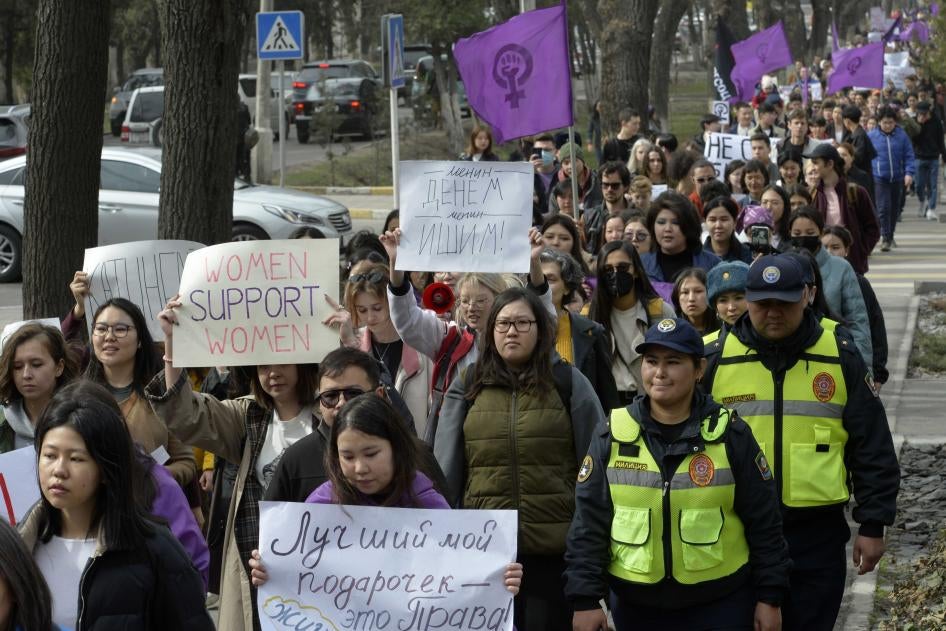
Women march to mark International Women's Day in Bishkek, Kyrgyzstan, March 8, 2023. Some of the posters read : "The best gift for me it's my rights!, My body, my choice!" © 2023 AP Photo/Vladimir Voronin

Altyn Kapalova is a lesbian feminist, artist, and writer from Kyrgyzstan who has been fighting with Kyrgyz authorities for more than two years for the right to keep the matronymic she gave her three children.

Kapalova chose to give her children an appendage to their first name that comes from her first name, or a matronymic, rather than a patronymic, the father’s first name, as required by law. Patronymics are a vestige of the Russian tradition of naming, still present in many former Soviet republics.

Initially, the Kyrgyz Civil Registry allowed Kapalova to make this change. But the registry moved to annul this decision after she wrote a Facebook post about the decision, calling it a “feminist victory over patriarchy.”

Kapalova has been fighting to maintain the registry’s initial decision ever since, including before the Supreme Court, which upheld the registry’s annulment request. On June 30, the Kyrgyz Constitutional Court handed her a mixed victory, ruling that any Kyrgyz citizen over age 16 could choose between a patronymic and a matronymic on their identity documents, but upholding the annulment in her case, citing the age of her children, who are 6 to 16.

The court found the current Kyrgyz Law “On Acts of Civil Status,” which only allows patronymics, to be discriminatory and unconstitutional. The court’s decisions are final and cannot be appealed in Kyrgyzstan.

The story started in December 2020 when Kapalova had her children’s birth certificates reissued with her name as the “patronymic.” Kapalova had applied for new birth certificates after a lengthy legal battle to strip the children’s fathers of their parental rights, citing their total absence from the children’s lives and lack of financial or moral support in their upbringing.

“Why is it that I, their mom, who is bringing them up completely alone, not asking for any kind of support from the government or anyone else, cannot give them my last name and my name as their matronymic?” said Kapalova.

Kapalova considers the Constitutional Court decision a win for many single-parent, mostly mother-led, families in Kyrgyzstan.

“This is not the end for me – I will fight for the right of mothers to give matronymics for their children at birth,” Kapalova told Human Rights Watch.

Mysterious and deadly ‘brain ailment’ alarms health officials in Canada

By Adarsh Kumar Gupta
Jul 04, 2023 

Health officials are further concerned as the brain disorder has been affecting young people.

A mysterious, deadly brain ailment is affecting people in New Brunswick province of Canada and health authorities are concerned. According to a report in New York Post, the disorder leads to neurological symptoms like hallucinations, muscle wasting, vision problems, memory loss and abnormal movements. The first cases were detected in 2015.
Image for representation(Getty Images)

Health officials are further concerned as the brain disorder has been affecting young people.

“I am particularly concerned about the increase in numbers of young-onset and early-onset neurological syndrome,” neurologist Dr. Alier Marrero wrote in a Jan. 30, 2023, letter to New Brunswick’s chief medical officer and the chief federal public health officer.

“Over the past year, I have been following 147 cases, between the ages of 17 and 80 years old. Out of those, 57 are early-onset cases and 41 are young-onset cases,” read the letter from Marrero, according to the Toronto Star.

Marrero and health officials suspect a herbicide called Glyphosate to be the likely reason behind the brain ailment. The herbicide is used in agriculture, the forestry industry and household weedkillers.


In his letter, Marrero highlighted that laboratory tests on patients revealed “clear signs of exposure” to glyphosate, as well as other compounds linked to herbicides.

A group of patients from New Brunswick have been requesting the federal and provincial government to conduct a full-scale investigation on the brain ailment.

“We are formally demanding that federal Health Minister Jean-Yves Duclos unmuzzle Canadian scientists and direct the Public Health Agency of Canada to uphold the Canada Health Act and reinstate federal experts into the investigation,” Steve Ellis, who is a patient advocate, told the Toronto Star.


https://files.libcom.org/files/Bookchin%20M.%20Our%20Synthetic%20Environment.pdf

Heart disease, cancer, arthritis, and diabetes-the most important degenerative diseases of our time-claim their victims from the welltodo and poor alike. The.


CALIFORNIA
Esmeralda Soria, the daughter of farmworkers, to chair Assembly Agriculture Committee


Andrew Kuhn/akuhn@mercedsun-star.com

Juan Esparza Loera
Mon, July 3, 2023

Assemblymember Esmeralda Soria, D-Merced, has been appointed chair of the Assembly Agriculture Committee, which helps oversee California’s $50 billion farming industry.

The appointment, announced Monday, means that the state Senate and Assembly agriculture committees are now chaired by daughters of farmworkers from the Central Valley.

State Sen. Melissa Hurtado, D-Bakersfield, grew up in Sanger, about 55 miles from Soria’s hometown of Lindsay.

New Assembly Speaker Robert Rivas, D-Hollister, is the grandson of farmworkers.

“I hold a deep connection with California agriculture,” said Soria, a former Fresno City Councilmember who won her Assembly race last November. “I pledge to continually engage with and bring the voices of farmers and farmworkers to the state Capitol.”

Her 27th Assembly District stretches from just south of Turlock to Merced, Los Baños, Mendota, Coalinga and a swath of Fresno. The region is largely agricultural.

Soria will lead an 11-member committee on issues including commodities, commissions, food access, fairs, food labeling, pest management, livestock/poultry, and the state Department of Food and Agriculture.

“As the daughter of first-generation immigrants and farmworkers, I worked alongside my parents in the Central Valley agricultural fields, and understand the importance of supporting both our agricultural industry and workers,” said Soria in a news statement.

“I’m grateful to Speaker Rivas for entrusting me with the important work of this committee,” she said.

Soria vowed to “continually engage with and bring the voices of farmers and farmworkers to the state Capitol.

“I hold a deep connection with California agriculture.” she said.

Juan Esparza Loera is the editor of Vida en el Valle.
RIP
Peter Brötzmann, 82, Dies; His Thunderous Saxophone Shook Jazz Traditions

One of Europe’s most influential free-jazz musicians, he played with “a kind of scream” to exorcise his demons, and those of German history.

Peter Brötzmann, the avant-garde tenor saxophonist (shown here with one of his other instruments, a bass clarinet), suspected that his hard-blowing style might have caused respiratory problems. A fellow musician said that Mr. Brötzmann’s nose would sometimes bleed because he was playing so hard.
Credit...Chris Felver


By Mike Rubin
July 3, 2023

Peter Brötzmann, an avant-garde saxophonist whose ferocious playing and uncompromising independence made him one of Europe’s most influential free-jazz musicians, died on June 22 at his home in Wuppertal, Germany. He was 82.

His death was confirmed by Michael Ehlers, the director of Eremite Records, who served as Mr. Brötzmann’s longtime North American tour manager and business partner.

No cause was given, but Mr. Brötzmann had suffered from respiratory issues for the last decade. A self-taught musician — best known for his tenor saxophone work, he also played various clarinets and the tarogato, a Hungarian woodwind instrument — he said that his practice of pushing too much air through his horn might have caused his health problems, which he likened to the lung damage suffered by glassblowers.

“I wanted to sound like four tenor saxophonists,” he told the British music magazine The Wire in 2012. “That’s what I’m still chasing.”

The force of Mr. Brötzmann’s abrasive squall felt tectonic. “I can’t think of anyone that played with more power than Peter,” the British saxophonist Evan Parker, who appeared on several of Mr. Brötzmann’s early records, said in a phone interview. “I don’t think it can be done, to get more out of a saxophone than that. Sometimes his nose would bleed because he was blowing so hard. He gave everything.”

Mr. Brötzmann in performance at the Vision Festival in New York in 2011. He said he “wanted to sound like four tenor saxophonists.”
Credit...Ozier Muhammad/The New York Times

Mr. Brötzmann described his style as a means of exorcising demons — particularly those of Germany’s crimes against humanity in World War II.

“Younger people don’t understand, but what has happened to us in Germany is a kind of trauma of our generation,” he told The Wire. “There is a great shame there and a terrible kind of trauma. And that’s why maybe the German way of playing this kind of music sounds always a bit different than the music from the other parts of Europe, at least. It’s always more a kind of scream. More brutal, more aggressive.”

Hans Peter Hermann Brötzmann was born on March 6, 1941, in Remscheid, an industrial city in western Germany. The city was almost destroyed by Allied bombardment in 1943, and Mr. Brötzmann’s earliest memory was of running through the streets holding his mother’s hand to escape the firestorm.

His father, Johannes, a tax officer, had been conscripted into the Nazi Army. Captured by the Russians on the Eastern Front, he didn’t return until 1948, after escaping from a P.O.W. camp in Siberia. Mr. Brötzmann grew up in Remscheid with his family — his father, his mother, Frida (Schröder) Brötzmann, and his sister Mariane — but moved to Wuppertal for school and remained there the rest of his life.

He studied graphic design and visual art in the late 1950s at the School of Applied Arts in Wuppertal, where he created his own fonts: striking, blocky alphabets that he later used on the covers of many of his albums. He had his first gallery show in 1959 and participated in early performances staged by the experimental, interdisciplinary art movement Fluxus. In 1963 he collaborated on the first major exhibition by Nam June Paik, the Korean American artist who would become known for his video work, but who at that point was building musically oriented installations and interactive sculptural objects.

Mr. Brötzmann continued making artwork prolifically even as music assumed a place of priority in his life.

“From the very start, he didn’t love the art-world milieu,” said John Corbett, co-owner of the Corbett vs. Dempsey gallery in Chicago, who began curating exhibitions of Mr. Brötzmann’s artwork in 2003. “But he continued privately making visual art. He was interested in beauty, but it had to be accompanied by a certain kind of honesty and forthrightness.

“He really could not deal with people who were false, with art that was false, and with music that he felt was false,” Mr. Corbett added. “He was quite intolerant of all those things.”

In 1967, Mr. Brötzmann released his first album as a bandleader on his own label, BRÖ. If its title, “For Adolphe Sax,” read like a provocation aimed at the 19th-century inventor of the saxophone, then his next BRÖ album, “Machine Gun,” released in 1968 and credited to the Peter Brötzmann Octet, announced all-out war on everything that had come before.

“Machine Gun” was a nickname the trumpeter Don Cherry had given him, as well as a reference to the carnage of the war in Vietnam. A milestone of collective improvisation, the album boasted three tenor saxophonists who would become titans of European free music: Mr. Parker, Willem Breuker of the Netherlands and Mr. Brötzmann.

Mr. Brötzmann’s violently expressive sounds, combined with confrontational album titles like “Nipples” (1969) and “Balls” (1970), “was something to get used to,” Mr. Parker said. “It wasn’t the gentle school of English ‘after you, sir’ kind of improvising.”

In 1969, Mr. Brötzmann co-founded a new label, FMP (the initials stood for “free music production”), for which his poster and album designs helped create a distinctive visual aesthetic. His trio with the Dutch drummer Han Bennink and the Belgian pianist Fred Van Hove — both veterans of “Machine Gun” — lasted a dozen years before Mr. Van Hove, struggling to be heard above the din, departed; Mr. Brötzmann and Mr. Bennink continued collaborating as a duo.

But Mr. Brötzmann’s reputation was largely confined to Europe until the mid-1980s, when he joined with the guitarist Sonny Sharrock, the bassist Bill Laswell and the drummer Ronald Shannon Jackson to form Last Exit, a group whose amplified cacophony flirted with heavy metal and raised his profile in North America.

Beginning in the late 1990s, reissues on Mr. Corbett’s label Unheard Music Series made Mr. Brötzmann’s early music readily available to a new generation of listeners, while collaborations with younger musicians like the Chicago Tentet (which featured the saxophonist and composer Ken Vandermark) established him as a revered figure in that city.

Throughout, Mr. Brötzmann toured relentlessly, earning the nickname Soldier of the Road, which was later the title of a 2011 documentary about him.

He almost never turned down a booking invitation, regardless of the money involved or the distance to be traveled; he even performed in Beirut in 2005 during the chaotic aftermath of the Cedar Revolution. That concert, like most of his travels, resulted in yet another album.

By Mr. Ehlers’s count, Mr. Brötzmann appeared on more than 350 records, including 180 as leader or co-leader.

Into his 70s, Mr. Brötzmann was traveling in minivans across North America with Mr. Ehlers, playing at theaters, clubs, do-it-yourself art spaces, community centers and occasionally even squats. He paid his audience back in kind, Mr. Ehlers said, through “the little gesture of playing every concert until he almost collapsed from the effort.”

In recent years, he toured in a duo with the pedal steel guitarist Heather Leigh and played frequently with the bassist William Parker and the drummer Hamid Drake, whom he considered his favorite rhythm section.

“Peter had his own relationship with sound,” William Parker said in a phone interview, “and every time he played, he tried to, as we call it, go to the moon.”

Mr. Brötzmann married Krista Bolland in 1962. They eventually separated, but remained close. She died in 2006.

Mr. Brötzmann is survived by a son, Caspar, a free-form rock guitarist with whom he recorded “Last Home,” a 1990 album of incendiary duets; a daughter, Wendela Brötzmann; and a grandson. His sister died before him.

Mr. Brötzmann’s restless creativity sometimes found unlikely admirers. In a 2001 interview with Oxford American magazine, former President Bill Clinton was asked to name a musician readers would be surprised he listened to.

His response: “Brötzmann, the tenor sax player, one of the greatest alive.”

Bangladesh-Myanmar: Expanding Menace Of ARSA – Analysis

 File photo of Arakan Rohingya Salvation Army (ARSA). Photo Credit: DMG

By 

By Afsara Shaheen*

On June 19, 2023, a Rohingya youth, identified as Iman Hossain, was killed and another was injured in a gunfight between the Arakan Rohingya Salvation Army (ARSA) and the Rohingya Solidarity Organisation (RSO) at Balukhali Rohingya Camp-8 in the Ukhiya Upazila (Sub-District) of Cox’s Bazar District.

On June 13, 2023, one person, Bashir Ullah, was killed in a gunfight between ARSA and RSO at the H/32 block of Camp-10 in Ukhiya.

On June 5, 2023, a group of eight to ten ARSA operatives shot dead a madrassa (seminary) student, Mohammad Bashir, at Kutupalong refugee camp in Ukhiya.

According to partial data compiled by the by the Institute for Conflict Management (ICM), at least nine persons have been killed in ARSA-linked violence in 2023 (data till July 2), including four ARSA cadres. There were four such fatalities in 2022 (including one ARSA cadre) and one (ARSA cadre) in 2021.

Meanwhile, SFs have arrested at least 31 ARSA operatives in Bangladesh in 2023, four in 2022 and 10 in 2021. Some of the recent arrests included


June 12, 2023: An ARSA operative and also an accused in six murders, Sabbir Ahmed aka Lalu, was arrested by the Armed Police Battalion (APBn) from Balukhali camp in Ukhiya.

May 21, 2023: A suspected ARSA operative, Rahmat Kabir, was arrested with a firearm by the APBn from Camp-9 in Ukhiya.

May 10, 2023: A top ARSA ‘commander’, Mohammad Zubair, was arrested by the APBn in Ukhiya.

ARSA was formed following the riots in the Rakhine State of Myanmar in 2012, in which ethnic Rohingya Muslims were targeted by ethnic Rakhine Buddhists. It, however, first came into prominence in October 2016 when it attacked three police outposts in the Maungdaw and Rathedaung townships in Myanmar, killing nine Police officers, provoking massive retaliatory violence by state Forces and fuelling a wave of distress migration of Rohingyas into Bangladesh.

Reports in 2018 indicated ARSA was responsible for two 2017 massacres in which up to 99 Hindu residents in the northern Rakhine state of Myanmar were murdered, including children. Further, reports of ARSA targeting the small Christian Rohingya community living in the Bangladeshi refugee camps as well as Rohingya civilians working with international humanitarian organisations surfaced throughout 2019 and 2020. ARSA has also come under fire for its claimed role in the 2016–2017 killings of moderate Rohingya community leaders in Rakhine State, a trend that continues in the camps in Bangladesh. ARSA was widely implicated in the high-profile September 2021 murder of Mohib Ullah, a moderate Rohingya leader who was shot dead outside the office of the Arakan Rohingya Society for Peace and Human Rights, the organisation he led. However, ARSA denied any involvement in the killing.

During 2016 and 2017, ARSA leaders had started visiting certain Rohingya areas in Myanmar to recruit locals. They would then ask each community to ‘contribute’ five to ten individuals for ‘basic training’. After completing their initial training, new ARSA members went back to their communities to carry out ‘security responsibilities’, promote active religious observance, and allegedly use violence to silence Rohingyas who opposed their actions or were seen as being too close to the authorities.

For internal communications and recruiting, ARSA used text messages from mobile phones and shortly, the encrypted WhatsApp, while it used Facebook and Twitter to spread its message more publicly. In 2017, Facebook classified ARSA as a “dangerous organisation,” which basically put an end to the group’s Facebook activity. ARSA maintained a consistent posting schedule on its @ARSA_Official Twitter account, which is still active on the social media site.

Myanmar’s Anti-Terrorism Central Committee, meanwhile, declared ARSA a terrorist group on August 25, 2017, in accordance with the country’s counter-terrorism law. ARSA is also considered a terrorist group in Malaysia.

ARSA is led by Ataullah abu Ammar Jununi aka Hafiz Tohar, a Rohingya born in Karachi, Pakistan, who grew up in Mecca, Saudi Arabia.  Bertin Linter in the report “ARSA linked to foreign extremist groups”, mentions ARSA’s second-ranking leader, as a person known only as ‘Sharif’, who comes from Chittagong in Bangladesh and does not appear in any of the group’s propaganda videos. Sharif reportedly speaks with an Urdu accent, the official language of Pakistan. Other members of the ARSA leadership include a committee of Rohingya émigrés in Saudi Arabia.

ARSA claims it is fighting on behalf of more than a million Rohingya, who have been denied the most basic rights, including citizenship, in Myanmar; as well as against the ‘inhuman’ condition of Rohingya refugees in Bangladesh. In a statement on May 10, 2023, Ataullah declared,

ARSA’s ultimate objective is to repatriate the entire Rohingya community to their Ancestral land. Yet the current repatriation plan of the Genocidal Burmese Territory Military Regime is nothing but a scheme to mislead both the Rohingya and the International Community. The proposed establishment of temporary camps for a limited number of people only serves to relieve them from international pressures and avoid accountability for the Genocide committed against the Rohingya people.

The statement maintains that the only viable option for the safe repatriation of the Rohingya people is the establishment of a ‘Safe Zone’ under the ‘Responsibility to Protect’ (R2P).

ARSA operates in the Rakhine State and inside Bangladesh refugee camps.

A February 15, 2023, report placed before the Parliamentary Standing Committee of the Defence Ministry of Bangladesh, stated that ARSA was among 10 terrorist and dacoit gangs active in the Rohingya camps. The report added that Tambru’s Konapara Camp, on the ‘zero line’ (Bangladesh-Myanmar border), had become the centre point for ARSA’s organisational operations, training, and control of drug smuggling and terrorist activities, due to a lack of regular patrolling and surveillance. The report stated that ARSA is active in Ukhia, Balukhali, Palangkhali (Ukhiya Sub-District) and Whykong (Teknaf Sub-District) of Bangladesh. Noting that ARSA controlled most of the camps, the report stated that ARSA and the Nabi Hussain dacoit gang often engaged in clashes over dominance and control, resulting in a series of murders.

In a February 24, 2022, interview, ARSA leader Ataullah claimed that his group had a cadre strength of 14,000 in Bangladesh and 2,000 in Myanmar.

Little is known about the financial backers of ARSA, but the International Crisis Group believes funding originates from an unnamed group of supporters in Mecca and Medina in Saudi Arabia. Four banks, including the Islami Bank, Al Arafa Islami Bank, Western Union, and Pubali Bank, which are located in the Rohingya refugee camps in the Cox’s Bazar District, have been used by ARSA to receive international funding. 

According to a recent report, Rohingya Camps Near the Border — a New Source of Insecurity? released on May 26, 2022, the Bangladesh Police described ARSA as the ‘kingpins’ of the illegal trade across the Bangladesh–Myanmar border. The report added that, though ARSA was a Burmese terrorist organization, the group uses Bangladesh for their arms and Yaba trade (drugs trafficking), to raise revenues.

Interestingly, ARSA has revealed that it had received training from Tehrik-e-Taliban Pakistan (TTP). ARSA and the Bangladesh-based Jama’atul Mujahideen Bangladesh (JMB) are also linked and videos of joint undergoing arms training have surfaced on social media. Indeed, a statement by Ambassador Hau Do Suan, Permanent Representative of Myanmar to the United Nations, on Agenda Item 109 “Measures to Eliminate International Terrorism”, at the Sixth Committee of the 74rd Session of the United Nations General Assembly, read:

We are concerned about the link between ARSA and international terrorist groups, including FTFs (Foreign Terrorist Fighters). Since its inception, ARSA has been reportedly guided and supported by foreign terrorists such as Al-Qaeda, ISIL, and Tehrik-e-Taliban Pakistan (TTP).

The threat to security from ARSA in Bangladesh, principally in the Rohingya refugee camps and surrounding area in Cox’s Bazar District, has increased manifold in the recent past, as this group has intensified its efforts to establish its dominance in these areas. The resultant clashes with Rohingya camp leaders as well as other insurgent/criminal groups, have enormously vitiated the security environment, and it is likely that this sort of violence will continue.


Afsara Shaheen, Research Assistant, Institute for Conflict Management

SATP, or the South Asia Terrorism Portal (SATP) publishes the South Asia Intelligence Review, and is a product of The Institute for Conflict Management, a non-Profit Society set up in 1997 in New Delhi, and which is committed to the continuous evaluation and resolution of problems of internal security in South Asia. The Institute was set up on the initiative of, and is presently headed by, its President, Mr. K.P.S. Gill, IPS (Retd).

 chase money dollar trap welfare free market

The Myth Of The Free Market – OpEd

By 

The media are really going overboard in telling us the days of the free market are over with Biden’s new economic policies. President Biden has quite explicitly implemented policies intended to reshape the direction of the economy, pushing clean energy and more domestic production of advanced semiconductors and other products. He also has reinvigorated anti-trust policy, which was largely shelved by his predecessors.

But the idea that the policies of the last four decades were somehow a matter of just leaving things to the market is a grotesque lie that no person remotely familiar with economic policy should be repeating.

The Finance Industry Cesspool

I will reverse the usual course of my diatribe here and start with the financial sector. Suppose back in 2008-09 we let the market work its magic when Citigroup, Bank of America, and other financial giants were effectively bankrupted by their own greed and stupidity. We would have a radically downsized financial sector, with many fewer people earning seven and eight-figure salaries at banks. (No, we would not have had a Second Great Depression. Keynes taught us how to prevent a depression: spend money.)

We would also have a much smaller financial sector if we taxed sales of stocks, bonds, and derivatives like we taxed sales of clothes, cars, and furniture. It is the power of the financial industry, not the free market, that tells us that these financial transactions should be exempted from the sales taxes that apply to just about everything else we buy.

There is also nothing “free market” about the special tax treatment that some of the richest people in the country get when they have “carried interest” income as partners in hedge funds or private equity funds. Nor is it the free market when these funds prey on public pension funds, promising high returns that they rarely deliver.

“Free Trade” is a Story for Children and Elite Pundits

The “free trade” deals of the last forty years had little to do with free trade. We did want to remove trade barriers on manufactured goods, in order to subject our manufacturing workers to direct competition with low-paid workers in the developing world. This had the predicted effect of costing us millions of manufacturing jobs, and substantially reducing the pay of the jobs that remained.

But we could have made the focus of free trade removing barriers that protected doctors, dentists, and other highly paid professionals from competition with their lower paid counterparts in the developing world. This would have had the effect of reducing jobs and pay for U.S. born professionals.

For some reason, this was never a part of our “free trade” agreements. We could speculate this was because the people deciding on trade policy were far more likely to have friends and family members who are highly paid professionals than friends and family members who were autoworkers or textile workers, but that would be rude. In any case, this part of “free trade” deals was about a having a freer trade in a particular sector of the economy, where the predicted and actual effect was to drive down the pay of non-college educated workers.

Patent and Copyright Monopolies

The other really big part of our free trade deals was to make patent and copyright monopolies, and related protections, longer and stronger. It is incredibly Orwellian that these government-granted monopolies are somehow discussed as being the free market.

And, their impact is not some small sideshow. We will spend over $550 billion this year on prescription drugs. If drugs sold in a free market, without patents or related protections, the cost would almost certainly be less than $100 billion. The difference of $450 billion is more than four times the annual food stamp budget. It’s more than half of what we spend on the military each year. It comes to more than $3,000 a family.

If we projected out over ten years, and accounted for growth in spending, it would be close to $6 trillion. That is six times President Biden’s widely touted infrastructure program.

And, it has a huge impact on inequality. The people who benefit from these monopolies are many of the country’s richest people. Bill Gates is the poster child. He would likely still be working for a living if the government didn’t threaten to arrest people who copy Microsoft software without his permission.

Just since the pandemic, we created five Moderna billionaires by paying the company to develop vaccines and then letting them keep control over the vaccines. Don’t try to tell us that is the free market.

By my calculation we transfer over $1 trillion a year to the beneficiaries of patent and copyright monopolies, compared to a situation where items like drugs, medical equipment, computer software and other items sold at their free market price. This is around 40 percent of all after-tax corporate profits.

Why the Free Market Lie?

I could on at great length laying out other areas where the government has structured the market in ways that redistribute income upward. (See Rigged, it’s free.) It should be obvious to anyone at all familiar with economic policy over the last four decades that it was not about the free market, it was about structuring the economy in ways that made the rich richer.

It is understandable that the proponents of these policies would like to claim it was just the free market. After all it sounds much better to tell the public, the vast majority who are losers from these policies, that “the market creates both winners and losers,” as opposed to saying, “we’re implementing polices to transfer money from you to us.”

But why do people who oppose these policies go along with the hoax? There apparently is a big market for this sort of pretending in major media outlets, but it would be nice if we could get more reality-based policy discussions.


This first appeared on CEPR.

Dean Baker is the co-director of the Center for Economic and Policy Research (CEPR). He is the author of Plunder and Blunder: The Rise and Fall of the Bubble Economy.
Drought menacing Thailand threatens global supply of sugar, rice

The dire outlook has prompted the Thai authorities to ask farmers to restrict rice planting to a single crop to conserve water. 
PHOTO: ST FILE

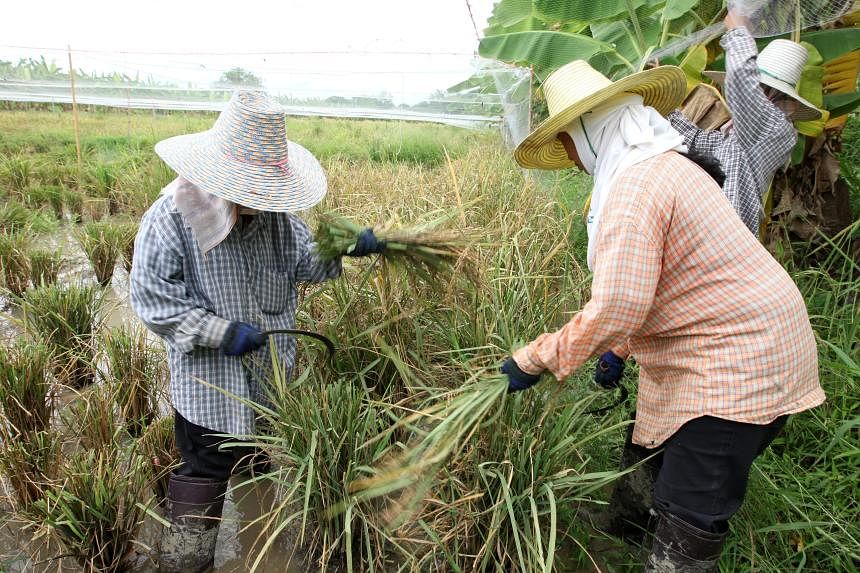
BANGKOK – Thailand is preparing contingency plans to deal with a potential drought that could last years and squeeze global supplies of sugar and rice.

Rainfall across the nation may be as much as 10 per cent below average this monsoon season, and the onset of the El Nino weather pattern could lower precipitation even further over the next two years, according to government officials.

Thailand is facing widespread drought conditions from early 2024, the authorities have warned.


The dire outlook has prompted the Thai authorities to ask farmers to restrict rice planting to a single crop to conserve water, and sugar producers see output falling for the first time in three years.

A drought is certain to fuel inflation in the South-east Asian nation as vegetables, fresh food and meat get pricier on reduced harvests and more expensive animal feed.

Prime Minister Prayut Chan-o-cha has asked state-run power utility Electricity Generating Authority and the Office of the National Water Resources to help draw up contingency plans to conserve water.

So far in 2023, the nation’s rainfall has been 28 per cent below the same period in 2022, according to official data.

El Nino can lead to drier conditions in parts of Asia and Africa, and heavy rain in South America, damaging a wide range of crops globally.

Previous El Ninos have resulted in a marked impact on global inflation and hit gross domestic product in nations from Brazil to India and Australia.

Thailand is seeking to nurture a rebound in economic growth that is already facing headwinds from a slowdown in China, the nation’s largest trade partner, and a prolonged drought may scupper efforts to keep inflation under check.

Thailand has already grappled with record heat in 2023.

“El Nino will pose a bigger worry on growth than inflation,” said Mr Euben Paracuelles, an analyst at Nomura Holdings. “Thailand is a large food exporter, with only half of total output consumed domestically. So the buffers could help limit the near-term inflation impact, alongside government price controls and subsidies.”

If El Nino turns severe, it could shave off 0.2 percentage point of gross domestic product (GDP) in 2023 because drought conditions could coincide with seasonal production in the second half, especially for rice, he added.

The central bank forecasts Thailand to clock GDP growth of 3.6 per cent in 2023, accelerating from 2.6 per cent in 2022.

Power demand in Thailand hit a record in April when some regions saw all-time high temperatures, forcing companies and households to increase the use of air-conditioning to escape the sweltering heat.

The bigger, global impact from below-average rainfall in Thailand will be the hit to crops such as sugar and rubber, and could even threaten the nation’s position as the world’s second-biggest supplier of rice.

Shipments tumbled a third to 7.6 million tonnes in 2019, the first year of the previous El Niño.

Sugar cane is a sturdy crop, but the nation’s millers have forecast a decline in output. That will cut the supply to the world market and further fuel a rally in refined sugar prices that are hovering around a decade-high.

MORE ON THIS TOPIC

Are Singapore and the region ready for El Nino?

The nation produced about 11 million tonnes of sugar in the 2022-23 season and is estimated to have exported about 80 per cent of its output.

Thailand’s lack of long-term mitigation efforts to deal with floods and droughts will likely aggravate the impact of extreme weather on the nation, according to the World Bank.

“The frequency of floods and droughts and the high human and economic cost associated with them make climate change adaptation and water management important in Thailand,” said Mr Fabrizio Zarcone, the World Bank’s country manager for Thailand.

“A more robust framework prioritising risk mitigation planning, investing in water resources infrastructure, and managing land and water use is needed.” BLOOMBERG

From hydrocarbons to hydrogen? Gulf states seek
the good oil (SIC) in green transition

The region that has long dominated global energy
politics is well placed to shape a shift to new supplies.

Attempts to rapidly scale up hydrogen production speaks to the desire by GCC states to be early movers in the sector, supplying both European and Asian markets
 (Maya Siddiqui/Bloomberg via Getty Images)


ACHREF CHIBANI
Published 4 Jul 2023 Energy

Hydrogen has been hailed as an energy of the future and the technical fix in the green transition. But as hydrogen’s technological and cost barriers continue to fall, there remain political barriers to hydrogen as a green energy technology in the 21st century. This is just as true for the Gulf states, who have been traditional geographic powerhouses in the oil economy. The policies, legislation, production and infrastructure adopted by the Gulf Corporation Council (GCC) states will be crucial to shaping the role of hydrogen in the years ahead.

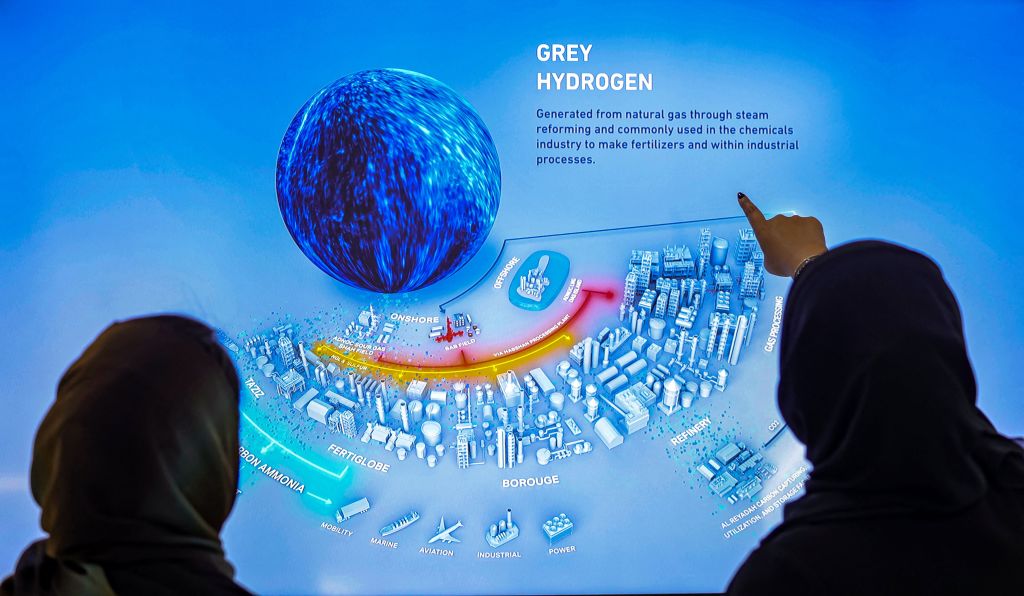
This is because hydrogen represents an energy carrier and store rather than source, i.e., it requires other energy for its manufacture. The green credentials of hydrogen are therefore highly dependent on what energy inputs are included in its production. Colours are used to distinguish between different energy sources, so while “green hydrogen” is produced solely from renewable energy sources such as wind, solar and hydro, “grey hydrogen” employs natural gas, and “blue hydrogen” is produced from natural gas or coal but can incorporate carbon capture and storage into the production process.

The GCC states are well suited to the production of green, grey and blue hydrogen and eye-catching reports have predicted that those states may generate annual revenues of as much as US$200 billion from green hydrogen by 2050. The region’s hydrogen policy began in 2019 when Oman, Saudi Arabia, the United Arab Emirates and Kuwait started to outline hydrogen strategies and publicise ambitious hydrogen projects. Most notably, Saudi Arabia announced plans to produce 1.2 million tonnes of green-hydrogen-based ammonia as part of its NEOM megaproject. The project, which is a joint venture between the state-owned NEOM, Saudi Arabia’s ACWA Power and the US company Air Products, is estimated to cost US$8.4 billion and to come online in 2026.

An infographic about grey hydrogen, produced from natural gas, on display at the UAE pavilion during the COP27 climate conference last year in Sharm el-Sheikh, Egypt
 (Fayez Nureldine/AFP via Getty Images)

Attempts to rapidly scale up hydrogen production speak to the desire by GCC states to be early movers in the sector and position the region as a global hub for hydrogen, supplying both European and Asian markets. The region has several competitive advantages including the relative low cost of land across Gulf states, high potential solar power generation, existing industrial capacity and underground storage options for carbon sequestration in the production of blue hydrogen.

If, in the 20th century, Gulf states were reliant on Europe and the United States to help develop their oil resources, the hydrogen economy is likely to reflect shifts in global power. GCC states are aware of the potential to become market leaders in hydrogen technologies, which would offer the added benefit of being able to sell hydrogen manufacturing, storage and transportation technologies and expertise to the rest of the world. Just as American oil engineers and companies made their fortunes in the Gulf in the mid-20th century, it is not inconceivable that Arab hydrogen expertise might be exported to the world in the 21st century.
A tanker-based hydrogen transportation regime may well benefit GCC states, allowing them to convert their current port infrastructure to mirror current hydrocarbon shipping lanes.

Though Europe has looked to nurture hydrogen energy relations with the GCC, the Asia-Pacific is emerging as the most attractive hydrogen market for Gulf states who have begun to actively look to build relations with Asian partners. Saudi Arabia has signed memorandums of understanding on hydrogen with China and Japan’s Marubeni Corporation. Oman, meanwhile, has entered into an agreement with a consortium of South Korean companies to build and operate hydrogen plants in the Sultanate. It is likely that this kind of “hydrogen diplomacy” will grow in importance as new markets are developed. In addition, there are signs of growing competition between rival hydrogen-producing states. Outside the Gulf, Egypt and Morocco are also vying to be regional leaders in hydrogen production.

Key to securing the region’s hub status will be its ability to develop hydrogen infrastructure that can transport energy to markets. Reflecting Gulf states’ preference for bilateral energy relations, states have historically forgone pipelines in preference for tankers as the means to transport hydrocarbons to their consumers. While hydrogen pipelines have been proved effective over short to medium distances, it is expected that hydrogen will be transported by tanker over longer distances.

A tanker-based hydrogen transportation regime may well benefit GCC states, allowing them to convert their current port infrastructure to service hydrogen transportation and for a global hydrogen network to mirror current hydrocarbon shipping lanes. Admittedly, this would reproduce current energy transportation security concerns and chokepoints – such as the Strait of Hormuz or the Malacca Strait – but it is likely that global maritime and energy corporations will favour known risks over navigating a new energy geography and its attendant security regime.

As GCC states engage with the energy transition, it is unsurprising that new hydrogen technologies are proving an attractive alternative to hydrocarbons. In many ways, they allow GCC states to maintain the global energy status quo, retaining the Gulf’s position as the paramount energy producer and exporter. That said, hydrogen is not oil, and it is likely to produce new geopolitical dynamics that reshape international politics.