Tuesday, August 15, 2023

UK
Biggest rise in wages since records began


Matt Mathers
Tue, 15 August 2023

Wages grew at a record annual pace in the past three months as unemployment rose slightly, official figures show.

The Office for National Statistics said regular pay rose by 7.8 per cent between April and June.

Unemployment, meanwhile, rose to 4.2 per cent in the three months to June, up from 3.9 per cent in the previous three-month period.

The unemployment rate is the highest since the three months to October 2021, the ONS said, and brings the measure above pre-pandemic levels.

In real terms, regular pay rose 0.1 per cent for the year when adjusting for Consumer Prices Index including owner occupiers’ housing costs (CPIH) inflation.

It is the first time since October 2021 that real wages have increased, the ONS added.

Growth in wages comes against a backdrop of high inflation, or rising prices, which have begun to ease but remain at 7.9 per cent - well above the Bank of England’s 2 per cent target.

The inflation figures for July are published later this week and analysts expect the rate to fall by nearly a full percentage point.

The data is expected to show consumer prices index (CPI) inflation falling from 7.9 per cent to around 7 per cent.

However, The Independent understands that analysis by Treasury officials shows that inflation will rebound again in August – with the unwelcome reversal set to show up in figures released the following month.

The ONS data published on Tuesday also showed that inactivity in the labour market due to long-term sickness hit a new record high.

Job vacancies also fell by 66,000 though remain just above the million mark (1.02m).

Jack Kennedy, senior economist at the global hiring and matching platform, Indeed, said: “There are signs the cost of living could finally start to ease after record annual pay growth drove pay above inflation for the first time in over one-and-a-half years.

“Regular pay growth jumped to a record 7.8 per cent year on year in the second quarter of 2023, the highest it’s been since comparable data began in 2001.

“Including bonuses, the figure was 8.2 per cent year on year, driven by one-off NHS bonuses in June.”

He added: “While the wage growth figures will grab attention, the ONS data also showed the labour market continuing to rebalance.

“The unemployment rate jumped by a larger than expected 0.3 percentage points to 4.2 per cent, driven by an increase in long-term unemployment and more people moving out of inactivity. However, inactivity due to long-term sickness hit a new record high.”

The data also shows the number of payrolled employees increased by 97,000 to 30.2 million in July, although the ONS said this is a "provisional estimate and is likely to be revised when more data are received next month".

Responding to the figures, chancellor Jeremy Hunt said: "Thanks to the action we’ve taken in the jobs market, it’s great to see a record number of employees.

"Our ambitious reforms will make work pay and help even more people into work - including by expanding free childcare next year - helping to deliver on our priority to grow the economy."

ONS director of economic statistics Darren Morgan said: "The number of unemployed people has risen again while the number of people working has fallen back a little.

"This is mainly due to people taking slightly longer to find work than those who started job hunting in recent months.

"The drop in those neither working nor looking for work is mainly among those looking after their family or home.

"Meanwhile the number of people prevented from working by long-term sickness has risen again to a new record.

"Job vacancies have now fallen over a quarter of a million since this time last year. However, they remain significantly above pre-Covid levels.

"Earnings continue to grow in cash terms, with basic pay growing at its fastest since current records began.

"Coupled with lower inflation, this means the position on people’s real pay is recovering and now looks a bit better than a few months back."
Former FBI agent says he was not aware of interference in Hunter Biden probe

Reuters
Mon, August 14, 2023 

U.S. President Biden's son Hunter to face tax charges in federal court


WASHINGTON (Reuters) - A former FBI agent who helped lead the probe of Hunter Biden told congressional investigators that he was not aware of any political interference in the case, though he said higher-ups blocked an interview with President Joe Biden's son weeks after the 2020 presidential election, transcripts show.

In transcripts from a July 17 interview with the Republican-controlled House of Representatives Oversight Committee, the unidentified FBI supervisory agent corroborated earlier testimony by an Internal Revenue Service whistleblower that investigators were not allowed to interview Hunter Biden on Dec. 8, 2020, after top Secret Service officials and the Biden transition team were notified of the plan.

The former agent, who retired last year after more than 20 years with the agency, told investigators that he was frustrated over the decision by more senior officials to block the interview but didn't consider the outcome problematic.

"I wasn't aware of political interference, personally," the former agent said.

Republicans pointed to the testimony as evidence that the Justice Department intervened to delay the Hunter Biden probe, even though the events took place while Republican President Donald Trump was in office.

"Tipping off the transition team and not being able to interview Hunter Biden as planned are just a couple of examples that reveal the Justice Department's misconduct in the Biden criminal investigation," House Oversight Committee Chairman James Comer said in a statement on Monday when the committee released the transcript.

Comer said the alleged misconduct occurred under U.S. Attorney David Weiss, a Trump appointee who was named special counsel in the Hunter Biden investigation last week over the objections of many House Republicans including Comer.

Hunter Biden in July pleaded not guilty to charges of failing to pay taxes on more than $1.5 million in income in 2017 and 2018 despite owing more than $100,000. He did not enter a plea in a separate case where he is charged with unlawfully owning a firearm while using illegal drugs, which is a felony.

The former agent said investigators had planned to surprise Hunter Biden with their interview request, but first had to notify the Secret Service, which had begun protecting the son of the then-president-elect days earlier.

In the end, both FBI and Secret Service headquarters were notified about the interview plan, the interviewers' access to Hunter Biden was blocked and the former FBI agent heard from an attorney for Hunter Biden.

(Reporting by David Morgan; Editing by Scott Malone and Howard Goller)
Border officers at Edmonton airport find tarantulas in plastic container, toy plane

The Canadian Press
Mon, August 14, 2023 a


EDMONTON — The Canada Border Services Agency says officers discovered two live tarantulas hidden inside plastic containers at the Edmonton International Airport earlier this year.

In May, officers saw irregularities in a small package from Hong Kong and found a male tarantula hidden inside a plastic container.

Weeks later, an inspection of another package from the same shipper found a female spider hidden inside a children’s toy plane.

It turns out the species of tarantula, which is native to Hong Kong, did not require permits to import into Canada.

But the agency says the spiders were seized because they weren't transported humanely.

They have since found a new home at the Royal Alberta Mus
eum.

The agency says all living creatures, including pets, must be declared when importing them into Canada in order to avoid spreading disease and introducing foreign species.

"CBSA officers were able to find and rescue these two tarantulas from inhumane shipping methods. All living creatures need to be transported and imported properly to keep Canada’s ecosystem and biodiversity safe," said Lisa Laurencelle-Peace, the agency's regional director of the Prairie region.

"The CBSA works closely with its enforcement partners, including (Environment and Climate Change Canada) enforcement officers, to keep Canada’s border secure and stop the illegal wildlife trade."

This report by The Canadian Press was first published on Aug. 14, 2023.

The Canadian Press
CANADA
Housing minister says federal government should have stayed in housing game


The Canadian Press
Mon, August 14, 2023 


BURNABY, B.C. — Housing Minister Sean Fraser says the federal government should have never got out of the housing business even as high-income professionals are struggling to find affordable housing.

Fraser says federal governments over the past half century, both Liberal and Conservative, stepped away from the file and now much of the country is dealing with a housing crunch that has no easy fixes.


He told media in Vancouver that past federal governments were mostly preoccupied with providing subsidized housing to low-income people, but there's been a fundamental shift as working professionals struggle to afford a home.

Fraser says it's important for housing to be built for people across the income spectrum, and his government is looking at ways to speed up construction of housing through subsidies and other incentives.

The minister was unable to point to a specific price he would consider affordable rent for a one-bedroom apartment, while the average price for such a unit in Vancouver was recently reported to be $3,000.

Fraser says he believes bringing more rentals to the market will drive prices down, but concedes Canadian home prices are subject to many market forces that make them difficult to predict.

This report by The Canadian Press was first published Aug. 14, 2023.

The Canadian Press


PETULANT CLIMATE CHANGE DENIER
Alberta premier offers up contradictory versions for imposed wind and solar pause


Mon, August 14, 2023

CALGARY — Alberta Premier Danielle Smith has offered conflicting explanations for why her government put a temporary ban on large wind and solar energy projects.

Smith told reporters in Calgary today the Alberta Utilities Commission and the Alberta Electric System Operator wrote to the government on July 21 asking for a pause.

But neither letter asks for such a moratorium.

When reporters pressed Smith on the contradiction, the premier said the Utilities Commission did ask for the pause, but her office has declined to clarify when or how it did so, and the commission could not be immediately reached for comment.

Smith’s government has faced criticism for announcing the moratorium on Aug. 3 with no advance notice and without consulting stakeholders, jeopardizing billions of dollars in potential investment in renewables.

Smith says it should have been obvious drastic action was coming given she spoke publicly in the spring about whether renewable energy was sufficiently backstopped by natural gas and expressed concern over projects taking up too much farmland.

This report by The Canadian Press was first published Aug. 14, 2023.

The Canadian Press
Democrats’ climate law set off a wave of energy projects in GOP districts. A backlash followed.

Michael Conroy/AP Photo

Josh Siegel, Kelsey Tamborrino and Jessie Blaeser
Sun, August 13, 2023 


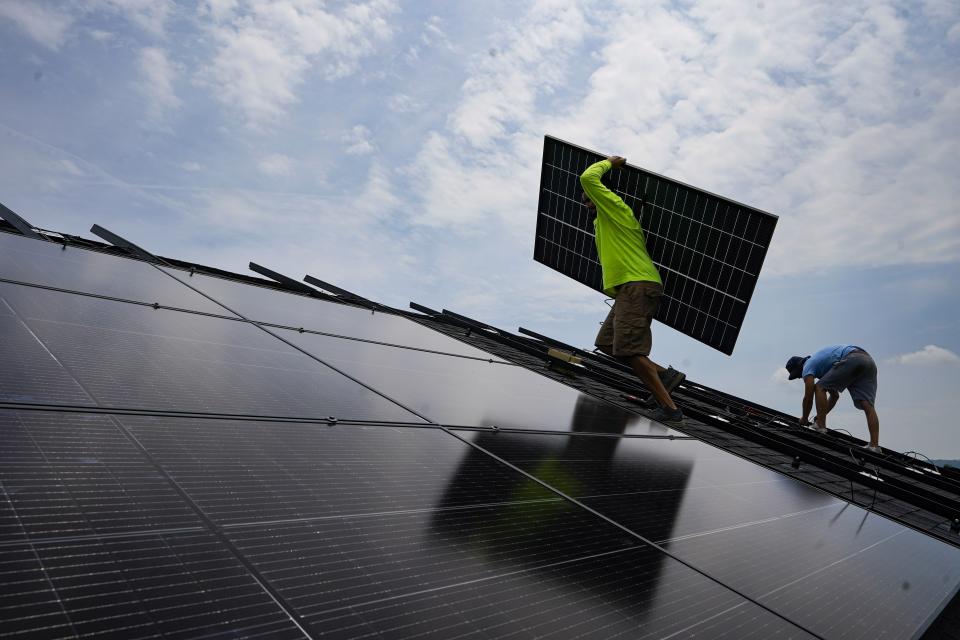
President Joe Biden’s year-old climate law triggered a deluge of clean energy spending in almost every state — and it’s splitting conservatives across rural America.

Some communities are welcoming their slice of the $370 billion pot of federal tax incentives meant to accelerate the development of renewable energy and the deployment of electric vehicles as a way to bring back jobs. Others see the Inflation Reduction Act as a vehicle for boosting Chinese businesses and the reach of their government.

While Republicans on the campaign trail and in Congress regularly bash the law — which Biden signed a year ago Wednesday — as big-government overreach by Democrats bent on killing off fossil fuels, its benefits are disproportionately landing in their communities. And as the measure supercharges efforts to combat climate change, it’s also rekindling economies where people have felt forgotten, potentially softening how some voters view Biden as he seeks reelection.

“We always knew that it would fall across America, not in one particular state or another,” Senate Majority Leader Chuck Schumer said in an interview. “We know that rural areas have been neglected, we know that rural areas have fallen behind, and we wanted to help those rural areas. And if some of those rural areas are red, so be it.”

For the companies that are hoping to reap federal tax incentives as well as state and local sweeteners, Republican parts of the country often look more attractive. Of the 200 project locations that have been announced through July, more than 60 percent are in GOP-held districts, according to a POLITICO analysis.

“Companies are building projects where they will be the most effective and generate the most resources,” said Jason Grumet, CEO of the American Clean Power Association, a clean energy industry trade group. “It is no surprise in the Southeast, Upper Midwest, where you have significant amounts of manufacturing capacity, much of which has been idled and left the country.”

As the IRA hits its first anniversary, POLITICO traveled across the nation to examine how the law is playing out in Oklahoma (where the Republican governor is claiming credit for the state’s booming clean energy sector), Michigan (where multibillion-dollar battery projects will generate jobs but are provoking uproars over Chinese ties) and upstate New York (where Republican congressmembers in Biden districts are trying to navigate the politics of the IRA).

MICHIGAN: Green Charter Township and Marshall

Jim Chapman, the Republican supervisor for Green Charter Township, a small rural community an hour’s drive north of Grand Rapids, said he’s received several death threats over a planned $2.36 billion battery component manufacturing facility in the area.

“I accepted the fact that I was going to have to be the lightning rod,” Chapman said in an interview from his office. He is facing a recall effort launched by residents worried about the plant’s sponsor, Gotion, and its links to China.

“Where you have people that are concerned about the Chinese Communist [Party] — they don’t know how to [fight] it in Lansing. They don’t know how to deal with it in Washington. They can deal with it locally,” he said.

Gotion Inc., which recently finalized the purchase of 270 acres in Green Charter Township, is a U.S. subsidiary of Gotion High-tech Co., an international company founded in China.

Residents and some elected officials point to Gotion High-tech documents that include language to “carry out Party activities” in accordance with the Chinese Communist Party.

Chuck Thelen, the vice president of North American manufacturing at Gotion, has insisted there is no such language in the U.S.-based company’s articles of incorporation. Thelen said the Chinese Communist Party has no presence in the North American company.

“The rumors that you’ve heard about us bringing communism to North America are just flat-out fear-mongering and really have nothing based in reality,” he said.

The plant’s backers say the opposition represents just a small minority of residents and argue it will bring much-needed economic growth.

“We desperately need good-paying jobs,” said Carlleen Rose, 69, a local business owner.

But those who oppose the project have a lengthy list of concerns, including a lack of transparency in the process up to this point and potential for air and water pollution stemming from battery materials.

Thelen said the company is currently going through the permitting process for the facility, including the next phase of an environmental study.

“All you gotta do is drive around the community and you’ll see how many people are against it,” said Lori Brock, 58, the owner of a local real estate agency and a horse farm across from the planned site.

“They’re pushing it down our throats,” Brock added. “Why are we giving our tax money to China when we’re almost at war with China? Why aren’t we giving our tax money to an American company?”

That antipathy is shared by local elected officials, including Republican Rep. John Moolenaar, who represents the district.

“Gotion North America is a subsidiary of a company that pledges allegiance to the CCP and I don’t think they should be receiving taxpayer money to build in Michigan,” he said in an interview.

The site’s proximity to a military training center has also raised national security concerns, although the Committee on Foreign Investment in the United States reportedly determined earlier this year the factory was outside of its jurisdiction.

The project — along with a separate Ford Motor Co. battery facility in Marshall, Mich., that will license technology from a Chinese company — mark a recurring theme of distrust that undergirds some of the manufacturing announcements that are flowing to red districts.

More than 40 percent of the new manufacturing announcements made since the IRA was enacted were led by companies based outside the U.S. or by companies outside the U.S. in partnership with a U.S. company, according to data shared with POLITICO by national business group E2. At least six of those announcements were made by, or in partnership with, a Chinese-based company.

Ford’s planned $3.5 billion BlueOval Battery Park Michigan project two hours south of the Gotion plant is expected to create 2,500 new U.S. jobs.

But its reliance on technology from China-based Contemporary Amperex Technology Co. Ltd., a large global battery producer, has drawn pushback both locally and in Washington, where Republicans are putting the project under a microscope. Residents have also lodged concerns about the plant's effects on the environment, particularly to the Kalamazoo River, and the loss of farmland.

Ford spokesperson Melissa Miller said there’s “a lot of misinformation” about the Marshall project. Ford, she said in a statement, will own and control the plant with “zero foreign investment” and its Chinese partner’s involvement will be as a licensor of battery cell technology and a service provider on a contractual basis.

“CATL does not and will not have any equity in the plant and will receive zero tax dollars,” Miller said.

On the environmental concerns, she said the company is still designing the plant, but has begun identifying and mitigating potential failures.

Residents in both communities have packed into town meetings over the months and launched Facebook pages devoted to their opposition. The two projects have prompted recall efforts for local officials and in the case of the Marshall project, a citizen-led lawsuit.

“America’s gotta wake up. We’re being taken over,” Debbie Dygert, 71, said in an interview after a recent Green Charter Township board meeting, which devolved into shouting over concerns of China’s influence and claims by some of xenophobia.

Both the Ford and Gotion facilities were applauded by Gov. Gretchen Whitmer, a Democrat, and are taking advantage of hundreds of millions of dollars in state-level incentives, on top of the likely incentives under the IRA.

Quentin Messer, Jr., the CEO of the Michigan Economic Development Corporation, a quasi-state agency, called it “critically important” for Michigan to maintain a foothold in battery manufacturing.

“You always have to make the affirmative case as to why growth and progress are going to be beneficial, and not something to be feared,” Messer said. “And I think that’s something that we understand we have to do and make more explicit to folks.”
OKLAHOMA: Inola and Oklahoma City

Bill McAnally, a self-declared “Trump fan,” was ecstatic when an Italian company, Enel, announced plans in May to spend more than $1 billion — the largest private investment in the state’s history — to build a solar cell and panel manufacturing facility a half-hour drive east of Tulsa.

He owns a diner that is one of the few restaurants around Inola, a town home to 1,500 people, and stands to see sales jump from the influx of new customers.

“It’s a great deal,” said McAnally, 68, since Enel, through its affiliate 3Sun USA, expects to generate 1,000 manufacturing jobs in 2025. “All it does is help my business.”

But when told by a reporter that Enel plans to take advantage of tax credits included in Biden’s climate law, McAnally abruptly changed his tune.

“I don’t support it now,” he said. “The federal government doesn’t need to get involved. We all support bringing in green, but we don’t want to give them all this free money.”

But Oklahoma’s Republican governor, Kevin Stitt, has no qualms about the IRA incentives that are attracting multinational companies to his state.

“Obviously some of these incentives from the federal government are causing people to look into the U.S. market,” Stitt said in an interview in the state capitol.

In addition to Enel, electric vehicle startup Canoo announced plans in November to manufacture cars in Oklahoma City, where it says it will employ 500 people, as well as battery modules in Pryor.

But Stitt also personally takes credit for attracting clean energy manufacturing, a sector he said dovetails with Oklahoma’s oil and gas industry, low energy costs, ample transportation infrastructure and central location in the country. The state also draws about 40 percent of its power from wind and is home to more electric vehicle fast-charging stations per capita than any other state.

“We’re just trying to be smart,” Stitt said. “All the [research and development] dollars are flowing into electric vehicles. Batteries. So then I’m thinking, let’s go where the puck is headed. Oklahoma doesn’t want to get left behind. We want the jobs.”


At Stitt’s behest, the Legislature approved taxpayer-funded rebates to companies that build facilities and create jobs in the state, including a $180 million incentive package to help lure Enel. It offered $300 million in incentives to Canoo, though the California-based company saw that figure drop after it missed construction targets.

But some in the state’s all-Republican congressional delegation are resisting the push — including Rep. Josh Brecheen, a freshman member of the conservative House Freedom Caucus who represents the district where Enel is building its huge solar project.

“Do I want jobs to come to Oklahoma? Yes. Do I want companies to stand on their own and be on an even playing field without taxpayer subsidization? Absolutely,” Brecheen said in an interview where he ridiculed wind and solar energy as “unreliable.”

Rep. Kevin Hern, who represents the larger Tulsa area surrounding the Enel project site, has helped lead GOP efforts to undo Biden’s climate law as chair of the Republican Study Committee, which released a proposal in June to repeal the IRA.

But Stitt doesn’t support repealing the law because companies have already factored in the incentives.

“I would never want to change the rules on someone mid-game,” he said.

Ron Burrows, one of three Republican commissioners for Rogers County, home to a river port in Inola that is set to host the plant, said local political leaders were important in sealing Enel’s decision to locate in Oklahoma.

“Local government is the last welcome mat before they enter the door, and my role is to give them some peace of mind that I’m supportive and not adversarial,” Burrows said.

GOP lawmakers, he said, need to take into account how their actions affect the districts they serve.

“You got to weigh what your belief system is versus what in reality is happening in the community,” Burrows said. “If things get passed outside of what [they] believe in, then [they have] to trust in us to spend that money to the best of our ability and we will grow these rural populations.”
NEW YORK: Kingston

The Hudson Valley has been waiting for an industrial reboot for almost 30 years. And now that Biden’s climate law is offering some flicker of hope, some Republicans are lining up to claim some bit of credit.

With the lucrative IRA incentives on offer, Canadian company Zinc8 Energy Solutions is planning to use a former IBM computer factory to make batteries for EVs and ones that can bolster electric grids, although it hasn’t finalized the site yet.

Having seen the economic engine of the region empty out 7,000 jobs a generation ago, both Democrats and Republicans support bringing the new project to Ulster County.

GOP Rep. Marc Molinaro, who represents the county, acknowledged the federal program is an “exceptionally important tool” in helping draw Zinc8 — despite his joining most Republicans in voting for legislation that would’ve repealed many of the climate law’s clean energy incentives.


In an interview, Molinaro, who is one of Democrats’ top targets in 2024, minimized the importance of his vote, saying the measure was mostly a messaging bill ahead of the debt ceiling fight with Democrats this spring. He insists he would fight to keep the IRA clean energy subsidies intact in the future and that enough Republicans agree.

“When you grow up living along the Hudson River and seeing businesses contaminate and leave, you grow up understanding the value of protecting our natural resources, and building the next generation of industry in a sustainable way,” he said. “I embraced that well before most folks in elected office in Hudson Valley.”

But Democratic Rep. Pat Ryan, who represents the neighboring 18th Congressional District, had no sympathy for Molinaro’s political predicament.

“You can’t sit there passively,” said Ryan, whose grandfather worked for IBM for 36 years before a restructuring shuttered the site. “We need people to champion [IRA tax credits] and block terrible public policy [to repeal it] at exactly the wrong moment.”

Ryan, who was Ulster County executive before being elected to Congress in 2022, and other local officials had begun taking action to revitalize the site. But the passage of the IRA was “like jet fuel,” Ryan said.

New York has also offered a grant of up to $9 million to Zinc8 to locate in the state, and the company is receiving a $10 million bond from the Ulster County Industrial Development Agency to help acquire machinery and equipment.

Local officials are cognizant of challenges that remain to ensure Zinc8’s success in Ulster County, which has seen previous efforts to redevelop the former IBM site fail, including a hollowed out workforce, which they are seeking to bolster through training programs with local schools and community groups.

“We literally don’t have the trained workers,” said Ulster County Executive Jen Metzger, a Democrat. “But now we have this enormous opportunity to turn it into a real hub for the new green economy.”

Grant Schwab contributed to this report.
Biden’s climate law has led to 86,000 new jobs and $132 billion in investment, new report says

Nathaniel Meyersohn, CNN
Mon, August 14, 2023 

A year after Democrats passed their sweeping $750 billion climate and health care law, it’s leading to a surge of clean energy projects and job creation, according to a recent Bank of America report.

More than 270 new clean energy projects have been announced since the passage of the Inflation Reduction Act (IRA), with private investments totaling $132 billion, according to the report. These investments are expected to be accompanied by more than 86,000 jobs, including 50,000 jobs related to electric vehicles.

The Inflation Reduction Act “is not only working to strengthen supply chains but also to boost domestic manufacturing and create new jobs,” Bank of America said in the report.

The White House is attempting to keep focus on the one-year anniversary of the lnflation Reduction Act’s passage this week with an assortment of senior officials traveling across the country to mark the occasion – selling the bill to voters, a White House official says. A recent poll found most voters still don’t know what’s in the law.

The nearly $370 billion clean energy and climate package, which passed on a party-line vote, was the largest climate investment in US history. Its goal is to reduce carbon emissions by 40% by 2030. Inflation has cooled over the past year, but it doesn’t have much to do with the law.

The bill contained many tax incentives meant to bring down the cost of electricity with more renewables, and spur more consumers to switch to clean electricity to power their homes and vehicles.

Close to half of private investment went to EVs and battery production, while the rest went to renewable energy like solar, wind and nuclear projects, grid investments, and other projects, according to Bank of America. The law is driving the most clean energy job growth in Georgia, South Carolina, Nevada and Tennessee.

The Inflation Reduction Act’s “impact is becoming more evident,” Bank of America said. The law is expected to “play a vital role in incentivizing investments and creating jobs” in 2024 and 2025, too.
White House touts law

President Joe Biden is traveling to a clean energy manufacturing company in Wisconsin Tuesday and holding an event celebrating the anniversary back at the White House Wednesday.

It comes after a Washington Post-UMD poll out last week found 71% of Americans have heard “little” or “nothing at all” about the legislation one year after its enactment.


Last week, Biden lamented the choice of the law’s name.

“The Inflation Reduction Act – I wish I hadn’t called it that, because it has less to do with reducing inflation than it does to do with dealing with providing for alternatives that generate economic growth,” he told donors, according to a transcript provided by the White House.

CNN’s Betsy Klein contributed to this article.

Canoo finalizes incentive package with Oklahoma, Cherokee Nation

Reuters
Mon, August 14, 2023 

A view shows a Canoo LTV (Light Tactical Vehicle) electric vehicle, produced for the U.S. Army, at a manufacturing site

(Reuters) - Electric-vehicle startup Canoo said on Monday it finalized incentive agreements with the state of Oklahoma and the North American tribe Cherokee Nation, for an estimated value of $113 million over 10 years.

As part of the agreements, Canoo said it has already started hiring for its vehicle assembly facility in Oklahoma City and the battery manufacturing factory in Pryor.

The company said the agreement with the Department of Commerce will enable Canoo to receive performance-based payouts and make it eligible for some state tax credit and exemption programs.

Canoo, which will invest more than $320 million at both its facilities in the state, had entered into a long-term lease agreement for the vehicle manufacturing facility in Oklahoma City earlier this year.

Analysts expect the startup to report a loss of about $75 million when it reports second-quarter results after markets close on Monday, according to Refinitiv data.

(Reporting by Tanya Jain and Akash Sriram in Bengaluru; Editing by Krishna Chandra Eluri)

Republican-controlled states like Oklahoma are rushing to invest in clean energy, even as conservative groups push for more oil and gas

Chris Panella
Updated Mon, August 14, 2023


Republican-controlled states across the country are seeing record investment in renewable energy industries.Jason Kozlowski / EyeEm

GOP-controlled states like Oklahoma are seeing major economic investment in clean energy industries.


A solar power exec told The New York Times the "financial opportunity" is drawing people in.


But conservative groups behind The Heritage Foundation are pushing for more fossil fuel production.


Across the US, Republican-controlled states are seeing major investments in clean energy such as wind and solar. But conservative groups are banning together to slash renewables and increase oil and gas production should a Republican be elected president in 2024.

The conservative-led Heritage Foundation's policy playbook for renewable energy seeks to reverse regulations to rein in greenhouse gases, cut federal spending on wind and solar, and bolster oil and gas production. The plan is part of the foundation's Project 2025, a sweeping agenda designed by dozens of conservative groups to "pave the way for an effective conservative administration" should a Republican be elected president in 2024.

No leading Republican presidential candidate has responded on whether they support the project, according to The New York Times, but several officials involved were former members of the Trump administration and their plans match Trump's 2024 platform.

But as The Heritage Foundation pushes back against renewables, clean energy companies and projects are leading the way in Republican-led states. About two-thirds of new clean energy investment is in Republican states such as Oklahoma, Texas, and South Dakota, the Times reported.

A solar farm plan in Arkansas, for example, will be the state's largest and power a major nearby US Steel factory by late 2024, which the company Entergy says will help them meet their sustainability goals and cut the steel factory's greenhouse gas emissions by 80%, the Times reported.

Meanwhile, Texas produced the most renewable energy of any US state in 2021, according to a 2022 report from the American Clean Power Association, and renewable energy sources have kept its power grid stable this summer despite record heat.

And in Oklahoma, economics takes precedence over politics, as renewables lead to record profits.

"The environmental benefits are nice," J.W. Peters, president of Solar Power of Oklahoma, told the Times, "but most people are doing this for the financial opportunity."
AI is going to eliminate way more jobs than anyone realizes


Emil Skandul
Updated Mon, August 14, 2023 


The AI revolution is about the crash into the global economy and upend millions of jobs.
Arantza Pena Popo/Insider

A tidal wave is about to crash into the global economy.

The rise of artificial intelligence has captured our imagination for decades, in whimsical movies and sober academic texts. Despite this speculation, the emergence of public, easy-to-use AI tools over the past year has been a jolt, like the future arrived years ahead of schedule. Now this long-expected, all-too-sudden technological revolution is ready to upend the economy.

A March Goldman Sachs report found over 300 million jobs around the world could be disrupted by AI, and the global consulting firm McKinsey estimated at least 12 million Americans would change to another field of work by 2030. A "gale of creative destruction," as economist Joseph Schumpeter once described it, will blow away countless firms and breathe life into new industries. It won't be all bleak: Over the coming decades, nongenerative and generative AI are estimated to add between $17 trillion and $26 trillion to the global economy. And crucially, many of the jobs that will be lost will be replaced by new ones.

The crescendo for this technological wave is surging, and we are at just the beginning of this upheaval that will ripple through the labor market and global economy. It's likely to be a transformation as influential as the industrial revolution and the rise of the internet. The changes could boost living standards, improve productivity, and accelerate economic opportunities, but this rosy future is not guaranteed. Unless governments, CEOs, and workers properly prepare for the upsurge with urgency, the AI revolution could be painful.
We didn't see the internet coming, but AI is within view

The adoption of groundbreaking technology is often hard to predict. Take the internet: In 1995, Newsweek published an article titled, "Why the Web Won't Be Nirvana," making the case that books and airline tickets would never be purchased over the internet. Later that year, Bill Gates was asked by an unconvinced David Letterman, "What about this internet thing?" Even three years later, as adoption grew, the economist Paul Krugman famously declared that the internet's influence would be no greater than that of the fax machine. In hindsight, it's clear that the internet's effects couldn't have been any more miscalculated.

Part of the reason for the initial skepticism was that the influence of the internet was uneven and slow at first but quickly grew as more people learned how it worked. "The rule for exponential curves is that they changed the world slowly at first, and then suddenly," Erik Brynjolfsson, a Stanford University innovation economist, told me.

The arrival of AI presents similar unknowns — but the growth curve is becoming clear much quicker. In 2017, McKinsey estimated that robust large language models such as GPT-4 would be developed by 2027. But they are already here. And seemingly overnight, OpenAI's generative AI was integrated into Microsoft products, and in the span of a few months, corporate giants including Amazon, AT&T, Salesforce, and Cisco have rushed to incorporate enterprise-grade AI tools. McKinsey's latest report predicted that somewhere between 2030 and 2060, half of today's work tasks would be automated. Their best guess as to when this will happen — 2045 — is almost a decade earlier than previously estimated. Things are changing fast.And as adoption picks up, so will the downstream effects of the technology. The World Economic Forum estimated 83 million jobs worldwide would be lost over the next five years because of AI, with 69 million jobs created — that leaves 14 million jobs that will cease to exist during that timeframe. Even the people who do retain their jobs will experience a massive shift in how they do their work: The World Economic Forum says that 44% of workers' core skills are expected to change in the next five years.

Stanford economist Erik Brynjolfsson

Past automation technologies had the most effect on low-skilled workers. But with generative AI, the more educated and highly skilled workers who previously were immune to automation are vulnerable. According to the International Labor Organization, there are between 644 and 997 million knowledge workers globally, between 20% and 30% of total global employment. In the US, the knowledge-worker class is estimated to be nearly 100 million workers, one out of three Americans. A broad spectrum of occupations — marketing and sales, software engineering, research and development, accounting, financial advising, and writing, to name a few — is at risk of being automated away or evolving.

This doesn't mean, however, that there will be a flood of unemployed workers begging for any job. AI will lead to net job creation over the long run, and some roles that seem like they will be affected may actually grow in demand. For instance, ATMs increased the number of bank tellers.

"I do not think we'll see mass unemployment," Brynjolfsson, who anticipates AI spreading faster than other general-purpose technologies, told me. "But I do think we'll see mass disruption, where a lot of wages for some jobs will fall, wages for other jobs will rise, and we'll be shifting around into demand for different kinds of skills. They'll have to be a lot of reallocation of labor and rescaling of labor with winners and losers."

This shift will be so massive that we won't miss many of the jobs that disappear. Before the industrial revolution, the job of a human alarm clock was to wake up workers in the early-morning hours by tapping a broomstick on their window. Thanks to alarm clocks, no one misses this job today. Similarly with AI, there will be jobs that will be conveniently forgotten about.

Permanent mass unemployment can safely be ruled out, but in the short term, the transition will be messy. If one-quarter of tasks across all US occupations were automated by AI, and one-third of workers' workload replaced, it would take only a small segment of the broad white-collar class to simultaneously experience job losses or transitions for it to have a dire impact on the broader economy. This sort of monumental reshuffling requires preparation on the part of governments and businesses. In its most recent employment outlook, the Organization for Economic Co-operation and Development declared that this AI revolution was creating "an urgent need to act now" to help the economy adapt.
Productivity boom

In 1987, the economist Robert Solow famously declared: "You can see the computer age everywhere but in the productivity statistics." Solow's "productivity paradox" spotlighted a key puzzle of the emerging computer age. Even with heavy investments in information technology and computing — which were supposedly making workers more productive — official statistics showed that workers were not producing more per hour.

Robert Gordon, a macroeconomist and self-styled "prophet of pessimism," provocatively suggested that the ho-hum productivity figures proved that new technology today was less radical than in the past and that as a result, the world's advanced economies had entered a point of stagnation. The most impactful technologies — the car, the toilet — have already been invented, he argued, and everything else only incrementally improves productivity. Along the same lines, other economists have suggested that the growth rate of new ideas is slowing.

These arguments may seem like a compelling reason to doubt the productivity gains of AI at first, but there's good reason to think that the latest revolution could produce more rapid gains. The internet's mass adoption required software, network protocols, infrastructure, and devices — it took awhile for every home and office to have computers and internet access.

Today, AI's adoption could happen much faster since the technological infrastructure is already in place. Plus, in contrast to hype cycles around crypto or the metaverse, AI is entering maturity. Its user experience makes it uncomplicated, and it already has practical uses, which is why hundreds of millions of people are already integrating the tech into their day-to-day workflows. This is starting to push the technology into companies.

It's also not AI on its own that's game-changing; layering AI on top of preexisting tech can unlock exponential gains — just as the combination of the internet, GPS technology, and smartphones changed our world. Laser weeders that use AI, GPS, and tractor technology can now comb through crop fields in seconds to zap weeds, eliminating the need for herbicides or large hand-weeding crews. And AI embedded within advanced imaging tools have the potential to diagnose and treat cancer.

If the internet made the world flat, then AI makes the world faster. One recent study conducted by Brynjolfsson and his colleagues quantified the productivity of over 5,000 customer-service agents who used generative-AI technology. The results were encouraging: Call-center operators became 14% more productive, and less experienced workers improved their productivity as much as 30%. A study out of MIT found software developers completed tasks 56% faster with generative-code-completion software, and yet another study found that professional-document writing was 40% faster using generative AI.

The small and large compounding effects of productivity growth across many industries are central to the growth trajectory and the long-run effects of AI. Goldman Sachs estimated that over 10 years, generative AI alone could raise annual US labor-productivity growth by just under 1.5 percentage points, "roughly the same-sized boost that followed the emergence of prior transformative technologies like the electric motor and personal computer." If that proved true, it would lead to an annual increase of 7% in global GDP, while contributing $2.6 trillion to 4.4 trillion to the global economy — about the equivalent of the UK economy.

Brynjolfsson, a "mindful optimist," is confident that these productivity gains will accumulate — and show up in the official stats. He told me that he had a bet with Gordon, the pessimist, that productivity growth over the coming years would outpace the 1.4% annual growth projected by the Congressional Budget Office. "In fact, I think it's going to be closer to double that," he said.

While estimates for productivity reflect how workers within firms will become more efficient at their jobs, it also assumes that laid-off workers will find new jobs. As productivity rises, total economic output will increase and GDP will rise. This will create a virtuous cycle, as companies will need to expand operations to keep up with this increased demand, which means they will need more workers. Plus, labor-productivity growth has been shown to raise real incomes, benefiting workers and households. Simply put: Technological innovation, even as it may lead to worker displacement, will help workers in the long run. A widely cited study by the economist David Autor and colleagues found 60% of workers today had jobs that did not exist 80 years ago, suggesting that 85% growth in employment was a result of technology innovation.
Future proofing — faster and smarter

That's all great news, but the turbulence of the AI revolution can't be ignored. The rapid pace of AI advancement and adoption makes this shift markedly different from past industrial revolutions. It's not as simple as textile workers being replaced by mechanized looms — workforce transformations are happening to varying degrees across occupations. And this pace of change is bound to outrun any changes in education and workforce preparation designed to keep up with the tech.

America's already antiquated workforce education system already fails to address modern workers' needs, let alone what they may need as AI takes hold. Maria Flynn, the CEO of the Washington think tank Jobs for the Future, said the US was encumbered by a "patchwork of programs that don't blend into a nice-looking quilt." In fact, there are 43 federal employment-training programs whose total budget is $20 billion, or less than 0.1% of US GDP. This is an alarmingly trivial amount for an economy of $25 trillion GDP and over 150 million workers.

To ease the pain of the labor-market upheaval, the US needs to invest more in its workforce — and fast. One approach is to adopt Denmark's model of job security and retraining, known as "flexicurity." The system helps avoid structural unemployment by making it easy for employers to let go of workers and by providing a substantial cushion for those laid off. The program provides unemployment benefits for two years at as much as $2,860 a month for people who are laid off, as well as one-on-one job counseling with retraining opportunities. As a result, the Danes are unemployed for much less time compared with workers in similar countries.

The US once had a similar program, the Trade Adjustment Assistance program, which was established in 1974 and administered by the Department of Labor for workers affected by trade and production in other countries. "It was an entitlement program so that any worker who met certain conditions — that their job was displaced due to trade — had an entitlement to receive a package of income support and retraining support," Flynn told me. An expansive and well-funded program geared toward the AI labor-market shift would help ease turbulence for workers by providing relocation grants and wage insurance to temporarily bridge the wage gap when workers find employment in lower-paying jobs.

To retrain people for an AI-based economy, the US could look to Singapore. There, workers above the age of 25 are given $500 in credits to access 24,000 courses in anything from data science to business, and a public-private retraining program makes sure skills training is matched to employers' job classifications. Every year, over 660,000 people make use of the country's national retraining program. For those concerned about productivity lags, these kinds of large-scale upgrades to education and training have the potential to fill in the gaps of a major workforce transition. Singapore's efforts have helped step up the annual labor-productivity growth rate to a respectable 3%.

All these public-sector policies would still need to be complemented by private-sector investment in retraining. In an MIT survey of workers, 50% of respondents reported receiving formal skills training by their employers. Incentivizing retraining through tax credits –– such as those in New York and Georgia –– could spur employers into action and ensure everyone is ready for the AI revolution.

Technology can't be uninvented — disruptive catalysts such as AI require the proactive pursuit of adapting to that change. And making workers resilient to large shocks requires recognizing that this technological wave can temporarily wipe out a large portion of the workforce, or it can be smoothly surfed to calm waters.

Emil Skandul is a writer on technology and urban economics, and a Tony Blair Institute fellow.