Saturday, October 14, 2023

Using sustainable aviation fuels could reduce emissions by up to 80%, scientists find
Using sustainable aviation fuels could reduce emissions by up to 80%, scientists find
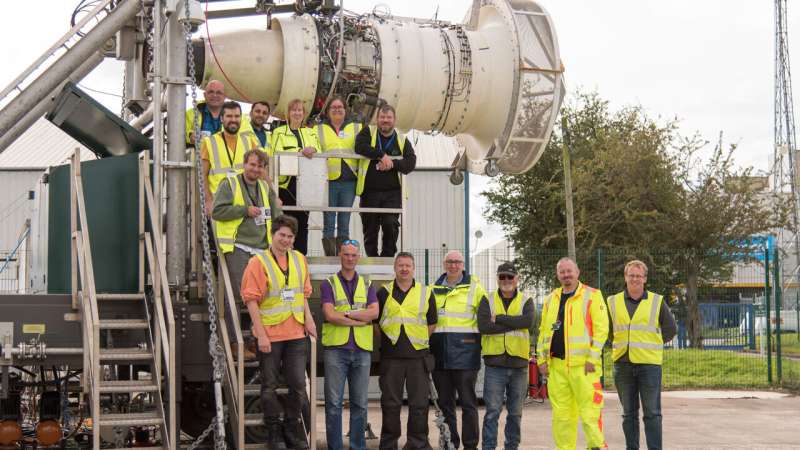
Aircraft emissions team. Credit: University of Manchester

A team of scientists have completed tests to quantify the emissions from the combustion of sustainable aviation fuels, revealing a profound reduction when compared to regular jet fuel.

Researchers from the National Center for Atmospheric Science (NCAS), including those from the University of Manchester, compared standard jet fuels with several different blends of sustainable  fuel, including fuels supplied by Neste.

They monitored the  produced by two different engines, included those used on the FAAM Airborne Laboratory's BAe-146-301 aircraft using CFS Aero facilities at Hawarden Airport.

The  was responsible for more than 2% of  in 2021, but sustainable aviation fuel has the potential to reduce climate-changing greenhouse gas emissions—such as carbon dioxide—in aviation by up to 80% when compared to standard jet fuel. It also has the potential to benefit local air quality.

Findings from the research found that emissions of ultrafine  at low thrust, which directly impacts local air quality, was 45% less in number and 80% less in mass for every kilogram of blended sustainable aviation fuel burnt.

The results could help reduce the climate warming effects of aviation globally.

Dr. Paul I Williams, NCAS research scientist based at The University of Manchester, said, "As aviation and the UKRI funding bodies move towards , it is important to understand what effects these  have. This study is really important to understand these effects and to provide the U.K. with capability to make these assessments in the future as new fuels and technologies are developed."

Sustainable aviation fuel is made from renewable biomass and waste resources and can be used as a direct replacement for jet fuel sourced from crude oil. These fuels are blended with standard jet fuels so they are compatible with all current aircraft, including the FAAM aircraft

The goal is by 2050, all jet fuels will be 100% synthetic and not from fossil fuels.

"This study is really important to understand what effects these alternative fuels have and to provide the U.K. with capability to make these assessments in the future as new fuels and technologies are developed," says Dr. Paul I Williams.

The ground-based engine testing enabled the team to detect a range of air pollutant emissions created by the combustion of blended aviation biofuel and HEFA fuel—to compare emissions between fuels from sustainable and non-sustainable sources.

The chemical and physical properties of emitted gases and particles—such as , carbon monoxide, nitrogen oxides, and suspended small particles—were evaluated.

Using a sample probe developed by SCITEK, and equipment from The University of Manchester, Cardiff University and York University, emissions were measured within the engine exhaust.

Dr. Williams added, "As part of the ground-based engine testing we sampled emissions of ultrafine black carbon, also known as non-volatile particulate matter. Non-volatile particulate matter emissions from aircraft engines at low thrust directly impact local air quality near the earth's surface, and the people who live and work nearby airports. The testing shows that at low thrust, for every kilogram of blended sustainable aviation fuel burnt, there is approximately 45% less in number and 80% less in mass of non-volatile particulate matter.

"At cruise thrusts, we found that there were also lower amounts of non-volatile particulate matter being emitted from the burning of sustainable aviation fuel. This indicates that while an aircraft is cruising there would be less non-volatile particulate matter produced, which in turn impacts contrail formation. This could have the potential to reduce the climate warming effects of aviation globally."

Using sustainable aviation fuel, as well as adopting a range of other sustainable practices, is a quick way to reduce carbon emissions from aviation, which includes the U.K. research aircraft and operations.

The study follows on from the world's first in-flight emissions study, which recently made its first flight using a blend of sustainable aviation fuel.

Alan Woolley, head of the NCAS-managed FAAM Airborne Laboratory, said, "For NCAS and the FAAM Airborne Laboratory, the results from this emissions-testing work will inform decisions around investment and the use of sustainable aviation  for future airborne science missions around the world.

"The aviation sector will be able to use our data to improve sector-wide understanding of the gases and particles released from gas turbine engines—of the size used on the FAAM Airborne Laboratory's research aircraft."

EU agrees to boost green fuels for aviation, cut emissions


EU warns Google over YouTube disinfo in wake of Hamas attack

youtube
Credit: CC0 Public Domain

The EU's top tech enforcer, Commissioner Thierry Breton, warned Google parent Alphabet on Friday to be wary of potential "illegal content and disinformation" on its YouTube platform.

In the latest in a series of messages to tech CEOs that has already seen him sparring with Elon Musk on X, formerly Twitter, the EU industry commissioner wrote to Alphabet CEO Sundar Pichai.

The  was also posted online on the Bluesky social media , an upstart rival to Musk's X, and warns YouTube to comply with the terms of the EU's new Digital Services Act (DSA).

"Following the terrorist acts carried out by Hamas against Israel, we are seeing a surge of illegal content and disinformation being disseminated in the EU via certain platforms", Breton wrote.

This warning mirrored the previous letters to Musk, Facebook and Meta's Mark Zuckerberg and Chinese giant TikTok's Shou Zi Chew earlier this week.

Breton noted that YouTube in particular is used by many children and teenagers and warned that Google thus has a special responsibility to protect users from propaganda and violent or harmful images.

"Notwithstanding the fact that my team will follow up with a specific request on a number of issues to establish DSA compliance, I urge you to proactively report in a prompt, accurate and complete manner to the aspects raised in this letter," Breton wrote.

"As you know, following the opening of a potential investigation and a finding of non-compliance, penalties can be imposed."

© 2023 AFP


Researchers measure global consensus over the ethical use of AI

machine learning
Credit: Pixabay/CC0 Public Domain

To examine the global state of AI ethics, a team of researchers from Brazil performed a systematic review and meta-analysis of global guidelines for AI use. Publishing October 13 in in the journal Patterns, the researchers found that, while most of the guidelines valued privacy, transparency, and accountability, very few valued truthfulness, intellectual property, or children's rights. Additionally, most of the guidelines described ethical principles and values without proposing practical methods for implementing them and without pushing for legally binding regulation.

"Establishing clear ethical guidelines and governance structures for the deployment of AI around the world is the first step to promoting trust and confidence, mitigating its risks, and ensuring that its benefits are fairly distributed," says social scientist and co-author James William Santos of the Pontifical Catholic University of Rio Grande do Sul.

"Previous work predominantly centered around North American and European documents, which prompted us to actively seek and include perspectives from regions such as Asia, Latin America, Africa, and beyond," says lead author Nicholas Kluge Corrêa of the Pontifical Catholic University of Rio Grande do Sul and the University of Bonn.

To determine whether a  exists regarding the ethical development and use of AI, and to help guide such a consensus, the researchers conducted a  of policy and ethical guidelines published between 2014 and 2022.

From this, they identified 200 documents related to AI ethics and governance from 37 countries and six continents and written or translated into five  (English, Portuguese, French, German, and Spanish). These documents included recommendations, practical guides, policy frameworks, legal landmarks, and codes of conduct.

Then, the team conducted a meta-analysis of these documents to identify the most common , examine their , and assess biases in terms of the type of organizations or people producing these documents.

The researchers found that the most common principles were transparency, security, justice, privacy, and accountability, which appeared in 82.5%, 78%, 75.5%, 68.5%, and 67% of the documents, respectively.

The least common principles were labor rights, truthfulness, intellectual property, and children/adolescent rights, which appeared in 19.5%, 8.5%, 7%, and 6% of the documents, and the authors emphasize that these principles deserve more attention. For example, truthfulness—the idea that AI should provide truthful information—is becoming increasingly relevant with the release of generative AI technologies like ChatGPT. And since AI has the potential to displace workers and change the way we work, practical measures are to avoid mass unemployment or monopolies.

Most (96%) of the guidelines were "normative"—describing ethical values that should be considered during AI development and use—while only 2% recommended practical methods of implementing AI ethics, and only 4.5% proposed legally binding forms of AI regulation.

"It's mostly voluntary commitments that say, 'these are some principles that we hold important,' but they lack practical implementations and legal requirements," says Santos. "If you're trying to build AI systems or if you're using AI systems in your enterprise, you have to respect things like privacy and user rights, but how you do that is the gray area that does not appear in these guidelines."

The researchers also identified several biases in terms of where these guidelines were produced and who produced them. The researchers noted a gender disparity in terms of authorship. Though 66% of samples had no authorship information, the authors of the remaining documents more often had male names (549 = 66% male, 281 = 34% female).

Geographically, most of the guidelines came from countries in Western Europe (31.5%), North America (34.5%), and Asia (11.5%), while less than 4.5% of the documents originated in South America, Africa, and Oceania combined. Some of these imbalances in distribution may be due to language and public access limitations, but the team says that these results suggest that many parts of the Global South are underrepresented in the global discourse on AI ethics.

In some cases, this includes countries that are heavily involved in AI research and development, such as China, whose output of AI-related research increased by over 120% between 2016 and 2019.

"Our research demonstrates and reinforces our call for the Global South to wake up and a plea for the Global North to be ready to listen and welcome us," says co-author Camila Galvão of the Pontifical Catholic University of Rio Grande do Sul. "We must not forget that we live in a plural, unequal, and diverse world. We must remember the voices that, until now, haven't had the opportunity to claim their preferences, explain their contexts, and perhaps tell us something that we still don't know."

As well as incorporating more voices, the researchers say that future efforts should focus on how to practically implement principles of AI ethics. "The next step is to build a bridge between abstract principles of ethics and the practical development of AI systems and applications," says Santos.

More information: Nicholas Kluge Corrêa et al, Worldwide AI ethics: a review of 200 guidelines and recommendations for ai governance, Patterns (2023). DOI: 10.1016/j.patter.2023.100857www.cell.com/patterns/fulltext … 2666-3899(23)00241-6


Journal information: Patterns 

Provided by Cell Press 

Cleared to launch? Ethical guidelines needed for human research in commercial spaceflight

Microsoft spent two years trying to buy Activision Blizzard. For Xbox CEO, that was the easy part

by Matt O'brien
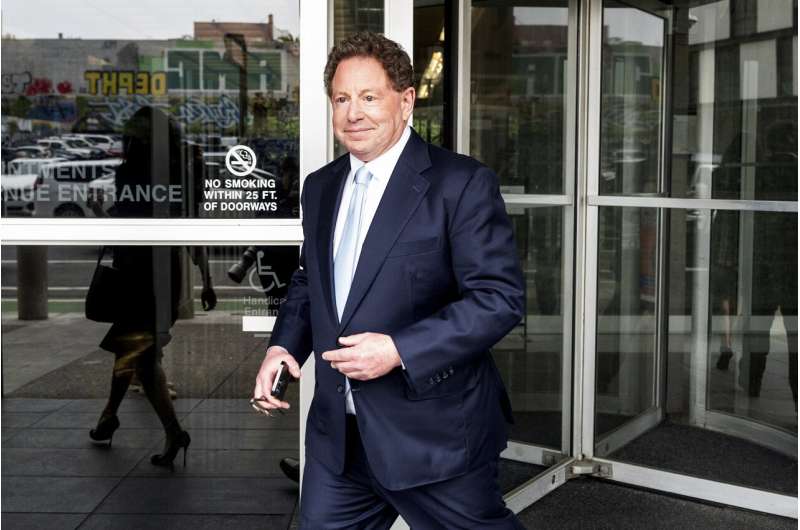
Xbox CEO Phil Spencer arrives at the Phillip Burton Federal Building and U.S. Courthouse on June 28, 2023 in San Francisco. After two years co-piloting the biggest acquisition in video game history past an onslaught of challenges, Spencer now moves on to his next quest: making Microsoft's takeover of Activision Blizzard worth the hassle. 
Credit: AP Photo/Noah Berger, File

After two years co-piloting the biggest acquisition in video game history past an onslaught of challenges, Xbox CEO Phil Spencer now moves on to his next quest: making Microsoft's takeover of Activision Blizzard worth the hassle.

Microsoft, which owns the Xbox gaming system, closed its $69 billion deal to buy game-maker Activision Blizzard on Friday after fending off global opposition from antitrust regulators and rivals.

It marks a career-defining moment for Spencer, who first joined Microsoft as an intern in 1988 and has helmed Xbox since 2014. After years of lagging behind rival Sony's PlayStation, acquiring Activision's collection of popular game titles gives Microsoft a rare chance to catch up.

"His job really just starts today," said analyst Gil Luria, technology strategist at D.A. Davidson, after the deal's closure. "All he's been doing is preparing for today where he actually gets to integrate the business."

And it marks the end of an era for Activision Blizzard CEO Bobby Kotick, who's led the Southern California maker of Call of Duty and other blockbuster franchises since 1991 after helping to buy it from bankruptcy. Kotick said he's assisting with the transition until the end of the year.

Activision Blizzard was still reeling from worker protests, lawsuits and government investigations over allegations of workplace harassment against women and unequal pay when Microsoft privately reached out about buying the company in 2021.
Activision Blizzard CEO Bobby Kotick leaves the Phillip Burton Federal Building and U.S. Courthouse in San Francisco on June 28, 2023. Microsoft, which owns the Xbox gaming system, closed its $69 billion deal to buy game-maker Activision Blizzard on Friday. It marks the end of an era for Kotick, who's led the Southern California maker of Call of Duty since 1991. Credit: AP Photo/Noah Berger, File

When the companies announced a planned merger in January 2022, Microsoft CEO Satya Nadella made clear it would be "critical for Activision Blizzard to drive forward" on its commitments to improve its workplace culture.

That was just the start of Microsoft's challenges in bringing home the deal. After negotiations with Spencer faltered, top rival Sony brought its concerns about losing access to the Call of Duty franchise to regulators around the world. The strongest opposition came from U.S. antitrust enforcers emboldened by President Joe Biden's administration to take a tougher look at big tech deals, as well as their counterparts in the United Kingdom who finally relented in approving the deal Friday only after Microsoft agreed to make concessions.

"Microsoft didn't have a choice. If they wanted to be long-term competitive with Sony and the PlayStation platform, they need to have a much more robust content offering," Luria said.

An image from Activision's Call of Duty is shown on a smartphone near a photograph of the Microsoft logo in this photo taken in New York, June 15, 2023. Microsoft’s purchase of video game maker Activision Blizzard won final approval Friday, Oct. 13, from Britain’s competition watchdog, reversing its earlier decision to block the $69 billion deal and removing a last obstacle for one of the largest tech transactions in history. Credit: AP Photo/Peter Morgan, File




But, "in retrospect, they should have read the writing on the wall in terms of the difficulty of closing the deal," Luria said. "They needed to do the deal to stay competitive, but knowing what they know now, they might have done it differently."

A key moment came in June, when a federal judge weighed the U.S. Federal Trade Commission's attempt to block the merger while it awaited further review. In an unusual move for a CEO that telegraphed the deal's importance, Spencer spent the better part of two weeks at the defendant table of a San Francisco courtroom conferring with Microsoft's lawyers. The judge eventually dismissed the FTC's request, though the agency is still seeking to unwind the deal.

Microsoft's success in integrating Activision's business is "not guaranteed, especially as its track record with acquisitions has been a mixed bag," said George Jijiashvili, senior principal analyst at research and advisory firm Omdia. Last year, Microsoft spent $7.5 billion to acquire ZeniMax Media, the parent company of video game publisher Bethesda Softworks, maker of Elder Scrolls and Fallout.
Scenes from "Candy Crush Saga," left, by Activision Blizzard, and "Crash Team Rumble," from Activision Publishing, are shown in this photo, in New York, Wednesday, June 21, 2023. Microsoft’s purchase of video game maker Activision Blizzard won final approval Friday, Oct. 13, from Britain’s competition watchdog, reversing its earlier decision to block the $69 billion deal and removing a last obstacle for one of the largest tech transactions in history. Credit: AP Photo/Richard Drew

Microsoft's two key game launches this year from its Bethesda merger, Redfall and Starfield, have "been met with mixed reactions at best," Jijiashvili said. "However, with globally popular game franchises such as Call of Duty now under its wing, the company is strategically much better positioned."

Another challenge for Microsoft will be overcoming the workforce challenges that dogged Activision before the takeover.

As of late last year, Activision Blizzard had 13,000 employees, about 72% in North America, according to a regulatory filing. Microsoft has already pledged it will stay neutral if the nearly 10,000 workers in the U.S. and Canada seek to organize into a labor union, part of a 2022 agreement with the Communications Workers of America meant to address U.S. political concerns about the merger's effects.
The logo for Microsoft, and a scene from Activision "Call of Duty - Modern Warfare," are shown in this photo, in New York, June 21, 2023. Microsoft’s purchase of video game maker Activision Blizzard won final approval Friday, Oct. 13, from Britain’s competition watchdog, reversing its earlier decision to block the $69 billion deal and removing a last obstacle for one of the largest tech transactions in history. Credit: AP Photo/Richard Drew, File
A sign is seen outside the Activision building in Santa Monica, Calif. on June 21, 2023. Microsoft’s purchase of video game maker Activision Blizzard won final approval Friday, Oct. 13, from Britain’s competition watchdog, reversing its earlier decision to block the $69 billion deal and removing a last obstacle for one of the largest tech transactions in history. Credit: AP Photo/Richard Vogel, File

"It is a new day for workers at Activision Blizzard," said CWA President Claude Cummings Jr. in a statement Friday.

"Over two years ago, workers at Activision Blizzard's studios captured the country's attention through walkouts and other protests over discrimination, sexual harassment, pay inequity, and other issues they were facing on the job," Cummings Jr. said. "Their efforts to form unions were met with illegal retaliation and attempts to delay and block union elections. Now these workers are free to join our union through a fair process, without interference from management."

In a Friday welcome email to Activision employees, Spencer said he wanted to "reiterate that we hold ourselves to a high bar in delivering the most inclusive and welcoming experiences for players, creators, and employees."

© 2023 The Associated Press. All rights reserved. This material may not be published, broadcast, rewritten or redistributed without permission.


Explore furtherMicrosoft agrees to keep Call of Duty on Sony Playstation after it buys Activision Blizzard

 CRYPTO CRIMINAL CAPITALI$M

Cryptocurrency in professional sports poses financial risk to fans, new report finds

NFTs
Credit: Pixabay/CC0 Public Domain

The University of Liverpool Management School has contributed to a new report by the government's Culture, Media and Sport Committee warning that the promotion of crypto assets in professional sport is putting fans at financial risk and potentially damaging the reputations of clubs.

The "NFTs and the Blockchain: The Risks to Sport and Culture" report notes that while the Non Fungible Tokens (NFTs) market saw record sales last year, this emerging technology may not reach the same level of popularity in the future, raising concerns over legal protection for .

According to the report, the technical, volatile and largely unregulated nature of NFTs means that advertising such products comes with a significant risk of financial harm to consumers.

Senior Teacher in Accountancy at the University of Liverpool Management School, Kieran Maguire, who provided supporting evidence for the report, stated, "At present, in terms of the relationship between the football industry and the NFT and digital industry, the football clubs say, 'Thank you very much for the money,' and then they let the likes of Sorare (a cryptoasset-based fantasy sports game) and Socios (a sports cryptoassets marketplace) market their products. There is nothing inherently wrong with the products. I think that it is the marketing.

"Education is essential, as too many buyers of these products see them as investments but there is a real danger people could lose all money they spend on the tokens."

NFTs are becoming increasingly popular as promotional tools, as they allow brands to reach and engage consumers by providing extra benefits for those purchasing them.

Within , NFTs offer a new revenue stream for , clubs, international teams and leagues at little cost.

However, while utility tokens give owners access to certain perks, such as being able to vote in fan polls or getting access to ticket ballot, the report states price volatility associated to NFTs has proven to be inherently risky for fans who invest in them.

In addition, the Committee heard criticisms that clubs are not delivering on promises of fan engagement and NFTs being marketed as equivalent to other legitimate club memberships.

Dame Caroline Dinenage MP, Chair of the CMS Committee, said, "In the world of sport, clubs are promoting volatile cryptoasset schemes to extract additional money from loyal supporters, often with promises of privileges and perks that fails to materialize. Fan token schemes must not be used as a substitute for meaningful engagement with supporters."

The report concludes with a recommendation to explicitly exclude the use of fan tokens from any measurement of fan engagement in sports, including in the forthcoming regulation of football.

Provided by University of Liverpool Spanish league joins blockchain world and launches NFTs


Smoke from Brazil Amazon rainforest fires suffocates Manaus

The environment minister blamed the forest fires on 'criminals' clearing land for farming
The environment minister blamed the forest fires on 'criminals' clearing land for farming.

Manaus, the largest city in Brazil's Amazonas state, has for days been engulfed by a toxic cloud of smoke from forest fires lit by what the government labeled "criminals".

The city of nearly two million people has been forced to cancel some public events including a marathon.

The fires in the Amazon have produced a blanket of gray smoke over the capital of the northern state of Amazonas since Wednesday.

Air quality in the city is among the worst in the world, according to the World Air Quality Index.

"This smoke is hurting us. People don't know what they are doing by burning the forest, and many animals are dying," said Maria Luiza Reis, a 72-year-old Manaus resident.

"It's sad, and it causes us difficulties. I wear a mask so I don't breathe that  because I already have ," she added.

Health authorities have urged city inhabitants avoid exposure as much as possible.

There are "significant risks, mainly " for those exposed to smoke, said Marcio Garcia, a director with the government's public health emergencies department.

Amazonas, Brazil's biggest state, has suffered the worst October in terms of fires in the last 25 years, according to data from the National Institute for Space Research (INPE).

INPE has registered 2,770 fire outbreaks so far this month as of Thursday, a 154 percent increase compared to the same period in 2022.

The government announced on Friday it was deploying two helicopters and an additional 149 firefighters to supplement an almost equal number already fighting the fires in the region.

Environment Minister Marina Silva blamed the fires on "criminals" who light them to clear the forest for farming.

"There is no natural fire in the Amazon," Silva told a news conference on Friday.

The fires come as the region is experiencing an exceptionally severe drought, aggravated by the El Niño weather phenomenon, which has caused the level of some rivers to drop drastically.

"It is an extremely serious situation," said the minister.

Cancellation of the marathon left some runners disappointed.

"I came from Goiania specifically to run the marathon on Sunday, but it was canceled. It's frustrating," said Zacharias Martins.

© 2023 AFP

H2 NEWZ

Hydrogen hubs too reliant on fossil fuels, expert says

hydrogen
Credit: Pixabay/CC0 Public Domain

The Biden administration has announced the locations of seven regional manufacturing hubs that will receive a portion of $7 billion in initial funding to help jumpstart a hydrogen industry.

Hydrogen is seen by some as a cleaner alternative to fossil fuels. But others note that that the process still relies heavily on fossil fuels as a source feedstock.

Robert Howarth is a professor of ecology and environmental biology and a faculty fellow at Cornell's Atkinson Center for Sustainability. Howarth's research shows that "blue hydrogen," which uses methane from natural gas, may harm the climate more than burning fossil fuel.

Howarth says, "It is extremely disappointing to see the Biden administration provide funds for hydrogen hubs which will be based on , even with the . It takes a lot of natural gas to make hydrogen, since the methane in the natural gas is the chemical feedstock for the process, and natural gas is also burned to power the  of breaking the methane down into hydrogen and carbon dioxide. So, the emissions of carbon dioxide are quite high.

"'Blue hydrogen' is an invention of the oil and gas industry, a marketing term they came up with only within the last eight years. The concept is to capture the carbon dioxide that is released when the methane breaks down. Unfortunately, this capturing also takes , which is met by burning even more natural gas. And the carbon capture is far from perfect: significant amounts of carbon dioxide are still released to the atmosphere.

"It is simply not possible to develop, process, transport, and store  without some of it being emitted to the atmosphere unburned as methane. The quantity may seem low, but methane is an incredibly powerful greenhouse gas, more than 80 times more powerful than carbon dioxide as an agent of global warming.

"As for the future of hydrogen in a decarbonized energy future, there is a role, but only for 'green hydrogen,' that is hydrogen made from 100%  used to break water down into hydrogen and oxygen, in a process called 'electrolysis,' with no release of ."

Provided by Cornell University
Touted as clean, 'blue' hydrogen may be worse than gas, coal

Paving a way to green hydrogen production

by Raven Wuebker, Texas A&M University
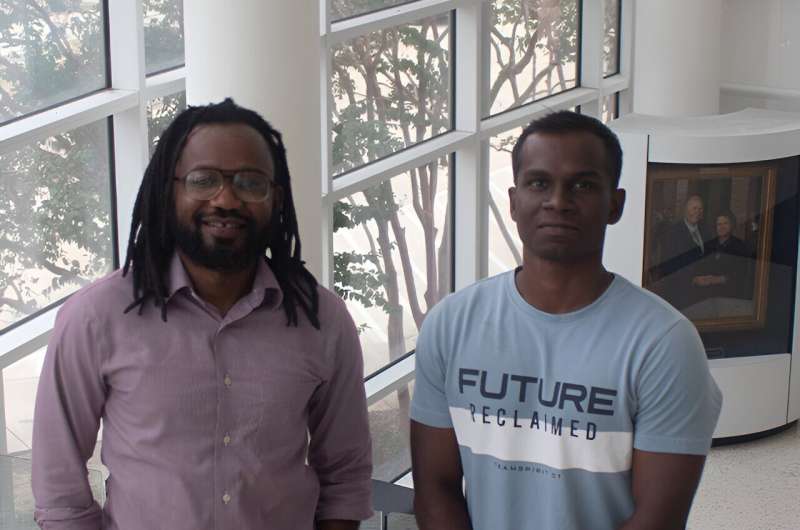
Dr. Abdoulaye Djire, David Kumar Yesudoss and Dr. Miladin Radovic (not pictured) say they have found a way to reduce the cost of catalysts that are used in producing green hydrogen by half. Credit: Texas A&M Engineering

A sustainable route to green hydrogen production is becoming possible through the use of efficient electrocatalysts in research by Texas A&M University chemical engineering professor Dr. Abdoulaye Djire.


In CHEM Catalysis, Djire, chemical engineering graduate student David Kumar Yesudoss and materials science and engineering professor Dr. Miladin Radovic explain their research using MXenes—a new class of 2D-layered material—as a catalyst supporting Ru-atom for hydrogen evolution reaction (HER) catalysis for green hydrogen production.

The goal is to produce green hydrogen using cheap, earth-abundant materials that use renewable electricity. Platinum—an expensive noble metal—is the current benchmark catalyst for this reaction. Using these inexpensive catalysts instead of platinum will significantly reduce the cost of the resulting hydrogen technology, Djire said.

"My work is centered around designing and evaluating materials to be used as catalysts for sustainable chemical production," Yesudoss said. "We have been able to reduce the cost of catalysts that are used in producing green hydrogen by half, which I think is really significant."

More than 95% of hydrogen used in the chemical industry is produced through steam methane reforming—a fossil fuel method with negative environmental impacts, Djire said.

The existing commercial method of producing hydrogen is not sustainable and adds to global warming. Djire said this work will pave the way for sustainable hydrogen technologies.

"We showed the reaction rate of the electrochemical conversion processes could be increased by modifying the electrochemical responses of these 2D nanostructured materials (called MXenes) fabricated in our laboratory at Texas A&M University," Djire said. "By inserting metal, we were able to tune inexpensive materials and enhance their performance to match closely that of noble metals. Specifically, into the structure of the material, we can enhance the electro-catalytic performance of the material significantly."

Ultimately, the group aims to further lower the cost of the system by refining the particle size down to individual atoms.

"Such noble metals are hard to mine; our approach will make sure each atom is effectively utilized for green hydrogen production," Yesudoss said. "Roughly, the size of one atom is less than a nanometer. So, we are talking about 50,000 times smaller than a human hair."

The group used density functional theory to show synergistic effects between Ru and MXene that was performed by their collaborator Dr. Kingsley Obodo from North-West University in South Africa. This collaboration was established through the U.S.-Africa Frontiers of Science, Engineering and Medicine symposium in Nairobi, Kenya, last year, where Djire and Obodo were both invited participants.

"In this study, we opened an avenue for one more, and possibly most promising, application of MXenes as catalysts for HER," Radovic said.

Results showed the Ru atoms attach preferably to the surfaces of the MXene. From these findings, a new approach of tuning the electrocatalytic activity of MXenes was found to accelerate the development of cost-effective, efficient and sustainable hydrogen technology.

"If further developed, this technology has the potential to revolutionize the chemical industry," Djire said.

Additional participating collaborators include graduate student Ekenedilichukwu Uwadiunor and undergraduate student Hoang Nguyen from the Artie McFerrin Department of Chemical Engineering at Texas A&M along with graduate students Vrushali Kotastane and Eugenie Pranda from the Department of Materials Science and Engineering at Texas A&M and Dr. Kingsley Obodo from HySa Infrastructure at North-West University in South Africa.

During the U.S.-Africa Frontiers symposium last year, Djire met Obodo and noticed his work involves computational work, where they use machine learning, density and functional theory. From there, the partnership began.


More information: Ekenedilichukwu Uwadiunor et al, Pt-like catalytic activity from an atomistically engineered carbonitride MXene for sustainable hydrogen production, Chem Catalysis (2023). DOI: 10.1016/j.checat.2023.100634

Journal information: Chem Catalysis

Provided by Texas A&M University

Cheap and efficient catalyst could boost renewable energy storage


New catalyst could provide liquid hydrogen fuel of the future

New catalyst could provide liquid hydrogen fuel of the future
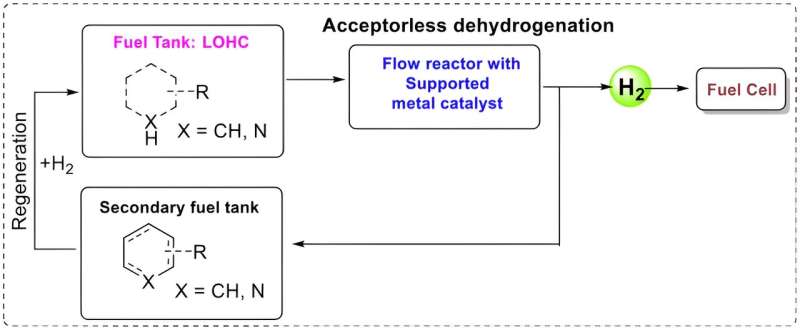
Concept of LOHCs under continuous-flow conditions. Credit: Catalysis Science & 
Technology (2023). DOI: 10.1039/D3CY00881A

Researchers at Lund University in Sweden are investigating a car fuel comprised of a liquid that is converted to hydrogen by a solid catalyst. The used liquid is then emptied from the tank and charged with hydrogen, after which it can be used again in a circular system that is free from greenhouse gas emissions.

Lund researchers have demonstrated that the method works, and while it is still basic research, it has the potential to become an efficient energy-storage system in the future.

"Our catalyst is one of the most efficient around, at least if you look at publicly available research," says Ola Wendt, professor at the Department of Chemistry at Lund University, and one of the authors.

The findings are published in the journal Catalysis Science & Technology.

Finding alternative ways of producing, storing and transforming energy in order to reduce carbon dioxide emissions from fossil fuels is necessary to reduce the impact on the climate. One way involves much-talked-about  gas, which many see as a future solution for energy storage. Nature stores energy in , and hydrogen contains the highest energy density in relation to its weight.

"However, gas can be difficult to handle, so we are looking at  charged with hydrogen that can be delivered at a pump, in a way broadly similar to what happens at petrol stations today," says Wendt.

The concept is known as LOHC (liquid organic hydrogen carriers) and is not new as such. The challenge is in finding as efficient a catalyst as possible, that can extract the hydrogen from the liquid.

The system is intended to work using a liquid that is "charged" with hydrogen. The liquid is pumped through a  which extracts the hydrogen. This can be used in a —which converts chemical fuel to electricity—while the "spent" liquid carries on to another tank. The only emission is water.

The spent liquid can then be emptied at a filling station before refueling with new, charged liquid. This would probably mean large scale production of the substance, comparable to today's oil refineries.

"We converted more than 99 percent of the hydrogen gas that was present in the liquid," says Wendt.

Researchers have also been calculating whether it might be possible to use the fuel for larger vehicles such as buses, trucks and aircraft.

"With the large tanks that they have, it might be possible to cover almost the same distance as you can with a tank of diesel. You would also convert around 50 percent more energy compared to compressed hydrogen," Wendt explains.

The liquids used are isopropanol (which is a common ingredient in screenwash) and 4-methylpiperidine.

Does this sound a little too good to be true? Yes—for now at least, a number of challenges remain. One is that the lifespan of the catalyst is rather limited. Another is that iridium, which the catalyst is based on, is a precious metal.

Wendt cautions, "But we estimate that you need about two grams of iridium per car. This could be compared to today's exhaust-cleaning , which contain about three grams of platinum, palladium and rhodium, which are also precious metals."

This is a technical solution based on basic research. If a decision were made to go for a finished product, Wendt believes that the concept could be ready in ten years' time—provided that it is economically viable and that there is interest from society.

Another problem is how hydrogen is produced—today, most production is not climate-friendly. The hydrogen then must be stored and transported in an effective way, which is not that straightforward today. There are also the risks of refueling with compressed hydrogen. The Lund researchers hope to solve this with their method.

"Ninety-eight percent of all hydrogen today is fossil-based, produced from . The biproduct is carbon dioxide. From an environmental point of view, the notion of producing hydrogen for steel, batteries and fuel is pointless if it is done using natural gas," says Wendt, but he explains that there is a lot of research going on into how "green hydrogen" might be produced by splitting water into hydrogen and oxygen with the help of renewable energy.

At the same time, he believes that political decisions are required for renewable and climate-friendly alternatives to gain a proper foothold.

"It needs to be cheaper, and it takes . Renewables have no chance of competing with something that you just dig out of the ground, where transport is almost the only cost, as is the case with ," he concludes.

More information: Kaushik Chakrabarti et al, Acceptorless dehydrogenation of 4-methylpiperidine by supported pincer-ligated iridium catalysts in continuous flow, Catalysis Science & Technology (2023). DOI: 10.1039/D3CY00881A

Provided by Lund University 
Cheap and efficient catalyst could boost renewable energy storage


New catalyst could provide liquid hydrogen fuel of the future


Peer-Reviewed Publication

LUND UNIVERSITY


Researchers at Lund University in Sweden are investigating a car fuel comprised of a liquid that is converted to hydrogen by a solid catalyst. The used liquid is then emptied from the tank and charged with hydrogen, after which it can be used again in a circular system that is free from greenhouse gas emissions. 

In two research articles, Lund researchers have demonstrated that the method works, and while it is still basic research, it has the potential to become an efficient energy-storage system in the future.

“Our catalyst is one of the most efficient around, at least if you look at publicly available research,” says Ola Wendt, professor at the Department of Chemistry at Lund University, and one of the authors.

Finding alternative ways of producing, storing and transforming energy in order to reduce carbon dioxide emissions from fossil fuels is necessary to reduce the impact on the climate. One way involves much-talked-about hydrogen gas, which many see as a future solution for energy storage. Nature stores energy in chemical bonds, and hydrogen contains the highest energy density in relation to its weight.

“However, gas can be difficult to handle, so we are looking at liquid fuel charged with hydrogen that can be delivered at a pump, in a way broadly similar to what happens at petrol stations today,” says Ola Wendt.

The concept is known as LOHC (liquid organic hydrogen carriers) and is not new as such. The challenge is in finding as efficient a catalyst as possible, that can extract the hydrogen from the liquid.

The system is intended to work using a liquid that is “charged” with hydrogen. The liquid is pumped through a solid catalyst which extracts the hydrogen. This can be used in a fuel cell – which converts chemical fuel to electricity – while the “spent” liquid carries on to another tank. The only emission is water.

The spent liquid can then be emptied at a filling station before refuelling with new, charged liquid. This would probably mean large scale production of the substance, comparable to today’s oil refineries. 

“We converted more than 99 per cent of the hydrogen gas that was present in the liquid,” says Ola Wendt.

Researchers have also been calculating whether it might be possible to use the fuel for larger vehicles such as buses, trucks and aircraft.

“With the large tanks that they have, it might be possible to cover almost the same distance as you can with a tank of diesel. You would also convert around 50 per cent more energy compared to compressed hydrogen,” says Ola Wendt.

The liquids used are isopropanol (which is a common ingredient in screenwash) and 4-methylpiperidine.

Does this sound a little too good to be true? Yes – for now at least, a number of challenges remain. One is that the lifespan of the catalyst is rather limited. Another is that iridium, which the catalyst is based on, is a precious metal.

“But we estimate that you need about two grams of iridium per car. This could be compared to today’s exhaust-cleaning catalytic converters, which contain about three grams of platinum, palladium and rhodium, which are also precious metals,” says Ola Wendt.

This is a technical solution based on basic research. If a decision was made to go for a finished product, Ola Wendt believes that the concept could be ready in ten years’ time – provided that it is economically viable and that there is interest from society.

Another problem is how hydrogen is produced – today, most production is not climate friendly. The hydrogen then needs to be stored and transported in an effective way, which is not that straightforward today. There are also the risks of refuelling with compressed hydrogen. The Lund researchers hope to solve this with their method.

“Ninety-eight per cent of all hydrogen today is fossil-based, produced from natural gas. The biproduct is carbon dioxide. From an environmental point of view, the notion of producing hydrogen for steel, batteries and fuel is pointless if it is done using natural gas,” says Ola Wendt, but he explains that there is a lot of research going on into how “green hydrogen” might be produced by splitting water into hydrogen and oxygen with the help of renewable energy.

At the same time, Ola Wendt believes that political decisions are required for renewable and climate-friendly alternatives to gain a proper foothold.

“It needs to be cheaper, and it takes political decisions. Renewables have no chance of competing with something that you just dig out of the ground, where transport is almost the only cost, as is the case with fossil fuels,” he concludes.


New research can help better predict the health and sustainability of 'grassy' ecosystems

New UNCG research will help better predict the health and sustainability of 'grassy' ecosystems
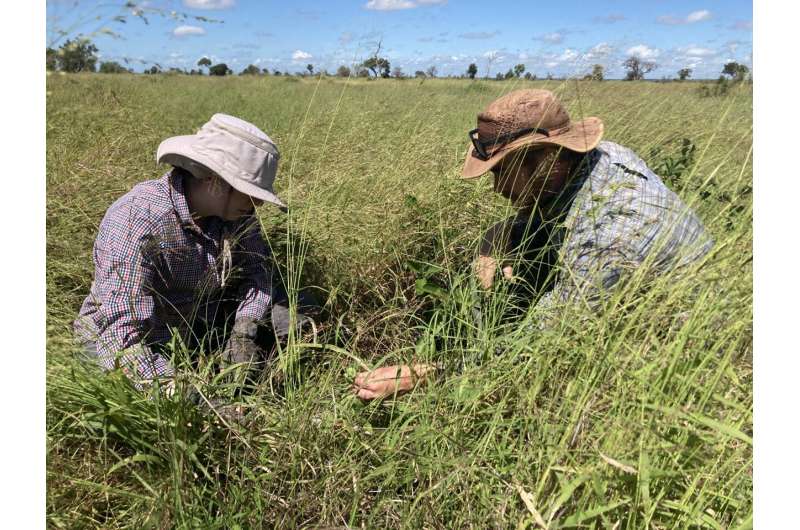
UNCG Biology graduate student Shelby Williford and associate professor Kevin Wilcox 
measure characteristics of Panicum maximum (common name: Guinea grass) in a 
savanna grassland in Kruger National Park, South Africa. Credit: A. Rodgers

Newly published research from UNC Greensboro's Dr. Kevin Wilcox and colleagues will help scientists better predict how global changes—such as droughts, fires, and heat waves—will impact the health and sustainability of the Earth's grassy ecosystems.

The article, published October 10, 2023, in Global Change Biology, provides key steps forward to improving mathematical models that forecast changes to our planet's savannas, prairies, grasslands, and arctic tundras.

"Forest ecosystems tend to get the lion's share of ," said Wilcox. "But ecosystems dominated by non-tree vegetation—that is, 'grassy' ecosystems—make up 40 percent of Earth's land surface. So our research is playing important scientific 'catch-up' in these landscapes."

Grassy ecosystems provide many necessary resources and services to humans, including food production, pollinators, and carbon sequestration. They also serve as  for wildlife, such as elk and bison in North America.

Yet, when one looks deeper into humankind's ability to predict how these ecosystems will persist under forthcoming global changes, the research lags far behind the predictive capacity for forests. Wilcox's research on Earth system models is helping to close this gap.

Scientists use these models to simulate the effects of physical phenomena, such as droughts and , on landscapes. The mathematical equations that make up these models are strung together to create thousands of lines of computer code that ultimately provide an abstraction of reality. These models represent a wide range of ecological processes, such as rainfall penetrating the soil, insects defoliating a savanna, or  causing plant and animal mortality.

New UNCG research will help better predict the health and sustainability of 'grassy' ecosystems
A UNCG Biology student examines a species of grass at the UNCG Plant and Pollinator 
Center. Grassy ecosystems make up 40 percent of the Earth’s land surface. Credit: UNCG

"But if our models don't accurately represent ecological processes, their predictions are meaningless," said Wilcox.

An important facet to get right, Wilcox explains, is the ever-changing nature of these grassy systems.

"We can't just assume that all of the major components of the ecosystem, such as , will remain unchanged as droughts and heat waves continue to occur."

One of the biggest challenges is how grasses are represented. Currently, many models represent grasses as either miniature trees or as a 'green slime' that exists on the surface of the planet. The authors say this representation may be part of why the models have had trouble matching real-world observations in grassy ecosystems.

"Better collaboration between empiricists and modelers will also be key for improving herbaceous dynamics within ecosystem models," adds Wilcox.

Implementing these changes, the authors say, will be vital in helping guide  and management of these important ecosystems in the future, when droughts and deluges are more frequent and extreme, disturbances such as fires are more severe, and human pressures continue.

More information: Kevin R. Wilcox et al, Accounting for herbaceous communities in process‐based models will advance our understanding of "grassy" ecosystems, Global Change Biology (2023). DOI: 10.1111/gcb.16950