Wednesday, October 18, 2023

Remember who we are': Trudeau calls for calm as tensions rise over Israel-Hamas war

Story by Catharine Tunney •1d

Prime Minister Justin Trudeau called on Canadians to avoid "entrenching division" Monday as tensions escalate in the Middle East and at home over the Israel-Hamas conflict.

In an address to the House of Commons, Trudeau again stated that Canada supports Israel's right to self-defence while adding that international law must be upheld in Gaza — where the humanitarian situation is rapidly deteriorating.

The prime minister then turned his attention to the domestic front, where emotions have been running high since Oct. 7 — when Hamas militants attacked southern Israel, killing 1,300 people, including a number of Canadians. According to the latest figures, three Canadians are still missing in the region.

In a statement last week, the RCMP said it's aware of threats on social media directed at Canada's Jewish community. Police across the country have either issued warnings or intensified patrols.

Trudeau issued a warning about the threat of antisemitism and Islamophobia, adding that Jewish and Muslim parents alike are wondering whether their kids are safe at school.

"Unrest is being felt in ways big and small. Canadians are deeply worried, no matter their background," he said.


Trudeau urged Canadians to remember that "the Canadian idea of liberty is inclusive freedom, expansive freedom.

"Remember, it's a short path to walk from mistrusting your neighbour to entrenching division.

"Let's remember who we are as Canadians, and what we stand for here, and around the world." 


21 Canadians in West Bank have crossed into Jordan: Joly

Earlier in the day, Foreign Affairs Minister Mélanie Joly announced the first bus had departed the West Bank bringing Canadians to safety in Jordan. Her office said 21 Canadians were on board.

It's part of an effort to get Canadians out of an increasingly volatile situation. Trudeau said 10 Canadian Armed Forces flights have departed Tel Aviv so far, carrying about 1,300 passengers.

The government also has directed all non-essential staff working at Canada's embassy in Tel Aviv to leave Israel, sources have told Radio-Canada.

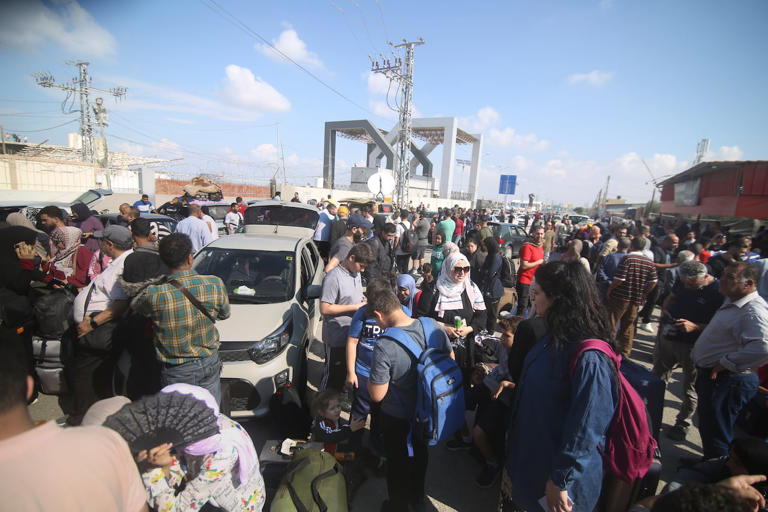
Meanwhile, other Canadians have joined the thousands of people on the Gaza side of the Rafah border waiting to escape into Egypt. Rumours of a ceasefire that would have allowed people to pass through the crossing have been dashed for now.

Following reports that the war could spread to the northern border, Joly also has urged Canadians in Lebanon to consider leaving while commercial flights are still available.

During a briefing to reporters over the weekend, Global Affairs Canada said it expects to use two buses to evacuate Canadians from the West Bank. Officials said about 250 people have asked for Canada's help leaving the territory.

The West Bank, a Palestinian territory that Israel has occupied since 1967, has become a temporary home for hundreds of people from Gaza who were either working in Israel or visiting family in the West Bank when Hamas militants attacked Israel.

Canada calls for humanitarian access to Gaza 

Trudeau said it's vital that civilians in Gaza receive food, fuel and water. The territory has endured unrelenting death and destruction from Israeli bombing since the the conflict began more than a week ago.

"Canada fully supports Israel's right to defend itself in accordance with international law. And in Gaza, as elsewhere, international law, including humanitarian law, must be upheld by all," he said. 

"Even wars have rules."

Gaza has had no electricity for five days now, leaving its hospitals and water services in dire straits as its foods supplies diminish. Joly recently called the Gaza Strip "one of the worst places on Earth right now to be living in."

Authorities in Gaza say at least 2,808 people have been killed so far by the Israeli strikes — a quarter of them children — and about 10,850 have been wounded.
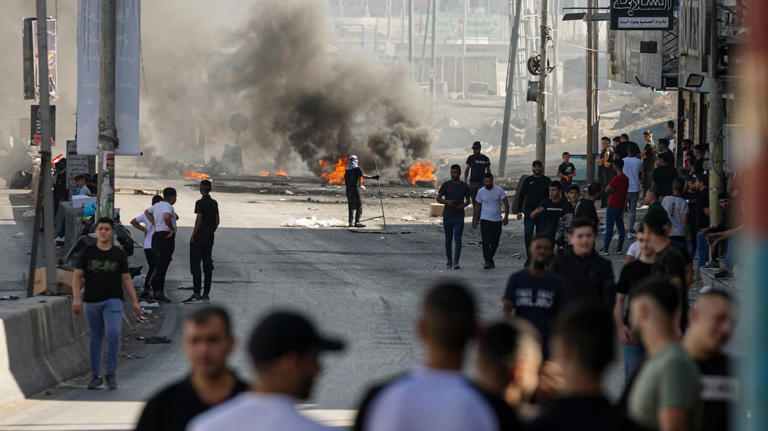

A road blockade near the Qalandiya refugee camp, in the occupied West Bank.
 (Jean-Francois Bisson/CBC)© Jean-Francois Bisson/CBC

After calling for those living in Gaza to evacuate to the south, Israel is now imposing a full blockade and is preparing a ground invasion into Gaza to destroy Hamas.

Israel also has told villages in a strip of territory near its border with Lebanon to evacuate. In an address to Israel's Knesset on Monday, Prime Minister Benjamin Netanyahu warned the Lebanese militant group Hezbollah and its Iranian benefactor not to "test us in the north."

'Hamas can only be destroyed': Poilievre

As more details of the five Canadians killed emerged, Conservative Leader Pierre Poilievre called Hamas's incursion "also an attack on Canadians."

"Every innocent human life, Palestinian or Israeli, Jewish, Muslim, Christian, or otherwise, is of equal precious value," he said to applause.

"All of us must do everything in our power to preserve this precious life and minimize the suffering of innocent civilians."

In his own address to the chamber, Poilievre called on the government to free Canadians believed to be among the nearly 200 hostages being held captive by Hamas.

"There can be no negotiating with Hamas. Hamas can only be destroyed," he said 

Speaking for the NDP, MP Heather McPherson urged the Canadian government to call for a ceasefire. 

"The only solution is a political solution. There is no military solution to this conflict," she said.

She ended her emotional speech with words of appreciation for Israeli and Palestinian medical and aid workers struggling to save lives.

"There's a light in this darkness," she said. "We see you and we stand with you."

House meeting for a 'take note' debate

The House will meet later Monday for a "take note" debate — a form of Parliamentary procedure that asks members for their views on an issue or aspect of public policy.

Such debates were used to discuss the future of peacekeeping in the former Yugoslavia in 1994, the Iraq war and Canada's deployment in Afghanistan.

In his afternoon speech, Poilievre said his party will call for a number of possible actions and previewed one: designating Iran's Islamic Revolutionary Guard Corps (IRGC) as a terrorist entity. 

The federal government lists a branch of the IRGC, its expeditionary Quds Force, as a terrorist entity, but has not designated the whole militia group as a terrorist entity under Canada's Criminal Code — despite mounting calls for it to do so.

"Canada must criminalize the IRGC," Poilievre said. "Terrorists must be kicked out and this organization must be a criminal entity."

Canada already has designated Hamas and Hezbollah as terrorist organizations.

MPs block Conservative attempts to probe CBC coverage of Hamas attacks

TORIES HATE CBC

Story by John Paul Tasker • Oct 17, 2023

Bloc Québécois, NDP and most Liberal MPs on the House of Commons public accounts committee voted Tuesday to shut down debate on a Conservative motion that would have prompted a study of the CBC's coverage of the ongoing Israel-Hamas conflict.

Conservative MPs Melissa Lantsman and Rachael Thomas pushed their fellow parliamentarians to launch the study. They argued CBC's reporting on the conflict is biased because its language guide urges journalists to avoid using the words "terrorism" and "terrorist" when describing an attack and its perpetrators.

They wanted a CBC executive and its director of journalism standards to appear before MPs to answer questions about its policy on those words.

The Tory MPs suggested that CBC's policy warning against the use of "terrorist" terminology shields Hamas from criticism for perpetrating violence.

They also took issue with CBC guidance that says its journalists should be careful about describing the past Israeli presence in Gaza.

"Here's why this is so important — the CBC is a public broadcaster and gets $1.2 billion in taxpayer money," Thomas said during debate.

"The CBC is failing. They're failing the Jewish community. They're failing the innocent lives lost."

Thomas said the nature of Hamas's attack on Israeli civilians on Oct. 7 more than justifies the use of the word "terrorism."

"What other side would you take when you have 1,400 people massacred in an evening? When you have 40 babies who are beheaded? Whose side are you on?" she said. "As if there would be some other side you can take.

"This is a terrorist organization functioning in a sadistic manner. It is pure evil and to suggest otherwise is alarming."

Now that this motion to call CBC executives has failed at the public accounts committee, the Conservatives will present a similar one at the heritage committee later this week.

CBC's editorial leaders have defended the corporation's extensive coverage of the conflict and said there's no "ban" on the use of the words "terrorist" or "terrorism" — they can be used in a quote or a clip when said by somebody else.

Leon Mar, a spokesperson for CBC, said the corporation's journalists are on the ground in the region "risking their safety in order to tell Canadians what is happening there.

"They are the very best at what they do and the quality and accuracy of their journalism stands among the best in the world."

Mar said the corporation is aware that "some members of Parliament believe they have a role in determining how journalists do their work."

"It is worth remembering that the independence of CBC/Radio-Canada's journalism from the government and Parliament is protected in law, in the Broadcasting Act," Mar said.


Conservative deputy leader Melissa Lantsman walks through West Block on Parliament Hill in Ottawa
. (Sean Kilpatrick/Canadian Press)

Lantsman said the members of Hamas, a group created in the late 1980s with founding documents that called for the destruction of Israel, should be called terrorists because of the brutality they inflicted on innocent Israeli civilians during a sneak attack earlier this month.

The Hamas attack left hundreds of Israelis dead — including at least six Canadians. Others were kidnapped.

"The Liberal-NDP government must stop protecting the CBC's gross journalistic incompetence and allow Conservatives to demand answers from the CBC's senior leadership," Lantsman said.

Conservative Leader Pierre Poilievre has vowed to "defund the CBC" if elected.

Ontario Liberal MP Iqra Khalid, a member of the public accounts committee, said Parliament shouldn't be policing what's said by a free press.

"I think the media has a very, very critical role to play in today's day and age, not only ensuring that they are giving an objective and fair voice to what is happening in the Middle East but also making sure they're not politicizing or inflaming issues that create further harm and hurt to communities here in Canada," she said during debate on the motion.

"We as Parliament, whether we agree with it or don't agree with it, should not have a say on what they're reporting on. I think we need to lower the temperature on this very, very sensitive issue."

Khalid then tabled a motion to adjourn — shut down — debate.


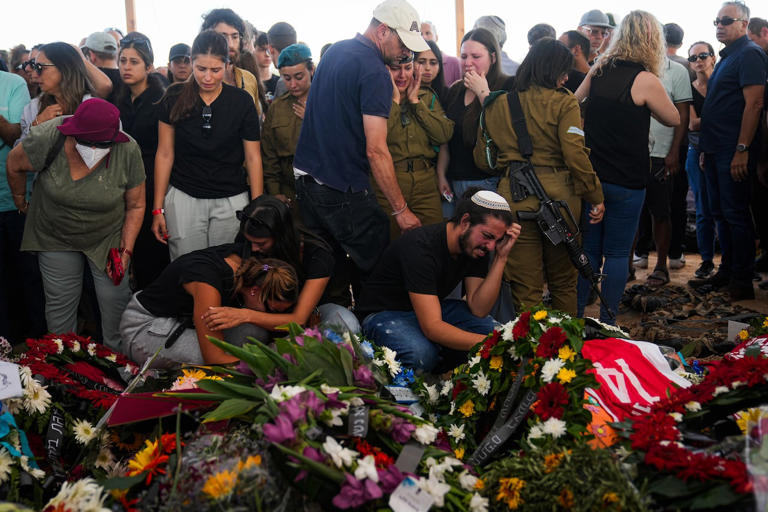
Mourners attend the funeral of the Kotz family in Gan Yavne, Israel, Tuesday, Oct. 17, 2023. The Israeli family of five was killed by Hamas militants on Oct. 7 at their house in Kibbutz Kfar Azza near the border with the Gaza Strip. More than 1,400 people were killed and some 200 captured in an unprecedented, multi-front attack by the militant group that rules Gaza. (Ohad Zwigenber/AP Photo)© Provided by cbc.ca

All Conservative MPs and Liberal MP Kody Blois voted against it.

Blois said he objected to closing off debate now because he had more to say on the issue.

Bloc Québécois MP Nathalie Sinclair-Desgagné said the CBC is a public broadcaster free from government control and Parliament should leave editorial decisions to the company's leadership.

"Whatever the colour of the government, whether it's red or blue, the public television is not state television. It has to remain neutral," she said.

During question period, Bloc MP Martin Champoux took a different approach — chiding CBC's management for "muzzling" its journalists by telling them how to describe Hamas violence.

Champoux, the vice-chair of the Commons heritage committee, said journalists should be trusted to pick their own words to describe "Hamas's heinous attacks."

"For management to issue a directive is something else entirely. It borders on censorship. The CBC management themselves are muzzling the press and taking a position that enters into the political debate, which is not their role," Champoux said.

He asked Heritage Minister Pascale St-Onge, the minister responsible for CBC/Radio-Canada, to "remind CBC management that newsrooms must remain free of political and ideological influence."

This controversy was ignited by a leaked internal memo from George Achi, the CBC's director of journalistic standards and public trust.

In his correspondence with CBC journalists in the early hours of the Hamas attack, Achi urged staff to read the language guide's policy on the Middle East and its section on Gaza and terrorism in particular.

"The notion of terrorism remains heavily politicized and is part of the story. Even when quoting/clipping a government or a source referring to fighters as 'terrorists,' we should add context to ensure the audience understands this is opinion, not fact. That includes statements from the Canadian government and Canadian politicians," Achi said.


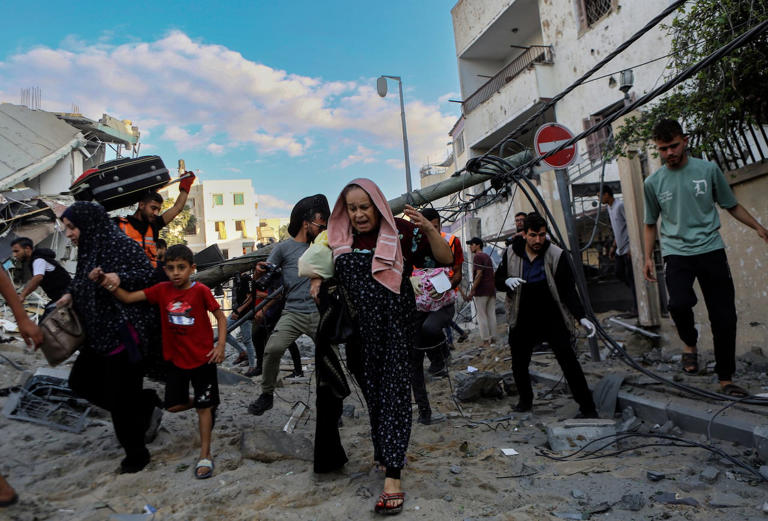
Palestinian families rush out of their homes after Israeli airstrikes target their neighbourhood in Gaza City, central Gaza Strip, Tuesday, Oct. 17, 2023. 
(Abed Khaled/AP Photo)


Achi was not specific about what "context" should be added when quoting someone else branding Hamas as a terrorist organization.

Achi's note and his references to the language guide were subsequently leaked to an outside group and picked up by other news outlets, such as Fox News and the New York Post.

The CBC language guide itself urges "extreme caution" when labelling anybody a "terrorist."

"While the language is not seriously disputed in some cases, it's less clear if not highly contested at other times — which can lead to virtually endless questions about consistency and impartiality in our coverage of various attacks around the world," the guide reads.

"Terrorism generally implies attacks against unarmed civilians for political, religious or some other ideological reason. But it's a highly controversial term that can leave journalists taking sides in a conflict."


CBC explains why they avoid calling Hamas 'terrorists' in war against Israel


Story by National Post Staff •

The Canadian Broadcasting Corporation Toronto headquarters. The CBC says it uses the word© Provided by National Post

In the wake of last week’s leaked CBC memo telling its journalists to avoid use of the word “terrorist” in reference to Hamas fighters in Israel and Gaza , the CBC’s editor in chief has crafted a more detailed missive for public release on the broadcaster’s website.

Brodie Fenlon, editor in chief and executive director of programs and standards for CBC News, posted the nearly 1,300-word reply on Monday.

“Hello and thank you for writing about our use of the word ‘terrorist,’” he begins. “During a period of tragic breaking news in Israel, a screenshot of an internal reminder about our longstanding editorial standards was published on social media — without the full context of those standards as they are practised in our newsrooms. This spiralled into a controversy that I believe is based on an incomplete understanding of our work.”

Brodie Fenlon: I run CBC News. Elon Musk’s Twitter changes had to be called out

Fenlon goes on to say that the CBC does not have a “ban” on the word terrorist. “As a matter of fact, you may have heard and read that word many times on all CBC News platforms over the past week. Our journalists cite it and quote it often, with attribution. That means they also tell the audience who has used it and in what context.”

He points to a recent story about airlifting of Canadians out of the region, noting that it uses the terms terrorist and terrorism six times, in each case in quotes from Justin Trudeau, Pierre Poilievre and Chrystia Freeland.

“Attribution of the word “terrorist” has been our policy for decades,” he adds, “mirrored by other news organizations such as the BBC, AP, AFP and Reuters, among many others.”

None of that convinced Conservative MP Rachael Thomas, who took to X (formerly Twitter) with her rebuttal. “This is a group of militant men who went in and killed 1,400 people in a night,” she said, referring to Hamas. “Who kidnapped, raped and murdered women … who went in and beheaded 40 innocent babies. This is no doubt a terrorist organization. Canada has had the officially listed as such for more than 20 years.”

NO BABIES WERE BEHEADED! 


She adds that she wants to hold the CBC to account. “So my Conservative colleagues and I are bringing them to committee, or at least moving a motion to do so.”

The CBC’s job is to “bear witness,” Fenlon writes in his post. “But CBC News does not itself designate specific groups as terrorists, or specific acts as terrorism, regardless of the region or the events, because these words are so loaded with meaning, politics and emotion that they can end up being impediments to our journalism.”


He goes on to quote at length from the CBC’s language guide, which instructs journalists to refer to events such as the London bombings of July 2005, the Madrid train bombings of the previous year, and Sept. 11, 2001 as “attacks” and not “terrorist attacks.”

The guide also notes: “By restricting ourselves to neutral language, we aren’t faced with the problem of calling one incident a “terrorist act” (e.g., the destruction of the World Trade Center) while classifying another as, say, a mere “bombing” (e.g., the destruction of a crowded shopping mall in the Middle East).

“To be clear, this has nothing to do with Hamas or Israel, and nothing to do with the intensity of suffering and horror we saw last week,” Fenlon adds.

The post concludes: “I am not trying to convince you that this is the only way to approach editorial language … But I do hope that my explanation has reassured you of our good faith in this work, based on our mandate as an independent public service news organization — even if you disagree with the outcome here.”


Conservative MPs want to bring CBC executives before Commons committee over 'terrorism' language policy

Story by John Paul Tasker •1d


Apair of Conservative MPs will try to compel a CBC executive and a journalism standards director to appear before a House of Commons committee to defend the company's language guide — which discourages the use of the words "terrorism" and "terrorists" when describing attacks and their perpetrators.

Alberta Conservative MP Rachael Thomas, the party's Canadian heritage critic, said in a statement posted to social media that the idea is to hold the Crown corporation accountable for what she calls "its biased coverage of Hamas' attack on Israel."

She said an internal email about language guide policies that urges caution about using the word "terrorist" — which was subsequently leaked and picked up by other outlets, including Fox News — suggests the CBC is downplaying violence perpetrated by Hamas against innocent Israeli civilians.

She said the news organization should clearly refer to the attackers behind the "horrific, sadistic violence" as terrorists.

She also took issue with CBC guidance that says its journalists should be careful about describing the past Israeli presence in Gaza.


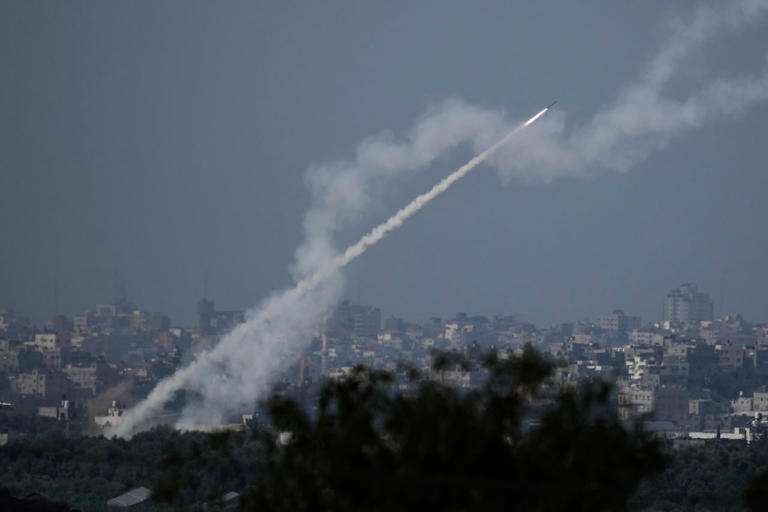
Rockets are fired toward Israel from the Gaza Strip, as seen from southern Israel,
on Monday, Oct. 16, 2023. (Leo Correa/AP Photo)

Leon Mar, a spokesperson for CBC News, said the corporation's journalists are on the ground in the region "risking their safety in order to tell Canadians what is happening there.

"They are the very best at what they do and the quality and accuracy of their journalism stands among the best in the world."

Mar said the corporation is aware that "some members of Parliament believe they have a role in determining how journalists do their work."

"It is worth remembering that the independence of CBC/Radio-Canada's journalism from the government and Parliament is protected in law, in the Broadcasting Act," Mar said.

Thomas is backed by the party's deputy leader, Ontario MP Melissa Lantsman, who said she'd force the issue before the public accounts committee, which is due to meet Tuesday.

The Conservative MPs would need the support of at least one other party to compel the committee to launch a study of the issue.

Lantsman said she will pressure the NDP to back the study.

"Will they allow a recipient of $1.4 billion in tax dollars to give a pass to terrorists?" she said, referring to the corporation's parliamentary appropriation. CBC/Radio-Canada received roughly $1.2 billion in government funding in 2022, according to the most recent annual report.

Conservative Leader Pierre Poilievre has vowed to "defund the CBC" if elected.

In a video posted to social media, Lantsman said the CBC doesn't have "journalistic integrity" because "if you can't call people who murder the elderly, kidnap children, rape women and kill entire families terrorists, then I don't think it's worth funding."


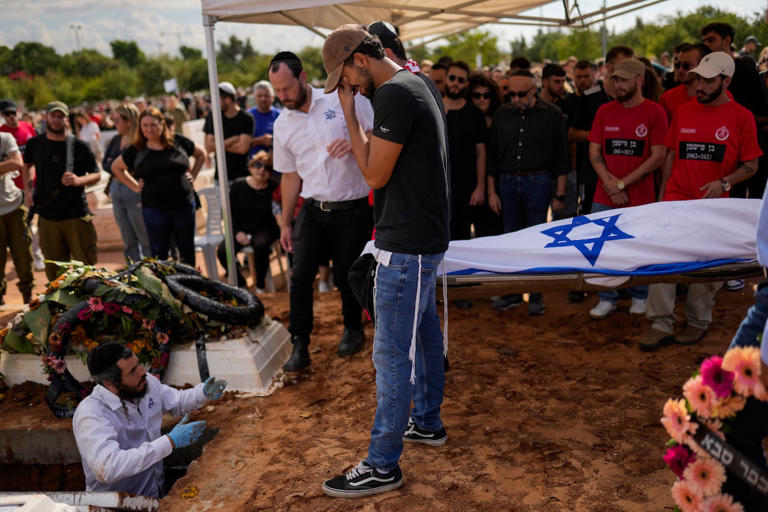
Covered with the Israeli flag, the body of Ben Fishman is buried at Pardes Haim cemetery in Kfar Saba, near Tel Aviv, Israel, Sunday, Oct. 15, 2023. Fishman was killed when Hamas unleashed its attack on thousands of Jews attending a music festival in southern Israel earlier this month. (Francisco Seco/AP Photo)© Provided by cbc.ca


Brodie Fenlon, CBC News' editor-in-chief, defended the corporation's reporting on the conflict in an editors' blog posted Monday.

The post came more than a week after the language guide policy was disseminated to CBC journalists and leaked to an outside group.

"Within hours of these shocking Hamas attacks, we had several teams on the ground in Israel, more than any other Canadian news organization, and we documented in gruesome, explicit detail what transpired over that weekend," Fenlon wrote.

"I believe that we, as a news organization, have accurately depicted the horror of what happened in those attacks — and there is no doubt in the minds of our audience about what Hamas did."

Fenlon also pointed to news items that have included the words "terrorist" or "terrorism" when they have been attributed to others. There isn't a "ban" on use of the word, he said.

"You will hear the acts described as terror. You will hear that governments, including Canada's, have designated Hamas a terrorist organization. And you will always hear those terms attributed to governments, officials, authorities, experts and politicians," Fenlon said.

Hamas was created in the late 1980s with founding documents that called for the destruction of Israel. It has said its goal is to drive all Israeli forces from Palestinian territories and set up an Islamic state. It has been designated a terrorist entity under Canadian law.

In the early hours of Hamas' brutal surprise attack on Israelis, which left hundreds dead and others captured, George Achi, the corporation's director of journalistic standards and public trust, asked journalists to read the language guide entry on the Middle East.


Palestinians wait to cross to the Egyptian side at Rafah border, Gaza Strip, Monday, Oct. 16, 2023. (Hatem Ali/AP Photo)© Provided by cbc.ca

He highlighted that it's acceptable to use the short-form "Gaza" when referring to the Gaza strip.

But he said the 2005 Israeli disengagement from the Palestinian territory should not be described as "the end of the occupation" because Israel maintains control over the area's airspace, seafront "and virtually all movement into or out of the area."

In 2005, under former prime minister Ariel Sharon, Israel dismantled longstanding Israeli settlements and forcibly expelled some Jewish settlers from Gaza amid fierce opposition from some Israeli politicians and citizens.

Hamas won 2006 parliamentary elections and in 2007 violently seized control of Gaza from the internationally recognized Palestinian Authority.

Israel then responded to the Hamas takeover with a blockade on Gaza, restricting movement of people and goods in and out of the territory — a step it said is needed to keep the group from developing weapons.

"Our description should be fact-based, referring to the end of permanent Israeli military presence on the ground," Achi said.

He also said CBC journalists "do not refer to militants, soldiers or anyone else as 'terrorists.'"

"The notion of terrorism remains heavily politicized and is part of the story. Even when quoting/clipping a government or a source referring to fighters as 'terrorists,' we should add context to ensure the audience understands this is opinion, not fact. That includes statements from the Canadian government and Canadian politicians," Achi said.

Achi was not specific about what "context" should be added when quoting someone else branding Hamas as a terrorist organization.


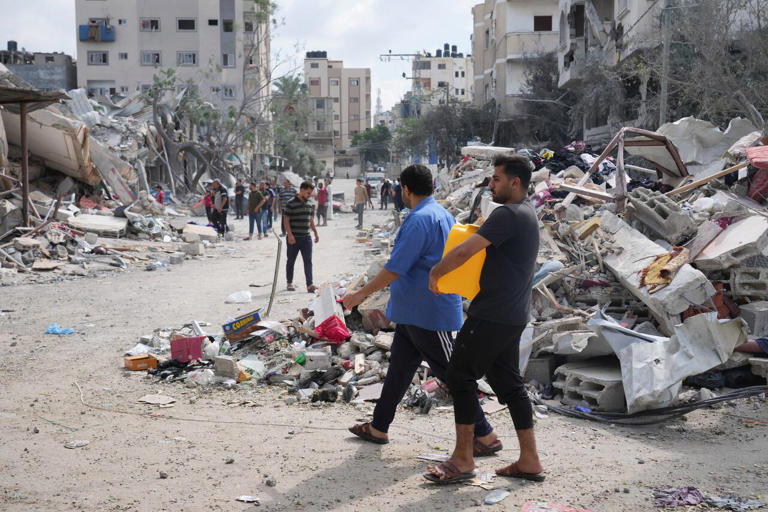
A Palestinian carries a water canister by buildings destroyed in an Israeli airstrike in Nuseirat camp in the central Gaza Strip, Monday, Oct. 16, 2023. (Hatem Moussa/AP Photo)© Provided by cbc.ca

Thomas and Lanstman said Achi should be called to appear before the Commons' heritage committee.

The two MPs also said Catherine Tait, the president and CEO of CBC/Radio-Canada, should "appear for two hours by herself within seven days of the motion being adopted."

Mar, the CBC spokesperson, did not address a question about whether Achi or Tait would agree to testify if called to appear by the committee.

The language guide, which is not intended for public consumption and is password-protected to restrict its use to employees, goes into greater detail about using the words terrorist and terrorism in CBC news coverage.

The overarching goal, the guide states, is to avoid "virtually endless questions about consistency and impartiality in our coverage of various attacks around the world."

"Terrorism generally implies attacks against unarmed civilians for political, religious or some other ideological reason. But it's a highly controversial term that can leave journalists taking sides in a conflict," the guide reads.

"By restricting ourselves to neutral language, we aren't faced with the problem of calling one incident a "terrorist act" (e.g., the destruction of the World Trade Center) while classifying another as, say, a mere "bombing" (e.g., the destruction of a crowded shopping mall in the Middle East)," the guide reads.

BBC, the British public broadcaster, also avoids using the words terrorist or terrorism unattributed.

John Simpson, the BBC's world affairs editor, said in a story last week that terrorism is "a loaded word" that "people use about an outfit they disapprove of morally."

"It's simply not the BBC's job to tell people who to support and who to condemn — who are the good guys and who are the bad guys," Simpson said.

Fury grows in Turkey against Israel, fresh protests planned


Pro-Palestinian demonstrators shout slogans during a protest, after hundreds of Palestinians were killed in a blast at Al-Ahli hospital in Gaza that Israeli and Palestinian officials blamed on each other, near the Israeli Consulate in Istanbul, Turkey October 17, 2023. 
REUTERS/Dilara Senkaya

By Ece Toksabay

ANKARA (Reuters) - Turkish protesters clashed with police overnight in angry demonstrations following a blast that killed hundreds of Palestinians at a Gaza hospital, and further rallies were expected on Wednesday.

Palestinian officials said the blast was caused by an Israeli air strike. Israel blamed the blast at Al-Ahli al-Arabi hospital on a failed rocket launch by the Palestinian Islamic Jihad group, which denied responsibility.


Pro-Palestinian demonstrators take part in a protest, after hundreds of Palestinians were killed in a blast at Al-Ahli hospital in Gaza that Israeli and Palestinian officials blamed on each other, near the Israeli Embassy in Ankara, Turkey October 17, 2023. Reuters could not immediately verify the claims nor the death toll. 
REUTERS/Cagla Gurdogan


President Tayyip Erdogan called the blast "the latest example of Israeli attacks devoid of the most basic human values".

Turkey's presidential communications office quickly branded Israel's claim "#FakeNews" on social media platform X.

Overnight Turks marched with Palestinian flags and chanted slogans denouncing Israel in at least a dozen Turkish cities, including outside the Israeli embassy in the capital Ankara.

Police used pepper spray and water cannon to disperse thousands of protesters who tried to enter the compound of Israel's consulate in Istanbul, Turkey's largest city. Five people were detained, the Istanbul governor's office said.

On Wednesday, there was a large security presence around the consulate, with hundreds of police officers and around 10 water cannon vehicles deployed behind a line of metal barriers. Police conducted identity checks on those seeking to pass through.

Political analysts said the Gaza hospital blast could have dire consequences for ties between Israel and Turkey.

"Ankara is now likely to assume a much harder anti-Israel stance, especially as the Israel Defense Force's incursion into Gaza is expected to intensify in the days ahead, with inevitable humanitarian costs," said Wolfango Piccoli at Teneo.

"Erdogan may even decide to abandon the rapprochement with Israel, which was initiated in 2022 after more than ten years of fraught ties between the two countries (...) A deterioration in relations between Turkey and Israel would also likely impact Turkey-US ties, creating further stress between the two NATO allies at a volatile time."

Related video: Israel 'Forced' To Allow Gaza Supplies; Aid Trucks Enter Palestinian Enclave From Egypt - Report (Hindustan Times)   Duration 3:11  View on Watch

(Reporting by Ece Toksabay and Mert Ozkan in Ankara, Bulent Usta, Dilara Senkaya and Daren Butler in Istanbul; Editing by Gareth Jones)


Menopause costs the Canadian economy billions every year. Here’s why 

Story by Katie Dangerfield • Global News

Deepti Neto, 63, was trying to run her Toronto-based real estate business running on three to four hours of sleep every night.

She had always been a great sleeper, but in 2013 she started experiencing insomnia and her cognitive and communication abilities were declining as a result.

Global News
Women needlessly suffering with menopause symptoms
Duration 5:01  View on Watch

Menopause symptoms costing economy billions
Duration 2:17   View on Watch

Neto tried to buy a new mattress to help, but it wasn't until she noticed her period became more sporadic that she realized she may be experiencing perimenopausal symptoms.

"So I did what everyone does: I drank herbal teas, went to acupuncture, I did everything I could do, but nothing was helping. My sleep was getting worse," she said, adding that it was affecting her business.

"I am a real estate agent so my communication and cognitive skills are my best skills, it's my job. I was getting worried."

She then went to her doctor, who informed her that he could not provide treatment until she had gone a full year without a period, as that is "when they consider you to be in menopause," she said. Instead, she was given antidepressants.

But Neto was still having sporadic periods. She was experiencing insomnia, hot flashes and anxiety, all of which are characteristic of perimenopause, the stage leading up to menopause. And she said the antidepressants were causing her more fatigue.

She stopped taking the antidepressants and switched doctors. She was then prescribed menopause hormone therapy and "immediately started feeling better."

"The sleep symptoms were eradicated within a week or two," she said, adding that if she hadn't advocated for her health, she may have never found the solution.

Menopause, exacerbated by stigma, lack of workplace support and the burden of debilitating symptoms, carries a substantial cost for the Canadian economy, amounting to an estimated $3.5 billion per year, according to a new report.

The Menopause Foundation of Canada released the report Monday, finding that unmanaged symptoms of menopause cost employers an estimated $237 million annually in lost productivity. And women experience a substantial financial burden, with $3.3 billion in lost income because of reduced hours, diminished pay, or leaving the workforce altogether.

The report also found that 540,000 lost days of work can be attributed to menopause symptom management per year.

"Many women are blindsided by menopause, which is really just being unprepared for this stage of life," explained Janet Ko, president and co-founder, of the Menopause Foundation of Canada.

"What that leads to is some women stepping back from the workforce, leaving altogether, taking a lesser job, reducing their hours, going part-time or not taking that promotion. We believe menopause is the missing link to explain why more women are breaking through the glass ceiling," she added.

Menopause impacts women’s careers according to a recent report


In Canada, there are more than two million working women aged 45-55, which is the average age at which most women experience menopause, according to the report.

There is also a period before menopause, called perimenopause, which can last two to 20 years, Ko said. And then there's post-menopause, which can last for the rest of a woman's life.

"So women will actually spend up to half of their lives in a stage of menopause," she said.

While menopause is a universal life stage for most women, a survey in the report found that 46 per per cent of respondents said they are not prepared for this transition.


Menopause costs the Canadian economy billions every year. Here’s why© Provided by Global News

Ko referred to this as the "menopause knowledge gap," signifying a lack of understanding among women regarding the changes in their bodies and the symptoms triggered by hormonal fluctuations.

As a result, many women do not get the help they need.

"That not only impacts their health, their quality of life, but it also impacts their ability to work as productively as they would like," she said, adding that menopause usually happens during the peak of women's careers.

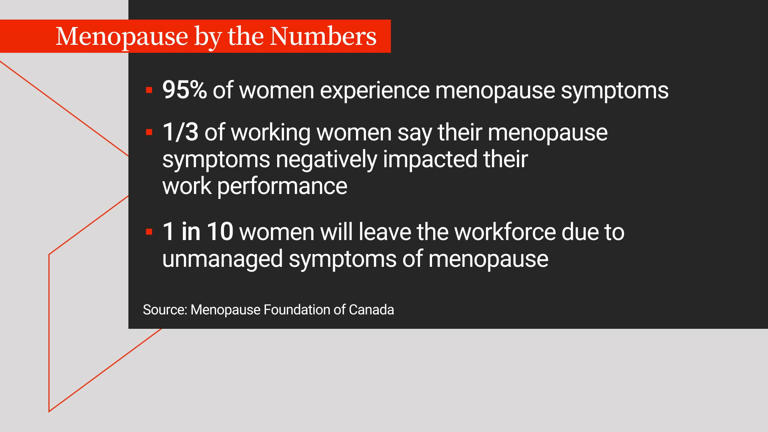
The survey also found that more than one-third of working women said menopause symptoms negatively impacted their work performance. And around one-quarter said they his their symptoms at work.

Sixty-seven per cent said they would not feel comfortable talking to their supervisor about their symptoms, and almost half said they would be too embarrassed to ask for help at work.

And an estimated one in 10 women will leave the workforce due to unmanaged symptoms of menopause.

During menopause, the ovaries stop the process of ovulation and estrogen production, and as a consequence, women stop menstruating, explained Teresa Isabel Dias, a pharmacist and a certified menopause practitioner based in Toronto.

Perimenopause is the transition period, lasting six to eight years, leading up to menopause when a woman’s menstrual cycles could become irregular as the hormone levels fluctuate.

"Women may start experiencing things like this at the age of 35. And nobody is aware of that such big change can take place so early in life. So a lot of women struggle for many years when they have early perimenopause because our health care is not trained on this," she said.

In Canada, the average age of menopause is 51.5 years. But most women are in perimenopause between the ages of 40 and 50, according to the Menopause Foundation of Canada.

And women can continue experiencing symptoms into their 60s and 70s.

There are also over 30 symptoms of menopause, including hot flashes, insomnia, brain fog, anxiety and joint pains.

Surprising facts about menopause

Not every woman goes through a rough time, Dias said, adding that "20 per cent do not experience any bothersome symptoms."

But one of the biggest risks of menopause that she hopes women will be aware of is the loss of estrogen.

"Estrogen is protective for the bones. It helps to not lose bone density as fast. It also helps with the heart," she said.

"Estrogen is a girl's best friend. And when we don't have it, we have to do other things to reduce our risk for disease," she said.

The number one piece of advice Dias gave for women is to lead a healthy lifestyle, such as eating healthy nutritious foods, drinking enough water, getting regular exercise and sleeping at least eight hours every night.

"We have to have compassion towards ourselves, have a lot of patience to go through this and believe that we'll get to the other side," she said.

Treatments for menopause, like hormone replacement therapy and pelvic floor physiotherapy, are available options. However, Ko pointed out that due to the significant stigma surrounding this topic, many women do not know where to seek help and often are hesitant to talk about it.

The report found that 87 per cent of working women felt their employer does not provide, or do not know if they provide, support related to menopause. The most common supports identified as desirable are medical coverage, flexible workplace policies and environmental adjustments, along with general awareness and education, the report found.

"It's a really important topic that doesn't get a lot of attention," Ko said. "Menopause is overwhelmingly viewed as negative in our society.

"The image of the menopausal woman is very unflattering, which is why I think many women don't want to be associated with that negative portrayal of a woman. So menopause comes wrapped up in secrecy and mystery."


But the workplace could be a great place to start breaking down the stigma, she said.

This could entail holding information sessions with employees, putting information up on the company website, creating an employee resource group and improving benefit plans (to cover hormone therapy), Ko said.

"We believe that most employers have just never considered this and that when they understand the number of women in the workforce that are going through this they'll start to look at it," she said.

"We have the skills, experience and leadership that employers need, and they can't afford to lose."

-- with files from Global News' Saba Aziz
Used clothing from the West is a big seller in East Africa. Uganda's leader wants a ban


KAMPALA, Uganda (AP) — Jostling for space, people jam the crowded footpaths crisscrossing a massive open market in Uganda's capital. They are mostly looking for secondhand clothing, sifting through underwear for pairs that seem new or trying on shoes despite getting pushed around in the crush.

Downtown Kampala’s Owino Market has long been a go-to enclave for rich and poor people alike looking for affordable but quality-made used clothes, underscoring perceptions that Western fashion is superior to what is made at home.

Discarded by Europeans and Americans, these clothes are often purchased from wholesalers and then shipped to African countries by middlemen. It's a multimillion-dollar business, with some two-thirds of people in seven countries in East Africa having “purchased at least a portion of their clothes from the secondhand clothing market,” according to a 2017 U.S. Agency for International Development study, the most recent with such details.

Despite the popularity, secondhand clothes are facing increasing pushback. Ugandan President Yoweri Museveni, a semi-authoritarian leader who has held power since 1986, declared in August that he was banning imports of used clothing, saying the items are coming “from dead people.”

“When a white person dies, they gather their clothes and send them to Africa,” Museveni said.

Trade authorities have not yet enforced the president’s order, which needs to be backed by a legal measure such as an executive order.

Other African governments also are trying to stop the shipments, saying the business amounts to dumping and undermines the growth of local textile industries. The East African Community trade bloc — consisting of Burundi, Congo, Kenya, Rwanda, South Sudan, Tanzania and Uganda — has recommended banning imports of used apparel since 2016. However, member states have not enforced it at the same pace amid pressure from Washington.

In Uganda, the president's order has spread panic among traders, for whom such a ban, if implemented, spells disaster. They hawk used clothes in scores of large open-air markets across the country of 45 million people, at roadside stands and even in shops in malls where it’s possible to buy secondhand clothes marketed as new.

The clothes are cheap and drop further in price as traders make room for new shipments: a pair of denim jeans can go for 20 cents, a cashmere scarf for even less.

At one of Uganda’s Green Shops, a chain specializing in used clothes, apparel reseller Glen Kalungi shopped for items his customers might want: vintage pants for men and cottony tops for women.

“I am a thrift shopper,” he said. “I usually come to these Green Shops to check out clothes because they have the best prices around town.”

Kalungi likes to visit on clearance days when he can buy clothes for a fraction of a dollar. Then he sells them at a profit.

The chain, whose owners include Europeans, unveils new clothes every two weeks at its three stores. Some of the items are sourced from suppliers in countries including China and Germany, retail manager Allan Zavuga said.

“How they collect the clothes, we are not aware of that,” Zavuga said of their suppliers. “But (the clothes) go through all the verification, the fumigation, all that, before they are shipped to Uganda. And we get all documents for that.”

The Green Shops are environmentally friendly because they recycle used clothes in bulk, he said.

The association of traders in Kampala, known by the acronym KACITA, opposes a firm ban on used apparel, recommending a phased embargo that allows local clothing producers to build capacity to meet demand.

Some Ugandan apparel makers, like Winfred Arinaitwe, acknowledge that the quality of locally made fabric is often poor. Not surprisingly, many people would rather buy used clothing, she said.

"Because it lasts longer,” she said. “It can easily be seen.”

In Owino Market, a ban on used clothes is inconceivable to many, including some who say they don't think the president’s threat was serious.

Abdulrashid Ssuuna, who tries to persuade customers in the market to stop by his brother’s used clothing business, said a ban would deny him a livelihood.

“It’s like they want to chase us out of the country,” he said of the president’s order. “From these old clothes, we get what to eat. If you say we leave this business, you are saying we go into new clothes. But we can’t afford to go there.”

Ssuuna approaches people in Owino Market to urge them to visit the stall where his brother sells used jeans. The market is aggressively competitive, with merchants sitting behind heaps of clothes and shouting words of welcome to possible customers.

If he helps his brother sell clothing, “I get something,” said Ssuuna, who started this work after dropping out of high school in 2020.

The market is always full of shoppers, but business is unpredictable: Traders must try to anticipate what customers are looking for before they are lured by other sellers.

Some days are better than others, said Tadeo Walusimbi, who has been a used-clothes trader for six years. A government ban is simply untenable, he warned.

It “will not work for me and for so many people,” Walusimbi said.

Rodney Muhumuza, The Associated Press