Wednesday, October 18, 2023

The politics of housing: How N.S. and Halifax governments are ‘obviously not in sync’

Story by Alex Cooke • GLOBAL NEWS
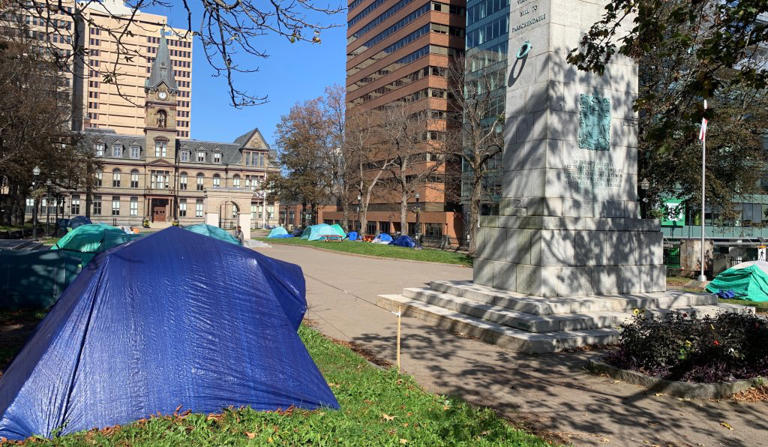
Tents are seen at Grand Parade in downtown Halifax on Oct. 6, 2023.
© Megan King/Global News


The housing crisis in Halifax is looking bleaker than ever: the number of unhoused people has climbed to more than 1,000, the tent encampment outside city hall continues to grow, and winter is now just weeks away.

Meanwhile, the provincial and municipal governments can’t seem to agree on the best course of action.

“They could be doing more by collaborating effectively, but they’re not,” said Jeffrey MacLeod, a political science professor at Mount Saint Vincent University in Halifax.

“They’re obviously not in sync now.”

MacLeod said the word “crisis” can often be overused, but it’s well-suited when it comes to the current housing situation.

“This is an exponentially-getting-worse problem,” he said.

One of the biggest issues, he said, is a “political disconnect” between the province and the city. He noted that Nova Scotia is fairly unique in that governments can be formed without much urban support -- and the current provincial government is a “perfect example” of that.

Most of the legislature seats in Halifax Regional Municipality belong to the Liberals and the NDP, while the governing Progressive Conservatives hold most of the seats outside of the capital city.

For a government almost “entirely disengaged from HRM issues,” it was therefore surprising to see them swoop in last week to give themselves more control over urban development, MacLeod said.

“It’s a complex big city, and this is not a (provincial) government that’s seemingly been interested in that since its election,” he said.

On Thursday, the province announced legislation to insert itself into the process of approving residential developments in Halifax, saying it needs to create a fast-track system to deal with housing shortages.

The bill would require the city to work with the province to allow pre-qualified developers to receive expedited approvals for residential units and would impose a two-year freeze on the fees the city levies on builders.

Municipal Affairs and Housing Minister John Lohr said the “express lane” for developers is needed because there are still unacceptable delays in getting projects off the ground in the Halifax area.

He told reporters last week that the proposed legislation will “remove barriers, increase density and ensure that housing remains a priority focus in our most urban centre.”

But Halifax Mayor Mike Savage called the bill a “direct intrusion into municipal affairs” which doesn’t address the real culprits for the housing shortage: high interest rates and labour shortages.

He told reporters last week that the city already has permits to build 11,000 housing units and there is development-ready land available for 200,000 units.

“You can say a lot of things about housing in Nova Scotia,” Savage said. “But you can’t say that the staff at HRM have been the problem.”

Savage also indicated that while he did receive a call from Lohr the night before the legislation was announced, the city was not consulted beforehand.

On his part, Lohr said the legislation was informed by a 2022 report conducted by Deloitte, Inc., and “parts of the bill” have been in discussion with HRM over the last year-and-a-half to two years.

‘Odd way to do business’

While MacLeod said the province does have “entire authority” over municipal governments and can make changes like this, he did call the proposed legislation a “dramatic reach into traditionally municipal authority.”

The political science professor said this sends the message that the province doesn’t have confidence in Halifax Regional Municipality -- and the fact that the municipality didn’t get much of a heads-up before this was announced is an “odd way to do business."

MacLeod said this could end up being “counterproductive” because the two levels of government still need to work together.

“If you get friction and animosity between the two different administrative structures, that can’t be helpful,” he said. “That’s not going to solve the problem. That’s just going to exacerbate it.”

In addition, this kind of public disagreement between the two entities just “looks terrible” to the public.

“It’s uncooperative, it’s dismissive of that relationship -- that rapport between HRM council and the provincial cabinet,” MacLeod said.

Lisa Blackburn, the councillor for Middle/Upper Sackville-Beaver Bank-Lucasville, described the recent move as “completely an overreach.”

“I’m without words and in shock at the level to which the province has chosen to escalate this,” she said.

Blackburn -- along with her fellow councillors -- has long been critical of the province’s response to homelessness.

During a tense and emotional meeting last month which saw council vote on whether to turn parts of the Halifax Common into homeless encampments, Blackburn warned of a looming “humanitarian crisis” this winter when rents are slated to rise.

She said council is unable to do much without the province’s help, and said she is eager to work with them -- “but I think we are at the stage now where, my God, we’ve got to embarrass them into doing something.

“I say put up tents, all the tents, on the Common and then declare a disaster so maybe then we can get some federal assistance,” she said at the time.

“Maybe we can get some provincial assistance. Maybe having the Red Cross come in to help with this will embarrass the province into doing their bloody job.”

The premier later said municipalities should stop “pointing fingers” and instead “roll up your sleeves” and get to work on the issue.

In an interview Friday, Blackburn said it’s unclear to her why exactly the province felt the need to step into municipal territory.

“What is it the city’s not doing that the province feels we need to be doing to help with this crisis?” she said. “Because that seems to be the missing piece for me.”

Premier Tim Houston dodged that question from a Global News reporter last week, saying simply that his government is focused on housing.

“If the municipality wants to partner with us, they’ve got a great willing partner with us,” he said.

But Blackburn said the move shows a lack of respect toward the municipality, which has its own processes and programs it’s working with.

She said the announcement was especially disappointing because it came after some positive news on the housing front.

The previous day, the province announced it would collaborate with the municipality to build tiny homes for people experiencing homelessness in the Halifax area, signalling hope that the two entities were working together.

That hope quickly evaporated for Blackburn after the province made its surprise announcement.

“They dangled us first with the carrot and then smacked us in the face with the stick,” she said.

She added that the municipality recently worked with the federal government to get funding through the Housing Accelerator Fund to build nearly 9,000 homes. It was like “night and day” compared to working with the province, said Blackburn.

“It was collaborative, it was respectful, and we got it done,” she said.

Video: Halifax receives federal funds to fast-track home building

She said she doesn’t know why working with the province can be such a challenge.

“I would hate to think that the province is playing party politics at the expense of vulnerable people who just need a damn place to live.”

In response to a reporter asking last week if the recent move was a “power grab,” Housing Minister Lohr said he doesn’t “see it that way.”

“I see it as the recognition that we are in a world that’s just changing so quickly, that we need to be able to react quickly,” he said.

Bill 'performative': mayor

On Monday, municipal officials tried and failed to get the province to pause the legislation during the legislature's law amendment committee.

Mayor Savage further criticized the bill, calling it "unnecessary and harmful" and an “egregious overreach.”

“This bill is performative and addresses a problem that doesn’t exist,” he said.

Despite objections from the mayor and seven Halifax Regional Council members, the Progressive Conservative majority on the committee voted to return the bill to the legislature without amendments.

MacLeod, the political science professor, said he doesn’t blame councillors and the mayor for being frustrated with the legislation -- especially with the lack of consultation.

“You can consult them and not agree, that’s one thing, but when ... it’s just unilaterally imposed on you, that’s another order of offensive,” he said.

“It’s very paternalistic and not really a fair ball, from a political perspective. It really is the province putting its thumb on the scale and saying, ‘OK, we’re in charge now.’”

Video: Opposition politicians in N.S. hoping for more transparency from government on housing plans

While politicians continue to bicker over who does what, that doesn't change the fact that winter is fast approaching and much of the city's parks and green space continues to be covered in tents.

MacLeod said this back-and-forth and finger-pointing between the provincial and municipal governments “doesn’t play well” to the public, many of whom are struggling under the rising cost of living and are waiting on action from their elected officials.

“You want a solution, you want collaboration, you want to see something getting done,” he said.

“When you’re under stress and you’re having trouble putting a roof over your head and that sort of thing, those partisan issues and government intricacies probably are immensely frustrating.”

The clock is ticking on pharmacare year-end deadline, NDP says


Story by David Baxter • GLOBAL NEWS

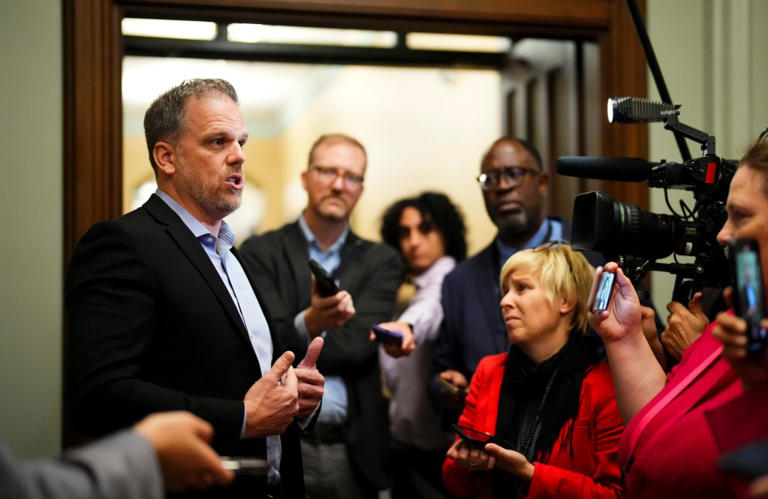
Health Minister Mark Holland arrives to a caucus meeting on Parliament Hill in Ottawa on Wednesday, Sept. 27, 2023.© Sean Kilpatrick / The Canadian Press


Health Minister Mark Holland says he doesn’t think ultimatums are necessary as his NDP critic says the passage of single-payer pharamcare is a "red line" for the supply and confidence agreement keeping the Liberals in power.

“We have to make the decision based on reason and logic, what’s the best thing for our health system and what is possible in terms of the constraints we have fiscally,” Holland told reporters on his way into Tuesday morning’s cabinet meeting.

“So people can make ultimatums and draw lines, and all do all of those kinds of things, but you can’t lead from that place. You have to lead a place of what’s right to do.”

As part of the supply and confidence agreement between the Liberals and the NDP, the Liberals will advance some key NDP priorities in exchange for support on confidence votes in the minority Parliament until fall 2025, when another election must by law be held.

This includes passing legislation on pharmacare by the end of this year.

At their policy convention over the weekend, NDP delegates voted in favour of having this pharmacare provision be a make-or-break point in the supply and confidence agreement.

The agreement says the Liberals will introduce and pass the Canada Pharmacare Act by the end of 2023 and then task the National Drug Agency to develop a formulary of essential medicines and bulk purchasing plan by the end of the agreement, which runs to 2025.

"I think it was a crystal clear message to the government that we want public pharmacare and we expect the Liberals to deliver on the promise, and it's going to be a red line for us," NDP health critic Don Davies told reporters on his way into question period on Monday.

He added that the NDP sees this as essential because too many people in Canada can’t access prescription medication in an affordable way.

“Eight million Canadians right now, as we're talking, don't have access to pharmaceutical coverage. Millions more have some, but it's deficient. Thousands of people die every year in a G7 country because they don't get access to medication,” Davies said.

Video: No rise in deductible for Pharmacare this year: province

Currently, Conservatives are leading in the polls and projected to have a shot at forming a majority government, though a thin one, if an election were called today.

When asked if there’s a political risk of the NDP pulling support for the Liberals at this time, Davies stood firm.

“Sometimes you have to stand on principle, and this is a principle we're fighting for,” Davies said.

“It was the NDP that forced the Liberals to bring in health care in the '60s, and we're going to force them to bring in pharmacare in the 2000s or expose them for the, frankly, the faux progressive that they are.”

The NDP previously rejected a first draft of pharmacare legislation put forward by the Liberals, saying it wants to get a national single-payer system for all Canadians.

At this point, Parliament is scheduled to rise on Dec. 15 and the government has not unveiled its pharmacare plan. The NDP tabled its own legislation in June in an attempt to push the government to act.

Holland says work is still underway.

“We’re having internal conversations about what is and what isn’t possible, and that’s about as much as I can share at this point,” Holland said.

Davies acknowledged that time is short to pass legislation by the end of the year, but said the NDP is willing to be patient on implementation and gradually expanding the formulary to eventually include all medications.

— with files from The Canadian Press.

B.C. MLA and former Mountie speaks out amid new female police officer class action suit

By Catherine Urquhart Global News
Posted October 17, 2023 


Few female officers were as high profile as Elenore Sturko was when she was the media relations sergeant for Surrey RCMP. Now a BC United MLA, she is telling her own story for the first time and urging change to protect female officers. Catherine Urquhart reports.

One of B.C.’s most high-profile politicians is talking about her own personal  trauma as she throws her support behind six female police officers who recently filed a proposed class action lawsuit.

Surrey South BC United MLA Elenore Sturko, who served as an RCMP officer for 13 years, says she also faced harassment during her time as a police officer.

Click to play video: 'Police officers begin class action process for systemic gender-based harassment and discrimination'
Police officers begin class action process for systemic gender-based harassment and discrimination

Sturko also revealed, for the first time publicly, that she was among the women who received a settlement in the Merlo-Davidson class action lawsuit, which resulted in more than $100 million dollars being awarded to female RCMP officers.

“The day the cheque came to me in the mail I was devastated, because you always think that will be something that makes you feel better, but it doesn’t,” she told Global News.

“You have a lot of healing to do, a lot of trust that you have to rebuild in your organization when things like this happen.”

Last week, numerous sexual harassment claims were made by six women, as they launched their class action suit against B.C.’s 13 cities with municipal police forces. The suit also names the Office of the Police Complaint Commissioner and B.C.’s solicitor general and public safety minister.

“I think I can speak for all of us, and we’ve all been in very dark places, and I consider myself lucky to have been able to leave,” plaintiff Helen Irvine, a former Delta Police officer, told Global News in an interview last week.

Click to play video: 'B.C.’s public safety minister reacts to proposed class action lawsuit by female officers'
B.C.’s public safety minister reacts to proposed class action lawsuit by female officers

Solicitor General and Public Safety Minister Mike Farnworth said his staff members are reviewing the lawsuit and promised changes to the Police Act to better deal with harassment.

“The idea of a separate office or independent officer to take harassment issues to or cases, I think has some merit, and I’m prepared to look at that,” he said.

Sturko also believes an outside agency might be needed.

“There’s a lot of stigma attached to coming forward to say that something happened, and standing up to either bullying, sexual harassment, sexual assaults for some people,” she said.

“It’s a very lonely time.”

Rise in unsafe sex practices among youth prompts calls to update sex-ed curriculum

A survey of Canadian youth has found sex-ed curriculums lacks practical knowledge and skills to help them prepare for safe sex. As health reporter Katherine Ward explains, the report also suggests more young people are engaging in riskier behaviour. 

WE SPY WITH FIVE EYES

CSIS warned Canadian company unwittingly supplying drone tech to Russia: Director


Story by Alex Boutilier • GLOBAL NEWS

David Vigneault, Director of the Canadian Security Intelligence Service (CSIS), prepares to appear before the Standing Committee on Procedure and House Affairs on Parliament Hill in Ottawa, on Tuesday, June 13, 2023.© JDT


Canada’s domestic spy agency warned a Canadian company that it was unwittingly supplying drone technology that Russia has used against Ukraine.

In 2022, a Kyiv-based think tank reported that Canadian-made components from a company called Tallysman Wireless were found in Iranian drones shot down by Ukrainian defence forces.

Speaking at a public meeting of Five Eyes spy chiefs at Stanford University in California, Canadian Security Intelligence Service (CSIS) director David Vigneault said he had a “very difficult” conversation with a Canadian company supplying drone parts for Russia’s war efforts.

“We essentially were able to show that person that we had discovered … that some components of high-tech guidance (technology) had been used in Russian drones to kill Ukrainians absolutely unbeknownst to that business leader,” Vigneault said.

“That engagement, us taking that information, finding the right way to have classified information to share with those individuals, a tangible example like that goes a long way.”

Vigneault said it was an example of how CSIS has increasingly been working with private sector companies and universities to counter attempts by other nations to steal cutting-edge technology and research.

In a statement, a CSIS spokesperson said Vigneault was referring to Iranian-made Shahed-136 drones “used by Russia against Ukrainian civilians” and which included Canadian components.

In recent years, CSIS has dramatically stepped up its outreach to Canadian businesses and research universities over concerns about hostile states stealing intellectual property and trade secrets. Vigneault gave a rare public speech in 2018 to the Economic Club of Canada, where he called foreign interference and espionage the “greatest threat” to Canada’s “prosperity and national interest.”

CSIS accelerated these efforts during the COVID-19 pandemic, when Canada’s spy agencies repeatedly warned that hostile nations were attempting to hijack vaccine research and disrupt already-shaken supply chains.

Vigneault said the agency has been hampered by the “stigma” attached to what Western intelligence agencies have done since the Sept. 11, 2001 attacks in the U.S.


“After 9/11, you know, there are a number of practices that have been put in place in each of our organizations that may not” have stood the test of time, Vigneault said.

“But we need to overcome that.”

The Stanford event on Tuesday brought together the domestic intelligence heads of Five Eyes countries — the United States, United Kingdom, Canada, Australia and New Zealand — to discuss the challenges of emerging technologies like artificial intelligence on national security. It’s extremely rare for all five countries’ spymasters to gather for a public discussion.

Unsurprisingly, the People’s Republic of China loomed large in the discussion.

“(This) unprecedented meeting is because we’re dealing with … (an) unprecedented threat,” said Christopher Wray, the director of the U.S. Federal Bureau of Investigation (FBI), who convened the Five Eyes meeting.


“There is no greater threat to innovation than the Chinese government. And it is a measure of how seriously the five of us and our services take that threat that we have chosen to come together to try to highlight that, raise awareness, raise resilience and work closely with the private sector to try to build better protections for innovation, especially in a place like Northern California, but really across all five of our countries.”

“Five or six years ago … every analyst would continue to say that, you know, investment in China was absolutely the way to go,” Vigneault said.

“You would go to Bay Street or Wall Street, you know, and that was the thing to do when we would come from the intelligence community and say, well, wait a second, there is this aspect (of Chinese investment).”

Vigneault spoke sparingly during the hour-long panel discussion on the challenges of emerging technology in national security. But the CSIS director also noted cultural difficulties in getting his agency to “think differently.”


“The question is, you know, how can we legally (and) safely operate with these technologies in our environment, with the oversight we have and so on. But that cultural reticence from our organization is something we need to break,” Vigneault said.

“The fact that we have top secret clearances, that we operate in the environment we’re very comfortable with … Breaking down these silos is one of the most important aspects that we can do, and that’s why we’re here."

CSIS chief opens up about China's interest in Canadian universities

Story by Catharine Tunney •13h


The head of Canada's intelligence agency spoke openly about China's interest in partnering with Canadian universities to gain a military edge during a conference with his Five Eyes counterparts on Tuesday.

"China has been very transparent," Canadian Security Intelligence Service (CSIS) Director David Vigneault said.

"Everything that they're doing in our universities and in new technology, it's going back into a system very organized to create dual-use applications for the military."

Vigneault made the comments on stage during a rare public gathering with spy bosses from the U.S., the U.K., Australia and New Zealand.

The representatives of the Five Eyes intelligence-sharing alliance are meeting in California's Silicon Valley at the invitation of FBI Director Christopher Wray to discuss adversaries' use of technology and threats to innovation and research.

Vigneault said CSIS has been trying to warn Canadian universities about the People's Republic of China's motivations and is in the process of setting up a research security centre to provide advice directly to research institutions.

"We're not telling people who they should hire or not hire. But we tell them ... if you're working for one of those seven universities in the PRC associated with the People's Liberation Army, you know it's probably not a good idea if you're working in cutting-edge technology in the university," said Vigneault.

According to the Hoover Institution, which hosted Tuesday's event, a cluster of institutions in China, often referred to as the "Seven Sons of National Defence," collaborate with universities around the world to harvest research and divert it to military applications.

Vigneault said CSIS supports Canadian universities being able to attract talent from around the world, including China.

"But you also need to understand that, unfortunately, the rules of engagement, the rules of the games have changed," he said.

"They've been so bold about what they're doing, how they have been stealing intellectual property, how they have interfered in our democratic processes, how they have been engaging on campuses, of all places to interfere."
IP theft 'unprecedented'

Earlier this year, The Globe and Mail reported that 50 Canadian universities have collaborated for years with a Chinese military research university.

Since 2005, those institutions have published more than 240 joint papers with Chinese military scientists on such topics as quantum cryptography, photonics and space science, said the newspaper.


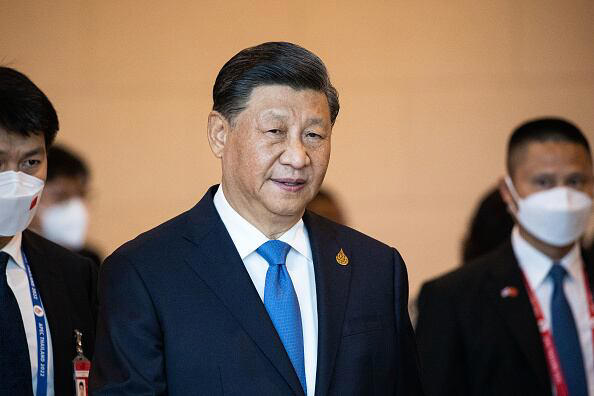
The head of Canada's spy agency says President Xi Jinping of China is transparent about wanting to use Canadian research. (Lauren DeCicca/Getty Images)© Provided by cbc.ca

In February the Liberal government announced it would ban all federal research grants for projects linked to "foreign state actors" that pose a threat to Canada's national security — and urged provinces and universities to follow suit.

Mike Burgess, head of the Australian Security Intelligence Organisation, bluntly told the audience that "all nations spy."

"All nations seek secrets and all nations seek strategic advantage. But the behaviour we're talking about here goes well beyond traditional espionage," he told the conference.

"And the threat is that we have the Chinese government engaged in the most sustained, scaled and sophisticated theft of intellectual property and acquisition of expertise that is unprecedented in human history. And that's why we're together."
'It's not enough to cry wolf'

During an exchange moderated by former U.S. secretary of state Condoleezza Rice, Vigneault also spoke of trying to engage with the Canadian business community on threats.

Recently, leaders in Canada's business community have been demanding that the intelligence service be given the power to share intelligence with companies being targeted for economic espionage.

Earlier this month, the Business Council of Canada, made up of chief executives and entrepreneurs in the country's major companies, called on Ottawa to update the CSIS Act so that private firms targeted by foreign interference actually know they're in danger.

"We need to go out of our way to give concrete examples," Vigneault acknowledged. "Because it's not enough to cry wolf."

Business Council of Canada president Goldy Hyder joined the Canadian delegation at the conference. He said Canadian businesses are more than ready to work with government to protect national security.

"In an era of renewed geopolitical rivalry, when a country's ability to continuously push the boundaries of science and technology is the foundation upon which military, economic, and cultural power now rests, deep and sustained partnerships between the private and public sectors are necessary to protect our citizens and our prosperity," he said in a post on social media.

A spokesperson for Public Safety Minister LeBlanc recently said the federal government is looking at improving information sharing but wouldn't commit to a timeline.

The Five Eyes intelligence service leaders are taking questions from reporters later tonight.

How tiny Qatar hosts the leaders of Hamas without consequences

Story by Evan Dyer • CBC

On October 7, as Hamas gunmen rampaged across southern Israel, a group of middle-aged men in a luxury suite in Doha, Qatar gathered in front of a camera.

Hamas leaders, led by Ismail Haniyeh, recorded themselves showing surprise about the attacks from the news on a large-screen television, and then kneeling to give thanks to Allah for the success of the operation.

This episode served as a reminder that while innocent civilians in Gaza die in their hundreds from aerial bombing and tens of thousands more are rendered homeless, Hamas's leaders exist above the fray in air-conditioned comfort 2,000 kilometres away as guests of Emir Tamim bin Hamad Al-Thani.

But they are not the only guests of Qatar. 

Just a few minutes drive away from the hotels and villas housing Hamas leaders is Al-Udaid Air Base, home to the U.S. military's Central Command. Washington's relationship with Qatar is so close that last year the White House officially designated the tiny emirate a "Major Non-NATO Ally" of the United States.

For a small country with fewer than half a million citizens, Qatar manages to squeeze in a lot of contradictions.

Trudeau calls the emir

On Monday evening, according to the government of Canada, Prime Minister Justin Trudeau had a phone conversation with Qatar's Emir Al-Thani.

Those who cover Canadian foreign relations have learned not to give much weight to Ottawa's anodyne readouts (descriptions of official calls), which often omit important information and are sometimes misleading. The account from the Qatari side is equally opaque.

Related video: Hamas says civilians could be quickly released if Israeli airstrikes stop (MSNBC)
Duration 3:02   View on Watch

Neither the Canadian government readout nor the Qatari one mention anyone raising the presence of Hamas' leadership in Qatar during the call.

CBC News asked the Prime Minister's Office if Trudeau had indeed spoken with the Emir without mentioning the issue of Hamas's presence in Qatar, but did not receive an answer. 

An official in Mélanie Joly's office told CBC News "I can say that it has not been raised by the minister."

Qatar's embassy in Canada did respond, although it did not reveal details of the Trudeau-Thani conversation.

The embassy told CBC News that Qatar condemns "all forms of targeting civilians" and that "killing innocent civilians, especially women and children, and practising the policy of collective punishment are unacceptable.

"Since the first day of the confrontations between the Palestinians and the Israelis, the State of Qatar has been keen to reduce escalation and calm down with aim to reach a complete cessation of the fighting in order to stop the bloodshed and prevent the region from sliding into a wider cycle of violence

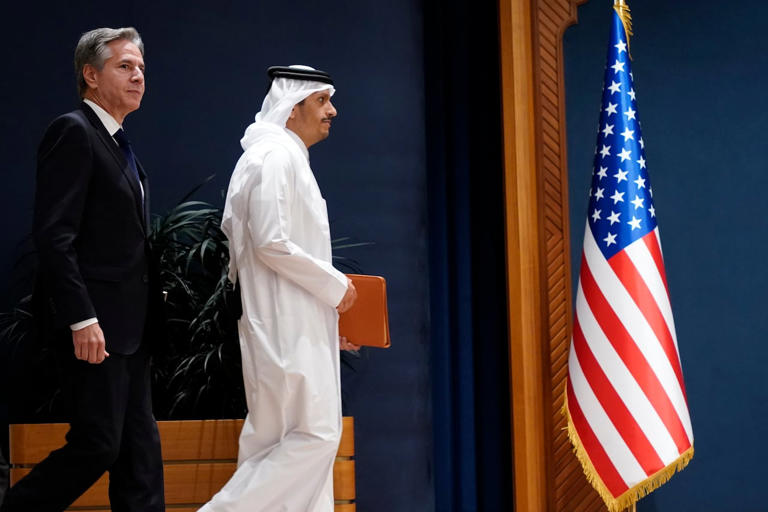
U.S. Secretary of State Antony Blinken, left, and Qatar's Prime Minister and Foreign Minister Mohammed bin Abdulrahman Al Thani arrive for the statements to the media in Doha, Qatar, Friday Oct. 13, 2023. (Jacquelyn Martin/AP)© Provided by cbc.ca

U.S. Secretary of State Antony Blinken also included Qatar in his whirlwind tour of the Middle East, where he gave a joint news conference with Qatari PM (and royal family member) Mohammed Bin Abdulrahman Al Thani on Friday. 

Blinken was asked if he had pressed Qatar to close the Hamas political bureau in Doha. He didn't answer the question directly but did say, "There can be no more business as usual with Hamas."

Qatar's PM defended Hamas's presence in his country. "This was started to be used as a way of communicating and bringing peace and calm into the region, not to instigate any war," he said. "And this is the purpose of that office."

The message was echoed by Qatar's embassy in Ottawa. "Regarding the Hamas office in Doha, it has been used from the beginning as a channel of communication and a means to bring peace to the region and that is in coordination with our western allies, particularly the United States," the embassy told CBC News in a written answer.

'Qatar talks to everyone'

Thomas Juneau, an expert in Middle Eastern politics at the University of Ottawa, said that embassy statement actually explains the West's tolerance of Qatar hosting groups it considers enemies.

"On the surface this looks like a set of contradictions, but there is a very clear common thread that makes all of this coherent," he said. "Qatar's entire foreign policy, its brand, its identity, is premised on the idea that it talks to everyone.

"It talks to the Taliban, it talks to Hamas, it talks to Libyan rebels, and so on.

"And its logic is that as a small vulnerable state, by being indispensable, by having all of these networks, all of these contacts, the U.S. needs it and it works for it. On a regular basis, the U.S. becomes frustrated by that, and if I had to guess, I would say that the U.S. is frustrated by the fact that some of Hamas's political leadership is in Qatar right now.

"That's true. But when the U.S. needs to talk to Hamas, when the U.S. needs to talk to the Taliban, then Qatar becomes extremely useful."

The embassy in Ottawa told CBC News much the same: "Qatar believes that the only way to reach a peaceful and immediate solution to this crisis is to keep all channels of communication open with all concerned parties, and that resolving this crisis requires continuous and intensive cooperation.

"Qatar is committed to its role as a partner in peacemaking and a mediator in resolving conflicts, which should not be used to harm its reputation by levelling accusations that were proven to be false."

Hotels for pariahs

Hamas leaders such as Ismail Haniyeh are not the only international pariahs who have come to know the swanky hotels of Doha very well.

Even as the Pentagon used Qatar as its centre of logistics and planning for the U.S. war effort in Afghanistan, those same Doha hotels also played host to the leadership of the Afghan Taliban.

It was at the Sheraton Grand Doha in February 2020 that the U.S. and Taliban negotiated the American withdrawal from Afghanistan, leading to the fall of Kabul seventeen months later.

Qatar has even acted — successfully — as a mediator between Russia and Ukraine.

And Qatar frequently has acted in hostage negotiations, including for its own royalty.


The Taliban delegation arrives for Afghan peace talks in Doha, Qatar, Thursday, Aug.12, 2021. (Hussein Sayed/AP)© Provided by cbc.ca

All of this may explain why Israel itself has been somewhat muted in its criticism of Qatar, compared to its language on Iran, which does not host senior Hamas leaders (though it has helped to arm the organization).

Qatar's role as a go-between and host for the most difficult negotiations was evident within 48 hours of the Hamas assault on southern Israel, when its foreign ministry announced that it would act as mediator in negotiations for the return of Israelis kidnapped by Hamas.

"We are in constant contact with all sides at the moment. Our priorities are to end the bloodshed, release the prisoners and make sure the conflict is contained with no regional spillover," Qatari foreign ministry spokesperson Majed Al-Ansari told Reuters news agency on October 9.

Rags to riches

No country in the world has undergone a more rapid and dramatic transformation than Qatar. Prior to the start of its oil industry in 1949, it was a sleepy and impoverished peninsula of Arabia with an economy that revolved around fishing and pearl-diving. 

It has since become tremendously wealthy. Its 315,000 citizens enjoy a per capita income more than twice that of their Saudi and Kuwaiti neighbours. For each Qatari citizen, there are about nine guest workers to lighten their daily burden.

But Qatar is also a vulnerable country, said Juneau — sandwiched between two regional superpowers, Saudi Arabia and Iran, with few natural defences.


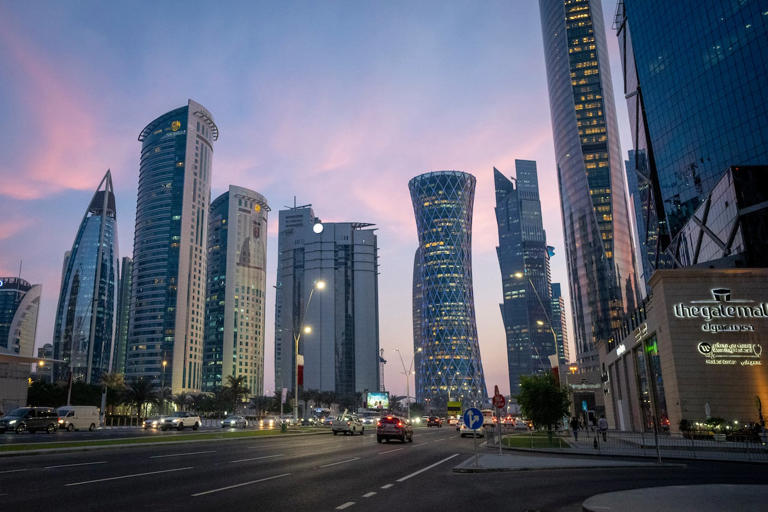
A view of hotels and other buildings at the West Bay area in Doha, Qatar, Thursday, Dec. 9, 2021. (Darko Bandic/AP)© Provided by cbc.ca

"To be clear, the Qatari government has genuine and real sympathy for the Palestinian cause," he told CBC News. "That being said, what explains Qatar's decision to host the political, or some of the political leadership, of Hamas?

"There is some affinity, but here it's not what matters. It's a ruthless pragmatism on the part of Qatar to position itself as that indispensable mediator, as the best way to assure its survival as a regime given its vulnerabilities."

'We're the good guys'

The same considerations drive Qatar's hugely expensive public relations efforts, which were crowned with the successful 2022 FIFA World Cup.

"Its extraordinary prosperity is based on this idea that we're the good guys as a destination for foreign investment, a destination for tourism, a destination for mediation, and so on," said Juneau.

Perhaps the most famous form of Qatari outreach is the Al Jazeera television network, which revolutionized Arab television starting in 1996.

Al Jazeera won over Arab audiences and infuriated Arab governments with its critical reporting on the dictatorships and monarchies of the region. Yet there was one absolute monarchy it never criticized: its patrons, the Al-Thanis of Qatar. 

Al Jazeera was a major factor in one of the biggest crises Qatar ever had to weather, when in June 2017, Saudi Arabia, the UAE, Egypt and Bahrain all severed relations with Doha and the Saudis imposed a blockade on Qatar's only land border. 

Their governments accused Qatar of fomenting radicalism throughout the Arab world.

Qatar made it through four years of blockade with help from Iran and Turkey, and arguably emerged stronger. Saudi Arabia normalized its relations with Qatar in 2021 and Al Jazeera stayed on the air. But many analysts have noticed that it has toned down its criticism of other Arab governments somewhat.

Atrocities test Qatar's tolerance

Although Qatar has reasons to believe its approach works, Juneau said Hamas's atrocities in southern Israel test the limits of what the Al-Thanis are willing to tolerate.

"It's a safe assumption that it's on the minds of the Qatari leadership that this is not what they signed up for," he said.

Qatar may yet face demands from other countries to expel or even extradite Hamas leaders, he said, "because the Hamas terrorist attack on Israel was so apocalyptically violent and brutal."

""That being said, by and large, there is that argument that it's in the interest of the U.S. to have Qatar remain as it is, a mediator who talks to everyone."

Blinken's comments in Doha on October 13 suggest that's the U.S. view.

"I really thank Qatar for the work that they are doing to try to help secure the release of hostages," he said. "This is something that we deeply appreciate."


Wounded Palestinians lay at the al-Shifa hospital following Israeli airstrikes in Gaza City on Tuesday, Oct. 17, 2023. (Abed Khaled/The Associated Press)© Provided by cbc.ca


The Qatari Embassy in Ottawa told CBC News its government also wants to see relief for the people of Gaza.

"When the crisis began, HH the Amir Sheikh Tamim bin Hamad Al-Thani, and [the] Prime Minister and Minister of Foreign [Affairs] established many contacts with many regional and international officials to seek de-escalation of the situation, hoping that the war will stop and humanitarian corridors will be secured to pass aid to Gaza, as well as the issue of civilian prisoners ... Qatar is working with its partners for their return to their families in the end," the embassy said.

"Qatar hopes that all the detained hostages and prisoners will return and Qatar is doing everything in its power for their safe release."

Juneau said Qatar's services will likely be required again.

"Unless you think that Israel is able to destroy Hamas, of which I'm skeptical, Hamas will survive, even if it will be weakened," he said. "And there will need to be talks with Hamas at some point. And somebody has to host these talks, somebody has to coordinate these talks, somebody has to initiate these talks.

"If it's not Qatar, then you are stuck with somebody else doing it, which may not be as useful as Qatar."